He Built His Shed Over Her Mother’s Roses, Then Learned Twenty-Two Inches Could Cost Everything
Chapter 1: The Concrete Was Still Wet Beneath Betty’s Roses
Laura Johnson knew something was wrong before she reached the kitchen window.
The sound coming from the side yard was too heavy for a lawn mower and too steady for a delivery truck. Metal scraped against concrete. A motor idled. Someone shouted, “Bring it another foot.”
She set down her coffee and stepped through the back door.
For one second, she simply stood there.
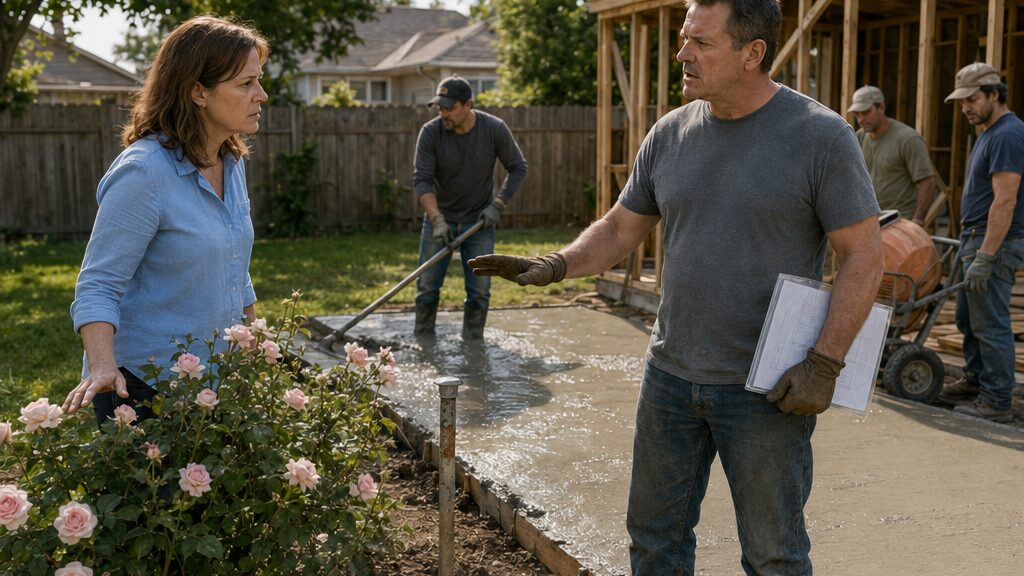
Three men were working beside the fence line between her yard and Gregory Hall’s. Wooden framing already rose waist-high behind them. A mixer sat near Gregory’s driveway. Fresh gray concrete spread beneath the new structure in a smooth rectangular pad.
And one corner of that rectangle was on Laura’s side.
Not near it.
On it.
The wet concrete stopped less than a foot from the rose bush her mother had planted seventeen years earlier.
“Gregory.”
Her voice came out thinner than she intended.
Gregory turned from the crew. He wore work gloves and an old gray T-shirt, and he looked more inconvenienced than surprised to see her.
“Morning.”
“What are you doing?”
He glanced at the framing as though the answer were obvious.
“Getting the shed up.”
“That’s over the line.”
One of the workers looked toward Gregory. The other two kept moving.
Gregory took off one glove with his teeth.
“It’s fine.”
“No, it isn’t.”
Laura walked toward the roses. The bush was large now, nearly shoulder-high in summer, its pale pink flowers opening unevenly along woody canes. Her mother, Betty, had planted it the July before she died.
Betty had hated ornamental landscaping that required too much attention.
“If it can’t survive me forgetting about it for a week,” she had said, kneeling beside the freshly dug hole, “it doesn’t deserve the yard.”
Laura had laughed then.
After Betty died, Laura had watered that bush every week.
Even in winter, when there was almost nothing to see.
She pointed toward the concrete.
“You’re on my property.”
Gregory sighed and looked toward the crew foreman.
“Give us a minute.”
The mixer kept turning.
Gregory walked closer.
“The HOA approved it.”
“That doesn’t make my yard yours.”
“It’s barely across anything.”
“You don’t know that.”
“I know where the line is.”
“So do I.”
Gregory gave her a small, tired smile.
“Laura, come on.”
That smile bothered her more than anger would have.
She moved past him toward the fence line.
Years ago, before the landscaping filled in, the property boundary had been easier to see. Her mother had once hired someone to confirm it after a drainage repair. Laura remembered bright string between stakes, Betty complaining about men who charged hundreds of dollars to tell you where your own dirt ended.
Most of those markers had disappeared beneath mulch and roots.
But not all of them.
Laura bent near the rose bush.
There.
A weathered metal-topped survey stake protruded from the soil beside the concrete form.
Half-hidden, but visible.
Her heartbeat changed.
She brushed away loose dirt.
“Gregory.”
He came over reluctantly.
She pointed.
“That’s the boundary marker.”
He looked down.
For a moment, he said nothing.
The crew foreman noticed the silence and approached.
“Problem?”
Laura looked at him.
“This concrete is crossing my property line.”
The foreman looked to Gregory.
Gregory folded his arms.
“That marker isn’t necessarily current.”
“It’s exactly where it’s always been.”
“You don’t know that.”
“My mother had this line checked.”
“When?”
“Years ago.”
Gregory nodded as though that settled something in his favor.
“Exactly.”
Laura felt heat rise into her face.
“The concrete is still wet. You can stop.”
The foreman shifted his weight.
“We can hold for a few minutes if there’s a boundary issue.”
Gregory’s expression changed.
Not dramatically.
Just enough.
He was no longer talking only to Laura. Now money and schedule had entered the conversation.
“I have approval,” he said.
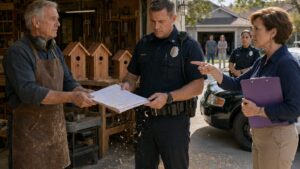
From a folding table near his back steps, he picked up a clear plastic folder. He removed a sheet stamped with the HOA’s architectural committee header and held it toward Laura.
She saw a simple shed drawing. Dimensions. Roof pitch. Exterior color. A small site sketch.
At the bottom was an approval notation.
Gregory tapped it.
“Approved three weeks ago.”
Laura stared at the paper.
The sketch showed the shed tucked neatly inside Gregory’s lot.
No rose bush.
No survey stake.
No measurement from the actual boundary that she could see.
“You submitted this?”
“Of course.”
“And the HOA came out here?”
“They didn’t need to.”
“So they never measured anything.”
“They approved the plan.”
“That’s not what I asked.”
Gregory’s jaw tightened.
The foreman looked from one neighbor to the other.
Laura hated scenes.
She had always hated them.
At restaurants, she would eat the wrong order rather than send it back. At work, she once spent two months fixing another person’s mistakes because confronting them seemed worse than doing the extra work herself.
Betty used to call that “buying peace at retail.”
Laura had never liked the phrase.
Now she understood it.
The mixer continued to turn.
The roses moved slightly in the breeze.
A wet gray edge sat inches from their roots.
Laura looked again at the stake.
Then at Gregory’s approval.
“Stop the pour until this is checked.”
Gregory exhaled sharply.
“I’ve got a crew here. Materials are here. I paid for today.”
“That isn’t my responsibility.”
“It becomes everyone’s responsibility when somebody decides to turn two feet of dirt into a crisis.”
Laura looked at him.
“You don’t know it’s two feet.”
“Exactly.”
The words landed strangely.
He meant them as dismissal.
She heard an admission.
He did not know.
And he was building anyway.
Laura stepped back from the forms.
“Then stop until you do.”
Gregory put the approval sheet back into its folder.
“No.”
The foreman frowned.
“Greg, if there’s a real dispute—”
“There isn’t.”
Laura pointed once more at the stake.
“That is not imaginary.”
Gregory looked at the marker, then at the shed frame already rising behind him.
For the first time, Laura saw what was actually driving him.
Not certainty.
Momentum.
The concrete truck was there. The crew was there. The lumber was cut. The money was spent.
Stopping would make the doubt real.
Gregory pulled his glove back on.
“We’re finishing the pad.”
Laura’s stomach tightened.
“Gregory.”
He turned toward the crew.
“Keep pouring.”
Chapter 2: She Photographed the Stake Instead of Touching the Concrete
The concrete crept closer to the rose roots while Laura’s hands shook badly enough that she almost dropped her phone.
She stood three feet from the form and watched the crew spread the wet mixture with long-handled tools.
Every instinct in her body told her to do something physical.
Step in front of them.
Pull the form board loose.
Stand on the disputed strip and refuse to move.
Instead, she opened the camera.
Gregory noticed.
“What are you doing?”
Laura took a photograph of the survey stake.
Then another, wider, showing the stake in relation to the concrete edge and the rose bush.
“Documenting it.”
Gregory stared at her.
The crew foreman stopped smoothing the pad.
Laura turned her phone sideways and photographed the framing, the fence corner, the stake, and Gregory’s back steps in a single shot.
Then she checked the time.
9:42 a.m.
She opened a note and typed it.
Gregory walked toward her.
“You’re making this bigger than it needs to be.”
Laura’s fingers were trembling, but her voice steadied.
“You already made it bigger.”
“I showed you the approval.”
“You showed me permission for a shed.”
“Same thing.”
“No.”
He glanced toward the men working.
“I’m not doing this all morning.”
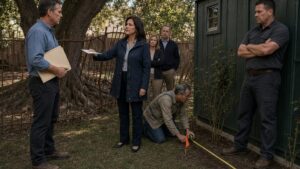
Laura crouched beside the stake.
She found an old tape measure in the gardening box near the patio and stretched it from the marker to the outside edge of the concrete form.
She photographed that too.
Not because she trusted her own measurement.
Because she wanted a record of what she had seen before anything changed.
Gregory watched her.
“You planning to sue me over eighteen inches?”
“I don’t know how many inches it is.”
“Close enough.”
Laura looked up.
“Then why didn’t you measure before you poured concrete?”
His face hardened.
The foreman looked away.
That was the first moment Laura understood something clearly: Gregory was not confused about whether there was a disagreement.
He was confused about whether the disagreement could stop him.
Those were different things.
By ten fifteen, the pad was nearly finished.
Fine gray dust clung to the lower leaves of Betty’s rose bush. Several pale petals were speckled with it.
Laura touched one with her fingertip.
For years, she had thought of the rose as sturdy because it had survived everything.
Heat.
Ice.
A broken irrigation line.
Two weeks when Laura had been away helping Betty’s sister after surgery.
The bush always came back.
Looking at the dust on the petals, she suddenly felt foolish for assuming it always would.
She took another photograph.
Gregory was speaking with the foreman near the lumber pile.
Laura heard only the end.
“—approved exactly what we’re building.”
The foreman glanced at her.
“Your call.”
“It’s my property,” Gregory said.
Laura straightened.
“Not all of it.”
He ignored her.
She went inside.
The kitchen seemed unnaturally quiet after the equipment outside.
Laura placed her phone on the table and opened the HOA website.
The architectural committee page was full of forms she had barely looked at in years.
Roof replacements.
Exterior paint.
Fences.
Accessory structures.
She found the contact number for the committee chair and called.
A woman answered after four rings.
“Architectural committee, Angela Roberts.”
“My name is Laura Johnson. I live next to Gregory Hall.”
There was a pause.
“All right.”
“You approved his shed.”
Another pause, more careful this time.
“We approved an architectural request.”
“He’s building it across my property line.”
Angela’s tone changed immediately.
“The association doesn’t determine property boundaries.”
“Then why is he telling everyone your approval means he can build there?”
“I can’t speak to what Mr. Hall is telling anyone.”
“He showed me your form.”
“What exactly is happening?”
Laura looked through the window.
The crew had begun cleaning tools.
The concrete pad gleamed wetly in the sun.
“It’s being poured right now.”
Angela was silent for a second.
“Do you have a survey?”
“I have a boundary stake.”
“Current survey?”
“My mother had one done.”
“How long ago?”
Laura closed her eyes.
“I don’t know. More than ten years.”
“All right. Send me photographs and whatever property documents you have.”
“You approved his site plan.”
“We approved what he submitted.”
“That drawing shows the shed inside his property.”
“If the drawing was inaccurate, that becomes a different issue.”
Laura gripped the edge of the table.
“Did anyone from the HOA verify the location?”
“No.”
“Did anyone measure the setback?”
“No. We rely on homeowner submissions for property-line representation unless our rules specifically require supporting documentation.”
“So your approval doesn’t mean he owns that strip.”
“No.”
The word was simple.
Laura sat down.
Outside, Gregory stood beside the finished pad with his hands on his hips.
The small answer gave her less satisfaction than she expected.
“So what does it mean?”
“It means the shed’s design met the association’s architectural standards based on the information submitted.”
Laura almost laughed.
Not because anything was funny.
Because Gregory had been waving the paper like a deed.
Angela continued.
“But if there’s an actual encroachment, that would need to be resolved between the property owners, possibly with the county depending on permits and setbacks.”
“Can you tell him to stop?”
“We don’t have authority to adjudicate a boundary dispute.”
The familiar pressure returned.
Everybody had a sentence explaining why the problem belonged somewhere else.
Gregory had approval.
The crew had Gregory’s instruction.
The HOA did not determine boundaries.
And Laura was standing in the middle with a buried metal stake and a dying feeling in her stomach.
“Send me what you have,” Angela said. “I’ll pull the original submission.”
Laura ended the call and began organizing the photographs.
9:42 — visible stake before completion.
9:47 — concrete form across marker.
10:03 — rose bush and fresh pad.
10:18 — completed concrete.
She emailed them to herself first.
Then to Angela.
After that she went to the hall closet where old property documents were kept in two cardboard file boxes.
She had not opened them in years.
Tax statements.
Insurance papers.
A roof warranty.
An old closing packet.
She found a survey copy, but it was faint and difficult to read.
The line along Gregory’s side appeared to match what she remembered.
Still, she wanted something clearer.
Her phone rang.
Angela.
Laura answered immediately.
“I have Gregory’s application in front of me,” Angela said.
“And?”
“He submitted a site sketch.”
“I saw it.”
“Yes. But I’m looking at our property file for your lot too.”
Laura waited.
Angela’s voice became slower.
“The boundary representation in our file does not appear to match what you’re describing.”
Laura looked toward the window.
“What does that mean?”
“It may mean our file is outdated. Or yours is. I don’t want to guess.”
“My stake is in the ground.”
“I understand.”
“Then what do you need?”
“The original property documentation. Anything showing a corrected boundary, resurvey, easement adjustment, whatever was done.”
Laura frowned.
“Corrected?”
There was a pause.
“You said your mother had the line checked.”
“Yes.”
Angela said, “Laura, do you know whether she ever submitted an updated survey to the association?”
Laura looked at the boxes on the floor.
For the first time that morning, the question frightened her more than Gregory’s concrete.
“I don’t know.”
“Then find what you have and send it to me. Because right now, Gregory’s sketch is consistent with the older drawing in our file.”
Laura stared through the glass at the new concrete pad.
The problem had changed.
It was no longer only whether Gregory had crossed the line.
Now there were two versions of where the line was supposed to be.
Chapter 3: The HOA Approval Said Less Than Gregory Claimed
On Monday morning, Angela Roberts slid Gregory’s shed application across the conference table and said, “This is the part he keeps quoting.”
Laura leaned forward.
The HOA office occupied one converted room beside the neighborhood clubhouse, furnished with a long laminate table, stacked binders, and a printer that sounded louder than necessary.
Angela placed one finger on the approval block.
Approved exterior design, dimensions, roofing material, and color.
Laura read it twice.
“That’s it?”
“That’s what the committee approved.”
“No placement?”
“The placement was represented on his sketch.”
“But you didn’t verify it.”
“No.”
“Setback?”
“Based on what he submitted, it appeared compliant.”
Laura sat back.
Angela did not look defensive exactly.
She looked like someone who had already repeated the same careful sentence to herself several times.
“We are not surveyors,” Angela said. “We don’t establish private property lines.”
“Gregory told the crew your approval meant the location was approved.”
“I can’t control how he characterizes the document.”
“You could write it more clearly.”
Angela looked at her.
Laura regretted the sharpness immediately, which irritated her even more.
Angela folded her hands.
“That may be fair.”
The answer disarmed her.
Angela pulled another sheet from the file.
“This is the sketch he submitted.”
A small rectangle represented Gregory’s lot. The proposed shed sat near the rear corner, apparently several feet inside his side boundary.
Laura studied it.
“The line is wrong.”
“According to what?”
“The stake.”
“I know.”
“And my mother’s survey.”
“Which I still haven’t seen.”
Laura looked down.
“I’m trying to find it.”
Angela turned the paper toward herself.
“Gregory used the boundary location already reflected in the HOA file. That doesn’t make it legally correct. But it means I can’t say he invented this line out of nowhere.”
Laura felt a pulse of resistance.
“He saw the stake Saturday.”
“That matters.”
“He saw it and kept building.”
“That matters too.”
“But?”
Angela exhaled.
“But if we’re going to untangle this properly, we need to know why our file shows something different.”
Laura looked at the older property sketch Angela had printed.
The line along the side yard angled slightly inward near the rear.
On Laura’s memory of the survey, it ran straighter.
The difference looked small on paper.
In a backyard, it was enough for a shed corner.
Enough for roses.
Enough for concrete.
Laura left the office carrying copies of both drawings.
When she got home, Gregory’s crew was back.
The pad had cured enough for framing.
By lunch, a wall was standing.
She did not go outside.
Instead, she spread the HOA copies across her kitchen table.
The strange thing was that Angela had been right: Gregory’s sketch did resemble the old HOA drawing.
Laura hated that.
It would have been easier if everything pointed one direction.
If Gregory had forged something.
If the HOA had obviously made a mistake.
If she alone possessed the clean truth and everyone else only needed to admit it.
But the older drawing existed.
And she had seen something like it before.
That thought stayed with her until late afternoon.
She walked outside carrying a watering can.
The rose bush looked different.
Not dramatically.
Just tired.
Several leaves near the construction side had curled inward. One cane leaned lower than usual. Dust coated the petals closest to the pad.
Laura poured water slowly around the exposed side of the root area.
She remembered Betty kneeling there with both knees in the dirt.
Not planting the rose.
Something later.
A man had been standing nearby holding a measuring rod.
There had been orange flags.
Laura stopped pouring.
The memory sharpened.
Her mother had complained for weeks about drainage water crossing the corner of the lot. Somebody had come out. There had been a survey.
Then paperwork.
Betty had called Laura one afternoon and said, “When I’m gone, make sure they have the right line in their records.”
Laura closed her eyes.
She could hear the sentence now.
Not perfectly.
But enough.
The watering can slipped slightly in her hand.
She went inside and pulled both file boxes into the middle of the living room.
She emptied them.
Envelopes spread across the carpet.
Mortgage releases.
Appliance receipts.
Tax assessments.
Betty’s handwritten notes in the margins of old statements.
Laura searched until dusk.
At seven thirty, she found a thick envelope marked with the name of a local surveying company.
It was opened.
Inside was a plat showing the side boundary exactly where Laura remembered it.
Straighter than the HOA copy.
Near the back was a small note in Betty’s handwriting:
Send updated copy to association.
Laura sat on the floor.
Under the survey was another envelope.
This one was still sealed.
It was addressed to the HOA.
Betty had prepared it.
Laura knew immediately what had happened.
Her mother’s health had deteriorated quickly that fall.
Appointments multiplied.
Medication changed.
Laura began spending more nights at Betty’s house than her own.
After the funeral, paperwork arrived in waves.
Insurance.
Utilities.
Bank forms.
Property records.
Laura had sorted everything into piles and promised herself she would finish later.
Somewhere in those months, the sealed envelope had gone into a box.
And stayed there.
The next morning, Angela called.
“I reviewed the original association archive,” she said. “I found no updated survey submission.”
Laura looked at Betty’s sealed envelope on the table.
“I know.”
“You found something?”
“Yes.”
“What?”
Laura swallowed.
“The corrected survey.”
Angela waited.
Laura forced herself to say the rest.
“And the copy my mother meant to send you.”
“Was it submitted?”
“No.”
The silence on the line was not judgmental.
That made it worse.
Outside, a power saw started.
Laura went to the window.
Gregory’s shed now had four walls.
One of the workers lifted a sheet of siding into place.
Angela said quietly, “Send me the survey.”
“I will.”
“And Laura?”
“Yes?”
“Our approval still doesn’t determine the property line.”
Laura watched Gregory carry a stack of boards toward the structure.
“But our file helped him think he was right.”
Angela did not answer immediately.
“Yes,” she said at last. “It probably did.”
Laura looked at the unopened envelope her mother had prepared years earlier.
For two days, she had been asking who had failed to respect the line.
Now she had an answer she had not wanted.
Gregory had ignored the stake.
The HOA had relied on an old drawing.
And Laura had left the correction sitting sealed in a box after her mother died.
Chapter 4: The Paperwork Laura Could Not Finish After Her Mother Died
The envelope Betty had prepared was still sealed.
Laura turned it over in her hands at the kitchen table, staring at her mother’s handwriting in the upper-left corner. The address belonged to the homeowners association. The stamp had never been added.
For years, the envelope had survived moves between drawers, cardboard boxes, and closets without anyone realizing what it contained.
Now a power saw screamed next door.
Laura looked toward the window.
Gregory’s crew was attaching siding to the shed.
She opened the envelope.
Inside was a copy of the corrected survey, a short note from Betty asking that the association update its property records, and a photocopy of the earlier site drawing with a handwritten correction beside the rear boundary.
Nothing dramatic.
No hidden deed.
No legal bombshell.
Just paperwork that should have been mailed.
Laura sat with both hands flat on the table.
She remembered those last months with painful clarity now: bottles of medication arranged beside Betty’s sink, appointment cards stuck to the refrigerator, food going untouched because everything tasted wrong.
After Betty died, Laura had handled what seemed urgent.
The utility accounts.
The insurance.
The funeral invoices.
The bank.
The things with deadlines.
The rest had gone into boxes.
She had told herself she would deal with them when she could think clearly.
Then months passed.
Then years.
Her phone buzzed.
Angela.
Laura answered.
“I scanned everything.”
“I see it,” Angela said. “I’m comparing the dates now.”
Laura waited.
Angela continued, “The corrected survey is newer than the drawing in our HOA file.”
“So the HOA file is wrong.”
“Outdated,” Angela said carefully. “Yes.”
Laura closed her eyes.
“That’s because I never sent this.”
“It appears so.”
The admission felt worse spoken aloud.
Outside, a nail gun snapped three times.
Laura said, “Does that make Gregory right?”
“No.”
The answer came immediately.
Angela’s voice softened slightly.
“It explains why his submission didn’t trigger questions here. It does not establish his property boundary.”
Laura looked at the envelope.
“I should have finished this.”
“Yes.”
Angela did not rescue her from the fact.
Laura appreciated that more than reassurance.
“But,” Angela continued, “Mr. Hall was shown a physical marker before the concrete was finished. Once he knew there was an active boundary dispute, continuing was his decision.”
Laura glanced toward the yard.
“Can your committee revoke the approval?”
“We can clarify that it does not cover placement. But I don’t want to pretend that solves your problem.”
“It doesn’t.”
“No.”
After the call, Laura carried the watering can outside.
Gregory was on a ladder fitting trim along the roofline.
He saw her and climbed down.
“You talk to Angela?”
“Yes.”
“And?”
“The HOA drawing was outdated.”
Something loosened in his face.
“I told you.”
Laura shook her head.
“No. You told me your approval proved the shed was where it belonged.”
“It was based on their records.”
“Their records were wrong.”
“Which I didn’t know.”
“Neither did I.”
Gregory stared at her.
For a moment, neither had the clean advantage.
Laura could feel the difference.
She had expected admitting her mistake to weaken her.
Instead it made the situation harder to simplify.
Gregory looked toward the shed.
“So now what?”
“I’m getting a current survey.”
He rubbed his jaw.
“That’ll cost you.”
“I know.”
“And if it shows I’m inside my line?”
“Then I’ll live with that.”
He looked genuinely surprised.
Laura lifted the watering can.
“But if it doesn’t, you will.”
She walked to the rose bush.
Several leaves came away when she touched them.
The soil nearest the concrete was compacted hard. She poured water slowly, trying to keep it from running across the slab.
Gregory watched from a few yards away.
“You know that bush was already old.”
Laura stopped pouring.
“What?”
“I’m saying plants die.”
She turned.
“My mother planted this.”
His expression changed.
He had not known.
For one brief second, Gregory looked embarrassed.
Then his eyes shifted to the concrete.
“I didn’t know that.”
“No.”
“I wasn’t trying to kill it.”
Laura looked at the gray slab crowding the root area.
“You didn’t have to be trying.”
Gregory did not answer.
By Friday, the shed was fully sided.
On Saturday morning it was painted gray.
By Sunday, Gregory had stacked firewood beside it and moved shelving inside.
The speed of it unsettled Laura.
It was as though completion itself were an argument.
The more finished the structure looked, the more unreasonable removing it would seem.
On Monday, the licensed surveyor arrived.
Laura met him beside the rose bush.
Gregory stood near his patio, arms folded.
The surveyor located existing markers, checked county records, set equipment, and worked without discussing conclusions.
Gregory lasted twenty minutes before asking, “So?”
“I’ll tell both owners when I’m finished.”
More measurements followed.
A bright line was stretched between newly verified points.
Laura watched it pass beside the rose bed.
Then beneath the side wall of Gregory’s shed.
Gregory stepped closer.
“That can’t be right.”
The surveyor checked his instrument again.
“It is.”
“How far?”
“I’ll put the exact measurements in the report.”
Gregory pointed toward the HOA sketch.
“I have documents showing the line somewhere else.”
The surveyor barely glanced at them.
“I’m establishing the recorded boundary, not the HOA’s drawing.”
Laura felt no triumph.
Only a tightness beneath her ribs.
The line was exactly where Betty had said it was.
Exactly where the old stake suggested.
The surveyor walked toward the rear corner and drove a new pin into the soil.
Then he returned to Laura.
“I don’t want to give you a final number until I finish the report.”
“But it’s over?”
He looked at the shed wall crossing the line.
“Yes.”
Gregory stood ten feet away, perfectly still.
The surveyor packed his equipment.
Laura asked, “Clearly?”
He nodded.
“Clearly.”
Chapter 5: Twenty-Two Inches Turned One Dispute Into Three Violations
The surveyor’s bright string ran directly beneath Gregory’s finished shed wall.
Laura stood beside it the following Tuesday while he read the final measurement from his report.
“Twenty-two inches at the widest point.”
Gregory gave a short laugh.
“That’s what this is about?”
The surveyor looked up.
“That’s the encroachment.”
“Twenty-two inches.”
“Yes.”
Gregory turned toward Laura.
“You’re seriously doing all this over less than two feet?”
Laura looked at the shed.
Gray siding.
Fresh trim.
Shelves visible through the open door.
The structure looked permanent now.
“That’s not how property works.”
“I know how property works.”
“Then why is your shed on mine?”
Gregory’s mouth tightened.
The surveyor handed each of them a copy of the marked plan.
The line cut through the outer portion of the shed foundation and across the damaged rose bed.
Gregory pointed to Laura’s packet.
“You admitted your HOA record was wrong.”
“Outdated.”
“You never corrected it.”
“No.”
“So I used the information I had.”
Laura nodded.
“You did.”
Gregory seemed surprised again.
Then she added, “Until Saturday morning.”
His expression changed.
She tapped the photograph attached to her folder.
“The stake was visible. I showed it to you. The concrete was wet.”
“You didn’t have a current survey then.”
“Neither did you.”
The surveyor quietly packed his tripod.
Gregory turned away.
Laura expected the confirmation to make everything simple.
Instead, the first official proof only opened more doors.
At the county permitting counter that afternoon, the clerk reviewed the survey and Gregory’s shed location.
“Was there a building permit issued?”
“I don’t know.”
The clerk typed the address.
Then typed again.
“I’m not finding one.”
Laura frowned.
“The HOA approved the shed.”
“That’s separate.”
The phrase was becoming familiar.
The clerk printed a page and marked a section.
“Accessory structures over the applicable threshold require county review. There are also setback requirements.”
“How close can it be to the boundary?”
“That depends on the structure and zoning designation. An inspector will need to review the property.”
Laura almost said she did not care about anything except the twenty-two inches.
But that was not exactly true.
What she cared about was having the line treated as real.
She submitted the encroachment documentation and left.
Two days later, a county zoning/code inspector came to the property.
Gregory emerged from his shed before Laura even reached the backyard.
“This is getting ridiculous.”
The inspector introduced himself by role and asked for access around the structure.
Gregory gestured toward Laura.
“She called you over twenty-two inches.”
The inspector looked at him.
“I’m here to inspect the structure.”
“That’s what I said.”
“No. You told me why you think I’m here.”
Gregory fell silent.
The inspector measured from the verified line.
He checked the shed dimensions.
He photographed the slab.
Then he asked Gregory for his permit paperwork.
Gregory showed him the HOA architectural approval.
The inspector handed it back.
“This isn’t a county permit.”
“No one told me I needed another one.”
“That’s your responsibility as the property owner.”
Gregory’s face reddened.
Laura looked down at the roses.
Several canes were turning brown.
The inspector continued measuring.
When he finished, he told Gregory the shed appeared to violate the required setback even if the property line problem were ignored.
Gregory stared at him.
“So now there are two problems?”
“At least.”
The inspector looked at the slab.
“And I’ll need to confirm the permit requirement based on size.”
The following morning, Angela asked Laura to meet at the HOA office.
Gregory was already there.
He had brought copies of the older site sketch.
He placed them on the table before Laura sat down.
“This is what your association gave me.”
Angela looked at the papers.
“It’s what existed in the file.”
“And you approved my application.”
“We approved architectural elements based on your representation of location.”
“You keep saying that now.”
Angela’s expression tightened.
“I said it before you built too. It’s on the application.”
Gregory pushed the form toward her.
“In fine print.”
“It’s still there.”
Laura sat quietly.
Gregory looked at her.
“And her updated survey was sitting in a box for years.”
“Yes,” Laura said.
Both Gregory and Angela turned toward her.
Laura continued, “That part is mine.”
Gregory spread his hands.
“Thank you.”
“But I showed you the marker before the pad was finished.”
His hands dropped.
“You showed me an old stake.”
“I told you there was a dispute.”
“And I had an approved plan.”
“You had enough doubt to stop.”
He looked away.
That was the part he never answered directly.
Later that afternoon, the county inspector called Laura.
The encroachment was confirmed.
The shed lacked the required county permit.
Its location also failed the setback requirement.
Three separate problems had grown from one decision to keep pouring.
Laura should have felt vindicated.
Instead she stood at the kitchen sink looking at Betty’s rose bush through the window.
A cluster of leaves had gone yellow.
She thought about Gregory’s outdated sketch.
Her sealed envelope.
Angela’s approval form.
Everyone had relied on something incomplete.
But only one person had been standing beside wet concrete after being told to stop.
The county issued Gregory a formal correction and removal notice.
Fifteen days.
The structure had to be moved into compliance or removed, at Gregory’s expense.
Laura read the notice twice.
That evening, someone knocked on her front door.
She knew who it was before she opened it.
Gregory stood on the porch holding the notice.
The confidence she had seen beside the concrete was gone.
“Can we talk?”
Chapter 6: Fifteen Days Forced Them to Say What They Had Avoided
Gregory’s first offer was more money than the twenty-two-inch strip could possibly be worth.
He stood on Laura’s porch the evening the notice arrived and named the amount without sitting down.
“I’ll pay you for an easement.”
Laura held the door half open.
“No.”
“You didn’t even think about it.”
“I’ve been thinking about that strip for two weeks.”
“It’s dirt.”
“It’s my property.”
“I’m offering to pay for it.”
“No.”
Gregory looked past her toward the hallway, then back at her.
“You want me to tear down a finished shed.”
“I wanted you to stop before it became a finished shed.”
He clenched the folded county notice.
“I’ve already got almost everything I can spare tied up in that building.”
Laura said nothing.
Gregory exhaled through his nose.
“I lost the storage unit I was using for the repair business. New owner doubled the rent. I needed somewhere to work.”
“That’s why you built it?”
“That’s why I built it fast.”
There was a difference.
Laura heard it.
Gregory looked toward his own house.
“I had customers waiting. Tools sitting under tarps. Materials already ordered. Then you come out Saturday morning pointing at a rusty stake.”
“It wasn’t rusty enough for you not to notice it.”
His jaw shifted.
Laura watched him carefully.
“You knew there was a chance I was right.”
He did not answer.
“Gregory.”
He looked at her.
“What?”
“You knew.”
“I knew you believed it.”
“That isn’t what I asked.”
He stared at the county notice.
Finally he said, “I thought you’d complain.”
Laura waited.
He rubbed the fold in the paper with his thumb.
“I didn’t think you’d take it this far.”
The sentence landed more heavily than an insult.
Laura had expected greed.
Maybe arrogance.
She had not expected accuracy.
Gregory had watched her for years.
He knew she avoided neighborhood arguments.
Knew she rarely attended HOA meetings.
Knew that when his tree limbs dropped into her yard, she cut them herself instead of mentioning it.
He had made a calculation.
Not that she was wrong.
That she would retreat.
Laura stepped onto the porch and pulled the door closed behind her.
“So you kept pouring because you thought I wouldn’t do anything.”
Gregory frowned.
“That’s not what I said.”
“It’s exactly what you said.”
“I said I didn’t expect this.”
He lifted the county notice.
“Inspectors. Surveys. Removal orders.”
“What did you expect?”
He looked toward the street.
“That we’d work it out.”
“I tried to work it out while the concrete was wet.”
Gregory had no response to that.
The next week reduced their dispute to a countdown.
Day three.
Day six.
Day nine.
The shed remained where it was.
Gregory obtained estimates to move it, then complained that the slab made relocation more expensive than he expected.
Laura watched the rose bush decline.
Leaves dried at the edges and dropped whenever she watered it.
By Day 10, the ground beneath it was scattered with brown fragments.
At the HOA meeting that evening, Angela placed a copy of the architectural application on the table.
“We need to discuss our process,” she told the board.
Gregory sat near the back.
Laura had not expected him to attend.
Angela continued.
“Our approval language states that owners are responsible for property boundaries and government permits. But this dispute has shown that the disclaimer is not sufficiently prominent.”
One board member objected.
“We can’t survey every project.”
“I’m not proposing that.”
Angela looked toward Laura.
“We can require clearer setback documentation for structures built near lot lines, and we can state in plain language that HOA approval does not verify ownership boundaries.”
Gregory shifted in his chair.
“So the process was flawed.”
Angela looked at him.
“It contributed to false confidence.”
Laura noticed the wording.
Not blame.
Not absolution.
Gregory leaned forward.
“Then why am I paying for all of it?”
Angela answered carefully.
“Because the HOA did not pour your concrete.”
Silence followed.
After the meeting, Gregory caught Laura beside the clubhouse door.
“Day ten.”
“I know.”
“I can move the upper structure. The slab is the problem.”
Laura said nothing.
“If I cut back the wall and leave part of the slab—”
“No.”
“It wouldn’t affect you.”
“It already affected me.”
He glanced down.
“That rose bush?”
Laura looked at him.
“Yes.”
Gregory rubbed the back of his neck.
“I’m sorry about the plant.”
She believed he meant it.
That made everything less satisfying, not more.
“It doesn’t fix the line.”
“I know.”
For the first time, he said it without argument.
By Day 13, Gregory had moved some tools out of the shed.
Laura noticed through the open door.
For a few hours, she thought he had finally decided to comply.
Then nothing else happened.
On Day 14, he knocked again.
This time he carried a handwritten proposal.
He increased the money.
Offered to pay Laura’s survey cost.
Offered landscaping replacement.
All she had to do was sign an agreement allowing the shed to remain.
Laura read the page at her kitchen table.
The amount would cover every direct expense she had incurred.
It would pay for a new rose bed.
More than one.
For several minutes, she imagined accepting.
The county matter would end.
Gregory would stop knocking.
The neighborhood would stop watching.
She could go back to not being the person involved in a property dispute.
Then she looked through the window.
The shed wall still sat across the boundary.
The same twenty-two inches.
She understood, finally, what bothered her.
It was not the size.
It was the idea that enough inconvenience could turn someone else’s no into yes.
Laura handed the proposal back.
“I don’t want your shed.”
Gregory frowned.
“What?”
“I don’t want your money either. I want your building on your property.”
His face closed.
“You’re really going to make them remove it.”
“You can move it yourself before the deadline.”
“You know that’s expensive.”
“Yes.”
He stared at her.
“Vindictive.”
The word hurt because part of Laura had feared it from the beginning.
She let herself feel that before answering.
“No.”
Gregory gave a humorless laugh.
“You think this is reasonable?”
“I think I asked you to stop when it was cheap.”
He looked away.
Laura continued quietly.
“You chose expensive.”
He left without another word.
Day 15 arrived.
Laura spent the afternoon working at her kitchen table, glancing toward the backyard more often than she wanted to admit.
At four, the shed remained standing.
At six, Gregory removed one more shelf.
At seven thirty, he shut the door.
Nothing had moved.
The light faded across the yards.
Laura walked outside and stood beside the rose bush.
A dead leaf detached from one cane and landed near the survey stake.
Across the boundary, Gregory’s finished gray shed sat exactly where it had sat that morning.
The deadline expired at midnight.
Laura took out her phone, opened the county enforcement email, and rested her thumb over the response confirming that the structure was still in violation.
For years, she had confused leaving things unresolved with keeping the peace.
At 11:57 p.m., Laura pressed Send.
Chapter 7: On Day Sixteen the Shed Came Apart Board by Board
At 9:08 the next morning, a flatbed truck stopped in front of Gregory Hall’s house.
Laura saw it through the kitchen window.
Two workers stepped out, followed by the county zoning/code inspector. The truck carried straps, pry bars, a compact lifting frame, and enough empty bed space for the gray shed.
Laura’s stomach dropped.
She had known this was coming.
Knowing did not make the sight easier.
Gregory came out his front door before anyone reached the side yard. He was wearing jeans and the same gray work shirt Laura remembered from the morning the concrete had been poured.
“What is this?”
The inspector held a folder.
“The compliance period expired.”
“I’m moving it.”
“You were required to have it moved by yesterday.”
“I said I’m moving it.”
“You told us that last week.”
Gregory looked past him and saw Laura standing near her back steps.
For one second, she expected him to shout.
Instead he stared at her.
“You actually did it.”
Laura walked closer.
“I confirmed it was still there.”
“You could have waited another day.”
“I already waited fifteen.”
One of the workers opened the shed and began checking how the walls were attached to the slab.
Gregory turned sharply.
“Don’t touch my tools.”
“We’re not removing personal property,” the worker said. “You need to clear anything remaining.”
Gregory stepped inside and pulled out a drill case, two plastic bins, and a box of electrical parts.
Laura watched without moving.
Several nearby homeowners had noticed the truck. A woman walking a dog slowed at the corner. A car paused before continuing down the street.
Laura wished they would all leave.
This was the moment she had imagined during the worst days of the dispute: the structure finally coming down, the line restored, Gregory forced to confront what he had done.
It did not feel triumphant.
It felt expensive and public.
The first section removed was the door.
Then the trim.
Then sections of siding.
The workers moved methodically, setting screws and hardware into containers rather than destroying anything unnecessarily.
Gregory stood with his arms crossed.
“Careful with that.”
One worker nodded.
Laura looked toward the rose bush.
Most of its leaves were gone.
The remaining canes leaned away from the concrete, brittle at the ends.
A pale flower that had struggled open two days earlier now hung brown at the edges.
She turned away.
By ten fifteen, one wall was down.
The inside of the shed was exposed to the yard.
Gregory’s shelves stood against nothing.
For weeks the gray walls had made the building appear settled and inevitable.
Without them, it suddenly looked temporary again.
The inspector walked toward Laura.
“We’ll need access along your side for part of the removal.”
“That’s fine.”
He nodded toward the rose bed.
“We’ll try not to disturb that area more than necessary.”
Laura almost told him it no longer mattered.
Instead she said, “Thank you.”
A worker knelt beside the slab, examining the edge where the survey line crossed underneath it.
He brushed away loose dirt.
Something metallic appeared.
“Got a marker here.”
Laura stepped closer.
The old survey stake.
It had been there the entire time, half buried beside the poured edge.
The worker cleared enough soil to expose its top.
Gregory saw it too.
Nobody said anything.
Laura remembered kneeling beside that same marker on the first morning.
Gregory telling her it might not be current.
The crew waiting.
The concrete still wet.
For weeks she had imagined that memory with anger attached to it.
Now, looking at the marker reappear beneath the dismantled structure, she felt something quieter.
Proof did not become more true because somebody finally respected it.
The line had existed before the argument.
Before the HOA approval.
Before the surveyor returned.
Before Laura found Betty’s unopened envelope.
It had simply been easier for everyone to behave as though uncertainty erased it.
Gregory stepped beside her.
“I should have stopped.”
Laura looked at him.
He kept his eyes on the stake.
“I thought once it was built, nobody would make me undo it.”
There it was.
Not an apology exactly.
Something less polished and more useful.
Laura said, “I know.”
Gregory nodded once.
Then he walked back toward the pile of his tools.
By eleven thirty, the roof sections were strapped down on the flatbed.
The remaining wall framing came apart next.
The workers lifted each piece clear of the slab and carried it toward the truck.
Nobody applauded.
Nobody confronted Gregory.
The watching neighbors eventually lost interest and went back inside.
That absence relieved Laura.
She had not wanted a spectacle.
She had wanted the twenty-two inches returned.
Shortly before noon, the last large section left the yard.
The inspector walked the boundary with the survey in hand and confirmed that nothing from the shed remained over Laura’s line.
The slab would require additional work, but the encroaching structure was gone.
Laura stood where the wall had been.
For the first time in weeks, she could look from her patio toward the rear corner without seeing gray siding cutting across it.
The land had returned.
The feeling she expected did not.
Gregory remained near his driveway as the workers secured the final pieces to the flatbed.
Before leaving, the inspector gave him paperwork covering removal, transportation, storage, and the existing zoning violation.
Gregory looked at the total.
His face tightened.
“This is more than three thousand dollars.”
The inspector said, “There are instructions for review and payment options.”
Gregory folded the paper.
He did not look at Laura.
The flatbed pulled away.
Its engine faded at the end of the street.
The yards became strangely quiet.
Laura picked up her pruning shears.
She had postponed examining the rose bush carefully because part of her had been waiting for the shed to disappear first, as though removal might change what was happening beneath the leaves.
She cut one small branch.
The wood inside was brown.
Another.
Brown again.
She moved lower.
A healthy cane should have shown pale green beneath the bark.
This one did not.
Laura crouched beside the root crown.
Concrete had covered and compressed part of the surrounding ground for weeks. Heat from the slab and damaged roots had done what she kept refusing to name.
She scratched a thumbnail along the base of the oldest cane.
Nothing green appeared.
Behind her, Gregory’s back door opened.
Laura did not turn.
She cut another cane.
Then another.
Dead wood clicked softly onto the ground beside the old survey stake.
The structure was gone.
The property line was hers again.
Betty’s rose was already dead.
Chapter 8: The Boundary Returned, but the Old Rose Could Not
Three weeks later, the disputed strip was empty, and Laura still could not call it restored.
The remaining section of slab that had crossed the line had been cut back. Fresh soil filled the damaged edge. The shed itself was gone from Gregory’s yard, leaving only a pale rectangle where it had stood.
Nothing crossed the survey line anymore.
Nothing crowded the place where Betty’s rose had grown.
That was the problem.
Laura stood with a shovel in her hands and a new rose plant beside her.
She had bought it two days earlier and left it in its nursery pot because every place she considered planting it felt wrong.
If she put it exactly where Betty’s bush had been, it felt like pretending nothing had happened.
If she planted it somewhere else, it felt like abandoning the spot.
She pushed the shovel into the soil, then stopped.
The back gate clicked.
Gregory stood on his side of the boundary.
He no longer walked into conversations with papers already in his hand.
“Can I talk to you?”
Laura rested both hands on the shovel.
“Yes.”
He stayed where he was.
That mattered.
“I got the final removal bill.”
Laura waited.
“And the survey invoice you sent.”
“I didn’t send it. The county asked for documentation.”
“Right.”
He looked toward the empty strip.
“I’ll reimburse you for the survey.”
Laura studied him.
“You don’t have to.”
“I know.”
He reached into his pocket and took out an envelope.
“And the landscaping repair.”
Laura did not take it immediately.
Gregory added, “I’m not asking you to sign anything.”
That surprised her more than the money.
“No easement?”
“No.”
“No agreement about the shed?”
“There is no shed.”
They both looked toward the pale rectangle on his side.
Laura took the envelope.
“I’m not agreeing that this covers everything.”
“I know.”
“I could still pursue damages for the rose.”
Gregory nodded.
“I know that too.”
There was no challenge in his voice.
Laura had expected this moment to contain something cleaner.
A full apology.
A reconciliation.
Maybe a sentence that would organize the previous month into a simple lesson.
Instead Gregory stood six feet away looking tired.
“I’m not going to,” Laura said.
He looked up.
“Pursue it.”
“Why?”
She glanced at the dead canes she had bundled near the garage.
“Because the county handled the violations. You’re paying the removal costs. You’re paying me back for what I spent proving the line.”
Gregory waited.
“That’s enough for me.”
He looked toward the new rose.
“I am sorry about that.”
Laura followed his gaze.
“I know.”
It was the first time she had said those words and meant something different.
Not forgiveness.
Not forgetting.
Simply recognition.
Gregory nodded.
“I’ll stay on my side.”
Laura almost smiled.
“That would be a good start.”
He went back inside.
The HOA meeting took place that Thursday.
Angela sat at the end of the clubhouse table with a revised architectural application projected onto the wall.
Laura had nearly skipped the meeting.
A month earlier, she probably would have.
Now she took a chair near the middle.
Angela pointed to a new section printed in larger type.
“Accessory structures proposed near lot boundaries will require the owner to provide documented setback measurements. The association still will not certify private property lines.”
A board member asked, “Are we creating liability by asking for more documentation?”
Angela shook her head.
“We created confusion by letting homeowners mistake architectural approval for location verification.”
Gregory was not there.
Laura was glad.
This part did not need him.
Angela continued.
“The approval notice will also state plainly that HOA authorization does not replace county permitting.”
Someone at the other end of the table said, “Seems like a lot because two neighbors had a dispute.”
Laura felt several people glance toward her.
For once, she did not look down.
“It wasn’t a lot when the concrete was wet,” she said.
The room became quiet.
Laura kept her voice even.
“It became a lot because everyone relied on somebody else’s paperwork instead of checking the boundary.”
Angela looked at her.
Laura added, “Including me.”
That changed the room.
She did not need Gregory to carry every failure.
Her mother had prepared the corrected survey.
Laura had left it sealed.
The HOA had relied on old information.
Gregory had relied on that information until the moment he was given a reason to stop.
Then he had made his own choice.
Angela nodded.
“That’s exactly why the process needs to change.”
The revised requirement passed without ceremony.
No applause.
Just several hands raised around a laminate table.
Laura preferred it that way.
On Saturday morning, she returned to the new rose.
It was smaller than Betty’s had been, with dark green leaves and three tight buds.
Laura dug the hole eighteen inches away from the original root site.
Not on top of it.
Beside it.
The distinction mattered.
She mixed compost into the soil, lowered the plant carefully, and pressed dirt around its base.
When she finished, she watered slowly until the ground darkened.
For a moment, she felt guilty.
The feeling was so immediate that she almost laughed.
As though planting something new were an act of disloyalty.
Betty would have hated that.
Her mother had never treated plants as sacred objects.
She had pruned without mercy and replaced anything that refused to grow.
Laura could almost hear her complaining about sentimentality while secretly checking every new bud.
The old survey stake lay on the patio where the workers had left it after the shed removal.
Laura picked it up.
For years it had been half buried, useful only because someone once decided where a line existed.
Then it had become evidence.
Then an argument.
Then proof.
She carried it to the new rose.
Instead of hammering it back into the property corner, she pressed it into the soil beside the plant, leaving several inches visible.
Not as a legal marker.
The new survey pins already handled that.
This one could be something else.
A reminder, perhaps.
Not that Gregory had crossed the line.
She did not want him living permanently inside the meaning of the garden.
A reminder that lines mattered before people were angry about them.
That unfinished things did not disappear simply because they were painful to face.
That protecting something did not guarantee it could be saved.
The next morning, Laura found a single pale pink bud beginning to open.
She knelt beside it.
Gregory’s yard was quiet.
The pale rectangle where the shed had stood was slowly being covered by grass seed.
Nothing about the view looked exactly as it had before.
It never would.
Laura touched the old survey stake with two fingers, then loosened the soil around the new rose.
For seventeen years she had watered Betty’s bush because she thought keeping it alive was the promise.
She understood now that she had been wrong.
The promise was not to keep one plant alive forever.
It was to care for what had been left to her while accepting that care did not make anything permanent.
The boundary remained.
The old rose did not.
Laura stood, carried the empty watering can toward the house, and left the new bud opening beside the weathered stake.
The story has ended.