The Flipped Banquet: The Outlaw Brother Who Saved Thanksgiving From A Bomb
CHAPTER 1: THE CRASH IN THE CRYSTAL
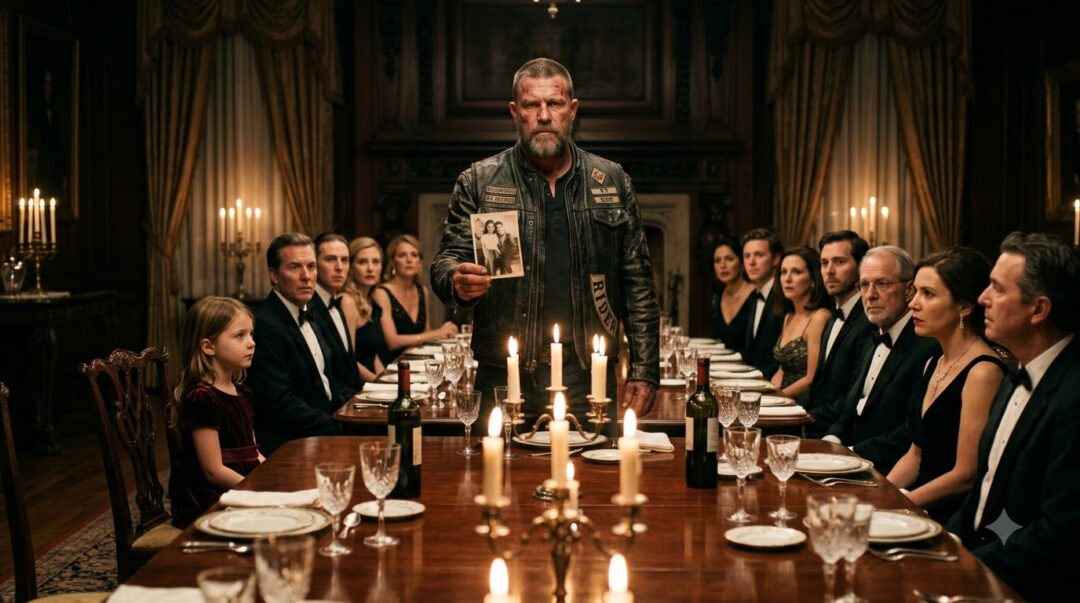
The grand formal dining salon of Sterling Manor, an imposing stone estate perched high on the bluffs overlooking the frozen gray waters of the Hudson River in Westchester County, was the very picture of American aristocratic luxury. At six in the evening on Thanksgiving night, three blazing marble fireplaces filled the room with the dry warmth of aromatic birch logs, while two eight-foot Waterford crystal chandeliers suspended from the coffered plaster ceiling cast thousands of glittering amber reflections across the room.
Seated around a twelve-foot antique mahogany banquet table were twenty-six members of New York’s corporate and political elite: defense contractors, federal procurement liaisons, federal appellate judges, and the senior executive board of Sterling Aerospace Dynamics.
At the head of the table sat Richard Sterling, the company’s fifty-year-old CEO, dressed in an immaculate bespoke tuxedo, holding a crystal flute of vintage Dom Pérignon as he prepared to deliver the annual holiday toast. Beside him sat his wife Victoria in an emerald silk evening gown, her diamond necklace catching the candlelight.
Standing silently near the heavy oak sideboard, looking like a dark bird of prey that had wandered into a royal court, was Vance “Grizzly” Sterling.
At forty-six, Vance was Richard’s estranged younger brother. Where Richard was polished, manicured, and perfumed with wealth, Vance was six-foot-three of raw, scarred muscle and highway iron—the national president of the Hudson Iron Motorcycle Club. His black leather cut, worn over a plain black long-sleeve henley, was adorned with the silver master explosive ordnance disposal badge and three combat jump wings from his twelve years as an elite Army combat engineer. He had only attended tonight’s dinner because his seven-year-old niece, Lily, had sent him a hand-drawn crayon invitation pleading for her favorite uncle to come home for Thanksgiving.
Vance stood with his broad arms crossed over his chest, his dark eyes scanning the room not with nostalgia, but with the cold, restless vigilance of a combat soldier walking a patrol through an unsecured perimeter.
For twenty minutes, something had been bothering his tactical senses. A faint, high-frequency electronic hum—less than sixty hertz, completely imperceptible to the laughing executives—was vibrating through the floorboards beneath the head of the mahogany table. And every time the dining room chandeliers were dimmed for the course presentations, the digital display on the commercial wine cooler had flickered with a rhythmic, micro-second voltage surge.
At the head of the table, seven-year-old Lily Sterling, wearing a red velvet holiday dress with white lace cuffs, accidentally bumped her porcelain bread plate.
A small, hand-painted ceramic turkey figurine slipped off the edge of the linen tablecloth, tumbling beneath the heavy mahogany table onto the polished parquet floor.
“Oops,” Lily giggled softly.
The little girl slipped down from her velvet-upholstered chair, dropped to her hands and knees on the floor, and reached her small arm beneath the carved mahogany apron of the twelve-foot table.
Vance’s gaze dropped to the table’s undercarriage.
Through the narrow gap between the heavy linen tablecloth and the floor, the ambient light from the fireplace illuminated the underside of the central table leaf.
Taped flush against the four-inch solid mahogany core, wired directly into the room’s floorboard electrical conduit, was a six-pound brick of olive-drab military C4 plastic explosive. In the center of the block, resting in a clear glass capsule filled with liquid silver, was a dual-axis mercury tilt switch connected to two electric blasting caps.
And Lily’s small, outstretched fingers were two inches away from brushing against the sensitive mercury vial.
“LILY, NO!” Vance’s roar shattered the polite laughter of the dining room like a bomb blast.
Before Richard could lower his champagne flute, before the tuxedoed guests could turn their heads, Vance exploded across the polished parquet floor in a three-stride blur of raw, terrifying momentum.
His massive, tattooed arms reached down, scooping seven-year-old Lily off the floor by her velvet waist with blinding speed, pulling the child hard against his leather-clad chest as his boots slid across the waxed wood.
In the same seamless, explosive motion, Vance lowered his shoulder, drove his right knee beneath the heavy mahogany table edge, and threw the entire two-hundred-and-forty-pound weight of his muscular torso upward with a guttural, animalistic battle cry.
KABOOM.
The twelve-foot antique banquet table, weighing over five hundred pounds, was hurled vertically into the air, flipping upside down in a catastrophic, deafening explosion of luxury.
Twenty-six crystal goblets shattered simultaneously into tens of thousands of flying glass shards. Spilled red wine erupted across the white linen like a fountain of fresh blood. Silver platters, tureens of boiling turkey gravy, and roasted meat crashed across the parquet floor, spattering the evening gowns of screaming women and knocking three executives flat on their backs.
Richard Sterling leaped from his overturned chair, his face contorted in a wild, purple fury of aristocratic outrage. He lunged toward Vance, clawing at his brother’s leather cut.
“ARE YOU INSANE?” Richard shrieked, his voice cracking with hysterical rage. “You barbarian! You psychotic piece of trash! You ruined my home! You ruined Thanksgiving!”
Vance shoved his older brother backward with a single open-palm strike that sent Richard staggering into the marble fireplace hearth.
Vance set seven-year-old Lily gently behind his back, shielding the crying child with his massive frame, his eyes blazing with an authority so terrifying that every screaming guest in the room fell into instant, breathless silence.
“SHUT UP AND DON’T MOVE!” Vance bellowed, his voice echoing off the vaulted plaster like a command on a hot drop zone. “NOBODY TOUCH THE FLOOR! NOBODY TAKE A SINGLE STEP!”
Vance pointed his calloused, scarred index finger downward at the exposed undercarriage of the overturned mahogany table.
The room froze.
Mounted firmly to the center leaf, exposed for all thirty guests to see, was the six-pound block of olive-drab C4. The clear glass mercury vial was cracked, liquid silver beading on the wood, connected to a digital radio receiver whose green armed LED was pulsing once every second.
And running from the detonator block, spliced directly into the main chandelier electrical junction in the baseboard, was a hair-thin copper wire that was humming with live, lethal voltage.
Vance looked up at the glittering crystal chandeliers overhead, his voice dropping into an ice-cold, urgent gravel that made every guest’s blood run cold.
“It’s a radio-frequency mercury tilt trap, Richard,” Vance whispered. “And whoever planted it tied the detonator into the main ballroom lighting circuit. Cut the main breaker right now, or this entire wing is going to be vaporized in forty seconds.”
CHAPTER 2: THE SILENT CHANDELIER
The formal dining salon of Sterling Manor fell into a suffocating, tomb-like silence. The only sound was the crackle of birch logs in the marble fireplace, the slow, rhythmic drip… drip… drip of vintage Pinot Noir running off the overturned mahogany table, and the terrified, whimpering sobs of Victoria Sterling clutching her pearl necklace against her throat.
Richard Sterling stood frozen against the fireplace hearth, his tuxedo lapels spattered with cranberry sauce, staring with wide, horrified eyes at the olive-drab block of C4 plastic explosive resting four feet away on the upturned table underside.
“C4…” Richard stammered, his aristocratic voice reduced to a thin, trembling whisper. “That’s… that’s military demolition ordnance. Vance… who… who would put a bomb in my dining room?”
“The same people who didn’t want you to sign the five-hundred-million-dollar drone guidance contract tomorrow morning, Richard,” Vance replied, his tone razor-sharp and calm as he kept Lily shielded behind his leather-clad thighs.
Vance reached to his hip, unclipped an eight-inch insulated tactical wire cutter from his biker tool roll, and knelt beside the exposed bomb.
The cold, wine-scented dampness of the dining salon seemed to intensify with every ticking second, the faint, acrid smell of uncured synthetic plastic explosive hanging in the still air like a curse. Vance worked with surgical, unhurried discipline, his calloused fingertips moving across the delicate copper filaments with the complete, instinctual familiarity of a veteran who had defused vehicle bombs along the perimeter roads of Baghdad. He knew that one fractional tremor, one careless slip of the steel cutters against the live lead, would turn this palace of high finance into an inferno of pulverized brick and shattered bone. Behind him, seven-year-old Lily held the hem of his leather cut with both hands, her small chest rising and falling in silent, terrified rhythm, trusting her uncle with the absolute, unquestioning faith of a child.
His trained combat engineer’s eyes scanned the circuit: the mercury vial was compromised, but the secondary detonator loop was still active, drawing a micro-ampere current directly from the room’s high-voltage lighting conduit.
“The detonator has a dual-trigger failsafe,” Vance said, his voice carrying the absolute authority of a master explosive technician. “If the main chandeliers are turned off using the wall dimmer switch, the sudden voltage drop collapses the relay and fires the blasting caps. But if the master circuit breaker in the basement is thrown, cutting all utility power simultaneously, the capacitor drains harmlessly without triggering the discharge.”
Vance looked up at his brother. “Where is the master breaker panel for the manor, Richard?”
“The… the utility basement,” Richard choked, his hands trembling violently. “Behind the wine cellar. But the master panel has a biometric lock—”
“Then move your ass down those stairs and throw the lever, Richard!” Vance roared. “You have thirty seconds before that capacitor reaches critical saturation!”
Richard didn’t argue. The billionaire CEO turned on his patent-leather dress shoes and sprinted through the arched hallway toward the service stairs, stripping off his ruined tuxedo jacket as he ran.
Vance turned to the twenty-four terrified guests huddled against the dining room walls. “Everyone, listen to me carefully. Walk along the perimeter baseboards. Do not run. Do not touch the chandeliers. Follow the stone hallway down into the reinforced wine cellar on the lower terrace. The foundation walls are four feet of solid granite; if this charge detonates, that cellar will hold.”
The guests moved with frantic, disciplined haste, shedding high heels and evening wraps, shuffling past the broken crystal toward the reinforced corridor.
As the room cleared, Vance looked around the shattered dining salon.
His sharp eyes caught something that made his jaw tighten into cold iron.
The place setting directly across from Richard—the seat assigned to Marcus Thorne, the vice-chairman of Sterling Aerospace and Richard’s closest business confidant—was completely undisturbed. Thorne’s napkin was still folded neatly in its silver ring. His crystal water glass was full.
“Uncle Vance…” Lily whispered, tugging on his leather cut, her small face pale in the firelight. “Mr. Thorne left right before the soup came out. He said he had to check his coat in the foyer.”
Vance looked down at the child, a lethal realization flashing behind his eyes. “He didn’t check his coat, Lily. He went to arm the receiver.”
CLACK.
Deep in the subterranean bowels of the estate, the heavy mechanical clunk of an industrial four-hundred-ampere circuit breaker disconnecting echoed through the floorboards.
Instantly, the two massive Waterford chandeliers died. The emergency exit signs extinguished. The entire manor was plunged into pitch-black darkness, illuminated only by the dying orange embers of the fireplace.
Beside the overturned table, the green armed LED on the C4 demolition block blinked three times, sputtered, and died completely as the residual capacitor current dissipated into the grounding wire.
Vance exhaled a slow, cold breath through his teeth.
He quickly, delicately severed the copper trigger leads with his insulated cutters, plucked the two blasting caps from the plastic explosive core, and shoved the neutralized ordnance into his heavy canvas tool pouch.
He scooped Lily into his left arm, drawing his customized Kimber .45 pistol from his shoulder holster with his right.
Through the tall leaded-glass windows overlooking the estate’s rear drive, the dark, rainy night was suddenly fractured by two brilliant, sweeping beams of high-intensity halogen floodlights.
An unmarked black armored transport van, followed by two dark SUVs, had pulled across the front circular gravel driveway, blocking the main gates.
The heavy front double doors of the manor house groaned as an industrial steel ramming tool struck the deadbolt with a concussive, deafening crash.
CHAPTER 3: THE MANOR LOCKDOWN
The sound of the hydraulic ram striking the heavy oak front doors of Sterling Manor echoed through the three-story marble foyer like a thunderclap, sending dust drifting down from the vaulted ceiling.
Vance stood at the threshold of the dining room, his combat boots planted wide on the parquet floor, Lily cradled securely in his left arm, his Kimber .45 resting at the low ready. Through the leaded glass sidelights of the entrance hall, the flashing yellow strobes of the armored transport illuminated four figures in dark tactical parkas, carrying suppressed submachine guns and tactical breaching shields.
“They’re not here to negotiate,” Vance murmured, his voice dropping into that quiet, deadly frequency he had used in the mountain passes of Afghanistan. “They’re here to confirm the detonation. And when they find thirty survivors in the basement, they’ll execute every witness in the house.”
From the service stairwell behind the dining room, Richard Sterling emerged into the firelight, panting heavily, clutching a heavy brass flashlight in his trembling hand.
“The breaker is open!” Richard wheezed, stumbling into the room. “Vance… the landlines are dead. My satellite phone has zero signal—someone has deployed a localized radio jammer on the property!”
“Marcus Thorne,” Vance said, his eyes never leaving the front foyer. “He didn’t just plant that C4, Richard. He brought his private corporate security contractors to sweep the estate. How many weapons do you keep in the gun room?”
Richard swallowed hard, his face pale in the flashlight beam. “Just… my over-and-under Beretta twelve-gauge and two hunting rifles in the gun room cabinet. But the cabinet is locked with a biometric keypad—”
“Lead the way,” Vance ordered.
The dark, mahogany-lined corridors of the manor house seemed to close in around them like the walls of a fortified redoubt, the heavy silence broken only by the distant, rhythmic ticking of the grandfather clock in the stairwell. Vance moved with deliberate, silent strides, his boots absorbing every vibration of the parquet floor, his senses expanding into the darkness to track the tactical movements of the breaching squad advancing from the foyer.
They moved silently through the dark, paneled library toward the north wing, slipping through the secret jib door into Richard’s private sporting salon. The room smelled of gun oil, polished walnut, and fine Turkish tobacco.
Vance set Lily down inside a reinforced leather armchair behind the massive mahogany desk. “Lily, you stay right here behind this desk. Keep your head down and don’t make a sound. Understand?”
The seven-year-old nodded bravely, wiping a tear from her cheek, her small hands clutching the silver medal Vance had hung around her neck. “I won’t move, Uncle Vance. I promise.”
Richard pressed his thumb to the digital scanner on the heavy oak gun cabinet. The electronic lock beeped, releasing the glass-fronted doors.
Inside hung a magnificent collection of English and Italian sporting arms: a matched pair of Holland & Holland side-by-side twelve-gauges, a custom .375 H&H Magnum dangerous-game rifle, and three cases of heavy European solid-slug ammunition.
Vance grabbed the .375 Magnum rifle, checked the smooth, hand-stoned action of the Mauser bolt, and loaded four heavy three-hundred-grain solid-copper rounds into the internal magazine from a leather cartridge belt on the shelf.
He handed the Holland & Holland twelve-gauge to Richard, along with a box of heavy double-ought buckshot.
“You’ve been shooting clay pigeons at the club for twenty years, Richard,” Vance said, his amber eyes pinning his older brother with cold, unyielding intensity. “Tonight, you’re shooting for your daughter’s life. If a man in a black tactical helmet steps through that door, you don’t ask for identification. You aim for the chest and you pull both triggers.”
Richard took the heavy twelve-gauge, his hands shaking so violently the steel barrels rattled against the cabinet frame. But as he looked down at his seven-year-old daughter huddled behind the desk, the aristocratic fear in the CEO’s eyes hardened into something ancient, fierce, and protective.
“I won’t let them touch her, Vance,” Richard said, his voice finding an iron resolve he hadn’t known he possessed. “I swear to God, I won’t let them touch her.”
CRASH.
Down the grand hallway, the heavy oak front doors finally gave way with a deafening screech of sheared brass hinges and splintered timber.
Heavy combat boots hit the marble foyer floor in a rapid, disciplined tactical sweep.
“Alpha team, clear the ground floor!” a harsh, filtered voice barked through a radio headset from the entrance hall. “Beta team, check the service stairs to the cellar! Thorne confirmed the target is in the building! Terminate all occupants with extreme prejudice!”
Vance stepped into the shadows of the library doorway, raising the heavy .375 Magnum rifle to his shoulder, his thumb sliding the three-position safety forward with a nearly silent metallic click.
Through the darkness of the gallery, three weapon lights cut through the gloom like laser pointers, illuminating the oil paintings of five generations of Sterling ancestors.
Vance waited until the lead contractor stepped within twenty feet of the library threshold, his weapon light sweeping the mahogany bookcases.
Vance stepped into the open doorway.
BOOOM.
The heavy .375 Magnum rifle roared in the enclosed hallway with the concussive, deafening violence of a field artillery piece, throwing a two-foot muzzle flash through the dark. The three-hundred-grain solid bullet punched clean through the lead contractor’s Level IV ceramic chest plate, lifting the two-hundred-pound operative off his feet and throwing him eight feet backward onto the marble floor.
“CONTACT LEFT!” the second contractor screamed in panic, diving behind a marble bust of George Washington.
Vance cycled the bolt with blinding, mechanical speed, an empty three-inch brass casing clattering onto the hardwood, as he stepped forward into the gallery to take back his family’s home.
CHAPTER 4: THE IRON DEFENSE
The acoustic shockwave of the .375 Magnum round still echoed through the vaulted ceilings of Sterling Manor as Vance advanced down the gallery, moving with the low, fluid grace of a combat veteran clearing an enemy bunker.
The second contractor leaned out from behind the marble pedestal, opening fire with a suppressed MPX submachine gun: chug-chug-chug-chug.
Nine-millimeter rounds chewed through the antique oil paintings along the wall, shredding a portrait of Richard’s grandfather in a flurry of canvas dust and gilded plaster. Vance ducked low into an alcove, feeling the supersonic wind of the bullets graze the steerhide of his leather cut.
From the library doorway behind him, Richard Sterling stepped into the hall.
The wealthy CEO didn’t panic. With teeth bared and tears of adrenaline streaming down his face, Richard raised the Holland & Holland twelve-gauge, leveled both barrels at the contractor behind the marble bust, and pulled both triggers simultaneously.
KABOOM.
Twenty-four heavy lead buckshot pellets exploded from the twin barrels in a devastating, concussive volley that shattered the marble pedestal into chunks and knocked the contractor sprawling across the bloodstained floorboards, his submachine gun spinning into the dark.
“Good shot, brother!” Vance shouted, cycling the heavy bolt of the .375 Magnum with a sharp metallic clack.
The third contractor, realizing he was facing two determined defenders in an enclosed corridor, turned on his tactical boots and sprinted back toward the open foyer, shouting frantically into his throat microphone:
“Heavy resistance in the north gallery! Thorne, we need immediate suppressive fire from the exterior gun trucks!”
Vance raised the heavy rifle, tracked the fleeing contractor through the darkness of the arched doorway, and squeezed the trigger.
BOOOM.
The heavy three-hundred-grain round punched through the contractor’s right shoulder, spinning him violently around before he crashed face-first onto the cold marble of the entrance hall, his weapon clattering across the wet floor.
Vance strode into the grand foyer, his combat boots crunching on the shattered glass of the entrance sidelights. He stepped up to the wounded contractor, pinning the man’s uninjured arm to the marble floor with his heavy boot heel.
“Where is Marcus Thorne?” Vance growled, the hot muzzle of the rifle resting two inches from the contractor’s forehead.
The contractor coughed blood onto the white marble, his face twisted in agonizing pain. “The… the private helipad… at the south lawn cliff… Thorne has the executive helicopter warming its turbines right now… he’s taking the prototype guidance telemetry drive to a corporate jet in Teterboro…”
“How much time does he have?”
“Five minutes…” the contractor gasped, his eyes rolling back in terror. “He has two gunners on the pad… and he has a secondary radio detonator wired to the estate’s natural gas mains… if he clears the valley, he’s blowing the entire manor off the bluff…”
Vance’s jaw tightened until the bone burned.
He turned to Richard, who was running up the foyer steps carrying Lily in his arms, the smoking twelve-gauge shotgun slung over his shoulder.
“Take Lily down to the wine cellar with the others, Richard,” Vance commanded, his voice carrying the absolute finality of an executioner. “Barricade the steel door from the inside and do not open it for anyone except me.”
“Vance, where are you going?” Richard asked, his eyes wide with desperate concern for his brother.
“Thorne has a radio switch on the gas mains,” Vance said. “I’m going to the helipad to make sure that helicopter never leaves the ground.”
The cold November sleet outside the tall leaded-glass windows beat against the stone lintels with an ominous, drumming rhythm that masked the subtle tactical sounds of the estate’s perimeter. Vance paused at the entrance to the south conservatory, his heavy rifle resting across his chest, his breath slow and deliberate. For twenty years, he had lived apart from his family, choosing the solitary freedom of the highway and the uncompromising brotherhood of his motorcycle club over the gilded compromises of corporate boardrooms. He had believed that his brother Richard was lost to him forever, buried beneath layers of pride, luxury, and corporate deceit. But seeing Richard stand in that gallery with smoke pouring from his shotgun barrels, ready to die for his little girl, Vance knew that the core of their father’s blood remained unbroken.
Vance sprinted through the shattered front entrance into the freezing November rain.
Outside, the cold rain was turning into a driving, icy sleet that coated the circular gravel driveway in slick mud. Parked beneath the stone porte-cochère was Vance’s personal motorcycle: a custom 1980 Harley-Davidson Shovelhead, stroked to ninety-six cubic inches, fitted with an oversized knobby rear tire and heavy steel crash bars designed for rough mountain terrain.
Vance vaulted into the solo leather saddle, kicked the starter arm through with the full weight of his two-hundred-and-forty-pound frame, and the massive engine erupted into life with an ear-splitting, pavement-shattering bark of unmuffled power.
Vance knew the terrain of the Hudson estate like the back of his scarred hand; every carriage trail, stone wall, and drainage culvert had been part of his childhood playground. He reached to his sissy bar, unclipped a heavy ten-foot braided steel towing chain with a four-pound forged iron hook, and looped the steel links around his left forearm.
Vance dropped the clutch, the fat rear tire throwing a thirty-foot rooster tail of wet gravel and mud across the luxury lawn, launching the Shovelhead down the winding, unpaved carriage trail toward the south cliff overlooking the Hudson River.
CHAPTER 5: THE HELIPAD SPRINT
The narrow carriage trail through the estate’s private pine woods was a treacherous, mud-slicked ribbon of dark loam and exposed granite boulders that wound along the edge of the two-hundred-foot bluffs overlooking the Hudson River. The freezing sleet lashed Vance’s face like thrown gravel, water streaming from his gray-streaked beard, but his amber eyes remained locked onto the red-and-white flashing navigation strobes cutting through the tree line three hundred yards ahead.
The 96-cubic-inch Shovelhead engine screamed in second gear, its open dual straight pipes barking with the deafening, earth-shaking thunder of a charging warhorse.
Vance rode standing on the steel footpegs, his knees absorbing the violent shocks of the rocky terrain, his heavy forearms wrestling the wide handlebars as the motorcycle fishtailed across patches of wet pine needles at sixty miles an hour through the pitch-black gale.
Ahead, situated on a broad circular terrace of reinforced concrete that jutted out over the river gorge, was the estate’s private helipad.
Sitting on the illuminated landing circle was a twin-engine Eurocopter EC135 corporate helicopter, its turbine engines whining in a rising, high-pitched mechanical scream that cut through the roar of the wind. The massive composite main rotor blades were already spinning at two hundred revolutions per minute, whipping the freezing rain into a blinding hurricane of white spray.
Standing beside the open cabin door was Marcus Thorne.
At fifty-two, the corporate vice-chairman had stripped off his evening jacket, wearing a heavy tactical storm coat over his silk shirt, clutching a water-resistant titanium briefcase containing Sterling Aerospace’s classified guidance telemetry.
Beside Thorne stood his two surviving personal bodyguards, armed with tactical carbines, frantically waving the pilot to pull pitch and lift off.
“HURRY UP, DAMN IT!” Thorne screamed through the open cabin door over the turbine roar. “LIFT OFF RIGHT NOW!”
“Sir, the tail rotor temperature hasn’t stabilized!” the pilot yelled back through his headset.
“PULL THE PITCH OR I’LL SHOOT YOU IN THE SEAT!” Thorne shrieked, pulling a compact machine pistol from his coat and aiming it at the back of the pilot’s helmet.
The turbine engines roared to maximum takeoff power. The heavy helicopter shuddered, its skid gear lifting six inches off the concrete pad as the aircraft began to pivot toward the open chasm of the Hudson River.
From the dark pine woods behind the helipad, an apocalyptic roar tore through the gale.
Tearing out of the trees at seventy miles an hour came Vance Sterling.
The Shovelhead went airborne over the three-foot stone retaining wall of the helipad, its knobby tires clearing the granite blocks in a magnificent, terrifying jump that sent a shower of sparks cascading across the wet concrete.
The motorcycle slammed down onto the landing deck twenty feet from the hovering aircraft, the rear tire smoking against the pavement as Vance executed a controlled, high-speed slide that brought the machine parallel to the helicopter’s spinning tail rotor assembly.
Thorne’s two bodyguards turned with weapons drawn, opening fire with erratic, desperate bursts that chewed into the helipad concrete.
Vance didn’t slow down.
With his left hand on the throttle, Vance uncoiled the ten-foot braided steel towing chain from his forearm, swung the heavy four-pound forged iron hook in a horizontal circle beneath his knee, and hurled the iron block directly into the spinning carbon-fiber blades of the helicopter’s exposed tail rotor assembly.
CLANG-SCREEECH.
The heavy steel chain wrapped itself around the titanium rotor shaft with catastrophic, instantaneous violence.
The high-speed composite blades struck the hardened iron chain at fifteen hundred RPM in an explosion of sheared carbon fiber, spinning gears, and shrieking aluminum. The tail rotor gearbox seized solid, tearing itself free from the tail boom with a deafening metallic screech that sent shredded metal fragments whistling across the helipad like shrapnel.
The helicopter, instantly losing all anti-torque yaw control, began spinning uncontrollably in a violent, three-hundred-and-sixty-degree pirouette.
“WE LOST THE TAIL!” the pilot screamed over the radio.
The pilot dumped the collective pitch in sheer terror, slamming the heavy aircraft back down onto the concrete pad. The skids collapsed under the violent impact, the fuselage tilting heavily to the left, the main rotor blades striking the chain-link security fence with an ear-splitting, concussive boom that shattered the blades into harmless composite dust.
Marcus Thorne was thrown violently from the open cabin door, tumbling forty feet across the wet concrete before crashing hard into the stone retaining wall, his titanium briefcase skidding to a halt three feet from Vance’s front tire.
Vance killed the Shovelhead’s ignition.
The sudden, absolute silence that crashed down upon the helipad was broken only by the hiss of the rain on hot exhaust pipes and the dying turbine whine of the crippled aircraft.
Vance dismounted with slow, terrifying deliberation.
He walked across the wet concrete, picked up the titanium briefcase with his left hand, and stepped up to where Marcus Thorne lay gasping in the mud.
Thorne was covered in grease and blood, his silk shirt torn, his eyes wild with the frantic, cornered panic of a rat whose world had ended. In his trembling right hand, he clutched a small black electronic transmitter fitted with an illuminated red toggle switch.
“Stay back, Vance!” Thorne sobbed through his teeth, holding the transmitter high. “This switch is tied to the main gas regulators in the basement! If I release this button, the entire manor blows to hell! Let me walk down the trail or I’ll kill your whole family!”
CHAPTER 6: THE HUDSON BLUFF RECKONING
The rain over the Hudson River bluffs fell in steady, freezing sheets, washing the blood from Marcus Thorne’s face as he backed his shoulders against the cold stone masonry of the retaining wall. The black electronic transmitter in his trembling hand was humming with a faint, high-frequency pulse, its red indicator light glowing like an eye in the dark.
Vance Sterling stood six feet away on the wet concrete, his boots planted wide, the cold wind whipping his gray-streaked beard. He didn’t raise his pistol. He didn’t take a step forward.
“A dead-man’s switch on the natural gas mains, Marcus?” Vance said, his voice dropping into that deep, terrifying gravel that carried no fear, only absolute, icy certainty. “You really didn’t study my service record before you came to my brother’s house, did you?”
Thorne gasped, his finger trembling on the spring-loaded toggle. “I know who you are, Vance! You’re an outlaw biker! A broken veteran! You have no power here!”
“I was the master EOD technician for the 75th Ranger Regiment for eight years, Marcus,” Vance replied quietly, taking a half-step closer. “I’ve dismantled two hundred improvised explosive devices from Kandahar to the Syrian border. And I know that the residential natural gas mains for Sterling Manor were converted to commercial liquid propane back in nineteen-ninety-four. There are no gas mains under that basement, Thorne. You wired that radio trigger to an empty pipe.”
Thorne’s eyes bulged in sudden, horrifying realization. He stared at the handheld transmitter in his fist, his composure shattering into frantic, disbelieving terror.
“You’re lying!” Thorne shrieked. “Richard told me—”
Vance moved with the blinding, explosive speed of a striking viper.
He didn’t reach for the transmitter. His right combat boot launched forward in a vicious, short-range front kick that struck Thorne’s right wrist with the force of a sledgehammer.
CRACK.
The bones in Thorne’s wrist shattered with an audible pop. The electronic transmitter flew from the vice-chairman’s paralyzed fingers, arching thirty feet through the air before plunging harmlessly over the cliff edge into the black, rushing waters of the Hudson River two hundred feet below.
Before Thorne could scream, Vance stepped in, his massive left hand clamping around Thorne’s throat like an iron hydraulic vise.
Vance lifted the one-hundred-and-eighty-pound executive clean off his feet, driving his spine hard against the wet granite balustrade, holding him suspended over the open chasm of the river gorge.
“You brought a military bomb to my niece’s Thanksgiving dinner, Marcus,” Vance whispered, his face three inches from Thorne’s purple, gasping face. “You made a seven-year-old child cry in her own home. Give me one good reason why I shouldn’t drop you into the river right now.”
“Please…” Thorne choked, tears and snot streaming down his face, his heels kicking uselessly against the stone wall. “The contract… the defense merger was worth forty million… I’ll give you half… I’ll give you everything…”
“My family’s honor isn’t for sale, Thorne,” Vance growled.
The roaring wind off the Hudson River carried the bitter scent of wood smoke and freezing spray, whipping the dark pine branches against the stone bluffs in wild, chaotic arcs. Vance stood over the weeping vice-chairman, his heavy boots planted on the concrete deck, feeling the hot exhaust of his idling Shovelhead warm his legs. Justice had finally caught up with the corporate raiders who believed they could sacrifice innocent lives on the altar of corporate mergers.
Vance hauled Thorne backward off the balustrade, slamming him face-down onto the wet helipad concrete with a concussive thud that drove every drop of air from the executive’s lungs. Vance pulled a pair of heavy industrial steel zip-ties from his cut, ratcheting Thorne’s wrists behind his back until the plastic bit into the bone.
From the wooded carriage trail behind the helipad, the headlights of three heavy vehicles cut through the darkness.
Richard Sterling’s black Land Rover, followed by two Westchester County Police tactical cruisers with their emergency strobes flashing in a brilliant display of blue and red, screeched to a halt on the concrete landing circle.
Richard leaped from the vehicle, holding the Holland & Holland shotgun across his chest, rushing to Vance’s side.
Behind the police cruisers stepped two Special Agents from the Federal Bureau of Investigation, accompanied by the United States Attorney for the Southern District of New York.
“Vance Sterling!” the lead FBI agent called out, his badge held high in the rainy glare. “We received your automated distress transmission from the Hudson Iron clubhouse forty minutes ago. Is the package secured?”
Vance picked up the titanium briefcase from the concrete, handing it to the federal agent.
“The proprietary drone guidance telemetry is intact, Agent,” Vance said, his voice steady and calm. “And Marcus Thorne is ready to explain why he planted six pounds of military C4 beneath my family’s dining table.”
Richard Sterling looked down at his ruined, weeping business partner in the mud, then turned to Vance.
The arrogant, polished corporate CEO stood in the freezing rain, his tuxedo soaked, his face streaked with soot and tears, looking at his younger brother with an expression of profound, soul-deep reverence that erased twenty years of bitter estrangement.
“Vance…” Richard choked, his voice breaking into a ragged sob. “You saved my life. You saved Victoria… and Lily… my God, Vance, you saved my little girl.”
Richard threw his arms around his leather-clad brother, burying his face in Vance’s coffee-stained cut, weeping with an overwhelming, cleansing grief.
Vance hesitated for a fraction of a second, feeling the awkwardness of thirty years of distance melt away. He raised his massive, scarred arm and wrapped it firmly around his brother’s back.
“Happy Thanksgiving, Richard,” Vance murmured softly. “Let’s go home and finish dinner.”
CHAPTER 7: THE TRUE FAMILY TABLE
The cold rain over the Hudson Valley finally cleared by midnight, leaving the November sky washed in a brilliant, star-strewn canopy of indigo and diamond frost. The sprawling stone facade of Sterling Manor was bathed in the warm, golden glow of emergency halogen work lamps as federal forensic investigators and county bomb squad technicians finished clearing the property.
In the spacious, heated four-car carriage house behind the main estate—where the smell of motor oil, clean chrome, and aged cedar wood replaced the shattered elegance of the main dining room—a new Thanksgiving table had been assembled.
Three heavy wooden mechanic workbenches had been pushed together down the center of the concrete floor, covered in clean brown butcher paper and decorated with salvaged pine boughs and candles stuck in empty oil cans.
Sitting along both sides of the improvised banquet table were twenty-six members of the Sterling family, dressed in borrowed flannel shirts and warm wool sweaters, laughing and sharing slices of cold roasted turkey, warm sourdough bread, and hot spiced cider.
Seated at the head of the table was seven-year-old Lily Sterling, her eyes bright with pure joy, wearing her uncle’s oversized leather motorcycle gloves and grinning from ear to ear as she dipped a roast drumstick into a bowl of gravy.
Beside her sat Vance, his heavy leather cut hung over the back of his wooden chair, his scarred forearms resting on the butcher paper, drinking a bottle of dark amber ale.
Richard Sterling stood at the head of the table, holding a ceramic coffee mug filled with hot cider. The billionaire CEO looked completely different than he had five hours earlier: his hair was messy, his sleeves were rolled to his elbows, and his eyes were clear, humble, and radiant with a profound, unshakeable peace.
Richard tapped his spoon against the ceramic mug, calling the room to silence.
“Twenty years ago,” Richard said, his voice rich with an emotion that touched every heart in the garage, “I made the gravest mistake of my life. I judged my brother Vance by the clothes he wore, the iron he rode, and the scars he carried from defending this country. I thought that true dignity belonged to men who lived in stone mansions and signed multi-million-dollar contracts.”
Richard looked down at his brother, tears glistening in his eyes.
“Tonight, when death was taped beneath our feet, it wasn’t my corporate lawyers or my board of directors who saved this family,” Richard continued, his voice trembling with pride. “It was an outlaw who knew the sacred value of brotherhood. A man who threw himself into the fire without hesitation to save my daughter.”
Richard raised his mug high into the air. “To Vance ‘Grizzly’ Sterling. The finest brother, the bravest warrior, and the true guardian of this house.”
The twenty-six guests rose to their feet in an earth-shaking, joyous toast, applauding and cheering as Lily threw her small arms around Vance’s neck, planting a loud, messy kiss on his scarred cheek.
“Thank you, Uncle Vance,” the little girl giggled. “You’re my favorite superhero.”
Vance smiled—a deep, rugged crease that transformed his hardened features into pure warmth. He kissed his niece’s forehead, setting her gently back onto her chair.
The warm laughter of the gathered family echoed off the high cedar rafters of the carriage house, mingling with the sizzle of carved turkey and the sweet, comforting fragrance of hot apple pie. Outside, the great stone facade of Sterling Manor stood silent and dark under the starry midnight sky, its broken glass and shattered crystal hidden by the night, while inside the workshop, true hospitality reigned supreme. For the first time in their lives, the wealthy executives and their wives were eating off butcher paper, drinking cold beer from brown bottles, and talking with rough-hewn outlaw veterans about engine displacement, cross-country runs, and the sacred code of the highway. The artificial walls of social class and corporate hierarchy had been burned away by the fire of shared survival, replaced by the profound, eternal reality of true family communion.
Outside the carriage house, the gravel driveway crunched under the arrival of twenty heavy motorcycles.
Riding into the courtyard, their engines idling in a low, respectful rumble, were twenty members of the Hudson Iron Motorcycle Club, led by Road Captain Tank and Preacher, who had ridden up from the county line upon hearing the all-clear transmission.
Vance walked to the open bay doors, carrying a massive carving platter loaded with half a roasted turkey, three loaves of bread, and two cases of cold beer.
“Hey, Tank!” Vance shouted into the cold night air, his booming laugh echoing off the stone bluffs. “Get off those machines! We’ve got twenty pounds of bird and plenty of cold brew waiting for the brothers!”
The twenty bikers let out a thunderous cheer, dismounting their chrome cruisers and marching into the warm carriage house, where Richard and Victoria greeted them with warm handshakes and open arms.
For the first time in thirty years, the Sterling name was whole again—united not by wealth or corporate status, but by the unbreakable bond of blood, honor, and the sacred code of the American road.
Vance stood at the open doorway for a quiet moment, looking out over the moonlit waters of the Hudson River stretching toward the southern horizon, feeling the cold, clean wind of true freedom on his face, knowing that some families are born in boardrooms, but the best ones are forged in iron and love.