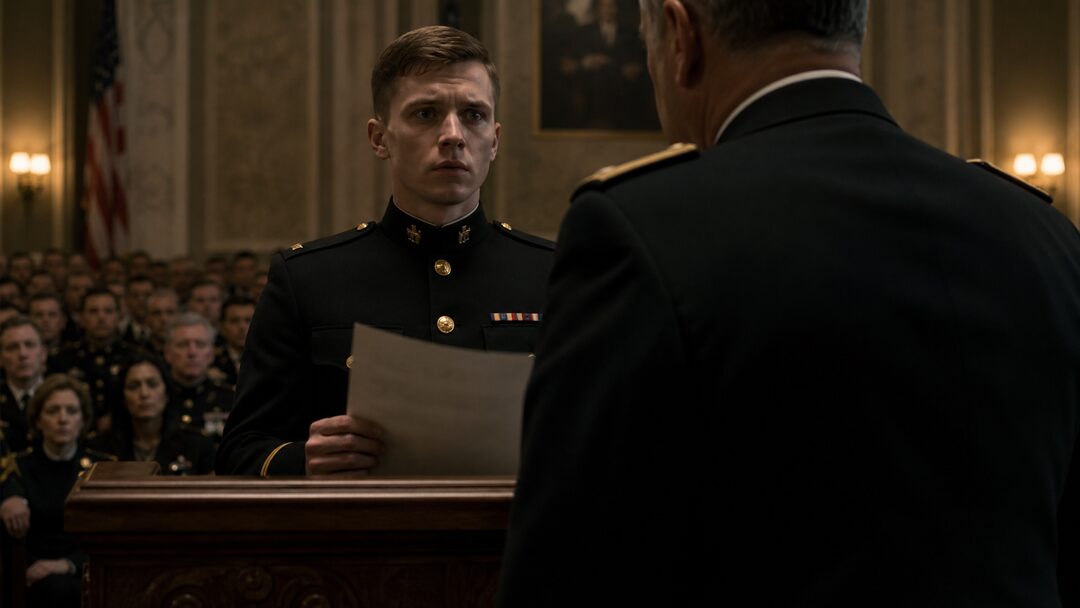
What the Room Remembered
Part I — The White Cup
The white cup lay broken at Sarah Mitchell’s boots, and every person in the dining hall was waiting to see whether she would bend.
Coffee spread in a dark sheet across the pale tile. A thin line of it reached the toe of her polished boot, stopped there, and trembled under the overhead lights.
No one moved.
Not the two rows of soldiers seated at the long tables.
Not Private Daniel Brooks, standing half a step behind her with his face drained of color.
Not Captain James Walker near the doors, jaw tight, eyes fixed on the cup as if it had become evidence.
Major Robert Hale stood in front of Sarah with his hands folded behind his back.
He had not raised his voice. That was his gift. He could make a room feel smaller without ever sounding angry.
“Staff Sergeant Mitchell,” he said, “are you finished making a spectacle of yourself?”
Sarah kept her eyes on the center button of his dress shirt.
It was easier than looking at Daniel.
It was easier than looking at the room.
Hale turned slightly, allowing the company to see Sarah’s face. She knew the gesture. It was not accidental. He was not speaking only to her. He was arranging her.
“Pick it up,” he said.
Sarah did not move.
The drip from the table edge marked the silence.
One drop.
Then another.
Hale’s polished boot shifted near the largest shard. “Pick up the pieces, apologize to this company for proving my point, and we can all return to breakfast.”
Someone at the far table swallowed too loudly.
Sarah’s hands stayed at her sides.
Behind her, Daniel drew in a sharp breath. She felt the movement more than heard it.
“Sir,” Daniel said, voice cracking.
Sarah turned her head just enough.
“Not here,” she said.
Two words. Low. Final.
Daniel stopped as if she had put a hand against his chest.
Hale noticed. Of course he noticed. His eyes moved from Sarah to Daniel, then back to Sarah with something like satisfaction.
“There it is,” he said. “The pattern.”
Sarah let him have the silence.
Silence was the only thing in the room he had not yet taken.
Hale walked slowly around the coffee spill, speaking to the company now. “You are looking at what happens when composure is mistaken for leadership. Staff Sergeant Mitchell was given responsibility beyond her present fitness. I have tried to handle that privately.”
Sarah felt the room change.
Private discomfort became official discomfort.
That was Hale’s real weapon. He could turn an incident into a record before anyone else understood the shape of it.
“I asked her a simple question,” Hale continued. “I received defiance. I asked for accountability. I received theater.”
Daniel’s hands curled into fists.
Sarah did not look back. If he spoke now, Hale would crush him gently, cleanly, in front of everyone.
“Sir,” Captain Walker said from the doorway.
Hale paused.
Walker stepped forward. Broad-shouldered, controlled, already reading the damage. “Maybe we should clear the room.”
Hale smiled without warmth. “An excellent suggestion.”
He faced the soldiers. “Company dismissed. Leave your trays.”
Chairs scraped. Boots shuffled. No one looked directly at Sarah as they passed, which was worse than staring. A few glanced at the broken cup. One glanced at Daniel and quickly away.
When the last soldier left, the dining hall seemed larger and emptier.
Hale turned back to Sarah.
“Now,” he said softly, “let’s make sure the paperwork tells the truth.”
Sarah almost laughed.
It would have been the worst mistake of her life.
Part II — The Report
The four of them remained in the dining hall: Hale, Walker, Sarah, and Daniel.
The coffee had reached the grout lines. It spread there in thin, stubborn paths.
Walker looked at Sarah first. “Staff Sergeant?”
Sarah said nothing.
Daniel did.
“He knocked it out of her hand.”
Hale did not react. Not with surprise. Not with anger. He simply turned his head toward Daniel as if the younger man had failed a simple test.
“Private Brooks,” Hale said, “you should think carefully before making emotional statements.”
“It’s what happened.”
“Is it?”
Daniel’s mouth opened, then closed.
Hale stepped closer to him. “What you saw was a senior noncommissioned officer losing control during corrective instruction.”
“No,” Daniel said. “You told her to say—”
“Private,” Sarah warned.
Daniel looked at her, wounded by the interruption.
She could see the whole future forming in Hale’s face. Daniel written up as unstable. Daniel’s grief dragged into a statement. Daniel’s brother turned into a footnote again.
Hale had built careers out of making people defend themselves badly.
Walker glanced between them. “Major, I need to understand what happened before I sign anything.”
“You need to understand exactly what you saw,” Hale replied. “A soldier under your command refused correction, escalated in front of enlisted personnel, and then allowed a junior private to step into the scene as emotional cover.”
“That is not what I saw,” Daniel said.
Hale’s voice lowered. “You saw what Staff Sergeant Mitchell needed you to see.”
Sarah finally lifted her eyes.
Hale met them.
There it was. The thing he had wanted from the start. Not the cup. Not the apology. Her eyes. Her reaction. Proof that he could still get through the wall she had built out of discipline and old grief.
Walker moved closer. “Major.”
Hale turned to him. “Captain, I have concerns about Staff Sergeant Mitchell’s readiness. I had them before this morning. Now I have witnesses.”
Sarah felt the word settle.
Witnesses.
Not soldiers. Not people. Witnesses.
Hale looked back at her. “You were being considered for the Carter remembrance detail.”
Sarah’s throat tightened before she could stop it.
He saw that too.
“I will recommend your removal,” he said. “It would be inappropriate to place you in a public ceremonial role after this display.”
Daniel stared at her. He did not know what that meant. Not yet.
Walker did.
“Major,” Walker said carefully, “that detail was requested by the Carter family.”
“The Carter family requested dignity,” Hale said. “Not instability.”
Sarah’s hand twitched once.
Hale’s gaze dropped to it. “Careful.”
One word.
Like a leash.
Sarah looked down at the broken cup. A white handle sat apart from the rest, curved upward like a question.
This was how he did it.
He created the shape of a story and dared everyone else to enter it too late.
Walker said, “I’ll take statements separately.”
“You’ll take a report,” Hale said. “And you’ll remember that emotional loyalty is not command judgment.”
The two men held each other’s gaze.
Walker looked away first.
Sarah did not blame him. That was the terrible part. She understood hesitation. She had lived inside it for two years.
Hale walked toward the exit, then stopped beside Sarah.
“Clean it up,” he said.
This time he did not say it loudly enough for anyone else to hear.
When he was gone, Daniel bent toward the cup.
Sarah caught his wrist.
“No.”
“But he—”
“No,” she said again.
Daniel’s eyes were wet with anger. “Why won’t you let me tell them?”
Sarah released him slowly.
“Because he wants you angry,” she said. “Angry people are easy to file away.”
Daniel looked like she had slapped him.
Walker remained near the door, silent.
Sarah turned to him. “Am I removed?”
Walker exhaled. “Pending review.”
“That means yes.”
“It means I’m trying to keep this from getting worse.”
Sarah looked at the shards.
Worse had a way of arriving anyway.
Part III — The Name on the Program
By noon, Sarah’s name was gone from the ceremony program.
She saw it on Walker’s desk before he told her. A fresh copy lay beside his keyboard, still warm from the printer.
Gold Star Remembrance Detail.
Major Robert Hale, presiding.
Private Daniel Brooks, reader.
Sarah read the last line twice.
Walker shut his office door.
“He requested Brooks specifically,” he said.
Sarah’s face did not change. That was old training. Old survival.
“Why?”
Walker did not answer quickly enough.
“Captain.”
Walker rubbed a hand over his close-cropped hair. “Hale said it would demonstrate confidence in a young soldier after this morning’s confusion.”
“Confusion.”
“I’m telling you what he said.”
“No,” Sarah said. “You’re telling me what he wants written down.”
Walker looked tired in a way that made him seem older than forty. “Sarah, I can’t stop every bad decision with suspicion.”
“You can when you know it’s bad.”
“I need more than knowing.”
That sentence hit harder because it was honest.
Sarah looked at the program again. Daniel’s name sat neatly where hers had been. Clean font. Clean paper. Clean lie.
“Does Daniel know?” she asked.
“He’s being notified now.”
Sarah left before Walker could say anything else.
She found Daniel behind the training building, standing under the narrow strip of shade cast by the roof. His cap was in his hand. His hair was damp with sweat though the day was cool.
“I can’t do it,” he said as soon as he saw her.
Sarah stopped several feet away. “You can.”
“No, I mean I can’t read that thing.”
“What thing?”
Daniel pulled a folded page from his pocket. His fingers shook as he opened it.
Sarah did not need to see much. Official language had a smell.
He read one line, bitterly: “‘Due to unavoidable route confusion under hostile pressure, the convoy encountered a fatal delay.’”
Sarah felt the air go thin.
Daniel looked up. “My brother was in that convoy.”
She had known the last name. Brooks. She had noticed it the first week. She had told herself it was common enough to ignore.
Now she hated herself for that.
“Your brother was Anthony Brooks,” she said.
Daniel blinked. “You knew him?”
“I knew of him.”
“That’s not what I asked.”
Sarah looked across the empty yard. Beyond the fence, a flag cracked in the wind.
Daniel stepped closer. “They said he missed a turn. They said he hesitated. My mother kept that letter in a drawer like it was a diagnosis.”
Sarah did not speak.
Daniel’s voice dropped. “I joined because I thought if I was good enough, someone would tell me he wasn’t what they said.”
Sarah saw him then as he had been that morning: not just a frightened private, but a son carrying an institution’s whisper like a family curse.
“Hale knows,” Daniel said.
“Yes.”
“He’s making me read it because he knows.”
“Yes.”
Daniel folded the citation until the crease nearly split.
“Then tell them,” he said.
Sarah looked at him.
He was so young that his anger still believed truth could arrive whole if called by name.
“It’s not that simple,” she said.
“It is to me.”
“It won’t be when they start asking why you care. When they ask whether you joined with a bias. When they ask whether I influenced you. When they ask why I waited two years.”
“Why did you?”
The question was not cruel.
That made it worse.
Sarah looked past him, and for a moment the yard vanished.
She saw a different morning. Heat. Dust. A voice over comms that came too late. Emily Carter’s hand shoving her down by the collar. Metal against stone. Someone yelling that the route was wrong. Someone else saying the order stood.
Then Emily laughing once, breathless, because she had always laughed when afraid.
Sarah closed the door on the memory before it opened all the way.
“Because I didn’t have enough,” she said.
Daniel stared at her. “Enough for who?”
That was the question that stayed with her after he walked away.
Enough for who.
Part IV — The Other Cup
Sarah kept Emily Carter’s metal cup in the bottom drawer of her dresser, wrapped in the same faded cloth pouch it had arrived in two years earlier.
It was not beautiful.
It was dented along one side. The handle was bent slightly inward. The rim carried a tiny notch where Emily used to hook her thumb.
Sarah had tried to mail it back three times.
Each time, she had stopped at the counter with the package in her hands and imagined Emily’s mother opening it. Imagined her seeing the dent. Imagined her asking what else had been sent to the wrong place.
So Sarah kept it.
Not as a keepsake. Not exactly.
As a thing she had failed to return.
That evening, she sat on the edge of her bed and unwrapped the pouch.
The folded map was still inside.
Emily had tucked it there during the deployment because she never trusted digital copies alone. The paper was soft at the creases. One corner was darkened from old dirt. Across the route, Emily’s handwriting cut through the printed lines in black ink.
Updated hazard marking. Avoid eastern service road. Correction sent 0430.
Below that, circled twice:
Do not proceed without reroute.
Sarah touched the words but not the ink.
Her phone buzzed.
Walker.
She almost let it ring out.
Then she answered.
“I found something,” he said.
Sarah stood. “What?”
“Old maintenance log. Vehicle tracker check from the morning of the convoy. It shows a correction packet received before departure.”
Sarah closed her hand around the edge of the dresser.
“Does it prove Hale saw it?”
“No.”
The hope in her chest did not disappear. It changed shape.
Walker continued, “But it supports the map. Enough that if someone raises the issue formally, it can’t be dismissed as memory.”
“Someone.”
“You know what I mean.”
Sarah looked at Emily’s cup.
“Will you raise it?”
Silence.
Then Walker said, “I will not stop you.”
“That’s not what I asked.”
“No,” he said. “It isn’t.”
There it was again. The careful distance. The line men like Walker drew when they wanted to stand near courage without yet touching it.
Sarah almost hated him for it.
Then he said, quieter, “If you speak, I’ll confirm the log exists.”
She sat back down.
It was not protection.
It was not rescue.
But it was a crack in the wall.
“Sarah,” Walker said, “this won’t end clean.”
“I know.”
“You could lose rank. Position. Maybe more.”
“I know.”
“And if the Carter family doesn’t want this—”
“I know.”
He let out a breath. “Then why now?”
Sarah looked at the citation Daniel had texted her, the sentence still glowing on the screen.
Due to unavoidable route confusion.
Because Daniel had been ordered to read his brother into blame.
Because Emily’s correction had been folded in a pouch for two years while Hale kept receiving applause.
Because silence had started as a shield and become a room.
“Because he found someone younger to carry it,” Sarah said.
Walker did not answer.
After the call ended, Sarah wrapped the cup again, then unwrapped it.
She placed the map beside it.
For a long time she sat there, listening to the low hum of the barracks and the distant sound of boots on pavement.
At 2200, someone knocked.
Daniel stood outside her door.
His eyes went to the cup immediately.
“Is that hers?” he asked.
Sarah stepped aside.
He entered like he was afraid the room might accuse him too.
Sarah handed him the map.
He read it once. Then again. His face changed slowly, not into relief, but into something heavier.
“My brother didn’t miss the turn,” he said.
“No.”
Daniel pressed the heel of his hand to his eye.
Sarah looked away.
When he lowered his hand, he said, “Don’t do it.”
Sarah frowned. “What?”
“Tomorrow. Don’t do it for me.”
“I’m not doing it for you.”
“You know what I mean. Don’t throw away your career because I couldn’t keep my mouth shut.”
“You kept quiet when I told you to.”
“I shouldn’t have.”
“Maybe not.”
That startled him.
Sarah folded the map carefully. “But if you had spoken in that room, he would have made you the story.”
Daniel’s voice broke. “I’m tired of him making the story.”
Sarah looked at him then.
There were moments when a person stopped being young because time passed. And there were moments when they stopped because someone handed them the cost of knowing.
“I am too,” she said.
Daniel stared at the cup. “What if nobody believes it?”
“Some won’t.”
“What if they believe it and nothing happens?”
Sarah did not lie.
“Then at least they’ll know what they chose.”
That line stayed between them.
Not comfort.
Something harder.
Something they could stand on.
Part V — The Program
The ceremony hall had better light than the dining room.
That made it worse.
Everything looked clean. The chairs in rows. The folded programs. The polished lectern. The framed photographs on the front table, each one with a nameplate beneath it.
Emily Carter smiled from the third frame on the left.
Sarah entered through the side door and stayed near the wall.
She was not part of the detail anymore. That much was clear from the way people noticed her and then pretended not to. She wore her dress uniform anyway. Every ribbon was straight. Every button fastened. Her hair was tight enough to hurt.
Emily’s cup rested inside the cloth pouch under her arm.
The map was folded beneath it.
At the front of the room, Hale stood with effortless command. Silver at the temples. Shoulders squared. Voice quiet as he greeted family members one by one.
He saw Sarah.
His expression did not change.
That was how she knew he was furious.
Walker stood near the front row, holding a folder. His eyes found Sarah’s for one second.
One second was all he gave her.
Daniel stood by the lectern, citation in hand.
He looked smaller there.
Not weak. Just young. Too young to hold a page that had already hurt his family once.
Hale opened the ceremony with words about sacrifice, service, and the burden of command. He said each phrase beautifully. Sarah watched the families receive them because grief often accepted clean language when the alternative was emptiness.
Then Hale turned.
“Private Brooks will now read the official citation of remembrance.”
Daniel stepped up.
The paper shook once in his hand.
Sarah felt her own pulse slow.
Daniel began well. His voice was uneven but clear. He read the names. He read the date. He read the line about courage under pressure.
Then he reached it.
“Due to unavoidable route confusion under hostile pressure…”
His voice stopped.
No one breathed.
Hale moved before anyone else could understand the pause.
He approached the lectern with a sympathetic expression already arranged on his face. “Private Brooks.”
Daniel stared at the paper.
Hale placed a hand near the microphone. Not on Daniel. Near him. Close enough to control the space.
“I’ll continue,” Hale said gently.
That was when Sarah stepped forward.
The sound of her shoes carried.
Every head turned.
Hale’s eyes hardened. “Staff Sergeant Mitchell.”
Sarah stopped three feet from the lectern.
Daniel looked at her, and for the first time since the dining hall, he did not look like he wanted her to save him.
He looked like he wanted to stand.
“Return to your seat,” Hale said.
Sarah placed the cloth pouch on the lectern.
The room changed.
It was not dramatic. No one gasped. No one stood. But attention gathered around the small faded pouch as if it had arrived from another time.
Hale’s voice lowered. “This is not appropriate.”
“No,” Sarah said. “It isn’t.”
She opened the pouch.
Emily’s cup rolled into her palm, dented and dull under the bright lights.
A woman in the front row made a sound so small Sarah almost missed it.
Emily’s mother.
Sarah did not look at her yet. If she did, she might not finish.
Hale stepped closer. “Stand down.”
The words were familiar.
So was the room.
So was the watching.
Sarah set the metal cup on the lectern. The small click it made seemed louder than the shattered cup in the dining hall.
Then she unfolded the map.
Hale’s face changed.
Only for a moment.
Only enough.
Sarah saw it. Walker saw it. Daniel saw it.
“This correction was written before the convoy left,” Sarah said.
Her voice was steady, but steady was not the same as unafraid.
She pointed to Emily’s handwriting. “Corporal Emily Carter marked the eastern service road as unsafe. The correction was sent. The order to proceed did not change.”
Hale’s tone sharpened. “You are making an unsupported accusation during a remembrance ceremony.”
Sarah looked at him. “No, sir. I am refusing to let a remembrance become a second order.”
The line landed in the room like something heavy placed gently on glass.
Hale turned to Walker. “Captain, remove her.”
Walker did not move.
Hale’s eyes narrowed. “Captain.”
Walker opened his folder.
Sarah had never seen a man look more afraid while doing the right thing.
“There is a maintenance log,” Walker said, voice controlled. “It supports the existence of a received correction packet prior to departure. This requires formal review.”
The room did not erupt.
That would have been easier.
Instead, silence widened.
Hale looked at Walker as if Walker had become a stranger.
“You understand what you’re saying?” Hale asked.
Walker swallowed. “Yes, sir.”
Daniel stepped away from the lectern.
Then he stepped beside Sarah.
Not behind her.
Beside her.
Sarah kept her eyes forward because if she looked at him, she would break.
Hale opened his mouth.
For once, no one leaned in to listen.
That was when Sarah understood: authority did not vanish all at once. Sometimes it simply stopped filling the room.
Part VI — What Stayed
No one took Hale away.
No one apologized.
No one announced justice in a clear voice.
A senior officer asked everyone to remain seated. Another took Walker’s folder. Hale stood apart from the lectern, immaculate and silent, his face emptied of everything except calculation.
Sarah was relieved of duty pending inquiry before the families left the hall.
The words were formal. Careful. Predictable.
She accepted them.
Daniel tried to speak, but Sarah shook her head once.
Not here.
This time, he understood differently.
Emily’s mother approached after the room had thinned.
She was smaller than Sarah remembered from the photographs sent with holiday cards, but her eyes were sharp. She stopped in front of the lectern and looked at the cup.
Sarah stepped back.
The woman reached out and touched the dented rim with two fingers.
“She carried this everywhere,” she said.
Sarah nodded.
“I wondered where it went.”
“I should have returned it.”
Emily’s mother looked at her then. “Why didn’t you?”
There were many answers.
Cowardice. Protection. Shame. Timing. Proof. Fear that grief would ask for more than Sarah could give.
None of them were clean enough to say.
“I wasn’t ready to give you only part of the truth,” Sarah said.
Emily’s mother looked down at the cup again.
Then she asked, “Did she know?”
Sarah felt the question move through the room, through the two years, through the dining hall, through the broken white cup still sitting somewhere in a trash bin as if it had only ever been ceramic.
She answered carefully.
“She knew enough to warn us.”
Emily’s mother closed her hand around the cup.
For a moment Sarah thought she might cry.
She did not.
She held the cup as if it were both too little and all that was left to hold.
Outside, the afternoon light was flat and pale.
Sarah stood near the steps while Walker spoke with two officers by the entrance. He looked over once, but did not come to her. Not yet. Maybe he had more courage now. Maybe he had only used all he had for the day.
Daniel came out carrying the empty cloth pouch.
He stopped beside Sarah.
For a while they watched Emily’s mother cross the parking lot with the cup held close against her chest.
Daniel said, “What happens now?”
Sarah looked at the flag at the edge of the grounds. It moved in the wind, bright and restless.
“Now they decide what kind of record they can live with.”
Daniel nodded, though his face showed he hated the answer.
After a minute, he said, “You told me angry people are easy to file away.”
“I did.”
“I’m still angry.”
Sarah looked at him.
“So am I.”
That seemed to steady him.
Across the lot, Emily’s mother turned back once. She did not wave. She only looked at Sarah, then at Daniel, then continued walking.
Sarah’s career might narrow after this. It might end. Hale might survive longer than he deserved. The report might become careful language around a hard thing. Men like him knew how to stand still until storms passed.
But the room had changed.
That mattered.
Daniel stood beside her now, not behind.
Walker had spoken.
Emily’s cup was no longer hidden in Sarah’s drawer.
And somewhere inside the hall, on a clean lectern under bright lights, a folded map had made silence answer for itself.
Sarah breathed in.
For the first time all day, no one was ordering her to pick anything up.
So she stood there with empty hands, letting the weight remain where it belonged.