The High Noon Alfalfa Option Inside The Snake River Barn
CHAPTER 1: HIGH NOON ON THE SCALE
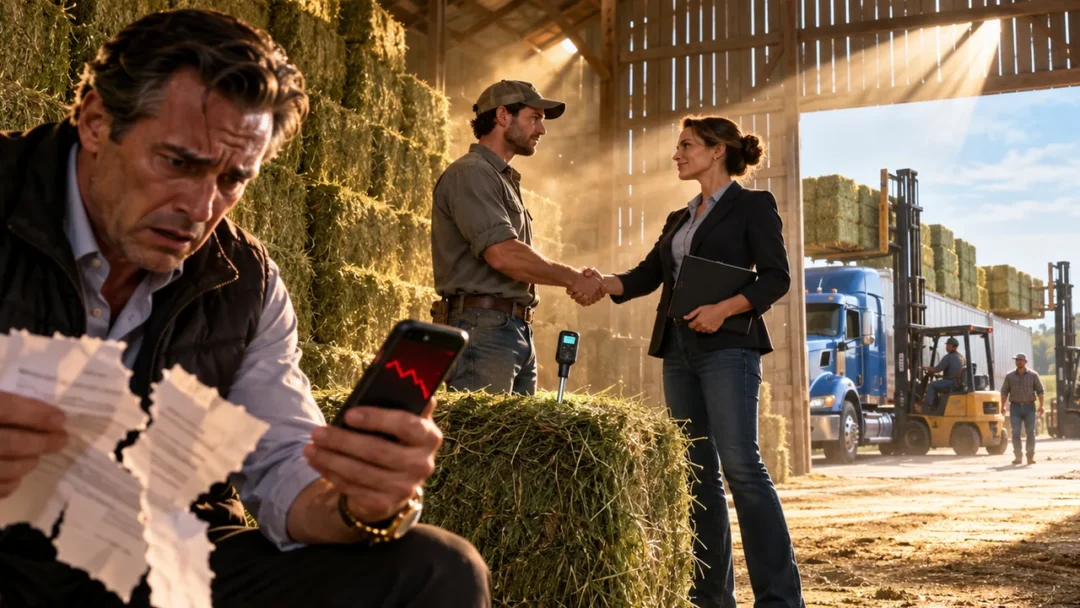
The high desert air inside the open-span steel hay barn smelled of sweet dried clover, curing alfalfa, and fine basalt dust drifting in from the sagebrush flats of Twin Falls County. Caleb Ward stood with his back against a twelve-foot stack of tightly bound three-string green bales, his work boots planted firmly on the grooved concrete apron of the eighty-foot commercial truck scale. He was twenty-seven years old, his hands calloused from three solid seasons of cutting, raking, and baling six hundred acres of irrigated bottomland along the Snake River canyon rim, wearing a faded canvas chore coat with split elbows and grease stains across the cuffs.
Five feet in front of him stood Marcus Dane. Dane was forty-two, wearing a custom-tailored lambskin shearling jacket over an immaculate pearl-snap shirt, imported ostrich-skin boots that had never touched a shovel, and heavy titanium-framed aviator sunglasses. In his manicured left hand, Dane held a glowing smartphone connected to the Boise Board of Trade live commodities index; in his right, he clutched a printed three-page legal document marked with the red corporate stamp of Intermountain Forage & Feed Brokers LLC.
Above their heads, bolted to the center steel support girder of the barn, an industrial red LED digital clock read 11:59:14.
Outside the massive corrugated steel rolling doors, idling on the sun-baked gravel apron under the blinding Idaho noon glare, three leased Peterbilt semi-trucks with empty flatbed trailers rumbled at low idle. Their chrome exhaust stacks puffed thin heat waves into the ninety-degree heat.
“Time’s up, Ward,” Dane said, his voice flat, predatory, and oozing with the practiced condescension of a man who made his living foreclosing on generational family ranches. “Look at that clock. Forty seconds until noon. The spot market for dairy alfalfa dropped thirty dollars a ton this morning in Jerome. Nobody is paying two hundred and eighty dollars for fourth-cutting hay in the middle of a drought.”
Caleb did not answer. He held his own phone in his left hand, its camera lens pointed squarely at Dane’s face, the red recording timer ticking steadily in the upper corner of the screen.
“I have forty tons of certified dairy-grade alfalfa sitting on this concrete, Marcus,” Caleb said, his voice level and steady as a surveyor’s transit. “Our contract was signed thirty days ago. Two hundred and eighty dollars a ton, moisture content certified below twelve percent, delivery scheduled for twelve o’clock today. You have an exclusive purchase option until noon. Either sign the delivery release or get your trucks off my scale.”
“You don’t understand the real world, kid,” Dane scoffed, taking half a step closer and tapping the back of the contract against Caleb’s chest. “Your old man died six months ago leaving you with three hundred thousand dollars in bank notes at the Jerome Ag Credit Union. Your balloon payment is due at five o’clock this afternoon. If my trucks roll out of here empty, you don’t make that deposit. The bank moves to seize your center pivots by tomorrow morning.”
The red digits on the barn wall flipped: 11:59:38.
“Here’s the deal, Caleb,” Dane whispered, leaning in until Caleb could smell his mint chewing gum and expensive aftershave. “One hundred and forty dollars a ton. Exactly half price. Take it right now, sign the amendment, and I’ll have my drivers strap these forty tons down before one o’clock. You get twenty-eight thousand dollars cash in escrow, which is just enough to keep the bank off your neck for thirty days. Refuse, and you eat sixty tons of rotting grass while the auctioneer sets up his tent on your front lawn.”
“Our contract has an explicit clause, Marcus,” Caleb said, nodding toward the paper in Dane’s fist. “Section Four. The exclusive purchase option expires at exactly twelve noon. If the buyer formally declines the load before the deadline, all rights terminate immediately.”
Dane laughed—a loud, mocking bray that echoed off the high corrugated ceiling.
“You think somebody else is coming to save you out here in the dust?” Dane sneered. “I control every feed lot between here and the Oregon border. Nobody buys a single blade of grass in this valley without my sign-off.”
Dane raised the contract, held it squarely before Caleb’s recording phone camera, and gripped the paper with both hands.
“Let the record show,” Dane shouted theatrically into the phone lens. “As managing director of Intermountain Forage, I hereby formally reject this shipment as sub-standard, unmarketable, and overpriced! The load is declined!”
With a vicious, theatrical snap, Dane ripped the three-page contract down the middle, tore it across a second time, and flung the shredded white scraps down at the toes of Caleb’s dusty leather boots.
The overhead digital clock flipped to 12:00:00.
Caleb did not flinch. He lowered his phone, tapped the stop-recording button, and calmly reached out his right arm to the green industrial push-button station mounted on the concrete pillar.
He pressed the toggle.
With a heavy hum of electric motors and the rattle of heavy chains, the forty-foot corrugated steel doors on the far eastern side of the barn began to roll smoothly upward toward the rafters.