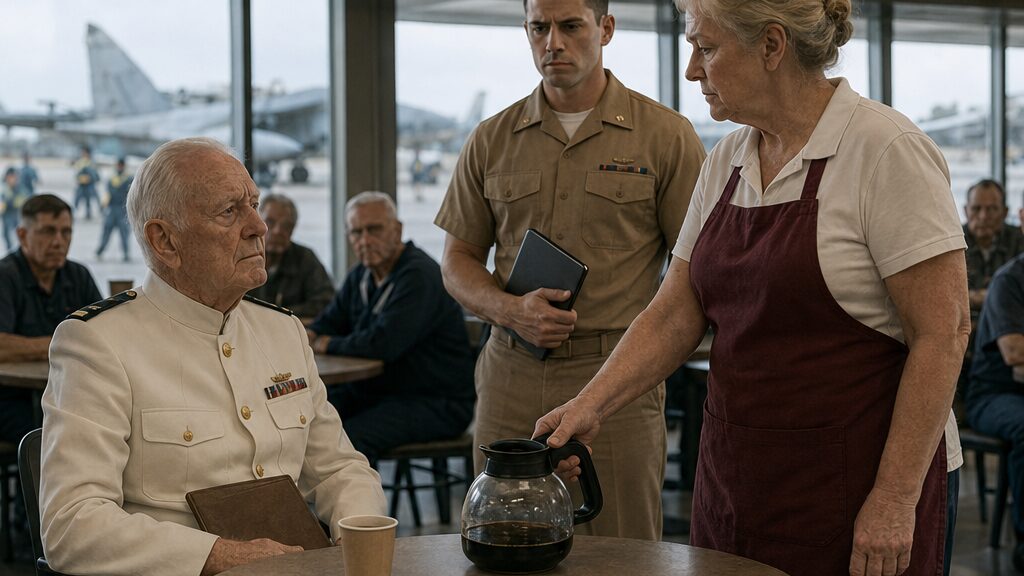
The Old Navy Veteran Asked Only for Coffee, But the Cafeteria Remembered His Silence
Chapter 1: The Table by the Windows Was Already Taken
Charles Bennett arrived before the first rush of uniforms.
The airbase cafeteria had always sounded different at that hour. Before the trays clattered, before the voices rose, before the young sailors began laughing too loudly over eggs and toast, there was only the low hum of the drink coolers, the soft rattle of pans from the kitchen, and the faraway cough of engines beyond the long windows.
Charles stood just inside the entrance and let the door ease shut behind him.
Outside, under the pale wash of morning, the flight line stretched flat and silver. Aircraft sat in rows with their noses turned toward the open sky. Maintenance crews moved under them like careful shadows. The glass was cleaner than he remembered. The floor was newer. The tables had been replaced with lighter ones that did not wobble at the legs.
But the window was the same.
He took off his cap.
Not because anyone had asked him to. Not because the sign at the entrance said anything about it. He did it because he had always done it there.
He wore his white Navy jacket buttoned to the throat, though the collar had grown a little tight over the years. The cloth had yellowed faintly at the seams. His ribbons were in place, not many compared to men who liked to wear their lives on their chests, but enough that a passing sailor gave him a quick second look. Charles did not return it. He held a folded breakfast ticket in one hand and a thin brown folder in the other.
A young sailor at the check-in table glanced up from a printed list.
“Good morning, sir. Memorial breakfast?”
Charles nodded and offered the ticket.
The sailor took it carefully, as if age made paper fragile. “Name?”
“Charles Bennett.”
The sailor ran his finger down the page. He did not find it at first. Charles watched the boy’s mouth tighten with the faint worry of someone afraid of failing at a simple task.
“It may be under retired personnel,” Charles said.
“Yes, sir. One second.”
The boy checked another column, then straightened. “Here you are. You’re early.”
“I know.”
“We’re not serving hot food until oh-seven hundred.”
“That’s all right.”
The sailor handed the ticket back. “You can sit wherever the reserved signs aren’t placed yet.”
Charles looked toward the window table.
It was a round table, smaller than the old one, set near the third pane of glass from the north end. From that seat a man could see past the hangar doors and across the apron to where planes lifted out, then vanished into morning glare. Years ago, the table had been square and scarred. Its corners had held coffee rings deep enough to look permanent. Someone had carved initials underneath it, and one leg had been shimmed with folded cardboard from a sugar box.
Now the table had a smooth gray top and a little laminated tent card in the center.
RESERVED — CEREMONY STAFF.
Charles remained still long enough that the sailor followed his gaze.
“Sir? That one might be for the event coordinators. We can move you to another table.”
Charles folded the ticket once along its crease. “I’ll ask.”
He crossed the cafeteria slowly, not because he wanted to appear solemn, but because his left knee had never forgiven cold mornings. The room smelled of disinfectant, toasted bread, and coffee that had been brewed too early. On the serving counter, three steel urns stood under a row of paper cups. Beside them, almost hidden behind a stack of trays, sat an old glass coffee pot with a black handle.
Charles stopped when he saw it.
The pot did not belong with the rest of the new equipment. Its lid was cloudy from years of washing. The black handle had a pale scratch near the top where someone had once dropped it on tile. There were newer thermal carafes on the counter now, tall and polished, but the glass pot remained as if no one had known where else to put it.
He breathed in through his nose.
The smell was wrong. Too sharp, too clean. But underneath it was still there, the bitter dark smell of coffee held too long on a warmer.
A woman came through the swinging kitchen door carrying a tray of wrapped silverware. She was older than most of the staff, with short gray-blond hair pinned back and a burgundy apron tied over a white polo. Her name tag caught the light as she turned.
SUSAN.
She noticed Charles standing near the window table.
“Breakfast hasn’t started yet,” she said.
Her voice was not rude. Not yet. It was the practical voice of someone who had said the same sentence many times.
“I’m aware,” Charles said.
“The ceremony group is checking in by the front.”
“I checked in.”
She set the silverware tray on a service cart and looked at the tent card on the table. “That table’s reserved.”
Charles touched the back of the nearest chair. “Would it trouble anyone if I sat here until they arrive?”
Susan glanced toward the kitchen, then toward the front entrance. “They’ll need it for staff folders.”
“I won’t be in the way.”
“That’s what everyone says.” The words came out tired, not cruel, but they landed hard enough. “We’ve got a schedule today.”
Charles moved his hand from the chair.
For a moment he felt the old, foolish urge to explain himself. He could have said he had sat at that table before any of the laminated signs existed. He could have said the event coordinator had called him twice and mailed the ticket to his apartment because he had refused email. He could have said he had not come for pancakes, or speeches, or a photograph by the flag.
Instead he looked again at the glass coffee pot on the counter.
“May I have coffee?”
Susan followed his eyes. “Cups are at the urns. Self-serve.”
“I meant the pot.”
“The pot?”
“The glass one.”
Her expression tightened with confusion. “We don’t do table service for coffee anymore.”
“I can bring it back.”
“That’s not the point.” She picked up the tray again, then stopped herself. “Sir, the urns are right there.”
Charles nodded once.
A younger man in tan uniform entered through the side door near the windows, carrying a tablet tucked against his ribs. He moved with the distracted speed of someone who had already been given three jobs before sunrise. He paused when he saw Charles.
“Mr. Bennett?”
Charles turned.
The young man approached with a careful smile. “Daniel Reed. We spoke on the phone last week.”
“Yes.”
“I’m glad you made it.” Daniel looked at the reserved sign, then at Susan, then back at Charles. “We have your seat set aside.”
Susan’s eyes narrowed slightly. “This table is for ceremony staff.”
Daniel checked the tablet with his thumb. “I think this is the one—”
“It’s all right,” Charles said.
Daniel looked up.
Charles did not raise his voice. “I can wait.”
A small silence settled between them. From beyond the glass came the rising whine of an engine turning over. It filled the cafeteria, trembled through the window, and faded.
Susan shifted the silverware tray higher against her hip. “Sir, we’re going to be busy. If you want coffee, the urns are open.”
Charles looked at the pot one more time.
On the mornings that mattered, coffee was not fetched from an urn. It sat on the table where men could reach it without asking. It went cold while people waited. It turned bitter while chairs stayed empty.
But that was not something to put on a cafeteria worker before breakfast.
He placed the folded ticket in his jacket pocket and kept the folder under his arm.
“Thank you,” he said.
Susan seemed to hear dismissal where he had meant courtesy. Her mouth firmed. “I’m just following procedure.”
“I know.”
Daniel’s hand tightened around the tablet. He looked ready to say something else, but Charles gave a small shake of his head.
Not now.
Not in the first five minutes.
Not with the coffee still behind the counter.
Charles stepped away from the window table and chose another seat two tables over, where he could still see the flight line if he turned his head. He lowered himself carefully into the chair. His knee gave its usual complaint. He set the folder flat on his lap and rested both hands on it.
Susan watched him for a moment, then went back through the swinging door.
Daniel remained standing beside the reserved table.
“I’m sorry,” he said quietly.
Charles looked through the glass.
Outside, a mechanic in hearing protection lifted one arm to signal someone out of view. A plane rolled slowly across the morning light.
“She’s doing her job,” Charles said.
Daniel did not answer.
On the counter, the old coffee pot sat empty beside the urns, its black handle turned toward the room like something waiting to be picked up.
Chapter 2: The Woman in the Burgundy Apron Said Rules Were Rules
By seven o’clock the cafeteria had filled with the sound Charles remembered and did not remember.
Boots scraped under tables. Trays slid along rails. Someone laughed near the drink station with the high, careless laugh of a person young enough to believe mornings were endless. The kitchen doors swung open and shut, releasing bursts of heat and the smell of eggs. A few retirees came in wearing ball caps with ship names stitched across the front. Some walked with wives. Some walked alone. Some wore jackets with patches. Charles kept his cap folded beside his folder and watched their reflections move in the window.
He had taken one paper cup of coffee from the urn.
It cooled too quickly.
The cup sat untouched near his right hand. The coffee inside had a thin brown sheen, not from cream but from sitting still. Charles had not come to drink from paper.
At the window table, no ceremony staff had arrived. The laminated reserved sign remained in the center, clean and unnecessary. Daniel had removed it once, then replaced it when the manager called him away. Charles had seen his hesitation.
The young man wanted to fix a seating chart.
Charles wanted him to learn that not all things were fixed by touching a screen.
Susan came out of the kitchen with the old glass pot in one hand and a towel in the other. Someone must have rinsed it, because drops clung to the inside. She began wiping down a station near the window.
Charles watched the pot.
He did not mean to stare. He told himself not to. But the black handle, the cloudy lid, the slight chip at the pouring lip pulled his eyes every time.
Susan noticed.
Her shoulders lifted, then fell. She walked toward him.
“Sir,” she said, keeping her voice low enough to pretend the room was not listening, “is there a problem with the coffee at the urn?”
“No.”
“You haven’t touched it.”
“I know.”
“Then I don’t understand what you’re needing from us.”
Charles looked down at his hands. They were still broad, still marked with small scars that had faded white. The nails had been trimmed that morning with more care than usual. His left thumb rested on the folder’s edge.
“I asked for the pot,” he said.
“And I told you we don’t leave pots on tables anymore. It’s a safety issue and a service issue. People walk off with things. People spill. People complain it’s cold.”
“It will get cold.”
Susan blinked. “Excuse me?”
Charles looked up. “Coffee does that.”
A sailor at the next table turned his head, then pretended he had not.
Susan’s cheeks colored. “Sir, I’m trying to help you.”
“I understand.”
“No, I don’t think you do.” She set the pot down on the table between them harder than necessary. Not enough to break it. Enough for the glass to click against the surface. “We have a lot of people coming in. We have procedures. We have a guest list. We can’t change service because one person remembers it differently.”
The room did not stop. Not fully. But several conversations weakened at the edges.
Charles looked at the pot.
Up close, the scratch on the handle was exactly where he remembered. There were water spots along the glass and a brown stain under the lip that no amount of scrubbing had ever fully removed. He could see Susan’s hand still wrapped around the handle.
“May I pour one cup?” he asked.
“You already have a cup.”
“Not for me.”
Susan stared at him.
Daniel appeared near the end of the table, tablet under his arm. “Mr. Bennett?”
Charles did not turn.
Susan straightened. “Lieutenant, maybe you can help. I have a gentleman here who keeps asking for table service we no longer provide.”
Daniel’s eyes moved quickly: Charles, the pot, Susan’s hand, the untouched paper cup.
“He’s on the memorial list,” Daniel said.
“I didn’t say he wasn’t on a list.”
“You asked earlier whether he belonged here.”
Susan’s jaw tightened. “I asked because this table was reserved, and we’ve had people wander in during base events before. We were specifically told to watch that.”
Daniel touched the tablet screen. “His name is here.”
Charles heard the small electronic tap. He heard Daniel inhale as if preparing to read something aloud.
“Don’t,” Charles said.
Daniel stopped.
Susan looked from one man to the other. “Don’t what?”
Charles lifted his eyes to Daniel. “Not like this.”
The young officer looked pained. “Sir, she needs to know.”
“She knows enough.”
“I don’t,” Susan said.
A sharper silence followed that.
Charles folded his hands on top of the folder. Around them, the cafeteria pretended to continue. Forks moved more softly. A chair leg squealed, and the sound seemed too loud.
Susan’s voice lowered. “I’m not trying to embarrass anyone. But I have a room full of people and rules I’m required to follow. If you’re part of the ceremony, Lieutenant Reed can seat you with the group. If you’re waiting for someone, we need to know. If you need assistance, we can call—”
“I do not need assistance,” Charles said.
He regretted the edge in his voice as soon as it left him.
Susan took it as anger. Her posture hardened. “Then please use the coffee station like everyone else.”
Charles nodded slowly.
Daniel stepped closer. “Mr. Bennett, I can speak to the manager.”
“No.”
“Sir—”
Charles reached into his jacket pocket and removed the folded breakfast ticket. The crease was soft from the warmth of his hand. He placed it beneath the paper cup, not because the cup needed it, but because the vent above the table had begun stirring the corners.
Then he slid the folder from his lap and held it against his chest.
“I will sit where I’m assigned,” he said.
Susan looked at the ticket under the cup but did not pick it up. “Thank you.”
The words were polite enough to pass inspection. They carried no relief.
She reached for the coffee pot.
For one instant Charles’s hand moved. It rose no higher than the table edge, fingers opening slightly as if to stop her.
Then he let it fall.
Susan lifted the pot. The glass caught the light from the window. For a second the pot was bright, almost white, and empty.
She turned toward the counter.
Daniel watched her go, then looked down at Charles. The young man’s face had changed. He no longer looked like someone managing a schedule. He looked like someone standing at attention in a room where no one had ordered him to.
“She needs to know what table this is,” Daniel said softly.
Charles kept his eyes on the window.
Beyond the glass, aircraft moved in sun. Men in bright vests crossed the apron. A gull rode the air above the hangar roof as if nothing heavy had ever happened there.
“Not like this,” Charles repeated.
Daniel lowered the tablet.
At the next table, a retired man in a faded cap stared at Charles, then looked away. A younger sailor whispered something to another. Susan returned to the counter, set the pot beside the urns, and spoke to someone in the kitchen without looking back.
Charles picked up the paper cup.
The coffee had cooled to the point where the heat no longer reached his fingers. He brought it near his mouth, then stopped. Its smell was thin and metallic.
He set it down again on the ticket.
A small crescent of coffee had sloshed over the rim and stained one corner of the paper. The brown mark spread slowly across the printed line where his name had been typed.
Charles watched it move.
Once, long ago, he had watched coffee spread across a table after an engine report came in wrong. Someone had knocked over a cup reaching for the radio. No one had cleaned it for twenty minutes. They had all stood there listening to static, waiting for voices that never returned.
Susan came back from the counter without the pot.
“The manager can speak with you after the rush,” she said.
“That won’t be necessary.”
“I think it might.”
Charles looked up then. Not sharply. Just enough.
Susan’s expression wavered.
In his younger years, men had mistaken quiet for permission. Age had changed the shape of that mistake but not its nature. Now quiet meant frailty to some people. Confusion to others. Entitlement to those already tired before the day began.
He wanted, suddenly and with a bitterness that surprised him, to let Daniel read whatever was on the tablet. He wanted Susan to hear his name with the old operation attached. He wanted the room to shift around her, not with applause, but with discomfort. He wanted her to understand how carefully he had chosen not to hurt her.
The wanting passed.
Charles touched the folder once, lightly.
“No,” he said. “It won’t.”
Susan did not answer.
Daniel stood behind him, still holding the tablet no one was allowed to use.
Chapter 3: The Tablet Had His Name, But Not His Reason
Daniel Reed had believed in records because records had never raised their voices at him.
A list told him who was invited. A form told him who had confirmed. A schedule told him where people should stand. When things went wrong, he could usually find the missing line, the unchecked box, the outdated attachment. He was twenty-eight years old and already trusted systems more than instincts, mostly because systems gave him somewhere to put his hands.
That morning, his hands had nowhere useful to go.
He stood outside the dining facility manager’s office, tablet tucked under his arm, watching Janet Miller scroll through the event file on her desktop. The office had a narrow window looking onto the cafeteria floor. Through it Daniel could see Charles Bennett sitting two tables away from where he had been meant to sit. The old man’s back was straight. His untouched paper cup remained on the table. The folded ticket was still beneath it.
Susan moved through the room with a coffee carafe now, one of the newer thermal ones, filling cups for a cluster of retirees near the serving line. She did not go near Charles.
Janet sighed. “I’m not seeing a special accommodation note.”
“It isn’t an accommodation,” Daniel said.
“Then what is it?”
Daniel looked down at the tablet, though he already knew what it showed. “He requested the window table.”
“Half the room requests window tables during aircraft activity.”
“This request came through the memorial coordinator.”
Janet leaned back. She had the controlled expression of someone who had survived too many inspections to be impressed by urgent young officers. Her gray hair was pulled into a tight knot, and reading glasses hung from a cord against her blouse.
“Lieutenant Reed,” she said, “we were told ceremony staff needed that table for materials.”
“That was changed last night.”
“By whom?”
Daniel hesitated. “By me.”
Janet removed her glasses. “And did you tell my staff?”
“I updated the shared document.”
“That is not the same thing.”
No, it was not. He felt heat rise under his collar.
Janet turned back to the computer. “We have unauthorized visitors try to attend these breakfasts every year. We have retirees who forget whether they registered. We have family members who think military events run like church potlucks. Susan was told to verify before seating anyone at reserved tables.”
“She embarrassed him.”
Janet’s eyes came up. “Did she?”
Daniel looked through the office window again.
Charles had not moved much. That was the problem. He had not made embarrassment easy to identify. He had not argued, pointed, shaken, complained, demanded rank, or called for a superior. He had simply made room around the injury until everyone else could pretend it was not there.
“She questioned whether he belonged,” Daniel said.
“That is not the same as embarrassing him.”
“It is when he does belong.”
Janet’s face softened by half a degree, then closed again. “Show me.”
Daniel opened the tablet and pulled up the memorial breakfast list. His thumb moved faster than necessary. He found the name and turned the screen toward her.
CHARLES BENNETT — INVITED GUEST
SEAT REQUEST: WINDOW TABLE 3
CONTACT METHOD: PHONE / MAIL
NOTES: DECLINED FORMAL RECOGNITION
Janet read the note twice.
“Declined formal recognition,” she said.
“Yes.”
“Recognition for what?”
Daniel tapped the linked file. It loaded slowly. He hated the spinning circle more in that moment than he had hated anything all week.
The file opened into a scanned page from an old base newsletter, then a paragraph from a personnel archive, then a coordinator’s note written by Kevin Harris. It did not fit neatly on the screen. The words had the stiff quality of official history, giving dates and unit numbers and operation names, but little of what they had cost.
“Former Navy mess specialist assigned to temporary evacuation support during coastal storm response,” Daniel said. “He later coordinated food and staging for crews during the return search.”
Janet waited.
Daniel scrolled. “The memorial breakfast includes surviving personnel connected to that operation.”
“That doesn’t explain the coffee pot.”
“No,” Daniel said.
“Or why Susan was supposed to know any of that.”
Daniel closed his mouth.
He had wanted Janet to say, Of course, bring him the pot, apologize, fix this. He had wanted the record to carry the weight he had felt at the table. Instead, the record sat there on a screen, factual and insufficient.
Janet turned toward the window. “He could have told her.”
“He stopped me from telling her.”
“Why?”
Daniel looked at Charles again. The old man was now holding the brown folder on his lap with both hands.
“I don’t know,” Daniel said.
Janet studied him. “Then don’t turn this into a disciplinary scene before you do.”
“I’m not trying to punish Susan.”
“You came in here with the posture of someone trying to punish Susan.”
Daniel looked away.
On the cafeteria floor, Kevin Harris had arrived. Daniel recognized him from the volunteer emails: a broad-shouldered older man in a navy windbreaker with a veteran outreach badge clipped to the zipper. Kevin stopped near Charles’s table, bent slightly, and said something. Charles shook his head once.
Kevin’s smile faded.
Janet noticed Daniel watching. “Who is that?”
“Outreach volunteer. He’s been trying to get Mr. Bennett to attend for two years.”
“And this year he came.”
“Yes.”
“Then the day is not ruined yet.”
Daniel wanted to agree. He could not.
Susan entered the office without knocking, carrying a stack of supply forms. She stopped when she saw both of them facing the window.
“Am I being discussed?” she asked.
Janet turned. “The seating chart was changed last night and not properly communicated.”
Susan looked at Daniel, not Janet. “Was the table reserved or wasn’t it?”
“It was reserved for Mr. Bennett,” Daniel said.
Susan’s lips parted. Her gaze flicked toward the cafeteria.
Janet said, “You followed the information you had.”
Daniel said nothing.
Susan held the forms against her apron. “He asked for something we don’t do anymore.”
“The coffee pot,” Daniel said.
“Yes, the coffee pot. I can’t leave glass pots on tables because one guest wants things done like they used to be. Last month someone’s grandson burned his hand on gravy and we got a complaint that went all the way up. I’m not risking that over nostalgia.”
The word struck the room and stayed there.
Daniel watched Susan realize it. Not fully. Just enough for her chin to lift in defense.
“I didn’t mean—”
Janet cut in gently. “Go finish the floor. We’ll speak after breakfast.”
Susan looked once more through the office window.
Charles was still seated alone, though Kevin now stood nearby, waiting as if he had been invited to sit and declined. The paper cup had left a ring on the folded ticket. The brown folder rested under Charles’s palm.
Susan’s expression changed, not into regret exactly, but into uncertainty. Then she turned and left.
Daniel looked at Janet. “You heard that.”
“I heard a tired employee use the wrong word.”
“She took the pot from him in front of half the room.”
“And you tried to correct it with a tablet in front of the same half.”
Daniel said nothing.
Janet put her glasses back on. “Lieutenant, if Mr. Bennett declined recognition, maybe start by respecting that.”
The sentence annoyed him because it was true.
He stepped out of the office and back into the noise of the cafeteria. A few people glanced at him, then away. The room had nearly filled. The window table remained unused, the reserved sign still standing there like a small white accusation.
Daniel approached Charles.
Kevin Harris looked relieved. “Lieutenant.”
Charles did not.
“Sir,” Daniel said carefully, “the manager understands there was a communication issue.”
Charles nodded.
“She’d like to make it right.”
Charles looked toward the counter where the coffee pot sat on the warmer. “That depends on what she thinks right means.”
Kevin shifted. “Charles, maybe let them say something before the program starts. Just a small mention. People should know you’re here.”
“No.”
“It wouldn’t be a spectacle.”
Charles’s mouth twitched, almost a smile, almost pain. “It always becomes one.”
Daniel lowered himself into the chair across from him, though he had not been invited.
“Sir,” he said, “the file says you declined formal recognition.”
Charles looked at him then. His eyes were pale blue, steady, tired.
“The file says many things.”
“It doesn’t say why.”
Charles’s hand moved over the folder.
For the first time Daniel noticed that the folder was not a folder at all, not exactly. It was an old menu cover, the kind restaurants used years ago, brown vinyl cracked along the spine. Inside it, instead of menu pages, were slips of paper held under yellowing plastic.
Names.
Not printed in one font. Not official. Handwritten, typed, clipped, rewritten.
Daniel saw only a few before Charles closed it.
“Some reasons don’t belong in files,” Charles said.
Daniel sat back.
At the counter, Susan reached for the old glass coffee pot, then seemed to think better of it. She left it where it was and picked up a stack of paper cups instead.
Charles saw.
So did Daniel.
The young officer finally understood one thing clearly: Charles Bennett’s name was on the list, but the list had not brought him there.
Chapter 4: Susan Carter Had Been Wrong Before and Paid for It
Susan Carter had learned to be careful after the cake incident.
That was what people in the kitchen called it, though there had been more than cake involved. There had been a retirement ceremony, a grandson with sticky fingers, three unauthorized relatives carrying balloons through the side entrance, and one colonel’s spouse who wanted to know why the dining facility could not control its own guest list. Susan had let the family in because the old retiree had looked ashamed standing there with them at the door. She had thought kindness would cover the rule.
Kindness had not written the incident report.
So now she counted cups, watched doors, checked signs, and followed instructions even when people gave her wounded looks for it. She told herself that was adulthood. She told herself that if everyone wanted exceptions, then rules were the only fair thing left.
Still, when she pushed through the swinging kitchen doors after speaking to Janet, the old man’s face followed her.
Not anger. That would have been easier.
Anger gave her something to push back against. Anger made customers unreasonable. Anger gave her a tone to report, a witness to name, a reason to stand firm.
Charles Bennett had given her none of that.
He had looked at the coffee pot as if she had lifted something living off the table.
Susan set a tray of clean mugs near the warmer and told herself not to be ridiculous. It was a coffee pot. Old glass, black handle, scratched lid. Half the staff wanted to throw it out because it did not match the new service equipment. She had kept it only because the morning crew sometimes used it to top off coffee near the office.
The pot sat on the warmer now, empty and faintly fogged from the rinse. Susan reached for it, then stopped.
“Need that?” a kitchen worker asked behind her.
“No.”
She grabbed paper cups instead and carried them out to the beverage station.
The dining room had settled into the busy part of morning. Veterans, active-duty personnel, spouses, a few adult children, people with programs folded in their hands. The memorial breakfast always brought a strange mix of ceremony and appetite. People lowered their voices near the remembrance table, then complained about eggs getting cold. They nodded at old men’s jackets, then stepped around walkers without looking down.
Susan had worked enough of these events to know grief did not make people easier. Sometimes it made them particular. Sometimes it made them sharp. Sometimes they wanted chairs moved three inches because that was where someone used to sit.
She had sympathy for that.
She also had a serving line running behind schedule.
At table six, a retired man waved his cup. “Ma’am? Coffee?”
Susan filled it from the thermal carafe. “Regular.”
“Thank you.”
She moved to the next table, then the next. Her feet already hurt. Her back had begun its familiar pull above the beltline. When she reached the table nearest Charles, she felt herself slow.
He was still seated alone.
The young lieutenant had left him after a short conversation. The outreach volunteer had gone to speak with two older women near the entrance. Charles sat with the brown folder closed beneath his palm. The paper cup remained on the folded ticket. He had not moved to the window table, though no one else had taken it.
Susan told herself to keep walking.
Then she saw the stain.
The paper ticket under the cup had wicked up coffee along one edge. The typed text blurred at the corner, but she could still read the name.
CHARLES BENNETT.
Her stomach tightened in irritation first. He had been on the list. Fine. The table had been miscommunicated. Fine. That did not mean she should leave hot glass on a table.
But the irritation did not hold. It slipped into something more uncomfortable when she saw handwriting on the back of the ticket.
The ticket must have shifted when he set the cup down. At the exposed corner were two names, written small and neat in blue ink.
Miller. Harris.
No first names. Just last names, each followed by a short mark like a dash.
Susan stared long enough that Charles noticed.
He looked at her hand, then at the ticket, then at her face.
“Do you need this?” he asked.
His tone was mild. Not accusing.
“No,” Susan said too quickly. “I was just checking whether you wanted fresh coffee.”
She regretted the offer as soon as she made it. Fresh coffee from the thermal carafe was not what he had asked for.
Charles glanced at the carafe in her hand.
“No, thank you.”
Susan nodded and moved away.
In the corridor near the kitchen, she stopped and closed her eyes. She could hear the serving line behind her, the murmur of the dining room, the rattle of tongs against metal pans. She could also hear her own voice, clearer than she wanted.
We can’t change service because one person remembers it differently.
Nostalgia.
She had said that word like a broom across a floor.
A memory rose without permission. Her father in his recliner two months before he died, asking where his work boots were. He had not worn them in six years. His feet were swollen. He could not have stood long enough to lace them. But every afternoon he asked, and every afternoon Susan said, “You don’t need them anymore, Dad.” By the end she had said it with the same tired firmness she had used on Charles.
You don’t need them anymore.
After he died, she found the boots lined up in his closet, polished.
She opened her eyes.
“This is not the same thing,” she whispered.
A kitchen worker passed with a pan of biscuits and gave her a look. “You all right?”
“Yes.”
Susan returned to the front counter, but she did not pick up the carafe. She set it down and reached instead for the old glass pot.
Her hand closed around the black handle.
The pot was lighter than she expected.
She imagined carrying it back to Charles’s table, setting it down, saying something simple. Here. I misunderstood. But the room was still watching in that quiet way rooms watched after something awkward. If she brought it now, would it look like admission? Would people think she had been ordered? Would Charles think she was pitying him?
Pride, she thought, and hated that she could not tell whose it was.
“Susan.”
Janet stood at the office doorway. Her expression was calm but not soft.
Susan set the pot down. “I’m handling the floor.”
“I know.”
“If this is about Mr. Bennett, I already understand the table was changed.”
“That is part of it.”
“I wasn’t given the update.”
“No.”
Susan waited for relief. It did not come.
Janet stepped closer, lowering her voice. “He declined formal recognition.”
“So I heard.”
“Do you know why?”
Susan looked through the dining room toward Charles. “Does anyone?”
“Not fully.”
“Then how was I supposed to know?”
“You weren’t,” Janet said. “But there’s a difference between not knowing and deciding what not knowing means.”
The words struck too accurately.
Susan’s fingers curled against her apron. “I wasn’t trying to disrespect him.”
“I believe you.”
“That doesn’t sound like you believe me.”
“I believe you weren’t trying,” Janet said.
Susan looked away.
At the window table, the laminated reserved sign still sat untouched. She could have removed it. Anyone could have. It looked foolish now, guarding an empty table from the person it had been meant for.
“I’ll move the sign,” Susan said.
“That might be a start.”
A start.
Susan did not like the word because it implied a road.
She crossed the room with more purpose than she felt. Conversations thinned as she passed. She reached the window table, picked up the reserved sign, and tucked it under her arm.
Charles watched from two tables away.
Susan turned toward him. “The table is available now, Mr. Bennett.”
He looked at the chair, then at the glass beyond it.
“Thank you.”
He did not rise.
Susan stood there holding the sign like a tray she had forgotten how to serve from. “Would you like help moving your things?”
“No.”
The refusal was gentle. It was also complete.
She nodded once and returned the sign to the counter. Her face felt warm.
The morning moved on. The ceremony coordinator announced that the program would begin in twenty minutes. People shifted toward the center tables. Kevin Harris carried small printed programs from one group to another. Daniel checked something near the podium.
Charles remained where he was.
Only after the dining room thinned for the first ceremony remarks did Susan return to his table to clear unused cups. He was not there. His folder was gone. The paper cup remained, empty now, though she had not seen him drink it.
The folded ticket was still beneath it.
She picked up the cup carefully. The ticket clung to the damp bottom, then peeled free and fluttered to the floor.
Susan bent to retrieve it.
On the back, in narrow handwriting, were names. More than she had first seen. Not a list of guests. Not a note for staff. Names in columns, some crossed lightly, some underlined, some with dates beside them.
Miller. Harris. Cooper. Reed. Sullivan. Parker.
Her thumb covered one before she realized what she was doing.
At the bottom, below the names, Charles had written one sentence.
Coffee held until 0810.
Susan stood with the damp ticket in her hand while the room applauded politely for the start of the program.
She did not know what the sentence meant.
But she knew, with sudden certainty, that it was not nostalgia.
Chapter 5: The Names on the Ticket Were Not Guests
Charles found the quietest corner after the first round of speeches began.
It was not truly quiet. Cafeterias were never quiet. Even emptied halfway, they kept making sounds: refrigerator hum, pipe knock, coffee dripping into hidden reservoirs, chairs settling after people stood. Voices from the program carried unevenly through the speakers, clear for one word and blurred for the next.
Charles sat in the corner near an unused tray return, where he could see the window table without occupying it.
He had not meant to leave the ticket behind.
When he realized it was gone, his hand went to his jacket pocket and found only the soft line where the paper should have been. For a moment the room narrowed. Then he saw Susan near his old table, standing still with something small in her hand.
He looked away first.
That surprised him.
For years he had carried those names because forgetting felt like the only real betrayal left. He had written them on envelopes, napkins, church bulletins, the backs of medical appointment cards. When one list wore thin, he copied the names onto another. The ticket was only the newest place for them to rest.
Still, seeing it in Susan’s hand felt like having a door opened in his chest without permission.
Kevin Harris found him a few minutes later.
“You hiding from the speeches?” Kevin asked.
Charles did not look up. “Resting from them.”
Kevin lowered himself into the opposite chair. He was younger than Charles by maybe fifteen years, though he had the weathered confidence of a man who had sat with many older veterans and learned not to hurry them. His navy windbreaker was zipped to the throat despite the warm room. A volunteer badge hung crooked from the zipper.
“They’re going to mention the coastal response after the chaplain,” Kevin said.
“I know.”
“You could still let them include your name.”
“No.”
“Charles.”
The old man looked toward the window table. The morning light had shifted. It lay across the tabletop where the coffee pot should have been.
Kevin followed his gaze. “I saw what happened earlier.”
Charles did not answer.
“I’m sorry.”
“You didn’t do it.”
“I helped arrange the breakfast.”
“That doesn’t make you responsible for every cup in the room.”
Kevin smiled faintly, then let it go. He had the sense not to push humor where it would not hold.
After a moment he said, “She didn’t know.”
“No.”
“That matters.”
“It does.”
“But it doesn’t erase it.”
Charles looked at him then.
Kevin held up both hands slightly. “I’m not trying to start a fight for you.”
“Good.”
“I’m trying to keep you from swallowing one whole.”
Charles felt his mouth tighten.
From the speakers, the base chaplain spoke about service and sacrifice with the careful voice of a man stepping around deep water. Charles caught phrases: answered the call, those who stood watch, legacy of courage. They were not wrong. They simply never seemed to touch the part that mattered.
Kevin leaned forward. “Will you tell me about the coffee?”
Charles shifted his hand over the old menu folder.
“You already know enough.”
“I know the official version.”
“That’s usually plenty for people.”
“It isn’t for me.”
Charles studied him. Kevin’s face held no hunger for drama, only patience. That made him harder to refuse.
The folder lay on the table between them. Its cracked brown cover had once belonged to the old cafeteria, back when breakfast menus were printed on cards and slipped under plastic. Charles had found it in a disposal box years ago and asked if he could keep it. No one had cared then. Things became meaningful only after someone needed them and someone else did not.
He opened it.
The first plastic sleeve held a faded breakfast menu from another decade. Two eggs, toast, grits, coffee. Prices low enough to seem fictional now. Beneath that was a paper napkin with six names written in pencil. The pencil had blurred where fingers had touched it too often.
Kevin did not reach for it.
Charles appreciated that.
“It was a storm evacuation,” Charles said. “Not combat. People hear Navy and think everything that hurts a man happened under fire. Sometimes it’s weather. Sometimes it’s a bad report and a worse decision. Sometimes it’s waiting.”
Kevin listened.
“We had crews moving people off the coast. Flooding came faster than they said. Communications went bad. We turned this dining room into a staging place because it had power and windows facing the apron. Men came in soaked. Ate standing up. Left again before coffee cooled.”
His voice had become too even. He could hear it and disliked it, but could not find another way through.
“I was mess crew first. Then whatever was needed. Coffee. Blankets. Rosters. Calls to families when officers didn’t have hands free. Men joked that as long as Bennett kept coffee on the table, everybody would make it back.”
Kevin looked down at the names.
“One crew didn’t.”
The cafeteria around them seemed to move farther away.
Charles touched the edge of the napkin sleeve. “We got a transmission at 0752. Broken. Then nothing. The pot was full. Six cups set out. I kept it warm until 0810 because that was when they were due through the door.”
Kevin swallowed.
“They told me later it didn’t matter. Coffee doesn’t call men home. A table doesn’t hold a place open in the world. I knew that.” Charles closed the folder halfway, then opened it again. “But the next morning, I put the pot there anyway.”
“And every year after?”
“When they let me.”
Kevin looked toward the counter. “Why not tell them?”
Charles gave a small, tired laugh without humor. “Tell them what? That an old man wants a pot left out for ghosts?”
“That’s not what it is.”
“That is exactly how it sounds when said too loudly.”
Kevin sat back.
Across the room, Susan stood near the beverage station. She had the folded ticket in one hand. She was not pretending not to look now. When Charles met her eyes, she lowered them.
He felt no triumph in it.
He had wanted her to understand before she held the paper. He had wanted, foolishly perhaps, for the old ways of the room to explain themselves. A pot on a table. A chair left open. A man sitting quietly. But rooms did not speak. Objects did not defend themselves. Silence could be dignified and still fail to be understood.
Kevin followed his gaze again. “She found the ticket.”
“Yes.”
“Do you want it back?”
“In time.”
“You could let her bring it.”
Charles’s answer came too quickly. “No.”
Kevin waited.
Charles closed the folder. “If she brings it now, she’ll come with apology written all over her face. People will see. Then I’ll have to make her feel better in public.”
“That bothers you?”
“It should bother everyone.”
From the program area came another round of applause. A few people stood. Someone adjusted a microphone and produced a brief shriek of feedback. Charles flinched before he could stop himself.
Kevin noticed but said nothing.
Susan approached halfway, then stopped as Janet touched her elbow. The two women spoke quietly. Susan showed Janet the ticket. Janet’s face changed, not dramatically, but enough.
Charles looked at the tabletop.
His hands had begun to tremble. Not much. Enough.
Kevin’s voice lowered. “They want to honor you.”
“No. They want to fix discomfort.”
“Maybe both.”
Charles rubbed his thumb along the folder’s cracked edge. “Do you know what happens when people honor men like me at breakfasts?”
Kevin did not answer.
“They say your name. They ask you to stand. Everyone looks at the old body and tries to imagine the young one. They clap because clapping gives them something to do with grief that isn’t theirs. Then they eat.”
The words came sharper than he intended.
Kevin accepted them.
Charles exhaled. “I’m not ungrateful.”
“I know.”
“I just won’t turn those men into a lesson between eggs and a fruit cup.”
Kevin nodded slowly.
For a while neither of them spoke.
The old glass coffee pot remained on the warmer at the counter. Its emptiness bothered Charles more now that Susan knew. He had thought ignorance was the barrier. It was not. Knowledge could also be clumsy. It could rush in with hands full of solutions and break the very thing it hoped to repair.
A shadow fell across the table.
Susan stood there, holding the folded ticket.
She had come without Janet, without Daniel, without the coffee pot. Her face was pale in a way that stripped years from it. She held the ticket by its dry corner, careful not to smear the ink.
“Mr. Bennett,” she said.
Charles looked at the ticket, then at her.
“I believe this is yours.”
He took it.
Their fingers did not touch.
Susan’s eyes moved to the folder but did not linger. “I read part of it before I understood it wasn’t mine to read.”
Charles folded the ticket once along the old crease. “All right.”
“No,” she said, then stopped herself.
Kevin shifted but remained seated.
Susan swallowed. “No, it isn’t all right. But I don’t know what to say that doesn’t make it worse.”
Charles studied her for a moment. The room had given Susan authority earlier. Now she stood without it. No carafe, no tray, no policy in her hand. Only discomfort.
“Then don’t say it here,” he said.
Her eyes filled, though no tears fell. She nodded once, quickly, like an employee receiving an instruction.
She turned to go.
“Susan,” Charles said.
She stopped.
He had not meant to use her name. It changed the air between them.
He looked past her to the counter, to the old pot waiting on the warmer.
“At 0810,” he said, “it was still hot.”
Susan did not understand all of it. He could see that.
But she understood enough to look toward the pot as if it had become heavier than glass.
Chapter 6: The Apology He Refused Was the One Everyone Expected
Janet Miller’s office was too small for four people and an apology.
Charles sat in the chair nearest the door because it was the chair offered to him. Susan stood beside the filing cabinet, hands clasped in front of her apron. Daniel remained near the wall with his tablet dark against his side. Janet sat behind her desk, though the position seemed to bother her once everyone else was in place. After a moment she stood too.
That left them all upright except Charles.
He almost smiled at that.
People often rose when they did not know how to lower themselves.
On Janet’s desk sat the old glass coffee pot. Susan must have brought it in. It had been filled now, not to the top, but enough that dark coffee rested against the cloudy glass. Steam touched the lid and vanished.
No one mentioned it.
Janet began carefully. “Mr. Bennett, I want to apologize for the confusion this morning. The seating update was not communicated to staff, and that is my responsibility.”
Charles nodded.
Susan’s eyes flicked toward him. She looked as if she had rehearsed several sentences and trusted none of them.
Janet continued, “You were an invited guest. The window table should have been available when you arrived. We can move you there now if you would still like to sit there for the remainder of the program.”
“No, thank you.”
The answer unsettled the room more than anger would have.
Daniel looked down. Susan pressed her hands together.
Janet said, “We’d also like to provide your breakfast today at no charge.”
Charles looked at her.
Janet seemed to realize the mistake as she heard it aloud. “Of course, the breakfast is already complimentary for invited guests. I only mean—”
“I know what you mean.”
Silence gathered.
Susan took one breath. “Mr. Bennett, I was wrong.”
Charles turned toward her.
She did not look away. That counted for something.
“I thought you were asking for special treatment,” she said. “I thought you were upset because things had changed. I thought—” Her throat moved. “I thought a lot of things very quickly, and I acted like those thoughts were facts.”
Charles rested both hands on the folder in his lap.
Susan continued, quieter. “I shouldn’t have taken the pot from the table like that.”
“No,” Charles said. “You shouldn’t.”
The directness struck her. She nodded.
Daniel shifted against the wall. He looked ready to speak, then remembered himself.
Janet said, “We can make a brief correction before the program ends. Nothing elaborate. Just an acknowledgment that there was a mistake and that your table is reserved for you.”
“No.”
“Mr. Bennett—”
“No,” Charles repeated, still without raising his voice.
Janet stopped.
The coffee pot clicked softly as the warmer inside it adjusted to the room’s temperature. It sounded impossibly loud in the small office.
Charles looked at the pot. “If you say my name out there now, everyone will turn this morning into a story about a rude worker and an old veteran.”
Susan flinched.
Charles saw it and did not soften the truth. “Some will enjoy being angry. Some will enjoy forgiving. Some will decide what kind of person you are before finishing their coffee.”
Susan’s eyes lowered.
“I won’t have it,” Charles said.
Daniel lifted his head. “Sir, no one wants that.”
“People rarely want what they help create.”
The sentence settled over the young officer too. Charles had not aimed it at him, but Daniel received it anyway.
Janet folded her hands. “Then what would make this right?”
Charles looked at her for a long time.
He had been asked versions of that question before. After storms, after funerals, after paperwork exposed old errors no one could repair. What would make this right? As if wrongness were a table setting missing one fork. As if grief could be adjusted by management.
He touched the folder’s cracked spine.
“Nothing makes it right,” he said.
Susan’s face tightened.
“But some things keep it from becoming smaller.”
Janet waited.
Charles pointed to the coffee pot. “That pot used to sit on the table by the window during storm response. Not because anyone wrote it down. Because men came in cold, and coffee was the thing closest to mercy we could manage quickly.”
No one moved.
“One morning six cups were set out. Six men did not come in. I kept the pot warm until 0810. After that, I poured the coffee out and washed the cups.” He looked at the pot, not at them. “Every year I come, I ask for the pot. I pour one cup that no one drinks. I sit with it. Then I leave.”
Susan turned her face toward the filing cabinet, but Charles saw her eyes close.
Janet’s voice was low. “Why wasn’t this in the event notes?”
“Because I did not give it to the event.”
Daniel looked wounded by the answer, though he had no right to be.
Charles leaned back carefully. His knee had stiffened. “I don’t want a speech. I don’t want my name corrected over a microphone. I don’t want her embarrassed in the room where she works.”
Susan looked at him then, and the shame in her face changed shape. It became confusion first, then something nearer pain.
“You should be angry,” she said.
“I am.”
The honesty surprised even Charles. He let it remain.
Susan nodded as if she had deserved that and more.
“I am angry,” Charles said. “But I have been angry at weather, radios, officers, clocks, God, and myself. Anger is not rare enough to build a ceremony around.”
No one answered.
Outside the office window, the program had ended. People were moving toward coffee again, toward the ordinary hunger that followed solemn words. The cafeteria was becoming itself.
Charles looked at Susan. “Tomorrow morning, if the pot is still here, put it on the window table before the room fills.”
Susan’s hands parted slightly. “Tomorrow?”
“Yes.”
“The memorial breakfast is only today.”
“I know.”
Janet glanced at Daniel, then back at Charles. “The dining room is open tomorrow, but there’s no ceremony.”
“That is why tomorrow is better.”
Susan wiped one hand against her apron. “Do you want me to pour?”
Charles shook his head.
Her face fell.
“Not for me first,” he said.
She looked up.
“Put one empty cup at the chair facing the window. Fill it. Leave it alone. If anyone asks, tell them the table is being held for someone.”
Daniel’s grip tightened around the tablet.
Janet’s eyes had gone bright, though her voice remained steady. “We can do that.”
Charles looked at Susan. “Can you?”
She did not answer quickly. He respected that.
Finally she said, “Yes.”
There was no flourish in it. No dramatic promise. Just one word, roughened by the effort not to decorate it.
Charles nodded.
Daniel stepped forward. “Sir, I’d like to be there.”
“No.”
The young officer stopped.
Charles softened his voice. “Not at first.”
Daniel absorbed that. “Understood.”
Janet reached for the pot. “Should we return this to the warmer?”
Susan moved before Janet could touch it.
“I’ll take it,” she said.
She lifted the pot with both hands, though one would have been enough. The steam had faded. The coffee inside was still dark, still warm, still waiting for use.
Charles rose slowly from the chair. Daniel started to help, then stopped himself. Charles noticed. That, too, counted.
His knee protested, but he stood on his own.
Susan held the pot near her waist. “Mr. Bennett?”
He paused at the door.
“I’m sorry,” she said.
There it was. The expected sentence, plain and small.
Charles looked at her. “I know.”
She seemed unsure whether that was forgiveness.
It was not, not fully.
It was a door left unlocked.
He stepped into the cafeteria. Several people glanced toward him, but no one spoke. The window table stood empty. Sunlight lay across it. The chair facing the glass had been pushed in neatly, as if no one had ever waited there.
Charles walked to his earlier table, collected his cap, and slipped the folded ticket back into his jacket pocket. Then he took the old menu folder under his arm.
At the counter, Susan returned the coffee pot to the warmer. She did not release the handle immediately.
Charles saw her looking at the window table.
He did not tell her again.
Tomorrow, if she remembered, it would mean something.
Tomorrow, if she forgot, it would mean something too.
Chapter 7: One Cup Was Left for the Men Who Never Came In
Charles arrived the next morning without his white jacket.
He wore a navy windbreaker over a pressed shirt, dark trousers, and the same cap folded under his arm. The ceremonial jacket hung at home on the back of his closet door, where he had left it after brushing the sleeves and checking the buttons for coffee stains that were not there. He had stood before it longer than he meant to, one hand on the collar, wondering whether armor was still armor when everyone could see it was old.
Then he had chosen the windbreaker.
The base gate guard checked his identification and waved him through with a sleepy nod. There was no memorial traffic that morning. No printed programs, no volunteers in matching jackets, no clusters of families trying to find the right entrance. The road to the dining facility looked ordinary again. A truck moved slowly past the hangars. Somewhere beyond the buildings, an engine tested and faded.
Charles parked farther away than he needed to.
He sat for a moment with both hands on the steering wheel.
The folded ticket was in his breast pocket. The old menu folder rested on the passenger seat. He had almost left both at home. Then, just before locking the apartment door, he had gone back for them. Trust, he had learned, did not mean arriving empty-handed. Sometimes it meant carrying the thing anyway and seeing whether you had to use it.
Inside the cafeteria, the breakfast crowd was small. A few active-duty personnel sat with trays, heads bent over phones. Two maintenance workers stood near the beverage station, speaking quietly. The room looked bigger without ceremony in it.
Charles stopped just inside the door.
The window table was no longer marked reserved.
The chair facing the glass had been pulled back slightly. On the table sat the old glass coffee pot, filled halfway, its black handle turned toward the chair where he usually sat. Beside it were two white ceramic cups.
One cup was placed before the pulled-back chair.
The other sat across the table, facing the window.
It was full.
No steam rose from it now. Susan must have poured it before the room opened, or near enough. The surface was still, dark, untouched.
Charles did not move.
Across the room, Susan stood behind the counter in her burgundy apron. She did not wave. She did not smile in the bright, relieved way of someone asking to be forgiven. She simply met his eyes once, then lowered her gaze to the tray she was arranging.
That was better.
Much better.
Charles walked to the table by the windows. His knee was stiff, but he did not hurry and did not slow. When he reached the chair, he set the old folder down carefully, then placed his cap beside it.
The cup facing the window held coffee black and plain.
He looked through the glass.
Morning light spread over the apron. A plane sat near the far hangar, its nose angled toward a sky washed pale blue. A crewman in a reflective vest crossed beneath its wing, carrying something Charles could not identify. The scene was ordinary enough to hurt.
He pulled out the chair and sat.
For a while he did nothing.
The coffee pot waited in the center of the table. The empty cup before him waited too. Charles could smell the coffee, not as sharp as yesterday’s urn coffee, not perfect, but real. It had been brewed and poured with intention. That changed the room in a way no microphone ever could.
He opened the folder.
The old breakfast menu looked up at him through cloudy plastic. Two eggs, toast, grits, coffee. He turned the sleeve and found the napkin with the first six names, the pencil faded but not gone.
Miller. Harris. Cooper. Reed. Sullivan. Parker.
He touched each name once.
“You’re late,” he said under his breath.
The words did not break him as they had on some years. They did not comfort him either. They simply belonged at the table.
A shadow moved near the edge of his vision. Susan approached with a small plate covered by a paper napkin. She stopped a step away, not close enough to force conversation.
“I brought toast,” she said. “No charge, no ticket. Just toast.”
Charles looked at the plate.
It was plain white toast cut in two triangles, lightly buttered. Nothing ceremonial. Nothing decorated.
“Thank you.”
She set it near his empty cup, then looked at the full cup facing the window. “I poured that one first.”
“I see that.”
“I didn’t know how hot it should be.”
“It cools.”
Susan nodded. “Yes.”
She seemed ready to leave, then did not. Her hands rested against her apron, fingers lightly touching the fabric.
“May I ask something?” she said.
Charles closed the folder halfway. “You may ask.”
“If someone asks about the cup, what do you want me to say?”
He looked toward the room.
One of the maintenance workers had glanced over, then looked away. A young sailor at the beverage station was watching the pot with open curiosity. Questions would come. Not all of them today. But in a cafeteria, unusual things became known. A cup left untouched at a window table would ask its own question.
Charles looked back at Susan. “Say the table is being held.”
“For someone?”
“For the men who didn’t come in.”
Her mouth tightened, but she held herself steady. “All right.”
He waited for her to add more, but she did not.
Susan turned to go.
“Susan.”
She stopped.
Charles picked up the coffee pot. His hand trembled slightly under the weight. He filled his own cup, not all the way, then set the pot back in the center of the table.
“You may sit for a minute,” he said, “if you have one.”
She looked startled enough that he almost withdrew the offer. Then she glanced toward the counter. A kitchen worker was watching and gave her a small nod.
Susan pulled out the chair to Charles’s right, not the one facing the window, and sat carefully, as if the chair belonged to someone else.
For several seconds neither spoke.
Outside, the crewman under the plane raised one arm. Another answered from near a service cart. The morning continued.
Susan looked at the full cup. “Yesterday, I thought if I said the rule clearly enough, it would make the situation simple.”
Charles held his cup between both hands. “Rules do that sometimes.”
“But not always.”
“No.”
“My father used to ask for his work boots after he couldn’t work anymore,” she said. “I kept telling him he didn’t need them.”
Charles did not look at her. That made it easier for her to continue.
“After he died, I found them polished in his closet. I still don’t know what he wanted when he asked.”
“Maybe he wanted to know they were still his.”
Susan’s hands folded in her lap.
The answer stayed between them.
At the counter, Daniel Reed entered in tan uniform, tablet tucked under one arm. He stopped when he saw the table. His eyes went to the pot, the two cups, Susan sitting beside Charles. He did not approach.
Charles noticed.
So did Susan.
“He wanted to come yesterday,” Charles said.
“I know.”
“He will learn.”
Susan gave the faintest nod. “So will I.”
A few minutes later, Janet appeared near the office doorway. She saw the table and paused. She did not come over either. Instead, she removed a small laminated sign from under her clipboard and placed it on the counter near the register. Charles could not read it from where he sat, but he saw a young sailor lean toward it.
The sailor’s expression changed. He looked toward the window table, then straightened. He did not salute. He did not nudge his friend. He simply took his tray and chose a table farther away.
Susan saw Charles watching. “Janet asked if she could make a sign. I told her not unless it was small.”
“What does it say?”
Susan hesitated. “This table is held each morning until 0810.”
Charles looked back out the window.
No names. No explanation. No performance.
Just time.
“That will do,” he said.
Susan let out a breath she had been holding.
At 0809, Charles removed the folded ticket from his pocket. The coffee stain from yesterday had dried into a brown crescent over part of his typed name. On the back, the names remained legible. He unfolded it once, looked at it, then folded it again.
At 0810, he lifted the full cup facing the window.
Susan’s hand moved slightly, as if she thought he might need help, then stopped.
Charles held the cup for a moment. The coffee had cooled, but not gone cold. He brought it close enough to breathe in the smell, then set it back down untouched.
“Still warm,” he said.
Susan looked at the cup.
Outside, a plane moved slowly along the apron, guided by two figures in vests. The sun flashed briefly along its side. Charles watched until the brightness passed.
He slid the folded ticket beneath the full cup.
Not hidden. Not displayed. Held.
Susan noticed but did not reach for it.
Charles closed the old menu folder and rested his palm on top. For the first time that morning, he drank from his own cup. The coffee was not very good. It had been left too long on the warmer, and the pot carried a faint taste of age.
He drank anyway.
After a while Susan stood. “I should get back.”
“Yes.”
She pushed in her chair quietly. Before leaving, she looked once more at the cup facing the window.
“I’ll leave it until after 0810,” she said.
Charles corrected her gently. “After the room settles.”
She understood. “After the room settles.”
She returned to the counter.
Daniel waited until she had gone before approaching. He stopped across from Charles, careful not to stand in front of the full cup.
“Good morning, sir.”
“Good morning.”
Daniel glanced at the small sign near the register. “That was Janet’s idea?”
“And Susan’s restraint.”
Daniel accepted the correction with a small bow of his head. “May I sit?”
Charles looked at the chair facing the window.
Daniel saw the glance. “Not there.”
Charles nodded toward the chair Susan had used.
Daniel sat.
For a time, he said nothing. The tablet remained dark under his arm.
Finally he said, “The file still doesn’t say enough.”
“No file does.”
“Should it?”
Charles considered that.
There were men whose stories had disappeared because no one wrote them down. There were others whose stories had been written so poorly that the record felt like a second burial. He had spent years mistrusting official words, then resenting their absence.
“Maybe someday,” he said. “But not this morning.”
Daniel nodded.
At the counter, a young sailor asked Susan something and pointed toward the window table. Susan answered briefly. The sailor listened, glanced at the cup, and then did something small Charles did not expect.
He removed his cap.
Only for a second. Only while passing the table on his way out.
No one else noticed except Daniel and Susan.
Charles looked down at his cup until the room steadied.
He had not wanted gestures. He still did not. Gestures could become habits without meaning. But this one had come quietly, without command, and had left no demand behind it.
The breakfast rush thinned. Trays were returned. The maintenance workers left. Janet went back into her office. Daniel was called away by someone near the entrance and excused himself with a nod.
Charles remained at the table.
When the room had settled, he stood.
He took his cap and folder. He left his own cup empty. He left the coffee pot in the center. He left the full cup facing the window, the folded ticket tucked beneath it.
Susan watched from the counter but did not come to collect anything yet.
At the door, Charles paused and looked back.
The table by the window was no longer taken from him. It was no longer his alone either. The pot, the cup, the small sign near the register, Susan’s lowered voice when someone asked, Daniel’s darkened tablet, Janet’s decision not to make the sign larger—all of it held the morning differently.
Not fixed.
Held.
Charles stepped outside into the clean light.
Behind him, in the cafeteria, the coffee cooled at the table by the windows. No one rushed to clear it. No one explained it too loudly. No one turned it into a ceremony.
For the first time in many years, Charles walked to his car without carrying the whole room with him.
The story has ended.