They Moved the Old Sailor Behind the Barrier Until One Scratched Brass Star Stopped the Pier
Chapter 1: The Old Man Outside the Veterans’ Gate
“Move him before the boarding group arrives.”
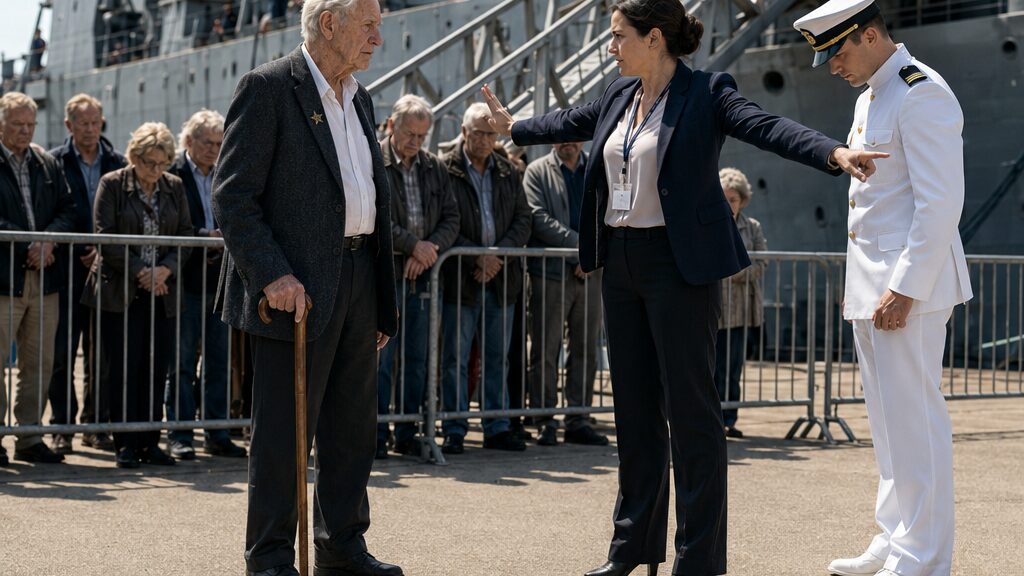
The woman with the event badge said it loudly enough for the people behind Robert Harris to hear.
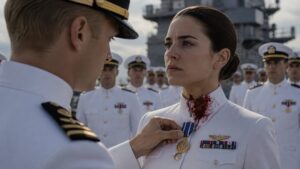
Robert stood beneath a blue sign marked VETERAN ACCESS, one hand resting on the curved handle of his polished wooden cane. Beyond the barrier, the restored destroyer rose from the pier in slabs of gray steel. Dress flags ran from bow to mast. Sailors in white uniforms moved along the gangway while a photographer backed between them, capturing the kind of careful excitement that belonged in brochures.
The woman pointed toward the public line.
“Sir, general admission begins over there.”
Robert did not turn. “I can read the sign.”
Her mouth tightened. “Then you understand this entrance is for registered veterans.”
The young naval officer beside her glanced at a tablet. His nameplate read KING. His uniform was so clean that the morning light seemed to sit on his shoulders.
“I’m not finding a Robert Harris,” he said.
“Try Harris, Robert.”
“I did, sir.”
The woman drew out the next sentence as though addressing someone who might forget it halfway through.
“You need to step behind the other barrier.”
Robert’s cane struck the pier once.
It was not a dramatic sound. Just wood against concrete. But the old rhythm returned through his wrist: test the deck, place the weight, move only when the footing answered.
Three elderly men in service caps waited behind him. None spoke. A woman with a small flag lowered her eyes. The foundation photographer kept filming.
Robert looked up at the ship. The port side had been repainted, but the lines were still there beneath the newer work. The hawsepipe sat where it always had. The aft ventilator was wrong by six inches.
He had not come for the ceremony.
He had come for one compartment no visitor was supposed to see.
The woman moved closer. “Lieutenant King, please escort him to general admission. We’re already seven minutes behind.”
King stepped around the barrier.
“Sir, may I—”
“No.”
The officer stopped.
Robert did not raise his voice. “You may tell me where the access list came from.”
“The heritage foundation supplied it.”
“And who supplied the foundation?”
The woman answered. “The Navy, registered veterans’ groups, sponsors and invited families. This is not something we can debate at the gate.”
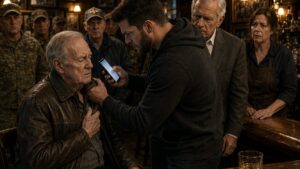
A breeze came off the water and tugged at her lanyard. Robert shifted his cane to keep his balance. The small brass token inside his left lapel caught briefly against the edge of his jacket.
The woman reached toward it.
“This also can’t be displayed in the controlled photography area unless it has been approved.”
Robert moved back, but not quickly enough.
Her plastic badge snagged the old clasp.
There was a faint metallic snap.
The brass piece dropped, struck the pier and spun once between Robert’s cane and King’s polished white shoe.
The woman froze.
Robert’s fingers tightened around the cane.
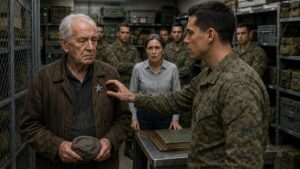
The token had five uneven points, more like something cut in a shipyard than a proper star. Its face was darkened by age. On the reverse, exposed to the sun, were shallow hand-cut marks: C-17, followed by four sets of initials.
King bent down.
“Don’t touch the face with bare fingers,” Robert said.
The officer stopped with his hand inches from it.
“The salt gets into the scoring.”
King looked up. Something in his expression had changed—not recognition yet, but attention.
He pulled a white handkerchief from his pocket and unfolded it across his palm.
“May I pick it up, Mr. Harris?”
The woman glanced sharply at him. “Lieutenant—”
“I asked him a question.”
Robert studied the young man’s hand. It was steady.
“Yes.”
King lifted the token by its edges and turned it over inside the cloth. His eyes settled on the compartment designation.
“C-17,” he said.
“You know it?”
“I’ve seen it.”
“Where?”
King did not answer immediately. He looked past Robert toward the ship’s forward superstructure.
“In a restricted restoration summary.”
The woman gave a quick, dismissive breath. “A scratched number proves nothing.”
“No,” Robert said. “It doesn’t.”
King examined the marks again. “The restoration report called it Compartment Charlie-One-Seven.”
“That’s what the museum calls it.”
“What did the ship call it?”
Robert looked up at the gray hull.
“After the first refit, nobody called it Charlie-One-Seven. It was Four-Frame Auxiliary, port access. The old fire-main valve sat behind the electrical trunk, not beside it. You had to reach under the cable tray to dog it shut.”
King’s back straightened.
The woman noticed.
“You could have learned that from a tour guide,” she said.
“No tour guide has been through there,” King replied.
Robert held out his hand for the token.
King returned it on the folded cloth rather than dropping it into Robert’s palm.
“Thank you,” Robert said.
The broken clasp hung from the back.
King’s voice lowered. “Were you stationed aboard?”
Robert tucked the token into his inside pocket. “I worked where the ship needed me.”
“That isn’t an answer.”
“It is the one I gave.”
The woman stepped between them. “Lieutenant, we have a security procedure. We cannot turn every personal story into an exception.”
Robert looked at her badge. CYNTHIA ROBERTS, EVENT DIRECTOR.
“You didn’t hear a story.”
Cynthia’s cheeks colored.
A whistle sounded from the gangway. The first official boarding group had begun to form. Honor guard sailors aligned themselves beside the rail.
Cynthia checked her watch.
“Mr. Harris, your choices are general admission or the waiting area while we verify your identity. You cannot remain here.”
“I know who I am.”
“That is not what we’re verifying.”
Robert felt the eyes behind him. Not cruel eyes. Worse, perhaps. Passive ones. People who sensed something wrong but were grateful not to be the person holding up the line.
King turned the tablet toward himself and began typing.
Cynthia said, “Lieutenant, that device does not contain the restoration archive.”
“It contains the event security portal.”
“He is not on the event list.”
“No,” King said. “But C-17 is.”
Robert’s cane touched the concrete again.
King opened a secondary file. His expression sharpened as he scrolled.
Cynthia moved beside him. “What are you looking at?”
“A restricted-site flag attached to today’s opening inspection.”
“This is a public ceremony, not an inspection.”
“Apparently both.”
He enlarged a line of text.
Robert watched the young officer read it once, then a second time.
King lifted his eyes.
“Mr. Harris, the restored compartment is still sealed.”
“That is why I came.”
Cynthia folded her arms. “You just said you weren’t here for the ceremony.”
“I’m not.”
“The ship is not open for private visits.”
“I didn’t ask for one.”
“Then what exactly do you want?”
Robert looked at the gangway, at the white uniforms, at the flags trembling above a deck where men had once run blind through smoke.
“To leave something where it belongs.”
King glanced toward Robert’s inside pocket.
“The token?”
Robert did not answer.
The officer returned to the tablet. “There’s a note attached to the compartment file. It was entered by the restoration team four months ago.”
Cynthia leaned closer.
King read silently. Then his face lost the last trace of impatience.
“What?” Cynthia asked.
He angled the screen away from the growing line and spoke quietly.
“It says, ‘Contact survivor before opening.’”
Robert’s hand closed over the top of his cane.
King looked directly at him.
“The listed survivor is Robert Harris.”
Robert’s gaze stayed on the ship.
“You have the wrong man,” he said.
Chapter 2: The Invitation Robert Never Intended to Use
“Grandpa!”
Rachel Harris came through the public line with one shoe half untied and anger carrying her faster than caution.
Robert had been placed in a folding chair outside the temporary security office. Nicholas King stood nearby, speaking into a radio. Cynthia Roberts was behind a canvas wall arguing with someone about a delayed boarding sequence.
Rachel stopped in front of Robert and looked him over from head to toe.
“Did you fall?”
“No.”
“Are you hurt?”
“No.”
“Why did you leave the house before six in the morning without your phone?”
“I left it charging.”
“You left a note that said, ‘Went to the ship.’ That is not a plan. That is a clue.”
Robert adjusted the cuff of his dark jacket.
Rachel turned on King. “Who moved him out here?”
King removed his cap before answering. “Ma’am, there was a problem with his registration.”
“He’s eighty-two years old.”
“I’m aware.”
“Then why is he sitting outside a security trailer?”
“Because he refused general admission.”
Robert tapped his cane against the chair leg.
“I can answer for myself.”
Rachel looked at him. “That would be new today.”
The remark landed harder than she intended. He saw it in the way her mouth changed afterward, but neither of them took it back.
Cynthia emerged from the office holding a printed form.
“We’re working to resolve the matter. Lieutenant King found a restoration reference connected to Mr. Harris, but we still need confirmation.”
Rachel said, “Confirmation that he served?”
“Confirmation of his relationship to the restricted compartment.”
“He was Navy for twenty-two years.”
Robert turned his head.
Rachel caught the look. “What? That isn’t classified.”
Cynthia’s tone softened, though not by much. “If he had included that information during registration, this would have been much simpler.”
“I didn’t register,” Robert said.
Rachel stared at him. “You told me you were going to.”
“I said I had received something.”
“That is not the same sentence.”
King crouched beside the cane.
“Mr. Harris, may I look at the lower section?”
Robert frowned. “Why?”
“You said you came to leave something. The token was in your jacket. I’m trying to understand whether there were additional documents.”
Rachel gave King an uncertain glance. “There’s a storage sleeve inside the shaft. He keeps emergency information there.”
Robert moved the cane away.
Rachel caught it before he could.
“Don’t.”
“Rachel.”
“You disappeared before sunrise, refused to register and told an officer they had the wrong survivor. I’m done pretending your silence is the same thing as independence.”
She twisted the small brass collar beneath the handle. A narrow compartment opened. Inside were two folded medical cards, a house key and a cream-colored envelope worn soft along its edges.
Robert looked toward the ship.
Rachel pulled out the envelope.
The return address belonged to the naval heritage foundation.
Cynthia recognized it first.
“That is one of our formal invitations.”
Rachel unfolded the letter. A second sheet slipped onto Robert’s lap.
Across the top was the ceremony program. A heavy black line had been drawn through Robert’s printed name.
Rachel read aloud before Robert could stop her.
“Special recognition: Robert Harris, lone hero of Compartment C-17.”
The words seemed to make the air inside the waiting area smaller.
King’s eyes moved from the paper to Robert.
Cynthia said, “So you were invited.”
Robert took the program from Rachel and folded it along the old crease.
“I did not accept.”
“You also did not decline,” Cynthia said. “Our office called three times.”
“I heard the messages.”
Rachel lowered herself into the empty chair beside him. “You knew they wanted you here.”
“They wanted somebody who doesn’t exist.”
King leaned one shoulder against the trailer frame. “The lone hero?”
Robert’s thumb pressed over the black line crossing his name.
Cynthia exhaled. “Mr. Harris, ceremonial language is often simplified for the public. It doesn’t mean anyone intended to misrepresent your service.”
“You put words under a man’s name, they become his words.”
“The phrase came from the archived action report.”
“That does not make it true.”
Cynthia looked toward the pier, where volunteers were redirecting guests around the delayed veterans’ gate.
“We made an access error,” she said. “I’ll acknowledge that privately. But you arrived without credentials after ignoring our office. You allowed the staff to believe you were an unregistered visitor.”
Robert lifted his gaze. “You believed I was confused before you asked why I was there.”
Her jaw worked once.
King spoke before she could answer. “We can issue a replacement veteran badge.”
Cynthia picked up a blank badge from the office table and fed it through a portable printer.
A minute later she handed it to Robert.
His name appeared in large letters.
Beneath it, in smaller type, was the same title.
LONE HERO OF C-17.
Robert did not take it.
King saw the words and turned to Cynthia. “Can that line be removed?”
“It is pulled from the event database.”
“Then change the database.”
“That requires foundation approval.”
“I’m standing beside the foundation’s event director.”
“It also requires program authorization, and the ceremony begins in less than four hours.”
Robert rested both hands on the cane.
“Keep it.”
Cynthia held the badge out. “Without it, you cannot board.”
“Then I won’t board under that name.”
Rachel stared at him. “You came all this way to get onto that ship.”
“I came to put the token back.”
“Where?”
He said nothing.
Her anger returned, but it had changed direction. It no longer pointed only at Cynthia or King.
“You hid the invitation inside your cane,” she said. “You let me think this was some sudden decision. You knew there would be a ceremony.”
“I knew there would be a mistake.”
“And you thought saying nothing would fix it?”
Robert’s fingers moved over the smooth handle. The wood had been shaped from an old length of ash, rubbed down until it fit his palm. He had carried it for nine years. Before that, he had carried other things.
Cynthia’s radio crackled.
A voice said the ship’s historian needed to speak with her immediately.
She answered, “Can it wait?”
“No, ma’am. It concerns the memorial compartment.”
Cynthia looked at Robert.
“What now?”
The historian appeared at the entrance to the waiting area, out of breath and holding a tablet against his chest.
“Commander Thomas asked for the restored plate to be uncovered before rehearsal,” he said. “We removed the protective cloth.”
“And?”
The historian glanced at Robert, then at the badge still in Cynthia’s hand.
“The plaque is already engraved.”
Cynthia’s shoulders lowered slightly. “That was the plan.”
“The inscription is not the same as the approved restoration text.”
King stepped closer. “What does it say?”
The historian swallowed.
“It names Robert Harris as the sole sailor who saved Compartment C-17.”
Robert’s cane stopped moving.
Rachel looked at him. “Sole sailor?”
The historian continued, more quietly.
“There are no other names.”
Robert took the folded program from his lap, tore it once through the printed title and placed both halves on the empty chair beside him.
“Then the plate is wrong too,” he said.
Chapter 3: Four Initials Scratched Beneath the Star
“That cable trunk was moved after the fire.”
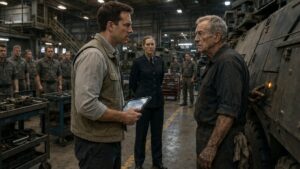
Robert’s voice came from behind a row of archival cabinets before Commander Jeffrey Thomas entered the museum records room.
The maintenance chief stood beside an enlarged diagram mounted on a light table. Nicholas King had placed the scratched brass token under a magnifying lens. Rachel remained near the doorway, arms folded, while Cynthia watched the clock on the wall as if it were an adversary.
Jeffrey paused inside the hatch.
He was a broad-shouldered man in dress whites, his cap tucked beneath one arm. His eyes went first to Robert’s cane, which lay across two chairs, then to Robert himself.
“I was told we had an identity issue,” Jeffrey said.
Robert pointed to the diagram.
“You have a bulkhead issue.”
The commander approached the table.
Robert traced a line without touching the paper. “This trunk is shown against the forward frame. It wasn’t there when the ship commissioned. After the first refit, they shifted it aft to clear the fire-main access.”
The maintenance chief said, “The restoration plans show the trunk in its current position.”
“Current plans are not old plans.”
Jeffrey looked at Nicholas. “Lieutenant?”
“Mr. Harris identified the valve arrangement before boarding. The C-17 restoration summary mentions an undocumented modification, but it doesn’t specify what.”
Cynthia said, “None of this changes the event schedule.”
Jeffrey ignored her for the moment.
“Mr. Harris, how do you know where the trunk used to be?”
Robert looked through the small porthole in the records room door. A section of the ship’s deck was visible beyond it, freshly painted, clean enough to deny that heat and smoke had ever touched it.
“I bruised my shoulder on it often enough.”
The maintenance chief leaned toward the commander. “There’s one way to confirm it. We can send a scope through the inspection seam.”
“How long?”
“Ten minutes.”
Cynthia checked the clock again. “We do not have ten minutes for a cable trunk.”
Robert reached for his cane.
“Then you don’t have time for me either.”
Jeffrey lifted a hand. “Wait.”
The gesture was not a command so much as a request made by a man accustomed to his requests becoming commands.
“Run the scope,” he told the maintenance chief.
Cynthia stepped aside and lowered her voice. “Commander, the first donor reception begins in an hour. The restoration grant committee is already aboard.”
“I know.”
“They were promised a completed exhibit.”
“They were promised an accurate one.”
“We have an archived report, an engraved plaque and a named honoree who chose not to answer our calls.”
Robert turned toward her.
“That last part is true.”
Cynthia seemed briefly unprepared for his agreement.
The maintenance chief left with the diagram. Silence settled over the room, broken by the hum of the ventilation fan and distant footsteps on steel.
Nicholas adjusted the magnifying lens.
“Mr. Harris, may I ask about the initials?”
Robert looked at the token beneath the glass.
R.H.
R.B.
J.M.
T.L.
The cuts were uneven. One set had been scratched deeper than the others, as if the hand holding the tool had slipped or pressed too hard.
“You may ask.”
“Will you answer?”
“That depends on the question.”
Nicholas pointed without touching. “Are these members of the damage-control team?”
Robert’s eyes remained on the brass.
“Some.”
Rachel moved closer. “You never showed me that.”
“It wasn’t for showing.”
Cynthia said, “If those initials can establish the historical record, we need the names.”
Robert looked at her. “You already engraved a plate without them.”
The words struck more cleanly than an accusation shouted across the room.
Jeffrey set his cap on a cabinet.
“Mr. Harris, I’m not asking you to excuse what happened at the gate. I’m asking you to help us determine what is true.”
“You have records.”
“We have conflicting records.”
“You have the report you wanted.”
Jeffrey’s gaze sharpened. “What does that mean?”
Before Robert could answer, the maintenance chief returned carrying a flexible inspection scope and a grease-marked photograph on his tablet.
“You were right,” he told Robert.
He enlarged the image.
Behind the restored cable trunk, half obscured by paint and insulation, an older mounting bracket remained bolted to the forward frame. Beside it was the capped end of a pipe branch not shown on the modern plans.
“The fire-main valve used to sit exactly where he said,” the chief continued. “The branch was cut during the refit. Whoever documented the compartment missed it.”
Jeffrey faced Robert fully.
“You served aboard this ship.”
Robert’s mouth tightened.
It should have felt like a door opening. Instead it felt like the old one closing again.
Nicholas reached for a file box containing copied personnel rosters. “We can verify the initials.”
The ship’s historian slid into the chair beside him and began searching.
“Robert Harris,” he murmured. “Damage Controlman First Class.”
Robert corrected him. “Petty Officer. Ship’s crew did not call men by a museum label.”
The historian nodded. “Robert Harris. Ronald Baker. Both assigned to Engineering Repair Two.”
At the name Ronald Baker, Robert’s hand shifted on the cane.
Nicholas saw it.
The historian continued.
“J.M. matches a casualty entry. T.L. also matches.”
Rachel leaned over the table. “Casualties from the fire?”
The historian nodded.
“What were their full names?” she asked.
Robert answered before the man could.
“Their families did not give permission for you to turn them into an afternoon attraction.”
Rachel drew back.
Robert regretted the sharpness at once, but he did not soften it.
Nicholas studied the token again. “There are four sets of initials, but the restoration summary lists three men who died in the compartment.”
Robert’s face became still.
Jeffrey said, “Who was the third?”
“No initial.”
“Why not?”
“Because the token was made afterward.”
The room seemed to contract around that one sentence.
Nicholas looked up. “You made it?”
“Yes.”
“For the survivors?”
Robert did not answer.
“For everyone who was there?” Rachel asked.
His thumb moved across the cane handle.
The historian opened another file. “Commander, I found the action report.”
Jeffrey held out his hand.
The copied pages were thin and yellowed at the edges. The report described a machinery-space fire, an isolated electrical failure and a decisive action by Robert Harris, who had secured a compromised compartment and prevented the spread of flames toward an ammunition transfer line.
It contained no mention of Ronald Baker.
No mention of J.M. or T.L.
No mention of the third sailor whose initials were absent from the token.
The last page carried Robert’s signature.
Jeffrey read the concluding paragraph twice.
“This states that you acted alone.”
Robert stared at the signature. The younger hand that had written it had been steady. That offended him most.
Cynthia moved beside Jeffrey and read over his shoulder.
“The ceremony language came directly from this.”
Rachel looked from the report to her grandfather.
“You signed it.”
“Yes.”
“Then why are you saying the plaque is false?”
Robert reached across the table and pulled the report closer.
For a moment, he seemed to be reading it. In truth, he was seeing the room where it had been placed before him, the metal desk, the officer who had kept his voice low, the coffee untouched between them.
Nicholas asked, “Did someone falsify your signature?”
“No.”
“Were you ordered to sign?”
Robert’s eyes stayed on his own name.
Jeffrey said, “Mr. Harris, if the report is wrong, I need to know which part.”
Robert folded the final page back over the others.
“The signature is mine,” he said.
Cynthia released a breath that sounded almost like relief.
Then Robert looked at the four initials beneath the magnifying glass.
“And the report is still a lie.”
Chapter 4: The Hero Story the Navy Preferred
“Then I held the line alone.”
The voice came through the open wardroom door in the smooth, measured tone of an actor practicing words meant to sound remembered.
Robert stopped so abruptly that Rachel nearly walked into him.
Inside, a man stood beneath a portable light reading from a teleprompter. Behind him, a projection screen showed a black-and-white photograph of Robert at twenty-three: narrow-faced, grease on his collar, eyes turned away from the camera.
The actor tried the sentence again.
“Then I held the line alone, because that is what sailors do.”
Robert planted his cane.
“I never said that.”
The rehearsal stopped.
Cynthia, standing beside a technician, closed her eyes for half a second. Jeffrey Thomas came up behind Robert with the copied action report still in his hand.
“The script was adapted from the report,” Cynthia said.
“That sentence is not in the report.”
“It was written to connect the historical material for a general audience.”
“You connected it to my mouth.”
The actor stepped away from the teleprompter. The technician lowered the projection volume, but the photograph remained on the screen, Robert’s younger face larger than anyone in the room.
Nicholas entered carrying a small repair kit borrowed from the ship’s museum workshop. He took in the frozen rehearsal, then quietly moved to a side table.
Jeffrey addressed the technician. “Pause everything.”
Cynthia crossed to him. “We are already behind. The donor committee tours the wardroom in forty minutes, and the public ceremony begins at sixteen hundred.”
Jeffrey held up the report.
“This document may be inaccurate.”
“It is an official action report.”
“So was the restoration plan until Mr. Harris showed us a pipe we had missed.”
“The grant committee did not finance a debate over a sixty-year-old report.”
Robert looked at her.
“No. They financed a story.”
Cynthia faced him. Her control had begun to fray at the edges, though her voice stayed low.
“They financed preservation. Steel replacement, corrosion control, archival storage, public access. None of that happens because people enjoy reading maintenance logs. Stories bring them here.”
“Then tell one that happened.”
The technician, uncertain whether he was still supposed to be present, switched the projection to the next frame.
Three casualty photographs appeared for less than a second before dissolving into Robert’s portrait. Their names were absent. A title rose over the image:
THE MAN WHO SAVED C-17.
“Stop it there,” Robert said.
The technician froze the screen.
Robert moved closer. His cane sounded once, then again, against the deck.
“Go back.”
The three faces returned. Young men in working uniforms, photographed separately. One was smiling. One had been caught blinking. The third stared directly at the camera with a confidence Robert remembered disliking until the day he needed it.
No names.
Rachel stood beside him. “Are those the men?”
“Some of them.”
“Why aren’t they identified?”
The historian answered from the back of the room. “The montage was built from cleared public materials. The families did not all respond to release requests.”
Robert studied the photographs.
“You found enough permission to use their faces.”
No one answered.
Nicholas had set the brass token on a square of white cloth. With a pair of fine pliers, he worked on the broken clasp. He did not look up.
Jeffrey approached Robert.
“I can arrange a private visit to C-17 before the ceremony. No press, no donors. You can place the token there yourself.”
Robert turned from the screen.
“And the program?”
“We will review it after today.”
“The plaque?”
“We can cover it until the wording is verified.”
“You mean uncover it again when I’m gone.”
Jeffrey’s jaw shifted. “I am trying to give you what you came for.”
“You are trying to keep both things. A clean ceremony and a quiet old man.”
The words remained between them.
Jeffrey did not deny it.
Cynthia stepped toward the table and lowered her voice, as if privacy could still be recovered.
“The foundation is in the final stage of a preservation grant worth enough to keep this ship open for years. The committee expects a coherent public account. If today becomes a dispute over records, they may delay funding or withdraw.”
Rachel said, “So the wrong story stays because it raises money?”
“That is not what I said.”
“It is what you described.”
Cynthia looked at Robert, not Rachel.
“My father is seventy-nine. Some mornings he knows exactly which bus he drove for thirty-two years. Some mornings he insists he never had a license. I have learned that memory can be absolute and still be wrong.”
Robert’s expression did not change.
“You decided what I was before I opened my mouth.”
“I decided that a crowded pier, a missing credential and a restricted gangway required procedure.”
“You spoke louder because I was old.”
A flicker crossed her face. Shame, perhaps, but it did not make her surrender.
“And you withheld the invitation, ignored our calls and denied being the listed survivor. You made verification harder.”
“That is also true.”
Rachel looked at him, surprised again by his refusal to make himself blameless.
Jeffrey placed the report on the wardroom table.
“Why did you sign it?”
Robert looked at the screen, where the three unnamed faces waited.
He could still smell scorched insulation if he let himself. He could still hear the metal lever slam into its housing. For years he had believed memory remained sharp because punishment required accuracy.
“A commanding officer put it in front of me,” he said.
“Did he order you?”
“He explained what would happen if the fire became an operational failure instead of an isolated equipment casualty. Hearings. Delays. The ship’s commissioning future questioned. Families held in uncertainty while every decision was examined by men who had not been in the smoke.”
Jeffrey’s gaze stayed on him. “And the missing sailors?”
“They were called unrecoverable losses from the initial fire.”
“Were they?”
Robert’s hand closed around the cane.
“They were alive when the hatch was shut.”
Rachel inhaled softly.
Cynthia looked toward the frozen screen.
The actor had removed his microphone and stood near the door, forgotten.
Jeffrey asked, “Who wrote the account crediting you alone?”
“A man who said one decisive sailor was easier for Washington to understand than six frightened men making decisions in the dark.”
“And you signed.”
“Yes.”
The admission had no defense in it.
Nicholas finished shaping the clasp. He lifted the token carefully.
“I can secure this now, sir.”
Robert looked at the repaired pin.
Nicholas waited rather than approaching.
After a moment, Robert said, “Not yet.”
The young officer nodded and set the token back on the cloth.
The restraint mattered more than Robert wanted it to.
A corpsman entered, took one look at Robert’s color and opened a medical bag.
“I’m fine.”
Rachel reached for his wrist.
“You’re pale.”
“I have been pale since the Eisenhower administration.”
“Sit down.”
He almost refused simply because she had told him to. Then the room tilted slightly beneath his feet.
Rachel guided him into a chair. This time he allowed it.
The corpsman wrapped a cuff around his arm. As it tightened, Robert watched his younger face on the screen and understood something he had avoided for decades. His silence had not kept the dead from being used. It had merely left other people free to choose the use.
The wardroom speaker crackled.
“Event director, be advised the lead donor party is boarding.”
Cynthia checked her watch.
Jeffrey turned to the technician. “Remove the quotation attributed to Mr. Harris.”
“The whole segment?”
“All language he did not personally approve.”
Cynthia said, “That leaves gaps.”
“Then we have gaps.”
It was a small correction. Robert saw how much effort it cost them to make even that.
The wardroom door opened again.
An elderly man stood in the passage wearing a brown jacket too heavy for the warm afternoon. His white hair was combed straight back. One hand held the rail. In the other was a brass star-shaped token, dark with age.
Robert’s heart gave a single hard beat beneath the medical cuff.
The man looked first at the screen, then at the report on the table.
Finally, he looked at Robert.
“Ronald,” Robert said.
Ronald Baker entered the wardroom without offering his hand.
“I asked them to let me speak to you before the ceremony,” he said.
His token rested in his palm, its four scratched initials catching the projector light.
“Before you lie for us one more time.”
Chapter 5: The Hatch They Both Heard Closing
“I didn’t come to accuse you.”
Ronald’s words followed them down the narrow passage toward the sealed compartment.
Robert moved slowly, his cane finding the deck between each step. Nicholas walked behind him without touching his arm. Rachel stayed close enough to catch him if necessary, though he could feel her effort not to crowd him.
Ronald kept several paces ahead.
“You chose a strange opening line,” Robert said.
“I had fifty-eight years to improve it.”
Jeffrey had cleared the lower passage and ordered the rehearsal delayed. Cynthia remained with the event staff above, trying to keep donors occupied without promising them a version of the afternoon no one could yet guarantee.
At the end of the corridor, a temporary steel panel covered the entrance to C-17. New bolts shone against old paint. A restoration notice hung from a chain.
AUTHORIZED PERSONNEL ONLY.
Ronald stopped before it.
“The Navy is about to turn my cowardice into your heroism,” he said. “I won’t let them do it again.”
Rachel looked from one man to the other.
Robert leaned both hands on the cane.
“You were not a coward.”
“I begged you to open the hatch.”
“You had a brother below it.”
“I begged you to risk the ship for him.”
The passage seemed to lose its present shape.
Robert heard alarms flattened by smoke. Men shouting through breathing masks. Water striking hot metal and returning as steam. Ronald’s hands had been burned through his gloves from trying to turn a wheel that no longer mattered.
The fire had crossed the cable runs before anyone understood how far it had spread. Beyond C-17 lay the ammunition transfer line. The temperature indicators were climbing. If the flames reached it, the damage would not remain inside one compartment.
Robert had been the senior man still conscious at the boundary.
He had ordered the hatch shut.
Ronald touched the steel panel with two fingers.
“My brother was on the sound-powered phone,” he said. “I heard him before the line failed.”
Rachel lowered her eyes.
Nicholas stood motionless.
Robert remembered that voice too, though he had spent years denying himself the exact sound. A young sailor reporting heat, smoke, a failed secondary exit. Still following procedure while the compartment became impossible.
“You told me we had forty seconds,” Ronald said.
“We had less.”
“I said we could get them out.”
“You said we had to try.”
“And you said no.”
Robert’s cane tip shifted against the deck.
“I said secure the hatch.”
Ronald turned.
“You dogged it yourself.”
“Yes.”
The word left Robert without resistance.
Behind the sealed panel, the old locking dogs remained, restored and painted, displayed as hardware rather than choice.
Jeffrey spoke quietly. “What happened after?”
Robert looked at him.
“The fire-main pressure was failing. We had one hose team left. The transfer line ran through the next section. We shut C-17, cooled the boundary and flooded the adjacent trunk.”
“You prevented the fire from spreading.”
“We prevented one thing. We caused another.”
Ronald’s mouth tightened. “No. The fire caused it.”
“I closed the door.”
“And if you had opened it, more men might have died.”
“Might.”
Ronald struck the panel with the side of his fist. Not hard. Hard enough to make the chain tremble.
“That word has eaten both of us.”
The sound traveled down the passage.
Robert’s cane tapped once as he steadied himself. The echo returned from the sealed metal in the same blunt rhythm he had heard after the hatch closed: wrench, dog, steel, silence.
Ronald opened his hand.
His brass token matched Robert’s, but the points were less even. On the reverse were the same four groups of initials.
“I thought you made one,” Robert said.
“I made two.”
Robert looked at him.
“The night before they transferred me,” Ronald continued. “You were asleep in medical. I cut them from scrap plate.”
“You told me mine came from the yard.”
“I lied.”
“Why?”
“Because if I told you I made it, I would have had to speak to you.”
Robert’s face hardened.
“You managed not to for fifty-eight years.”
“Yes.”
The answer carried no excuse.
Ronald stared at the initials.
“After the inquiry, I heard you had signed the report. Heard they were calling you the sailor who saved the ship. I let myself believe you wanted it.”
“You knew me better.”
“I knew myself worse.”
The speaker mounted in the passage clicked alive.
“Commander Thomas, public tribute begins in twenty minutes.”
Jeffrey pressed the response switch.
“Understood.”
The announcement gave the past a deadline.
Ronald continued before anyone could move.
“I was ashamed of what I asked you to do. Open the hatch. Let the fire breathe. Risk every man aft because my brother was behind that door. I thought if I looked at you, I’d hear myself saying it again.”
Robert’s fingers tightened around the cane handle.
“I thought you blamed me.”
“I did.”
The honesty struck cleaner than mercy.
“For a while,” Ronald said. “Then I blamed the officer who wrote the report. Then the investigators. Then the ship. Mostly, I blamed anybody who let me avoid admitting that you made the choice I could not.”
Robert looked at the sealed entrance.
“You should have blamed me.”
“No. I should have spoken to you.”
Ronald stepped closer, but left space between them.
“You signed because they told us the families would wait years if the inquiry widened. They said the ship might be taken out of service before commissioning. They said the dead would become evidence.”
Robert’s eyes remained on the panel.
“They said your brother’s last transmission would be played in hearings.”
Ronald’s face tightened.
“And I told you to sign.”
Rachel looked up sharply.
Robert turned to Ronald.
“You said nothing.”
“I stood outside the room. When you came out, I asked if it was done. You nodded. That was me telling you to sign without having to carry the pen.”
For decades Robert had kept Ronald’s silence as a verdict. He had sharpened it, preserved it, used it whenever anyone tried to tell him he had done what duty required.
Now it changed shape in front of him.
Not forgiveness.
Shared failure.
Shared fear.
Shared survival.
Nicholas spoke carefully. “The fourth casualty—the man whose initials aren’t on the token.”
Ronald looked at Robert.
Robert answered.
“He was on the other side of the hatch. Ronald made the tokens before the final casualty list was released. We knew three were trapped. We did not know the boundary team leader had gone back for them.”
The young officer’s eyes lowered.
Jeffrey removed his cap.
“The plaque cannot remain as it is,” he said.
Robert gave a tired, humorless breath. “That is the smallest problem in this passage.”
“What do you want the record to say?”
Robert looked at Ronald.
Ronald did not answer for him.
That mattered.
The speaker clicked again. Music from the pier bled faintly through the ship’s structure. Above them, guests were taking their seats. Programs bearing Robert’s false title rested in their hands.
Rachel touched his sleeve.
“You don’t have to go out there.”
He had expected her to urge him home. The permission to leave made the choice harder.
“If I go,” he said, “they will turn this into another version.”
“Only if you let them write it first.”
Robert looked at her.
For years he had treated silence as discipline. Now he saw the damage it had done in her as well—the careful questions she had stopped asking, the family history built around rooms no one entered.
Jeffrey stepped toward the panel.
“Mr. Harris, tell me what must change.”
Robert’s back hurt. His blood pressure was still too high. The repaired brass token waited above in the wardroom, and a crowd had gathered to hear a story that had already been polished past truth.
He planted the cane squarely on the deck.
“The ceremony,” he said.
Jeffrey nodded once.
“The plaque.”
Another nod.
Robert looked toward the passage leading up to the pier.
“And the first sentence you say.”
Chapter 6: No Ceremony Until Every Name Is Read
“One sailor stood alone.”
The false words rolled across the pier before Robert reached the stage barrier.
A giant screen showed his younger face above the seated crowd. Music swelled beneath the narration. On the platform, the master of ceremonies stood beside Jeffrey’s empty place, waiting for a cue.
Cynthia held the control tablet in both hands.
Robert stopped at the end of the aisle and planted his cane on the concrete.
Nicholas stood beside him with the repaired brass token wrapped in white cloth. Ronald waited on Robert’s other side, his own token pinned inside his jacket rather than displayed.
Rachel remained one step behind.
The narrator continued.
“When fire threatened the ship, Robert Harris acted without hesitation—”
“No,” Robert said.
The word was not amplified, but Nicholas heard it.
So did Cynthia.
She looked down the aisle. For one instant, her eyes met Robert’s. Then she turned to the donor representative beside the control station.
“We need to stop the montage.”
The representative shook his head. “We are live.”
“The material is disputed.”
“It was approved.”
“Before we verified it.”
The representative reached toward the tablet. Cynthia pulled it back.
On the screen, the unnamed casualty photographs flashed and disappeared.
Robert’s cane struck the pier.
Cynthia pressed the control.
The screen went black.
The music died in the middle of a rising chord.
A murmur moved through the audience.
The donor representative whispered sharply, “Do you understand what you are risking?”
Cynthia set the tablet on the console.
“Yes.”
She did not look relieved. She looked frightened and committed, which Robert trusted more.
Jeffrey stepped onto the platform without the prepared script. He approached the microphone and waited until the pier quieted.
“The account you were about to hear is incomplete,” he said.
The master of ceremonies shifted beside him.
Jeffrey continued. “It was drawn from an official report, but official does not always mean whole. We intended to honor service today. Instead, we nearly repeated an error made decades ago.”
No applause came. Robert was grateful.
Jeffrey looked toward him.
“Mr. Harris, will you join us?”
Nicholas moved as if to offer his arm, then stopped.
“May I assist you, sir?”
Robert looked at the steps leading to the platform.
“Yes. At the elbow.”
Nicholas supported him exactly where asked, applying no more pressure than necessary. When they reached the barrier, Robert paused.
Ronald had remained behind.
Jeffrey said, “Mr. Harris, the center position is yours.”
Robert looked at the empty mark taped on the stage floor.
“No.”
The audience stirred again.
He turned toward Ronald.
“Not unless he stands there too.”
Ronald’s face tightened. For a moment Robert thought he might refuse. Then Ronald came forward, slower than pride preferred.
Nicholas helped him over the low cable guard.
The two old sailors stood side by side beneath the gray hull.
Cynthia approached with the repaired token. Nicholas took it from the cloth and held it before Robert.
“The clasp is secure,” he said. “Would you like me to pin it?”
Robert looked down at the irregular brass star.
Once it had been private proof of a burden he believed no one else could understand. On the pier that morning, it had been treated as unauthorized decoration. Now dozens of eyes waited for it to become a medal.
It was none of those things.
He nodded.
Nicholas fastened it carefully inside the edge of Robert’s lapel, visible but not centered.
Ronald took out his own token and pinned it in the same place.
Jeffrey stepped back from the microphone.
Robert approached it. Rachel remained near the stairs, not pushing him forward, not speaking for him.
The crowd blurred at the edges. Robert could distinguish white uniforms, service caps, summer dresses, foundation badges. The photographer from the gate lowered his camera.
Robert looked at the black screen behind him.
“The first thing you should know,” he said, “is that nobody stood alone.”
His voice was rough but carried.
“We were a damage-control team. We were tired, frightened and working with less time than the report later gave us.”
He did not describe flames as noble. He did not call smoke an enemy or sacrifice beautiful.
He explained that a fire had crossed electrical runs faster than expected. He explained that C-17 lay between the machinery space and an ammunition transfer line. He explained that men below the hatch were still alive when the boundary had to be secured.
A child in the front row shifted against a parent’s shoulder. Somewhere near the back, a chair creaked.
Robert placed both hands over the cane.
“I gave the order to close it.”
The sentence landed without music beneath it.
“I believed then that the fire would spread if we did not. I believe that now. Believing it was necessary did not make it clean. It did not make the men behind that hatch less alive.”
Ronald stood still beside him.
Robert continued.
“Ronald Baker held the boundary line after his brother’s voice disappeared from the circuit. Others carried hoses through heat that had already burned through their gloves. Three men remained below. A fourth went back for them.”
He looked toward Jeffrey.
“The report named me because one name was easier than the truth.”
Jeffrey returned to the microphone with a handwritten page.
“We will read the full team,” he said.
The historian brought the verified names. Where family clearance remained unresolved, Jeffrey identified the sailors by service role and stated that the permanent record would include every name after direct family consultation. He did not turn uncertainty into another excuse for omission.
Ronald Baker was named.
Robert Harris was named.
The two casualties represented by J.M. and T.L. were named in full from the verified roster.
The boundary team leader who had gone back was named.
Then Jeffrey read the names of the surviving hose-team sailors and electricians whose actions had never entered the public account.
No one clapped between names.
That silence was the first respectful thing the crowd did.
When Jeffrey finished, he said, “The memorial plaque aboard this vessel will be removed today. It will not return until the account reflects the team, the dead and the decisions made in that compartment.”
The donor representative stood rigid near the control station.
Cynthia faced him.
“The corrected program will be distributed with the exhibit reopening,” she said.
He spoke through a tight jaw. “There may not be an exhibit reopening if the committee withdraws.”
Robert heard her answer.
“Then we preserve less steel and more truth.”
She did not sound heroic. She sounded as though she understood the cost and would be paying part of it.
Jeffrey turned to Robert and Ronald.
“On behalf of this command, I offer an apology for reducing your service to a convenient story.”
Robert said, “Correct the record. That will last longer.”
Jeffrey’s expression shifted—not wounded, not defensive. Listening.
“Yes, sir.”
He stepped back and raised a restrained salute.
Nicholas stood straight beside the platform and did the same.
Only the uniformed personnel joined them. The crowd remained still. No orchestrated wave of hands, no spectacle.
Robert did not return the salute. He was in civilian clothes, leaning on a cane, and had no need to perform the past.
He inclined his head.
The photographer lifted his camera, then lowered it again before taking the picture.
As Jeffrey ended the salute, a few people began to clap.
Robert turned away from the audience.
The applause faltered.
“Mr. Harris?” Jeffrey asked.
Robert looked toward the gangway.
“I want to see the plate.”
“The ceremony—”
“Can wait.”
Jeffrey studied him, then addressed the microphone.
“This portion of the program is concluded.”
Robert stepped down with Nicholas at his elbow and Ronald beside him. Rachel followed. Cynthia left the control station and joined them without asking whether she was welcome.
Together they crossed beneath the shadow of the ship.
Behind them, the audience remained seated, uncertain what came after a ceremony that had refused to give them a simple ending.
At the foot of the gangway, Robert stopped.
His cane rested against the first metal tread.
“Before anyone applauds me,” he said, “take me to what you engraved.”
Chapter 7: What Respect Looked Like After the Salute
The memorial plate was gone.
Four clean bolt marks remained in the bulkhead where the polished brass rectangle had been mounted. Against the surrounding gray paint, the empty space looked brighter than the plaque ever had.
Robert stood before it that evening with his cane planted between his shoes.
The ship had grown quiet after the crowd left. Paper programs still lay folded on several chairs above, but the music equipment had been shut down, the donor signs removed from the rail. Below deck, only the ventilation system and the occasional footstep disturbed the steel silence.
Ronald stopped beside him.
“They moved fast,” he said.
“They engraved faster.”
Jeffrey stood behind them with Nicholas, Cynthia and the ship’s historian. Rachel had found a folding chair for Robert but had not opened it. She held it at her side and waited for him to ask.
The maintenance chief carried the plate beneath one arm, its false inscription turned inward.
Jeffrey said, “It will remain off the wall.”
“Until when?” Robert asked.
“Until the record is corrected.”
“By whom?”
The historian opened a folder. “We’ll begin with the action report, deck logs, casualty records and restoration files. Then we want recorded testimony from everyone still living.”
Robert looked at Ronald.
Ronald’s matching token sat inside his lapel.
“Records don’t agree because men didn’t agree,” Robert said.
“Then the exhibit should preserve that,” Jeffrey replied. “Not force one version into a clean line.”
It was the first useful answer Robert had heard from the institution all day.
Cynthia stepped forward. Her event badge was gone. Without it, she looked less protected and more tired.
“The grant committee suspended its decision,” she said. “They did not withdraw.”
Jeffrey glanced at her.
“They want a revised preservation plan and an explanation for the program change.”
Robert said, “Give them one.”
“I intend to.”
She looked at the empty bolt marks.
“I also authorized the plate before the final family review was complete.”
Jeffrey’s expression showed that he had not known this.
Cynthia continued before he could speak.
“The engraver needed a deadline. I approved the archived language because I thought verification was a formality.”
“You thought the story was already finished,” Robert said.
“Yes.”
The admission came without defense.
Rachel opened the folding chair.
This time Robert sat before his legs could make the decision for him.
Cynthia crouched enough that she did not have to speak down toward him.
“I am not asking you to forgive how I treated you at the gate.”
“Good.”
A small movement passed across Nicholas’s face. It might have been surprise. It might have been approval.
Cynthia took several sheets from a folder.
“I am asking you to examine a new access procedure before we use it.”
Robert accepted the pages.
The first line required staff to offer seating before extended verification. Another prohibited speaking about an elderly guest’s capacity unless a medical concern was present. Veteran status could be confirmed through multiple records rather than a single digital list. Most important, the procedure required staff to ask the guest’s purpose before redirecting them.
Robert read the page twice.
“You wrote this today?”
“With help from Lieutenant King and the security team.”
“You left out one thing.”
Cynthia waited.
“Apply it to every old person. Not only veterans.”
Her eyes lowered to the page.
“Yes,” she said. “We should.”
Respect given only after proof of service would have been another kind of gate.
Several weeks later, Robert returned to the ship.
This time Rachel drove. He carried his phone in his jacket, fully charged, and told her the departure time the night before. Neither of them mentioned the significance of those details.
At the pier entrance, an elderly man in a faded work coat stood before the general-admission desk. He had no veteran cap, no military pin and no printed ticket. His hands shook as he searched his pockets.
Nicholas came around the desk.
He did not raise his voice.
“Take your time, sir. Would you like a chair?”
The man nodded.
Nicholas brought one, then asked, “What did you come to see?”
Robert stopped several yards away.
Nicholas had not noticed him yet.
There was no recognition scene, no change in posture after a clue, no reward for discovering that the man had once been important. The respect had come first.
Rachel touched Robert’s sleeve.
“You saw that?”
“Yes.”
“What do you think?”
Robert resumed walking.
“I think he learns slowly.”
She smiled. “Runs in the family.”
Inside C-17, the restored exhibit remained unfinished.
The false plaque had been replaced by a temporary panel bearing the verified names of the damage-control team. Beside it, a smaller notice explained that the historical record contained conflicting accounts and that the exhibit would include those differences rather than conceal them.
Robert’s and Ronald’s brass tokens rested inside a plain glass case. They were not described as medals. The label called them what they were: two pieces of scrap brass cut by surviving sailors after the fire.
Beside the case was an empty space marked for oral testimony.
Ronald waited near the old hatch. He had already recorded his interview that morning.
“How bad was it?” Robert asked.
“I told the truth for forty-three minutes. Felt longer.”
“Truth usually does.”
The historian arranged two microphones at a small table. Rachel placed Robert’s cane against the chair rather than across his knees.
For a moment, his hand remained on the handle.
Then he let go.
Cynthia entered carrying a final copy of the revised access policy. Robert had crossed out two phrases and written a note in the margin. She had accepted every change.
“The foundation board approved it,” she said. “All visitors, not just veterans.”
Robert nodded.
“And the grant?”
“Reduced, not lost. We’ll restore one compartment next year instead of three.”
Jeffrey came through the hatch behind her.
“We can preserve slower,” he said.
Robert looked around C-17.
“Ships survive worse.”
Nicholas approached with a small archival cloth. He opened the display case and adjusted one token by less than an inch so both sets of initials could be seen.
He asked Ronald before moving his.
Then he asked Robert.
That, too, was part of the record now: permission before handling what belonged to someone else.
The historian switched on the microphones.
A red light appeared.
Robert’s chest tightened.
For decades, he had avoided this exact thing—a room waiting for his version, a machine prepared to preserve it, people ready to attach his name to whatever he said.
Rachel sat beyond the camera. She did not prompt him.
Ronald stood near the hatch.
Jeffrey, Nicholas and Cynthia remained outside the recording area, close enough to hear but far enough not to direct him.
The historian asked, “Please state your name and your role aboard the vessel.”
Robert looked at the empty space beside the tokens.
His own name waited in his mouth. It would have been the simple beginning. The proper archival beginning.
Instead, he leaned toward the microphone.
He began with the names of the men below the hatch.
He spoke each one slowly enough that no editor could mistake it, shorten it or move past it.
Then he named Ronald.
He named the hose teams, the electricians and the sailors who carried the injured through smoke.
Only after all of them had entered the record did Robert say who he was.
The red light continued to burn.
His cane rested beside him, untouched.
The story has ended.