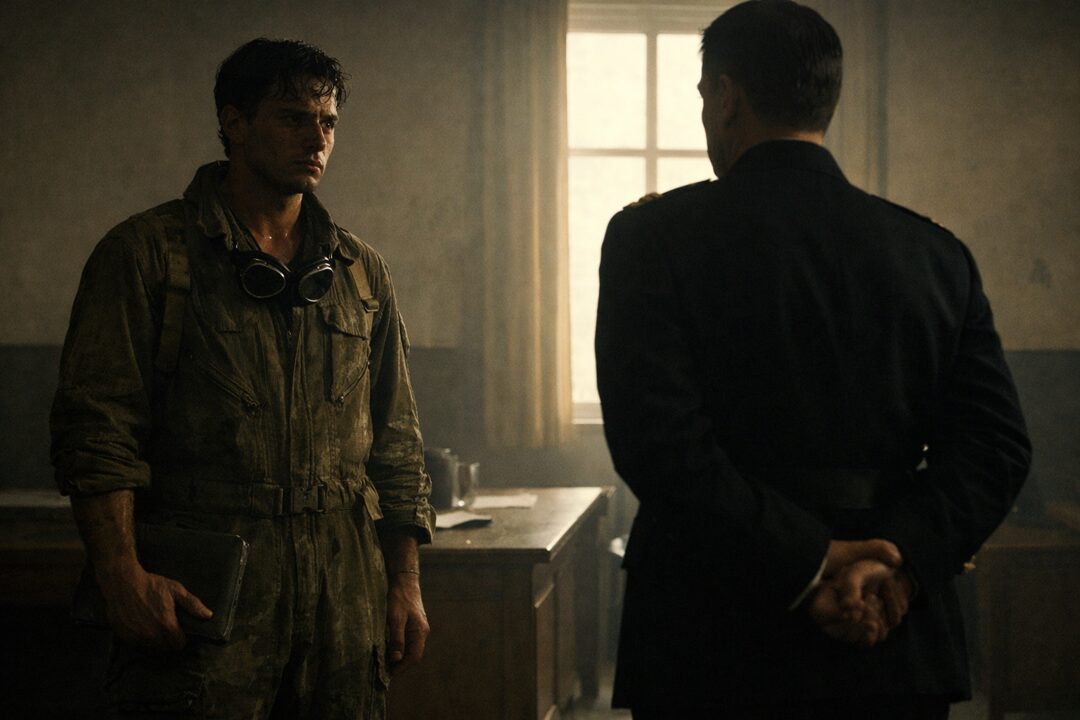
The Ninth Return
Part I — The Man Who Landed
They ran toward the plane the way men ran toward wreckage—fast, tense, ready to pull a body out of twisted metal.
But when the wheels stopped skipping over the dirt and the engine coughed into silence, Lieutenant Ren Sato lifted the canopy and climbed down by himself.
For one stunned second, nobody moved.
Then the chief mechanic, Daichi Mori, stepped in close and looked first at the fuselage, out of habit, at the dents near the wing root, the torn paint, the oil streaking the cowling. Only after that did he look at Ren’s face.
Ren was breathing too hard. His goggles had left pale rings around his eyes. He looked like a man who had fallen out of the sky and discovered the earth still willing to take him.
“Did you strike?” one of the ground crew asked.
Not Are you hurt? Not Was it bad out there?
Only that.
Ren pulled off his gloves one finger at a time. “No.”
The word passed through the men around him like a draft under a door.
He gave the report in the ready room with his cap under his arm and his throat still full of engine fumes. Major Hayama stood at the front, posture so straight it looked painful. He had a narrow face, the kind that gave nothing away unless you watched too long. Beside the wall, the younger pilots sat or stood with fixed expressions, waiting to hear whether Ren had failed or survived correctly.
“There was cloud cover over the target zone,” Ren said. “The ship formation changed position. I took anti-aircraft fire before visual confirmation. I could not verify the correct vessel.”
He kept his voice level. That was harder than the flying had been.
The room stayed silent.
Then Hayama said, “And according to standing orders?”
Ren knew what he was being made to do. He answered anyway. “If a valid target cannot be confirmed, the pilot may return.”
A chair creaked in the back. Someone exhaled through his nose, sharp with contempt.
Hayama’s eyes rested on him for one beat too long. “That rule exists.”
It should have sounded like protection. It didn’t. It sounded like a thin bridge over a deep place.
From the far side of the room, a voice cut in.
“A man can fail to see many things,” said Toma Akiyama. He was nineteen and looked younger, his face not yet finished hardening into the soldier he wanted the world to see. “Especially if he hopes not to.”
Nobody told him to be quiet.
Ren turned his head. Toma’s uniform was immaculate. He wore his certainty like polished metal.
“I saw smoke,” Ren said. “I saw decoys. I saw a destroyer or a transport—I could not confirm which through the cloud.”
Toma smiled without warmth. “And so you preserved the aircraft.”
“I preserved the mission from being wasted.”
That shifted the room.
Toma’s eyes sharpened. Hayama lifted one hand, not enough to rebuke either of them, only enough to remind them he still controlled the air in the room.
“The aircraft is damaged,” Hayama said. “The pilot is alive. The mission was not completed.” His voice stayed quiet. “Those are the facts. We will not improve them by decorating them.”
The debrief ended there.
No one spoke to Ren as he left.
Outside, the airfield lay under a white, punishing afternoon sky. Beyond the revetments the sea glimmered like something indifferent and far away. Daichi was waiting near Ren’s aircraft, wiping his hands on a rag already dark with grease.
“They want the machine checked before sunset,” Daichi said.
Ren nodded.
Daichi looked at the plane, then at Ren again. “Did you really lose the target?”
Ren almost laughed. Not because it was funny. Because it was the wrong question and the only honest one.
“I lost the certainty,” he said.
Daichi held his gaze another second, then looked away. “That will be enough to trouble everyone.”
In the barracks that night, Ren found his bedding moved a little farther from the others. Not enough to announce anything. Just enough that he had to notice.
He sat down slowly and unbuttoned the inner pocket of his tunic.
Inside was a folded letter gone soft at the corners. He had read it so many times the paper felt like cloth. It was from his sister in Nagano, written months ago, before the roads broke apart and before rice had become something families wrote about in the language of weather and prayer.
She had not asked him to live. No one dared write such things plainly anymore. She had only written, When you come back, the plum tree will have to be cut. It leans too far toward the roof, and Father keeps pretending not to notice.
When you come back.
He unfolded the page in the dark and ran his thumb across that one line until the fibers warmed.
Across the room, someone said, not loudly enough to be called an accusation, “Some men are very fortunate.”
Ren folded the letter again.
He did not sleep much.
At dawn, orders came down for another sortie.
He was on the list.
Part II — The Rule That Narrowed
The second return was worse because there was no shock left in it.
On the first, men could still tell themselves that war was chaos and cloud cover was real and anti-aircraft fire did not care about ceremony. On the second, the same living body stepping back onto the runway began to look less like chance and more like a habit.
By then the count existed.
No one said it openly at first. Ren heard it in fragments.
“Twice.”
“Again.”
“How many times does the rule apply?”
On the second mission, sea haze had swallowed the target line by the time he descended. On the third, a mechanical tremor had shaken the control column and cost him the last clean angle. Both explanations were true. Neither helped him.
After his third return, the cook handed him his rice without meeting his eyes.
That evening, Toma took the empty place across from him in the mess hall and set down his tray with precise care.
“You are becoming famous,” Toma said.
Ren kept eating.
“They speak of you at the maintenance sheds now. One says you are cursed. Another says you are clever.” Toma tilted his head. “Which do you prefer?”
Ren swallowed. “Neither.”
Toma smiled. “Then you should make a better death.”
Several men nearby went very still.
Ren looked up at him. Toma’s face had that brittle brightness some young men wore before battle—too much light concentrated in too small a space.
“Sit down,” Ren said.
“I am sitting.”
“You know what I mean.”
Toma leaned closer. “Do you?”
Ren set his chopsticks down. “You speak as if dying is a performance. It is only dying.”
For the first time, something flickered behind Toma’s practiced fervor. Fear, maybe. Or anger at being spoken to like a boy.
“It becomes more than that,” Toma said, lower now. “If it has meaning.”
Ren heard the strain in the words. If. Toma needed that word buried so deeply he could not hear it himself.
“And if it doesn’t?” Ren asked.
Toma stood so abruptly his stool scraped the floor. “Then men like you make sure of it.”
That night Major Hayama sent for Ren privately.
The major’s office was spare except for a metal inkstand, a map on the wall, and a photograph turned face-down near the lamp. Ren noticed it immediately and wished he had not.
Hayama did not offer him a seat.
“You understand the atmosphere around you,” the major said.
“Yes, sir.”
“Do you?”
Ren waited.
Hayama folded his hands behind his back. “There are written orders. There is also the function of those orders. They are not always identical.”
Ren said nothing.
“The provision to return exists for operational necessity,” Hayama continued. “Not for repeated accommodation.”
“I have not asked for accommodation.”
“No. You have asked for procedure. Repeatedly.” The major’s voice did not rise. It never needed to. “A rule can protect a man once. Twice, perhaps. Beyond that, it begins to expose him.”
Ren felt a coldness move through him that had nothing to do with the room. “If a target cannot be confirmed, am I to strike anyway?”
Hayama’s eyes rested on him. “You know what is expected.”
“That is not the same question.”
For the first time, irritation showed—small, sharp, controlled. “Do not insult me by pretending this is still only about navigation.”
Silence thickened between them.
Then Hayama said, quieter still, “I am giving you the only warning I can give.”
Ren left with his pulse beating in the back of his throat.
Outside, night had settled over the field. Near the hangar lamps, Daichi was crouched by a landing gear assembly, tightening something with steady hands.
“He called you in,” Daichi said without looking up.
“Yes.”
“That is never good.”
“No.”
Daichi set down the wrench. “When you landed the first time, I checked the plane before I looked at you.”
Ren said nothing.
“I kept doing it.” Daichi wiped his hands. “Today I looked at you first.”
Ren frowned. “Why?”
Daichi finally met his eyes. “Because now I know which part they blame.”
The fourth and fifth missions blurred into salt air, engine vibration, and the rising certainty that every return shortened the distance to something waiting on the ground.
He told himself he was still inside the rule.
He also knew the rule was shrinking.
Sometimes the target was obscured. Sometimes escort fire broke his approach. Sometimes he saw enough to descend and then, at the final moment, not enough to turn his body into a weapon with clean conviction.
That last part he never put in his report.
One afternoon, as he cleaned his sidearm at his bunk, Toma stopped beside him and dropped a folded strip of white cloth onto the blanket.
Ren looked up.
It was a hachimaki, a headband printed with characters for loyalty and certain victory.
“It should go to someone else,” Ren said.
Toma’s mouth tightened. “I brought it because I thought perhaps you had forgotten what you were.”
Ren touched the cloth with one finger. “No. I remember every day.”
Toma leaned down. “Then why do you keep returning?”
Ren could have answered a dozen ways. Because cloud moved. Because ships shifted. Because anti-aircraft fire climbed the sky like iron rain. Because fear was not always loud enough to be called fear. Because when he thought of impact, his mind kept producing the image of a plum tree leaning toward a roof in spring.
Instead he said, “Because I am still able to.”
Toma stared at him, and for one naked second looked not righteous but horrified.
It was not Ren’s survival that offended him most.
It was the possibility that a man could choose it.
Part III — The Dead and the Living
The sixth mission took three aircraft out before dawn and brought back only one.
Ren’s.
He landed with a shattered radio, blood drying under his collar where something in the cockpit had cut him, and a silence waiting on the ground so complete it felt staged.
Daichi reached him first this time and did not look at the plane at all.
“You’re hit,” he said.
“It’s shallow.”
“Where are the others?”
Ren removed his goggles slowly. The skin beneath them was gray with fatigue. “Ichiro struck. I saw the flash.”
“And Toma?”
Ren’s hand stopped.
A pause. Too brief to be theatrical. Too long to be kind.
“I lost him in the dive.”
Daichi closed his eyes once.
The base learned Toma Akiyama’s death before lunch. By afternoon it had already changed shape.
At the memorial assembly, Toma was spoken of as if his soul had risen clean through the smoke, all conflict burned away. A boy who had hungered for purity became, in the words of the adjutant, purity fulfilled. Men stood straight. Heads bowed. The language smoothed every rough edge from him.
Ren stood in the back and felt grief turn strange inside him.
Because he remembered Toma’s last face.
Not in death. In the air.
Cloud had broken just enough over the target line to make the sea below look like torn metal. Ren had seen Toma’s plane ahead and to the left, dropping faster than ordered, the nose wavering once—once—before correcting. It had not looked like exultation. It had looked like panic forced into obedience.
Then flak burst. Smoke sheared across the sky. Toma vanished in it.
Now the room called that certainty.
After the assembly, Hayama said, “Lieutenant Sato. Stay.”
The others filed out, leaving incense smoke and a photograph of Toma propped on a black cloth-covered stand. In the picture he looked exactly the way he had wanted to be remembered—chin lifted, mouth firm, gaze already fixed on a future made of legend.
Hayama remained facing the portrait for a long moment.
“At what range did you last see him?” he asked.
“Close enough to observe his dive.”
“Was he committed?”
There it was. The real question.
Ren chose his words carefully. “He descended toward the target.”
Hayama turned. “That is not what I asked.”
Ren held his gaze. “No, sir.”
The major’s face hardened into something almost weary. “The base requires clarity.”
“Then the base should ask the sea for it.”
A dangerous answer. They both knew it.
Hayama stepped closer. “Do not mistake my restraint for permission.”
Ren heard his own breathing in the room. “I saw him hesitate.”
The words fell between them and changed everything.
For one second, Hayama did not move at all. Then he said, very softly, “No.”
It was not disbelief. It was refusal.
“He corrected,” Ren said. “He went in. But he hesitated first.”
Hayama’s voice thinned to a wire. “You will not speak that to anyone.”
Ren looked at Toma’s smiling photograph. “Because it would wound the dead?”
“Because it would wound the living.”
That was the first honest thing the major had ever said to him.
The conversation should have ended there. Instead Hayama crossed to the desk, turned the face-down photograph upright for the first time, and looked at it before speaking.
A boy in cadet uniform stared up from the frame. Younger than Ren. Younger even than Toma.
“My nephew,” Hayama said. “He died last winter. His mother asks whether he was brave.” He did not look at Ren. “There are answers that preserve a family. And answers that destroy one.”
Ren understood then that the major’s cruelty was not clean. It had roots. That did not make it mercy.
“Was he brave?” Ren asked.
Hayama replaced the photograph face-down again. “He died.”
Ren left with that sentence lodged inside him like shrapnel.
Toma’s death should have eased the pressure on Ren. Instead it sharpened it. The pure believer was gone. The man who had returned yet again remained.
Now his continued existence did not merely raise suspicion. It spoiled the myth that had already begun forming around the dead.
Men watched him more openly.
The seventh return was greeted with no visible surprise at all.
By the eighth, the number followed him like a prayer said backward.
Eight.
Eight.
Eight.
In the barracks, someone had carved a small mark into the wood above Ren’s bunk. He found it while undressing: eight short lines, neat as tally cuts.
He stared at them until the room blurred.
Then he reached into his tunic for the letter.
This time he did not read the whole thing. Only the line about the plum tree.
When you come back.
His sister had written it before the word come back became something shameful.
A floorboard creaked behind him.
Daichi stood in the doorway, cap in hand. Ground crew were not meant to linger in pilot quarters, but the rule against it had become one of those small things war stopped having time to enforce.
“I found this in Toma’s locker,” he said.
He held out a sheet torn from a notebook. Ren took it.
The handwriting was cramped and rushed.
I thought courage would feel clean. It does not. It feels like there is no room left to step aside.
Ren read it twice.
Daichi looked at the wall, not at Ren. “I should burn it.”
“Yes,” Ren said.
Daichi didn’t move.
“He was afraid,” Ren said.
Daichi gave one bitter half-laugh. “Of course he was.”
Men were not afraid in speeches. Only in scraps. In unfinished lines. In the privacy of things not meant to survive them.
Ren folded the page and handed it back.
Daichi did not take it.
“Keep it,” he said. “Or don’t. I am tired of helping turn boys into examples.”
Part IV — The Ninth Flight
Major Hayama summoned Ren on a morning so clear it felt like a provocation.
No clouds. No haze. Just a hard blue sky over the field and the sea beyond it like polished steel.
Hayama stood at the window when Ren entered.
“The target area will be visible today,” he said.
Ren waited.
The major turned. There was no anger in him now. That was worse. Anger at least acknowledged heat. This was something colder.
“You know the count.”
“Yes, sir.”
“If you return again, I cannot protect you.”
“You have not been protecting me.”
Hayama accepted that without objection.
Then he said, “There is still a path available to you.”
Ren almost smiled. Not from humor. From the ugliness of how gently the sentence had been framed.
“To die correctly,” he said.
Hayama’s jaw tightened. “To end this with honor.”
Ren heard the trap inside the word. End this. As if the problem were not the dying but the repeated proof that he had not yet done it.
“And if I do not?”
The major looked at him with a kind of exhausted precision. “Then others will decide what your returns have meant.”
Ren thought of Toma’s note. Of the face-down photograph on the desk. Of his sister writing about spring as if spring were a thing that still belonged to ordinary people.
“What if I cannot tell anymore,” Ren asked, “where duty ends and the wish to live begins?”
Hayama’s answer came at once, like something long rehearsed. “That uncertainty is a luxury.”
“No,” Ren said. “It is a human condition.”
For the first time, the major’s control slipped. Only slightly. But Ren saw it.
“That,” Hayama said, “is precisely the problem.”
They looked at each other in silence.
Then Hayama handed him the mission packet.
When Ren reached the aircraft, Daichi was already there, checking the straps with unnecessary care.
“Everything is in order,” Daichi said.
Ren nodded.
Daichi hesitated, then reached into his pocket and pressed something small into Ren’s palm without letting the others see. Ren looked down.
It was a plum pit, dried and smooth.
“I found it in your footlocker when I was repairing the latch last month,” Daichi said. “Wrapped in cloth.”
Ren closed his fingers around it.
“My sister sent it,” he said.
“I guessed.”
“Why are you giving it back now?”
Daichi looked past him toward the runway. “Because if you return, they will search your things.”
A silence.
“And if I don’t?” Ren asked.
Daichi finally met his eyes. “Then I wanted something of yours to have touched your hand one last time.”
Ren slipped the pit into the same pocket as the letter.
He climbed into the cockpit.
The engine started in a cough, then a roar. The propeller blurred. Ahead, the runway stretched out in a straight line that had become something stranger over the past months. Once it had meant departure and return. Then it meant ordeal. Now it looked almost ceremonial.
As the plane gathered speed, Ren thought: If I strike cleanly today, they forgive the past. If I return, they will erase me for surviving too often.
It should have simplified the choice.
It did not.
The sea opened below him. The target appeared exactly where the briefing had placed it: a transport vessel with escort cover, visible enough to turn the old excuses into ash.
He descended.
Wind hit the cockpit hard. The aircraft shuddered.
The target grew larger. He could see the line of the deck, the wake breaking behind it, the pinprick movement of men below who were too far away to be men and too close to be abstractions.
He tightened his grip.
This is the moment, he thought. Not the speeches. Not the flags. This.
A memory rose without permission: his sister, sleeves rolled, laughing as she tried to prop the leaning plum tree with a plank of scrap wood. Their father pretending not to see because cutting it down would make the yard look emptier than he could bear.
The target filled the glass.
Ren lowered the nose.
He could do it. He knew that suddenly with terrible clarity. Whatever had been uncertain before, this was not uncertainty. The angle was good. The ship was real. The path was there.
He could do it.
Then the thought came, naked and unadorned:
I want one more day.
Not honor. Not innocence. Not justification.
One more day.
His hands moved before the argument finished.
He pulled up.
Flak burst below and behind him. The plane screamed in protest. For a second he thought the wings would shear off. The sea dropped away.
He did not look back again.
When the runway came into view, the airfield seemed already to know him.
No one ran this time.
Men stood and waited.
Ren brought the plane down cleanly. It rolled, slowed, stopped.
He sat for one second too long with both hands on the controls.
Then he opened the canopy and climbed out into the heat.
Two military police officers were already walking toward him.
Daichi stood farther back, unmoving.
Major Hayama did not come to the airfield.
Part V — The Quiet Judgment
They held the questioning in a side room off the administrative building, not the ready room, not anywhere public enough to become spectacle.
The intimacy made it worse.
Ren sat at a plain table. His cap lay in front of him. Dust clung to one knee of his flight suit. Through the open slats of the window, he could hear ordinary base sounds continuing: boots on packed ground, distant engine work, someone shouting for tools.
War had not paused for him. It never had.
Major Hayama entered with a paper folder and another officer Ren did not know. The second man remained by the door, mostly silent, mostly there to make the procedure undeniable.
Hayama sat opposite him.
“For the record,” the major said, “state the reason for mission failure.”
The old wording. The old ritual.
Ren looked at him.
“There was no failure of navigation.”
Hayama’s face did not change. “State the reason.”
Ren thought of lying and saw instantly that the lie would not save him. He had passed beyond the point where uncertainty could shelter him. That had been true before he took off.
He said, “I saw the target.”
The second officer shifted.
Hayama asked, “Could you have struck it?”
Ren’s throat felt dry. “Yes.”
The word entered the room and removed every remaining disguise.
Hayama closed the folder without writing anything. “Then why did you return?”
Ren could have said fear. He could have said his aircraft was unstable, though it would not have held. He could have said he wanted to preserve ordnance for a better opportunity, but the day had been too clear for that kind of fiction.
Instead he told the truth in the smallest form he could bear.
“I wanted one more day.”
The second officer looked at him as if he had spoken obscenely.
Hayama did not move for several seconds.
When he finally spoke, his voice was almost gentle. “Do you understand what that sounds like in this room?”
“Yes.”
“And outside it?”
“Yes.”
Hayama nodded once, a motion so slight it might have meant anything. “Then there is nothing further to clarify.”
There was no trial. Only signatures.
Ren was kept under guard in a storage room emptied of crates, with one stool and one bucket and light coming through cracks in the boards. Sometime near evening, Daichi was allowed in under escort to collect Ren’s personal effects for inventory.
The guard stayed by the door.
Daichi set the folded items on a table between them: spare gloves, mess tin, grooming kit, the letter.
The plum pit was missing.
Ren looked up.
Daichi’s expression did not change, but one of his grease-darkened hands closed once around nothing.
He had taken it. Hidden it.
Good, Ren thought.
He reached for the letter instead. The guard started to object. Hayama, who had appeared behind him without Ren hearing the approach, said, “Let him keep it for now.”
Daichi looked at neither of them. “Is there anything else?”
There was too much else. There was nothing else.
Ren said, “No.”
Daichi nodded and gathered the objects he was permitted to remove. As he turned away, he said, so softly the guard might have missed it, “The tree should be cut in spring, not winter.”
Ren closed his eyes once.
After Daichi left, Hayama remained.
He dismissed the guard to the doorway and stood with his hands behind his back, as if this were still only another debrief.
“I could record your statement differently,” he said.
Ren looked up. “Could you?”
Hayama’s face was unreadable. “Not truthfully.”
“No,” Ren said. “Not truthfully.”
A muscle moved once in the major’s jaw. “You think I wanted this.”
“I think you needed it.”
That landed.
Hayama stepped closer. “Do not flatter yourself. Institutions survive worse contradictions than one pilot.”
“Then why am I here?”
The major held his gaze. For the first time since Ren had known him, the answer came stripped of discipline.
“Because you kept returning,” he said. “Because the others watched you do it. Because each time you came back, you made death look less like destiny and more like consent.”
There it was. The center of it.
Not failure.
Contagion.
Ren felt something in him go still.
Hayama seemed to hear what he had admitted, because his next words came rougher. “Men must be able to believe.”
“In what?”
The major did not answer.
Ren thought of the face-down photograph. Of Toma’s neat handwriting shaking through the line I thought courage would feel clean. Of the sea, enormous and indifferent under every sortie.
He said, “You are not killing cowardice.”
Hayama’s mouth tightened.
“You are killing hesitation,” Ren said. “Because hesitation spreads.”
“No,” Hayama said, but too quickly.
Ren looked at him for a long moment. “Major. Did your nephew hesitate?”
The question struck like a blow precisely because it was quiet.
Hayama’s face drained, then hardened back into command. “You will be silent now.”
He turned and left.
The execution was scheduled before dawn.
No speeches. No assembled unit. No chance for his death to become useful in the wrong way.
They took him to the rear edge of the field where scrub grass grew thin over hard ground and the sea wind carried the smell of fuel from the hangars. The sky was beginning to pale, colorless and raw.
Three men waited.
Hayama stood apart from them.
Ren was not bound until the last moment. He noticed that as if it mattered. The rope around his wrists was coarse. A small practical indignity in a world built of larger ones.
One of the officers asked if he wished to make a final statement.
Ren almost said no.
Then he thought of how easily silence became an empty space others filled with whatever legend they needed.
So he said only this:
“I was not trying to be brave.”
The officer frowned, uncertain what to do with the sentence.
Ren looked past him at the runway in the distance.
“I was trying to remain human.”
No one wrote that down.
Hayama’s eyes closed for one brief second.
Then he gave the order.
Part VI — What Stayed Behind
Later, Daichi would remember that the field sounded ordinary again by breakfast.
That was the cruelest part. Not the shot. Not the body carried away before the light fully rose.
The ordinary sound after.
An engine tested near the hangar. A cook shouted over missing rice sacks. Two crewmen argued over a stripped bolt. Somewhere a radio crackled and failed.
The base had made its correction.
In Ren’s vacated locker, there was nothing left worth inventorying. The letter had been removed. His blanket was folded. His cup had already been reassigned. On the wood above the bunk, the eight tally marks remained.
Daichi stood looking at them for a long time.
Then he took a knife from his pocket and carved a ninth.
Not because the base had granted it. Because it had happened.
That evening he went to the maintenance shed where confiscated personal effects waited before redistribution or disposal. He moved slowly, methodically, like a man looking for a misplaced tool. At the back of a shelf, wrapped in an oily scrap of cloth, he had hidden the plum pit.
It sat in his palm now, light as a tooth.
He thought of Ren holding it before the final sortie. He thought of all the language men had used around these pilots—glory, purity, duty, offering. None of it had room for something as small and stubborn as a seed from a tree that leaned the wrong way toward a roof.
Daichi closed his fingers around it.
A week later, Major Hayama passed the maintenance shed near dusk and found Daichi alone, repairing a landing strut by lantern light.
“Your report on Aircraft Twelve is late,” Hayama said.
“Yes, sir.”
The major should have left then. Instead he stood a moment longer, watching the mechanic’s hands.
Finally he said, “Was Lieutenant Sato’s aircraft serviceable on the last sortie?”
Daichi kept working. “Yes, sir.”
“Was there any mechanical fault that might have affected impact?”
“No, sir.”
Hayama was quiet.
Then, in a voice so low it almost disappeared into the scrape of metal, he asked, “Did he seem afraid?”
Daichi stopped.
He could have answered a hundred ways. He could have preserved the dead. He could have preserved the major. He could have repeated the language everyone already used when they wanted the world simpler than it was.
Instead he said, “He seemed alive.”
Hayama did not speak again.
When Daichi finally looked up, the major had already turned away.
Months later, when the season changed somewhere beyond the island and the war dragged on toward whatever end would claim it, Daichi planted the plum pit behind the shed where no one important walked. He did not know whether it would ever take. The soil was bad. Salt reached everything. Men stepped on what they did not notice.
Still, he pressed it into the ground with his thumb.
No witness. No prayer.
Only a small act done because one man had wanted one more day, and for that the world had killed him.
The base continued. Aircraft rose. Aircraft burned. Names were spoken and then simplified. Rules remained on paper long after everyone knew what they truly meant.
But sometimes, passing the edge of the field in the early morning, Daichi still saw the runway as Ren must have seen it on that last descent—not as a strip of dirt leading home, but as a line that had narrowed each time he crossed it, until returning became the unforgivable thing.
And when the wind came in from the sea, carrying salt and fuel and the rough breath of engines, Daichi would touch the hidden pocket of his work jacket where, for months, he had kept the letter before finally burning it unread by anyone else.
He had memorized only one line.
When you come back.
That was all.
And in the end, it had been enough to condemn a man.