The One Who Saw Him Breathing
Part I — Say It
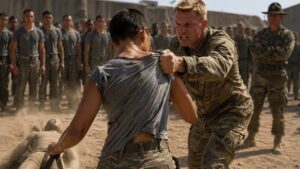
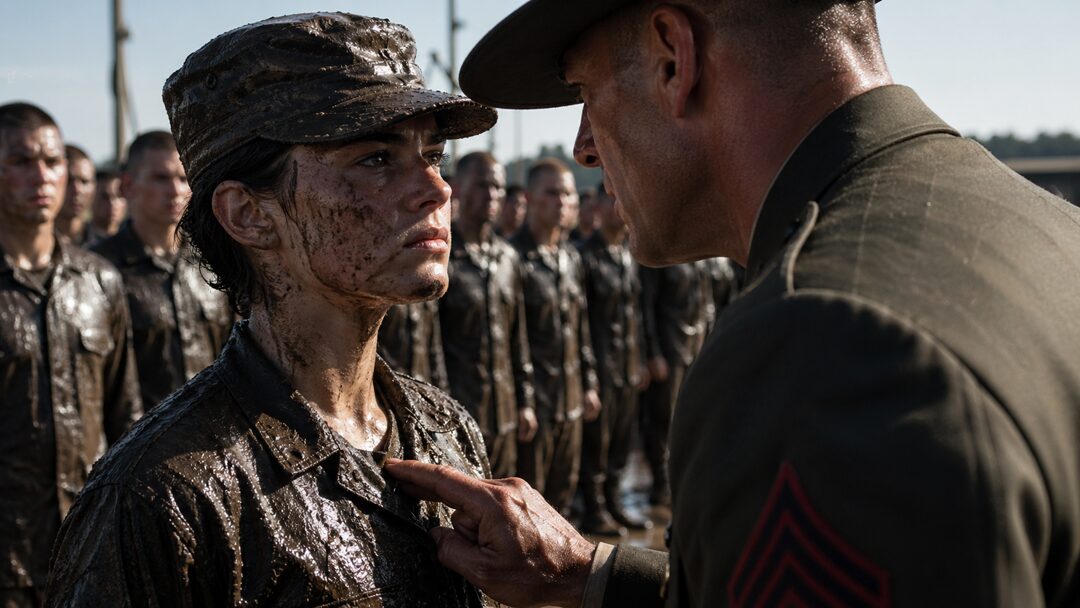
Staff Sergeant Elias Hale stood so close that the brim of his campaign hat cut the sun off Mara Venn’s face, and the only thing between his anger and her heartbeat was the mud-stiff front of her training blouse.
His fingers pressed there.
Not hard enough to bruise.
Hard enough for everyone to see.
“Tell me,” he said, low enough that the first row had to strain to hear him. “Did you freeze because you were scared, Venn? Or did you finally understand you were a mistake?”
Mara did not blink.
Behind her, two lines of recruits stood locked at attention, boots sinking into the wet training field. Their uniforms were streaked with mud from the casualty-carry lane. Their chests rose and fell like they were trying to breathe without being caught doing it.
Nobody looked away.
Nobody dared.
Mara kept her eyes on a point just past Hale’s left ear. His face was close enough for her to see the pale scar at the corner of his mouth, the gray in the stubble he had shaved down too hard that morning, the dust caught in the crease beside his nose.
Her jaw hurt from keeping it still.
“Answer me.”
She said nothing.
The silence was worse than shouting. It stretched down the formation and settled on every recruit who had watched her fail.
One second.
That was all it had been.
One second between the order and her body moving.
One second while the dummy lay in the mud and the simulated fire cracked from speakers mounted near the tree line. One second while rainwater slid down her neck and the instructor’s whistle split the field.
One second, and their whole squad had been sent back.
Hale leaned closer.
“I asked you a question.”
Mara tasted metal. She had bitten the inside of her cheek sometime during the drill. She could feel a bead of blood under her tongue, warm and private.
Private was the only place she had left.
“Staff Sergeant,” called Corporal Dana Reeve from ten feet away, her voice level.
Hale did not turn.
“I know where I am, Corporal.”
Reeve said nothing else. She stood with her hands clasped behind her back, close-cropped hair damp against her skull, eyes moving once from Hale’s hand to Mara’s face.
Mara saw the glance.
She did not take it as rescue.
Rescue was dangerous. Rescue made you a person people had to explain. Mara had spent twelve weeks trying not to become that.
Hale’s fingers tapped once against her blouse.
“Say it.”
The word moved through the platoon without sound.
Say it.
Mara’s throat tightened.
“Say, ‘I don’t belong here.’”
Someone behind her swallowed. Mara knew it was Jonas Ellis without turning. He was always two places down in formation, broad-shouldered, strong-looking, the kind of recruit instructors trusted to carry heavy things and other recruits trusted to pretend fear did not exist.
“Say it,” Hale repeated.
Mara’s knees locked.
Mud dried on her cheek. She could feel it pulling at her skin when she wanted to move her mouth. The weight of every stare pushed against the back of her skull.
She had known this kind of silence before.
A living room full of folded flags and untouched food.
Her mother not crying because people were watching.
A paused video on a government laptop, the image grainy and beige with dust.
A hand dragging through gravel.
A breath that should have ended, but did not.
Mara pushed the memory back down.
Not here.
Not in front of them.
Not for him.
Hale’s voice lowered even further.
“You froze when a body hit the ground. What do you think happens when the body is real?”
Her eyes burned.
She did not answer.
Because if she opened her mouth, the wrong thing might come out.
Because the wrong thing was not I don’t belong here.
The wrong thing was I know.
Part II — One Second
Twenty minutes earlier, the field had looked almost ordinary.
Wet grass. Brown lanes. Gray sky. A line of recruits waiting their turn while speakers spat recorded chaos into the air.
Then the whistle blew.
“Casualty down!” Hale shouted. “Move!”
Mara had been paired with Ellis for the lane. He went first, dragging the dummy by its straps through mud that sucked at his boots. He moved fast for a big man, face red, teeth bared, shoulders heaving.
When he crossed the line, he dropped the dummy and bent with his hands on his knees.
“Venn!” Hale barked. “You’re up.”
Mara stepped forward.
The dummy lay face-down in the mud. It was canvas and rubber, weighted wrong, stiff at the joints. No one could mistake it for a man unless they had already seen too much.
The whistle screamed.
The speakers cracked.
For one second, Mara heard something under the fake gunfire.
Not a sound from the field.
A sound from memory.
A thin, broken pull of air.
Her brother had sounded like that in the video. Not at first. At first there had been shouting, boots, static, the hard rhythm of men trying to get another man out of a street that did not want to let him go.
Then dust.
Then the camera tilted.
Then her brother’s hand appeared in the lower corner of the frame, gloved fingers clawing once at gravel.
Still breathing.
The officer who came to their house said he had died quickly.
The video proved that people said many things because they had to leave afterward.
“Venn!”
Mara moved.
Too late.
Her boots hit the mud, her hands caught the dummy’s straps, and she dragged with everything in her narrow shoulders. But the timing had already broken. Ellis had stepped forward as if to help. Another recruit had moved before being ordered. The lane turned messy. Hale’s whistle cut again, this time not as part of the drill.
“Stop!”
Every recruit froze.
Hale walked down the lane slowly, like he had all day to reach her.
He looked first at the dummy.
Then at the tracks in the mud.
Then at Mara.
“One second,” he said.
Nobody breathed.
“One second is a body bleeding out. One second is a door closing. One second is the difference between carrying someone home and writing their mother a letter.”
Mara’s hands were still wrapped in the dummy’s straps.
She wanted to say, I know.
But knowledge did not matter if it came out sounding like an excuse.
Hale turned to the formation. “Reset.”
Groans almost happened. They died in throats.
“Not the lane,” Hale said. “The platoon.”
That was when Mara understood.
This was not about the drill anymore.
By the time they stood in formation, the mud had cooled through her sleeves. Her arms trembled from the carry. Ellis kept glancing at her with the pained loyalty of someone who wanted to help but understood help would only make the fire larger.
Hale walked the line once before stopping in front of her.
“Recruit Venn.”
“Staff Sergeant.”
“Step forward.”
The field seemed to widen as she moved. One step. Not much. Enough to become separate.
Enough to become the lesson.
Now Hale stood with his hand against her uniform, asking her to say she did not belong.
And Mara understood something simple and ugly.
He did not need her to quit.
He needed the others to watch what quitting looked like before they did it privately.
“You are five foot nothing after breakfast,” Hale said. “You are slow on the wall. You lose grip on the rope. You carry half of what Ellis carries and look twice as surprised by the weight.”
Ellis shifted.
Hale’s head snapped. “Eyes front.”
Ellis locked up.
Mara did not move.
“You have no family name I know,” Hale said to her. “No colonel father. No sergeant mother. No uncle who wore stripes before you. Nothing on your file except acceptable scores and a tendency to make instructors wait.”
Mara’s pulse hit once at the base of her throat.
Her file did not have her brother’s name in it. She had made sure.
Daniel Venn belonged in a folded flag on her mother’s mantel, not in a training record for instructors to handle. Mara had not enlisted to wear his death like a badge. She had enlisted because the house after him had become a museum of things no one could touch.
His boots by the garage door.
His unopened birthday card.
His old sweatshirt hanging from the chair because her mother could not wash it and could not move it.
Grief had filled every room until Mara had to leave just to breathe.
The Army had not been escape.
It had been a place where grief could be ordered to stand up straight.
Hale leaned in.
“No instinct,” he said. “That is what bothers me. Not your size. Not your time. Instinct. When something drops, you move. You do not think. You do not remember. You do not decide whether it hurts your feelings. You move.”
The words hit too close.
Mara’s mouth opened before she could stop it.
“The casualty was breathing.”
Hale went still.
The field changed.
Not visibly. The recruits did not move. The wind did not shift. The speakers had long since gone silent.
But the air sharpened around her.
Hale’s eyes narrowed. “What did you say?”
Mara should have stopped.
She knew it.
But the sentence had already escaped, and now the shape of it stood between them.
“The casualty was breathing,” she said again.
Behind her, someone’s breath caught.
Hale pointed toward the lane. “That casualty is canvas and sand.”
“Yes, Staff Sergeant.”
“So now you’re seeing things?”
“No, Staff Sergeant.”
His voice dropped. “Then explain yourself.”
Mara stared past him. Her cheek twitched where the mud had dried.
Do not give it to him.
Do not hand him the room inside you.
But Hale waited. The whole platoon waited. And suddenly silence no longer protected her. It only made her look like she had invented a strange little lie and lacked the courage to finish it.
“My brother,” she said.
The two words felt obscene in the open air.
Hale did not blink.
Mara swallowed.
“He was killed during an extraction. There was footage. I saw it once.” She stopped because more than once was not something she would admit. “In the drill, when the dummy hit the mud, I remembered the sound.”
“What sound?”
Her tongue felt too large for her mouth.
“Breathing.”
No one moved.
“I froze for one second,” she said. “Because I thought—”
She cut herself off.
Because I thought dead men could still need you.
Because I thought if I moved wrong, he would die again.
Because I am here because of him and I hate that and I love that and I do not know what part of me is mine anymore.
She said none of it.
Hale watched her for a long time.
For the first time since the formation began, his hand dropped from her uniform.
The absence of pressure felt almost worse.
Part III — Not an Excuse
Hale stepped back once.
Mara thought, stupidly, that the worst had passed.
Then he said, “Memory is not an excuse.”
The words were flat. Not cruel in the way shouting was cruel. Worse than that. Measured.
“Staff Sergeant—” Reeve began.
Hale raised one hand. She stopped.
His eyes stayed on Mara.
“Memory doesn’t drag a body. Memory doesn’t clear a doorway. Memory doesn’t stop blood loss. Memory does not get to stand in for action.”
Mara felt heat rise under the mud on her face.
It would have been easier if he mocked her. Easier if he said something unforgivable. Then she could hate him cleanly.
But he spoke like a man reciting something he had learned the hard way and resented anyone else for not learning yet.
Hale turned his head. “Ellis.”
Ellis snapped straighter. “Staff Sergeant.”
“Front.”
Ellis moved to Mara’s left. Up close, he looked less solid than he had in formation. His face was flushed, but his lips had gone pale at the edges.
Hale pointed toward the casualty lane.
“Again.”
Mara’s stomach tightened.
“Staff Sergeant,” Reeve said, quiet but sharper now, “they just ran the lane.”
“And now they’ll run it with understanding.”
Reeve’s eyes held his for half a second too long. Then she looked at Mara.
Not pity.
Warning.
Hale faced the platoon. “You will watch. You will learn the price of one second.”
Mara wanted to say she already had.
Instead, she moved.
The walk back to the lane felt longer than any run she had done that morning. Mud pulled at her boots. Her sleeves had stiffened. Her shoulders burned from the first carry.
Ellis walked beside her.
When they were far enough from formation that Hale could not hear without effort, Ellis muttered, “You okay?”
Mara almost laughed.
It came out as air.
“Don’t,” she said.
He nodded once, embarrassed. “Right.”
They reached the starting line.
The dummy had been reset face-down in the churned mud. Its straps lay twisted like wet belts. A black smear marked where Mara had dragged it badly the first time.
Ellis rolled his shoulders.
“You don’t have to prove anything to me,” he said under his breath.
Mara looked at him then.
His hands were shaking.
Not much. Enough.
She had never noticed before because Ellis was built like a locked door. People assumed men shaped like that did not have nerves, only muscles and volume.
“You good?” she asked.
His mouth twitched. “Don’t.”
It was almost a smile.
Almost.
Hale’s whistle pierced the air.
“Begin!”
Ellis went first again. That was the order Hale gave, maybe because Ellis was faster, maybe because he wanted Mara to watch the correct version before trying again.
Ellis grabbed the dummy and hauled it backward through the lane. Mud sprayed off his boots. His face tightened. The speakers came alive with simulated fire, sharp cracks snapping across the field.
Mara waited, counting.
One.
Two.
Three.
Ellis dragged hard, too hard at first, burning energy in the first stretch. His boot slipped but he recovered. Reeve watched from near the boundary marker, arms folded, eyes not on the dummy but on Ellis’s face.
Mara saw it then.
A flicker.
Ellis’s breath changed.
Not fatigue. Not ordinary strain.
It caught high in his chest and did not come down.
He crossed the line and dropped the dummy, but instead of stepping aside, he bent forward sharply. One hand went to his thigh. The other rose toward his throat and stopped there as if he knew touching it would make it real.
Hale shouted, “Venn! Move!”
Mara moved.
She ran to the dummy.
Her hands closed around the straps.
The speakers cracked again. Mud sucked at her boots. Hale’s voice cut across everything.
“Drag!”
Mara pulled.
The dummy shifted.
Behind her, Ellis made a sound.
Small.
Wrong.
Not dramatic. Not a shout. Just a torn little inhale that failed halfway through.
Mara stopped.
“Venn!” Hale barked.
The old fear rose like water in her ears. Orders. Noise. A body on the ground. Breathing that did not sound like breathing anymore.
She turned.
Ellis was on one knee now, one hand planted in the mud, eyes wide with fury and shame. He was trying to force air through a chest that had locked against him.
“Keep moving!” Hale shouted.
Mara looked at the dummy.
Then at Ellis.
The whole drill narrowed to two bodies: the false one she had been ordered to move, and the living one everyone was pretending was fine because pretending was easier than stopping.
She let go of the straps.
Hale’s voice cracked like a whip. “Venn!”
Mara was already at Ellis’s side.
“Ellis,” she said. “Look at me.”
He tried to turn away.
She caught his shoulder. Not hard. Firm.
“Look at me.”
His eyes found hers.
There was terror there, and worse than terror, humiliation.
“I’m fine,” he forced out.
“No, you’re not.”
Reeve was moving now.
Hale was too, but slower, anger and uncertainty fighting in the set of his shoulders.
Mara dropped to one knee in the mud.
“Can you breathe?”
Ellis shook his head once, barely.
“Corporal!” Mara called, clear and loud. “He can’t get air.”
For one second, the field froze again.
But this time Mara did not.
She loosened Ellis’s collar. She kept him upright. She made him follow her hand down, slow, even when his body wanted to panic harder.
“In through your nose if you can,” she said. “Small. Don’t fight the whole breath. Just take part of it.”
Ellis gripped her sleeve.
It hurt.
She let him.
Reeve reached them and crouched on Ellis’s other side.
“Good catch,” Reeve said, low enough that only Mara heard.
Hale arrived last.
His shadow fell over them.
For a terrible moment, Mara thought he would order her back to the dummy.
Instead he looked at Ellis.
Then at the dummy abandoned in the mud.
Then at Mara’s hand on Ellis’s shoulder.
His jaw shifted once.
“Medical,” he called.
The word traveled across the field like something nobody had expected to hear.
Ellis closed his eyes, ashamed even while he dragged a thin breath into his lungs.
Mara stayed beside him until Reeve touched her wrist.
“I’ve got him.”
Only then did Mara stand.
Her knees shook.
Not from fear now.
From the knowledge that she had disobeyed and been right, which was somehow more dangerous than being wrong.
Part IV — Attention
They put Ellis on the bench near the field house with a medic beside him and a blanket over his shoulders he clearly hated.
He would be fine. That was what the medic said.
Fine did not look fine. Fine looked pale, furious, and unable to meet anyone’s eyes.
Hale listened to the medic without speaking. Reeve stood a few feet behind him, her expression unreadable.
The platoon waited in formation where they had been ordered to wait. No one talked. Even the wind seemed to keep its distance.
Mara stood apart from everyone, mud to her elbows, dummy straps still marked across her palms.
She could feel every place where she had broken the drill.
She had stopped.
She had turned.
She had released the casualty she was ordered to move.
In another version of the morning, those facts would have ended her.
Maybe they still would.
Hale turned from the medic.
“Formation.”
The word hit harder than a shout.
Reeve looked at him. “Staff Sergeant.”
“Formation,” he repeated.
This time, Mara did not need to be told where to stand.
She stepped back into place.
No, not into place.
Forward from it.
The same single step as before.
The platoon reset behind her. Ellis remained on the bench, blanket over his shoulders, watching with a face full of things he could not say.
Hale crossed the field toward Mara.
His boots struck the mud with slow precision.
The first time he came close, she had not understood him. Not fully. He had been only force, shadow, authority, the man with the hand against her chest and the demand in her face.
Now she saw the cost in him.
It did not make him gentle.
It did not make him right.
It made him harder to hate.
He stopped inches away.
The brim of his hat cut the sun off her eyes again.
The formation vanished behind the pressure of his presence. Same mud. Same field. Same breath held in thirty chests.
Hale lifted his hand.
Two fingers touched the front of her blouse, exactly where his hand had pressed before.
Mara’s heart struck once against them.
“What,” he said, “do you think you just proved?”
The answer rose in pieces.
That you were wrong.
That I belong.
That I can see what you missed.
That my brother died breathing and someone should have heard him sooner.
All of them were true.
All of them were too small.
Mara looked past his shoulder at Ellis, wrapped in the ugly gray blanket, staring at the mud between his boots like the ground had betrayed him.
Then she looked back at Hale.
“I saw him breathing.”
The field went silent in a different way.
Not empty.
Full.
Hale’s fingers did not move from her uniform. For a moment his face changed so slightly that Mara might have imagined it. A tightening at the eyes. A brief drop in the mask. Something old passing behind him.
He heard it.
Not just Ellis.
Daniel.
The dummy.
The body-camera footage.
All the people who looked like training until they became memory.
Hale lowered his hand.
Mara waited for punishment.
He turned to the platoon.
“Some of you think panic is noise,” he said. “It is not always noise.”
No one moved.
“Sometimes panic looks like a big recruit trying to turn blue quietly because he’s too proud to take a knee. Sometimes attention looks like disobedience because the order in front of you is not the problem anymore.”
His voice stayed hard.
No comfort entered it.
“That is the difference between panic and attention.”
Mara’s breath caught.
She hated that it mattered.
She hated that his recognition, after all that, could still reach something in her she had not given permission to move.
Hale faced her again.
“You broke the lane.”
“Yes, Staff Sergeant.”
“You saw the field.”
“Yes, Staff Sergeant.”
His eyes held hers.
“Do not make me tell you twice again.”
It was not praise.
It was not forgiveness.
It was not clean.
But it was not dismissal.
Mara understood the shape of it and stood straighter.
“Yes, Staff Sergeant.”
Hale stepped away.
The sun returned to her face all at once.
Behind her, the platoon exhaled like one body.
Part V — The Patch
After evening chow, Mara sat alone outside the equipment room, scraping dried mud from the seams of her boots with the edge of a broken plastic spoon.
Her hands ached. Her shoulders burned. Her cheek still held a faint stain where the mud had dried and cracked and been wiped away badly in the mirror.
Nobody had said much to her after the drill.
That was almost kind.
Ellis had found her once near the water station. He had stood there with his canteen in both hands, too large and too embarrassed.
“Venn,” he said.
She waited.
His ears went red.
“You saw it before I did.”
Mara looked down at the canteen.
“You felt it before I did.”
He swallowed. “I thought if I stopped, everybody would know.”
“They knew anyway.”
He gave a short, painful laugh.
“Yeah.”
Then he said, “Thanks,” so quietly that it barely survived the space between them.
Mara nodded once. That was all either of them could handle.
Now the training grounds had gone orange with late sun. The field looked calmer from a distance, like it had not spent the day pulling people apart. The dummy lay stacked with two others near the shed, blank-faced and harmless.
Mara hated it a little.
She scraped mud from her boot until a shadow crossed the concrete.
She did not look up at first.
The boots were too polished to be a recruit’s.
Hale stood beside the bench, hat in one hand.
Without it, he looked older. Not softer. Just more human in a way that felt almost intrusive.
“Venn.”
She started to rise.
“Sit.”
She sat.
Hale looked toward the field, not at her.
For a while he said nothing. Mara kept the boot in her lap and the spoon in her hand. The silence between them was not the same as the formation silence. It did not have an audience to feed.
Finally, Hale reached into his pocket.
He placed something on the bench beside her.
A patch.
Faded. Edges worn soft. The stitching had frayed in two corners. It was not new enough to be a reward and not official enough to be an assignment.
Mara looked at it but did not touch it.
“He never froze in training,” Hale said.
Mara’s hand stilled.
Hale’s eyes stayed on the field.
“Soldier I lost. Years ago. Fastest man in his group. First through doors. First to volunteer. Never hesitated where an instructor could see.” His jaw worked once. “That was the problem. We never knew what he carried until it was too late.”
The evening sound of the base moved around them: a distant shout, a metal door closing, boots on gravel.
Mara understood then that Hale was not apologizing.
Maybe he did not know how.
Maybe he did not believe he should.
He was giving her the shape of the wound he had used against her.
That was not enough to make the morning right.
But it was enough to make it real.
“My brother hated being called brave,” Mara said.
The words surprised her. They came out without permission, but not like before. This time they did not feel stolen from her.
Hale looked down at the patch.
“Most of the brave ones do.”
Mara set the boot aside.
The patch lay between them.
She still did not pick it up.
“What’s it for?” she asked.
Hale’s mouth tightened, almost not a smile.
“Nothing you can wear.”
“Then why give it to me?”
He looked at her then.
“Because memory is not an excuse,” he said. “But it is not nothing.”
Mara’s throat closed.
That was the closest he would come.
Maybe the closest she wanted.
She picked up the patch. The fabric was rough against her thumb. Someone had carried it through years of sweat, weather, and whatever kind of day made a man like Hale keep cloth in his pocket like penance.
She did not ask the soldier’s name.
He did not offer it.
Some names were not for benches outside equipment rooms. Some names had to be earned slowly, if they were given at all.
Hale put his hat back on.
“Formation at zero six.”
“Yes, Staff Sergeant.”
He took two steps, then stopped.
“Venn.”
She looked up.
His face had returned to its usual hard lines.
“You see something wrong, you call it.”
Mara held the patch in her palm.
“Even if it breaks the lane?”
His eyes stayed on hers.
“Especially then.”
He walked away before the words could become gentle.
Mara sat there until the sun dropped behind the barracks and the field went dull and blue. She thought of Daniel’s hand in the video. The impossible pull of air. The way her mother had said, Don’t watch it again, baby, and how Mara had watched it anyway because not knowing felt like abandoning him.
She had believed memory was a room she had to lock before entering uniform.
Now the patch sat in her hand, warm from her skin.
Not a key.
Not a cure.
A weight.
A weight could drag you down.
It could also teach you how to stand.
Part VI — Still Standing
The next morning, the field smelled of wet grass and old mud.
Mara stood in formation before sunrise, boots clean enough, blouse stiff, cap low over her short dark hair. The patch was not on her uniform. It was folded inside the small pocket of her locker, behind a spare pair of socks.
She had almost slept with it under her pillow.
That had felt too much like a prayer.
Ellis stood two places down, shoulders squared, face still pale around the edges. When Hale’s office door opened across the yard, Ellis inhaled once too fast.
Mara heard it.
She did not turn her head.
She lowered her hand just enough that her knuckles brushed his sleeve.
Once.
A signal, not comfort.
Ellis’s breathing steadied.
Corporal Reeve saw it. Her mouth did not move, but her eyes held on Mara for one quiet second before shifting forward.
Then Hale came onto the field.
Campaign hat. Severe posture. Weathered face. The same man, mostly.
He walked the line slowly.
Every recruit stared forward.
When he reached Mara, the air around her body remembered before she did. Her shoulders wanted to lock harder. Her mouth wanted to close around silence like a fist.
Hale stopped in front of her.
For one heartbeat, the whole formation seemed to wait for the old scene to return: the hand, the pressure, the demand.
Say it.
Mara looked straight ahead.
Hale’s shadow crossed her boots.
Then he moved on.
No touch.
No accusation.
No public mercy either.
Just the clean fact of passing her without needing to stop.
Mara breathed.
Not deeply. Not dramatically.
Just enough.
The sun lifted over the field, catching on the wet grass and the scuffed toes of thirty pairs of boots. Somewhere behind her, Ellis stood steadier. Somewhere beside the line, Reeve watched without interfering. Ahead of them all, Hale called the morning order in a voice that still expected obedience and would still punish failure.
Nothing had become easy.
That was not the promise.
The whistle blew.
The platoon moved.
Mara moved with them. Not first. Not fastest. Not untouched.
But when the first body hit the mud, she saw the field.
And she did not look away.