The Quiet Man Behind the Coffee Cart Was Waiting for Someone to Listen
Part I — The Cups in the Sand
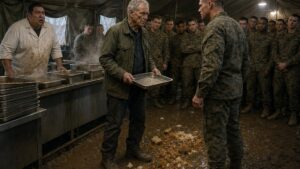
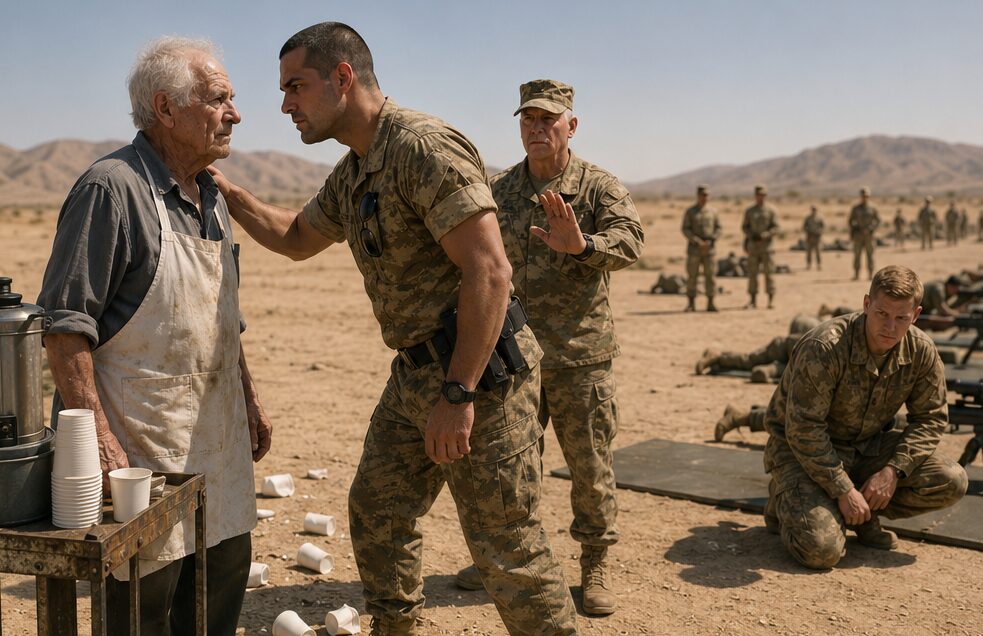
The first cup hit the sand before Thomas Hale could catch it, then another, then a whole white stack spilled beside his boots while Sergeant Ryan Davis stood close enough for Thomas to smell the mint on his breath.
“Stay behind the coffee, old man,” Ryan said.
The line went quiet.
Not fully quiet. Nothing was ever fully quiet on the range. Wind hissed over the hard flats. Canvas straps snapped against benches. Young men shifted in their gear and pretended not to watch.
But the laughter stopped breathing for a second.
Thomas looked down at the paper cups scattered across the desert dust. Powdered creamer clung to the front of his white apron. His faded gray shirt was damp beneath the arms. At seventy-two, he had learned that bending down took longer than people expected and standing back up took more pride than it should.
He did not bend yet.
He looked at Ryan’s rifle.
Then at the target line.
Then at the flag trembling near lane six.
“Your shooter’s pulling left because you’re making him hold his breath too long,” Thomas said quietly. “And his scope shadow’s not centered.”
Ryan blinked once.
A few soldiers exchanged looks. One of them gave a short laugh, then killed it when Ryan turned his head.
Ryan was twenty-nine, sharp-jawed and compact, with mirrored sunglasses hooked to his vest like a badge of his own reflection. He had the kind of confidence that needed witnesses.
“You hear that?” he said to the line. “Coffee cart’s coaching now.”
This time some of the soldiers laughed.
Thomas did not.
He had been refilling coffee at Fort Albright’s desert training range for six years. Most new soldiers knew him only as the old man who arrived before dawn, made the urns hot, stacked the cups, wiped sugar from the folding table, and disappeared before anyone thought to thank him.
That suited him.
Usually.
Ryan stepped closer, his boots crushing one cup flat.
“You got a problem with my instruction?” he asked.
Thomas’s eyes stayed on lane six. A young private lay behind the rifle there, cheek pressed down too hard, shoulders tight, elbows fighting the ground instead of using it.
“He’s scared of you,” Thomas said. “That’s different from being disciplined.”
The line went quiet again, deeper this time.
Ryan’s face changed.
Not anger first. Embarrassment.
Anger came after.
“You don’t know what you’re talking about.”
Thomas finally bent down. His knees clicked. He gathered two cups, then a third. His fingers were sun-spotted, steady, careful with useless things.
“I know what fear does to breath,” he said.
Ryan opened his mouth, but a hand rose between them.
Captain Edward Miller stood three paces away, square-shouldered, sunburned at the neck, his cap pulled low over tired eyes. He did not touch Ryan. He did not raise his voice.
“Back up, Sergeant.”
Ryan stared at him.
“Sir, with respect—”
“Back up.”
The word settled harder than shouting would have.
Ryan stepped away. Not far enough to look obedient. Just far enough to say he had heard.
Edward looked at Thomas, then at the cups in his hands. There was something in his expression Thomas did not like.
Recognition trying not to be recognition.
Thomas lowered his eyes first.
“Range is shifting,” Thomas said. “Wind’s quartering. Lane six is compensating wrong.”
Ryan gave a humorless laugh.
“Old men always think they know the field because they watched documentaries.”
A few smiles appeared, nervous and hungry for permission.
Thomas picked up the last cup Ryan had crushed. Its rim was split. He set it on the cart anyway.
Some things could be damaged and still hold what they were made to hold.
Part II — Three Dots on a Napkin
Private Joseph Reed looked too young to be trying so hard not to look young.
His uniform was neat, too neat, the sleeves creased like he had ironed fear into them. His sandy hair was cut close, and when Ryan crouched beside him at lane six, Joseph’s fingers tightened around the grip until his knuckles blanched.
Thomas watched from the coffee cart.
He was supposed to be rinsing the stirrers. He was supposed to be counting sleeves of cups and checking whether the second urn had gone bitter.
Instead, he watched Joseph’s breathing.
In. Hold.
Too long.
Hold.
The rifle muzzle dipped a hair.
Ryan said, “Take the shot.”
Joseph did not.
Ryan leaned closer. “Take it.”
Thomas saw the sling slipping loose across Joseph’s arm. He saw the target marker board near the pit edge, still standing where it should have been cleared. He saw two figures moving too close below the berm, trusting the range call more than the wind.
His hand stopped on the coffee urn handle.
“Cease the lane,” Thomas said.
No one answered.
He said it louder. “Cease lane six.”
Ryan turned his head. “You don’t call my lane.”
“That pit isn’t clear.”
“It’s clear.”
“It is not.”
Ryan stood, and now everyone looked again. The soldiers at the other lanes held themselves very still, grateful and terrified that the attention had moved somewhere else.
Edward Miller’s gaze moved to the pit, then to Thomas. He did not speak fast enough.
“Sergeant,” Edward began.
Ryan snapped, “Private Reed, fire.”
Joseph fired.
The sound cracked across the flats.
Thomas closed his eyes before the target came back.
Not from fear.
From knowing.
When the marker rose, the impact was low-left.
Ryan cursed under his breath.
“Again,” he said.
Joseph swallowed.
Thomas’s hand went to the stack of napkins beside the cups. He took one, pulled the golf pencil from behind the sugar packets, and made a tiny dot near the lower left corner.
The second shot cracked.
Low-left.
Thomas marked the second dot without looking at the target.
Edward had moved closer to the cart now.
“What are you doing?” he asked, low enough that only Thomas heard.
Thomas marked a third dot, wider to the right.
“If he pushes him again, he’ll overcorrect.”
Edward looked at the napkin.
Then at Thomas.
The third shot cracked.
The target came back.
Wide right.
Nobody laughed this time.
Ryan turned from the target to Thomas. For one second, his face showed the thing he feared most: not anger, not authority, but exposure.
Then he buried it.
“Well, hell,” Ryan said loudly. “Maybe the lunch lady wants to qualify for him.”
The words landed wrong.
Even the soldiers who wanted to laugh did not know where to put their faces.
Thomas folded the napkin once and slid it beneath the coffee urn, weighted under the metal foot.
His pulse had not changed.
That bothered him more than the insult.
He had spent years teaching his body a civilian rhythm. Pour coffee. Count cups. Sweep sand. Lock the range shack. Go home. Sleep until the old dreams found the cracks.
But there were things the body kept.
Wind.
Breath.
Distance.
The way a frightened young man tightened his shoulder before a mistake.
Ryan pointed at Joseph.
“Back on the rifle.”
Joseph hesitated.
“That was enough,” Thomas said.
Ryan smiled without warmth. “I’m sorry, did the snack bar just give an order?”
Thomas looked at Edward.
This time Edward did not look away.
“Check the pit,” Thomas said.
Ryan’s voice sharpened. “Sir, are we really doing this?”
Edward looked toward the berm. The marker board still stood at the edge, a bright rectangle where no one had cleared it. A man below it had stepped back only after the third shot.
Edward’s jaw tightened.
“Hold lane six,” he said.
Ryan’s face flushed.
“Sir.”
“Hold it.”
Thomas reached for a fresh stack of cups. His hand brushed the folded napkin. He wished he had never marked it.
Proof was a hungry thing. Once people saw it, they wanted more.
Part III — The Apron on the Table
Ryan did not like silence when it belonged to someone else.
He walked back and forth behind the firing line, shoulders stiff, voice louder than needed.
“Everybody’s an expert until it’s their turn,” he said. “Everybody sees wind from the coffee cart.”
Thomas wiped the same patch of table twice.
Joseph remained on one knee beside lane six, staring at the ground as though the sand might give him instructions kinder than Ryan’s.
Edward returned from speaking with the pit crew. His face had settled into command calm, but Thomas saw the small muscle jumping near his cheek.
“You were right,” Edward said.
Thomas kept wiping.
“Not about everything,” he said.
“About enough.”
That was when Ryan turned.
His embarrassment had nowhere left to go, so he handed it to the oldest man there.
“You know so much,” Ryan said, carrying his voice across the line, “why don’t you show us?”
Thomas did not move.
Ryan spread his hands. “Come on. You corrected my breathing call. You predicted impacts. You called a pit issue from thirty yards back. Get down there and show the privates how it’s done.”
The soldiers watched Thomas now with a new hunger.
Not mockery exactly.
Curiosity.
Sometimes curiosity cut closer.
Edward said, “Sergeant, stand down.”
“No disrespect, sir,” Ryan said, all disrespect now wearing a clean shirt, “but if a civilian contractor is going to interfere with instruction, maybe we should verify the source.”
Thomas looked at Joseph.
The young private was still pale. Still trying to hide the tremor in his hand. Still ready to obey the next loud order because that was easier than trusting what his own fear was telling him.
Thomas had seen that look before.
Different desert. Different young man.
Dennis Bennett had looked at him once across a wall of heat and dust, grinning like the world could not possibly choose him.
You always see it first, Tommy.
Thomas’s fingers tightened around the rag.
Edward said, “Mr. Hale, you don’t have to entertain this.”
Mr. Hale.
Not Thomas.
Not the name Edward had seen somewhere. Not the one printed on old doctrine sheets in the schoolhouse. Edward was giving him a door to walk through.
Thomas could have taken it.
He could have gone back to the urn. He could have let Ryan keep his pride and Joseph keep his fear and Edward keep his careful ignorance.
He looked at the range flag.
It snapped once, then twisted back on itself.
“No pit crew past the berm,” Thomas said.
Ryan’s expression flickered.
Thomas removed the rag from his hand and laid it flat on the cart. Then he reached behind his neck and untied the apron.
No one spoke.
The apron came away slowly. White cloth, creamer dust, a brown stain near the pocket from coffee spilled three weeks ago.
Thomas folded it once.
Then again.
He placed it on the table beside the cups.
“Clear the lane,” he said.
Edward’s voice came immediately. “Clear lane six. Pit crew behind cover. Marker board down.”
Men moved.
Ryan watched Thomas with a smile that had started to fail.
Thomas stepped toward the rifle.
The ground felt farther away than it used to. His knees did not appreciate the descent. His hip complained when he lowered himself behind the mat.
But his hands found the rifle without asking permission from age.
That was the first thing that scared him.
Not the soldiers watching.
Not Ryan waiting for him to fail.
The hands.
They settled as though no years had passed.
Left hand easy. Shoulder placed. Cheek lowered. Breath taken and released halfway.
The world narrowed.
Dust vanished.
Voices vanished.
The target came closer through glass.
And behind it, because memory was cruel with doors, another target rose from another day.
A road bright with heat.
A convoy stopped where it should not have stopped.
Dennis beside him, saying something stupid to make him laugh.
Then the call.
Then Thomas doing exactly what he had been trained to do.
A perfect decision.
A perfect shot.
Lives saved downrange.
Dennis gone before Thomas understood the cost had come from beside him.
Thomas lifted his eye from the scope.
For a moment the range returned in pieces.
Sun.
Sand.
Men waiting.
Ryan’s mouth pressed thin.
Joseph frozen on one knee.
Edward watching with a look Thomas had avoided for twenty years.
“Everything all right?” Edward asked.
Thomas almost laughed.
Instead he lowered his eye again.
“No,” he said.
Then he settled behind the glass.
Part IV — What the Target Knew
The first shot cracked clean.
Not rushed.
Not dramatic.
A single hard answer to a question no one had earned the right to ask.
The target did not move at first. The sound traveled out and died against the hills.
Thomas breathed.
The second shot followed.
Then the third.
He did not fire like a man proving himself.
He fired like a man returning borrowed tools to their exact place.
When the target was brought in, nobody spoke.
The group sat tight in the correction Thomas had named before he ever touched the rifle.
Three clean marks, close enough that several soldiers leaned forward before remembering they were not supposed to.
Ryan stared at the target like it had betrayed him.
Joseph looked at Thomas.
Not at the target.
At Thomas.
That was worse.
Admiration could be another kind of demand.
Thomas pushed himself up from the mat slowly. His body, which had remembered too much a minute ago, remembered age again all at once. His palm pressed against the ground. Sand stuck to the creases of his skin.
Edward stepped forward, then stopped himself from offering help.
Good, Thomas thought.
Let me stand.
He stood.
Ryan’s voice came rough. “That doesn’t prove anything.”
Nobody helped him with the sentence.
“It proves he was right,” Joseph said.
The words were soft, but they changed the air.
Ryan turned. “You got something to add, Private?”
Joseph swallowed. His hand still shook, but his eyes did not drop.
“He told us to cease the lane.”
Ryan took one step toward him.
Edward’s voice cut in. “That’s enough.”
Ryan turned back, flushed and cornered.
“Sir, with respect, this feels like a setup.”
Edward looked at him. “A setup?”
Ryan pointed at Thomas. “You bring some old pro out here, let him play cafeteria worker, wait for one of us to make a mistake—”
“I didn’t bring him,” Edward said.
The range went still.
Edward’s eyes moved to Thomas, and this time he did not hide what he knew.
“I should have known sooner,” he said quietly.
Thomas looked away.
Edward spoke louder, for the line now. “Master Sergeant Thomas Hale.”
The name crossed the range like a wind shift.
Ryan’s face tightened.
A soldier near lane four whispered, “Hale?”
Another said, “From the manuals?”
Thomas closed his eyes briefly.
There it was.
The part he hated most.
Not the insult. Not the disbelief.
The turning.
Men who had looked through him now looked at him like history had stepped out from behind the coffee urn.
Edward continued, careful but firm. “Some of the training material in the schoolhouse comes from his instruction. Some of you have copied his diagrams without knowing whose hand made them.”
Thomas heard the old classroom again. Chalk on a board. Young faces. Dennis laughing from the back because Thomas had drawn the wind arrows too perfectly.
He had wanted the work to remain.
He had not wanted the face attached.
Ryan shook his head. “Then why is he serving coffee?”
The question came out uglier than he meant it, but it was honest enough to wound.
Thomas looked at him.
“Because coffee doesn’t ask what you remember,” he said.
No one answered.
Edward ordered a formal review of lane six. Men moved quickly now, ashamed into efficiency. The marker board was pulled. The pit crew gave statements. Joseph told the truth in a voice that shook only at the beginning.
Ryan stood apart, sunglasses in his hand, no reflection left to hide behind.
Thomas returned to the cart.
His folded apron waited beside the cups.
He touched it once but did not put it on.
Not yet.
Part V — The Loudest Voice on the Line
Edward found him beside the range shack, where the shade ended in a hard line across the concrete.
“I need you to speak to them,” Edward said.
Thomas looked out over the range. “I already did.”
“You know what I mean.”
“Yes,” Thomas said. “That’s why I said no.”
Edward removed his cap and rubbed the bridge of his nose. For the first time all morning, he looked less like a commander and more like a man who had let something happen because no rule told him to stop it sooner.
“I let them treat you like you were invisible,” Edward said.
Thomas said nothing.
“That’s on me.”
“Yes,” Thomas said.
Edward accepted it with a small nod.
“I’m asking anyway.”
Thomas’s mouth tightened.
There it was again. The institution’s oldest habit. First it forgot you. Then it needed you to stand up and make the forgetting useful.
“I’m not a lesson,” Thomas said.
“No,” Edward said. “But they need one.”
Thomas almost refused again.
Then Joseph walked past the open doorway, escorted by another soldier, face pale with the exhaustion that comes after fear has nowhere to go. He glanced toward Thomas, then away, as if respect had made him shy.
Thomas knew that look too.
A young man waiting for someone to tell him whether obedience had almost cost him his soul.
Thomas picked up the folded napkin from beneath the coffee urn. The pencil marks had smudged at the edges, but the three dots remained.
Low-left.
Low-left.
Wide right.
“Bring Davis,” Thomas said. “And Reed.”
Edward studied him.
“Just them?”
Thomas looked toward the line. “Everyone can listen. They don’t all need to be used.”
A few minutes later, Ryan and Joseph stood near the target frame while the rest of the unit gathered at a distance. Ryan’s posture remained rigid, but something had gone out of his shoulders. Joseph stood with his hands clasped behind him, trying not to look at the three marks on paper.
Thomas carried the target himself.
No one offered to take it.
No one dared.
He pinned it against the frame and stepped back.
“Read it,” he said to Ryan.
Ryan’s jaw worked. “Tight group.”
“Louder.”
Ryan’s eyes flashed, but Edward was watching.
“Tight group,” Ryan said.
Thomas pointed to the range markers beyond the line. “Read those.”
Ryan looked.
The words took longer.
“Pit boundary. Marker board clearance. Personnel hold.”
“And did you clear them?”
Ryan said nothing.
Thomas waited.
The wind moved over the line and lifted the corner of his folded apron on the cart twenty yards away.
“No,” Ryan said.
Thomas nodded once.
He did not smile.
He did not look pleased.
“That’s the part that matters.”
Ryan’s face tightened with confusion. “Not the shots?”
“The shots are the easiest thing to worship,” Thomas said. “That’s why men get stupid around them.”
A few soldiers shifted.
Thomas turned to Joseph.
“Private Reed, why did you fire?”
Joseph’s throat moved. “Because I was ordered to.”
“Did it feel right?”
“No.”
“Then remember that.”
Ryan’s head lifted sharply, but Thomas held up one hand.
“I’m not teaching disobedience. I’m teaching attention.”
The line took that in.
Thomas looked at Ryan again.
“Rank can make a man responsible,” he said. “It doesn’t make him right.”
Ryan looked down.
Thomas unfolded the napkin and held it out to Joseph.
The young man accepted it carefully, as if it weighed more than paper.
“You saw those shots before I proved them,” Thomas said. “Your body knew. Your breath knew. Trust what you see before you trust the loudest voice on the line.”
Joseph nodded once.
Thomas had planned to stop there.
He should have.
But Dennis’s name had been waiting all morning, patient as dust.
“The best shot I ever made,” Thomas said, “saved more men than I can count.”
Every face turned toward him.
Thomas kept his eyes on the target.
“It also cost me the one man who trusted me most.”
No one moved.
No one asked.
For that, Thomas was grateful.
“I don’t tell you that so you’ll admire it,” he said. “I tell you because being good at something does not make it clean. So if you’re put in charge of another person’s breath, another person’s fear, another person’s life—”
He looked at Ryan.
“—do not spend it protecting your pride.”
Ryan’s lips parted, then closed.
Thomas turned away before anyone could turn the moment into applause.
The silence that followed was not empty.
It was work.
Part VI — Where He Had Always Been
By sunset, the range had gone the color of old brass.
The soldiers packed their gear with less noise than usual. Nobody joked near the coffee cart. Nobody reached over Thomas’s shoulder for sugar. Men who had ignored him that morning now paused before speaking, as if the space around him had become part of the range rules.
Thomas put the apron back on.
The knot behind his neck took two tries.
His hands were steady, but tired.
He was lifting the damaged cups from the sand-colored table when Ryan appeared beside him.
For a moment, neither of them spoke.
Then Ryan crouched.
He picked up the cups he had knocked down in the morning, including the crushed one under his own boot print. He stacked what could be stacked and held the broken one separately.
“I’ll replace these,” Ryan said.
Thomas looked at him.
The apology was not in the words.
It was in the crouching.
It was in the fact that Ryan had to look up.
Thomas took the broken cup from him.
“No need.”
Ryan swallowed.
“I was out of line.”
“Yes.”
Ryan nodded as if the plainness hurt and helped at once.
“I thought you were trying to make me look small.”
Thomas set the broken cup in the trash.
“No,” he said. “You were doing that without help.”
A flicker crossed Ryan’s face.
Not anger.
Shame.
Then, unexpectedly, a faint breath of almost-laughter. Not because it was funny. Because it was true and survivable.
Joseph came next, holding the folded napkin like a pass he had not been told how to use.
“Sir,” he began, then stopped. “Mr. Hale.”
Thomas poured coffee into a fresh cup.
Joseph looked embarrassed. “Are you coming back next week?”
Thomas handed him the coffee.
“I’ve always been here.”
Joseph looked at the cup.
Then at him.
This time he understood enough not to answer quickly.
Across the shack, Edward opened a locked cabinet that had not been opened in years. Thomas watched him from the corner of his eye.
The frame came out dusty.
Old photograph. Faded range line. Younger men in sun-bleached uniforms. A chalkboard behind them filled with wind arrows and breath counts.
Thomas stood in the second row, younger by decades, posture straight, eyes already older than his face.
Beside him stood Dennis, grinning like consequence had not learned his name yet.
Thomas stopped pouring.
Edward wiped the glass with his sleeve and hung the frame inside the range shack, beside the safety board where every soldier would pass before stepping out.
Not in the hall of honors.
Not under a spotlight.
Just there.
Where it could be seen.
Where it could do some good.
Thomas stared at it for a long moment.
He waited for the old pain to rise sharp enough to shame him for allowing this.
It came, but not sharp.
Heavy.
Familiar.
Something he could carry without hiding both hands.
Edward stepped back. “Is that all right?”
Thomas looked at the young face in the photograph. Then at Dennis. Then at the coffee cart, the cups, the folded napkin in Joseph’s careful hand, Ryan standing quiet where he had once stood loud.
“No speeches,” Thomas said.
Edward nodded. “No speeches.”
Thomas tied the apron tighter.
Outside, the last light moved across the empty lanes. The flags hung still for the first time all day.
Thomas poured one more cup of coffee, black and hot, and set it on the counter beneath the photograph.
No one asked who it was for.
No one touched it.
And for once, Thomas did not feel invisible standing beside what remained.