The Old Man Who Asked the Room to Remember His Promise
Part I — The Man at the Rope
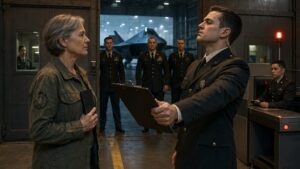
The old man crossed the red safety rope like he had forgotten the world still had rules for people like him.
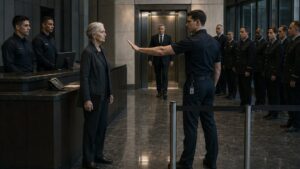
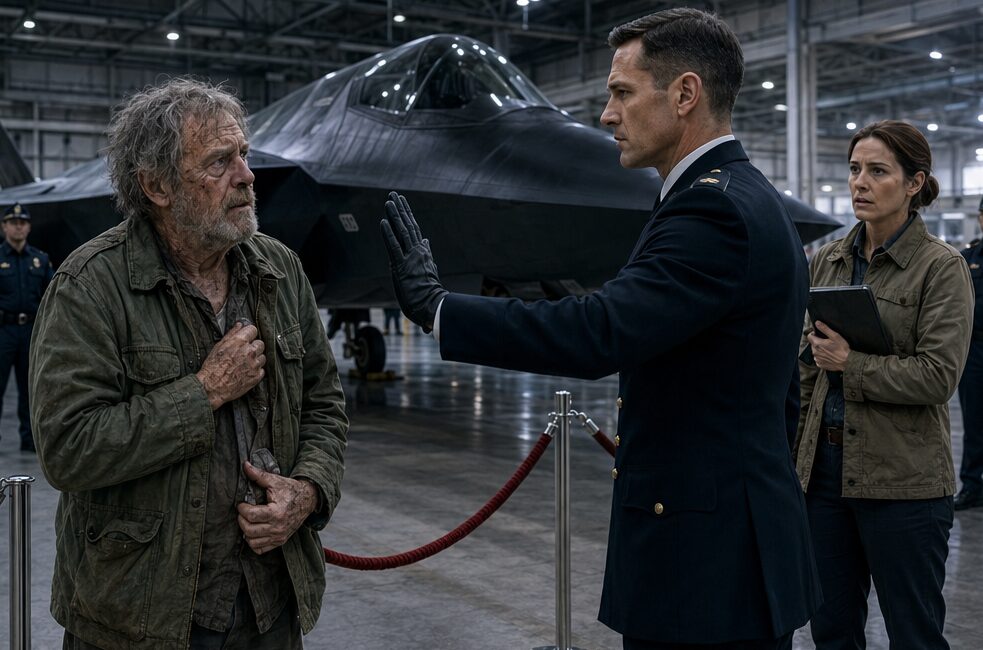
“Sir.” Captain Benjamin Harris lifted one gloved hand. Not a greeting. A barrier. “You need to step back.”
The hangar went quieter than it should have.
Mechanics paused with polishing cloths in their hands. Two airmen near the coffee station turned their heads. A contractor standing beside a rolling platform lowered his clipboard just enough to stare.
The old man stood beneath the lights in an old green field jacket, his gray beard uneven, his boots leaving faint dark prints on the clean floor. One sleeve had a grease stain so old it had become part of the fabric. He was breathing hard, but he did not look lost.
He looked late.
Behind him, the aircraft waited.
It had been restored until it seemed almost unreal, black and angular beneath the hangar lights, its surface drinking in every reflection. The base had spent months preparing for this morning. Families would be let in through the east doors in twenty minutes. Press would follow. Then commanders, donors, retired officers, the official remarks, the unveiling of the dedication plaque.
Benjamin had rehearsed the order of movement twice before sunrise.
The old man had not been in any version of it.
“I said step back,” Benjamin repeated.
The man’s eyes stayed on the aircraft. “You can’t roll it out under that name.”
That made Benjamin’s jaw tighten.
Not because the words were loud. They were not. The old man’s voice was rough and nearly swallowed by the hangar’s ventilation system.
But he had spoken as if he had authority.
“You’re in a restricted area,” Benjamin said. “Show identification.”
The old man pulled a cracked plastic badge from inside his jacket. His fingers trembled so badly it took him two tries to turn it outward.
Benjamin accepted it without lowering his guard.
The photo was decades old. A younger man with dark hair, square shoulders, and a face hardened by desert sun stared out from behind cloudy plastic. Beneath it, the printed text named a contractor program attached to a Nevada test range that had been closed before half the room had finished high school.
One of the younger airmen behind Benjamin gave a short laugh through his nose.
The old man heard it.
His hand closed slowly.
Benjamin looked at the badge, then back at him. “This expired twenty-seven years ago.”
“So did the lie,” the old man said.
That shut the laugh down.
Across the hangar, Cynthia Bennett lifted her eyes from her tablet.
She was not wearing a uniform, which made her easier to underestimate and harder to ignore. Khaki jacket, practical shoes, hair tied back, a tablet tucked against her forearm. She had spent the last four months building the public history package for the aircraft—serial records, restoration notes, archived photographs, approved language clean enough for families and reporters.
She knew every name cleared for the ceremony.
She did not know this man.
Benjamin passed the badge back. “What’s your name?”
“Raymond.”
“Last name?”
“Does it matter if you already decided I don’t belong?”
The words were not angry. That was what made them sting.
Benjamin glanced toward the security desk. Two personnel near the far wall had already started moving.
Raymond saw them too.
He raised one hand, palm out. The gesture should have looked defensive. Instead it looked like a mechanic trying to stop someone from lowering an engine onto a man beneath it.
“Ten minutes,” he said. “That’s all I’m asking.”
“You’re asking for access you don’t have.”
“No.” Raymond’s eyes went back to the aircraft. “I’m asking you not to let that jet wear the wrong man’s history.”
The hangar held still.
Cynthia’s tablet dimmed in her hand.
Benjamin’s voice cooled. “Be very careful.”
Raymond looked at him then. Fully.
“I’ve been careful for thirty years,” he said. “That’s the problem.”
Part II — The Name on the Plaque
Benjamin stepped closer so the conversation would not carry. It carried anyway.
“Mr. Raymond,” he said, using the first name like a label on a box. “This aircraft is part of a sanctioned heritage presentation. If you have a concern, there are channels.”
Raymond gave a small, almost tired smile. “Channels are where truth goes to drown politely.”
Cynthia moved before she meant to. Only three steps, but enough that Benjamin noticed.
“Captain,” she said, “I can check his badge against the restoration files.”
Benjamin did not look away from Raymond. “That won’t be necessary.”
“It may be faster than having security drag him out in front of the press.”
That landed.
Benjamin turned his head just enough to look at her. Cynthia had worked with officers long enough to recognize the silence between an order and a warning.
She kept her face neutral.
The east hangar doors were still closed, but beyond them came the low murmur of a gathering crowd. Families. Photographers. A base band warming up somewhere outside. A ceremony waiting for its clean version of the past.
Raymond’s gaze flicked toward the doors and back.
“Please,” he said.
It was the first time he sounded old.
Not weak. Old.
As if every second he stood there cost him more than anyone had guessed.
Benjamin exhaled once through his nose. “Five minutes. In my presence. Then you leave.”
Raymond looked at the aircraft. “Five may be all I’ve got.”
Cynthia opened the ceremony file on her tablet. Her thumb moved through approved captions and image panels.
Aircraft restoration timeline.
Technical lineage.
Memorial dedication language.
She reached the plaque proof and turned the screen slightly.
A brushed steel rectangle appeared on it, ready to be bolted beneath the aircraft’s left wing display stand.
In honor of Colonel Jacob Walker, whose courage advanced the future of flight.
Raymond’s face changed before he spoke.
Not surprise. Recognition.
Pain with a name.
“There,” Cynthia said softly.
Raymond swallowed.
Benjamin saw it too and stiffened. “Colonel Walker was a decorated test pilot.”
“He wasn’t alone.”
The words came too fast, as if Raymond had spent years holding them behind his teeth.
Benjamin’s hand rose again. Same barrier, sharper now. “Do not make accusations about a deceased officer in this hangar.”
Raymond’s eyes flashed. “I’m not accusing the dead.”
“Then what are you doing?”
“I’m naming the ones buried under him.”
The two security men had reached the edge of the work area. Benjamin signaled with two fingers for them to hold. They stopped, but not far enough.
Cynthia scrolled through the casualty page. There was only one name attached to the incident approved for public mention: Colonel Jacob Walker. Test accident. Classified aircraft platform. Loss of control. Pilot unrecovered. Wording careful enough to reveal nothing and suggest everything.
Raymond stepped toward the plaque proof.
Benjamin blocked him.
“Enough.”
Raymond looked past him to the aircraft, to the smooth dark skin repaired and polished until no seam showed.
“He told me to bring them home,” Raymond whispered.
Cynthia’s thumb froze.
Benjamin heard it, but his face hardened instead of softening. “Who?”
Raymond did not answer right away.
The hangar lights buzzed faintly overhead. Someone outside tested a microphone. A brief squeal of feedback slid under the doors and vanished.
Benjamin checked his watch.
Seventeen minutes.
“We are not doing this during a base ceremony,” he said. “Mr. Raymond, you are going to leave with security now.”
Raymond’s shoulders lowered, but not in surrender.
He reached inside his jacket.
Both security men moved.
Benjamin’s voice cut hard. “Hands where I can see them.”
Raymond stopped.
For one cold second, every young person in that room saw an old man as a possible threat.
Raymond saw them seeing it.
His eyes closed once.
Then, very slowly, he brought his hand out and opened his palm.
A broken metal tag lay across his scarred fingers.
Not a full identification tag. Half of one. Bent at the edge. Darkened with age. The hole where a chain had once passed through was torn open. Engraved across the dull surface were numbers Cynthia could read even from where she stood.
34°52”N.
69°17”E.
Her tablet slipped.
It hit the polished floor with a crack that seemed louder than the microphone outside.
Benjamin turned.
Cynthia was staring at the tag as if it had spoken her name.
Raymond did not move.
No one laughed now.
Part III — The Numbers That Should Not Exist
Cynthia crouched for the tablet, but her eyes stayed on Raymond’s hand.
“Where did you get that?” she asked.
Benjamin looked at her. “You recognize it?”
She did not answer him.
She stood, tablet in both hands now, the screen cracked from corner to corner. Her thumb moved faster than before. Ceremony file. Archive index. Redacted appendices. Cross-reference image cache. She knew the structure because she had built the clean public version from sealed fragments, and she knew what she had been told not to connect.
The numbers were not supposed to be in the same room as that aircraft.
“Cynthia,” Benjamin said.
She looked up. “Those coordinates appear in an appendix attached to the recovery inventory.”
Benjamin’s face went still. “That appendix is sealed.”
“It was partially visible in a scanned metadata header. I thought it was a processing artifact.” Her eyes returned to the tag. “It wasn’t.”
Raymond let out a breath that almost broke.
Benjamin stepped between them. “A broken tag doesn’t override classified records.”
“No,” Raymond said. “It outlived them.”
Benjamin’s voice sharpened. “Whose tag is it?”
Raymond closed his fingers around it, but not to hide it. To hold himself together.
“Michael.”
No one in the hangar knew what to do with the name.
Cynthia searched it. Her tablet lagged, then loaded a personnel roster clipped from an old maintenance attachment. Most names were blacked out. One line, misfiled under equipment reconciliation, still showed enough.
Michael R.
Crew chief.
Status: reassigned.
The word was too clean.
Cynthia’s mouth tightened. “There’s no casualty record under that name.”
“There wouldn’t be.”
Benjamin’s eyes moved from the tablet to Raymond. “Say that again.”
Raymond looked at him as if he were choosing which pain could fit into a sentence.
“There wouldn’t be,” he repeated. “Because if he died there, then the mission existed. If the mission existed, the aircraft wasn’t only a test platform. If the aircraft wasn’t only a test platform, your plaque becomes a problem.”
Benjamin’s jaw flexed.
The east doors rattled faintly as someone outside tested the opening mechanism. The ceremony crew was getting ready.
Benjamin spoke low. “You’re making claims about material you could not legally know.”
Raymond almost laughed. It was a dry sound, stripped of humor. “I cleaned that material out of sand with my hands.”
The words entered the room differently.
Cynthia saw Benjamin’s posture change, not softer, not convinced, but less certain of the ground beneath him.
She scrolled deeper into the restoration database. “Captain, there are recovery part numbers tied to the current frame.”
“Everything on that aircraft was cleared.”
“Yes.” Cynthia’s eyes narrowed. “But not all under the same incident title.”
Benjamin stepped beside her. “Show me.”
Raymond stayed where he was, the tag in his hand, his body angled toward the aircraft like a compass that had been forced to point at one place for thirty years.
Cynthia pulled up a scanned maintenance note, degraded and crooked. Most of the handwriting was hard to read. One corner contained a notation beside a recovered structural bracket.
R. Miller.
But there was no Raymond Miller in the room now.
There was only Raymond, breathing through the shock of being seen.
Cynthia looked from the note to the old man. “This is your handwriting.”
Raymond did not ask to see it.
He knew.
Benjamin saw the name too. His face changed in a way small enough that only Cynthia caught it.
“What?” she asked.
Benjamin took the tablet.
At the bottom of the scanned document was a routing stamp. Report prepared for review by the office of Brigadier General Harris.
Cynthia looked at Benjamin.
He did not look back.
“My father worked under him,” Benjamin said.
Raymond’s face did not move. “Then he knew what got left out.”
Benjamin’s hand tightened around the cracked tablet. “You don’t know what he knew.”
“I know what I carried.”
“That is not the same thing.”
“No.” Raymond’s voice dropped. “It’s heavier.”
The security men shifted closer. One of them touched the radio at his shoulder.
Benjamin looked toward the east doors. People outside were beginning to applaud something. Maybe the band. Maybe a commander arriving. The sound came muffled through steel, cheerful and wrong.
Cynthia lowered her voice. “Captain, if this is connected, the ceremony language is inaccurate.”
“If,” Benjamin said.
Raymond looked at him then with something like pity. “You still think this is about wording.”
Benjamin turned on him. “I think a base full of families is outside waiting to honor a man who gave everything.”
Raymond’s eyes filled, but no tears fell.
“He did,” Raymond said. “And so did the men your record learned to step around.”
Part IV — The Report His Father Touched
Benjamin took the tablet from Cynthia and walked three steps away, as if distance could make the scan less real.
His father had kept a framed photograph of General Harris in the study. Not family, not exactly, but close enough that Benjamin had grown up understanding the difference between a clean record and a stained one.
Do your duty where people can see it, his father had told him once.
And where they can’t? Benjamin had asked.
His father had not answered.
Now the answer stood in front of him wearing oil-stained boots.
The security radio crackled.
“Captain Harris, public entry in eight minutes. Confirm hangar clear.”
Benjamin did not respond.
Cynthia moved beside him. “There’s more.”
He looked down.
She had opened another file. A routing memo, not public. Its header carried a classification marking that had since expired, but several paragraphs remained blacked out. Near the bottom, a handwritten correction appeared in blue ink.
Casualty language must remain singular pending authorization.
Singular.
Benjamin read it twice.
His throat tightened before he could stop it.
Cynthia said, “That correction was initialed by someone in your father’s office.”
Benjamin looked at her sharply. “Careful.”
“I am being careful.”
“No,” he said. “You’re standing in a room with an unverified intruder and a broken artifact, implying my father helped erase casualties.”
Raymond spoke from behind them. “Not implying.”
Benjamin turned.
The old man had not moved closer, but he seemed larger now. Not physically. The hangar had simply stopped shrinking him.
“You don’t get to do that,” Benjamin said.
Raymond’s voice stayed quiet. “I didn’t come here to punish your father.”
“Then why are you here?”
Raymond looked at the plaque, still covered in protective film on a rolling cart beside the aircraft.
“Because they’re about to polish the last fingerprints off the truth.”
The sentence hit Cynthia harder than she expected.
She had spent weeks making the presentation clean. Cropping photographs. Standardizing dates. Removing language that raised questions. She had thought accuracy meant approved consistency.
Now she wondered how many erased things had looked like formatting problems.
Benjamin finally pressed his radio. “Hold public entry.”
There was a pause.
“Say again, Captain?”
“Hold public entry.”
“Sir, command staff is assembled.”
“I said hold.”
The hangar heard it.
Raymond heard it too, and his face tightened not with relief, but with fear.
The delay made the truth possible.
It also made it dangerous.
One security man moved closer. “Captain, do you want him detained?”
Benjamin did not answer fast enough.
Raymond looked at him. “You can still put me out.”
“I know.”
“You can still let them bolt that plaque on.”
“I know.”
“Then know this too.” Raymond opened his hand again. The broken tag lay there, small and ugly under all that light. “I didn’t keep this because I wanted to be believed. I kept it because he asked me not to let the numbers die.”
Cynthia’s voice softened. “Michael?”
Raymond nodded once.
Benjamin looked at the tag. “What happened at those coordinates?”
Raymond’s fingers closed again.
Not yet.
It was there on his face.
Not yet, because to say it would make the room real again. The sand, the heat, the wreckage, the men breathing in the dark. The order that came through clean and impossible. The retreat. The weight in his pocket that had never stopped being warm.
The radio crackled again. “Captain, east doors are standing by.”
Benjamin looked at the two security men. “No one opens those doors without my order.”
Then he faced Raymond fully.
For the first time that morning, he did not raise his hand.
“Tell me enough to know whether I’m stopping history or saving it.”
Raymond gave him a tired look.
“Son,” he said, “sometimes it’s the same thing.”
Part V — What the Tag Remembered
Raymond walked toward the aircraft slowly, and this time Benjamin did not block him.
Every step changed the room.
The young airman who had laughed at the badge looked down. The security men watched Benjamin for permission that no longer came. Cynthia followed at a distance, tablet against her chest, as if the cracked screen had become something fragile and alive.
Raymond stopped beneath the left wing.
Up close, the aircraft smelled faintly of sealant, metal, and new paint. It looked flawless. That was what bothered him most.
Nothing that carried history should look that untouched.
“They sent us after a crash,” Raymond said. “Not a rescue. They used that word later. It was recovery from the start.”
Benjamin stood a few feet away. “Who sent you?”
Raymond shook his head. “Names won’t help you today.”
“They might.”
“They’ll help men with lawyers. Not the ones I came for.”
Cynthia looked up from the tablet. “How many were there?”
“Four at the site when we arrived. Colonel Jacob Walker was already gone. Two crew support. One systems tech. Michael was alive.”
The hangar seemed to contract around the name.
Raymond touched the aircraft’s underside with two fingers, not affectionately, not reverently. Like a mechanic checking a fever.
“We weren’t supposed to find anyone alive. That was the problem.”
Benjamin’s expression tightened. “What does that mean?”
“It means the report had already been written in someone’s head.”
Outside, muffled applause rose and faded again.
Raymond kept going before Benjamin could interrupt.
“The wreck was half-buried in a ravine. Night coming fast. Hostile patrols somewhere above us. Radio cutting in and out. Michael had his leg pinned under a panel I couldn’t lift with two men and a prayer.”
His voice stayed level. That made it worse.
“He asked me if the others were out. I lied.”
Cynthia closed her eyes briefly.
Benjamin did not move.
Raymond looked at the floor, but he was no longer seeing the hangar.
“He knew. Men always know when you lie that badly.”
The broken tag clicked softly in his palm as his hand tightened around it.
“Command ordered withdrawal. Destroy sensitive material. Mark site unrecoverable. Leave no trace that tied the platform to the operation.”
Benjamin’s face drained. “If there were survivors, they would not—”
“They did.”
The words were not loud.
They did not need to be.
Raymond looked straight at him. “And I obeyed.”
For a moment, no one breathed normally.
There it was. Not heroism. Not clean martyrdom. The thing Raymond had carried beneath the tag.
“I took what I could,” he said. “Flight memory core. Two structural plates. A burned section of control housing. Michael grabbed my sleeve before I climbed out.”
His voice thinned, but it did not break.
“He had already snapped the tag off. Pressed it into my hand. Told me the coordinates twice. Made me repeat them.”
Cynthia’s eyes shone.
Raymond looked at her, then Benjamin.
“He said, ‘If they make us disappear, make the numbers stay.’”
The line settled over the room.
The young airman who had laughed wiped at his mouth with the back of his hand.
Raymond turned toward the dedication plaque resting on the cart. Its brushed surface caught the hangar lights. Colonel Jacob Walker’s name waited there, clean and singular.
“He wasn’t wrong,” Raymond said. “They made him disappear.”
Benjamin’s radio crackled again.
“Captain, command is requesting status.”
Benjamin did not touch it.
Raymond stepped toward the plaque.
One security man moved on instinct.
Benjamin’s voice stopped him. “Stand down.”
The man froze.
Raymond looked at Benjamin.
There was no gratitude in his face. Only the exhausted dignity of a man who had finally been allowed to finish a sentence begun thirty years earlier.
He placed the broken tag against the empty space beneath Colonel Jacob Walker’s name.
The metal made a small sound.
Not dramatic.
Not enough for history.
Enough for the room.
“There,” Raymond said.
His hand remained over the tag.
“Now he’s not under the paint.”
Part VI — Until the Names Catch Up
No one opened the east doors.
The waiting crowd outside never saw the moment the ceremony ended before it began. They did not see Captain Benjamin Harris order the plaque covered. They did not see Cynthia Bennett copy the scanned note, the redacted appendix, the metadata header, and the cracked-screen photograph of the tag into a protected evidence channel with three recipients and no recall option.
They did not see Raymond sit down beneath the wing because his knees had finally given up pretending.
But the hangar saw.
That was enough to start.
Benjamin stood beside the covered plaque while a senior commander demanded answers over the radio. His responses were clipped, careful, and less certain than they had been that morning.
“Historical discrepancy,” he said once.
Cynthia looked at him.
He looked back and corrected himself.
“Material discrepancy.”
Raymond gave the faintest nod.
Not approval.
Recognition.
There was a difference.
The young airman who had laughed brought Raymond a paper cup of water and could not quite meet his eyes.
Raymond accepted it.
“Thank you,” he said.
The airman swallowed. “Sir, I—”
Raymond shook his head. “Don’t spend your apology before you know what it’s for.”
The airman stepped back, wounded by the mercy.
Cynthia crouched beside Raymond, tablet balanced carefully in both hands.
“I sent it where it can’t disappear quietly,” she said.
Raymond looked at the cracked screen. “You sure that won’t cost you?”
“No.”
He almost smiled. “Honest answer.”
“It’s the only kind that feels useful today.”
A few feet away, Benjamin removed one glove. Then the other. He looked younger without them. Less polished. Less protected.
He approached Raymond and held out the broken tag.
“I should return this.”
Raymond stared at it for a long moment.
The tag had spent thirty years in coat linings, cigar boxes, workbench drawers, under mattresses, once in the wall behind a bathroom mirror when he thought men in clean shoes had come to ask him questions. It had crossed three states, two marriages, four apartments, and every night he had woken with the taste of dust in his mouth.
He had kept it safe.
He had also kept it silent.
His fingers rose, stopped, and lowered.
“No,” Raymond said.
Benjamin waited.
“Keep it.”
Cynthia looked up.
Raymond’s voice was tired but clear. “Not forever. Just until the names catch up to it.”
Benjamin closed his hand around the tag as if he had been handed something heavier than metal.
“My father may have known,” he said.
Raymond looked at him. “Maybe.”
“If he did, I don’t know what that makes him.”
Raymond leaned his head back against the cool metal support beneath the wing. His eyes moved across the underside of the aircraft, tracing shapes no one else could read.
“It makes him a man who stood close to a wrong thing,” Raymond said. “You’ll have to decide how close you stand now.”
Benjamin had no answer.
That was the first honest thing about him.
Outside, the crowd noise shifted. Confusion moved differently from celebration. People were being told to wait, then to leave, then likely told nothing useful at all.
The aircraft remained under the lights, magnificent and incomplete.
Cynthia stood and walked to the covered plaque. The cloth over it was plain gray, borrowed from a maintenance cart. It did not look ceremonial. It looked temporary.
That mattered.
Raymond watched it for a while.
He had imagined this moment many times, and in most versions, he had been angrier. Younger too, somehow. He had imagined shouting names until the rafters gave them back. He had imagined commanders paling, old files opening, men in suits losing the privilege of forgetting.
The real thing was quieter.
A delayed ceremony.
A covered plaque.
A young officer holding a broken tag like it might cut him.
A woman with a cracked tablet making sure the evidence traveled farther than fear.
And Raymond, still alive long enough to see the first piece of the lie stop moving.
It was not enough.
It was more than yesterday.
Benjamin turned toward the east doors, then stopped. “Mr. Raymond.”
Raymond looked at him.
Benjamin’s posture straightened, but this time it did not feel like a wall.
“You asked for ten minutes.”
Raymond blinked.
Benjamin looked toward the covered plaque. “Take as long as you need.”
The hangar emptied slowly after that.
No applause followed Raymond. No one saluted him. No commander crossed the floor to apologize in a voice large enough for witnesses.
That was all right.
He had not come for a scene.
He had come for a name.
When only Cynthia and Benjamin remained nearby, Raymond pushed himself to his feet. His joints protested. His hand found the aircraft’s support beam, and for once, nobody reached for him as if age had made him breakable.
He stood on his own.
Then he touched two fingers to the gray cloth over the plaque.
“Michael,” he said softly.
The name did not echo.
It stayed.
For Raymond, that was better.
Benjamin opened his hand and looked once at the broken tag before closing it again.
Cynthia’s tablet chimed with an outgoing confirmation.
The hangar doors remained shut.
And beneath the wing of an aircraft no longer clean enough for a false story, Raymond walked toward the exit without being escorted, carrying nothing in his hands for the first time in thirty years.