The Old Marine Held Out One Folded Visitor Card, And The Gate Went Silent
Chapter 1: The Folded Card At The Gate
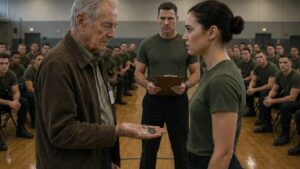
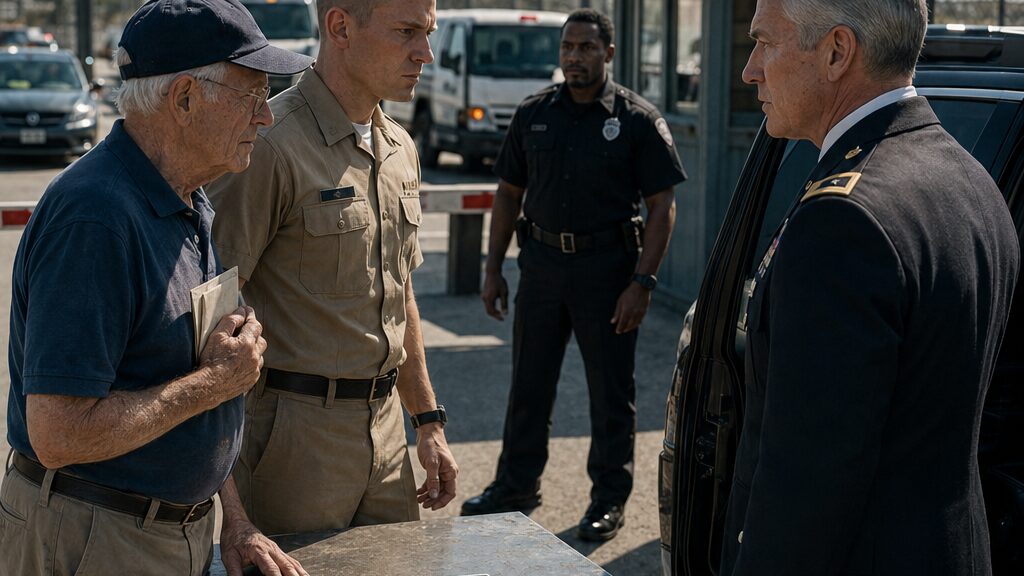
Jerry Bennett reached the outer gate just before the late-morning sun turned the pavement white.
He had dressed for the heat because the forecast had warned him, but the blue polo still clung to his back beneath the shoulders. His khaki pants were pressed as well as his hands could press them. His brown shoes had been polished the night before, not to shine, exactly, but to show he had cared enough to try.
The navy cap sat low on his white hair. It was not a service cap. He had not worn one of those in years. This one came from a hardware store near his house, plain except for a faint salt line above the brim where sweat had dried into the cloth. The glasses on his nose slipped every time he looked down.
He looked down often.
In his right hand, folded once and then once again along the same old crease, was a visitor request card that had turned soft from being handled. The edges had gone gray. The printed box where his name appeared had faded, but the letters could still be read if someone took the time. Tucked behind the card was a photograph no bigger than his palm.
He had not looked at the photograph since leaving his truck in the visitor lot.
Looking made things harder.
A line of cars waited behind the gate arm. A delivery van idled with its hazard lights clicking. Somewhere beyond the chain-link fence, a truck beeped in reverse. The base road ran straight under a row of sunburned flags and toward low tan buildings that looked exactly like Jerry remembered and not at all like he remembered.
He stepped toward the pedestrian lane.
A young man in tan uniform looked up from a tablet.
“Sir, you need to stay behind the yellow line.”
Jerry stopped.
The yellow line was fresh, painted thick across the concrete. He had already crossed it by half a shoe. Slowly, he drew his foot back.
“Morning,” Jerry said.
The young man did not answer the greeting. He was tall, broad through the shoulders, with close-cropped blond hair and black boots so clean they reflected small pieces of light. His name tape read CARTER. A black watch sat tight against his wrist. Everything about him seemed squared off: jaw, stance, the angle of his elbows.
“Identification,” the young man said.
Jerry lifted the folded card.
“I’ve got this.”
“That’s not identification.”
“No,” Jerry said. “It’s what they told me to bring.”
“Who told you?”
Jerry looked past him through the gate. A black vehicle moved slowly along the inner road, then disappeared behind a building. For a second, he forgot the question. He saw another road, narrower, wet after rain, and a younger man running beside him with a grin too large for the trouble they were in.
The guard’s voice sharpened. “Sir. Who told you?”
Jerry blinked. “Visitor office. A while back.”
“A while back?”
“Yes.”
“How long is a while?”
Jerry felt the card soften under his thumb. “Longer than it should’ve been.”
The guard held out his hand.
Jerry placed the card in it carefully, as if the way he gave it might teach the young man how to hold it. The guard opened it with a flick that made one corner snap. Jerry’s fingers rose before he could stop them.
“There’s a picture inside,” he said.
The guard glanced down, then up. “This is old.”
“Yes.”
“This format isn’t used anymore.”
“I figured it might not be.”
The guard turned the card over, looking for something with the speed of a man trained to reject what did not match. “There’s no barcode.”
“No.”
“No current date.”
“It was approved before they changed the room.”
“What room?”
“The memorial room.”
A car behind Jerry gave a short impatient honk. Jerry did not turn around. The sound pressed against the back of his neck.
The guard looked over Jerry’s shoulder toward the line. “Sir, I’m going to need you to step out of the lane.”
“I only need to ask someone to check the old list.”
“That’s not how gate access works.”
“I understand.”
The guard’s mouth tightened as if Jerry had said the opposite. “If you understood, you’d have current credentials.”
The words were not shouted. That almost made them worse. They were spoken flatly, in a voice built for moving people along.
Jerry took a breath through his nose. Hot asphalt. Diesel. Cut grass from somewhere inside the fence. The smell of military mornings had changed less than the buildings.
“My name is on that card,” he said.
“A name on an old card doesn’t get you through a federal gate.”
“I’m not asking to walk through alone.”
“Then what are you asking?”
Jerry looked at the card in the young man’s hand. The crease ran across the middle like a scar.
“I’m asking you to read the back.”
The guard did not. Instead he closed the card and held it at his side.
“You have a driver’s license?”
“In my wallet.”
“Take it out.”
Jerry reached slowly toward his back pocket. His fingers had grown stiff over the years, and the wallet always caught against the seam. He knew how he looked while he worked it free: bent slightly, fumbling, an old man taking too long at a place built for quick answers.
The guard watched him.
Jerry got the license out and offered it.
The guard checked it, then looked at the tablet. He tapped the screen. Waited. Tapped again.
“You’re not in today’s visitor system.”
“No, I wouldn’t be.”
“Then you don’t have access.”
“The woman on the phone said old requests had to be checked manually.”
“What woman?”
Jerry swallowed. “I don’t remember her name.”
The guard gave a small breath through his nose, not quite a laugh. “Of course.”
Jerry heard it.
Not the word. The meaning underneath.
Old man. Wrong line. Old paper. No name. No appointment. No reason anyone should stop the morning for him.
The delivery van honked again, longer this time.
The guard glanced toward it, then at Jerry. “Sir, step aside.”
Jerry did not move.
Not because he wanted to be difficult. He had spent most of his life moving when told. Left, right, forward, down, hold, wait. He had obeyed voices in storms, in smoke, in places where hesitation could cost more than pride.
But there were moments when moving aside meant losing something that could not be requested again.
“They start work at one,” Jerry said.
“What?”
“The renovation crew. On the memorial room. They start at one.”
The guard frowned. “That’s not my concern.”
“It is mine.”
The young man’s face closed. “Sir, this is your final warning to clear the pedestrian lane.”
Jerry looked beyond him again. Past the gatehouse. Past the road. Somewhere inside, down a hall he had not walked in decades, was a wall with names that belonged to men who never got old enough to be spoken to this way.
He smoothed the crease of the card with his thumb, though it was no longer in his hand.
“May I have that back?” he asked.
The guard looked at him for a long moment. Then he glanced down at the folded card as if surprised to find it still there. He handed it over.
Jerry took it. The photograph inside shifted. A pale corner showed.
The young man’s eyes caught it.
“What’s that?”
“A picture.”
“Of what?”
Jerry slid the corner back under the card. “Of someone who should be in that room before they take it apart.”
A black-uniformed security officer stepped from the gatehouse door and looked toward them, drawn by the held-up line. The cars idled. A woman in the first sedan leaned toward her windshield, watching. The delivery driver had his elbow out the window.
Jerry felt every eye without looking for them.
The guard’s voice dropped. “Sir, I’m not doing this with you in front of traffic.”
“I’m not asking you to do anything but check.”
“I checked.”
“You checked the new system.”
“That is the system.”
Jerry held the card against his chest. For a moment his hand covered the old ink, the faded approval stamp, and the photograph beneath it. The gesture was not meant to hide anything. It was simply where his hand went when the world pressed too close.
The guard pointed to the side of the lane.
“Move to the inspection table.”
Jerry nodded once.
The table stood under a patch of shade near the gatehouse, metal-legged, its surface scratched by keys, bins, belt buckles, and years of hurried hands. Jerry walked toward it slowly, aware of the guard at his shoulder and the waiting line behind him.
At the table, the guard held out his hand again.
Jerry placed the folded card down instead of handing it over.
The young man stared at it.
“Name,” he said.
“Jerry Bennett.”
The guard tapped the tablet without looking at him.
Then his eyes narrowed at the screen.
“Jerry Bennett,” he repeated.
“Yes.”
The guard tapped again, harder this time, as though the machine might respond better to irritation.
Finally he looked up.
“The name on it doesn’t exist in the system.”
Chapter 2: You Can Read It While I’m Standing
For a moment, Jerry Bennett thought of taking the card back and leaving.
It would have been easy enough. Easier than standing at a scratched metal table while a young man half his age held his morning hostage with a tablet and a tone. Easier than feeling the line of vehicles behind him tighten with annoyance. Easier than explaining, again, that old things did not become false because a newer machine could not find them.
But the memorial room would be emptied at one.
He could picture the work order though he had never seen it: crew arrival, protective plastic, boxes, labeled panels, names removed with careful hands that did not know which names had once been shouted over rain, whispered into letters, carved into the inside of a man’s sleep.
Jerry placed both palms lightly on the edge of the table.
“My name’s on the card,” he said.
Paul Carter lifted it, opened it, and laid it flat. “Your name is on a card that doesn’t match our current access process.”
“Then check the old one.”
“There is no old one at the gate.”
“There’s always an old one somewhere.”
Paul’s jaw flexed. The black-uniformed security officer had come closer but had not yet stepped in. He stood near the gatehouse door, watching with the wary stillness of a man deciding whether a thing was a problem or only an inconvenience.
Paul lowered his voice. “Sir, you’re holding up an active entry point.”
“I didn’t choose the gate.”
“That’s where you are.”
Jerry looked at the card between them. “And where else would a man go to get inside?”
The delivery driver called from his van, “Come on, man!”
Paul looked back sharply. “Stay in your vehicle.”
The driver lifted both hands and disappeared behind the windshield.
Paul turned back to Jerry. The interruption had embarrassed him. Jerry saw it land: the young sergeant’s face reddening at the neck, the awareness of eyes, the need to regain control.
That need had a weather of its own.
“Empty your pockets,” Paul said.
Jerry looked at him. “For what reason?”
“Inspection.”
“I’m not carrying anything that needs inspecting.”
“You don’t decide that.”
“No,” Jerry said. “But you can ask me standing straight.”
Paul’s eyes hardened. “Hands on the table.”
Jerry did not move right away.
Not out of defiance. His mind had gone, for half a second, to a different table: green metal under a tent, rainwater pooling at one leg, Timothy Miller spreading a damp map with fingers that shook only when no one was looking. Stand straight when they’re wrong, Timothy had said once, grinning through a split lip. Makes them work harder to lie about you.
“Sir,” Paul said.
Jerry placed his hands flat on the table.
The metal was warm.
Paul stepped to his side. “Feet back.”
Jerry moved his shoes back six inches.
“Farther.”
He moved them again.
The angle pulled at his lower back. He had woken with pain there that morning, the kind that started as a whisper and became a hand by noon.
Paul’s palm came down between Jerry’s shoulder blades.
It was not a strike. It was not hard enough to bruise. That might have made it simpler. It was the practiced pressure of someone moving an object into the position he wanted.
Jerry bent forward.
The table rose toward his face. His glasses slid down his nose. The folded card lay inches from his cheek, open now, the faded photograph half exposed beneath the printed paper. Two young men stood in the picture, sun in their eyes, sleeves rolled, grinning at something outside the frame. One of them was Jerry before age had thinned him down to bone and patience. The other was Timothy Miller, alive in the way photographs made the dead cruelly alive.
For a second, Jerry could not breathe.
The gate went quiet in pieces.
The van stopped rattling. The woman in the sedan stopped moving. The black-uniformed officer shifted his weight.
Paul’s hand remained on Jerry’s back.
“Keep your hands where I can see them,” Paul said.
Jerry stared at the photograph.
He could have turned. He could have said things. He could have given the young man every year, every unit, every name, every night that still came back smelling of wet canvas and burned coffee. He could have made his voice into a weapon. Men had taught him how.
Instead, he lifted his head as far as the pressure allowed.
“You can read it while I’m standing,” he said.
Paul’s hand paused.
Jerry did not say it loudly. That was why it carried.
The black-uniformed officer took two steps closer. “Sergeant Carter.”
Paul removed his hand, but not quickly enough to make it seem accidental.
Jerry straightened slowly.
His back objected. His fingers stayed on the table until the world steadied. He reached for his glasses and pushed them up the bridge of his nose. The movement took too long. He knew it. He did it anyway.
Paul looked at the security officer. “He refused to comply with access procedure.”
“I heard him ask you to read the card,” the officer said.
Paul’s ears reddened. “He’s not in the system.”
Jerry picked up the folded card, but before he could close it, Paul’s eyes fell on the photograph.
“Who’s that?” Paul asked.
Jerry tucked the photograph back with his thumb.
“No one you’re required to know.”
“That’s not an answer.”
“It’s the only one I have for you right now.”
Paul stepped closer again, anger and uncertainty mixing in his face. “You don’t get to come to my gate with old paper, no appointment, and then talk in riddles.”
Jerry looked at the name tape on the young man’s chest.
CARTER.
He wondered if anyone had ever stood in front of Paul Carter and seen him as more than the uniform. Probably. Probably not enough.
“This isn’t your gate,” Jerry said.
Paul’s shoulders rose. “Excuse me?”
Jerry’s voice remained even. “It was here before you. It’ll be here after you.”
The words struck harder than Jerry intended. He regretted the sharpness almost immediately, but not the truth.
Paul reached for the card.
Jerry moved it back, not fast, just enough.
The movement changed the air.
Paul’s hand stopped halfway. The black-uniformed officer noticed. So did the woman in the sedan. So did the delivery driver, who had leaned forward again.
Jerry held the folded card against the table with two fingers.
“You may read it,” he said. “You may call someone. You may tell me no after you’ve done both. But you don’t get to put your hand on my neck and pretend paper is the problem.”
The silence after that did not belong to Jerry. It belonged to everyone who had seen enough to understand exactly what had happened and not enough to know what should happen next.
Paul’s face tightened as if he had been slapped, though Jerry had not raised his voice.
The black-uniformed officer came to the table. “Let me see the card.”
Jerry looked at him, measured something in his expression, then handed it over.
The officer opened it carefully.
That was the first decent thing anyone had done with it that morning.
He read the front, then turned it over. His eyebrows drew together.
“What is it?” Paul asked.
The officer did not answer at once. He slid the photograph halfway out, then stopped when Jerry’s fingers twitched.
“May I?” the officer asked.
Jerry nodded.
The photograph came into full sunlight.
The old colors had browned at the edges. Two Marines stood beside a dented transport truck, both too young to know how young they were. On the back, written in faded blue ink, was a line Jerry knew without looking.
For the room, when they finally build it.
Under that were two names.
Jerry Bennett.
Timothy Miller.
The black-uniformed officer looked at Jerry, then down at the card again. “How old is this request?”
“Old enough,” Jerry said.
Paul leaned in despite himself. “That picture is from when?”
Jerry folded his hands in front of him so they would not shake. “That picture is older than your whole file.”
The words hung between them, not as an insult this time, but as a door opened only a crack.
Before Paul could answer, tires rolled over the inner lane beyond the gate. A black command vehicle slowed near the curb. Its paint caught the sun in a hard, clean line.
The rear door opened.
A man in a dark formal uniform stepped out, white gloves bright against the shadowed interior of the car. He turned toward the gatehouse, saw the cluster at the inspection table, and began walking over.
Paul straightened immediately.
The black-uniformed officer held the photograph and folded card in both hands now.
Jerry did not turn until the man was close enough for the sunlight to reveal his face: older, controlled, silver at the temples, with the expression of someone who had spent years not reacting too quickly.
His eyes moved from Paul to the security officer, then to Jerry.
“What’s the delay?” he asked.
No one answered at first.
Jerry reached for the card.
The security officer gave it back.
The dark-uniformed man saw the name on the front just before Jerry folded it closed.
His gaze changed, not dramatically, not enough for the waiting cars to understand. But Jerry saw recognition begin like a match struck behind glass.
“Mr. Bennett?” the man asked.
Jerry held the card still.
“Yes.”
The man’s voice lowered.
“Were you with Timothy Miller?”
Chapter 3: The Man Beside The Black Car
Paul Carter had been trained to notice hands first.
Hands told the truth before mouths did. Hands reached, hid, struck, passed, trembled. Hands gave away the difference between confusion and threat.
That morning, the old man’s hands had annoyed him.
They were slow. Too careful. They kept going back to that folded card as if the paper had feelings. They had made every movement take longer than it needed to take, while traffic backed up and the inspection window tightened and the command visit inside the gate sat like a weight on Paul’s schedule.
Now those hands were still.
Jerry Bennett held the card against his chest and looked at Alexander Sullivan as if the senior officer had spoken a name from a room no one else could enter.
Paul stood beside the inspection table with heat rising through his boots and a line of vehicles watching his back. The black command car waited inside the gate with its rear door open. The driver stood beside it, white gloves resting at his sides. Everything had the polished look of an official morning, except the old man in a blue polo and the bent card that had somehow become the center of it.
Alexander Sullivan did not repeat the question.
Were you with Timothy Miller?
The name meant nothing to Paul, and that bothered him more than it should have. He knew current rosters, visitor codes, alert procedures, delivery schedules, contractor badges, names of officers whose cars could not be delayed. He knew what the gate required him to know.
Apparently he did not know enough.
Jerry looked down at the card.
“I was,” he said.
Alexander’s posture changed by a fraction. Not a salute. Not ceremony. Something smaller and more personal, a straightening from inside.
“I’ve seen that name,” Alexander said. “In the old wing.”
Jerry’s mouth moved as if he might smile, but the expression never arrived. “Then you know why I’m here.”
“I know part of it.”
“That’s usually all anyone gets.”
Paul heard the edge in the old man’s voice, quiet as it was. He looked at the card again. One corner had bent when he first opened it. He could see the crease from where he stood.
He wished he had not noticed.
Alexander turned to him. “Sergeant Carter, what happened here?”
Paul felt the question land in public.
The security officer watched him. The delivery driver watched him. The woman in the sedan had lowered her window now, not all the way, just enough to hear what authority sounded like when authority questioned itself.
Paul chose the safe words.
“Sir, Mr. Bennett presented an outdated visitor request not found in the current system. I directed him to comply with inspection procedures.”
Alexander looked at Jerry. “Is that accurate?”
Jerry took a moment.
Paul expected him to say no. Or to describe the hand on his back, the table, the angle he had been pushed into. Paul braced for it, anger already building a defense around the shame.
Jerry said, “That is what he believes happened.”
The words were worse than an accusation.
Alexander’s eyes returned to Paul. “What does that mean?”
Paul kept his face still. “Sir, I followed access protocol.”
The black-uniformed officer spoke carefully. “There may have been unnecessary physical guidance.”
Paul’s throat tightened. “He was not following instructions.”
“I was slow,” Jerry said.
No one moved.
Jerry looked at Paul then. Not angrily. That was the problem. Anger would have given Paul something to meet.
“I was slow,” Jerry repeated. “There’s a difference.”
Paul looked away first.
Alexander extended one gloved hand toward Jerry. “May I see the card?”
Jerry hesitated.
Paul saw it now, the way the old man’s thumb pressed the crease before he released it. Not possessive. Protective.
Alexander accepted the card like it mattered. He opened it with both hands, read the front, then turned it over. The photograph slid into view.
The senior officer’s face did not break, but the breath he took was different.
“Where did you get this approval?” he asked.
“Visitor office,” Jerry said. “Before my wife passed. Before I stopped driving at night. Before they changed the phone numbers twice.”
Alexander looked toward the gatehouse. “This predates the current system.”
“Yes.”
“Why today?”
Jerry’s gaze moved beyond the gate. “Because the memorial room won’t look the same tomorrow.”
Paul thought of the renovation notices he had ignored because they did not concern gate duty. Temporary closure. Archive relocation. Old wing modernization. Words in an email, passed over between shift changes.
Alexander folded the card halfway, then stopped and left it open. “You should have been met at the visitor center.”
“I called.”
“When?”
“Last week. Monday, I think. Maybe Tuesday.”
“Who did you speak to?”
Jerry’s expression gave the same answer before his mouth did. “I don’t remember.”
Paul almost breathed out through his nose again. He caught himself before the sound became visible.
Alexander did not.
“Then we’ll find out,” he said.
He turned to the black-uniformed officer. “Clear the lane. Move Mr. Bennett out of the sun.”
“I can stand,” Jerry said.
Alexander looked at him.
“I know,” he replied.
Something in that answer moved through Paul like a quiet correction.
The senior officer did not offer help Jerry had not requested. He did not touch his elbow. He did not make a show of kindness for the people watching. He simply stepped slightly aside, opening a path between the table and the shade.
Jerry walked under his own power.
Paul remained where he was until Alexander looked back.
“Sergeant Carter.”
“Yes, sir.”
“Bring the tablet.”
Paul picked it up from the table. His hands felt too large around it.
The vehicle line began to move after the security officer redirected traffic to the adjacent lane. Engines rolled past. Faces turned and turned away. The woman in the sedan looked at Jerry once more before driving through. Her expression was not admiration. It was discomfort.
That stayed with Paul.
Inside the narrow shade of the gatehouse awning, Alexander handed the folded card back to Jerry.
“I remember a Timothy Miller listed in the old memorial corridor,” he said. “Not well enough to speak on it. Enough to know this shouldn’t be handled at the gate.”
Jerry’s thumb found the crease again. “Most things shouldn’t.”
Paul looked down.
Alexander turned toward him. “Search Bennett. Jerry Bennett. Prior visitor logs. Manual archive.”
Paul entered the name. The tablet returned nothing.
“No result, sir.”
“Try Miller.”
Paul typed.
Nothing.
Alexander’s jaw tightened. “Of course.”
The security officer stepped in. “Visitor office may have the old binders. They kept paper backups before the system migration.”
“Call them,” Alexander said.
Paul reached for his radio, grateful for a task that did not involve looking at Jerry.
Before he could speak, Jerry said, “There was a woman who told me if the card didn’t scan, to ask for Records. Not command. Not anybody important. Just Records.”
Alexander looked at him. “Did she give you a name?”
Jerry closed his eyes briefly, searching.
Paul watched him and felt, against his will, the difference between evasion and age. The old man was not hiding the answer. He was walking through fog to find it.
“Samantha,” Jerry said at last. “Maybe Reed. She said her name fast.”
Alexander nodded to Paul. “Call visitor records. Ask for Samantha Reed.”
Paul made the call.
While the radio clicked and transferred, Alexander glanced toward the black vehicle. The driver waited by the open door, still as a carved figure. Whatever schedule Alexander had been on was slipping minute by minute. Paul knew the cost of that. He knew command mornings. He knew what delay did to people whose names appeared on calendars.
But Alexander did not rush the old man.
A woman’s voice came through the radio speaker. “Visitor records.”
Paul pressed the button. “This is Gate Two. I need Samantha Reed.”
A pause. “Speaking.”
Paul looked at Alexander.
The senior officer leaned closer. “Ms. Reed, this is Alexander Sullivan. I have a Mr. Jerry Bennett at Gate Two with an old visitor request card connected to Timothy Miller and the memorial room. Can you verify?”
There was silence on the line long enough for static to fill the space.
Then Samantha Reed said, “He came?”
Jerry’s hand tightened around the card.
Alexander looked at him, then back at the radio.
“Yes,” he said. “He came.”
The radio crackled again.
“Please don’t let him leave,” Samantha said. “That request was never supposed to be lost.”
Chapter 4: A Name Missing From The New Wall
Samantha Reed had spent the morning listening to the old building complain.
The visitor records office sat in the narrow wing between the gate control room and the administrative corridor, where every door stuck in summer and every air vent rattled with the same tired metallic cough. Boxes lined one wall, each marked with black marker and dates that did not agree with the dates in the new system. A shred bin waited by the copy machine with a plastic sign that read DIGITIZED MATERIAL ONLY.
Samantha did not trust that sign.
She had been told more than once that the paper binders were dead weight. She had been told the base had moved forward. New software, clean searches, barcodes, credential scans, searchable archives. No one wanted to hear that names disappeared when systems were moved by contractors who had never stood in the rooms those names belonged to.
When the call came from Gate Two, she had been kneeling in front of a cabinet whose bottom drawer opened only if kicked.
Jerry Bennett.
Timothy Miller.
For a second she had not been in the office at all. She had been back on the phone last week, listening to an old man breathe quietly as she explained the gate process twice because he had written one digit wrong the first time.
“I have the card,” he had told her then. “They told me never to lose it.”
“Who did?”
There had been a pause.
“A woman who worked there before you were born.”
She had almost smiled. Then she had looked up the memorial renovation schedule and stopped smiling.
Now Alexander Sullivan stood in her doorway with Jerry Bennett beside him, and Sergeant Paul Carter one step behind them as if distance might erase the morning.
Jerry looked smaller indoors. Not weaker. Just more contained. His navy cap was in one hand. His white hair was flattened where the cap had been. In the other hand he held the folded visitor card.
Samantha rose too quickly and struck her knee against the open drawer.
“You’re Mr. Bennett,” she said.
Jerry nodded.
“I’m Samantha Reed. We spoke last week.”
“Yes,” he said. “You said Records.”
“I said if the gate couldn’t scan it, ask for Records.”
“I did.”
Samantha glanced at Paul without meaning to.
Paul’s eyes dropped to the floor.
Alexander stepped inside. The room was too small for uniforms, boxes, and guilt. “What do we have?”
Samantha turned to the cabinet. “Old visitor requests were migrated in phases. Memorial access cards from before the renovation planning were supposed to be verified manually. Some were scanned as images but never entered as active records.”
“That includes Mr. Bennett?”
“It may.”
“May?”
She hated that word. It was honest, and honest words often sounded like excuses.
“I found the Miller reference last week,” she said. “Not the complete file. Just enough to know Mr. Bennett had reason to call.”
Jerry stood very still.
Samantha pulled a binder from the drawer. Its spine had split, and the label had browned under clear tape. M–N VISITOR AND MEMORIAL ACCESS, ARCHIVE COPY. She placed it on her desk and turned the pages carefully. The paper smelled dry, almost sweet.
Paul remained near the doorway.
Alexander noticed. “Sergeant, come in or wait outside. Don’t hover.”
Paul stepped in.
Samantha found the page by the shape of the old paper tab, not by the index. The tab had been cut crooked. MILLER, TIMOTHY. She turned it over.
“There,” she said.
The room quieted.
Jerry’s visitor request had been stapled to a memorial placement form. The original ink had faded, but the approval stamp remained visible in one corner. Beneath it was a note written in a neat hand that did not match Jerry’s.
Photo to be placed when room is completed. J.B. authorized by widow.
Attached: one personal photograph. Pending final display.
Samantha looked at Jerry. “This was never marked complete.”
“No,” Jerry said.
“You kept the photograph?”
He nodded.
Alexander leaned closer to read the page. “Who was supposed to finalize it?”
Samantha followed the routing line with her finger. “Memorial office. Then base historical archive. Then visitor follow-up.”
“And none of it happened.”
“The room opened before the final personal items were installed,” Samantha said. “After that, the file was boxed.”
She could feel Paul listening behind her. She did not look at him.
Jerry unfolded the card. His hands moved slowly. The photograph came out from behind it, and for the first time in Samantha’s office, the two young Marines saw daylight.
Samantha had seen thousands of scanned images: ceremonies, rosters, unit photos, retirement packets, brittle news clippings. But this one was not arranged for history. It looked stolen from an ordinary afternoon. Two young men beside a truck. One grinning like he knew trouble by name. The other squinting with a cigarette tucked behind one ear, though the cigarette had been scratched nearly invisible by age.
“That’s Timothy?” she asked.
Jerry touched the edge of the photograph but did not cover either face.
“The one on the right.”
“And you?”
“The other fool.”
Samantha smiled before she could stop herself. Jerry almost did too.
Alexander read the back of the photograph. His expression settled into something quiet.
For the room, when they finally build it.
“Mr. Bennett,” he said, “why wasn’t this brought in when the room opened?”
Jerry kept his eyes on the picture. “Because I told Betty I’d do it myself.”
“That doesn’t answer—”
“It does,” Jerry said softly.
Alexander stopped.
Jerry slid the photograph back onto the card, not behind it this time, but on top, where everyone could see. “I told her I’d do it myself. Then the day came, and I got as far as the parking lot.”
No one asked which day.
Samantha understood enough not to.
Outside the office, a cart rattled down the corridor. Voices passed, laughing about lunch. The ordinary sound seemed wrong beside the old photograph.
Samantha turned back to her computer and opened the renovation schedule. She had already looked at it twice that morning. Looking again did not change it.
Her stomach tightened.
“What is it?” Alexander asked.
“The memorial corridor closes at twelve-thirty for protective covering. The room is cleared at one.”
Alexander checked his watch. “That gives us time.”
Samantha shook her head. “Not much. The old wall panels are being removed first. Timothy Miller’s panel is on the old wall.”
Jerry’s fingers pressed the card crease.
Paul spoke for the first time since entering the office. “Can the crew hold?”
Alexander looked at him.
Paul’s face flushed, but he did not look away.
Samantha picked up the phone. “I can call the memorial attendant.”
“Do it,” Alexander said.
She dialed. The line rang four times. Five.
Jerry looked toward the hallway.
Samantha could see the pull in him. He was already beyond the office, beyond procedure, standing in front of a wall only he could see.
The attendant answered. Samantha gave her name, spoke quickly, listened, and wrote nothing down because there was nothing to write that would help.
When she hung up, the room knew before she spoke.
“The crew has already started staging,” she said. “The corridor is open, but only until they seal it.”
“How long?” Alexander asked.
“Forty minutes.”
Jerry picked up the photograph and folded the card behind it. This time his hands did not shake.
“Then I should stop making all of you late,” he said.
Paul stepped back to clear the doorway.
Jerry moved toward the hall.
At the threshold, Samantha noticed the bottom corner of the visitor card had split where the old crease met the edge. A small tear, but growing.
“Mr. Bennett,” she said.
He turned.
She took a clear archive sleeve from a box on her desk. “For the photograph. Just until we get there.”
Jerry looked at the sleeve, then at the picture in his hand.
For the first time since entering the office, he seemed unsure.
“It won’t take anything from it,” Samantha said.
He let her slide the photograph inside.
The young faces disappeared behind clean plastic.
Jerry looked down at them through the shine.
Then he said, almost to himself, “Betty thought this was already finished.”
Chapter 5: The Promise Betty Thought Was Finished
The corridor outside the memorial room had been painted a new shade of beige.
Jerry knew it was new because no military building kept paint that smooth for long. Give it a year, and carts would scar the corners. Boots would darken the baseboards. Someone would hang a notice crooked and leave four holes when it came down. Time always found a way to make a place honest.
For now, the corridor looked like it had been prepared for people who preferred memory without dust.
Samantha walked ahead carrying the archive sleeve in both hands. Alexander spoke quietly with the memorial attendant near the double doors. Paul stayed a few steps behind Jerry, close enough to be useful and far enough not to presume.
That distance did not escape Jerry.
He was tired now. The morning had taken more from him than he had planned to spend. His back ached from the table. His knees had begun their old grinding complaint. The air-conditioning smelled faintly of wet cardboard and floor wax, and underneath it all was the smell of the photograph, or what Jerry imagined as the smell: old paper, drawer wood, years shut away.
There was a bench against the wall before the memorial corridor turned left.
Jerry stopped beside it.
Samantha turned. “Mr. Bennett?”
“I’m all right.”
But he sat.
No one argued. That alone felt like mercy.
Alexander finished speaking with the attendant and looked down the hall. “They’ll give us a few minutes. The crew is covering the display cases now.”
“A few minutes,” Jerry said.
He had heard those words before in too many shapes. A few minutes before the convoy moved. A few minutes before the rain hit. A few minutes before a man stopped breathing and another man had to decide which memory to carry.
Samantha held the sleeve out. “Do you want this back?”
Jerry took it.
The photograph looked different in plastic. Protected. Distant.
Paul stood near the opposite wall, hands clasped behind his back. He was trying not to look at the old man’s face, which meant he was looking at everything else: the floor, the door sign, the folded visitor card in Jerry’s lap.
“You can sit,” Jerry said.
Paul blinked. “I’m fine.”
“That wasn’t a test.”
Paul hesitated, then sat on the far end of the bench. Not close. Not relaxed. But seated.
Samantha pretended to check something on her clipboard near the doors. Alexander gave the attendant another instruction. For a small moment, the hallway belonged only to the old Marine, the young sergeant, and the photograph between them.
Jerry slid the folded visitor card under the archive sleeve. The card looked worse now beside the clean plastic. Gray edges. Soft corners. A crease nearly worn through.
“Betty gave me this picture in a grocery store parking lot,” he said.
Paul turned his head.
Jerry kept his eyes forward. “Not the first place you expect to be handed a dead man.”
Paul said nothing.
“She had it in an envelope. White one. Her handwriting on the front. Jerry, please don’t forget. As if that was something a person could choose.”
The hallway hummed.
“She was Timothy’s wife?” Paul asked.
“Widow.”
Paul accepted the correction with a small nod.
Jerry drew his thumb along the sleeve edge. “They were married eleven months. She liked to say they spent more time writing letters than living in the same house. He liked to say that made the marriage safer.”
The corner of Jerry’s mouth moved.
This time the smile arrived, but it was brief and worn thin.
“When the base announced they were building the memorial room, she called me. Said they had asked families for photographs, letters, anything personal. She didn’t drive long distances by then. Asked if I’d take it when I went.”
“And you didn’t?”
Jerry looked at him then.
Paul did not flinch, but something in his face braced.
“No,” Jerry said. “I did. I drove here the first opening day. Parked out where visitors parked before they changed all this. I sat with the envelope on the seat beside me.”
He could see it even now. His old truck. The envelope bright on cracked vinyl. His wife still alive then, sitting at home with the phone beside her because she knew he might call and say he couldn’t.
“I watched families go in,” Jerry said. “Men in jackets that still fit. Women holding flowers. Children bored because they were too young to understand what room they were entering. I got out once. Made it maybe ten steps.”
Paul’s voice was quiet. “What happened?”
Jerry looked back at the photograph.
“I heard his laugh.”
No one in the hallway moved.
“It wasn’t really there,” Jerry said. “I know that. But it was. Clear as you sitting there. Timothy laughed when he was scared. Drove people crazy. The worse things got, the bigger that grin came out, like fear was a joke he’d heard already.”
Jerry swallowed.
“I got back in the truck and went home.”
The words were plain. That made them heavier.
Paul’s hands tightened together.
“Did you tell Betty?” he asked.
Jerry shook his head. “I told myself I’d come the next week. Then my wife got sick. Then night driving got harder. Then Betty stopped asking, which was worse than asking. I kept the card. Kept the picture. Every time I saw it, I thought, tomorrow.”
Samantha had stopped pretending to read. Alexander stood still near the doors, his face turned partly away to give Jerry privacy without leaving him alone.
Jerry lifted the folded card. “You asked why I came with old paper. Because old paper is what I had left after I ran out of better excuses.”
Paul looked down at his boots.
“I thought…” He stopped.
Jerry waited.
Paul tried again. “At the gate, I thought you were trying to push through with a story.”
“You said that with your hand.”
Paul closed his eyes once.
Jerry looked toward the memorial doors. “I’ve known men who used stories to get things. I’ve known men who used uniforms the same way. Doesn’t mean the next one is lying.”
“No, sir.”
Jerry did not correct the sir. He did not accept it either.
The renovation crew moved somewhere beyond the doors. Plastic sheeting whispered. A strip of tape tore with a sharp, ripping sound.
Jerry placed the visitor card on his knee and smoothed the crease again.
Paul watched the gesture this time as if he had only just learned it was a sentence.
“I wasn’t trying to make you bow,” Paul said.
Jerry looked at him.
The young man’s face had gone tight, but not with anger now.
“I know what it looked like,” Paul said. “I know what I did. I’m saying I wasn’t thinking of it that way.”
“That’s usually how disrespect gets through,” Jerry said. “When nobody invites it by name.”
Paul’s mouth opened, then closed.
Jerry lifted the photograph sleeve. Timothy’s grin caught the overhead light.
“He pulled me out of a truck once,” Jerry said. “Not because it was brave. Because I was blocking his way and he was too stubborn to leave without yelling at me. Saved my life by being irritated.”
Paul gave a small breath that might have become a laugh in another room.
Jerry looked at Timothy’s face. “Afterward, I told him I owed him. He said, ‘Then stand upright when it counts, Bennett.’ He was always saying foolish things like they were orders.”
The memorial attendant stepped closer. “We have to start sealing the side hall.”
Alexander nodded. “We’re ready.”
Jerry’s fingers closed around the card and sleeve.
But he did not stand immediately.
Paul shifted as if to help, then stopped himself.
Jerry noticed.
“Not yet,” Jerry said.
Paul lowered his hand.
Jerry pushed himself up from the bench. It took longer than he wanted. His knee caught halfway. His back tightened. He hated that part of age more than pain itself—the way effort became visible.
Paul stayed still.
When Jerry was standing, he looked at the young sergeant.
“That was better,” he said.
Paul’s face changed.
Not relieved. Not forgiven.
Listening.
Jerry turned toward the memorial doors with the photograph held flat against the folded card.
Behind him, Paul said, barely above the hallway hum, “I understand why it wasn’t about the gate.”
Jerry kept walking.
“No,” he said. “But you’re closer.”
Chapter 6: The Gate Sergeant Lowers His Voice
Paul Carter had never thought of a hallway as a place where a man could be judged.
Gates, yes. Inspection tables. Formation lines. Offices with closed doors. Those places made judgment obvious. A hallway was only a passage from one duty to another.
But walking behind Jerry Bennett toward the memorial room, Paul felt every step measure him.
Not by rank. Not by regulation. By the distance between what he had meant and what he had done.
The folded visitor card was in Jerry’s left hand now, the photograph sealed above it in the clean sleeve Samantha had provided. The old paper and the new plastic looked wrong together. Paul could not stop seeing the bent corner where his own impatience had damaged it.
Alexander Sullivan walked slightly ahead with the memorial attendant. Samantha carried a thin folder from Records. The black-uniformed security officer had remained at the gate, but his presence seemed to follow anyway, along with the faces in the cars, the delivery driver’s raised hands, the woman’s half-open window.
Paul heard Jerry’s sentence again.
You can read it while I’m standing.
At the memorial corridor entrance, the renovation crew had rolled protective paper across the floor. Blue tape marked the edges. Plastic sheeting hung over display cases like fogged glass. Beyond it, the old memorial room waited with one wall still uncovered.
The attendant held up a hand. “We can allow only two inside at first. The crew has equipment staged.”
Alexander looked to Jerry. “Mr. Bennett?”
Jerry’s answer came after a breath. “I need the wall.”
“I can take you,” Alexander said.
Paul expected that to settle it.
Jerry looked at him instead.
“Sergeant Carter can open the door.”
Paul felt the words before he understood them.
Alexander’s eyes moved between them. “If that is what you want.”
“It is.”
Paul stepped forward. “Mr. Bennett, I don’t think—”
Jerry’s eyes stopped him.
The old man did not glare. He simply waited, and Paul realized he had been about to refuse a chance he did not deserve because it made him uncomfortable.
“Yes,” Paul said. “I can do that.”
His voice came out lower than he expected.
The attendant handed him a temporary access key. “Use the side reader. The main door is propped for equipment, but this one will keep the dust seal from opening too far.”
Paul took the key.
He had opened hundreds of secured doors. There was nothing complicated about this one. Present key. Wait for light. Pull handle. Control entry.
Still, his thumb slipped once before the reader accepted it.
The lock clicked.
He pulled the door open and held it.
Jerry did not move through at once.
He looked at the opening, then down at the card and photograph. His jaw shifted with an effort Paul could not name.
“Mr. Bennett,” Paul said.
Jerry turned.
Paul held the door with one hand. With the other, he reached into his pocket and took out the folded visitor card.
Jerry looked at his empty hand, then at Paul’s. In the movement between hallway and door, the card had slipped from under the sleeve and fallen. Paul must have picked it up without realizing he had kept it.
For one cold second, Paul imagined how it looked: the young sergeant once again holding the old man’s paper.
He stepped closer, slowly, and held it out with both hands.
“I’m sorry,” he said.
The hallway did not make room for the words. They had to stand where they were.
Jerry looked at the card.
Paul did not lower his hands.
“I don’t mean for the gate delay,” Paul said. “Not only that.”
Alexander shifted, but did not interrupt. Samantha watched from near the wall, the folder pressed to her chest.
Paul kept his eyes on Jerry. “I put my hand on you when I should have used my voice. I made you bend because I wanted the line moving and I wanted control back. That wasn’t procedure. That was me.”
The words cost him more than he expected. Not because they were eloquent. Because they left him nowhere to hide.
Jerry took the card, but did not put it away.
“Why?” he asked.
Paul swallowed. “Why what?”
“Why did you need control that badly?”
Paul looked past him into the memorial room. The old wall waited in dim light, rows of names barely visible beyond plastic.
“We had a breach two weeks ago,” Paul said. “Contractor badge passed wrong. Nobody was hurt, but command came down hard. My shift was told we were soft. I decided no one would say that again while I was at the gate.”
Jerry listened.
Paul forced himself to continue. “That’s not an excuse.”
“No.”
“I know.”
“Do you?”
Paul’s face warmed. “I’m trying to.”
Jerry held the card between them. The tear at the crease showed plainly now.
“You made me small,” Jerry said.
Paul did not speak.
“I’ve been made many things in my life. Young. Afraid. Useful. Tired. Lucky. Old. But small is something another person tries to do to you when they don’t want to spend the effort seeing your full size.”
Paul absorbed it without defense because there was no defense that would not shrink him further.
“I can report what happened,” Alexander said quietly. “There are corrective channels.”
Jerry looked at the senior officer. “I imagine there are.”
Paul stood still.
He would accept it. Whatever came. Reprimand, retraining, removed from the gate. Maybe that would even be easier than standing there with Jerry’s steady eyes on him.
But Jerry turned back to Paul.
“If this becomes paperwork first,” he said, “you’ll learn how to survive paperwork. That isn’t what I need from you.”
Paul’s throat tightened. “What do you need?”
Jerry placed the visitor card flat against Paul’s chest, not hard, just enough that Paul had to take it again.
“Hold it right.”
Paul took it with both hands.
“Not like evidence,” Jerry said. “Not like trash. Like it belongs to somebody.”
Paul changed his grip.
Jerry watched until satisfied.
“Now walk beside me,” Jerry said. “Not behind me. Not pushing me. Beside me. And when we get in there, you don’t explain me to anybody.”
Paul nodded.
“Say it,” Jerry said.
Paul looked at him.
Jerry’s voice remained calm. “Words matter before doors open.”
Paul held the card carefully. “I’ll walk beside you. I won’t push. I won’t explain you.”
“And the next old man at your gate?”
Paul answered more slowly. “I’ll let him stand while I read.”
Jerry took the card back.
For the first time that day, his expression softened toward Paul, though it was not yet forgiveness.
“That’s a start.”
Samantha looked down quickly, as if the folder had become urgent. Alexander turned his face toward the plastic-covered cases. The memorial attendant wiped one hand on her trouser seam.
Paul held the door wider.
Jerry stepped forward.
His first step caught on the edge of the protective paper. Paul’s hand moved by instinct, then stopped half an inch from Jerry’s elbow.
Jerry noticed.
A faint breath left him.
“You may offer,” Jerry said.
Paul lowered his hand, palm open. “Would you like my arm?”
Jerry looked into the memorial room, where the old wall waited.
“Not yet.”
Paul nodded.
They crossed the threshold together, neither leading, neither following. Behind them, Samantha gathered the archive folder. Alexander let the door close slowly enough that it did not make a sound.
Inside, the light was dimmer. The names on the wall came into focus row by row.
Jerry stopped.
Paul stopped beside him.
The old Marine’s hand tightened around the folded card.
“Open it,” Jerry said.
Paul looked at the door, then at him.
Jerry’s voice was steady.
“You brought me this far,” he said. “You can open the room.”
Chapter 7: Standing Upright Before The Photograph
Paul Carter opened the memorial room door.
Not the way he opened the gate, not with impatience hidden under procedure. He opened it carefully, one hand on the handle, one hand flat against the edge, easing the seal so the plastic sheeting beyond it did not pull loose from the frame.
Jerry Bennett stepped inside beside him.
The room had been half prepared for disappearance.
Clear plastic covered the display cases along the left wall. Blue tape ran in straight lines across the floor, marking where visitors could no longer walk. A ladder leaned near the far corner. Cardboard tubes, empty packing crates, and folded cloth pads waited near the center of the room. The air held dust, old varnish, and the faint clean smell of new construction supplies.
But the right wall remained uncovered.
Names ran across it in dark letters on pale panels. Rows and rows of them. Some belonged to men Jerry had never known. Some belonged to men he had known only through stories told by other men who had needed their names spoken aloud. And one, near the middle panel, second column from the left, belonged to Timothy Miller.
Jerry did not move when he saw it.
Paul stopped beside him and waited.
Behind them, Samantha Reed entered with the records folder. Alexander Sullivan followed, then remained near the door with the memorial attendant. No one filled the quiet. Even the renovation crew, visible through the open side passage, seemed to understand that their tools could wait a little longer.
Jerry took off his navy cap.
His hair lifted in thin white strands where sweat had held it down. He held the cap against his chest with the same hand that held the folded visitor card. With the other, he carried the archive sleeve.
Timothy’s grin caught the room’s softer light.
For a moment Jerry saw the young man in the photograph and the name on the wall at the same time, and the years between them folded in on themselves.
“You made it look official,” Jerry said.
No one knew whether he was speaking to the wall, the photograph, or Timothy.
Paul’s eyes moved to the name. TIMOTHY MILLER. The letters were simple. No story. No laugh. No wife in a grocery store parking lot. No friend who had turned around when he could have kept moving. Just a name, steady and silent, waiting for people to bring meaning to it.
Jerry stepped closer.
His knee troubled him on the second step. Paul saw the hesitation and lifted his hand. This time he remembered.
“Would you like my arm?” he asked.
Jerry did not answer immediately.
His eyes stayed on Timothy’s name. His face had gone pale in the dim room, the lines deeper around his mouth. Pride and need stood together in him, neither willing to step aside first.
At last Jerry said, “Just stand there.”
Paul stood.
Jerry took another step on his own. Then another.
He reached the wall and raised the photograph sleeve.
His hand stopped before touching the panel.
The memorial attendant came forward quietly. “Mr. Bennett, we have a temporary archival holder. The permanent installation will be logged before the wall is moved.”
Jerry nodded without looking at her.
Samantha opened her folder and removed a clear backing sheet, acid-free tape strips, and a small printed form. She had done the work quickly, but not carelessly. The form had Timothy Miller’s name typed at the top and Jerry Bennett listed as donor of record.
Jerry noticed that.
“Donor,” he said.
“If that’s all right,” Samantha said.
Jerry looked at the photograph. “It was never mine.”
She took a pen from her folder. “Then we can write it differently.”
Alexander moved closer but did not take over. “How would you like it recorded?”
Jerry’s thumb found the old crease in the visitor card.
The card had done its duty. It had crossed the gate, the inspection table, the office, the corridor, and the threshold. It had been doubted, bent, nearly torn, and finally read. He looked at it now and saw not permission but passage.
“From Betty Miller,” he said. “Carried by Jerry Bennett.”
Samantha wrote the words.
Her pen made a small scratching sound that seemed louder than it should have.
Paul watched the old man’s shoulders. At the gate, he had mistaken their stoop for weakness. Here, he saw the weight more clearly. It was not weakness. It was years, and choice, and the particular burden of being the one who returned.
The memorial attendant fixed the backing sheet beside Timothy’s name. Samantha slid the photograph from the sleeve just enough to align it under the archival cover. Jerry’s hand hovered nearby, not interfering, not letting go either.
The photograph settled into place.
Two young Marines beside a dented transport truck. One of them grinning at the edge of danger. One of them not yet old enough to know he would someday stand here with a folded card in his hand.
The attendant pressed the final strip.
“There,” she said softly.
Jerry did not breathe for several seconds.
Then he reached out and placed two fingers beneath Timothy’s name, not touching the photograph, just the wall below it.
“I’m late,” he said.
The words barely entered the room.
Paul looked down.
Jerry’s fingers remained on the wall.
“I told her I’d bring you back when they built it,” Jerry said. “I sat in the parking lot with you like a coward and drove home.”
Samantha lowered her eyes. Alexander stood still. The crew beyond the side passage did not move.
Jerry swallowed. “Betty thought I was stronger than I was.”
His hand slipped a little on the wall.
Paul stepped closer, then stopped.
Jerry felt him there.
This time, without turning, Jerry said, “Now.”
Paul offered his arm.
Jerry took it.
Not because he had fallen. Not because Paul had reached first. Because he had chosen the help, and that made all the difference.
Together they stood before the photograph.
Paul did not hold him up so much as hold steady beside him. The contact was light. Enough to support. Not enough to own.
Jerry looked at Timothy’s face behind the clear cover.
“You told me to stand upright when it counted,” he said. “I did today. Took me a while.”
A breath moved through the room, soft and human.
Alexander bowed his head slightly. Samantha closed the records folder against her chest. The memorial attendant stepped back from the wall.
Paul stared at the photograph until the two young Marines blurred.
He had wanted, earlier, for the morning to be simple. A man in the system or not. Access granted or denied. Procedure followed or broken. He had not understood how much harm could fit inside the space between a rule and the way it was enforced.
Jerry released his arm.
Paul let him.
The old Marine turned toward him slowly. “You can stop looking like I handed you a sentence.”
Paul tried to speak, but the first attempt failed.
Jerry waited.
“I don’t know how to make it right,” Paul said.
“You don’t get to make it right all at once.”
Paul nodded.
Jerry held out the folded visitor card. Paul looked at it but did not take it.
“It belongs with the file,” Jerry said.
Samantha stepped forward. “I can place it behind the photograph in the archive sleeve. It will stay with the donor record.”
Jerry kept the card extended toward Paul.
“Give it to her,” he said.
Paul understood then.
He accepted the card with both hands. The crease was soft beneath his thumbs. The small tear at the corner seemed shamefully large now that he was responsible for it.
He turned and handed it to Samantha the same way.
Samantha took it carefully. She slid it into the sleeve behind the photograph record, not hidden, but preserved.
Jerry watched until it was done.
Outside the room, a strip of tape tore again. The renovation crew was waiting. Time had returned.
Alexander stepped closer. “Mr. Bennett, when the new display is installed, I’ll make sure you and Mrs. Miller are notified.”
“Betty doesn’t travel anymore,” Jerry said.
“Then we’ll send a photograph.”
Jerry gave a small nod.
“And Sergeant Carter,” Alexander added, “will see that the visitor note is added to the gate training file.”
Paul straightened. “Yes, sir.”
Jerry glanced at Alexander. “Training file?”
“With your permission,” Alexander said. “No names beyond what you allow. But the lesson should not end in this room.”
Jerry considered that.
He looked at Paul.
“The lesson is simple,” Jerry said. “Let a man stand while you read what he brought.”
Paul held his gaze. “Yes, sir.”
This time Jerry accepted it.
The memorial attendant opened the side door wider to let the crew begin preparing the far wall. Jerry put his navy cap back on. The brim shadowed his eyes, but not enough to hide how tired he was.
Samantha touched the archive folder. “Would you like a copy of the record before you leave?”
Jerry shook his head. “Send one to Betty.”
“I will.”
He started toward the door, then stopped and looked back once.
The photograph was small on the wall. Smaller than the memory it carried. Smaller than the years it had waited. But it was there.
That was all he had promised.
Paul walked beside him out of the memorial room.
In the corridor, the air seemed brighter. The protective paper whispered under their shoes. Alexander remained behind to speak with the attendant, and Samantha went toward Records with the folder held carefully in both arms.
Jerry and Paul reached the bench where Jerry had rested earlier.
“You need to sit?” Paul asked.
Jerry looked at him.
Paul corrected himself. “Would you like to sit?”
Jerry’s mouth twitched. “You learn fast when it hurts.”
Paul accepted that.
They walked on.
At the outer doors, sunlight fell across the floor in a white rectangle. Beyond the glass, the black command vehicle waited. The driver stood beside it, hands folded, no impatience on his face.
Jerry stopped before stepping outside.
He took a small phone from his pocket. The screen was old and scratched, the numbers large. He pressed through his contacts slowly. Paul looked away, giving him the privacy of not watching a man struggle with small buttons.
The call connected after three rings.
“Betty,” Jerry said.
His voice changed when he said her name. It became lighter and older at once.
“Yes,” he said. “It’s me.”
He looked through the glass toward the base road, the gate beyond it, the place where the morning had nearly turned him back.
“No, I’m all right.”
A pause.
Paul stood beside him, hands behind his back.
Jerry looked toward the memorial corridor.
“He’s back where we said he’d be.”
The line was quiet long enough that Paul heard only the faint buzz of the building lights.
Jerry lowered his head, but he did not bend.
“No,” he said softly. “I didn’t do it alone.”
He listened.
Then he smiled, and the smile held.
“I’ll tell him,” Jerry said.
He ended the call and slipped the phone away.
Paul did not ask.
Jerry told him anyway.
“She said thank you.”
Paul’s face tightened again, but this time he did not look away. “I don’t deserve that.”
“Most thanks aren’t about deserving,” Jerry said. “They’re about what you do after.”
Outside, heat waited on the pavement. The base went on with its engines, orders, radios, and schedules. At Gate Two, another old man someday would step forward with something folded in his hand. Maybe a card. Maybe a letter. Maybe only a question that took too long to ask.
Paul looked toward the gate as if seeing it from farther away.
Jerry noticed.
“Don’t become gentle,” Jerry said.
Paul turned back.
“A gate still needs guarding,” Jerry said. “Just don’t confuse guarding with making people smaller.”
Paul nodded once. “I won’t.”
Jerry studied him for a moment, then stepped into the sunlight.
This time Paul did not walk behind him.
He walked beside him to the black vehicle, matching his pace without making a show of slowing down. At the open door, the driver reached forward, then paused, waiting for Jerry to decide whether he wanted help.
Jerry saw that too.
He placed one hand on the door frame, gathered himself, and climbed in.
Before the door closed, he looked at Paul.
“Sergeant Carter.”
“Yes, sir.”
“Next time somebody hands you old paper, assume it survived for a reason.”
Paul stood straighter.
“Yes, sir.”
The driver closed the door gently.
The black vehicle pulled away from the curb and moved down the base road, past the gatehouse, past the yellow line, past the inspection table where the morning had gone wrong.
Paul watched until it turned.
Then he walked back to Gate Two.
The black-uniformed security officer looked up as he approached. Nothing was said between them for a moment.
A car rolled into the pedestrian lane. An elderly woman sat in the passenger seat, holding a folder against her chest while the driver searched for identification.
Paul stepped toward the window.
His voice, when he spoke, was firm enough to be heard and low enough not to cut.
“Take your time,” he said. “I’ll read what you brought.”
The story has ended.