The Old Crew Chief Touched The Landing Gear Once And Heard What Everyone Else Ignored
Chapter 1: The Old Man Beside The Nose Gear
The hangar smelled of hydraulic fluid, old concrete, and coffee that had burned too long in a metal pot somewhere behind the maintenance desk.
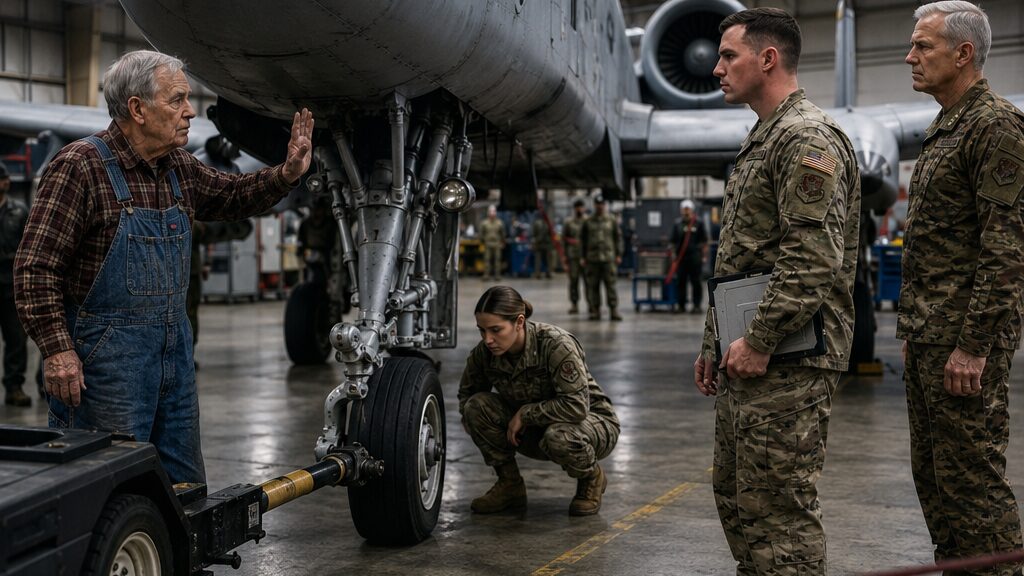
David Bennett stood beneath the nose of the aircraft with his left hand resting lightly against the landing gear strut, three fingers spread as if he were checking the forehead of a feverish child. The aircraft towered over him, gray and broad-shouldered, its worn paint dulled by years of sun and weather. Under the lights, the nose gear cast a hard shadow across the polished floor.
He had not meant to touch it.
That was what he told himself at first.
He had come in that morning as a restoration volunteer, nothing more. Lisa Walker had called him two weeks earlier and asked whether he would help identify some older fittings on the aircraft before the heritage demonstration. “Just a few hours,” she had said. “Mostly looking things over. Nobody knows these birds like you do.”
David had almost said no. At seventy-three, he had learned that returning to old places was not the same as returning to old time. The base had new badges, new procedures, new faces. The hangar doors opened with a smoother electric hum than he remembered. The young airmen wore uniforms cut different from the ones he had spent his life around. Even the aircraft seemed displayed more than worked, polished for cameras and visiting families.
But then Lisa had said the aircraft’s tail number.
David had been quiet long enough that she asked if the line had gone dead.
Now he stood under that same nose, in denim overalls faded white at the knees and a red-brown plaid shirt with one cuff button missing. His canvas tool roll lay open beside his boot. He had not needed most of the tools in years, but he had kept them wrapped and oiled. Old habits had a way of staying loyal even when people did not.
A radio lay on the floor a few feet away where one of the crew had set it down during a tire-pressure check. It muttered now and then, the voices clipped and young.
David closed his eyes.
The hangar was full of sound. A cart rattled near the far wall. Someone laughed outside the office. A wrench clicked twice, then stopped. Air hissed faintly from a line overhead. The aircraft itself made almost no sound, which was how most people liked machines to be.
David did not like quiet machines.
He pressed three fingers against the strut, paused, and shifted his weight.
There it was.
Not a noise exactly. Not enough to point at. A tired little uneasiness traveling through metal, too low for the ear and too old for paperwork. He took his hand away, looked at his fingertips, then crouched slowly. His right knee complained. He ignored it.
The nose wheel sat square enough. The tow bar had been disconnected and placed off to one side. The torque link had fresh grease at the fitting, neat and glossy. Someone had wiped the assembly clean for the demonstration, maybe too clean. David reached into his tool roll and lifted the inspection mirror with the cracked handle.
He angled it under the joint.
A crescent mark looked back at him from the shadow.
Thin. Pale. Almost nothing.
David held the mirror still.
“Sir?”
The voice came from behind him, firm and young enough to make the word sir sound like a warning rather than respect.
David did not turn at once. He lowered the mirror, laid it on the tool roll, and pushed himself upright with one hand on his thigh. The movement took longer than he wanted. That was the thing about growing old in public: every small motion became evidence for somebody else.
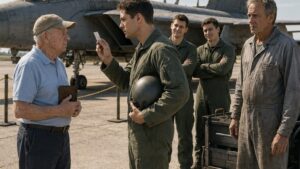
A young man in camouflage stood ten feet away with a clipboard tucked under one arm. His name tape read Carter. He was clean-shaven, narrow-eyed, with the squared shoulders of a man who believed posture could solve uncertainty. Behind him stood a young woman in the same uniform, dark hair pulled tight, hands folded loosely in front of her. She watched David more than the aircraft.
“I asked if you were assigned to this bay,” the young man said.
David wiped two fingers on his overalls. “I was invited.”
“By who?”
“Lisa Walker.”
The young man’s eyes flicked toward the offices. “Civilian restoration?”
“That’s right.”
“This area is active maintenance.” He shifted the clipboard into both hands. “We’ve got a movement window in twenty minutes and a public affairs schedule behind it. You can’t be under the aircraft without clearance.”
David looked past him toward the hangar doors. A line of folding chairs had been set up beyond the safety barrier. In a few hours, families would come through. Visiting veterans too, if their knees and lungs allowed it. Children would point at the aircraft. Someone from public affairs would talk about service and history. The aircraft might taxi, maybe fly if the inspection held and the weather stayed clean.
That was the part sitting like a stone in David’s chest.
“Your nose gear needs another look,” he said.
The young man blinked once. Not surprised. Irritated.
“It’s already been inspected.”
“I figured.”
“The form is signed.”
David nodded.
The young woman glanced at the gear, then at the tool roll. She did not speak.
The young man stepped closer. “Mr.—”
“Bennett.”
“Mr. Bennett. I appreciate you volunteering, but we have qualified crew on this aircraft.”
David almost smiled. Not because it was funny. Because it was familiar.
Qualified.
He had spent half his life hearing men hide behind that word when they were afraid of listening. He had used it himself once or twice, back when his hands were steady and his back did not ache in the morning.
“I’m sure you do,” he said.
“Then I need you clear of the aircraft.”
David looked down at the crescent mark hidden beneath the joint. From where Carter stood, it was invisible. From where most people stood, it would stay invisible until the nose gear took weight at the wrong angle and spoke louder.
He picked up the inspection mirror and folded it into his palm.
The young man watched the movement as if the old tool were contraband.
“Son,” David said quietly, “when this bird rolls, watch the nose wheel before you watch the tow team.”
Carter’s jaw tightened.
The word son had landed wrong. David had known it might. He had not meant it as an insult, but intention was another thing age took from you. Young men heard what they were ready to hear.
“I’m not your son,” Carter said.
“No,” David said. “You’re not.”
The hangar noise seemed to thin.
The young woman lowered her eyes for a moment, then lifted them again. The radio crackled on the floor. Someone called for a torque wrench in the next bay. The aircraft waited above them, indifferent and heavy.
Carter tucked the clipboard tighter against his side. “Step back, Mr. Bennett.”
David looked at the landing gear one more time.
He wanted, suddenly and sharply, to be forty again. Not strong for the sake of strength. Not young for vanity. Just young enough that when he pointed to a piece of metal, people saw training instead of tremor.
But wanting did not change the aircraft. Wanting did not change the mark.
He took one step back.
Carter gave a small nod, as if the matter had been settled.
David bent, slowly gathered the edge of his tool roll, and stopped before folding it. His fingers rested on the cracked inspection mirror. The old handle fit the groove in his palm exactly.
“You’ll want light from the left side,” he said.
Carter exhaled through his nose. “We’ll handle it.”
David straightened and looked at him, not angry, not pleading.
“No,” he said. “You’ll move it.”
Carter’s expression hardened.
Behind him, the young woman looked toward the nose gear again.
Chapter 2: The Clipboard Said The Aircraft Was Clear
Ryan Carter had learned early that hesitation looked like weakness.
His first flight chief had told him that during a rainstorm on a training line in Oklahoma, when Ryan was twenty-two and pretending not to be cold. “If you don’t know, find out,” the man had said. “But don’t stand there looking lost. People remember lost.”
Ryan had never forgotten it.
Now, with a retired civilian volunteer standing under his aircraft and an operations major already calling twice about the demonstration schedule, Ryan kept his shoulders square and his voice level. He had a signed inspection sheet. He had a crew that knew their jobs. He had a public flight window that would close if one more person found one more reason to stop work.
And he had David Bennett, who looked like he had wandered in from a farm supply store and decided to diagnose a military aircraft by touching it.
Ryan turned slightly toward the female technician behind him. “Harris, check the barrier line. Make sure no visitors came through early.”
Kimberly Harris looked from him to David. “Yes, Staff Sergeant.”
She moved, but not far. Ryan noticed. He noticed everything when he was irritated.
David remained near the tool roll, not close enough to violate the order, not far enough to leave. That bothered Ryan more than open defiance would have. The old man’s stillness had weight. He did not fidget. He did not complain. He looked at the aircraft as if the conversation with Ryan were a delay and the machine were the only thing worth patience.
Ryan opened the clipboard.
“Nose gear visual, complete. Tire pressure, complete. Torque link lubrication, complete. Steering actuator check, complete. Hydraulic seep inspection, clean. Signed at zero eight forty by qualified maintenance personnel.”
David listened as though Ryan were reading a weather report.
“Who signed the hydraulic seep inspection?” David asked.
Ryan lowered the clipboard. “That isn’t your concern.”
“It is if they wiped before they looked.”
Kimberly stopped beside the barrier rope.
Ryan felt heat climb into his neck. “Excuse me?”
David pointed toward the joint, not dramatically, just enough. “That fitting’s too clean for a working assembly. Could be pride. Could be habit. Could be somebody didn’t want a smear showing during public affairs photography.”
“Our crew does not hide faults.”
“I didn’t say hide.”
“That’s what you implied.”
David’s hand lowered. “I said wipe.”
Ryan stared at him. The distinction was irritating because it was careful. Men looking for trouble exaggerated. David Bennett did not. He shaved words down until they were hard to grab.
A cart rolled by behind them, pushed by two airmen carrying folded barricade signs. On the far side of the hangar, the aircraft’s wings stretched toward the open doors. Sunlight pooled beneath them, bright and clean. Outside, a small crowd of base staff was already arranging flags.
Ryan imagined Major Michael Sullivan walking in to find him debating maintenance philosophy with an old volunteer in overalls. He imagined the delay report. He imagined the phrase “failure to control active bay access.”
“Mr. Bennett,” he said, lowering his voice, “I don’t know what you think you saw, but this aircraft has been checked.”
David looked down at his tool roll. “I saw a crescent rub line under the lower joint.”
Ryan glanced despite himself.
From standing height, he saw nothing but painted metal, fittings, tire, shadow.
“It’s grime.”
“Might be.”
“Then we’re done.”
David lifted the cracked inspection mirror and held it out, handle first. “Look from low left. Don’t shine straight into it. Let the mark catch itself.”
Ryan did not take the mirror.
Kimberly’s eyes moved to the old tool. Something in her face changed, not belief, exactly. Attention.
Ryan hated that too.
“You’re not on the active maintenance roster,” he said.
“No.”
“You’re not part of this crew.”
“No.”
“You have no authority to stop movement.”
David’s fingers remained around the mirror handle. “I have no authority at all.”
For one strange second, Ryan expected him to smile. He did not.
“That doesn’t make the mark disappear,” David said.
The words landed in the space between them and stayed there.
Ryan reached for the mirror because refusing it felt too much like fear. He crouched, quick and efficient, knees young enough not to announce themselves. He angled the mirror beneath the torque link. The cracked handle made the glass tremble slightly. For half a second, he saw only darkness, then a smear of reflected light, then a pale curve near the edge of the assembly.
It could have been nothing.
It was probably nothing.
He stood and gave the mirror back.
“Surface rub,” he said. “Cosmetic.”
David tucked the mirror into his palm. “You’re sure?”
Ryan heard the trap in the question. Not a trap made of cleverness. Worse. A trap made of conscience.
“I’m sure enough to follow the signed inspection.”
David’s eyes held his. They were light-colored, tired at the edges, but not cloudy. “That’s not the same.”
Kimberly looked away.
Ryan snapped the clipboard shut. “You need to clear the bay.”
Before David could answer, a sharper voice cut across the hangar.
“Carter.”
Major Michael Sullivan strode toward them from the operations office, cap tucked under one arm, uniform pressed, expression already impatient. Lisa Walker followed a few steps behind, her civilian badge swinging against a navy blazer. She looked at David first, then at the open tool roll, and Ryan saw worry cross her face.
“What’s the delay?” Sullivan asked.
Ryan came to attention by reflex. “Sir, no operational delay. Civilian restoration volunteer entered the active area and raised a concern about the nose gear. I’m resolving it.”
Sullivan turned to David. “You’re the volunteer?”
David nodded. “David Bennett.”
“Major Sullivan.” He did not offer his hand. “What concern?”
Ryan answered before David could. “Possible surface rub under the torque link. Inspection already signed clean.”
Sullivan’s eyes moved to the clipboard. “Aircraft cleared?”
“Yes, sir.”
“Then why are we discussing it?”
The question was not really a question. Ryan felt relief and discomfort arrive together.
David looked up at the aircraft, then back at Sullivan. “Because it’s easier to discuss here than after the nose starts walking under tow.”
Sullivan’s face tightened. “Walking?”
David set the mirror down on the tool roll. Carefully. Flat. “A low shimmy before it becomes a loud one.”
The major stared at him for a second too long. “Mr. Bennett, this aircraft is not being flown by memory and superstition.”
“No, sir,” David said. “It shouldn’t be flown by schedule either.”
The hangar seemed to hear that. Even the airmen near the barricades slowed.
Ryan felt the words strike the major and wished the old man had shouted instead. A shout could be dismissed. Quiet made people listen before they could stop themselves.
Sullivan’s voice dropped. “Carter, remove him from the active bay.”
Lisa stepped forward. “Major, I asked him here. David worked this airframe family for years.”
Sullivan did not look at her. “Then he should understand boundaries better than anyone.”
David bent, rolled the canvas around his tools, and tied it with the old strap. His hands were steady except for the last pull, where age betrayed him with a small tremor.
Kimberly saw it. Ryan saw her see it.
David lifted the roll and tucked it under his arm.
At the safety line, he stopped and looked once more toward the nose gear. The aircraft sat clean and silent beneath the lights. Too silent.
Ryan expected another warning, another old-man phrase, another challenge.
Instead David said, “If you tow it, have someone watch from the left.”
Sullivan turned away.
Ryan opened the clipboard again, though he no longer needed to read anything on it.
Behind him, Kimberly Harris looked at the place where the mirror had been and did not move.
Chapter 3: Kimberly Heard The Pause
Kimberly Harris had been taught to trust checklists before instinct.
Checklists did not care whether you were tired. They did not care who outranked you. They did not change tone when someone important entered the hangar. A good checklist gave order to machines that could punish pride. Kimberly liked that about them.
But she also knew that every box on a form had a human hand behind it.
That thought followed her after David Bennett crossed the safety line and stood near the restoration tables with his canvas tool roll tucked under his arm. He did not look offended. That was what bothered her. Men who were only protecting ego usually made noise when it got bruised. David only watched the aircraft.
Ryan Carter had returned to the maintenance desk, flipping through the inspection sheets with more force than necessary. Major Sullivan was on his phone near the hangar doors, speaking in a clipped voice about the flyover window. Lisa Walker stood beside David, saying something Kimberly could not hear. David gave her a small nod, but his eyes kept going back to the nose gear.
Kimberly told herself to let it go.
She had been on the aircraft all week. She had checked panels, wiped fittings, verified tags, chased a stubborn grounding lead until her back hurt. The nose gear inspection had not been hers, but she knew the crew. Nobody on that floor would knowingly pass a dangerous assembly.
Still, she had seen the way David held the mirror.
Not like a man looking for a reason to be important.
Like a man who already knew where the answer would hide.
She walked to the tool cage under the pretense of returning a socket set. The cage smelled of metal drawers and marker ink. She took off one glove, flexed her fingers, then put it back on. Her skin felt warm under the nitrile. She looked out through the mesh at the aircraft.
David was still standing beyond the line.
Lisa touched his sleeve. He shook his head once. Not sharply. Just no.
Kimberly remembered his phrase.
Let the mark catch itself.
It sounded old-fashioned enough to be dismissed. It also sounded exact.
She left the socket set on the return bench and walked back toward the aircraft. Ryan noticed at once.
“Harris,” he called. “Where are you going?”
“Left side check before tow,” she said.
His eyes narrowed. “We already did the pre-tow walkaround.”
“You told him someone should watch from the left.”
“I didn’t tell him that. He told us.”
Kimberly stopped. The difference mattered to Ryan. It did not matter to the gear.
“I’ll be clear of the tow path,” she said.
Ryan glanced toward Sullivan, who was still on the phone, then back at her. “Fine. Visual only. Don’t start taking things apart because a volunteer got dramatic.”
“Yes, Staff Sergeant.”
David’s head turned slightly when she approached the nose gear. He did not call out. He did not encourage her. That silence made her feel more alone than if he had spoken.
She crouched near the left side.
From there, the underside of the torque link was mostly shadow. She shifted lower, feeling the cold floor through one knee. She used her flashlight first, then stopped. Too much glare. The metal went flat under direct light.
Kimberly clicked the light off.
Across the hangar, David had turned his body just enough that she could see his right hand. Three fingers tapped lightly against his thigh. Touch. Pause. Listen. Not a signal. More like a habit that had escaped.
She placed three gloved fingers on the strut.
At first, she felt only cold metal.
She waited.
The hangar moved around her. Voices, cart wheels, Sullivan’s low frustration, Ryan’s clipboard pages. Nothing useful. Nothing strange.
Then a tow cart backed somewhere nearby with a short mechanical beep, and the aircraft gave the smallest answering tremor through the floor. Kimberly felt it in her fingertips, not as movement, but as a delayed little shiver that did not match the rest of the assembly.
She pulled her hand away.
Her heart had sped up. She disliked that. Excitement made people sloppy. Fear made them worse.
She reached for a clean cloth from her pocket and wiped beneath the joint, lightly, not enough to disturb anything. When she drew the cloth back, there was almost nothing on it. A faint gray line. Maybe old grime. Maybe grease thinned by handling.
She looked at her glove.
On the side of her index finger, near the seam, a tiny trace of amber oil had collected against the blue material.
Not a leak. Not enough to call out. Not enough to stop an aircraft in front of a major who wanted answers in clean sentences.
But not nothing.
She stood.
Ryan was watching her now. “Well?”
Kimberly looked toward David. He had not moved.
She could say surface rub. She could say no finding. She could say visual appears normal and let the form remain stronger than the doubt. That was how a day stayed smooth. That was how young technicians kept from becoming difficult.
Instead, she said, “I’d like to recheck the lower joint after tow.”
Ryan’s mouth flattened. “Why?”
She held up her gloved finger. From ten feet away, the trace of oil would be invisible. She knew how it looked: a young technician spooked by an old man’s warning.
“I picked up a slight trace.”
Ryan stepped closer, took her wrist gently but firmly, and examined the glove. His face did not change.
“That could be from anything in this bay.”
“Yes.”
“You know that.”
“Yes.”
“Then don’t build a finding out of maybe.”
Kimberly lowered her hand. “I’m not building one. I’m asking to watch it.”
Ryan looked past her to David and Lisa. His expression shifted, hardening into something defensive. Kimberly understood then that this was no longer only about the gear. It was about control of the bay, about the major watching, about whether a signed sheet meant Ryan had command of the situation.
“Do the visual,” he said. “No more.”
She nodded.
When she turned back, David was looking at her glove.
Not triumphantly. Not even with relief.
He looked sad.
That unsettled her more than the oil.
The tow team began gathering near the aircraft. A crew member picked up the radio from the floor and clipped it to his vest. The hangar doors opened wider, letting in a bright slice of afternoon. The aircraft’s shadow shifted.
Kimberly moved to the left of the nose gear, where David had told them to watch. She set her boots square on the painted safety line and folded her hands so no one could accuse her of touching anything else.
Across the bay, David Bennett stood outside the rope like a visitor.
But his eyes were under the aircraft, right where hers had been.
Ryan gave the tow lead a nod.
The tow cart engine started with a low electric whine.
Kimberly listened harder than she had ever listened to a quiet machine.
Chapter 4: The Flight Schedule Had No Room For Doubt
Ryan Carter could feel the day tightening around him.
It was there in the way Major Sullivan paced near the hangar doors, one hand on his phone, the other pressed against his hip as if holding impatience in place. It was there in the public affairs staff moving flags twice because the light through the open doors kept shifting. It was there in the airmen pretending not to watch while they waited for the tow order that should already have been complete.
Most of all, it was there on Kimberly Harris’s glove.
A trace so faint it might have been anything.
Ryan stood at the maintenance desk and stared down at the signed sheet. The words were clean. The signatures were clean. The boxes were marked in black ink, straight and official.
Nose Gear Assembly Visual Inspection: Complete.
No abnormal seepage noted.
Torque Link Condition: Serviceable.
He had not signed that line himself. The night-shift crew had completed it before dawn. But the aircraft was now under his floor control, and that made the sheet feel like his. If it held, he held. If it failed, the failure would not stop at the name written there.
He looked over the clipboard toward the aircraft.
Kimberly stood on the left side of the nose, exactly where the old man had told them to watch. Her hands were folded, but Ryan could see the alertness in her shoulders. She had not challenged him outright. That was good. But she had not dismissed the concern either.
David Bennett remained beyond the safety rope beside Lisa Walker and a table stacked with restoration binders. From that distance, he looked smaller. The aircraft seemed to have shed him. Without his hand on the gear, without the mirror in his palm, he was just an old civilian with a tool roll under one arm.
Ryan wished he would leave.
The thought arrived sharp and unpleasant, and Ryan did not like himself for it. The old man had not insulted anyone. He had not raised his voice. He had not made a scene for the visitors. He had simply introduced doubt into a system that survived by limiting doubt to the proper channels.
Ryan took a breath and turned a page he had already read.
“Carter.”
Major Sullivan’s voice came from behind him.
Ryan straightened. “Sir.”
Sullivan joined him at the desk. He kept his voice low, but low did not mean calm. “Where are we?”
“Tow team is ready. Harris is positioned for left-side visual.”
“Because of Bennett?”
“Because an extra visual costs us nothing if we maintain the schedule.”
Sullivan looked at him. “That wasn’t my question.”
Ryan held still.
“Yes, sir,” he said. “Because of Bennett.”
Sullivan’s mouth tightened. He looked across the hangar at David, then back to Ryan. “Do you believe there is a maintenance issue with that aircraft?”
The proper answer was no. The useful answer was no. The answer that kept the day moving was no.
Ryan glanced down at the sheet.
“I believe the aircraft passed inspection.”
“That is not the same thing.”
The words echoed David so closely that Ryan’s face warmed.
Sullivan noticed. Of course he did.
The major leaned closer. “Listen carefully. I don’t care if that man once turned wrenches on every aircraft in the Air Force. Today he is not assigned to this crew. He is not in our chain. He is not responsible for explaining a cancellation to command, public affairs, visiting families, or the heritage office. We are.”
“Yes, sir.”
“If you have a real finding, bring it to me. If you have an old man making you nervous, fix it.”
Ryan looked toward Kimberly again. She had turned slightly, following something near the nose wheel with her eyes. Nothing was moving yet. The tow cart idled low. The radio on the lead’s vest gave a short burst of static.
“I’ll fix it,” Ryan said.
Sullivan nodded once and walked away.
Ryan stayed at the desk for another moment, his hands flat on either side of the clipboard.
He remembered being a young airman and watching an older master sergeant run a hand along a panel seam, then send three men crawling through access points because a rivet “looked tired.” Ryan had thought it was superstition until they found a cracked bracket. Back then, he had respected that kind of instinct because it wore rank on its sleeve.
David Bennett wore faded denim and a plaid shirt.
That should not have mattered.
It did.
Ryan hated that it did.
He closed the clipboard and crossed the hangar. The tow lead watched him approach, waiting for the signal. Kimberly’s eyes flicked toward him and then back to the gear.
“You good?” Ryan asked.
She nodded, but not cleanly. “Positioned.”
“Visual only.”
“Yes.”
He lowered his voice. “Harris, I need you with me on this.”
Her jaw moved slightly. “I am with the aircraft.”
It was not defiance. That made it worse. Defiance he could correct. Honesty required something from him.
He looked toward David. The old man had one hand against the edge of the restoration table, not leaning exactly, but resting as if his legs had begun to count the hours. Lisa was speaking to him softly. He shook his head once, and Ryan saw the stubbornness in it.
Or maybe it was pain.
Ryan looked away.
A base security airman had come in near the office entrance. He stood there with the awkward patience of someone summoned before being given a task. Sullivan glanced toward him, then toward Ryan.
Ryan understood.
His stomach sank.
He walked to the safety rope.
Lisa saw him coming first. “Staff Sergeant Carter.”
“Ms. Walker.”
David turned.
Ryan kept his voice controlled. “Mr. Bennett, the aircraft is about to move. I need you to relocate to the visitor seating area or the restoration office until movement is complete.”
“I’m clear of your line.”
“That’s not the issue.”
“What is?”
Ryan wished the old man would be difficult. He wished he would complain, accuse, perform something that made removal simple.
“You’re creating uncertainty around an active operation,” Ryan said.
David looked past him to the aircraft. “No. The aircraft did that.”
Ryan’s fingers tightened against the clipboard. “Sir, don’t make this harder.”
For the first time, something like tiredness crossed David’s face.
“I’m not trying to.”
Lisa stepped closer. “Ryan, he has authorization to be here.”
“Not inside an active concern that’s distracting my crew.”
David’s eyes returned to him. “Your crew should be distractible by the right things.”
Ryan had no answer that did not sound worse than silence.
Behind him, the tow cart’s motor rose slightly, then settled. The sound made David’s head turn at once. Not his whole body. Just his head, quick and exact, as if something in the pitch had touched a wire inside him.
Ryan noticed despite himself.
So did Kimberly.
David’s hand shifted at his side. Three fingers opened, closed, then stilled.
“Mr. Bennett,” Ryan said, quieter now, “if there is a finding, my crew will find it.”
David looked at Kimberly, then back to Ryan. “I hope so.”
That was all.
No challenge. No warning. No last dramatic phrase.
Ryan would have preferred anger.
He signaled the security airman to stand down, not because he had changed his mind, but because Lisa was watching and the old man had already taken one step back from the rope. David let Lisa guide him toward the restoration office, but halfway there he stopped near a stack of folding chairs. He did not sit.
Ryan returned to the aircraft.
Sullivan was watching. Public affairs was watching. The tow team was waiting. The day was waiting.
Ryan lifted his hand and gave the tow lead the signal.
“Slow roll,” he said into the radio. “Nose left visual active. Maintain crawl.”
Kimberly lowered herself slightly, eyes fixed beneath the nose.
The tow cart began to pull.
Chapter 5: The Sound Under The Tow Bar
David heard it before the aircraft moved six inches.
Not loud. Not sharp. Nothing that would turn heads among men and women trained to ignore harmless noise. The tow cart gave its electric whine, the tires whispered against the polished concrete, the radio clicked, and beneath all of it came the small, wrong answer from the nose gear.
A low knock.
Once.
Then not again.
David’s fingers curled around the back of the folding chair in front of him. The metal edge pressed into his palm. He had promised Lisa he would stay behind the line. He had promised himself, years earlier, never to let a promise to procedure outrank a promise to life.
The aircraft rolled forward another foot.
Kimberly moved with it, crouched slightly, eyes level with the lower joint. She had good discipline. David saw that now. She did not lean into the path. She did not crowd the wheel. She let the machine come to her vision instead of chasing it.
The nose wheel began to turn.
The knock came again, softer this time, followed by a tremor David felt through the floor more than heard. The sound passed up his legs and found an old place in him.
For a second, the hangar in front of him was not this hangar.
It was another line, another aircraft, another day that had looked ordinary until it stopped being ordinary. He had been younger then, strong enough to work sixteen hours and still climb into a truck without groaning. A lieutenant had wanted the aircraft ready. A captain had said the window was tight. David had seen a streak near a joint and told himself it had been checked by the previous shift.
He had signed.
Nothing catastrophic had happened, not the way stories made things happen. No fireball. No headline. No folded flag presented at a door. But the aircraft had come back hard, nose shaking, crew pale, one man with blood on his mouth from where he had bitten through his lip during emergency handling. David had stood beside the gear afterward and looked at the mark he should have respected earlier.
He had never forgotten the sound.
The aircraft in front of him rolled another few inches.
David released the chair.
Lisa turned. “David?”
He was already moving.
His knees did not like sudden movement. His balance took one half-second longer than it used to. But the old body still remembered urgency, and it carried him past the restoration table before anyone could stop him.
“Stop the tow,” he said.
No one heard him.
The tow cart continued at crawl speed. Ryan stood near the lead, watching Kimberly, one hand on his radio. Major Sullivan looked irritated but attentive near the doors.
David crossed the safety rope.
“David,” Lisa called, sharper now.
The security airman near the office straightened. Ryan saw David and his eyes flashed with anger.
“Mr. Bennett, get back—”
The nose wheel shifted.
It was barely anything. A small sideways hesitation under load, a stutter too slight to be seen unless a person expected the machine to lie politely before it told the truth.
Kimberly saw it.
Her head snapped up. “Staff Sergeant—”
The knock came a third time.
David stepped into the open path ahead of the tow line, far enough to be seen, not close enough to touch the moving gear. He raised one hand, palm out.
“Not another foot.”
The tow lead reacted before rank could argue. His boot came off the pedal. The cart stopped with a soft dip. The aircraft settled behind it.
The hangar froze.
Ryan was on David in three strides. “Are you out of your mind?”
David kept his palm raised until the wheel stopped moving completely. Only then did he lower it.
“Watch the link,” he said.
“You just stepped into an active tow.”
“I stepped where he could see me.”
“You could have been hurt.”
“Yes.”
Ryan stared at him, breathing hard. “That doesn’t make it right.”
“No,” David said. “It makes it necessary.”
Sullivan approached fast. “What is going on?”
Kimberly had not moved from her position. She was still looking under the joint, her face changed now. Not frightened. Focused in a way that made the rest of the hangar irrelevant.
“Staff Sergeant,” she said, “I saw lateral movement.”
Ryan turned. “How much?”
“Small.”
“Quantify.”
“I can’t from here.”
Sullivan made a frustrated sound. “Then what are we stopping for?”
Kimberly swallowed, then pointed. “The rub line changed when the nose loaded.”
Ryan crouched beside her before he could stop himself. David watched him reach for his flashlight, then lower it again after a glance toward the glare.
Good, David thought.
Ryan shifted to the left, nearly where David had crouched earlier. He looked, adjusted, looked again. His expression did not transform all at once. It tightened, resisted, then went still.
“Mirror,” he said.
David looked down.
His tool roll was still near the restoration table.
Kimberly reached into her own pouch and pulled out a newer inspection mirror, bright-handled, clean glass. Ryan took it and angled it wrong at first, too direct. The mark vanished under glare.
David said nothing.
Kimberly noticed. “Let it catch itself,” she murmured.
Ryan heard her. His hand paused. Then he tipped the mirror left, lowering the light, letting the shadow do half the work.
The crescent mark appeared.
Not alone now. Beside it, at the edge of the fitting, a thin wetness had gathered where the gear had shifted under tow. It was still small. A lesser eye could still call it harmless.
Ryan did not.
He reached one finger toward it, stopped before touching, and looked back at Kimberly’s glove. The trace she had shown him earlier no longer seemed like anything. It seemed like the beginning.
Sullivan stood over them. “Carter?”
Ryan did not answer immediately.
David saw the fight in him. Not against the old man now. Against the signed sheet. Against the schedule. Against the version of himself that wanted certainty to come from ink because ink could be defended.
Ryan stood slowly.
“Sir,” he said, voice controlled, “I recommend we suspend tow and open a maintenance discrepancy for deeper inspection of the nose gear assembly.”
The words cost him. David could hear it.
Sullivan looked from Ryan to Kimberly to David. “Based on what?”
“Observed lateral movement under tow,” Ryan said. “Possible seepage. Rub line at lower torque link. Needs confirmation.”
Sullivan’s face hardened. “Possible?”
Ryan’s jaw flexed. “Yes, sir.”
The major turned toward Kimberly. “You observed movement?”
Kimberly straightened. “Yes, sir.”
“How much?”
“Enough to stop.”
It was the first time her voice had carried across the hangar.
David looked at her then, really looked. She was young, but she had put herself between a superior’s impatience and an uncertain truth. That was not youth or age. That was character.
Sullivan exhaled and looked toward the hangar doors. Outside, the flags moved in the sun. The public affairs staff had gone still.
“This will cancel the flight window,” he said.
No one answered.
The aircraft sat between them, quiet as a held breath.
Sullivan turned to Ryan. “You own this call.”
Ryan’s eyes flicked once to David, then back to the major.
“Yes, sir,” he said.
David felt something in his chest loosen, but not enough. Not yet.
Ryan walked toward the maintenance desk, reached for a red discrepancy tag, and stopped. His hand hovered over it.
For a moment, David saw the young man he had been once, caught between pride and doubt, wanting the machine to be simpler than it was.
Then Ryan pulled the tag free.
“Tow suspended,” he said into the radio. “Open the bay. We’re inspecting the nose gear.”
David stepped back from the tow path.
His hands had begun to tremble, so he folded them behind him where fewer people could see.
Chapter 6: The Inspection They Did Not Want
The aircraft looked different once the red tag hung from the nose gear.
Nothing physical had changed. The same gray fuselage rested under the same hangar lights. The same nose wheel sat on the same polished concrete. But the tag made doubt official, and official doubt had a gravity of its own.
People moved differently around it.
The tow team backed away. Public affairs staff disappeared toward the office with tight faces. A mechanic brought over a low rolling stool and a light stand. Someone pulled a maintenance manual from the cabinet. The radio traffic grew more careful, all call signs and confirmations.
David stood outside the immediate work circle with his tool roll held in both hands. No one had asked him to come closer.
No one had asked him to leave again either.
That was something.
Ryan Carter knelt beneath the nose gear with Kimberly Harris beside him. Major Sullivan stood a few feet back, arms folded, expression carved into restraint. Lisa Walker watched from behind the safety line, her hands clasped around her badge.
“Light lower,” Kimberly said.
Ryan adjusted it without comment.
They had already checked the obvious points. No streaming leak. No broken bracket visible from the outside. No dramatic failure waiting to vindicate anyone quickly. David had expected that. The worst problems often began as insults too small to impress a room.
Ryan used the newer mirror again. “I’ve got the rub line. Still seeing trace fluid at lower edge.”
“Could be residual,” one of the mechanics said.
Ryan did not snap at him. “Could be. We verify.”
David lowered his eyes to the tool roll. The strap had loosened. He retied it, more to keep his fingers occupied than because it needed tying.
Sullivan checked his watch. “How long to open the assembly enough to confirm?”
The mechanic looked uncomfortable. “Sir, if we start pulling access and checking play properly, we’re past the demonstration window.”
“We are already past the demonstration window if this is real,” Ryan said.
The hangar went quiet around that.
Sullivan looked at him. Ryan kept his eyes on the gear.
David felt, unexpectedly, a small respect for the young man. Not affection. Not yet. But respect. It was hard to turn in front of people after taking a position. Harder when the turn might cost you.
Kimberly glanced toward David. “Mr. Bennett?”
Ryan looked up sharply, but he did not stop her.
Kimberly continued, “When you said low shimmy, were you thinking torque link wear or steering actuator?”
David waited before answering. Partly to make sure he had been invited. Partly because old memories had teeth.
“Could be either,” he said. “But the mark sits wrong for actuator alone.”
Ryan’s face tightened at the word wrong. “Explain.”
David stepped closer, slowly enough that no one could mistake it for taking over. He stopped outside the circle and pointed, not touching. “If the actuator was pushing uneven, I’d expect the wear to show broader with more smear. That crescent is tight. Repeated kiss, not drag.”
The mechanic with the light frowned and leaned in.
David continued, “Something’s letting it answer late under load. Not much. Enough that the wheel thinks for half a breath before it follows.”
Ryan stared at the joint. “You’re describing play.”
“Yes.”
“Then why didn’t it show on standard ground check?”
“Because nobody asked it the right question.”
Sullivan shifted. “Meaning?”
David looked at the major. “Meaning a machine can pass a straight pull and still complain on a slow angled load. Especially an old one dressed up for company.”
Lisa lowered her gaze, almost smiling despite the tension.
Ryan turned back to Kimberly. “Set the tow bar angle again. No movement. Just load.”
Sullivan began, “Carter—”
Ryan looked up. “Sir, controlled static load only. Chocks in. No roll.”
A long second passed.
Sullivan gave one hard nod.
The crew set the tow bar with deliberate care. Chocks were placed. The cart connected but did not pull. Ryan and Kimberly positioned themselves low, mirror angled left, light softened against the concrete. David watched from behind them, hands clasped around the tool roll strap.
“Apply slight load,” Ryan called.
The tow cart leaned into the bar.
The aircraft did not roll.
For a moment, nothing happened.
Then Kimberly said, “There.”
Ryan’s hand tightened around the mirror.
The lower joint gave the smallest delayed shift, followed by a bead of amber fluid pressing out at the edge like the aircraft had been holding its breath too long.
Nobody spoke.
The mechanic with the light whispered, “I’ll be damned.”
Ryan lowered the mirror.
“Release load,” he said.
The tow cart eased back.
Sullivan stepped closer. “Confirmed?”
Ryan looked at Kimberly.
She nodded. “Confirmed movement under static angled load. Fluid trace present.”
Ryan stood. He looked pale now, not from fear of Sullivan, David thought, but from understanding how close he had come to being wrong in motion.
“We need to open it,” Ryan said.
Sullivan looked toward the hangar doors. Beyond them, the bright afternoon waited with flags and chairs and people expecting a show. Then he looked at the red tag.
“Open it,” he said.
The work that followed was not dramatic. It was careful, cramped, and slow. Panels came loose. Hands reached into awkward spaces. A worn bushing emerged in pieces that seemed too small to have carried such consequence. A misalignment showed itself only after the assembly relaxed under the crew’s tools. The younger mechanics grew quieter as the finding took shape.
Ryan placed the worn part on a clean cloth.
No one cheered. No one apologized. Not then.
That was right, David thought. The aircraft deserved the first attention.
Kimberly looked at the part, then at the crescent mark, then at David’s hands. “How did you hear that before it moved?”
David almost answered with a simple thing. Experience. Habit. Years.
Instead, his eyes went to the nose wheel, and for a moment the hangar blurred at the edges.
He saw another aircraft returning with a nose that would not settle right. He saw a young crewman climbing down with blood on his chin, trying to laugh because men that age thought fear needed permission. He saw his own signature on a sheet that had been technically defensible and morally useless.
“I didn’t hear it first,” he said.
Ryan looked at him.
David rubbed his thumb over the cracked handle hidden inside the tool roll. “I remembered it.”
The words did not explain everything. They explained enough.
Sullivan unfolded his arms. His voice, when it came, had lost its edge. “Mr. Bennett, were you a crew chief?”
David looked at him. “A long time ago.”
“On this type?”
“On its older brothers. On stubborn cousins. On anything they parked in front of me and told me had to fly by morning.”
A faint laugh moved through one of the mechanics and died quickly, not from disrespect but from the seriousness still in the air.
Ryan picked up the clipboard from the maintenance desk. He stared at the signed inspection sheet, then turned it over and began writing on the back.
Kimberly watched him. “Staff Sergeant?”
“Temporary notes until the discrepancy is entered properly.” His pen moved hard enough to score the paper. “Observed under angled static load. Prior standard inspection insufficient to identify delayed play.”
He stopped, then added another line.
“Initial concern raised by restoration volunteer David Bennett.”
David looked away before anyone could read his face.
Sullivan’s phone rang. He silenced it without looking.
Ryan came toward David with the clipboard in one hand and the red tag in the other. He stopped at a respectful distance, which David noticed because the young man seemed to choose it deliberately.
“I should have checked it the way you asked,” Ryan said.
The hangar did not stop this time. Work continued around them. Tools clicked. A mechanic called for a replacement part search. Kimberly began photographing the worn bushing for the record.
David appreciated that. Apologies were easier to bear when they were not made into theater.
“You checked it when you were ready,” David said.
Ryan swallowed. “That could have been too late.”
“Yes.”
The honesty sat between them, plain and heavy.
Ryan looked down at the red tag. “How did you learn the three-finger thing?”
David’s grip tightened on the tool roll, then eased. “From men older than I was. Men I thought were slow until I got fast enough to make mistakes.”
Ryan’s face changed at that. Something defensive loosened.
Sullivan walked over, phone still in hand. “The flight is postponed. Public affairs will announce a maintenance delay.”
Ryan nodded. “Yes, sir.”
The major turned to David. “You saved us from a bad day.”
David looked back at the aircraft. The nose gear was open now, exposed, no longer pretending to be fine.
“No,” he said. “The aircraft did. I just believed it.”
Kimberly rose from beside the gear, holding the bright-handled mirror in one hand. She looked at David’s closed tool roll.
“Mr. Bennett,” she said, “would you show me again?”
Chapter 7: The Note Added Below The Signature
By late afternoon, the hangar had emptied of expectation.
The chairs outside the safety line still faced the aircraft, but no families sat in them. The flags near the doors had been taken down and leaned in a neat bundle against the wall. Public affairs had made its announcement with careful language about caution, inspection, and rescheduling. The visiting veterans had been offered coffee and a walk-through instead of a flyover. Some had left disappointed. Some had nodded like men who had known machines long enough not to be offended by prudence.
The aircraft remained in its bay, nose gear open, red tag hanging where sunlight touched it whenever the hangar doors shifted. Mechanics had packed away most of the tools. The worn bushing sat inside a labeled evidence bag on the maintenance desk, small and unimpressive now that it was no longer hiding.
David Bennett stood beside the restoration table with his canvas tool roll in front of him.
He had been standing too long. His hips had begun to ache, and his right knee pulsed with every heartbeat. He would pay for the day tomorrow. Maybe for two days. Age collected interest on every stubborn choice.
Still, he did not sit.
Across the bay, Ryan Carter finished speaking with Major Sullivan. The major’s face had settled into something less sharp than before. Not warm, exactly. But honest. He looked once toward David, gave a small nod, then walked toward the operations office with his phone already in hand.
Ryan remained by the maintenance desk.
Kimberly Harris stood beside him, writing in the official log while Ryan checked the discrepancy entry on a tablet. The two of them spoke quietly. Not like people trying to decide whether David had been right. That had been decided. They spoke like people trying to decide what to do with being wrong.
Lisa Walker came up beside David and set a paper cup of coffee on the table.
“It’s terrible,” she said.
David looked at it. “Military coffee usually is.”
“It came from public affairs.”
“Then it’s worse.”
Lisa smiled, but it faded quickly. “I’m sorry about this morning.”
David kept his eyes on the aircraft. “You didn’t order me away.”
“No. But I brought you here knowing some people would see overalls before experience.”
“That’s not new.”
“It shouldn’t be acceptable just because it’s familiar.”
David turned the coffee cup slowly with two fingers. It was too hot to drink. “Most people aren’t trying to be cruel. They just trust what looks official.”
Lisa glanced at his faded shirt, the worn knees of his overalls, the old tool roll. “And you don’t?”
“I used to.” He looked toward the maintenance desk. “Until I learned official can still miss quiet.”
Ryan closed the tablet. Kimberly looked up and said something to him. He nodded, then picked up the clipboard that had started the day clean and certain.
David watched him approach.
The young man no longer walked like someone arriving to remove a problem. His shoulders were still squared, but the stiffness had gone out of them. He stopped on the other side of the restoration table, the clipboard held loosely at his side.
“Mr. Bennett.”
“Staff Sergeant.”
Ryan glanced at Lisa, then back at David. “The discrepancy is entered. The aircraft is down until replacement parts and follow-up inspection are complete.”
David nodded. “Good.”
Ryan placed the clipboard on the table and turned it so David could see.
The original inspection sheet remained clipped on top, its boxes checked, its signatures orderly. Below it was a temporary maintenance note in Ryan’s handwriting, darker and less neat because it had been written under pressure.
Observed lateral response under angled static load. Fluid trace at lower nose gear torque link. Crescent rub line not visible under direct inspection light. Initial concern raised by restoration volunteer David Bennett. Recommend adding angled load visual check to restoration ground movement procedure.
David read the words once.
Then he read the last line again.
His throat tightened in a way that annoyed him. He had held himself steady through confrontation, through the tow, through the inspection. A line of handwriting nearly undid him.
Ryan noticed, but to his credit, he did not call attention to it.
“I should have written crew chief,” Ryan said. “Not volunteer.”
David looked up. “Today I was a volunteer.”
Ryan’s mouth moved as if he wanted to argue, then he let the argument go. “Yes, sir.”
The sir sounded different now. Not perfect. Not ceremonial. Better than that. Earned in both directions.
Kimberly came over carrying David’s cracked inspection mirror. At some point, he had set it down near the gear and forgotten it. She held it carefully, as if its old handle deserved more respect than its condition suggested.
“You left this under the nose,” she said.
David took it. “Wouldn’t be the first tool I lost under an aircraft.”
“I cleaned the glass.”
He looked at the mirror. The metal still showed scratches. The handle still had its crack. But the glass caught the hangar lights clearly now.
“Thank you.”
Kimberly did not step away. “Would you show me the check again?”
Ryan looked at her, then at David. “If you’re willing.”
David wanted to say no.
Not because he was angry. That would have been easier. He wanted to say no because teaching required hope, and hope was harder on an old man than bitterness. Bitterness could sit in a chair all day and call itself wisdom. Hope had to stand up.
He picked up the mirror and tucked it into the tool roll.
“All right,” he said.
They walked together to the aircraft.
This time, no one told him to stay behind the rope.
The nose gear assembly remained open, parts labeled, the red tag still hanging. Kimberly crouched first, leaving room for David beside her. Ryan stayed back half a step, not because he lacked authority but because he had chosen not to crowd the lesson.
David lowered himself carefully. His knee gave a small crack. Kimberly pretended not to hear it. He appreciated that.
He placed three fingers lightly against the strut.
“Don’t press like you’re trying to prove you’re strong,” he said. “The aircraft doesn’t care how strong you are.”
Kimberly set her fingers beside his, lighter this time than before.
“Touch,” David said. “Pause.”
The hangar hummed around them. Air through vents. A cart rolling far away. A radio chirp from the office. The aircraft, opened and resting, gave nothing back now but cool metal.
“Listen,” David said.
“With my hand?”
“With whatever part of you is paying attention.”
Kimberly did not smile. She closed her eyes for half a second, then opened them. Ryan watched from behind her, the clipboard resting against his leg.
David lifted his hand. “Most times you won’t feel anything. That’s fine. Don’t invent trouble just to feel useful.”
Kimberly nodded.
“And don’t ignore trouble because someone already signed a box.”
Ryan lowered his eyes briefly.
David looked at him. “That was not just for her.”
“I know,” Ryan said.
The answer was quiet, and it was enough.
They stood. David had to push off his thigh. Ryan moved as if to help, then stopped himself. David saw the restraint and, after a moment, gave one small nod. Ryan understood and offered his forearm without grabbing.
David accepted it.
Not because he had to. Because dignity did not require refusing every hand.
Back at the maintenance desk, Ryan unclipped the temporary note and added one more line beneath the others. He did not ask permission. He wrote slowly, pressing the pen into the paper.
Three-finger check demonstrated by David Bennett for left-side nose gear observation during angled load.
He signed beneath it.
Then he handed the clipboard to Kimberly.
She signed too.
David looked at the two names below his own and felt the old hangar settle differently around him. Not younger. Not repaired. Just less closed.
Lisa stood near the safety rope, watching with one hand pressed lightly against her badge. She did not speak. She did not need to.
Outside the open doors, the sun had lowered behind the base buildings. The postponed flight would happen another day, or it would not. Parts would arrive. Forms would be updated. The aircraft would sit until it was ready instead of until people wanted it ready. That was a kind of respect too.
David rolled his tools slowly. The mirror went in last. Kimberly watched how he folded the canvas over it, not tightly, not carelessly, the way a person put away something that had survived being useful.
When he reached the hangar doors, he looked back.
Kimberly had returned to the nose gear. Ryan stood beside her with the clipboard. She placed three fingers against the strut, paused, and listened. Not as imitation. Not as performance.
As practice.
David stepped into the evening with the tool roll under his arm, walking slowly because he was old and tired and because there was no longer any need to hurry.
Behind him, the aircraft rested in the hangar, quiet for the right reason at last.
The story has ended.