The Old Man on the Memorial Bench Said Nothing Until the Officer Recognized the Black Pistol
Chapter 1: The Man Who Came Before the Barricades
John Bennett reached the town square before the delivery trucks.
He had done it that way for so many years that his body no longer asked permission from sleep. At five thirty-eight, his eyes opened to the blue-gray ceiling of his bedroom. At five forty-one, his feet found the slippers beside the bed. At five fifty-two, he stood at the kitchen counter with one hand braced on the edge and the other holding a chipped white mug while the coffee maker coughed and hissed like it was older than he was.
The house was quiet except for the clock above the sink.
John watched the second hand complete its circle. He did not need to, but he watched anyway.
On the table lay the red jacket Ruth had bought him twelve years ago because she said he owned too many brown things. It had faded at the shoulders, and one cuff was beginning to fray, but it still held its shape if he was careful with the zipper. Beside it sat an old black canvas bag, the kind of bag no one used anymore unless they had kept it past usefulness into loyalty.
John lifted the bag by its handles and set it gently on the chair.
Inside, wrapped in a square of dark cloth, was the black starter pistol.
It had never been pretty. The grip was worn dull where fingers had held it through heat, rain, and nervous Memorial Day mornings. The barrel was blocked, its chamber fitted for blanks, but from a distance it looked like what frightened people thought it was. John knew that. Ruth had known it too.
“Then don’t wave it around,” she had told him once, standing in the kitchen with a pencil tucked behind one ear and a ceremony schedule in her hand. “You’re not a cowboy, John.”
“I was in the Army,” he had said.
“You were never a cowboy there either.”
That had made him laugh then. It still tried to make him laugh now, but the sound did not come easily in an empty kitchen.
He checked the bag again. Cloth. Starter pistol. Three sealed blanks in their paper sleeve. Brass timing tag tied to the trigger guard with old cord. The tag was smaller than a dog tag and had been rubbed bright around the edges. Ruth had stamped the numbers herself with a kit from the hardware store.
11:48.
John closed the bag.
By six thirty, he was walking down Maple Street with the bag in his left hand and his cane in his right. He did not lean on the cane much at first. Pride still woke before pain. But halfway past the post office, his knee caught, and he stopped beside the blue collection box until it released him.
The town square waited two blocks ahead, just visible between the old brick buildings. A flag hung from the courthouse roof, limp in the early air. Storefront windows reflected pale light. Nancy Harris’s café was still dark except for the kitchen glow in the back, where someone would already be turning on ovens and wiping counters. Across from it, the memorial bench sat at the edge of the grass, facing the granite names.
John always approached it from the left.
Not because it mattered to anyone else. Because Ruth had liked that way best. She said the bench looked less lonely if you came toward it from the café side, as if you were meeting somebody instead of arriving at a marker.
The bench was black iron and dark wood, bolted to brick paving that had shifted slightly over the years. One board had a pale scar where a child had once tried to carve initials and been stopped by a mother with a sharp voice. Beneath the backrest, screwed into the center plank, was a small bronze plaque.
IN MEMORY OF RUTH BENNETT
WHO KEPT THE NAMES IN ORDER
Most people stepped past it without bending to read.
John set the canvas bag on the ground beside the bench, lowered himself slowly, and waited for his breath to settle. He crossed one leg over the other, then uncrossed it because his hip complained. After a moment, he crossed it again.
The courthouse clock showed six forty-six.
Too early for ceremony. Too early for speeches. Too early for boys in pressed uniforms to remember that old people had once been young.
But not too early for preparation.
A white town maintenance truck rolled along the curb at seven ten. Two workers climbed out, both wearing orange vests and carrying folded barricades. They unloaded the metal rails with a clang that scattered pigeons from the grass.
One of them looked at John and nodded without recognition.
“Morning.”
John returned the nod.
The younger worker dragged a barricade too close to the bench. Its rubber foot scraped the brick near John’s shoe.
“Sir, you might want to move for a bit,” the worker said. “We’re setting up the walkway.”
John looked at the distance between the bench and the barricade. “You’ll need another foot if the Gold Star families come through here.”
The worker blinked. “What?”
“The chairs,” John said. “They’ll place them too wide. They always do. If you put that there, Mrs. Coleman won’t get through with her walker.”
The older worker paused with a second barricade balanced in both hands. “You help with the event?”
John’s hand tightened lightly on the cane. “I sit here.”
The younger worker gave a polite smile that was not unkind and not listening. “Well, we got a layout from the town office this year.”
John looked toward the granite memorial. The space between the first row and the walkway was too narrow. Ruth would have caught it before the first chair left storage.
“Of course,” he said.
The younger worker shifted the barricade only a few inches and moved on.
By eight o’clock, the square had begun to fill with the sounds of work. A delivery driver rolled stacked folding chairs from a truck. A volunteer in a bright shirt taped paper signs to lampposts. Someone tested a microphone on the temporary platform and sent a burst of feedback across the square so sharp that John’s hand rose toward his ear before he could stop it.
Nancy unlocked the café door at eight fifteen. She stepped out with a broom, saw John, and leaned on the handle.
“You beat the trucks again,” she called.
“They’re slower than they used to be.”
“They probably say the same about you.”
John allowed one corner of his mouth to move. “They’d be right.”
Nancy smiled, but her eyes dropped to the canvas bag by his foot. She had seen it before. Everybody had, if they had been paying attention, though most people paid attention only after being told where to look.
“You need coffee?” she asked.
“Not yet.”
“That means yes later.”
“That means not yet.”
She went back inside, leaving the door propped open. Soon the smell of toast and coffee drifted across the brick, mixing with cut grass and exhaust.
John took the timing card from his jacket pocket. It was softened by years of folding, its edges feathered. Ruth’s handwriting still marked the order of sounds more clearly than any official schedule ever had.
10:30 — Bell check.
11:20 — Families seated.
11:40 — Names.
11:48 — Cue.
11:49 — Bugle.
No applause.
That last line had been underlined twice.
This year, no one had asked for the card. Catherine Walker from the town office had sent a printed schedule to the veterans’ hall and the church and probably every email address she could find, but no one had come to John’s porch. No one had asked whether the square clock still ran four minutes slow when the weather turned damp. No one had asked where Ruth kept the spare name cards. No one had asked who would cue the bugle.
John folded the card once and put it away.
A junior event volunteer came toward the bench with a coil of yellow cord over one shoulder. He stopped when he saw the bag on the ground.
“Sir, is this yours?”
“Yes.”
“We’re supposed to keep personal items out of the ceremony area.”
“It’s not in the ceremony area.”
The volunteer looked around as though hoping an adult would appear, though he looked old enough to drive. “It kind of is. This whole section is marked for participants.”
John looked at the granite memorial, then at the bench beneath him. “I know.”
The volunteer’s smile strained. “Right. But I mean official participants.”
John said nothing.
The young man’s eyes dropped again to the bag. It had shifted open half an inch, just enough for the dark cloth inside to show the hard outline beneath it. The volunteer’s face changed in the small way faces change before words catch up.
“Sir,” he said, quieter now, “what’s in the bag?”
John reached down slowly, not because he meant to frighten him, but because everything he did now was slow. The volunteer stepped back.
John stopped.
For a moment they looked at each other across the morning sunlight.
“It belongs with the ceremony,” John said.
The volunteer swallowed. “I’m going to get someone.”
John nodded once. “You do that.”
The volunteer hurried away toward the town office table near the courthouse steps. John watched him speak to a woman with a clipboard, who turned and looked across the square. Then she spoke into a radio.
John did not touch the bag again.
The courthouse clock showed eight twenty-seven.
The official ceremony was two days away, but already the square had begun choosing what it remembered and what it did not. Barricades made new paths over old ones. Paper schedules replaced handwritten cards. Volunteers passed the bench without reading Ruth’s name.
John rested both hands on the top of his cane.
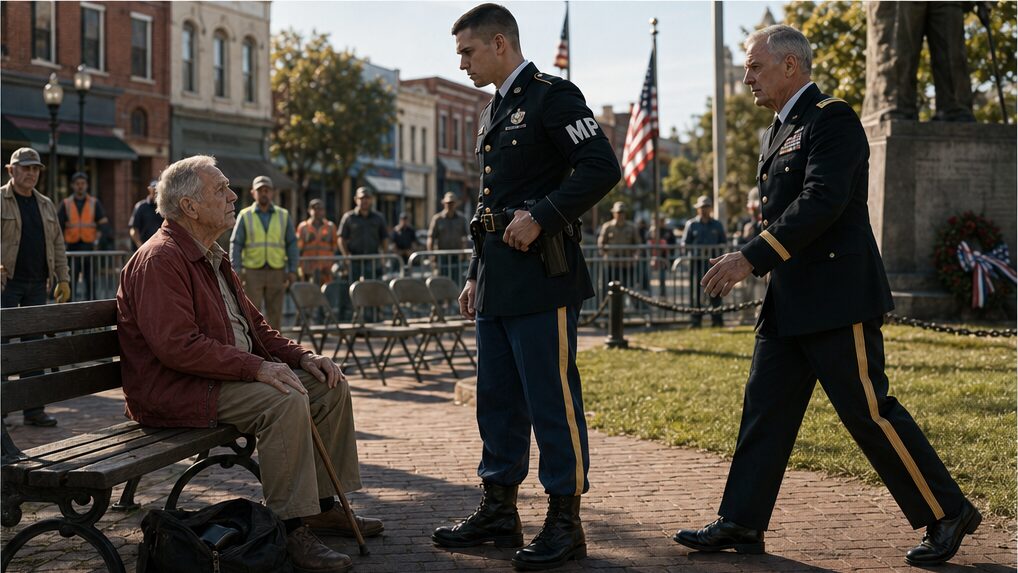
A uniformed young man appeared near the courthouse steps, walking with purpose. His boots were polished, his sleeves crisp, his jaw set in a way that belonged to men trying to look older than they were. He was not local police. His uniform marked him as military police assigned for the weekend event.
He spoke first to the woman with the clipboard. She pointed toward the bench.
Then the young man turned toward John.
John looked down at the canvas bag beside his shoe and saw, where the zipper had opened a little farther, the black grip beneath the cloth.
He closed his eyes once, briefly.
“Ruth,” he murmured, so softly no one heard, “they moved the barricade wrong.”
Chapter 2: The Object on the Ground Looked Like Trouble
Eric Carter had been told twice that morning not to overcomplicate a simple assignment.
The first time came from the police dispatcher, who handed him the event security packet and said, “It’s a town ceremony, not a base lockdown.”
The second came from Catherine Walker, who wore a navy blazer despite the warming day and tapped her clipboard against her palm while explaining where volunteers were supposed to stand.
“We need presence,” she said. “Calm presence. People feel better when they see a uniform.”
Eric had nodded because that was what he had been trained to do when receiving instructions he did not entirely trust. He had been assigned to help secure the Memorial Day setup after a training review at the armory had gone badly. Nobody had used the word mistake in the official notes, but Eric had replayed the moment enough times to know what people meant when they said he needed “experience with civilian judgment.”
Civilian judgment seemed to mean smiling while people ignored barriers, answered questions vaguely, and brought unknown bags into crowded areas.
So when the volunteer approached with a pale face and said, “There’s an old guy by the bench with something that looks like a gun,” Eric did not smile.
He asked where. He asked who had seen it. He asked whether the man had made a threat. The volunteer said no, then maybe, then no again, but he was sitting in the ceremony area and would not say what was in the bag.
Catherine’s lips pressed thin. “Handle it quietly.”
Eric adjusted his belt and walked toward the bench.
The old man watched him come. That was the first thing Eric noticed. Not panic. Not confusion. Not the fidgety guilt of someone caught doing something wrong. The old man simply watched.
He wore a red jacket too bright for his lined face, khaki pants, brown shoes polished long ago and cared for since. His gray hair lay flat against his head. One hand rested on a cane. The other lay open on his knee, fingers slightly curled.
The bag sat by his right foot.
Its zipper had come open. Beneath a dark cloth, Eric saw a black grip.
Every sound in the square seemed to separate itself: chair legs scraping pavement, a truck reversing, café dishes clinking across the street, a flag rope tapping its pole.
Eric stopped six feet away.
“Sir,” he said, keeping his voice even, “I need you to move your hands where I can see them.”
The old man looked at his own hands as if mildly surprised by them. Then he lifted them slowly, palms open, one still holding the cane.
A few people nearby noticed and stopped pretending not to look.
“Is that your bag?” Eric asked.
“Yes.”
“What’s inside it?”
The old man looked at the bag, then back at him. “Something that belongs here.”
“That’s not an answer.”
“No,” the old man said. “It’s the truth.”
Eric felt heat rise under his collar. He had expected denial, explanation, maybe anger. The calm bothered him more.
“Sir, I’m asking you to stand and step away from the bag.”
The old man did not move at first. His eyes shifted past Eric to the granite memorial, then to the courthouse clock.
“Slowly,” Eric added.
“I do most things that way now.”
A few people heard it. Someone gave a nervous half laugh, then stopped when Eric glanced over.
The old man leaned forward. Eric’s hand moved to his own holster before he thought about it.
“Do not reach for the bag.”
“I’m reaching for the cane.”
“Leave the cane.”
The old man paused, bent halfway forward, one hand hovering above the worn wooden handle. His face did not change, but something in his stillness made the command feel louder than Eric had intended.
Across the street, Nancy Harris stepped out of the café, wiping her hands on a towel. The maintenance workers had stopped unloading barricades. Catherine stood near the courthouse table with her phone in hand.
The old man straightened without the cane.
“Stand up,” Eric said.
It took longer than Eric wanted. The old man pressed one hand against the bench and pushed himself upward in stages, jaw tight, shoulders trembling once before he steadied. No one helped him. Eric did not help him because stepping closer meant stepping closer to the bag, and the black grip was still visible under the cloth.
Once upright, the old man swayed slightly.
“What is your name?” Eric asked.
“John Bennett.”
“Mr. Bennett, step to your left.”
John did so.
Eric crouched near the bag, careful to keep his body angled. With two fingers, he pulled the cloth back.
The black pistol lay there.
Someone gasped.
Eric’s pulse kicked hard. It was smaller than a service pistol, older, the finish rubbed dull, but the shape was enough. He lifted it by the grip, pointed it down, and opened the chamber the way he had been trained. Blocked barrel. Blank chamber. No live round.
A tag swung from the trigger guard on a faded cord.
Before he could read it, a voice cut across the square.
“Put that down with both hands, Carter.”
Eric turned.
Charles Reed was walking toward him from the far side of the memorial, his uniform jacket open at the throat, his face set in a way that made people clear a path without being asked. He was retired, technically, but no one who had seen him move through a room ever mistook retired for finished.
Eric stood. “Sergeant Major, we have a weapon in the event area.”
Charles stopped close enough to see the pistol in Eric’s hand.
His expression changed.
Not dramatically. His eyes simply dropped to the tag, and the firmness in his jaw loosened for one second before returning harder than before.
“Give it to me,” Charles said.
“Sir, I need to secure—”
“Both hands.”
Eric hesitated. That hesitation was the worst thing he could have done.
Charles stepped closer, voice low enough that only Eric and John could hear the first words.
“That is not your prop to wave around in front of him.”
Eric felt his face burn. “I wasn’t waving it.”
Charles held out his hands. “You were holding the town’s memory like evidence.”
The square had gone quiet around them.
Eric placed the pistol into Charles’s hands. Charles took it not like a dangerous thing and not like a harmless thing, but like an old object with weight beyond metal. He turned the brass tag over with his thumb.
11:48.
Then Charles looked at John.
For the first time since Eric had approached, the old man’s eyes dropped.
“Mr. Bennett,” Charles said, and the title sounded different in his mouth. Not polite. Exact. “I’m sorry.”
John’s face remained still. “You didn’t move the barricade.”
Charles almost smiled, but the moment would not hold it.
Eric looked between them. “You know him?”
Charles turned back so sharply that Eric straightened without meaning to.
“I know enough to know you should have asked before you ordered.”
“He had what appeared to be a firearm beside a public ceremony site.”
“And you had a man in front of you telling you it belonged here.”
“That doesn’t clear him.”
“No,” Charles said. “But it should have slowed you down.”
Catherine had reached them now, clipboard pressed to her chest. “Charles, what is this?”
Charles did not take his eyes off Eric. “A starter pistol. Ceremonial. Blanks only.”
Catherine’s relief came too quickly. “Then we can remove it and document—”
“No,” John said.
It was not loud. It did not need to be. Everyone had been waiting for him to say something, and when he did, the square turned toward him.
Eric still held his posture, but he felt something shift under it.
John nodded once toward the pistol. “It fires blanks at eleven forty-eight.”
Catherine blinked. “The ceremony is at noon.”
“The speeches are at noon,” John said.
Charles looked at the tag again.
Eric heard himself ask, “What happens at eleven forty-eight?”
John’s hand lowered to the top of his cane. He looked tired now, not weak, but tired of deciding how much strangers deserved to know.
“The square listens,” he said.
A delivery truck rumbled behind them, then stopped as the driver realized no one was moving. The flag rope tapped the pole twice. Somewhere inside Nancy’s café, a timer began beeping and continued until someone shut it off.
Charles stepped to the side, placing himself between Eric and John without making a show of it.
“Carter,” he said.
Eric faced him.
Charles pointed at the ground near the bench, where the bag still lay open, cloth crumpled from Eric’s search.
“You just put your hand on the one thing this town forgot to thank him for.”
Eric’s throat tightened with a response he did not have.
John bent for his bag. This time, no one told him not to reach. He folded the cloth with deliberate care, though Charles still held the starter pistol. Then John took the empty bag by its handles.
“I’ll come back when the square remembers what it’s doing,” he said.
“Mr. Bennett,” Eric began.
John did not look at him. “Officer.”
The word was not an insult. That made it worse.
John turned, cane clicking once against the brick, and walked away from the bench. The crowd parted for him with the awkwardness of people who had noticed too late that they were in the way.
Charles watched until John crossed in front of the café.
Only then did he turn back to Eric.
The pointing came fast, sharp, and public.
“You will not mistake control for judgment again,” Charles said.
Eric stood rigid. He felt the eyes of the square on him, but the worst weight was the black starter pistol resting in Charles Reed’s careful hands, its brass tag swinging in the morning light like a question no one had bothered to read.
Chapter 3: The Bench Plaque Nobody Read
Nancy Harris burned the first tray of biscuits after John Bennett left the square.
She smelled them before the timer went off, but she did not move. She stood just inside the café door, towel in one hand, and watched John’s red jacket disappear beyond the post office. By the time she returned to the oven, the biscuit tops were dark and smoking at the edges.
The breakfast regulars noticed.
They noticed everything, though not always the things worth noticing.
At the corner table, a retired mail carrier leaned sideways to look through the window. “Was that a real gun?”
“Starter pistol,” Nancy said, sliding the tray onto the counter harder than she meant to.
“Still looks like a gun.”
“Most things look like something if you don’t know what you’re looking at.”
The mail carrier looked down into his coffee.
By nine o’clock, the story had already changed twice. The first version said an old man had brought a firearm to the Memorial Day setup. The second said the military police had taken him down, which was nonsense because John had walked out under his own power, slower than usual but straight-backed. The third version, delivered by a woman buying muffins, said Charles Reed had nearly arrested the young officer for disrespecting a war hero.
Nancy placed the muffins in a paper bag and folded the top. “Charles doesn’t arrest anybody. He just makes them wish they had read the room.”
The woman lowered her voice. “So John really was some kind of hero?”
Nancy looked through the window at the empty bench.
“I don’t know what he was,” she said. “That’s the point, isn’t it?”
After the breakfast rush thinned, Nancy wiped the front tables twice and then stopped pretending to work. Across the street, the setup had resumed, but differently. The maintenance workers spoke quieter. Catherine Walker moved between the platform and the barricades with her phone pressed to her ear. Eric Carter stood near the courthouse steps, stiff as a post, while Charles Reed spoke to him in a low voice that made Eric’s shoulders square and sink at the same time.
The bench sat empty in the middle of it all.
Nancy untied her apron and went outside.
The morning had warmed. Sunlight bounced off storefront glass and lay bright over the brick. A paper program, not yet taped down, fluttered near the curb. Nancy picked it up and set it on the bench.
That was when she looked at the plaque.
She had seen it before, of course. She swept around that bench every other morning. She had watched children climb on it, couples share ice cream on it, teenagers leave soda cans beneath it, and John Bennett sit on it like he had a reservation written into the wood. But seeing words was not the same as reading them.
IN MEMORY OF RUTH BENNETT
WHO KEPT THE NAMES IN ORDER
Nancy crouched.
The bronze had gone dull in the grooves of the letters. A thin line of dirt sat along the bottom edge. Someone had stuck a piece of gum under the plank above it, years ago by the look of it, hard and gray now. Nancy felt anger rise in her at the gum, at the dirt, at herself for noticing both only now.
She took the towel from her shoulder and rubbed the plaque gently.
“Need something cleaned, Nancy?”
She looked up.
Catherine Walker stood beside the barricade, still holding her clipboard, though now it looked more like a shield than a tool.
“No,” Nancy said. “Something read.”
Catherine’s eyes followed her hand to the plaque. “I know Ruth’s name is there.”
“Do you?”
Catherine’s mouth tightened. She was not a cruel woman. Nancy knew that. Catherine organized toy drives, called elderly residents before storms, and could find extra folding chairs faster than anyone in town. But she trusted forms more than faces. If a thing was not on the schedule, it seemed to frighten her.
Catherine looked toward the bench, then the memorial. “Today got out of hand.”
“Today was out of hand before that boy walked over here.”
“He is not a boy. He’s assigned military police.”
“Then he’s old enough to ask a question.”
Catherine exhaled. “He saw what looked like a weapon.”
Nancy stood, knees complaining. “And John saw a square full of people moving around a ceremony they don’t understand.”
Catherine glanced over her shoulder toward Eric. He was now alone near the platform, looking down at something in his hand. Probably a report form. Men had always loved forms after harm was done.
“The starter pistol can’t be used,” Catherine said.
Nancy stared at her. “What?”
“Not until we verify ownership, safety compliance, and liability coverage. Charles says it’s ceremonial, and I’m sure he’s right, but I can’t allow an unsecured pistol-shaped object in a public gathering. Not this year. Not after people saw it.”
“People saw a mistake.”
“People saw enough to panic.”
“Because nobody knew what they were seeing.”
“That doesn’t change my responsibility.”
Nancy folded the towel. “Does your responsibility include asking John why he had it?”
Catherine looked away.
A church bell rang the quarter hour. Its sound crossed the square thinly, swallowed by the noise of workers setting up chairs. The first rows were going exactly where John had said they would, too wide near the walkway. Nancy noticed now. Once she noticed, she could not stop noticing.
Catherine followed her gaze. “The layout was approved.”
“It’s too tight for Mrs. Coleman’s walker.”
Catherine blinked. “How do you know that?”
“John said it this morning.”
For a moment neither woman spoke.
Then Catherine looked down at the plaque again. “Ruth used to handle the name cards.”
Nancy remembered then. Not clearly, not enough to be proud of. A woman in a pale sweater moving between rows with a clipboard. John standing farther back in a dark jacket. Ruth touching his sleeve before the bugle sounded. Ruth correcting a councilman who had mispronounced a name. Ruth laughing in the café afterward, asking for coffee with too much cream.
“How long ago?” Nancy asked.
“Before I had this job,” Catherine said. “Before the town digitized everything.”
“Digitized,” Nancy repeated.
Catherine heard the judgment and did not argue. “I’m doing what I can with the records we have.”
“Maybe the records you need are sitting on that bench every morning.”
Catherine looked wounded then, and Nancy regretted the sharpness but not the truth.
Across the street, Eric started toward them, then stopped when Charles called his name from near the memorial. Charles held the black starter pistol case tucked under one arm now. He had not given it back to Eric. That, at least, was something.
Nancy turned back to the café. “I’m bringing him coffee tomorrow.”
“John?”
“Yes.”
“He may not come tomorrow.”
Nancy looked at the empty bench. “Then I’ll bring it the day after.”
Catherine’s phone buzzed. She checked the screen and sighed. “The town manager wants a statement.”
“Tell him the truth.”
“That an elderly man brought a starter pistol to the square and security responded?”
Nancy’s eyes hardened. “That the town forgot who kept its silence.”
Catherine did not answer.
By noon, the square had mostly returned to motion. Chairs were unfolded. Flags were unwrapped. A volunteer taped down cords. People glanced at the bench less often, but when they did, their eyes dropped toward the plaque.
Nancy noticed Eric cross the square alone after Charles left. He stood in front of the bench for nearly a minute before bending down.
At first she thought he was looking for something on the ground. Then she realized he was reading.
His lips moved around Ruth’s name.
He reached out as if to touch the plaque, stopped himself, and let his hand fall.
Good, Nancy thought. Don’t touch what you haven’t earned.
That afternoon, Catherine sent a notice to the event committee. Nancy saw it because one of the volunteers brought a printed copy into the café and left it on a table.
Due to safety review, any ceremonial device not previously listed on the approved schedule is prohibited from the Memorial Day square until documentation can be verified.
Nancy read it twice.
Then she looked out at the bench.
Near the curb, a single black thread from John’s canvas bag had caught on a rough edge of brick. It moved lightly in the breeze, almost invisible unless a person knew to look down.
Chapter 4: The Ledger in the Veterans’ Hall
Eric Carter did not sleep well that night.
He lay in the narrow bed of the room the town had provided above the old municipal annex and stared at the ceiling fan turning in uneven circles. Every time he closed his eyes, he saw John Bennett standing without his cane, one hand hovering where he had been told not to reach. He saw the black pistol in his own grip. He saw Charles Reed’s face when the brass tag swung into view.
You were holding the town’s memory like evidence.
At six in the morning, Eric dressed before his alarm. He pressed his uniform sleeves twice though they did not need it. In the mirror, he looked clean, young, and exactly as uncertain as he had felt the day before.
The square was empty when he crossed it. The barricades stood in neat lines. Chairs were stacked under tarps. The memorial bench waited with a paper coffee cup beside it, steam rising into the cool morning.
John was not there.
Nancy Harris was unlocking the café door. She saw Eric looking at the cup.
“He takes it black,” she said.
Eric turned. “I didn’t know that.”
“No,” Nancy said. “You didn’t.”
He accepted that without defense. “Do you know where I can find ceremony records?”
Nancy pushed the door open with her hip. “Town office has the new ones.”
“I need the old ones.”
She studied him long enough to make him stand still. “Veterans’ hall. Back room. Ask the clerk for the ledgers if they haven’t been boxed under the Christmas wreaths.”
“Thank you.”
“And Officer?”
Eric stopped.
“If you find what you’re looking for, don’t bring it back like a trophy.”
The veterans’ hall sat behind the library in a low brick building with a faded flag painted on one side. Its front door stuck at the bottom, and Eric had to shoulder it gently before it opened. Inside, the air smelled of floor wax, dust, and coffee that had been sitting too long on a burner.
A clerk at the front desk looked up from a crossword puzzle.
“Hall doesn’t open for another hour.”
“I’m looking for Memorial Day ceremony records,” Eric said. “Older ones.”
The clerk took in his uniform, then his face. “You the one from yesterday?”
Eric’s jaw tightened. “Yes.”
The clerk folded the newspaper slowly. “Back room.”
The back room was narrow and dim, lined with file cabinets, plastic storage bins, and shelves that sagged under binders. Framed photographs leaned against the wall because no one had found space to hang them. Men in uniforms stared out from black-and-white images, their names typed on yellowing labels. Some were young enough to look unfinished.
The clerk pointed to a stack of ledgers beneath a folding table. “Ceremony books are there. Don’t tear anything. Some pages come loose if you breathe wrong.”
Eric thanked him and crouched.
The first ledger was from years too recent to help: printed programs, emails, speaker lists. Catherine Walker’s name appeared everywhere in tidy signatures. He set it aside.
The second was older. Handwritten notes. Seating changes. Weather reports. The names of families who needed shade or easy access. In the margins, someone had written small instructions no official schedule would include.
Mrs. Coleman prefers aisle.
Move wreath left if wind comes from courthouse.
Bell rope sticks after rain.
No applause after bugle.
The handwriting changed halfway through the book. The earlier script was rounded, careful, and firm. The later entries were smaller and heavier, as if the hand that wrote them pressed harder than it meant to.
Eric turned a page and found the first line that made him stop.
11:48 — Bennett cue.
He ran his finger beneath the words without touching the ink.
The entry appeared the next year too.
11:48 — John cue, Ruth cards.
Then again.
11:48 — cue pistol, bugle follows.
Page after page, year after year, the same minute returned. Sometimes the weather changed. Sometimes the mayor changed. Sometimes the bugler changed. The cue did not.
Eric shifted on his heels, knees stiff, and kept reading.
In one year, the rounded handwriting had written: John says clock is slow. Trust his watch.
In another: Ruth says no applause, even if mayor starts.
Eric almost smiled, then did not.
The ledger became a record not of ceremony, but of care. Names corrected in red pencil. Phonetic spellings added beside families. Notes about who should receive a chair, who did not like microphones, who might need a hand walking to the wreath stand. John and Ruth Bennett appeared not as honorees, but as the invisible hands that kept the morning from becoming a performance.
Then he turned a page and found the change.
The year before it, the entry read: John and Ruth arrive 7:00. Check clock, chairs, cards.
The next year, in the smaller, heavier hand: John arrive 6:30. Ruth absent. Check names twice.
Eric sat back.
The fluorescent light above him hummed.
He thought of the plaque on the bench. Ruth Bennett, who kept the names in order. He had read it yesterday with shame burning under his skin, but reading a plaque was easy. Reading years of someone’s work was harder. The ledger made Ruth less like a dedication and more like a presence that had been removed from a room without the chairs being rearranged afterward.
He turned more pages. In the later years, the entries grew shorter.
11:48 — cue.
11:48 — cue.
11:48 — cue.
Then, in the most recent ledger, Catherine’s printed schedules began. The handwritten notes disappeared. There were clean tables, permit numbers, insurance language, assigned volunteer zones. No mention of John. No mention of Ruth. No mention of the pistol.
Eric found last year’s program. The bugle was listed at 11:50.
He remembered John’s voice.
The speeches are at noon.
He closed the ledger and sat very still.
The clerk appeared in the doorway, holding a mug. “Find something?”
Eric looked at the stack of books. “Too much.”
“That happens in here.”
“Why isn’t any of this in the town office files?”
The clerk shrugged. “Because when people retire, die, or stop coming to meetings, somebody says they’ll transfer the old stuff later. Later is a deep hole.”
Eric looked at the open page again. “Did you know him?”
“John?” The clerk leaned against the doorframe. “Everybody knows John.”
Eric almost asked the question, but stopped himself because he already knew the answer. Everybody knew John the way Nancy knew the bench: by sight, by routine, by convenience. Not by asking.
The clerk sipped his coffee. “He played bugle once. Long time ago. Not for applause. Never could stand that.”
“Why did he stop?”
“Breath, I guess. Age. Maybe memory.” The clerk nodded toward the ledgers. “Ruth handled the names after that. John handled the minute.”
“The minute?”
“Eleven forty-eight.” The clerk said it like a person repeating a church response learned in childhood. “Don’t ask me why. Folks just knew not to argue.”
Eric looked down at the page where Ruth’s name disappeared.
“Somebody should have asked,” he said.
The clerk gave him a sad, practical look. “Somebody always should have.”
Eric spent another hour photographing pages with permission and writing notes by hand because touching the old paper made him feel he owed it more than a quick picture. He found programs with John’s name once listed as “Bugle,” then later “Ceremony cue,” then not listed at all. He found Ruth’s seating charts, Ruth’s name cards, Ruth’s careful correction of a fallen soldier’s middle initial. He found a folded schedule from years ago with a coffee stain and the words John says silence starts before sound.
At the bottom of the storage bin was a small envelope. Inside was a copy of an old permit for blank ceremonial discharge in the square. Responsible party: John Bennett. Secondary: Ruth Bennett.
Eric set the permit beside the ledger and stared at the blank where Ruth’s signature had once carried equal weight.
At ten fifteen, Charles Reed found him there.
The older man did not speak at first. He looked at the open ledgers, the permit, the photographs, and then at Eric.
“You came early,” Charles said.
“Yes, Sergeant Major.”
“Looking to clear your report?”
Eric shook his head. “Looking to understand what I interrupted.”
Charles stepped into the room and lifted one of the ledgers carefully. “That’s a better answer.”
Eric swallowed. “Why didn’t you tell me all this yesterday?”
“Because it wasn’t mine to use against you.”
“But you knew.”
“I knew pieces.” Charles turned a page. “I knew the first time I heard that pistol, I was twenty-three and thought ceremony meant standing still until it was over. Then John Bennett raised that thing at eleven forty-eight, and the whole square went quiet before the bugle. Not after. Before. Like the town was taking a breath together.”
Eric watched his thumb rest near Ruth’s handwriting.
“Why eleven forty-eight?”
Charles closed the ledger gently. “Ask him.”
“I’m not sure he’ll answer me.”
“He might not.” Charles looked toward the hallway, where dust moved in a beam of light. “You’re not owed an answer just because you finally found the question.”
Eric accepted that too.
When he left the veterans’ hall, he carried copies of the permit and ledger pages in a folder, not under his arm like evidence but held flat against his chest to keep them from bending. The town square was brighter now, busier, louder. Catherine stood near the platform, arguing into her phone. Nancy’s café door was open.
The bench was still empty.
Beside it, the coffee Nancy had left had gone cold.
Eric crossed the brick slowly and stood where he had stood the day before. He looked at the plaque, then at the narrow path between the barricade and the first row of chairs. John had been right. Mrs. Coleman would not fit through with her walker.
Eric set the folder down on the bench, moved to the barricade, and dragged it one foot back.
The rubber foot scraped the brick.
It was not enough.
But it was the first useful thing he had done.
Chapter 5: The Time John Refused to Explain
John Bennett heard the truck outside before he heard the knock.
He sat at the kitchen table with Ruth’s timing card unfolded in front of him and the morning light cut into squares on the linoleum. The card looked smaller at home than it did in the square. Less official. More breakable. He had copied it onto fresh paper twice over the years, but he always returned to the old one because Ruth’s handwriting knew what mattered.
The knock came softly.
John did not answer at first.
He listened to the house. The refrigerator hummed. The wall clock ticked. Somewhere in the pipes, water settled. The sound of the truck engine stopped outside, and a door closed with more care than most men gave car doors.
A second knock.
“John,” Charles Reed called through the screen. “It’s Charles.”
John folded the timing card once, then once again, and slid it beneath the sugar bowl.
“Door’s open.”
Charles entered without his hat in his hand. That was one thing John still liked about him. Some men took off their hats dramatically in houses, as if respect needed an audience. Charles simply held his at his side.
He stopped in the kitchen doorway and took in the table, the empty second chair, the red jacket hanging over the back, and the space where the black canvas bag usually rested.
“You moved the barricade wrong,” John said.
Charles looked down, and the corner of his mouth shifted. “Carter moved it back.”
“Enough?”
“Not yet.”
John nodded toward the chair. “Then sit.”
Charles sat.
For a moment they did not speak. They had known each other too long in the strange way men knew each other through ceremonies and funerals, through nods across rooms, through names spoken carefully into microphones. Charles had been younger once, with a neck too stiff and boots too loud. John remembered him standing in the square after his first deployment, looking like he wanted someone to tell him where to put all the things he had brought home in his head.
Ruth had handed him a program and said, “Stand near the third flag. If you feel like leaving, count the names instead.”
Charles had counted.
Now his hair had gone iron-gray, and he carried himself like a man others still expected to command. But he looked tired in John’s kitchen.
“I brought the pistol,” Charles said.
John’s hand moved slightly on the table.
“It’s locked in my truck,” Charles added. “I didn’t want to walk it in without asking.”
John looked at him then.
That was something. A small thing, but most respect was small before it was anything else.
“Catherine banned it,” John said.
“Temporarily.”
“That word does a lot of work for people who don’t want to say no.”
Charles took that without flinching. “She wants documentation.”
“She had years to want it.”
“She didn’t know.”
John’s eyes hardened. “No. She didn’t ask.”
The clock ticked between them.
Charles placed a folder on the table but did not open it. “Carter went to the hall.”
John looked at the folder, then away. “Did he?”
“He found the ledgers.”
“Good for him.”
“He found Ruth’s notes.”
John’s jaw shifted once.
Charles lowered his voice. “He moved the barricade.”
John nearly laughed, but it caught somewhere in his chest. “A heroic act.”
“No,” Charles said. “A useful one.”
That quieted the room.
John stood slowly and went to the sink. His knee had been bad since the day before. Standing without his cane in the square had cost him more than he had let show, and the cost had come due in the night. He filled the kettle though he did not want tea.
Charles remained seated. Smart man.
“You came to ask if I’ll return,” John said.
“Yes.”
“No.”
The answer had been ready all morning. It felt less satisfying spoken aloud.
Charles leaned back. “Because of Carter?”
“Because of all of you.”
Charles looked down.
John turned from the sink. “I sat on that bench for fifteen years after Ruth died. Fifteen. Before that, we sat together. Before that, I stood because my lungs still worked right and I could play. Do you know how many event directors, mayors, volunteers, pastors, and officers walked past that pistol bag?”
“John—”
“No.” He gripped the edge of the counter. “Don’t soften it for me. I’m old, not glass.”
Charles closed his mouth.
John looked at the sugar bowl where the card lay hidden beneath. “Every year somebody says thank you into a microphone. Thank you for your service. Thank you for your sacrifice. Thank you to those who made the ultimate whatever phrase they printed from last year’s program. Then they stack the chairs, throw away the cups, and forget who needed room for a walker.”
His voice had not risen, but his breath had shortened. He waited until it steadied.
“I’m not angry because that young man didn’t know me,” he said. “He had no reason to know me. I’m angry because nobody knew what the minute was for, and they kept using it anyway.”
Charles’s face changed in the smallest way. “Then tell them.”
John shook his head. “No.”
“They need to hear it.”
“They need to listen before there’s a story.”
The kettle began to tremble before the boil. John turned off the burner.
Charles opened the folder then, not fully, just enough for John to see the top copy. The old permit. John’s signature beside Ruth’s. Her name in blue ink, his in black.
John stared at it longer than he meant to.
“She signed everything bigger than I did,” he said.
“She wanted it legible.”
“She wanted people to stop pretending they could read men’s handwriting.”
Charles smiled faintly.
John sat again because his leg was beginning to shake. The kitchen chair creaked under him.
“The first eleven forty-eight wasn’t in this town,” John said.
Charles went still.
John regretted the words as soon as they left him, but he did not take them back. He looked at the window above the sink instead of at Charles.
“We were waiting for orders that morning. Not ceremony. Not speeches. Just waiting. Somebody had a watch that ran fast. Somebody else had one that ran slow. We argued about three minutes like fools because arguing was easier than being scared. Then the message came at eleven forty-eight.”
He stopped.
Outside, a truck passed slowly on the street.
Charles did not ask what the message said. That was why John had trusted him with as much as he had.
“Later,” John continued, “after the names started coming home different than the men had left, I couldn’t stand how ceremonies waited until the bugle to get quiet. Like grief needed a cue. Ruth said silence ought to arrive first. She said the names deserved to enter a room already prepared.”
He rubbed his thumb over the table’s worn edge. “So we made the minute.”
“And the pistol?”
“People hear a shot.” John’s face tightened. “Even a blank. They stop pretending they don’t.”
Charles looked toward the window. “Ruth stamped the tag?”
“Yes.”
“Why keep doing it alone?”
John looked at him then. “Because I wasn’t alone.”
The words settled harder than he intended.
Charles bowed his head once.
On the counter, the kettle clicked as it cooled.
John reached beneath the sugar bowl and pulled out the card. He unfolded it halfway, then pushed it across the table. Charles did not touch it until John let go.
“Every year,” John said, “Ruth checked the names twice. Not because the town would notice if they were right. Because the families would notice if they were wrong. After she died, I checked them. Then the town moved to printed programs and online files and volunteers who call the ceremony an event.”
Charles read the card carefully.
“I can speak to Catherine,” he said.
“You already did.”
“I can speak louder.”
“That’s your habit, not a solution.”
Charles absorbed that with a tired smile. “Fair.”
John took the card back and folded it. His fingers were not as steady as he wanted them to be.
“I won’t be placed on that platform,” he said. “I won’t sit in a special chair while people clap because they feel guilty. I won’t have that boy apologize in front of a crowd so everyone can feel clean.”
“What will you do?”
“I’ll stay home.”
The sentence hurt more than he expected.
Charles knew it. He looked toward the empty chair across from John, the one Ruth had used every morning until she did not.
“The ceremony will be poorer for it,” Charles said.
“The ceremony has been poorer for years. It survived.”
Charles stood slowly. “Carter wants to make it right.”
John looked down at the folded card. “Then he can start by not making it about himself.”
“He asked what eleven forty-eight means.”
John’s eyes closed for half a second. “Of course he did.”
“I told him to ask you.”
John opened his eyes. “You shouldn’t have.”
“Maybe not.”
The two men looked at each other across the kitchen, old soldiers of different wars, each knowing the other had offered something and withheld something.
Charles picked up his hat.
At the door, he paused. “What should I tell him?”
John looked at Ruth’s card. He thought of Eric’s hand near his holster, the command to leave the cane, the black pistol lifted like contraband. Then he thought of the barricade moved one foot back.
“If he wants the pistol back in the square,” John said, “he can ask me himself.”
Charles nodded once, opened the screen door, and stepped onto the porch.
John waited until the truck engine started. He waited until it faded down the street. Then he stood, crossed to the front window, and pulled the curtain aside.
The porch steps were empty.
For one foolish second, he had expected Ruth to be there with her pencil behind her ear, telling him he was being stubborn for the right reason and the wrong one at the same time.
He let the curtain fall.
On the table, the timing card waited beside two untouched cups.
Chapter 6: Permission Before Procedure
Catherine Walker had turned the town office conference room into a battlefield of paper.
Permits covered one end of the table. Printed schedules covered the other. A laptop sat open between them, its screen filled with an email chain that had grown longer every time someone tried to shorten it. The town manager wanted clarity. The insurance office wanted language. The police dispatcher wanted confirmation that no unauthorized discharge device would be present. The veterans’ hall wanted to know why the ceremony had forgotten a procedure everybody assumed somebody else had written down.
Eric Carter stood near the wall with the folder from the hall under his arm and said nothing until Catherine looked up.
“If you’re here to tell me Charles is unhappy,” she said, “take a number.”
“I’m not here for Sergeant Major Reed.”
“Good. Because I’ve had four calls from people who suddenly remember John Bennett was important after forgetting to invite him to planning meetings for a decade.”
Eric accepted the edge in her voice. He had earned some of it. Not all, but enough.
“The starter pistol is listed on prior permits,” he said.
Catherine held up a sheet. “Expired permits.”
“Yes.”
“And no current safety plan.”
“No.”
“And no approved responsible party for this year.”
Eric laid the folder on the table and opened it to the copied ledger page. “Then the current safety plan is incomplete.”
Catherine stared at him. “That is not helpful.”
“It’s accurate.”
“Accurate is not always helpful two days before a ceremony.”
Eric almost replied the way he would have yesterday. Procedure exists for a reason. Public safety comes first. Unknown objects must be secured. All true. All insufficient.
Instead, he looked at the old ledger page.
“John knew the walkway was too narrow,” he said. “Before any of us measured it.”
Catherine rubbed both hands over her face. She looked older without the clipboard in front of her. “I moved the barricade after you did. He was right.”
“He also knew the program timing was wrong.”
“The program timing follows last year’s posted schedule.”
“Last year’s posted schedule was wrong too.”
Catherine looked at the page but did not touch it. “What do you want me to do?”
“Put his name back.”
“Where?”
Eric slid the blank permit form from the stack. A line near the bottom read Responsible keeper of ceremonial device.
Catherine gave a short, humorless laugh. “You think I can just write in the name of a man who hasn’t agreed to participate?”
“No,” Eric said. “I think that’s the problem.”
She looked at him then.
He picked up a pen, held it for a moment, and set it down beside the form. “Yesterday I treated the pistol like the issue. It wasn’t. The issue was that I thought securing the square meant removing anything I didn’t understand.”
Catherine leaned back. “You’re making this sound simple.”
“It isn’t.”
“No. It isn’t.” She tapped the permit. “If that object is used, someone is responsible. If someone panics, someone answers. If a blank misfires, if a child gets too close, if a video gets posted without context, if the town looks reckless—”
“Then we answer for the plan,” Eric said. “Not by erasing the person who knows how it works.”
Catherine’s mouth closed.
The office around them hummed with printers and distant phones. Through the window, the square was visible in slices: platform, flags, bench, chairs.
Eric looked at the bench.
“My grandfather served,” he said.
Catherine’s eyebrows lifted, not because the statement was remarkable, but because it was personal and he had not sounded personal before.
“He never talked about it,” Eric continued. “When I was a kid, I thought that meant there wasn’t much to tell. Later I thought it meant he didn’t trust us with it. Now I think maybe nobody asked him right.”
Catherine’s expression softened despite herself.
Eric looked down at the blank line. “I don’t know how to ask John Bennett right. But replacing him because asking is uncomfortable seems worse.”
For a while Catherine did not speak. Then she picked up the pen and wrote nothing. She placed it back down.
“I can’t authorize the device without his agreement,” she said.
“I know.”
“And the police chief needs confirmation.”
“I’ll get it.”
“And Charles needs to approve the ceremony handling.”
“He will if John does.”
“And John may say no.”
Eric nodded. “Then we don’t use it.”
Catherine studied him. “You understand what that means? The ceremony changes.”
“No,” Eric said. “It means the ceremony already changed, and we finally noticed.”
The sentence surprised both of them.
Catherine folded the permit form and slid it toward him. “Take it. Don’t fill it out for him.”
“I wasn’t going to.”
She gave him a look that said yesterday he might have.
He deserved that too.
By late afternoon, Eric had the locked pistol case from Charles Reed, the blank permit, and the copied ledger pages sealed in a folder. Charles met him beside the memorial before he left.
“Do you know what you’re asking for?” Charles said.
“Permission.”
“From John, yes. But also permission to stand in a place you mishandled.”
Eric looked across the square. Nancy had set another coffee on the bench that morning. John had not come for it.
“I know.”
Charles held the pistol case out. Eric did not take it immediately.
“Both hands,” Charles said.
Eric stepped closer and received it with both hands.
The case was heavier than it looked. Or maybe he simply knew more than he had yesterday.
“I owe him an apology,” Eric said.
“Yes.”
“But that can’t be the first thing I ask him to carry.”
Charles’s eyes narrowed slightly, approving but not indulgent. “Good.”
Eric drove to John Bennett’s house as the evening light lowered behind the maples. He passed small yards with flags already planted along the edges, porch chairs turned toward quiet streets, a child drawing stars in chalk on a driveway. Twice he checked the address though there was no need. The red jacket hanging on the porch rail told him before the house number did.
He parked at the curb and sat with the engine off.
The pistol case rested on the passenger seat. The permit folder lay beneath it. He could see the corner of the copied ledger where Ruth’s handwriting curved around the words No applause.
Eric thought of his grandfather’s garage, the coffee cans of screws, the old field jacket that had hung beside fishing rods, the way everyone had known not to touch it and no one had known why. After his grandfather died, the jacket went into a donation bag. Eric had carried it to the truck himself.
He had not thought about that in years.
Now he sat outside John Bennett’s house, and shame did not arrive as a blow. It arrived as detail.
The command to leave the cane.
The pistol lifted in one hand.
The word Officer.
Eric got out.
He carried the case in both hands, the folder tucked beneath his arm. The porch steps creaked under his boots. Through the screen door, he could see the shape of a kitchen table and a wall clock.
He knocked once, waited, then knocked again.
No answer.
He considered leaving the case on the porch. The thought embarrassed him as soon as it came. Leaving a hard conversation in a box was not respect.
He knocked a third time, softer.
Inside, a chair scraped.
John appeared in the hallway with his cane in one hand. He looked at Eric through the screen. His face showed no surprise.
“Mr. Bennett,” Eric said.
John did not open the door. “Officer Carter.”
Eric held up the case slightly, not as evidence, not as a trophy, simply so John could see it.
“I brought it back,” he said. “But I’m not asking you to take it.”
John’s eyes moved from the case to Eric’s face.
Eric swallowed.
“I’m asking permission to ask what should happen next.”
Chapter 7: Eleven Forty-Eight in the Square
John opened the screen door but did not step aside.
Eric Carter stood on the porch holding the black case with both hands. His uniform was still sharp, but his face had lost the hard polish John had seen in the square. He looked younger now, which did not make him harmless. Young men had done plenty of harm while looking young. But this one had learned enough not to put the case down without being told.
John looked at the case, then at the folder beneath Eric’s arm.
“You brought paperwork too,” John said.
“Yes, sir.”
“That word won’t help you.”
Eric swallowed. “No, sir.”
John let the screen door rest against his shoulder. “What are you asking?”
Eric’s eyes dropped briefly to the case. “Permission to bring this inside.”
John waited one full breath before answering.
“Kitchen table,” he said.
Eric stepped in carefully, as if the threshold itself required approval. He placed the case on the kitchen table, turned it so the latches faced John, then stood back. He did not open it.
John noticed.
He hated that he noticed.
The folder came next. Eric slid it onto the table but kept his hand on top until John looked at it.
“I went to the veterans’ hall,” Eric said. “I found the old permits. The ledgers. Mrs. Bennett’s notes.”
John’s gaze sharpened. “Ruth.”
“Yes,” Eric said quietly. “Ruth’s notes.”
The correction landed. John saw it land. Not as embarrassment this time, but as adjustment.
He sat down slowly. Eric remained standing.
“You can sit,” John said.
“I’d rather stand unless you want me to.”
John almost told him to stop trying so hard. Instead, he opened the case.
The starter pistol lay inside on the folded dark cloth. Charles had cleaned nothing, polished nothing, changed nothing. The brass timing tag still hung from the trigger guard, rubbed bright at the edges, the stamped numbers uneven.
11:48.
John touched the tag with one finger.
Eric looked away, giving him the privacy of a man handling something that had survived too many hands already.
“You want this back in the square,” John said.
“I want the square to be right,” Eric answered. “If that means this stays here, then it stays here.”
John lifted his eyes.
Eric’s face had gone pale with effort, not fear. “I can’t undo yesterday. I spoke over you. I ordered you away from your cane. I picked this up with one hand and treated it like contraband. I’m sorry.”
John closed the case.
The apology sat there between them, plain and not enough. But not nothing.
“Sorry is a door,” John said. “Not a room.”
Eric nodded once. “Then I’m asking where to stand.”
John looked toward the wall clock. Evening had deepened outside. The kitchen smelled faintly of dust and tea leaves. Ruth’s empty chair sat on the far side of the table, turned slightly inward as if she had just stepped away.
“Eleven forty-eight,” John said. “You asked what it means.”
“Yes.”
“I’m not giving you the whole of it.”
“I understand.”
“No, you don’t.” John’s voice remained even. “But you may understand enough.”
He opened the case again and lifted the pistol. Eric did not move.
“It fires a blank one minute before the bugle,” John said. “Not to startle people. To stop them. Talking, shifting programs, looking at phones, waiting for the song to tell them when to feel respectful. That minute is not empty. It belongs to the names.”
Eric’s throat moved. “And Ruth kept the names.”
“Ruth kept them right.”
The distinction mattered. Eric seemed to know that.
John set the pistol back in the case. “If I come tomorrow, there will be no special chair on the platform. No announcement. No apology with a microphone. No one says the town honors me today like they discovered a lost box in storage.”
“I told Catherine not to do that.”
John leaned back. “Did you?”
“She wanted to make a correction publicly. I said she should ask you first.”
“Good.”
Eric waited.
John hated waiting men almost as much as he hated rushing ones.
“You’ll stand three steps behind the bench until I call you,” John said. “Not beside me. Not in front. Behind.”
“Yes, sir.”
“When the names begin, you do nothing.”
“Yes, sir.”
“When the clock reaches eleven forty-seven, you open the case.”
Eric’s eyes flicked to the case. “You’ll fire it?”
John looked at his right hand. The fingers curled slowly, stiff and not as certain as memory wanted them to be. He could still do it. He thought he could. Pride answered quickly. His body did not.
“I’ll decide tomorrow,” John said.
Eric nodded, but his eyes had understood more than John had said.
That almost made John angry.
Instead, he closed the case and pushed it toward Eric. “Bring it at ten thirty. If you’re late, keep driving.”
“I won’t be late.”
“No. You probably won’t.”
Eric stood.
At the door, he paused. “Mr. Bennett?”
John looked at him.
“I moved the barricade again. Mrs. Coleman will fit.”
John held his face still. “Good.”
After Eric left, John sat alone with Ruth’s timing card and the sound of the porch steps fading away. The house settled around him, boards cooling, pipes ticking, silence returning to its familiar corners.
He slept badly and woke before the alarm.
Memorial Day came in clear and windless. By seven, the town square had already begun filling with people who wore clean shirts and careful faces. Flags lined the walkway. Folding chairs stood in rows, this time with a wider path along the left. The temporary platform was smaller than John remembered, though perhaps everything public looked smaller once grief had measured it enough.
Nancy Harris saw him first.
She stood outside the café holding a cup of black coffee with both hands, as if bringing it across the street too quickly might spill more than coffee.
John arrived in his red jacket. His cane struck the brick at its usual pace. Eric walked behind him carrying the black case. Three steps behind. No closer.
Nancy did not say she was glad he came. She did not say the town needed him. She held out the cup.
“Not yet?” she asked.
John took it. “Not yet.”
She smiled.
At the bench, John stopped.
Someone had cleaned the plaque. The bronze letters were brighter than yesterday, though not new. Nothing old should look new at a memorial, Ruth used to say. Clean, yes. New, no.
IN MEMORY OF RUTH BENNETT
WHO KEPT THE NAMES IN ORDER
John lowered himself onto the bench.
Across the square, Catherine Walker stood with a program in her hand, watching. She did not approach immediately. That was wise. When she finally did, she stopped at the edge of the brick path.
“Mr. Bennett,” she said. “The program has been corrected.”
John looked at her.
“No applause after the bugle,” she added. “And the families have the aisle.”
John nodded once.
Catherine looked as though she had prepared more words and was now abandoning them one by one. “Ruth’s name cards are on the side table if you want to check them.”
John’s hand tightened on the cane. “I already did.”
Her eyes widened slightly.
“I came at six,” he said.
Behind him, Eric said nothing.
Catherine looked down at the program. “Of course.”
“No,” John said. “Not of course. That’s how we got here.”
Catherine absorbed that. “Then thank you for checking them.”
He nodded again, and she left without trying to turn the exchange into ceremony.
By eleven twenty, the families had seated. Mrs. Coleman came through the widened path with her walker and did not have to turn sideways. John watched her pass. She paused near him and touched the handle of her walker.
“Ruth would have fussed about these chairs,” she said.
“She did every year.”
Mrs. Coleman smiled, then moved on.
Charles Reed stood near the memorial in uniform, his hands folded in front of him. When his eyes met John’s, he did not salute. He bowed his head slightly, the way a man does when he knows the moment belongs elsewhere.
The names began at eleven forty.
A local pastor read them slowly. Not perfectly. No one ever did. But the corrections were there, penciled into the program in Ruth’s old style because John had made the volunteer rewrite them by hand. Each name entered the square and settled.
John kept his eyes on the courthouse clock.
Eleven forty-six.
A child coughed. A program rustled. Somewhere a phone buzzed and was silenced.
Eleven forty-seven.
Eric stepped forward exactly three paces and knelt beside the bench. He placed the black case on the brick and opened it. The cloth inside was folded back. The starter pistol lay still, the brass tag catching light.
John reached for it.
His fingers closed around the grip, but not cleanly. Pain shot through his knuckles. The pistol shifted once in his hand.
Eric did not reach out.
Good, John thought. Good boy.
John tried again. The weight was small. The years were not.
The pastor finished the final name. The square entered the dangerous second before people decide whether silence is over.
John looked at the tag.
11:48.
Not yet, Ruth would have said. Let them arrive.
His hand trembled.
Eric’s voice came low, barely more than air. “Permission to steady the case?”
Not the pistol. Not John.
The case.
John looked at him.
Eric’s hand hovered beside the open lid, waiting.
John gave one small nod.
Eric steadied the case with both hands. John rested his wrist against the edge, lifted the starter pistol, and aimed safely toward the grass beyond the memorial, the same angle he had used for years. His finger found the trigger.
The blank cracked across the square.
Everyone stopped.
Not froze. Stopped.
No program rustled. No child whispered. No chair scraped. The sound rolled off the brick storefronts and lifted into the flag above the courthouse. John lowered the pistol and placed it back in the case.
The square listened.
At eleven forty-nine, the bugle began.
John closed his eyes.
He no longer played. His lungs had surrendered that honor years ago, and he had made peace with the surrender on most days. But he knew every place the melody needed breath. He heard where a younger player wanted to hurry and did not. He heard the final note rise cleanly into the morning and fall back over the names.
No one applauded.
For one full minute after the bugle ended, no one moved.
Then John opened his eyes.
Eric was still kneeling beside the case. His head was bowed, not theatrically, not for the crowd. The posture looked less like performance than attention.
John took the brass timing tag in his fingers. The cord slipped free from the trigger guard with a small tug. Ruth had tied it well. Of course she had.
Eric looked up.
John placed the tag in his palm.
“You’ll bring it back after the ceremony,” John said.
Eric closed his fingers around it carefully. “Yes, sir.”
John leaned back against the bench. “And next year, you’ll check the clock before the chairs.”
Eric’s face changed then, not into relief exactly. Into the weight of being trusted with something that could not be fixed if treated carelessly.
“Yes, sir,” he said.
This time, the words helped.
Chapter 8: The Name Added Beneath the Plaque
A week after Memorial Day, Catherine Walker arrived at John Bennett’s house with no clipboard in her hands.
That was the first thing John noticed through the screen door.
The second was the small envelope she held instead.
He opened the door and let her stand on the porch. He did not invite her in. The morning was warm, and the porch held enough shade for whatever she had come to say.
“Mr. Bennett,” Catherine said, “the town council approved the bench update.”
John looked at the envelope. “Sounds expensive.”
“It isn’t.”
“Then it might be useful.”
She smiled carefully. “We’re adding a line beneath Ruth’s plaque. Not replacing anything. Just a smaller plate below it.”
John said nothing.
Catherine took a breath. “It will read: At 11:48, the square listens.”
John looked past her toward the street. A delivery truck moved slowly under the maples. Somewhere nearby, a mower started, then stopped after hitting a thick patch of grass.
“Whose idea was that?” he asked.
“Nancy’s words. Charles agreed. Eric said we should ask you before ordering it.”
“He’s learning.”
“Yes,” Catherine said. “He is.”
John took the envelope when she offered it. Inside was a proof of the small bronze plate, the letters dark against the paper. He read it twice.
At 11:48, the square listens.
No mention of his name. Good.
No mention of sacrifice. Better.
No mention of heroism. Best.
“What about the ceremony records?” he asked.
Catherine straightened. “Ruth’s notes are being scanned and copied into the official archive. The originals stay at the veterans’ hall. The permit process will include a ritual keeper line, not just a device authorization. And the family access path will be measured before chairs are placed.”
John watched her face while she listed the changes. There had been a time, not long ago, when Catherine would have delivered such items as proof that the matter was settled. Today she looked as if she understood that paper could keep faith only if people did.
“Ruth’s name?” he asked.
“On the archive file. First page.”
John folded the proof and slid it back into the envelope. “Then you’ve done something.”
Catherine’s eyes shone, but she did not make him comfort her. That was another kind of progress.
“I’m sorry it took this,” she said.
John looked down at the porch boards. One nail had worked itself loose near the step. He would have to fix it before someone caught a shoe.
“So am I,” he said.
That was all he gave her. It was enough.
The updated plaque was installed two days later, early in the morning before the square grew busy. John did not attend. He watched from Nancy’s café window with a cup of black coffee cooling near his elbow. Nancy stood beside him, arms folded.
A maintenance worker knelt by the bench with a drill. The sound set John’s teeth on edge, but it ended quickly. The worker wiped the new plate with a cloth, then stepped back.
Nancy leaned closer to the glass. “Looks right.”
John said nothing.
Across the street, Eric Carter stood near the memorial, out of the worker’s way. He was not in uniform today. Plain shirt, dark jeans, boots still too polished. He held a small notebook in one hand and looked awkward in civilian clothes, as if no one had told his shoulders they were off duty.
When the worker left, Eric approached the bench. He did not touch the plaque. He read it. Then he looked toward the café.
John lifted his coffee cup slightly.
Eric nodded.
Nancy pretended not to smile and failed.
Later that afternoon, John walked to the bench alone. The new plate sat beneath Ruth’s, smaller and simpler.
IN MEMORY OF RUTH BENNETT
WHO KEPT THE NAMES IN ORDER
AT 11:48, THE SQUARE LISTENS
John ran his thumb along the lower edge of Ruth’s plaque, where the bronze had warmed in the sun.
“They finally gave you a second line,” he said.
A breeze moved through the flags still hanging along the square. Most of the Memorial Day chairs were gone. The platform had been taken down. Only faint rectangular marks in the grass showed where things had stood. That was how ceremonies passed: visible for a while, then pressed into memory by weather and use.
Nancy came out with coffee, saw him speaking to the plaque, and turned around without interrupting.
John appreciated that.
He sat until the courthouse clock struck eleven forty-eight, though there was no ceremony, no bugle, no names being read. A delivery driver crossed the square carrying boxes. A mother guided a child away from stepping in a flower bed. Two teenagers rode bicycles past the courthouse and laughed at something neither would remember by dinner.
The square did not stop.
That was all right. It did not need to stop every day. It only needed to know how when the time came.
The next year arrived more quickly than John expected.
Age did that. It stole distance from the calendar and left weight in the mornings. His hands hurt more in damp weather. His knee made the walk from his house to the square longer than the map admitted. He considered calling for a ride, then did not. Pride, he had learned, could be foolish and still useful if handled carefully.
He left home at six twenty with the black canvas bag in one hand and his cane in the other.
At the corner of Maple Street, he stopped to rest beside the blue collection box. A car slowed as if the driver might offer help. John looked at the windshield until it continued on.
When he reached the square, someone was already there.
Eric Carter stood beside the memorial bench in uniform, hands folded behind him. The black starter pistol case rested closed on the bench, not on the ground. Beside it sat a cup of coffee from Nancy’s café and a paper program weighted with a smooth stone.
John stopped at the edge of the brick.
Eric saw him and stood straighter, but not stiffly. Not like the first morning. He waited.
John crossed the last few yards. His cane clicked once, twice, three times.
“You’re early,” John said.
“Yes, sir.”
“Clock checked?”
“Yes, sir. Courthouse clock is two minutes slow. Café clock is right. My watch matches the café.”
“Barricades?”
“Not placed yet. I marked the chair line with chalk.”
“Mrs. Coleman?”
“Aisle seat. Left side. Shade after eleven fifteen.”
John looked at him.
Eric held his gaze, but there was no challenge in it.
“Name cards?” John asked.
“On the table at Nancy’s. I haven’t checked them.”
“Why not?”
Eric glanced at the café window, where Nancy was pretending not to look out. “That was Ruth’s job. Then yours. I thought I should ask before I touched them.”
John looked at the bench.
The new plate caught the early light.
At 11:48, the square listens.
He lowered himself onto the bench carefully. The starter pistol case sat to his left. The coffee to his right. The program in front of him.
Eric remained standing.
For a while, John said nothing. He watched the square before the town arrived. The storefronts blinked with reflected sunrise. The flag above the courthouse lifted once, then settled. Somewhere, a delivery truck backed up with a soft beep. Nancy unlocked the café door and let the smell of coffee cross the brick.
John put one hand on the pistol case.
Not to open it. Not yet.
“You plan to stand there all morning?” he asked.
Eric’s mouth moved, almost a smile. “Unless directed otherwise.”
John looked at the empty place beside him on the bench. Ruth’s place, once. Then no one’s. Then memory’s.
He tapped the wood lightly with two fingers.
“Permission to sit?” Eric asked.
John looked at him for a long moment.
Then he nodded.
Eric sat at the far end of the bench, leaving space between them. Not too much. Not too little.
The town square brightened around them.
John reached for the paper program and unfolded it. The names were printed clearly, but a pencil rested across the top, sharpened and ready.
He picked it up and handed it to Eric.
“Read them aloud,” John said. “Slowly.”
Eric took the pencil first, then the program.
“Yes, sir.”
John leaned back against the bench and listened.
The story has ended.