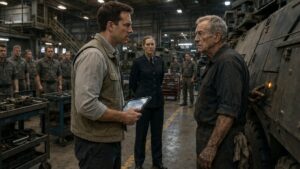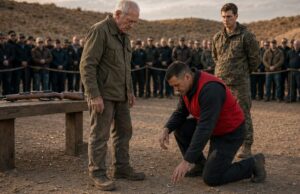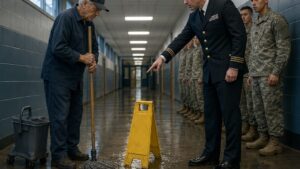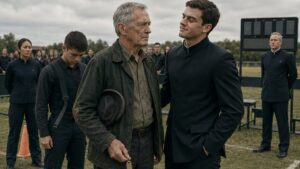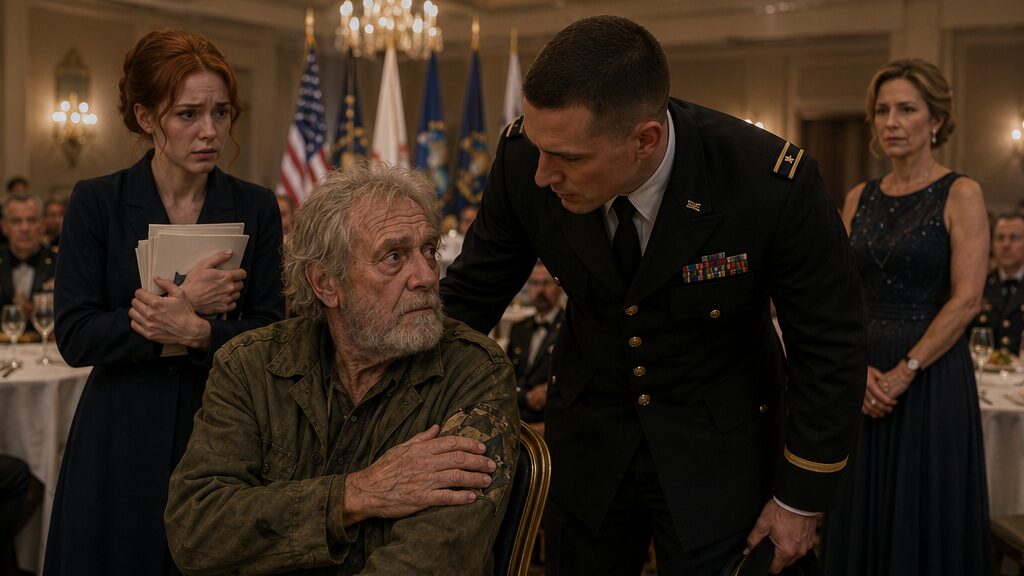
The Officer Questioned the Ragged Old Man Until He Saw the Faded Patch on His Sleeve
Chapter 1: The Empty Chair Beneath the Flags
Edward Bennett stopped just inside the hotel ballroom and let the door ease shut behind him.
The room was brighter than he had expected.
Chandeliers hung from a ceiling painted the color of old cream, their light scattering over polished glasses, folded napkins, brass name-card holders, and the sharp dark shoulders of dress uniforms. Along the far wall, flags stood in a line: the American flag first, then service flags, then a blue banner printed with the name of the foundation hosting the banquet. Men and women in uniforms moved between tables with the careful ease of people who knew where they belonged.
Edward did not move.
His boots had dried mud along the edges. The left sole had begun to separate near the toe, though he had blackened both shoes that afternoon with polish rubbed in by hand. His trousers were clean but old, the knees pale from years of wear. The jacket was worse. He had brushed it twice in the shelter bathroom, then again in the bus station, but the fabric still carried the stubborn dullness of age. On the left sleeve, where the cloth had thinned, a faded patch showed beneath the fraying seam.
Edward’s right hand rose without permission and covered it.
A woman near the registration table glanced up from her clipboard. Her smile came automatically, then hesitated. Edward knew the hesitation. He had seen it in pharmacy lines, church basements, clinic waiting rooms, and the lobbies of places that offered coffee only to people who looked as though they had a reason to sit down.
“Sir?” the woman asked.
Edward stepped toward the table. “I’m here for the dinner.”
The woman’s eyes flicked to his jacket, then his face. She had a volunteer badge pinned to her black blouse. “Of course. May I have your name?”
“Edward Bennett.”
She looked down. Her finger moved along a printed list. Then another page. Then a smaller sheet taped to the back of the clipboard.
Edward watched the flags while she searched. The air smelled of lemon oil, cooked beef, and the faint metallic scent of coffee urns warming at the side of the room. Silverware clicked. Somewhere near the stage, a microphone gave a soft pop, then went quiet.
“I’m sorry,” the volunteer said. “Could it be under another name?”
“No, ma’am.”
“Were you with one of the veteran groups?”
Edward’s hand tightened over his sleeve. “I was invited.”
She gave the careful smile again. “By the foundation?”
Edward reached into the inside pocket of his jacket. The paper inside had softened from being folded and unfolded too many times. He did not bring it out all the way. He only touched the edge, making sure it was still there.
“By Samantha Reed,” he said.
The volunteer’s expression changed. Not recognition exactly, but relief that the problem might belong to someone else. “Samantha is helping with guest seating. Let me see if I can find her.”
“That’s all right.” Edward’s voice came out low. “I can wait.”
“There are seats in the lobby.”
He looked toward the open ballroom. At the front, near the podium, one chair sat empty beside a table marked with a small sign: Reserved. Not for him, surely. He knew enough about formal rooms to know that the closer the chair was to the flags, the less likely it was to belong to a man in a torn jacket.
Still, Samantha had written: Come to the front table. Please don’t leave before I find you.
Edward had carried that note for three weeks. He had almost thrown it away twice.
The volunteer leaned toward another woman at the table, whispering. Edward looked away so they would not feel caught. Across the room, a man in a dark suit laughed softly with two uniformed officers. A photographer adjusted a lens. A server straightened place cards one by one.
Everything in the ballroom had been arranged to remember service in clean lines.
Edward had never known service to happen that way.
He took one step past the registration table.
“Sir,” the volunteer said quickly, “wait just a moment.”
Edward paused.
A few heads turned. Not many. Enough.
He felt the heat of them on the back of his neck. His shoulders, once trained to square under a pack, curved inward. His fingers pressed over the patch, hiding the stained threads, the half-visible symbol, the years he had failed to explain.
“I’m only going to sit down,” he said.
The volunteer hesitated, and in that hesitation Edward saw the whole evening unfolding without him. Someone would fetch someone else. A polite voice would lower itself. A hand would indicate the lobby. He would be told there had been a mistake. He would apologize for being the mistake.
Then he saw Samantha.
She was near the far aisle, carrying a stack of programs against her chest. Her red hair was pinned back, though loose strands had escaped around her face. She turned toward the registration table as if she had sensed trouble before hearing it.
Their eyes met.
For an instant, she looked not like a woman working an event, but like a child spotting someone she had been told was real and had begun to fear was not coming.
Edward almost lifted his hand.
She started toward him, but another volunteer stopped her with a question and a spilled bundle of seating cards. Samantha looked from the cards to Edward, panic tightening her mouth.
Edward gave the smallest shake of his head. Not now. Don’t make a scene.
She did not obey. She tried to step around the table, but someone called her name again.
Edward turned away before she could reach him.
The empty chair at the front waited beneath the flags.
He crossed the ballroom slowly. Conversations thinned around him, not stopping fully, only bending. A man in a navy dress uniform glanced at Edward’s boots. A woman in pearls shifted her purse from the back of one chair to the next. At one table, a younger officer lowered his voice in the middle of a sentence.
Edward kept his eyes on the chair.
Each table had a printed program folded like a church bulletin. His hand hovered over the one at the empty place before he sat. The paper was thick, expensive, embossed with a silver star and the foundation’s name.
He opened it.
The evening schedule filled the first page. Welcome. Invocation. Dinner. Keynote Address by Alexander Sullivan. Recognition of Legacy Families. Silent Auction Closing. Closing Remarks.
On the second page was a list of honored guests.
Edward read every name.
Then he read them again.
His was not there.
The absence did not surprise him. That was the trouble. A man could live long enough to become used to being left off papers. He had been left off rosters when clerks could not find the old unit file, left off hospital histories because his records had burned in some storage room flood, left off conversations because men who knew the truth had died before they learned to tell it.
Still, something inside him dipped.
He closed the program and laid it flat beside the water glass.
The chair cushion was too soft. It made him feel trapped. He sat with his back straight, right hand over his sleeve, left hand inside his jacket pocket where the folded letter rested against his ribs. The envelope was thin, yellowed, and sealed so long ago that the glue had darkened at the edges.
He had told himself he had come to deliver it.
Nothing more.
Not to be introduced. Not to be thanked. Not to be corrected into some version of himself easier for strangers to applaud.
Samantha reached the front table just as Edward settled in.
“Mr. Bennett,” she whispered, breathless. “I’m so sorry. They changed the seating chart this morning. I told them you were coming.”
“You’re busy.”
“I should have been at the door.”
“You were doing your job.”
She looked at the program lying closed by his plate. Her eyes lowered, and in that lowered glance he knew she had seen the missing name.
“I’ll fix it,” she said.
“No.”
“But—”
“No, ma’am.” He softened it with the old courtesy. “I’m here to give you something. After that, I’ll be out of your way.”
Her face tightened. “You’re not in the way.”
Edward looked toward the stage. The microphone stood ready. Behind it, the flags did not move.
“Everybody’s in somebody’s way eventually,” he said.
Samantha leaned closer, keeping her voice low. “My father talked about you.”
Edward’s hand pressed harder into his sleeve. “Your father talked too much.”
“He said you hated being thanked.”
“He was right.”
A shadow fell across the white tablecloth.
At the side of the room, Carolyn Harris stood near the registration table, speaking into the ear of a young officer in a dark formal uniform. Her posture was composed, her expression suitable for donors and photographs, but her eyes had found Edward and stayed there.
The officer listened, then looked toward the front table.
Samantha straightened.
Edward did not turn his head. He watched the man approach in the reflection of a polished spoon. Young. Controlled. Clean-shaven. His cap tucked beneath one arm. His shoes shined well enough to catch the chandelier light.
Samantha whispered, “Please let me handle this.”
Edward took his hand from his jacket pocket and placed it on the table, leaving the letter where it was.
“No,” he said quietly. “Let him do his job.”
The officer came down the aisle between tables, careful not to hurry, careful not to draw too much attention. But attention followed him anyway. It gathered in glances, in paused forks, in the small silence that forms when a public room senses that someone is about to be corrected.
Edward kept his palm over the faded patch.
Carolyn remained near the back, watching.
The officer stopped beside Edward’s chair and bent slightly, lowering his voice enough that only the nearest tables could hear.
“Sir,” he said, “may I speak with you for a moment?”
Edward looked at the empty plate in front of him.
“You already are,” he said.
Chapter 2: The Officer Who Saw Only a Problem
Paul Carter had been trained to read a room before he crossed it.
Entrances. Exits. Bottlenecks. People with too much to drink. People standing where they had no reason to stand. People whose hands stayed hidden. People whose eyes kept moving.
The old man at the front table was not doing any of those things.
That should have made Paul slower.
Instead, the room made him quick.
Carolyn Harris had caught him near the registration table with the voice she used when she did not want anyone to know she was alarmed.
“There’s a gentleman in the reserved front section,” she had said. “He is not on the final list.”
“Is he causing a disturbance?”
“Not yet.”
Paul had looked toward the front. The man sat under the flags in a worn jacket that seemed to belong to another decade and another kind of weather. His beard was gray and uneven. One hand covered his upper sleeve. Beside him, Samantha Reed hovered like someone ready to step between a match and dry grass.
Carolyn added, “We have donors at that table. General Sullivan arrives in ten minutes. I need this handled quietly.”
“He may be with one of the families.”
“He is not on the program.”
Paul had been hearing versions of that sentence all evening. Not on the program. Not on the list. Not cleared for the stage entrance. Not approved for the donor reception. The event had been built out of those lines, and Paul had been placed there to keep them from blurring.
Now, standing beside the old man’s chair, he felt the first blur.
“Sir,” Paul said, “I’m Captain Paul Carter. I’m assisting with event protocol tonight.”
The old man did not answer right away. He kept his eyes on the plate, as if the white china required attention.
Samantha said, “Captain Carter, this is Edward Bennett. I invited him.”
Paul looked at her. “Miss Reed, I understand.”
“He belongs here.”
“I’m not saying he doesn’t.”
But that was not entirely true. Or maybe it was worse: Paul did not know whether the man belonged, and he had allowed the uncertainty to lean toward removal.
The nearest table had gone quiet. An older woman in a blue dress pretended to read her program. A man with a row of ribbons on his jacket watched without pretending at all.
Paul bent a little lower. “Mr. Bennett, there seems to be some confusion with the seating list. Would you mind stepping into the hallway with me so we can sort it out?”
Edward’s mouth moved almost into a smile, but it carried no humor. “That what you call it?”
“Sir?”
“Sorting.”
Paul held his tone steady. “I’m trying to avoid making this uncomfortable.”
Edward looked up then.
His eyes were not clouded, not wandering, not confused. They were tired, yes. Red at the edges. Set deep in a face that had spent years in hard light. But they were clear enough to make Paul feel, suddenly, that he had chosen the wrong words before he had finished saying them.
Samantha’s hand tightened around the programs she still carried.
Paul tried again. “Your name isn’t in the printed program, and the seat you’re using was reserved for—”
“For nobody,” Edward said.
Paul paused.
Edward touched the program with two fingers. “Empty chair.”
“It may have been held for a late arrival.”
“Then I’ll get up when they arrive.”
A few people nearby shifted. Paul sensed Carolyn watching from the back. He sensed the room choosing sides before it understood the question.
“Mr. Bennett,” Paul said, “I need to confirm your invitation.”
Samantha stepped closer. “I told you, I invited him.”
“With respect, Miss Reed, you’re not authorized to assign front-table seating.”
Her face flushed. “He is not a security issue.”
Paul regretted the word before it left his mouth, though he had not spoken it. Somehow it was there anyway, in the space between them.
Edward heard it. His hand moved from the table back to his left sleeve.
Paul’s eyes followed.
The jacket was military, or had been once. Not current issue. Not ceremonial. Old olive fabric, faded in uneven patches. The cuff was frayed. The elbow had been repaired with a darker square of cloth. Under Edward’s palm, something was stitched to the sleeve.
Paul noticed only a corner at first: a dull curve of thread, nearly colorless.
“Sir,” he said, softer, “may I see your sleeve?”
Samantha inhaled sharply.
Edward’s hand did not move.
“No.”
The answer was not loud. It was not defiant. It was simply a door closing.
Paul straightened a fraction. “I’m not trying to take anything from you.”
“Then don’t.”
The old man’s fingers were thin, the knuckles swollen, the nails clean but ragged. They held the patch with a protectiveness Paul did not understand.
At the table behind him, someone whispered, “What is going on?”
Carolyn began walking toward them.
Paul felt the evening tightening. His job was to relieve pressure, not create it. A minute ago, he would have solved this by guiding the man into the hallway, checking records, maybe finding him a seat near the back. It would have been polite. Efficient. Invisible.
But something about Edward Bennett’s hand stopped him.
It was not the stubbornness. Paul had dealt with stubborn men before.
It was the way the hand covered the sleeve as if covering a wound.
“Mr. Bennett,” Paul said, lowering himself into a crouch so he no longer stood over him, “I apologize. I asked that badly.”
Edward looked at him without blinking.
Paul nodded toward the sleeve. “I caught sight of the patch. That’s all.”
For a second, Edward’s expression did not change.
Then his hand loosened just enough.
Paul saw the whole thing.
The patch was worn nearly flat. Its original colors had washed into gray-green and brown, but the shape remained: a small cross set inside a rough-edged shield, with a narrow line of letters along the bottom. Most people in the room would have seen nothing but old cloth.
Paul did not.
His first instructor at the academy had kept a photograph taped inside a footlocker: three medics in muddy uniforms outside a burned aid station, one with that same shield on his sleeve. Paul had seen the emblem again years later in a memorial lecture about a medical detachment that had kept pulling men out after its own evacuation route collapsed.
The 214th.
Not famous. Not the kind of unit civilians named at banquets. But every medic who trained under Paul’s first instructor had heard about them.
Paul’s throat tightened.
He looked from the patch to Edward’s face, then back again, as if the room had changed shape and he needed proof that the chair, the table, the flags were still where they had been.
Carolyn arrived at his shoulder. “Captain?”
Paul did not stand.
The old man’s hand hovered near the patch, ready to cover it again.
Paul lowered his voice. It was no longer the voice he used to manage rooms.
“Sir,” he said, “were you with the 214th Medical Detachment?”
The silence that followed was small, but it reached.
Samantha’s eyes filled before Edward answered. Carolyn stopped with her mouth slightly open. At the next table, the man with ribbons sat straighter.
Edward’s gaze moved past Paul to the flags.
“For a while,” he said.
Paul felt heat climb the back of his neck. He thought of the words he had used: confusion, confirm, step into the hallway. He thought of the way he had approached the chair, standing above the man, seeing a problem before seeing a person.
“Mr. Bennett,” he said carefully, “may I ask if you served with Captain Reed?”
Samantha’s fingers pressed against the programs until they bent.
Edward looked at her, and something flickered in his face that Paul could not name.
“He wasn’t captain then,” Edward said. “Just a scared kid who wrote letters too neat.”
Samantha made a sound and covered it with her hand.
Carolyn’s polished expression faltered. “Captain Carter, what is this?”
Paul rose, not quickly. He kept his hands visible, his voice low.
“This is Mr. Edward Bennett,” he said. “And I believe he was invited.”
Carolyn blinked. “He is not listed.”
Paul looked at the closed program beside Edward’s plate. “Then the list is wrong.”
It was too blunt for the room, but he did not take it back.
Edward’s shoulders shifted, the smallest flinch under the worn jacket. “No need for all that.”
Paul turned back to him. He wanted to apologize, but the words felt too easy. Too useful for Paul and not useful enough for the man seated in front of him.
So he did the only thing that seemed proper.
He took one step back, giving Edward space.
“Sir,” Paul said, “would you prefer to remain here, or would you like a quieter place while we correct this?”
Edward studied him. Not warmly. Not with forgiveness. Only measuring whether the question was real.
“I came to give Miss Reed something,” he said. “Then I’ll go.”
Samantha shook her head. “You don’t have to go.”
Edward kept his eyes on Paul. “People came for dinner, Captain. Not for me.”
Paul glanced at the room. Some guests were watching openly now. Carolyn was pale with restrained embarrassment, though whether for Edward or for the event, Paul could not tell.
Paul stepped aside, clearing the path but not directing Edward out of it.
“Then I’ll make sure no one mistakes that again,” he said.
Edward’s hand returned to the patch. His fingers covered it, but not completely this time.
From the stage, the microphone popped once.
At the ballroom entrance, a murmur passed through the room. Alexander Sullivan had arrived.
Paul barely turned.
Edward Bennett sat beneath the flags, still looking as if he might leave at any second.
Chapter 3: The Name Missing From the Program
Samantha Reed had spent the whole afternoon putting names in the right places.
She had sorted place cards by table, checked spellings against donor lists, moved a retired colonel away from a former business partner he disliked, and replaced three programs when someone noticed that a surviving spouse had been called “Mrs.” instead of “Dr.” Every correction had seemed urgent then. Every detail had carried weight because the foundation had taught her that respect lived in details.
Now Edward Bennett’s name was missing from every printed page in the room.
Samantha stood beside him with a stack of programs still pressed to her chest, ashamed of the paper in her hands.
Carolyn Harris pulled Paul a few feet away, speaking low and fast. Samantha caught pieces.
“Unverified.”
“Not in the final file.”
“Donors already seated.”
“Keynote timing.”
Paul did not look like a man being convinced. His posture had changed since he saw the patch. He stood straighter, but not the way he had when he crossed the room. It was less command than attention.
Edward remained seated. That was somehow worse than if he had argued. He looked smaller in the wide ballroom now that people knew something had happened around him. His hand rested across his sleeve, thumb moving once over the patch as though checking whether it had survived being seen.
Samantha pulled out the chair beside him and sat without asking permission.
“I told them,” she said.
Edward looked at her. “Told who what?”
“The foundation office. Carolyn. Seating. I told them your name. I gave them the note from my father’s papers.”
“Maybe it got lost.”
“That’s what people say when they don’t want to say ignored.”
His eyes narrowed, not in anger but warning. “Careful.”
“I am tired of being careful.”
“That’s usually when people break things they meant to fix.”
Samantha looked down at the top program. Its silver star caught the chandelier light. She wanted to tear it. Instead, she opened to the honored guest page and stared at the neat list of names.
“My father said you carried him.”
Edward’s fingers stopped moving.
“He said you came back through smoke after everyone told you not to. He said you kept saying, ‘One more step, Reed.’ He said he heard that sentence for years in his sleep.”
Edward’s jaw tightened. “Your father had a habit of making things sound better after they were over.”
“He said he would not have had a life if you hadn’t been stubborn.”
“He had a life because he fought for it after.”
Samantha swallowed. “He kept a photograph of your unit in his desk. He wrote your name on the back.”
Edward looked at the tablecloth. “He shouldn’t have done that.”
“Why?”
“Names get heavy.”
She did not know what to say to that. For weeks, since finding the sealed envelope and her father’s note clipped to it, she had imagined this meeting too many ways. In most versions, Edward had been shy, maybe emotional, maybe grateful that someone remembered him. She had not imagined this guarded man who treated recognition like a match held near dry leaves.
Across the room, Alexander Sullivan stood near the entrance shaking hands. He was taller than she expected, silver-haired, composed, wearing his age like rank. Guests rose or turned toward him. The banquet regained some of its formal rhythm, but the front table remained tense.
Carolyn returned with Paul.
“Miss Reed,” Carolyn said, the public smile back in place though strained at the corners, “may I speak with you briefly?”
Samantha did not stand. “Here is fine.”
Carolyn’s eyes flicked toward Edward. “Privately.”
Edward began to push his chair back. “I can step out.”
“No,” Samantha said, too quickly.
The word cut through the table. Edward looked at her. Paul looked at the floor.
Carolyn lowered her voice. “This evening has a schedule. If there has been an administrative mistake, we will address it after dinner.”
“His name isn’t in the program,” Samantha said.
“Several late additions did not make print.”
“He isn’t a late addition.”
Carolyn’s smile thinned. “The foundation operates from documented records.”
Samantha opened the program and turned it toward her. “Your records call my father a legacy family honoree. They mention the rescue that brought him home. They printed the operation name.”
“That portion was prepared from archived remarks.”
“But not the medic who saved him.”
Carolyn’s gaze moved to Edward’s sleeve. “We have not confirmed—”
Paul interrupted quietly. “The patch is consistent.”
Carolyn turned to him. “Consistent is not confirmed.”
Edward laughed once under his breath.
It was not a happy sound. It was almost gentle, which made it cut deeper.
Carolyn flushed. “Mr. Bennett, I do not mean disrespect.”
“Most folks don’t mean it,” Edward said.
No one answered.
A server approached with a basket of rolls, sensed the silence, and retreated.
Samantha laid the programs on the table. “My father left something for me to find. He wanted me to invite him. That is enough for me.”
Carolyn’s voice softened in the practiced way adults used when trying to calm a scene. “Samantha, grief can make us attach meaning to things.”
Samantha went still.
Edward’s eyes lifted to Carolyn for the first time.
Paul saw it and stepped half a pace forward, but Edward did not raise his voice.
“Her grief is not the problem in this room,” he said.
Carolyn’s face changed. Not anger. A struck look, as if the words had landed somewhere she had not armored.
Samantha felt her own anger loosen into something shakier. Edward had defended her without making it grand, and that made it harder to breathe.
Carolyn looked at the program in Samantha’s hand. “I will review the file after the keynote.”
“After the keynote,” Samantha said, “you’ll have already told the room a clean version of what happened.”
Paul looked toward the stage. The program announcer was testing the microphone again. Dinner would begin any minute.
Edward reached into the inside pocket of his jacket.
Samantha watched his hand disappear beneath the worn fabric. When it came out, he held an envelope.
It was yellowed, soft at the corners, and sealed. Her last name was written across the front in narrow, careful script that did not belong to Edward.
Reed Family.
Samantha stared at it.
Edward held it like something fragile enough to bruise.
“Your father wrote this before the evacuation,” he said.
The room noise seemed to move farther away.
Samantha did not take it at first. “You had this?”
“For a long time.”
“How long?”
Edward’s eyes dropped to the envelope. “Long enough to be ashamed of.”
She reached for it, but he did not let go immediately. His thumb rested over the old handwriting.
“He asked me to mail it if he didn’t make it,” Edward said. “Then he made it. So I kept it. Figured it belonged to him.”
“My father never gave it to me.”
“No.”
“Why not?”
Edward’s mouth tightened. “That’s a question for a dead man.”
He placed the envelope in her hands.
Samantha felt the age of the paper before she felt the weight of the words inside. Her father had been gone two years. His voice had already begun to blur in her memory around the edges. Now here was his handwriting, young and exact, reaching across time because an old man in a frayed jacket had carried it too long.
She slipped a finger beneath the flap.
Edward’s hand closed over hers.
“Not in this room,” he said.
His touch was careful, but it stopped her completely.
She looked up.
For the first time since he entered the ballroom, Edward seemed afraid.
Not of Paul. Not of Carolyn. Not of being asked to leave.
Of the envelope.
“Why?” Samantha whispered.
He withdrew his hand. “Because some words don’t belong under chandeliers.”
Behind them, the announcer’s voice filled the microphone.
“Ladies and gentlemen, if you would please take your seats, we will begin our evening program.”
Chairs scraped. Conversations settled. The formal room gathered itself again.
Samantha held the letter against her chest.
Edward pushed back slightly from the table, as if preparing to stand.
Paul noticed. “Mr. Bennett?”
Edward looked toward the side exit.
“I gave what I came to give,” he said.
At the back of the room, Alexander Sullivan had stopped speaking to a donor. His eyes were fixed on Edward’s sleeve.
Chapter 4: The Letter He Carried Too Long
Edward made it as far as the service corridor before Samantha caught up to him.
The hotel staff had left the door propped open with a brass wedge. Beyond it, the banquet’s music and silverware softened into a distant clatter. The corridor smelled of floor cleaner, coffee grounds, and warm rolls. Fluorescent light flattened everything into practical colors: gray tile, white walls, stainless carts, a stack of folded linens.
Edward preferred it.
No flags. No chandeliers. No polished glasses waiting for toasts.
He stopped beside a cart loaded with empty water pitchers and kept his back to the wall. The old habit came without thought. A wall behind him, doors in sight, one hand free. His other hand found the sleeve patch again, but now the gesture felt too visible, so he dropped it.
Samantha stood several feet away, holding the envelope in both hands.
“You said not in that room,” she said.
Edward looked toward the ballroom door. Voices swelled as the announcer welcomed everyone, then faded as the door eased mostly shut.
“I did.”
“Is here better?”
“No.” He rubbed his thumb along the seam of his jacket. “But it’s honest.”
Samantha looked down at the envelope. “My father’s handwriting looks so young.”
“He was young.”
“He never sounded young to me.”
“That happens when a man becomes your father.”
She swallowed and ran a finger along the sealed flap again, but did not open it.
Edward watched her hands. They were steady, but her shoulders were not. He had known grief like that—the kind that learned manners because it had nowhere else to go.
“You don’t have to read it tonight,” he said.
“I don’t know if I can wait.”
“That’s different.”
She looked up. “Why did you keep it?”
The question had been sitting between them since the moment he placed the envelope in her hands. Edward had carried it through bus rides, shelters, apartment rooms, clinics, three states, and two decades of winters that found the crack in every door. He had imagined answering it with something simpler.
I forgot.
I lost the address.
I thought he wanted it kept private.
All of those were partly true. None of them were clean enough to say aloud.
He looked at the floor, where a black scuff marked the tile near his boot.
“Your father wrote it when he thought he was dying,” he said.
Samantha’s lips parted slightly.
“There was a lull,” Edward continued. “Not quiet. It never got quiet. Just less noise in one direction. We had a lantern turned low. He asked me if my hands were steady enough to hold paper.”
Edward felt the corridor recede. Not vanish. He was still there under the hotel light, but memory folded itself over the present: heat without flame visible, smoke carrying metal and wet cloth, a young man trying to write neatly while his arm shook from pain.
“He wrote slow,” Edward said. “Kept asking if the letters were straight.”
Samantha pressed the envelope to her chest.
“He said, ‘If I don’t get home, make sure they know I was thinking clear.’ That mattered to him. Not brave. Not scared. Clear.”
Edward could hear him. Reed, not captain then. Just a narrow-faced kid with a careful part in his hair and a photograph tucked inside his boot because he said pockets got emptied.
Samantha whispered, “But he came home.”
“Yes.”
“So why didn’t you give it back to him?”
Edward’s jaw worked once. “I tried.”
“When?”
“Hospital in Germany. He was asleep. Nurse said family had been contacted. I stood there awhile.”
He had stood with the envelope in his hand, watching the kid breathe through a tube, his face slack and pale, his hair shaved near a bandage. Edward had wanted to leave the letter on the bedside table. Then Reed’s mother had come into the room with a coat still buttoned wrong and both hands over her mouth. Edward had stepped back into the hall and kept stepping.
“I told myself he should decide what to do with it,” Edward said. “Then I told myself I’d mail it. Then I told myself men who survived didn’t need dying letters following them around.”
“And later?”
“Later I didn’t know how to show up.”
Samantha’s eyes shone. “He would have wanted to see you.”
Edward shook his head. “You don’t know that.”
“I know my father.”
“You know who he became.”
The words came sharper than he meant. Samantha flinched, and Edward hated himself for it.
He lowered his voice. “I’m sorry.”
She took a breath. “No. You’re right. I know the man who came home. I don’t know the boy who wrote this.”
Edward looked at the envelope again. “He was good at being scared.”
Samantha gave a broken little laugh. “What does that mean?”
“Means he didn’t waste it. Some men get scared and turn cruel. Some freeze. Your father got scared and paid attention. He remembered who needed water. Who had a letter in their shirt. Who was bleeding through a bandage when everyone else was looking at the fire.”
The corridor was silent except for the hotel’s ventilation hum.
“He kept asking me who else got out,” Edward said.
Samantha held the envelope tighter.
“I lied to him once. Maybe twice. I don’t know anymore. He asked about Miller. I said Miller was ahead of us. He wasn’t. He asked about Harris. I told him not to talk. He understood that one.”
Edward closed his eyes briefly. Names, once spoken, had weight. He felt them settle in the corridor.
“That’s why I kept the letter,” he said. “Not because of your father. Because of the ones who didn’t get to write one. Because every time I looked at it, I thought about carrying out the wrong man.”
Samantha’s face changed with pain and confusion. “Wrong man?”
Edward opened his eyes.
There it was. The thing he had carried beneath the patch, beneath the jacket, beneath all the years when people mistook his silence for emptiness.
“In that kind of dark,” he said, “you make choices by touch. A sleeve. A belt. A voice. Whoever your hand reaches first. Then you live long enough to wonder whether your hand knew what it was doing.”
Samantha stepped closer, then stopped. She seemed to understand that comfort could become pressure.
“My father lived,” she said carefully.
“Yes.”
“And you think that means someone else didn’t.”
“I know someone else didn’t.”
She looked back toward the ballroom. “Is that why you didn’t want them saying it clean?”
Edward did not answer.
The door opened behind them.
Paul Carter stepped into the corridor and let it close softly. He had removed his cap, and in the flat light he looked younger than he had in the ballroom. The formal lines of his uniform remained, but his face had lost the certainty that had brought him down the aisle.
“I’m sorry,” he said. “I didn’t mean to interrupt.”
“You did,” Edward said.
Paul accepted it with a small nod. “Yes, sir.”
Samantha wiped under one eye quickly, not hiding it well.
Paul looked at the envelope, then at Edward’s sleeve. “General Sullivan saw your patch.”
Edward’s mouth tightened. “He’s not my general.”
“He asked if you served in Operation Lantern Ridge.”
The name struck the corridor like a dropped tray.
Samantha looked between them. “That was the rescue?”
Edward’s hand curled at his side. “That was the name they gave it after.”
Paul noticed. To his credit, he did not press.
“He said the keynote mentions it,” Paul said.
Edward laughed without humor. “Of course it does.”
“He wanted to speak with you before he goes onstage.”
“No.”
“Mr. Bennett—”
“No.”
Paul looked down, then back up. “Then I’ll tell him no.”
That answer unsettled Edward more than argument would have. He studied Paul’s face, searching for performance. There was tension there, and embarrassment, and something like shame still working its way through him. But no trick.
Samantha slid the envelope carefully into the inner pocket of her blazer. “They’re going to talk about it in there whether you speak or not.”
Edward looked at the service door at the end of the corridor. An exit sign glowed red above it. He could leave through the kitchen, cross the loading area, find the bus stop, and disappear into the city before dessert.
No one could stop him.
That knowledge had always comforted him.
Tonight it felt smaller.
Paul said, “Miss Harris wants the program unchanged.”
Edward looked at him. “And what do you want?”
The question surprised Paul. “I want not to make the same mistake twice.”
“That’s not a want. That’s a fear.”
Paul took the correction without looking away. “Then I want to know how to proceed without using you.”
Edward looked back toward Samantha. She was waiting, but not demanding. The envelope was hidden now, yet somehow the air still held its shape.
“You can proceed by letting me go,” Edward said.
Samantha’s face tightened, but she stayed silent.
Paul nodded slowly. “If that’s what you choose.”
The word choose hung there.
Edward had not felt accused by it. That made it worse.
Behind the ballroom door, applause rose. The evening had begun without him, neat and warm and printed. A clean version of a dirty thing was moving toward the microphone.
Edward looked at his sleeve.
The patch was faded almost beyond recognition. He had covered it for years not because he was ashamed of service, not exactly, but because people saw patches and wanted stories with endings. They wanted courage without confusion, sacrifice without resentment, survival without the taste of smoke. They wanted men like him to stand, receive gratitude, and make everyone feel better for having offered it.
But Samantha’s father had written a letter in a young man’s careful hand, trying to be clear.
Edward reached for the ballroom door handle, then stopped.
“If they’re going to say the name,” he said, “they ought to know what kind of name it is.”
Paul’s posture changed, but only slightly. Hope, checked by caution.
“Do you want to speak to General Sullivan?”
“No.” Edward opened the door a few inches. Light spilled across his boots. “I want to hear what he says first.”
Chapter 5: When Ceremony Was Not Enough
Paul Carter stood behind the stage curtain with the corrected program in his hand and understood, for the first time that night, that paper could be cowardly.
The printed schedule looked perfect. Heavy stock, silver emblem, clean type. Every name centered. Every donor category properly acknowledged. Every phrase rubbed smooth by committees until nothing jagged remained. Operation Lantern Ridge appeared in the keynote notes as a “successful evacuation effort under severe conditions.”
Paul had heard the phrase three minutes earlier when Alexander Sullivan handed his remarks to the program announcer for timing.
Successful evacuation effort.
Severe conditions.
Edward Bennett stood near the service corridor door, half in shadow, with his hand over the patch again.
Samantha stood beside him. She had not opened the envelope. Paul respected her for that more than he could say.
Carolyn Harris came toward Paul with controlled urgency. “Captain Carter, the keynote begins after the salad course. General Sullivan needs the stage manager ready.”
Paul held up the program. “Mr. Bennett’s name is not in here.”
“We have established that.”
“And the operation is referenced.”
“Yes, in a broad historical context.”
“Broad is the problem.”
Carolyn’s eyes sharpened. “This is not the moment to rewrite a public event.”
“No,” Paul said. “The moment was before printing. We missed it.”
Her gaze flicked toward Edward. “We do not know what he wants.”
Paul looked at the old man. Edward was not watching them. He was watching a server straighten chairs at the edge of the room, as if chairs deserved more trust than people.
“Then we ask him,” Paul said.
Carolyn exhaled through her nose. “He has already been put under enough pressure.”
That was true enough to quiet him.
Then Edward spoke from the doorway. “Don’t use me to avoid me.”
Carolyn turned.
Edward came closer, each step measured. The jacket hung loosely on him. Under the stage lights spilling from the ballroom, the sleeve patch looked older and more fragile, a scrap of cloth that had survived by accident.
Carolyn’s voice softened. “Mr. Bennett, I am trying to prevent further discomfort.”
“Whose?”
She had no immediate answer.
Alexander Sullivan approached from the opposite side of the stage. He carried himself with the practiced calm of a man accustomed to rooms making space for him. Up close, age showed in the delicate skin near his eyes and the careful way he held his shoulders, but his uniform was immaculate.
He stopped a respectful distance from Edward.
“Mr. Bennett,” he said. “Alexander Sullivan.”
Edward did not offer his hand. “I heard.”
Alexander accepted that. His eyes lowered briefly to the patch, then returned to Edward’s face.
“I have spoken about Lantern Ridge many times,” he said. “I did not know you were here tonight.”
“I wasn’t in the program.”
Something moved through Alexander’s expression—recognition not of the patch, but of the sentence beneath it.
“No,” he said. “You were not.”
Carolyn clasped her hands. “General Sullivan, we are looking into the records issue.”
Alexander looked at her, then at the program in Paul’s hand. “The record is not the same as the truth.”
Paul felt the sentence land and wished he had understood it earlier.
Edward’s mouth pressed into a thin line. “Careful with that. Truth gets dressed up quick in rooms like this.”
Alexander studied him. “Then tell us what not to dress up.”
The request was quiet. It carried no command. That, more than anything, made Edward look away.
Inside the ballroom, dinner sounds continued. Forks against plates. Low voices. A burst of laughter from a donor table that had no idea the evening had begun to split behind the curtain.
Edward looked toward Samantha. “Your father ever tell you why he hated fireworks?”
She shook her head.
“He told people it was the noise.” Edward touched his sleeve. “It was the light. Quick flashes in the wrong color.”
Samantha’s eyes lowered.
Alexander’s face tightened with understanding.
“The keynote says successful evacuation,” Paul said.
Edward looked at him. “Was it?”
No one answered.
“I carried out six men,” Edward said. “Three lived the night. Two lived the year. Your father lived long enough to have you.” His eyes shifted to Samantha, then away. “That makes people want to call it successful.”
Carolyn’s voice was small. “And you don’t?”
Edward looked down at the patch as though it belonged to someone else. “I call it what happened.”
Silence spread behind the stage, different from the ballroom’s polite quiet. It had weight.
Alexander folded his speech in half. “What would you have me say?”
Edward’s shoulders rose and fell once. “Nothing about me.”
Paul almost spoke, then stopped himself.
Carolyn did not. “Mr. Bennett, with respect, the room should understand who you are.”
Edward’s eyes moved to her. “That room is full of people who came to feel proud. Let them. Pride has uses. Opens wallets. Keeps foundations alive. Gets scholarships funded.”
Carolyn flushed, but he was not mocking her.
“I don’t begrudge it,” he continued. “But if you say my name like I’m the answer, they’ll leave cleaner than they came.”
Samantha whispered, “What do you want them to leave with?”
Edward took time with the question.
Paul watched his hand. The fingers had stopped guarding the patch and now rested beneath it, supporting the worn fabric from below.
“The missing names,” Edward said.
Alexander unfolded his speech and looked at the printed page as if it had become inadequate in his hand. “I don’t have them all.”
“I do.”
The answer was so quiet Paul almost missed it.
Edward reached into his inner jacket pocket, not the one where the letter had been, but the other side. He pulled out a small piece of notebook paper folded into quarters. Its creases were dark from use. When he opened it, the names were written in pencil, some letters faded, some pressed hard enough to scar the page.
Samantha covered her mouth.
Paul could not see the names, but he saw Carolyn’s face when Edward handed the paper to Alexander.
Not embarrassment now.
Something more difficult.
Alexander held the list with both hands.
“These are the men from your detachment?” he asked.
“Some of them.”
“Some?”
“The ones I still trust myself to spell.”
Alexander closed his eyes briefly.
Carolyn reached for a pen from the stage manager’s table. She held it out to Paul without speaking.
Paul took it and opened one of the programs to the keynote page.
“What are you doing?” Edward asked.
“Making the paper less wrong,” Paul said.
He wrote Edward Bennett carefully in the margin first, then stopped.
Edward watched him.
Paul looked up. “How do you want to be listed?”
Carolyn, Samantha, and Alexander all turned toward Edward, but no one answered for him.
The old man’s face shifted. Not softer. More exposed.
“Don’t put rank,” he said.
Paul’s pen hovered. “All right.”
“Don’t put hero.”
“I wasn’t going to.”
Edward almost smiled. “Good.”
“What should I put?”
Edward looked toward the ballroom where the flags stood over dinner plates and folded napkins. “Put former medic. If you have to put anything.”
Paul wrote: Edward Bennett, former medic, 214th Medical Detachment.
The line was cramped in the margin. Unofficial. Imperfect. It looked more honest than the printed page.
Alexander held the list of names. “May I read these?”
Edward’s jaw tightened again.
“You asked for missing names,” Alexander said gently. “I am asking permission.”
That word changed the space.
Permission.
Not clearance. Not verification. Not protocol.
Edward looked at Samantha. She nodded once, tears standing quietly in her eyes but not falling.
He looked at Paul. Paul kept the program open, pen still in hand, waiting.
At last Edward said, “Read them plain.”
Alexander nodded. “Plain.”
“And stop calling the rescue clean.”
“I will.”
Carolyn stepped back toward the stage table and picked up the master schedule. “The keynote can be shortened. The auction announcement can move after dessert.” Her voice steadied as she spoke, but the steadiness was different now. Less polished. More useful. “I’ll tell the announcer there is a correction before General Sullivan speaks.”
Edward’s eyes narrowed slightly. “You don’t need to make a production.”
“No,” Carolyn said. She glanced at the program in Paul’s hand. “We need to make a correction.”
Paul saw Edward absorb that. Suspicion did not leave him, and perhaps it should not. But something in his shoulders lowered a fraction.
Inside the ballroom, the salad plates were being cleared. The program announcer approached the microphone and tapped it once.
Carolyn moved toward him quickly.
Alexander stayed with Edward. “Would you sit at the front while I speak?”
Edward looked toward the service corridor.
Samantha’s hand moved, almost reaching for his sleeve, then stopped before touching him.
Edward noticed.
That restraint, more than any plea, kept him there.
“I’ll sit,” he said. “But I’m not standing for applause.”
Alexander nodded. “Then no one will ask you to.”
Paul doubted he could control a whole room’s instinct, but he understood what had been promised.
Edward turned to him. “Captain.”
“Yes, sir.”
“If they clap, don’t look proud of yourself.”
Paul felt the sting of it and accepted it.
“No, sir,” he said.
Edward started back toward the front table. His hand drifted toward the patch again, but this time he stopped it halfway.
The cloth remained visible beneath the stage light.
Chapter 6: The Patch No Longer Hidden
Edward returned to the front table through a room that had learned to pretend it was not watching him.
That, he thought, was almost funny. People who had spent their lives attending ceremonies knew how to stand, sit, smile, applaud, lower their voices, and raise glasses in unison. But they did not know what to do with an old man walking back to a chair they had silently decided he should leave.
So they looked at their plates. They adjusted napkins. They whispered into water glasses.
Edward sat.
The program beside his plate had been opened to the keynote page. In the margin, written in careful dark ink, was his name.
Edward Bennett, former medic, 214th Medical Detachment.
The handwriting was Paul Carter’s. Formal, upright, a little stiff. Edward looked at it only once, then closed the program.
Samantha sat to his right. She had placed the envelope inside her blazer, but one hand rested over the pocket as his had rested over the patch. Edward noticed and looked away before she could see that he had.
Onstage, Carolyn approached the microphone.
Her face still carried the strain of someone whose evening had gone beyond her control, but she did not try to smooth it away.
“Ladies and gentlemen,” she said, “before General Sullivan’s remarks, the foundation needs to make a correction.”
The word moved through the room softly.
Correction.
Not announcement. Not surprise. Not special honor.
Edward felt Paul standing somewhere behind his left shoulder, not close enough to crowd him. Alexander waited near the steps to the stage, holding his folded speech and the penciled list.
Carolyn looked down at the program in her hands. “Tonight’s printed materials omitted the name of a guest whose connection to the history we are discussing should have been handled with more care.”
Edward stared at the tablecloth.
He could feel Samantha holding her breath.
Carolyn continued, “Mr. Edward Bennett served as a medic with the 214th Medical Detachment. His name was not included in the program. That omission was ours.”
The room shifted. A chair creaked. Someone whispered his name, trying it out like a found object.
Edward did not raise his head.
Carolyn turned slightly toward him. “Mr. Bennett, thank you for allowing us to correct it.”
He wished she had not thanked him. Then he realized she had said allowing. Not letting us honor you. Not letting us recognize you. Allowing us to correct it.
He could live with that.
Alexander stepped to the microphone next. He placed his prepared remarks on the podium, then laid the penciled list on top of them. He did not begin right away.
“I came prepared,” he said, “to speak about service in the language usually used at events like this. Courage. Sacrifice. Duty. Those words are not wrong. But they can become too easy when separated from the people who paid for them.”
The room went still in a way it had not been all evening.
Edward looked up despite himself.
Alexander was not looking at the donors, or the cameras, or the flags. He was looking at the paper Edward had carried.
“Operation Lantern Ridge has often been described as a successful evacuation under severe conditions,” Alexander said. “Tonight I have been asked to say it more plainly.”
Edward’s fingers curled against his knee.
Alexander read the first name.
Then the second.
Then the third.
He did not add stories he did not know. He did not decorate the names with adjectives. He gave each one room enough to exist.
Edward felt the years open at the edges.
There was Miller, whose laugh had been too big for any room. Harris, who could fix a radio by insulting it. A young supply clerk whose name Edward had not trusted himself to spell until he saw it again on an old envelope years later. Men who had become shadows in official language, now spoken under chandeliers by a man who knew enough to keep his voice plain.
Samantha’s hand found the edge of the table and gripped it.
When Alexander finished the list, he folded the paper once, carefully, and looked toward Edward.
“Mr. Bennett,” he said, “I will not ask you to stand. I will not ask you to speak. But if there is anything you want corrected in what this room believes, you have the microphone.”
Edward’s body went cold.
A polite silence opened before him like a door over a drop.
He had not agreed to this. Not exactly. He had agreed to sit. To let the names be read. To keep the room from leaving with the word clean shining in their heads.
Now every face turned toward him.
Paul moved half a step, then stopped. Samantha did not touch him. Carolyn stood beside the stage with her hands clasped, no rescue in her face.
Edward could refuse. He had made a life of refusing
Chapter 7: Respect Was the Way They Listened
Afterward, the banquet did not know how to return to itself.
The salad plates were gone. The dessert course waited under silver covers along the service wall. The auction table glittered with framed certificates and ribboned baskets no one had the heart to bid on yet. People remained in their chairs longer than they needed to, speaking softly, as if the room had become a place where loud voices might damage something.
Edward sat at the front table with both hands around a glass of water.
No one rushed him.
That was the first difference.
Before, people had made space around him because they were unsure what to do with him. Now the space felt chosen. A server approached, leaned close, and asked if he wanted coffee. Not “Can I get that out of your way?” Not “Are you finished here?” Just coffee, asked in the same tone used for everyone else.
Edward said no, thank you.
The server nodded and left the cup where it was.
Samantha sat beside him, still holding the unopened letter inside her blazer. She had tried twice to speak and stopped both times. Edward understood. Some words needed to sit awhile before they belonged to anyone.
Across the room, Carolyn Harris moved from table to table. She did not smile as much now. She bent to speak with donors, with volunteers, with the banquet photographer, with the announcer. Once, Edward saw her take a stack of programs from the registration table and carry them herself to a side station where Paul stood with a pen.
Paul was writing in each one.
Not every program. Not all of them. Just the foundation copy, the archive copy, the keynote copy, the copy that would go into the annual record. Edward watched the young officer print the same cramped correction in the margins with slow care, as if the act itself had become part of his duty.
Alexander Sullivan returned to the podium only once more. He shortened his remarks. There was no grand tribute, no forced swell of music, no attempt to pull Edward into the center of the stage again. He spoke about scholarships and families and records that needed tending. When he mentioned Lantern Ridge, he did not call it successful. He called it costly. Then he read the names once more, not as a performance, but because a corrected record deserved repetition.
No one applauded after the names.
They bowed their heads.
Edward found that harder to endure.
When dessert finally came, he did not eat much. Samantha placed a fork beside his plate but did not comment when he ignored it. Paul came by once, asked if Edward needed anything, and accepted no as a complete answer. Carolyn approached near the end of the program, carrying a folder against her chest.
“Mr. Bennett,” she said.
Edward looked up.
She did not stand over him. She pulled out the empty chair on his left and sat, though the movement seemed unfamiliar to her in the middle of her own event.
“I owe you an apology,” she said.
Edward’s fingers tightened slightly around the glass.
Carolyn noticed and slowed down. “Not the kind that asks you to make me feel better.”
That surprised him enough to make him meet her eyes.
She opened the folder. Inside was a printed guest list marked in blue pen. Beside the front table number, his name had been added by hand.
“This will be corrected before it is archived,” she said. “The digital program as well. The foundation page references Lantern Ridge. That language will be changed. Not tonight, not from memory, and not without asking what can be verified properly. But changed.”
Edward looked at the paper, then at her.
“Records don’t fix everything,” he said.
“No,” Carolyn replied. “But wrong ones keep doing harm.”
He had no answer for that.
She slid the folder toward Paul, who had come up quietly behind her. “Captain Carter has the archive copy. I thought it should be done where you could see it. Not because seeing it makes it enough.”
Paul opened the folder and laid the program on the table between them. In the margin, under the printed heading Honored Guests, he had written the same line as before.
Edward Bennett, former medic, 214th Medical Detachment.
Below it, in smaller writing, he had added: Name corrected with permission.
Edward stared at the last two words.
With permission.
A strange pressure moved behind his ribs. Not relief exactly. Relief felt too light. This was heavier, like setting down something and still feeling its shape in the hand.
Paul held the pen but did not offer it to him. “Would you like anything changed?”
Edward read the line again. He thought of every form filled out by men who had never met him, every file that had turned him into a service number, every clerk who had told him the system did not show what he remembered. He thought of the chair at the front table and the way the evening had first tried to move him quietly out of sight.
Then he thought of the list Alexander had read.
“Put the names with it,” Edward said.
Paul nodded once. “Yes, sir.”
Edward’s eyes cut to him.
Paul corrected himself immediately. “Mr. Bennett.”
Edward held his gaze long enough to show he had noticed, then looked away.
Carolyn closed the folder gently. “We will need help spelling them correctly.”
“I’ll write what I know.”
“And what you don’t?”
Edward looked toward the flags. “Then you say you don’t know yet. That’s better than pretending.”
Carolyn nodded. She stood, but before leaving, she looked at Samantha.
“Miss Reed,” she said, “whenever you are ready, the side room is open. No one will interrupt you there.”
Samantha touched the envelope through her blazer. “Thank you.”
Carolyn left without trying to touch Edward’s shoulder or take his hand.
That was the second difference.
By the time the banquet ended, the room had thinned into small clusters. Uniformed guests lingered near the stage. Donors collected coats. Volunteers blew out small table candles one by one. The photographer lowered his camera whenever Edward turned his face away.
Samantha finally stood.
“Would you sit with me?” she asked.
Edward knew what she meant.
The letter.
His first instinct was no. It rose clean and sharp, reliable as pain. He had delivered the envelope. That was the promise. Reading it belonged to her family, not to him. He could go now. The city bus would still be running. His room at the veterans’ residence would be dark and narrow and his own.
But Samantha was not asking him to explain it.
She was asking him to sit.
Edward nodded.
They went to the small side room off the ballroom, a place meant for coats and private phone calls. A single lamp burned on a table. The wall held a framed print of the hotel as it had looked fifty years earlier. Paul walked them to the door but stopped outside.
“I’ll be here if needed,” he said.
Edward looked at him. “That an order?”
“No.” Paul’s face tightened, then softened. “A boundary.”
Edward almost smiled. “You learning words now?”
“Trying to.”
Samantha opened the envelope with care.
The paper inside was thin and folded twice. She held it for several seconds before reading. Edward turned toward the wall, giving her what privacy the small room allowed.
Her father’s voice did not come back for Edward. Not exactly. As Samantha read silently, Edward heard only the young man in pieces: asking if the letters were straight, swearing softly when the pen caught, telling Edward not to look because a man had a right to spell badly in private.
Samantha’s first tear fell without sound.
Edward kept still.
She read to the end, then pressed the letter against her mouth. When she lowered it, her face had changed. Grief had not left it. Gratitude had not replaced it. The two stood together now, neither one winning.
“He wrote that he was scared,” she said.
Edward nodded.
“He never told me that.”
“Most fathers edit.”
“He wrote that if he came home, he wanted to remember the men who didn’t as people, not shadows.”
Edward closed his eyes.
Samantha folded the letter along the old creases. “He did. Maybe not enough. But he did.”
Edward opened his eyes again.
She sat beside him on the small sofa, leaving space between them. The letter rested on her knee.
“I used to think,” she said, “that finding you would give me one clear feeling. Like gratitude. Or closure. Something simple.”
Edward looked at his hands. “Simple things don’t stay simple long.”
“No.” She breathed out shakily. “But I’m glad you came.”
He did not know what to do with that.
So he told the truth, as far as he could.
“I almost didn’t.”
“I know.”
“I almost left three times.”
“I know that too.”
He glanced at her.
She gave a small, tired smile. “You look at exits a lot.”
Edward huffed a breath that might have been a laugh if he had practiced more recently.
The side-room door opened a few inches. Paul did not enter.
“Mr. Bennett,” he said, “your ride situation—”
“I take the bus.”
Paul nodded as if he had expected the answer and had decided not to fight it directly. “The last one near this hotel runs in twenty minutes. I checked. It’s raining.”
Edward looked toward the dark window. Rain had begun to thread the glass, softening the reflection of the lamp.
“I’ve been wet before.”
“I believe you.”
Samantha stood. “Let me drive you.”
“No.”
She accepted it, though the refusal hurt her. He saw that and nearly took it back.
Paul said, “Then I’ll walk you to the stop.”
Edward frowned. “You don’t have to.”
“No.”
Paul waited.
Edward recognized the shape of it now. Not pity. Not command. Not even repayment.
Changed behavior.
A man making sure he did not mistake distance for respect, or respect for abandonment.
Edward stood slowly. His knees complained. Samantha folded the letter and returned it to the envelope. For a moment, she seemed unsure whether to keep it or offer it back.
Edward shook his head.
“That’s yours.”
She held it to her chest. “Will I see you again?”
The question was quiet enough to be refused.
Edward adjusted his jacket. The sleeve patch caught on the lamplight. He looked down at it, then did not cover it.
“I’m at the veterans’ residence on Coleman,” he said. “Most mornings I drink bad coffee in the lobby.”
Samantha’s face warmed with something fragile. “I can bring better coffee.”
“Don’t start fancy.”
“I won’t.”
Paul opened the door fully.
The ballroom was nearly empty now. The flags still stood along the wall. The corrected archive program lay on the front table, weighted by a clean water glass so no one would sweep it away with the linens.
As Edward crossed the room, Alexander Sullivan stepped from a group near the stage. He did not stop Edward, only came near enough to be heard.
“Mr. Bennett,” he said, “thank you for trusting us with the names.”
Edward looked at him. “Don’t make me regret it.”
“I’ll try not to.”
“That’s all anybody gets.”
Alexander nodded.
At the hotel entrance, the night air smelled of rain, pavement, and car exhaust. Guests waited beneath the awning for valet drivers. Paul stood beside Edward, cap under his arm, not shielding him from the weather, not ushering him, simply walking at his pace.
Samantha remained just inside the glass doors, envelope in hand.
Edward turned back once.
She lifted the letter slightly, not waving, not thanking him again. Just showing him she had it.
He gave a small nod.
Paul stepped down from the curb when Edward did, matching his slow stride toward the bus stop.
Rain dotted the old jacket. Darkened the shoulders. Collected along the threads of the faded patch until, for a moment, the worn colors looked almost alive again.
Edward noticed Paul looking at it.
This time, he did not move his hand to cover it.
The story has ended.