They Laughed When the Old Veteran Stopped the Bomber Demonstration to Paint One Missing Line
Chapter 1: The Old Man Who Touched the Bomber First
The gun was hanging wrong.
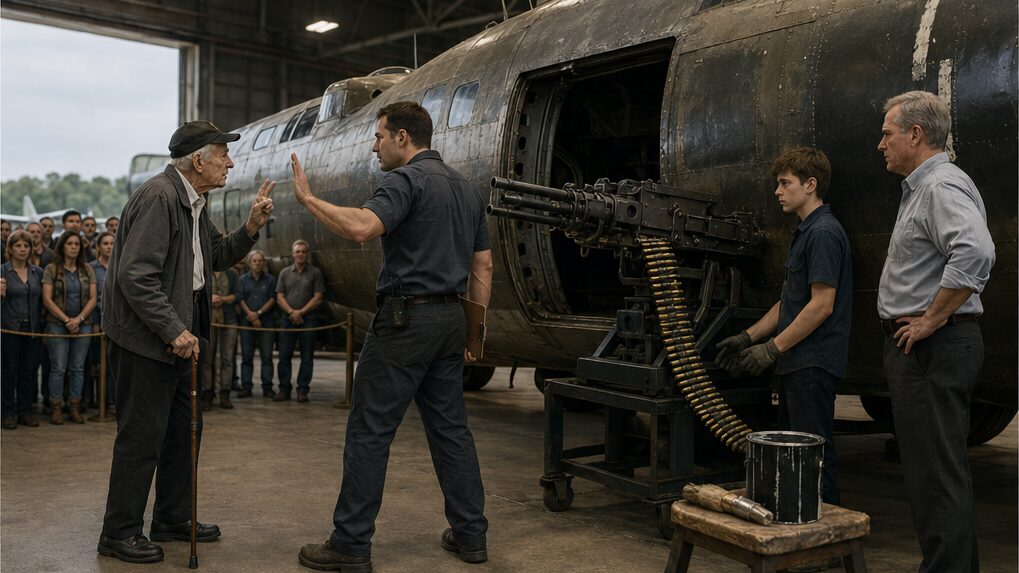
Jack Roberts saw it before he saw the sponsor banners, before he saw the folding chairs lined across the grass, before he saw the young men in museum polos moving around the bomber with clipboards and radios. The weapon sat on a padded cart beside the open side hatch, dark and heavy, its belt of dummy rounds draped over the edge like a tired snake. One end of the belt touched the concrete floor.
That was the first thing that bothered him.
The second was the mount.
The restored bomber crouched inside the hangar with its nose pointed toward the open doors and the morning light. Beyond it, the airfield stretched green and damp, cut by tire tracks from the equipment trucks. The aircraft’s skin had been polished in places, patched in others. Old rivets caught the light. The painted numbers near the nose were fresh enough to smell. But beside the gun position, where a thin black line should have run near the mounting point, there was only primer and a faint chalk mark.
Jack stopped walking.
A volunteer behind him nearly bumped his shoulder.
“Sir? Visitor entrance is that way.”
Jack moved half a step aside and let the volunteer pass. He did not answer. He kept his eyes on the bomber.
He had seen aircraft in museums before. Most looked too clean, their silence mistaken for peace. This one was not clean. Not entirely. Under the new paint and the donation plaques, under the ropes and the warning signs, the machine still held its old shape. Its belly sat low. Its side hatch looked narrower than memory and exactly the same. The gun port waited in the fuselage like a mouth that had learned not to speak.
Jack’s right hand tightened on the cane he did not like using.
He wore a gray jacket buttoned wrong at the middle, a white shirt, and shoes Lisa had polished the night before without telling him. His cap was plain, no unit patch, no pins. He had left the old ones in a drawer. At eighty-two, people looked at a decorated cap before they looked at the man beneath it, and Jack had never liked being read from a distance.
The bomber did not need his cap to know him.
A young man with a radio clipped to his belt crossed in front of the gun cart. He was broad-shouldered, quick in movement, and clean in the way people were clean when they had not yet worked long enough for grease to settle permanently into the edges of their hands. He pointed at the side hatch.
“Bring the mount up two inches before the cameras get here. I want the belt visible but not dragging.”
A teenage volunteer grabbed the belt at once.
Jack spoke before he meant to.
“Don’t pull it from that side.”
The volunteer froze. The young man turned.
Jack knew from the look that followed that he had already become a problem: old man, cane, quiet voice, no badge.
“Can I help you, sir?” the young man asked.
Jack’s eyes moved from the man’s face to the belt.
“You’ll twist the feed if you dress it that way.”
“It’s inert,” the young man said. “Display rounds. Nobody’s firing anything.”
“That doesn’t change how it sits.”
The young man smiled the small, contained smile of someone trying to remain polite in front of workers.
“Appreciate the concern. We’ve got it handled.”
Jack nodded once. He had heard that tone in hospitals, airports, hardware stores, and once from a boy at a grocery checkout who had called him “buddy.” It did not anger him anymore. Anger spent breath. He needed his breath for walking.
He took another step toward the bomber.
The smell changed near the aircraft: metal, solvent, old oil opened by fresh hands. A paint can sat on a low stool near the nose. Its lid was still sealed. Beside it lay a thin brush wrapped in paper, its bristles flat and new. A printed restoration diagram had been taped to the fuselage with blue painter’s tape, but the diagram did not show the field line. Jack had known it would not.
His fingers rose before he stopped them.
Two fingers. Index and middle. A habit older than the tremor in his hand.
He held them in the air near the gun mount but did not touch.
The spacer was wrong. Not by much. Enough.
“Sir.”
The young man had followed him. His name tag read Brandon Hall.
Jack lowered his hand.
“You’re missing a line.”
Brandon glanced at the fuselage, then at the diagram.
“The nose art team hasn’t finished. We’re doing the ceremonial touch-up at three.”
“Not that.”
Jack pointed with the end of his cane, careful not to touch the aircraft. “There.”
Brandon leaned closer, then gave a soft breath that was not quite a laugh. “That’s not part of the approved artwork.”
“No.”
“Then what is it?”
Jack looked past him to the opening beyond the hangar doors. The grass shone wet in the morning sun. He could almost see the younger men who had once stood there in a different field, not this field, not this year, not this country, waiting while someone older told them what to carry and what not to forget.
His throat tightened. He waited until it loosened.
“It’s where the gun tells you if it’s lying.”
Brandon blinked.
The teenage volunteer looked from Jack to the mount, interested now. Brandon noticed and straightened.
“Okay,” Brandon said. “I’m going to ask you not to get inside the work area. We have insurance rules. There’ll be a veteran seating section outside in about an hour.”
Jack looked at him then.
A veteran seating section.
He had come because Lisa had left the invitation on the kitchen table for three days without mentioning it. Because Gary had called and said the museum had finally rolled out the old bomber. Because the local paper had printed a photograph with the side hatch open, and Jack had seen, even in that blurred picture, the empty place where the line should have been.
He had not come to sit.
“I’m not looking for a chair,” Jack said.
Brandon’s smile thinned. “I understand. But this is an active restoration zone.”
“Active means listen before you move weight.”
“We have the manual.”
Jack looked at the gun cart. The belt had been lifted from the floor but now hung in a shallow twist over the feed side. The volunteer’s hands hovered, waiting for permission.
“The manual was written before that bracket got changed,” Jack said.
Brandon turned toward the cart, then back to Jack. “This plane’s been under professional restoration for two years.”
“That long?”
A flash of irritation crossed Brandon’s face. “Yes, sir. That long.”
Jack nodded, not because he agreed, but because the young man had answered the wrong question.
Two men in suits moved near the donor display. One of them, Eric Moore, the museum director, had his arm around an older sponsor representative and was pointing proudly at the bomber’s nose. A local reporter adjusted a tripod near the entrance. The day was already arranging itself around speeches, camera angles, and tidy memories.
Jack took one more step, slow but deliberate.
Brandon moved with him, blocking the way.
“Sir, I need you behind the rope.”
Jack looked over Brandon’s shoulder.
The volunteer had followed the earlier order. He lifted the belt to make it visible for the cameras. Its weight pulled gently against the gun assembly, and the mount shifted less than a quarter inch.
Almost nothing.
Enough.
Jack’s fingers rose again, two of them trembling in the air, measuring a space no one had asked him to remember.
“Leave it,” he said.
Brandon’s voice hardened. “Do not touch the aircraft.”
Jack did not touch it. He only stared at the belt as it settled into the wrong shape.
Chapter 2: The Demonstration Schedule Leaves No Room for Memory
By late morning, Brandon Hall had answered twelve questions about parking, three about the livestream, two about whether the dummy rounds were legal to display, and one from a museum board member who wanted to know why the coffee table had been placed too close to the donor wall.
The old man by the bomber was not on his list.
Brandon liked lists. Lists kept a restoration day from becoming a mess of good intentions. He had learned that in his first year at the museum, when a retired pilot had wandered past a rope barrier and nearly knocked over a wing panel waiting for installation. Everyone had called it charming afterward. Brandon had called it preventable.
Today had to be clean.
The bomber had taken two years, six fundraisers, three replacement suppliers, one terrible winter leak in the hangar roof, and more volunteer hours than anyone had bothered to count. The museum had promised a memorial demonstration: side hatch open, gun assembly mounted for display, nose marking completed in front of cameras, veterans honored, donors thanked, public invited to see history “come alive.”
Eric Moore loved that phrase.
Brandon did not love it, but he understood its use. Donors opened wallets for alive.
He crossed from the roped donor area to the aircraft, checking the positions as he moved. The folding chairs outside faced the hangar doors. The local reporter had already filmed a slow shot of the bomber’s nose. The safety inspector would arrive after lunch. The teenage volunteer was polishing fingerprints from the display rounds with a cloth as if each brass casing were a holy object.
And near the side hatch, Jack Roberts still stood where Brandon had left him, quiet and immovable.
Not in the way of a protester. Worse. In the way of a man who believed the room would eventually confess he was right.
“Sir,” Brandon said, keeping his voice lower this time, “I really do need you outside the work line.”
Jack looked at the rope as though noticing it for the first time. “You put the line in the wrong place.”
“The rope?”
“The paint.”
Brandon pressed his lips together. He had slept four hours. He had donors arriving in ninety minutes, and Eric had already told him twice that the sponsor representative wanted a photograph beside the ceremonial brush.
“The paint team followed the archive packet,” Brandon said.
“No.”
Brandon stared at him. “No?”
“The packet followed the factory layout.”
“That’s generally what restoration means.”
Jack’s face did not change. “Not always.”
There was no drama in his voice, no challenge. That made it harder to brush away. Brandon would have preferred bluster. Bluster could be managed.
He pointed toward the nose, where the sealed paint can sat beside the brush. “We’re doing the final line on camera. It’s ceremonial. Nobody’s forgotten it.”
Jack’s eyes shifted to the can. “Wrong line.”
Behind them, Eric’s laugh carried across the hangar. He was with the local reporter now, one hand resting lightly on the bomber as if the aircraft belonged to him personally.
Brandon lowered his voice. “Look, Mr.—”
“Roberts.”
“Mr. Roberts. I respect that this means something to you. Truly. But we have schematics. We have photographs. We have restoration notes. We can’t change markings because someone remembers something different.”
Jack nodded once, and Brandon thought, for one hopeful second, that the matter had ended.
Then Jack said, “Photographs are taken after men clean up.”
The sentence landed strangely.
Brandon looked toward the volunteer, who had slowed his polishing to listen. “Back to work,” Brandon said.
The volunteer bent quickly over the rounds.
Jack’s hand rested on the cane, knuckles pale but steady. He looked older up close than he had at first. Not fragile exactly. Worn. His skin had the thinness of old paper, and the veins on the back of his hand stood blue under the tremor. But his eyes did not drift. They fixed on the gun mount, then the belt, then the unpainted strip of fuselage with the clean attention of a measuring tool.
Brandon hated that he noticed.
He had grown up around men who told stories at ceremonies. Some were moving. Some were impossible to verify. Some got larger every year. The museum had to be careful. Memory mattered, but it could also turn a restoration into a debate no one could win.
A woman in a volunteer vest approached, carrying a stack of programs. “Brandon, Eric wants the veteran family seating opened before noon. Also the reporter wants to know if they can film the gun being placed.”
“Tell them five minutes,” Brandon said.
The woman glanced at Jack. “Dad?”
Brandon looked from her to the old man.
Jack did not turn right away. When he did, something in his face softened and closed at the same time.
“Lisa.”
“You’re inside the work area.”
“So they keep telling me.”
Lisa Taylor gave Brandon an apologetic look. “He used to work around these.”
Brandon waited for more. A title. A credential. A unit. Something useful.
Lisa only said, “Dad, maybe come sit a little. It’s warm in here.”
“I’m fine.”
“You said that yesterday when you forgot lunch.”
“I remembered dinner.”
“That is not the same thing.”
Brandon almost smiled, then caught himself. There was tenderness in her voice, but strain under it. She was not embarrassed by her father. She was afraid for him.
Eric called from across the hangar. “Brandon! Where are we on the gun mount?”
“Ready in a minute,” Brandon called back.
Jack’s head turned sharply toward the mount.
“You’re not ready.”
Brandon let out a controlled breath. “Mr. Roberts.”
“It will sit proud.”
The phrase sounded old, almost ridiculous, like something lifted from a manual with yellow pages. The teenage volunteer looked up again.
Brandon stepped closer, lowering his voice enough that only Jack and Lisa could hear. “It’s a static mount. The gun is secured. The belt is fake. The crowd will be behind ropes. Nothing is being fired, nothing is loaded, and nothing is happening that requires alarm.”
Jack’s eyes did not leave the bracket. “Weight doesn’t know it’s fake.”
That should have sounded foolish. It did not.
Lisa touched Jack’s elbow. “Dad.”
He looked at her hand, then back at the aircraft.
Brandon followed his gaze to the unopened paint can. The brush lay beside it in its paper sleeve, placed there for the sponsor photograph. The whole point was to have the board chair touch the final decorative stripe while Eric spoke about preserving sacrifice for future generations.
Jack stared at it as if someone had left medicine out of a wound.
“Why that line?” Brandon asked, despite himself.
Jack’s jaw moved once. No words came.
Eric arrived before the silence could answer. “Everything good?”
Brandon turned. “Yes. Just clearing the work line.”
Eric gave Jack the warm museum smile he used for elderly visitors and donors. “Sir, we’re very glad you’re here today. We’ll have reserved seating outside, water stations, and shaded tents. If you served, thank you.”
Jack looked at Eric’s hand when it came forward. He shook it after a beat, lightly.
“Don’t hang the belt that way,” Jack said.
Eric’s smile held, but his eyes went to Brandon.
Brandon felt heat rise in his neck. “We’ve addressed it.”
“No,” Jack said. “You dressed it for a picture.”
The volunteer froze completely this time.
Lisa whispered, “Dad, please.”
Eric’s voice stayed pleasant. “Mr. Roberts, I promise our restoration coordinator has this under control.”
Jack studied Brandon. Not accusing. Not pleading. That was the worst part. He was measuring him.
Then Jack stepped back, one careful foot behind the other, and let Lisa guide him toward the rope. He did not look defeated. He looked as if he had marked the room and found it wanting.
Brandon turned to the gun cart. “Mount it.”
The volunteer lifted the belt.
Jack’s voice came from behind the rope, quiet enough that Brandon almost missed it.
“It’ll sit proud if you force it.”
The volunteer glanced at Brandon.
Brandon gave a short laugh, sharper than he intended. “Then we’ll make sure it feels humble.”
A few workers smiled.
Jack did not. He only looked at the unpainted space beside the gun and waited.
Chapter 3: One Missing Line Beside the Gun
By early afternoon, the hangar smelled of hot concrete, old oil, and the fresh coffee being poured for people who would never come within arm’s reach of the bomber.
Jack stood behind the rope with Lisa on one side and Gary Sanchez on the other. Gary had arrived late, leaning heavily on a rebuilt knee and carrying the look of a man who had already guessed there was trouble.
“You found it,” Gary said.
Jack did not ask what he meant.
“Bracket’s wrong,” Jack said.
Gary watched the restoration team slide the gun assembly toward the hatch. “How wrong?”
“Wrong enough.”
Gary’s mouth tightened. “You tell them?”
Jack’s eyes stayed on Brandon. “Told them what they would hear.”
“That’s never much.”
Lisa looked between them. “What bracket?”
Neither man answered quickly. That was how Lisa knew the question mattered.
Brandon had gathered two volunteers and a photographer near the side hatch. The gun assembly rested on a lift now, angled toward the opening. Its dark barrel pointed safely toward the empty field, and the dummy belt hung in a curve arranged for visibility. Everything looked careful, impressive, and wrong.
Eric stood near the nose with the local reporter, speaking softly into a microphone.
“Today, we honor not only the machine, but the men who kept it flying,” he said.
Jack closed his eyes for half a second.
Men who kept it flying.
People said things like that because they had never heard an aircraft come back with holes in it and one less voice inside.
“Dad?” Lisa said.
“I’m here.”
But he was not entirely.
The mount came level with the side hatch. A volunteer reached to guide the assembly inward. Brandon stood beside him with one hand raised, directing, confident. The safety inspector had not yet arrived. The crowd outside had begun to gather in bright clusters beyond the hangar doors.
Jack saw the spacer as the mount turned.
Too clean. Too thick. Replaced from measurement, not from use.
He lifted the rope.
Lisa caught his sleeve. “Dad, no.”
Jack did not pull away hard. He simply kept moving, and Lisa let go because she felt the decision in him before she understood it.
“Mr. Roberts,” Brandon said as Jack approached. “Stop there.”
Jack stopped one step from the cart.
The gun hung between them, black and ceremonial, its dead weight pretending not to matter.
“Take that spacer out,” Jack said.
Brandon’s face went still. Behind him, the photographer lowered the camera slightly.
“This is not a conversation we’re having in the middle of setup,” Brandon said.
“Then don’t set it.”
Eric turned from the reporter. “Brandon?”
“It’s fine,” Brandon said, too fast.
Jack raised his right hand. The tremor had worsened since morning. He hated that everyone could see it. He held the hand still by placing two fingers lightly against his own coat before extending them toward the mount.
He did not touch the aircraft.
“Here,” he said. “Two fingers from the inner lip to the collar. Not three. Not with that spacer.”
Brandon looked at Jack’s fingers, then at the volunteer, then at the camera.
“Sir, please step back.”
“It’ll bind high.”
“It is a static display.”
“It still has weight.”
“We know the weight.”
“No,” Jack said. “You know the number.”
The words seemed to embarrass the room.
A few visitors near the hangar door had turned to watch. The reporter shifted the microphone downward. Eric’s expression changed from public warmth to private alarm.
Brandon stepped in front of the gun assembly, using his body to block Jack from the equipment. “You are not authorized to touch this aircraft.”
Jack looked at him, and for the first time that day, something like tiredness crossed his face.
“I touched one before you were born.”
“I’m sure you did.”
There it was. Not openly cruel. Almost polite. But the younger man’s voice carried enough for the volunteers to hear, enough for the photographer to catch the edge of it.
Jack absorbed it without blinking.
Gary muttered from behind the rope, “Easy, Jack.”
Lisa stood frozen, one hand at her mouth.
Brandon continued, “But this aircraft has been restored according to documented specifications. We can’t pause a public demonstration because of—”
“Because of what?”
The question was soft.
Brandon stopped.
Jack waited.
Because of an old man. Because of a shaking hand. Because of memory. Because of something that sounded strange and could not be entered neatly into a schedule.
Brandon did not say it.
Jack turned away from him and looked at the bomber’s side. The missing line sat pale against the new paint. In memory, it had been black. Not decorative black, not proud black. Practical. A narrow field mark brushed on in poor light by a hand that had been too young to shake.
He stepped toward the stool near the nose.
“Sir,” Brandon snapped.
Jack stopped at the paint can. The brush still lay wrapped beside it.
He pointed to it.
“Open that.”
Brandon stared. “What?”
“Open the paint.”
Eric came forward now. “Mr. Roberts, the ceremonial painting is scheduled for three o’clock with the board chair.”
Jack nodded. “Then she can paint the wrong thing at three.”
The hangar went quiet enough for the coffee urn to hiss in the corner.
Lisa shut her eyes.
Brandon’s face flushed. “That’s enough.”
Jack looked back at the gun mount. “Not yet.”
“Step away from the aircraft.”
Jack did step away. Not back toward the rope, but sideways, enough that everyone could see the space between the mount and the unfinished marking.
He held up two fingers again.
“This line belongs here. Not for looks. For the mount. You bring the gun in, you check the collar against the line, then you dress the belt. If the belt pulls down and the collar sits above that line, you don’t force it. You find out why.”
The teenage volunteer whispered, “Is that in the manual?”
Brandon shot him a look. “No.”
Jack heard the answer and almost smiled. Almost.
“No,” he said. “It was written on the plane.”
The reporter lifted the microphone slightly.
Eric noticed and stepped in. “Let’s pause filming for a moment.”
The photographer did not move.
Jack looked at Brandon. “You asked what I knew that your manuals didn’t.”
“I didn’t ask that.”
Jack’s gaze moved to the paint can.
“You wanted to.”
Brandon glanced toward the growing audience at the hangar entrance. He had lost the clean flow of the event. Jack knew it. Everyone knew it.
“Mr. Roberts,” Brandon said, softer now but colder, “I am asking you one last time to return behind the rope.”
Jack felt the whole day narrowing.
His knees ached. His hand had begun to pulse from being held too carefully. There was sweat under his collar. Lisa was watching him with that look she had worn when he first forgot which burner he had left on, a look that tried to protect him from the world and from himself at the same time.
He could go back. Let them mount it. Let the belt hang pretty. Let the ceremony pass. Maybe nothing would happen. Maybe the static display would hold for its ten-minute demonstration. Maybe the safety inspector would catch it. Maybe the old machine would forgive them.
But machines did not forgive. Men did that, or failed to.
Jack reached into his jacket pocket and pulled out a folded paper napkin. He had taken it from the coffee table earlier. Without asking, without explaining, he folded it once more into a thin strip and held it against the fuselage below the empty space where the line should have been.
His fingers trembled, but the strip did not.
“Here,” he said.
No one moved.
He lowered the napkin, then looked at the brush.
“I’m not asking to fire your gun. I’m asking you to mark where it tells the truth.”
Brandon’s mouth opened, then closed.
For one moment, the younger man looked not angry but uncertain, and Jack felt the danger in that. Uncertainty could still become listening. It could also become pride.
Eric made the choice for him.
“Brandon, reset the area. We need to stay on schedule.”
Brandon straightened, relief and irritation crossing his face together.
“You heard him,” he said to the volunteers. “Proceed with the mount.”
Lisa stepped forward. “Maybe just wait for the inspector?”
Brandon looked at her. “The inspector is reviewing the public side, not every volunteer memory.”
Jack folded the napkin carefully and put it back in his pocket.
Gary swore under his breath.
The volunteers lifted the gun again. The assembly moved toward the side hatch. The belt swung gently, polished rounds catching the light. It looked fine from ten feet away. Handsome, even. The kind of thing people photographed because danger became attractive once everyone agreed it was harmless.
Jack stepped back.
Not because Brandon had won.
Because the next warning needed room.
The mount slid in. The wrong spacer held. The gun settled high, just as Jack had said. Only slightly. Proud.
Brandon checked it, frowned almost invisibly, then smoothed his face before anyone could read it.
Jack saw.
Their eyes met.
For the first time, Brandon looked away first.
“Keep the crowd out from under this side,” Jack said.
Brandon’s jaw tightened.
Jack leaned both hands on his cane, the effort of standing suddenly heavy in his shoulders.
Brandon forced a laugh for the benefit of the workers nearby. “Mr. Roberts, nobody is standing under a display gun.”
Jack looked at the belt, then the mount, then the empty space where the painted line should have warned them all before pride entered the room.
“Then don’t let anyone stand under it,” he said.
Chapter 4: The Manual Was Right Until the Plane Wasn’t
Lisa Taylor had learned to watch her father’s hands before she listened to his words.
When Jack was tired, his right thumb rubbed against his forefinger as if feeling for a screw head. When he was angry, his hand went still. When memory had him by the throat, he folded his fingers inward and hid the tremor against his palm.
Now, in the restoration office beside the hangar, he held both hands around a paper cup of water and did not drink.
“You need to sit for ten minutes,” Lisa said.
“I am sitting.”
“You know what I mean.”
Jack looked at the office chair beneath him as though it had personally accused him of weakness. “Chair seems to be doing its job.”
Lisa did not smile.
Outside the office window, the bomber’s side hatch remained visible through the hangar bay. Workers moved around it in controlled bursts, trying to recover the schedule that had frayed around her father. Brandon Hall stood near the gun mount with a clipboard and a stiff back. Every few seconds, he looked toward the office window, then looked away.
Lisa turned the blinds halfway. Not closed enough to make Jack feel contained. Not open enough to invite staring.
“You scared me out there,” she said.
Jack’s eyes stayed on the water cup.
“Wasn’t trying to.”
“I know.”
That was the problem. He never tried to scare her. He simply stepped into trouble the way other people stepped over a puddle, as if the question were not whether he could afford it, but whether it was there.
The office was small and crowded with restoration binders, donor plaques waiting to be hung, and framed photographs of aircraft in various states of repair. A desk fan clicked with each turn. On one shelf, a plastic model of the bomber had been placed beside a stack of event programs. The model’s gun positions were too smooth, too clean, all history made safe for dusting.
Jack stared at none of it. He looked through the blinds at the aircraft.
Lisa sat across from him.
“Dad, why this plane?”
His cup bent slightly under his fingers.
“You know why.”
“No,” she said gently. “I know you served around bombers. I know you don’t like ceremonies. I know you didn’t want to come until Gary called. But I don’t know why you looked at that missing paint like someone had left a door open in winter.”
Jack’s mouth tightened. “You always had a way with words.”
“Mom said I got that from you.”
“She was kinder than facts.”
The mention of her mother softened the room for half a breath. Then the hangar noise filled it again: a rolling cart, a radio crackle, Eric Moore’s careful voice directing someone toward the donor table.
Lisa reached across the desk and touched Jack’s sleeve. “Your hand is shaking.”
“It shakes.”
“More today.”
“It has an audience.”
She looked down. There were two small dark smudges on his fingertips. Paint dust or old grease, she thought at first. Then she saw the faint black stain on the side of his index finger, transferred from the unpainted area near the bomber’s nose where he had held the folded napkin close to the fuselage.
“You touched it?”
“No.”
“Dad.”
“I touched old dust. That doesn’t count.”
His voice carried a small dry humor, but she did not follow it. She looked at the stain as if it were evidence of something she had not wanted to find.
“You promised me you weren’t coming here to punish yourself.”
Jack finally looked at her.
“I didn’t promise that.”
“You said you only wanted to see it.”
“I wanted to see it right.”
Lisa leaned back. The office chair creaked. She was not a child anymore, not the girl who had once sat outside his locked workshop door listening to sandpaper move over wood because that was the only sound he made after bad dreams. She had her own gray at the temples now, her own careful way of saying difficult things. Yet with him, she still felt twelve years old when he went silent.
“Brandon shouldn’t have laughed,” she said.
Jack looked away. “He’s young.”
“That’s not an excuse.”
“It’s an explanation.”
“You always do that.”
“What?”
“Make room for everyone else.”
The fan clicked. Outside, the teenage volunteer crossed past the window carrying a coil of rope. He was careful, almost exaggeratedly so, as if Jack’s warning had entered his hands even if no one admitted it.
Jack watched him.
“Not everyone,” he said.
Lisa waited.
He did not continue.
She folded her hands. “I think we should go home after the ceremony starts. We can watch from the car if you want.”
“No.”
“Dad.”
“No.”
“You’re exhausted.”
“I’m old. There’s a difference.”
“Sometimes there isn’t.”
That landed harder than she intended. She saw it in the slight lowering of his eyes.
“I’m sorry,” she said.
He nodded, accepting the apology without making her repeat it. That was how he forgave: quickly, almost secretly, and never in words that let the other person feel easy about needing it.
Outside, Brandon’s voice rose.
“Lift it slow. Not from the barrel. From the cradle. The cradle.”
Jack’s head turned.
Lisa turned too.
Through the half-closed blinds, she saw the gun assembly being shifted again. Brandon had brought in a rolling support and was directing two volunteers as they tested the mount angle. The dummy ammunition belt had been re-draped higher, more impressive now, its brass-colored shapes catching the light for the camera. The side hatch swallowed part of the assembly in shadow.
Jack set the paper cup down.
“Stay seated,” Lisa said.
He did, but every part of him leaned toward the window.
“They’re only testing it,” she said.
“They’re testing the wrong thing.”
“How do you know?”
“Because he’s watching the barrel.”
Lisa looked again. Brandon stood at the front of the assembly, eyes fixed on the visible line of the gun.
“What should he watch?”
Jack lifted his right hand without thinking. Two fingers extended, index and middle. He held them apart by a narrow measure.
“The collar.”
The word meant nothing to her and everything to him. She could hear it. The difference frightened her.
“Did something happen with this kind of mount?” she asked.
Jack lowered his hand.
“Many things happened with many mounts.”
“That’s not an answer.”
“It’s the one I have.”
A small tap sounded from outside. Metal settling on metal. Nothing dramatic. Not even loud enough to draw Eric from the donor area.
Jack closed his eyes.
Lisa looked at him, then out the window.
Brandon frowned at the mount. He said something to a volunteer. The volunteer adjusted the belt. Another small sound followed, sharper this time, like a coin dropped inside a pipe.
Jack stood.
Too fast.
The chair scraped backward and bumped the file cabinet. Lisa reached for him, but Gary appeared in the doorway first, breath slightly uneven from crossing the hangar.
“They’re doing a weight check,” Gary said.
Jack took his cane.
Gary’s eyes met Lisa’s. Something unspoken passed between the two older men, not panic, not yet, but recognition.
“Brandon says the inspector isn’t needed for the static test,” Gary added.
Jack moved toward the door.
Lisa stepped in front of him. “No. Tell me what happens if they’re wrong.”
His hand tightened on the cane. For a second, she thought he would move around her. He had that look. Not stubbornness, exactly. Duty with no room in it.
Then he stopped.
“If the collar rides high,” he said, “the weight pulls against the bracket instead of into it. Might hold. Might slip. Might only crack the paint and embarrass them.”
“And if it doesn’t only crack the paint?”
Jack looked through the blinds.
Another metallic tick sounded from the hangar bay.
This time Brandon heard it too.
Jack’s voice dropped.
“Then the plane reminds them it is not a stage prop.”
Lisa moved aside.
Chapter 5: The Sound Jack Heard Before Anyone Else
Brandon Hall heard the sound on the third test lift.
It was small, almost insulting in its quietness. A thin metallic shift hidden beneath the murmur of visitors outside and the buzz of the hangar lights. If he had not been irritated, he might have missed it. If Jack Roberts had not said, Then don’t let anyone stand under it, he would have dismissed it as the lift settling.
But the sound came from the bracket.
Not the lift.
Brandon held up one hand. “Stop.”
The volunteers froze. The gun assembly hovered half-seated in the side hatch, supported by the rolling lift and two padded blocks. The dummy ammunition belt hung in a clean, camera-ready curve, exactly as Brandon had wanted it. The display looked good. It looked controlled. It looked like two years of work finally becoming visible.
Then the bracket made the sound again.
Tick.
The teenage volunteer swallowed. “Was that supposed to—”
“Don’t move,” Brandon said.
His own voice sounded unfamiliar.
He crouched beside the mount, careful to stay clear of the barrel. The bracket was seated. The bolts were aligned. The spacer fit the documented measurement. Everything matched the restoration packet, the archived factory schematic, the reference photos. He had checked twice that morning and once the night before after everyone else had left.
Still, the collar sat high.
Only slightly.
Proud.
The word rose in his mind in Jack’s quiet voice, and Brandon hated how quickly it returned.
Eric appeared beside him. “What’s the delay?”
“Minor check.”
“Brandon.”
“I said minor.”
The sharpness of his own answer surprised him. Eric’s expression cooled, but he did not push in front of the volunteers. The local reporter stood several yards away, watching with the alert stillness of someone who had smelled a story changing direction.
Brandon touched the bracket housing with the back of his fingers. It vibrated faintly under the weight.
He looked toward the restoration office.
Jack was already in the doorway.
Not rushing. Not triumphant. One hand on the cane, one hand close to his side, shoulders narrow under his gray jacket. Lisa stood behind him, worried enough that Brandon looked away from her first.
Gary walked at Jack’s left but did not hold him.
Brandon rose.
For a moment the hangar divided itself into two worlds: the public side, with flags and chairs and programs and donor signs; and the aircraft side, where old metal carried weight according to rules no microphone could soften.
“Mr. Roberts,” Brandon said.
Jack stopped outside the roped area.
“You hear it?” Jack asked.
Brandon’s face warmed. He almost said yes. The word lodged in his pride.
“I’m checking it.”
Jack nodded.
Not enough to mock him. Enough to acknowledge that checking was better than forcing.
Eric leaned close to Brandon. “We have guests waiting.”
Brandon kept his eyes on the bracket. “Then move them back from this side.”
Eric stared. “What?”
“Move the first row back from the hangar line. And clear the side angle.”
“Why?”
Brandon did not want to say because the old man told me. He did not want to say because I laughed at him. He did not want to say because the manual says one thing and the aircraft is saying another.
“Because I’m not comfortable with the load,” he said.
Eric’s jaw tightened. “This is a static display.”
“I know.”
“The sponsor representative is outside.”
“I know.”
“The board chair is expecting the paint moment in twenty minutes.”
Brandon turned then. “And I’m telling you we need to move the crowd.”
The words carried farther than he intended. A few volunteers looked up. The reporter shifted again. Brandon felt his control of the day slipping from his hands, not all at once, but bolt by bolt.
Jack had not moved.
That made it worse.
If the old man had smiled, Brandon could have resented him. If he had said I told you so, Brandon could have defended himself. But Jack only watched the gun mount with a sadness that did not seem directed at Brandon at all.
Brandon turned to the teenage volunteer. “Ease the belt down.”
The volunteer reached for it.
“No,” Jack said.
Everyone stopped.
Brandon looked at him.
Jack pointed with his cane, not at the belt, but at the support beneath the assembly. “Block first. Then belt. Don’t unload it uneven.”
Brandon stood still.
The instruction made sense. Simple sense. The kind that should have been obvious once spoken. But obvious was not the same as known before it mattered.
He nodded to the volunteer. “Block first.”
The volunteer placed the padded block under Brandon’s direction. The belt was lowered after. As the weight changed, the bracket gave a slightly louder click.
A woman near the hangar door gasped.
Nothing fell. No one was hurt. The gun remained on the support.
But the sound moved through the room like a hand over skin.
Eric stepped back. “All right. That’s enough. We’ll pause the display.”
“The side crowd,” Jack said.
Eric looked at him, irritated and shaken. “We are pausing.”
“Move them first.”
Eric’s eyes narrowed. “Mr. Roberts, we appreciate your concern.”
“No,” Jack said.
The word was not loud, but it cut cleanly through the hangar.
Brandon had heard enough versions of old men saying no to last a lifetime: no to help, no to change, no to hearing aids, no to anyone younger touching their tools. This was different. Jack’s no had no vanity in it. It was a door closing against harm.
Jack moved one step closer to the rope. Lisa reached for his sleeve, but he lifted his hand slightly, and she stopped.
“Move them,” Jack said again. “Then I’ll help you unload it.”
Eric looked at Brandon.
For once, Brandon did not look back for permission.
“Clear the side angle,” he called. “Move the first two rows back ten feet. Nobody stands under the hatch side.”
The teenage volunteer ran to help. The visitor crowd outside shifted in confusion, chairs scraping on grass. The reporter began filming again until Eric put a hand over the lens and said something too low to hear.
Brandon stepped toward Jack.
“Can you tell me what’s binding?”
Jack’s gaze flicked to him.
There it was. The first real question Brandon had asked all day.
Jack did not answer quickly. His breathing was measured, but Brandon noticed the effort beneath it. The tremor had moved into his wrist. The old man was not hiding his weakness now because the plane mattered more than the disguise.
“Spacer,” Jack said. “Too thick for this bracket after the field change.”
“We matched the factory packet.”
“You matched the factory.”
“This is the original bracket.”
“No.”
Brandon almost argued. Then stopped.
Jack looked at the gun mount the way a man might look at an old scar on someone else’s body.
“Original to the plane,” Jack said. “Not original to the drawing.”
Brandon crouched again. He saw old grinding marks near the bracket’s inner lip, faint beneath primer and paint. He had noticed them months ago and filed them mentally under wartime roughness. Lots of things on the bomber were rough. That had been part of the charm.
Now the marks looked less like charm and more like testimony.
Jack’s two fingers lifted again.
“Measure here,” he said. “Inner lip to collar. Not the outer plate.”
Brandon took the calipers from his pocket. His hands felt clumsy. He set them where Jack indicated.
The number was off.
Not dramatically. Not in a way that would have alarmed anyone reading a document. But with the belt dressed for display and the mount angled for photographs, the load pulled exactly where Jack had warned.
Brandon stared at the measurement.
Eric came behind him. “Well?”
Brandon did not turn. “He’s right.”
No one spoke.
The words sounded smaller than Brandon expected. They did not fix anything. They did not erase the morning. They did not make him generous or wise. They only opened the door to the next difficult thing.
Jack leaned slightly on his cane.
“Unload it,” he said.
Brandon nodded. “Show me.”
Jack shook his head once. “Crowd first.”
“They’re moving.”
“All of them.”
Eric stepped forward. “We can keep them outside the rope. There’s no need to alarm people.”
Jack looked at him then, and Brandon saw the old man’s patience run thin. Not gone. Thin.
“You already alarmed the plane,” Jack said.
The teenage volunteer looked down to hide his reaction.
Eric’s face reddened.
Brandon stepped between them, not to protect Eric from embarrassment, but to keep the moment from becoming about pride again.
“I’ll move them,” Brandon said.
He walked to the hangar doors himself. Outside, visitors murmured as chairs were dragged backward over the grass. A few complained. Someone asked if the event was canceled. The sponsor representative looked displeased. The board chair clutched the ceremonial program against her jacket.
Brandon heard all of it and kept moving people back.
When he returned, Jack was standing exactly where he had been, eyes on the mount, saving himself for the work.
“All right,” Brandon said.
Jack studied the cleared space. Then he nodded.
“Now we can touch it.”
Together, with Gary steadying the support and the volunteers following instructions in careful silence, they unloaded the belt, lowered the assembly, and eased the pressure off the bracket. Jack did not take over. He gave short directions, each one plain, each one necessary. He corrected Brandon once with two words. He corrected the volunteer with a gesture. When the gun settled safely back onto the cart, the whole room seemed to exhale.
Brandon stood over the bracket, looking at the faint grinding marks and the unfinished paint.
“What happened the first time?” he asked before he could stop himself.
Jack’s face closed.
Gary looked away.
Lisa, near the office door, went very still.
Brandon knew then that the question had not belonged to the museum.
Jack picked up his cane.
“If you want me to continue,” he said, “no one stands there again until that line is back.”
Eric opened his mouth.
Jack looked at him.
“And no cameras.”
Chapter 6: The Brush Was Never for Decoration
By evening, the hangar had gone quiet in the embarrassed way public places go quiet after almost becoming dangerous.
The crowd had been sent home with rain-check passes, though there had been no rain. The sponsor representative had left in a dark car with the board chair. The local reporter had been told the restoration team had discovered “a minor display adjustment” and would reschedule the ceremony. Eric had repeated the phrase three times until even he seemed tired of it.
Now only the bomber remained fully awake.
Its side hatch stood open. The gun assembly rested on the padded cart beside it, unloaded and safe. The dummy belt lay coiled carefully, no longer arranged for beauty. Near the nose, the paint can sat open at last, its black surface shining under the hangar lights. The brush rested across the rim.
Jack stood before it without touching.
Lisa watched from a few steps away. Gary leaned against a workbench, arms folded, his face drawn. Brandon held a notebook but had not written anything for several minutes. Eric stood near the donor table, jacket off, tie loosened, still trying to arrange the day into something manageable.
“We should document this properly,” Eric said. “If Mr. Roberts is willing, we could record a short interview. Not for today, obviously, but for the archive. A firsthand account would be valuable.”
Jack looked at the paint, not at Eric.
“Archive,” he said.
Eric’s mouth tightened. “That is what museums do.”
“Sometimes.”
Lisa heard the weariness in her father’s voice. Not anger. Something older.
Brandon stepped closer to Eric. “Maybe not tonight.”
Eric gave him a surprised look. Brandon did not back down.
The shift was small, but Lisa saw it. All day Brandon had stood between her father and the aircraft to keep Jack out. Now he stood between Jack and the room to keep the room away.
Jack reached for the brush.
His hand trembled before he touched it.
Lisa moved instinctively.
“I’ve got it,” Jack said.
She stopped.
He lifted the brush with care. A thread of black paint stretched from the bristles to the can, then broke. He held the brush over the unmarked strip beside the gun position. The space was narrow. It had looked meaningless that morning, just another unfinished detail on a machine covered in details.
Now everyone looked at it.
Jack did not paint.
Brandon opened his notebook. “Inner lip to collar,” he said quietly. “Two fingers as field check. Line placed at corrected seating height after bracket modification.”
Jack’s eyes moved to him.
“Not seating height,” Jack said.
Brandon paused, pencil ready.
“Truth height.”
Eric shifted. “Mr. Roberts, for restoration purposes we may need a more technical—”
“Write corrected collar reference,” Jack said.
Brandon wrote it.
Lisa saw the corner of Jack’s mouth move, almost a smile, gone before it settled.
Gary pushed away from the workbench. “Jack, you don’t have to do the rest.”
“Yes,” Jack said. “I do.”
The words did not invite argument.
He touched the brush to the metal.
The first stroke was too short. His hand shook, and the paint thickened at one end. Lisa expected him to wipe it away. Instead he waited, breathed through his nose, and placed the brush again. The line lengthened slowly, black against the restored paint, plain and narrow and utterly without decoration.
With the brush in his hand, he did not look eighty-two.
He did not look young either.
He looked like both ages had met in one body and neither had won.
“When was it changed?” Brandon asked.
Jack kept painting. “In a field.”
“During the war?”
The brush stopped.
Eric glanced toward Lisa, perhaps hoping she would help guide the memory into words. Lisa gave him nothing.
Jack lifted the brush from the fuselage.
“There was a factory way,” he said. “Then there was the way after the first month. Then the way after men came back angry at the factory way. Then the way after men didn’t come back.”
No one spoke.
The hangar lights hummed.
Jack looked at the line, judging its width. “We had a bracket that rode high under belt weight. Not every time. That was the devil of it. If it failed every time, even a fool could fix it. It failed when the belt was dressed pretty, when the angle was wrong, when somebody wanted the gun ready before the plane was.”
Brandon’s pencil had stopped moving.
Jack noticed. “Write.”
Brandon looked down and wrote.
Lisa felt the room becoming too still. She wanted to stop him and wanted him to continue. All her life, her father’s past had existed in objects without explanations: a locked drawer, a missing photograph, a hand that went silent over toast when aircraft flew low during county fairs. Her mother had known more, perhaps all of it, but had guarded his silence as if it were part of the marriage.
Jack dipped the brush again.
“A boy on our crew liked clean things,” he said. “Not clean like polished. Clean like correct. He’d line the belt with his thumb before missions. Said if a man had to be afraid, he could at least be neat.”
Gary lowered his eyes.
Jack painted another inch.
“One morning we were late. Mud up to the tires. Orders changing. Everybody shouting. The mount had been serviced after a rough landing. Spacer swapped. Looked close enough. I saw it sit high.”
His voice did not break. That made it harder to hear.
Lisa pressed her fingers together until they hurt.
“I said something,” Jack continued. “Not enough. Not to the right man. Not loud enough to cost us the takeoff.”
Brandon’s face had gone pale beneath the hangar lights.
Eric’s professional stillness had vanished.
“The gun jammed after the turn back,” Jack said. “Then kicked loose enough to tear the feed and bracket. Not like today. Not a clean little tick in a museum. Noise, cold, smoke. A man trying to hold weight that didn’t care whether he was brave.”
The brush hovered.
Lisa could barely breathe.
“Was he the boy?” she asked.
Jack looked at her. The question had escaped her before she could soften it.
He nodded once.
No name. Not yet. Maybe not ever.
“The line came after,” Jack said. “Field paint. Bad brush. Bad light. We marked where the collar belonged after the correction. Anybody could see it. Anybody could check. Two fingers if the paint wore off.”
He lifted his hand, showing the old measure.
“That line wasn’t art.”
Brandon looked at the gun cart. “It was a warning.”
“It was a promise,” Jack said.
The word entered the hangar and stayed there.
Eric cleared his throat softly. “Mr. Roberts, that history should be part of the public record. People should hear—”
“No.”
Eric stopped.
Jack placed the brush across the rim of the can. His hand was shaking badly now.
“No cameras,” Jack said. “No poster. No headline about the old man saving the day.”
“That isn’t what I meant.”
“It’s what happens when people need a clean story.”
The words struck Lisa because they were true of museums, of families, of daughters who wanted their fathers safe more than understood.
Eric looked wounded, but not unfairly. “Then what would you have us do?”
Jack looked at Brandon’s notebook.
“Write the correction. Fix the mount. Move the line in the restoration file. Teach whoever handles this plane why it’s there. If someone asks, tell them it came from a field modification after a crew loss. That’s enough.”
Brandon’s pencil moved again.
Eric said nothing.
Lisa stepped nearer. “Dad, why didn’t you ever tell me?”
Jack’s eyes closed briefly.
“Because you were small.”
“I’m not small now.”
“No.”
“And after Mom died?”
He opened his eyes. “Because by then I was old.”
She almost argued. Then understood: old meant the story had hardened around him. Old meant silence had become furniture in the house. Old meant he no longer knew where to put the grief without knocking something over.
Her anger softened into something more painful.
“You carried that alone,” she said.
Jack looked at the painted line.
“Not alone. Just quiet.”
Gary turned away and wiped his face with the heel of his hand.
Brandon tore a page from his notebook carefully, then seemed to think better of it and left it attached. “Mr. Roberts,” he said, “will you show me the correction properly?”
Jack looked at him for a long moment.
Brandon stood straight, but not proudly. The pencil remained in his hand. His earlier certainty was gone, replaced by something less polished and more useful.
“No cameras,” Jack said.
“No cameras.”
“No donor speech.”
“No donor speech.”
“If I get tired, Gary talks.”
Gary gave a rough little laugh. “First sensible order all day.”
Jack looked at Lisa.
She nodded, though he had not asked a question aloud.
Then Jack picked up the brush again and held it over the unfinished line.
“Come here,” he said to Brandon. “Not in front of me. Beside me.”
Brandon moved to his side.
Jack guided the brush back to the metal, not handing over the work yet, not surrendering it either.
“Look at the collar,” he said. “Then the line. Then the belt. In that order. Never let the pretty part speak first.”
Brandon bent to see.
Outside, the sun had gone low across the empty airfield. No crowd remained to clap. No microphone captured the words. The old bomber waited in the quiet while Jack Roberts showed a younger man how to listen to metal, memory, and the thin black line between them.
Chapter 7: The Line They Finally Let Him Finish
At sunrise, the bomber looked less restored than forgiven.
Lisa stood at the edge of the hangar doors with a paper cup of coffee cooling between her hands, watching pale light gather along the aircraft’s skin. The day before, the bomber had seemed staged for guests, angled toward banners and microphones. Now, with the chairs still stacked outside and the donor table covered by a plain cloth, it looked like a machine again. A tired one. A waiting one.
Jack was already beside it.
He had arrived before she woke, though Gary insisted he had driven him and made him eat half a piece of toast in the truck. Jack wore the same gray jacket, now buttoned correctly, and stood near the side hatch with both hands resting on his cane. The black line he had begun the night before ran along the fuselage beside the corrected collar reference, not yet complete. It stopped short of the final mark, as if even the paint had waited for daylight.
Brandon Hall crouched beneath the gun mount with a flashlight and notebook. The gun assembly was off the cart now, not installed, only aligned for measurement. The dummy belt lay on a clean canvas sheet, no longer dressed for pictures. Each section had been inspected, uncoiled, and set aside in the order Jack had taught.
“Inner lip to collar,” Brandon said quietly.
Jack did not look down. “Again.”
Brandon measured again.
The teenage volunteer, standing nearby with a pencil behind one ear, watched Brandon rather than Jack now. Not because Jack had become less important, but because the lesson had begun to move through other hands.
“Two fingers checks it,” Brandon said.
“Only if the fingers know what they’re checking.”
Brandon nodded and wrote that down too.
Lisa smiled into her coffee before she could stop herself.
Eric Moore came in from the office side, carrying a folder and looking as though he had slept even less than she had. His tie was gone. His sleeves were rolled. Without the public version of himself assembled, he looked older and more uncertain, which made Lisa dislike him less.
He stopped a few feet from Jack.
“Mr. Roberts.”
Jack turned.
Eric held the folder out, but not too close, as if he had learned something about distance. “The public event is postponed. Officially, we’re calling it a restoration correction day.”
Gary snorted from the workbench. “That’ll pack the seats.”
Eric accepted the hit. “Probably not.”
Jack looked at the folder, then at Eric.
“I also removed the interview request,” Eric said. “No recording unless you ask for it. No feature story. No sponsor photograph with the brush.”
Brandon glanced up from the mount, surprised.
Eric continued, “There will be a short note in the restoration file. Technical first. Historical second. We can include the crew-loss reference exactly as you stated it, or leave that line sealed in the internal record.”
Jack’s face gave away almost nothing. Lisa had spent a lifetime reading almost nothing.
“You wrote ‘crew loss’?” Jack asked.
“I wrote ‘field correction after crew loss,’ pending your approval.”
Jack looked out at the airfield. Morning light spread over the grass, turning the tire tracks silver. Beyond the fence, a few cars passed on the road, ordinary people heading toward ordinary errands. None of them knew that a line on an old bomber had kept a man awake for more than half a century.
“Leave it,” Jack said.
Eric nodded once. “Thank you.”
“No,” Jack said. “Don’t thank me for that.”
Eric lowered his eyes, then gave another nod, this one smaller.
Lisa stepped closer to her father. “How are you feeling?”
“Observed.”
“That isn’t an answer.”
“It’s the one I have.”
The familiar dodge almost made her laugh. Almost. She touched his sleeve, and this time he did not move away.
Brandon rose from the mount with the notebook in hand. “I reset the spacer stack according to your correction. Gary checked the stress marks. The inspector is coming back this afternoon, but the load sits clean now.”
Jack looked at Gary.
Gary shrugged. “It sits like it’s got manners.”
“That’s not a measurement.”
“It’s a better measurement than yesterday.”
The teenage volunteer laughed softly, then stopped when he realized nobody else had. Jack looked at him, and the boy stiffened.
Then Jack said, “A machine with manners is still a machine. Don’t trust it because it behaved once.”
The volunteer nodded seriously. “Yes, sir.”
Jack’s eyes rested on the boy for a moment. “Don’t call me sir unless you mean to listen.”
The boy swallowed. “Yes—” He caught himself. “I mean, I will.”
Brandon closed the notebook. “Mr. Roberts, would you check the line before we seal it?”
Jack looked at the unfinished black mark.
There was no ceremony table now. No board chair holding the brush for a photograph. No camera waiting to catch an old veteran’s trembling hand and turn it into something simple. The paint can sat on a low stool, the brush cleaned and wrapped loosely in paper, not posed, just ready.
Jack moved toward it.
Lisa saw the effort in every step. He had spent too much of himself the day before. His shoulders were high with pain he would not name, and his right hand shook as soon as he released the cane. She wanted to take the brush for him. She wanted to spare him the humiliation of a crooked line. She wanted, because she loved him, to interrupt the very thing he had come to do.
She kept still.
Jack picked up the brush.
Brandon reached for the cane before it could fall, but did not touch Jack. He only held the cane upright beside him, waiting in case it was wanted.
Jack noticed.
“Good,” he said.
Brandon’s face changed at the word. Not much. Enough.
Jack dipped the brush and wiped one side against the rim. A small thread of paint clung, stretched, and broke. He held his wrist near the metal, breathing slowly. The black line waited beneath his hand, blunt at the unfinished end.
Lisa remembered all the times she had mistaken silence for absence. Her father at the kitchen table, reading the same newspaper page for twenty minutes. Her father in the garage, aligning tools no one else touched. Her father standing at her mother’s funeral while people thanked him for his service, his hands folded in front of him as if holding something invisible and heavy.
He had been speaking all that time, she thought.
Only not in words she had known how to hear.
The brush touched the bomber.
The line continued.
It did not come perfectly. A tiny tremor thickened the edge. Jack paused, waited, adjusted the pressure, and drew the mark forward until it met the reference point beside the corrected collar. The final stroke was plain, narrow, and dark. No flourish. No decoration.
Just a line.
When he lifted the brush, nobody clapped.
That was what made Lisa’s throat tighten.
Brandon held the notebook open and looked from the line to the mount. “Corrected collar reference line restored,” he said, writing as he spoke. “Field modification verified by physical bracket marks and veteran procedure. Spacer adjusted. Belt display to remain unloaded unless inspected under corrected load path.”
Jack listened.
“Add,” Jack said, “pretty comes last.”
Brandon looked at him.
Gary laughed once, low and rough. Lisa looked down to hide her smile.
Brandon wrote it.
Eric, standing a little apart, did not object.
The safety inspector arrived later than expected, carrying a case and wearing the tired expression of a man who had been warned not to rush. Brandon met him at the hangar door, not Eric. He walked him to the side hatch and explained the correction in order: bracket marks, spacer change, collar reference, belt load, crowd clearance. When he reached the line, he did not point at Jack first.
He pointed at the aircraft.
Lisa watched her father watching Brandon. Jack’s face remained still, but his hand loosened on the cane.
The inspector asked two questions. Brandon answered the first. Gary answered the second. Jack answered the third before it was fully formed, not because he needed to prove anything, but because the answer belonged where only he could place it.
By midmorning, the bomber had been cleared for a revised static display with the gun unloaded, the belt supported differently, and a new note in the restoration file. The ceremony would happen another day. Smaller, Eric said. More accurate.
Jack did not stay for the planning.
He cleaned the brush himself at the utility sink, slowly, until the water ran gray and then clear. Lisa stood beside him with a towel. For a while, neither spoke.
“I thought this place was hurting you,” she said at last.
Jack turned the brush under the water. “It did.”
She waited.
“So why come?”
He shut off the tap and held the brush above the sink, letting it drip.
“Because hurt isn’t always a warning to leave,” he said. “Sometimes it’s where you left something.”
Lisa folded the towel around the brush handle and dried it carefully. “Did you find it?”
Jack looked toward the bomber.
“No,” he said. “But I marked where it belongs.”
She felt the answer settle somewhere deep and unfinished. It was not comfort exactly. It was better than comfort because it did not lie.
Outside, the airfield had brightened. A few early visitors stood near the gate reading the postponement sign. The local reporter had returned but stayed beyond the rope after Eric spoke to him. No one rushed Jack when he crossed the hangar. No one asked him to pose. No one thanked him too loudly.
At the bomber’s side, Brandon waited with the notebook.
“I made a copy of the correction page for you,” he said, then hesitated. “Not as proof. Just so you know what we kept.”
Jack took the page.
His eyes moved over Brandon’s handwriting. Lisa leaned close enough to see the last line.
Pretty comes last.
Jack folded the page once and put it inside his jacket pocket.
“You’ll teach the boy?” he asked.
Brandon glanced at the teenage volunteer, who was labeling the unloaded belt sections. “Yes.”
“Not just what to do.”
“I know,” Brandon said. “Why to do it.”
Jack studied him for a moment, then gave back the cane Brandon had been holding nearby without realizing he still had it.
No apology passed between them. No speech could have done the work as cleanly.
Jack turned toward the open hangar doors.
Lisa walked beside him, not holding his arm until he offered it. After a few steps, he did. She took it lightly.
Behind them, Gary said something to Brandon about never trusting a bracket that looked too pleased with itself. The teenage volunteer laughed. Eric’s voice carried from the office, lower than yesterday, explaining to someone on the phone that accuracy mattered more than schedule.
At the threshold, Jack stopped.
The bomber stood in the hangar shadow, its side hatch open, its corrected mount quiet, its painted line black against the morning. The brush lay clean on the stool beside the paint can. Not displayed. Not labeled. Just left where work had ended.
Lisa looked at her father.
“Do you want to stay until they open?”
Jack shook his head.
“They don’t need me standing next to it.”
“That isn’t why I asked.”
“I know.”
He looked at the aircraft a final time. His face held grief, but not only grief. There was relief there too, and fatigue, and a kind of privacy the world had not managed to take from him.
Then he turned away before the first visitors entered.
Lisa walked with him into the morning, across the damp grass, past the rows of empty chairs waiting for another day. Behind them, in the hangar, the old bomber kept its line.
The story has ended.