The Officer Told the Old Woman She Was Not on the List Until He Read Her Envelope
Chapter 1: The Woman With the Envelope Was Not on the List
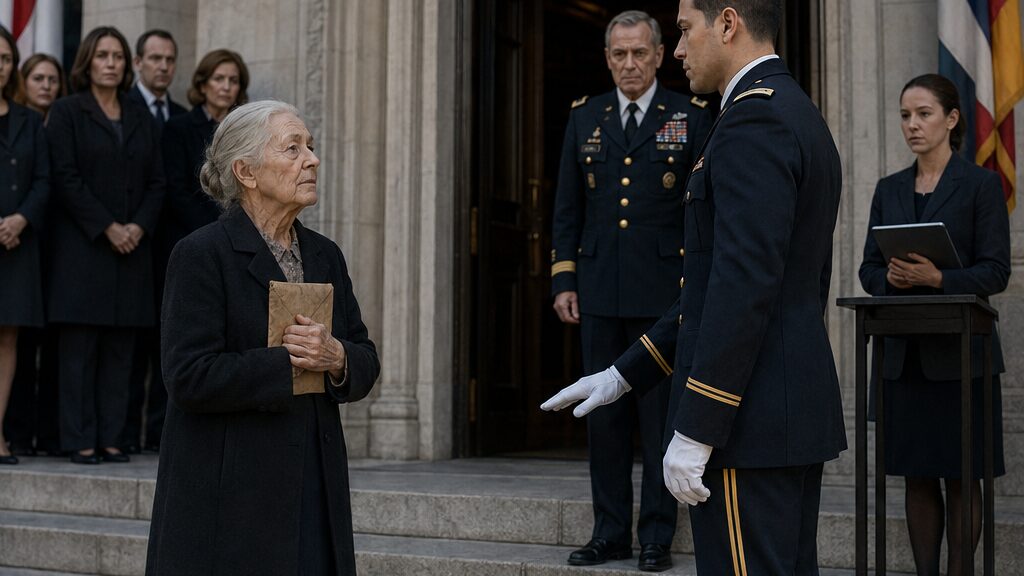
The officer’s white-gloved hand stopped Sharon Harris three inches before her shoe reached the top step.
Not against her body. Not rudely. Just there, palm angled downward, a practiced signal that had probably stopped delivery drivers, late guests, confused tourists, and anyone else who approached the stone entrance without the right credential.
Sharon looked at the hand first.
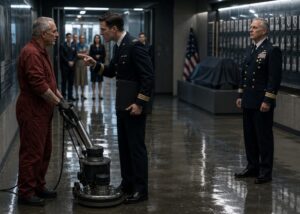
The glove was clean enough to show the faint gray line where the fingers bent. Behind it, the brass buttons on the young officer’s dress uniform caught the morning light. Behind him, the open doors of the military records hall revealed polished floors, flags in brass stands, and rows of chairs already filling with people who had arrived early enough to belong.
She kept both hands folded over the envelope pressed against her chest.
“Ma’am,” the officer said, “this entrance is for registered guests and invited participants.”
His voice was even. Young, but trained to sound older. Sharon had known men who used that voice to hide fear, boredom, kindness, and irritation. This one was hiding haste. He had people to process, a ceremony to protect, and an old woman standing in the middle of the morning’s neat order.
“I understand,” Sharon said.
A man in a suit passed behind her carrying a program. The paper brushed her sleeve. He did not apologize. Two women in dark coats paused near the bottom of the steps, saw the officer’s hand still held out, and moved around Sharon without asking whether she needed help.
The building stood above them like a courthouse. Pale stone columns. Carved dates above the entrance. Two flags moving in a light wind. Sharon had seen it once from the passenger seat of a city bus, years earlier, when her knees still trusted stairs more than elevators. She had thought then that buildings like this were made for the dead and the recorded, not for people still walking around with the missing parts.
Now she stood on the top step, wearing her plain dark coat, her black shoes, and the gray scarf she had chosen because it did not call attention to itself.
The envelope did.
It was small enough to hide under a book and old enough that the corners had softened like cloth. Its paper had browned unevenly. Along the sealed edge, the glue had darkened in a thin wavering line. Sharon held it gently, but not loosely. Anyone close enough could see the way her thumbs rested over the middle as if keeping it warm.
The officer glanced toward the envelope, then back to her face.
“Do you have your invitation?” he asked.
“No.”
“Registration card?”
“No.”
“Government identification?”
“Yes.”
He waited.
Sharon did not reach into her handbag. She had identification. It said Sharon Harris. It showed the address of her apartment, her date of birth, and a picture taken under fluorescent light by a clerk who had told her not to smile. It would not show why she was there.
The officer’s mouth tightened, not with anger, but with the patience of someone running out of it.
“Ma’am, I can direct you to the public assistance desk. It opens after the program. They can help with veterans’ records requests, family inquiries, memorial corrections, and—”
“I did not come for assistance.”
The sentence was quiet enough that the people behind her kept talking. The officer heard it. His eyes sharpened.
“Then may I ask why you are here?”
“For the reading.”
“The reading is closed to invited families and confirmed service members connected to the corrected records.”
“Yes.”
A brief pause settled between them.
The officer looked down at the clipboard in the hand not held up between them. Sharon could see the typed list clipped beneath a clear plastic sheet. Names in neat columns. Last names first. Confirmation numbers. Seat assignments. The names looked simple when they were printed that way. As if a life could be made tidy by alphabetizing it.
“Your name?” he asked.
“Sharon Harris.”
He ran one gloved finger down the page. Then he turned to another page. The wind lifted the corner, and he pressed it flat.
Sharon watched his finger move past names she did not know. Each one had made it inside. Each one had survived the clerks and forms and the long machinery that decided who would be remembered in a room with flags.
The officer looked again.
“I’m sorry, Mrs. Harris. You’re not on the list.”
She nodded once. She had expected the sentence. That did not make it lighter.
“It may be under another name,” she said.
“Do you have that name?”
She felt the envelope shift under her hands, though she had not moved it.
“Not for the doorway,” she said.
The officer glanced past her at the line forming at the lower step. A security guard near the side rail watched without moving closer. Beyond Raymond’s shoulder, inside the hall, a senior officer in a decorated uniform stood near the doorway, speaking to an aide. He turned his head slightly, not enough to interrupt, enough to notice.
The young officer saw the line too. His nameplate read Garcia. Raymond Garcia, if the small program badge under it belonged to him.
“Ma’am,” he said, lower now, “I don’t want you standing out here longer than necessary. If there’s a family name you’re trying to submit, the public desk can give you the proper packet.”
“This is the packet.”
Raymond Garcia’s gaze dropped again.
For the first time, Sharon saw not impatience but discomfort. Not because he had done wrong yet, but because something in her tone did not fit the category he had placed her in. She was not lost. She was not pleading. She was not angry enough to dismiss as difficult.
She was waiting.
He cleared his throat. “Is that an official document?”
“It was.”
“If it’s fragile, we should not handle it here on the steps.”
“I agree.”
“Then the records desk is the proper—”
“The records desk already had fifty-three years.”
The line behind Sharon quieted in patches. One of the women at the bottom step looked up. The man with the program turned his head.
Raymond Garcia straightened. It was only a small change, a tightening at the shoulders, but Sharon saw it. He had been trained to hear numbers when everything else sounded like emotion.
“Mrs. Harris,” he said, “this ceremony is beginning shortly. I have to keep the entrance clear.”
“Yes.”
“If you are not on the list, I cannot admit you through this entrance.”
“Yes.”
“And if this is about a correction, there is a process.”
Sharon looked past him into the hall.
Inside, a row of framed photographs hung along the far wall. Young faces. Old uniforms. Men looking away from cameras as if already watching for orders. She could not see the details from where she stood, but she knew the kind of photographs they were. Every institution had them. Proof of memory. Proof that someone had chosen which faces deserved glass.
Her thumb moved once over the envelope.
“Processes are very good at closing doors,” she said. “Less good at opening the right ones.”
Raymond did not answer immediately. He looked too young to understand how long a closed door could stay closed. He looked too careful to dismiss her completely. That was why she stayed.
Behind him, the senior officer had stopped speaking to the aide. His attention had shifted fully to the steps. He was tall, gray at the temples, with ribbons arranged in disciplined rows. He did not come forward. Not yet.
The wind crossed the entrance and slipped under Sharon’s coat. Her fingers ached where the old paper pressed into them. The envelope had spent most of the last five decades inside a cedar box under folded winter blankets. It smelled faintly of dust and dry wood, though no one else would notice unless they held it close.
She had told herself that morning that she would not clutch it. Clutching made people think you were fragile. But the envelope had a way of pulling her hands back to it.
Raymond turned to the entrance aide. “Check Harris again. Sharon Harris.”
The aide scanned a tablet. “No Harris, Sharon. We have a Harris family group, but not Sharon.”
“Williams?” Sharon said.
The word left her before she decided to offer it.
Raymond looked back.
“First name Sharon?” he asked.
She nodded.
The aide tapped again. A pause. “No Sharon Williams on the guest list.”
Of course not, Sharon thought.
It should not have hurt. She had come because of the absence. She had ridden two buses and walked four blocks because of it. Still, hearing both names fail in the young aide’s quick voice made something small and old inside her fold itself once more.
Raymond exhaled through his nose.
“Mrs. Harris, I’m going to ask you to step aside.”
The security guard moved one pace closer. Not threateningly. Not even with much interest. Only enough to make the shape of procedure clear.
Sharon looked at the guard, then at Raymond’s hand, then at the doorway.
“I can step aside,” she said. “I cannot leave.”
The people behind her were watching now. Some with irritation, some with sympathy, some with the soft, distant curiosity people gave to trouble that was not yet their own. Sharon felt their eyes on her white hair, her coat, her careful shoes, her hands pressed over an old envelope.
An old woman blocking the entrance.
That was what the scene looked like. She knew it. She had learned long ago that appearances could become orders before anyone spoke.
Raymond’s voice softened, which somehow made it worse.
“Do you have someone inside who can come out for you? A son, daughter, sponsor, service representative?”
“No.”
“No family attending?”
“Not for me.”
The answer slipped out more bare than she intended. Raymond blinked once.
Sharon lifted her chin. Not high. Enough.
“I was told to bring this when the names were read aloud again.”
“Who told you that?”
She did not answer.
The senior officer in the doorway took one step forward, then stopped at the threshold. The morning light touched the polished toe of his shoe.
Raymond followed Sharon’s eyes and noticed him. Something in Raymond’s face changed—awareness of supervision, perhaps, or the sudden weight of being watched by someone whose opinion would matter after the ceremony ended.
He lowered his hand at last.
Not as permission. As reconsideration.
“Whose name did you come for, Mrs. Harris?” he asked.
The question arrived gently, but it still found the old place.
Sharon looked down at the envelope. She saw, as she always did, the faded line where another hand had once pressed it shut. A hand younger than hers then. A hand that had trembled only after the noise stopped.
She looked back at Raymond Garcia.
“Mine,” she said. “Mine is only the first mistake.”
Chapter 2: Raymond Garcia Notices the Name That Does Not Match
Raymond Garcia had been told that ceremonies failed at the door.
Not in the speeches. Not in the seating plan. Not when microphones cut out or old veterans refused to stand when their knees had already given enough. They failed at the door, where grief arrived early, pride arrived late, and paperwork never carried the whole truth.
He had repeated that to the entrance team at 0700 with the confidence of a man who believed preparation could hold back disorder. He had checked the barriers, badges, route signs, wheelchair access, press line, family seating codes, and the list. Especially the list.
Now an elderly woman in a dark coat stood in front of him holding an envelope as if the paper had a pulse.
Mine is only the first mistake.
The words sat in Raymond’s ear after she said them.
He glanced toward the senior officer at the threshold. James Nelson had not yet intervened, but his stillness was not neutral. He watched Raymond with a quietness that felt heavier than correction.
Raymond turned slightly so the people behind Sharon would not hear every word.
“Mrs. Harris,” he said, “I need to understand what you mean.”
“No,” she said. “You need to decide whether understanding is required before courtesy.”
The sentence was not sharp. That made it land harder.
Raymond felt warmth rise under his collar. He had not been discourteous. Not exactly. He had followed the list. He had used “ma’am.” He had offered the public assistance desk. But when he replayed the last few minutes, he saw his own hand suspended between her and the doorway. He saw the security guard waiting for the signal he had nearly given.
He looked at the envelope again.
“May I see the outside?” he asked.
Her hands did not move.
“Not open it,” he said. “Only the outside. I won’t take it unless you allow me.”
For a moment, Raymond thought she would refuse. Then Sharon Harris lowered the envelope from her chest, slowly, as if the air itself might damage it. She did not hand it to him. She turned it outward while keeping her fingers along the edges.
Raymond bent his head.
The paper was older than he had expected, not a recent copy made to look old, not a family keepsake tucked into a modern folder. Its surface had the thin, dry texture of something that had outlived filing cabinets. A faded block of print marked one corner. Some of the ink had bled into the paper fibers.
He saw a name first.
WILLIAMS, SHARON A.
Not Harris.
Below it, half obscured by age and a diagonal crease, was a routing stamp. Raymond knew enough about old records to know what he did not know. The code was not part of the modern filing system. It carried a unit marking, a message-control number, and a date that made his jaw tighten.
He glanced up.
“You were Sharon Williams?”
“Yes.”
“This says—”
“It says what it says.”
He leaned closer, careful not to breathe too hard on the paper. Another line appeared beneath the code, handwritten in fading blue ink. It was not an address. It was not a family note.
COMMUNICATIONS SECTION — FIELD DELIVERY HOLD.
Raymond felt the morning around him shift. The line, the doors, the ceremony schedule, the badge scanner—everything remained in place, but it no longer arranged itself around the same center.
“Mrs. Harris,” he said, and stopped.
The name felt suddenly incomplete.
Her eyes met his. Pale, steady, tired. Not demanding.
Raymond straightened.
“Were you service personnel?”
The question sounded wrong the moment he asked it. Too official. Too late.
“I wore the uniform they issued me,” Sharon said. “I answered the call sign they gave me. I signed the forms they put in front of me.”
The entrance aide looked up from the tablet.
Raymond gave him one small look that meant: quiet.
He turned back to Sharon. “Do you have documentation of your service?”
She looked down at the envelope.
“You are looking at the reason there is none where you expected it.”
The answer did not clarify. It deepened.
Raymond could hear the ceremony guests moving past under the supervision of the aide, their shoes tapping against the stone, their voices lowering as they entered the hall. Every minute mattered. The reading of corrected names would begin at 1100. Families had traveled across states to hear someone official admit that a record had been wrong.
And here, on the threshold, was a woman whose name was wrong before she had even entered the room.
He extended both hands, palms up.
“May I hold it?”
Sharon studied him.
Raymond stood still. He did not reach farther. The old habit of command—take, inspect, process—pressed at him. He held it down.
“Only the outside,” he said. “Only long enough to read the stamp clearly.”
Her fingers tightened once at the edges. Then she placed the envelope across his gloves.
It weighed almost nothing.
That surprised him. Something that had stopped her on the steps, changed her voice, and pulled James Nelson to the doorway should have weighed more. Raymond held it with both hands because one suddenly felt disrespectful.
The paper rested against the white cotton of his gloves. Under the lower left corner, nearly hidden by Sharon’s thumbprint and time, he saw a second name.
MARTIN, WILLIAM R.
A thin line connected it to the routing number. A delivery notation had been stamped but not completed. The final box was empty.
Raymond knew the structure of unfinished records. He had seen enough in preparation for the ceremony. Missing dates. Wrong initials. Service numbers transposed. Death notifications delayed. But this was different. This was not a clerical line without a document. This was a document that had survived outside the system.
He looked at Sharon.
“Why isn’t this in the archive?”
A faint change moved across her face. Not quite pain. Recognition of the right question arriving years late.
“Because the archive said it was safer without it.”
Raymond did not know what to say.
Behind him, James Nelson came forward at last. The sound of his shoes against the stone was measured, neither hurried nor ceremonial. The security guard stepped back without being told.
“Garcia,” James said.
Raymond turned, still holding the envelope.
“Sir.”
James’s gaze went first to Sharon, then to the envelope, then to Raymond’s hands. He seemed to approve of the way Raymond held it before he read anything.
“What do we have?”
Raymond did not immediately answer. He looked down again, confirming what he had seen.
“An old communications routing packet,” he said. “Name listed as Sharon Williams. Also references William Martin. It has a field delivery hold stamp and a message-control code I don’t recognize.”
At the name William Martin, James’s expression did not change quickly, but it did change. Something behind his eyes tightened, the way a locked drawer might resist a key.
“May I?” James asked Sharon.
Not Raymond. Sharon.
The difference was small. Raymond felt it.
Sharon’s posture shifted, but she did not reach for the envelope.
“You may look at the outside,” she said.
James nodded once. Raymond angled the paper so James could read without taking it.
The senior officer leaned in. His ribbons remained still across his chest. His mouth set into a thin line as his eyes moved over the routing mark.
“Where did you get this?” James asked.
Sharon’s face closed.
Raymond expected her to say she had found it in a box, or that it belonged to her husband, or that a relative had asked her to bring it. Those were the stories he knew how to process. Family grief. Late paperwork. A keepsake searching for a file.
Sharon said, “It was given to me to carry.”
James looked up.
“By whom?”
She did not answer.
The silence lasted long enough for Raymond to hear the flags outside snapping lightly in the wind.
The entrance aide approached with the tablet held against his chest. “Sir, we need to close the doors in five minutes for rehearsal.”
James did not look away from Sharon.
“Keep them open,” he said.
The aide hesitated. “Sir?”
James turned then, and the aide stepped back.
Raymond felt the first real break in the morning’s order. It should have unsettled him. Instead, it steadied something.
He faced Sharon again and lowered his voice.
“Mrs. Harris, would you be willing to come inside to the security desk? Not the public assistance desk. Just inside. Out of the wind.”
The woman glanced toward the threshold.
Raymond realized then that she had never asked to be comfortable. She had asked to be let into the place where names were being read.
“You will keep the envelope in your sight,” he added. “No one opens it without your permission.”
Sharon looked at his gloved hands. Then she took the envelope back.
The paper left a faint yellow shadow across the cotton where dust had transferred.
Raymond did not wipe it away.
He stepped aside.
Not dramatically. No salute. No announcement.
Just one step, enough to clear the doorway.
Sharon climbed the final inch of stone and entered the hall. Her shoes made almost no sound on the polished floor. People turned to look, then turned away, unsure whether they had witnessed an exception or an error.
James Nelson remained beside the door, eyes on the envelope.
Raymond followed at a respectful distance, no longer guiding her as a problem to be moved, but accompanying a question he should have known how to ask sooner.
At the security desk, under the soft buzz of overhead lights, Sharon placed the envelope on the counter but kept two fingers resting along one edge.
James read the routing code again.
His face was paler now.
“Garcia,” he said quietly.
“Sir?”
James did not take his eyes off the stamp.
“Do not send her away.”
Chapter 3: The Records Room Had No Place for Her
Amy Rivera knew the sound of trouble before she saw it.
It was not loud. Loud trouble belonged to people who had already decided they were right. Quiet trouble came in with officers who lowered their voices, civilians who held paper too carefully, and senior staff who asked for archived systems without explaining why.
Her records terminal had frozen twice that morning. The printer in the corner clicked without printing. A stack of corrected-name packets waited beside her elbow, each one marked for the ceremony that was supposed to begin on time because families had flown in, driven in, and waited through years of government language to hear someone say a name properly.
Then Raymond Garcia appeared in the records office doorway with James Nelson behind him and an elderly woman between them.
Amy looked first at the woman’s hands.
People brought folders, envelopes, photographs, plastic bags, framed certificates, and once a shoebox full of damp letters. Most held those things forward, eager to have the weight transferred to someone official. This woman held her envelope back, close to the center of herself.
Amy stood.
“Sir?”
James did not step fully into the room. He glanced toward the supervisor’s closed office, then at the two veterans waiting near the file-review counter. His voice remained low.
“We need a records check. Immediate, discreet.”
Amy’s fingers were already moving toward the keyboard.
“Name?”
Raymond answered. “Sharon Harris.”
Amy typed. The system searched. A small wheel turned. She hated that wheel. It made every human being wait while the machine pretended absence required effort.
No matching participant.
She expanded the search.
“Date of birth?”
Sharon gave it.
Amy typed again. Nothing under ceremony registration. Nothing under confirmed honoree relation. Nothing under scheduled speaker, witness, or correction petitioner.
She switched to veteran records access.
“Do you have a service number?” she asked.
Sharon’s eyes moved from the screen to Amy’s face.
“Not one that followed me home.”
Amy paused.
Raymond shifted slightly beside Sharon, not interrupting.
Amy had worked in records long enough to know that strange answers were sometimes evasions and sometimes keys. She softened her tone.
“Did you serve under another name?”
“Yes.”
“What name?”
“Sharon Williams.”
Amy typed it. The system produced three pages of unrelated results: a nurse, a supply clerk, a dependent spouse, a civilian contractor. None matched the date of birth. None matched the woman standing in front of her.
Amy searched by partial date. Then by last name and communications. Then by first initial and old service branch filters. The screen returned too much, then nothing, then too much again.
“I’m not finding a clean match,” Amy said.
Sharon nodded, as if Amy had confirmed the weather.
James crossed his arms loosely, but Amy could see tension in the way his fingers gripped his sleeve.
“Try inactive cross-reference,” he said.
Amy glanced at him. “That index is incomplete before the later digitization.”
“Try it.”
She did.
The old system opened in a window that looked as if it had survived purely out of spite. Pale background. Fixed-width text. Search fields that punished spelling. Amy entered WILLIAMS, SHARON A.
One result appeared, then disappeared when she clicked it.
“Archived pointer only,” Amy murmured.
Raymond leaned forward. “What does that mean?”
“It means there was once a file, or there was supposed to be a file connected to another file.” Amy tried to retrieve the pointer again. “Sometimes a married name, sometimes a transfer, sometimes a correction that was never finished.”
“I became Harris after I came home,” Sharon said.
Amy looked at her. “Was that reported?”
“I signed what they gave me.”
“Do you remember where?”
A faint, almost dry breath moved through Sharon. Not amusement. Not quite.
“Too many desks ago.”
Amy lowered her eyes to the keyboard. She had heard older veterans speak that way about paperwork. Not because they were careless, but because systems asked them to prove the same life again and again until details wore down.
She tried HARRIS linked to WILLIAMS. Nothing. She reversed the names. Nothing. She searched by date of birth without first name. A long list appeared. She narrowed by branch.
A partial record surfaced.
WILLIAMS, S.A.
TEMP COMM SEC ATTACHMENT
STATUS: UNMERGED
RELATED HOLD: SEE REF 71-MR-448-DEL
Amy stopped typing.
Raymond noticed. “You found something?”
“Maybe.”
James moved behind her shoulder but kept enough distance not to crowd the desk.
Amy opened the related hold field. A warning appeared.
RESTRICTED LEGACY INDEX. REFER TO ARCHIVE SUPERVISOR.
She looked up.
James’s jaw tightened. “Can you see the reference line?”
“Only the number.” Amy read it carefully. “Seventy-one-MR-four-four-eight-DEL.”
The envelope made a faint sound under Sharon’s fingers. Paper shifting against skin.
Amy looked at her. “Does that mean something to you?”
Sharon did not answer immediately.
The records office around them carried on in quiet fragments. A phone rang once and was silenced. The two veterans near the counter pretended not to listen. Somewhere beyond the wall, a microphone gave a brief pop as someone tested the sound system in the ceremony room.
Finally Sharon said, “It was on the pouch.”
“What pouch?”
“The first one.”
Amy felt the room change around that answer, though she did not yet understand it.
Raymond turned slightly toward Sharon. “There was more than one?”
Sharon’s hand flattened over the envelope.
“There were supposed to be.”
James exhaled, slow and controlled.
Amy studied the woman again. The white hair pulled back neatly. The dark coat worn at the cuffs. The careful shoes. The envelope held as if everyone else in the building might misunderstand it by touching it too quickly.
She had first seen an elderly walk-in with a document problem. Then a possible family petitioner. Then maybe a veteran with a missing name.
Now the old index on her screen was telling her there had been a hold, a delivery reference, and an unmerged status attached to a communications section.
Amy clicked into the supervisor request queue and marked it urgent. The system asked for a reason. She typed: Ceremony participant identity verification.
Then she deleted it.
That was not enough.
She typed: Possible legacy service record and sealed delivery correction.
The request went through.
A red pending marker appeared.
James said, “How long?”
“For a supervisor override? On a normal day, fifteen minutes if they’re kind. Today, with the ceremony—” Amy stopped herself. “I’ll push it.”
Sharon looked toward the hallway.
From the ceremony room came the faint murmur of people settling into chairs. Names printed in programs. Names placed on reserved seats. Names waiting to be read into a microphone.
Amy felt a sudden shame at the way she had trusted the screen’s first answer. Not because she had been careless. Because she knew better than anyone that the first answer was often the system protecting itself from the older mess beneath.
She turned back to Sharon.
“Mrs. Harris,” she said, then corrected herself. “Were you Specialist Williams?”
Raymond looked at Amy. James looked down.
Sharon’s eyes held hers.
“For a while,” Sharon said.
Amy nodded, not making more of it than Sharon had offered.
“Specialist Williams,” she said carefully, “I can’t access the sealed reference yet. But your name is not absent. It is buried.”
The words landed hard enough that no one spoke after them.
Sharon closed her eyes for one second.
When she opened them, they were clear.
“Buried things still move,” she said.
The records-room supervisor’s door opened at the far end of the office. A role-only man in rolled sleeves stepped out with a folder already in his hand, irritation on his face from being pulled away before the ceremony. Amy saw the look fade as he read the reference number on his tablet.
He came toward them more slowly.
“This reference,” he said, “is attached to a William Martin.”
The envelope under Sharon’s hand went still.
Amy looked from the supervisor to Sharon.
“William Martin,” Amy repeated softly.
Sharon’s fingers did not tremble, but they pressed down on the old paper as if keeping it from rising out of the past by itself.
Chapter 4: The Message Was Marked Undelivered
Sharon had spent most of her life learning that paper could lie without meaning to.
A form could forget a name because a clerk had turned the page too soon. A report could call a road secure because no one had written down the smoke beyond the trees. A message could be marked undelivered because the person who carried it was told later that delivery no longer mattered.
In the small archive consultation room, under a square of white ceiling light, the old envelope lay on the table between her and three people who wanted it to explain itself.
It did not.
It sat there quietly, browned at the edges, sealed along one side, light as a dry leaf and heavy enough to bend the air in the room.
James Nelson stood at the far side of the table with his hands clasped behind his back. He had removed his cap. That mattered to Sharon, though she did not say so. Raymond Garcia stood near the closed door, no longer blocking it, no longer hovering over the process. Amy Rivera sat at a terminal against the wall, scrolling through a legacy index that seemed to resist her at every line.
The records-room supervisor had brought the sealed reference summary, then left with a warning that the ceremony schedule could not wait for an unscheduled archival dispute. He had not meant to sound cold. Sharon could tell. People who served systems learned to confuse coldness with neutrality.
James read from the summary again, slower this time.
“Reference seventy-one-MR-four-four-eight-DEL. Related service notation: Williams, S.A. Temporary Communications Section Attachment. Related casualty record: Martin, William R. Delivery status: undelivered. Correction status: unresolved.”
He lowered the page.
Sharon kept her eyes on the envelope.
“Mrs. Harris,” James said.
She did not look up.
“Specialist Williams,” he corrected.
That made her lift her eyes.
The room did not change, but Raymond did. He looked from James to Sharon, then down at his own gloves as if understanding again that names were not decoration.
James continued carefully. “Can you tell us why you brought this today?”
Sharon’s hands rested in her lap. Without the envelope in them, they seemed smaller. Older. She folded one over the other to keep them still.
“Because today you read names that were missed,” she said.
“Yes.”
“And because people will believe the reading is complete.”
Amy stopped typing.
Sharon looked at the sealed packet on the table. “It should not be complete with that line still wrong.”
Raymond’s voice came from near the door. “William Martin’s message?”
She turned toward him.
He stood straighter than he had outside. Not stiffly. Attentively. The difference between posture for display and posture for listening.
“Yes.”
James drew out the chair opposite Sharon but did not sit until she gave a small nod. He lowered himself slowly, keeping the summary page flat before him.
“The record says the message was never delivered,” he said.
“The record says many things.”
“Was it delivered?”
The question moved cleanly through the room.
Sharon looked past him to the small frosted window in the archive door. Shadows passed beyond it: staff, guests, someone carrying flowers, the ceremony continuing to assemble itself around the absence that had brought her there.
“I carried what I was ordered to carry,” she said. “Then I carried what I promised.”
James waited.
That was the first thing he did well. He waited without filling the silence with authority.
Sharon looked back at the envelope.
“It was near the end of my attachment,” she said. “I was twenty-three. Communications, temporary field routing. We were not supposed to be remembered. Not because we were important. Because we were paperwork that moved faster than the units that owned us.”
Raymond’s brow tightened, but he did not interrupt.
“The first pouch was official. The second was not supposed to exist. The third never reached our hands.” Her eyes moved to the sealed edge of the envelope. “William Martin gave me this after the road broke apart.”
“Broke apart?” Amy asked softly.
Sharon’s gaze stayed on the envelope.
“Noise first. Then dust. Then everyone calling for the person they thought still had the map.” She swallowed once. “He was not dead when he gave it to me.”
No one spoke.
The ceiling light hummed.
Sharon saw it again without wanting to: William Martin’s face gray with dirt, one sleeve dark, his mouth trying to make a joke because young men hated being afraid in front of young women. She had not known him well. That was the truth. Stories preferred deep friendships, last confessions, perfect meanings. Life often handed you a stranger’s weight and gave you no time to decide whether you were worthy of it.
“He said if his name was read wrong, his mother would not know which part of him came home.”
Amy’s hand moved from the keyboard to her lap.
James looked down at the summary page, then up again. “His casualty record was corrected in part. That is why he is in today’s reading.”
“Part is not enough.”
“What is missing?”
Sharon held his eyes. “The message was marked undelivered.”
“Yes.”
“It was not.”
James glanced at the envelope. “Then why is it still sealed?”
The question was fair. Sharon disliked him less for asking it plainly.
“Because it is not the message to his mother,” she said. “That one was delivered.”
Raymond shifted. “Then what is inside this one?”
Sharon’s fingers tightened together.
“The record they asked me to sign.”
The room drew inward.
James sat back a fraction. “What record?”
She looked at the envelope as if it were a thing that could hear her. “A field delivery confirmation. A statement that the communications pouch had been lost before assignment, that no unofficial message had been carried, that no personnel outside the listed unit had taken part in the delivery.”
Amy turned slowly back to the terminal and typed something.
Raymond’s face changed in small stages. Confusion first. Then comprehension. Then discomfort.
“They wanted you to say you didn’t carry it,” he said.
“They wanted the file to close.”
“Why?”
Sharon let out a breath that almost became a laugh, but did not.
“Because people were tired. Because the road was a mistake. Because William Martin’s name had been attached to a movement no one wanted reopened. Because I was a temporary attachment and a young woman who had already been told I was lucky to be sent home breathing.”
James looked down.
Sharon saw that he understood enough to be ashamed, though perhaps not of himself. It was possible to inherit shame. Institutions were good at handing it down folded and unlabeled.
“I refused,” she said.
Amy’s fingers stopped above the keys.
Sharon looked at them one by one.
“I did not make a scene. I did not accuse anyone. I said the message had been delivered, because it had. I said I would sign only that. They told me the correction would be handled without me.”
“And your service record?” Raymond asked.
She smiled faintly, not kindly, not bitterly. Just tired.
“Temporary things are easy to misplace.”
The words settled around them.
James touched the summary page with two fingers. “Specialist Williams—”
“Harris now.”
“Harris,” he said. “If this envelope contains a statement they asked you to sign, it could help explain why the record remained unresolved. But we cannot use it unless it is opened and logged.”
“I know.”
“Then why not bring it before today?”
Sharon looked toward the door again.
Because for years she had believed the truth was still somewhere inside the building, even if buried. Because after her husband died, there had been no one to ask why she kept a sealed envelope under blankets in a cedar box. Because the first time she wrote to the records office, the reply had addressed her as the widow of a serviceman she had never married. Because the second reply had asked for documentation that could only exist if the first mistake had not been made. Because there were years when surviving took all the strength she had.
She said only, “I was waiting for them to read the names aloud again.”
James leaned forward. “Today’s ceremony was publicly posted only two months ago.”
“I saw it in the newspaper at the library.”
“You came alone?”
“Yes.”
Raymond looked toward the envelope, then at the chair beside Sharon, as if noticing for the first time that no one had brought her water, no one had asked whether the stairs hurt, no one had offered anything except process.
He took a paper cup from the side counter and filled it from the cooler. He brought it over, then stopped before setting it down.
“May I put this here?” he asked.
Sharon looked at the cup. Then at him.
“Yes.”
He placed it within reach without touching her space.
James watched that small exchange, and something in his expression altered. Not enough for apology. Enough for learning.
Amy turned from the terminal. “The reference summary is tied to William Martin’s correction, but there’s a sealed memo attached to both names. I can request access, but we need a justification.”
James said, “Use command review.”
Amy looked at Sharon. “That may allow us to see why the file was restricted.”
Sharon reached for the cup and held it without drinking.
James touched the envelope’s corner, then stopped before contact.
Sharon noticed.
“Thank you,” she said.
He withdrew his hand.
“I need to ask,” James said. “Will you allow us to open it under archive procedure?”
“No.”
Raymond looked up.
Amy stayed very still.
James absorbed the answer without visible irritation. “May I ask why?”
“Because you are asking for the paper before you have decided what truth is allowed to do.”
James’s face tightened.
Sharon leaned forward slightly. The movement cost her, but she did not show it.
“That envelope has been called lost, irrelevant, unsafe, unofficial, misfiled, and undelivered. It will not be opened as a curiosity. It will not be opened so someone can say they tried. If it enters your record, it enters correctly.”
James said nothing.
Outside the consultation room, a bell chimed softly, signaling guests to take their seats.
The sound reached Sharon like a hand around the ribs.
Amy glanced toward the hallway. “They’re starting soon.”
Sharon looked at the old envelope on the table. William Martin’s name sat hidden inside a record that had outlived him incorrectly. Her own name existed in fragments: Harris on her identification, Williams on the envelope, S.A. in a machine that had nearly forgotten both.
James picked up the summary page again.
“The record says William Martin’s message was never delivered,” he said quietly.
Sharon’s gaze did not move.
“That is why I am still here.”
Chapter 5: A Seat at the Ceremony Was Not Enough
Raymond Garcia stood outside the ceremony room and listened to the names begin without her.
The first name came through the doors softened by wood and distance, followed by a pause long enough for a family to receive it. No applause. The ceremony had been designed with restraint. Each corrected name would be read once, then entered into the official record with a brief statement of service. Families had been told it would be dignified, not theatrical.
Raymond had admired that when he read the schedule.
Now each pause felt like a door closing.
Sharon Harris sat on a bench in the side hallway with the envelope in her lap. The paper cup of water remained untouched beside her. The light above her made the lines in her face sharper, but she did not look diminished. She looked placed there by mistake, like a witness waiting outside a room where the trial had started without her.
James Nelson stood near the wall, speaking quietly with the records-room supervisor. Amy Rivera had gone back into the records office to push for the sealed memo. No one had asked Raymond to stay with Sharon, but he had.
The entrance duty had been reassigned to the aide. Raymond could have returned to the doorway. Instead he remained six feet from the bench, close enough to be useful, far enough not to crowd her.
Inside the room, another name was read.
A woman behind the doors let out a quiet sound—half sob, half breath. The reader continued after the proper pause.
Raymond looked at Sharon. Her eyes were on the envelope.
He had thought recognition would feel cleaner. Notice the clue. Correct the address. Bring the person inside. Instead, the morning had opened into older damage, and every corrected courtesy seemed too small for it.
James ended his conversation and came toward them. The supervisor disappeared down the hall with the expression of a man calculating time against discomfort.
“Mrs. Harris,” James said, then adjusted. “Specialist Harris.”
Sharon’s eyes lifted.
Raymond saw the correction land. Not as reward. As accuracy.
James stood before her with his cap tucked under one arm. “The ceremony is underway. We do not yet have authorization to read the sealed memo. Amy is working on it.”
Sharon waited.
“I can seat you now,” James said. “There is space in the second row. I will make sure your presence is noted. After the ceremony, we can continue the review properly.”
Raymond heard the care in his voice. He also heard the offer’s limit.
Sharon did too.
“A seat,” she said.
“Yes.”
“In the room where the names are being corrected.”
“Yes.”
“With William Martin’s line still wrong.”
James did not answer quickly enough.
Sharon’s hand moved over the envelope once, smoothing nothing.
Raymond looked away toward the closed doors. He had escorted families to those seats all morning. He had considered it respect to make sure they were placed correctly, not jostled, not left uncertain. A seat had seemed like honor.
Now, beside Sharon, it looked like storage.
James lowered his voice. “I do not want your concern lost in the schedule.”
“Then do not place me inside it as decoration.”
The words were quiet, but Raymond felt them like a command.
James’s mouth tightened. “That is not what I intended.”
“I know.”
Her answer removed the easy defense. Raymond saw James take it in.
Inside, another name was read. A man’s voice broke on the response, too low to make out.
Sharon turned toward the doors. “Do they know?”
“Who?”
“The families in there. Do they know correction can still be partial?”
James looked toward the room. “They know records are imperfect.”
“That is not the same thing.”
Raymond watched the senior officer’s face. James Nelson was not an unkind man. That had become clear. But kindness within procedure had its boundaries, and Sharon had found one.
James stepped closer, then stopped. “What would you have me do before we have the document?”
“Delay William Martin’s reading.”
“The program order is already set.”
“It was set without him once before.”
Raymond lowered his eyes.
James inhaled slowly. “If I delay a name without explanation, I create confusion for his family.”
“Is someone here for him?”
James hesitated.
Raymond knew the answer before he said it. “There is one registered relative. Role listed as surviving family.”
Sharon closed her eyes.
The hallway seemed to narrow. The names from inside continued, each one gently released into the room, each one given its official correction.
Sharon opened her eyes. “Then do not let them hear another wrong version.”
James’s voice remained controlled. “The current correction recognizes his service and casualty status.”
“But not the message.”
“No.”
“And not who carried it.”
“No.”
“Then it is not corrected.”
Raymond felt his own earlier words returning to shame him. Not on the list. Public assistance desk. Proper process. Keep the entrance clear. Each phrase had seemed harmless because it belonged to the system. He had not understood how easily harmless words could join a long line of closed doors.
The records-room supervisor returned, carrying a thin printed sheet. Amy followed him, her face focused and pale.
“We have partial access,” Amy said. “Not the memo body yet. But the index confirms the sealed reference links William Martin’s delivery status to Sharon Williams’s unmerged service attachment.”
James turned. “Can we enter a temporary hold on the reading?”
The supervisor frowned. “Sir, the order has already been loaded. The reader has the printed program. We can pass a note, but changing it mid-ceremony—”
“Can we?”
The supervisor glanced toward the doors. “Yes, but it will be noticed.”
Sharon stood.
The movement was careful. Raymond stepped forward instinctively, then stopped himself before offering an arm she had not asked for.
Sharon picked up the envelope.
“Being noticed is not the harm,” she said.
Amy looked at her then, not as a case, not as a petitioner. As someone whose absence from the record had become visible enough to stand in the hallway with them.
James took the printed sheet from the supervisor and read it. His eyes moved once, twice, then stopped near the bottom.
“What is it?” Raymond asked.
James handed the sheet to him.
Raymond read the line.
DELIVERY DISPUTED. COURIER STATEMENT DECLINED. RESOLUTION DEFERRED.
Courier.
He looked at Sharon.
Not widow. Not visitor. Not confused civilian. Courier.
No, he corrected himself. Communications specialist. Service member. The person who had carried what others later found inconvenient.
The ceremony room doors opened slightly, and an aide stepped out. The murmur of the audience came with him. “Sir, William Martin is four names away.”
Sharon’s fingers closed over the envelope.
The hallway waited.
James looked at the supervisor. “Send a hold to the reader. Say archival verification pending.”
The supervisor’s discomfort sharpened. “That will raise questions.”
“Yes,” James said.
The aide disappeared back inside with the message.
For the first time that morning, Raymond saw James choose disorder over false order.
Sharon remained standing, but her shoulders seemed to lower a fraction.
James turned to her. “Specialist Harris, I can still seat you while we complete the review.”
She looked toward the ceremony room doors. Beyond them, a room full of families waited inside a version of history that was almost right.
“No,” she said.
Raymond expected James to object. He did not.
Sharon looked down at the envelope, then back at them.
“I did not come here for a chair.”
Amy stepped closer, holding another printout. “The supervisor can request full memo access if there is claimant consent tied to the physical packet.”
“What does that require?” James asked.
Amy looked at Sharon. “Your permission to treat the envelope as potential record evidence.”
Sharon’s gaze sharpened. “Potential?”
“That is the system word,” Amy said. “Not mine.”
A faint softness touched Sharon’s face and vanished.
Raymond understood then that respect was not only lowering his voice or stepping aside. It was staying uncomfortable long enough for the right thing to become possible.
Inside, the reader announced another name.
William Martin was closer now.
Sharon turned slightly toward the doors.
“His name will not be read under a mistake while I am alive to stop it,” she said.
Chapter 6: The Envelope Was Opened Only After Permission
Sharon had imagined opening the envelope many times, but never under lights this white.
In her mind, it had always happened in a quieter place. At her kitchen table, perhaps, with the curtains half drawn and the cedar box open beside her. Or in a records office where a patient clerk understood the weight of old paper without needing to be taught. Sometimes she had imagined never opening it at all. Let it remain sealed, let the promise remain between the people who had made it, let the world keep its wrong file if the world had so much practice being wrong.
But William Martin’s name was four places from being read again.
So Sharon sat in the archive room with Raymond Garcia, James Nelson, Amy Rivera, the records-room supervisor, and the envelope centered on a gray preservation mat.
No one touched it.
That was the first thing that made it bearable.
The supervisor had brought cotton gloves, a document sleeve, a camera stand, and a narrow tool meant for lifting old sealed flaps without tearing them. He had also brought a form requiring Sharon’s signature. Amy read it aloud instead of sliding it across the table without explanation.
“This grants temporary permission to inspect, image, and enter the contents into restricted review,” Amy said. “It does not transfer ownership until you authorize deposit.”
Sharon looked at the form. “And if I do not authorize deposit?”
“Then the images can be used for review only if you allow that separately.”
The supervisor shifted, impatient. “For the record to be corrected today, deposit would be the cleanest path.”
Raymond looked at him.
The supervisor stopped.
Sharon noticed. Small corrections. Small changed behaviors. They mattered more than speeches.
James sat across from her. “Specialist Harris, before anything is opened, I need to state clearly what I can and cannot do. I can delay the reading briefly. I can authorize a correction if the document supports the reference. I can add a verbal amendment before the ceremony closes. Permanent archival correction will still require review.”
Sharon listened.
“I will not promise what I cannot complete today,” he said.
She appreciated that.
“Will William Martin’s line be read as undelivered?”
James looked at Amy, then the supervisor, then back to Sharon.
“Not if the document confirms what you have told us.”
“My service name?”
“We can state the record is under immediate correction and identify you as Sharon Williams Harris if you permit it.”
The sound of the two names together moved through Sharon like cold water.
Williams belonged to a young woman in a field shirt with ink on her fingers, who could sleep sitting upright if someone promised to wake her for the next dispatch. Harris belonged to a woman who had paid rent, buried a husband, bought groceries with coupons, and answered mail addressed to Mrs. Harris because correcting every stranger was exhausting.
Together, they sounded almost whole.
She signed the form.
Her handwriting was slower than it had once been, but still legible.
The supervisor reached for the envelope.
Sharon’s hand came down over it.
The room froze.
He drew back immediately.
Sharon looked at James. “Not yet.”
James nodded. “Tell us what condition you require.”
She kept her palm on the envelope. The paper was cool beneath her skin.
“William Martin’s record and my service name must both be corrected. Not one as a courtesy for the other. Not mine because I am in the room and his because he is not. Both.”
James did not hesitate. “Agreed, if the document supports it.”
“And the envelope is not to be opened as if it is abandoned property.”
“It is yours until you deposit it.”
“It was never only mine.”
The words came out before she could smooth them.
Raymond stood near the side of the table, hands folded before him, expression still. Amy’s eyes had lowered to the envelope. The supervisor looked less impatient now.
Sharon lifted her palm.
“Now,” she said.
The supervisor put on gloves. So did Amy. Raymond already wore his white gloves from the ceremony entrance, but he did not move toward the table until Sharon looked at him.
“Would you prefer I step back?” he asked.
“No,” she said. “You were at the door.”
He understood enough to remain.
The supervisor positioned the envelope under the camera. Amy logged the exterior: old routing stamp, Williams, Sharon A.; Martin, William R.; delivery hold; message-control number; sealed flap intact. Her voice was professional, but softer than before.
When the tool slid under the flap, Sharon felt the sound in her teeth.
It was almost nothing—a dry whisper of old glue loosening. Yet her fingers curled against her skirt, and for a moment the archive room vanished.
Dust. Heat. A young man pressing folded paper toward her with a hand that would not stop shaking. Someone shouting for a medic. A pouch strap cutting into her shoulder. Her own voice saying, “I’ll carry it,” because there had been no time to say anything better.
The flap lifted.
Inside were two folded sheets.
Not many. Not dramatic. No medal. No photograph. No grand confession.
Just two pieces of paper that had waited longer than most people lived.
Amy lifted the first sheet with both hands and laid it flat beneath a transparent weight.
The supervisor photographed it.
James leaned forward.
Raymond did not.
Sharon watched his restraint and was grateful.
Amy read the heading. “Field delivery statement. Communications section attachment. Courier: Williams, Sharon A.”
Her voice caught slightly on courier, but she continued.
“Subject: Martin, William R. Final personal message delivered to next of kin through field chaplain chain. Delivery witnessed by—” She paused, scanning the faded signatures. “Two names partially illegible. Date confirms after casualty notation.”
James closed his eyes briefly.
Raymond looked at Sharon.
She did not look back. Her eyes were on the paper.
Amy read the second document more slowly.
“Statement declined. Proposed amendment indicates courier unable to verify delivery due to field disruption. Signature line unsigned.”
“That is the one,” Sharon said.
James looked up. “The statement they wanted you to sign.”
“Yes.”
The second page had been folded smaller. Along the bottom was an empty signature line. Above it, typed words claimed what Sharon had refused to make true.
Courier unable to confirm final message delivery.
She remembered the officer who had placed it before her. Tired eyes. Bad coffee. A bandage on his hand. He had not shouted. He had said, “This will make it easier.” He had said, “No one is blaming you.” He had said, “The family has been notified. The rest is administrative.”
She had stared at the signature line and seen William Martin trying to lift his head.
So she had not signed.
Amy turned the first page slightly. “There is a handwritten note at the bottom.”
Sharon knew.
She had read it once. Only once, before sealing everything away.
Amy looked at her. “May I read it aloud?”
Sharon’s throat tightened.
“Yes.”
Amy leaned closer.
“Specialist Williams completed delivery after separation from assigned movement. Remove hold when Martin record corrected. Do not discard courier statement.”
The room went silent.
James’s hand closed slowly around the edge of the table.
Raymond’s face had gone pale beneath the controlled stillness.
The supervisor whispered, “That should have triggered a correction.”
Amy said, “It didn’t.”
Sharon looked at the empty signature line on the false statement. It had been waiting all these years for her to become tired enough to agree
Chapter 7: Respect Became the Way They Said Her Name
The ceremony room had not been built for interruptions.
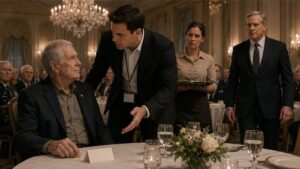
Rows of chairs faced a raised platform beneath two flags and a seal mounted on dark wood. Programs rested in laps. Hands folded over them. Some guests leaned toward one another in low confusion because the reader had stopped after announcing an archival verification pause. No one had said William Martin’s name yet.
Sharon stood just outside the threshold with Raymond Garcia beside her and the opened envelope behind her in the archive room, protected now in a sleeve.
She had thought she would feel lighter once it was opened.
She did not.
Some burdens did not leave when proof appeared. They changed shape. They moved from the chest into the room and asked everyone else what they would do with the space they had been given.
James Nelson walked down the side aisle carrying the corrected page. He did not hurry. That steadied the room more than speed would have. People watched him, some curious, some impatient, some simply tired in the way families became tired when grief had to sit through procedure.
At the front, the reader stepped back from the microphone.
James took his place but did not begin at once.
Raymond glanced at Sharon. “Would you like to sit before he speaks?”
She looked at the empty chair near the side wall that someone had placed there for her. A kind gesture. A useful one. Still, she remained standing.
“Not yet,” she said.
Raymond nodded and did not ask again.
Across the room, a single woman sat alone near the third row, holding her program with both hands. She was older than Raymond but younger than Sharon, with a dark coat buttoned to the throat. A folded tissue rested unused in her palm. Sharon did not know her, but she knew the shape of waiting in her shoulders.
William Martin’s surviving relative.
The thought did not strike like lightning. It settled. Heavy, exact.
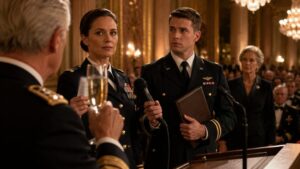
James adjusted the microphone. The small sound traveled through the speakers.
“Ladies and gentlemen,” he said, “thank you for your patience. Before we continue the reading, an immediate correction must be entered into today’s record.”
The room went very still.
Sharon felt Raymond shift beside her. Not with discomfort. With attention.
James looked down at the page, then out at the room.
“The purpose of this ceremony is not to make the record sound complete. It is to correct it where it has failed. A short time ago, a legacy field document connected to one of today’s names was brought forward. It has been inspected under archive procedure and entered for immediate review.”
A murmur moved and died.
James did not look toward Sharon. She was grateful. He was not putting her on display before the correction had been made.
“The next name in the original sequence was to be read as follows,” James continued. “William R. Martin, service record amended to confirm casualty status and unit identification.”
The woman in the third row lowered her chin.
James looked at the corrected page.
“That is incomplete.”
The sentence reached Sharon where she stood in the doorway.
It was not an apology. It was better. It was a refusal to keep repeating the wrong thing.
James continued, his voice even. “The interim correction entered today confirms that William R. Martin’s final personal message was delivered through field communication channels after the event that caused the original record failure. The prior notation stating delivery was undetermined or undelivered is suspended pending permanent correction.”
The woman in the third row raised her head.
Sharon kept her hands at her sides. They wanted the envelope. They wanted the old position against her chest. But the envelope was no longer only hers to protect by hiding it.
James turned the page slightly.
“This correction also confirms that the courier statement was connected to Sharon A. Williams, later Sharon Harris, temporary Communications Section attachment. Her service cross-reference was not merged into the record properly. That correction also begins today.”
The room did not applaud.
For one suspended second, Sharon feared it might. Applause would have broken the thing open in the wrong direction. It would have made a performance of what had taken too long to say.
Instead, the room remained quiet.
Then a man in the first row straightened in his chair. One of the two veterans near the aisle removed his cap and placed it over his knee. The reader stepped back another half pace, giving James the microphone fully. A woman near the back lowered her program as if paper had suddenly become insufficient.
The change was small, but Sharon felt it.
Respect, when it was real, often arrived as room made for the truth.
James looked toward the third row. “A surviving family representative for William Martin is present. After the ceremony, the records staff will make the corrected interim statement available for review.”
The woman pressed the tissue to her mouth.
James lowered his eyes to the page.
“William R. Martin,” he read.
The name entered the room cleanly.
No flourish. No trembling music. No forced solemnity beyond the weight it already carried.
“Final personal message delivery confirmed through field communication statement. Prior delivery notation suspended for correction. Related courier record: Sharon A. Williams Harris, Communications Section attachment, cross-reference pending merge.”
Sharon closed her eyes.
There he was.
Not alive. Not restored. Not made into the simple hero people sometimes needed the dead to be. But no longer marked by that one false absence. The message had reached the world that needed to know it had been carried.
When Sharon opened her eyes, the woman in the third row was standing.
Not fully at first. Her knees seemed to hesitate, then she rose, program in one hand, tissue in the other. She turned toward the side of the room, searching. Her eyes found the doorway.
Sharon did not move.
The woman looked at her for a long moment. There were questions in her face, too many for the room, too many for a ceremony, too many for an old woman who had spent the morning holding herself together by the edges.
So Sharon gave her the only answer she could from across the room.
She nodded once.
The woman covered her mouth and sat back down.
James stepped aside, and the reader returned to the microphone. The ceremony continued. Other names followed. Each one deserved its space. Sharon listened from the threshold, because leaving before the end felt wrong and entering fully felt unnecessary. Raymond stayed beside her.
When the final name had been read, the room remained quiet again. Chairs shifted. People stood slowly. Some turned toward Sharon, curious, but James moved first, coming down from the front not to guide attention toward her but to shield her from its suddenness.
Amy appeared from the archive hallway with the sleeved envelope resting on a flat document board. She carried it with both hands.
Sharon looked at it.
Empty, she had thought earlier.
But it was not empty. It held the impression of what it had guarded. It held the old routing stamp, the service name, the crease where years had leaned on it. It held the distance between the steps and this room.
Amy stopped before her. “The documents are imaged and logged. We can return the envelope to you now, or you can authorize deposit with the file.”
Sharon looked beyond Amy into the ceremony room.
The woman from the third row was standing near her seat, not approaching yet. Waiting. That restraint touched Sharon more than a rush would have.
“Will it stay with his record?” Sharon asked.
Amy glanced at James.
James answered. “With his correction and yours. Cross-referenced. Not separated again.”
“Not as abandoned material.”
“No,” Amy said. “As submitted by Sharon A. Williams Harris.”
Sharon took in the sound of it.
There was still work ahead. Permanent review. More forms. More people who would ask for copies and signatures and dates. The system had not become good because one room had listened. But the false line had been interrupted. That mattered.
She nodded.
“Then it stays.”
Amy’s eyes softened. “I’ll prepare the deposit receipt.”
The records-room supervisor hovered behind her with a folder, subdued now. He did not reach forward. He waited until Amy turned and handed him the document board. Then he took it carefully, like something that could not be replaced.
Raymond stepped toward Sharon with the old outer envelope, now inside a clear protective sleeve. Amy had separated it from the internal documents for her to see before deposit. He held it in both gloved hands.
“May I return this for your review?” he asked.
The question undid something in her.
Not because it was grand. Because it was exact. In the morning, his hand had stopped her before the doorway. Now those same white gloves held the envelope as something requiring permission.
“Yes,” Sharon said.
He placed it across her palms.
For a moment she felt the strange distance between paper and skin through the sleeve. She missed the texture of it, the old dry surface, the tiny breaks along the corner. Then she understood that missing it was part of releasing it.
The woman from the third row approached slowly.
James noticed but did not interfere. Raymond stepped back. Amy turned away to give them privacy without leaving.
The woman stopped a few feet from Sharon.
“Were you the one?” she asked.
Her voice was low. Not accusing. Not even asking for the whole story. Only trying to connect the name she had heard to the person standing before her.
Sharon held the sleeved envelope.
“I carried what he gave me.”
The woman looked at the envelope, then at Sharon’s face. “My father was William’s brother.”
Sharon nodded. She had known the family representative might not be his mother, of course. Too many years had passed. Time replaced witnesses with descendants and asked them to grieve things they had never seen whole.
“He talked about the message,” the woman said. “Not often. He said his mother received something that let her sleep. But the record always said—”
“I know.”
The woman’s eyes filled, but she did not cry. “He hated that.”
“So did I.”
They stood with that between them.
There were many things Sharon could have said. That William had tried to make a joke. That his hand had been cold despite the heat. That she had been afraid she would drop the pouch. That she had delivered the message with dust in her mouth and blood dried on one sleeve that was not hers. That she had spent years wondering whether a mother’s sleep had been worth a young woman’s silence.
But those were not all hers to give in a hallway.
The woman looked at the envelope again. “Thank you.”
Sharon’s grip tightened slightly.
She had heard thank you before in careless forms. Thank you for your inquiry. Thank you for your patience. Thank you for your service, spoken by people already looking past her.
This one did not move past her.
Sharon inclined her head. “He wanted it carried.”
“And you carried it.”
“Yes.”
The woman stepped aside after that, not because the conversation was finished, but because she understood that some gratitude should not trap the person receiving it.
Amy returned with a deposit receipt and a pen. Sharon signed slowly: Sharon A. Williams Harris.
The three names looked unfamiliar together, then right.
James signed beneath her as witness. The supervisor signed. Amy logged the time. The envelope and documents were placed into an archival folder marked with both records. Sharon watched until the folder was closed.
Only then did she feel the morning reach her body.
The stairs. The buses. The standing. The years.
Raymond saw it and moved a chair closer without touching her arm.
“Here,” he said, then corrected himself. “Would this help?”
She looked at him.
“Yes.”
She sat.
For a few minutes, the hall emptied around her. Guests passed quietly, some glancing at her, some nodding, none interrupting. The flags near the doorway moved faintly in the draft each time the outside doors opened.
James came to stand beside her chair.
“I owe you an apology,” he said.
Sharon looked up. “For what part?”
He accepted the question.
“For believing the record was complete because it had reached my desk that way.”
She considered that.
“Then do not apologize only to me.”
“No,” he said. “I won’t.”
That was enough for now.
Amy gave Sharon a copy of the deposit receipt and the interim correction. Sharon folded the receipt once and placed it in her handbag. Her hands felt oddly empty without the envelope. She rested them on her knees and let them be empty.
When she finally stood to leave, Raymond was near the entrance.
The same stone doorway waited ahead. Morning light had shifted to evening gray. Outside, the steps descended to the sidewalk where people moved on with ordinary errands, carrying bags, checking phones, calling for rides.
Sharon walked toward the doors.
Raymond did not hurry ahead to open them as if she were helpless. He reached the door first only because he was closer, then paused with his hand on the handle and looked back.
She gave a small nod.
He opened it.
The air outside was cool. Sharon stepped onto the top landing where he had stopped her hours earlier. For a moment, she stood in the exact place where his white glove had hovered between her and the hall.
Raymond came beside her, leaving enough space.
Behind them, James and Amy remained just inside, speaking quietly with the records-room supervisor. The building no longer looked like a thing made only for the recorded dead. It looked, for the first time, like a place that could still be corrected by the living.
Sharon adjusted her scarf.
Raymond faced her. His voice, when he spoke, was not loud enough for anyone else to use.
“Specialist Harris.”
She looked at him.
He did not salute. Perhaps he wanted to. Perhaps he knew that was not what the moment required. Instead, he stood straight, held her gaze, and waited.
“Would you permit me to walk with you down the steps?”
Sharon looked at the steps, then at his gloved hands, then at the open door behind them.
In the morning, she had been asked to step aside.
Now she was being asked.
That was the difference.
“Yes, Officer Garcia,” she said. “You may walk beside me.”
They descended slowly, not because she could not walk alone, but because he had finally learned not to decide that for her.
At the bottom, Sharon turned once toward the stone building. Somewhere inside, an archive folder now held the envelope, the signed statement, the unsigned lie, William Martin’s corrected line, and her two names brought back together.
She touched the folded receipt inside her handbag.
It was not the same as holding the envelope.
It was enough.
Raymond waited beside her on the sidewalk until she chose her direction.
Then Sharon Harris, who had arrived as an old woman not on the list, walked away from the records hall with her name finally moving through the proper doors behind her.
The story has ended.