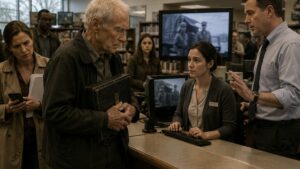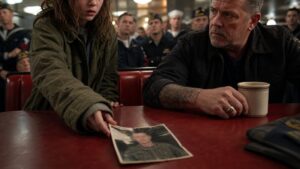
The Old Veteran Sat In The Rain Until One Officer Read His Forgotten Folder
Chapter 1: The Man Sitting Below The Brick Wall
The old man was sitting in the rain before anyone decided whether he was allowed to exist there.
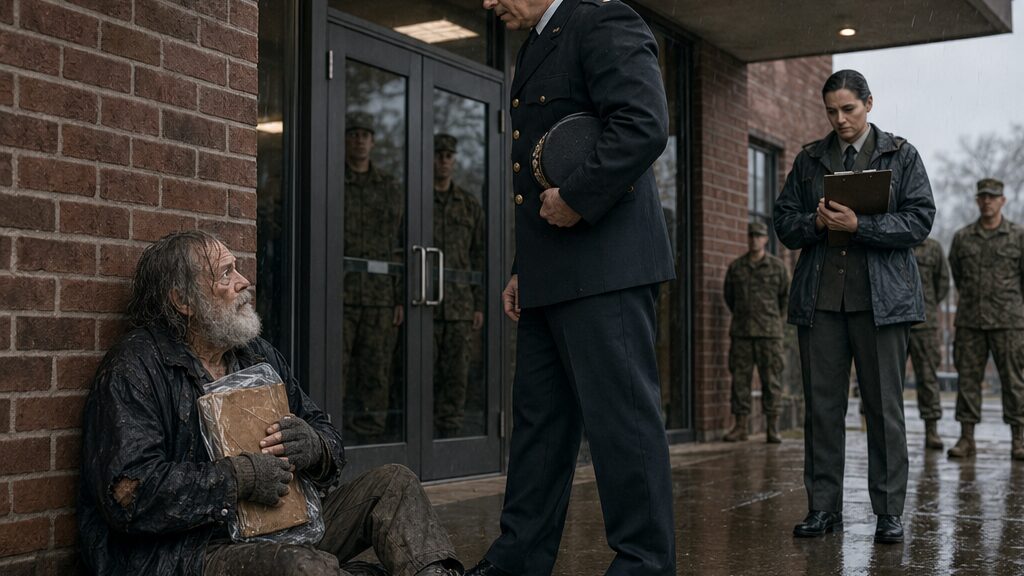
Water ran from the edge of the brick administration building and fell in steady threads onto the pavement beside his boots. The left boot had split near the toe. The right one still held, though the lace had been knotted twice with a piece of brown string. David Walker kept both feet tucked under him as well as his knees would allow, his back against the wall, his shoulders curved around the cardboard folder pressed to his chest.
The folder had once been tan. Rain had darkened it to the color of old tea. Tape crossed the spine in three cloudy strips. One corner had gone soft, and David kept his gloved thumb over it, not because it helped much, but because his hand needed something to do besides tremble.
People went in and out of the building under black umbrellas and stiff green ponchos. None of them looked at him for long. A glance, a narrowing of the eyes, a small adjustment of direction, then they passed through the glass doors where warm light spilled across the entry mat.
David knew those doors.
Not these exact doors, maybe. Not this polished handle or this security camera tucked beneath the awning. But he knew the smell that came out when the doors opened: floor wax, wet wool, paper, coffee burned too long in a pot. He knew the way a military building held its breath in the morning, everyone trying to look prepared before anyone knew what the day would ask of them.
He had arrived before sunrise.
The guard at the outer gate had told him visitor processing opened at seven. At seven, another guard told him the memorial event had changed traffic flow and no walk-ins were being cleared. At seven-thirty, David tried the number written in blue ink on the visitor request folded inside his folder. The call rang until it gave him a recorded message. At eight, rain became hard enough to blur the flagpole across the courtyard. At eight-twenty, his legs stopped trusting him. He lowered himself beside the brick wall, away from the center of the entrance, and waited.
Now it was after nine, and a pair of young soldiers stood ten yards away, pretending not to watch.
David felt their eyes move across his beard, his coat, his fingerless gloves, the plastic grocery sack tied around one side of the folder. He did not blame them. At their age, a man on the ground was either a problem or a warning.
The glass doors opened again.
A man stepped out in a dark dress uniform, shoulders squared under the canopy light. He wore his cap low enough that rain dotted the brim but not his face. His shoes were polished black. His jaw looked freshly shaved. Everything about him had edges.
David looked at the nameplate before he looked at the man’s eyes.
Miller.
The officer stopped a few feet in front of him. He did not crouch. He did not ask if David needed help. He looked down the way men looked at something blocking a hallway.
“Sir,” the officer said, and the word held no respect, only procedure. “You can’t sit here.”
David tightened his hand on the folder. “I’m not blocking the door.”
“This is a controlled entrance.”
“I know.”
The officer’s expression changed a little at that. Not surprise. More irritation, as if David had chosen the wrong answer.
“You need to move to the public waiting area outside the gate.”
“I was at the gate.”
“Then you’ll need to return there.”
David lifted his face. Rain had gathered in his eyebrows and in the lines beside his nose. He blinked it away slowly. “I have papers for the room with the names.”
One of the young soldiers shifted his weight. The sound of his boot sole scraping wet pavement was small but sharp.
The officer glanced at the folder. “Records office?”
David did not answer quickly enough.
“Sir,” Miller said again, firmer now, “if you have a claim or a benefits issue, this is not how you file it. You can call the VA office or make an appointment online.”
“I called.”
“Then call again.”
“They hung up the first time. The second time, a woman told me the file was closed.”
The officer looked toward the gate, then back at David. The rain gave him an excuse not to soften. “This building is preparing for a memorial dedication. We have guests arriving. Families. Command staff. You can’t remain by the entrance with”—his eyes dropped again—“that.”
David looked down too.
That.
The folder had been in a dresser drawer for eleven years after he stopped keeping it under the bed. Before that it had lived in a footlocker. Before that in a green canvas bag with a broken zipper. Before that it had crossed an ocean in a plastic sleeve that smelled like diesel and mildew. It had been handled by clerks, officers, a chaplain, and once by a boy who had asked whether the old photograph inside showed David when he was brave.
David had not known what to say then either.
“It has to get inside today,” he said.
Miller exhaled through his nose. “Sir, I’m not going to debate this in the rain.”
“Then don’t.”
The officer’s eyes sharpened.
David knew that look too. A younger version of himself had once given it to men who would not move fast enough, men who dropped equipment, men who cried in places where crying made other people afraid. It was the look of someone confusing control with duty because control was easier to inspect.
Miller turned slightly toward the soldiers. “Get security to bring a chair to the outer station.”
“I don’t need a chair.”
“You need to move.”
David’s legs ached from the cold pavement. His right hip had begun to burn. He could feel water seeping through the back of his coat where it touched the wall. A younger man would have stood. An angrier man would have made a scene. David only pressed the folder closer, careful not to bend the papers inside.
A gust pushed rain under the canopy. Drops struck the folder. He curled his body over it.
Miller saw the movement and misread it.
“What’s in there?”
David’s thumb covered the taped corner.
“Papers.”
“What kind of papers?”
“The kind that got lost when men didn’t.”
The officer stared at him.
Behind Miller, the glass doors opened once more. A woman came out carrying a clipboard against her chest, her dark hair pulled back tight, uniform sleeves clean and dry except where rain touched them at the cuffs. She slowed when she saw the circle of attention: Miller standing, David seated, two soldiers watching, the folder between them like something no one wanted to name.
“Major Miller?” she said.
Miller did not turn all the way. “Not now, Lieutenant.”
She stopped anyway.
David saw her eyes move over him with the same first glance everyone gave. Wet coat. Old face. Worn boots. Beard. Problem. Then her gaze dropped to the folder.
Not just to the folder.
To the half-exposed strip of paper beneath the plastic sack, where rain had loosened the top sheet and lifted one faded corner. David looked down and saw what she saw: a line of old block letters, almost washed pale, and beneath it a number written in a format no one used anymore.
Michelle Roberts took one step closer.
Miller noticed. “Lieutenant, I said not now.”
Her voice changed before her face did. It grew careful.
“Sir,” she said, “may I see that folder?”
David looked at her hand, then at her eyes. She did not reach for it. She waited.
That was the first thing anyone had done right all morning.
“It gets wet if I open it here,” he said.
Michelle shifted the clipboard under one arm and unbuttoned the top of her rain jacket. “Then we can move it under the canopy.”
“I’m under the canopy.”
“No,” she said softly. “I mean all the way under.”
Miller’s mouth tightened. “Lieutenant Roberts.”
But Michelle was looking at the old code again. Her face did not show pity. David was glad of that. Pity made people careless.
“What did you call the place you needed?” she asked.
David swallowed. His throat felt scraped by the cold.
“The room with the names.”
Miller looked away for half a second, impatient with the phrase, but Michelle did not. She looked at her clipboard, then back at the folder, and something in her posture stilled.
David saw it happen.
Not recognition. Not yet.
But the beginning of a question strong enough to stop procedure in its tracks.
Chapter 2: The Clipboard Number That Made Her Stop
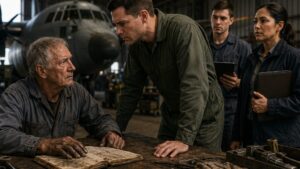
Michelle Roberts had spent the morning checking names against a printed schedule that left no room for rain, old men, or damaged cardboard folders.
The memorial dedication was supposed to begin at four. Families would arrive at two-thirty. Command staff would arrive at three. The program would honor a unit whose history had been condensed into clean paragraphs, framed photographs, and a bronze plaque covered in blue cloth. Michelle’s job was simple: confirm guests, confirm seating, confirm access badges, confirm that no one embarrassed the command by appearing unprepared.
Then she saw the number on the old man’s folder.
It was not printed cleanly. It sat beneath a smear of water and lifted tape, half-hidden by the plastic grocery sack he had wrapped around the folder. But the shape of it was enough.
A two-letter unit code. A dash. Four digits. A suffix.
Michelle looked down at the top sheet on her clipboard.
The same two-letter code appeared under the memorial file heading.
Her fingers tightened around the clipboard until the metal clip pressed into her thumb.
“Sir,” Major Miller said behind her, “this has already taken too long.”
Michelle heard him, but she did not look away from the folder.
The old man was watching her with a tired patience that made her feel suddenly, sharply young. Not young in age. Young in certainty. Young in all the ways she trusted forms to tell her what mattered.
“Mr…?” she asked.
The old man did not answer right away.
Miller cut in. “He hasn’t provided identification.”
Michelle kept her eyes on the old man. “What name should I use?”
Rain tapped against the canopy. A drop slid from the man’s beard and landed on the folder.
“David,” he said.
Michelle waited.
“David Walker.”
The name struck the page before she found it.
Walker, D.
Not on the guest list. Not under living veterans invited. Not under family contacts.
Lower.
In the incident appendix attached to the dedication packet, listed as witness unavailable.
Michelle read the line twice, because the first time her mind rejected it.
Witness unavailable.
The man in front of her shifted the folder closer to his chest, as if her silence had become another hand reaching for it.
Michelle lowered her voice. “Mr. Walker, did you serve with the 214th Field Support Detachment?”
Miller turned fully now. “Lieutenant.”
David’s gaze did not move from Michelle’s face. “For a while.”
“When?”
“A long time ago.”
“What year?”
His eyes hardened just enough to shut a door. “Year’s in the folder.”
Miller gave a short laugh without humor. “Lieutenant, you are not processing an unknown individual through this entrance based on something written on wet cardboard.”
Michelle turned one page on her clipboard. Her training told her not to challenge a senior officer in front of enlisted personnel. Her conscience told her that training had limits.
“The number on his folder matches the restricted incident file tied to today’s dedication.”
Miller looked down at the folder again. This time he did not see trash, but he still looked at it as if it had inconvenienced him.
“Coincidence.”
“It also matches the packet I signed for this morning.”
“That packet has been cleared.”
“Not completely.”
Miller stepped closer. “What does that mean?”
Michelle glanced at David. She did not want to turn his life into a line item spoken over his head. Yet that was already what the morning had done.
“It means his name is in our file.”
The young enlisted guard nearest the door stopped pretending not to listen.
David looked toward him briefly. The guard straightened too late, embarrassed by being caught.
Michelle felt heat in her face despite the cold. She slid the clipboard under her arm and crouched, careful to keep her knees out of the puddle spreading along the brick seam. She was still in uniform. She knew exactly how it looked for her to crouch while Miller stood. She did it anyway.
“Mr. Walker,” she said, “I’m going to ask carefully. Do you have identification inside that folder?”
“Not the kind the gate wants.”
“What kind?”
“Old kind.”
“May I see just the top page?”
His thumb moved over the taped corner. For a moment she thought he would refuse. Then he adjusted the plastic sack, opening it enough to expose a brittle sheet beneath. The paper had been folded and unfolded so many times the creases had gone white. At the top was a faded seal. Below it, typed letters.
WALKER, DAVID.
Michelle did not touch it.
Miller leaned in as if he might.
David’s hand closed.
Michelle looked up fast. “Please don’t.”
The words came out sharper than she intended.
Miller stared at her.
She made herself steady her voice. “The paper is wet. If we tear it, we may lose the identifying marks.”
The explanation gave him a way not to hear the accusation.
David’s eyes rested on her for one second longer than before.
Michelle stood. “Mr. Walker, can you come inside to the security desk?”
“No.”
Miller’s face tightened again. “You just said you needed to get inside.”
“I said the folder did.”
Michelle paused. “You don’t want to come in?”
David looked through the glass doors. Warm light crossed his face, then vanished as the doors slid shut. “I didn’t come to be received.”
“Then why?”
His jaw worked once.
“The names,” he said.
Miller rubbed a hand over his mouth, impatience returning. “Lieutenant, this is absurd. We have a memorial event today. We cannot derail access control because a man with no current ID says he has papers.”
Michelle looked down at her clipboard. Her thumb found the memorial appendix again. The dedication plaque listed names of personnel from a long-ago evacuation mission. The official summary had arrived sanitized, shortened, safe. One casualty line had a notation beside it: conduct under review, no family contact confirmed.
Below that, a witness note.
Walker, D. — unavailable.
She looked at the man sitting against the wall.
He did not look unavailable. He looked like someone everyone had avoided finding.
“Major,” she said, “we don’t have to clear him into the building yet. But we do need to protect those documents.”
“We?”
“Yes, sir.”
Miller’s eyes flicked toward the soldiers. He knew they were watching. Michelle knew he knew. That made the silence worse.
The young guard by the door spoke before anyone expected him to.
“There’s a dry table at the security station, sir.”
Miller turned his head slowly. The guard’s face went pale, but he did not take the words back.
Michelle saw the opening and took it. “We can move the folder there. Mr. Walker can remain in the public side of the station until Records verifies the number.”
David gave a small shake of his head. “No one takes it where I can’t see it.”
“No one will,” Michelle said.
She waited until he looked at her.
“I’ll ask before I touch it.”
The rain softened for a moment, just enough that the individual drops could be heard striking the puddles. David looked at the folder as if it were not paper but a person resting against him.
Then he shifted one hand to the wall.
Michelle moved instinctively to help, then stopped herself. He noticed that too. Pride, pain, and gratitude crossed his face so quickly she almost missed them all.
He pushed himself up slowly. His knees resisted. His right boot slipped on the wet pavement, and the young guard stepped forward. David lifted one finger without looking at him.
Not yet.
The guard froze.
David stood.
He was shorter than Miller, stooped by age and cold, but standing changed him. The folder remained against his chest. Rainwater dripped from its lower edge onto the pavement.
Michelle stepped aside to give him space.
Miller did not move at first. Then, stiffly, he shifted one polished shoe out of David’s path.
That small movement altered the entire entrance.
David took one step under the deeper part of the canopy. Then another. Michelle walked beside him, close enough to steady him if he fell, far enough not to make the offer visible. Miller followed.
At the security desk, fluorescent light made the folder look worse. Its tape had yellowed. The cardboard sagged in the middle. A dark stain marked one side, old enough that Michelle could not tell whether it was mud, oil, or something the paper had carried from another country.
David placed the folder on the metal table himself.
Water pooled beneath it.
Michelle set her clipboard beside it. Clean white pages. Straight black print. Official lines.
Old paper and new paper touched at the corners.
The incident number matched.
Michelle read it once more, then looked up at Miller.
“This name,” she said quietly, “is already on today’s program.”
Miller’s expression tightened, confused.
Michelle turned the clipboard so he could see the appendix, then pointed not to the printed honorees but to the small witness line no one had planned to read aloud.
“But not where it should be.”
Chapter 3: The Officer Who Mistook Order For Honor
Anthony Miller had built his career on preventing small disorder from becoming large embarrassment.
A blocked entrance, a missing badge, a civilian wandering through the wrong door, a family member arriving upset before a ceremony—these were not dramatic problems, but they were the kind that exposed weak seams. People remembered the ceremony that went wrong. They remembered the officer who let it happen.
So when he first saw the old man under the wall, Anthony did not see history. He saw risk.
Now the risk was sitting inside the public side of the security station, dripping rainwater onto a metal chair, refusing coffee, refusing a blanket, refusing to be taken anywhere he could not see the folder.
Anthony stood near the door with his arms at his sides, aware of every set of eyes in the room.
Lieutenant Roberts had placed paper towels around the folder but not beneath it until David Walker nodded permission. The young guard, Baker, stood too straight behind the desk, looking as if he wished he had not spoken earlier. Two other soldiers came and went through the hallway, slowing as they passed the glass partition.
Anthony disliked the way they looked at the old man now.
Not with respect. Not yet.
With curiosity.
Curiosity was disorder wearing a softer face.
“Mr. Walker,” Lieutenant Roberts said, her tone careful, “Records is asking whether you had an appointment.”
David sat with both hands resting on his knees. Without the folder against his chest, he seemed smaller. His coat hung from his shoulders in wet folds. His beard had dried enough to show more white than gray.
“I called Tuesday,” he said.
Michelle wrote it down.
Anthony watched the pencil move. “Who did you speak to?”
“Woman on the first call didn’t give a name.”
“And the second?”
“Man said the file was closed.”
“What man?”
David looked at him. “Didn’t give a name either.”
Anthony held the look. “That makes it difficult to verify.”
David nodded once, as if Anthony had reported the weather.
“I know.”
There was no accusation in the old man’s voice. That made Anthony feel, irrationally, more accused.
Michelle lifted another sheet carefully from the exposed edge of the folder. She had put on thin archival gloves borrowed from Records, though Records had not yet agreed to come down. “This visitor request is dated three weeks ago.”
Anthony stepped closer despite himself.
The form was wrinkled and water-marked. The handwriting was narrow, controlled, old-fashioned in the way letters leaned into each other.
Reason for visit: correction to memorial record.
Anthony read the line twice.
“Why wasn’t this processed?” Michelle asked.
“No current ID,” David said.
Anthony looked at him. “You came to a military installation without valid identification?”
“Came with what I had.”
“That is not how access works.”
“No.”
Anthony waited for more, but the old man gave him nothing.
The restraint irritated him. Most people defended themselves. Complained. Explained. Asked for special treatment while insisting they were not asking for special treatment. David Walker only sat there with rainwater drying on his cuffs, answering what was asked and no more.
Michelle turned slightly. “Major, the visitor request was denied pending identity verification. There’s a note that says he was advised to contact the VA.”
Anthony seized on the familiar ground. “There. Then procedure was followed.”
David’s eyes dropped to the folder.
Michelle did not answer immediately. She turned the page. “There are two phone numbers listed here. One disconnected. One handwritten below.”
“Mine,” David said.
“Did anyone call you back?”
“No.”
Anthony felt the room become quieter.
He looked toward Baker. The guard found sudden interest in the monitor.
Anthony lowered his voice. “Mr. Walker, if this is a benefits matter, I can have someone arrange transport to the VA office after the ceremony.”
David shook his head.
“A shelter contact, then. A veterans’ outreach coordinator.”
Another shake.
Anthony’s patience thinned. “What exactly do you want?”
For the first time since Anthony had approached him outside, David’s face changed. Not anger. Something older and harder.
“I want the folder to get to the room with the names.”
“That phrase doesn’t mean anything administratively.”
“It meant something to the man who told me to find it.”
Michelle stopped writing.
Anthony saw it. “What man?”
David’s right hand curled against his knee. The fingertips were rough and reddened from cold. “One who didn’t get a room.”
No one spoke.
Anthony looked at the folder again. He wished, suddenly and strongly, that the thing had stayed outside. Wet cardboard had no rank. No authorized access. No chain of command. Yet it had entered the building and made everyone behave as if it were fragile.
The phone on the security desk rang. Baker grabbed it too quickly.
“Yes, ma’am.” He listened, then held the receiver out toward Michelle. “Records supervisor.”
Michelle took it. “Lieutenant Roberts.”
Anthony could hear only the flat buzz of the voice on the other end. Michelle’s expression became professional, then tense.
“Yes, ma’am. The document is physically present.” A pause. “No, I have not removed it from his custody.” Another pause. “Because of condition and because he requested visual contact.”
Anthony almost interrupted, but stopped when David looked at the phone as if it were a door closing.
Michelle glanced at Anthony. “Yes, Major Miller is here.”
She listened again. “Understood. We can bring the folder up if Mr. Walker consents.”
David’s answer was immediate. “No.”
Michelle covered the receiver. “She says the file can only be checked in Records.”
“Then I go with it.”
Anthony shook his head. “You are not cleared beyond this station.”
David’s eyes stayed on Michelle. “Then she comes down.”
Michelle relayed it. The answer from Records was long enough for her to close her eyes briefly.
“She says that is not possible.”
“Then the folder waits.”
Anthony stepped forward. “Mr. Walker, you came here insisting this was urgent. Now you’re refusing the path available.”
David looked up at him. “I’ve seen papers disappear on available paths.”
The sentence landed with quiet force.
Anthony felt Baker look at him and then look away.
“Are you accusing this office of misconduct?” Anthony asked.
“No.”
“Then what are you saying?”
David’s gaze moved to the folder. “I’m saying paper is easier to lose than a man. And men got lost anyway.”
Michelle lowered the receiver fully. “Records wants proof he is the original witness before releasing the restricted file.”
Anthony rubbed at the bridge of his nose. “What proof?”
Michelle listened again, then repeated the question as it came through the phone.
“The supervisor says only the original witness would know what was written on the back of the missing radio log.”
David went still.
The rain outside ticked against the glass. Somewhere deeper in the building, someone laughed, then stopped as they passed the security station.
Anthony watched the old man’s hands.
They had begun to shake, but not from cold now.
Michelle’s voice softened. “Mr. Walker?”
David’s eyes were on the folder, but Anthony had the unsettling sense that he was seeing past it, into some place no one else in the room had clearance to enter.
“Back of the log,” David said.
Michelle kept the phone near her ear.
David swallowed once.
“It said Baker Ridge was clear.”
The young guard flinched at his own last name, though no one meant him.
Michelle repeated the answer into the phone. Then she listened.
Anthony saw her face change before she spoke.
“That is correct,” she said quietly.
David closed his eyes.
For a moment, no one moved.
Then Michelle listened again, and the professional stiffness returned to her shoulders. “She says there is a second verification question.”
Anthony frowned. “A second?”
Michelle looked at him, then at David, apologetic before she even said it.
“Rebecca Smith says she will not open the file unless Mr. Walker can answer one question only the original witness would know.”
Chapter 4: The Record Room Behind The Locked Door
David had forgotten the color of the second question until Rebecca Smith asked it.
Not the words. The color.
It came back to him as a pale yellow flash, paper lit by a swinging field lamp, rainwater turning dust into paste outside the tent, a pencil moving too hard across the back of a radio log because the man writing it had been scared and trying not to show it.
The security station had gone silent while Michelle held the receiver. Major Miller stood beside the metal desk with his cap tucked under one arm. The young guard, Baker, looked at David as if he had accidentally opened a door in the floor.
Michelle repeated the question from Records.
“What was written under the ridge note?”
David’s fingers rested on the folder. He could feel the soft place in the corner where rain had almost gotten through.
For a moment, he wanted to say he did not remember.
That would have been easier. He could let them close the file again. He could let them say the old man was confused, that the numbers were coincidence, that the morning had been unfortunate but harmless. He could take the folder back into the rain and keep carrying what he had carried.
But the question had found the place in him that still answered to a voice no one else in that building could hear.
He looked at Michelle.
“Three trucks short,” he said.
Michelle repeated it into the phone.
Another pause.
David watched her face, not the receiver. He saw the answer arrive before she said it.
“Yes, ma’am,” Michelle said softly. “Understood.”
She lowered the phone.
Rebecca Smith came down eight minutes later.
David heard her before he saw her: steady heels in the hallway, not hurried, not slow. She entered the security station with a gray file box held against her ribs and reading glasses hanging from a cord at her neck. Her uniform was not military. Dark suit, sensible shoes, hair pinned in a way that made her look prepared for arguments.
Her eyes went first to the folder.
Then to David.
“Mr. Walker,” she said.
He nodded.
“I’m Rebecca Smith. I supervise historical records and casualty archive access.”
David did not know what answer that required, so he gave none.
Her gaze moved to the water on the desk. “That folder should not have been exposed to rain.”
Miller shifted, as if the sentence had found him.
David said, “It was raining outside too.”
Michelle looked down to hide something in her expression.
Rebecca did not smile. “I’ll need to move the contents into a preservation sleeve.”
“No.”
The answer was quiet, but it stopped her hand before it reached the table.
Rebecca looked at him over her glasses. “Mr. Walker, if these are original documents—”
“They stay where I can see them.”
“That may not be possible.”
“Then neither is opening them.”
Miller made a low sound of impatience. Rebecca lifted one finger slightly without looking at him. It was not a military gesture, but it worked.
She studied David for a moment. “You understand I can refuse archive review if the documents are mishandled.”
“Yes.”
“And you understand I cannot certify anything from a wet folder on a security desk.”
“Yes.”
“Then what are you asking me to do?”
David looked toward the hallway beyond her. Somewhere past it was the room he had come to find. Not because it would forgive him. Rooms did not forgive. But rooms kept things after people stopped being able to.
“Let me sit where they are,” he said. “You can turn the pages.”
Rebecca’s face did not soften, but her eyes changed. A clerk’s eyes, David thought. A person who knew paper could outlive mercy if someone bothered to file it correctly.
She turned to Miller. “I can authorize escorted movement to Records. Public side access only until verification is complete.”
Miller’s jaw tightened. “We have arrivals in less than two hours.”
“Then we should not waste time.”
No one spoke after that.
The walk to Records was not long, but David’s hip made it long. Michelle stayed at his left, not touching him. Miller walked ahead as if clearing a path no one had asked him to clear. Baker remained behind at the station, but David felt the young guard watching through the glass until the hallway turned.
The building smelled stronger inside: wax, copier heat, damp coats. Framed photographs lined the corridor. Men younger than David had ever felt looked out from black-and-white prints, their faces fixed in the confidence of a day before the day that would change them.
David did not look long.
Records sat behind a locked door with a keypad and a small sign requesting no food, drink, or ink pens. Rebecca entered a code, then held the door open. She did not wave him through. She waited until he was ready.
That was the second thing someone had done right.
Inside, the room was cool and dry. Shelves held gray boxes labeled by year and unit. A long table stood in the center beneath flat white lights. Rebecca placed her file box at one end. David placed his folder at the other.
He did it slowly.
The cardboard made a faint tearing sound when it left his coat.
Rebecca heard it. “May I?”
David kept one palm on top of the folder, then removed it.
Rebecca put on gloves. Michelle did too. Miller remained bare-handed and standing back.
The first page came free with a whisper.
Visitor request. Denied.
The second page was a photocopy of an old roster, the print faded at one edge. Rebecca read the unit designation, then David’s name. Her mouth tightened at the witness line.
The third page was folded twice. David looked away before she opened it.
Michelle saw him.
Rebecca unfolded the paper carefully. “Casualty notification draft,” she said.
“Not final,” David murmured.
“No,” Rebecca said. “It’s marked preliminary.”
“It shouldn’t have gone out that way.”
Rebecca looked at him. “To whom?”
David’s hand found the table edge. “His mother.”
No one asked whose. Not yet.
Rebecca removed one more sheet. This one had been protected inside wax paper so old it had become cloudy. The paper beneath was thin, yellowing, and torn along the top.
“The radio log,” Michelle said.
“Copy of it,” David answered. “Back side.”
Rebecca turned it over.
Baker Ridge clear.
Three trucks short.
Below that, in cramped pencil, almost rubbed away: Perez stayed.
Michelle leaned closer. “Perez?”
David closed his eyes.
The room changed. Not visibly. The lights remained white, the shelves gray, the table steady. But in David’s chest the air became hot, then filled with the grit of a road cut between low hills. He heard engines coughing, men shouting over rain, a radio that would not hold signal. He smelled fuel. He smelled wet canvas. He heard someone say the ridge was clear because that was what the log said, and someone else say it could not be clear because the last truck had not come through.
Perez stayed.
Rebecca’s voice brought him back. “The official casualty line says the soldier abandoned assigned position during withdrawal.”
David opened his eyes.
“He did not.”
Miller spoke from the far side of the room. His voice had lost its entrance-hardness, but not its caution. “Mr. Walker, before we go further, you need to understand what you’re saying. Accusing an old report of error is one thing. Accusing it of mischaracterizing a soldier’s actions is another.”
David looked at him.
“I understand what words do after a man can’t answer them.”
Miller had no reply.
Rebecca opened the gray file box she had brought. Inside was a clean folder stamped RESTRICTED HISTORICAL REVIEW. She removed a typed report and placed it beside David’s damaged papers. The official version looked almost elegant in its neatness. Margins aligned. Names capitalized. Events arranged into sentences that did not shake.
“According to this,” Rebecca said, “the convoy evacuation proceeded under compromised communication. One vehicle disabled. One casualty separated from unit movement. Witness unavailable.”
“Witness was told to be unavailable.”
Rebecca looked up.
David had not meant to say that much. He pressed his lips together.
Michelle’s pencil stopped.
Miller stepped closer. “By whom?”
David looked at the official report. His own name appeared only once, attached to a line that made him sound absent from his own life.
“I came for Perez,” he said.
Rebecca’s expression sharpened. “The soldier named Perez?”
David nodded.
“The official dedication program does not include that name among those being honored today,” Michelle said quietly.
“I know.”
Rebecca picked up another page from David’s folder. This one held only three lines in David’s handwriting, written years apart by the look of the ink.
Perez stayed.
Perez loaded the last two.
Tell her he did not run.
The room held the words without touching them.
Rebecca lowered the page. “His first name isn’t here.”
David’s gaze stayed on the paper. “The Army had it.”
“But you don’t?”
His jaw tightened. Shame rose in him, old and familiar.
“I had blood in my eyes,” he said. “Rain in the radio. Men yelling from both sides of the road. He was Perez to me. That was enough then. It wasn’t enough after.”
Michelle looked down.
Rebecca drew in a slow breath. “There may be a sealed addendum.”
Miller frowned. “Why sealed?”
“Because the file involved command review and disputed conduct.” Rebecca turned to the box, sorting through the inner folders. “If it exists, it should have cross-reference initials.”
David watched her hands move. Efficient. Clean. Dry.
His own hands looked wrong on the table.
Rebecca removed a narrow envelope, stiff with age, and stopped.
“What?” Michelle asked.
Rebecca did not answer immediately.
On the back flap, beside the archive stamp, were three faded initials.
D.W.
David felt the room tilt, not enough for anyone else to see. His hand reached for the table edge again.
Rebecca looked at him, and this time her voice had lost its administrative shield.
“Mr. Walker,” she said, “this addendum is marked with your initials.”
Chapter 5: The Name They Planned To Leave Out
Michelle had seen ceremonies built from paper before.
Programs, seating charts, name cards, biographies cut down to fit a page, speeches printed in large font for officers who did not want to look as if they were reading. A ceremony always looked solemn from the audience side. From behind it, solemnity had staples, correction tape, extension cords, and someone whispering that the coffee had arrived in the wrong room.
But she had never seen a ceremony begin to come apart because of one wet folder.
The memorial preparation hall was larger than the records room and warmer by several degrees. Rows of chairs faced a covered plaque at the front. The blue cloth hung straight, weighted at the bottom so it would not flutter when unveiled. On a side table sat three stacks of printed programs, each tied with white ribbon. The names were already inked, folded, counted.
Michelle stood near the programs with David’s folder in sight on the table beside them. Rebecca had placed a clean blotting sheet beneath it but had not removed anything from David’s order. The damaged cardboard looked almost indecent beside the crisp programs.
David sat two chairs away from the table. He had accepted a dry towel but not a blanket. He used the towel only for his hands. His coat remained damp. His boots left dark half-moons on the polished floor.
Major Miller stood by the side doors, speaking in a low voice to a memorial committee representative. Michelle heard enough.
“Historical review issue.”
“No, not a threat.”
“Yes, before the dedication.”
“No, I’m aware families are arriving.”
His voice had changed since the entrance. It had not become gentle. Michelle did not think gentle would have suited him. But he no longer sounded as if David were an obstacle to remove. He sounded like a man discovering that the floor plan he trusted had a sealed room underneath it.
Rebecca came from the records hallway carrying two copied pages and the sealed addendum in an archival sleeve. Her face told Michelle the answer before her words did.
“The addendum confirms the dispute,” Rebecca said.
David did not look up.
Michelle moved closer. “And Perez?”
Rebecca placed the sleeve beside the program. “The full casualty card identifies him as Anthony Perez.”
Major Miller turned at the sound of his own first name attached to a dead man’s surname, though no one remarked on it.
Michelle looked at David. “Anthony Perez.”
His eyes closed once, slowly.
“Anthony,” he repeated.
It was not a discovery. It was a retrieval. A name lifted out of mud after too many years under it.
Rebecca continued, each word measured. “The addendum says Perez remained behind during the convoy confusion and loaded two wounded personnel into the last moving truck. It also says the initial report of abandonment was based on incomplete radio traffic.”
“Not incomplete,” David said.
Rebecca looked at him.
He opened his eyes. “Changed.”
The hall seemed to draw inward.
Miller stepped away from the side doors. “Changed by whom?”
David’s mouth tightened. “By men who came back.”
“You were one of them.”
“Yes.”
Michelle heard something in the answer that stopped her from asking the easy next question. David was not separating himself from guilt. He was refusing to stand outside it.
Rebecca took off her glasses and held them by the stem. “The addendum includes your statement, Mr. Walker. It says you challenged the initial report.”
“I signed what they put in front of me after.”
“Why?”
He looked at the covered plaque.
The blue cloth hid the names that were not yet public, as if cloth could still decide history.
“They said if the report reopened, families would wait longer. They said Perez’s mother had already been notified. They said the men pulled from the last truck needed their papers cleared. They said one wrong line could be fixed later.”
Miller’s jaw worked. “And it wasn’t.”
“No.”
“You refused a commendation.”
David’s eyes shifted to him.
Miller held up a copied page. “It’s in the addendum. Recommendation withdrawn at service member’s request.”
Michelle looked from the page to David. The story could have turned then, easily, into the shape people liked. The humble veteran refusing glory. The forgotten hero. The old man vindicated. She could almost hear the version a public affairs office would write.
David made sure it could not become that simple.
“I didn’t refuse because I was humble,” he said.
The room went still.
His hands rested on his knees. They looked worn enough to belong to someone else.
“I refused because if they pinned something on me, I would have had to stand there while Perez stayed what the paper made him.”
Rebecca lowered her glasses.
David looked at the programs. “And because I was tired. Because I was twenty-three and tired and angry and I wanted to stop seeing his mother’s address on envelopes. Because I told myself later would come.”
His voice did not break. That made it harder to hear.
Michelle’s throat tightened.
The memorial committee representative shifted uncomfortably near the side doors. “Major, with respect, changing the program now is not realistic. The families are already arriving. The plaque text has been approved through command.”
David looked at him for the first time. “Then speak his name.”
The representative blinked. “Sir, the dedication remarks are already finalized.”
David nodded.
Not agreement. Recognition of the wall.
Rebecca touched the archival sleeve. “An official correction cannot be completed in an hour. It requires review, a signed statement, command approval—”
“Then start with the part that doesn’t need approval.”
Miller asked, “Which is?”
David looked down at the damp folder.
“Stop leaving him out of the room.”
Michelle turned toward the plaque. Beneath the cloth, the bronze waited with its approved names. Approved absence. Approved silence.
She picked up one of the printed programs and opened it. The page smelled like fresh ink. The roster under the dedication heading held seven names. Not Anthony Perez. Not David Walker except, buried in the background notes, as a witness unavailable in the file that guests would never see.
“His name isn’t anywhere in the program,” she said.
Rebecca’s lips pressed into a thin line. “No.”
Miller walked to the side table. He picked up a program, opened it, and stared as if the missing name might appear if he applied enough authority.
The representative spoke again, lower. “Major, I understand this is sensitive, but we cannot turn a dedication into an unresolved records dispute.”
David’s face did not change.
Michelle hated the phrase records dispute so quickly and completely that she had to look away.
Miller looked at David. “Mr. Walker, what exactly are you asking to happen today?”
Rebecca started to answer. “Major, administratively—”
“No.” Miller lifted a hand, not sharply. He kept his eyes on David. “I’m asking him.”
It was the first time Michelle had heard him do that without impatience beneath it.
David took longer to answer than anyone wanted. Outside the tall windows, the rain had thinned to a fine gray mist. Guests were beginning to cross the courtyard under umbrellas. Some were elderly. Some held flowers. Some had children with them dressed in uncomfortable shoes.
David watched them come.
“I don’t want them told I was brave,” he said.
Miller’s face tightened, but he did not interrupt.
“I don’t want a chair up front. I don’t want someone saying the Army regrets an oversight. I don’t want a room full of people turning around to look at me like I came for that.”
Michelle lowered the program.
David touched the folder with two fingers. “I want the name Anthony Perez spoken before the cloth comes off. I want the record to say he stayed because two men were still breathing. I want someone to stop calling him separated like he wandered away.”
Rebecca looked at the archival sleeve.
The memorial committee representative said, “That would imply fault in the original report.”
David nodded. “It should.”
The representative looked toward Miller, alarmed. “Major—”
Miller did not look at him. “Was his family invited?”
Rebecca checked the casualty card. “No confirmed current contact.”
David closed his eyes again.
Michelle understood then why he had come in the rain, why he would not mail the folder, why he refused to let it leave his sight. It was not only mistrust. It was penance shaped into cardboard and tape. As long as he carried it, the failure remained his to guard. If he handed it over carelessly, he would be abandoning Perez a second time.
Miller stepped closer to David.
Outside, the first visitors entered the far hallway. Voices rose, then softened as they neared the memorial hall.
“Mr. Walker,” Miller said, “if we stop the program, there will be questions.”
“There should be.”
“If we read from this folder, people may ask why it was not corrected earlier.”
“They should.”
“If I do this now, it will not be clean.”
David looked up at him. “It wasn’t clean then.”
The words passed through the room without force, yet everyone moved around them.
Miller looked at Michelle. “Can you draft a correction note for the opening remarks?”
“Yes, sir.”
Rebecca said, “It must be phrased as pending formal record review.”
David’s eyes hardened.
Michelle stepped in before the moment closed. “Pending review, but naming what the addendum confirms. That he remained to load the wounded.”
Rebecca considered, then gave one brief nod.
The representative looked as if he might object again, but Miller turned to him.
“Have the chaplain delay the start by five minutes.”
“Major, command staff—”
“Five minutes.”
The representative left.
Michelle moved to the side table, opened her clipboard, and began writing on the back of an extra program. Her hand moved fast, then stopped. The sentence was wrong. Too official. Too smooth.
She crossed it out.
David watched, but did not correct her.
Miller picked up the damaged folder. Not by one corner, not with two fingers as he might lift refuse from a desk. He placed both hands beneath it, supporting the sagging middle.
David’s breath caught so quietly Michelle almost missed it.
Miller noticed. He looked down at what he was holding, then back at David.
“What do you want said?” he asked.
David’s eyes moved from the folder to the covered plaque, then to the guests gathering beyond the door.
When he answered, his voice was low enough that everyone had to listen.
“Not about me.”
Chapter 6: Before They Speak The Wrong Name Again
David heard the memorial room filling through the wall.
Chairs scraped. Programs opened. Low voices settled into the careful hush people used around grief that had been scheduled. Somewhere near the front, a microphone gave a short, dull thump as someone tested it and thought better of saying anything.
He sat in the hallway outside with his folder on his lap.
Not clutched now. Resting.
The difference frightened him.
For years, holding the folder had meant the truth was still in his keeping. Under his arm on buses. Beneath his coat in cheap rooms. Wrapped in plastic during storms. Hidden when he thought someone might ask about it and he was not ready to answer. The folder had been burden, proof, excuse, punishment. Now it sat on his knees under the white hallway lights while other people discussed what to do with it.
That should have been relief.
Instead, it felt like standing without a rifle in a place where shots might still come.
Michelle knelt beside a chair across from him, writing the final version of the correction on the back of a clean program. Rebecca stood over her shoulder, changing one word, then changing it back. Major Miller waited near the memorial room door with David’s folder in both hands, the way a man might hold something breakable that had already survived too much.
The posture unsettled David more than the earlier anger had.
Anger was familiar. Care was dangerous. It could make a man believe the hard part was over before the cost had been paid.
A door opened at the far end of the hallway. More visitors arrived. David saw an old woman with a cane, a middle-aged man holding a folded flag case, a child tugging at a collar. No one looked his way for long. He was still an old man in a damp coat sitting outside a room where better-dressed grief had been invited.
Miller crossed to him.
“Mr. Walker.”
David looked up.
Miller’s cap was tucked under his arm. Without it, he seemed less armored and more tired. The lines beside his mouth had deepened since morning.
“I can make a formal apology now,” Miller said. “Before this begins.”
David waited.
“For how you were treated at the entrance. For not checking before I acted.”
Michelle’s pencil stopped moving, though she did not look up.
David rubbed one thumb over the warped edge of the folder. “Will that put his name in the room?”
Miller lowered his eyes.
“No.”
“Then keep it until later.”
The answer was not meant to wound. David could see that it did anyway.
Miller nodded once. “Understood.”
Rebecca came over with the drafted note. “This is as far as I can support without formal command review.”
David took the paper. His eyes moved slowly across the lines.
Before today’s dedication, we acknowledge the discovery of an archival addendum concerning Specialist Anthony Perez, whose actions during the evacuation remained under incomplete review. The addendum states that Specialist Perez remained at Baker Ridge to assist wounded personnel into the final vehicle. His name will be entered for immediate historical review and spoken today in recognition of that service.
David read it again.
Specialist.
Anthony Perez.
Remained.
Wounded personnel.
Final vehicle.
Recognition.
Clean words. Safer than the truth. But his name was there.
He handed it back.
Rebecca searched his face. “Mr. Walker?”
“It doesn’t say he was called a coward.”
“No.”
“It doesn’t say men let that stand.”
“No.”
“It doesn’t say I let it stand too.”
Rebecca’s mouth tightened. “Not today.”
David looked toward the closed memorial room doors. “Then what is today?”
Michelle answered, not Rebecca.
“Today is the first time they don’t leave him out.”
David looked at her.
She held his gaze, then lowered her eyes, as if she knew she had no right to make that enough.
It was not enough.
But it was something.
David reached for the folder. Miller stepped forward, then stopped and waited.
That was new too.
David straightened the warped corner with his palm. The cardboard resisted. The crease had been there too long. He smoothed it anyway, once, twice, until the tape lay flatter.
Then he lifted the folder and held it out to Miller.
The major did not take it immediately.
“Permission?” Miller asked.
David’s hand tightened around the edge.
No one in the hallway moved.
It would have been easy to refuse. He could walk into the room himself. He could speak Perez’s name in a voice rough enough to make everyone turn. He could tell them about the report, the pressure, the officer who told him history did not need confusion. He could make them feel what had lived under his ribs for decades.
Part of him wanted to.
Not the noble part. Not the part people would thank.
The bitter part. The tired part. The twenty-three-year-old who had signed the altered statement because a captain with clean hands told him the families needed closure and the unit needed order. The old man who had called twice and been dismissed twice. The man who had sat in the rain while polished shoes stood above him.
He could use the room.
He could make them all look.
Then he saw Perez as he had last seen him: not in a clean memory, not in heroic light, but half-turned in rain and smoke, shoving a wounded man toward the truck with both hands, yelling something David could not hear over the engine. Not asking to be seen. Only trying to get one more living body out.
David released the folder into Miller’s hands.
“Yes,” he said.
Miller took it with both palms beneath it.
Michelle stood, holding the correction note. “Major, the chaplain is ready.”
Miller looked toward the doors.
David pushed himself to his feet. His hip caught; pain flashed down his leg. Michelle moved, then stopped when he steadied himself on the chair. He appreciated the stopping.
“You don’t have to stand,” she said.
“Yes,” David said. “I do.”
Rebecca opened the door just enough for sound to escape. The room beyond had settled. A few heads turned toward the movement, then forward again. The covered plaque waited at the front beneath blue cloth.
Miller stepped to the doorway, then paused and looked back at David.
“What do you want me to call you?”
David almost said nothing. Almost said Walker. Almost said that names did not matter once the right one was spoken.
But the morning had begun with sir spoken like a broom pushing him aside.
“David Walker,” he said.
Miller nodded. “David Walker.”
He entered the room.
Michelle followed with the note. Rebecca stayed beside David in the hallway. Through the open door, David could see Miller walk to the front, folder in hand. The memorial committee representative leaned toward him, whispering urgently. Miller listened, then shook his head once.
The microphone carried the small sound of his breath.
“Ladies and gentlemen,” Miller said.
David closed one hand around the back of the chair.
“This dedication will not begin with the printed program.”
A stir moved across the room. Programs shifted. Someone whispered. The blue cloth remained still.
Miller looked down at the folder before looking back at the audience.
“Before we speak the names prepared for today, we will speak one that should not have been absent.”
David bowed his head.
The hallway light shone on the rainwater drying in the folder’s torn corners as Miller opened it carefully and stopped the printed program from being read.
Chapter 7: The Folder They Finally Carried Carefully
The rain stopped while Anthony Perez’s name was being spoken.
David did not notice it at first. He stood in the hallway with one hand on the back of the chair and his eyes lowered to the carpet, listening through the open memorial room door as Major Miller read from the paper Michelle had written and Rebecca had permitted. The words came through the microphone steady, stripped of decoration.
Specialist Anthony Perez.
Remained at Baker Ridge.
Assisted wounded personnel into the final vehicle.
Immediate historical review.
Spoken today in recognition of that service.
There was no gasp from the room. No wave of sound. Only a shifting stillness, the kind that happened when people understood that the ceremony they had entered was not the ceremony they were going to leave.
David kept his head bowed.
He had imagined this moment too many times over too many years. In some versions, he had stood before a room and told everything. In others, he had handed the folder to someone important and watched the past repair itself in a single stroke. In the worst versions, no one listened and he walked back out with the same weight under his arm.
The real moment was smaller than all of those.
A man read a name.
A room listened.
The dead remained dead.
But the name did not remain outside.
When Miller finished, the chaplain stepped to the microphone. His voice was gentle and careful, but not soft enough to hide the change in the room. He did not pretend the correction was part of the planned program. He paused before the prayer and said Anthony Perez’s name once more.
David’s hand tightened on the chair.
Michelle stood beside him, not watching him directly. Rebecca stood farther away with her folder of copies held against her body. Neither woman spoke.
Inside the room, the program continued. The printed names were read. The blue cloth was lifted from the plaque. People stood when they were asked to stand. A few bowed their heads. A child coughed and was hushed. The world did not split open because the truth had entered it.
That was almost harder.
David had spent years believing truth would arrive like thunder if anyone let it in. Instead it came like rain ending: quietly, with everything still wet.
When the ceremony was over, people rose slowly. Chairs knocked against one another. Low conversation spread, cautious and confused. David stepped back from the doorway so no one would have to squeeze past him.
Miller came out first.
He carried the folder against his chest now, not under his arm. The cardboard had been placed inside a temporary clear sleeve, open at the top. David saw the taped spine through the plastic and felt an unreasonable stab of loss, as if the folder had been changed too quickly into something official.
Miller stopped in front of him.
For a moment, the major looked like he intended to say the apology he had held earlier. His mouth opened, then closed. He seemed to understand that an apology, by itself, would only tidy the air.
Instead, he held out the folder.
David reached for it.
Miller did not release it until David had both hands on the sleeve.
“Mr. Walker,” Miller said, “Records will need to retain the originals for the review, if you consent.”
David looked down at the plastic.
Consent.
A small word. A late one. But he had not been given many small words that morning.
He ran his thumb along the folder’s warped edge. “Not under my name.”
Rebecca stepped closer. “What do you mean?”
David looked toward the memorial room. Guests were leaving through the opposite doors. Some looked his way but did not approach. He was grateful for that.
“File it under Perez.”
Rebecca adjusted her glasses. “The documents include your witness statement. They’ll be cross-referenced under both names.”
“Main file,” David said. “Under him.”
Rebecca started to explain the system. He saw the explanation gather in her face: indexing, accession rules, primary identifiers. Then she stopped. The folder of copies in her arms lowered slightly.
“I can make the addendum lead with Specialist Perez’s casualty review,” she said. “Your statement will support it.”
David nodded.
That was enough.
Michelle came forward with a pen and a consent form clipped to her board. She held it out, then stopped.
“Would you like me to read it first?” she asked.
David looked at the form. Earlier that day, paper had been used to keep him outside. Now paper was asking permission to take what he had carried.
“Yes,” he said.
Michelle read every line. She did not rush when footsteps passed nearby. She did not summarize the uncomfortable parts. She explained that the folder would go to Records, that the originals would be sleeved, scanned, logged, and attached to a formal historical review. She explained that David could request copies. She explained that the review might take time.
“Time,” David said.
Michelle lowered the clipboard. “Yes.”
He almost laughed. Not because it was funny. Because time had always been the thing people promised when they wanted the living to stop bothering the settled dead.
Miller heard it too. “It starts today,” he said.
David looked at him.
Miller did not look away. “Not later.”
The hallway emptied around them. The memorial committee representative walked past with a stack of unused programs. His eyes dropped to the folder, then to David.
“Mr. Walker,” he said awkwardly, “thank you for coming.”
David did not answer.
The representative moved on.
Miller watched him go. “That wasn’t enough.”
“No,” David said.
Miller accepted it without defense.
David signed the consent form with Michelle’s pen. His handwriting was smaller than he expected. The letters shook. David Walker. For a moment, he looked at the name and saw the witness line again.
Unavailable.
He capped the pen and handed it back.
Rebecca set a hard archival case on a side table. It had come from Records while the ceremony was ending, carried by a clerk who had not entered the conversation. Rebecca opened it and placed a clean support board inside.
“May I?” she asked.
David held the folder one last time against his coat.
He thought he might feel Perez in it. Some final pressure. Some warning not to let go. But the folder was only cardboard, tape, wet paper, old pencil, and the shape of years. The promise had never lived inside it. The promise had lived in the fact that he kept returning to it.
Now he had to let it return somewhere else.
He placed the folder into the case himself.
Rebecca did not touch it until his hands withdrew. Then she adjusted the support board with two careful fingers and lowered the lid halfway, not closing it yet.
“I’ll log it under Specialist Anthony Perez’s review file,” she said.
David nodded.
Michelle’s eyes were bright, but her voice remained steady. “Would you like a copy of the corrected opening note?”
David thought of another paper in another pocket, another official sentence that had stayed wrong because men were tired and afraid of consequences.
“No,” he said. “Keep that with him too.”
Miller looked toward the entrance hallway. “Do you have a ride?”
David almost said yes out of habit.
The truth was that he had taken two buses and walked from the outer stop before sunrise. He had planned to leave the same way, if his legs held. He had not planned for the folder to be lighter.
Michelle seemed to read the pause. “We can arrange transportation.”
David’s first instinct was to refuse. Too much care felt like being handled. Too much help could become another room where people decided what he needed without asking.
Miller said, “Or we can call someone of your choosing.”
David looked at him. The correction mattered.
“No one to call,” he said.
The words did not embarrass him until they were outside his mouth. Then they sat among the uniforms and polished floors with nowhere to hide.
Michelle lowered her clipboard.
Miller did not fill the silence with pity. “Then we’ll arrange transportation and ask where you want to be taken.”
David accepted with a small nod.
They walked him back through the same corridor.
This time, no one hurried him. Rebecca carried the archival case with both hands. Michelle walked beside David. Miller walked a few steps ahead, then slowed when he realized he had moved too far.
Framed photographs watched from the walls. David let himself look at them now. Young faces. Clean uniforms. Men and women caught before time knew what to do with them. He wondered how many of their stories had been filed correctly. He wondered how many had depended on someone old and stubborn enough to come back in the rain.
At the security station, Baker stood when he saw them.
He did it fast, almost too fast, knocking his knee against the underside of the desk. His face reddened. David remembered him watching from the doorway that morning, silent while Miller told him to move. The boy looked different now, though nothing about his uniform had changed.
The outer doors opened ahead of them.
Gray evening light entered the lobby. The wet pavement outside shone under the clearing sky. Along the brick wall, where David had sat, there was still a dark shape on the ground where his coat had pressed against the rain.
He stopped.
Michelle stopped too.
The spot looked smaller than it had felt.
Baker moved around the desk and reached the door before anyone else. His hand went to the handle, then he glanced back, not at Miller, but at David.
“Mr. Walker,” he said, “let me get that for you.”
Not sir. Not buddy. Not this way.
His name.
David looked at the young guard’s face. There was no ceremony in it. No practiced reverence. Only discomfort, regret, and the effort to do one thing differently while he still could.
David nodded.
Baker opened the door and held it wide.
Cool air touched David’s face. The rain had stopped completely. Water still ran along the curb in narrow silver lines, carrying leaves, grit, and small scraps of paper toward the drain. The flag above the courtyard hung heavy and damp, but the clouds behind it had begun to break.
David stepped outside.
He did not have the folder under his arm. For the first time in longer than he wanted to count, his coat hung unevenly from both shoulders with nothing hidden beneath it.
The absence hurt.
Then, beneath the hurt, something else made room.
Behind him, Rebecca carried the case back toward Records. Michelle remained near the doorway, clipboard against her side. Miller stood beside her without his cap on. None of them saluted. David was glad. He did not want a gesture large enough to turn him into someone else’s moment.
Baker held the door until David had cleared the threshold.
“David Walker,” the guard said again, quieter this time.
David turned back.
“Yes?”
Baker swallowed. “The transport will pull up here. You don’t have to wait by the wall.”
David looked at the brick, the wet pavement, the place where the morning had mistaken him for a problem.
Then he looked at the open door.
“No,” he said. “I suppose I don’t.”
He stood under the canopy, not against the wall, while the last drops fell from the roof edge beside him. Inside the building, somewhere beyond locked doors and careful hands, the folder was being placed where it should have been placed years ago.
Not under his name first.
Under Perez.
David lifted his face toward the clearing sky and listened to the base settling into evening. No applause followed him. No speech repaired him. No medal appeared from a drawer to explain why he mattered.
A young guard kept the door open.
An officer had asked permission.
A woman with a clipboard had read before judging.
And in the room with the names, one name had finally entered before the cloth came off.
The story has ended.