The Night They Put a Repair Bill Beside Michael’s Untouched Glass at the Old Tavern
Chapter 1: The Bill Beside the Untouched Glass
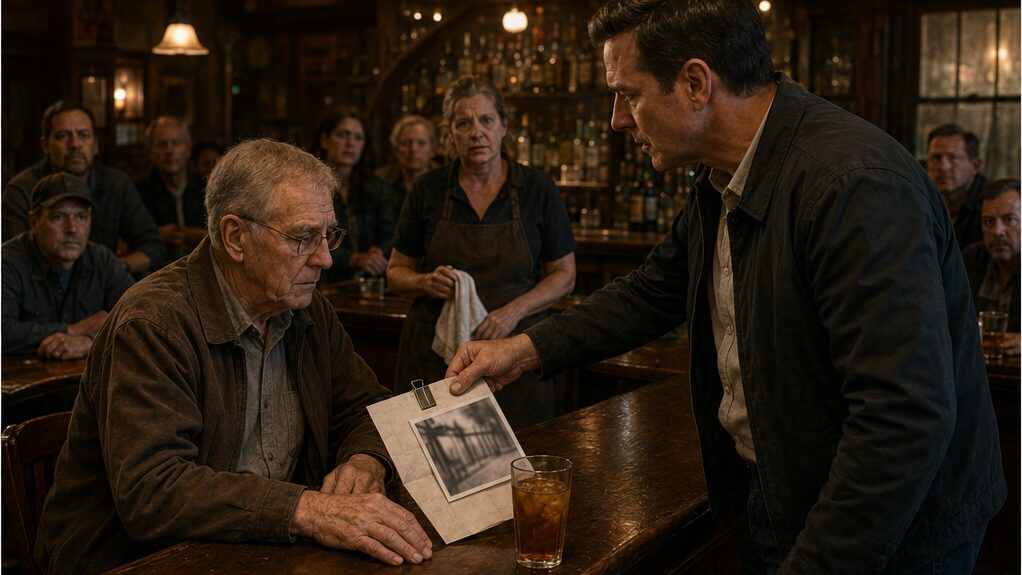
Daniel Scott put the folded repair bill on the bar hard enough to make Michael Johnson’s iced tea tremble.
The glass had been sitting untouched in front of Michael for nearly fifteen minutes, beads of water sliding down its side and gathering in a pale ring on the dark wood. Brenda Hill had set it there the way she always did on Friday evenings, without asking, with one lemon wedge and no straw because Michael never used one. He had wrapped both hands around it once, then let go. His fingers rested flat now, the knuckles swollen from years of gate hinges, fence posts, and cold mornings spent holding tools before his joints were ready.
The paper landed beside those hands.
A silver clip held a photograph to the front. Even before Daniel spoke, Michael saw the image clearly enough: the rear gate between their properties, one brass latch bent out of line, the driveway apron cracked in a jagged curve near the alley.
The tavern got quiet in the way a room gets quiet when everyone pretends not to listen.
Daniel stood too close to Michael’s stool. He had come in through the side door with his jacket still on, his cheeks bright from the cold outside, one hand on the bill like he had brought in proof from a courthouse. He was thirty years younger than Michael and carried himself like a man who expected rooms to open around him.
“You can look at it now,” Daniel said. “Or you can look at it after the HOA secretary gets a copy Monday.”
Michael did not pick up the paper.
Brenda paused behind the counter with a towel in one hand. The light above the bar threw a yellow line across the bottles behind her. At the tables, the Friday regulars shifted in their chairs. Someone lowered a basket of fries. Someone else gave a small laugh, not because anything was funny, but because nervous people sometimes tried to make a sound before silence swallowed them.
Daniel tapped the bill with two fingers.
“Eight thousand seven hundred and forty dollars,” he said. “That’s what your little mistake cost.”
Michael looked from the paper to Daniel’s face.
“My mistake,” he said.
Daniel smiled, but there was no warmth in it. “Don’t start that. My contractor already looked at it.”
Larry Miller’s name was printed near the top of the invoice. Michael recognized the company logo. He had seen Larry’s truck around the neighborhood plenty of times, usually parked half over the curb while Larry measured gutters or patched fencing for people who did not want to do the work themselves.
Daniel slid the invoice closer until the edge touched the wet ring from Michael’s glass.
“You backed that old truck of yours too far up the drive,” Daniel said. “You clipped the gate, cracked the apron, and left me with the mess. I’m trying to be decent by bringing it to you before I file anything official.”
At the end of the bar, one of the regulars muttered, “That truck is old.”
A few people gave little sounds of agreement. Not accusations exactly. Just the low hum of people letting a story harden before facts had time to breathe.
Michael kept his right hand flat on the bar. His left thumb moved once, a small rub against the side of his index finger. He had been doing that since his wife died, only when he wanted to speak too quickly and knew he shouldn’t.
“I didn’t hit your gate,” he said.
Daniel’s eyes widened as if Michael had disappointed him. “Come on, Michael. Don’t make this ugly.”
The room heard that. It was meant for the room.
Michael felt it pass over his shoulders: the old man being difficult, the old man not remembering, the old man making younger people chase him for money. He felt their glances settle on his coat, his hands, the slight stoop in his back when he sat too long. He had lived on Hillcrest Lane for forty-one years. He had fixed half the fences between that tavern and the creek before his knees made ladders a poor idea. Yet in that moment he could feel himself reduced to one thing: an old man with an old truck and a bill he did not want to pay.
Brenda set the towel down. “Daniel, this doesn’t need to happen at my bar.”
“I’m not raising my voice,” Daniel said, raising it. “I’m asking him to take responsibility.”
He flipped the clipped photograph upward so the people behind Michael could see it. A damaged gate, a close-up of the latch, the broken edge of concrete. The photograph had been printed in color, but cheaply; the brass looked almost orange under the ink.
Daniel pointed at the latch. “That’s from impact. Larry said it clear as day.”
Michael looked at the photo.
The gate was old cedar with a diagonal brace on Daniel’s side and two strap hinges mounted toward the alley. Michael knew that gate better than anyone in the room. He had hung it originally for the previous owner, then replaced the latch years later after a spring storm twisted the post. Daniel had not lived there then. His wife had still been alive then. She had stood in the kitchen window with a dish towel over her shoulder and told him he was too old to be working in rain, even though he had been only seventy-two and still stubborn enough to laugh at her.
The memory came sharp and then went quiet.
Daniel leaned down toward him. “You know what happens if the insurance company has to chase this? They’ll come after you. They can put it against your homeowner’s policy. HOA can fine you for damaging shared property. You want that kind of trouble?”
Michael’s throat felt dry. His iced tea sat within reach, but he did not touch it.
“How long are you giving me?” he asked.
Daniel’s smile returned. He thought he had reached the soft part. “I’ll give you the weekend. Sign the responsibility form, we work out payment, and I don’t have to embarrass anybody.”
A man at a table let out a short laugh. “Sounds fair enough.”
Brenda’s eyes moved to Michael. She looked as if she wanted to say something and did not know where to stand without turning her bar into a courtroom.
Daniel pulled a second paper from inside his jacket and laid it over the invoice. “This just says you accept responsibility for the damage. We can talk payment plan after. I’m not heartless.”
There it was. The real weight of the paper.
Not the invoice. The signature.
Michael looked at the blank line waiting for his name. His own name, printed beneath it in a neat font, as though the page already expected his hand to obey. He imagined the number leaving his savings account in pieces, month after month. He imagined Nicole hearing about it and trying to hide fear behind competence. He imagined the house going quiet around him because he had paid for peace and bought only a lie.
His fingers moved from the bar to the photograph.
He did not pick it up. He steadied it with two fingers, the way he used to steady a hinge leaf before setting the first screw.
The latch in the photograph bent outward.
Not inward.
Michael stared a moment longer.
Daniel sighed loudly for the crowd. “You need me to read it to you?”
A couple of people laughed before they could decide whether they meant to.
Michael felt heat move up the back of his neck. He lifted his eyes. His voice came out low, but it carried because the tavern had gone still around it.
“That latch did not bend from my side.”
Daniel blinked once. Then he laughed, full and sharp, as if Michael had given him exactly the ending he wanted.
“Sure,” Daniel said. “That’s what we’re doing now.”
He collected the responsibility form but left the invoice and photograph beside Michael’s glass. Then he stepped away from the bar, shaking his head for the benefit of everyone watching. The front door opened as someone came in, and daylight spilled across the floor in a hard white rectangle.
Daniel walked toward it laughing, his shoulders broad against the light, leaving Michael with the bill, the untouched glass, and the room’s silence.
Chapter 2: The Fence Line Everyone Thought They Knew
The next morning, the invoice lay open on Michael’s kitchen table beside a bowl of oatmeal that had gone cold.
Nicole Johnson stood across from him with her coat still zipped to the throat, one hand wrapped around her phone and the other pressed against the back of a chair. She had arrived twenty minutes after he called, which meant she had driven too fast and pretended not to. Her hair was tucked behind one ear the way she did when she was trying to sound calm.
“Dad,” she said, “eight thousand dollars is not nothing.”
Michael looked at the invoice again. The total had been typed in bold at the bottom: $8,740.00. Beneath it were line items for gate replacement, concrete apron repair, labor, disposal, emergency scheduling, and administrative handling. That last one bothered him. Administrative handling. As if Daniel’s impatience had become a service with a price.
“I know what eight thousand dollars is,” Michael said.
Nicole closed her eyes for half a second. “I didn’t mean that.”
He knew she hadn’t. That was the trouble with worry. It came out wearing other clothes.
The house was quiet except for the refrigerator clicking on and the faint ticking of the wall clock above the stove. Michael had bought that clock the year Nicole started high school. His wife had hated it at first because the tick was too loud, then complained whenever it stopped.
Nicole pulled out the chair and sat. “Maybe you could offer half. Not because you did it. Just to keep this from turning into something bigger.”
Michael folded the invoice along its crease, then unfolded it.
“Paying half says I did half.”
“It says you want peace.”
“No,” he said. “It says I can be priced.”
Nicole looked at him then, really looked, and the frustration loosened around her mouth. “I’m worried about you.”
He nodded. He could receive that much.
“I know.”
“You called me at midnight and told me Daniel put a bill in front of you at Brenda’s like some kind of public hearing. You barely slept, did you?”
“I slept.”
“Dad.”
He looked toward the back window. The yard beyond it was pale with morning light. The fence line ran along the rear of the property, cedar boards silvered by years of weather, the shared gate set between his driveway and Daniel’s alley access. From the kitchen table, he could just see the top hinge if he leaned a little.
“I want to look at it,” he said.
Nicole’s shoulders dropped. “You already know what you think you saw in a photo.”
“No,” Michael said. “I know what I saw on a latch.”
He stood slowly, not because he wanted sympathy, but because standing quickly had become a young man’s habit his body no longer agreed to. Nicole reached as if to help, then stopped herself. He appreciated that more than he said.
Outside, the cold made his hands ache before he reached the back steps. The yard smelled of damp leaves and thawing soil. A thin line of moss clung to the base of the fence, and the concrete driveway held dark patches from last night’s rain.
Daniel’s damaged gate leaned slightly at the top.
Michael stopped three feet from it.
Nicole came up beside him and pulled her coat tighter. “It does look bad.”
“It is bad.”
The latch plate had twisted away from the post. The brass tongue sat crooked, its edge scraped and bright where fresh metal showed through the old tarnish. Below it, the concrete apron on Daniel’s side had a crack shaped like a bent finger.
Nicole pointed. “Could your truck have done that?”
Michael turned his head and looked at his truck parked under the small carport. It was old, yes. A faded blue pickup with more primer than shine and a rear bumper that had known better decades. But it sat where it had sat for three days, because he had taken the bus to the pharmacy Thursday and Nicole had brought groceries after work.
“Not from where I park.”
“But if you backed up—”
“I didn’t.”
She stopped. He heard the careful breath she took before trying again.
“I’m not accusing you.”
“I know.”
“I just need to understand.”
Michael stepped closer to the gate. His shoes crunched over grit at the edge of the concrete. He ran one finger along the latch plate, then stopped where the metal bent away from his side of the post.
“When a gate gets hit from my driveway,” he said, “the latch gets pushed inward. The tongue jams into the keeper. Splits the post sometimes.”
Nicole leaned closer despite herself.
“This one pulled out,” he said. “See there? Screws lifted toward Daniel’s side. Wood fibers came with them.”
She looked where he pointed. To her it probably looked like damage. To him it looked like direction, pressure, sequence. Wood told on force if a person had patience to read it.
“You fixed this before?” she asked.
“After the storm six years ago.”
“You remember that?”
He gave her a mild look.
She flushed. “I didn’t mean—”
“Yes,” he said, softer. “I remember.”
He remembered because his wife had circled the storm date on the kitchen calendar after the fence blew loose. He remembered because he had gone to the hardware store twice, once for a latch that did not fit and again for the brass one he should have bought first. He remembered because she had made soup that night and told him cedar swelled different after rain, and he had told her she was repeating something he taught her thirty years before.
He touched the latch again.
The metal was colder than the morning.
“If I kept the receipt, it’s in the house box,” he said.
Nicole looked toward the kitchen window. “The one under the sink?”
“No. That one’s plumbing and appliance warranties. House box is in the garage, unless I moved it.”
“Dad, this is what I mean. You shouldn’t have to dig through boxes because Daniel embarrassed you.”
Michael turned from the gate. “That is exactly why I have to.”
She did not answer.
They went back inside. The kitchen smelled faintly of coffee he had made and not finished. Nicole lifted the invoice again, and for the first time she did not look only at the total. She looked at the photograph clipped to the front.
“The picture is cropped tight,” she said.
Michael took off his cap and laid it on the table.
“Yes.”
“It doesn’t show the whole gate.”
“No.”
She set the paper down. “That doesn’t prove he’s wrong.”
“No,” Michael said. “It proves he chose what to show.”
Nicole’s phone buzzed. She ignored it. Then it buzzed again, and she glanced down.
Her face changed.
“What?” Michael asked.
“It’s the neighborhood message thread,” she said. “Daniel posted that he tried to resolve it privately, but you refused to cooperate.”
Michael looked toward the back door.
The gate waited in the cold, bent but not speechless.
Before he could answer, the mail slot in the front door clattered. An envelope slid across the floor and came to rest against the rug. Nicole went to pick it up. Michael saw the return address before she turned around.
An insurance office.
Nicole held it without opening it.
His name showed through the little window in the envelope, clean and official, as if trouble had learned to type.
Chapter 3: The Contractor’s Tape Measure
By Monday afternoon, Daniel had moved the argument to the property line and dressed it in work boots.
Larry Miller stood between the two back driveways with a tape measure hooked to his belt, a clipboard under one arm, and a pencil tucked behind his ear. His white truck was parked crooked near the alley, hazard lights blinking though no hazard existed except the men gathered around Michael’s fence. Daniel had invited two neighboring homeowners to stand nearby, and the HOA secretary had come with a folder pressed to her chest as if she were holding something fragile and official.
Michael arrived from his back door wearing his brown jacket and work gloves.
Nicole had wanted to come. He had told her no. Not because he did not want her beside him, but because Daniel had already turned the story into a performance. Michael did not intend to bring his daughter into the audience.
Daniel pointed before Michael reached them.
“There,” he said to Larry. “That angle. That’s where his truck would’ve come in.”
Larry stretched the tape from the cracked apron toward Michael’s driveway, the metal blade making a dry rasp as it extended. “I’m just documenting measurements.”
“You already documented enough for the invoice,” Daniel said. “We’re making sure everybody understands.”
Michael stopped at the fence line. “Afternoon.”
Larry glanced up. “Michael.”
Daniel did not return the greeting. “You bring a pen?”
“No.”
The HOA secretary shifted. “Mr. Johnson, this is only a preliminary matter. No formal fine has been assessed yet.”
“Yet,” Daniel said.
Michael looked at the gate. In daylight, the damage seemed both worse and clearer. The top corner sagged. The latch plate sat proud of the post. The driveway crack traveled outward from Daniel’s side, not straight from Michael’s approach. A smear of dirt marked the bottom rail near the alley opening.
Larry crouched by the apron and measured from the crack to the gatepost.
“Larry,” Michael said, “when you wrote that invoice, did you inspect my truck?”
Larry paused. “No.”
“Did you inspect tire marks?”
“There weren’t clear tire marks.”
“Did you ask me where I park?”
Daniel cut in. “He didn’t need your life story. The damage is between our properties.”
Michael kept his eyes on Larry. “Did you determine cause?”
Larry stood, clipboard in hand. “I wrote an estimate for repair based on visible damage and what I was told about the likely impact.”
“What you were told,” Michael said.
Daniel laughed once through his nose. “Here we go.”
Larry looked uncomfortable. “Daniel called me out to price the repair. That’s what the invoice is. Gate replacement, latch hardware, post reset, apron patch.”
“But the invoice says impact from adjacent driveway.”
Larry glanced down at the page clipped to his board. “That was the reported cause.”
“Reported by Daniel.”
Daniel stepped closer. “Reported by the person whose property got hit.”
The two neighboring homeowners watched from a few feet away. One had arms folded. The other looked mostly cold. Michael felt their eyes, the same weight he had felt at the tavern, only now the bar had become a fence line and the glass had become a clipboard.
The HOA secretary opened her folder. “If the parties can agree to responsibility, it prevents escalation.”
Michael looked at her. “Escalation to what?”
“A violation review, possibly. If shared property or adjoining structures are involved.”
Daniel held out a paper. “Or we skip the dance. Sign this, we set a payment schedule, and I don’t file for full enforcement.”
The paper was the same responsibility form from Friday night. Michael recognized the blank line for his signature.
Wind moved through the alley and rattled the loosened gate.
Michael did not take the paper.
Larry bent near the hinge side and made another note. His tape measure snapped back with a metallic slap.
“Careful with that,” Michael said.
Larry looked up. “With what?”
“The tape. It’s catching the hinge.”
Larry glanced down. The end of the tape had snagged briefly against the lower strap hinge before retracting. He pulled it free.
Daniel shook the paper impatiently. “Michael.”
Michael stepped closer to the gate, but not to Daniel. He crouched slowly. His knees complained, and for a second he felt the humiliation of taking longer to lower himself while younger men watched. He let the feeling pass. Wood and metal were down here. The truth, if it was anywhere, would not rise to meet him.
He examined the lower hinge.
Something small had lodged along the seam where hinge met post, nearly hidden by old grease and dirt. At first glance it looked like paint from the gate, except the gate had never been blue. Michael put on his glasses and leaned in.
The flecks were bright blue.
Not faded pickup blue like his truck, which had gone dull years ago. This was newer paint, glossy where the edge had scraped clean.
He looked toward his pickup under the carport. Its paint was oxidized, chalky, pale as old denim. No fresh shine. No deep blue.
Daniel was still speaking above him.
“I’ve been patient,” Daniel said. “You think I want to drag this through insurance? You think I want to involve the HOA? I’m giving him a chance here.”
Michael reached out and touched the hinge near the flecks, careful not to disturb them.
“Larry,” he said.
The contractor came closer.
Michael pointed. “Did you photograph this side?”
Larry crouched beside him. “The hinge?”
“This edge.”
Larry narrowed his eyes. “I took general photos.”
“From Daniel’s side?”
“Mostly.”
Daniel stepped forward. “Because that’s where the damage is.”
Michael did not look at him. “The damage is where the force ended. Not always where it started.”
For the first time that afternoon, Larry did not answer quickly.
The HOA secretary leaned in but stayed far enough not to dirty her shoes. “What are we looking at?”
“Paint,” Michael said.
Daniel scoffed. “Your truck is blue.”
Michael turned his head then, slowly.
“My truck used to be blue.”
The wind moved again, lifting the corner of Daniel’s responsibility form. Michael looked back at the hinge, at the bright flecks caught on the alley-side metal, where a vehicle coming from Daniel’s direction would scrape before pushing the latch outward.
The flecks sat there small and stubborn, lodged on the wrong side for Daniel’s story.
Chapter 4: The Old Receipt in the Coffee Tin
By Monday night, the invoice had become the loudest thing in Michael’s kitchen.
It lay in the center of the table under the yellow stove light, its corners flattened by Nicole’s careful hands, its total still bold enough to pull the eye no matter how often Michael tried to look past it. Beside it sat the photograph of the latch, the responsibility form, and a small smear of blue paint Michael had lifted from the hinge with a strip of clear tape and pressed to a white envelope.
Nicole stood at the sink washing a mug that was already clean.
“You shouldn’t have crouched out there that long,” she said.
Michael sat with his glasses low on his nose, studying the invoice line by line. “Larry didn’t look at the hinge side.”
“You told me.”
“He priced the damage. Didn’t read it.”
“You told me that too.”
He looked up.
Nicole turned off the faucet. “I’m not saying you’re wrong.”
“No.”
“I’m saying you looked pale when you came in.”
“I’m seventy-eight. Sometimes I come in pale.”
She gave him a tired look, and he let the corner of his mouth move, not quite a smile. It failed quickly.
Outside the kitchen window, the backyard had gone black except for the porch light shining over the fence. The damaged gate sat beyond the glass, mostly hidden now, but Michael knew exactly where the latch caught the light. Since afternoon, his mind had returned again and again to that small blue fleck lodged on the alley-side hinge. A wrong color in a wrong place. Not enough. Not proof. But something.
Nicole dried the mug and put it away. “Let me call someone tomorrow. Maybe there’s a county office, or insurance advice line, or—”
“No.”
“Dad.”
“No lawyers. No police. No turning this into something bigger before I understand it.”
“It’s already bigger. Daniel made it bigger.”
Michael folded the invoice along its original crease. The paper resisted at first, then gave.
“That doesn’t mean he gets to set the pace.”
Nicole leaned back against the counter. The house seemed to hold its breath between them. Since her mother died, Nicole had learned to fill quiet spaces with errands, calls, appointments, lists. Michael had learned to leave some spaces empty because they belonged to what was gone. Tonight those two habits met over one kitchen table.
“You said there was a receipt,” she said.
“There should be.”
“For the latch?”
“For the latch, the keeper plate, two brass screws because the ones in the packet were soft, and a cedar shim.”
Nicole stared at him. “You remember the screws?”
“They stripped.”
“You remember screws from six years ago, but you forgot your cardiology appointment last month.”
“I didn’t forget. I chose not to tell you until after.”
“That is not better.”
“It was only a follow-up.”
She pressed her lips together, trying not to follow the argument down its usual hallway.
Michael pushed his chair back. “Coffee tin.”
“What?”
“Your mother’s blue coffee tin. I put house receipts in it after she said folders disappear but tins stay put.”
Nicole’s face changed at the mention of her mother, but only for a second. Then she reached for her coat. “Garage?”
“Garage first.”
The garage smelled of cardboard, dust, motor oil, and the sweet dry rot of old lumber. Michael pulled the chain for the overhead bulb. Its light swung slightly, sending shadows across shelves stacked with paint cans, coffee cans full of screws, boxes labeled in his wife’s handwriting, and tools he still kept sharp though he used them less every year.
Nicole moved toward the nearest shelf. “Which box?”
“If I knew that, I’d already have it.”
She gave a soft sigh, but she started looking.
They opened boxes in silence for a while. Kitchen faucet manuals. Old tax records. Christmas lights. A cracked photo frame. Weatherstripping. A bundle of seed packets from a garden Michael had not planted since his wife’s knees got bad.
Nicole found the blue coffee tin behind a box of furnace filters.
It was smaller than Michael remembered, with a dent near the lid and a faded label showing a mountain scene. His wife had bought it because she liked the color and hated the coffee. He took it from Nicole and felt the cool metal settle into his palm like something alive enough to forgive him for misplacing it.
At the kitchen table, he pried the lid open.
Receipts rose out in curled layers. Hardware store slips. Window screen repair. Storm door handle. Two bags of concrete mix. A plumber’s invoice from a winter pipe freeze. Nicole sat across from him and began sorting by date, her earlier impatience replaced by the steady focus she had inherited from her mother.
“Here,” she said after several minutes.
Michael took the receipt.
The paper had faded nearly white at the edges, but the print remained legible enough: brass gate latch, heavy duty; exterior screws; cedar shims; weather sealant. Six years earlier, three days after the spring storm. The total was circled in his wife’s blue pen.
Under the circle, in her handwriting, she had written: Gate fixed before soup burned.
Michael held the receipt a little longer than necessary.
Nicole saw it and looked down.
“I remember that storm,” she said quietly. “Mom called me because the power flickered.”
“She said the fence sounded like it was arguing with the wind.”
Nicole laughed once, small and unwilling. “That sounds like her.”
Michael set the receipt beside Daniel’s invoice. The two papers looked wrong together. One thin, faded, ordinary; one bright, printed, demanding. He placed the photograph of the bent latch between them and looked at all three until the kitchen seemed to narrow around the table.
“This latch was mounted after the storm,” he said. “The keeper plate sat on my side of the post. If my truck pushed through, the tongue would drive into the keeper. The screws would bury, not pull.”
Nicole touched the photograph. “Daniel’s picture doesn’t show the keeper.”
“No.”
“Could it have broken loose some other way?”
“Yes.”
He did not dress the answer up. Yes. Damage could be complicated. Wood could be weakened by rain, age, old stress. Metal could fail from more than one strike. He knew better than to make certainty out of pride.
But he also knew what he had seen.
He stood and went back to the garage, returning with a shallow cardboard file box. Nicole followed with the coffee tin. Together they searched deeper. Old utility maps. A driveway permit from years ago. A letter about alley maintenance. Warranty papers for roof work. His wife had kept more than he remembered and less than he wished.
Near the bottom of the box, beneath a folder marked fence line, Michael found a county notice folded in thirds.
He opened it carefully. The crease had softened from age.
The notice concerned temporary alley access restrictions during private deliveries and construction staging on rear lots. It had been sent when Daniel renovated his back patio two years earlier. Michael remembered the inconvenience more than the paper: delivery trucks idling where they should not, Daniel promising it would only be a few days, the county warning residents not to block shared access with trailers or materials.
Nicole leaned over his shoulder. “Is that useful?”
Michael read the last paragraph twice.
Any heavy delivery through the shared rear alley required temporary clearance and resident notification if turning radius affected adjoining gates, fences, or apron access.
Resident notification.
He had not been notified of any heavy delivery last week. But Larry had measured trailer clearance. Daniel had materials stacked near the rear patio on Thursday morning; Michael had seen tarps through the fence slats when he took out trash. At the time, he had thought nothing of it.
Nicole watched his face.
“What is it?”
Michael folded the notice along the old crease and placed it beside the invoice.
“Daniel had no business moving a trailer through that alley without notice,” he said.
Nicole looked from the county notice to the clipped photograph to the old receipt.
For the first time since the bill landed in his life, she did not suggest paying.
Michael took the blue coffee tin and set it on top of the papers so the furnace vent would not disturb them. His hand rested on the dented lid.
The tin looked too small to hold a house together.
But for that night, it held enough to begin.
Chapter 5: The Claim That Used Michael’s Name
The insurance adjuster said Michael’s name as if it had already been filed in the correct drawer.
“Mr. Johnson, we received a preliminary liability notice listing you as the adjoining homeowner connected to the reported damage.”
Michael sat at the kitchen table with the phone on speaker, a pencil in his hand, the invoice spread open before him. Nicole had offered to stay home from work. He had told her no again, though this time he had let her arrange the papers before she left: Daniel’s invoice, the latch receipt, the county notice, the envelope with the paint fleck, and a clean sheet where she had written dates across the top.
Friday: tavern bill.
Monday: contractor measurement.
Unknown: actual damage date.
Michael underlined unknown.
“I did not cause the damage,” he said.
“I understand that is your position.”
It was the kind of sentence that made no promise to understand anything.
“Who reported that I did?”
“The claim information came through Mr. Scott’s carrier, with supporting repair documentation.”
“Larry Miller’s invoice?”
“A contractor estimate was included, yes.”
“Estimate,” Michael said. “Not cause.”
There was a pause. He could hear keys clicking faintly on the other end.
“The documents describe impact damage from the adjacent driveway.”
“Describe,” Michael said. “Or prove?”
Another pause, shorter this time.
“Mr. Johnson, at this stage we’re gathering statements. No final liability determination has been made.”
“At this stage,” he said, “my name is already in your file.”
The adjuster did not answer right away.
Michael looked at his hands. They did not shake exactly, but the pencil rolled slightly under his thumb. He thought of Daniel’s paper waiting for his signature, the way a blank line could make a lie look patient.
“What should I send you?” Michael asked.
“Any photographs, prior repair records, property documents, or written statement disputing the reported cause.”
“I have some of that.”
“Then I recommend you submit copies as soon as possible. If there are HOA proceedings, those may also affect the timeline.”
There it was again. Timeline. The word had become a narrow bridge, and everyone wanted him to hurry across it before he saw where it led.
After the call, Michael sat still in the kitchen. The house made its small daytime sounds around him. Refrigerator. Clock. A branch touching the siding. He wrote: Insurance has no proof of cause yet.
Then he circled Friday and Monday.
Larry’s invoice was dated Friday morning.
Daniel had placed it beside his glass Friday evening.
Michael turned the invoice over and studied the supplier code printed near the materials line. He knew enough about contractors to know many ordered parts after inspection, not before. But the hinge kit and latch set listed on Larry’s estimate had a specific item number from the local hardware store.
He put on his cap and drove there before he could talk himself into waiting.
The hardware store had changed owners twice and rearranged the aisles three times, but it still smelled like sawdust, fertilizer, and rubber mats. Michael moved slowly through the front entrance, past carts of discounted mulch and seasonal porch lights, until he reached the service counter.
The clerk looked up. “Can I help you?”
Michael placed a handwritten item number on the counter. “Do you carry this?”
The clerk typed it in. “Heavy strap hinge kit. Exterior gate hardware. We have two in stock.”
“Can you tell when one was purchased recently?”
The clerk’s expression closed a little. “I can’t give out customer information.”
“I’m not asking who. I’m asking when. A contractor used the number on an estimate that has my name tied to it.”
The clerk hesitated.
Michael did not push. He took Daniel’s invoice from his folder and turned it so the materials line showed. Not the total. Not the accusation. Just the item number.
“I’m trying not to sign for something I didn’t damage,” he said.
The clerk read the invoice. Something in the quietness of that sentence made more space than anger would have.
“I can’t print customer details,” the clerk said. “But I can tell you inventory movement.”
“That would help.”
The clerk tapped keys. “Two kits sold last Wednesday morning. Same item number. Contractor account.”
“Wednesday,” Michael said.
“Yes.”
“Not Friday.”
“No. Wednesday.”
Michael folded the invoice carefully. “Can I buy one of the kits?”
“You want the same one?”
“Yes.”
The clerk brought it from aisle seven. Michael paid cash and asked for a receipt. Outside in his truck, he compared the new receipt to Larry’s material line, then wrote Wednesday: hinge kit sold.
Wednesday was two days before Daniel put the bill in front of him.
Two days before the tavern.
Maybe Larry had bought parts for another job. Maybe Daniel had noticed damage earlier and waited. Maybe all of it had an innocent shape if viewed from far enough away.
Michael sat behind the wheel until a driver waiting for his parking spot gave a small horn tap. He looked up, put the receipt into his folder, and drove to Brenda’s.
The tavern was quieter on Tuesday afternoon. No evening crowd yet, just two regulars at a side table and Brenda restocking glasses behind the bar. The same stool waited near the center, but Michael did not sit at first.
Brenda saw the folder under his arm. “Tea?”
“Yes, please.”
She filled the glass and set it down. For a moment neither of them spoke.
“I should’ve said more Friday,” she said.
Michael eased onto the stool. “It’s your bar.”
“That doesn’t mean I liked what happened.”
He looked at her. “Liking and stopping aren’t the same thing.”
She took that without defending herself. Her eyes moved to the folder. “You finding anything?”
“Pieces.”
“Good pieces?”
“Small ones.”
“Small ones count.”
He took out a second copy of the invoice Nicole had made that morning. With the pencil from his pocket, he circled the invoice date. Then he circled the material line. Then, below both, he wrote Wednesday hardware.
Brenda watched. “Daniel was in here Thursday afternoon.”
Michael’s pencil stopped.
“He was?”
“With a delivery driver for maybe ten minutes. Not drinking. Just came in asking if anyone had parked behind the alley because a truck needed room.” She frowned. “I didn’t think anything of it.”
“What color was the truck?”
“White cab, maybe. Trailer was blue.”
Michael looked at the old glass in front of him. Condensation slid down exactly as it had Friday night, but this time his hand closed around it.
The tea was cold and sharp with lemon.
Before he could answer, the side door opened.
Daniel walked in with his phone in one hand and a folded paper in the other. He looked first at Brenda, then at the folder, then at Michael’s circled invoice.
His face settled into a smile that had practiced patience and missed.
“There you are,” Daniel said. “I was just telling folks you’re making everyone wait.”
The two regulars at the side table went still.
Michael slid the circled invoice back into his folder.
Daniel came closer. “I talked to the HOA secretary. She hasn’t filed the complaint yet. I can still make this easy.”
Michael rested one hand on the folder.
Daniel laid the folded paper on the bar, not as hard as Friday, but close enough to Michael’s glass that the corner touched the wet ring.
“Sign before tomorrow,” Daniel said, “and I’ll keep your name out of the formal complaint.”
Michael looked at the paper, then at Daniel.
The tavern seemed dimmer than it had a moment before.
Chapter 6: The Latch Did Not Bend That Way
On Wednesday evening, Michael returned to Brenda’s tavern with the bent latch in a paper bag.
He had removed it that afternoon with a hand screwdriver, not the drill, because the drill would have been faster and speed had done enough harm already. The brass plate came loose after the third screw. The fourth resisted, swollen in the wood, and Michael had to sit on an overturned bucket for a minute before trying again. When it finally released, the latch rested in his palm with its bright scrape, twisted tongue, and pulled screw holes all facing the story Daniel did not want told.
Now it sat in the bag beneath his folder, heavy enough to feel like a tool.
The tavern was busier than it should have been for a Wednesday. Word had moved through Hillcrest Lane the way unpaid bills and public accusations did. A few regulars sat at their usual tables. The HOA secretary stood near the end of the bar with her folder. Larry Miller was already there, cap in his hands, looking uncomfortable before anyone said his name.
Daniel stood near Michael’s stool.
That was how Michael knew the evening had been arranged to corner him. Daniel had chosen the same place, same light, same audience. Brenda caught Michael’s eye from behind the bar, and her expression said she understood it too late.
She set his iced tea in front of him.
Michael looked at the glass but did not drink.
Daniel placed a responsibility form beside it. “Last chance.”
The room turned toward them with the hunger of people who did not want to admit they had come to watch.
Daniel’s voice was smooth at first. “I tried to settle this privately. I gave you time. I tried to spare you a formal complaint. But if you won’t accept responsibility, I’m not going to let you drag everyone else into your denial.”
Michael sat on the stool and placed his folder on the bar.
No one laughed yet.
Daniel gestured toward Larry. “My contractor is here. The HOA secretary is here. You wanted to make this complicated, so let’s be clear.”
Larry looked down. “Daniel—”
“No, it’s fine,” Daniel said. “We’re all adults.”
Michael opened his folder and removed the original invoice Daniel had left at the tavern Friday night. He laid it flat. Then he placed the old receipt from the coffee tin beside it, the county alley notice below that, and the hardware store receipt at the bottom.
Daniel’s smile thinned. “What is all that supposed to be?”
“Dates,” Michael said.
“Dates don’t change impact damage.”
“No,” Michael said. “They show when people knew they needed parts.”
Larry’s eyes moved to the hardware receipt.
Michael turned it so Larry could read it. “The same hinge kit listed on your invoice sold Wednesday morning on a contractor account.”
Larry shifted his weight. “I buy common hardware ahead sometimes.”
“Did you buy that for Daniel’s gate?”
Larry looked at Daniel.
Daniel said quickly, “This is ridiculous. Contractors keep supplies.”
Michael reached into the paper bag and took out the latch.
He set it on top of the invoice.
The sound was small, brass against paper, but it quieted the room more completely than a shout.
“This is the latch from the gate,” Michael said.
Daniel stared at it. “You removed shared property?”
“I removed damaged hardware from my side of a shared post after I photographed it in place.”
The HOA secretary leaned forward. “Mr. Johnson, you photographed it?”
“Yes.”
Michael did not reach for the photos yet. He let the latch sit there under the bar light. Its bent tongue pointed slightly upward. The screw holes on one side were stretched into small ovals where the metal had pulled away.
He looked at Larry. “You wrote impact from adjacent driveway.”
Larry swallowed. “Based on what I was told and what I saw.”
“What did you see?”
“Gate damage. Latch damage. Apron crack.”
“Did you see where force started?”
Larry did not answer.
Daniel slapped one hand on the bar. The glass jumped, and tea lapped against the rim but did not spill. A few people flinched.
“There it is,” Daniel said. “Now he’s accusing me. You all hear this? He’s trying to turn it around because he doesn’t want to pay.”
Michael kept his eyes on Larry. “Did you measure trailer clearance Monday?”
Larry’s mouth tightened.
Daniel turned toward him. “Don’t get pulled into his nonsense.”
Michael took out Larry’s measurement page. It was not a secret document; Larry had dropped a carbon copy near the fence when he tore a sheet from his pad Monday, and Michael had picked it up after everyone left. There were numbers down one side, a rough sketch of the alley, and a note near the bottom: trailer swing / gate clearance.
He placed it beside the latch.
Larry stepped closer despite himself.
“You wrote that,” Michael said.
Larry picked up the sheet, then set it back down. “I measured the alley because Daniel asked whether a trailer could’ve cleared after the repair.”
“After?”
Larry rubbed his forehead. “Before. I don’t remember exactly.”
Daniel’s voice sharpened. “Larry.”
Michael turned the county notice toward the HOA secretary. “Heavy delivery through the alley requires notification if turning radius affects adjoining gates or apron access.”
The secretary read silently.
“I was not notified,” Michael said.
Brenda spoke from behind the bar, quiet but clear. “Daniel came in Thursday asking if anyone had parked behind the alley because a truck needed room.”
Daniel looked at her. “That was unrelated.”
“What truck?” the HOA secretary asked.
“A delivery,” Daniel said. “For patio materials. It didn’t hit anything.”
“What color was the trailer?” Michael asked.
Daniel’s jaw moved.
Brenda wiped her hands on her towel though they were dry. “Blue trailer.”
A murmur moved through the room.
Michael took the envelope from his folder and laid the strip of clear tape on the bar. The blue paint flecks were tiny, almost nothing. Under the tavern light, they shone brighter than they had in the yard.
“These were lodged on the alley-side hinge,” he said. “Not the driveway side.”
Daniel laughed, but this time it came out wrong. Too loud, too alone. “His truck is blue.”
Michael did not look toward the crowd. “My truck’s paint is oxidized. You can rub it with a cloth and it comes off pale. These are glossy. Newer. Darker.”
Larry leaned down, looking at the tape without touching it.
Michael picked up the latch and held it upright with two fingers. His hands ached. He did not let them tremble.
“When a vehicle comes from my driveway and pushes through, the latch tongue jams inward toward the keeper. Screws compress into the post.” He turned the latch slowly. “This pulled outward. The screw holes stretched toward Daniel’s side. The scrape begins on the alley hinge and travels forward.”
No one spoke.
Daniel’s face had reddened. “That’s your opinion.”
“Yes,” Michael said. “It is.”
The simple admission seemed to unsettle him more than argument.
Michael looked to Larry. “What is your opinion?”
Larry exhaled. He looked at the latch, the tape, the measurement notes, the invoice, the old receipt with Michael’s wife’s handwriting at the bottom. He looked finally at Daniel, and whatever arrangement he thought he had walked into seemed to fall apart behind his eyes.
“I can’t say Michael’s truck caused it,” Larry said.
Daniel’s head snapped toward him. “You already wrote the invoice.”
“I wrote a repair estimate,” Larry said. His voice was low. “I did not perform a cause investigation.”
“The invoice says adjacent driveway.”
“Because that’s what you reported.”
A chair creaked somewhere behind Michael. Someone whispered, then stopped.
Daniel reached for the responsibility form. “This is exactly why I didn’t want to do this in public. He’s confusing everyone with old papers and hardware.”
Michael placed two fingers on the edge of the form before Daniel could lift it.
Not forcefully. Just enough.
Daniel looked at his hand as if those old fingers had no right to stop anything.
Michael said, “You put my name on a claim before you proved I caused damage.”
Daniel’s eyes narrowed. “I protected myself.”
“You tried to make me protect you.”
The room held that sentence.
Michael let go of the form and slid it back toward Daniel. His chest felt tight, but his voice remained even.
“I am not signing.”
The HOA secretary closed her folder halfway. “Given the dispute over cause, I can’t file this as an uncontested responsibility matter.”
Daniel stared at her. “You said—”
“I said if both parties agreed.”
“We all know what happened.”
“No,” Larry said.
It was one word, but it made Daniel turn slowly.
Larry picked up the invoice he had written. His thumb pressed against the company logo at the top. “We know the gate needs repair. We know the apron is cracked. We know I priced the work. That’s all my estimate proves.”
Michael watched him. He did not feel victory. Not yet. What he felt was the strange sadness of seeing a lie lose one layer and reveal how many more remained underneath.
Daniel looked around the tavern, searching faces for the easy agreement he had had on Friday. He found curiosity now. Doubt. A few eyes lowered in embarrassment. No laughter.
Brenda reached for Michael’s glass but did not take it. She only wiped the bar near it, clearing away a ring of water beside the latch.
Larry set the invoice down carefully.
“My estimate never proved Michael caused the damage,” he said.
Chapter 7: The Door Daniel Had to Walk Back Through
A week later, Daniel walked back into Brenda’s tavern through the same bright doorway he had used to leave Michael sitting with the bill.
This time he did not laugh.
The late afternoon sun came in behind him, thinning his outline for a moment before the door swung shut. He stood near the entrance with one hand at his side and the other holding a white envelope. His jacket was unzipped. His face looked older than it had the week before, though not old in the way Michael understood the word. More like a man who had slept badly and blamed the pillow.
Michael sat at the same stool.
Brenda had placed an iced tea in front of him, but he had already taken two slow drinks from it. The glass was not untouched now. A faint lemon seed rested at the bottom, and a ring of water spread beneath it on the bar.
The invoice lay beside the glass.
Not folded. Not threatening. Stamped across the front in flat blue ink were the words: responsibility withdrawn.
Michael had not asked Brenda to keep it there. She had done it after Larry delivered the corrected repair statement that morning and the insurance adjuster confirmed by phone that Michael would not be listed as liable. The claim had shifted to Daniel’s delivery damage. The repair would still happen. Money would still change hands. The gate would still need new wood, new hardware, and a careful reset.
But Michael’s name had been taken off the debt.
Daniel crossed the tavern slowly. The regulars noticed him, of course. They tried not to turn their heads all at once. The same men who had laughed too quickly now studied their glasses, their menus, their hands. The HOA secretary was not there. Larry was not there. Nicole stood near the far end of the bar, not beside Michael, because he had asked her not to stand as if he needed guarding.
She had come anyway. He had not told her to leave.
Daniel stopped two stools away.
Brenda wiped the counter in front of him though there was nothing on it. “Daniel.”
He gave her a short nod. Then he looked at Michael.
For a moment, all Michael could hear was the low hum of the cooler behind the bar and the scrape of a chair leg somewhere near the back. The room had waited for anger, maybe. Or apology. Rooms liked clean scenes. People did too.
Michael had spent the morning deciding how little he needed.
The insurance adjuster had called at nine-thirty. The voice on the line had been more careful than before, more formal. Supporting materials received. Liability reassigned. No action against your homeowner’s policy at this time. Written confirmation to follow.
At ten, Larry had come by the house with his corrected estimate and his cap in both hands. He did not over-apologize. Michael respected that. Larry said he should have marked the first invoice as repair pricing only, not repeated Daniel’s reported cause in a way that looked like fact. Michael had nodded. The two of them walked the fence line. Larry looked at the hinge side again, longer this time, and said the trailer swing explained the pull on the latch.
By noon, Daniel’s carrier had accepted the delivery damage explanation after contacting the materials company. No one said confession. No one needed to. A driver had noted a “tight alley turn” on his delivery sheet. That was not drama. That was enough.
Now Daniel placed the envelope on the bar.
“I withdrew the HOA complaint,” he said.
Michael looked at the envelope but did not touch it.
“And the insurance claim correction?”
“Filed.”
“In writing?”
Daniel’s jaw tightened. He took a paper from the envelope and laid it beside the stamped invoice. “There.”
Michael put on his glasses.
The letter was short. Daniel Scott formally withdraws the statement assigning responsibility to Michael Johnson for rear gate and driveway apron damage. Delivery-related impact under separate review. No claim against Michael Johnson should proceed.
Michael read it twice.
Nicole shifted at the end of the bar. He did not look over. This had to be his hand, his choice, his silence or his words.
Daniel said, quieter, “I shouldn’t have put it on you like that.”
The sentence sat between them with all the things it did not hold. It did not hold the tavern laughter. It did not hold the blank signature line. It did not hold Nicole’s face over the insurance envelope. It did not hold the week Michael had spent measuring not just a gate, but the distance between being quiet and being erased.
Michael folded the letter once along its crease.
“No,” he said. “You shouldn’t have.”
Daniel waited, perhaps for more. Perhaps for forgiveness because discomfort wanted somewhere to go.
Michael gave him only what was true.
“You saw an old man alone at a bar,” Michael said, “and thought that made the bill lighter to carry.”
Daniel looked down.
No one spoke.
Michael slid the letter back into the envelope and tapped it once with two fingers. “Send a copy to Nicole. Send one to Larry. Send one to the HOA secretary.”
“I already sent—”
“Send them.”
Daniel nodded. “All right.”
Michael looked toward the stamped invoice. For days it had seemed larger than paper, larger than money. Now it looked almost ordinary, an office mistake with teeth removed. Still, he knew better. Paper could bite again if left loose.
He pushed it toward Brenda.
“Would you mind taking that away?”
Brenda picked up the invoice. She did not make a ceremony of it. She did not hold it up. She simply lifted it from beside his glass and set it under the counter, where old receipts, delivery slips, and spilled-bar paperwork went to become someone else’s filing problem.
Then she poured fresh iced tea into a clean glass and set it where the invoice had been.
Michael wrapped his hand around it.
The cold reached his palm first, then the ache in his fingers. He welcomed both.
Daniel remained a moment longer. “The gate repair starts Friday.”
“I know.”
“Larry said you knew the old hinge pattern better than anyone.”
Michael looked at him. “I hung that gate before you bought the house.”
Daniel’s eyes moved away.
There were apologies that asked the injured person to repair the speaker. Michael had no room in his hands for that. He had a glass, an envelope, and the old patience of a man who still knew how to fix a latch without pretending wood had no memory.
Daniel turned and walked back toward the door.
This time the room did not follow him as closely. A few people glanced, then looked away. The doorway opened, bright again, and he stepped through it smaller than he had seemed before.
Nicole came to Michael’s side after the door closed.
“You okay?” she asked.
He took a drink of tea before answering. “No one is after the house.”
Her mouth trembled at that, and she looked down quickly. “I should’ve trusted you sooner.”
Michael shook his head. “You were scared.”
“So were you.”
“Yes.”
It was the first time he had said it plainly. The word did not diminish him. It only set something down.
That evening, after the tavern emptied and Nicole drove home, Michael returned to the fence line alone. Larry had installed a temporary latch until the full repair could begin. It was plain steel, not brass, and it clicked without grace, but it held.
Michael stood in the cool dusk with his key ring in one hand and the old bent latch in the other. He had decided to keep it. Not as a trophy. A trophy was for winning over someone. This was for remembering what force looked like when it tried to pass itself off as truth.
He opened the gate and closed it once.
The latch caught.
He tested it again, listening to the small, honest sound of metal meeting metal. Behind him, his kitchen window glowed softly. The house stood where it had always stood, not grand, not new, not safe from every future trouble, but still his.
Michael locked the repaired gate himself.
Not because he had to prove anything.
Because it was still his home.
The story has ended.