The Woman They Thought Was Just Another Elder Until One Battlefield Name Returned
Chapter 1: The Paper They Wanted Her To Sign
The letter was already open when Deborah Carter reached the veterans housing office.
It sat on the corner of Patricia Jones’s desk beside a stack of folders and a coffee cup gone cold. Deborah recognized the envelope immediately. Official mail always looked the same—thick paper, too many printed numbers, and language designed to sound polite while delivering bad news.
Patricia glanced up when Deborah entered.
“Ms. Carter, have a seat.”
Deborah lowered herself carefully into the chair across from the desk. At seventy-four, she moved slower than she once had, but she disliked when people mistook caution for weakness.
The office buzzed with quiet activity. Phones rang. Printers hummed. Residents came and went carrying folders and forms.
Patricia slid the letter closer.
“We’ve completed our annual housing review.”
Deborah looked at the pages without touching them.
“And?”
“There have been changes.”
The answer was practiced.
Not cruel.
Not kind.
Simply practiced.
Patricia folded her hands.
“The support program that helped subsidize your unit is being reorganized.”
Deborah waited.
“The new requirements are stricter.”
“Meaning?”
Patricia glanced at the paperwork.
“Meaning we need additional documentation. If we can’t verify eligibility under the updated guidelines, your lease status could be affected.”
Could be affected.
Deborah almost smiled.
She had spent enough years around military bureaucracy to know that phrases like that always meant exactly what they sounded like.
“You mean I could lose the apartment.”
Patricia hesitated.
“Potentially.”
The apartment was small.
One bedroom.
A narrow balcony.
A view of a parking lot and two oak trees.
Nothing special.
But it had been home for thirteen years.
Deborah folded her hands together to stop herself from rubbing them.
A habit.
An old one.
Whenever anxiety arrived, her hands remembered before the rest of her did.
Patricia continued speaking.
There were forms.
Verification requirements.
Missing records.
Program audits.
Words piled on top of words.
Deborah listened quietly.
When Patricia finished, she pushed a signature page forward.
“If you’ll sign acknowledging receipt—”
Deborah looked at the paper.
The signature line seemed oddly familiar.
Years ago she had signed casualty reports.
Transfer documents.
Medical evaluations.
Forms that decided where wounded soldiers went next.
Lives had shifted because of signatures.
Now a signature might decide where she slept.
“What if I don’t have the documents?” she asked.
Patricia sighed softly.
“We need something.”
The phrase landed harder than intended.
Something.
As though a life could be reduced to paperwork.
As though decades existed only if filed correctly.
Deborah reached into her handbag.
The leather was worn smooth at the edges.
Inside were ordinary things.
Keys.
Reading glasses.
A folded grocery list.
And an old envelope she carried everywhere.
She wasn’t sure why she had brought it that morning.
Maybe habit.
Maybe instinct.
She removed several papers.
Discharge copies.
Medical certifications.
Old veteran records.
Patricia accepted them and began sorting.
“Some of these might help.”
Deborah nodded.
Across the room, a younger man emerged from another office carrying files.
Deborah had seen him before.
John Miller.
One of the administrators who worked between the housing program and veterans clinic.
He looked busy.
Too busy to notice her.
Which was fine.
Most people didn’t.
Patricia continued flipping through documents.
Then she frowned.
“What is this?”
Deborah looked down.
A small folded card had slipped from the envelope.
Yellowed with age.
Edges frayed.
Patricia picked it up carefully.
The paper was stained dark brown in one corner.
Not dirt.
Not coffee.
Time had changed the color, but Deborah knew what it was.
Blood.
Her fingers tightened.
“Just an old record,” she said.
Patricia looked puzzled.
“It doesn’t look official.”
“It was.”
Patricia turned it over.
The writing had faded.
Numbers.
Medical abbreviations.
A handwritten name.
Patricia seemed ready to set it aside.
Then someone appeared beside the desk.
John Miller.
“Need anything?” he asked.
Patricia held up the card.
“Do you know what this is?”
John glanced at it casually.
Then looked again.
His expression changed.
Only slightly.
But Deborah noticed.
People rarely fooled former medics.
He reached for the card.
“May I?”
Deborah nodded.
John studied the markings.
The faded codes.
The emergency triage notations.
The shorthand used decades earlier in combat zones.
His eyebrows lifted.
“Where did you get this?”
Patricia answered before Deborah could.
“It was mixed in with her paperwork.”
John looked at Deborah.
For the first time all morning, he looked directly at her.
Not through her.
Not around her.
At her.
“This is yours?”
“Yes.”
Silence lingered.
John turned the card over.
The old stain sat near the corner.
His thumb stopped beside a handwritten name.
Benjamin Walker.
The letters were faint but readable.
Deborah’s stomach tightened unexpectedly.
She had not spoken that name aloud in years.
Maybe decades.
John glanced between the card and Deborah.
“Who was Benjamin Walker?”
The room seemed quieter suddenly.
The phones still rang.
The printer still hummed.
Yet everything felt distant.
Deborah looked at the card.
At the fading ink.
At a name she had carried longer than some people carried marriages.
“I don’t know,” she said softly.
John blinked.
“You don’t know?”
“I knew him for less than an hour.”
Patricia frowned.
Neither understood.
How could they?
Some people entered your life for years and left little behind.
Others arrived bleeding and terrified for twenty minutes and remained forever.
Deborah reached for the card.
John handed it back immediately.
More carefully than Patricia had.
A small thing.
But noticeable.
She slid the card into the envelope.
The movement felt strangely protective.
Patricia cleared her throat.
“Ms. Carter, we still need documentation.”
Deborah nodded.
The problem had not disappeared.
The apartment was still at risk.
The forms still needed answers.
Life continued.
Yet something had shifted.
Not enough to solve anything.
Just enough to be felt.
As she stood to leave, John spoke.
“Would you mind if I looked into that record?”
Deborah paused.
“Why?”
“I’ve never seen one preserved like that.”
She almost laughed.
Preserved.
That wasn’t the right word.
Some things survived because you couldn’t throw them away.
Not because you wanted to keep them.
“I don’t think there’s much to find,” she said.
John looked at the envelope.
Then back at her.
“Maybe.”
Outside, the afternoon sun washed the parking lot in pale light.
Deborah walked slowly toward her car.
The letter remained inside her purse.
So did the card.
One threatened her future.
The other refused to release the past.
Behind her, through the office window, she could see John standing beside Patricia’s desk.
Still looking in her direction.
Still thinking about something.
And for the first time in many years, Deborah wondered whether Benjamin Walker had truly disappeared forever.
Chapter 2: Hands That Never Forgot
The apartment was quiet except for the ticking kitchen clock.
Deborah set her purse on the table and stood motionless for a moment.
The meeting had drained her more than she wanted to admit.
Not because Patricia had been harsh.
She hadn’t.
The problem was simpler than that.
Being reduced to paperwork always felt exhausting.
The apartment smelled faintly of coffee and furniture polish.
The same scent it had carried for years.
She moved automatically through familiar routines.
Shoes by the door.
Mail on the counter.
Kettle filled with water.
Everything in its place.
Everything predictable.
Until her eyes landed on the envelope.
The old one.
The one she had opened at the housing office.
She sat at the kitchen table.
For several seconds she stared at it.
Then she pulled out the contents.
Discharge papers.
Service records.
Medical certifications.
And finally the treatment card.
The paper looked even older beneath the kitchen light.
Fragile.
Thin.
Nearly transparent in places.
Her fingers found the edge of the stain.
The motion was unconscious.
A touch repeated hundreds of times over decades.
Outside, a car door slammed.
Inside, Deborah rubbed her hands together.
Once.
Twice.
Three times.
The habit returned whenever memories approached.
A knock interrupted her thoughts.
She glanced toward the door.
Sharon Rivera stood outside carrying a paper grocery bag.
When Deborah opened the door, Sharon immediately frowned.
“What happened?”
“Good afternoon to you too.”
“You look like you’ve been arguing with the government.”
Deborah smiled despite herself.
“Come in.”
Sharon stepped inside.
They had been friends long enough to skip formalities.
She placed the groceries on the counter.
“I bought too much fruit again.”
“You always do.”
“And you always complain while eating it.”
The familiar exchange eased some of the tension.
Some.
Not all.
Sharon eventually noticed the papers spread across the table.
“What are those?”
“Housing review.”
The smile vanished from Sharon’s face.
“What now?”
Deborah explained.
The new requirements.
The paperwork.
The possibility of losing the apartment.
Sharon listened quietly.
Then she noticed the treatment card.
“Oh.”
Just that.
Oh.
Because Sharon knew.
Not the whole story.
But enough.
“You haven’t looked at that in a while.”
“I didn’t mean to.”
“Yet here it is.”
Deborah sighed.
“Someone noticed the name.”
“At the office?”
She nodded.
Sharon sat across from her.
Neither spoke for a moment.
The clock ticked.
The kettle began to whistle softly.
Finally Sharon asked, “Do you ever think about finding out?”
Deborah laughed softly.
“No.”
The answer arrived too quickly.
They both knew it.
Sharon raised an eyebrow.
“You still don’t know if he survived.”
Deborah stood and moved toward the sink.
The kettle needed attention.
The tea needed preparation.
Anything was easier than that conversation.
She turned on the faucet.
Water rushed across her hands.
Cold.
Clean.
Necessary.
Her fingers scrubbed automatically.
Sharon watched.
Neither mentioned it.
The habit had existed too long.
Deborah dried her hands.
Then sat again.
“He probably died.”
“You don’t know that.”
“It was war.”
“That doesn’t answer the question.”
No.
It didn’t.
The card lay between them.
Benjamin Walker.
The name seemed louder now than it had that morning.
Deborah closed her eyes.
And memory arrived.
Not gently.
Never gently.
The medical tent shook violently.
Dust rained from the canvas ceiling.
Someone shouted outside.
Another explosion followed.
Closer.
The tables rattled.
Metal instruments scattered across the floor.
Deborah was twenty-three again.
Exhausted.
Covered in dirt.
Running on adrenaline and training.
The wounded kept coming.
Some walking.
Some carried.
Some silent.
The smell always returned first.
Smoke.
Fuel.
Blood.
Then the voices.
Calls for help.
Orders.
Pain.
She remembered moving from patient to patient.
Pressure dressings.
Bandages.
Needles.
Tourniquets.
No time to think.
Only time to act.
Then someone had dragged in another soldier.
Young.
Bleeding heavily.
His face pale beneath the grime.
“Medic!”
She remembered dropping beside him.
Remembered blood coating her gloves almost instantly.
Remembered searching for a pulse.
Finding one.
Weak.
Too weak.
“What is your name?” she had asked.
The soldier’s eyes fluttered.
“Benjamin.”
The memory ended there.
Not because it was finished.
Because Deborah pushed it away.
The kitchen returned.
The tea.
The apartment.
Sharon watching quietly.
“You went somewhere,” Sharon said.
Deborah looked down.
Her hands were rubbing together again.
She stopped.
“Sorry.”
“Don’t apologize.”
Deborah folded the card.
Carefully.
The same way she always did.
Sharon stood.
“I’ll help with the paperwork.”
“You don’t have to.”
“I know.”
The answer carried years of friendship.
Before leaving, Sharon paused beside the door.
“What if he’s alive?”
Deborah stared at the card.
“What if he isn’t?”
Sharon nodded slowly.
Neither possibility seemed easy.
After she left, evening settled over the apartment.
Deborah placed the envelope back inside a drawer.
Then hesitated.
Something bothered her.
A detail she couldn’t identify.
She opened the drawer again.
Pulled out the card.
Looked at the name.
Benjamin Walker.
The letters seemed clearer than before.
Perhaps because someone else had spoken them aloud.
Perhaps because memory had returned.
Or perhaps because after fifty years, the question had finally begun asking itself again.
Chapter 3: The Card With Blood On It
John Miller had reviewed thousands of veteran records.
Most looked the same.
Forms.
Dates.
Codes.
Service histories.
Everything neat.
Everything categorized.
The card on his desk was different.
He wasn’t supposed to have it.
Technically.
Deborah had only allowed him a quick look before taking it back.
But he couldn’t stop thinking about it.
The image remained clear in his mind.
Faded paper.
Combat triage markings.
A blood stain preserved by accident and time.
And a name.
Benjamin Walker.
The next morning, John arrived at the office early.
He opened archived medical databases before anyone else appeared.
Most searches led nowhere.
Records from that era were incomplete.
Scattered.
Transferred.
Lost.
Yet curiosity refused to leave him alone.
Around nine o’clock, Patricia entered carrying coffee.
“You’ve been here since dawn?”
John didn’t look away from the screen.
“Do you know who Deborah Carter is?”
Patricia laughed.
“A resident.”
“No.”
“What do you mean no?”
John leaned back.
“I mean that’s not all she is.”
Patricia set down her coffee.
“What are you talking about?”
He explained the markings on the card.
The field-hospital coding.
The combat medic annotations.
The age of the paper.
Patricia listened quietly.
When he finished, she looked uncomfortable.
“I didn’t realize.”
“Neither did I.”
That bothered him.
They handled veteran paperwork every day.
Yet somehow Deborah had become invisible.
Reduced to forms.
Requirements.
Deadlines.
A case number.
John returned to the records.
Hours passed.
Searches failed.
Then failed again.
A nurse from the clinic stopped by.
“Still chasing ghosts?”
“Maybe.”
She laughed and left.
John kept working.
Near noon, a fragment appeared.
One partial record.
Damaged.
Incomplete.
But real.
His pulse quickened.
Combat casualty.
Emergency treatment.
Field medical station.
Patient name:
Walker, Benjamin.
John sat up straighter.
The file contained almost nothing else.
Transfer codes.
Injury classifications.
A date.
No final outcome.
No clear discharge.
No death notation.
Just enough information to continue searching.
Not enough to answer anything.
Patricia appeared beside him.
“Find something?”
He turned the monitor.
Her eyes widened.
“That’s him?”
“I think so.”
The uncertainty frustrated him.
One document led to another.
Then another.
The trail moved through old archives and digitized military records.
Some files remained inaccessible.
Others were incomplete.
Still, a picture slowly emerged.
Benjamin Walker had survived long enough to leave the field hospital.
After that, the trail disappeared again.
John found himself thinking about Deborah.
The way she had answered his question.
I knew him for less than an hour.
Most people wouldn’t keep a record for fifty years.
Unless that hour mattered.
Late that afternoon, Deborah returned to submit additional housing paperwork.
John spotted her entering the office.
Something unexpected happened.
He stood.
Not dramatically.
Not consciously.
He simply stood.
Patricia noticed.
So did Deborah.
For a brief moment she seemed confused.
John walked toward her.
“Ms. Carter.”
She looked surprised by the formality.
“I brought the documents.”
“Thank you.”
He accepted the folder.
Carefully.
The same way one might handle something important.
Deborah noticed.
Again.
People noticed more than others assumed.
Patricia joined them.
Her voice sounded different than the day before.
Less rushed.
Less dismissive.
“We appreciate you coming back.”
Deborah nodded.
A small silence followed.
Not awkward.
Respectful.
Then John asked quietly, “May I ask something?”
“If I can answer it.”
“The card.”
Deborah’s expression changed slightly.
“What about it?”
“Was Benjamin Walker a patient?”
She studied him for a moment.
As though deciding whether the question deserved an answer.
Finally she said, “Yes.”
John waited.
She continued.
“There were many patients.”
“But you kept his card.”
Deborah looked away.
Toward the window.
Toward a memory only she could see.
“Not all questions disappear.”
The answer lingered.
Patricia said nothing.
For once, nobody hurried the conversation.
Nobody interrupted.
Nobody treated Deborah like paperwork.
John realized that was the real change.
Not the card.
Not the military connection.
The change was attention.
People were finally listening.
Deborah adjusted her purse.
“I should go.”
John nodded.
Then made a decision.
“Ms. Carter?”
She paused.
“I’m going to keep looking.”
“For what?”
“For Benjamin Walker.”
Something moved across her face.
Hope.
Fear.
Maybe both.
“That was a long time ago,” she said.
“I know.”
She held his gaze for several seconds.
Then nodded once.
Nothing more.
After she left, John returned to the archives.
Hours later, long after most employees had gone home, he finally found another lead.
Tiny.
Incomplete.
Easy to miss.
A forwarding address attached to an old veteran benefits file.
Not recent.
Not certain.
But possible.
For the first time all day, John smiled.
Somewhere beyond the records and missing pages, there might still be a man named Benjamin Walker.
And if there was, an old question carried by Deborah Carter for half a century might finally have an answer.
Chapter 4: The Name Buried In Records
John Miller spent the next three days buried beneath files.
The veterans clinic archive occupied a basement level few people visited unless they had to. Metal shelves stretched across the room. Old boxes carried faded labels. The air smelled faintly of paper and dust.
Most searches ended the same way.
Missing records.
Damaged records.
Transferred records.
No records.
By Thursday afternoon, John understood why Deborah had never looked for Benjamin Walker herself.
The system seemed designed to lose people.
A clinic receptionist appeared at the doorway.
“You’ve got another housing meeting in twenty minutes.”
John barely looked up.
“I’ll be there.”
She left unconvinced.
He returned to the screen.
A benefits application from twenty-seven years earlier had led him to a regional database. That database had produced a pension record. The pension record pointed toward a veterans support office in another state.
Small pieces.
Nothing definitive.
Yet each piece suggested the same thing.
Benjamin Walker had survived.
At least for a while.
John leaned back and rubbed his eyes.
A photograph sat beside his keyboard.
Not of family.
Not of friends.
A photocopy he had made from Deborah’s treatment card.
The handwriting remained barely visible.
Benjamin Walker.
The name no longer felt like a mystery.
It felt like a responsibility.
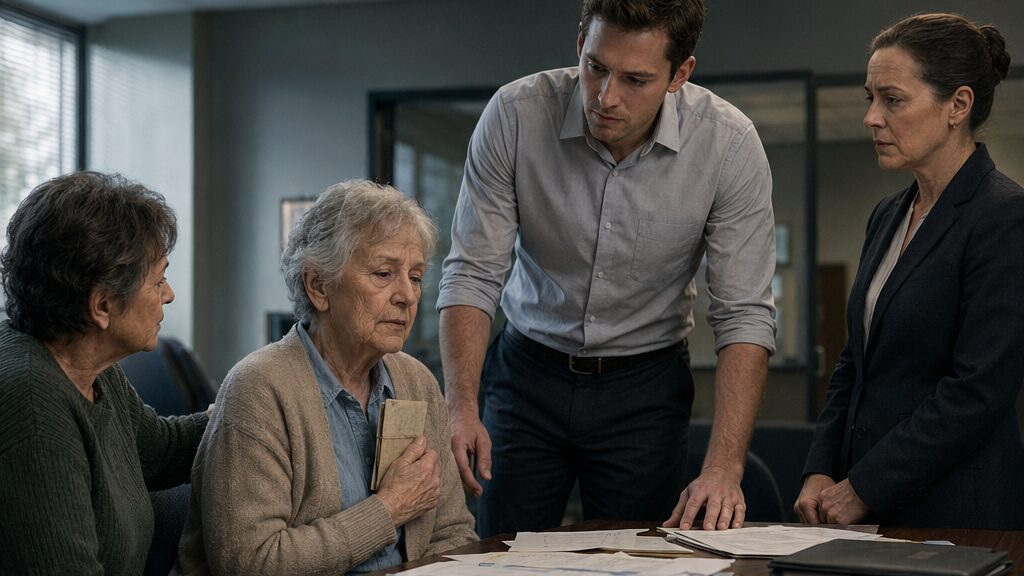
When he finally reached the housing office, Patricia was already seated at the conference table.
Several folders lay open before her.
Deborah sat quietly at the far end.
Sharon occupied the chair beside her.
Patricia glanced at John.
“Glad you could join us.”
Something in her tone had changed over the past week.
Not dramatically.
Just enough.
The meeting began.
Housing requirements.
Verification timelines.
Eligibility reviews.
The same language Deborah had already heard.
Yet this time interruptions were absent.
When Deborah spoke, nobody rushed her.
When she searched for a document, people waited.
The difference was subtle.
Respect often was.
Patricia reviewed several forms.
Then paused.
“There are still gaps in the file.”
Deborah nodded.
“I know.”
“We may need additional time.”
Before Deborah could answer, John spoke.
“Then let’s give her additional time.”
Patricia looked at him.
“The review schedule—”
“Can be adjusted.”
The room grew quiet.
John wasn’t arguing.
He was stating a fact.
Patricia looked down at the paperwork.
Then nodded slowly.
“We can extend the review period.”
Sharon released a breath she had clearly been holding.
Deborah simply said, “Thank you.”
No triumph.
No celebration.
Just gratitude.
After the meeting ended, Deborah lingered near the doorway.
John approached.
“I found something.”
Her eyes narrowed slightly.
“What kind of something?”
“Not enough.”
“That’s not an answer.”
For a moment he saw a glimpse of the younger woman she must once have been.
Direct.
Unimpressed.
He smiled.
“I found evidence that Benjamin Walker survived the field hospital.”
Deborah didn’t move.
Didn’t speak.
Didn’t even blink.
Yet something shifted behind her eyes.
A wall moving half an inch.
Nothing more.
“You sure?”
“No.”
The honest answer.
“But I think so.”
Silence settled between them.
Finally Deborah looked toward the parking lot.
“When I left that tent, there were other patients.”
John waited.
“There was always another patient.”
The words sounded practiced.
Something repeated over many years.
“You did what you could.”
She gave a faint smile.
“That’s what everyone says.”
Before he could respond, she adjusted her purse.
“Let me know if you find anything real.”
Then she walked away.
John watched her cross the lot.
For the first time, he wondered whether finding Benjamin Walker would answer Deborah’s question—or simply replace it with another.
That evening he returned to the archives.
Near closing time, a final record surfaced.
A mailing address.
Old.
Possibly outdated.
Yet attached to a living benefits account.
John stared at the screen.
Hope arrived quietly.
For the first time, Benjamin Walker seemed less like a file and more like a man.
A man who might still be somewhere in the world.
Chapter 5: The Man Deborah Never Stopped Wondering About
Benjamin Walker noticed the letter because nobody wrote letters anymore.
It waited in his mailbox between advertisements and utility notices.
A plain envelope.
No special markings.
No urgent stamp.
Just his name.
He carried it into the house without opening it.
The habit came from age.
Everything could wait until coffee.
His home sat near the edge of a small town.
Modest.
Quiet.
The kind of place where neighbors waved and everyone knew which dog belonged to which family.
Benjamin lived alone.
Not unhappily.
Just alone.
The scar along his side ached whenever storms approached.
That morning it hurt.
He set his coffee mug on the kitchen table and opened the envelope.
Inside was a short note.
Professional.
Careful.
Signed by John Miller.
Benjamin read it twice.
Then a third time.
The words remained unchanged.
They still felt impossible.
The note mentioned a military treatment record.
A combat medical station.
A possible connection to a former Army medic named Deborah Carter.
Benjamin stared through the kitchen window.
The coffee cooled beside him.
For fifty years he had carried fragments.
Voices.
Images.
Sensations.
Never a complete memory.
A medic pressing down on a wound.
Dust falling from a canvas ceiling.
Someone refusing to leave.
Someone shouting for supplies.
Someone telling him to stay awake.
The face had faded.
The voice remained.
Sometimes he still heard it during sleepless nights.
Not the words.
Just the determination behind them.
Benjamin stood and crossed the room.
A small wooden box rested on a bookshelf.
He opened it carefully.
Inside lay old photographs.
Service documents.
Letters.
Nothing extraordinary.
At the bottom sat a folded hospital transfer paper.
The edges had yellowed.
A medic’s notation occupied one corner.
The signature was unreadable.
Benjamin touched the paper gently.
His scar tightened.
Memory returned.
Not fully.
Never fully.
But enough.
The medical tent had been under attack.
He remembered that.
The ground shaking.
The smell of smoke.
The feeling of drifting away.
And a pair of hands.
Steady hands.
Hands covered in blood that was not their own.
He sat heavily in a chair.
For years he had tried searching.
Not obsessively.
Not constantly.
Just enough.
Records requests.
Veterans organizations.
Occasional inquiries.
The answer had always been the same.
Not enough information.
Not enough records.
Not enough history left.
Eventually life moved forward.
Marriage.
Work.
Loss.
Children.
Then grandchildren.
Time.
Still, some questions remained.
His phone rang.
He ignored it.
The coffee grew cold.
The letter stayed open beside him.
By evening he called the number John Miller had provided.
The conversation lasted nearly an hour.
John explained everything he knew.
Which wasn’t much.
An elderly veteran.
A treatment card.
A preserved name.
A possibility.
Benjamin listened without interruption.
When the call ended, neither man spoke for several seconds.
Finally John asked, “Do you remember her?”
Benjamin looked toward the old transfer paper.
“No.”
The answer sounded strange.
True.
But incomplete.
“I remember what she did.”
After hanging up, he walked outside.
The evening air felt cool against his face.
Across the yard, a neighbor watered flowers.
Ordinary life continued.
Yet something had changed.
A door he thought was permanently closed had opened a crack.
Benjamin sat on the porch until darkness arrived.
Then he returned inside.
The scar along his side pulled faintly when he moved.
A reminder carried through half a century.
Before bed, he folded John’s letter and placed it beside the transfer paper.
Two pieces of a puzzle.
Two traces of the same day.
The decision came quietly.
Not dramatic.
Not emotional.
Simply certain.
In the morning, he would begin traveling.
If Deborah Carter was alive, he wanted to meet her.
Not because he owed a debt.
Not because he wanted a reunion.
Because some people spend an hour in your life and leave a mark that never fully fades.
And after fifty years, Benjamin Walker wanted to say thank you.
Chapter 6: What Really Happened Inside The Medical Tent
The explosion knocked one of the overhead lamps loose.
It swung violently from the tent frame as dust filled the air.
Deborah barely looked up.
Another casualty had arrived.
Another wounded soldier.
Another life balanced on minutes.
The field hospital had been overwhelmed for hours.
Stretchers covered every available space.
Medics moved constantly.
Doctors shouted over the noise.
Outside, the battle seemed to be moving closer.
Inside, nobody had time to care.
Deborah dropped beside a patient whose shoulder injury required immediate attention.
Her gloves were already stained.
Her uniform carried dust and sweat.
The shift had begun before sunrise.
Night had arrived without permission.
She worked automatically.
Training replacing exhaustion.
Procedure replacing fear.
Then the tent flap burst open.
Several soldiers rushed inside carrying another casualty.
One look told her everything.
Critical.
Massive blood loss.
Immediate intervention.
The stretcher landed on an empty table.
Deborah moved toward it.
The wounded soldier looked impossibly young.
Most of them did.
His face had gone pale beneath dirt and smoke.
Blood soaked through improvised bandages.
One soldier leaned close.
“Found him near the road.”
Deborah nodded.
No time for details.
She checked his pulse.
Weak.
Rapid.
Dangerously weak.
“What is your name?” she asked.
His eyes struggled to focus.
“Benjamin.”
The answer barely reached her.
“Benjamin what?”
“Walker.”
Deborah repeated it while another medic recorded information.
Names mattered.
Names prevented people from becoming numbers.
Outside, another blast shook the ground.
Several lights flickered.
Someone shouted for additional supplies.
Deborah ignored everything except the patient before her.
Pressure on the wound.
New dressing.
Assessment.
Stabilization.
Every action bought seconds.
Seconds became minutes.
Minutes became possibility.
Benjamin drifted in and out of consciousness.
Whenever his eyes closed, Deborah called him back.
“Stay with me.”
Sometimes he listened.
Sometimes he didn’t.
The attack intensified.
Dust fell continuously from the tent ceiling.
One doctor approached.
“We may need to evacuate.”
Deborah glanced up.
“What about these patients?”
“We take who we can.”
The answer felt like a knife.
Yet reality often did.
The doctor moved away.
Another explosion followed.
Closer.
This one shook equipment from nearby tables.
Metal trays crashed onto the floor.
A medic cursed.
Someone screamed.
Benjamin’s pulse weakened again.
Deborah pressed harder.
Blood covered her gloves.
Then her sleeves.
Then her hands beneath torn fabric.
Hours blurred.
The tent transformed into a world measured only by survival.
Eventually evacuation orders came.
Some personnel began moving patients.
Others prepared vehicles.
Chaos expanded.
Deborah looked at Benjamin.
Still alive.
Barely.
A transport team arrived.
“Ready?”
She checked him one final time.
Adjusted bandages.
Updated notes.
Completed a treatment card.
The small card recorded everything that mattered.
Name.
Condition.
Interventions.
Urgency.
Her handwriting rushed across the paper.
Benjamin Walker.
She attached the card.
Then hesitated.
Something felt unfinished.
Perhaps because she had spent so long fighting for his life.
Perhaps because uncertainty lingered.
She never learned which.
The transport team lifted the stretcher.
Benjamin’s eyes opened briefly.
Only briefly.
Long enough to see her.
Long enough to speak.
“Don’t leave.”
The words almost disappeared beneath the noise.
Deborah leaned closer.
“You’ll be okay.”
A promise she had no right to make.
Yet she made it anyway.
The stretcher moved toward the exit.
Benjamin vanished into darkness beyond the tent flap.
Deborah watched him go.
Then turned back.
Because another patient waited.
And another.
And another.
The war didn’t pause for endings.
Hours later, evacuation finally reached her position.
By then she could barely stand.
Her hands trembled from exhaustion.
Blood covered everything.
Someone else’s blood.
Always someone else’s.
The treatment card remained in her pocket.
She wasn’t sure why she kept it.
Maybe she intended to file it later.
Maybe she forgot.
Maybe part of her needed proof that Benjamin Walker had existed.
Years passed.
The card remained.
The answer never arrived.
And every so often, usually in quiet moments, Deborah wondered whether the young man carried out of that tent had lived long enough to see another morning.
Chapter 7: The Story She Never Told Anyone
The community meeting was supposed to be about housing.
That was what the notice said.
Residents gathered in the common hall shortly before sunset. Folding chairs filled the room. A coffee station stood against one wall. Several staff members arranged paperwork near the front.
Deborah almost didn’t attend.
She sat in her apartment for nearly twenty minutes holding the notice in one hand.
Housing reviews.
Policy updates.
Resident concerns.
Nothing about those words appealed to her.
Yet Sharon insisted.
“You need to be there.”
“I already filled out forms.”
“This isn’t about forms.”
Deborah gave her a look.
“Everything is about forms lately.”
Sharon laughed.
Then she drove her to the meeting anyway.
Now Deborah sat near the back row while people slowly filled the room.
Patricia stood near the front speaking quietly with staff members.
John moved between tables carrying folders.
When he noticed Deborah, he walked over.
“Thank you for coming.”
She nodded.
“You found something.”
It wasn’t a question.
John looked surprised.
“How do you know?”
“You’ve been walking around all evening trying not to smile.”
His expression confirmed it.
Not everything.
But enough.
“I found more records.”
Deborah’s stomach tightened.
“Good records?”
“Better records.”
That answer wasn’t particularly helpful.
Before she could press further, Patricia stepped to the microphone.
The meeting began.
Most of the discussion centered on practical concerns.
Maintenance requests.
Parking issues.
Program changes.
Budget limitations.
Residents spoke.
Staff responded.
The familiar rhythm of community meetings unfolded.
Deborah listened without contributing.
She preferred it that way.
The less attention, the better.
Eventually the conversation shifted toward housing reviews.
Tension entered the room immediately.
Questions became sharper.
Voices became louder.
Several residents worried about eligibility requirements.
Others feared losing assistance.
Deborah understood every concern.
She felt them herself.
Patricia answered carefully.
She seemed different than she had during Deborah’s first review.
Still professional.
Still focused on policy.
But she listened more.
Paused more.
Asked questions before giving conclusions.
Respect had arrived gradually.
Not through dramatic revelations.
Through attention.
When the discussion opened for additional comments, John stood.
He held a thin folder.
“I’d like to address something related to our review process.”
The room quieted.
Deborah felt an unexpected knot form in her chest.
John looked toward her.
Not dramatically.
Not in a way that drew immediate attention.
Just enough.
He opened the folder.
“Over the last several weeks, I’ve been reviewing historical service documentation connected to one of our residents.”
Deborah closed her eyes briefly.
Sharon touched her arm.
A silent question.
Are you okay?
Deborah nodded.
John continued.
“What I discovered reminded me that paperwork rarely tells the whole story.”
Several people looked confused.
Patricia watched quietly.
John didn’t mention medals.
Or awards.
Or rank.
Instead he held up a photocopy of an old treatment record.
Not the original.
Never the original.
“The record belongs to Deborah Carter.”
A few heads turned.
Deborah wished they wouldn’t.
John kept speaking.
“Many years ago she served as a combat medic.”
Silence settled across the room.
No applause.
No gasps.
Just silence.
The respectful kind.
John looked toward Deborah.
“If you’re comfortable, I think people should hear part of that story.”
Every eye in the room seemed to shift toward her.
Deborah hated moments like this.
Not because she feared speaking.
Because she disliked being the center of attention.
The treatment card rested inside her purse.
She could feel its presence without touching it.
Sharon leaned closer.
“You don’t have to.”
Deborah knew that.
The choice belonged to her.
Always had.
For several seconds she considered refusing.
Then she stood.
Slowly.
The room remained quiet.
She walked toward the front.
Not because she wanted recognition.
Because there was one thing she had never said aloud.
Not completely.
Not honestly.
She looked at the photocopy in John’s hand.
Then at the residents waiting patiently.
“I was a medic,” she said.
The words felt strange.
She rarely used them anymore.
“I worked in a field hospital.”
Nobody interrupted.
“I treated a lot of people.”
Her hands rubbed together briefly before she stopped herself.
Old habit.
Old memory.
“There was one soldier.”
The room disappeared.
Not physically.
Emotionally.
Suddenly she was staring through decades.
Back toward canvas walls and falling dust.
Back toward blood-stained gloves.
Back toward a young man trying not to die.
“I never knew what happened to him.”
Her voice remained steady.
That surprised her.
“He was brought into the tent during an attack.”
She swallowed.
“I treated him. Sent him out with an evacuation team.”
A pause.
“I spent fifty years wondering if he survived.”
The admission hung in the room.
Small.
Honest.
Human.
Not heroic.
Not dramatic.
Just true.
Deborah looked down.
The treatment card was already in her hand.
She hadn’t realized she’d removed it from her purse.
The stained paper seemed impossibly fragile.
“I kept this because I couldn’t throw it away.”
Nobody spoke.
Nobody hurried her.
For the first time, Deborah understood that people were listening not because she had been a soldier.
They were listening because she was a person.
A person carrying a question for half a century.
She exhaled slowly.
“I don’t know why that mattered so much.”
“Maybe because it mattered to him.”
The voice came from the doorway.
Every head turned.
The room went completely still.
A man stood near the entrance.
Gray hair.
Weathered face.
One hand resting against the frame.
Travel dust still clung to his jacket.
His eyes never left Deborah.
Neither did hers.
For a moment nobody moved.
Then Deborah saw the scar visible above his collar.
And somehow she knew.
Not from memory.
Not exactly.
From recognition deeper than memory.
The treatment card trembled in her hand.
The man took a slow step forward.
“Hello, Deborah.”
Chapter 8: Respect That Changed What Happened Next
Nobody rushed toward Benjamin Walker.
Nobody turned the moment into a spectacle.
The room simply held its breath.
Benjamin crossed the hall slowly.
As if afraid sudden movement might break something fragile.
Deborah remained where she stood.
The treatment card still in her hand.
The years between them felt impossible.
Yet somehow they had already disappeared.
Benjamin stopped a few feet away.
For several seconds neither spoke.
Then he smiled.
A small smile.
The kind built from relief rather than happiness.
“You kept it.”
Deborah looked down at the card.
“Apparently.”
A few quiet laughs drifted through the room.
The tension eased.
Not completely.
Just enough.
Benjamin glanced at the paper.
“I thought I imagined most of that day.”
His voice carried age and distance.
“I remembered pieces. Never enough.”
Deborah stared at him.
“You survived.”
The words escaped before she could stop them.
Benjamin nodded.
“Because you refused to quit.”
Silence followed.
No one interrupted.
No one filled the space with unnecessary words.
Deborah lowered her eyes.
“You don’t know that.”
“I do.”
Benjamin touched the scar along his side.
The motion seemed automatic.
“I spent months recovering.”
His gaze returned to her.
“I asked about the medic who stayed with me.”
Deborah felt something tighten in her chest.
“I never found a name.”
John stood quietly near the side of the room.
Patricia sat motionless.
Neither seemed willing to disturb the conversation.
Benjamin looked around the hall.
Then back at Deborah.
“I searched off and on for years.”
She blinked.
“Why?”
The answer came without hesitation.
“Because I wanted to thank you.”
Deborah laughed softly.
The sound carried more emotion than she intended.
“For fifty years?”
Benjamin smiled.
“Not every day.”
A few people chuckled.
The room relaxed further.
The exchange felt less like a reunion and more like two people finally finishing an unfinished conversation.
Benjamin’s expression grew serious again.
“When I left that tent, I thought I was dying.”
Deborah remembered.
She remembered because she had thought the same thing.
“The last thing I clearly remember is you telling me I’d be okay.”
A shadow crossed her face.
“I wasn’t sure that was true.”
“I know.”
Benjamin nodded.
“That’s why I believed you.”
The answer struck her unexpectedly.
Not because of what he said.
Because of how he said it.
Simple.
Matter-of-fact.
No exaggeration.
No hero worship.
Just truth.
Benjamin stepped closer.
“I had a family because I survived.”
The room became very quiet.
“I got married.”
He paused.
“Had children.”
Another pause.
“Then grandchildren.”
Deborah closed her eyes briefly.
A lifetime.
An entire lifetime.
Built beyond the walls of that medical tent.
Benjamin continued.
“I wanted you to know that.”
Nothing more.
No speech.
No dramatic declaration.
Just information she had carried half a century without possessing.
The answer to a question that had followed her everywhere.
She opened her eyes again.
For the first time in years, the memory of that day felt different.
Not lighter.
But complete.
Patricia eventually stood.
Not to interrupt.
To address the reason everyone had gathered.
The housing review.
Yet even that conversation sounded different now.
She looked toward Deborah before speaking.
“After reviewing the circumstances of Ms. Carter’s case, we’ve decided to extend her eligibility and preserve her housing status.”
A murmur moved through the room.
Deborah blinked.
The announcement almost felt secondary.
Patricia continued.
“There were gaps in the documentation.”
She glanced down briefly.
“Those gaps existed because we weren’t asking the right questions.”
The statement wasn’t dramatic.
Yet it carried weight.
Patricia looked directly at Deborah.
“We should have listened sooner.”
Deborah didn’t know how to answer.
Fortunately none was required.
Patricia returned to her seat.
The meeting continued.
Briefly.
Almost everyone seemed aware that the important part had already happened.
Afterward, residents approached Deborah.
Not to praise her.
Not to celebrate.
Simply to speak with her.
To ask questions.
To listen.
One woman thanked her for sharing her story.
A veteran volunteer asked about her medical training.
Another resident spoke about losing a brother in service.
The conversations felt human.
Balanced.
Respectful.
Exactly what Deborah would have wanted.
Later, as the hall slowly emptied, Benjamin remained nearby.
So did John.
So did Sharon.
The four of them stood together in comfortable silence.
Finally Benjamin reached into his jacket pocket.
He removed a folded paper.
The old transfer document he had carried for decades.
Deborah recognized it immediately.
He held it beside the treatment card.
Two surviving pieces of the same day.
Two fragments that had spent fifty years apart.
Neither spoke for a moment.
Then Benjamin carefully handed the transfer paper to her.
Deborah examined it.
The faded writing.
The worn edges.
The years contained within it.
When she looked up, Benjamin gently returned the treatment card.
Not casually.
Not ceremonially.
With care.
As though returning something valuable.
She accepted it.
The paper felt different now.
For years it had represented uncertainty.
A question.
A burden.
Now it represented a life.
A real one.
Benjamin glanced toward the doorway.
“I should probably head to my hotel.”
“You came all this way.”
“I did.”
Deborah smiled.
“So did you.”
They both laughed.
The sound felt easy.
Sharon watched quietly.
John did too.
Neither tried to turn the moment into something larger.
It wasn’t larger.
It was exactly what it needed to be.
Outside, evening settled across the parking lot.
People drifted toward their cars.
Conversations faded.
The hall lights dimmed.
Deborah stood near the entrance holding the treatment card.
For the first time in decades, she didn’t feel compelled to hide it away immediately.
The question that had followed her through half her life finally had an answer.
Benjamin Walker had survived.
More importantly, he had lived.
John approached before leaving.
“Goodnight, Ms. Carter.”
She smiled.
“Goodnight, John.”
No special tone.
No awkward reverence.
Just respect.
The kind built from understanding.
As everyone gradually departed, Deborah slipped the treatment card back into its envelope.
Not because she couldn’t let go.
Because she no longer needed to.
The story has ended.