The Young Instructor Mocked His Shaking Hands Until The Desert Target Came Back Silent
Chapter 1: The Old Rifle Case At The Desert Range
The old rifle case looked out of place against the desert dust.
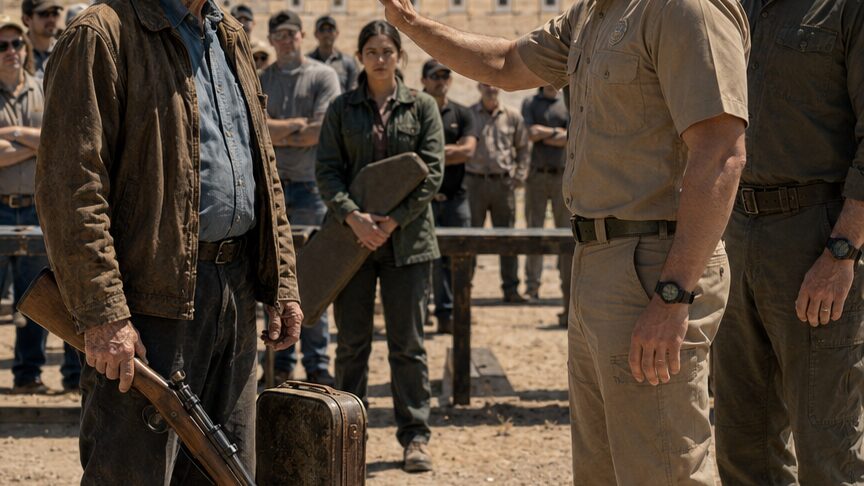
George Wilson set it down beside a folding chair and stood quietly for a moment while pickup trucks rolled through the parking area. Beyond them, heat shimmered above the firing lanes. Steel signs rattled softly in the morning wind. Volunteers moved tables into place for the veteran charity qualification event.
Nobody paid much attention to the old man at first.
That changed when they noticed the case.
A few younger shooters glanced toward it and then toward him. Some looked curious. Others looked concerned.
George understood the look.
Late seventies. Slightly stooped shoulders. Weathered face. Hands that sometimes trembled when he reached for a coffee cup.
The world had become very quick to make decisions.
He lifted the case again and started toward registration.
A young volunteer smiled politely.
“Morning, sir.”
“Morning.”
She checked a clipboard.
“Participant?”
“Demonstration shooter.”
The smile faltered.
She looked him over again.
“Let me find the organizer.”
George nodded.
No irritation. No complaint.
He had expected this.
The charity event had grown larger than he remembered. Years ago the range had been a training facility filled mostly with instructors and service members. Now banners stood beside the entrance. Junior competitors unloaded expensive rifles from padded cases. Sponsors had tents arranged along the fence line.
Time changed places.
Sometimes it changed people too.
A voice behind him broke his thoughts.
“Sir, is that firearm registered for today’s event?”
George turned.
The speaker wore a tan instructor uniform and carried himself with the confidence of someone accustomed to being obeyed.
Larry Clark.
Young. Sharp jaw. Straight posture.
George had seen hundreds like him.
Good men sometimes.
Sometimes not.
“It is,” George said.
Larry’s eyes moved to the worn wooden case.
“That’s what you’re planning to use?”
“Yes.”
Larry frowned.
“For the demonstration?”
“That’s right.”
The younger man seemed unsure whether George was joking.
A few nearby shooters slowed to listen.
George could almost hear assumptions forming.
Old rifle.
Old man.
Old problem.
Larry crossed his arms.
“We’ve got safety standards here.”
George nodded.
“Good.”
Larry blinked.
The answer had not gone where he expected.
“We take equipment condition seriously.”
“So should every range.”
Larry stared at him for a moment.
Then he gestured toward the case.
“Mind opening it?”
George set the case on a table.
The latches clicked.
Inside rested an old wooden-stock rifle.
Not flashy.
No expensive optics.
No modern finish.
Just careful maintenance and decades of use.
The wood had darkened with age.
The metal carried faint signs of handling.
A rifle that had worked for a living.
Larry examined it.
“It still functions safely?”
“Yes.”
“When was it last inspected?”
“Last month.”
The younger instructor looked mildly surprised.
George almost smiled.
The rifle had been cleaned more carefully than most modern competition guns.
Not because he planned to prove anything.
Because promises mattered.
His wife had understood that.
Even near the end.
Especially near the end.
The memory arrived quietly.
A hospital room.
A tired smile.
A hand squeezing his.
Go back once.
Not to win.
Not to hide.
Just go back.
He closed the memory away.
The morning wasn’t ready for it.
Larry shut the rifle case.
“I’ll need to verify your demonstration authorization.”
“Of course.”
The organizer finally arrived and hurried over.
Recognition flashed across her face.
“Mr. Wilson?”
George nodded.
“Thank you for coming.”
Larry looked between them.
“He’s approved?”
“He was invited.”
The organizer seemed confused by the question.
Larry’s expression tightened slightly.
“Invited for what exactly?”
The organizer glanced at George.
“For the charity demonstration.”
“With that rifle?”
George said nothing.
The organizer answered carefully.
“Yes.”
Larry looked unconvinced.
Across the range, shooters continued arriving.
Several were openly watching now.
George could feel their attention.
Not hostile.
Not friendly.
Evaluating.
The same way people inspected equipment before deciding whether it still worked.
The organizer handed him a participant badge.
“Range briefing starts in twenty minutes.”
“Thank you.”
As George turned away, Larry spoke again.
“Sir.”
George stopped.
“This event is competitive.”
“I know.”
“The firing line is busy.”
George waited.
Larry finally said what he wanted to say.
“Maybe today isn’t the best day to push yourself.”
Silence lingered.
George looked at the young instructor.
He saw concern mixed with pride.
The dangerous kind.
The kind that believed certainty was wisdom.
“I’ll be careful,” George said.
Then he walked away.
The desert wind moved lightly across the range.
Behind him, conversation resumed.
Ahead, targets stood against distant berms.
The place felt familiar and strange at the same time.
He found a chair beneath a shade structure and rested the rifle case beside him.
A junior shooter sat nearby studying qualification sheets.
Nervous.
Focused.
Trying hard not to look nervous.
George remembered that feeling.
Everyone started somewhere.
The girl noticed the case.
“Old rifle?”
“Very.”
She smiled.
“Still accurate?”
George looked toward the distant targets.
“We’ll find out.”
The girl laughed softly.
A simple sound.
No judgment.
Just curiosity.
It reminded him of why he had once enjoyed teaching.
The range loudspeaker crackled.
People began moving toward the briefing area.
George stood.
The rifle case felt heavier than its actual weight.
Not because of age.
Because of memory.
Because every step brought him closer to the reason he had returned.
As he approached the firing line, Larry stood waiting with several instructors.
Their eyes met.
Larry’s expression hardened.
The younger man looked toward the lanes.
Then back toward George.
His voice carried farther than necessary.
“This line is for shooters, not memories.”
Chapter 2: The Young Instructor Raises His Voice
The remark hung in the air.
Not loud enough to become a scene.
Not quiet enough to remain private.
Several nearby shooters turned.
George stopped walking.
For a moment nobody spoke.
Then the range briefing resumed and people drifted forward.
The tension should have ended there.
It didn’t.
Larry seemed determined to prove a point.
During equipment inspection he returned again and again to George’s station.
Checking.
Questioning.
Watching.
Each visit drew more attention.
By late morning a small audience had begun following the exchange.
George remained patient.
Patience had taken decades to learn.
Arrogance usually arrived much faster.
“Need help with that?” Larry asked as George adjusted the sling.
“No.”
“You sure?”
“Yes.”
Larry watched his hands.
George knew what he saw.
A faint tremor.
Age.
Nothing more.
The younger instructor nodded toward the rifle.
“You really think you can manage this safely?”
George secured the sling.
“I wouldn’t be here otherwise.”
A few spectators exchanged glances.
Larry crouched slightly.
“What about your eyesight?”
George looked at him.
“It still works.”
A laugh escaped someone farther down the line.
Larry straightened.
His cheeks colored slightly.
He wasn’t trying to be cruel.
George recognized that too.
Larry wanted control.
Control felt safer than uncertainty.
Many instructors made that mistake.
The range moved into preparation mode.
Targets were posted.
Equipment checked.
Safety confirmations repeated.
George listened carefully.
Then something caught his attention.
A minor oversight.
Small.
Easy to miss.
Potentially dangerous.
Larry finished his instructions and began directing shooters toward assigned positions.
George waited.
Then he spoke.
“Range flag.”
Larry frowned.
“What?”
“The secondary flag.”
The younger man looked toward the safety station.
Nothing.
Then realization crossed his face.
One flag had not been raised.
A required visual indicator.
Not catastrophic.
Still important.
The kind of detail instructors were expected to notice.
Silence spread nearby.
Larry quickly signaled a volunteer.
The missing flag went up.
Problem solved.
But not forgotten.
Larry turned back toward George.
“Good catch.”
George nodded.
No triumph.
No lecture.
Just acknowledgment.
That somehow made it worse.
A young competitor asked quietly, “How’d he notice that?”
Nobody answered.
George sat at a check-in table while shooters rotated through equipment verification.
From his shirt pocket he removed a folded card.
The paper had yellowed with age.
Its edges were worn smooth.
His thumb brushed across the surface.
Handwritten notes covered one side.
Safety reminders.
Wind observations.
Teaching phrases.
A lifetime compressed into a few inches of paper.
His range card.
The same one Sharon had found tucked away among old belongings.
The same one his wife had preserved.
George looked at it for a moment.
Then folded it again.
Larry appeared.
“What’s that?”
“A range card.”
The younger man held out a hand.
George passed it over.
Larry studied the handwriting.
His expression shifted.
The notes were detailed.
Professional.
Practical.
Not the work of an amateur.
Several nearby instructors glanced at the card.
One pointed toward a line written along the margin.
“That’s actually pretty good.”
Larry ignored the comment.
“Where’d you get this?”
George almost smiled.
“I wrote it.”
The answer seemed to irritate him.
Before he could respond, another voice interrupted.
“Let me see that.”
The speaker had authority.
Everyone recognized it immediately.
Thomas Moore approached from the command area.
The senior range officer accepted the card carefully.
His eyes moved across the faded handwriting.
Then stopped.
Something in his expression changed.
Not recognition.
Not yet.
Something close.
His gaze lingered on a short phrase written near the bottom.
Slow is smooth. Smooth is accurate.
Thomas stared at it longer than necessary.
The noise of the range faded around him.
George noticed.
So did Larry.
“You know him?” Larry asked.
Thomas didn’t answer immediately.
Instead he looked from the card to George.
Then back again.
The older man’s face seemed familiar.
The phrase seemed familiar.
The handwriting felt familiar.
A memory stirred somewhere beyond reach.
Thomas handed the card back slowly.
“Where did you say you got this?”
George slid it into his pocket.
“I didn’t.”
For several seconds neither man spoke.
Larry looked confused.
Thomas looked unsettled.
The difference mattered.
Because confusion passed quickly.
Recognition lasted.
Thomas finally stepped aside.
But he glanced back twice before leaving.
The crowd noticed.
And crowds noticed everything.
Whispers began moving through the range.
Not loud.
Not clear.
Just enough.
Who was the old man?
Why had the senior officer reacted like that?
George ignored it.
Speculation never hit targets.
Discipline did.
The sun climbed higher.
Heat shimmered above the distant lanes.
By noon the event schedule reached the demonstration portion.
Shooters gathered near the long-distance section.
Larry stepped forward with renewed confidence.
If uncertainty had touched him, he had hidden it.
He addressed the crowd.
Then looked directly at George.
“We’ll conclude with a public demonstration challenge.”
The words drew immediate attention.
George remained still.
Larry continued.
“And anyone who believes they can meet the standard is welcome to try.”
His eyes never left George.
Around them, anticipation spread through the spectators.
Thomas Moore stood near the rear of the crowd.
Watching.
Thinking.
Remembering.
And for the first time all morning, George suspected the day might become more complicated than he had intended.
Chapter 3: The Officer Who Remembered The Rule
Thomas Moore had spent most of his career learning to trust instincts.
The problem was that instincts rarely explained themselves.
He stood beneath a shade tent overlooking the range and watched George Wilson speak quietly with event organizers.
The old man seemed ordinary.
That was what bothered him.
The truly memorable instructors had often seemed ordinary.
Until they opened their mouths.
Or corrected a mistake.
Or stopped an accident before it happened.
Thomas rubbed the back of his neck.
The phrase remained lodged in his thoughts.
Slow is smooth. Smooth is accurate.
He had heard it years ago.
Not in a classroom.
Not from a manual.
From a person.
A specific person.
Someone standing beside a firing line.
Someone who never raised his voice.
The memory hovered frustratingly beyond reach.
A volunteer approached.
“Everything okay, sir?”
“Fine.”
But it wasn’t.
Thomas disliked unanswered questions.
Especially when they involved safety.
Especially when they involved pride.
Across the range Larry prepared equipment for the demonstration challenge.
The younger instructor moved efficiently.
Confidently.
Too confidently, perhaps.
Thomas had seen the confrontation earlier.
Larry believed he was protecting standards.
That part was admirable.
The public nature of it was less admirable.
Authority worked best when it wasn’t performed.
His gaze returned to George.
The old man sat alone cleaning dust from the rifle stock with a cloth.
Careful movements.
No wasted effort.
No hurry.
The rifle itself looked familiar too.
Not because Thomas recognized the weapon.
Because he recognized how it was handled.
Respectfully.
Methodically.
As if safety began long before a trigger.
Thomas walked toward him.
George looked up.
“Officer.”
“George.”
The name felt natural somehow.
Thomas sat beside him.
For several moments they watched the range together.
Finally Thomas said, “Have we met before?”
George considered the question.
“A long time ago.”
The answer struck like a distant echo.
Thomas frowned.
“You trained here.”
George smiled faintly.
“Many people trained here.”
Not a denial.
Not confirmation.
Thomas felt the memory shifting closer.
A younger version of himself.
Nervous hands.
A difficult qualification day.
An instructor correcting posture without embarrassment.
Teaching instead of showing off.
The details remained blurred.
The feeling did not.
“You taught safety first,” Thomas said quietly.
George looked toward the firing line.
“Everyone should.”
The response settled something inside him.
Not certainty.
But direction.
Thomas suddenly understood one thing clearly.
Larry had underestimated this man.
Badly.
The realization brought embarrassment.
Not for George.
For the range.
For everyone who had watched.
Yet George himself seemed unconcerned.
That was perhaps the strongest evidence of all.
People seeking recognition usually reached for it.
George avoided it.
“Why didn’t you tell anyone who you are?” Thomas asked.
The older man folded the cloth carefully.
“Would it matter?”
Thomas opened his mouth.
Then closed it again.
The uncomfortable answer was yes.
It would have mattered.
People would have listened sooner.
And that was exactly the problem.
George rose to his feet.
“I didn’t come here for that.”
Thomas watched him walk toward the preparation area.
The old rifle rested against his shoulder.
The desert wind stirred lightly across the range.
Nearby, Larry stepped onto a small platform and addressed the crowd.
His voice carried clearly.
Confident.
Professional.
Determined.
The audience gathered closer.
Junior shooters.
Veterans.
Volunteers.
Melissa Garcia among them.
Everyone waiting.
Everyone curious.
Larry gestured toward the long-distance lane.
“We’re going to run a demonstration challenge.”
Murmurs spread immediately.
The target chosen was difficult.
Far enough to expose mistakes.
Demanding enough to test skill.
Exactly the kind of shot that could embarrass someone publicly.
Thomas felt a knot form in his stomach.
Not because he doubted George.
Because he doubted Larry understood what he was inviting.
The younger instructor looked toward George.
The challenge was no longer subtle.
The entire range knew it.
George met his gaze calmly.
No anger.
No pride.
Just quiet attention.
The same expression Thomas remembered from years ago.
At last the memory locked into place.
Not completely.
But enough.
Enough to know.
Enough to understand.
Enough to realize that the old man standing beside the firing line might once have taught half the instructors in the region.
The crowd fell silent.
Larry lifted a hand toward the distant target.
The challenge had begun.
Chapter 4: The Wind Nobody Young Could See
The long-distance lane sat at the far edge of the range, where the desert stopped pretending to be still.
George could see the mirage moving before anyone finished talking.
It shimmered low over the sand, sliding in thin waves across the target line. Heat bent the air just enough to mislead a careless eye. The wind flags nearer the shooters looked calm, but the brush beyond the berm told a different story.
Larry placed a spotting scope on the table with deliberate care.
“The demonstration challenge is simple,” he said. “One shooter. Three rounds. Standard qualification position. Distant paper target.”
He glanced at George.
“Any safe rifle may be used, provided the shooter can control it.”
The words were clean.
The meaning was not.
George stood beside his rifle case and listened.
He could feel the crowd behind him: junior shooters whispering, veterans folding their arms, volunteers pretending to adjust chairs while watching every movement.
The old dislike of spectacle rose in him.
Shooting had never been theater.
At least, not when it was done correctly.
Larry continued explaining the target distance, the scoring circle, the qualification standard. His tone suggested fairness. His eyes suggested challenge.
Melissa stood near the front of the crowd, her own rifle case at her feet. She looked from Larry to George, uncertain which lesson she was supposed to learn.
George wished she did not have to learn it this way.
Thomas Moore stood closer to the safety station, face unreadable.
Larry finished and turned.
“Mr. Wilson, since you’re here as a demonstration shooter, would you like to attempt the standard?”
George looked toward the target.
The paper was barely more than a pale square in the heat.
He could refuse.
That had been his first instinct from the moment Larry began circling him. He had not come for applause or correction or some public measuring contest. He had come because his wife had asked him to return once, and because the charity organizer had requested a short demonstration for the younger shooters.
A promise, not a performance.
Yet a different responsibility had appeared.
Larry’s pride had become a classroom.
George opened the rifle case.
The murmurs faded.
He lifted the old wooden rifle with both hands. The stock fit his palm in the way only long-used things did. The finish had worn smooth where his cheek had rested over the years. Small marks along the wood were not damage to him. They were dates without numbers.
He remembered cleaning it at the kitchen table after his wife had fallen asleep in the chair nearby.
“You still love that old thing?” she had asked.
“I trust it.”
“Same answer you gave me when I asked why you married me.”
He had laughed then.
The memory hurt gently now.
Larry watched him handle the rifle.
“Need a bench?”
“No.”
“Most shooters your age prefer support.”
George checked the rifle with calm, visible care.
“Most shooters should use whatever position the course requires.”
A few heads turned toward Larry.
George did not look up.
He verified the chamber, the magazine, the safe direction. Not rushed. Not theatrical. Every motion placed where anyone watching could follow.
Thomas saw it.
His posture changed slightly.
George carried the rifle to the line only after the range was cleared and confirmed. The firing-line safety officer repeated the commands. George listened to each one.
Larry adjusted the spotting scope.
“Wind is nearly flat,” he said.
George looked past the near flags.
“No.”
Larry paused.
“Excuse me?”
“Left to right at the target. Not much here. More downrange.”
The young instructor almost smiled.
“The flags aren’t showing that.”
“The flags near us aren’t.”
A quiet ripple moved through the spectators.
Larry leaned toward the scope and studied the distant lane.
George said nothing more.
The desert did not care who believed it.
A strip of mirage bent along the lower edge of the target frame. The tall dry grass near the berm leaned and relaxed in faint pulses. The sun pressed against the back of George’s neck. He adjusted nothing yet.
Larry stood upright.
“What correction would you make?”
George named it.
Small.
Precise.
Enough to sound either foolish or masterful.
Larry’s expression tightened.
“That’s a lot of confidence.”
“No,” George said. “It’s just wind.”
The answer landed softly, but it changed the air.
For the first time, Larry did not reply at once.
George stepped back from the rifle and removed the yellowed range card from his pocket. His thumb found the old line before his eyes did.
Slow is smooth. Smooth is accurate.
Beneath it, in his wife’s smaller handwriting, she had added years ago: Then come home smooth too.
He folded the card again.
His hands trembled slightly.
He let them.
A tremor standing upright meant very little. A person was not a machine. Age had earned its place in his body. He did not resent it. He only needed to work honestly with what remained.
He rolled his shoulders once.
Breathed out.
Larry watched closely, waiting for weakness to become proof.
George gave him none.
The firing-line safety officer looked to Thomas.
Thomas nodded.
The command came.
“Range is hot.”
The words moved through the crowd like a door closing.
George lowered himself carefully.
One knee touched the dusty mat.
Then the other foot settled.
The motion took longer than it once had. He felt the pull in his joints, the ache in his back, the weight of years gathering around the simple act of kneeling.
Somewhere behind him, someone drew in a breath.
Larry’s face showed the first flicker of doubt.
George did not see it.
He was looking only at the lane.
The rifle came to his shoulder.
The old wood touched his cheek.
The tremor in his hands changed.
Not gone.
Never gone.
But gathered.
Contained.
Turned into rhythm.
The wind moved.
The desert shimmered.
The crowd fell away.
George settled into the kneeling position as the range went silent.
Chapter 5: When The Target Came Back Silent
The silence at the firing line was not empty.
George could hear everything inside it.
A paper target shifting faintly in the far stand.
The dry tap of a loose sign against metal.
The low breath of someone waiting too hard.
His own heart, slower than the morning had been.
The rifle rested against him like an old sentence he still knew how to finish.
He did not rush to fire.
Rushing was often fear wearing a uniform.
He let the front sight settle. He let it drift. He let the wind speak its small language downrange.
Left to right.
Not steady.
Coming in pulses.
The near flags barely moved, but the target lane had its own weather. It always did. Beginners watched the closest sign. Better shooters watched the world between themselves and the target.
George breathed in.
Paused.
Breathed out.
Behind him, Larry’s boots shifted in the dust.
George felt no anger toward the young man now. Not clean anger. Not useful anger. Only a tired understanding. Pride was a burden many young instructors carried because they mistook uncertainty for weakness.
He had done it once too.
Long before gray hair.
Long before grief.
Long before this desert range had become a place he avoided.
The rifle sight moved in a small arc.
His hands trembled at the edge of stillness.
He accepted the movement instead of fighting it.
The shot broke.
A sharp crack rolled down the lane.
No one spoke.
George kept position.
He worked the rifle with measured care, never letting safety leave his mind. The casing landed near the mat. His cheek returned to the stock.
Larry leaned into the spotting scope.
His body went still.
George did not ask.
The target would answer later.
Second breath.
Second hold.
The wind eased, then tugged again.
George adjusted by almost nothing.
The second shot broke.
The range remained silent.
Not impressed yet.
Not relieved.
Waiting.
George felt the ache in his knee spreading. He had not practiced this position as often as he should have. That was the truth. Pride would have pretended otherwise. Discipline did not require pretending.
He shifted only enough to protect control.
The rifle stayed pointed safely downrange.
The firing-line safety officer watched him with growing attention.
Thomas stood behind the line, eyes fixed on George’s posture.
Perhaps remembering.
Perhaps already knowing.
George took the third breath.
This one came harder.
For a moment the desert brightened, and the target blurred.
He blinked once.
No drama.
No fear.
Just age reminding him it had come along too.
He waited until the sight returned.
There.
The third shot broke.
The sound faded into open sand.
George remained still for two full breaths.
Then he made the rifle safe with the same care he had shown before the first round. Chamber checked. Muzzle controlled. Finger clear. Actions visible.
Only then did he lower the rifle.
The crowd seemed not to know whether it was allowed to breathe.
Larry stayed bent over the scope.
His face had changed.
Not defeated.
Not yet.
Simply unprepared.
“What do you see?” Thomas asked.
Larry didn’t answer.
The firing-line safety officer looked into the scope next.
His eyebrows rose.
He stepped back without comment.
That silence did more than any shout could have.
The target retrieval system hummed to life.
Far downrange, the paper began its slow journey back.
Everyone watched.
George set the rifle gently on the mat and eased himself up. His knee objected. He used one hand on the bench, not hiding the effort.
Melissa saw it.
So did Larry.
George did not mind.
Strength was not the absence of effort. Sometimes it was refusing to lie about effort.
The paper target slid closer.
At halfway, some in the crowd leaned forward.
At twenty yards, the grouping became visible.
At ten, nobody moved.
The paper arrived.
Three clean holes sat tight in the scoring center.
Not touching perfectly.
Not some impossible miracle.
Better than that.
Real.
Controlled.
Human.
Undeniable.
The kind of group that could be measured without argument.
The kind that ended noise.
The young shooters stared.
A veteran spectator removed his cap.
The charity organizer covered her mouth with one hand.
Melissa looked at George as if a door had opened in front of her.
Larry stood near the target carrier, his face drained of the practiced confidence he had worn all morning. He looked first at the holes. Then at the old rifle. Then at George’s hands.
Those hands shook again now.
Lightly.
Plainly.
The same hands he had mocked.
George picked up the spent brass, one piece at a time.
No flourish.
No glance toward the crowd.
When he finished, he placed the brass in his pocket and reached for the rifle.
“Sir,” Larry said.
The word came out quietly.
George looked at him.
Larry swallowed.
“I didn’t think—”
“No,” George said gently. “You didn’t.”
The words held no cruelty.
That made them harder to hear.
Larry looked down.
The crowd still had not erupted into applause. Something better had happened. They had fallen into respect before noise could cheapen it.
Thomas stepped forward.
His eyes were no longer uncertain.
“Master Instructor Wilson,” he whispered.
The title crossed the firing line like wind over dust.
George closed his eyes for a brief moment.
Not because of pride.
Because some names carried weight when spoken after years of silence.
Larry heard it.
So did everyone else.
Thomas stared at him with the wonder of a student remembering the shape of an old lesson.
“You taught me,” he said softly. “I was twenty-two. I kept rushing the trigger.”
George looked at him.
“You learned.”
Thomas gave a small, shaken laugh.
“You made me say the rule until I hated it.”
George’s thumb brushed the edge of the range card in his pocket.
“Then it worked.”
No one spoke for several seconds.
The target hung between them.
White paper.
Three holes.
A desert answer.
Larry looked smaller now, though not destroyed. George was glad for that. Humiliation could teach a man, but only if it left him enough dignity to stand back up.
Thomas turned toward the range office.
“That record wall is still inside.”
George’s expression shifted.
For the first time all afternoon, discomfort crossed his face.
“Thomas.”
But Thomas was already looking at him with full recognition.
“Your old title is still there.”
Chapter 6: The Record Still On The Wall
Sharon Wilson arrived when the sun had begun sliding toward late afternoon.
She found her father in the old range office, standing before a wall she had only heard about in pieces.
Not from him.
Never from him.
From other people who used words like legend and instructor and record-holder as if they belonged naturally beside his name.
To Sharon, he had always been Dad.
A man who forgot where he put his reading glasses.
A man who kept canned soup too long.
A man who moved slower in winter and pretended not to.
A man who had sat beside her mother’s bed and said almost nothing because all the important things had already been said.
Now he stood beneath a faded board of range records.
Near the top, behind dusty glass, was a name she knew.
George Wilson.
The date beside it was old.
The score beside it still unbeaten.
Sharon stopped in the doorway.
“Dad.”
He turned.
For a moment he looked guilty, like a child caught somewhere he had no permission to be.
That hurt her more than she expected.
“I called the organizer when you didn’t answer,” she said.
George patted his shirt pocket.
“Phone’s in the truck, I think.”
“You think?”
A faint smile touched his mouth.
“Pretty sure.”
She crossed the room slowly.
The office smelled of dust, paper, old coffee, and sun-warmed wood. Framed photographs lined one wall. Some were faded almost colorless. Men and women stood in shooting jackets, range uniforms, plain field clothes. Younger versions of people Sharon would not recognize.
Then she saw him.
Her father, decades younger, standing beside a row of trainees.
Straight-backed.
Calm-eyed.
Not smiling, exactly.
But present in a way she had not seen since before her mother died.
Sharon looked away before emotion showed too plainly.
“I heard there was a scene.”
George sighed.
“Not much of one.”
“People are talking about it in the parking lot.”
“People do that.”
She turned to him.
“You promised me you weren’t coming out here to prove something.”
“I didn’t.”
“Then why shoot?”
George looked at the record wall.
For a long moment he did not answer.
Sharon knew that silence. It was the place he went when pain stood too close.
She softened her voice.
“Dad.”
He reached into his pocket and took out the yellowed range card.
The paper looked fragile in his hand.
“Your mother kept this.”
“I know.”
“I thought she threw it away years ago.”
“She kept a lot of your things.”
George nodded.
“She gave it back near the end.”
Sharon folded her arms around herself.
The room felt suddenly smaller.
George looked down at the card.
“She said I stopped teaching before I stopped being useful.”
Sharon swallowed.
“She said that?”
“Not exactly. But close enough.”
Outside, a distant range command echoed across the lanes.
Inside, the old office held still.
“I didn’t leave because I couldn’t shoot anymore,” George said. “I left because after your mother got sick, everything here felt like a place I had stolen time from.”
Sharon’s eyes stung.
He rarely said such things directly.
“When she was gone,” he continued, “I thought coming back would mean trying to become who I was before. I didn’t want that.”
“And today?”
“Today I came because she asked me to return once. Not to win.” He looked through the window toward the junior shooters gathering near the shade tents. “To teach.”
Sharon followed his gaze.
Melissa Garcia stood outside with her rifle case, watching the office but not approaching.
“That girl?” Sharon asked.
“Maybe.”
“You gave everyone quite a lesson already.”
George shook his head.
“That was a target. Not a lesson.”
Sharon looked at the record wall again.
“Thomas said they want to restore your nameplate.”
“It doesn’t need restoring.”
“It’s faded.”
“So am I.”
“Dad.”
He smiled gently, but she could see the weariness behind it.
Not weakness.
Cost.
The day had taken more from him than the crowd understood.
She reached for the range card.
He handed it over.
The handwriting was his, but another line near the bottom was her mother’s. Sharon traced it with her eyes and had to turn slightly away.
“She really kept this all those years.”
“She said a person shouldn’t lose the part of himself that helped others stand steadier.”
Sharon pressed the card carefully back into his hand.
“I thought this place only reopened grief.”
“It did.”
“Then why do you look lighter?”
George did not answer right away.
Outside, the desert wind pushed dust along the walkway.
At last he said, “Because grief isn’t the only thing here.”
Sharon looked at him then, really looked, and saw what the range had given back. Not youth. Not glory. Not even confidence.
Purpose.
Small, quiet, manageable purpose.
The door creaked.
Melissa stood in the entrance, one hand gripping the strap of her rifle case.
“I’m sorry,” she said quickly. “They told me you were in here.”
George turned.
“It’s all right.”
Melissa hesitated.
Her eyes moved to the record wall, then back to George.
The boldness that had carried her to the doorway seemed to fade.
“I wanted to ask something.”
Sharon stepped aside.
George waited.
Melissa looked down at her hands.
They were trembling.
Not much.
Enough that she had clearly noticed.
Enough that she feared everyone else had too.
Her voice dropped.
“If my hands shake, does that mean I should quit?”
Chapter 7: The Lesson He Left Behind
George looked at Melissa’s trembling hands and remembered every student who had ever mistaken nerves for failure.
“No,” he said.
The answer was simple enough that she looked startled.
“No?”
“No.”
She glanced toward her fingers, embarrassed by them.
“But what if I can’t stop it?”
George stepped out of the range office with her, moving slowly toward the fading light over the firing line. Sharon followed at a distance, close enough to hear, far enough to let the moment belong to them.
“You don’t start by stopping it,” George said. “You start by noticing it.”
Melissa frowned.
“That sounds too easy.”
“It isn’t.”
They reached an empty bench near the line. The range had quieted. Most of the crowd had drifted into small conversations near the tents, though many still looked toward George when they thought he would not notice.
Larry Clark stood alone beside the target table.
The paper with George’s grouping lay there under a small weight, its three holes visible even from a distance.
Larry had not touched it.
George set his old rifle case on the bench.
“Put your hands on the table,” he told Melissa.
She did.
Her fingers shook faintly.
George placed the yellowed range card beside them.
“See the movement?”
She nodded.
“Don’t hate it. Work with it. Breathe until the movement has a pattern.”
Melissa stared at her hands.
George tapped the card gently.
“Slow is smooth. Smooth is accurate.”
She read the line once.
Then again.
Larry approached quietly.
His posture had changed since morning. Not broken. Lowered. The difference mattered.
“Mr. Wilson,” he said.
George turned.
Larry removed his cap.
“I owe you an apology.”
The nearby conversations softened.
George said nothing.
Larry looked at the old rifle case, then at George’s hands.
“I judged you in front of people before I had earned the right to correct you. I made it about age, not safety.” His throat moved. “That was wrong.”
George studied him for a moment.
The young man was ashamed.
That was enough.
“Safety was the right concern,” George said. “The way you carried it wasn’t.”
Larry nodded.
“Yes, sir.”
George looked toward the flag station.
“You missed the secondary flag because you were watching me instead of the range.”
Larry’s face tightened with the sting of truth.
“Yes, sir.”
“Don’t do that again.”
“I won’t.”
Thomas Moore stepped near them, holding a small frame taken from the office wall.
“We can clean the record plaque,” he said. “Put it back up properly.”
George glanced at it.
His younger name sat behind dusty glass.
A lifetime people wanted to restore.
He shook his head.
“Only if something goes beside it.”
Thomas waited.
“The rule,” George said. “Where every instructor sees it before they step onto the line.”
Thomas understood at once.
“Slow is smooth. Smooth is accurate.”
George nodded.
“And one more.”
Larry looked up.
George met his eyes.
“Respect comes before correction.”
The words settled over the bench.
Not a slogan.
A standard.
Thomas looked toward Larry.
“We’ll put both up.”
George picked up the yellowed range card.
For a moment his thumb rested on his wife’s handwriting.
Then he handed the card to Melissa.
She stared at it.
“I can’t take this.”
“You can.”
“But it’s yours.”
“It was never meant to stay in a pocket.”
Sharon looked down, smiling through tears she did not wipe away.
Melissa held the card carefully with both hands, as if age had made it sacred.
“What do I do with it?”
“Use it until you don’t need to look at it. Then give it to someone who does.”
The last shooters began packing up under the orange light. The desert cooled by degrees. Shadows stretched long across the firing lanes.
Larry carried George’s target to the records table but did not display it like a trophy. He placed it flat, respectfully, beside the event materials.
When he returned, he offered George his hand.
George accepted.
No one applauded.
Not loudly.
A few people nodded.
A veteran spectator touched the brim of his cap.
Thomas stood straighter than before, though his eyes were wet.
Sharon walked with George toward the parking area.
The old wooden rifle rested in its case, latched and safe.
“Are you all right?” Sharon asked.
George considered the question.
His knee ached. His back was stiff. His hands trembled.
And somewhere inside him, something that had been clenched for years had opened.
“I am.”
She slipped her arm through his.
Behind them, Melissa stood at the empty bench, reading the card under the sunset light. Larry remained beside her, not instructing yet, only listening as Thomas explained the new rule that would go on the wall.
George reached his truck and set the rifle case inside.
It felt lighter than it had that morning.
Not because anything had been removed.
Because something had been left behind.
The story has ended.