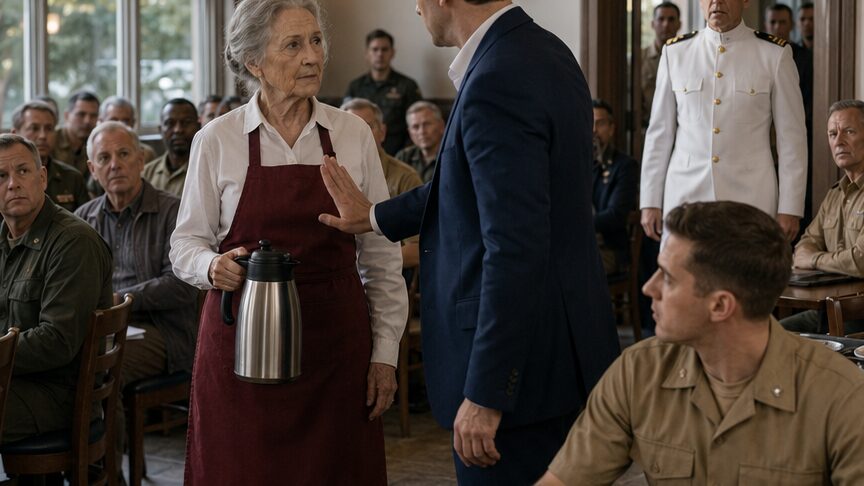
The Old Woman Poured Coffee In A Red Apron, Then The Colonel Read Her Name Aloud
Chapter 1: The Woman With The Coffee Pot
The coffee pot was almost too heavy for Christine Carter’s left hand, but she refused to switch it to the right.
Her right hand had begun trembling before dawn.
Not badly. Not enough that anyone else would notice if she kept moving. But enough for her to know. Enough for her to wrap both hands around the steering wheel in the parking lot and wait until the small shake settled beneath her skin.
Now, inside the newly polished dining hall, she held the stainless-steel pot the way she had held field cups, folders, radios, briefing papers, condolence letters, and the edge of a hospital bed when there was nothing left to say. Carefully. Quietly. Without asking the hand to do more than it could.
Steam rose from the spout. The smell of coffee spread through the long room, dark and bitter and familiar.
The place had changed.
New floor. New ceiling lights. New windows along the east wall. Fresh paint covered the old cracks where rainwater once came through in thin brown lines. The serving counter had been rebuilt with smooth metal rails and glass sneeze guards. The old clock was gone. The old noise was gone too, or maybe Christine only remembered it louder: boots scraping, trays sliding, young voices calling across tables, someone laughing too hard because shipping out made every joke sound like it mattered.
She paused near the center aisle.
The dedication banner hung above the far wall.
WELCOME HOME DINING HALL REDEDICATION
Beneath it, rows of round tables waited for senior guests, veterans, active-duty personnel, donors, and families. At each place setting lay a folded program, cream-colored and stiff. The front bore the base emblem and a line about service, memory, and renewal.
Christine did not pick one up.
She knew what ceremonies could promise. She also knew what buildings remembered after everyone went home.
A young kitchen worker hurried past carrying a tray of cups. “Ma’am, volunteers check in by the back pantry.”
Christine looked down at her apron. Dark red. Tied carefully at the waist. Pressed last night on her ironing board until the old cotton held a clean line. Someone had given her the apron when the dining hall first opened, back when the fabric had been brighter, almost cheerful. She had kept it folded in cedar paper for years.
“I already checked in,” she said.
The worker gave a quick nod without slowing. “Yes, ma’am.”
No one meant harm by it. That was what age did. It turned people polite enough to stop looking closely.
Christine moved toward the first table.
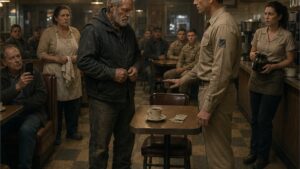
A young serviceman sat alone near the aisle, tan uniform neat, shoulders squared, phone facedown beside his elbow. He was too still to be relaxed and too young to be tired in the way he was trying to look tired. His name tape read MITCHELL.
“Coffee?” Christine asked.
He glanced up only after she spoke.
“Yes, ma’am.”
His cup sat untouched beside a folded napkin. She poured, keeping the stream steady. Not a drop touched the saucer.
The young man watched the cup fill. “Thanks.”
Christine gave a small nod and moved on.
At the next table, two veterans were speaking softly over the program. One held his glasses far from his face. Another traced the print with one finger. Christine filled their cups and accepted their murmured thanks. Near the east wall, junior soldiers stood in a loose cluster, laughing under their breath until a senior enlisted soldier looked their way.
Christine let the sounds pass through her.
The dining hall had always been loudest before ceremonies. People spoke too quickly when they were near grief. They needed coffee, chairs, something to do with their hands.
She had come to pour coffee.
That was all she had promised herself on the drive in.
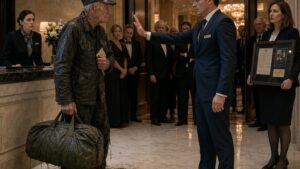
At the entrance, a man in a fitted navy blazer moved briskly between the guest tables, checking place cards and straightening programs by fractions of an inch. His shoes shone brighter than the floor. A plastic event badge bounced from a lanyard against his chest.
Anthony Miller.
Christine had heard his name from the administrator who called two weeks ago, her voice careful and professional. New operations supervisor. Very organized. Very eager. Wanted the rededication to go well.
Anthony stopped when he saw Christine.
His eyes moved from her gray hair to the apron, from the apron to the coffee pot, then to the table number beside her hip. His expression did not harden all at once. It tightened in stages, as though he were trying to decide whether she was a problem he could solve quietly.
“Ma’am,” he said, crossing toward her. “Can I help you?”
Christine held the coffee pot close to her side. “I’m serving coffee.”
“This section is for invited guests and senior personnel only.”
“I know.”
He gave a short laugh that carried no amusement. “The volunteer station is behind the kitchen. We have assigned lanes.”
Christine looked at the tables around them. “These tables used to take coffee first.”
Anthony blinked. “Excuse me?”
“The center row. Then the east wall. The west side gets cold faster because the doors open there.”
He stared at her for half a second too long. “That may have been true before the renovation, but today we’re following the floor plan.”
“Of course.”
She turned slightly, intending to continue toward the next cup.
Anthony stepped into her path.
A few conversations nearby softened. Not stopped. Softened. That was worse. A stopped room admitted something had happened. A softened room pretended nothing had.
“Ma’am,” Anthony said, lower now, “I need you to return to the volunteer area until I confirm where you’re supposed to be.”
Christine studied his face. Not angry. Not cruel. Nervous under the polish. A man afraid of mistakes because he believed a mistake would reveal he did not belong.
“I was asked to come,” she said.
“I’m sure you were asked to help. But we can’t have volunteers wandering among VIP tables before the ceremony.”
The coffee pot warmed her palm through the handle. “I’m not wandering.”
The young serviceman at the first table looked over. Jack Mitchell. His eyes flicked from Anthony to Christine, then quickly back to his cup. His hand moved toward his phone and stopped.
Anthony noticed the attention gathering and smiled too widely.
“I understand this place may mean something to you,” he said. “A lot of our older volunteers worked here years ago. But today is a formal military event, and I need everyone in the right place.”
Christine heard the word older land between them like a utensil dropped on tile.
She had stood in rooms where generals shouted, senators threatened, radios failed, and weather reports turned deadly in the space between one sentence and the next. She had learned long ago that volume rarely proved authority. The men who yelled first were often the ones who listened last.
“I have an invitation,” she said.
Anthony extended a hand. “May I see it?”
Christine set the coffee pot down on the nearest service cart. The base of it clicked softly against metal. Then she reached into the pocket of her apron and withdrew a folded envelope.
It was old-fashioned, cream paper, her name typed across the front.
C. Carter
No title. She had asked for that.
Anthony took it, opened it, and frowned.
“This doesn’t list your volunteer assignment.”
“No.”
“It doesn’t list a table either.”
“No.”
His mouth tightened. “Then this is not sufficient.”
Christine took the envelope back when he held it out. She folded it once and returned it to her pocket.
“You can check the name again,” she said.
Anthony looked toward the front entrance, where two officers in dress uniforms had just entered with a small group of guests. “I don’t have time to chase down every incomplete invitation.”
“It will take less time than moving me twice.”
His eyes sharpened.
At the first table, Jack Mitchell lowered his gaze again. His coffee sat steaming, untouched.
Anthony turned and lifted two fingers toward the entrance. A security guard near the door looked over.
Christine did not move.
She could feel the old hall beneath the new floor. She could almost hear trays striking tables in a rhythm that had once told her how many soldiers were eating, how many were too anxious to sit, how many had asked for second coffee because no one slept the night before deployment.
Anthony leaned closer, voice still controlled. “Please don’t make this difficult.”
Christine looked at him then, fully.
“I have waited in worse places,” she said.
The words were not loud. They did not need to be.
For a moment, Anthony seemed unsure what to do with them. The guard began walking over. Several soldiers at the east wall had stopped pretending not to watch.
Christine picked up the coffee pot again.
Its weight steadied her.
The security guard arrived beside Anthony. “Sir?”
Anthony kept his eyes on Christine, as if looking away might weaken him. “Please verify this woman’s name with administration. C. Carter. She says she was invited.”
The guard nodded. “Yes, sir.”
“And until then,” Anthony added, “she is not to serve the senior tables.”
The room seemed to hold its breath in a hundred small ways.
Christine looked once toward the banner. Then toward the tables. Then down at the pot in her hand.
The coffee was still hot.
Chapter 2: The Young Soldier Who Looked Away
Jack Mitchell had been taught not to stare.
He had been taught how to stand, how to answer, how to fold a blanket tight enough that a coin might bounce, how to make his boots look better than they felt, and how to keep his face empty when someone senior entered a room. He had been taught that hesitation could look like disrespect and that disrespect could follow a young soldier longer than a mistake on paper.
But no one had taught him what to do when an old woman in a red apron stood with a coffee pot in her hand while a room full of uniforms decided whether she belonged.
So Jack looked away.
He looked at the steam rising from his cup. He looked at the program folded beside his plate. He looked at the small printed words on the cover, though he did not read them. He could feel the scene happening ten feet from him, the way a person could feel weather turning before the first crack of thunder.
Anthony Miller was still speaking in that polished voice, careful enough to sound reasonable to anyone who did not hear the edge beneath it.
“Ma’am, I’m not accusing you of anything. I’m trying to maintain order.”
The old woman did not answer immediately.
That was what bothered Jack most.
Most people rushed to defend themselves. They explained too much. They laughed nervously. They got angry. They pointed at papers. They repeated names.
She did none of that.
She stood with the pot angled slightly away from her body so the steam would not touch the sleeve of her white shirt. Her shoulders were narrow but not collapsed. Her gray hair was pinned at the back of her head. Her face looked lined in the way old photographs looked lined, not fragile so much as weathered by things no one in the room had asked about.
“I understand order,” she said.
Anthony’s jaw moved. “Then you understand why I can’t have you creating confusion.”
A few junior soldiers near the wall shifted. One whispered something Jack could not catch. Another smirked, then stopped when the old woman turned her head slightly in their direction. She had not glared. She had barely moved. Still, the whisper died.
Jack picked up his cup, mostly to give his hands something to do.
The coffee tasted stronger than he expected.
He looked at her again and caught the smallest detail: when Anthony blocked her from the senior tables, she did not look embarrassed. She looked disappointed.
That landed differently.
The security guard had taken the envelope toward the admin hallway. Anthony remained near Christine as though she might bolt past him with the coffee pot and ruin the morning.
“You can wait by the kitchen,” he said.
Christine glanced toward the swinging doors. “The kitchen is crowded.”
“Then by the service cart.”
“I’m beside it.”
Someone at the veterans’ table coughed into a napkin. Jack stared at his cup.
Anthony inhaled through his nose.
“All right,” he said, voice lowering. “Let me be clearer. This row is reserved. Colonel Roberts is expected any minute. We have guests from command, donors, families. They don’t need confusion before the program begins.”
Christine’s hand tightened around the coffee pot handle. “Colonel Roberts takes his coffee black.”
Jack looked up.
Anthony paused. “What?”
“Unless that changed.” She looked toward the main doors, not at Anthony. “He used to pretend he liked it sweet when he was younger.”
The veterans at the next table stopped moving.
Anthony gave a thin smile. “You know Colonel Roberts?”
“I knew a lieutenant who did not yet know when to stop talking.”
The words were so calmly said that it took Jack a second to understand them.
One of the older veterans made a sound low in his throat, almost a laugh, almost not. Jack felt the room tilt slightly, not physically but socially, as if a table leg had been kicked loose.
Anthony’s smile vanished.
“Ma’am,” he said, “with respect, I doubt Colonel Roberts wants old stories repeated by volunteer staff.”
The old woman looked down at the coffee pot.
Jack waited for her to answer. He wanted her to. He wanted her to say something that would make this simple, something that would turn Anthony into the fool and let everyone else off the hook.
But she only said, “No. I expect he has enough of his own.”
A strange silence followed.
Jack’s phone buzzed against the table. He ignored it.
Anthony turned slightly, catching the eyes of the junior soldiers by the wall. “Everyone can return to their seats. There’s nothing to see.”
No one moved quickly enough.
That seemed to irritate him more than open defiance would have. He reached toward the coffee pot.
“I’ll take that.”
Christine moved it back half an inch.
Not much. Not dramatically. But enough.
Anthony’s hand stopped in the air.
Jack felt his own back straighten.
The old woman’s voice remained even. “It’s hot.”
“I can manage a coffee pot.”
“I’m sure you can.”
“Then give it to me.”
She looked at his hand, then at his face. “No.”
The word was small, but it struck the floor hard.
Anthony flushed.
Jack heard someone draw in a breath. He thought it might have been him.
The old woman continued, “I was asked to serve coffee here this morning. Until someone with the authority to say otherwise tells me to stop, I will not hand a full pot to a man reaching for it because he is irritated.”
Anthony’s expression shifted from embarrassment to something sharper.
Jack should have spoken then.
He knew it even before the moment passed.
He could have said she had poured his coffee perfectly. He could have said she was not causing confusion. He could have said, Sir, maybe we should wait for administration. Nothing heroic. Nothing risky. Just one sentence to slow the room down.
Instead he kept both hands around his cup.
He told himself he was junior. He told himself it was not his place. He told himself Anthony had the badge, the lanyard, the authority over the hall.
But the old woman stood alone, and Jack knew he was helping make her alone by staying quiet.
Anthony stepped back, smoothing his jacket front. “Fine. We’ll wait.”
Christine nodded once.
Then, as if the exchange had been no more than a delay between tables, she turned to the veteran nearest her and asked, “Would you like a warm-up?”
The veteran looked startled, then held out his cup. “Yes, ma’am.”
Christine poured.
The stream was perfect. No shake. No spill. Steam curled upward between them.
Jack watched her move down the line, stopped from serving the senior table but still serving whoever was within reach. Her pace was slow enough to look ordinary, precise enough to feel practiced. When she reached the end of the row, she adjusted one chair without looking down, pulling it out exactly far enough for a man with a cane to sit.
Jack’s eyes narrowed.
That was not luck.
A moment later, a senior officer in a white uniform entered through the main doors.
The room responded before anyone announced him. Soldiers straightened. Conversations lowered. Anthony turned with visible relief.
Colonel Richard Roberts carried himself with the kind of quiet authority that did not need extra movement. His hair was close-cropped and silvered at the temples. His white uniform was immaculate, but his face was not ceremonial. He looked like a man who had learned to scan a room before entering it fully.
Anthony crossed toward him at once.
“Colonel Roberts. Good morning, sir. We’re just handling a small volunteer issue.”
Richard’s attention moved past him.
Jack followed his line of sight.
The old woman stood beside the service cart, coffee pot in hand, red apron tied over her white shirt. She had turned slightly toward the door. Her face had not changed much, but Jack saw something pass through it—recognition, maybe, or the cost of being recognized.
Richard stopped mid-step.
Anthony was still talking. “There was an incomplete invitation, and I’ve asked security to verify—”
Richard did not seem to hear him.
His eyes remained fixed on Christine.
The room began to notice. One by one, heads turned, not toward the colonel, but toward the woman he could not stop looking at.
Christine lowered the coffee pot until it rested against the side of her skirt.
For the first time all morning, Jack saw her hand tremble.
Richard took one slow step forward.
Chapter 3: A Name Missing From The Program
Melissa Anderson had spent six months making sure nothing about the rededication looked improvised, which meant that by eleven in the morning, everything had begun to improvise itself.
The florist had delivered arrangements meant for the chapel instead of the dining hall. Two families had arrived an hour early and wanted to know whether the front row was reserved for them. The sound technician had discovered that one microphone produced a low hum whenever someone stood too close to the new memorial wall. A donor’s assistant wanted bottled water without labels showing. The kitchen wanted to know whether the ceremony would delay lunch service.
And now a security guard stood in Melissa’s office holding a cream envelope and asking whether a woman named C. Carter belonged in the building.
Melissa pressed two fingers to the bridge of her nose.
“Carter,” she repeated.
“Yes, ma’am,” the guard said. “Older woman. White shirt. Red apron. Says she was invited.”
Melissa lowered her hand.
“Red apron?”
“That’s what Mr. Miller said.”
The office was hardly an office at all, more a converted storage room off the admin hallway. Boxes of printed programs leaned against one wall. A folding table held name tags arranged in careful rows. Two garment bags hung from a hook behind the door. Melissa’s laptop sat open to a spreadsheet with highlighted guest categories.
She clicked into the search field and typed Carter.
No match.
She typed C. Carter.
No match.
She checked the volunteer list.
No Carter.
The donor list.
No Carter.
The veterans’ family list.
No Carter.
Her shoulders tightened.
“Did she say who invited her?”
The guard looked at the envelope. “Invitation came from this office.”
Melissa took it.
The paper felt familiar because she had chosen the stock herself. The base emblem was embossed at the top. The envelope had been typed, not handwritten, and the alignment matched the batch her office mailed three weeks ago.
C. Carter
No table number. No title. No guest category.
That should not have happened.
Melissa opened the envelope. Inside was the standard invitation card, but there was no printed insert. No RSVP slip. No color-coded corner mark. Just the ceremony time and the line: Your presence is requested at the Welcome Home Dining Hall Rededication.
Her stomach sank with the particular dread of a person who knew systems well enough to know when something had slipped beneath them.
“Where is she now?” Melissa asked.
“Dining hall, ma’am. Mr. Miller told her not to serve senior tables until verified.”
Melissa shut her laptop halfway. “He told her what?”
The guard hesitated.
That was answer enough.
Melissa stood, then sat again because standing without knowing where to go was how mistakes multiplied. “Give me one minute.”
The guard remained by the door.
Melissa reopened the spreadsheet. Her files were organized by tabs: Guests, Volunteers, Speakers, Families, Seating, Media, Program Credits. She searched each one again. Nothing.
Carter was not an unusual name. It could be a widow. Former staff. A late addition from command. A community volunteer. An old kitchen employee invited as a courtesy. But the blank category bothered her. Melissa did not send blank invitations. She especially did not send them to people listed only by an initial.
She opened the archived email folder.
Carter.
The search produced too many unrelated results: vendor contacts, stationery orders, a donor named Carter from a previous event. She refined it.
“C. Carter.”
One result appeared.
The subject line read: Special handling request.
Melissa leaned closer.
The email was from three months earlier, forwarded from the previous director before retirement. The message was short.
Please include C. Carter on the invitation list for the dining hall rededication. No rank on envelope. No public announcement without confirmation. Seat assignment pending final program approval. See sealed guest-of-honor page.
Melissa read it twice.
“Sealed guest-of-honor page,” she whispered.
The guard shifted. “Ma’am?”
“One minute.”
She turned toward the stacked program boxes.
Each program had been printed in two versions. Standard programs for most attendees, and a final ceremony copy with the inside dedication page kept separate until command approved the wording. Melissa had been told not to insert that page until the morning of the event. Then the sound issue, the flowers, the families, and the donor water had swallowed the morning whole.
She moved to the cabinet where the final packet should have been.
Empty.
“No,” she said softly.
She opened the drawer beneath it. Vendor receipts, tape, spare name tags. No packet.
She checked the top shelf. Nothing.
The guard wisely said nothing.
Melissa forced herself to breathe. “Did Mr. Miller remove any sealed packet from this office?”
“I don’t know, ma’am.”
Of course he did not know. Anthony was efficient enough to move things and anxious enough not to mention it if he believed he was helping.
Melissa stepped into the hallway.
The sound from the dining hall reached her in fragments: chair legs, low voices, the muffled public voice of Anthony Miller trying to keep everything smooth.
She turned toward the small prep room beside the stage entrance.
Inside, two boxes of programs sat on a rolling cart. A volunteer had stacked them with the front covers facing up. On top lay a large envelope marked FINAL INSERT — HOLD FOR ADMINISTRATOR.
Melissa snatched it up.
The seal was unbroken.
For a moment, she simply held it.
She had worked around military events long enough to recognize that some names arrived carrying more history than the paper could hold. She also knew the danger of assuming significance where there was only clerical confusion. A title omitted could be humility. Or privacy. Or a mistake. Or grief.
She slid one finger beneath the flap and opened the envelope.
Inside was a single printed page for the dedication program. At the top was the same base emblem. Beneath it, in formal type, was a heading:
HONORED GUEST
The name below it made Melissa go still.
General Christine Carter, U.S. Army, Retired
Her eyes moved down the page, catching fragments before she could arrange them.
Former commanding officer.
Original Welcome Home Dining Hall preservation order.
Families of the fallen.
Requested private attendance.
No formal honors unless she consented.
Melissa sat down on the nearest chair, though she had not meant to sit.
The old woman in the red apron.
C. Carter.
No rank on envelope.
No public announcement without confirmation.
From the dining hall came a sudden hush, not complete but noticeable, as if a wave had passed through the room and left everyone waiting.
Melissa stood so quickly the chair legs scraped the floor.
She grabbed the insert, the envelope, and the original invitation. Then she stopped.
Something else was in the bottom of the packet.
A photocopy, slightly faded, folded once.
Melissa opened it.
It was an old dedication file from the dining hall’s first opening decades earlier. A black-and-white photograph showed a younger group standing behind the serving line. Officers, kitchen staff, junior soldiers. The image was grainy, but one woman near the center was unmistakable even through time: straight-backed, composed, dark hair pinned neatly beneath her cap.
Beside her, hanging from a hook, was a dark apron.
The caption beneath the photograph read:
Colonel C. Carter with command staff at first Welcome Home Dining Hall dedication.
Melissa looked from the photograph to the insert in her hand.
Then she saw the note clipped behind it, written in the previous director’s careful handwriting.
She may choose to serve coffee. Let her.
Melissa closed her fist around the page and hurried toward the dining hall.
Chapter 4: The Photograph Behind The Serving Line
Richard Roberts had seen the woman before he knew where memory had hidden her.
That was the first thing that unsettled him.
Not recognition. Not yet. Recognition had shape and name. This was older, more instinctive: the sensation of being a junior officer again, standing too straight in a corridor because someone had entered it who did not need to raise her voice.
He stopped near the entrance while Anthony Miller continued speaking beside him.
“Sir, I apologize for the disturbance. We had an unverified volunteer in the senior section. Administration is checking her name now.”
Richard heard the words. He understood them. Still, his attention remained fixed across the dining hall, where the elderly woman in the red apron stood beside a service cart, one hand resting near the handle of a coffee pot.
She looked smaller than memory should allow.
Age had narrowed her shoulders. Time had softened the sharp line of her jaw. Her hair was gray now, pinned neatly at the back of her head instead of tucked beneath a cap. But there was something in the way she held herself while everyone looked at her that pressed against the back of Richard’s mind.
“Sir?” Anthony said.
Richard blinked once. “What did she say her name was?”
“C. Carter, sir. The invitation is incomplete. No table number, no assignment.”
The woman’s eyes met Richard’s across the room.
For one second, the years inside him rearranged themselves.
Not fully. Not enough.
But something old came close.
Richard stepped farther into the hall. The room obeyed his movement in the quiet way military rooms did. Soldiers straightened. Conversations thinned. Forks settled against plates. Anthony followed half a pace behind him, visibly relieved to have a senior officer absorb the problem.
The woman did not come forward. She did not salute. She did not speak first.
Richard appreciated that more than he could explain.
“Ma’am,” he said, stopping a respectful distance away.
“Colonel Roberts,” she said.
His breath caught at the title on her tongue.
Not “sir.” Not “Colonel.” The full name, measured and familiar, as if she had used it in another life when he was not yet the man the room saw.
Anthony’s eyebrows lifted. “You do know him?”
The woman did not look at Anthony.
Richard studied her face. “Have we met?”
A faint softness touched the corner of her mouth. “You were younger.”
“That narrows it less than I’d like.”
“You talked too much in briefings.”
A low ripple moved through the nearest tables. It was not laughter exactly. It was the sound of people hearing something they had not expected from someone they had already dismissed.
Richard felt heat rise in his face, not from embarrassment, but from the sudden nearness of memory.
There had been a briefing room years ago. A summer storm rattling windows. A lieutenant with too much confidence explaining logistics to people who had survived worse than his charts. A woman at the head of the table letting him speak until he finally heard how little he knew. Then her voice: Lieutenant Roberts, never confuse movement with readiness.
He had carried that sentence for thirty years.
His eyes sharpened.
“Where did you serve?” he asked quietly.
The woman lowered her gaze to the coffee pot. “Several places.”
Anthony gave a small, strained laugh. “Sir, I don’t think this is necessary. Administration will clear it up.”
Richard turned slightly toward him. “Then let administration clear it up.”
“Yes, sir. Of course. I only meant—”
“I know what you meant.”
Anthony closed his mouth.
Richard looked back at the woman. She had retreated behind silence again. That, too, felt familiar. The best commanders he had known did not fill the room unless the room required filling.
Behind her, the renovated serving line gleamed under new lights. Above it hung a row of framed photographs from the dining hall’s earlier years. Richard had passed them on entry but had not stopped. Ceremony photographs. Ribbon cuttings. Staff gatherings. The kind of institutional memory people mounted on walls and then walked past.
Now one frame caught his attention.
It hung partly behind a tall coffee urn, slightly crooked, as if no one had thought it important enough to adjust. Richard moved toward it.
Anthony began, “Sir, the seating—”
Richard lifted one hand without looking back.
The frame held a black-and-white photograph from decades earlier. The caption had faded but remained legible beneath the glass.
First Welcome Home Dining Hall dedication.
A younger command staff stood behind the old serving line. Some wore uniforms, some kitchen whites, some aprons. Their faces were stiff with ceremonial patience. At the center stood a woman in uniform, dark hair pinned under her cap, posture exact, eyes focused slightly past the camera as if already thinking about what needed doing after the picture was taken.
Richard leaned closer.
The woman in the photograph was younger than memory, but the bearing was unmistakable. Not the face alone. Faces changed. Bearing did not.
His gaze dropped to the caption.
Colonel C. Carter with command staff.
Behind the young colonel, hanging from a hook near the serving line, was a dark apron.
Richard turned slowly.
Christine Carter stood twenty feet away in that same color apron, or one so like it that time seemed to have folded back on itself.
The room had grown very quiet now.
Jack Mitchell stood near his table, half-risen without realizing it. Two veterans leaned forward. Anthony’s face had lost its practiced confidence.
Richard walked back toward Christine.
He did not salute. Not yet. Not in the middle of uncertainty. Not for theater. But his shoulders squared in a way he could not prevent.
“Carter,” he said.
She held his gaze.
“I haven’t used much more than that today,” she replied.
Richard swallowed.
He remembered another detail then, one he had not known he remembered: a field message passed hand to hand, a name spoken in tones junior officers learned to recognize. Carter had signed the preservation order after the deployment losses. Carter had refused to let the hall be renamed for donors. Carter had insisted families should have a place to sit, eat, grieve, and be spoken to as people rather than entries in a report.
He looked at the apron again.
“Were you here when this hall first opened?” he asked.
Christine’s hand rested on the pot. “Yes.”
Anthony exhaled. “A lot of former employees were, sir.”
Richard turned his head.
The young supervisor immediately seemed to regret speaking, but pride pushed him onward.
“I only mean the photograph lists staff and command. It doesn’t clarify her status today. We still need proper verification before allowing her around senior guests.”
Richard stared at him for a long beat.
Anthony’s face reddened. “For security reasons.”
Christine spoke before Richard could.
“He is not wrong to verify,” she said.
Anthony looked at her, startled.
“But he was wrong not to listen first.”
The sentence settled harder than an accusation.
Richard looked back at the photograph. The young colonel in the frame seemed to watch all of them from another year, another hall, another morning when coffee had also been poured before hard things were said.
A door opened near the admin hallway.
Melissa Anderson appeared, moving quickly, papers clutched in one hand. Her face told Richard enough before she reached them.
Anthony turned toward her. “Melissa, good. We need confirmation on this volunteer.”
Melissa did not answer him.
Her eyes went first to Christine, then to the photograph behind the serving line, then to the paper in her hand.
Richard heard himself speak, barely above a whisper.
“General Carter?”
Christine’s expression did not change.
But the coffee pot trembled once against her skirt.
Chapter 5: She Came Back For The Empty Chairs
Christine found the side room because she had always known where quiet lived in military buildings.
It was never where people said it would be. Not the chapel. Not the office marked private. Not the waiting room with tissue boxes and framed landscapes. Quiet lived in supply closets, service corridors, unused classrooms, stairwells, the back of trucks, and rooms where chairs had been stacked because no one expected grief to need seating.
This room had once held spare trays and cleaning equipment. Now it held folded banquet chairs, two extra lecterns, a box of extension cords, and a small table with bottled water for ceremony speakers. The hum of the dining hall reached through the wall in low waves.
Christine set the coffee pot on the table.
Her hand shook openly now.
She watched it for a moment as if it belonged to someone else. Then she pressed her palm flat against the table until the tremor became pressure instead of movement.
Outside, the room still murmured around her name.
Not loudly. Not fully. Not yet.
General Carter.
Richard had whispered it softly, almost to himself, but names had a way of traveling faster than feet. Melissa had arrived with papers. Anthony had gone pale. Jack Mitchell had stood beside his table with the stunned expression of a young man who had just discovered silence could be an action.
Christine had not stayed to watch them decide what to do with her.
She had said, “I need a moment.”
Richard had moved aside immediately. Melissa had begun apologizing, and Christine had lifted one hand, not to forgive, not yet, but to stop the words before they became another task she had to carry.
Now she stood alone in the side room with the smell of coffee and cardboard and new paint.
On the wall, someone had taped a temporary sign.
RESERVED ITEMS — DO NOT MOVE
Christine almost smiled.
The Army had taught her that nothing stayed reserved and everything moved.
She untied the apron, then stopped halfway. The knot sat beneath her fingers, stubborn from the morning’s work. Her younger hands had tied knots quickly. Bandage knots. Boot laces. Tent lines. Ribbon on official packets sent to families because someone had once decided even sorrow should arrive in proper form.
She left the apron on.
There were four folding chairs lined against the far wall. She pulled them out one by one and opened them. The metal legs clicked into place.
Four chairs.
Then a fifth.
Then a sixth.
She arranged them in a row facing the small table.
No one had asked her to. No one had planned this. But she had not come for the banner, the program, the renovated windows, or the careful language about sacrifice. She had come because thirty-two years earlier, six soldiers had eaten breakfast in the old dining hall before leaving on a mission she had authorized.
They had complained about the eggs.
That was the detail that stayed.
Not the formal report. Not the weather summary. Not the briefing notes. The eggs.
One of them had asked whether the coffee was strong enough to float a wrench. Another had taken two biscuits and wrapped one in a napkin for later. One had forgotten his gloves and jogged back from the door, laughing because everyone shouted after him. They were young, hungry, irritated, brave in ordinary ways that did not yet know they would be remembered.
Christine had stood near the serving line that morning with a cup she never finished.
She had given the order.
The mission had been necessary. That had been the phrase repeated afterward. Necessary. Justified. Strategically sound. Properly authorized. All true. None of it useful when six chairs remained empty by dinner.
She had spent years learning how to speak of them without letting her voice break. Their families deserved steadiness. Her staff deserved clarity. Her superiors deserved facts. The public deserved something cleaner than the truth of a commander lying awake with names becoming a roll call inside her chest.
The dining hall had nearly closed two years later.
Budget efficiencies. Consolidation. Modernization.
Christine had signed the order that kept it open. Not because of nostalgia. Because families needed a place that did not feel like an office. Because soldiers needed somewhere to sit after funerals and before departures. Because grief, like hunger, became worse when people were made to stand.
She had promised herself then that if the hall ever reopened after renovation, she would come back without title, without dress uniform, without anyone standing because a protocol officer told them to.
She would pour coffee.
For the six who had not returned to finish theirs.
Christine took six paper cups from a sleeve near the water bottles and placed one on each chair. Then she lifted the coffee pot.
Her hand steadied.
One cup.
Then another.
She filled each halfway. No more. A soldier called away from breakfast rarely had time to finish.
The door behind her opened softly.
Christine did not turn.
Jack Mitchell stood in the doorway.
She could see his reflection faintly in the dark glass of a framed emergency instruction poster. Tall, uncertain, too young to have learned what to do with a thing he could not salute his way out of.
“I’m sorry,” he said.
Christine poured the fourth cup. “For coming in?”
“For not saying anything.”
She paused.
Outside the door, a voice called for someone to check the front row. The ceremony was drawing closer. The building wanted order again.
Jack stepped no farther inside. “Mr. Miller was wrong.”
“He was afraid.”
“That doesn’t make it right.”
“No.”
Christine poured the fifth cup.
Jack looked at the row of chairs. “Are those for someone?”
“Yes.”
He waited, but she did not explain.
That was the problem with the young, Christine thought. They mistook silence for invitation. Then again, perhaps the old mistook silence for protection.
Jack’s voice lowered. “Colonel Roberts said your name.”
“Did he?”
“He said General Carter.”
Christine filled the sixth cup.
The coffee line rose dark and still.
“People say many things in dining halls,” she said.
“My grandfather was Army,” Jack said quickly, as if that might excuse his awkwardness. “He didn’t talk about it much. I used to think that meant there wasn’t much to tell.”
Christine set the pot down.
“And now?”
Jack looked at the cups. “Now I think maybe there was too much.”
For the first time since entering the room, Christine turned toward him.
His face had changed from the indifferent young man at the table. Not older. Not wiser in any permanent way. But open in a way embarrassment sometimes made people open if they did not run from it.
She looked back at the six cups.
“They ate here,” she said. “A long time ago.”
Jack did not move.
“The morning was cold. The heat was broken on this side of the building. One of them burned his tongue because he said cold rooms made coffee cool too fast, and he tried to beat it.”
A small breath left her, not quite a laugh.
Jack remained silent now in a better way.
Christine touched the back of the first chair. “Donald Taylor.”
She moved to the second. “John Hernandez.”
Third. “Richard Jones.”
Fourth. “Anthony Robinson.”
Her hand stilled slightly at the fifth. “Jack Anderson.”
The young soldier in the doorway flinched at his own first name.
Christine continued.
“Melissa Martinez.”
The last name left her softly.
The room seemed to hold all six.
Jack looked down. “They didn’t come back.”
“No.”
“You were their commander?”
Christine closed her eyes briefly.
The question was simple. The answer had lived too long.
“I was responsible for the order,” she said.
Jack absorbed that.
He did not say it wasn’t her fault. Christine was grateful. People reached for that sentence when they wanted pain to sit down quickly. Fault was not the question that mattered after enough years. Responsibility was.
“Why didn’t you tell Mr. Miller?” Jack asked.
Christine opened her eyes. “Tell him what?”
“That you were—” He stopped himself. “Who you are.”
She looked at the apron tied at her waist. “Because I did not come here to be who I was.”
Jack’s gaze moved to the cups. “Then why come?”
Christine picked up the coffee pot again, though it was nearly empty.
“Because I told their families this place would remember them,” she said. “Buildings don’t remember on their own.”
Footsteps approached in the hallway. Melissa’s voice, then Richard’s, low and urgent.
Jack stepped aside.
Before the others reached the door, he looked once more at the six cups and spoke the names under his breath, carefully, as if afraid to damage them.
Christine heard every one.
Chapter 6: The Colonel Read Her Name Aloud
By the time Christine returned to the dining hall, every place setting had become an unanswered question.
The guests were seated now. Veterans in dark jackets, families with folded programs in their laps, junior soldiers standing near the back because no one had told them whether they were allowed to sit. The donors had stopped checking their phones. The kitchen staff watched through the serving window. The rebuilt hall gleamed with all the care that had gone into making old walls appear new.
Christine noticed none of that first.
She noticed the coffee pot beside the podium.
Someone had placed it there on a small cart, polished but ordinary, its handle turned toward her as though waiting for the hand that knew its weight. Beside it lay the red apron she had taken off in the side room after Melissa and Richard found her. Folded once. Not hidden. Not displayed like a relic. Simply there.
Melissa stood near the podium with the final program insert held against her chest. Her face carried the strain of a person who had found the truth and understood that truth did not erase the harm done before it.
Richard waited at the front row.
Anthony stood a few feet from the aisle, pale and rigid, his event badge hanging crookedly. He looked smaller without motion. Less like a man in charge of a room. More like a man who could hear the room thinking about him.
When Christine entered, conversation faded.
She disliked that kind of silence. It had too much hunger in it. People wanted revelation, correction, a clean turning of tables. They wanted the old woman to become someone else so everyone could know how to behave.
But she was still the woman who had driven herself to the hall that morning, waited for her hand to stop shaking, tied a red apron over a white shirt, and picked up a coffee pot.
Jack stood near the side wall. His eyes followed her, but he did not stare in the way people had stared before. He looked as though he was trying to remain present without taking anything from her.
Anthony stepped forward suddenly.
“Ma’am,” he said.
The word came out rough. Too late, too public, too full of panic.
Christine stopped.
Anthony swallowed. “I need to apologize. I didn’t know—”
“No,” Christine said.
The hall went utterly still.
Anthony’s mouth remained slightly open.
Christine did not raise her voice. “Not yet.”
His face reddened.
Richard’s gaze moved from Christine to Anthony, but he said nothing.
Melissa stepped to the microphone. It hummed once, then settled. Her hands trembled against the paper.
“Ladies and gentlemen,” she began, “before we begin the dedication program, there is a correction to make.”
Christine looked down at the floor.
Corrections. She had signed thousands. Corrected maps, corrected supply estimates, corrected public statements that could not quite hold all the facts. But there were corrections no paper could make. A name restored after being dismissed was one. An apology made only after rank appeared was another.
Melissa continued.
“This morning, due to an administrative error, one of our invited guests was not properly listed in the seating materials distributed to staff.”
Anthony closed his eyes briefly.
“That error led to confusion,” Melissa said, then paused. Her gaze shifted to Christine. “And to disrespect that should not have occurred.”
Christine felt the room’s attention tighten.
Melissa lifted the insert.
“The final dedication page, which should have been placed in every program before arrival, identifies today’s honored guest.”
She unfolded the paper slowly. The sound was small, but in the silence it seemed as sharp as a flag being raised.
Richard stepped beside the podium.
Melissa looked at him, and he gave the slightest nod. She moved back.
Richard did not take the microphone immediately. For a moment, he stood with the page in hand, looking not at the guests but at Christine. His face had the controlled gravity of a man carrying something he wished had been handled better.
Then he spoke.
“Some names are printed in programs because protocol requires it,” he said. “Some names belong on walls because institutions eventually remember what people did when the cost was still private.”
Christine’s jaw tightened.
Richard looked down at the page.
“Today’s honored guest requested no title on her invitation and no formal recognition unless she consented. She came here quietly. She came wearing an apron that belongs to the history of this hall. She came to serve coffee in a room that exists, in part, because she once refused to let it be closed.”
A murmur moved through the guests.
Anthony’s eyes flicked to Christine, then away.
Richard’s voice remained steady.
“General Christine Carter, United States Army, retired, served as commanding officer during the original Welcome Home Dining Hall dedication. After the deployment loss that took six soldiers from this community, she signed the preservation order that kept this hall open for families, soldiers, and veterans who needed more than a briefing room in which to remember.”
The words landed one by one.
General.
Christine Carter.
United States Army.
Retired.
The room changed.
It did not erupt. That would have been easier. Instead, silence deepened until it became visible. A donor lowered his head. A junior soldier at the back straightened so sharply his boots clicked together. One of the veterans at the side table covered his mouth with both hands.
Jack Mitchell stood very still.
Anthony looked as though the floor had shifted beneath him.
Richard turned toward the memorial wall. “The photograph behind the serving line shows her here when this hall first opened. At the time, she was Colonel Carter. Many here knew the building. Fewer knew the order that saved it. Fewer still knew the promise behind it.”
Melissa moved to the wall and carefully lifted the old photograph from its frame mount. She did not remove it fully, only angled it so the front rows could see. The younger Christine stood in the center of the black-and-white image, composed and unsmiling, command staff around her, the dark apron hanging behind the serving line like an ordinary thing that had waited decades to matter again.
People leaned forward.
Recognition passed through the room not as excitement, but as shame.
Christine wished, briefly and fiercely, that the six chairs in the side room were still the only witnesses.
Richard faced her.
“General Carter,” he said, and this time his voice carried the title with formal clarity, “would you allow us to proceed with you in the honored seat?”
The front row turned toward an empty chair at the center.
Christine looked at it.
She had avoided chairs like that all her life. Seats that placed one person above the work of many. Seats that made sacrifice look like biography instead of a web of names, orders, accidents, courage, weather, fear, and families answering phones.
Her eyes moved to Anthony.
He stood frozen near the aisle.
She could let the room punish him. It wanted to. She could feel it. Every embarrassed glance wanted somewhere to go. Every person who had watched in silence wanted a cleaner villain than themselves.
Anthony gave her that. A young man with a polished badge and a wrong assumption.
But Christine had commanded long enough to know the danger of allowing a room to become righteous too quickly.
She walked toward him.
People tracked each step.
Anthony’s lips moved before sound came. “General, I’m—I am deeply sorry. I didn’t know who you were.”
Christine stopped close enough that he had to meet her eyes.
“That is not the apology I need,” she said.
His face drained.
She held his gaze, not cruelly. “You were not wrong because I was a general.”
No one moved.
“You were wrong because you thought there was a kind of person you could dismiss without listening.”
Anthony’s throat worked.
Christine let the silence remain long enough for the words to belong to everyone, not only him.
Then she turned toward Richard. “Colonel Roberts.”
“Yes, ma’am.”
“I will sit after the names are read.”
Richard’s expression softened. “Which names?”
Christine looked toward the side hallway, where six paper cups waited on six folding chairs.
“The ones the hall was kept for.”
Richard understood.
So did Jack.
From the side wall, the young soldier stepped forward, uncertain but determined. “Ma’am,” he said, voice quiet, “I can bring the cups.”
Christine looked at him.
The room waited for rank to answer youth.
Instead, Christine nodded.
“Carefully,” she said.
Jack moved at once.
While he disappeared into the hallway, Christine stepped to the podium. She did not take the honored seat. She did not stand behind the microphone like someone claiming the room. She stood beside the coffee pot.
When Jack returned, he carried a tray with six half-filled paper cups. His hands were steady, but his eyes were wet. He placed the tray on the small cart beside the pot and stepped back.
Christine touched the rim of the first cup.
“Donald Taylor,” she said.
No title. No rank. Just the name.
The room listened.
“John Hernandez.”
The old walls seemed to receive it.
“Richard Jones.”
A veteran in the second row bowed his head.
“Anthony Robinson.”
Anthony Miller flinched at the shared first name, then lowered his eyes.
“Jack Anderson.”
Jack Mitchell stood straighter.
“Melissa Martinez.”
Melissa Anderson pressed the program insert against her chest.
Christine let her hand rest near the last cup. The applause did not come, and she was grateful. Applause would have been too easy. Silence, when held properly, could do more.
Only after the final name faded did Richard move to the front-row chair.
Christine looked at the coffee pot, then at the red apron folded beside it.
She picked up the apron and held it for a moment.
Then she walked to the honored seat, not as though the room had finally given her permission, but as though she had finally decided what part of its attention she was willing to carry.
Chapter 7: Respect Before The Rank
By evening, the dining hall had emptied itself of ceremony.
The banner still hung above the far wall, but its edges had begun to curl slightly from the warm air. Programs lay abandoned on a few tables, some folded neatly, some left open to the dedication page as if the readers had not wanted to close it too quickly. The flower arrangements had been moved away from the serving line. The microphone had been unplugged. The polished floor showed faint scuffs where chairs had been pushed back, where people had stood, where memory had passed through in shoes and boots and quiet steps.
Christine Carter remained seated for a while after the last guests left.
Not in the honored chair.
She had sat there during the formal dedication because refusing it would have made the room work harder than accepting it. But as soon as the ceremony ended, she had moved to a small table near the side wall, the same kind of table where soldiers had once eaten quickly with one eye on the clock.
The six paper cups were gone now.
Not thrown away. Jack Mitchell had asked what should be done with them, and Christine had looked toward the kitchen window. One of the older kitchen workers had brought a tray without being asked. Together, they had carried the cups to the back sink. Christine had poured each one out slowly, not because coffee mattered after all those years, but because gestures did.
The red apron lay across her lap.
Her fingers rested on the fabric.
It had been washed and faded by time, though she had rarely worn it. The color was no longer the deep red from the photograph. It had softened into something quieter, like brick after rain.
Across the room, Anthony Miller stood near the service cart with Melissa Anderson. They were speaking softly. Or rather, Melissa was speaking, and Anthony was listening in the stunned, careful way people listened when they had run out of defenses.
Christine watched him without pleasure.
He had made a mistake. A public one. A harmful one. But she had seen worse things done by better people under fear. She had seen decent men become cruel when they thought authority required hardness. She had seen smart women stop listening because a checklist made them feel safe. She had done things herself, over a long life, that looked different in memory than they had on paper.
That did not excuse him.
It made him reachable.
Richard Roberts approached with two cups of fresh coffee. He set one in front of her and kept the other in his hand.
“I was told you take it black,” he said.
Christine looked up. “You remember that?”
“I remember being corrected about it.”
“I remember you pretending correction was unnecessary.”
Richard allowed himself a small smile. “I was younger.”
“You talked too much.”
“So I’ve been told.”
He sat across from her, careful not to fill the silence too quickly. That was new. Age had improved him.
For a while they drank without speaking.
The hall made different sounds at the end of a day. Pipes ticking inside walls. A cart wheel squeaking somewhere in the kitchen. Distant voices fading down a corridor. Christine could almost believe the building had exhaled.
Richard looked toward the memorial wall. The old photograph had been straightened. Beneath it, Melissa had placed a temporary printed card until a proper plaque could be made. Christine had not read it. She did not need to know what words people would use to make the past presentable.
“You could have told us sooner,” Richard said.
Christine looked into her cup. “Yes.”
“Why didn’t you?”
“Because I wanted to know whether the hall still knew how to welcome someone without being told why.”
Richard absorbed that.
“And did it?”
Christine’s gaze moved across the room, past the empty tables, past Anthony, past the wall of photographs. “Parts of it did.”
Richard nodded once, as if that was fair.
Jack Mitchell appeared near the kitchen entrance, uncertain whether to approach. He had changed in small ways since morning. His posture was still formal, but the stiffness had gone out of his face. He no longer looked like a young man hoping not to be noticed. He looked like someone who had noticed too much to return easily to what he had been before breakfast.
Christine lifted a hand slightly.
Jack came over.
“Ma’am,” he said, then corrected himself. “General.”
Christine set down her cup. “Christine is enough for coffee.”
He looked startled, then nodded. “Christine.”
Richard hid a smile behind his cup.
Jack held something in his hand. The morning program. It had been folded carefully to the dedication page.
“I wanted to ask,” he said, then stopped.
Christine waited.
He looked down at the paper. “Earlier, when Mr. Miller asked for the pot, I should have said something.”
“Yes,” Christine said.
Jack’s eyes rose.
She did not soften the word. He deserved the truth more than comfort.
His throat moved. “I knew it while it was happening.”
“That is usually when it matters.”
“I thought it wasn’t my place.”
Christine looked at him for a long moment. “Whose place did you think it was?”
He had no answer.
That was all right. Most important questions did not ask for immediate answers. They worked slowly, if a person let them.
Anthony had begun walking toward them.
Each step seemed chosen, as if he were approaching a doorway he was not certain he had permission to enter. Melissa remained behind, watching but not following.
Anthony stopped beside the table. His event badge was gone. Without it, he looked younger than he had that morning.
“General Carter,” he said.
Christine did not correct the title this time.
Anthony clasped his hands in front of him, then released them when he seemed to realize the gesture made him look like he was pleading. “I owe you an apology.”
Christine looked at him steadily.
He took a breath. “Not because of your rank. I mean—yes, I embarrassed myself by not knowing. But that isn’t the part I keep thinking about.”
Jack stood very still beside the table.
Anthony continued, voice quieter. “I treated you like you were in the way. I did that before I knew anything about you. I used rules I hadn’t even checked because they made me feel in control. I talked around you instead of to you.”
Christine’s fingers rested on the apron.
“I am sorry,” Anthony said. “For that.”
The hall gave the apology room to stand.
Christine studied him. She did not look for tears. She did not look for humiliation. She looked for the one thing apology required before words mattered: the willingness to see clearly.
At last she said, “What will you do differently tomorrow?”
Anthony blinked.
It was not the response he had expected.
“Tomorrow?”
“Yes.”
He looked toward the serving line, the tables, the volunteer station near the kitchen. “I’ll review the check-in process. Make sure invitations are verified before guests arrive. Make sure volunteer assignments are clear.”
Christine’s expression did not change.
Anthony stopped himself.
Then, more slowly, he said, “And I’ll learn people’s names before I decide whether they matter.”
Christine nodded.
“That is a better beginning.”
Anthony’s shoulders lowered, not with relief exactly, but with the weight of being allowed to begin rather than perform remorse until forgiven.
“I understand if you don’t want me here,” he said.
“I did not come here to remove you.”
He looked at her, uncertain.
Christine picked up the red apron and stood. Richard rose automatically. Jack did too. Anthony started to, then realized he was already standing.
She walked to the hook behind the serving line where the apron in the old photograph had once hung. The new hook was stainless steel instead of black iron. It had no memory yet.
Christine placed the apron over it.
The fabric settled against the wall.
For a moment, it was only an apron. A faded piece of cloth. Something worn by people who carried trays, washed cups, filled bowls, wiped spills, and kept rooms running while others stood at podiums.
That was why it mattered.
Melissa joined them near the serving line. “We’ll make sure it’s preserved properly,” she said.
Christine shook her head. “Preserved things stop being useful.”
Melissa hesitated. “Then what would you like done with it?”
Christine looked toward the kitchen, where a worker was stacking cups.
“Hang it here,” she said. “Let people ask about it. And when they do, tell them it belonged to the hall before it belonged to me.”
Melissa nodded, eyes bright.
Jack stepped closer to the service cart. The coffee pot sat there, half full, catching a pale reflection of the overhead lights.
“May I?” he asked.
Christine followed his gaze.
He reached for the pot, then paused. Not waiting for permission exactly. Waiting with awareness of what he held.
Christine picked up a clean cup from the cart and set it before him.
Jack poured.
A little coffee splashed onto the saucer.
His face tightened. “Sorry.”
Christine looked at the small spill. “You’ll improve.”
Richard coughed once into his hand.
Jack gave the first real smile Christine had seen from him all day.
He offered the cup to her.
She accepted it, then shook her head and handed it back. “You drink it.”
He looked confused.
“You have been staring at cold coffee since morning,” she said.
Jack laughed softly, embarrassed. He took the cup in both hands.
Anthony looked at the pot, then at the rows of tables waiting to be cleared. Without announcement, he picked up a cloth from the cart and began wiping the nearest table. He did it awkwardly at first, then more carefully. A kitchen worker noticed and handed him a tray for empty cups. Anthony accepted it without a word.
Richard watched him go. “That may be the most useful thing he has done all day.”
“Then let him do it,” Christine said.
The colonel nodded.
The light outside the east windows had begun to fade. Evening turned the glass dark enough that Christine could see the room reflected back: the serving line, the memorial wall, the straightened photograph, Melissa gathering programs, Anthony clearing cups, Richard standing with his coffee, Jack holding his own as though it had become heavier than it was.
Christine saw herself too.
An old woman in a white shirt, gray hair pinned neatly, one hand resting near the cart.
Not the woman from the photograph. Not the title from the program. Not the commander others had finally remembered. Just the person left after all the rooms, all the orders, all the names.
Jack stepped beside her.
“Christine,” he said carefully.
She glanced at him.
“Earlier you said buildings don’t remember on their own.”
“Yes.”
“How do they?”
Christine looked at the apron on the hook.
“People teach them.”
Jack followed her gaze.
The red fabric hung quietly against the wall, no longer hidden in a drawer, no longer worn as a disguise, no longer treated as proof of low importance. It would be seen by soldiers reaching for trays, by families waiting for coffee, by supervisors in a hurry, by young men and women who thought old people were background until some morning taught them otherwise.
Christine picked up the coffee pot one last time.
Her right hand trembled. This time, she let it.
Jack noticed, but did not reach to take the pot away. That mattered.
She poured a final cup, slowly, carefully, letting the stream settle dark and steady.
Then she handed it to him.
“Respect should not need a uniform,” she said.
Jack accepted the cup with both hands.
“No, ma’am,” he said. Then, after a breath, “It shouldn’t.”
Christine looked once more across the dining hall.
The new walls would learn.
The story has ended.