Nobody Asked Why He Hid The Photograph Until His Granddaughter Opened The Trunk
Chapter 1: The Trunk Nobody Was Supposed To Open
The padlock was already broken when Melissa found it.
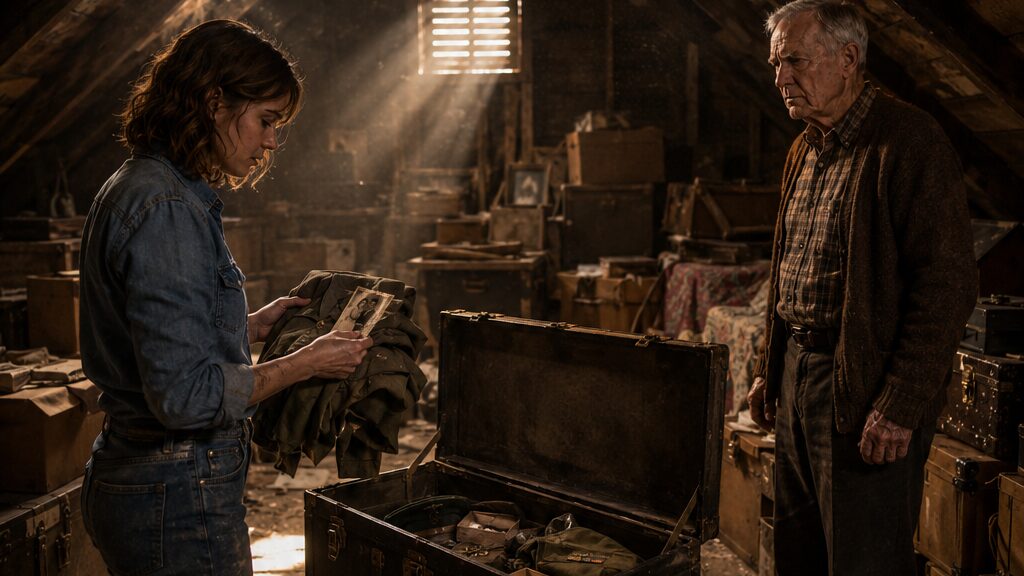
She was kneeling in the attic, pushing aside dusty storage bins, when a loose board shifted under her knee and exposed the corner of an old military-green trunk hidden behind insulation rolls and forgotten Christmas decorations.
“Grandpa?” she called.
No answer.
Below her, the television murmured from the living room.
Edward Hall had agreed to let her help clean the attic only because a leak had stained part of the ceiling. He had spent the morning insisting there was nothing worth saving up there.
The trunk suggested otherwise.
Melissa brushed dust from the lid.
No name.
No markings except a faded stencil she couldn’t fully read.
The lock hung open, rusted through.
She hesitated.
Then lifted the lid.
A smell escaped first.
Old paper.
Old cloth.
A scent trapped for decades.
Inside sat a carefully folded uniform.
Not a costume.
Not surplus clothing.
A real military uniform.
Melissa stared.
For a moment she thought she had opened the wrong trunk.
Her grandfather never talked about the military.
Never attended Veterans Day events.
Never wore veteran hats.
Never mentioned serving.
As far as she knew, he had worked construction most of his life.
Slowly, she lifted the uniform.
Something slid free.
A photograph.
The frame had been shattered years ago. The glass was gone, but cracks still ran through the picture itself.
Melissa caught it before it fell.
A young woman smiled at the camera.
Beside her stood a young man in uniform.
The young man looked unmistakably like Edward.
The photograph had been folded once.
Right through the middle.
The crack separated the two faces.
“Melissa?”
The voice came from behind her.
She jumped.
Edward stood at the attic entrance.
For a second nobody moved.
His eyes settled on the uniform.
Then the photograph.
Everything in his face seemed to stop.
Not anger.
Not surprise.
Something quieter.
Something heavier.
Melissa suddenly felt as if she had walked into a room she wasn’t supposed to enter.
“I didn’t know,” she said.
Edward climbed the final steps slowly.
His gaze never left the photograph.
“Grandpa…”
Still nothing.
She looked back into the trunk.
There were more photographs.
Patches.
Letters.
Military paperwork.
A folded American flag.
The entire hidden history of a man she thought she knew.
“Why didn’t you ever tell us you served?”
The question slipped out naturally.
Edward looked at her.
His expression didn’t change.
But the silence stretched long enough to make her regret asking.
Finally he reached forward.
Took the photograph from her hand.
Turned it over.
Held it for a moment.
Then placed it carefully back inside.
“Put those back.”
Three words.
Quiet.
Controlled.
Final.
Melissa blinked.
“Grandpa—”
“Put them back.”
The tone hadn’t changed.
That somehow made it harder.
Not an order.
Not a threat.
A wall.
Edward lowered himself onto an old wooden crate.
For several seconds he simply stared at the open trunk.
Melissa had never seen him look old before.
Not really.
He still mowed his own lawn.
Still fixed things around the house.
Still complained about people who paid someone else to change a tire.
But sitting there beside the trunk, he suddenly looked every one of his seventy-eight years.
“What happened?” she asked softly.
He shook his head.
“Nothing you need to worry about.”
She glanced again at the uniform.
“That’s not true.”
Edward stood.
Closed the trunk.
The lid shut with a dull metallic sound.
Conversation over.
Or so he hoped.
Melissa followed him downstairs.
The rest of the afternoon passed awkwardly.
Edward busied himself in the garage.
Melissa pretended to organize boxes.
Neither mentioned the trunk.
By evening, David arrived for dinner.
Melissa waited until Edward stepped outside to check the mailbox.
Then she spoke.
“Dad.”
David looked up from the kitchen table.
“What?”
“Grandpa was in the military.”
His fork stopped halfway to his mouth.
For a second she thought he would laugh.
Instead his face tightened.
“Where did you hear that?”
“I found a trunk.”
David exhaled slowly.
The reaction surprised her.
“You knew.”
“A little.”
“A little?”
David rubbed his forehead.
“Your grandfather doesn’t like talking about that time.”
“Why?”
“I don’t know.”
“You never asked?”
David gave a short humorless laugh.
“When I was a kid, I asked once.”
“And?”
“He told me to help him paint the fence.”
Melissa frowned.
“That’s it?”
“That’s it.”
She waited.
David looked away.
Which told her more than the words had.
“You know something.”
“No.”
“You do.”
“No, Melissa. I know enough to leave it alone.”
The back door opened.
Edward stepped inside carrying the mail.
The conversation ended immediately.
Nobody mentioned the trunk again.
But later that night Melissa couldn’t sleep.
She kept seeing the photograph.
The young man in uniform.
The young woman beside him.
The crack running between them.
Near midnight she went downstairs for water.
A light glowed beneath Edward’s bedroom door.
She paused.
Then noticed something else.
The attic key.
Sitting on the kitchen counter.
Next to a folded piece of paper.
Curiosity won.
She looked.
The paper wasn’t a letter.
It was an old photograph.
Another one.
A military group picture.
Young soldiers standing shoulder to shoulder.
One face had been circled in faded pencil.
Edward.
Someone had taken the photograph out after she went to bed.
Someone had been looking at it.
Melissa heard a floorboard creak down the hallway.
She quickly stepped back.
Edward emerged from his room.
His eyes landed on the photograph.
Then on her.
Neither spoke.
For a long moment they simply looked at each other across the kitchen.
Finally Edward picked up the picture.
Turned it face down.
And carried it away.
Chapter 2: The Things Nobody Asked
“Why didn’t you tell us?”
Melissa asked the question the next morning before Edward could escape to the garage.
He stopped halfway through pouring coffee.
The silence that followed felt familiar now.
Not empty.
Defensive.
“I told you to leave that alone.”
“You told me to put things back.”
“Same idea.”
Melissa sat at the kitchen table.
The circled photograph lay beside her.
She had taken a picture of it with her phone before Edward carried it away.
Not because she wanted to invade his privacy.
Because she couldn’t stop wondering.
“You were gone for years.”
Edward stared into his coffee.
“Not years.”
“Then how long?”
No answer.
She pushed gently.
“Why hide it?”
Edward took his mug and walked toward the back porch.
Conversation over again.
Except this time Melissa wasn’t willing to let it end.
“You served your country.”
He stopped.
Just briefly.
Then kept walking.
The back door closed behind him.
Melissa watched through the window as he settled into his chair outside.
Alone.
Exactly where he preferred to be.
By afternoon David arrived.
Melissa intercepted him before he reached the porch.
“We need to talk.”
David immediately looked tired.
“No.”
“Why is everybody acting like this is some kind of secret?”
“Because it is.”
The answer surprised both of them.
David sighed.
“I didn’t mean it like that.”
“Then what did you mean?”
He lowered his voice.
“I mean it’s his.”
Melissa folded her arms.
“That’s not an answer.”
“No. It’s the only answer you’re getting.”
The argument sharpened from there.
Not loud.
Worse.
Frustrated.
Melissa accused him of protecting silence.
David accused her of digging into something she didn’t understand.
Neither fully believed the other was wrong.
Which made it harder.
Finally David sat down heavily.
“When I was ten, I found some papers.”
Melissa waited.
“He took them away.”
“What papers?”
“I don’t know.”
“Did you ask?”
“Of course I asked.”
“And?”
David stared toward the porch.
“He said some things are easier to carry if nobody keeps picking them up.”
Melissa didn’t know what to do with that.
Later that day she drove to the local library.
Not because she had a plan.
Because she needed somewhere to start.
The photograph on her phone showed a military unit.
Numbers.
Insignia.
Names too blurry to read.
The librarian pointed her toward local military archives.
Most were incomplete.
A dead end.
Until she found a volunteer helping organize historical records.
Heather Campbell.
“You’ve got one photograph?” Heather asked.
Melissa showed her the image.
Heather studied it.
“Hmm.”
“What?”
“Could take some work.”
“Can you identify it?”
“Maybe.”
That maybe was enough.
Heather took down information and promised to call if she found anything.
When Melissa returned home, Edward was sitting at the kitchen table.
The trunk key rested beside him.
Not hidden.
Not mentioned.
Visible.
Like a test.
She sat across from him.
Neither spoke.
After several minutes Edward nodded toward her phone.
“You been looking things up?”
Melissa considered lying.
Didn’t.
“Yes.”
He looked disappointed.
Not angry.
Just tired.
“Why?”
The question caught her off guard.
Because she hadn’t expected him to ask.
“Because you’re my grandfather.”
Edward glanced toward the window.
“That’s got nothing to do with it.”
“It has everything to do with it.”
For the first time, something shifted.
Only slightly.
But enough.
Edward’s eyes moved to the key.
Then to her.
“You think finding records will tell you who I was.”
Melissa waited.
“It won’t.”
He stood.
Picked up the key.
Carried it away.
That evening Heather called.
“I found something.”
Melissa sat upright immediately.
“What?”
“The unit photograph.”
Her voice quickened.
“You identified it?”
“Not completely.”
“But?”
Heather hesitated.
“There was another copy.”
Melissa grabbed a pen.
“And?”
“One soldier was circled in pencil.”
Melissa already knew that.
Then Heather added something unexpected.
“The circle wasn’t added recently.”
A pause.
“It was there in the original archive copy.”
Melissa stared at the wall.
“What does that mean?”
“I don’t know.”
“But somebody wanted people to notice him.”
Heather emailed the image moments later.
When it arrived, Melissa zoomed in.
There was Edward.
Young.
Serious.
Standing among dozens of soldiers.
Circled.
Marked.
Remembered by someone.
The question was no longer whether he had served.
The question was why somebody had wanted him found.
Chapter 3: The Man In The Circled Photograph
Melissa was waiting outside Heather Campbell’s office before it opened.
Heather arrived carrying a cardboard box of archive folders.
“You really didn’t sleep on this, did you?”
“No.”
Heather smiled.
“Good. Neither did I.”
Inside, they spread documents across a table.
Photographs.
Roster sheets.
Unit summaries.
Nothing dramatic.
Nothing secret.
Just ordinary records.
Yet each piece felt enormous because every page contradicted the version of Edward Hall that Melissa had grown up knowing.
Heather slid one document forward.
“There.”
Melissa read.
Edward Hall.
Unit assignment.
Deployment dates.
Length of service.
Her breath caught.
“He was there that long?”
Heather nodded.
“Looks that way.”
Melissa had expected months.
Not years.
Not enough time for an entire chapter of a man’s life to disappear.
“He never told anybody.”
Heather studied the photograph again.
“Some people don’t.”
“Why?”
Heather leaned back.
“Different reasons.”
That answer irritated Melissa.
Everyone kept giving answers that weren’t answers.
She drove home carrying copies of everything.
The first thing she noticed was Edward’s truck missing from the driveway.
The second was David standing on the porch.
Waiting.
He held the folder before she could hide it.
“Tell me you aren’t doing this.”
Melissa walked past him.
“No.”
“Melissa.”
“You don’t get to be angry.”
“I’m not angry.”
“Then what are you?”
David followed her into the house.
“Worried.”
“For who?”
“For him.”
The answer landed harder than she expected.
David sat heavily in a chair.
“You think you’re uncovering history.”
“What am I uncovering?”
He looked toward the hallway.
The room where Edward kept the trunk.
The room nobody entered.
“I don’t know,” David admitted.
“Exactly.”
David laughed bitterly.
“You sound just like your grandmother.”
Melissa froze.
“My grandmother?”
It was the first time he had mentioned Barbara in weeks.
“How?”
“Once she decided she needed an answer, there wasn’t much stopping her.”
Before Melissa could ask more, the front door opened.
Edward stepped inside carrying groceries.
The folder in Melissa’s hands became impossible to hide.
His eyes found it immediately.
Nobody spoke.
Edward placed the grocery bags on the counter.
One by one.
Methodically.
Milk.
Bread.
Coffee.
Then he looked at the folder.
“What’d you find?”
Melissa wasn’t prepared for the question.
“You want to know?”
“No.”
A pause.
“But you’re going to tell me anyway.”
She opened the folder.
“You served almost three years.”
Edward nodded once.
No surprise.
No pride.
Just fact.
“You never told us.”
“No.”
“Why?”
Edward turned away.
Melissa felt frustration rising again.
Every answer created three new questions.
Then she took out the unit photograph.
The circled one.
Edward froze.
Not dramatically.
Just enough.
“Who circled you?”
For a long moment he stared.
Finally he took the picture.
Held it close.
A faint smile touched one corner of his mouth.
The first smile connected to any of this.
“He did.”
“Who?”
“A friend.”
Melissa leaned forward.
“What friend?”
Edward looked down at the photograph.
The smile disappeared.
“Gone a long time now.”
Another piece.
Another incomplete answer.
That night Melissa found him sitting alone on the back porch.
The photograph rested beside him.
The same one.
She sat quietly.
Neither spoke for several minutes.
Crickets filled the silence.
Finally she asked the question she hadn’t tried before.
“Do you miss it?”
Edward surprised her.
“Sometimes.”
The answer came immediately.
No hesitation.
No wall.
Just truth.
“Then why don’t you ever go to Veterans Day?”
His expression changed.
Not angry.
Not hurt.
Something older.
The porch seemed quieter.
Even the insects faded into the background.
Edward stared into the darkness beyond the yard.
For so long that Melissa thought he wouldn’t answer.
Then he said softly,
“I went once.”
She waited.
His hands tightened around the photograph.
“Never again.”
And this time, for the first time since she opened the trunk, Melissa knew she was finally getting close to the real story.
Chapter 4: Why He Never Went Back
The conversation should have ended on the porch.
It didn’t.
Melissa found Edward in the garage the next morning, standing motionless beside an old workbench.
A cardboard box sat open in front of him.
Not the trunk.
Not military records.
Just ordinary tools.
Yet he wasn’t touching any of them.
“You said you went once,” Melissa said.
Edward didn’t look up.
The wrench in his hand remained suspended above the bench.
“I did.”
“To a Veterans Day event?”
“Mm.”
“What happened?”
He set the wrench down.
Carefully.
The way someone sets down something fragile.
“Nothing worth talking about.”
Melissa leaned against the doorway.
A month ago she would have accepted that answer.
Now she recognized it for what it was.
A retreat.
Not a response.
“You keep saying that.”
Edward picked up a screwdriver.
“You keep asking.”
Neither sounded angry.
The tension came from how familiar the exchange had become.
Finally Melissa stepped inside.
“Grandpa, were you ashamed?”
The screwdriver stopped moving.
For several seconds neither spoke.
Then Edward surprised her.
“No.”
It came quickly.
Firmly.
The first immediate answer he had given her.
“No,” he repeated. “Never that.”
The certainty lingered in the garage after the words ended.
Melissa watched him.
If shame wasn’t the reason, then what was?
Before she could ask, a truck pulled into the driveway.
The neighbor.
An older man who occasionally helped Edward with heavy yard work.
The interruption ended the conversation.
Again.
By noon, Melissa was frustrated enough to leave the house.
She stopped at the grocery store on the edge of town.
Inside, she wandered the aisles without really shopping.
Near the front entrance, a small display had been set up.
Flags.
Patriotic decorations.
A sign advertising an upcoming community Veterans Day breakfast.
Melissa barely noticed it.
Until she saw Edward.
He wasn’t supposed to be there.
Yet he stood twenty feet away near the pharmacy counter.
Frozen.
A young soldier in modern uniform had approached him.
The soldier couldn’t have been older than twenty-two.
He smiled politely.
Said something Melissa couldn’t hear.
Edward answered.
The soldier’s expression softened.
Then he extended his hand.
Melissa moved closer.
Just enough to hear.
“Thank you for your service, sir.”
The words were simple.
Ordinary.
The kind people said every day.
Yet Edward reacted as if the sentence had weight.
Not dramatic weight.
Not visible pain.
Something subtler.
His eyes shifted away.
His shoulders stiffened.
He accepted the handshake.
Nodded once.
Then left.
No conversation.
No smile.
Nothing.
The young soldier looked confused.
Melissa hurried outside.
Edward was already loading groceries into his truck.
“What was that?”
He shut the tailgate.
“What was what?”
“The soldier.”
“He was being polite.”
“You looked upset.”
“I wasn’t.”
The answer came too quickly.
Melissa noticed it.
So did he.
For a moment they stood beside the truck in silence.
Then Edward sighed.
Not dramatically.
Just tired.
“You think every answer is hidden behind another answer.”
“Isn’t it?”
His mouth twitched.
Almost a smile.
Almost.
Then disappeared.
He climbed into the truck.
The drive home was quiet.
When they arrived, Melissa followed him into the kitchen.
The grocery bags remained unopened on the counter.
Neither moved.
Finally she spoke.
“You served. Why is it so hard to hear somebody say thank you?”
Edward stared at the countertop.
His fingers tapped once.
Twice.
Then stopped.
Because now he had reached the edge of something.
Melissa could see it.
A place he usually turned away from.
“When I came home,” he said quietly, “people weren’t saying that.”
Her pulse quickened.
The first real crack.
The first piece of something concrete.
“What were they saying?”
Edward’s gaze drifted toward the window.
Not toward her.
Not toward the room.
Toward something much farther away.
A memory.
For a long time he said nothing.
Then:
“Doesn’t matter now.”
The wall returned.
Melissa felt it slam back into place.
“Grandpa—”
“It doesn’t.”
“Then why won’t you talk about it?”
His expression hardened.
Not with anger.
With protection.
The same way someone shields an old injury when they know exactly where it hurts.
“Because talking about it doesn’t change it.”
The conversation ended there.
Or should have.
That evening David arrived carrying takeout containers.
Melissa told him about the soldier.
About the reaction.
About the comment.
David listened quietly.
Then sat down at the kitchen table.
“Stop pushing him.”
Melissa stared.
“You know something too.”
David rubbed his eyes.
“I know enough.”
“What does that mean?”
“It means there are some stories people survive by not telling.”
Melissa looked toward the hallway.
Toward Edward’s room.
Toward the hidden trunk.
The hidden photographs.
The missing years.
“Maybe surviving isn’t the same thing as living.”
David didn’t answer.
Because for the first time, he wasn’t entirely sure she was wrong.
Later that night Melissa found Edward sitting alone on the porch.
The circled photograph rested beside him again.
Always the photograph.
Always that same face among dozens.
She sat down quietly.
No questions.
No pressure.
Just silence.
Minutes passed.
Then Edward surprised her.
“You know what the funny thing is?”
She turned.
“What?”
“I don’t remember most of the flight home.”
His voice sounded distant.
“I remember getting off the plane.”
A pause.
“I remember the airport.”
His jaw tightened.
Then the silence returned.
Melissa waited.
Carefully.
Patiently.
Edward stood.
Picked up the photograph.
And headed inside.
At the door he stopped.
Without turning around, he said softly:
“You wouldn’t understand.”
Then he disappeared into the house.
Chapter 5: The Photograph Under The Uniform
Melissa found the date by accident.
She had pulled the damaged wedding photograph from the digital pictures she had secretly taken when the trunk was first opened.
Now she sat at her laptop enlarging every corner.
Studying details.
Searching for answers.
The photograph itself was simple.
Young Edward.
Young Barbara.
A wedding smile frozen in time.
But in the lower corner, partially hidden beneath the crack, was a date.
Melissa zoomed in.
Then again.
And again.
Until the numbers became clear.
She stared.
Something felt wrong immediately.
Not because she recognized the date.
Because she didn’t.
The wedding had happened earlier than she expected.
Much earlier.
She dug through family records.
Photo albums.
Old documents.
Anything she could find.
Hours later she sat surrounded by papers.
Confused.
The timeline didn’t fit.
The family story had always been simple.
Edward went away.
Came home.
Started his life.
Built a family.
But the dates suggested something messier.
Something interrupted.
Something missing.
When she showed David, his expression changed.
Not shock.
Recognition.
“You knew.”
David looked away.
“I knew the dates.”
“And?”
“And I never asked why they didn’t make sense.”
Melissa almost laughed.
Everybody in this family seemed to specialize in not asking questions.
That afternoon she drove to see Heather.
The local archives offered no magical answer.
Only more pieces.
Service dates.
Deployment dates.
Leave records.
Enough to establish one thing.
Edward returned home unexpectedly.
Earlier than he was supposed to.
Heather frowned as she reviewed the paperwork.
“That’s unusual.”
“Why?”
“People usually know when somebody’s coming home.”
Melissa felt a chill.
Not because she understood.
Because she almost did.
The shape of the truth was beginning to appear.
Still hidden.
Still incomplete.
But visible.
By evening she returned home carrying copies.
The house was quiet.
Too quiet.
She found Edward sitting at the dining room table.
The trunk key rested beside him.
Again.
Visible.
As if he wanted her to notice it.
Or wanted himself to.
The damaged wedding photograph sat nearby.
Outside the trunk for the first time.
Melissa stopped.
Neither spoke.
Edward’s fingers rested on the edge of the picture.
Tracing one of the cracks.
“Who is she?” Melissa asked softly.
He looked down.
Then smiled faintly.
A sad smile.
“Your grandmother.”
“You loved her.”
The answer came immediately.
“Yes.”
No hesitation.
No uncertainty.
Just truth.
The response unsettled her more than denial would have.
Because if he loved her that much—
Why hide the photograph?
Why bury it beneath a military uniform for fifty years?
Edward seemed to sense the question.
He folded his hands.
Looked at the picture.
Then away.
“Funny thing about photographs.”
Melissa waited.
“They only keep one second.”
The room fell silent.
A floorboard creaked somewhere in the house.
A refrigerator hummed.
Life continued around a conversation neither fully understood.
Finally Melissa spoke.
“What happened after this picture?”
Edward’s eyes closed briefly.
Not long.
Just enough.
When they opened again, something had changed.
Not surrender.
Not yet.
But fatigue.
The exhaustion of carrying something too long.
He reached forward.
Placed his hand on the photograph.
Then looked directly at her.
The first time he had done that while discussing any of this.
“Bring me that picture.”
Melissa frowned.
“It’s right there.”
“The copy.”
She realized what he meant.
The digital restoration she had been working on.
The clearer version.
The one where the date could finally be seen.
“Why?”
Edward stared at the photograph.
For several seconds he said nothing.
Then:
“Because if we’re going to talk about it…”
His voice trailed away.
The unfinished sentence hung between them.
More powerful than a finished one.
Melissa felt her heart pound.
After weeks of resistance.
After years of silence.
The door had moved.
Only an inch.
But it had moved.
Chapter 6: The House He Came Home To
Edward carried the photograph onto the back porch.
Not because it needed sunlight.
Because he needed somewhere to look besides Melissa.
She sat across from him.
Quiet.
The restored image rested between them.
The younger Edward smiled from the photograph.
The older Edward could barely meet his own eyes.
For several minutes nobody spoke.
Then Edward tapped the date with one finger.
“I came home three days after this.”
Melissa held her breath.
The story had finally begun.
Not all at once.
Not dramatically.
The way old wounds open.
Slowly.
Carefully.
“I wasn’t supposed to be home.”
His voice remained steady.
“I got leave approved at the last minute.”
He stared beyond the yard.
Beyond the trees.
Back toward another lifetime.
“Barbara didn’t know.”
Melissa listened.
No interruptions.
No questions.
Just listening.
Edward nodded slightly.
As if confirming details to himself.
“We’d been writing letters.”
A faint smile touched his face.
“She wrote every week.”
The smile disappeared.
“I thought I was surprising her.”
Silence.
Then:
“I took a taxi from the airport.”
Melissa noticed his hand tightening around the photograph.
Not enough to bend it.
Enough to matter.
“The house looked exactly the same.”
His eyes drifted shut briefly.
“When you’ve been gone a long time, you notice strange things.”
Another pause.
“The porch light was on.”
The words sounded ordinary.
Yet something beneath them wasn’t.
Melissa felt it.
The story was approaching something.
Edward looked down.
At the crack crossing Barbara’s face.
“I remember carrying my bag.”
His voice lowered.
“I remember thinking how happy she was going to be.”
The silence afterward stretched longer than any before.
Not because he had forgotten.
Because he remembered perfectly.
When he spoke again, his voice had changed.
Only slightly.
Enough.
“I walked inside.”
Melissa’s stomach tightened.
Edward rubbed his thumb along the edge of the photograph.
“The television was on.”
A breath.
“I heard voices.”
Another.
“I thought she was entertaining friends.”
He stopped.
For several seconds the story refused to move.
The porch seemed smaller.
Quieter.
The entire world narrowed to one old man and one damaged photograph.
Finally:
“She wasn’t.”
Melissa closed her eyes briefly.
Not because she was surprised.
Because hearing it was different from suspecting it.
Edward laughed once.
A short sound without humor.
“You spend years imagining home.”
His gaze remained fixed on the photograph.
“Then suddenly you’re standing in it.”
The words carried more weight than the facts themselves.
Melissa realized something then.
The betrayal wasn’t the whole wound.
The destruction of expectation was.
The collapse of something he had carried through years of service.
Edward continued.
“I didn’t yell.”
The statement sounded important.
Almost defensive.
As though he needed someone to understand that.
“I didn’t throw anything.”
His eyes remained distant.
“I didn’t hit anybody.”
Melissa nodded.
He wasn’t telling her because he wanted praise.
He was telling her because those details had mattered to him for fifty years.
“They looked more surprised than I was.”
A faint bitterness entered his voice.
The first real bitterness she had heard.
“Funny how that works.”
He looked away.
Toward the darkening yard.
“Barbara cried.”
The words landed softly.
Not with anger.
Not with hatred.
With memory.
“She kept trying to explain.”
Melissa waited.
Edward shook his head.
“I don’t remember most of what she said.”
The statement felt true.
Some moments burn so brightly they erase everything around them.
“I remember standing there.”
He swallowed.
“Still carrying my bag.”
The image hit Melissa harder than anything else.
Not the affair.
Not the betrayal.
The bag.
The homecoming frozen in place.
A soldier still arriving.
A husband already too late.
Edward’s hand trembled once.
Only once.
Then steadied.
“I left.”
Melissa blinked.
“You just left?”
“I walked out.”
His gaze remained on the yard.
“I got back in the taxi.”
The answer raised more questions than it solved.
Where had he gone?
What happened afterward?
How did a marriage continue long enough for Melissa to exist?
Edward seemed to know exactly what she was thinking.
Because he looked down at the photograph again.
And stopped talking.
The silence returned.
This time different.
Not protective.
Painful.
Melissa waited several minutes.
Finally she spoke.
“What happened next?”
Edward stared at the photograph.
At the smiling faces trapped inside a single second.
At the crack that divided them.
For a long time he said nothing.
Then he folded the photograph carefully.
Placed it on the table.
And stood.
“I can’t do the rest tonight.”
He walked inside before Melissa could answer.
Leaving the photograph behind.
Leaving the story unfinished.
Leaving only one question in its place.
What happened after he walked out of that house?
Chapter 7: The Welcome Home He Never Received
The photograph was gone when Melissa woke up.
Edward had taken it.
Not hidden it.
Taken it somewhere.
For the first time since the trunk had been opened, the absence felt more important than the object itself.
She found him in the attic.
The trunk stood open.
Fully open.
The lid leaned back against the wall.
Sunlight from the small attic window fell across the uniform, the letters, the photographs, and the folded flag.
Edward sat beside it.
Not touching anything.
Just sitting there.
Melissa stopped at the top of the stairs.
The sight alone felt different.
For weeks the trunk had been a secret.
Now it looked almost ordinary.
An old box holding an old life.
Edward glanced at her.
“Come here.”
The words startled her.
She crossed the attic slowly and sat beside him.
The photograph rested on top of the uniform.
The crack still divided the smiling couple.
Edward looked older than she had ever seen him.
Not weaker.
Just tired of carrying something.
For a while neither spoke.
Then he nodded toward the photograph.
“I left the house.”
Melissa stayed silent.
Edward’s eyes remained on the trunk.
“I sat outside for almost an hour.”
His voice was steady.
“I didn’t know where to go.”
The confession sounded small.
Yet it felt larger than every military record Melissa had uncovered.
People imagined soldiers knowing what to do.
Knowing how to act.
Knowing how to endure.
Nobody imagined them sitting alone in a taxi with nowhere to go.
“I got back to the airport.”
Melissa frowned.
“The airport?”
Edward nodded.
“I thought maybe I’d get another flight somewhere.”
A faint smile touched his face.
“Didn’t even know where.”
He rubbed his hands together.
A habit Melissa suddenly recognized.
The same habit she had seen all her life.
The same habit nobody had ever connected to anything.
“I sat in a terminal for hours.”
The attic seemed to shrink around his words.
“Still carrying my bag.”
The image returned.
The soldier.
The husband.
The man between two lives.
Edward’s gaze drifted toward the attic window.
“I wasn’t crying.”
He said it almost defensively.
Melissa believed him.
Some wounds sat too deep for tears.
“Mostly I was embarrassed.”
The statement caught her off guard.
“Embarrassed?”
Edward nodded.
“Everybody talks about heartbreak.”
His voice remained calm.
“Nobody talks much about humiliation.”
The word lingered.
Humiliation.
Not grief.
Not anger.
Humiliation.
A wound that had survived half a century.
Edward looked down.
“I remember a woman walking past.”
His jaw tightened slightly.
“She looked at the uniform.”
A pause.
“Then at me.”
Melissa waited.
The attic became silent except for distant traffic outside.
Finally Edward spoke again.
“She said something.”
“What?”
His eyes remained fixed on the trunk.
“‘You people should’ve stayed over there.'”
Melissa felt cold.
The words weren’t shouted.
That somehow made them worse.
Edward nodded slowly.
“As if I’d chosen where to go.”
His voice remained controlled.
Not bitter.
Not angry.
Simply factual.
Like a weather report from another life.
“I didn’t answer.”
Another pause.
“Then somebody else laughed.”
The silence afterward lasted a long time.
Melissa understood now why he had resisted.
The wound wasn’t one moment.
It was two.
The house.
Then the airport.
Home gone.
Country distant.
Nowhere left to stand.
Edward picked up the photograph.
Held it carefully.
“Barbara found me two days later.”
Melissa blinked.
The story shifted unexpectedly.
“She did?”
“She called everybody she could think of.”
He smiled faintly.
“She always was stubborn.”
The smile vanished.
“She wanted forgiveness.”
“Did you forgive her?”
Edward stared at the crack across the photograph.
For several seconds he seemed unable to answer.
Then:
“Eventually.”
Melissa hadn’t expected that.
Not after everything.
Edward seemed to read her expression.
“Life’s longer than people think.”
His voice softened.
“You run out of room to carry certain things.”
Another surprise.
Not because he forgave her.
Because he had.
The complexity of it made the story feel more painful, not less.
Barbara was no longer a villain.
Just a flawed human being who had hurt someone deeply.
They sat together in silence.
Eventually Edward looked toward the trunk.
Toward the uniform he had hidden for decades.
“I didn’t stop talking about the military because of the war.”
The sentence felt important.
“I stopped because every time somebody asked, I remembered coming home.”
Melissa nodded.
Finally understanding.
Not completely.
But enough.
The uniform.
The photograph.
The silence.
All connected.
Edward picked up the folded jacket.
The same one Melissa had found beneath the photograph.
He ran a hand across the fabric.
Then carefully placed it back.
For the first time he didn’t hide it.
Didn’t cover it.
Didn’t lock it away.
The trunk remained open.
Hours later, after dinner, Melissa found him sitting at the kitchen table.
The photograph rested beside him.
The attic dust still clung to his sleeves.
He looked up as she entered.
For a moment she saw the younger man from the picture.
Not physically.
Something deeper.
A version of him she had never known.
Melissa pulled out a chair.
Sat down.
The silence felt different now.
No walls.
No defenses.
Only distance left to cross.
She looked at him carefully.
Then said the only thing that felt right.
“Tell me the rest.”
Chapter 8: Leaving The Trunk Open
The next evening the trunk sat in the living room.
Nobody mentioned moving it.
Nobody questioned why it was there.
It simply occupied a space it had never been allowed to occupy before.
Visible.
Part of the house.
Part of the family.
Melissa sat on the floor beside it.
Edward occupied his usual chair.
David sat on the couch across from them.
The arrangement felt accidental.
It wasn’t.
The trunk remained open.
The uniform folded neatly inside.
The photographs stacked beside it.
The damaged wedding picture rested on the coffee table.
No longer hidden beneath anything.
No longer buried.
For a while nobody spoke.
Then David cleared his throat.
“I should’ve asked.”
Edward looked at him.
David stared at the floor.
“When I was younger.”
A pause.
“When I found those papers.”
His voice tightened.
“I should’ve asked.”
Edward studied his son quietly.
“You did ask.”
David laughed once.
Without humor.
“I let you avoid the answer.”
The room fell silent.
Edward leaned back.
The years seemed visible on his face now.
Not because he looked older.
Because he looked lighter.
Not healed.
Just lighter.
“There wasn’t exactly a good answer.”
David nodded.
Melissa watched both men.
The distance between them suddenly seemed measurable.
Not in feet.
In decades.
Edward reached into the trunk.
The movement immediately drew everyone’s attention.
He removed the circled photograph.
The unit picture.
The one that had started so many questions.
He handed it to David.
“That’s him.”
David studied the image.
“The friend?”
Edward nodded.
The smile that followed carried sadness and affection in equal measure.
“He circled me because he said I’d disappear someday.”
Melissa looked up.
“What?”
Edward chuckled softly.
“He always said I was good at disappearing.”
The room grew quiet.
Because everybody understood the irony.
He had disappeared.
Not physically.
Emotionally.
Historically.
Inside his own family.
David held the photograph carefully.
As if afraid to damage it.
“I wish I’d known him.”
Edward’s smile deepened slightly.
“You would’ve liked him.”
For a while they talked.
Not dramatically.
Not as some grand emotional release.
Just stories.
Small ones.
The kind that had never been told.
The friend who never stopped talking.
The terrible coffee.
The practical jokes.
The endless waiting.
The ordinary pieces of military life that had been missing from family history.
Melissa listened.
Sometimes asking questions.
Sometimes simply letting the stories exist.
The night stretched on.
The trunk remained open.
Nobody rushed to close it.
Eventually David left.
The house grew quiet.
Melissa stayed behind.
Helping gather cups from the table.
The photograph still rested near Edward’s chair.
The cracked one.
The wedding picture.
She picked it up.
Carefully.
“You keeping this out now?”
Edward looked at it.
A long time passed before he answered.
“Yeah.”
No explanation.
None needed.
The photograph no longer represented only betrayal.
Now it represented truth.
A life that had happened.
A wound that had finally been acknowledged.
A burden no longer carried alone.
Melissa set it gently beside the trunk.
Edward watched her.
Something moved behind his eyes.
Not grief.
Not relief.
Something between them.
The kind of emotion that arrives when a person finally stops hiding.
“You know,” Melissa said quietly, “I used to think you just didn’t like talking.”
Edward laughed.
A real laugh this time.
“I don’t.”
She smiled.
“Good point.”
The laughter faded.
The comfortable silence remained.
Outside, a car passed on the road.
Inside, the old house settled around them.
Melissa looked at the trunk.
Then at her grandfather.
Then back at the trunk.
Still open.
Still visible.
No lock.
No secrecy.
No attic.
She thought about the young soldier at the grocery store.
The one who had offered gratitude that arrived fifty years too late.
She thought about the airport.
The house.
The taxi.
The years of silence.
And she realized something.
The story had never really been about military service.
It had been about being seen.
Finally.
Completely.
Without looking away.
Edward followed her gaze to the trunk.
Then to the photograph.
Then back to her.
Neither spoke for several seconds.
Finally Melissa reached across the table.
Placed her hand gently over his.
The gesture was simple.
Small.
The kind of thing easy to overlook.
Edward looked down.
Then back up.
His eyes glistened slightly.
Not enough for tears.
Enough.
Melissa squeezed his hand once.
And quietly, with no audience beyond the two of them, she said the words that should have arrived half a century earlier.
“Welcome home, Grandpa.”
Edward closed his eyes.
Only for a moment.
When he opened them again, he nodded.
The trunk remained open between them.
And neither of them tried to close it.
The story has ended.