The Woman Who Stood Between an Old Veteran and a Town That Had Already Judged Him
Chapter 1: The Man Everyone Wanted Out of the Way
Jessica Wilson heard shouting before she saw who it was.
She stepped out of the diner carrying a box of napkins for the outdoor tables and froze.
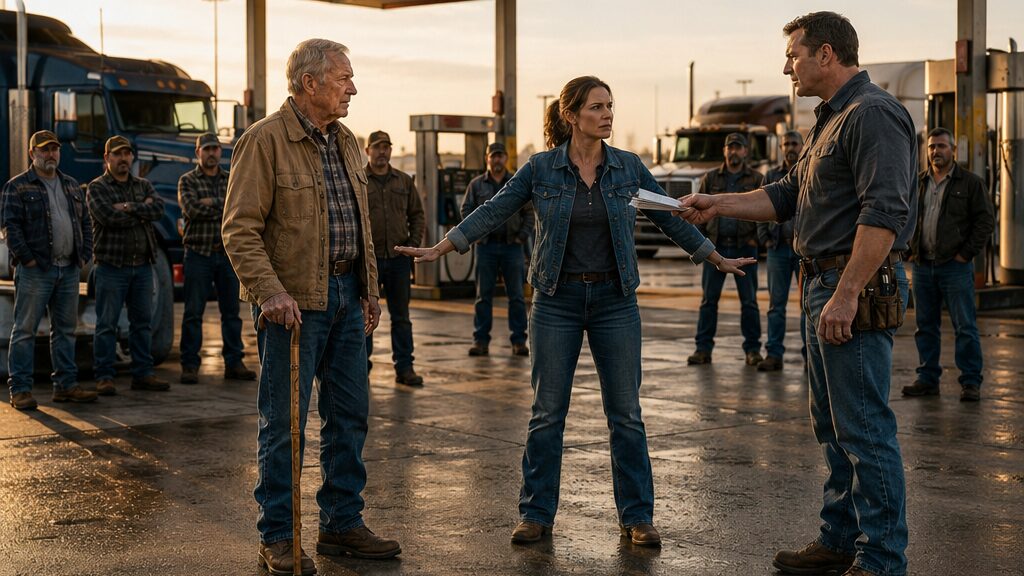
Across the fuel lot, near pump four, Kevin Martin stood inches from an old man holding a cane.
Stephen Harris.
Even from a distance, Jessica could tell something was wrong.
Kevin wasn’t talking.
He was performing.
His voice carried across the concrete, loud enough for truck drivers fueling rigs and customers walking toward the convenience store.
“You’ve had months, Stephen.”
Stephen stood quietly beside the pump island.
His left hand rested on the worn wooden handle of his cane.
His expression didn’t change.
Kevin held a clipboard in one hand.
A stack of papers fluttered in the dry Texas wind.
“This isn’t complicated,” Kevin continued. “Everybody else signed. Everybody else understands what this town needs.”
A few people stopped walking.
Nobody intervened.
Jessica set the box down.
Stephen said nothing.
That somehow seemed to irritate Kevin even more.
“Do you even know what you’re refusing anymore?”
Several heads turned.
Jessica started walking.
Fast.
Kevin pointed toward the narrow road that ran behind the truck stop.
A stretch of cracked asphalt disappearing between mesquite trees and scrub brush.
“You own one piece of land,” he said. “One tiny strip. That’s it.”
Still silence.
Kevin laughed.
The sound carried farther than his words.
“Or maybe you don’t understand what you’re signing.”
That finally stopped Jessica.
Not because of what Kevin said.
Because she saw Stephen’s grip tighten around the cane.
Just slightly.
The movement lasted less than a second.
But she knew him.
He always tightened his grip when he was trying not to react.
“Kevin.”
Her voice cut through the gathering crowd.
He turned.
“So now you’ve got an audience,” Jessica said.
Kevin exhaled.
“Stay out of this.”
“No.”
Stephen looked at her.
There was a quiet warning in his eyes.
Not fear.
Not embarrassment.
A request.
Let it go.
Jessica ignored it.
She walked directly between them.
The same way she had once stepped between two drunk truckers fighting in her diner parking lot.
The same way she’d spent most of her life stepping into situations she probably shouldn’t.
Kevin shook his head.
“This doesn’t concern you.”
“It concerns me when somebody decides humiliating an old man in public is a business strategy.”
Several people nearby suddenly found the fuel pumps fascinating.
Nobody wanted eye contact.
Kevin lowered his voice.
“Nobody’s humiliating anybody.”
“You sure about that?”
For a moment nobody spoke.
Then Kevin held out the papers.
“Stephen knows exactly what’s happening.”
Jessica looked at Stephen.
“Do you?”
Stephen’s eyes remained on the road behind the truck stop.
“I know.”
“Then why not tell him?”
The old man shifted his weight.
The cane clicked softly against concrete.
Because of his age, people often mistook every movement for weakness.
Jessica knew better.
Stephen moved carefully because pain followed him everywhere.
Not because he was fragile.
Kevin thrust the papers forward.
“Sign the access agreement.”
Stephen didn’t look at them.
“No.”
The answer came quietly.
Kevin laughed again.
“That’s not a reason.”
“No.”
The same word.
Same tone.
Jessica watched frustration spread across Kevin’s face.
It wasn’t the reaction of a man enjoying power.
It looked more desperate than that.
A contractor with three unfinished projects.
Loans.
Payroll.
Deadlines.
Everybody in town knew his business was struggling.
But desperation didn’t excuse cruelty.
Kevin stepped closer.
“You are holding up jobs.”
Stephen remained still.
“You are holding up expansion.”
Nothing.
“You are holding up money this town needs.”
Still nothing.
The crowd grew.
A truck driver crossed his arms.
The gas station manager emerged from the store doorway.
Kevin pointed at the road again.
“Why?”
Stephen looked at him.
For the first time.
The entire lot seemed to quiet.
“No road is worth breaking a promise.”
Kevin blinked.
Jessica frowned.
A promise?
“What promise?” Kevin demanded.
Stephen didn’t answer.
Kevin spread his hands.
“See? This is exactly what I’m talking about.”
He turned toward the crowd.
“Nobody knows why he’s doing this.”
A few people nodded.
That was the dangerous thing.
Not anger.
Agreement.
People liked simple explanations.
Old man. Stubborn. Problem solved.
Kevin seized on it.
“We’ve got investors ready to move.”
He pointed at Stephen.
“And one person won’t even explain himself.”
Jessica stepped forward again.
“Maybe because he doesn’t owe you every detail of his life.”
Kevin stared at her.
“You think this is about dignity?”
“It is.”
“No. It’s about business.”
Stephen finally moved.
He turned away from both of them.
Toward the road.
The cane struck the pavement once.
Twice.
Three times.
The crowd parted automatically.
Nobody offered help.
Nobody needed to.
He walked slowly but steadily.
The same way he’d walked into her diner every morning for almost fifteen years.
Kevin watched him go.
“So that’s it?”
Stephen didn’t stop.
“That’s it.”
The old man disappeared beyond the pumps.
The crowd began dispersing.
Conversation returned.
Engines started.
Life resumed.
As if nothing had happened.
Kevin gathered his papers.
Jessica caught his arm.
“What exactly is on those forms?”
His jaw tightened.
“Access rights.”
“To what?”
“The road.”
“Why do you need it?”
Kevin hesitated.
Only for a second.
But she noticed.
“Because the expansion can’t happen without it.”
Then he pulled away.
Jessica watched him leave.
Something felt wrong.
Not the argument.
The road.
The promise.
The way Kevin had acted as though ownership should automatically become obedience.
The way Stephen had chosen silence over explanation.
Later that afternoon, Stephen sat alone outside his small house beyond the edge of town.
Jessica found him repairing the rubber tip on his cane.
The old wooden handle rested across his knees.
“You could have told him something.”
Stephen kept working.
“I know.”
“Then why didn’t you?”
The silence stretched.
Finally he spoke.
“People hear what they want.”
“Maybe.”
“They decide what kind of man you are first.”
He tightened a screw.
“After that, facts don’t help much.”
Jessica sat beside him.
“That promise.”
Stephen stared toward the horizon.
For a moment she thought he wouldn’t answer.
Then he surprised her.
“It matters.”
“To who?”
His expression changed.
Only slightly.
A shadow moving through old memories.
“Someone who isn’t here anymore.”
Jessica waited.
Nothing else came.
The old veteran rose slowly.
Leaning on the cane.
The same cane everybody saw.
The same cane nobody understood.
Before he stepped inside, he paused.
Without looking back, he said quietly,
“The promise wasn’t about the road.”
Then he disappeared into the house.
Jessica sat alone on the porch.
Trying to understand why a road mattered enough to divide a town.
And why an old man who never asked anything from anyone was willing to stand against everybody for it.
Chapter 2: The Road Beneath the Argument
By eight the next morning, Jessica was standing inside the county records office staring at an empty space in a filing box.
The clerk looked annoyed.
“That’s all that’s there.”
Jessica pointed again.
“There should be more.”
The clerk shrugged.
“Maybe.”
A thin folder sat open on the counter.
Property maps.
Tax records.
Transfer notices.
But several pages were missing.
Including documents connected to the strip of road behind the truck stop.
Jessica folded her arms.
“Missing how?”
“No idea.”
“That seems important.”
The clerk gave her a tired look.
“Important and unusual aren’t always the same thing.”
Jessica left more frustrated than when she’d arrived.
Outside, trucks rolled past on the highway.
Across town, Stephen was probably drinking coffee on his porch as if none of this mattered.
That irritated her.
Not because she disagreed with him.
Because she couldn’t tell if he was protecting something or simply refusing help.
By noon she had visited three people.
A retired surveyor.
A former county employee.
The gas station manager.
All of them told variations of the same story.
The road had always been there.
The ownership had always been complicated.
Nobody had paid attention until money became involved.
That afternoon she found Stephen sitting at the corner table inside her diner.
His coffee was untouched.
“You’re avoiding me.”
“No.”
“You are.”
Stephen looked mildly offended.
“I came here.”
“To avoid talking.”
“That’s different.”
Despite herself, Jessica smiled.
Then she dropped a stack of copied maps onto the table.
The smile disappeared.
“What am I missing?”
Stephen examined the papers.
Not the way a confused old man would.
The way a mechanic inspected an engine.
Slowly.
Carefully.
Looking for what mattered.
Finally he tapped one section.
“The road.”
“I know.”
“No.”
His finger remained there.
“The road.”
Jessica leaned closer.
A narrow strip connected the highway to land behind the truck stop.
Not much.
Just enough.
Then she understood.
“Everything depends on that access point.”
Stephen nodded.
“Without it?”
“The expansion stops.”
Jessica sat back.
“So Kevin wasn’t exaggerating.”
“No.”
That answer surprised her.
Most people would have enjoyed seeing an opponent painted as dishonest.
Stephen never did.
“So why not sell?”
The old man looked toward the diner window.
Traffic moved steadily along the highway.
A school bus passed.
Life going somewhere.
“The answer hasn’t changed.”
“The promise.”
“Yes.”
Jessica rubbed her forehead.
“You realize that’s driving everybody crazy.”
“I know.”
The fact that he sounded almost apologetic made it worse.
The diner bell rang.
Several customers entered.
One glanced toward Stephen.
Then toward Jessica.
Then whispered something to another customer.
The whisper spread.
Jessica watched it happen.
People pretending not to stare.
Pretending not to judge.
The town had already picked a side.
By evening, the planning board announced a public meeting.
The notice appeared online.
Then on bulletin boards.
Then in conversations everywhere.
Jessica read it twice.
Discussion of truck-stop expansion and access-road dispute.
Open community attendance.
She knew immediately what would happen.
Not discussion.
Pressure.
The meeting took place two nights later.
The room overflowed.
Contractors.
Drivers.
Business owners.
Residents.
Carolyn Lewis sat at the center table.
Calm.
Professional.
Already tired.
Kevin stood near the front.
Confident but strained.
Stephen sat alone near the back.
His cane resting against his chair.
People noticed it.
Jessica noticed them noticing it.
As though the cane itself proved something.
Weakness.
Age.
Obstruction.
Carolyn called the meeting to order.
Kevin spoke first.
Economic benefits.
Jobs.
Investment.
Growth.
Nothing unreasonable.
That made it harder.
Because some of what he said was true.
Then Carolyn invited public comment.
Kevin stood again.
“I’d like everyone to understand that this project is being delayed by one property owner refusing to cooperate.”
Murmurs.
Heads turning.
Toward Stephen.
Jessica felt her stomach tighten.
Kevin continued.
“We still don’t know why.”
The room shifted.
The pressure became visible.
Stephen remained seated.
Silent.
Carolyn looked at him.
“Mr. Harris, would you like to respond?”
A long pause.
Then Stephen stood.
Slowly.
Using the cane.
The room watched every movement.
As though waiting for proof of something.
He reached the microphone.
Looked around.
And said only:
“No.”
Confusion spread immediately.
Carolyn blinked.
“No?”
“No, I would not like to respond.”
Then he returned to his seat.
The room erupted with frustrated whispers.
Kevin stared in disbelief.
Jessica felt something break.
Not in Stephen.
In the room.
Every person there now believed the same thing.
That silence meant guilt.
That refusal meant selfishness.
That age meant stubbornness.
Carolyn waited for quiet.
Then, reluctantly, she spoke.
“Given the lack of explanation from the property owner, the board must consider the broader community impact.”
Kevin exhaled.
Relief.
Jessica saw it.
And hated it.
Because for the first time, someone with authority had publicly leaned his direction.
The meeting ended twenty minutes later.
People filed out.
Conversations buzzing.
Opinions hardening.
Stephen picked up his cane.
Jessica intercepted him near the exit.
“You just handed them exactly what they wanted.”
“I know.”
“Then why do it?”
The old man looked exhausted.
Not physically.
Emotionally.
As if carrying something far heavier than land.
“Because some truths don’t belong only to me.”
Before she could ask what that meant, he walked away.
Jessica stood alone in the parking lot.
Then she noticed something.
A folded document had slipped from Stephen’s stack of papers.
Half hidden beneath a chair.
She picked it up.
The page was old.
Decades old.
The signature line was torn away.
And across the top was a name she didn’t recognize.
Chapter 3: What Silence Costs
The first customer left without ordering.
The second asked for coffee and stayed five minutes.
The third walked in, saw Stephen sitting near the window, and turned around.
Jessica watched every one of them.
By noon, the diner felt half empty.
Not because of bad food.
Not because of weather.
Because people had started treating the road dispute like a loyalty test.
A waitress carried a tray past Jessica.
“Tough morning.”
Jessica nodded.
The waitress hesitated.
Then lowered her voice.
“People are talking.”
“I know.”
“They think you’re choosing sides.”
“I am choosing sides.”
The waitress looked uncomfortable.
That answer traveled through the diner faster than any rumor.
Jessica wiped down a clean counter just to keep her hands busy.
Across the room, Stephen sat quietly reading an old newspaper.
As if he hadn’t become the town’s favorite topic.
As if business wasn’t disappearing one table at a time.
That irritated her more than she wanted to admit.
Late that afternoon she carried a plate of pie to his table.
“You owe me money.”
Stephen looked up.
“For pie?”
“For lost customers.”
A faint smile appeared.
Brief.
Gone again.
She sat across from him.
The old document lay folded in her apron pocket.
“I found something.”
His expression changed immediately.
Not fear.
Recognition.
“You shouldn’t go through my papers.”
“It fell on the floor.”
“Still.”
Jessica placed the document on the table.
The old veteran stared at it.
Then sighed.
“You should have left it alone.”
“Who is it?”
No answer.
The silence returned.
Familiar.
Infuriating.
Jessica leaned back.
“You know what everybody thinks?”
“Probably.”
“They think you’re protecting your property.”
Stephen folded the document carefully.
“They’re wrong.”
“Then help me understand.”
The old man stared through the diner window.
Past the highway.
Past the fuel station.
Past the road.
Toward something much farther away.
“I don’t need people to understand.”
“That’s not true.”
“It is.”
“No, Stephen.”
Her voice softened.
“It stopped being true the moment your silence started hurting other people too.”
That landed.
She saw it.
His shoulders dropped slightly.
Not defeat.
Recognition.
Before he could answer, the diner bell rang.
A truck driver entered carrying a cardboard box.
“Package for Harris.”
Stephen frowned.
“I didn’t order anything.”
“Don’t know.”
The driver placed the box on the table and left.
Inside was an old photograph.
Nothing else.
No note.
No return address.
Just a black-and-white image.
Three young soldiers standing beside a military transport truck.
Jessica leaned closer.
One of them was clearly Stephen.
Younger.
Thinner.
Smiling.
The sight alone felt strange.
She had known him fifteen years and had never once seen him smile like that.
The other two men were strangers.
One rested a hand on Stephen’s shoulder.
The third held a wrench.
All three looked covered in dust.
All three looked exhausted.
All three looked happy.
Stephen stared at the photograph.
For a very long time.
Finally he reached out.
His finger touched the man standing beside him.
Not himself.
The other man.
The one with his hand on Stephen’s shoulder.
Jessica noticed.
“Who is he?”
The old veteran swallowed.
“A friend.”
“From the war?”
“Yes.”
The answer created more questions than it solved.
The photograph proved something important.
The promise came from somewhere real.
Not stubbornness.
Not pride.
Something older.
Something connected to another life.
Yet Stephen still refused to explain.
By closing time Jessica remained irritated.
She locked the front door and carried the photograph into the office.
The old document lay beside it.
This time she examined both carefully.
The paper looked decades old.
Property-related.
Partially damaged.
The name appeared again.
Not Stephen Harris.
Someone else.
She compared dates.
Addresses.
Fragments.
Then she noticed something.
A second signature line.
Barely visible beneath a fold.
The name wasn’t complete.
But enough remained to suggest something unexpected.
The road had once belonged to two people.
Not one.
Jessica stared at the faded ink.
The town believed Stephen alone controlled everything.
But the document suggested another owner.
Or at least another claim.
Someone tied to the promise.
Someone tied to the photograph.
Someone nobody had mentioned.
Outside, headlights swept across the diner windows.
Jessica folded the paper carefully.
For the first time since the argument at the truck stop, the question changed.
It was no longer why Stephen refused to sell.
It was who he had been protecting all these years.
And whether that person was still out there.
Chapter 4: The Promise Nobody Heard
Jessica was already knocking on Stephen’s front door when the sun came up.
No answer.
She knocked again.
Still nothing.
Then she heard the familiar tap of a cane against wood.
The door opened.
Stephen looked tired.
Not sick.
Cornered.
Jessica held up the old document.
“We need to talk.”
His eyes moved immediately to the paper.
Then away.
That told her everything.
He stepped aside.
“Come in.”
The house smelled faintly of coffee and machine oil.
A habit left over from another life.
Tools hung neatly on one wall.
Every shelf looked organized with military precision.
Jessica sat at the kitchen table.
Stephen lowered himself carefully into the chair opposite her.
The cane rested beside him.
For several moments neither spoke.
Finally Jessica slid the document across the table.
“Who was the second owner?”
Stephen stared at the faded page.
“A friend.”
“The one in the photograph?”
“Yes.”
“What was his name?”
The old veteran rubbed his thumb along the edge of the table.
A nervous habit she had never seen before.
“Why does it matter?”
“Because the whole town thinks you’re fighting over land.”
“I’m not.”
“I know that.”
“Then let it go.”
Jessica laughed once.
Short and sharp.
“No.”
Stephen looked genuinely surprised.
“You spent years teaching me that people should stand up when something isn’t right.”
“I don’t remember teaching you that.”
“You did.”
His silence admitted it.
Jessica leaned forward.
“The road isn’t the reason.”
“No.”
“The promise is.”
“Yes.”
The answer came so quickly she almost missed it.
For the first time he wasn’t avoiding the question.
Only the details.
“The promise came from him.”
Stephen nodded.
The old veteran looked toward a framed photograph on a shelf.
Not the military photograph.
A different one.
A group of men standing beside trucks.
Maintenance crews.
Grease-covered faces.
Young men who had believed they had plenty of time.
Jessica followed his gaze.
“You never talk about the war.”
“There’s not much to say.”
She gave him a look.
Stephen almost smiled.
“Fine. There’s too much to say.”
The room settled into quiet.
Not the defensive silence she had been fighting.
Something different.
A silence before a difficult truth.
“He was my friend,” Stephen finally said.
“Close friend?”
“Like a brother.”
Jessica waited.
“The promise happened later.”
“After the war?”
“Yes.”
The answer opened another door.
Then he closed it immediately.
Nothing else followed.
Jessica’s frustration returned.
“You realize this is exactly what drives people crazy.”
“I know.”
“Then why stop there?”
Stephen looked down at his hands.
Old hands.
Scarred hands.
Hands that had spent decades fixing engines and solving practical problems.
Yet here he was creating a problem with his own stubbornness.
Because he was afraid.
Jessica suddenly saw it.
Not fear of Kevin.
Not fear of losing land.
Fear of exposing something.
Fear of betraying someone.
The realization softened her anger.
“You think telling the truth hurts somebody.”
Stephen’s head lifted.
For the first time she saw genuine surprise.
She had guessed correctly.
A long silence followed.
Then he spoke quietly.
“Some people spent their lives trying to move forward.”
“And?”
“And some stories drag people backward.”
Jessica sat back.
The answer explained more than he intended.
The promise wasn’t protecting the dead.
It was protecting the living.
A knock interrupted them.
Both turned.
A delivery driver stood outside holding an envelope.
“Certified mail.”
Stephen signed.
The driver left.
Inside was an official notice.
Planning board review.
Attendance requested.
Community impact hearing.
Three weeks away.
Jessica watched Stephen read it.
His expression never changed.
But his grip tightened around the paper.
The same way it tightened around the cane.
Pressure.
Always pressure.
“Kevin won’t stop.”
“No.”
“Neither will Carolyn.”
“No.”
Jessica folded her arms.
“Then eventually you’re going to have to say something.”
Stephen stared at the notice.
“Maybe.”
The answer irritated her all over again.
“Maybe?”
He looked toward the road visible through the kitchen window.
The road causing all of this.
“The truth belongs to more than me.”
Hours later, after leaving Stephen’s house, Jessica drove to the county archives again.
This time she searched older records.
Older than the property dispute.
Older than the truck stop.
Older than most of the town’s memories.
The clerk recognized her immediately.
“Back again?”
“Unfortunately.”
Several dusty boxes later, she found another document.
Not complete.
Not clean.
But enough.
The same unfamiliar name appeared again.
This time attached to tax records.
Land records.
Ownership references.
The person had existed.
The connection was real.
Jessica copied everything she could.
Back at the diner that evening, she spread the papers across her office desk.
The military photograph.
The old ownership document.
The tax records.
She lined up dates.
Addresses.
Signatures.
And suddenly saw something she had missed before.
The unfamiliar name appeared repeatedly beside a specific mailing address.
Not Stephen’s.
Never Stephen’s.
Someone else’s.
Someone who should have inherited part of the property.
Someone whose connection had vanished from every recent record.
Jessica stared at the address.
Then at the name.
The person behind the promise was becoming real.
Not a memory.
Not a story.
A person.
And for the first time she wondered whether that person—or their family—might still be alive.
Chapter 5: The Cost of Telling the Truth
The address led nowhere.
At least that was what Jessica thought after her first two calls.
The property listed in the records had been sold years ago.
The phone number no longer existed.
The forwarding information was incomplete.
By lunchtime she was ready to admit defeat.
Then an elderly clerk at a neighboring county office remembered something.
Not a name.
Not a date.
A family connection.
Just enough to keep the search alive.
Jessica wrote everything down.
By evening she was driving two towns away.
The road stretched through dry fields and aging ranch land.
Nothing about the trip felt certain.
Yet something told her she was finally moving in the right direction.
The small house sat behind a chain-link fence.
Modest.
Quiet.
A place built for people who wanted attention to pass them by.
Jessica knocked.
A woman answered.
Jessica immediately understood why Stephen had been afraid to talk.
The resemblance wasn’t physical.
It was emotional.
The guarded expression.
The caution.
The feeling that old wounds still occupied the room.
After a difficult conversation and several reassurances, Jessica finally showed the photograph.
The woman’s eyes widened.
She reached for it slowly.
“I haven’t seen this in years.”
Jessica’s pulse quickened.
“You know him?”
The woman nodded.
“My father.”
Everything inside Jessica seemed to stop.
The friend.
The promise.
The second owner.
Real.
Not history.
Not speculation.
Real.
She spent the next hour listening.
Not asking many questions.
Just listening.
By the time she left, the shape of the truth had changed.
The land had never been about money.
Never been about development.
Never even been about ownership.
It was about protection.
Years earlier, after the war, Stephen’s friend had fallen into financial trouble.
Pride had prevented him from asking for help.
Mistakes followed.
Embarrassing mistakes.
The kind that could damage a family for generations in a small community.
Stephen had stepped in quietly.
Not to rescue him publicly.
Not to make himself a hero.
To protect his dignity.
The arrangement involving the property had been part of that protection.
And when his friend became ill years later, a promise followed.
Keep the family out of it.
Keep the details private.
Let them move forward.
Jessica finally understood the real conflict.
Stephen wasn’t protecting land.
He was protecting someone else’s right not to be defined forever by their worst years.
Back in town, she found Stephen sitting outside his house.
As if he had known she would come.
“You found them.”
It wasn’t a question.
Jessica sat beside him.
“You knew I would.”
“Probably.”
She shook her head.
“They deserved to know.”
“They already know enough.”
“No.”
The answer surprised him.
Jessica looked directly at him.
“You’ve been carrying this alone for decades.”
Stephen stared at the road.
The cane rested across his knees.
A familiar object.
Yet now it seemed different.
Less a symbol of age.
More a reminder of endurance.
“I gave my word.”
“You did.”
“I don’t break my word.”
“I know.”
The old veteran remained silent.
Jessica understood the deeper problem.
He wasn’t protecting the promise anymore.
The promise had become part of who he was.
Without it, he didn’t know how to let go.
“You could have ended this years ago.”
Stephen nodded.
“Yes.”
That answer shocked her.
“You had proof?”
“Enough.”
“Then why not use it?”
The old man looked tired.
Very tired.
“Because proving I was right would have exposed things they wanted forgotten.”
There it was.
The surprise.
Not stubbornness.
Not pride.
Sacrifice.
Stephen had chosen years of misunderstanding because the alternative required humiliating someone else.
Jessica suddenly understood why the town had misread him.
Because even she had.
The silence wasn’t weakness.
It was restraint.
Headlights appeared at the end of the driveway.
A truck stopped.
Kevin climbed out.
Neither Jessica nor Stephen expected him.
Kevin looked uncomfortable.
Almost embarrassed.
He approached slowly.
“I heard something.”
Stephen said nothing.
Kevin glanced between them.
“Not everything.”
“Then don’t repeat rumors,” Jessica said.
Kevin ignored her.
His attention remained on Stephen.
For the first time there was uncertainty in his voice.
“Is this really about somebody else’s family?”
Stephen looked away.
That was answer enough.
Kevin exhaled heavily.
Months of frustration battled against something new.
Doubt.
The first crack in his certainty.
Unfortunately it wasn’t enough.
“Even if that’s true, it doesn’t solve the project.”
Stephen nodded.
“No.”
Kevin looked almost angry again.
Not because he hated Stephen.
Because reality refused to simplify itself.
He left without another word.
The truck disappeared into the darkness.
Jessica watched the taillights vanish.
“He knows now.”
“No,” Stephen said quietly.
“He knows part of it.”
The distinction mattered.
Three days later, official notices appeared throughout town.
The hearing date was finalized.
Attendance encouraged.
Property dispute review.
Community testimony.
Decision pending.
Jessica read the notice twice.
Then drove directly to Stephen’s house.
He was standing by the road with his cane.
Watching traffic.
Watching time run out.
“The hearing is official.”
“I know.”
“Are you finally going to tell them?”
Stephen remained silent.
The old habit returning.
But this time it lasted only a few seconds.
Then he surprised her.
“Yes.”
Jessica stared at him.
“Really?”
The veteran nodded.
Slowly.
Painfully.
As though the decision itself weighed something.
“I think it’s time.”
For the first time since the confrontation at the truck stop, the future shifted.
Not toward victory.
Not toward defeat.
Toward truth.
And the entire town was about to hear it.
Chapter 6: The Hearing at the Truck Stop
The crowd arrived before the chairs did.
Truck drivers leaned against fuel pumps.
Business owners gathered near folding tables.
Residents stood in clusters beneath the awning beside the convenience store.
The truck stop had become a courtroom.
A public square.
A place where people intended to settle a story they barely understood.
Jessica arrived early.
Stephen was already there.
Standing near the edge of the lot.
His cane planted firmly beside him.
He looked smaller than the crowd surrounding him.
Older.
More tired.
Yet somehow steadier.
People watched him.
Not openly.
Not politely.
But constantly.
For weeks they had talked about him.
Now they wanted answers.
Carolyn Lewis adjusted papers at the front table.
Kevin stood nearby.
The usual confidence was gone.
In its place sat nervous anticipation.
When the hearing began, conversations slowly faded.
Carolyn spoke first.
Procedures.
Records.
Property concerns.
Economic impact.
The formal language sounded almost absurd after weeks of rumor and judgment.
Then she turned toward Stephen.
“Mr. Harris.”
The crowd shifted.
Every eye moved with hers.
“If you wish to make a statement, now would be the appropriate time.”
Silence followed.
The same silence that had frustrated everyone before.
But this time it felt different.
Stephen stood.
The cane touched the pavement.
Once.
Twice.
The familiar sound carried farther than expected.
Jessica watched him make his way toward the microphone.
Nobody interrupted.
Nobody whispered.
Even Kevin remained still.
Stephen stopped in front of the crowd.
For a moment he simply looked at them.
Not accusing.
Not defensive.
Just looking.
At people he had known for decades.
People who believed they knew him.
Then he began.
“When I came home from Vietnam, I had a friend.”
The words surprised everyone.
Not because they were dramatic.
Because they existed at all.
Stephen rarely volunteered personal history.
Now he continued.
“We worked together after the service.”
His voice remained calm.
Measured.
The voice of a man fixing an engine one piece at a time.
“We bought property together.”
Murmurs spread immediately.
Jessica heard them.
So did Carolyn.
So did Kevin.
The second owner.
Finally real.
Stephen continued before anyone could interrupt.
“He got into trouble later.”
No details.
No names.
No humiliation.
Just dignity.
“He made mistakes.”
The old veteran paused.
“Good people make mistakes.”
The crowd quieted again.
“He worried those mistakes would follow his family forever.”
Stephen rested one hand on the cane.
Not for weakness.
For balance.
For memory.
For the weight of what came next.
“So I made him a promise.”
A long silence.
Then:
“When he got sick, I promised I would protect what was left for the people he loved.”
Jessica felt her throat tighten.
No speech.
No performance.
Just truth.
Simple truth.
Stephen looked toward the road.
The disputed road.
The road beneath all the anger.
“The land was never the point.”
Kevin lowered his eyes.
Stephen noticed.
But he didn’t attack.
Didn’t embarrass him.
Didn’t use the moment for revenge.
“The promise was.”
Carolyn slowly removed her glasses.
The crowd listened.
Really listened.
For the first time.
Then came the deeper truth.
The truth Stephen had protected for decades.
“There are surviving family members.”
A ripple moved through the audience.
Stephen raised a hand slightly.
“They asked for privacy.”
The room settled again.
“I intend to respect that.”
No names.
No documents held up.
No exposure.
Just a line he refused to cross.
Jessica suddenly understood what made this so difficult.
The evidence existed.
The proof existed.
Stephen could have defended himself years ago.
Instead he had chosen misunderstanding.
Because exposing the truth would have hurt innocent people.
That choice changed everything.
Not because it proved he was right.
Because it revealed who he was.
Kevin stood abruptly.
The movement startled several people.
For a moment Jessica feared another confrontation.
Instead Kevin looked exhausted.
More exhausted than angry.
“You could have told me.”
Stephen met his gaze.
“I could have.”
“Then why didn’t you?”
The answer came immediately.
“Because it wasn’t my story to tell.”
The truck stop fell silent.
Even the highway noise seemed distant.
Kevin stared at him.
Weeks of frustration collapsed into something harder to carry.
Regret.
Not complete.
Not dramatic.
Real.
Carolyn cleared her throat.
“The board has reviewed the ownership documents.”
Her voice sounded different now.
Less impatient.
More careful.
“The property rights remain valid.”
Nobody argued.
Nobody seemed interested anymore.
The issue had become larger than permits.
Larger than roads.
Larger than money.
It had become a question of what people owed one another.
The hearing concluded shortly afterward.
No applause followed.
No celebration.
People simply stood quietly.
Thinking.
Processing.
A few approached Stephen.
Not to congratulate him.
To shake his hand.
To look him in the eye.
To acknowledge him.
Respect returning in small pieces.
The way it should.
Yet one question remained.
The project.
The road.
The future.
As the crowd dispersed, Carolyn approached Stephen.
“So what happens now?”
The old veteran looked toward the access road.
The road he had defended.
The road everyone wanted.
The road that had become a burden.
For the first time in years, the decision was entirely his.
And everyone knew it.
“What happens now?” Carolyn repeated.
Stephen rested both hands on the cane.
Thinking.
Considering.
Then he gave an answer nobody expected.
An answer that would change everything once again.
Chapter 7: The Road That Stayed Open
“I’ll sell part of it.”
The words settled over the truck stop more heavily than any speech.
Carolyn blinked.
Kevin looked genuinely stunned.
Jessica stared at Stephen.
“You what?” Kevin asked.
Stephen rested both hands on the top of his cane.
“I’ll sell part of it.”
The old veteran glanced toward the narrow road.
“Not all of it.”
Nobody spoke.
For weeks the town had assumed Stephen was refusing because he wanted to win.
Now it became obvious he had never been trying to win anything.
He had been trying to protect something.
There was a difference.
Kevin stepped closer.
“You’re serious?”
“Yes.”
“After all this?”
Stephen gave a tired shrug.
“The promise was never about stopping the future.”
Kevin looked away.
The answer landed harder than an accusation.
Because it exposed something uncomfortable.
He had spent weeks treating Stephen like an obstacle instead of a person.
Carolyn carefully gathered her papers.
“What conditions are you proposing?”
Stephen answered without hesitation.
“The section tied directly to the family remains untouched.”
Carolyn nodded slowly.
“The remaining access?”
“We can discuss it.”
No celebration followed.
No dramatic reaction.
Just practical conversation.
Exactly the kind of conversation that should have happened from the beginning.
Yet everyone present understood why it hadn’t.
Trust had been missing.
Respect had been missing.
The hearing dissolved into smaller discussions.
People drifted away.
The crowd that had come searching for conflict left carrying something more complicated.
Jessica found Stephen standing alone near the fuel pumps.
The same place where Kevin had confronted him weeks earlier.
The same place where she had stepped between them.
The same place where the entire mess had begun.
“You planned that?” she asked.
“No.”
“You knew you might do it.”
Stephen smiled faintly.
“A little.”
Jessica folded her arms.
“You could have saved me a lot of stress.”
“I know.”
“You enjoy being difficult.”
The smile widened slightly.
“Sometimes.”
For the first time in weeks, the tension between them felt lighter.
Not gone.
Just lighter.
A truck engine started nearby.
The familiar sounds of the truck stop returned.
People getting back to work.
Moving forward.
Life continuing.
Jessica looked at the cane.
The old wooden handle showed years of use.
Scars.
Scratches.
Repairs.
Like its owner.
“You know,” she said, “everybody saw that cane and decided they knew who you were.”
Stephen looked down at it.
“They weren’t looking very hard.”
“No.”
His expression softened.
“But I didn’t make it easy.”
That was true.
The admission mattered because it came from him.
Not from his critics.
Not from his defenders.
From him.
Silence had protected others.
But silence had also built walls.
Stephen finally understood that.
The following week, surveyors appeared near the access road.
Meetings took place.
Lawyers reviewed paperwork.
The process moved forward carefully.
Without public arguments.
Without accusations.
Without crowds.
The way ordinary problems were supposed to be handled.
One afternoon Kevin walked into Jessica’s diner.
The room grew noticeably quieter.
Several customers looked up.
Jessica stood behind the counter.
Kevin hesitated.
Then nodded toward a corner table.
Stephen sat alone drinking coffee.
The contractor walked over.
For several seconds neither man spoke.
Jessica pretended to wipe down a counter while listening.
Not very subtly.
Kevin noticed.
Stephen definitely noticed.
Neither commented.
Finally Kevin sat down.
“I owe you something.”
Stephen took a sip of coffee.
“You don’t owe me money.”
Kevin let out a short laugh.
“No.”
The humor disappeared quickly.
“I was wrong.”
Stephen studied him.
The younger man looked exhausted.
Months of pressure had left their mark.
Debt.
Deadlines.
Responsibility.
Those problems hadn’t vanished.
But something else had.
Certainty.
Kevin rubbed a hand across his face.
“I thought you were being stubborn.”
“Sometimes I am.”
The answer surprised him.
It surprised Jessica too.
Kevin shook his head.
“That’s not what I mean.”
“I know.”
A long silence followed.
Then Kevin spoke quietly.
“I never should’ve done that at the truck stop.”
Stephen looked out the window.
Traffic moved along the highway.
Life moving in both directions.
“No.”
“No?”
“No, you shouldn’t have.”
The answer wasn’t angry.
That somehow made it harder to hear.
Kevin nodded slowly.
“I appreciate you not embarrassing me back there.”
Stephen glanced toward him.
The old veteran’s expression remained calm.
“If I wanted humiliation, I would’ve started with myself.”
Kevin stared at him for a second.
Then laughed despite himself.
The tension eased.
Not friendship.
Not forgiveness wrapped neatly in a bow.
Something more realistic.
Understanding.
When Kevin left, Jessica carried fresh coffee to Stephen.
“You could’ve made him feel terrible.”
“Probably.”
“Why didn’t you?”
Stephen looked toward the road beyond the diner windows.
Because he already knew the answer.
And so did she.
“Hurting people gets tiring.”
Jessica sat down.
For a moment neither spoke.
Then she reached into her apron pocket.
A folded envelope.
The surviving family had sent it several days earlier.
Stephen had refused to open it in public.
Now she slid it across the table.
“You should read it.”
The old veteran hesitated.
Then opened the envelope carefully.
Inside was a handwritten note.
Short.
Simple.
Private.
Jessica never saw the words.
But she saw the effect.
Stephen read it once.
Then again.
His eyes remained fixed on the page.
Not crying.
Not smiling.
Just still.
After a while he folded it carefully.
The same way he handled old photographs.
The same way he handled promises.
The same way he handled memories.
“They’re doing well?” Jessica asked.
Stephen nodded.
“Yes.”
“That’s all?”
A faint smile appeared.
“That’s enough.”
Weeks later the final agreement was completed.
Part of the road remained protected.
Part of it opened for development.
The compromise satisfied almost nobody completely.
Which meant it was probably fair.
The truck stop expansion moved forward.
Construction began.
Life changed.
Yet some things remained the same.
Every morning Stephen still arrived at the diner.
Every morning he carried the cane.
Not because he wanted sympathy.
Not because he wanted attention.
Because he needed it.
And because there was no shame in needing it.
One morning Jessica watched a young driver hold the diner door open for him.
Not dramatically.
Not performatively.
Just naturally.
The kind of small courtesy people offer when they actually see someone.
Stephen thanked him and walked inside.
Nothing remarkable happened afterward.
No speeches.
No recognition ceremony.
No crowd.
Only an old veteran drinking coffee at his usual table.
A woman bringing him a refill without asking.
A town that finally understood a little more than it had before.
The cane rested beside his chair.
No longer a symbol of weakness.
No longer a target for assumptions.
Just part of a life that had carried promises, mistakes, loyalty, grief, and dignity farther than most people knew.
Outside, trucks rolled along the highway.
Some heading toward town.
Some leaving it behind.
And beside them, the road remained open.
Not because anyone had won.
Because one man had finally found a way to honor both his promise and the future.
The story has ended.