The Officer Told the Old Man to Leave Before He Saw Why He Kept His Head Down
Chapter 1: The Uniform Stopped Beside His Table
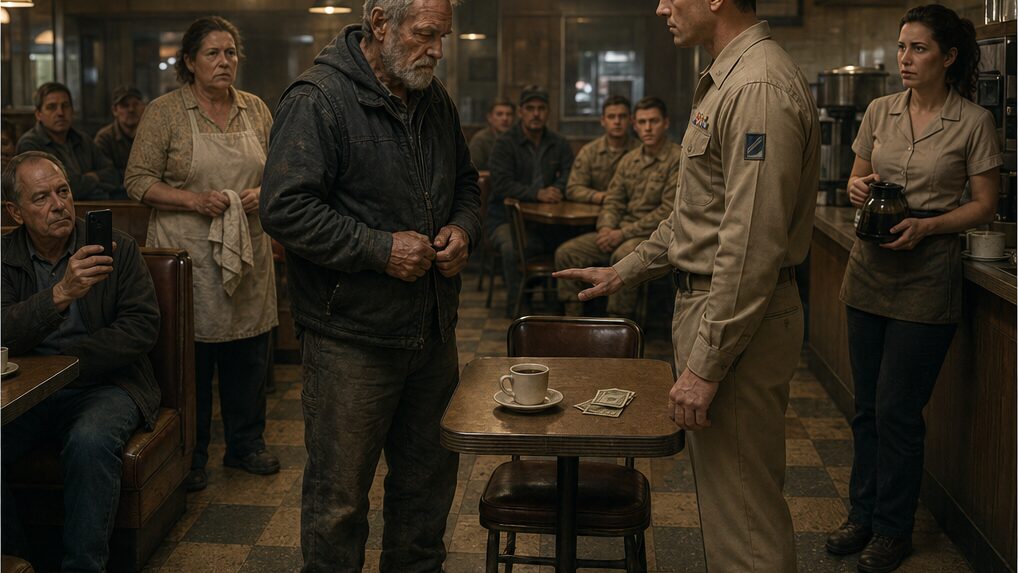
The first thing Dennis Carter saw was not the officer’s face, but the shadow of his polished boots stopping beside the cracked tile under Dennis’s table.
The diner went quiet in the way public places went quiet when people wanted to pretend they were not listening. Forks slowed against plates. A chair leg scraped and then stopped. The old ceiling fan kept turning above the counter, pushing the smell of coffee, bacon grease, and cigarette smoke into slow circles.
Dennis did not look up right away.
His hands stayed near the zipper of his old dark vest, the one with the torn seam near the left pocket and the oil stain that never washed out. Beneath it he wore a faded hoodie, thick at the elbows, frayed where the cuffs had rubbed against tools and weather and time. He knew what he looked like. He had seen himself in the diner window before stepping inside: seventy-two years old, wide in the shoulders but bent some at the spine, gray beard untrimmed at the edge, boots dusty from the shoulder of the county road.
A man like that did not get the benefit of a story.
A man like that got watched.
“Sir,” the younger man said.
Dennis kept his eyes on the coffee cup in front of him. The cup was white with a brown ring near the handle. It had been set down too quickly, and a thin line of coffee had run along the saucer.
“Sir,” the man repeated, firmer.
Dennis raised his eyes just enough to see the tan uniform pressed sharp at the thigh, the belt centered, the hands clean and square at the sides. Young hands. The kind that had learned discipline from instruction, not yet from losing things they could not get back.
Across the diner, two young service members in uniform sat near the window with half-finished plates in front of them. They were trying not to stare. Behind the counter, Pamela Hill moved a towel over the same spot on the counter without really wiping it. Samantha Roberts stood near the coffee station, a pot in one hand, her gaze caught between Dennis and the officer.
Dennis had chosen the wrong day to come, maybe. Or the right one. He had not yet decided.
The Crossroad Diner had changed owners twice since he had first sat in the back booth. The red vinyl had split at the corners. The wall clock lost three minutes every hour. Someone had painted over the old smoke stains but not high enough to hide them. Still, the place kept its shape. The same counter. The same bell over the door. The same booth near the back wall where the sun touched the table just before noon.
Dennis had come for that booth.
But the booth had been taken by the two young service members when he arrived, so he had sat at the small table beside the aisle and ordered coffee. Nothing else. He had put two folded bills under the edge of the napkin dispenser before he sat down, as he always did, because Pamela hated when he paid in coins.
He had meant to drink slowly, wait for the booth to clear, and leave before anyone asked him why he came.
Now the officer stood beside him.
“My name is Ryan Mitchell,” the young man said. “I need you to step outside with me.”
A murmur moved at the far end of the counter. Ronald Walker leaned back in his booth, phone already angled in his hand, pretending to check something on the screen.
Dennis heard the faint click of Samantha setting the coffee pot down.
He looked up then.
Ryan Mitchell was younger than Dennis expected from the voice. Early thirties, maybe. Clean-shaven. Straight-backed. His uniform was tan and correct, the ribbons aligned, the nameplate clean. He had the expression of a man who had been asked to handle something and wanted to handle it cleanly, without making it worse.
That made him more dangerous than a bully.
Bullies at least knew they had chosen their side.
Dennis said, “I’m drinking coffee.”
Ryan’s jaw tightened. “The owner says there’s been a disturbance.”
Pamela stopped wiping.
Dennis did not turn toward her. He could feel her behind the counter, feel the heat of her embarrassment as clearly as the steam from his cup. She had not said those words to his face. That was something, though not much.
“I didn’t disturb anybody,” Dennis said.
“Sir, I’m not here to argue.”
“No,” Dennis said softly. “I can see that.”
The nearest patron looked down at his plate. Someone gave a small cough. The bell over the door trembled from a draft but did not ring.
Ryan glanced at Pamela, then at the young service members, then back to Dennis. There it was. The reason. Not fear exactly. Order. A room full of people in uniform, and an old man in a dirty vest who did not fit the picture.
Dennis had seen rooms decide before.
Once, long ago, rooms had decided he belonged because his boots were shined and his name was sewn over his heart. Later, rooms decided he was useful if something needed fixing and invisible if nothing did. Lately, most rooms decided before he spoke.
His fingers touched the zipper pull of the vest. It was cold from the morning air.
Samantha took one small step from behind the counter. “Pamela, maybe—”
Pamela’s eyes warned her back. Not cruelly. Tiredly. A diner owner’s eyes, full of bills, complaints, inspections, and customers who liked to say they would never come back and then did.
Dennis understood Pamela better than she knew. Understanding did not make the chair beneath him feel any less narrow.
Ryan lowered his voice. “Sir, let’s do this outside.”
Dennis looked past him to the back booth.
The two young service members had gone still. One had a fork halfway to his mouth. The other was watching Dennis’s hands, the way soldiers learned to watch hands in crowded rooms. Dennis kept his palms open on the table.
“I came to sit over there,” Dennis said.
Ryan followed his glance, then looked back. “That booth is occupied.”
“I know.”
“Then you can come back another time.”
Dennis felt something old and sharp move under his ribs. It was not anger first. Anger would have been easier. Anger had a shape. This was smaller and more dangerous: the sudden childish wish to say, You don’t know what this place is.
Instead, he picked up his cup.
The coffee had gone lukewarm. He drank anyway.
Ryan waited. A few people watched. The smoke-stained mirror behind the counter held all of them in a warped line: Pamela with her towel, Samantha with her hand near the coffee pot, Ronald with his phone, Ryan in his pressed uniform, and Dennis hunched over a cup no one believed he had earned the right to finish.
When Dennis set the cup down, his hand trembled once.
He flattened it against the table until it stopped.
Ryan saw the tremor. Dennis saw him see it. The young man’s expression changed, but not toward kindness. Toward caution.
“Sir,” Ryan said, “I need you to stand up.”
Dennis looked at the money already tucked beneath the napkin dispenser. Then at the aisle. Then at the booth where sunlight touched the table.
He had come on the same date as last year. And the year before. And every year since he had stopped telling himself he would not come again.
There were things a man could explain and things that turned cheap when dragged into public air.
Dennis pushed his chair back.
The sound of its legs against the tile seemed too loud.
He stood carefully. His knees complained. His back took a second to straighten. He did not reach for the table, though he wanted to. He kept his hands at the zipper of his vest and faced Ryan Mitchell in the middle of the Crossroad Diner.
The officer was taller by an inch. Younger by forty years. Clean where Dennis was worn. Bright where Dennis had let himself fade.
Ryan stepped into the aisle, blocking the path to the booth, the counter, and the door all at once.
“Sir,” he said, “I’m asking you to leave now.”
Chapter 2: The Vest Made Everyone Decide First
Ryan Mitchell had not planned to embarrass the old man.
That was the part that would trouble him later, though in the moment it seemed like the only clean line left in a messy room. Pamela Hill had leaned toward him at the register while he waited for the lunch order and said, quietly, that the man by the aisle had been sitting too long, staring at the back booth, making customers uneasy. She said he came in sometimes, paid oddly, asked questions about old fixtures, and refused to order more than coffee.
“He’s not dangerous,” Pamela had added.
But she had looked toward the two young service members by the window when she said it.
Ryan understood that look. Protect the room. Keep things from becoming a scene. Use the uniform if the uniform helped.
So he had walked over.
Now the scene existed anyway.
The old man stood in front of him with his hands held still at the zipper of a dark vest that had seen better decades. There was grease near the hem, white threads along one shoulder, and a place near the pocket where the fabric had been stitched by hand in uneven black loops. The hoodie beneath it sagged at the neck. His boots were cracked. His beard needed trimming.
Everything about him told the room what to believe.
Ryan hated that he noticed.
“Let’s step outside,” he said again, keeping his tone low.
Dennis Carter did not move. “I paid.”
“You can get your coffee another day.”
“I paid today.”
A couple at the counter exchanged looks. Ronald Walker shifted in his booth, phone held chest-high now. Ryan caught the motion from the corner of his eye and felt irritation flash through him. People loved order only until order gave them something to record.
“This doesn’t need to be difficult,” Ryan said.
Dennis’s eyes lifted then. Pale, tired, not drunk. That detail landed against Ryan’s assumptions and did not settle.
“It already is,” Dennis said.
Samantha Roberts came around the counter with a rag in one hand. “Mr. Carter, maybe I can put your coffee in a cup to go.”
Ryan looked at her. “You know him?”
Samantha hesitated. “He comes in.”
Pamela said, “Samantha.”
One word, but enough.
Dennis heard it too. His face did not change, but his hand moved once against the vest zipper, thumb pressing the metal tab like he was checking whether it still held.
Ryan lowered his right hand, palm angled toward the floor. Calm down. Stay here. Don’t reach.
It was not meant as an insult. It was training. It was habit.
The old man saw the gesture and went very still.
Then his gaze dropped.
Not to Ryan’s hand. Lower. To the left side of Ryan’s chest.
Ryan felt, absurdly, exposed. The nameplate. The ribbons. The small unit patch on his sleeve, half-visible where his arm bent. He had worn all of it that morning without thinking. He had dressed the way he was supposed to dress for a base outreach lunch and a meeting with the county veterans office after.
Dennis stared at the patch.
The diner noise thinned until all Ryan could hear was the ceiling fan and the faint sizzle from the grill.
“You with the 317th?” Dennis asked.
The question was so quiet Ryan almost missed it.
His shoulders tightened. “What?”
Dennis did not raise his head. “That patch. Old route unit used a broken-wheel mark before they changed it.”
Ryan looked down at his sleeve despite himself. “You recognize it?”
Dennis’s mouth moved like he considered several answers and trusted none of them.
“Once,” he said.
Ronald’s phone tilted higher.
Ryan felt control slipping from the simple shape he had made for it. Old man. Complaint. Remove quietly. Now there was a phrase in the air that did not match the vest, the dirty boots, the waitress’s warning, or the way Pamela kept rubbing the counter.
“Were you in?” Ryan asked before he could stop himself.
Dennis finally looked at him again. Something tired crossed his face, not pride and not resentment exactly. Almost disappointment.
“I’m trying to drink coffee,” he said.
“That’s not what I asked.”
“No,” Dennis said. “It isn’t.”
Ryan heard the edge in it and felt heat climb his neck. A few patrons were watching openly now. The young service member nearest the window had set down his fork. Pamela’s towel had gone still.
Ryan had been corrected before. He had been dressed down by men with stripes and calm voices and the kind of patience that cut deeper than shouting. This was not that. This was an old man in a worn vest refusing to give him the one piece of information that would make the room easy.
“Sir,” Ryan said, more firmly than he intended, “if you’re claiming prior service—”
Dennis’s eyes sharpened.
“I’m not claiming anything.”
The sentence landed flat and final.
Ryan’s hand dropped again, the same downward gesture, more out of frustration than procedure this time. “Then I need you to step outside.”
Dennis looked at the hand. Then at the patch again. Then at the floor between them.
The change in him was small, but the room felt it. His shoulders, already rounded, seemed to take on weight from somewhere behind the present moment. He was no longer arguing about coffee. He was somewhere else, or holding somewhere else back.
When he spoke, his voice was low enough that Ryan had to lean in.
“Wheel breaks,” Dennis said, “convoy walks.”
Ryan stopped breathing for half a second.
It was not a phrase in current use, not officially. He had heard it once from an older instructor during a maintenance briefing, said with a laugh that had not quite been a laugh. Wheel breaks, convoy walks. Keep the trucks alive or everyone pays.
Ryan stared at Dennis.
The old man kept his eyes down.
“You a mechanic?” Ryan asked.
Dennis reached slowly into his pants pocket. Ryan’s body reacted before thought, one boot shifting, hand rising slightly.
Dennis stopped at once.
Not offended. Not surprised. Just tired.
The small humiliation of it moved through Ryan too late.
Dennis withdrew his hand empty and placed it open against his vest. “Wallet,” he said.
Ryan forced his arm down. “Go ahead.”
Dennis took out a worn billfold and opened it just enough to remove two folded bills. No card flashed. No veteran ID. No old photograph shown for effect. He laid the money beside his cup, aligning it with the edge of the saucer.
“I don’t owe for trouble,” he said. “Just coffee.”
Samantha’s face changed.
Pamela looked away.
Ronald whispered something to the person across from him, and Ryan heard one word: “faker.”
Dennis heard it too. His jaw moved once, but he did not turn.
Ryan should have corrected the whisper. He knew that even as he failed to do it. Instead he stood inside the authority Pamela had handed him and the room had accepted, trying to understand why the old man’s refusal felt less like defiance than discipline.
“Mr. Carter,” Samantha said softly, “you don’t have to—”
Dennis gave her a look that stopped her. Not harsh. Protective.
He picked up his coffee cup, but did not drink. He held it for a moment with both hands, as if warming them, though the coffee was nearly cold. Then he set it down.
“I’ll go,” he said.
Ryan stepped aside.
He expected relief from the room. Instead the air grew heavier.
Dennis walked toward the door with slow, careful steps. No one blocked him. No one apologized. The bell rang when he opened the door, letting in a strip of white late-morning light that cut across the tile and touched the booth by the back wall.
At the threshold, Dennis paused.
Ryan thought he might finally turn and say something that would explain him.
Dennis only looked once toward the back booth.
Then he lowered his head and stepped outside.
Ronald Walker’s phone kept recording, catching Ryan in uniform, Pamela behind the counter, Samantha frozen beside the coffee pot, and Dennis Carter’s old vest disappearing through the door.
Chapter 3: The Coffee Went Cold in Public
Samantha Roberts did not pick up Dennis Carter’s cup until the coffee had gone cold enough to leave no steam on the surface.
She had served three tables after he walked out. She had smiled twice, forgotten one refill, dropped a fork, apologized to a woman who said the hash browns were too soft, and carried plates past the small table in the aisle without looking at it directly. The cup remained there. So did the bills Dennis had laid beside it, two ones folded into squares as neat as bandages.
No one sat at the table.
That was the first thing Samantha noticed after the lunch rush thinned. People had been willing to watch him be removed from it, but no one wanted the chair after.
Pamela came around the counter with the gray bus tub tucked against her hip. “I’ll get that.”
“I’ve got it,” Samantha said.
Pamela stopped.
The cook’s radio played low from the kitchen, some old country station with more static than music. Outside, the late sun had found the dust on the front windows. The two young service members were gone. Ryan Mitchell was gone too, though Samantha had seen him sit in his truck for a full five minutes before driving away.
Ronald Walker remained in his booth, grinning at his phone.
Samantha picked up Dennis’s cup. A brown line marked where the coffee had sat. He had barely drunk half.
“He paid,” she said.
Pamela put the bus tub down harder than necessary. “I didn’t say he didn’t.”
“You said there was a disturbance.”
“There was about to be.”
“There wasn’t.”
Pamela’s mouth tightened. She looked older when she was tired, not elderly, but worn in the way people got when they had spent too many years being responsible for things that never stayed fixed. “You saw those boys by the window. You saw how he kept staring.”
“At the booth.”
“At them.”
“No,” Samantha said. “At the booth.”
Pamela exhaled through her nose. “He makes customers nervous.”
“Does he?”
“Samantha.”
The warning was softer this time. That made it worse.
Samantha wiped the table slowly. Under the napkin dispenser she found two more bills, folded smaller than the others. Not payment for coffee. Too much for coffee. She lifted the dispenser and stared at them.
Pamela saw. “What is that?”
“Money.”
“I can see that.”
Samantha unfolded one bill, then another. There was no note. Dennis did not leave notes when money could do the work quietly. She remembered now that he always paid in strange amounts. Too much for coffee, not enough to look generous, always tucked somewhere half-hidden as if he hoped no one would mention it.
From Ronald’s booth came a short laugh.
Pamela turned. “Ronald, if you’re going to sit there all day, order something else.”
“I’m helping your publicity,” Ronald said.
Samantha looked over.
He held up his phone. On the screen, frozen in a bright little rectangle, Ryan stood in the aisle facing Dennis. Dennis’s head was down. His vest looked darker on camera, dirtier. His shoulders looked heavier. The caption Ronald had typed sat above the image.
Old guy pretending to be military gets removed from diner by real officer.
Samantha felt heat crawl up her throat. “You don’t know that.”
Ronald shrugged. “Looked like it.”
“You recorded him?”
“Everybody records everything.”
“That doesn’t mean you should.”
Pamela stepped closer. “Don’t post that.”
“Already did.” Ronald tapped the screen. “Folks love this stuff.”
Pamela’s face changed, but not fast enough to be innocence. Samantha saw the first flash of worry, then calculation. A diner owner thinking of reviews. A woman thinking of what people might say. A person trying to decide whether the mistake was moral or merely inconvenient.
Samantha carried Dennis’s cup to the dish station. She did not drop it in the rack. She set it down like it might break.
In the narrow back hallway, where old invoices curled on a corkboard and boxes of paper napkins leaned against the wall, she stood still until the pressure in her chest eased. She had worked at Crossroad Diner for seven years. Long enough to know the regulars who tipped badly but asked after her mother. Long enough to know Pamela’s good side and her hard side. Long enough to know that some people came in because they were hungry, and some because there was nowhere else that remembered them.
She had never known which one Dennis was.
He came maybe once a month, sometimes less. Always in that vest, always near opening or after the lunch rush, always with exact small movements. He fixed the loose coat hook near the restroom last winter. Pamela had said it must have been the cook, but the cook denied it. The squeak in the front door had vanished one morning after Dennis had sat under it for twenty minutes, looking at the hinge more than the menu. The sugar caddy in the back booth, broken for weeks, had been repaired with a tiny screw no one on staff remembered finding.
Samantha went to the corkboard and began moving old papers aside.
“What are you doing?” Pamela asked from behind her.
“Looking.”
“For what?”
“I don’t know yet.”
Pamela stood in the hall entrance, arms crossed. “You’re making this into something bigger than it was.”
“Maybe it was bigger while it was happening.”
Samantha pulled down a faded delivery notice, an expired inspection reminder, a receipt for fryer oil, and then a yellowed scrap caught beneath a magnet shaped like a coffee cup. It was not an invoice exactly. More like the back of an envelope, folded once.
Written on it in small block letters were three items:
Back booth leg
Door hinge
Coffee warmer cord
Beside each item was a check mark.
At the bottom, in the same careful handwriting, were the initials D.C.
Samantha stared at them.
Pamela reached for the paper. “Let me see.”
Samantha handed it over.
Pamela read it once, then again. “This could be anybody.”
“Back booth leg,” Samantha said.
Pamela did not answer.
The back booth had stopped wobbling two months ago. Pamela had complained about it for half a year before that, saying she would call someone when there was money. One morning the wobble was gone. No bill arrived. No repairman came by.
Samantha looked toward the dining room.
Ronald’s voice carried from his booth. “Already got comments. People saying good job, Lieutenant.”
Pamela folded the scrap too carefully.
“He never told me,” she said.
“No,” Samantha replied. “He wouldn’t.”
Through the small window in the back door, Samantha could see the parking lot. Dennis was not there. Of course he was not. Men like him did not linger where they had been made to leave.
The comments on Ronald’s phone kept chiming, small bright sounds in the diner air.
Samantha took the repair note from Pamela’s hand and looked again at the initials.
D.C.
For the first time all day, she wondered what else Dennis Carter had fixed without asking anyo
Chapter 4: The Clip Chose the Wrong Villain
By morning, Ryan Mitchell had been thanked for something that did not feel clean.
The first message came from a man in his unit who sent the clip with three laughing emojis and wrote, Nice crowd control, sir. Ryan watched five seconds before shutting it off. The frame froze on his own face in profile, uniform sharp under the diner’s yellow lights, one hand lowered toward the floor. Dennis Carter stood across from him with his head down and his hands near the zipper of that old dark vest.
The caption sat above them like a verdict.
Old guy pretending to be military gets removed from diner by real officer.
Ryan set his phone face down on his desk.
His office was small, made smaller by the hum of the fluorescent light and the cardboard boxes stacked beside the filing cabinet. A county veterans-services meeting was scheduled for noon, and a folder sat open in front of him with typed names, benefit forms, and outreach notes. Most mornings, Ryan liked the order of paperwork. Names. Dates. Proof. Procedure. A person could be helped when the correct line was filled in.
There was no line on any form for the way an old man lowered his head.
He tried to work. He read the same paragraph three times, signed where he was supposed to initial, initialed where he was supposed to sign, and finally gave up.
The clip kept returning in pieces. Pamela leaning behind the counter. Samantha’s hand frozen around the coffee pot. Ronald Walker’s phone held slightly too high. Dennis’s voice, too quiet for the phone to catch clearly, but clear enough in Ryan’s memory.
Wheel breaks, convoy walks.
Ryan took his phone again and opened the clip. This time he let it play.
The sound was bad. Plates, chairs, someone whispering. His own voice came through firmer than he remembered.
“Sir, I’m asking you to leave now.”
The camera shook when Ronald adjusted his grip. Dennis’s reply was mostly lost, except for the last word: “coffee.”
People had commented below it all night.
Good job. Too many fakers these days.
He knew he got caught.
That vest tells you everything.
Respect the uniform.
Ryan scrolled faster. Then slower.
One comment, buried beneath jokes, stopped him.
Anybody ask why the old man knew that patch?
Ryan stared at it.
Another comment under that said, My dad was 317th years back. “Wheel breaks, convoy walks” was an old motor-pool saying. Not common.
Ryan locked the screen.
The office felt hotter.
He stood, walked to the window, and looked out at the parking lot. Two service vehicles sat under a gray sky. A flag moved on a pole near the county building, not dramatically, just enough to show wind. Ryan had never liked people who made the flag do emotional work for them. He believed in quiet competence. In clean behavior. In not making service into theater.
Yesterday, he had let a room turn his uniform into a weapon.
His phone buzzed again.
Pamela Hill had sent a message through the diner’s business number.
Have you seen Ronald’s post? Can you stop by later? This is getting out of hand.
Ryan almost typed, You asked me to handle him.
He deleted it.
He could have told himself Pamela created the situation. She had pointed him toward Dennis. She had said customers were uncomfortable. She had given the problem a shape. But Ryan had stepped into that shape willingly. He had not asked enough questions. He had not corrected Ronald. He had not followed Dennis outside.
He had watched an old man leave and felt relieved for half a minute.
That was the part that sat badly.
At noon, the county veterans-services clerk came by with a stack of outreach pamphlets and a paper cup of coffee. Ryan kept the meeting short. He listened to enrollment numbers, transportation complaints, missed appointments. His pen moved automatically until the clerk mentioned an older roster from regional units used for reunion notices.
Ryan looked up. “Do you have anything on old convoy or maintenance groups? Around the 317th?”
The clerk blinked. “Depends how old.”
“Older motto. Broken-wheel mark. Maybe before the patch changed.”
The clerk gave him a curious look. “That’s specific.”
“I heard something yesterday.”
“What exactly?”
Ryan hesitated. Saying it out loud made the diner come back—the old man, the phone, the dark vest.
“Wheel breaks, convoy walks.”
The clerk’s expression shifted from curiosity into recognition. Not full knowledge, but enough.
“That’s old,” the clerk said. “Motor pool. Convoy support. My uncle used to say something like that. He said it meant maintenance was not background work. If your truck failed, everybody on the road paid for it.”
Ryan leaned back.
The sentence had weight. Not heroic weight. Work weight. Grease-under-the-nails weight. The kind men said when no one wrote them up for medals.
“You know anybody local connected to it?” Ryan asked.
The clerk thought. “Maybe. A few. Records are messy. Some don’t like being contacted. Some don’t want anything from us at all.”
Ryan pictured Dennis’s billfold opening just enough for two folded bills, no ID shown, no proof offered.
“Why?” the clerk asked. “Someone need help?”
Ryan looked at the open folder on his desk.
“I don’t know what he needs,” he said. “That may be the problem.”
After the clerk left, Ryan opened the clip again. This time he watched Dennis, not himself.
The old man’s shoulders did not sag until Ryan made the downward gesture. Before that he had been guarded, irritated, maybe offended. After the gesture, his eyes fell to the patch. His mouth changed. He looked like a man who had stepped on a piece of glass but refused to limp in front of anyone.
Ryan replayed it twice more.
Then he saw what he had missed: Dennis had kept his hands visible the entire time. Not like a drunk man afraid of being caught. Like a man who knew exactly how another man in uniform would read movement in a tight room.
Ryan turned the phone off and sat in the hum of the office.
By late afternoon, the clip had been shared by a local page. Someone had added music, slow and mocking. The caption changed once, then again. In one version Dennis was a faker. In another he was a homeless man removed from a patriotic luncheon. Ryan saw his own name in the comments and felt no pride in the praise.
When he drove past Crossroad Diner on his way home, he slowed but did not turn in.
Through the windows, he could see Pamela behind the counter and Samantha clearing a table. The back booth was empty. The small table by the aisle had been reset, but no one sat there.
Ryan pulled into the lot anyway.
His truck idled for a moment before he turned it off.
Inside, the bell over the door sounded too loud. Pamela looked up quickly, relief and worry moving across her face in the same second.
“Ryan,” she said. “Thank you for coming.”
Samantha, near the coffee station, did not say anything.
Ronald Walker sat in his usual booth, phone on the table now, screen glowing.
Ryan walked to him first.
Ronald grinned. “Lieutenant, you’re famous.”
“Take it down,” Ryan said.
The grin weakened. “What?”
“The clip. Take it down.”
Ronald looked around as if checking whether this was part of the joke. “Why? It makes you look good.”
“No,” Ryan said. “It doesn’t.”
Pamela came from behind the counter. “Ryan, maybe we should talk in back.”
Ryan kept his eyes on Ronald. “You captioned something you didn’t understand.”
Ronald’s face hardened. “I recorded what happened.”
“You recorded what you wanted it to be.”
For a moment, no one spoke. Then Ronald picked up his phone, muttering under his breath. “Fine. Won’t matter. People already saved it.”
Ryan knew he was right. That made the correction feel too late before it even began.
Samantha stepped forward and placed a folded scrap of paper on the counter between him and Pamela.
Ryan looked at it. Three repairs. Three check marks. Initials at the bottom.
D.C.
“Back booth leg,” Samantha said. “Door hinge. Coffee warmer cord.”
Pamela’s face flushed. “We don’t know for sure—”
“Yes,” Samantha said, quiet but firm. “We do.”
Ryan picked up the paper. The handwriting was small, controlled, almost mechanical. Not old-fashioned. Functional.
He looked toward the back booth.
“Why that booth?” he asked.
Pamela folded her arms. “He sits there when it’s empty. Always that one.”
Samantha’s voice softened. “Not always. Same date, though. I checked old receipts. Or tried to. He comes around this week every year.”
Ryan felt the phrase return.
Wheel breaks, convoy walks.
He looked down at the paper again.
The three checked items suddenly felt less like repairs and more like a man leaving evidence by accident because he never meant to be seen.
That night, Ryan searched until the office light flickered off on its motion sensor and left him in darkness.
When he found the first archived mention of the old 317th convoy support detachment, the image was grainy and nearly useless. Trucks in a desert road. Men standing beside them in sun glare. A broken-wheel insignia painted on a shop door.
Under the photograph, one line of text named no heroes.
It only listed a route, a year, and a unit that had kept moving after losing two vehicles outside a settlement called Lopez Crossing.
Ryan sat very still.
Lopez.
He turned the light back on.
Chapter 5: The Repair Note Under the Counter
After closing, Crossroad Diner sounded less like a business and more like an old body settling into pain.
The refrigerator clicked. The pipes knocked behind the restroom wall. The front door hinge gave the faintest sigh when the wind pressed against it, but it did not squeak anymore. Samantha stood in the empty dining room with the repair note in one hand and listened to all the things Dennis Carter had made quieter.
Pamela was counting the register for the third time.
“You’re going to wear the numbers off,” Samantha said.
Pamela did not look up. “I’m making sure.”
“You were sure the first two times.”
Pamela shut the drawer. “Do you want me to say it?”
Samantha leaned against the counter. “Not if you’re only saying it because the post made people mad.”
Pamela’s eyes lifted.
The day had been worse than either of them expected. Ronald had taken the original clip down, but copies kept appearing. Some people mocked Dennis. Some criticized Ryan. Some blamed Pamela without knowing her name. A few showed up just to look around the diner as if the room itself had become evidence. One man asked which table “the faker” had been sitting at. Samantha told him the kitchen was closed even though it was two in the afternoon.
Pamela had smiled through most of it until a woman with a service sticker on her truck left without ordering.
Now the diner was locked, the neon sign off, the booths wiped clean. The back booth sat in the corner under its dull cone of yellow light. One leg had a metal shim neatly fitted beneath it, not the folded cardboard Pamela used to jam under wobbly tables. Samantha crouched and touched it.
“Look at this,” she said.
Pamela came over reluctantly.
The shim was not new. It had been cut from a small piece of flat metal, edges filed smooth so no one would snag a shoe. It fit the booth leg perfectly.
Pamela knelt with more effort than she wanted anyone to notice. “I thought the cook fixed that.”
“He said he didn’t.”
“He forgets things.”
“He remembers things that let him avoid work.”
Pamela almost smiled. Then she looked at the shim again and did not.
Samantha stood and moved to the front door. She pushed it open halfway. The hinge made no complaint. Near the screw plate, a tiny smear of dark grease remained where a thumb might have wiped too late.
“He brought his own tools,” Samantha said.
“Maybe he likes fixing things.”
“Maybe he noticed we couldn’t afford to.”
Pamela turned sharply. “That isn’t fair.”
“No,” Samantha said. “It isn’t.”
The words sat between them with more meanings than either wanted.
Pamela walked back behind the counter, opened the drawer beneath the register, and began pulling out old envelopes. Receipts, coupons, a broken pen, a roll of quarters, a stack of handwritten IOUs from customers she pretended not to keep. Samantha waited.
“What are you looking for?” she asked.
“I don’t know.”
Pamela’s voice had lost its edge.
From the bottom of the drawer she pulled a small bundle held with a rubber band. Folded bills, each wrapped around a receipt. Samantha recognized the habit at once. Dennis’s folds were precise, corners matched, no note unless necessary.
Pamela set them on the counter.
“I thought it was tips,” she said. “Sometimes extra. Sometimes he would say it was for coffee later. Sometimes he wouldn’t say anything.”
Samantha unfolded the top receipt. Two coffees. One slice of pie. Paid in full. Beneath the printed total, in Dennis’s block letters: young table by window.
There were more.
Two breakfasts. Table six.
Three coffees. Uniforms.
Soup and sandwich. Driver said no cash.
No names. No story. Just enough money left quietly enough that whoever received the meal would never know an old man in a dark vest had paid for it.
Pamela sat down on the nearest stool.
Samantha touched the edge of one receipt. “How long?”
“I don’t know.”
“Pamela.”
“I don’t know,” Pamela said again, and this time her voice cracked at the edge. “I thought he was odd. I thought maybe he was lonely. I thought if he wanted to leave money, that was his business.”
“You never wondered why?”
Pamela looked toward the back booth. “People come in here with all kinds of whys. If I ask every one of them, I never get the coffee poured.”
It was the kind of answer that would have sounded practical yesterday. Tonight it sounded like a door closed too often.
Samantha went to the office nook behind the kitchen where Pamela kept old paper records because she did not trust the computer since it crashed during tax season. She pulled boxes from the shelf. Pamela did not stop her.
They searched in tired silence. The cook had gone home. Outside, passing headlights slid across the blinds. Every few minutes Samantha found something small: a receipt with “D.C.” written near the bottom; a maintenance slip marked paid though no repair company name appeared; a note about replacing the loose screw on the coffee warmer cord before someone got hurt.
Dennis’s handwriting was always the same. Small. Straight. No wasted curl.
Near the bottom of a box marked old menus, Samantha found a photograph stuck to the back of a laminated breakfast special. It was not military. Not dramatic. Just the diner years ago, before Pamela owned it, when the walls were brighter and the counter stools had red metal rims. A woman stood beside the back booth, laughing at whoever held the camera.
On the back, in blue ink, someone had written: Maria Lopez, opening week.
Samantha brought it to the front.
Pamela took the photograph and went still.
“You know her?” Samantha asked.
“No.” Pamela swallowed. “But that booth…”
“What?”
“When I bought the place, the old owner said some customers were attached to certain seats. He said if a man named Carter ever came in around this week, let him sit in the back if it was open.”
“And you never told me?”
“I thought it was one of those small-town things.” Pamela’s thumb brushed the photograph. “A superstition. A regular who liked his corner.”
Samantha looked toward the booth again.
The sunlight was gone now, and the table was only a square of worn laminate beneath a lamp. Without customers, it looked smaller. Not special enough to hold grief. But grief did not need special places. It used whatever table had been there when something still felt possible.
Pamela pressed the photograph flat on the counter beside the receipts.
“Maria Lopez,” she said.
The name sounded different in the empty diner than it would have during business hours. Less like a fact. More like a person entering.
Samantha remembered Dennis looking at the booth before he left. Not at the service members. Not at the room. At that booth.
“We have to call him,” Pamela said.
“Do you have his number?”
Pamela’s face answered before she did.
Samantha thought of Dennis walking out into the hard late-morning light, the bell ringing above him. Men like him did not leave contact information. They left fixed hinges and folded bills and initials no one read until too late.
Ryan arrived near ten, out of uniform this time, in a plain jacket that made him look younger and more ashamed. Pamela unlocked the door for him and locked it again behind him.
“I found something,” he said.
“So did we,” Samantha answered.
They spread everything on the counter: the repair note, the folded meal receipts, the photograph of Maria Lopez, Ryan’s printed page about the old 317th convoy support detachment. No single piece explained Dennis. Together they made the diner feel as if a second room had existed inside it for years, one nobody had entered because the door was made of silence.
Ryan pointed to the printed page. “Lopez Crossing. That was the name attached to an old route incident. Convoy support. Mechanical failure. Civilian contact. Records are thin.”
Pamela turned the photograph around. “This Maria Lopez?”
“I don’t know,” Ryan said. “Maybe family. Maybe not.”
Samantha looked from the photograph to the back booth. “Dennis knows.”
“No,” Pamela said quietly. “Dennis carries it.”
That was the first time she said his name without impatience.
Ryan rubbed both hands over his face. “I should have followed him outside.”
Pamela did not comfort him. Samantha was glad.
“I let you do it,” Pamela said. “That’s mine.”
The three of them stood beneath the diner lights, surrounded by proof that did not feel like proof enough. Dennis had not asked to be investigated. He had not asked to be rescued from a story other people had made of him. They knew more now, but knowing did not yet give them the right to use it.
Samantha picked up the photograph again.
On the counter behind Maria Lopez, barely visible near the register, sat a small handwritten sign: Coffee kept hot for the road.
Samantha read it aloud.
Ryan lowered his eyes.
Pamela touched the back booth with her gaze and seemed to see, finally, not a troublesome seat but a place someone had been trying to honor without making anyone uncomfortable.
“We need to find him,” she said.
Samantha turned the photograph over once more. At the bottom, beneath Maria’s name and the opening week note, there was another line she had missed because the ink had faded.
Save the back booth for D.C. if he ever comes through.
Chapter 6: The Name He Would Not Say Out Loud
Dennis Carter hung the dark vest on a nail inside his workshop and stood looking at it as if it belonged to somebody who might still come back for it.
Without the vest, he looked smaller.
That was the first thing he disliked. Not older. He had made a kind of peace with old. Old announced itself every morning in his knees, his hands, the careful way he rose from a chair. Smaller was different. Smaller meant the world had finally taken enough pieces that the outline left behind no longer matched the man he remembered.
He wore a gray thermal shirt beneath, sleeves pushed to the forearms. A thin line of grease ran along one wrist. On the bench before him lay the carburetor from a mower owned by a neighbor who would pay him in cash and tomatoes, if the tomatoes came in. Dennis cleaned one tiny part with a rag and did not look toward the phone on the shelf.
It had rung twice that morning.
He had not answered.
Outside, a truck slowed on the gravel road, then continued. Dennis waited until the sound passed before breathing normally again. That irritated him. At seventy-two, a man should not be thrown off by a vehicle slowing near his place.
He picked up a small screwdriver.
His hand was steady until he saw, for no reason he could name, Ryan Mitchell’s downward gesture in the diner aisle.
Palm angled toward the floor.
Stay still.
Dennis set the screwdriver down.
He had not hated the young officer for it. That was the hard thing. Hate would have given him somewhere to put the humiliation. Ryan had used a gesture Dennis knew too well, one meant for safety, one meant to keep a room from tipping. Dennis himself had used versions of it, long ago, with frightened drivers, angry boys, men too tired to think, civilians who did not understand why a convoy could not stop wherever grief told it to.
Still, in that diner, with Ronald’s phone up and Pamela silent behind the counter, the gesture had passed through time and found something buried.
Wheel breaks, convoy walks.
He had not meant to say it.
The phrase had come out like blood from an old cut reopened by weather.
A knock sounded at the workshop door.
Dennis did not move.
The knock came again, softer. “Mr. Carter?”
Ryan’s voice.
Dennis looked at the vest on the nail. Then at the door.
“It’s open,” he said.
Ryan stepped in without uniform.
That helped some. Not enough.
The young man stood just inside the doorway, hands visible at his sides, and Dennis saw that he had chosen that on purpose. No hat. Plain jacket. Boots with dust on them from Dennis’s driveway. He looked around the workshop but did not inspect it. That helped too.
“Mr. Carter,” Ryan said, “I owe you an apology.”
Dennis picked up the carburetor part again. “You drove out here to say one sentence?”
“No, sir.”
“Then start with the other one.”
Ryan’s mouth closed.
Dennis went back to cleaning the part, though it was already clean.
After a moment, Ryan said, “I was wrong.”
Dennis gave a dry breath that almost became a laugh. “That the other sentence?”
“It’s the first one I should have said yesterday.”
The workshop smelled of oil, sawdust, cold coffee, and metal filings. Shelves lined the walls with jars of screws sorted by size, coffee cans of bolts, fan belts hung on hooks, two cracked radios, an old vise, and a calendar from three years ago left on a month Dennis had not turned. The place was not tidy, but it had order if you knew how to look.
Ryan took one step farther in. “I let the room decide before I did.”
Dennis stopped cleaning.
There it was. Close enough to true that it had weight.
He set the part down. “Rooms do that.”
“I did it with them.”
Dennis looked at him then.
Ryan’s face held shame, but not the kind that begged to be relieved. That was better than most apologies.
“I spoke to the county clerk,” Ryan said. “About the phrase you used.”
Dennis’s eyes dropped to the bench.
Ryan noticed. “I’m not here to dig through your records.”
“Already started.”
“Yes,” Ryan said. “I did.”
A small muscle moved in Dennis’s jaw.
Ryan took the folded printed page from his jacket but did not offer it. He seemed to understand, barely in time, that paper was not permission.
“I saw Lopez Crossing,” Ryan said.
The workshop went still.
Outside, a crow called from the fence line. The sound came harsh and ordinary through the thin wall.
Dennis turned the carburetor part between his fingers. It was small enough to hide in his palm.
“You find a lot of things online,” he said.
“Not enough.”
“No.”
Ryan waited.
Dennis hated him a little for waiting well.
He crossed to the nail and took down the dark vest. Not to put it on. Just to hold it. The fabric was heavy in his hands from years of weather and repair dust. He rubbed his thumb over the uneven stitching near the pocket. Maria had done that stitch with black thread under bad diner light, laughing at him because he had torn the vest on a nail while trying to fix her back door for free.
You keep patching everybody else’s place, Dennis Carter. Let somebody patch you once.
He had told her the stitch looked crooked.
She had told him to wear it anyway.
Ryan’s voice came carefully. “Was Maria Lopez connected to the diner?”
Dennis closed his fingers around the vest.
“Who said that name?”
“Samantha found a photograph. Pamela had old notes. Nobody meant—”
“People usually don’t,” Dennis said.
Ryan flinched as if the words had touched something true in him.
Dennis moved to the open workshop door and looked across the yard. His property was small, edged by scrub grass, a leaning mailbox, and a gravel drive that collected rainwater in shallow ruts. Beyond it, the road ran toward town, toward Crossroad Diner, toward a booth that had once been only a booth until memory nailed it to the floor.
“Maria worked that diner before Pamela bought it,” Dennis said.
Ryan stayed quiet behind him.
“She wasn’t my wife,” Dennis added, because people always wanted to make grief fit a shape they understood. “Wasn’t sweetheart, not in the way folks mean when they’re fishing. She was a friend. Better than I deserved some years.”
His throat tightened at the last word. He waited it out.
“After I came back, I didn’t like sitting near doors. Didn’t like crowds behind me. Didn’t like people asking what it was like. Maria put me in that back booth and told anybody who complained that old men were allowed to be particular.”
Ryan said nothing.
Dennis looked down at the vest. “I wasn’t old then.”
A faint sound moved behind him, not quite a breath.
“She had a nephew,” Dennis continued. “Wanted to serve. Bright boy. Too bright for the men around him, which meant they either liked him or wanted to break him down some. He wrote to her. She read me parts while I fixed things in back. Said he was with transport. Convoy support.”
Ryan’s eyes lowered. He was beginning to see the outline now. Not the whole of it. Enough.
“317th?” he asked.
Dennis nodded once.
“We crossed near a place people later called Lopez Crossing,” Dennis said. “Wasn’t named that on our maps. Not then. Road dust. Bad axle. Worse timing. You keep a convoy moving because stopped trucks turn into targets. Wheel breaks, convoy walks. Everybody said it until it wasn’t funny.”
He stopped.
The workshop air felt too close.
Ryan’s voice was low. “Was her nephew there?”
Dennis looked at the gravel outside. “A lot of boys were there.”
It was not an answer. It was all he could give.
He saw again heat, shouting, the smell of burning rubber, hands slick with oil, a wheel assembly that should have held, a young man trying to smile while fear turned his mouth wrong. He saw himself years later in Maria’s diner, unable to tell her enough and unable to stop coming back.
“She knew?” Ryan asked.
“She knew some. Not all.” Dennis swallowed. “Enough to save me that booth when I came through. Enough not to ask on days I couldn’t speak.”
He put the vest back on the nail.
“She died before Pamela bought the place,” Dennis said. “I kept coming once a year. Not to be seen. Not to be thanked. Just to sit where somebody once knew when to leave a man alone.”
Ryan stood with his hands at his sides, face pale with the effort of holding more understanding than he had expected.
“I’m sorry,” he said.
Dennis did not turn. “For which part?”
“All of it.”
“That’s too much apology for one man.”
Ryan accepted the correction with a small nod. “For yesterday, then.”
Dennis looked back at him. “Yesterday, you made a mistake. So did Pamela. So did the man with the phone. So did everybody who watched and enjoyed knowing which side they were on.”
Ryan’s eyes did not move away.
“I’m going back,” Ryan said. “Pamela wants to make it right.”
Dennis’s face tightened. “How?”
“She wants you to come in. She wants to say something in front of everyone. I think she wants people to know what happened.”
Dennis gave a short, humorless laugh. “She wants to put me back in the aisle.”
Ryan seemed confused. “No, sir. She wants to apologize.”
“In the same room?”
“Yes.”
“With people watching?”
Ryan’s silence answered.
Dennis picked up the carburetor part and set it precisely in its tray. “Then she’s about to make the same mistake in reverse.”
Ryan frowned. “I don’t understand.”
Dennis reached for the vest again, this time not touching it, only letting his hand hover near the stitched pocket.
“You thought taking my dignity would keep the room comfortable,” Dennis said. “Now she thinks handing it back in public will make the room feel better.”
Ryan absorbed that slowly.
Dennis looked toward the road that led back to town.
“I’m not a lesson,” he said. “And I’m not a prop for somebody else’s apology.”
Chapter 7: The Apology He Would Not Allow
Dennis Carter wore the dark vest back into Crossroad Diner because he refused to let the room pretend it had only judged a coat.
The bell over the door rang at eleven thirty-four. The lunch rush had not yet fully arrived, but there were enough people to make silence possible. Ronald Walker sat in his usual booth, phone facedown this time. Two young service members had taken the table by the window. Pamela Hill stood behind the register with both hands flat on the counter. Samantha Roberts was near the coffee station, watching the doorway as if she had heard the truck before the bell.
Ryan Mitchell stood beside the aisle.
He was in uniform again.
Dennis stopped just inside the door when he saw it. His first instinct was to turn around, not because he was afraid, but because he knew how a uniform changed the weight of any room. Ryan saw the reaction and did not move toward him.
“I can leave,” Ryan said quietly.
Dennis looked past him to the back booth.
It was empty.
The table had been wiped clean. The sugar caddy sat straight. No sign had been placed on it. No flowers. No folded flag. No photograph of Maria Lopez propped against the wall. Dennis noticed that first, and because he noticed it, he stayed.
Pamela came out from behind the counter. Her face had the strained composure of someone who had rehearsed apology too many times and trusted none of the versions.
“Mr. Carter,” she said.
Dennis raised one hand slightly. Not sharp. Enough.
Pamela stopped.
Every eye in the diner moved between them. Dennis felt it on his vest, his boots, the gray beard he had trimmed poorly that morning, the scar across one knuckle, the old zipper beneath his fingers. He had told Ryan he would not stand in the aisle to make other people feel better. Yet here he was, in the same aisle.
The difference had to be his.
Dennis walked to the counter and placed a folded five-dollar bill beside the register.
“Coffee,” he said.
Samantha reached for a cup.
Pamela’s eyes shone, but she did not speak. Dennis appreciated that more than she could know.
Ryan stepped closer, leaving space between them. “Mr. Carter, before you sit, there’s something I need to correct.”
Dennis turned toward him. “Need?”
Ryan absorbed the word. “Something I should correct.”
The diner held still.
Ryan faced the room, but he did not raise his voice like a man making an announcement. He spoke plainly, almost too low for the far booth.
“Two days ago, I asked Mr. Carter to leave this diner. I did that in front of people. I did it based on incomplete information and wrong assumptions. I saw his clothes. I heard complaints. I trusted the room’s discomfort more than I trusted his calm.”
Ronald shifted in his seat.
Ryan looked at him briefly, then continued. “A video of that moment was posted with a false caption. Mr. Carter was not pretending to be anything. He was not causing danger. He was treated without the patience he deserved.”
Dennis looked down at the floor.
The tile between them had a thin crack running through it. He remembered seeing it the first day Maria told him to take the back booth. Back then, the crack had been shorter. Maybe everything widened if given enough years.
Ryan turned toward him. “I apologize, Mr. Carter.”
The words were clean. Better than the room deserved.
But Pamela stepped forward then, and Dennis saw the speech rising in her. Her lips trembled with it. Her hand went toward the counter where, he now realized, she had placed the old photograph of Maria facedown.
“Dennis,” Pamela said, voice catching, “we found out what you’ve done for this place. The repairs, the meals, Maria—”
“No.”
The word was not loud, but it stopped her.
Pamela’s hand froze above the photograph.
Dennis lifted his eyes. “Don’t spend her name to pay your debt.”
Pamela went pale.
Samantha closed her eyes for a second.
Ryan stood very still.
A few patrons looked away, embarrassed not by Dennis but by how close they had come to wanting a show.
Pamela lowered her hand. “I’m sorry.”
“I know.”
“I wanted people to understand.”
Dennis looked around the diner. At Ronald’s phone. At the service members by the window. At the counter stools, the old clock, the booth waiting behind him. “People understanding all at once is usually just people watching.”
No one answered.
He did not enjoy their discomfort. That disappointed some hard little part of him that had wanted, for one morning, to let somebody else feel small. He had imagined it on the drive in: Ronald made to delete the clip where everyone could see, Pamela forced to say she had been wrong, Ryan standing there in the same uniform with shame where certainty had been.
The fantasy had lasted four miles.
After that, he had heard Maria’s voice, dry as a matchstick.
You always did know how to fix a thing until you got mad at it.
Dennis reached into the inside pocket of his vest and drew out the photograph Samantha must have given Ryan to return. Maria at the old counter, laughing at someone outside the frame. He set it facedown on the counter, not for the room.
“For your drawer,” he said to Pamela. “Not the wall.”
Pamela nodded quickly. “Yes.”
Dennis turned to Ryan. “Say the other part.”
Ryan frowned faintly. “Other part?”
“You know it.”
Ryan looked at the floor, then back at the room. This time his voice roughened. “When I made the hand gesture toward Mr. Carter, I treated him as a risk before I treated him as a person. I can say it was training. It was still my hand.”
Dennis felt the old pressure in his chest loosen by a fraction.
He nodded once.
That was enough.
Ronald cleared his throat. “I took the post down.”
Dennis looked at him.
Ronald’s face reddened. “I said I took it down.”
“Did you say why?”
Ronald blinked. “What?”
“Did you say why?”
The question did not accuse. That made Ronald more uncomfortable.
“I can,” he said.
Dennis waited.
Ronald picked up his phone, then put it down again. “I will.”
“No caption,” Dennis said. “No big story. Just say you were wrong about what you saw.”
Ronald swallowed. “All right.”
Dennis moved toward the back booth.
No one stopped him. No one clapped. The lack of applause was a mercy.
At the booth, he rested one hand on the table before sitting. The surface was warm where the light touched it. The leg did not wobble. His own metal shim held beneath it, hidden and doing its work without needing credit.
Samantha brought the coffee herself.
She set it down carefully, then placed beside it not a bill, not a note, but a small sugar caddy with two packets turned the way Maria used to arrange them, white edges facing out.
Dennis looked at it.
Samantha said, “Pamela asked me not to make a thing of it.”
“You just did.”
“A small thing.”
Dennis almost smiled. Almost.
Pamela approached last. She did not sit. She did not loom. She stood at the open end of the booth, towel twisted in her hands.
“What practical change?” she asked.
Dennis looked up.
“You said yesterday I was about to make the same mistake in reverse,” Pamela said. “You were right. So tell me what to change.”
The diner listened, but differently now. Not hungrily. Carefully.
Dennis wrapped both hands around the coffee cup. “When an old man sits too long, ask if he needs more coffee before you ask somebody to move him.”
Pamela pressed the towel flat between her palms.
“All right,” she said.
“And if somebody pays for a meal quiet, let it stay quiet.”
Her eyes lowered. “Yes.”
“And that booth doesn’t belong to me.”
Pamela looked toward the seat across from him. “Then what do you want done with it?”
Dennis looked at the worn table, the repaired leg, the square of sunlight. He could still see Maria’s hand setting down coffee, hear the way she told him he was allowed to be particular. For years he had treated the booth like a debt he had not finished paying. Maybe that had been another kind of hiding.
“Let people sit,” he said. “Just don’t forget who saved it when I needed it.”
Pamela nodded.
Ryan remained by the aisle, uniform no longer filling the room the same way. He looked younger than he had two days ago and steadier than he had yesterday.
Dennis lifted his cup.
The coffee was hot this time.
By the window, one of the young service members leaned toward the other and whispered something Dennis could not hear. The other nodded and looked down at his plate, not in shame exactly, but thoughtfulness.
Dennis drank.
No one asked him for the whole story.
For the first time all week, that felt like respect.
Chapter 8: The Seat Nobody Owned Anymore
A week later, Dennis Carter waited in his truck until the back booth was taken before he went inside.
The man sitting there was a delivery driver with a wet jacket and a plate of eggs. He had one elbow on the table and one boot stretched too far into the aisle. He did not know he was sitting in a place that had once held letters read aloud, bad coffee, patched silence, and a woman named Maria Lopez telling a younger Dennis to quit watching the door like it owed him money.
Dennis watched him through the windshield and felt no anger.
That surprised him.
Rain tapped lightly on the truck roof. The old dark vest lay across the passenger seat, dry and folded. For a moment he considered leaving it there. Then he put it on because the morning was cold and because a man should not let shame choose his clothes for him.
The bell over the diner door rang when he entered.
Samantha looked up from the counter. Her smile came and went quickly, not bright enough to make him responsible for it.
“Coffee?” she asked.
“Yes.”
“Booth’s taken.”
“I can see that.”
“There’s a table by the aisle.”
Dennis glanced at it. The same small table where the cup had gone cold, where the money had lain beside the saucer, where Ryan’s boots had stopped in his vision before the officer’s face did.
He walked to it and sat down.
The room did not freeze this time. A few people looked, then looked away as people do when they have decided not to make a theater of noticing. Ronald Walker sat in his booth with his phone in his pocket, both hands around a mug. He gave Dennis a small nod.
Dennis returned it after a second.
Not forgiveness exactly. Not friendship. Enough for a room.
Behind the counter, Pamela moved differently now. Not softer in the way people act when they want praise for being kind. More exact. She asked an older man near the register if he wanted a refill before she cleared his plate. She told a young service member that the coffee warmer was hot near the cord and to watch his sleeve. When a man in a torn jacket came in and stood uncertainly by the door, she said, “Sit anywhere open. I’ll bring water.”
Dennis heard it all without looking as if he heard.
Samantha brought his coffee in the white cup with the brown ring near the handle. “Fresh pot.”
“You don’t have to announce that.”
“I announce it to everyone.”
“No, you don’t.”
She smiled faintly. “I might start.”
He put two folded bills under the edge of the napkin dispenser. Samantha saw him do it. She did not reach for them. That was something.
At the counter, Ryan Mitchell sat out of uniform, a plain jacket over a dark shirt. He had a folder beside him, closed. When Dennis entered, Ryan had not stood, and Dennis was grateful. Now Ryan lifted his cup slightly in greeting.
Dennis gave a small nod.
A few minutes passed in the ordinary music of the diner: fork against plate, rain at the windows, grill hiss, low talk, coffee poured into thick cups. The delivery driver at the back booth ate quickly and left cash under his plate. When he stood to go, Pamela did not rush to clear the table. She let it sit empty.
Dennis looked at it once.
Then he looked away.
Ryan came over with his coffee. “Mind if I sit?”
Dennis gestured to the chair across from him.
Ryan sat slowly, not like he was approaching a witness, not like he was entering a confession booth. Just a man sitting with another man.
“I posted a correction through the county page,” Ryan said. “Plain. No names except mine. Ronald posted his too.”
“I saw.”
Ryan blinked. “You’re online?”
“No. Samantha printed them and left them in my truck like evidence.”
At the counter, Samantha pretended not to hear.
Ryan almost smiled. “Was that all right?”
Dennis thought about saying no out of habit. Instead he drank coffee.
“It was short,” he said. “That helped.”
Ryan nodded. “Pamela wanted to put up a sign. Something about respect.”
Dennis looked at him over the cup.
“I told her not to,” Ryan said quickly.
“Good.”
“She put something else up.”
Dennis turned.
Near the register, where old specials and business cards used to clutter a corkboard, there was a small card in a plain frame. No flag. No military emblem. No photograph. Just words, printed small enough that a person had to step close to read them.
Ask before you assume. Coffee first.
Dennis stared at it longer than he meant to.
“Too much?” Ryan asked.
Dennis looked back at his cup. “No.”
The word surprised both of them.
The rain thickened, blurring the front windows. Pamela came from behind the counter and stopped at Dennis’s table, coffee pot in hand.
“Warm it up?” she asked.
He looked at his cup, still half-full.
“Not yet.”
“All right.”
She did not hover. She moved on.
That, more than the framed card, told Dennis something had changed.
When the back booth remained empty for ten full minutes, Samantha came by and tilted her head toward it. “It’s open.”
Dennis kept his hands around his cup.
“I know.”
“You want it?”
The question was gentle. Ordinary. It gave him room to want and room not to.
Dennis looked at the booth. Sunlight had broken through the rain for a moment and touched the table. He saw Maria there as memory gave her: laughing, tired, alive, wiping the counter with a rag thrown over one shoulder. He saw himself younger, then older, then old enough to understand that saving a seat forever could become another way to stay gone.
“Not today,” he said.
Samantha accepted that with a nod. “Okay.”
Ryan did not speak.
Dennis took another drink. The coffee was hot, a little bitter, better than it used to be. Across the diner, the delivery driver’s empty booth waited for whoever came next.
After a while, Dennis reached into his vest pocket and took out a small folded bill. He placed it under his cup, not hidden this time, not displayed either. Just left where a server would find it.
Samantha saw. Pamela saw. Neither said anything.
When Dennis stood to leave, his knees hurt less than he expected. He zipped the old dark vest against the damp air and looked once toward the back booth.
Then he lowered his gaze.
This time it was not because a room had judged him. It was for Maria, for the men who had not come home, for the parts of himself he had kept working in silence long after anyone knew what needed repair.
At the door, Ryan’s voice stopped him.
“Mr. Carter.”
Dennis turned.
Ryan stood beside the counter, not at attention, not saluting, not performing respect for the room.
“Coffee next week?” Ryan asked.
Dennis considered him. The room waited, but lightly now, without hunger.
“If the hinge holds,” Dennis said.
Ryan looked toward the front door, then back with the smallest smile. “I’ll check it before then.”
“No,” Dennis said. “You’ll ask Pamela where she keeps the oil.”
Pamela laughed once behind the counter, surprised by the sound.
Dennis opened the door. The bell rang above him. Rain-cooled air moved into the diner, carrying the smell of wet pavement and spring grass. Behind him, nobody clapped. Nobody called him hero. Nobody demanded the rest of the story.
He stepped outside with his vest zipped and his hands free.
On the table by the aisle, beneath the coffee cup, the folded bill waited without explanation.
The story has ended.