The Officer Raised His Hand at an Old Navy Woman Who Carried One Folded Letter
Chapter 1: The Hand That Stopped Her at the Pier
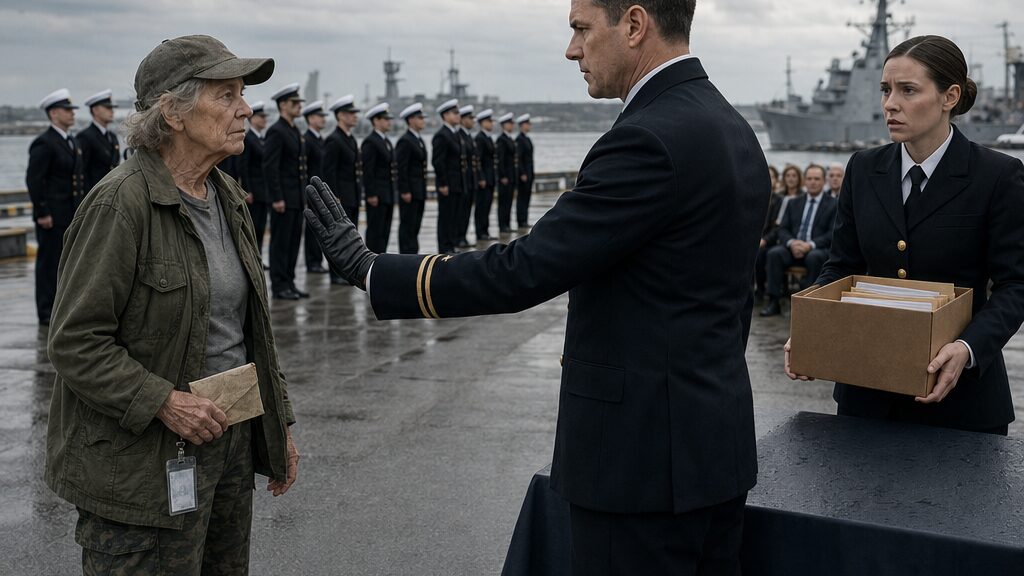
The officer’s hand rose before Nancy Hall could take the last step onto the ceremony deck.
It was not a wave, not a greeting, not even the careful stop of a man trying to spare an old woman from stumbling. His palm came up flat in front of her chest, close enough that she could see the pale line where his glove met his sleeve. Behind him, sailors stood in rows so straight they looked stitched into the gray morning, their dark uniforms facing the harbor, their faces trained forward as if they had not seen her.
But they had seen her.
Nancy felt it in the small shift of eyes. A glance from the left rank. A chin dipping from the right. A young sailor near the aisle trying not to turn his head. She had worn uniforms long enough to know when a formation was pretending not to notice.
“Ma’am,” the officer said, “this area is restricted.”
Nancy stopped with one hand around the folded letter in her pocket and the other resting against the seam of her old green field jacket. The jacket had not fit right for years. The cuffs were frayed, the shoulder had gone soft, and a rust-colored stain near the front zipper had survived every washing because it had never been rust. She had nearly left it in the closet. Then she had put it on anyway.
“I’m aware,” she said.
Her voice came out lower than she expected. The harbor wind took the edge off it and carried it toward the stacked chairs and the white-draped platform.
The officer looked her over once. Faded cap. Gray shirt. Field jacket older than some of the sailors. Camouflage pants tucked badly into boots with cracked black leather. Plastic pass at her waist, clouded with age. She knew what he saw before his eyes returned to her face.
“Guests are being checked in at the table behind the barricade,” he said. “If you have an invitation, present it there.”
“I already passed the table.”
His expression tightened, not with anger exactly, but with the irritation of a schedule snagged by something small and inconvenient. His name tag read Carter. Benjamin Carter, according to the printed program she had seen clipped to a board near the entrance. Senior enough that people moved when he turned his head. Young enough that his face had not yet learned what command cost when no one was looking.
“You passed the table without clearance?” he asked.
Nancy felt the rows behind him sharpening around the question. She did not look at them. She looked past Benjamin Carter’s raised hand to the empty chair near the front row, the one with no folded program on the seat.
“I was told to come here,” she said.
“By whom?”
That was where the letter pressed itself against her palm through the jacket cloth.
By a boy who had stopped breathing before he turned twenty. By a promise folded so many times the paper had begun to split along the creases. By a name the Navy had managed to keep in a box but not on a program.
Nancy said none of that.
“I have business with the records table.”
Benjamin’s hand did not move. “This is a memorial rededication, ma’am. The records table is not open to the public.”
“I’m not the public.”
A murmur almost happened, but discipline swallowed it. The ceremony announcer tested a microphone on the platform. A hollow tap carried across the deck. Beyond the rail, the water slapped against the pier pilings with the old dull sound Nancy had not heard in years except in dreams.
Benjamin lowered his eyes to the pass clipped near her waist. “May I see that?”
Nancy hesitated. Not because the pass was false. Because once she lifted it, the morning would stop being simple. It would no longer be an old woman at the wrong gate. It would become a record. A number. A file. The beginning of an explanation she had crossed three bus lines and a security checkpoint to avoid giving too soon.
His hand moved closer. “Ma’am.”
Nancy unclipped the pass and held it up between two fingers.
It was a hard plastic veteran access pass, the kind the base had stopped issuing long ago. The lamination had yellowed around the edges. Her photograph showed a woman younger by decades, face still narrow, mouth still stubborn, eyes already tired. The corner had cracked across the printed number.
Benjamin leaned in. He did not take it at first. He read the number, then the name, then the expiration field.
“This expired years ago.”
“It was reauthorized for today.”
“By whom?”
Nancy looked toward the check-in area. A young service member stood there with a cardboard document box held against her hip. She had been sorting ceremony packets when Nancy passed through, her hair pinned tight, her mouth serious in the way of people trying not to make mistakes on important mornings. Now she was watching them.
Benjamin followed Nancy’s glance. “Mitchell.”
The young woman stepped forward quickly, almost too quickly, with the box still in her arms. “Sir?”
“Did you clear this guest?”
Sarah Mitchell looked at Nancy, then at the pass. Her lips parted slightly, and for a moment she was no longer looking at an old woman. She was looking at the number.
Nancy saw the change. It moved across the younger woman’s face like a light in a narrow room.
“I checked the list she was attached to, sir,” Sarah said.
“Attached to what list?”
“The archive supplement.”
Benjamin’s hand finally dropped, but only to point toward the pass. “This badge is expired.”
“Yes, sir, but the number—”
“The number is not clearance.”
Nancy closed her fingers more tightly around the pass. The folded letter in her pocket seemed heavier than the harbor itself.
Sarah shifted the box in her arms, and Nancy saw the top file inside: blue folder, white label, red diagonal stripe. The kind used for restricted historical records. Nancy’s stomach tightened. She had not expected it to be there in the open. She had imagined a clerk, a small office, maybe a quiet conversation after the ceremony. She had not imagined rows of sailors standing witness while Benjamin Carter weighed her like a disruption.
“Sir,” Sarah said carefully, “I think we should check this before—”
“Before what?” Benjamin asked.
The question carried. Two seated guests turned. A security clerk near the barricade stopped writing. The ceremony announcer adjusted his microphone and looked over, then looked away.
Nancy lowered the pass to her side. She could have said it plainly. I served here. I was on the pier the night the lower deck caught. I carried one out. I failed to carry the other far enough. The letter is his. The name is missing.
Instead, she said, “I can wait at the records table.”
Benjamin’s eyes returned to her jacket, her boots, the stain on her shirt. “No, ma’am. You can wait outside the ceremony boundary until we determine why you were allowed through.”
Allowed.
The word landed harder than she wanted it to. Not because he meant it cruelly. Because it was the sort of word that erased everything before it. Years became a gate. Service became a pass. Memory became permission.
Nancy folded the pass back toward her palm.
Benjamin reached for it.
He did not snatch it. That would have been easier. He reached with the practiced confidence of someone used to receiving what he requested, and for one sharp second Nancy’s fingers closed around the plastic like it was skin.
Sarah stepped between them with the box pressed awkwardly against her side.
“Sir,” she said, quieter now, urgent enough that only those closest could hear, “please don’t take that from her.”
Benjamin froze.
Nancy looked at Sarah. The young woman’s face had lost color. Her eyes flicked from the badge number to the red-striped folder in the box and back again.
“What is it, Mitchell?” Benjamin asked.
Sarah swallowed. Her fingers tightened on the cardboard until one edge bent.
“That number,” she whispered, “belongs to the sealed memorial file.”
Chapter 2: The Badge That Proved Too Little
“Handle the paperwork later,” Benjamin Carter said, but Sarah Mitchell had already seen the number twice.
Once on the old woman’s pass, cracked through the final digit.
Once on the archive index she had been told not to open unless a family member challenged the printed roll.
The order should have been simple. Keep the ceremony moving. Keep guests in place. Keep the document box organized. Do not let confusion spread through a public event full of families, officers, sailors, and a local press camera waiting near the back row.
But the old woman stood three feet away with a folded letter still tucked against her jacket, and Sarah could not make her face become paperwork.
“Sir,” she said, “the supplement was included for discrepancies.”
Benjamin gave her the look senior officers used when a junior service member had chosen the wrong word at the wrong time. Not anger. Worse. Correction before witnesses.
“There is no discrepancy at the access line,” he said. “There is an expired badge and an unauthorized movement past the check-in table.”
Nancy Hall did not react to unauthorized. She looked toward the ceremony deck, not toward Benjamin, as if she had spent her life learning which insults deserved the expense of breath.
Sarah wished she would say something. Anything clear enough to make the situation easier. I was invited. I served. I have a document. Check this name. But Nancy only stood with her shoulders slightly rounded, one thumb pressed against the folded edge of the letter through the pocket cloth.
The pass lay in her other hand.
Sarah’s own hands felt clumsy around the box. The red-striped folder sat near the top, its label partly covered by a ceremony schedule. She could see the typed line: PIER INCIDENT MEMORIAL—SUPPLEMENTAL RECORDS. Beneath that, a faded file number.
Same prefix. Same sequence. Same last two digits, unless the crack in Nancy’s badge had lied.
“Ma’am,” Sarah asked, keeping her voice low, “were you contacted by base records?”
Nancy looked at her then. Her eyes were gray, though maybe the morning made them so. “Years ago.”
“For today?”
“No.”
Benjamin exhaled through his nose. “That answers that.”
Nancy’s jaw shifted, but she did not argue.
Sarah felt a small frustration spark where pity had been. The woman had come all this way, past security, past families with pressed clothes and flowers, past rows of sailors preparing to honor names from an old disaster. Why would she not help herself? Why stand there with proof hidden in a pocket and speak as if every word had to be rationed?
Then Nancy’s fingers brushed the folded letter, and Sarah saw the tremor.
Not fear. Control.
“Sir,” Sarah said, “I need two minutes at the check-in table.”
“No.”
“The archive index is right here.”
“And the ceremony starts in four.” Benjamin glanced toward the platform. The announcer was speaking with the sound technician. The seated guests were settling. A breeze lifted the corner of a program from the front row and dropped it again. “You will not open restricted records on the deck because someone walked in with an expired pass.”
Nancy finally turned back to him. “Someone?”
The word was not loud. It did not need to be. Sarah saw Benjamin hear it and dislike that he had.
“Ma’am,” he said, his voice flatter now, “I am trying to keep this morning orderly.”
“So am I.”
The answer unsettled Sarah more than protest would have. It held no anger, no pleading. Just a claim placed quietly on the same ground as his.
Benjamin looked away first.
He pointed toward the temporary check-in table. “Mitchell, verify the badge number. Do not delay the opening remarks. If there is no active clearance, escort her back to the public side.”
“Yes, sir.”
“And do not disturb the platform with archive speculation.”
“Yes, sir.”
Sarah hated the automatic answer as soon as it left her mouth.
She carried the box back to the table, where the security clerk stood with a roster, a tablet, and the expression of someone determined not to be blamed. Nancy followed slowly. Benjamin remained close enough to watch. He spoke briefly into a radio clipped near his shoulder, then turned his body to shield the ceremony area from whatever he believed Nancy represented.
Sarah set the box down. Her fingers found the red-striped folder. For one second she looked at the seal, then at the security clerk.
“I need the supplement index.”
The clerk frowned. “I thought those were only if a family member filed a dispute.”
“Just the index.”
The clerk slid a thin binder across. “You didn’t get it from me.”
Sarah opened it beneath the edge of the table so the pages would not flap in the wind. Names ran down one side. File numbers on the other. Some entries had handwritten corrections. Some had black lines through outdated contact information. Near the bottom of the second page, she found Hall, Nancy—Pier Emergency Logistics, 1979. A notation followed: witness statement withdrawn from public program at subject request.
Sarah looked up.
Nancy had not moved. Her pass was still in her hand. The folded letter remained in her pocket. Her gaze rested not on Sarah, not on Benjamin, but on the printed programs stacked at the far end of the table.
“Mrs. Hall,” Sarah said before she could correct herself. “Your name is here.”
“Nancy,” the woman said.
Sarah nodded. “Nancy. Your name is in the supplemental index.”
Benjamin stepped closer. “In what capacity?”
Sarah checked the line again. “Pier emergency logistics. Witness statement. Archive file attached.”
“Does it show current clearance?”
“No, sir. Not current base clearance.”
Benjamin’s shoulders settled, as if the answer returned the world to him.
“But,” Sarah added, “it shows she was part of the original incident record.”
The ceremony announcer’s voice rose through the speakers behind them, warm and practiced.
“Ladies and gentlemen, if you would please take your seats, we will begin the rededication of the Harbor Service Memorial.”
Nancy’s eyelids moved once.
Sarah turned the page quickly, scanning for the public program cross-reference. The names listed there matched the printed schedule in the ceremony packets. Families. Units. Dead. Injured. Commended personnel. She found Carter’s approved final sequence. She found the empty chair notation: RESERVED—UNNAMED SERVICE MEMBER, pending verification.
Then she found Nancy Hall’s entry again on a damaged page, half the margin stained, her surname intact but the associated ceremony line blank. Not deleted. Not included. Suspended somewhere between record and absence.
“She’s not on the program,” Sarah said.
Benjamin’s face tightened. “Because the program was finalized.”
“No, sir. I mean she’s in the archive index, but not in the program cross-reference.”
“That happens with old witness files.”
Nancy’s hand went into her pocket. For one hopeful second Sarah thought she would bring out the letter. Instead, the old woman only pressed it flatter.
“Do you have something we should see?” Sarah asked.
Nancy’s eyes stayed on the ceremony deck. “Not yet.”
Benjamin heard that. “Then we are done for now.”
Sarah looked at him. “Sir—”
“Mitchell.” His voice cut softly, which made it worse. “You have duties. The ceremony has begun. This matter can be reviewed afterward.”
Afterward, Sarah thought, looking at the front row where families were already sitting straight, hands folded around flowers and programs. After the names are read. After the record becomes memory again. After everyone leaves believing the clean paper was complete.
Nancy turned her head toward the speakers.
The announcer continued, “Today we honor the sailors, workers, and service personnel whose courage on this pier has remained part of our shared history.”
Benjamin gestured to the public side of the boundary. “Ma’am, you may wait there until we clarify the file.”
Nancy did not move.
The announcer began the memorial roll call.
The first name came through the speaker clear and formal. The second followed. Then the third.
Nancy’s fingers closed around the folded letter, and Sarah saw her mouth form a name the announcer had not said.
Chapter 3: The Letter No Program Mentioned
The announcer read the line exactly as it had been printed, and Nancy knew the silence inside it.
“—for their actions during the Harbor Service Pier incident of 1979, when personnel on site moved quickly to secure the lower deck, assist the injured, and prevent further loss.”
Moved quickly.
Assist the injured.
Prevent further loss.
Nancy had spent years learning how official language made clean rooms out of smoke. It turned screams into incidents, water into conditions, boys into personnel. It could fold a night down until it fit in a binder and then place that binder in a box where no one had to hear it breathe.
She stood beside the check-in table with Benjamin Carter’s order still hanging around her like another barrier. Public side. Wait there. Clarify the file.
Sarah Mitchell hovered near the document box, pretending to sort programs while watching Nancy as if one wrong movement from the old woman might crack the morning open.
Nancy kept her hand in her pocket.
The letter was soft along the creases. She knew each fold by touch. Top down. Bottom up. Left side tucked. It had been opened so often in the first ten years that the paper had begun to thin. After that she had opened it less because the words had stopped needing ink. They had taken root somewhere behind her ribs.
She had told herself she would wait until the ceremony ended. Find the records clerk. Hand over the letter. Ask for the correction quietly, without faces turning, without anyone whispering about the old woman in the stained jacket. A clean correction. A small one. The sort that did not require anyone living to stand in front of the dead.
Then she had seen the empty chair.
It sat near the front of the reserved row, set slightly apart, a white card folded on the seat with no name printed on it. Not forgotten entirely, then. Worse. Remembered halfway. Held open by bureaucracy, not by love.
“Ma’am.”
The voice came from her right. Not Benjamin’s. Older. Thinner.
Nancy turned enough to see a man in a volunteer vest standing near the stacked chairs. He had a coil of rope in one hand and a ceremony badge clipped crookedly to his shirt. His face was brown from pier weather, his eyebrows pale and heavy, his mouth uncertain.
“I’m sorry,” he said. “You were here before, weren’t you?”
Nancy did not answer right away.
The man looked at the pocket where her hand rested. “That paper. Is that from the night of the fire?”
Sarah’s head lifted.
Nancy felt the air tighten. “Who are you?”
“Andrew Harris.” He glanced toward Benjamin before stepping closer, as if permission might be required to remember. “I worked shipyard maintenance. Not Navy. Civilian crew. I was nineteen then.” He swallowed. “I saw you once after. At the inquiry office. You had that same fold of paper in your hand.”
Nancy looked at him longer. His face had changed too much to be retrieved whole from memory, but one detail came back: a young worker with burns on the side of his neck, sitting outside a closed door with both hands between his knees, saying over and over that he had only been told to bring the wrong wrench.
“You had a bandage here,” Nancy said, touching the side of her own neck.
Andrew’s eyes softened with surprise. “Yes, ma’am.”
Sarah came around the table, lowering her voice. “Mr. Harris, do you know what file this letter belongs to?”
Andrew’s gaze dropped. “I know what night it belongs to.”
The announcer began reading the official names. Each one landed with a pause after it, allowing families to bow their heads or close their eyes. Nancy listened without turning.
The first three belonged. So did the next two. One had been a machinist who cursed like breathing and wept when his daughter sent him crayon drawings. Another had carried a man twice his weight across slick metal while the emergency lights flashed red. The Navy had remembered them well enough.
Then came a name that made her throat tighten.
Not because it was wrong.
Because it came too soon.
Nancy pulled the letter from her pocket.
Sarah’s breath caught, but she did not reach for it. Good, Nancy thought. The young one could learn.
The paper emerged in its old square, yellowed along the fold lines. A corner had darkened from oil or blood or damp; Nancy no longer knew which. Her thumb covered the first line automatically. She had done that for years, as if hiding the name from herself could keep it safe from the world.
Andrew took half a step back. “That’s his, isn’t it?”
Benjamin, watching from near the aisle, noticed the movement. His eyes narrowed. He had been trying to track the ceremony and the disturbance at once, and Nancy saw the exact moment he decided the disturbance had grown legs.
He started toward them.
Sarah saw him too. “Nancy,” she whispered, “if that letter explains the discrepancy, we need to enter it into the record.”
Nancy almost laughed, though no sound came. Need. Records always needed. Forms needed. Boards needed. Men with clean sleeves needed. A boy on the lower deck had needed air.
“It explains what the record did not want,” Nancy said.
Sarah looked at the folded paper. “May I read it?”
Nancy’s fingers tightened.
There it was again: the old habit. Hold still. Keep quiet. Do not make your grief bigger than anyone else’s. Do not use a dead boy’s last words to clear your own name. Do not turn pain into performance.
“No,” Nancy said.
The single word came sharper than she intended.
Sarah stepped back, stung. “I’m trying to help.”
“I know.”
“Then let me.”
Nancy looked toward the front row, where the empty chair waited without a name. “Not yet.”
Benjamin arrived before Sarah could answer. “What is happening here?”
Andrew straightened, too fast. “Nothing, sir. Just—”
“I was asking her.”
Nancy folded the letter more tightly, though the creases did not need help.
Benjamin’s gaze moved from Andrew to Sarah to the paper. “Mrs. Hall, you were instructed to wait outside the boundary.”
“Nancy,” she said.
His mouth pressed thin. “Nancy. This is an official ceremony. If you have a document, you may submit it afterward through proper channels.”
“Proper channels had forty-seven years.”
The words slipped out before she could catch them.
Sarah went still. Andrew shut his eyes briefly, as if the number itself had opened a door.
Benjamin’s face changed, but not into understanding. Into alarm. He glanced toward the seated guests. A few had turned at Nancy’s voice. The ceremony announcer continued, unaware or pretending to be.
“That is exactly why this cannot be handled in the middle of a public event,” Benjamin said. “You are not going to gather people around an unverified claim and disrupt families who came here to grieve.”
Nancy looked at him then. Really looked.
He was not cruel in the simple way. Cruelty had an ease to it. Benjamin Carter was tight with fear. Fear of disorder. Fear of being seen mishandling something old and fragile. Fear that the paper in her hand might be more dangerous than she was.
That made his mistake smaller.
It did not make it harmless.
Andrew leaned closer, voice barely above the water striking the pilings. “She isn’t making a claim.”
Benjamin turned on him. “Mr. Harris, unless you are part of the records staff—”
“I loaded the lower deck that week,” Andrew said.
The words shook as they came out.
Nancy closed her eyes for one second. Not now, she thought. Not from him. Not because Benjamin had pushed and Sarah had pleaded and the empty chair had sat there like a wound dressed in white.
Andrew pointed toward the program in Sarah’s hand. “That list. It has the upper crew. It has the responders. It has the names command approved. But it doesn’t have all of them.”
Benjamin looked at Sarah. “Do not engage this.”
But Sarah was looking at the program now, scanning the roll call against the archive index, her finger moving down one column and stopping at the blank reserved line.
Nancy heard the announcer say, “And for those whose service continued beyond that day, we offer our enduring gratitude.”
Beyond that day.
The letter seemed to pulse in her hand.
Andrew’s voice dropped until only Nancy, Sarah, and Benjamin could hear.
“The program is missing the boy from the lower deck.”
Chapter 4: The Empty Chair on the Printed Schedule
Benjamin Carter saw the empty chair before he saw Nancy move toward it.
That was what bothered him most afterward: the chair had been there all morning, placed in the front row by his own instruction, marked with a folded white card that said only RESERVED. He had approved it because the records office had insisted the memorial file still contained an unresolved entry. He had told himself an unnamed chair was better than no chair at all. It was dignified. It was cautious. It kept the ceremony from making a claim it could not defend.
Now, with Nancy Hall standing near the records table and Andrew Harris speaking words Benjamin wished he had not heard, that empty chair looked less like caution and more like a blank left for someone else to answer.
“The boy from the lower deck,” Andrew had said.
Benjamin kept his face controlled. The guests nearest the aisle had turned halfway around. A sailor in the first formation line had shifted his eyes toward the side table. The announcer was still reading, but his voice had begun to thin at the edges, as if he sensed the attention draining away from the platform.
Benjamin stepped closer to Andrew. “Mr. Harris, this is not the time.”
Andrew’s hand tightened around the coil of rope. “That’s what they said then.”
The sentence struck harder than Benjamin expected. He looked toward the platform, where the ceremony program rested in a clean stack beneath the microphone. His own signature was on the final approval sheet. He had checked the order of speakers, the security line, the family seating, the press boundary, the timing for the bell, the placement of the wreath. He had reviewed everything that could go wrong in public.
Except the blank.
“Mitchell,” he said.
Sarah came forward with the binder against her chest. “Sir.”
“Show me the index.”
She hesitated only long enough to make him notice. Then she opened the binder on the edge of the records table, shielding the pages from the wind with one hand. Benjamin leaned over the paper.
The page looked as if it had survived a flood and an office move. Old type. Faint stamps. Handwritten notes in two inks. Several lines crossed out. Others marked pending. He found Nancy Hall’s name where Sarah indicated, tied to a file number and the phrase witness statement withdrawn from public program at subject request.
“That does not put her in the ceremony,” he said.
“No, sir.”
He looked up sharply.
Sarah did not back down, though her throat moved. “But it explains why her badge number matches the memorial file.”
Benjamin read the line again. The words did not become more useful.
Subject request.
Withdrawn.
He disliked the phrase because it gave him nothing solid. A person could withdraw a statement for a dozen reasons. Shame. Confusion. Legal caution. Family pressure. Resentment. Bad memory. It did not prove a missing name. It did not justify stopping a ceremony already underway in front of families who had dressed carefully and carried flowers like fragile orders.
He glanced at Nancy.
She stood with the folded letter in her hand now, no longer hidden in her pocket. It was smaller than he had expected, soft at the edges, stained in one corner. She held it the way some people held a prayer card at a funeral. Not displaying it. Not concealing it. Keeping it alive by touch.
“Mrs. Hall,” he said.
“Nancy.”
The correction came quietly, but several people heard it.
“Nancy,” he said, forcing patience into his voice. “If that document has relevance to the memorial file, I will make sure it is reviewed after the ceremony.”
Her eyes moved to the empty chair.
“After the names?”
Benjamin felt heat rise beneath his collar. “The names being read have been verified.”
“Not all.”
“By whom?”
Nancy’s fingers folded around the letter.
There it was again, that refusal. She wanted him to accept the weight of her silence as if silence could be entered into a record. Benjamin’s sympathy, whatever part of it remained available under pressure, began to harden around the edges. He was responsible for the living order of this event, not for every grief that arrived late with a stained jacket and an expired pass.
Sarah turned a page in the binder. “Sir, the program cross-reference has an empty chair notation.”
“I know.”
Her eyes lifted. “You knew there was an unnamed entry?”
“I knew there was a disputed entry.”
“And it wasn’t resolved?”
“It could not be resolved to the standard required for public reading.” He heard the defensiveness in his voice and lowered it. “That is why the chair was included.”
Nancy looked at him with an expression that was almost pity.
The pity irritated him more than accusation would have.
“Sir,” Sarah said, “the file number from her badge is attached to that dispute.”
“Attached is not verified.”
Andrew made a low sound. “People love that word when they’re not the ones missing.”
Benjamin turned to him. “You are here as a volunteer. Do not mistake that for authority.”
The moment he said it, he regretted it. Andrew’s face closed, but not before the hurt showed. A harbor maintenance worker near the stacked chairs lowered his eyes. Sarah’s hand stilled on the page.
Nancy said nothing.
Her silence did what Andrew’s sentence had not. It made Benjamin hear himself.
The announcer reached the section for surviving responders. Benjamin had chosen that placement deliberately: after the dead, before the wreath. It gave respect without turning attention from the families. A proper balance. A clean one.
“Among those whose quick action prevented further loss,” the announcer read, “we recognize the documented responders and support personnel recorded in the original inquiry.”
Benjamin looked back to the printed schedule in Sarah’s hand. The clean page did not mention Nancy. It did not mention the lower deck boy. It included a footnote directing unresolved supplemental items to the archive record.
A footnote. At a memorial.
For the first time that morning, Benjamin understood that the blank chair had not solved anything. It had only moved the burden from his desk to the front row.
Sarah slid another sheet toward him. “This is the approval chain.”
He saw his initials at the bottom. Above them, a records clerk’s note: UNVERIFIED NAME RETAINED AS SYMBOLIC RESERVED SEAT PENDING FAMILY CONFIRMATION. DO NOT READ ALOUD WITHOUT SUPPORTING DOCUMENTATION.
“Do we have family confirmation?” he asked.
Sarah shook her head. “Not in the active packet.”
“Then there is no authority to add a name.”
Nancy’s face did not change, but the letter in her hand bent slightly.
Benjamin forced himself to step back. The ceremony had seconds before the final responder line. He could feel the entire morning balancing on that small interval. If he stopped the announcer now and the old woman’s paper proved incomplete, he would have turned a memorial into confusion. If he allowed her to speak and she was wrong, families would remember the disruption, not the dead. If she was right—
He did not let himself finish that thought.
“Mitchell,” he said, “return to the table. Secure the supplement. After the ceremony, we will take Mrs. Hall’s statement in the proper place.”
Sarah stared at him. “Sir, the proper place may be before the roll is closed.”
“The roll is not being changed on the deck.”
Nancy finally moved.
Not quickly. Not dramatically. She took one step past the records table, then another, toward the aisle that ran along the front row. Her boots made almost no sound against the pier surface, but Benjamin heard them anyway. The folded letter hung at her side.
He moved to intercept her.
“Ma’am,” he said, catching himself too late.
She did not stop.
More guests turned now. The announcer glanced down from the platform. The bell attendant, waiting near the wreath, looked toward Benjamin for instruction.
Benjamin reached the aisle first, but the empty chair was only a few feet beyond him. Nancy’s eyes were fixed on it, and for the first time all morning, he saw not confusion, not stubbornness, not a desire to embarrass command, but a kind of terrible discipline. She had made herself walk slowly because if she moved any faster, she might break.
The announcer lowered his eyes to the final line.
Benjamin lifted his hand again.
Nancy stepped around it.
Chapter 5: The Name She Had Refused to Say
Nancy reached the empty chair before Benjamin could make his hand mean stop a second time.
The white card on the seat trembled in the harbor wind. RESERVED. Nothing else. No name, no rate, no date, no family, no proof that a person had ever breathed where the blank space now sat. Nancy stood over it with the folded letter in her hand and felt, with a clarity that made her knees weaken, that she had helped create this emptiness.
Benjamin came up beside her. “Nancy, step back.”
The announcer had stopped speaking. The silence did not fall all at once; it moved through the formation in pieces. First the guests closest to the aisle. Then the seated families. Then the rows of sailors, whose eyes remained forward but whose attention had shifted completely toward the old woman at the unnamed chair.
Nancy looked down at the card.
For forty-seven years she had told herself she was sparing others. She had asked to withdraw her public statement because she did not want anyone calling her brave for failing. She had refused invitations to ceremonies because she could not stand the way people cleaned the edges of disaster. She had let official language do what it did best: smooth the torn parts until no one cut their fingers on them.
And now the paper said RESERVED because the Navy still did not know what to do with a name she had kept folded away.
Benjamin spoke again, lower. “This is not the way.”
Nancy almost believed him. That was the trouble. She had believed some version of that sentence most of her life.
There would be a better time. A proper office. A form. A review. A family contact. A committee. A quiet correction. A way to speak that harmed no one, embarrassed no one, reopened nothing.
But the boy had died in noise.
Nancy unfolded the letter.
The sound of the paper opening was too small for the space, yet Sarah heard it from the records table. Andrew heard it from near the stacked chairs. Benjamin heard it and looked at the creases as if the letter itself had stepped across a line.
Nancy opened the first fold, then the second. The paper resisted at the old seams. She smoothed it with her thumb, careful not to split the center. Her hand shook once, and she hated that. Not because anyone saw. Because she had spent decades pretending the tremor belonged to age.
The handwriting slanted hard to the right. Not elegant. Young. Written in pencil first, then darkened in pen where the lines had faded. The top edge had a smudge where water had touched it.
Nancy did not read aloud. Not yet.
She saw the first line and the pier changed.
Smoke pressed low against the lower deck. Someone shouting for a hose. Metal slick under her boots. A boy with one sleeve torn, trying to help another man crawl before his own legs failed him. His face had been blackened except where tears or sweat had cut lines through the soot. He had grabbed Nancy’s wrist with a grip stronger than his breath.
Not my mother, he had tried to say. At least, that was what she had thought then. Later, when the letter was found in his shirt pocket, she understood.
Not my name.
Don’t let my name disappear.
“Nancy,” Sarah said softly, near enough now that Nancy could feel her presence but not close enough to take the paper. “Please.”
Benjamin turned on Sarah. “Stay back.”
Nancy looked at him. “Don’t speak to her like that.”
The words came out before she could soften them. They were not loud, but they carried in the silence. Benjamin’s mouth tightened, then closed.
Nancy looked back at the letter.
The boy’s name was there. Not in the first line. That was one of the reasons the file had tangled itself so badly. The letter had been written for someone else, a family member whose address had blurred. His full name appeared halfway down, in a sentence about returning a borrowed watch. The inquiry had copied it wrong the first time. Then a clerk had marked it uncertain. Then Nancy, in her grief and anger, had refused to sit through another hearing where men asked whether she was sure what she had heard while smoke burned her throat raw.
She had said, “Leave me out of it.”
They had.
But they had left more than her out.
Benjamin’s voice, when it came, had lost some of its command. “If that letter contains a name, it needs to be authenticated.”
Nancy nodded once. “Yes.”
“Then give it to records.”
“I will.”
“After we clear the area.”
“No.”
The word startled even her.
Benjamin stared.
Nancy folded the bottom of the letter back just enough to protect the weak crease. “If I give it to you now, you’ll put it where you put the chair. Somewhere respectful. Somewhere pending.”
Sarah’s face changed at pending. Andrew lowered his head.
Benjamin drew himself up. “That is not fair.”
“No,” Nancy said. “It isn’t.”
For a moment she saw the anger in his eyes, and beneath it something worse for him: fear that she was right. He had not caused the old omission. He had inherited it, dressed it, scheduled around it, and called that responsibility. Nancy knew something about that kind of inheritance. She had done the same with guilt.
The ceremony announcer leaned toward the microphone, uncertain. “Should we—”
Benjamin raised a hand toward him without looking.
There it was again. The hand. The stop. The reflex to control the space before understanding it.
Nancy saw it, and something inside her settled.
She had thought dignity meant staying small enough not to burden others. Quiet enough not to be accused of wanting attention. Strong enough to carry the dead without ever saying they were heavy.
But the empty chair did not need her quiet.
It needed her voice.
She turned toward the microphone.
Benjamin stepped slightly in front of her. “Nancy.”
This time there was no ma’am, no edge of dismissal. Just her name. It almost stopped her.
Almost.
“I was on the lower deck response team,” she said.
The words were plain. They carried because the microphone had not picked them up, because people leaned to hear. She did not add rank. She did not say years. She did not explain the stain on her jacket or the pass at her waist.
She held up the letter.
“This was found in his pocket.”
The first row of guests sat very still.
Benjamin looked toward the records table, then toward the platform, then back at Nancy. “Whose pocket?”
Nancy’s throat closed around the answer.
There, at last, was the old wall. Not protocol. Not Benjamin. Not the Navy. Her own refusal, built year by year out of the belief that speaking his name would make her failure fresh again.
She looked at the empty chair and saw him not as a file, not as smoke, not as a hand slipping from hers, but as a boy who had worried his name would be lost.
Sarah took one step closer. She did not speak.
Andrew whispered, “Say it.”
Nancy unfolded the letter fully, exposing the weak center crease, the smudged line, the name that had survived everything except official certainty.
Benjamin moved toward the microphone switch, perhaps to stop the uncertainty, perhaps to stop the damage, perhaps because command had trained his hand before his conscience could catch up.
Nancy spoke before he reached it.
“His name was Larry Allen.”
The microphone cut to silence on the last syllable.
Chapter 6: The Ceremony Waited for Her Choice
The silence after Larry Allen’s name was not empty.
It held the click of the microphone switch. It held the scrape of a chair leg as someone in the front row shifted and stopped. It held the water striking the pier and the breath Nancy had not known she was holding. It held Benjamin Carter’s hand hovering beside the control box as if even he did not know whether he had cut the sound or only reached too late to prevent it.
Sarah Mitchell looked from the dead microphone to Nancy’s face.
No one clapped. No one shouted. No one rushed forward with easy certainty. The formation remained still, and the families sat frozen with their programs in their laps, staring at the old woman beside the empty chair and the officer whose hand had twice tried to hold the morning in place.
Nancy lowered the letter.
For one brief, shameful moment, relief moved through her. She had said the name. If they removed her now, if they folded the morning back into schedule and procedure, at least the name had entered the air. It had crossed the pier. It had touched the rows of sailors. It had reached the chair.
Then she saw Sarah carrying the red-striped folder toward the platform.
“Sir,” Sarah said.
Benjamin did not answer. His hand was still near the switch.
“Sir,” she repeated, softer but firmer. “The file.”
That brought him back. He turned, and for a second his expression was unguarded enough for Nancy to see the man inside the uniform: cornered, embarrassed, angry at the disorder, frightened of making the wrong wrongness official.
Sarah set the folder on the platform table beside the ceremony program. She opened it carefully, not as if she were revealing a miracle, but as if she were doing the duty she had been assigned before fear complicated it. The archive index lay on top. Beneath it were photocopies, old inquiry notes, a damaged roster, and a page with several lines marked uncertain.
Nancy saw the name there, not cleanly, not enough to save anyone by itself.
L. Allen. Lower deck. Unconfirmed full entry. Personal effects: letter, watch, partial service card.
Sarah placed Nancy’s folded letter beside the file without touching it. “The record supports that there was an unresolved lower deck casualty entry,” she said. “It does not complete the full name without this.”
Benjamin looked at the paper.
Nancy held it back.
His jaw worked once. “Nancy, if that letter is what you say it is, we can take it to records now.”
“No.”
Several heads turned again. The small word had more force this time because the microphone was off and everyone was listening for what the machinery would not carry.
Benjamin lowered his voice. “I am offering to review it properly.”
“Later.”
“That is the process.”
“That is the delay.”
He flinched, and Nancy knew she had struck something true. She did not enjoy it. The morning had already carried enough humiliation. She had not come to hand his back to him.
Benjamin glanced toward the guests. “You are asking me to alter a memorial ceremony in progress based on a document that has not been authenticated.”
“No,” Nancy said. “I’m asking you not to finish it as if you know it is complete.”
The words settled between them.
Andrew came forward from the stacked chairs, not into the aisle, but close enough that Benjamin could see him without turning. The coil of rope was gone from his hand. He had taken off his volunteer cap.
“I remember him,” Andrew said.
Benjamin looked at him with weary caution. “Mr. Harris.”
“I know I’m not records staff.” Andrew’s voice shook, but he did not retreat. “I know what I am here as. But I remember the lower deck boy. He was always borrowing a watch because his stopped. He was young. Dark hair. Wouldn’t leave until the others got up the ladder.” He looked at Nancy. “I didn’t know his last name. I heard Larry. That much I heard.”
Sarah glanced down at the file. “Personal effects include a watch.”
Benjamin’s eyes closed for less than a second.
It was not proof enough for a court, Nancy knew. It was not tidy enough for a public affairs office. It was what memory often was: two damaged pieces meeting at an edge. A letter. A watch. A first name heard through smoke. A woman who had carried the rest and refused to unfold it until the last possible moment.
Benjamin opened his eyes. “Why did you withdraw your statement?”
The question was not accusatory. That made it harder.
Nancy looked at the letter. Her thumb rested over Larry Allen’s name, not hiding it now, only steadying the page against the wind.
“Because they called me a responder,” she said. “Because they wanted to put me in a chair like that and say I helped prevent further loss.” Her mouth tightened. “I was holding his arm when he stopped moving.”
Sarah’s eyes dropped.
A sound passed through the first row, not a gasp, not quite. The sound people made when a sentence entered them before they were ready.
Nancy continued because stopping now would only protect herself. “At the inquiry, they asked me what he said. I told them I didn’t know. I told them I couldn’t be sure.” She looked at Andrew briefly. “That was true enough to hide behind.”
Benjamin’s face had gone still.
“He had the letter in his pocket,” Nancy said. “It had his full name. They asked for my statement to connect it to the lower deck casualty. I said I wanted my part removed from the public program. I thought I was refusing praise.” She looked at the empty chair. “I did not understand what else they would remove with it.”
No one moved.
Sarah’s fingers rested on the edge of the archive folder. “Nancy, the letter can complete the entry.”
Nancy nodded.
“Will you release it to the record?”
The question was gentle. It still cut.
The paper had been with Nancy through apartments, moves, hospital rooms, winters when her hands stiffened around the kettle, nights when the sound of water against pipes woke her. She had kept it because letting it go felt like leaving him again. She had told herself the letter needed a guardian. She had not asked whether she had become a locked drawer.
Benjamin stepped away from the microphone switch. The movement was small, but Nancy saw it.
Then he said, “We can enter it after the ceremony and issue a correction.”
Sarah looked at him quickly.
Nancy did not.
“No,” she said.
Benjamin’s shoulders stiffened. “Nancy—”
“You can correct a spelling later. You can correct a date later. You cannot read the roll later to people who came to hear it now.”
His face colored. “You are asking me to make an official act without full review.”
“I am asking you to stop making an official act while knowing it may be wrong.”
That time, he had no answer.
The announcer stood near the microphone, eyes down. The bell attendant waited with one hand beside the rope. The guests waited. The sailors waited. The harbor waited with the indifference of water and steel.
Sarah slid the archive file closer to Benjamin. “Sir, we can mark it as a provisional correction pending final authentication. We do not have to embellish. We do not have to explain everything. We can acknowledge the name and enter the supporting document into the record.”
Benjamin stared at the folder. “That is not in the ceremony script.”
“No, sir.”
“It will be noticed.”
“Yes, sir.”
He gave her a hard look, but she did not lower her eyes this time.
Nancy saw then that Sarah was afraid. Not of Benjamin exactly. Of stepping outside the smooth line drawn for her. Of being remembered as the young service member who mishandled a ceremony. Of being wrong in public. Her courage was not clean or easy. It was work.
Benjamin turned back to Nancy. His voice was quieter. “If I turn that microphone on, what are you going to say?”
Nancy looked at the platform, then at the rows of sailors. She thought of speeches. She thought of all the words people used when they were afraid one name would not be enough. Sacrifice. Courage. Honor. Legacy. She had no strength for them.
“One name,” she said.
“That’s all?”
“And that the record box should hold his letter.”
Benjamin searched her face, perhaps looking for a trap, perhaps for anger he could defend against. He found neither.
“You do not want your statement read?”
“No.”
“You do not want your service recognized?”
Nancy’s fingers tightened around the letter. There it was, the old temptation to disappear completely. To say no so quickly that no one could ask again. To leave herself out because guilt had taught her to confuse erasure with humility.
She looked at the empty chair.
“This morning is not mine,” she said. “But I won’t let it stay unfinished.”
Benjamin looked down at his own hand. Nancy followed his gaze. It hovered near the microphone switch, the same hand that had stopped her at the aisle, the same hand that had reached for her pass, the same hand now deciding whether procedure would become another barrier.
Slowly, he lowered it.
Not to his side at first. To the table. To the microphone base. His fingers rested there without pressing.
Then he looked at the announcer. “Step back.”
The announcer obeyed.
Benjamin turned the microphone on. A faint hum moved through the speakers and across the pier. Every head seemed to lift into it.
He did not speak immediately.
The pause was long enough that Nancy wondered if he would choose some safer wording, some official fog that would make Larry Allen vanish even while being named.
Benjamin looked at the archive file, then at the letter in Nancy’s hand.
When he faced her again, his voice carried through the speakers, formal but stripped of its earlier hardness.
“Nancy Hall,” he said, “what name should be entered into the memorial record?”
Chapter 7: The Hand He Finally Lowered
Benjamin Carter approached Nancy Hall after the formation had been dismissed, and for the first time that morning, his hands stayed at his sides.
That was the detail she noticed before his face, before the careful way he walked across the pier, before Sarah Mitchell came behind him with the red-striped folder held flat against her chest. No raised palm. No reach for her pass. No fingers hovering over a switch. Just a man in a dress uniform crossing the emptying ceremony deck with the wind lifting the edge of his sleeve.
The guests had begun to leave in small, quiet groups. No one had applauded when Larry Allen’s name was read. Nancy was grateful for that. Applause would have made the moment too large, too easy, as if sound could cover everything the years had failed to hold. Instead, after Benjamin turned the microphone back on and asked her what name should be entered, Nancy had said it once more.
“Larry Allen.”
The announcer had repeated it, not with flourish, only with care. The bell attendant had waited for Benjamin’s nod, then pulled the rope once. The bell’s note had gone out over the harbor and faded against the water.
Now the chair was no longer blank. Sarah had written the name by hand on the white card and placed it on the seat until the official correction could be made. The letters were plain and dark.
Larry Allen.
Nancy stood near the pier rail, the folded letter no longer folded. It rested inside a clear archival sleeve Sarah had found in the document box. The paper looked smaller in plastic, almost fragile enough to be a leaf, but Nancy no longer felt that the wind could take it from her. For the first time in forty-seven years, she was not the only thing keeping it from disappearing.
Benjamin stopped a few feet away.
“Nancy,” he said.
She turned from the water.
Behind him, Sarah slowed, giving them distance but not leaving entirely. Andrew Harris stood farther off near the stacked chairs, speaking quietly with a harbor maintenance worker. Every few seconds he looked toward the card on the empty chair as if confirming it still had a name.
Benjamin removed his cap. The gesture was not ceremonial. It looked uncomfortable, almost private.
“I owe you an apology,” he said.
Nancy looked at the cap in his hand. “You owe the record a correction.”
“Yes.” He accepted that without defense. “That too.”
The answer changed something in the space between them. Not enough to erase his raised hand. Enough to keep Nancy from hardening herself against him.
He glanced toward the chair. “I handled it poorly.”
“You handled me poorly.”
His eyes returned to hers. For a moment she saw the instinct to explain rise in him: security, protocol, old badge, public ceremony, unresolved file. Then he swallowed it.
“Yes,” he said. “I did.”
Nancy looked down at her hands. They had steadied during the reading, but now the tremor had come back. She folded one over the other.
“I wasn’t helping you,” she said.
Benjamin seemed uncertain whether she meant it as forgiveness.
She did not.
“I came late,” she continued. “I would not say why. I gave Sarah half answers. I held the letter like you were supposed to know what it cost without being told.”
Sarah looked down at the folder, but Nancy knew she was listening.
Benjamin said, “You had reason.”
“Reason isn’t the same as right.”
The admission was harder than she expected. It scraped against the old place in her that still believed silence was the one thing no one could take from her. But silence had taken things too. It had taken Larry Allen’s full name out of the spoken record. It had taken Nancy out of rooms where she should have corrected a line, signed a page, answered one more question. It had let a blank chair stand where a person belonged.
Benjamin looked toward the archival sleeve. “Records will need the original letter for authentication.”
Nancy’s fingers moved over the plastic. Not gripping. Only touching.
Sarah stepped forward then, careful. “We can issue a receipt before you leave. The letter will be logged into the supplemental file today. I’ll make sure the scan and chain-of-custody note include the ceremony correction.”
Nancy heard the effort in Sarah’s voice: professional, exact, trying to make trust out of procedure.
“Will it disappear in there?” Nancy asked.
Sarah’s eyes lifted. “No.”
The answer came too fast to be policy. It was a promise.
Nancy studied her. “People make promises easily when a morning is still warm.”
Sarah flushed, but she did not look away. “Then I’ll make it harder than easy. I’ll put my name on the intake note.”
Benjamin turned slightly toward her. “Mitchell.”
Sarah straightened, expecting correction.
But Benjamin only nodded once. “Include mine as well.”
Nancy watched the two of them, the young service member with her fear still tucked under her discipline, the officer with his pride bruised and his authority quieter than it had been. Neither looked heroic. That made the moment easier to trust.
Sarah opened the folder and showed Nancy the intake page. There was space for the document description, source, receiving personnel, and related file number. Beneath the related file number, Sarah had already penciled Larry Allen’s name.
Not L. Allen. Not unresolved lower deck entry.
Larry Allen.
Nancy took the pen Sarah offered. Her fingers stiffened around it. She had signed forms her whole life, but this signature felt like handing over a living thing.
Before she wrote, Sarah asked, “Do you want your own service added to the public note?”
Benjamin looked at Sarah sharply, then stopped himself.
Nancy did not answer.
The public note. Her name in the correction. Her role restored where she had removed it. A line stating she had served on the pier-side emergency response team, that her witness statement and letter had helped complete the record. It would be true. It might even be fair.
For a breath, Nancy let herself imagine it: Nancy Hall, no longer a smudged entry in an archive index, no longer an old woman stopped at the boundary, no longer a witness who had withdrawn herself until the paper took someone else with her.
Then she looked at the chair.
Larry’s name sat there in Sarah’s dark handwriting, still fresh enough that the ink looked wet.
“No,” Nancy said.
Sarah’s face fell a little. “Are you sure?”
“I’m sure what I came for.”
Benjamin said gently, “That does not mean you did not serve.”
Nancy gave him a tired look. “I know what I did.”
The words surprised her by how steady they sounded. For years she had thought knowing what she did meant knowing only what she failed to do. But she had carried him as far as she could. She had kept his letter. Too long, maybe. Too privately. But she had brought it here while she still had strength enough to stand in front of the chair and say his name.
“I don’t need the note to make this about me,” she said. “But don’t remove me from the file again. If someone needs to understand how the letter got here, let them understand.”
Sarah nodded. “Private record, not public program.”
“Correct record,” Nancy said.
Sarah wrote it down.
Nancy signed beneath the intake line. Her signature came out uneven, the H in Hall dragging slightly where her hand caught. Sarah did not comment. She waited until Nancy set the pen down, then slid the archival sleeve into the folder with a care that made the old paper seem honored without being worshiped.
Benjamin closed the folder halfway, then stopped. “Would you like to place it in the record box?”
Nancy looked toward the table where the ceremony materials had been gathered. The record box sat open, blue-gray, metal-edged, ordinary. Programs, approval sheets, archive copies, and the handwritten name card waited inside.
She walked to it slowly. No one helped her. She was glad.
At the table, Sarah removed the white card from the chair and handed it to Nancy. Larry Allen’s name faced up. Nancy placed it on top of the archival sleeve. For a moment her palm rested over both.
“I’m sorry,” she said, but not to Benjamin, not to Sarah, not to the Navy.
The harbor wind moved across the table. The paper did not move.
Nancy lifted her hand.
Benjamin stood beside the box. He did not reach across her. He did not close it for her. He waited.
That was respect too, Nancy thought. Not the kind spoken into a microphone. The kind that made room.
She lowered the lid herself. The latch clicked softly, a small sound against the water and the gulls and the fading footsteps of families leaving the pier.
When Nancy turned back, Benjamin held her old plastic pass in both hands. He must have picked it up from the records table while she was signing. Earlier, he had reached for it like an object of suspicion. Now he offered it back as if it belonged to a person.
“I should have asked before touching this,” he said.
Nancy took it. The cracked corner pressed into her palm.
“Yes,” she said.
A faint, pained smile moved across his face and vanished. “Yes, ma’am.”
Nancy clipped the pass back to her jacket. “Nancy.”
This time, he did not need correcting twice. “Nancy.”
Sarah looked toward the dispersing formation. “Do you need a ride to the gate?”
Nancy almost said no by habit. Then her knees reminded her of the bus walk, the long morning, the cost of standing straight when every memory had leaned against her.
“To the gate,” she said. “Not past it.”
Sarah smiled a little. “To the gate.”
Andrew approached before they left, cap in his hands. He did not say much. He only touched two fingers to the edge of the record box, then nodded to Nancy. She nodded back. Some memories did not need to be shared aloud to be less alone.
As Sarah walked beside her toward the security path, Benjamin remained by the table, one hand resting near the closed box but not on it. Nancy looked back once.
His hand was lowered.
Beyond him, the chair that had been blank was being carried away with the others. For a second Nancy felt the old fear rise—that without the chair, without the card, without her hand on the letter, Larry Allen might vanish again.
Then Sarah shifted the folder in her arms, and Nancy saw the intake page through the open edge, saw the name written where the blank had been.
The fear did not disappear.
But it no longer had the whole room.
Nancy faced the gate and kept walking, her old pass tapping softly against her jacket with each step.
The story has ended.