They Laughed When the Veteran Drew a Cane Line in the Dust, Until the Canyon Answered
Chapter 1: The Line They Laughed At
Benjamin Carter laughed before Kathleen Harris had finished drawing the line.
It was not a loud laugh, not the kind meant to be cruel enough to own. It came out short and sharp behind his shoulder radio, a breath pushed through his nose, just enough for the other deputies to hear. Just enough for Kathleen to know that they had seen the cane in her hand, the bend in her back, the dust on her boots, and decided all of it explained her better than her words did.
“You’re standing in the wrong place,” she said again.
The canyon held the sentence for half a second.
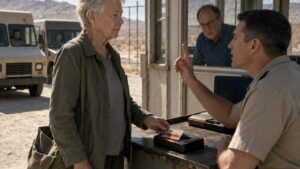
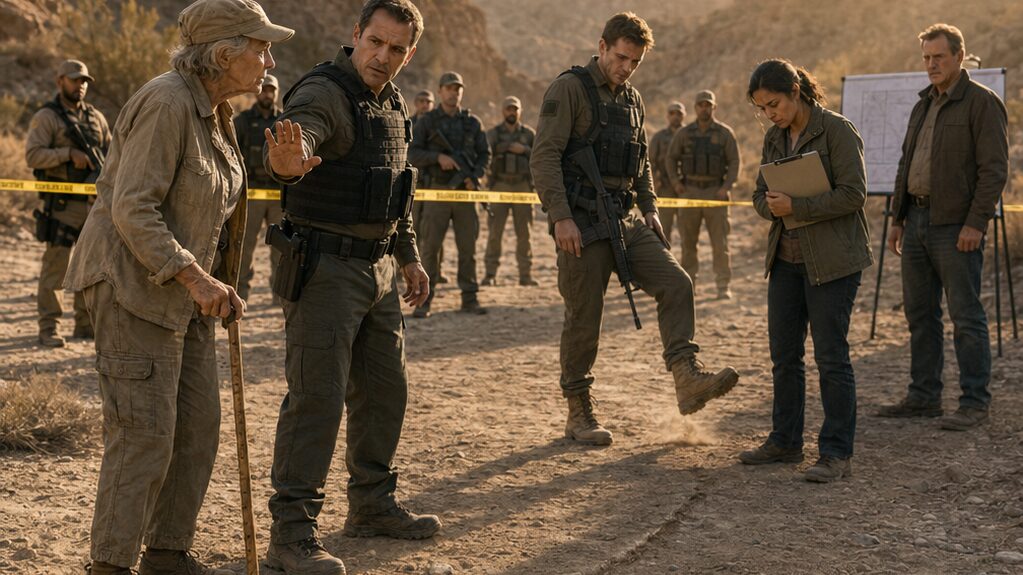
Dry Creek was not dry that week. The flash flood had gone through two days before, tearing brush from the banks, dragging pale stones into new piles, leaving the wash floor ribbed and crusted under a thin skin of powder. Yellow caution tape stretched from a survey stake to the side mirror of a county truck. Behind it stood armed deputies in tactical vests, two county workers in hard hats, and a young woman with a clipboard held too tight against her chest.
In front of it stood Kathleen, seventy-six years old, one hand wrapped around a wooden cane that had been sanded smooth by years of use. Her faded khaki field shirt hung loose at the shoulders. The brim of her old cap shadowed the creases around her eyes. Dust had settled into every line of her sleeves.
Steven Walker stepped toward her with his palm raised.
“Ma’am, I need you to move back behind the tape.”
Kathleen looked at the tape, then at the ground beneath his boots. The tape crossed the wash in a clean, official diagonal. Her cane mark curved away from it, cutting through the dust like a question no one wanted asked.
“It needs to be moved,” she said.
Benjamin shifted his rifle strap higher on his shoulder. “Based on what? Your walking stick?”
A county worker glanced down and then away, the way people did when they did not want to be caught agreeing with disrespect. Sarah Garcia, the woman with the clipboard, frowned at the map clipped under her thumb.
Kathleen did not answer Benjamin. She bent slowly, feeling the pull in her hip, and lowered the cane tip into a circular disturbance no wider than a dinner plate. The mark was easy to miss if a person expected danger to announce itself. A faint ring. A darker seam under pale dust. A shallow dimple where water had spun and settled. The kind of thing a boot could ruin in one careless step.
She traced the outside edge with the cane.
Steven’s voice tightened. “Do not touch the scene.”
“It already touched you,” Kathleen said.
The laugh disappeared from Benjamin’s face.
Steven came closer. He was younger than Kathleen by at least thirty years, with close-cut hair, a clean vest, and the posture of a man who had learned to make uncertainty look like command. His eyes flicked from her cane to her face, then back to the deputies lined along the tape.
“This is an active county safety perimeter,” he said. “We’ve got unstable walls, flood debris, and a possible exposed training marker. You are not authorized to be inside the line.”
“I’m not inside the line,” Kathleen said.
Steven stared at her.
Kathleen tapped the yellow tape once with her cane, then tapped the curve she had drawn in the dust. “That is your line. This is the ground’s.”
Benjamin muttered something under his breath. It was not quite another laugh, but it wanted to be.
Sarah’s pencil stopped moving.
Kathleen saw that. She had always noticed the person who stopped writing first. In briefings, in motor pools, in desert staging areas where young men pretended they were not scared, the one who stopped writing usually had seen the first crack between the report and the world.
Steven glanced back. “Sarah?”
Sarah looked down at her clipboard. The top sheet showed a printed canyon map with hazard zones shaded in orange. She had marked the flood path in blue. Kathleen could see from five feet away that the blue line was too straight.
“The perimeter follows the preliminary washout model,” Sarah said, but the confidence had gone thin in the middle. “The flood cut should be inside the tape.”
“Should be,” Kathleen said.
Steven turned back to her. “Ma’am.”
“Kathleen Harris.”
“All right. Ms. Harris. You need to step back.”
Kathleen straightened. It took effort, and because it took effort, Benjamin saw it. His gaze dropped to her knee, then her cane, then the loose skin at her wrist. He mistook the cost of standing for the absence of strength.
“You heard him,” Benjamin said. “Let us do our jobs.”
Kathleen looked at his boots. He had planted his right foot just beyond the shallow curve she had drawn. Not far. Six inches, maybe eight. Enough that the dust had pressed around his sole in a way she did not like.
“Move your foot,” she said.
Benjamin looked down, then back up with a smile that had too much audience in it. “My foot?”
“Yes.”
He gave Steven a quick look, asking permission to be amused.
Steven’s jaw flexed. “Deputy Carter, hold position.”
But Jeffrey Johnson’s voice came over Steven’s radio before anyone moved.
“Walker, what’s the delay? I’ve got two trail volunteers, a reporter, and half the county board asking why we still look like we’re running a raid out here.”
Steven pressed the radio at his shoulder. “Civilian inside the edge of the perimeter. We’re clearing it.”
Kathleen heard the word civilian and felt something old close quietly inside her.
Civilian. It was not wrong anymore. That was the part that made it cut.
Jeffrey’s answer crackled in the dry air. “Clear her now. We do not need a video of deputies arguing with somebody’s grandmother on the evening feed.”
Somebody’s grandmother.
Benjamin’s mouth twitched again.
Kathleen had no children. No grandchildren. No one had ever called her that unless they wanted to make her smaller.
Steven lowered his hand from the radio and stepped within arm’s reach. “Ms. Harris, I’m not going to ask again.”
Kathleen could smell the sun on his vest, the dust caught in its webbing, the faint metallic oil from the rifles behind him. She looked past him at the canyon wall, at the place where floodwater had bitten under the bank and left a shelf hanging too neat over empty space. She had seen ground hold its face like that before.
She planted the cane with more force than she meant to.
The tip sank a quarter inch.
Sarah saw it. Kathleen knew she did because the clipboard tilted.
“This wash used to carry runoff from the upper cut,” Kathleen said. “When water spins here, it doesn’t just drop silt. It pulls from underneath. You put your people on a crust.”
Steven’s eyes changed then. Not belief. Not yet. But something had interrupted him.
“How would you know that?” he asked.
Kathleen let the question hang. There were answers she could give. Too many. None short enough for men who had already laughed.
“Move his foot,” she said.
For one second nobody spoke.
Then Benjamin looked at Steven as if to say this had gone far enough. He shifted his weight back, not because he believed her, but because standing still had become embarrassing.
His boot pressed down.
The dust around his heel dropped.
It was not dramatic. No crack split the canyon. No wall collapsed. It was only a soft settling, a small breath of earth giving way beneath a man who thought he was safe.
Benjamin froze.
A thin crescent opened in the powder beside his sole.
Kathleen did not move. She only looked at Steven Walker and waited for him to decide whether he had heard the canyon speak.
Chapter 2: The Map That Would Not Match
“Civilian interference,” Steven said, and Sarah Garcia wrote it because her hand moved before her judgment did.
The command trailer smelled of dust, coffee gone bitter, and overheated electronics. Outside, the last light bled off the canyon walls while deputies shifted equipment back into trucks and pretended they were not watching the place where Benjamin Carter had nearly stepped through the wash crust. Inside, Steven stood over the folding table with his vest still on, one finger pressed to the map as if pressure could make the printed lines more true.
Sarah’s pencil hovered after the words.
Civilian interference.
She looked at the phrase, then at the dust still caught in the crease of Kathleen Harris’s cane where it leaned against the trailer wall. Steven had allowed Kathleen inside only because the reporter had not left and because Benjamin had gone quiet in a way that unsettled everyone more than shouting would have.
Kathleen sat in a metal chair near the door. She had refused water. Her hands rested on the cane handle. She looked tired now, but not confused.
Steven tapped the map. “We extended the perimeter by six feet. Carter’s fine. No collapse, no injury, no incident.”
“Six feet isn’t a correction,” Kathleen said. “It’s a gesture.”
Benjamin, standing near the rear steps, glanced away.
Steven exhaled through his nose. “Ms. Harris, I am documenting that you entered a restricted area and disrupted an active safety operation. I’m not documenting guesses.”
Sarah swallowed. The blue line she had drawn for the flood path did not touch Kathleen’s curved mark. It should have. The preliminary model showed the washout narrowing before the bend. On the ground, the dust ring sat past the narrowing, where the model said the soil should be stable.
She flipped to the second page.
The second page did not help.
“Sarah,” Steven said.
She looked up.
“Does the map support moving the line farther?”
The correct answer, professionally, was no. The map did not support it. The map was a clean satellite overlay with contour estimates, a county hazard grid, and one note from the road crew that the flash flood had altered the lower wash. It had everything a person needed if the ground had behaved politely.
“The model doesn’t show a void there,” she said.
Steven nodded, already satisfied.
“But,” Sarah added.
His finger stopped.
Kathleen did not turn her head, but Sarah felt her attention sharpen.
Sarah pulled the page closer. “The model is based on pre-flood contour data. The flood shifted debris from the upper cut. We knew that. What I don’t have is a post-flood subsurface reading.”
Benjamin spoke too quickly. “We all saw the boot mark. It was loose dust.”
Kathleen’s eyes moved to him. “Loose dust does not settle in a crescent around pressure unless something beneath it gives way unevenly.”
Benjamin’s face reddened. “With respect, ma’am—”
“Don’t borrow respect,” Kathleen said. “Use your own if you have some.”
The trailer went quiet.
Steven’s gaze hardened. “That’s enough.”
Kathleen lowered her eyes to her cane. “It was enough outside.”
Sarah looked down before anyone could catch the corner of her mouth shifting. Not a smile. Something smaller. Recognition, maybe.
She turned the map sideways and laid a sheet of tracing paper over it. With her pencil, she copied the yellow tape line. Then, from memory, she sketched Kathleen’s curve: cane tip through the circular mark, away from the clean diagonal, bending toward the old wash wall.
It touched nothing on the printed hazard zone.
That should have reassured her.
Instead, it made her pulse climb.
She checked the lower margin, where survey references were stacked in small type. One box had been blurred by a copier streak. She rubbed at it with her thumb, stupidly, as if the ink might clear.
“What is DCC-17?” she asked.
Kathleen’s hand tightened on the cane.
Steven looked at Sarah. “What?”
Sarah pointed to the margin. “There’s a reference code under the flood layer. It’s partly cut off. DCC-something. Maybe seventeen.”
Steven leaned in. “Old county designation?”
“No,” Kathleen said.
The word came too fast. Too sure.
Everyone looked at her.
Kathleen’s face had gone still in a way that seemed practiced, as if some inner door had closed before anyone could see inside.
Sarah asked, “Do you know that code?”
Kathleen looked at the map without standing. “Dry Creek Cut Seventeen.”
Steven’s brow furrowed. “That’s not on the public survey.”
“It wouldn’t be.”
“Why not?”
Kathleen did not answer.
Benjamin shifted near the door. The movement made the trailer step creak, and Kathleen’s eyes flicked toward the sound with automatic precision. Sarah saw it: not fear, not nerves, but old attention. A body that heard small changes before thought had time to dress them in meaning.
Steven folded his arms. “Ms. Harris, if you have relevant information, now is the time.”
Kathleen looked at him for a long moment. “You had time outside.”
The words landed clean. Not angry. Worse than angry.
Steven’s radio crackled again.
Jeffrey Johnson did not wait for Steven to respond. “I need a status update for the morning packet. Trail committee wants reopening conditions by eight. If we don’t have a hard hazard, we move to controlled access.”
Steven picked up the radio. “We’re reviewing.”
“Review faster. And keep the report clean. No speculation.”
Sarah’s eyes remained on the blurred code. “I need the annex records.”
Steven lowered the radio. “Tonight?”
“If DCC-17 is military or old federal transfer, the county file may have a restriction note.”
“We don’t need a history project.”
Kathleen stood. The chair legs scraped softly. For a second Sarah thought Steven would put a hand out to steady her. He did not. Kathleen did not need it, though the effort showed around her mouth.
“You don’t need history,” Kathleen said. “You need the part of it that’s still under your boots.”
Steven stared at her. “And you’re still not telling me how you know that.”
“No,” Kathleen said.
The refusal irritated him more than an argument would have. Sarah could see it. Steven wanted facts in proper order, with names, credentials, sources, liability channels. Kathleen offered only a line in the dust and a code from a map she should never have known.
That made her easier to dismiss.
It also made her harder to ignore.
An hour later, after Kathleen had been escorted to the outer lot and Benjamin had gone to check equipment he did not need to check, Sarah stood alone at the county records annex counter while the night clerk pulled transfer files from a locked cabinet.
“Dry Creek,” the clerk said. “Most of that’s digitized.”
“I need the restricted-site references.”
The clerk looked at her badge, then at the request form. “Old training land?”
Sarah did not answer quickly enough.
He returned with a thin folder, its edges soft from years of being handled by people who thought paper could safely bury danger. Most pages were maps, transfer summaries, range clearance notes. Near the back was a photocopied index, faded almost to gray.
Sarah ran her finger down the D entries.
DCC-17.
Dry Creek Cut Seventeen.
Below it, three names were typed in a small column under FIELD CLEARANCE REVIEW.
The first two meant nothing to her.
The third made her sit back.
HARRIS, KATHLEEN.
Chapter 3: The Veteran Nobody Asked About
The county warning notice was taped to Kathleen’s front door crookedly, as if whoever posted it had wanted to leave before being seen.
Amy Lewis found it first. She stood on the porch with a grocery bag against her hip and read the bold line twice before knocking, though she had a key.
NOTICE OF RESTRICTED AREA INTERFERENCE.
Inside the house, Kathleen did not answer.
Amy knocked harder. “Aunt Kathleen?”
The small house sat half a mile from the canyon road, close enough that fine dust found its way under the door no matter how often Kathleen swept. The porch boards were sun-faded. A wind chime made from old brass casings hung near the window, though Kathleen never explained where she had gotten them. A pair of boots stood beside the mat, one upright, one tilted as if kicked off by someone too tired to care.
Amy tried the handle. Unlocked.
That frightened her more than the notice.
She found Kathleen at the kitchen sink, rinsing dust from the end of her cane. The water ran brown for a moment, then clear. Kathleen held the cane under the stream with both hands, careful not to wet the leather wrap near the top.
“You saw it,” Kathleen said.
Amy set the grocery bag down too sharply. A can rolled out and bumped against the table leg. “Why is there a county notice on your door?”
“Because Steven Walker has tape and a printer.”
“That is not an answer.”
“It’s the answer they gave me.”
Amy pulled the paper from where she had folded it in her fist. “It says they can request a wellness intervention if you return to the restricted area.”
Kathleen turned off the tap.
“A wellness intervention,” Amy repeated. “Do you understand what that sounds like? They think you’re confused.”
Kathleen dried the cane with a dish towel, working slowly along its length. Near the lower third, under the fresh mud, a faint line had been scratched into the wood years ago. Not decorative. Measured. A notch, then another, then another, spaced with care.
Amy saw them. “I thought that was just Dad’s old cane.”
“It was never your father’s.”
The room changed around the sentence.
Amy lowered the notice. “What?”
Kathleen ran her thumb over the lowest notch. “It started as a measuring rod. Field cut. Hickory. Too light for some jobs, but it kept a straight edge if you knew how to use it.”
“From when?”
Kathleen hung the towel over the sink. “Before this house.”
Amy gave a small, helpless laugh. “That covers a lot of years.”
Kathleen moved past her to the table. The walk from the sink to the chair was six steps. Amy counted because lately she counted things she wished she did not have to count: pills left in the sorter, seconds before Kathleen answered the phone, the number of times she said she was fine when she was clearly not.
Kathleen sat without admitting she needed to.
Amy softened despite herself. “You scared me.”
“I scared them.”
“No, you embarrassed them. There’s a difference, and men with badges don’t always forgive it.”
Kathleen’s eyes went to the window. In the distance, beyond the roofline of the neighboring house, the canyon ridge had gone purple in the last light.
Amy sat across from her. “Tell me what happened.”
“I told them the line was wrong.”
“The tape?”
“The ground.”
Amy pressed her fingers to her eyes. “Aunt Kathleen.”
“I was right.”
“That is not the part I’m worried about.”
Kathleen looked back at her. “It should be.”
Amy had come prepared to argue. She had rehearsed it in the car with the groceries sliding in the passenger seat. You are seventy-six. You use a cane. You cannot just walk into an active county perimeter because you think you see something. But the words sounded smaller in Kathleen’s kitchen, surrounded by the disciplined neatness Amy had grown up taking for granted: boots aligned, tools cleaned before storage, bills clipped by due date, flashlight always by the door.
“Were you in danger?” Amy asked.
“Yes.”
The honest answer stopped her.
Kathleen’s hands rested flat on the table. They looked thinner than they had five years ago, but they were still steady.
“Then why?” Amy asked.
Kathleen did not respond.
Amy looked around, searching for help from familiar things. Her gaze landed on the small shelf beside the hallway, where framed photographs stood in a row. Most were family pictures. One showed Kathleen much younger, in a plain field uniform, cap low, standing beside a vehicle with half its markings hidden by glare. Amy had seen it before, but Kathleen had never talked about it beyond, “That was overseas,” or, “That was a long time ago.”
There was another photo behind it.
Amy noticed because its corner stuck out.
Kathleen noticed Amy noticing.
With a speed that startled them both, Kathleen reached over and slid the rear photograph free, face down, under a stack of mail.
Amy went still. “Who is that?”
“No one you know.”
“That’s usually what people say when it’s someone important.”
Kathleen’s mouth tightened. “Leave it.”
The sharpness hurt because Kathleen so rarely used it.
Amy stood, took the groceries to the counter, and began putting them away because she needed something to do with her hands. “You can’t keep doing this. You can’t go silent and expect everyone to understand you. If there’s something they need to know, tell them. If there isn’t, then stay away from the canyon.”
Kathleen looked at the hidden photograph.
Amy kept her back turned. “Steven Walker can request a wellness check. Do you know what happens if some county doctor writes that you’re not making safe decisions? They can make everything harder. Driving. Living alone. Even your appointments.”
Kathleen’s chair creaked.
“You think I don’t know what people can take when they decide you’re no longer fit?” she asked.
Amy turned.
For the first time that night, Kathleen looked old in a way that was not about her body. It was in her face, in the distance behind her eyes, in the restraint that had once been discipline and had calcified into habit.
“I know you served,” Amy said carefully. “I know you did more than you told us. But knowing a canyon code doesn’t mean you have to put yourself in front of armed deputies.”
Kathleen’s gaze sharpened. “What canyon code?”
Amy hesitated. “You said something in the kitchen once. Years ago. Dry Creek Cut something. I remembered because it sounded strange.”
Kathleen looked toward the hallway.
The house seemed to hold its breath.
After a moment, she stood. Amy moved to help, then stopped herself when Kathleen’s eyes warned her not to. Kathleen walked down the narrow hall to the spare room, the cane tapping once on each board. Amy followed at a distance.
The spare room was more storage than room: file boxes, winter blankets, a sewing machine no one used. Kathleen pulled a small metal box from the closet shelf. Its dark green paint was chipped at the corners. A strip of old tape crossed the lid, and on it, written in black marker faded brown with age, were four words.
DRY CREEK CUT 17.
Amy read them and felt the argument leave her.
Kathleen set the box on the bed. For a long moment she only rested her hand on the lid.
Then she unlocked it.
Chapter 4: The Old Sign Under New Dust
Steven Walker moved the yellow tape six feet and called it more than enough.
He drove the new stake in himself, hard enough that the county worker beside him stopped offering the mallet. The tape snapped in the morning wind, bright and official against the dull wash floor. It looked better on camera now. Farther from the crescent where Benjamin Carter’s boot had sunk. Far enough, Steven hoped, that Jeffrey Johnson would stop using words like delay and optics over the radio.
Sarah Garcia stood ten yards away with her clipboard against her ribs, watching the space between the old line and the new one.
“It still crosses her curve,” she said.
Steven pulled the tape tight. “Her curve is not a survey.”
“No,” Sarah said. “But it matches an old boundary better than ours does.”
He looked at her then.
She had not meant to say it that plainly. She had been up most of the night with the Dry Creek transfer file spread across the annex counter, comparing faded marks against county overlays until the clerk started turning lights off in sections. Sleep had not softened what she found. It had sharpened it.
Steven walked over, lowering his voice. “We are not building a perimeter around a woman’s cane scratch.”
“The cane scratch follows the old hand-drawn limit for DCC-17.”
“Old hand-drawn limits are why we use updated maps.”
“Updated from pre-flood contours.”
His jaw shifted. Sarah had seen that expression in people who thought the problem was not the information but the person bringing it.
Behind him, Benjamin stood near the truck bed, fastening straps on equipment he had already secured twice. He had barely spoken since the dust settled under his boot. Every few minutes he looked down at the ground as though it might remember him.
Kathleen Harris waited outside the tape.
That was the part Steven could not use against her.
She stood on the safe side of his new boundary, one hand on the cane, old cap low against the sun. Amy Lewis stood near the road with her arms folded, worry visible even from a distance. Kathleen had not crossed, had not argued, had not demanded anything. She had simply returned to the canyon and looked at the tape with a disappointment so quiet it irritated him more than protest.
Steven approached her. “You were advised not to return.”
Kathleen’s gaze stayed on the wash. “And I didn’t go in.”
“You’re close enough to interfere.”
“If standing here interferes with your plan, your plan is thin.”
Benjamin looked up.
Steven kept his voice controlled. “We moved the tape.”
“I see that.”
“Then you see we addressed your concern.”
Kathleen finally turned to him. “No. You addressed how it looked.”
Sarah felt the words hit harder because they were not loud.
Steven stepped closer. “Ms. Harris, if you want to help, give us a clear statement. How do you know this ground? Why did that code matter? What exactly are you claiming is under there?”
Kathleen looked past him to the bend in the wash where the flood had combed thin ripples across the sand. “You are asking for the part that protects you from listening.”
“I’m asking for facts.”
“No,” she said. “You’re asking me to earn the right to be heard after the ground already spoke.”
For a moment, Steven had no answer.
Sarah took that opening. “I’m going to the annex again.”
Steven turned too quickly. “You were there last night.”
“I need the restricted note attached to the DCC-17 transfer. The copy was incomplete.”
“We have enough to make a field adjustment.”
“No, we have enough to know our field adjustment may still be wrong.”
A county worker stopped pretending not to listen. Jeffrey’s white county SUV rolled into the gravel turnout before Steven could answer. Dust climbed around its tires and drifted across the tape, blurring the new line for three seconds.
Jeffrey Johnson got out with a phone in one hand and sunglasses in the other.
“Tell me,” he said, walking toward Steven, “that we are not still debating the same six feet.”
Sarah held up her clipboard. “It may be more than six.”
Jeffrey did not look at her first. He looked at Steven.
That bothered Sarah more than she wanted to admit.
Steven said, “We extended the perimeter. We’re reviewing old transfer records.”
Jeffrey’s smile was thin and public-facing, even with no public close enough to hear. “Old transfer records do not reopen trails. Current risk assessments do.”
“The current assessment may be incomplete,” Sarah said.
Jeffrey finally looked at her. “Then complete it. By tomorrow morning. Inspection is at nine. Controlled reopening at ten if there is no hard hazard.”
Kathleen’s cane tip pressed into the dust outside the tape.
Sarah saw the small mark. A dot, not a line. Restraint made visible.
Steven said, “Tomorrow is too soon.”
Jeffrey removed his sunglasses, and his expression lost its polish. “The county board has already been told this is a limited washout. Trail volunteers are waiting. Local businesses are calling. If we turn a flood closure into a federal mystery because one retired resident has a feeling, we own the panic.”
Kathleen’s mouth changed slightly at retired resident.
Sarah heard herself say, “Her name appears in the DCC-17 file.”
Steven’s head turned.
Jeffrey went still. “What file?”
“The old restricted-site index. Kathleen Harris is listed under field clearance review.”
Kathleen closed her eyes for half a breath.
Steven looked at her, not with belief, but with the discomfort of discovering he had been speaking to a door with a room behind it.
Jeffrey lowered his voice. “Sarah, with me. Now.”
The county records annex sat in a low building that smelled of paper dust and floor wax. Sarah rode there in Jeffrey’s SUV because he asked in a tone that made refusal look insubordinate. Steven followed in his county truck. Kathleen remained at the canyon, outside the tape, with Amy beside her.
In the annex, the same clerk brought the folder with visible reluctance. Jeffrey signed the access sheet. Steven stood at Sarah’s shoulder while she turned to the index again.
There it was.
DCC-17. Dry Creek Cut Seventeen. Field Clearance Review.
HARRIS, KATHLEEN.
Beneath her name, partly obscured by a staple shadow, was another.
SANCHEZ, SHARON.
Sarah touched the line with her pencil. “Who’s Sharon Sanchez?”
Steven leaned closer. “Another reviewer?”
“There’s a sealed notation beside her name.”
The clerk shifted behind the counter. “Some of the old military transfer pages were redacted before county receipt.”
“Redacted for what?” Sarah asked.
“Training incident, maybe. Equipment classification. I wouldn’t know.”
Jeffrey checked his watch. “We are not delaying tomorrow over a sealed thirty-year-old note.”
Sarah flipped to the map layer. The old hand-drawn boundary curved away from the modern tape line in a shape that made her stomach tighten. She laid her tracing paper over it, aligning ridge points, wash bend, access road.
Kathleen’s cane line crossed the old boundary almost exactly.
Steven saw it too. His face did not soften, but it changed. Something in him moved from denial to calculation.
“That could be coincidence,” Jeffrey said.
Sarah looked up. “It could.”
She hated that it was true. One old map did not prove a present void. One woman’s memory did not replace a geotechnical scan. But the match was too close to dismiss cleanly.
Steven reached for the file. “Let me see the incident page.”
Sarah turned the folder toward him.
His hand paused over the sheet with Sharon Sanchez’s name. For a moment, he looked not like the man in command at the canyon, but like someone hearing footsteps behind him in a hallway he thought was empty.
Then Jeffrey’s phone rang.
He turned away to answer, speaking low and fast about access schedules and public messaging.
Steven slid the page free.
Sarah caught the movement. “What are you doing?”
He did not look at her. “Making a copy.”
“The copier is behind you.”
He folded the page once, not sharply enough to crease it fully, and tucked it under the topographic sheet in his hand.
Sarah stared at him.
When Jeffrey turned back, Steven had already closed the folder.
“Nothing actionable,” Steven said.
Sarah’s eyes dropped to the place where the page had been.
A clean gap stared back from the file, thin as a line erased from dust before anyone could prove it had been there.
Chapter 5: The Name Kathleen Would Not Say
When Sarah said Sharon Sanchez’s name, Kathleen’s hand tightened so hard around the cane that Amy heard the wood creak.
They were on Kathleen’s porch, the afternoon sun angled low enough to throw the railing’s shadow across the boards. Dust from the canyon road lay in a pale film near Kathleen’s boots. Without meaning to, she had dragged the cane tip through it while Sarah spoke, drawing the same curved boundary again and again between the porch steps and Amy’s chair.
Sarah noticed the pattern before Kathleen did.
Amy noticed Kathleen’s hand.
“Who told you that name?” Kathleen asked.
Sarah stood at the foot of the steps, clipboard held lower than usual. She looked younger without the command trailer around her. Tired, too. “It was in the restricted file.”
“No.”
The word came flat.
Sarah hesitated. “Ms. Harris—”
“No,” Kathleen said again. “It was sealed.”
Amy looked from one woman to the other. “Who is Sharon?”
Kathleen lifted the cane from the dust line. The curve remained on the porch boards, thin and accusing.
Sarah climbed one step, then stopped herself from coming closer. “I don’t need personal details. But if Sharon Sanchez was part of a field clearance review at Dry Creek, and if something happened there—”
Kathleen’s eyes cut to her. “Do not make her a footnote in your report.”
Sarah took the rebuke without flinching. “Then help me keep the report from being wrong.”
The porch fell quiet except for the wind chime near the window. One casing tapped another with a small hollow sound. Amy had heard that sound all her life and never thought of where the pieces came from. Now every ordinary thing in Kathleen’s house seemed to have a second life hidden under it.
Kathleen sat in the porch chair. The motion was controlled, but Amy saw the pain that crossed her face before she hid it.
“She was faster than me,” Kathleen said.
Amy did not move.
Sarah lowered herself onto the bottom step.
Kathleen looked toward the canyon ridge beyond the road. “Sharon saw things quickly. Too quickly sometimes. I used to tell her the ground didn’t reward speed.”
Her mouth almost softened. Almost.
“We were assigned to a route-clearance training review after a washout. Dry Creek Cut Seventeen. Different year. Different command. Same kind of ground. Flood took the top layer and left a crust over what it had eaten underneath.”
Sarah’s pencil hovered, but she did not write.
Kathleen saw that. “You can write. I won’t say it twice.”
Sarah wrote.
Amy’s throat tightened. “You were Army?”
Kathleen glanced at her. “I told you I served.”
“You told us you handled field logistics.”
“I did.” A dry edge entered Kathleen’s voice. “People like simple labels at dinner.”
Sarah looked up. “What did you see back then?”
Kathleen’s gaze returned to the dust line on the porch. “A ring like yesterday’s. A little darker at the edge. Silt settled wrong. The old markers had shifted after rain. I said the staging point was too far in.”
“And they didn’t listen,” Amy said.
Kathleen’s jaw worked once. “They listened politely.”
The difference landed.
Sarah’s face changed, not with surprise, but recognition. She knew that kind of listening. The kind that let a person finish so the room could move on.
“What happened to Sharon?” Amy asked.
Kathleen rubbed her thumb along the cane handle. “She went to check the marker. I told her not to hurry. She looked back and grinned at me like she always did when she thought I was being old before my time.”
“You weren’t old then,” Amy said softly.
“No.” Kathleen looked at the curve in the dust. “But I was quiet.”
Sarah stopped writing.
Kathleen’s voice stayed even, which made it harder to hear. “The ground dropped under one side. Not far enough to bury her. Far enough to break what needed not to be broken. Far enough that she never walked the same again. Far enough that everyone called it an unforeseeable training-site failure.”
The wind chime tapped once.
“I had seen the sign,” Kathleen said. “I made the note. I said it in the briefing. When they moved on, I moved on with them.”
Amy’s eyes burned. “That wasn’t your fault.”
Kathleen turned to her then, and the old discipline cracked just enough for Amy to see the grief underneath.
“Fault is what other people assign,” Kathleen said. “Responsibility is what stays after they stop talking.”
Sarah closed her notebook. “Ms. Harris, if you tell Steven this—”
“No.”
“He needs to understand what the line means.”
“He needed that yesterday.”
Amy stepped forward. “Aunt Kathleen.”
Kathleen rose too quickly. Her knee caught, and she gripped the cane until the moment passed. Amy reached out, then stopped before touching her.
Kathleen saw that restraint. It hurt her more than being helped might have.
“I am not a story they can use to save face,” Kathleen said.
Sarah stood. “Then what about the people walking into that canyon tomorrow?”
Kathleen looked at her.
Sarah’s voice dropped. “I’m not asking you to perform for them. I’m asking because I think the wind is already changing the wash. By morning, the visible part of your mark may be gone. If I can’t show them, and you won’t explain, Jeffrey will call it unresolved concern and open on schedule.”
Kathleen’s eyes moved toward the canyon road.
Amy followed her gaze. A thin veil of dust was moving along the ridge line. Not much. Just enough to blur the low places.
Sarah saw it too. “The inspection group will stand where the tape tells them to stand.”
The cane shifted in Kathleen’s hand.
Amy realized then that fear for Kathleen had made her selfish in a way love often disguised. She wanted her aunt away from danger because danger might take her. Kathleen wanted to return because silence had already taken something and left her living with it.
Amy picked up the county notice from the porch table and folded it once. “If you go back, I’m driving.”
Kathleen looked at her, startled.
“I don’t like it,” Amy said. “I don’t have to like it. But I’m not letting them call you confused because you show up alone.”
For a moment Kathleen seemed unable to answer. Then she turned to Sarah.
“Tell me what Steven did with the page.”
Sarah’s face went still.
Amy looked between them. “What page?”
Sarah did not pretend. “The one with Sharon’s notation. He took it from the file before I could read it fully.”
Kathleen’s expression did not change, but the porch felt colder.
“He’s afraid of the wrong thing,” she said.
Sarah’s voice was careful. “What is the right thing?”
Kathleen looked at the dust curve she had drawn without noticing. Wind slipped through the porch and softened its edge.
“That canyon lies after a wind shift,” she said. “It covers the sign and leaves the hollow. By morning they’ll think the ground corrected itself.”
She turned to Amy.
“Drive me back before the inspection,” Kathleen said. “The canyon is going to lie to them again.”
Chapter 6: The Report That Proved Too Little
“Unless someone can prove otherwise,” Jeffrey Johnson said, “Dry Creek reopens under controlled access at ten.”
Steven Walker stood at the end of the folding table with a pen in his hand and the unsigned field summary in front of him. The command trailer was too crowded for six in the morning: Jeffrey with his clean jacket and county seal folder, Sarah with shadows under her eyes, Benjamin near the door pretending he had not come early for a reason, and two county workers waiting for instructions they could repeat if anyone asked later.
Outside, the yellow tape had been straightened overnight.
Steven had done it himself before sunrise. He had told himself it was because wind had loosened the stakes. But when he looked through the trailer window, the tape crossed the wash like a bright accusation. It looked official. It looked defensible. It did not look true.
Sarah’s caution note was not in the public packet.
She noticed before anyone else did.
“Where is my addendum?” she asked.
Jeffrey did not look up from his folder. “Condensed into the field summary.”
“You removed the uncertainty language.”
“I removed unsupported speculation.”
Sarah’s fingers tightened around her clipboard. “I wrote that the perimeter should remain provisional pending subsurface testing.”
“And the field team found no confirmed void.”
“We didn’t test.”
Jeffrey finally looked at her. “Then we cannot claim what we do not know.”
Steven heard the neatness of it. He had used versions of that sentence himself. In reports, in briefings, after incidents where decisions had to be made from incomplete facts and then defended as if they had been inevitable.
Benjamin shifted by the door.
Steven looked at him. “Something to add?”
Benjamin’s face closed. “No.”
But he did not sound like yesterday’s Benjamin. Yesterday’s Benjamin would have smirked. Yesterday’s Benjamin would have been glad to let an old woman carry the awkwardness for everyone.
Steven set the pen down. “Deputy Carter.”
Benjamin looked at the floor. “The ground moved under me.”
Jeffrey’s expression sharpened. “Loose topsoil.”
Benjamin’s jaw tightened. “Maybe.”
“That is not a useful word.”
“No, sir.”
Steven watched the young deputy’s thumb rub at a dust stain on his pants. The stain had survived washing. Or maybe Benjamin had not tried very hard to remove it.
Benjamin looked at Steven. “It wasn’t just soft. It dropped on one side. Like stepping on the lid of something.”
The room went quiet.
Sarah did not look triumphant. That made Steven trust her more.
Jeffrey closed his folder. “And you waited until now?”
Benjamin’s face reddened. “I didn’t want to make it bigger than it was.”
Steven almost laughed, not because it was funny, but because he knew the shape of that excuse so well. He had built whole days around it.
Years earlier, in another county and another uniform, Steven had delayed calling off a search-grid advance because the map said the slope held and his gut said it didn’t. A volunteer had fallen, not far, not fatally, but badly enough that every later command decision came with the taste of that radio call in his mouth. Afterward, people had told him he had followed available information. They meant to comfort him. Instead, they had taught him how thin available information could be when someone else carried the injury.
Since then, Steven had tried never to look uncertain in front of a team.
Kathleen Harris had seen through that faster than anyone.
Jeffrey slid the field summary toward him. “We have an inspection group arriving in three hours. County board, trail committee, press pool, volunteer coordinator. I need your signature on the safety posture.”
Sarah said, “Steven.”
Just his name. Not a plea. Not a challenge. Worse. A reminder that he still had a choice.
He looked at the packet. The language was careful. Controlled access. Visual inspection. No confirmed subsurface hazard. Continue monitoring after reopening. Every phrase was built to stand up in a meeting.
None of it said: an elderly veteran drew a better line than our map.
None of it said: we laughed.
Steven picked up the pen.
Sarah’s chair scraped back. “If you sign that without my note, I want my objection recorded.”
Jeffrey’s tone cooled. “You can file a supplemental after the inspection.”
“That is not the same.”
“No,” Jeffrey said. “It is the process.”
Steven signed.
The pen made a small sound against the paper, barely more than a scratch. Still, he felt it like a door closing.
Sarah stared at the signature.
Benjamin looked away.
Jeffrey took the packet before Steven could change his mind. “Good. Now we keep today clean.”
Outside, wind moved across the wash and lifted dust into low veils. For a second the canyon floor looked smooth all the way to the tape. The circular mark Kathleen had traced was almost gone.
Steven told himself that mattered. If the sign disappeared, perhaps it had never been as clear as she claimed. Perhaps she had caught a small instability and his six feet had corrected enough. Perhaps the old file and the missing page were history reaching forward only because anxious people wanted patterns.
Then Sarah placed something on the table in front of him.
It was a photocopy.
Not the page he had taken. Another sheet, made from her tracing paper. Kathleen’s cane line over the old DCC-17 boundary. Not proof. But alignment. Uncomfortable, stubborn alignment.
“I made it before the page disappeared,” Sarah said.
Jeffrey’s eyes flicked to Steven.
Steven felt heat rise under his collar.
Sarah did not accuse him. That made it worse.
“The inspection group needs to see this,” she said.
Jeffrey picked up the photocopy, glanced at it, and set it back down as if it were contaminated by uncertainty. “No. They need one message.”
Sarah’s voice was quiet. “That’s what worries me.”
The radio on Steven’s shoulder crackled. A deputy outside reported the first county vehicles turning off the main road.
Jeffrey straightened his jacket. “Positions.”
The trailer emptied into the pale morning. Steven stepped out last, the signed packet under his arm and the missing file page folded inside his vest pocket. The paper seemed heavier there than it had any right to be.
At the staging area, county workers adjusted cones. Trail volunteers gathered near the road. A local reporter stood beside a camera, speaking softly into a phone. The canyon waited beyond the tape, its surface newly smoothed by wind.
Steven took his place near the access point.
Then every head turned toward the road.
Amy Lewis’s car rolled slowly into the turnout. She parked beyond the county vehicles and came around to the passenger side.
Kathleen Harris stepped out wearing the faded khaki field shirt from the old photograph Steven had not seen but somehow recognized anyway. Her cap was pulled low. Her cane was in her right hand.
She did not look at the camera, the board members, or Jeffrey Johnson.
She looked only at the yellow tape.
Then she started walking toward the line.
Chapter 7: The Wrong Side of the Tape
“Benjamin.”
Kathleen’s voice cut across the staging area before the deputy’s boot touched the cleared path.
It was not loud, but it carried. The kind of voice that had once crossed engines, wind, and men pretending not to hear fear. Benjamin stopped with one foot lifted, his face tightening because everyone had heard her use his first name like an order.
The inspection group turned.
Jeffrey Johnson’s polished smile disappeared. The local reporter lowered her phone. Sarah Garcia looked from Benjamin’s boot to Kathleen’s cane, then to the yellow tape snapping against its stakes.
Steven Walker stepped forward. “Ms. Harris, stay behind the line.”
Kathleen did not move past the tape. She did not need to. She stood on the road side, old field shirt buttoned to the throat, cap low, cane planted in the dust. Amy stood several feet behind her, both hands wrapped around the county notice she had folded and refolded until its edges softened.
“He is walking into the hollow,” Kathleen said.
Benjamin slowly set his foot back where it had been.
Jeffrey laughed once, quietly, for the people near him rather than for himself. “We are not stopping a public inspection because of a hollow no scan has confirmed.”
“You did not scan,” Sarah said.
Jeffrey turned. “Not now.”
Sarah’s face was pale, but she stepped to the side of the folding display board where the county map had been clipped for the inspection group. “My caution note was removed from the public packet.”
The sentence changed the air.
Steven looked at her. He had expected anger from Kathleen. He had prepared for Amy’s worry. He had not prepared for Sarah to say that in front of county workers, trail volunteers, and the reporter.
Jeffrey’s voice went low. “Sarah.”
“No,” she said, and the word seemed to surprise even her. “If this is public safety, the uncertainty is public too.”
Kathleen watched the young woman’s hands tremble around the clipboard. Courage rarely looked clean while it was happening. Most people mistook it for disobedience until the danger passed.
Steven moved toward Kathleen, careful to keep himself between her and the inspection group. “Tell me exactly what you see.”
Kathleen looked at him. “Now you want exactly.”
His mouth tightened, but he did not look away. “Yes.”
Wind moved through the wash, dragging a thin sheet of dust across the ground. The circular mark she had traced the day before was almost gone. The canyon had done what she said it would. It had hidden its own warning beneath a fresh, even skin.
Kathleen felt the old box in her memory open: Dry Creek Cut Seventeen, a younger sun, Sharon Sanchez grinning over her shoulder, a briefing table where Kathleen had made her point and then let silence carry it away.
Not this time.
She stepped closer to the tape but did not cross it. Slowly, because her hip had stiffened during the drive, she lowered herself enough to place the cane tip into the dust on her side of the line. Steven’s hand moved as if to help her, then stopped.
Good, Kathleen thought. Learn when not to touch.
She drew the curve.
Not where the tape ran. Not where the map said the wash narrowed. She began at the road-edge stone, crossed the faint darker seam, and bent the line wide toward the old bank. The cane scraped softly. The sound traveled through the waiting group better than a shout.
“This was not made by yesterday’s flood alone,” she said. “The flood uncovered an old cut, then covered it again. Water spun here.” She tapped the place where the vanished ring had been. “It dropped fine silt on top and pulled from below. Your tape follows the visible debris. The void follows the pull.”
Jeffrey shook his head. “Void is a very specific claim.”
“So is safe,” Kathleen said.
A county board member shifted near the display board. The reporter’s phone rose again.
Steven looked toward Sarah. “Does the old boundary match that?”
Sarah unclipped her tracing sheet with fingers that still shook. “Yes. Not perfectly, but closer than the current perimeter.”
Jeffrey reached for it. Sarah held it back.
Steven saw the movement. So did everyone else.
Kathleen looked at Steven’s vest. “You have the page.”
His eyes changed.
Jeffrey turned sharply. “What page?”
Steven’s hand went, almost against his will, to the folded paper inside his vest pocket. For one second he looked as young as Benjamin had looked when the ground shifted under him. Trapped between what would protect him and what would protect everyone else.
Kathleen did not accuse him. She gave him that much.
“Read the notation,” she said.
Steven pulled the page out.
The paper had softened at the fold. He opened it carefully, as if it might break into something he could not repair.
His eyes scanned the old typed lines. Sarah came closer, but she did not take it from him.
Steven read, voice rougher than before. “Training wash instability. Post-flood crusting. Visual ring formation unreliable after wind shift. Field recommendation: relocate staging beyond secondary curve.”
Kathleen closed her eyes for half a breath.
Sarah whispered, “Who signed it?”
Steven looked at the bottom of the page.
Kathleen answered before he could. “I did.”
Everyone turned toward her.
“And Sharon Sanchez?” Sarah asked.
Kathleen’s grip tightened, but her voice held. “She was the reason I wrote it.”
No one spoke.
Kathleen looked past them into the canyon, where the yellow tape snapped and flashed in the wind. “Years ago, I saw the same sign here after a washout. I reported it. Quietly. Properly. Politely. They adjusted almost enough.” Her cane stayed in the dust line. “Almost is where people get hurt.”
Benjamin’s face drained.
Kathleen looked at him, not unkindly. “You stepped where she stepped.”
He lowered his eyes.
Jeffrey recovered first. “This is moving, Ms. Harris, but an old training injury does not establish present hazard.”
“No,” Kathleen said. “The ground does.”
Wind gusted hard across the wash.
The last visible trace of her earlier mark disappeared under moving dust. For a moment the entire cleared path looked smooth, harmless, almost inviting. Jeffrey seized on it with a small open gesture.
“There,” he said. “The supposed sign is gone.”
Kathleen looked at Steven.
“That is the sign,” she said.
The words seemed too small for the effect they had.
Sarah stepped beside Steven. “Wind masking.”
Kathleen nodded once. “Dust equalizes the surface. It does not fill what water took underneath.”
Steven looked at the tape, the display map, the old notation in his hand, then at Benjamin’s boots.
“Everyone back,” he said.
Jeffrey snapped his head toward him. “Steven.”
“Everyone behind Ms. Harris’s line.”
“That is not the approved perimeter.”
Steven’s voice hardened. “It is now.”
The first people to move were the trail volunteers. They did not need rank to understand the change in his voice. The county workers followed, dragging cones with them. Benjamin backed away slowly, eyes fixed on the place where his foot had nearly gone again.
Jeffrey stepped toward Steven. “You are making this decision in front of press.”
Steven did not look at the reporter. “Then I’ll make it clearly.”
Kathleen stayed where she was, cane tip still resting at the end of the curve. She felt Amy behind her, close but not crowding. She felt Sarah watching the dust, not the officials. She felt the old silence inside her loosen—not vanish, never vanish, but lose its command.
A thin cracking sound came from beyond the yellow tape.
Everyone heard it.
It was small, dry, and delicate, like a plate cooling too fast. A narrow seam opened where the official path met the wash floor. Not a collapse. Not yet. Just a warning made visible because people had finally stopped walking over it.
Steven lifted his arm, palm out—not at Kathleen this time, but at his own team.
“Hold,” he said. “Nobody crosses.”
The ground beyond the tape sagged a fraction, and a soft breath of dust rose from the place Kathleen had refused to stop marking.
Chapter 8: The Line They Chose to Keep
The statement Jeffrey Johnson placed in front of Kathleen two days later had already made her smaller before she reached the second sentence.
It sat on a polished county office table under fluorescent lights, printed in clean paragraphs with generous margins. Kathleen read it once while Amy sat beside her and Sarah Garcia stood near the wall with a folder hugged to her chest. Steven Walker waited at the far end of the room, hands clasped in front of him, no vest today, no radio voice to hide behind.
The statement thanked a local resident for bringing concerns to county attention.
Kathleen set the paper down.
“No.”
Jeffrey’s mouth tightened. “Ms. Harris, this language is standard.”
“That is why I said no.”
Amy’s knee shifted under the table, but she did not interrupt.
Jeffrey folded his hands. He looked tired now. Not defeated, not softened, but tired in the way people looked when a public mistake had become something they could no longer manage with phrases. “The county is prepared to acknowledge that additional field caution was warranted.”
“Prepared,” Kathleen said.
Sarah looked down quickly.
Steven stepped forward. “It should say your field observation corrected the perimeter.”
Jeffrey turned on him. “This is not the time to freelance the county position.”
Steven did not retreat. “It is the time to write what happened.”
Kathleen looked at him then.
He met her eyes, and for the first time since the canyon there was no command in his face. Only discomfort, and something more useful than comfort: responsibility.
Jeffrey drew a breath through his nose. “Fine. Revised language can note that Ms. Harris identified a discrepancy between surface indicators and the preliminary perimeter.”
Kathleen tapped the paper once with her finger. “And Sarah’s note.”
Jeffrey blinked. “Excuse me?”
“Her caution note was removed.”
Sarah’s head lifted.
Jeffrey’s expression cooled. “That is an internal process matter.”
“No,” Kathleen said. “It is how people get hurt politely.”
The room went still.
Amy’s hand moved under the table and rested near Kathleen’s, not on top of it. Near enough to offer. Far enough to let Kathleen choose.
Steven said, “Add it.”
Jeffrey stared at him.
Steven’s voice remained even. “The revised report should include Sarah’s provisional hazard note, the old DCC-17 notation, Deputy Carter’s boot-sink observation, and Ms. Harris’s field boundary.”
“Deputy Carter’s observation is anecdotal.”
“So was her cane line,” Steven said. “Until the ground moved.”
That ended the argument, not because Jeffrey agreed, but because the sentence had nowhere polite to go.
The revised report took forty minutes. Kathleen did not fill the waiting time with explanation. Sarah showed her the new boundary diagram, the one drawn from the curve in the dust. It had been converted into a clean black line now, labeled with measured offsets and reference points.
Kathleen studied it. “Do not make it too clean.”
Sarah frowned. “The diagram?”
“The line. People trust clean things too much.”
Sarah looked at the page as if seeing the problem for the first time. Then she took her pencil and added a note in the margin: field boundary approximate; reassess after wind, rain, or surface disturbance.
Kathleen nodded once.
It was the closest she came to praise.
When the meeting ended, Jeffrey offered a brief public statement in the hallway. Kathleen declined to stand beside him. The reporter tried to ask for a photo. Kathleen refused that too.
“I am not the story,” she said.
Amy, who had spent two days learning when to speak and when not to, said quietly, “Maybe part of it.”
Kathleen looked at her.
Amy did not look away. “Not the part they get to use. The part that matters.”
Kathleen had no answer ready for that.
Later, at the canyon overlook, the county installed the temporary hard markers along the curve where her cane had dragged through dust. The yellow tape was still there, but it no longer ruled the scene alone. New stakes followed the wider boundary, uneven where the ground demanded it. A county worker hammered one in, checked Sarah’s marked diagram, and moved it three inches farther back.
Kathleen watched from the safe side.
Steven came to stand beside her. For a while, neither spoke.
Then he said, “I heard him laugh.”
Kathleen kept her eyes on the wash.
Steven swallowed. “Carter. That first day. I heard it, and I let it stand because correcting him would have made the scene messier.”
The wind moved dust against the new markers.
“I have done that,” Kathleen said.
He looked at her.
“Let something stand because correcting it would cost more than silence seemed to cost.” Her hand shifted on the cane. “Silence keeps its own account.”
Steven nodded slowly. “I’m sorry.”
Kathleen did not tell him it was all right. It had not been. She did not tell him apology fixed it. It did not. But she accepted the shape of the words by remaining beside him instead of walking away.
After a moment, he said, “Sarah wants to conduct the reassessment with you. Not as a ceremony. As work.”
Kathleen looked toward Sarah, who was crouched near a marker, brushing loose dust from a stone with the edge of her pencil instead of her hand.
“She learns with her eyes first,” Kathleen said. “That’s good.”
“Will you help her?”
Kathleen almost said no.
Not because she did not want to. Because wanting to made her feel exposed. Because being useful was dangerous when people only valued you in emergencies. Because her body was tired, and she knew Amy was watching the slope of her shoulders, counting the same things Kathleen pretended not to count.
Amy came up beside her then, but not in front of her.
“You don’t have to,” Amy said.
Kathleen heard the difference. Not don’t. Not please stop. Just the space to choose.
She looked at the permanent marker being set where her cane line had been. No applause. No plaque. No one clapping for the old veteran who had been right. Only a corrected boundary and people standing on the safer side of it.
That was enough.
Almost.
“I’ll walk it with her,” Kathleen said. “Slowly.”
Amy smiled, small and relieved. “I can do slowly.”
Kathleen gave her a look. “I was not asking permission.”
“No,” Amy said. “I know.”
Sarah approached with the folder. “Ms. Harris?”
“Kathleen,” she said.
Sarah absorbed that carefully. “Kathleen. Can you show me where you first saw the spin pattern?”
Kathleen looked down at her cane. Dust had gathered again near the tip. It always would. The world kept laying new surfaces over old lessons.
She stepped forward. Amy moved with her, beside her rather than ahead. Steven stayed back. Sarah matched Kathleen’s pace without making a show of it.
At the edge of the overlook path, Kathleen paused where the old yellow tape fluttered from a removed stake, no longer stretched across the wash, only tied off to keep it from blowing away.
She lifted her cane and tapped once on the safe side of the line.
Then she left the tape behind.
The story has ended.