The Weight of Small Coins
The Weight of Small Coins
Part I — The Man at Pump Three
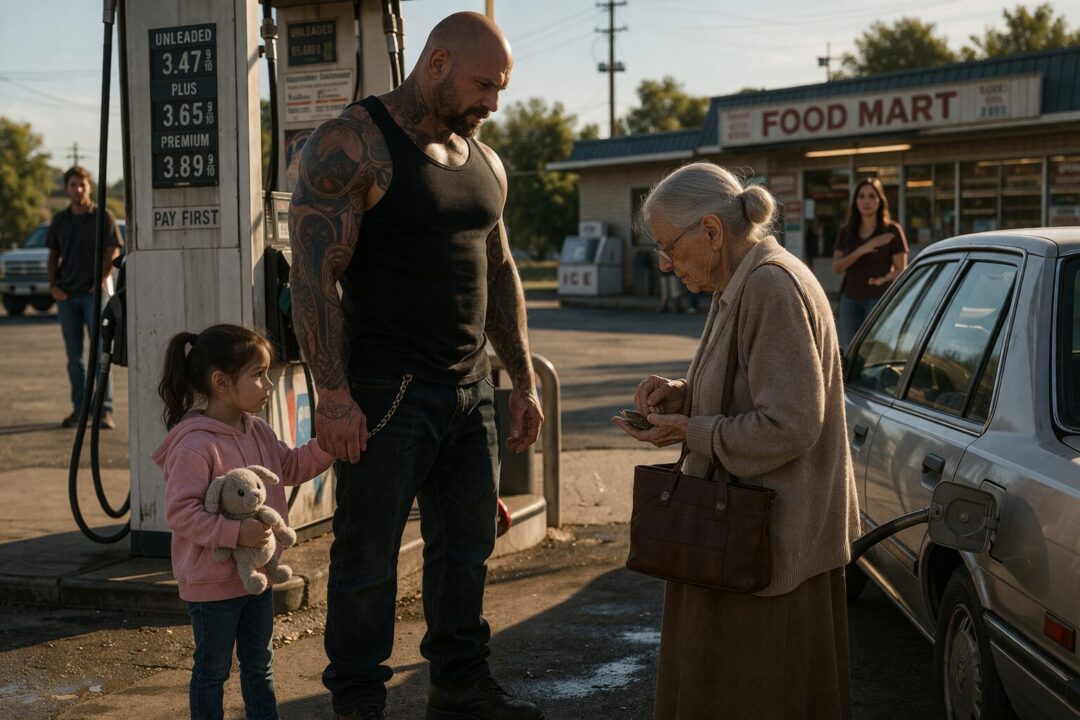
By the time the bald man reached pump three, half the station had already decided what he was.
Dangerous.
The judgment came easily. It always did for men built like him.
He moved with a kind of blunt force that made people shift out of his way before he ever touched them. Broad shoulders. Tattooed arms. Black tank top stretched over a chest thick as concrete. The look of somebody who had spent years breaking things before learning how to hold them together. When he crossed the cracked pavement toward the old silver sedan parked crooked beside the pump, a teenager near the ice freezer paused with the door open and stared. A woman at the next island turned her face but kept watching from the corner of her eye.
At the pump stood an elderly woman, thin as a winter branch, one hand on the car door, the other clutching a small handbag to her ribs.
And the man was heading straight for her.
Lenora saw him coming and felt the blood leave her face.
She had known she was short before she pulled into the station. The gas light had been on for twelve miles. She had watched the numbers crawl higher while the pump kept clicking, then unclicking, as though mocking her. Every gallon sounded like a question she could not afford to answer.
She had parked anyway because she had no choice.
Her grandson needed his inhaler from the pharmacy before evening. The road home ran long and empty, and running out of gas at her age was not an inconvenience. It was exposure. It was humiliation. It was danger.
She had counted her money twice in the car before getting out.
Six dollars and thirty-seven cents.
That was what stood between her and being stranded.
The station was loud in the ordinary way—engines rumbling, a radio leaking country music from somewhere near the garage bay, the faraway clatter of a delivery truck unloading crates—but as the man approached, all of it seemed to fold inward. The world narrowed to his boots on concrete and the open palm she had not yet had the courage to show anyone.
He stopped close enough for her to smell gasoline, heat, and soap.
His voice, when it came, was rough and low.
“That all?”
It should not have hurt, not really. Three words were nothing. Yet shame had a way of making small things sharp.
Lenora looked down instead of at him. His size alone made her feel cornered. Not because he had touched her. He hadn’t. Not because he had raised his voice. He hadn’t done that either. It was simply the pressure of him, the hard outline of a stranger who looked like trouble standing over the small arithmetic of her need.
She opened her hand.
The coins trembled in her palm.
A few quarters. Two dimes. Pennies. A folded one-dollar bill creased so many times it had become soft as cloth.
“It’s all I’ve got,” she said.
Her own voice embarrassed her more than the money did. Thin. Breathy. Apologetic without permission.
For a second he didn’t answer.
He just looked.
Not at her face. At her hand.
The station noise returned in pieces: the slap of a truck door, the hiss of a pump across the lot, a child laughing somewhere too far away to belong to this moment.
Then that laugh came closer.
A little girl in a pink hoodie appeared at the edge of the frame of Lenora’s fear, moving with the unsteady confidence of a child who trusted the world because she had not yet been taught otherwise. She had dark pigtails and a small stuffed rabbit tucked beneath one arm. She came up beside the man and placed her free hand lightly against his fingers.
“Dad?”
The change in him was so small that anyone not watching closely might have missed it.
An exhale.
A loosening at the jaw.
The slightest drop in the shoulders, as though something clenched deep inside him had finally let go.
Lenora did not know then that the girl’s name was Ivy, or that the man’s name was Rowan, or that an hour earlier he had been sitting in his pickup with both hands locked around the steering wheel, trying not to drive to a place he had promised himself he would never go again.
All she saw was the hard line of him falter.
And then, very quietly, he said, “Put that away.”
Part II — Bruises You Couldn’t See
That morning had started with a phone call Rowan did not want to answer.
He recognized the prison’s number before the second ring. His younger brother never called unless he needed money, a favor, or forgiveness he had not earned. Rowan let it ring once more, then picked up because old habits were harder to kill than hope.
He should have let it go to voicemail.
By the time the call ended, rage sat under his skin like live wire.
His brother had a hearing coming up. He said he was different now. He said he had made mistakes. He said family was supposed to show up. Rowan listened to the familiar theater of regret and felt the old life pressing against the door—the fights, the bars, the borrowed couches, the nights that ended with blood on someone’s knuckles and no memory of how it got there.
He had spent eleven years climbing out of that version of himself.
Eleven years learning that the world gave men like him only two scripts: monster or miracle. It never believed in the long, lonely middle where real change lived.
He worked construction now. Paid taxes. Packed school lunches. Remembered appointments. Went to bed tired instead of drunk. He had custody of Ivy because her mother had drifted farther and farther from daylight until even love could not pull her back. Rowan had become the steady one by necessity, and then, after enough days in a row, by choice.
But some mornings the old anger still woke before he did.
So he drove.
Not toward his brother. Not toward trouble. Just nowhere in particular, Ivy humming in the back seat, kicking the heel of one sneaker against the child seat while the radio played songs she did not know. He had promised her a popsicle later if she behaved at the hardware store. She had solemnly accepted the terms like a tiny lawyer.
Then he saw the sedan.
Older model. Rear bumper tied with a strip of white cord. One taillight webbed with cracks. The kind of car people kept alive not because they loved it, but because replacing it was impossible.
He watched it drift into the gas station lot with the hesitant angle of somebody already calculating failure.
He wouldn’t have paid attention if Ivy hadn’t asked, “Why is that grandma crying?”
Rowan looked over.
The woman wasn’t sobbing. Not yet. But there was something in the way she sat with both hands on the wheel for a full ten seconds after parking that made the word fit. She seemed to be gathering herself before stepping into a world that had grown too expensive for her.
He parked two pumps over.
He told himself he was only getting gas.
But when he saw her stop the pump after barely anything, then fumble in her purse, then stare at the numbers as if maybe mercy might round them down, something sour twisted through him.
Not at her.
At the memory of every time he had seen that look.
His mother wearing her work uniform at the kitchen table, sorting bills into hopeless stacks.
A landlord tapping two fingers against the doorway while she apologized for being short again.
The way poverty taught decent people to make themselves small before anyone had even accused them of anything.
By the time Rowan got out of his truck, the anger in him had found a target that had nothing to do with the old woman and everything to do with the world.
Unfortunately, anger always looked the same from the outside.
That was what Ivy saw.
That was what Lenora saw.
That was what the whole station saw when Rowan strode toward pump three like he meant to settle something.
And in a way, he did.
Just not the thing anyone imagined.
Part III — The Softest Thing in the Frame
Lenora did not move when he reached for his pocket.
Fear sharpened her senses. She noticed absurd things: the faded white scar across one of his knuckles, the clean line where his work tan ended above his wrist, the smell of laundry detergent still clinging to his shirt despite the summer heat.
He pulled out his wallet.
Not quickly. Not with drama. Just the way a man might pull out a receipt list or a folded note. Matter-of-fact. Final.
The little girl stayed tucked against his side, her stuffed rabbit pressed to her pink sleeve. She looked from his face to Lenora’s hand full of coins, then back again with the serious attention children sometimes give to adult pain, as if they know it matters long before they know why.
Rowan glanced once at Ivy, once at the coins, and then at Lenora.
“I said put it away.”
There was no cruelty in the words now. No edge. Only something almost tired.
Lenora swallowed. “I can pay some of it.”
He shook his head.
At the next pump, the woman who had been pretending not to watch gave up and watched openly.
Rowan stepped to the card reader, shielding the keypad from view with his body. The little display glowed, unreadable in the harsh afternoon light. Gas began to flow again.
Lenora stared at the numbers climbing on the pump and felt something worse than fear moving through her.
Relief.
Relief was dangerous when you had been holding yourself together all day. It loosened the knots pride used to keep you upright.
“You don’t have to do that,” she whispered.
He didn’t look at her. “Already doing it.”
His tone would have sounded rude to anyone who didn’t know what gentleness sometimes had to hide inside to survive. But Lenora had lived long enough to recognize awkward mercy when she saw it. Some people gave help with a smile that made you feel smaller for taking it. This man gave it like he wanted no witness to the giving at all.
That made it easier to bear.
When the tank was full enough to get her home and then some, he went inside the station without explanation. Lenora stood there with Ivy, the two of them joined by uncertainty.
The girl looked up at her. “My dad sounds mean when he’s worried.”
Lenora blinked.
The child offered the statement not as defense, but as truth.
“Does he?” Lenora asked softly.
Ivy nodded. “But he makes pancakes shaped like dinosaurs.”
Something in Lenora broke open then—not because the sentence was sweet, though it was, but because it was so ordinary. The enormous man with tattoos and a voice like gravel was somebody’s maker of dinosaur pancakes. Somebody’s safe place. Somebody’s morning.
The station door opened again.
Rowan came back holding a small paper bag in one hand and the receipt in the other. Neither carried any visible words from where Lenora stood; the world had mercifully blurred down to gesture and meaning.
He extended the bag toward her.
“There’s water in there,” he said. “And crackers.”
Lenora took it with both hands.
For a terrifying second she thought she might cry in front of him, and she hated that possibility. Crying in public made pain look theatrical when most pain was simply exhausting. But the bag was warm from the station lights, and the water bottle inside knocked gently against the paper, and the kindness of such practical thinking undid her more thoroughly than money could have.
Why crackers?
Because he had noticed she looked faint.
Why water?
Because he had noticed the heat.
It was one thing to be rescued from a problem. It was another to be seen.
“Why would you…” she began, and could not finish.
Rowan finally met her eyes.
Up close, his face was not soft. It still carried years of strain in the set of it. Still looked carved rather than made. But his gaze had changed entirely. The fury was gone. In its place was a kind of recognition too old to be pity.
“Everybody needs help sometimes,” he said.
The sentence should have sounded simple. Maybe it was. Yet behind it Lenora heard the echo of a private history. Not preached. Not displayed. Only present.
Everybody.
Not you.
Not people like you.
Everybody.
The distinction landed deep.
Ivy smiled then, a small, secret smile, as if she had known all along how this would end.
Rowan shifted his weight, uncomfortable with gratitude already gathering around him. He gave the slightest shrug, the universal gesture of men who do not know what to do with tenderness once it has escaped them.
“Get home safe,” he muttered.
Then he turned, took his daughter’s hand, and led her back toward the truck.
Halfway there, Ivy twisted around and waved the stuffed rabbit at Lenora like a blessing.
Lenora laughed through the tears she had failed to stop.
Part IV — What Stayed Behind
She did make it to the pharmacy.
She made it home before dusk, to the peeling blue house where her grandson Malik was sitting on the porch steps with a blanket around his shoulders even though the evening was warm. His chest had that careful, guarded rise children get when breathing has become a negotiation.
“You got it?” he asked.
Lenora held up the paper bag from the pharmacy with one hand and the station bag with the other.
“I got everything.”
Inside, she set the crackers on the counter and told herself she would save them for later, but Malik was hungry the moment he saw them. He ate two while she filled a glass with water and watched the medicine settle onto the shelf like one more day won from the teeth of need.
She did not tell him the whole story right away.
Children, even resilient ones, were too quick to hear fear and too slow to release it.
Instead she said, “A stranger helped me today.”
Malik, solemn with inherited caution, looked up from his crackers. “Was he nice?”
Lenora thought of black tattoos, a hard voice, a heavy stance, an exhale soft enough to change the shape of a moment.
“Eventually,” she said.
That night, after Malik had fallen asleep and the house went still, Lenora sat at the kitchen table under the dim yellow light and emptied her purse again.
The coins clicked onto the wood.
Six dollars and thirty-seven cents.
Untouched.
She stared at them for a long time.
It struck her then how rarely dignity arrived in grand forms. More often it came disguised as something blunt, awkward, and almost easy to miss. A stranger refusing to let you spend your last dollar. A child reaching for her father’s hand at the exact right second. A paper bag with crackers in it because someone noticed more than your problem.
Across town, Rowan tucked Ivy into bed in the apartment above the tire shop where rent was cheap and the walls were thin. She smelled like sunscreen and sugar. He pulled the blanket to her chin while she blinked up at him, fighting sleep.
“You were scary,” she said drowsily.
He leaned back. “I know.”
“But then you weren’t.”
A man could spend years trying to explain himself and still not say anything truer than what a child could say in six words.
Rowan brushed a hand over her hair. “Get some sleep.”
“Did grandma get home?”
He paused.
“I think so.”
Ivy considered that, then shut her eyes. “Good.”
After she slept, Rowan stood alone in the kitchen with the refrigerator humming and the evening pressing warm through the open window. He thought about his brother’s phone call. About the old reflex of rage. About how close anger always felt to usefulness until it stood in daylight and frightened the wrong person.
He had not become a saint. He knew that.
He was still too loud sometimes. Still too quick to harden. Still carrying a face the world read before it ever listened.
But maybe change was not becoming unrecognizable.
Maybe it was this.
Still looking like the storm.
Choosing, anyway, to bring rain where someone needed water.
A week later, Lenora stopped at the same gas station with a little more money in her wallet and far less fear in her chest. She did not expect to see them, and she didn’t. The pumps stood in their same tired row. The cashier inside looked bored. The sky over the lot was white with heat.
Everything ordinary.
And yet pump three had become, in her mind, the place where the world briefly betrayed its own hardness.
As the tank filled, she watched a young man in work boots hold the door open for an exhausted mother carrying a toddler on one hip. Neither of them smiled. They just kept moving. The kindness was quick, unannounced, nearly invisible.
Lenora smiled anyway.
Because once you had seen mercy wear an unexpected face, you started noticing how often it moved among people unnoticed.
Small. Unspectacular. Real.
When she got back in the car, the coins in her purse sounded different against one another—not like insufficiency, but like survival. Like proof that some days you were the one being carried, and on other days, if grace held, you might be the one holding something steady for somebody else.
She drove home under the late afternoon sun, past the pharmacy, past the laundromat, past all the places where people quietly lost and found themselves every day.
And all the way back, she kept thinking of the little girl’s hand resting on that man’s fist, and of the way one gentle touch had opened a door in him that anger could not keep shut.
By the time Lenora turned onto her street, she knew that what she would remember most was not the fear.
Not even the relief.
It was the moment after the misunderstanding, when the world could have stayed cruel and did not.
The moment a man everyone would have judged from across a parking lot chose kindness so practical, so restrained, and so human that it left no room for performance.
Only weight.
Only grace.
Only the soft clink of small coins that, for once, did not have to be enough.