They Put A Repair Bill In Front Of The Widow Until Her Old Soccer Ball Told The Truth
Chapter 1: The Ball Crossed The Curb Before Anyone Looked Twice
The ball left Jacob’s foot wrong.
Barbara Hall saw it the instant it happened, before the coach shouted, before the parents lifted their heads from folding chairs and paper coffee cups, before Jacob’s own face changed from concentration to fear.
The boy’s red-and-blue jersey flashed across the field, one sock sliding down his shin, one arm thrown out for balance. He had been chasing the ball too hard, trying to make up for being smaller than the other boys. His cleat caught the side of it instead of the center, and the ball spun off the damp grass with a crooked, angry bounce.
It did not roll toward the sideline.
It flew over it.
Barbara’s hand tightened around the top of her cane.
“Jacob,” she said, but the word came out too softly to matter.
The ball hit the strip of grass beyond the touchline, skipped once, and sailed toward the curb that separated the community field from the narrow residential lane. Beyond that curb, polished and dark as wet ink, sat Jeffrey Clark’s black SUV.
Barbara had noticed the SUV earlier because Jeffrey had parked it too close to the field gate again, half a tire over the faded white curb paint. Jeffrey always parked as if every inch of neighborhood pavement had been waiting for him. He was standing beside the driver’s door now in a dark suit, one hand holding his phone, the other resting on the roof as if the vehicle were a desk.
The ball struck the curb and popped upward.
Several parents gasped.
Jacob stopped running.
For half a second, the whole morning seemed to hold its breath. The children in bright uniforms froze in different poses across the grass. A whistle dangled silent from the coach’s mouth. Barbara felt the old familiar pull in her knees, the warning that she could not move fast enough no matter how badly she wanted to.
The ball came down beside the SUV.
It did not shatter glass. It did not set off an alarm. It did not make the loud metallic crack that every adult near the field seemed to be waiting for.
It bounced low near the front passenger side, nudged the tire, and rolled into the shade beneath the running board.
Jacob stood with both hands at his sides, his face pale under the sweat.
Jeffrey lowered his phone.
The look he gave the field was slow and deliberate, as if the ball had not been kicked by a child but thrown by someone with a grudge. His gaze moved from the SUV to Jacob, then past Jacob to Barbara, who was sitting beneath the small maple tree at the edge of her yard.
Barbara wished, with a sharpness that embarrassed her, that Kevin were still beside her in the old lawn chair with the torn green armrest. Kevin would have raised one hand, walked over before anyone had time to make a thing of it, and said something plain enough to settle the air. Easy, now. It’s only a ball.
But Kevin had been gone four years, and his chair stayed folded in the shed.
Barbara pushed herself up.
The ball was not only a ball, not to her. Its white panels had yellowed, and the blue seams were scuffed from years of grass, garage dust, and little feet. On one faded panel, written in permanent marker that had softened to gray, was Kevin Hall’s name. He had signed it on the last spring he coached the under-tens, when the children had begged him to mark something “official” for the team shed. After he died, Barbara had kept it in the hall closet. Jacob had found it the previous month and asked if he could practice with it.
“It still wants to be kicked,” Barbara had told him, though her throat had tightened when she said it.
Now Jeffrey Clark stepped away from the SUV.
He did not hurry. Somehow that made it worse.
Jacob looked back at Barbara. His mouth moved around a word she could not hear from across the grass. Sorry, probably. He was always apologizing before anyone accused him.
Barbara lifted her hand to him, palm down, telling him to stay still.
Jeffrey crouched beside the SUV and reached under the running board. When he straightened, the ball was in his hand. He turned it once, then stopped.
Barbara was still several steps away, moving carefully over the uneven grass. She saw his expression change before she saw what he was looking at.
His brows drew together. His mouth lost its hard line. For a moment he looked less angry than startled, almost caught. He rotated the ball until the faded signature faced him fully.
Kevin Hall.
The field noise returned in fragments. A child asked if the game was over. Someone laughed too loudly. The coach finally blew the whistle, though the play had already died.
“Mr. Clark,” Barbara called, keeping her voice even.
Jeffrey blinked. His hand tightened around the ball. Then the sternness came back, not all at once, but like a curtain being pulled into place.
“Is this yours?” he asked.
Barbara reached the curb and stopped where the grass met concrete. She did not like standing below him while he held the ball, but stepping into the street would put her too close to the SUV.
“It belongs to my family,” she said. “Jacob didn’t mean for it to come this way.”
Jacob had crept closer behind her. “I’m sorry, sir. I kicked it wrong.”
Jeffrey glanced at him only briefly. “A wrong kick can still do damage.”
Barbara looked at the SUV. The morning sun reflected off its black paint, making it hard to see anything except shine and shadow. Near the front passenger side, below the door, something small interrupted the reflection. A dent, perhaps. A scrape. Or just the bend of light across the panel.
“I didn’t hear it hit the door,” Barbara said.
“That doesn’t mean it didn’t.”
The coach came over with the cautious look of a man hoping not to be pulled into an adult dispute. “Everything okay here?”
Jeffrey held up the ball. “This came off your field.”
“It’s a community field,” the coach said. “But yes, it happened during practice. We’re sorry about that.”
Barbara heard the careful distance in his answer. Your field had become the field. Practice had become something happening around them, not with them.
Jeffrey turned back to Barbara. “I’ll have it looked at.”
“Of course,” Barbara said. “If there’s damage from the ball, we’ll talk about it properly.”
His eyes stayed on hers a little too long.
“Properly,” he repeated.
He tossed the ball underhand toward Jacob, but not gently. Jacob caught it against his chest with both arms and stepped back as if it might be taken from him again.
Barbara watched Jeffrey open the driver’s door. Before he got in, he looked once more toward the ball, toward the faded gray writing beneath Jacob’s fingers.
“You live in the blue house, right?” he asked.
Barbara nodded.
“I know where it is.”
The words should not have sounded like a threat. He was only stating a fact. But several parents had gone quiet again, and Barbara felt heat rise under her collar.
Jeffrey slid into the SUV, shut the door, and started the engine. The vehicle pulled away from the curb slowly. As it passed the metal gate at the field entrance, the front passenger side came close enough that Barbara held her breath without meaning to.
The SUV cleared it.
Jacob stood beside her with the ball pressed to his chest.
“I didn’t mean to,” he whispered.
“I know.”
“Is he going to make Mom pay?”
Barbara looked at the street where the SUV had been. The sunlight still showed the faint curve of tire marks near the curb and the chipped paint on the old gatepost. Kevin had complained about that gate for years, saying people swung too close to it because the lane was narrower than it looked.
“We don’t know anything yet,” she said.
Jacob lowered his eyes to the ball. One thumb rubbed over Kevin’s faded signature, smearing a line of fresh grass across the old ink.
Barbara gently took the ball from him and turned it in her hands. The leather was soft, much softer than the hard shine of Jeffrey’s SUV. A toy, Kevin would have said. Not a hammer.
Across the field, the coach called the children back to practice. The parents returned to their chairs, but Barbara could feel some of them still looking her way.
By afternoon, the story would already be easier for them to tell than the truth: Barbara Hall’s grandson kicked a ball into Jeffrey Clark’s SUV.
By Monday, Jeffrey would make it easier still.
He called late that evening while Barbara was rinsing her teacup.
“I had the vehicle inspected,” he said, without greeting. “I’ll bring the repair estimate to your porch.”
Barbara held the phone against her ear and looked through the kitchen window toward the field, where the grass had gone silver in the dusk.
“Bring whatever you think I need to see,” she said.
“I will,” Jeffrey replied. “And Mrs. Hall? This will be simpler if you don’t make it difficult.”
After he hung up, Barbara stood a moment longer by the sink. The signed ball rested on the kitchen chair, grass still streaked across Kevin’s name.
Chapter 2: The Repair Estimate Landed Beside Kevin’s Signature
Jeffrey Clark did not hand Barbara the estimate.
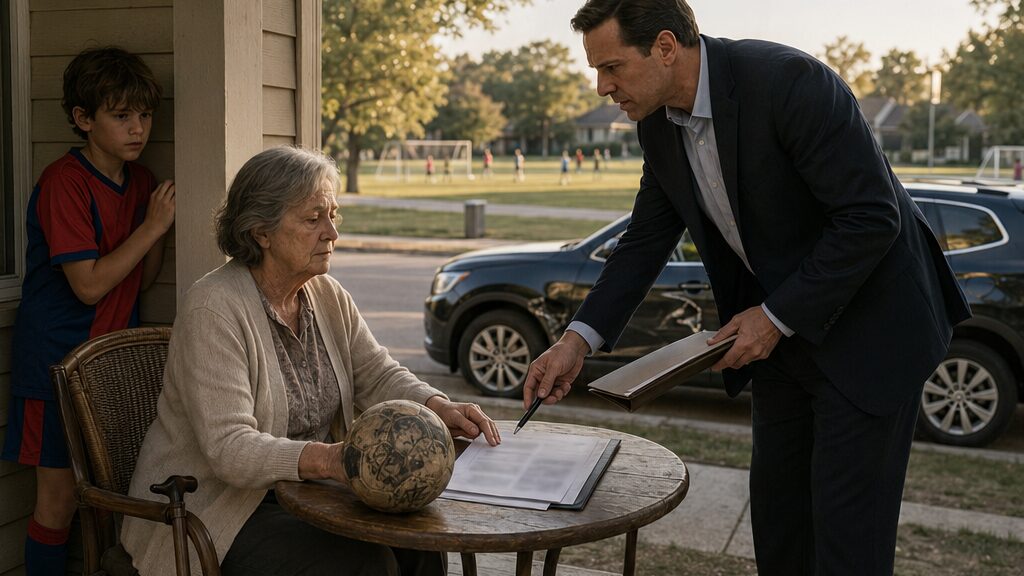
He placed it on her porch table, flat and square, as if serving her something she had ordered.
The paper was clipped to a glossy folder from a body shop she had never used. Across the top, in bold black print, was Jeffrey’s name, the make of the SUV, and a total that made Barbara’s fingers go cold before she had finished reading it.
$3,842.17.
Jacob, who had come over after school still wearing his practice shorts, stood half behind Barbara’s porch column. The old soccer ball was tucked under his elbow. Michelle Davis had not arrived yet, though Barbara had called her once and left a message that tried to sound calmer than she felt.
Jeffrey stood at the foot of the porch steps with his hands in the pockets of his suit pants. Behind him, parked at the curb in full view, was the black SUV. Its passenger side faced Barbara’s house as if he had positioned it for display.
“I don’t understand this amount,” Barbara said.
“It’s a luxury vehicle.”
She looked up from the paper. “I understand numbers, Mr. Clark. I said I don’t understand this amount for a ball.”
His mouth tightened. “The ball struck the quarter panel hard enough to dent and scuff it. There’s paint correction, panel work, blending. The shop explained it.”
“Was I supposed to be there when they explained it?”
“You’re not the owner of the vehicle.”
“No,” Barbara said. “But you’re asking me to pay for it.”
Jacob shifted behind the column. The ball squeaked faintly under his arm.
Jeffrey’s eyes moved toward him. “Your grandson caused the damage. I’m trying to handle this neighbor to neighbor.”
Barbara looked again at the estimate. She had paid bills all her life. Roofing bills. Plumbing bills. Kevin’s medical bills that came in envelopes so thin they seemed harmless until opened. She had learned not to let the total be the only thing she saw. Totals frightened people. Details told quieter stories.
Under the labor line, something caught her eye.
Supplement/reference: prior inspection note pending.
She read it once, then again.
Jeffrey reached into the folder and pulled out a second sheet. “This is a responsibility acknowledgment. If you sign it today, I won’t involve the HOA formally.”
Barbara did not take the pen he held out.
The porch seemed smaller suddenly. The wicker chair pressed against the wall. Her geranium pots sat in a neat row by the railing. Kevin’s wind chime moved faintly though there was barely any breeze.
“Why would the HOA be involved?” she asked.
“Because the incident came from property adjacent to a common-use area, and there have been complaints about loose balls and children cutting through yards.”
“Children have played there for thirty years.”
“That doesn’t make you exempt from responsibility.”
“I didn’t say it did.”
“You’re making this harder than it needs to be.”
Barbara folded her hands in her lap so he would not see the tremor in them. She was seated because standing too long made her hip ache, but she disliked how it made him loom from the steps.
Jacob whispered, “Grandma, I’m sorry.”
Jeffrey turned sharply. “Sorry doesn’t repair a vehicle.”
Barbara’s eyes lifted.
The porch went still.
Jacob’s face flushed red. He stared down at the floorboards, holding the ball tighter.
“Mr. Clark,” Barbara said, “you can speak to me about the bill. You don’t need to speak to him that way.”
Jeffrey exhaled through his nose. “Then sign the form and keep him out of it.”
Barbara reached for the soccer ball. Jacob gave it to her without looking up. She set it on the porch table beside the estimate. The old leather sagged slightly where the panels had softened. Kevin’s signature faced upward, faded beneath the grass streak from Saturday.
Jeffrey’s gaze dropped to it.
Again, the change came quickly and was gone almost as fast. His eyes narrowed, not in anger this time. Recognition passed over his face, thin but unmistakable.
“You knew my husband?” Barbara asked.
Jeffrey looked back at her. “Everyone knew Kevin Hall. He was around the field constantly.”
“That isn’t what I asked.”
“He coached kids,” Jeffrey said. “That doesn’t have anything to do with my SUV.”
Barbara let her hand rest on the ball. “No, maybe not.”
He stepped onto the first porch step. “Mrs. Hall, I understand this may be upsetting. I understand you’re on your own. That’s why I brought the paperwork directly instead of letting this become a larger matter.”
The words were dressed as kindness. Barbara heard what was underneath.
On your own.
She had heard it from bank clerks who spoke louder than necessary. From repairmen who told her to call her son though she did not have one. From neighbors who asked if she still drove at night. From Michelle, sometimes, when worry made her voice too careful.
Barbara looked down at the responsibility form. There was a blank line for her signature. Another for the date. The paper did not ask what she had seen. It did not ask what Jacob had felt when an adult man turned his mistake into a debt. It did not ask whether a soft soccer ball could make the kind of damage Jeffrey claimed.
It only waited for her name.
“I’m not signing this today,” Barbara said.
Jeffrey blinked. “Excuse me?”
“I said I’m not signing something I haven’t checked.”
“You saw what happened.”
“I saw a ball cross a curb.”
“You saw it hit my vehicle.”
“I saw it roll under your running board.”
He gave a short laugh. “That distinction won’t matter to the repair shop.”
“It matters to me.”
From the sidewalk, one of the neighborhood residents slowed while walking a small dog. Jeffrey noticed. His posture shifted, straighter, louder.
“Mrs. Hall, I’m trying to spare you additional fees. If this goes through the HOA, they may attach administrative costs. If insurance gets involved, they may contact your homeowner’s policy. If you delay, that is your choice.”
Barbara felt Jacob looking at her. She thought of the balance in her savings account, the roof she had postponed repairing, the property tax notice folded in the drawer beneath the phone book. Three thousand eight hundred forty-two dollars and seventeen cents was not an inconvenience. It was winter heat. It was medicine. It was the difference between choosing and being cornered.
She slid the estimate back toward Jeffrey, but kept the copy of the total facing herself.
“You may leave me a copy,” she said. “I will look at it.”
“I need acknowledgment that you received it.”
“I acknowledge that you put it on my porch.”
His jaw worked.
Barbara reached for the pen, and for one second Jeffrey’s expression eased. Then she wrote only the date and the word Received on the bottom margin of the copy, not on the responsibility form. Her handwriting was small but steady.
Jeffrey stared at it.
“That is not what I asked you to sign.”
“No,” Barbara said. “It is what I am willing to sign.”
The resident with the dog had stopped pretending not to listen.
Jeffrey gathered the folder with a controlled snap. “You understand that refusing to cooperate will not help your position.”
Barbara looked past him toward the SUV. Sunlight bent across the passenger panel. The dent was visible now, but from the porch it looked narrow and vertical, not round. A thin black scrape sat near its center, hard to distinguish from reflection.
“May I look at the damage closer?” she asked.
“You had your chance Saturday.”
“No, Saturday you drove away.”
“I had an appointment.”
“Then perhaps now.”
Jeffrey came down one step. “This is not an inspection. This is a courtesy visit.”
“Courtesy usually leaves room for questions.”
He laughed again, quieter. “Mrs. Hall, don’t let pride make this expensive.”
Barbara’s face warmed, but she did not answer quickly. Quick answers belonged to people who wanted to win the minute. She wanted to keep her house.
She lifted the soccer ball from the table and held it in both hands.
“Kevin used to tell the children to look twice before they kicked,” she said. “He said most mistakes happen after the first glance.”
Jeffrey’s eyes flicked to the signature again.
“This isn’t about Kevin.”
“Then it won’t hurt to look twice.”
For the first time, Jeffrey seemed uncertain whether anger would help him. He turned away, descended the steps, and paused at the walkway.
“I’ll notify the board,” he said. “There are procedures for this.”
“I’m sure there are.”
“And fines, if you force them to become involved.”
Barbara watched him return to the SUV. He opened the door, then looked back toward the porch table, where the repair estimate remained beside the empty ring of dust left by the ball.
“You have until the meeting,” he called. “After that, I can’t promise the amount stays the same.”
He drove away faster than he had on Saturday.
Jacob waited until the SUV disappeared around the corner before speaking.
“Grandma, what if Mom says we should pay?”
Barbara looked at Kevin’s signature under her thumb. The grass mark across it was green, not black. No paint. No hard scrape. No sharp edge. Just grass from a field that had known their family longer than Jeffrey Clark had known the neighborhood.
“Then I’ll listen to her,” Barbara said. “And I’ll still look twice.”
Chapter 3: The HOA Heard The Loudest Neighbor First
By Wednesday evening, the story had grown teeth.
Barbara felt them as soon as she stepped into the HOA meeting room.
It was not a proper room, only the back half of the community clubhouse with stackable chairs, humming fluorescent lights, and a folding table where the board sat with bottled water and printed agendas. Still, the place had a way of making small troubles look official. A neighbor’s overgrown hedge became a “visibility concern.” A trash bin left out overnight became “community compliance.” A soccer ball near a black SUV had become, according to the line printed halfway down the agenda, Vehicle Damage Incident Adjacent To Common Field.
Barbara stood just inside the doorway holding her purse and the folder Jeffrey had left on her porch. Jacob was not with her. She had asked Michelle to keep him home, though Michelle had sounded unhappy about the whole thing.
“You shouldn’t go alone,” Michelle had said.
“I’ve gone to grocery stores, banks, doctors’ offices, and funerals alone,” Barbara had replied. “I can sit in a meeting.”
“That’s not what I meant.”
Barbara knew it was not. That was the problem.
Several chairs were already occupied. Youth soccer parents sat near the back, arms folded, some looking guilty, some relieved not to be the subject of the agenda. Two neighborhood residents whispered near the coffee urn. Jeffrey Clark sat at the board table, not in the audience, because treasurer gave him a place among the people deciding what counted.
He had brought photographs.
Barbara saw them before she sat down: color printouts clipped into the packets arranged in front of the board. The top photo showed the old soccer ball beside the front tire of the black SUV. From the angle, the ball looked larger, closer to the door than Barbara remembered. Kevin’s signature was not visible. The softness of the ball was not visible. Jacob was not visible either, which was almost worse. Without the child, without the field, without the breathless second when the ball rolled instead of struck, the photograph looked like proof.
Barbara took a chair near the aisle.
The HOA board chair called the meeting to order with the weary confidence of someone who believed procedure made people reasonable.
After two landscaping complaints and a discussion about pool key replacements, Jeffrey adjusted the knot of his tie and stood.
“I’ll keep this brief,” he said.
He did not keep it brief.
He described the Saturday practice, the ball, the impact, the repair estimate, and Barbara’s refusal to sign responsibility. His voice was calm. That made people listen. He did not call her careless. He said “unfortunate.” He did not say Jacob was reckless. He said “minor supervision issue.” He did not say Barbara was old. He said “a resident who may not fully understand the liability process.”
Barbara’s fingers tightened around her purse clasp.
A woman in the second row glanced back at her, then away.
Jeffrey lifted one of the photos. “This is where the ball came to rest after striking the passenger side. The damage is consistent with that event.”
Barbara looked at the photo. The ball was under the running board, not against the panel. But no one else leaned close enough to notice.
The board chair turned to her. “Mrs. Hall, would you like to respond?”
Barbara stood carefully. Her hip objected after the hard chair. She held the folder against her ribs, feeling the paper edges through the thin cardboard.
“Yes,” she said. “The ball came near the vehicle. I have not agreed that it caused the damage.”
Jeffrey’s chair creaked. “With respect, Mrs. Hall, several people saw it.”
“Several people saw it leave the field.”
A man from the back muttered something about kids kicking too close to cars. The board chair tapped her pen once on the table.
Barbara continued. “I asked to look more closely at the damage. Mr. Clark declined.”
“I declined an informal inspection by someone with no expertise,” Jeffrey said.
“You declined my looking at what you asked me to pay for.”
A small silence followed. Not support, exactly. More like surprise that she had answered.
The board chair looked down at her packet. “The estimate is for three thousand eight hundred forty-two dollars and seventeen cents?”
“Yes,” Jeffrey said.
A soft sound moved through the room. Barbara kept her gaze forward. She had learned that if she looked embarrassed, others would decide she had reason to be.
Jeffrey placed both hands on the table. “This is not only about one vehicle. Residents along the field have had ongoing concerns. Children cut across lawns. Balls hit fences. We have asked for better boundaries before. Mrs. Hall’s property sits directly adjacent, and her family uses that access frequently.”
“My family uses my yard,” Barbara said.
“And the field.”
“The field is common property.”
“Which requires common responsibility.”
The phrase landed neatly. A few heads nodded.
Barbara heard Kevin’s voice in memory, not as comfort, but as a practical correction: Neat phrases can hide crooked work.
The board chair flipped through the packet. “Mrs. Hall, are you disputing that your grandson kicked the ball?”
“No.”
“Are you disputing that the ball reached Mr. Clark’s vehicle?”
“No.”
“Then what exactly are you disputing?”
The room waited.
Barbara felt the trap in the question. If she said too much without proof, she would sound confused. If she said too little, she would sound evasive. Jeffrey had brought photographs, a repair estimate, a title, a tone. Barbara had brought only what she had seen.
“I am disputing being asked to pay before anyone confirms what made that dent,” she said.
Jeffrey gave a patient sigh. “That is why I had an estimate prepared.”
“An estimate prices repair. It does not prove cause.”
The board chair’s pen paused.
Barbara did not look at Jeffrey. She looked at the photo packet. “May I ask why the estimate includes the phrase supplement/reference?”
Jeffrey’s expression changed only slightly. His mouth opened, then closed into a faint smile.
“That is standard shop language.”
“Maybe.”
“It is.”
“Then it should be easy to explain.”
The board chair looked between them. “Do we need the repair shop to clarify that?”
Jeffrey answered before Barbara could. “With respect, I don’t think we need to turn a straightforward neighbor damage matter into a trial. Mrs. Hall’s grandson made an honest mistake. I’m not trying to punish anyone. I’m asking for accountability.”
Accountability. Another neat word.
Barbara thought of Jacob’s face on the porch when Jeffrey said sorry did not repair a vehicle. She thought of the soccer ball pressed to his chest like a shield. She thought of Kevin’s name hidden in Jeffrey’s photograph because the ball had been turned the wrong way.
The board chair softened her voice. “Mrs. Hall, sometimes these matters are best resolved before they become more stressful. You may want to involve your family in deciding how to proceed.”
There it was again. Family as a polite substitute for supervision.
“I decide how I proceed,” Barbara said.
No one moved.
Her own voice had surprised her. Not loud. Not rude. But it had crossed something.
Jeffrey leaned back, watching her now with less polish in his face.
The board chair cleared her throat. “Of course. What we can do tonight is set a resolution period. Mr. Clark has submitted documentation of the claimed damage. Mrs. Hall has raised questions about causation. Since the vehicle was parked adjacent to a common area, the board may assess administrative fees if the matter remains unresolved and continues to require review.”
Barbara absorbed the words one by one. Administrative fees. Claimed damage. Resolution period. All of them sounded clean until they touched her life.
“How long?” she asked.
“Ten days,” the board chair said. “We’ll expect the parties to resolve the claim or provide further documentation by then.”
Jeffrey nodded as if this were generous.
Barbara sat down slowly. Around her, the meeting moved on to irrigation schedules and clubhouse reservations, but she heard little of it. Her name had not been shouted. No one had called her guilty. Yet somehow, by the end of the discussion, the room had accepted that she owed either money or proof.
Outside, the evening had cooled. The field lights were on, throwing white squares across the grass. Barbara walked the path home with the folder held close. Near the curb, she paused beside the old metal gate.
The black SUV was not there.
A stripe of chipped paint showed on the gatepost where years of careless parking had scraped it. Barbara had seen it before. Kevin had seen it before. He had once wrapped reflective tape around that post after a neighbor complained they could not see it at dusk. The tape was long gone now, peeled away by weather and time.
Barbara reached out and touched the rough edge of the chipped metal.
Then she looked back toward her blue house.
Through the kitchen window, she could see the faint shape of the soccer ball resting on a chair, where she had left it before the meeting.
Ten days, they had said.
Barbara continued up the walkway, knowing now that the bill was no longer the worst part.
The worst part was that they had believed the photograph before they had listened to her.
Chapter 4: Michelle Wanted Peace More Than Proof
Michelle arrived with a paper bag of groceries and a face that told Barbara she had already decided what kind of evening it would be.
She came through the kitchen door without knocking, the way she had since childhood, and set the bag beside the sink. A carton of eggs rested on top, cushioned by a loaf of wheat bread. Beneath them Barbara could see a bottle of dish soap, two cans of soup, and the tea Michelle bought when she worried too much to say so.
“You didn’t need to bring anything,” Barbara said.
“I was already at the store.”
“You live fifteen minutes from that store.”
Michelle ignored that and began putting things away. She moved quickly, opening cabinets she knew by memory. Barbara sat at the kitchen table with the HOA packet spread before her, the repair estimate on top, the signed soccer ball balanced on the chair beside her as if it needed its own seat.
Outside, the field was dark. The window over the sink reflected Michelle’s shape more clearly than the yard beyond.
“Jacob cried when I picked him up,” Michelle said.
Barbara looked down at the estimate. “I’m sorry.”
“He thinks he cost you almost four thousand dollars.”
“He didn’t.”
“He kicked the ball.”
“Yes,” Barbara said. “He did that.”
Michelle shut the cabinet too hard. “Mom.”
Barbara waited.
Michelle turned, one hand still on the cabinet knob. She looked tired, not angry exactly. There were lines beside her mouth that Barbara did not remember from last year. Worry had made Michelle older in uneven ways, sharpening some parts, softening others.
“I’m not saying Jeffrey Clark is right,” Michelle said. “I’m saying this could get bigger than it needs to be.”
“It’s already bigger than it needed to be.”
“That’s why I think we should talk about paying something.”
Barbara’s hands rested on the edge of the table. She did not move them.
“Something,” she repeated.
“Not the full amount. Maybe half. Maybe less. Enough to show goodwill.”
“Goodwill toward a bill I don’t believe I owe.”
“Goodwill toward making him stop.”
There it was, laid bare on the kitchen table beside the estimate and the printed photograph and the responsibility form with the blank signature line.
Making him stop.
Barbara could not blame Michelle for wanting that. After Kevin got sick, Michelle had become skilled at stopping things before they reached Barbara. She filtered medical calls, argued with billing offices, drove over in rainstorms to change smoke detector batteries that were not dead yet. She loved by reducing the number of sharp edges in the room.
But sometimes she took the knife from someone else’s hand and pressed the handle into Barbara’s.
Michelle pulled out the chair opposite her. “The HOA can be nasty about fees. You know that. And if insurance gets involved, what if your rates go up? What if they decide you were negligent because the field is right there?”
“The field is not my property.”
“But your yard is beside it.”
“That doesn’t make me responsible for every ball that crosses a curb.”
“I know that. I do. But proving it could cost more than settling.”
Barbara looked at her daughter’s hands. Michelle had folded them tightly, her thumb rubbing the side of one nail. She had done that as a girl when teachers sent notes home.
“I have enough in savings,” Barbara said carefully, “to handle my taxes, the furnace service, and part of the roof if it gets worse before spring. I do not have enough to pay a man because he frightened us quickly.”
Michelle’s face changed. “I’m not trying to frighten you.”
“No. He is.”
For a moment neither of them spoke.
The refrigerator clicked on. In the chair beside Barbara, the ball slowly shifted against the cushion and settled again.
Michelle looked at it, and her expression softened in spite of herself. “Why is that still out?”
“Because it’s part of what happened.”
“It’s just an old ball.”
Barbara touched the nearest panel. “Your father signed it.”
“I know.”
“No,” Barbara said softly. “You remember him signing many things. Permission slips. Player rosters. Checks for orange slices and shin guards. This one was the last season.”
Michelle looked away.
Barbara wished she had not said it that way. Grief did not need help finding openings. It lived in the kitchen chairs, the extra mug, the places where Kevin’s practical habits had left small hollows.
Michelle reached into her purse and took out her checkbook.
Barbara stared at it.
“What are you doing?”
“I can cover a payment,” Michelle said. “Not all of it, but enough to get him off your porch while we figure out the rest.”
“No.”
“Mom, please don’t make this about pride.”
Barbara’s throat tightened. Jeffrey had used nearly the same words.
“It is not pride to ask if a bill is true.”
Michelle flinched, but did not put the checkbook away. “And what if it is true? What if Jacob’s ball did hit it? What if everyone at that meeting thinks you’re just refusing because you don’t want to pay?”
Barbara looked at the photograph from the HOA packet. The old ball sat near the SUV tire, flattened by the angle into something heavier than it was. She picked it up from the chair and set it on the table between them.
The signature faced sideways. A green streak crossed Kevin’s name where Jacob’s thumb had rubbed grass into the faded marker.
Barbara had seen that streak every day since Saturday. On the porch, under Jeffrey’s eyes, it had seemed only a reminder of the field. Now, beneath the kitchen light, it caught differently.
She drew the ball closer.
“Mom?”
Barbara did not answer. She turned the ball slowly, panel by panel. Scuffs, dirt, worn seams. A brownish mark from the garage floor near one valve edge. A pale scratch where age had cracked the coating.
No black paint.
The streak across Kevin’s signature was grass. She rubbed it lightly with the corner of a napkin. Green came off. Nothing dark underneath. No hard residue. No flakes. No scrape like the kind that came from car paint or a metal panel.
“What are you doing?” Michelle asked.
“Looking.”
“At what?”
“At what isn’t here.”
Michelle sighed, but the sound lost some force before it ended. “A ball wouldn’t necessarily keep paint.”
“Maybe not.”
“Then this doesn’t prove anything.”
“No,” Barbara said. “It doesn’t.”
She set the ball down gently.
That was the thing no one wanted to tolerate: not knowing. Jeffrey had filled not knowing with a bill. The HOA had filled it with a deadline. Michelle wanted to fill it with a check. Barbara had almost let them.
Her hand moved toward the repair estimate, then stopped.
She imagined signing something because she was tired. She imagined the check clearing, the matter closing, and every neighbor on that field learning the same lesson: if something happened near Barbara Hall’s house, she could be made to pay before she was believed.
She pushed the checkbook back toward Michelle.
“I won’t do it tonight.”
Michelle closed her eyes. “What are you going to do?”
Barbara stood. Her hip ached from the meeting chair, but she crossed the kitchen slowly to the narrow pantry beside the back door. On the bottom shelf, behind a plastic bin of extension cords and old flower vases, was a blue storage box with Kevin’s handwriting on a strip of masking tape.
FIELD / HOUSE / MISC.
Michelle rose. “Mom, let me get that.”
“I can get a box.”
“It’s heavy.”
“I know what it weighs.”
Barbara bent carefully, bracing one hand on the door frame. The box dragged against the shelf with a dry cardboard scrape. She lifted it only an inch before Michelle stepped beside her, not taking over this time, just supporting the other side.
Together they carried it to the table.
Dust clung to the lid. Barbara had not opened it since the month after Kevin died, when she had searched for the sprinkler manual and found instead a stack of youth-league rosters with his notes in the margins. She had closed the box and left the sprinkler broken for another week.
Now she pulled off the lid.
Inside were folders, rolled field diagrams, old receipts, a whistle with a cracked cord, and a small measuring tape Kevin used to carry in his jacket pocket. His handwriting appeared on tabs and envelopes: GATE, DRAINAGE, FIELD LINES, SPRING MAINT.
Michelle sat down slowly.
Barbara lifted the folder marked GATE.
Her fingers were steadier than she expected.
Chapter 5: The Old Folder Remembered What Everyone Rushed Past
By morning, Barbara had three notes written in her own hand and one question she did not like.
The question sat at the top of a yellow pad beside her tea: If the ball did not mark the car, what did?
She had slept poorly. Not because of the box, exactly. The box had done what old things often did; it opened a room she had locked too quickly. Kevin’s handwriting had kept appearing under her fingers in the hours after Michelle left. A grocery receipt from seven years ago. A sketch of the field gate. A note about replacing reflective tape after a summer storm. None of it dramatic. None of it meant to be saved as memory.
That made it worse.
Kevin had not known he was leaving proof of himself.
Barbara sat at the kitchen table in her robe, the old soccer ball near her elbow and the blue storage box open on the chair. The folder marked GATE contained more than she expected. The HOA had argued for years about whether the field gate belonged to the association or to the city recreation department. Kevin, who disliked fuzzy responsibility, had kept copies of emails, hand-drawn measurements, and notes about near misses.
Cars cut too close turning out from lane.
Gate latch height approx. 29 in.
Black scrape on post after spring tournament—SUV? No report.
Barbara traced that last line with one finger.
The note was dated six years earlier.
She looked toward the window. The field was empty except for dew, the goals standing pale at either end. Beyond the grass, the metal gate waited by the curb.
She dressed without rushing. Slacks, cardigan, practical shoes. She put Kevin’s old measuring tape in her pocket, tucked the yellow pad under her arm, and carried the soccer ball in a cloth grocery bag so the neighbors would not see it and decide she was staging something.
At the curb, the morning air smelled of wet grass and cut leaves. Barbara stood where Jacob had stood Saturday. She looked toward the field, then toward the street, trying to make her memory behave like a room she could enter.
The kick had come from the left side of the field. The ball had skipped once, hit the curb, popped up, and rolled under the SUV. Had it touched the door? She could not swear it had not. That was the honest trouble. She had seen a near miss from an old woman’s distance, through panic and movement.
But she remembered the sound.
No sharp knock. No metallic thud. Only the soft slap of leather, the curb tap, and Jacob’s cleats stopping behind her.
Barbara took out the ball and placed it where it had rolled to rest, close to where Jeffrey’s tire had been. Without the SUV there, it looked small. Too small, almost foolishly small, to have frightened everyone.
She crouched, not easily, and measured from the ground to the center of the ball: a little under nine inches. Even with the bounce, even if it had clipped the vehicle, the likely mark would have been low and round.
The dent she had seen on Jeffrey’s SUV was narrow and higher.
She wrote that down.
Then she walked to the gatepost.
The metal gate was older than most of the neighborhood’s new paint jobs. Its green coating had faded to a dull, tired color, and rust showed in freckles along the hinge. The latch jutted from the passenger-side edge of the entrance where cars leaving the curb could swing too close if the driver turned sharply.
Barbara pulled Kevin’s measuring tape from her pocket. The metal tongue clicked against the gatepost.
Twenty-nine inches.
She measured again because she did not trust how badly she wanted it to matter.
Twenty-nine inches.
Her breath came out slowly.
On the side of the latch, near the outer curve, was a fresh black scrape.
Not the old dull marks Kevin had noted years before. This one had a shine to it where paint had transferred onto metal and not yet weathered. She touched the edge with the tip of one finger. It did not flake, but it left a faint dark smudge.
Barbara looked down the lane toward where Jeffrey usually parked. To leave that curb, a driver would have to angle around the gatepost, especially if another car sat across the narrow street. Jeffrey drove large vehicles as if lanes widened out of respect.
A voice behind her said, “You looking for something?”
Barbara turned too quickly and felt it in her hip.
The soccer coach stood at the field entrance holding a mesh bag of cones. He looked embarrassed the moment she faced him.
“Sorry,” he said. “Didn’t mean to startle you.”
“I’m looking at the gate.”
“I see that.”
He glanced at the measuring tape, then at the ball in the grocery bag. His expression became cautious. Everyone had become cautious around her, as if the accusation might spread by contact.
“You were there Saturday,” Barbara said.
“I was.”
“Did you hear the ball hit the SUV door?”
His mouth tightened. “Mrs. Hall…”
“I’m not asking you to take sides.”
“That’s sort of what the question does.”
Barbara accepted that. “Then tell me what you remember without taking sides.”
He looked across the field. “I saw Jacob kick it. I saw it bounce toward the SUV. I heard the curb. Then everybody reacted. I didn’t hear a big hit, but there was noise.”
“Children?”
“Children, parents, my whistle. I can’t say for sure.”
“Thank you.”
He shifted the cone bag to his other hand. “For what it’s worth, I told Mr. Clark the same thing when he asked.”
Barbara looked at him. “He asked you?”
“Saturday afternoon. He came back after practice.”
“What did he ask?”
“If I would write a statement that the ball hit the SUV. I said I could write that the ball went toward it and ended up under it. That wasn’t what he wanted.”
The field seemed to grow quieter around her.
“Did he say why?”
“He said he needed clean documentation.”
Clean. Another neat word.
Barbara put the measuring tape back in her pocket. “Did you give him anything?”
“No. I didn’t want to get involved.”
“You are involved,” Barbara said, not sharply, but he heard it anyway.
He looked down. “I’m sorry.”
She nodded. Sorry did not repair a vehicle. Sorry also did not correct a false story once it had been printed into packets.
The coach unlocked the equipment shed and disappeared inside. Barbara stayed by the gatepost.
She took one photograph with her old phone, then another when the first came out blurry. Her hands did not like holding the phone steady, so she braced her wrist against the post and tried again. The black scrape filled the screen, awkward and shadowed but visible. She photographed the measuring tape extended beside it. Twenty-nine inches.
Then she walked back to her kitchen.
The blue storage box waited on the table. Barbara laid Kevin’s GATE folder open and placed her yellow pad beside it. She added the coach’s statement carefully: Coach did not hear impact. Jeffrey asked for statement saying ball hit SUV. Coach refused exact wording.
She did not know if that mattered legally. She did not know if the HOA would care. She did not know if Edward Allen’s estimate meant what she suspected.
But for the first time since Saturday, the repair bill no longer seemed like a wall. It seemed like a door with a crack at the bottom.
Near noon, Michelle called.
“Are you okay?” she asked.
“Yes.”
“You sound out of breath.”
“I was outside.”
“Mom.”
“I measured the gate.”
Silence.
Barbara could hear Michelle choosing between concern and correction.
“Why?”
“Because your father wrote down its latch height six years ago.”
“What does that have to do with Jeffrey’s SUV?”
“I don’t know yet.”
“Please don’t go confronting him.”
“I’m not confronting anyone.”
“What are you doing?”
Barbara looked at the ball on the table. Kevin’s signature, still crossed by green, faced her.
“I’m giving myself the courtesy of checking before I pay.”
After the call, she returned to the curb one more time. The sun had shifted, and light now struck the gatepost from the side.
That was when she saw it.
Not only the black scrape on the latch. Below it, on the inner curve of the post, a short line of glossy black paint had caught along a burr in the metal. It sat at the same height as Kevin’s note, the same height as the dent she remembered on Jeffrey’s passenger side.
Fresh. Narrow. Vertical.
Barbara stood there with one hand on the gate and the other holding the measuring tape, feeling grief sharpen into something almost steady.
Kevin had not left her an answer.
He had left her the habit of looking for one.
Chapter 6: The Second Estimate Changed The Shape Of The Lie
The body shop smelled like rubber mats, coffee left too long on a burner, and the cold metallic dust of repairs Barbara could not see.
She almost turned around at the door.
The waiting area was small, with three vinyl chairs and a counter high enough that she had to lift her chin to speak to the clerk behind it. Through a wide interior window, she could see the edge of a silver sedan with its bumper removed. Somewhere deeper in the building, a tool whined and stopped.
Barbara carried a plain envelope containing Jeffrey’s estimate, the HOA packet photo, her notes, and two printed pictures of the gatepost. The prints had come out slightly dark at the drugstore kiosk, but the black scrape showed well enough. She had written the date on the back of each one.
The clerk looked up. “Can I help you?”
“I have a question about an estimate.”
“Name on it?”
“Jeffrey Clark.”
The clerk’s posture changed, not much. Enough.
Barbara noticed.
“I’m not here to change anything,” she said. “I’m being asked to pay this bill. I need to understand what I’m being asked to pay.”
The clerk took the paper, scanned it, and tapped something into the computer. “You’re not the vehicle owner?”
“No.”
“Then I can’t release customer information.”
“I’m not asking for private information. I’m asking what the words on the estimate mean.”
The clerk hesitated. A door opened behind the counter, and a man in a shop shirt stepped out wiping his hands on a towel. His name patch read Edward.
Barbara recognized the name from the estimate.
Edward Allen glanced at the paper. “That one mine?”
The clerk handed it to him.
Barbara straightened. “Mr. Allen?”
“That’s me.”
“I’m Barbara Hall. Mr. Clark says my grandson’s soccer ball caused the damage listed there.”
Edward’s eyes flicked over her, then softened into the kind of politeness people used when they thought they might have to repeat themselves. “Okay.”
“I don’t expect you to decide who caused what,” Barbara said. “I just need to understand why this says supplement/reference.”
Edward looked at the line she pointed to. He scratched the side of his jaw with the towel bunched in his hand.
“That’s an internal note.”
“What does it refer to?”
“Prior inspection note pending.”
“That is what it says. What does it mean?”
He studied her for a second. Barbara let him. She had worn her blue cardigan because Kevin used to say people listened better to blue. She had no idea if that was true. It made her feel less like a woman who had nearly stayed home out of embarrassment.
Edward came around the counter and motioned toward one of the chairs. “You want to sit?”
“No, thank you.”
“Mrs. Hall, if Mr. Clark is pursuing you for payment, that’s between you two. We only wrote the estimate.”
“Did you inspect the SUV after Saturday?”
“Yes.”
“Was all of the damage new?”
Edward looked toward the clerk. The clerk looked back at the computer.
“I can’t speak to history without authorization from the owner.”
Barbara nodded. She had expected something like that. “Can you speak generally?”
“Generally?”
“If a repair estimate says supplement/reference, does that always appear on a first inspection?”
“No.”
“Does it sometimes mean there was earlier documentation?”
“It can.”
“Did Mr. Clark ask you to say the soccer ball caused the dent?”
Edward’s expression closed. “We don’t determine cause unless it’s obvious. We document visible damage and customer statements.”
“Customer statements,” Barbara repeated.
“If a customer says, ‘This happened Saturday,’ that goes in the file as reported by customer.”
Barbara opened her envelope and removed one of the gatepost photographs. She did not hand it to him immediately. She placed it on the counter between them.
“This is the gate beside the field. The latch is twenty-nine inches from the ground. The mark is fresh.”
Edward looked at the photo longer than she expected.
She placed the HOA photo beside it. “This is the picture Mr. Clark gave the board. The ball is near the tire, under the running board. It is about nine inches high when sitting. It is soft.”
Edward did not touch either photograph.
Barbara felt heat rise in her neck. Perhaps she had come too far. Perhaps this was what Michelle feared: her mother standing in a repair shop trying to turn a ball and a gate into reason while strangers waited for her to finish.
Then Edward said, “A soccer ball usually doesn’t make a narrow vertical crease.”
Barbara’s breath caught.
He lifted one hand quickly. “Usually. I’m not making a statement for your HOA.”
“I understand.”
“And paint transfer matters. Direction matters. Height matters.”
“Yes.”
His eyes returned to the estimate. “The visible dent on Mr. Clark’s vehicle was higher than a rolling ball strike would typically be. I told him we’d need more context if someone was disputing cause.”
“Did he tell you someone was disputing it?”
“Not at first.”
“At first,” Barbara said.
Edward folded the towel slowly. “He came in once before. Not for a full estimate. Asked about a scrape near the passenger side. Said he might bring it back later. That’s the prior note.”
Barbara kept her face still, though inside her something shifted hard.
“When was that?”
“I can’t give you his file history.”
“No. Of course.”
“But I can tell you why the wording is there. It wasn’t created out of thin air.”
Barbara looked at the estimate again. The total remained the same, black and fixed, but it no longer stood alone. Beneath it were seams.
“Would you be willing to clarify in writing what supplement/reference means generally?” she asked.
Edward gave a short laugh without humor. “I have to be careful.”
“I’m not asking you to accuse him.”
“I know.”
“I’m asking for the meaning of your own words.”
He leaned against the counter, arms crossed, and looked toward the shop window. “I can write that the estimate includes a reference to a prior inspection note and that cause of damage was based on customer report, not independent determination. That’s true.”
Barbara felt her knees loosen. She put one hand on the counter.
“Thank you.”
“That doesn’t prove your grandson didn’t do anything.”
“No,” she said. “But it proves the bill is not proof by itself.”
Edward’s face changed then, not into warmth exactly, but into respect edged with discomfort. “You should have someone help you with this.”
“I am helping myself.”
He nodded once. “Fair enough.”
He printed the note on shop letterhead. It was short. Careful. No accusation. No drama. But it said what Barbara needed it to say. She folded it into her envelope with hands she had to command not to shake.
When she stepped outside, Jeffrey Clark was in the parking lot.
He stood beside the black SUV, one hand on the open driver’s door, watching her. For a foolish second Barbara wondered if he had followed her. Then she realized he had likely been called, or perhaps had arranged to come by for his own reasons. Either way, the coincidence was not kind.
“Mrs. Hall,” he said.
“Mr. Clark.”
His eyes dropped to the envelope in her hand. “I hope you weren’t bothering the shop.”
“I asked questions.”
“That’s not your vehicle.”
“It is my money you asked for.”
His face hardened. “You’re making this adversarial.”
“You brought a bill to my porch.”
“I brought you an opportunity to settle like a reasonable neighbor.”
Barbara walked past him toward the sidewalk. She did not want to have this conversation beside his SUV, where the dent sat between them like a third person.
Jeffrey shut the door and followed a few steps. “The deadline is Friday. If you keep trying to muddy this, I’ll file the insurance claim and name you as responsible. Then you can explain to your carrier why your grandson damaged my vehicle.”
Barbara stopped.
The street traffic moved beyond the lot in bright flashes. She could feel her heartbeat in her ears, but her voice came out level.
“I have not refused to explain anything.”
“You refused to sign.”
“Yes.”
“You refused to pay.”
“Yes.”
“You’re walking around taking pictures and questioning people as if I’m the one who did something wrong.”
Barbara turned to face him. “Did you?”
The question surprised both of them.
Jeffrey’s eyes sharpened. “Careful.”
The word landed quietly, more dangerous for that.
Barbara held the envelope against her chest. For the first time, she saw not only his anger but the strain beneath it. A man protecting more than a dent. A man who needed the story to remain simple because he had already handed it to too many people as fact.
“I have been careful,” she said. “That is why I still have questions.”
He stepped closer, then seemed to remember the shop windows behind him and stopped. “Friday,” he said. “After that, the amount may not be the only problem.”
Barbara did not answer.
She walked to her car without hurrying, though every part of her wanted to reach it faster. She locked the doors before she unfolded the paper Edward had given her. The words were still there. Plain. Limited. Useful.
That evening, when she returned home, a white envelope had been slid under the porch mat.
No stamp. No return address.
Inside was a single typed page from Jeffrey Clark.
If payment or signed responsibility is not received by Friday at 5:00 p.m., I will proceed with an insurance claim naming Barbara Hall and household visitors as responsible parties. HOA administrative escalation may follow.
Barbara read it twice.
Then she placed it in Kevin’s old folder, behind the gate notes, beside the photograph of the fresh black scrape.
The story Jeffrey wanted was getting louder.
But Barbara’s had begun to gather weight.
Chapter 7: Barbara Brought The Ball Back To The Table
By Friday evening, Barbara had learned that paper could be heavier than wood.
The folder in her arms looked ordinary enough: blue cardboard, softened at the corners, Kevin’s old masking-tape label still peeling at one end. But inside it were the things no one had wanted to hold long enough to understand. The repair estimate. Edward Allen’s careful note. Photographs of the gatepost. Measurements written twice so no one could say her hand had slipped. The HOA packet photo. Kevin’s old page about the latch height, dated in his square, practical handwriting.
And the ball.
She carried that separately in a canvas grocery bag, because it did not belong pressed flat among papers. It bumped gently against her knee as she walked into the clubhouse, soft and worn and patient.
The emergency review meeting had been set for six o’clock, though Jeffrey had objected to the word emergency in the email. Barbara had read the message twice. His sentences were clipped, formal, annoyed. He was willing to attend, he wrote, but did not see the need for further delay in a straightforward matter.
Straightforward.
Barbara had underlined that word in pencil and closed the email.
Now the same folding tables had been pushed into a U shape. The HOA board chair sat in the middle with a yellow legal pad. Jeffrey Clark sat to her right, his black SUV visible through the clubhouse window, parked beneath the field lights. Michelle sat in the second row, hands clasped around her purse. Jacob was not there. Barbara had told him this was a grown-up meeting, though she had seen relief and shame fight across his face when she said it.
Several residents had come too. Fewer than last time, but enough.
Barbara chose not to sit.
The board chair looked over her glasses. “Mrs. Hall, you requested this review before the five o’clock payment deadline.”
“Yes.”
Jeffrey leaned back. “Payment deadline was already clear.”
Barbara laid the blue folder on the table. “That is why I asked for the meeting before it passed.”
“You could have called me directly.”
“I did speak with you directly. On my porch. At the body shop. Through your letter under my mat.”
A small movement passed through the room at that. The board chair looked at Jeffrey. He did not look back.
Barbara opened the folder. Her hands were not perfectly steady. She allowed that. Steadiness was not the same as stillness.
“I am not here to say my grandson did not kick the ball toward Mr. Clark’s vehicle,” she said. “He did. He was frightened, and he apologized. I am here because I was asked to sign responsibility for damage no one had proved he caused.”
Jeffrey’s voice came smooth and quick. “Mrs. Hall continues to imply there is some mystery. The ball hit my SUV. The damage is there. The estimate is there.”
“Yes,” Barbara said. “The estimate is there.”
She placed it on the table first. The number faced upward.
$3,842.17.
Then she took out the HOA packet photo and set it beside the estimate.
“This is the photograph you provided. It shows the ball after the incident. The ball is under the running board, near the tire.”
Jeffrey lifted one hand. “After impact.”
“After movement,” Barbara said. “The photograph does not show impact.”
The board chair wrote something.
Barbara removed the ball from the canvas bag. A quietness moved through the room when she placed it beside the papers. The old leather sagged slightly on the polished table. Its faded panels looked almost embarrassed under fluorescent lights.
“This is the ball.”
Jeffrey’s jaw tightened.
Barbara turned it until Kevin’s signature faced the board.
“My husband, Kevin Hall, signed this during his last spring coaching on that field. It is soft. Its center, sitting on the ground, measures just under nine inches high. The scuffs on it are grass, dirt, and age. There is no black paint transfer.”
“That proves nothing,” Jeffrey said.
“No,” Barbara replied. “By itself, it does not.”
She had practiced not rushing that sentence.
Michelle’s eyes lifted to her from the second row.
Barbara took out the first gatepost photograph. “This is the field gate beside the curb where your SUV was parked. The latch is twenty-nine inches from the ground.”
She laid Kevin’s old note beside it.
“This is my husband’s maintenance note from six years ago. It lists the same latch height and mentions black scrapes from cars parking too close to the gate.”
The board chair leaned forward. “May I see that?”
Barbara slid the paper closer.
Jeffrey gave a short breath. “We are now discussing notes from six years ago?”
“We are discussing a gate that was there Saturday.”
“And a ball that hit my car Saturday.”
Barbara placed the second photograph down. “This is a fresh black scrape on that gate latch. I took this photograph Wednesday morning.”
No one spoke for a moment.
The board chair looked from the photo to Jeffrey. “Is this near where you parked?”
“It is near where many people park,” Jeffrey said.
Barbara nodded once. “Yes. That is true.”
The answer seemed to unsettle him more than denial would have.
She took out Edward Allen’s note. “I also went to the body shop. Mr. Allen did not accuse anyone. He did not say Mr. Clark caused his own damage. He wrote only what he could confirm.”
The board chair read the note silently. Her expression changed before she passed it to the other board members.
Jeffrey sat forward. “That was inappropriate. My vehicle file is private.”
Barbara looked at him. “Then you should not have brought its bill to my porch and asked me to sign my name to it.”
A low sound moved through the room, not applause, not approval exactly. Recognition, perhaps. The sound people made when a sentence found the line everyone had been stepping around.
The board chair tapped the paper. “This says the estimate includes a reference to a prior inspection note and that cause was based on customer report, not independent determination.”
Jeffrey’s face hardened. “That is standard language.”
“That may be,” the chair said. “But it is relevant.”
Jeffrey turned toward Barbara. “You went around trying to build a case against me.”
“I went around trying to understand a bill with my name waiting at the bottom.”
“No one forced you to sign.”
Barbara looked at the responsibility form in the folder. “You brought a pen.”
The room went quiet again.
For the first time, Jeffrey looked not confident but cornered. He glanced toward the window, where his SUV sat glossy and still beneath the lights. From this distance, the damaged area was only a shadow in the reflection.
Barbara picked up the soccer ball and held it in both hands.
“When this happened, you picked up the ball,” she said. “You turned it until you saw my husband’s name.”
Jeffrey’s eyes snapped back to her.
“You recognized it,” Barbara continued. “You knew Kevin coached that field. You knew he kept notes about the gate, the curb, the parking complaints, because he sent some of those notes to the HOA when you first moved here.”
Jeffrey’s mouth opened. Nothing came out.
The board chair looked at him. “Mr. Clark?”
He adjusted his cuff. “Kevin Hall was active in the neighborhood. I knew who he was.”
“That isn’t the question,” Barbara said.
Jeffrey’s eyes narrowed. “Then ask your question.”
“Why did you not mention that the gate had a history of scraping cars?”
“That history is irrelevant to the ball hitting my SUV.”
“Then why did the body shop already have a prior note?”
His chair scraped back slightly. “Because I asked about a minor scrape before. That does not mean the dent was there before.”
“No,” Barbara said. “It does not.”
She put the ball down gently.
“But your dent is narrow and high. The ball is soft and low. The gate latch is narrow and high. The fresh scrape on it is black. Your estimate references prior inspection. The coach would not write the statement you wanted. And the photograph you gave the board shows only where the ball stopped, not what it struck.”
Jeffrey looked around the table as if searching for the room he had entered, the room where the board would be impatient with Barbara and sympathetic to paperwork. It was not entirely gone. Some faces still held doubt. But doubt had moved. It no longer sat only on Barbara.
The board chair folded her hands. “Mr. Clark, did your vehicle come into contact with the field gate Saturday?”
“No.”
The answer came too quickly.
Barbara did not speak.
The chair waited. “You’re certain?”
Jeffrey looked toward the window again. “I may have turned close to it while leaving. But that was after the ball incident.”
“Did you inspect the passenger side before leaving?”
“I didn’t need to. I knew what happened.”
Barbara felt the words settle.
I knew what happened.
That had been the whole trouble from the beginning. He had known before checking. The HOA had known before asking. Michelle had nearly known before believing. Even Barbara, for one tired minute at her kitchen table, had almost allowed their knowing to replace her looking.
The chair turned a page on her pad. “The board cannot assign responsibility to Mrs. Hall based on the documentation currently provided.”
Jeffrey stared at her. “You’re letting this become emotional.”
“We are letting it become documented.”
His face flushed.
The chair continued, “Any insurance claim is, of course, your decision. But the HOA will not add administrative fees against Mrs. Hall, and we will not treat this as a resident violation without independent evidence.”
Barbara closed her eyes for one breath only.
Not relief. Not yet. Relief was too large and too dangerous to trust at once.
Jeffrey stood. “Fine. If the association won’t act, I’ll handle it myself.”
“You may,” the chair said. “But before you leave, I have one more question.”
He paused.
She held up the HOA packet photo in one hand and Kevin’s old gate note in the other.
“You recognized that ball on Saturday,” she said. “You knew it was Kevin Hall’s, and you knew Kevin had documented gate concerns before. Why did you leave that out when you brought this claim to us?”
Jeffrey’s eyes moved from the chair to Barbara, then to the ball on the table.
For a moment, the field outside seemed to press against the glass, bright and silent. Barbara could almost see Kevin there in his old cap, measuring tape hooked to his pocket, telling a child to look twice before kicking.
Jeffrey did not answer.
Chapter 8: The Widow Kept The Ball And Her Home
One week later, the corrected letter arrived in a plain white envelope.
Barbara saw it in the mailbox beneath a grocery flyer and a lawn-care coupon. The HOA return address was printed in the corner. For a moment she stood at the curb with the mailbox door open, her fingers resting on the envelope, not taking it out.
The soccer field was empty behind her. Morning sun lay across the grass. The old gatepost stood with its black scrape still visible if someone knew where to look.
Barbara finally carried the mail inside.
She did not open the letter at the kitchen table. That was where the estimate had lain, where Michelle’s checkbook had opened, where Kevin’s folder had returned from the pantry with dust on its lid. Instead, she sat on the porch with her tea, the blue folder beside her and the signed soccer ball at her feet.
The letter was short.
The HOA had reviewed the available documentation. No violation would be assessed against Barbara Hall. No administrative fees would be added. The vehicle damage matter would not be pursued by the association. The prior meeting note would be amended to reflect that responsibility had not been established.
Barbara read the last line twice.
Responsibility had not been established.
It was not an apology. It was not warm. It did not say they had believed too quickly or listened too slowly. It did not say that an old woman’s savings should never have been placed under a neighbor’s thumb because a photograph looked convenient.
Still, it moved the weight.
She folded the letter and placed it inside the blue folder.
Michelle came over before lunch. She had called first this time.
Barbara met her at the porch door, and for a second they only looked at each other. Michelle held no groceries, no checkbook, no plan.
“I got the email copy,” Michelle said.
Barbara nodded.
“Mom…”
“It’s all right.”
“No. It isn’t.”
Barbara opened the door wider. Michelle stepped in, then stopped at the sight of the folder on the porch table.
“I should have believed you slower,” Michelle said.
Barbara almost smiled at the strange shape of the sentence.
“I know what you mean.”
“I wanted it over.”
“So did I.”
“I made that more important than whether it was true.”
Barbara looked out toward the field. “Fear does that. It puts a broom in your hand and tells you to sweep everything under the nearest rug.”
Michelle gave a small, wet laugh. Then she covered her mouth, embarrassed by it.
Barbara touched her arm. “You were trying to protect me.”
“I was trying to manage you.”
The honesty cost her something. Barbara could see it.
“Sometimes,” Barbara said, “I let people.”
Michelle shook her head. “Not this time.”
“No.”
They sat together on the porch. The tea went lukewarm. A delivery truck passed slowly, its tires whispering over the curb lane. Neither of them mentioned Jeffrey for several minutes.
When they did, it was because Michelle asked, “What happens with his claim now?”
“He withdrew it from the HOA,” Barbara said. “The insurance adjuster called yesterday. I told them what I knew and sent copies of the documents. They said they’ll handle it with him directly if he continues.”
“Will he?”
“I don’t know.”
“Did he say anything to you?”
Barbara looked toward the Clark house down the lane. The black SUV was in the driveway, passenger side turned away from the street.
“He left a note.”
Michelle stiffened. “What note?”
“Not like before.” Barbara reached into the folder and took out a small folded page. “It said he was withdrawing the HOA request. It said there had been confusion about the timing of the damage.”
Michelle’s mouth tightened. “That’s not an apology.”
“No.”
“Are you angry?”
Barbara considered the question.
She had been angry in brief, hot flashes: at the porch table, in the HOA room, beside the body shop when Jeffrey said careful as if the word belonged to him. But anger had not stayed as cleanly as people pretended. It had tangled with fear, grief, embarrassment, and the dull ache of being doubted.
“I am finished paying for his certainty,” she said.
Michelle sat back. “That sounds like Dad.”
“Your father would have said it with more tools in his hands.”
That made Michelle smile for real.
In the afternoon, Jacob came over after school. He stopped at the edge of the porch when he saw the soccer ball.
“Am I allowed to touch it?” he asked.
The question hurt Barbara more than she expected.
She bent and picked up the ball. Kevin’s signature had faded another shade, or perhaps she only saw it differently now. The green smear was mostly gone, wiped away by the napkin that night with Michelle. The old marker remained, stubborn in the cracked panel.
“This ball was never the problem,” she said.
Jacob came closer. “Mom said Mr. Clark isn’t making us pay.”
“He is not.”
“Because of the gate?”
“Because we asked enough questions.”
He looked toward the field. “I don’t want to kick it that way again.”
“I hope you don’t.”
“I mean I don’t want to play by the road.”
“That is sensible.”
“I don’t want to make trouble for you.”
Barbara held the ball out to him. He did not take it at once.
“You did not make trouble for me,” she said. “A mistake happened. Then a grown man tried to turn it into something else. Those are different things.”
Jacob’s fingers closed around the ball.
“But I kicked it.”
“Yes.”
“So I did part of it.”
“You did the part that was yours. You apologized. You learned to look. You do not have to carry the part that was not yours.”
He looked down at Kevin’s signature. “Grandpa wrote his name funny.”
“He wrote quickly. He was usually late for something.”
Jacob smiled.
The soccer coach arrived at the field around four with a bag of cones over one shoulder. Children began to spill from minivans and bikes, bright jerseys moving across the grass like flags. Jacob watched them from Barbara’s porch steps.
“You can go,” Barbara said.
He looked back at her. “With this ball?”
Barbara hesitated.
For weeks after Kevin died, she had treated his things as if use would erase him. His mug stayed in the cabinet. His jacket stayed on its hook. The ball had stayed in the hall closet until Jacob found it. She had thought keeping things safe meant keeping them still.
Then the ball had crossed the curb, gathered blame, carried Kevin’s name into a room full of doubt, and come back with the truth attached to it.
“Yes,” she said. “With that ball.”
Jacob ran carefully across the yard, slower than usual until he reached the grass. Then he looked both ways at the curb, though he was nowhere near it, and Barbara had to press her lips together not to call out.
Michelle stood in the doorway behind her. “You’re really letting him play with it?”
“Kevin said it still wanted to be kicked.”
“He said that?”
“No,” Barbara admitted. “I did. But he would have liked it.”
They watched Jacob join the others. The coach said something to him, and Jacob nodded seriously. A moment later, he set the old ball down and tapped it with the inside of his foot, gentle at first, then with more confidence.
The ball rolled cleanly across the grass.
Later, after Michelle left and the field emptied, Barbara returned to the kitchen. She opened Kevin’s blue folder one last time and placed the HOA letter inside, followed by Edward Allen’s note, her photographs, and Jeffrey’s withdrawal. On a blank line inside the front cover, beneath Kevin’s old label, she wrote the date.
Her handwriting looked smaller than his, but not weaker.
She added one sentence.
Checked before paying.
Then she closed the folder and carried it back to the pantry. Not hidden behind the extension cords this time. She placed it on the middle shelf where she could reach it.
At dusk, she took the soccer ball from the porch, where Jacob had left it after practice, and set it beside the front door. Not in the closet. Not in the box. Not where memory went quiet.
Outside, the field darkened. The old gatepost stood at the curb, marked but visible. Down the lane, Jeffrey’s SUV remained in his driveway.
Barbara locked the door, then paused with her hand on the knob.
For the first time all week, the house felt like hers without needing to defend itself.
The story has ended.