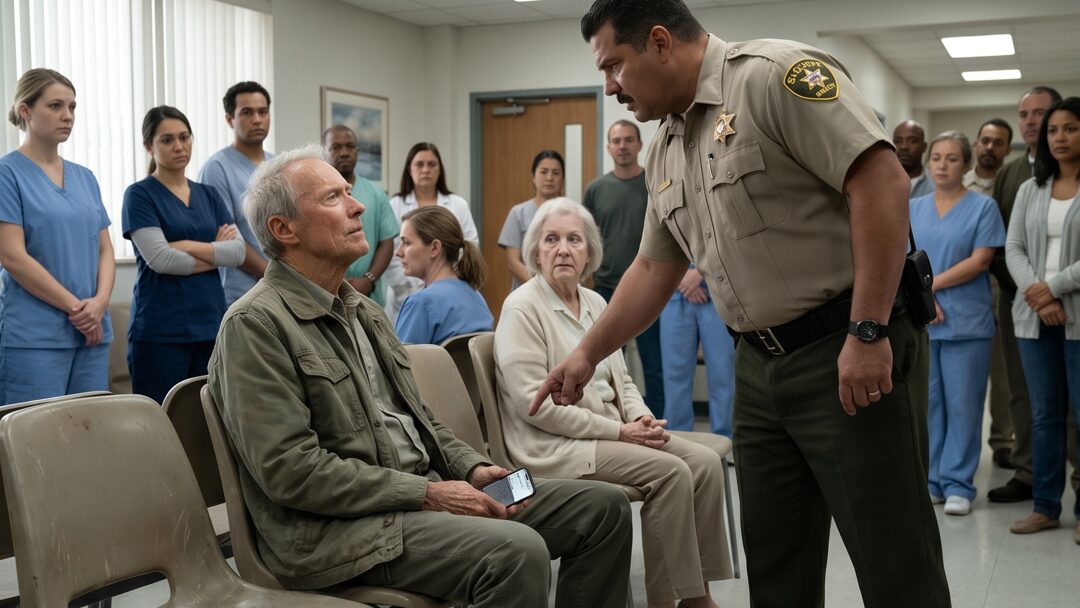
The Sheriff Who Struck an Old Man in a Hospital Waiting Room and Uncovered a County’s Buried Corruption
Chapter 1: The Chair Nobody Else Wanted
“Move. That’s my seat.”
The command cut through the crowded waiting room so sharply that several people looked up before quickly looking away again.
Frank Wilson remained seated.
The chair was nothing special. Gray plastic. One leg slightly shorter than the others. Every time someone shifted in it, the frame clicked softly against the tile floor.
Across from him, a young mother rocked a coughing child.
Two seats down, an elderly woman sat with both hands pressed against her stomach, her face pale beneath fluorescent lights.
The hospital had run out of room an hour ago.
Frank looked up at the man towering over him.
The sheriff’s badge gleamed.
His uniform was pressed.
His jaw was tight.
Sheriff Scott Hernandez.
Frank had seen men like him before.
Not the uniform.
The attitude.
The certainty that a room belonged to them the moment they entered it.
“I’m waiting,” Hernandez said.
Nobody spoke.
A nurse at the front desk suddenly found something fascinating on a clipboard.
A security guard near the hallway studied the ceiling.
The silence told Frank more than the badge ever could.
This wasn’t the first time.
“Sir?” Hernandez asked.
Frank’s voice remained calm.
“I heard you.”
“Then stand up.”
Frank glanced toward the elderly woman.
She was trying not to groan.
Someone should have taken her into a treatment room already.
Instead she was sitting in pain because the hospital was overwhelmed.
Frank slowly gestured toward the row of patients.
“There are people here who need this seat more than either of us.”
The sheriff stared at him.
The room seemed to shrink.
“You don’t understand.”
Frank nodded.
“That’s possible.”
A few nervous laughs escaped from somewhere near the back.
The sheriff heard them too.
His face hardened.
“This county pays my salary.”
Frank raised an eyebrow.
“I believe taxpayers do.”
Another silence.
Sharper this time.
The sheriff’s eyes narrowed.
Frank could almost see the moment embarrassment became anger.
Not because he had been insulted.
Because witnesses had heard it.
Power was easier to maintain when nobody laughed.
The elderly woman suddenly shifted, wincing.
Frank rose immediately.
“There.”
He motioned toward the chair.
The woman blinked.
“What?”
“Please sit.”
For a moment nobody moved.
Then Frank stepped aside.
The woman hesitated before lowering herself carefully into the chair.
Relief washed across her face.
A small thing.
Just a chair.
Yet several people watched as though they had witnessed something extraordinary.
Not kindness.
Defiance.
The sheriff’s ears reddened.
“That wasn’t your decision to make.”
Frank remained standing.
“Apparently it was.”
The waiting room went silent again.
The sheriff stepped closer.
“You think you’re funny?”
“No.”
“You think you’re smart?”
Frank shrugged.
“Depends on the day.”
The sheriff’s hand curled into a fist.
The nurse at the desk finally looked up.
Then immediately looked back down.
Nobody wanted involvement.
Frank understood.
Fear rarely announced itself.
It settled into routines.
Into habits.
Into lowered eyes.
The sheriff leaned forward.
“People around here know how things work.”
The statement wasn’t directed at Frank.
It was directed at the room.
A reminder.
A warning.
Frank slowly surveyed the faces around him.
Nobody met his gaze.
Except the elderly woman.
Kathleen Baker.
The name was written on the intake bracelet around her wrist.
She looked frightened.
Not for herself.
For him.
Frank felt something twist inside his chest.
Not anger.
Weariness.
The same weariness that had followed him for years.
Different places.
Different officials.
Different excuses.
Always the same outcome.
People stopped expecting fairness.
The sheriff mistook silence for agreement.
“Last chance.”
Frank folded his hands.
“I’m not interested in fighting with you.”
“Then leave.”
“No.”
The word landed softly.
Yet somehow it echoed.
Hernandez laughed once.
There was no humor in it.
“You don’t know who you’re talking to.”
Frank met his eyes.
“Maybe that’s true.”
The sheriff took a step closer.
“So let me explain.”
A cough echoed across the room.
Machines beeped somewhere beyond the hallway.
Life continued around them.
But nobody was paying attention to appointments anymore.
Everyone was watching.
The sheriff lowered his voice.
“People who make trouble usually regret it.”
Frank studied him.
There was something almost desperate beneath the arrogance.
A man used to immediate obedience.
A man terrified of losing it.
Frank had commanded thousands.
He knew insecurity when he saw it.
“You seem tired,” Frank said quietly.
The sheriff blinked.
“What?”
“You look tired.”
For the first time, uncertainty flickered across Hernandez’s face.
Then vanished.
Replaced by fury.
The room had witnessed too much.
The balance had shifted.
The old man wasn’t afraid.
That was dangerous.
The sheriff’s hand moved before anyone could react.
The crack echoed through the waiting room.
Gasps erupted.
Frank stumbled sideways.
His shoulder struck the wall.
Pain flashed across his jaw.
Warm blood touched the corner of his mouth.
For a heartbeat, nobody moved.
Nobody breathed.
The sheriff stood frozen.
Perhaps surprised by his own action.
Perhaps expecting surrender.
Frank slowly straightened.
He touched the blood with two fingers.
Looked at it.
Then looked back at the sheriff.
His expression never changed.
That frightened Hernandez more than any threat could have.
Because there was no fear.
No anger.
No humiliation.
Only calm.
And somewhere deep inside that calm, something had finally reached its limit.
Chapter 2: The Cracked Phone
Blood trickled slowly from the corner of Frank’s mouth.
The waiting room remained silent.
The sheriff stood rigid.
Nobody seemed sure what happened next.
Frank reached into the inside pocket of his faded jacket.
Several people expected a handkerchief.
Instead he pulled out an old phone.
The screen was cracked from corner to corner.
Its protective case was worn smooth from years of use.
It looked almost absurd.
A battered device held by a seventy-two-year-old man who had just been struck in public.
The sheriff smirked.
“There you go.”
Frank ignored him.
He unlocked the phone.
The room watched.
Even Kathleen Baker forgot about her pain for a moment.
Frank scrolled through a short list of contacts.
Not many names.
Just a few.
He selected one.
The call began ringing.
The sheriff laughed.
“You calling your lawyer?”
Frank held the phone to his ear.
“No.”
The line connected immediately.
Not after several rings.
Immediately.
A man’s voice answered.
Sharp.
Alert.
As though he had been expecting the call.
“Sir.”
Frank glanced at the blood on his fingers.
“I need you.”
The response came without hesitation.
“Location?”
“County Memorial Hospital.”
A pause.
Only a second.
Then:
“What’s happened?”
Frank looked directly at Hernandez.
“I’ve found something we need to discuss.”
The sheriff folded his arms.
Trying to appear relaxed.
Trying and failing.
The voice on the phone lowered.
“Do you require assistance?”
“Yes.”
“How much?”
Frank’s answer was calm.
Enough that several listeners almost missed its significance.
“Lock down the county.”
The waiting room froze.
A nurse dropped a pen.
The sheriff’s smile faded.
“What?”
Frank continued.
“Nobody involved in county administration leaves until you arrive.”
The voice responded instantly.
“I’m on my way, sir.”
The call ended.
Frank lowered the phone.
The screen went dark.
For a few seconds nobody spoke.
Then Hernandez laughed again.
Too loudly.
Too quickly.
“Lock down the county?”
A few nervous chuckles followed.
Nobody sounded convinced.
“Who was that?” he asked.
Frank slipped the phone back into his pocket.
“A former student.”
The answer somehow made things worse.
The sheriff shook his head.
“You expect people to believe that?”
“No.”
Frank sat down on another empty chair.
A smaller one near the wall.
The movement seemed strange.
As though he had simply resumed waiting for an appointment.
As though none of this mattered.
That calm unsettled everyone.
Including Sarah Lee.
The hospital administrator had arrived moments earlier after hearing reports of a disturbance.
Now she stood near the entrance, studying Frank.
She recognized the name.
Not completely.
But enough.
Wilson.
Where had she heard it?
Her stomach tightened.
The sheriff pointed toward Frank.
“This man assaulted nobody.”
Nobody answered.
“You all saw that.”
Still silence.
For the first time, Hernandez seemed annoyed by the lack of support.
Normally people rushed to reassure him.
Today they hesitated.
A security officer approached carefully.
“Sheriff…”
“What?”
“Maybe we should wait.”
“For what?”
The officer didn’t answer.
Sarah noticed his eyes.
He wasn’t looking at Frank.
He was looking at the phone.
As though it mattered.
As though he had seen something.
A message suddenly appeared on Sarah’s tablet.
Emergency notification.
State Operations Center.
Priority level: Immediate.
Her pulse quickened.
That notification should not concern a local hospital.
Unless something unusual was happening.
She opened it.
The message contained only a few lines.
Maintain current operations.
Await state representatives.
Do not release incident records.
Further instructions pending.
Sarah stared.
State representatives?
For a waiting-room altercation?
She looked up.
Frank sat quietly with folded hands.
The sheriff noticed her expression.
“What now?”
She hesitated.
“I think…”
The doors opened.
Two state vehicles rolled into the emergency entrance outside.
Nobody had heard sirens.
Nobody had expected company so quickly.
The sheriff turned toward the windows.
His confidence slipped.
Only slightly.
But enough.
Frank remained seated.
The cracked phone rested silently in his pocket.
And for the first time, the room began wondering whether the old man had been exactly who he claimed to be all along.
Chapter 3: Names That Change the Room
The first state official entered the hospital less than twenty minutes after the call.
The second arrived thirty seconds later.
Both walked with the urgency of people responding to an emergency they fully understood.
The sheriff did not.
That was becoming increasingly obvious.
“What is this?” Hernandez demanded.
Neither official answered him.
Instead, both scanned the waiting room.
The older of the two spotted Frank immediately.
His posture changed.
He crossed the room quickly.
“Sir.”
Frank looked up.
“Jacob.”
Jacob King stopped beside him.
Not directly in front.
Not looming.
Standing slightly to the side, the way one professional acknowledged another.
The way a student acknowledged a mentor.
Relief crossed his face.
Then concern.
He noticed the bruise forming on Frank’s cheek.
The blood.
His expression darkened.
“Who did that?”
Frank nodded toward the sheriff.
Jacob followed the gesture.
The room seemed to hold its breath.
Hernandez stepped forward.
“Now wait a minute—”
Jacob cut him off with a glance.
Not anger.
Assessment.
The kind that measured consequences.
“You’re Sheriff Hernandez?”
“I am.”
Jacob said nothing.
That silence felt worse than an accusation.
Frank stood.
Slowly.
Age showed in the movement.
Stiff knees.
Careful balance.
Yet the room somehow felt smaller once he was on his feet.
Sarah watched closely.
Something about the interaction bothered her.
Not because of power.
Because of familiarity.
Nobody introduced Frank.
Nobody explained who he was.
Yet these officials knew him instantly.
As if recognition required no confirmation.
More vehicles arrived outside.
Word spread quickly through the hospital.
Staff whispered in hallways.
Patients checked phones.
Rumors multiplied.
A retired judge had arrived.
No, a senator.
No, a military commander.
Nobody knew.
Everyone guessed.
The sheriff’s phone buzzed repeatedly.
Messages.
Calls.
Questions.
He ignored most of them.
A county commissioner finally reached him.
“What did you do?”
The question came before any greeting.
“What are you talking about?”
“The state operations center contacted us.”
Hernandez stared.
“Why?”
“You tell me.”
The call ended.
For the first time that afternoon, genuine worry appeared on the sheriff’s face.
Jacob approached Frank.
“We’ve begun implementing the request.”
Frank nodded.
“Any resistance?”
“Some.”
“I expected that.”
Jacob lowered his voice.
“Do you want this handled quietly?”
The question lingered.
Frank looked around the waiting room.
At Kathleen.
At the nurses.
At the people pretending not to listen.
At the fear that seemed ordinary here.
“No.”
Jacob understood immediately.
A subtle shift crossed his face.
Not excitement.
Acceptance.
The mission had changed.
Sarah finally stepped closer.
“Mr. Wilson?”
Frank turned.
“Yes?”
“I think we should move somewhere private.”
Before he could answer, another official entered.
An older man with silver hair.
The moment he saw Frank, he stopped.
Then smiled.
“General.”
The word echoed through the room.
Several people looked at each other.
General?
The silver-haired official extended a hand.
Frank shook it.
The sheriff felt his stomach drop.
Military.
The old man had military connections.
Serious ones.
Not stories.
Not exaggerations.
Real ones.
The official glanced at Hernandez.
Then back to Frank.
“What happened?”
Frank touched the bruise on his cheek.
“Long story.”
The official’s expression hardened.
“I’ll make time.”
The sheriff’s phone rang again.
This time it was the county administrator.
Then another commissioner.
Then a state investigator.
Calls stacked faster than he could answer.
Outside, more government vehicles arrived.
Not a flood.
Just enough to attract attention.
Enough to make county employees nervous.
Enough to start questions.
Jacob’s phone vibrated.
He checked the screen.
His expression changed.
“Sir.”
Frank looked up.
“It’s approved.”
“What is?”
Jacob handed him the phone.
Frank read the message.
A single authorization.
Simple.
Direct.
State oversight authority activated.
Temporary administrative restrictions in effect.
County officials required to remain available pending review.
Frank handed the phone back.
The sheriff saw only part of the screen.
It was enough.
The room tilted beneath him.
This wasn’t about a slap anymore.
This wasn’t about a chair.
Something larger had awakened.
Something that had apparently been waiting for a reason.
And he had just provided one.
Outside, county offices began receiving official notices.
Inside, the waiting room filled with whispers.
By sunset, nobody in county administration would be allowed to leave without clearance.
And Sheriff Scott Hernandez finally understood that the old man he had struck was not the center of the problem.
He was the beginning of it.
Chapter 4: What the General Already Knew
“That’s impossible.”
The county commissioner slapped a folder onto the conference-room table.
“We don’t have authority for this kind of review.”
Jacob slid a document across the polished surface.
“You did thirty minutes ago.”
The commissioner fell silent.
Around the room, county officials exchanged nervous looks. Phones buzzed. Messages arrived faster than anyone could answer them.
Frank sat near the end of the table.
The bruise on his cheek had darkened.
Nobody seemed willing to mention it.
The hospital conference room had never been intended for county-level emergencies. The chairs were mismatched. A coffee machine rattled in the corner. Medical charts still hung on one wall.
Yet every seat was occupied.
People who usually controlled meetings were no longer controlling this one.
Frank watched quietly.
Listening.
The same way he had spent years listening.
A woman from county administration introduced herself.
Frank nodded before she finished.
“I know your name.”
She stopped.
Surprised.
“We’ve never met.”
“No.”
Frank folded his hands.
“But I recognize it.”
The room became still.
One official shifted uneasily.
Another looked away.
Sarah noticed.
Frank noticed too.
Names.
That was what always remained.
People changed offices.
Changed titles.
Changed excuses.
Names stayed attached to paperwork.
And Frank had seen more paperwork than anyone in the room realized.
Jacob placed a stack of files on the table.
Not thick.
Not dramatic.
Just enough.
The commissioner stared at them.
“What is this?”
“Complaints.”
“About what?”
Jacob looked at Frank.
Frank answered.
“Intimidation.”
Nobody spoke.
“Misuse of county resources.”
Silence.
“Preferential treatment.”
The sheriff stared.
Frank continued.
“Interference with public services.”
Now several faces lost color.
Sarah felt a chill.
Because she recognized those words.
Not from reports.
From conversations.
Private ones.
Whispered ones.
The kinds people only shared when they believed nothing would change.
A nurse unable to report equipment shortages.
A clerk pressured to alter records.
A patient whose benefits disappeared after filing a complaint.
Small stories.
Easy to dismiss individually.
Harder to dismiss together.
The commissioner shook his head.
“Every county gets complaints.”
“Yes,” Frank said.
“They do.”
The answer carried no accusation.
That somehow made it worse.
The sheriff leaned forward.
“So this was planned?”
Jacob immediately looked up.
“What was planned?”
“This.”
Hernandez pointed around the room.
“The review. The lockdown. All of it.”
Frank met his eyes.
“No.”
The sheriff laughed bitterly.
“You expect me to believe that?”
Frank considered the question.
Then answered honestly.
“No.”
The room fell silent again.
Because it was true.
The situation did look planned.
The difference was that Frank had never intended to trigger it.
He had intended to wait for a medical appointment.
That was all.
Sarah suddenly opened a folder she had brought from her office.
Her hands trembled slightly.
She hated that they trembled.
For years she had told herself survival required compromise.
Keep the hospital functioning.
Avoid unnecessary fights.
Protect staff.
Protect patients.
Choose battles carefully.
Now she wasn’t sure whether that had been wisdom or fear.
“There is something else,” she said quietly.
Every head turned.
She swallowed.
Then pushed several reports onto the table.
“These were never investigated.”
Jacob picked up the first page.
Then the second.
Then the third.
Each involved county interference.
Funding delays.
Inspection threats.
Unexpected audits.
Pressure.
Always pressure.
Never enough to make headlines.
Always enough to make people comply.
The commissioner stared at Sarah.
“Why didn’t you report these?”
The question slipped out before he could stop it.
Sarah laughed once.
A tired laugh.
“To whom?”
Nobody answered.
Because everyone knew.
She had reported them.
Repeatedly.
Nothing happened.
The room seemed smaller now.
Less like a meeting.
More like a mirror.
The sheriff crossed his arms.
“People complain when they don’t get their way.”
Jacob looked up.
“And people abuse authority when nobody stops them.”
The sheriff glared at him.
Frank intervened before the exchange could escalate.
“Enough.”
The word was quiet.
Yet everyone obeyed.
Years of command still lingered in his voice.
Frank reached into his jacket.
Pulled out a small notebook.
Its cover was worn.
Corners bent.
Pages yellowed.
Sarah stared.
It looked almost as old as the cracked phone.
Frank opened it.
Names.
Dates.
Notes.
Nothing dramatic.
Just records.
Observations.
Questions.
Concerns.
Years of them.
The room watched.
The sheriff’s confidence visibly weakened.
“You’ve been keeping that?”
“For a long time.”
“Why?”
Frank looked down at the notebook.
Then out the conference-room window.
Toward the hospital parking lot.
Toward the county beyond it.
Toward a place he had hoped would correct itself.
“I thought someone else would handle it.”
The admission surprised everyone.
Especially Jacob.
Because for the first time that day, Frank sounded uncertain.
Not about facts.
About himself.
The room grew quiet.
The notebook remained open.
And as officials began comparing old complaints with new evidence, Frank realized something unsettling.
The problem might be far larger than even he had suspected.
Chapter 5: The Cost of Looking Away
The document landed in front of Frank just after sunset.
He recognized it immediately.
Not because of the contents.
Because of the date.
Three years earlier.
A complaint he had received and filed away.
A complaint he had never pursued.
Jacob placed it gently on the table.
“You remember this one?”
Frank did.
Unfortunately.
The meeting room had moved from the hospital conference room to a secured office nearby. Coffee cups covered the tables. Phones charged from every available outlet.
Nobody looked rested.
Least of all Frank.
He stared at the paper.
The complaint came from a former county employee.
Allegations of retaliation.
Pressure.
Improper use of authority.
At the time, the evidence had been thin.
The claims difficult to verify.
Frank had forwarded concerns through proper channels.
Then moved on.
The system was supposed to work.
It hadn’t.
Jacob watched him.
“You could have pushed harder.”
Frank nodded.
“Yes.”
No defense.
No explanation.
Just truth.
Jacob sat across from him.
The younger man had spent years admiring Frank.
That admiration remained.
But tonight frustration mixed with it.
“People listen when you speak.”
Frank remained silent.
“Maybe not everyone,” Jacob continued. “But enough.”
Still silence.
Jacob exhaled sharply.
“You saw warning signs.”
“I did.”
“And?”
Frank finally looked up.
“And I convinced myself observation was responsibility.”
The room quieted.
Several investigators pretended not to listen.
None succeeded.
Frank leaned back.
His hand moved unconsciously toward the cracked phone lying beside the documents.
The screen reflected overhead light.
A web of fractures.
Years old.
He had never replaced it.
Partly habit.
Partly stubbornness.
Now it seemed symbolic of something larger.
Something neglected because it still functioned.
Something damaged but tolerated.
Much like the county itself.
A knock interrupted the conversation.
Sarah entered carrying additional files.
More than before.
Many more.
Jacob stared.
“Where did those come from?”
“People started talking.”
Her answer carried its own weight.
For years people had remained silent.
Now they weren’t.
One by one, hospital staff submitted reports.
Maintenance workers.
Former employees.
Contractors.
Citizens.
Nothing explosive.
Just patterns.
The same names appearing repeatedly.
The same methods.
The same fear.
Sarah placed the files down.
“There’s more coming.”
Frank rubbed his forehead.
The room seemed heavier.
Not because corruption existed.
He had known that.
Because so many people had believed nobody would listen.
A former employee joined by video call.
Then another.
Then another.
Stories accumulated.
One lost a position after refusing a political favor.
Another faced repeated inspections after filing complaints.
A third simply stopped reporting problems altogether.
The details varied.
The pattern didn’t.
Hours passed.
The sheriff remained in another office under review.
His attorneys had arrived.
His allies had become strangely difficult to reach.
Yet he continued fighting.
Continued insisting.
Continued blaming.
Near midnight, Jacob received a message.
His expression darkened.
“What?”
Frank asked.
Jacob handed him the phone.
A witness statement.
Recently submitted.
Anonymous.
The statement claimed Frank had provoked the confrontation intentionally.
That he wanted publicity.
That he manipulated the situation.
Sarah frowned.
“That’s ridiculous.”
Jacob wasn’t so sure.
“Maybe.”
Frank studied the document.
Carefully.
Then smiled faintly.
Jacob blinked.
“What?”
“This isn’t anonymous.”
“It says anonymous.”
“No.”
Frank pointed to a phrase buried halfway down.
A peculiar expression.
One he had heard earlier that afternoon.
From Hernandez.
The sheriff had written it himself.
Or dictated it.
Trying to create distance.
Trying to build doubt.
Trying to regain control.
The discovery produced a strange reaction.
Not satisfaction.
Sadness.
Because it revealed something important.
The sheriff still believed appearances mattered more than truth.
Still believed intimidation could solve problems.
Still believed consequences were negotiable.
Frank placed the statement aside.
“He’s afraid.”
Sarah looked surprised.
“After everything that’s happened?”
“Especially after everything that’s happened.”
The room fell quiet.
Fear explained more than arrogance ever had.
Fear of exposure.
Fear of failure.
Fear of losing the identity he had built around authority.
A few minutes later another message arrived.
Then another.
New witnesses.
New complaints.
The dam had finally cracked.
Jacob looked toward Frank.
“So what now?”
The question lingered.
Frank stared at the files.
At the cracked phone.
At years of warnings he had chosen not to pursue aggressively enough.
The answer should have been easy.
Instead it felt personal.
Because this was no longer about Hernandez.
It was about what happened when decent people convinced themselves someone else would act.
A door opened suddenly.
An investigator hurried inside.
He looked directly at Jacob.
“We’ve got a problem.”
The room stiffened.
“What kind of problem?”
The investigator handed over a report.
Jacob read it.
Then looked at Frank.
The sheriff had attempted to contact multiple county employees.
Several witnesses reported receiving instructions.
Not threats.
Not directly.
Just reminders about loyalty.
Suggestions about what should remain unsaid.
One final effort to control the narrative.
Frank slowly stood.
The decision forming inside him was no longer theoretical.
Because the cover-up had just become active.
And by morning, he would have to decide whether to expose only a sheriff—or an entire culture that had allowed him to thrive.
Chapter 6: The County Reckoning
The hearing room was full before sunrise.
Sheriff Scott Hernandez sat alone at a long table beneath bright lights.
For the first time since entering the hospital the previous afternoon, nobody moved aside for him.
Nobody rushed to assist him.
Nobody seemed eager to stand nearby.
The absence of privilege unsettled him more than open hostility ever could.
He adjusted his tie.
Then adjusted it again.
Across the room sat county officials, investigators, hospital staff, and citizens who had finally agreed to speak.
Frank arrived quietly.
No announcement.
No escort.
Yet conversations softened when he entered.
Not because he demanded attention.
Because people noticed him.
The bruise remained visible.
A reminder of where this had begun.
Jacob took a seat beside the review panel.
The proceedings started immediately.
Evidence appeared one piece at a time.
Not dramatic revelations.
Not secret recordings.
Patterns.
Documents.
Statements.
Timelines.
The accumulation of small abuses.
The kind that survived precisely because each seemed too minor to fight alone.
Sarah testified first.
Her voice trembled during the opening questions.
Then steadied.
She described funding pressures.
Administrative interference.
Repeated attempts to influence hospital operations.
Not direct orders.
Suggestions.
Expectations.
Consequences for resistance.
The room listened.
Several officials avoided eye contact.
A maintenance worker followed.
Then a former employee.
Then a retired clerk.
One by one.
Each story added weight.
Not enough individually.
Overwhelming together.
Hernandez spent the morning shaking his head.
Denying.
Explaining.
Redirecting blame.
Sometimes successfully.
Sometimes not.
Around noon, the sheriff finally spoke for himself.
“You want someone to blame.”
His voice echoed through the room.
“You think I’m the problem?”
Nobody interrupted.
“You think county politics started with me?”
His gaze swept across the audience.
“You think pressure comes from one person?”
There it was.
Not denial.
Something more complicated.
Bitterness.
Frank watched carefully.
The sheriff wasn’t entirely wrong.
That was what made the moment uncomfortable.
Systems rarely depended on one individual.
They depended on permission.
Tolerance.
Silence.
The same silence Frank had spent years choosing.
Hernandez leaned forward.
“I did what every sheriff before me did.”
A murmur spread through the room.
“You don’t survive this job by making everyone happy.”
His eyes settled briefly on Frank.
“You survive by making decisions.”
Jacob frowned.
“Are you accepting responsibility?”
“I’m saying you’re all pretending this happened in a vacuum.”
The room grew quiet.
Because there was truth hidden inside the excuse.
Not enough to absolve him.
Enough to complicate the story.
Frank felt a familiar weight settle on his shoulders.
Responsibility.
Not legal responsibility.
Moral responsibility.
The kind nobody could assign.
Only accept.
The afternoon session revealed more evidence.
Personnel records.
Budget decisions.
Complaint histories.
Years of accumulated misconduct.
Nothing cinematic.
Nothing explosive.
Just undeniable.
By evening, even Hernandez looked exhausted.
The certainty had drained from him.
The arrogance too.
What remained was a tired man staring at consequences he could no longer manage.
The final witness surprised everyone.
Kathleen Baker.
The elderly woman from the waiting room.
She approached slowly.
Hands shaking.
Voice quiet.
The room expected little.
Instead they listened.
She described the chair.
The slap.
The silence.
Then she stopped.
For a moment nobody understood why.
Finally she spoke again.
“I wasn’t surprised.”
The words hung in the air.
“I should have been.”
Nobody moved.
“I wasn’t surprised because people like me get used to it.”
Her eyes glistened.
“Not the hitting.”
“The fear.”
The room remained silent.
“You stop expecting help.”
That statement landed harder than any accusation.
Because it wasn’t about Hernandez.
It was about everyone.
Including Frank.
Kathleen returned to her seat.
The hearing continued.
But the emotional center had shifted.
Hours later, findings were delivered.
Administrative actions initiated.
Investigations expanded.
Authority redistributed.
Formal accountability began.
The room slowly emptied.
Only a handful remained.
Frank among them.
He stood near a row of chairs identical to those in the hospital waiting room.
Simple.
Ordinary.
Meant for citizens.
Jacob approached.
“It’s done.”
Frank looked at the empty seats.
“No.”
Jacob frowned.
“What do you mean?”
“The easy part is done.”
The younger man followed his gaze.
Understanding arrived slowly.
The sheriff would face consequences.
Several officials would too.
But punishment alone would not repair what years of silence had damaged.
Frank reached into his pocket.
Pulled out the cracked phone.
The screen reflected the overhead lights.
For a moment he stared at it.
Then at the empty chairs.
Then at the people still waiting for someone to remain involved after the headlines disappeared.
Jacob noticed the expression.
A decision.
Not fully formed.
But close.
And for the first time since the confrontation began, Frank realized the hardest question was no longer what to expose.
It was what responsibility remained once the exposure was complete.
Chapter 7: The Seat Reserved for Citizens
The chair was still there.
Frank stopped just inside the hospital waiting room and looked at it.
The same gray plastic.
The same uneven leg.
The same faint clicking sound whenever someone shifted their weight.
Three weeks had passed.
The bruise on his cheek had faded.
The county had not.
People moved through the waiting room differently now.
Not dramatically.
No banners.
No celebrations.
No speeches.
Just small changes.
The front desk no longer fell silent when county officials entered.
Staff members looked patients in the eye.
People asked questions without lowering their voices.
The changes were subtle enough that an outsider might miss them.
Frank did not.
He had spent a lifetime learning that institutions rarely changed all at once.
They changed one habit at a time.
A receptionist looked up.
Recognition flickered across her face.
“Good morning, Mr. Wilson.”
“Good morning.”
No fear.
No nervousness.
Just courtesy.
Frank checked in for his appointment.
The receptionist handed him a clipboard.
Then smiled.
“A seat just opened up.”
Frank glanced toward the waiting area.
The familiar chair sat empty.
For a moment he simply stared at it.
The memory returned immediately.
The sheriff.
The slap.
The silence.
The cracked phone.
The choice.
Everything that followed.
He almost laughed at how much damage had emerged from a single chair.
Almost.
Instead he walked over and sat down.
The plastic clicked beneath him.
Around him, conversations continued.
Nobody stared.
Nobody whispered.
That alone felt different.
His phone vibrated.
The cracked screen lit up.
A message from Jacob.
County reform package approved.
Additional oversight begins Monday.
Frank read it once.
Then locked the screen.
Weeks earlier, that message would have felt like a conclusion.
Now it felt like a beginning.
The chair beside him creaked.
Frank looked up.
Kathleen Baker lowered herself carefully into the seat.
For a second she didn’t seem to recognize him.
Then her eyes widened.
“Oh.”
Frank smiled.
“Good morning.”
Kathleen laughed softly.
“I never thought I’d see you here again.”
“Neither did I.”
“You look better.”
“I’ve had worse weeks.”
That earned another laugh.
The sound surprised both of them.
Three weeks earlier she had seemed permanently exhausted.
Now there was energy in her voice.
Not much.
But enough.
They sat quietly for a moment.
The waiting room buzzed around them.
A television murmured from the corner.
A child complained about being bored.
Someone dropped a magazine.
Ordinary sounds.
Frank found them comforting.
Kathleen folded her hands.
“They asked me to speak at the hearing because I was there.”
“I know.”
She looked at him carefully.
“I almost didn’t.”
Frank waited.
“I figured it wouldn’t matter.”
There it was.
The same belief he had heard from dozens of people.
The same belief he had carried himself.
The assumption that speaking up changed nothing.
“What changed your mind?” he asked.
Kathleen smiled faintly.
“You got hit.”
Frank blinked.
That wasn’t the answer he expected.
She shrugged.
“Not because I wanted that to happen.”
“I assumed.”
“You stood up.”
Her eyes drifted toward the chair.
“You didn’t even know me.”
The statement lingered.
Frank looked away.
Because part of him knew the truth.
Standing up in that moment had been easier than what came afterward.
The investigation.
The hearings.
The responsibility.
The admission that he had spent years watching problems grow.
Kathleen seemed to read something in his expression.
“You look disappointed.”
Frank laughed quietly.
“Do I?”
“Yes.”
She studied him.
“The county changed.”
“Some of it.”
“More than before.”
Frank wasn’t sure.
He had seen reforms announced before.
Seen promises.
Seen momentum fade.
The old habit returned immediately.
Caution.
Distance.
The instinct to let others take responsibility.
His phone vibrated again.
Another message.
Another request.
Another county asking for advice regarding oversight reforms.
He stared at the notification.
Then locked the screen without answering.
Kathleen noticed.
“You planning to ignore that?”
Frank looked at her.
She pointed toward his pocket.
“The phone.”
He smiled.
“Maybe.”
“That seems unlikely.”
The answer arrived before he could stop it.
“I’m tired.”
The honesty surprised him.
Kathleen nodded.
“Fair.”
For a few moments neither spoke.
Then she leaned back.
“You know what I think?”
Frank braced himself.
“That usually means trouble.”
“It usually does.”
They shared a brief smile.
Then her expression softened.
“I think you’ve spent a long time believing somebody else should handle things.”
The words landed harder than any accusation from the hearings.
Because she wasn’t angry.
Because she wasn’t wrong.
Frank stared across the waiting room.
At the nurses.
At the patients.
At the chair.
Years earlier, retirement had felt like permission to step away.
To advise when asked.
To observe.
To let others lead.
It had sounded reasonable.
Responsible, even.
Yet every complaint notebook entry.
Every ignored warning.
Every delayed intervention had emerged from that same belief.
Someone else would handle it.
Eventually.
Kathleen rose when her name was called.
Before leaving, she paused.
“You know why that chair matters?”
Frank glanced at it.
“No.”
“Because it’s for whoever needs it.”
She smiled.
“Not whoever thinks they own it.”
Then she walked toward the treatment area.
Frank watched her go.
Simple words.
Simple truth.
The same principle applied far beyond a waiting room.
His phone vibrated again.
This time he answered it.
Jacob spoke immediately.
“Please tell me you’re not retiring from public life again.”
Frank chuckled.
“I was considering it.”
“Terrible idea.”
“That’s not very respectful.”
“Neither is abandoning the rest of us.”
Frank looked around the waiting room.
At people moving through a public institution that felt slightly healthier than it had three weeks ago.
Not fixed.
Not perfect.
Just better.
Because enough people had finally stopped looking away.
“I’ve been thinking,” Frank said.
Jacob immediately sounded suspicious.
“That sentence usually means more work for me.”
“It probably does.”
A pause.
Then:
“I’m staying involved.”
Silence.
Followed by a long exhale.
Jacob laughed.
“I’ll inform everyone.”
“Don’t.”
“Why not?”
Frank looked down at the cracked phone resting in his hand.
The fractures still spread across the glass.
The damage remained visible.
But it worked.
And now, instead of reminding him of neglect, it reminded him of responsibility.
“You don’t need to announce it.”
“Why?”
Frank looked toward the chair one last time.
Because real authority had never been the point.
Service was.
“People will figure it out.”
A nurse appeared at the doorway.
“Mr. Wilson?”
Frank stood.
His knees protested slightly.
Age always collected its debts.
But he felt lighter than he had in years.
Not because the county’s problems were solved.
Because he had finally stopped pretending they belonged only to someone else.
He slipped the cracked phone into his pocket.
Then followed the nurse down the hallway.
Behind him, the waiting room continued its ordinary rhythm.
Citizens waiting their turn.
Public servants doing their jobs.
A chair reserved for whoever needed it most.
Exactly as it should be.
The story has ended.