The Rain Had Already Started When They Came To Remove Joseph’s Only Safe Way Home
Chapter 1: The Loader Waiting In The Rain
The first sound Michelle Baker heard was not thunder.
It was a diesel engine.
Deep. Mechanical. Close.
She sat upright in bed before she was fully awake.
For a second she thought the sound belonged to the storm moving through the neighborhood.
Then came the hydraulic beeping.
Her stomach dropped.
“No.”
She was already moving before she realized she had spoken.
She grabbed a sweater from the chair beside the bed and hurried toward the front door.
The engine growled again.
When she opened the door, cold rain blew into the hallway.
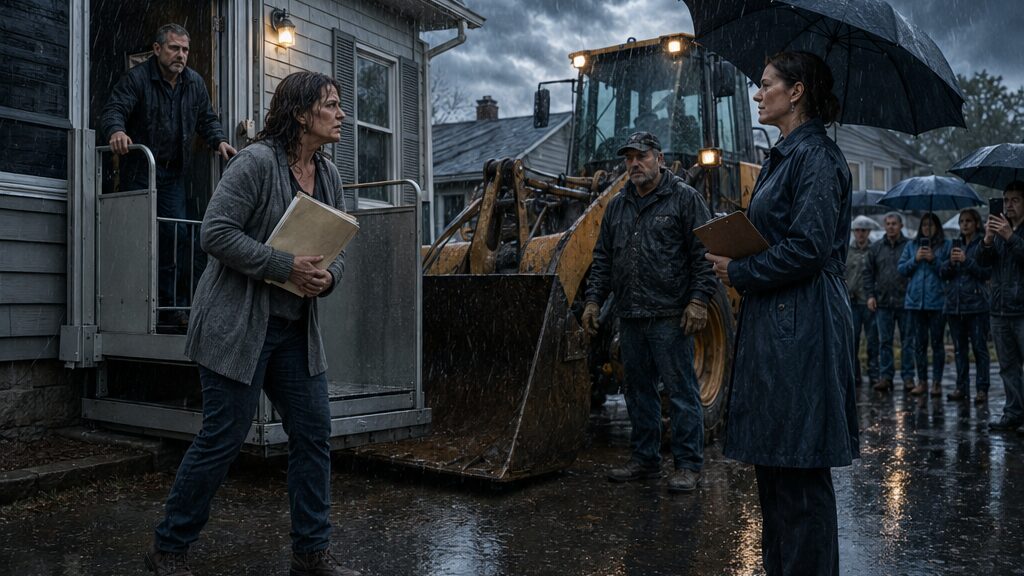
A large loader sat in her driveway.
Its headlights cut through the dawn.
Three workers stood beside it wearing bright rain jackets.
A utility truck blocked part of the curb.
And beside the exterior lift platform that ran from the driveway to her front porch stood Barbara Thompson.
The HOA president held a clipboard under a black umbrella.
Michelle stopped breathing for a moment.
The lift platform gleamed wet in the rain.
The metal rails.
The weatherproof control panel.
The reinforced landing.
All of it looked vulnerable beneath the loader’s raised bucket.
Barbara noticed her.
“Mrs. Baker.”
Michelle stepped onto the porch.
“What are you doing?”
Barbara looked down at her clipboard.
“This is now an enforcement matter.”
Michelle stared at her.
“What?”
“You were notified.”
“No.”
“The violation notice was mailed thirty-one days ago.”
“I appealed that notice.”
“The appeal was denied.”
Michelle blinked.
“No one told me that.”
Barbara’s expression barely changed.
“The deadline has passed.”
The loader beeped again.
One of the workers climbed into the cab.
Michelle descended the porch steps.
Rain soaked her hair immediately.
“Stop.”
Nobody moved.
She walked faster.
“Stop the machine.”
The worker hesitated.
Barbara raised her voice slightly.
“Please remain outside the work area.”
Michelle looked at the lift.
Then at the loader.
Then back at Barbara.
“You’re tearing it down?”
“The structure violates updated neighborhood appearance standards.”
“It’s an accessibility lift.”
“It does not meet current community design requirements.”
Michelle laughed once.
A sharp, disbelieving sound.
“You can’t be serious.”
Barbara kept her eyes on the clipboard.
“The crew is already scheduled.”
The words felt rehearsed.
As if she had practiced saying them.
Michelle noticed a sealed work order clipped beneath the top page.
A red stamp crossed the corner.
AUTHORIZED.
Something inside her tightened.
This wasn’t a warning.
This wasn’t a discussion.
Someone had already decided.
The loader moved forward a few inches.
Michelle stepped directly in front of it.
The worker hit the brakes.
Barbara sighed.
“Please don’t do this.”
“Do what?”
“Create a scene.”
Michelle pointed toward the lift.
“My brother uses that.”
Barbara glanced toward the house.
For the first time uncertainty flickered across her face.
Only for a second.
Then it disappeared.
“The board reviewed the situation.”
“No, you didn’t.”
“We did.”
“No.”
Michelle shook her head.
“If you had reviewed it, you would know exactly why it’s there.”
The rain intensified.
Water ran down Barbara’s umbrella.
The loader idled impatiently.
Another truck pulled up behind the first.
More workers climbed out.
Michelle felt the ground shifting beneath her.
Not physically.
Socially.
Institutionally.
The kind of shift that happened when people with paperwork arrived before the person being judged even knew a decision had been made.
One worker approached.
Tall. Gray-haired.
Practical eyes.
The supervisor.
Edward Campbell.
“Ma’am,” he said carefully, “we’ve been hired to remove the structure.”
“It was approved.”
He looked toward Barbara.
Barbara answered first.
“No record exists.”
Michelle stared at her.
“No record exists?”
“Not in current HOA files.”
Current.
The word bothered her.
Current was not the same as never.
Edward seemed bothered too.
His eyes moved between them.
“Do you have documentation?”
“Yes.”
Michelle answered instantly.
Then hesitated.
Because she wasn’t entirely sure where it was.
The approval packet had been years ago.
Before the new board.
Before Joseph moved in.
Before everything changed.
But she knew she had kept it.
Somewhere.
“I have it.”
Barbara checked her watch.
“The crew cannot wait indefinitely.”
“You brought them before you checked?”
“We checked.”
“No, you didn’t.”
The loader rolled forward another inch.
Michelle planted her feet.
For a moment nobody moved.
Rain hammered metal.
Water pooled along the curb.
Then the front door opened.
Everyone looked.
Joseph stood in the doorway.
He held the railing with one hand.
His shoulders were broad despite the years.
Despite the injury.
Despite the cane beside him.
The old military discipline remained visible even in stillness.
“What is going on?” he asked.
Michelle closed her eyes briefly.
She had hoped he wouldn’t see this.
Barbara shifted awkwardly.
Joseph’s gaze settled on the lift.
Then the machinery.
Then the workers.
Understanding arrived immediately.
“They’re removing it?”
Nobody answered.
Joseph’s expression changed.
Not anger.
Something worse.
Humiliation.
The kind that comes from being reminded that your independence depends on something others can take away.
Michelle felt it like a physical blow.
The supervisor noticed too.
His eyes lingered on Joseph.
On the cane.
On the distance between the porch and driveway.
On the rain.
The calculation was visible.
Barbara stepped forward.
“Sir, accommodations can be discussed later.”
Joseph laughed softly.
“Later?”
Michelle heard the bitterness.
Rare.
Dangerous.
The loader engine rumbled.
A worker climbed out carrying tools.
Metal clanked against metal.
Michelle looked at the lift again.
Not as equipment.
As routine.
Morning appointments.
Doctor visits.
Storm evacuations.
Groceries.
The hundred ordinary moments that had become possible because of it.
The storm wind pushed against them.
A weather alert buzzed on someone’s phone.
The supervisor glanced at the darkening sky.
Then at Barbara.
“You sure this is the day for this?”
Barbara’s jaw tightened.
“We have authorization.”
Michelle caught the emphasis.
Not approval.
Authorization.
Different things.
Different sources.
Different motives.
She turned and ran toward the house.
“Five minutes.”
Barbara called after her.
“The work order is active.”
Michelle didn’t stop.
Inside, she headed for the hallway cabinet.
Folders.
Tax records.
Insurance files.
Medical paperwork.
Contractor invoices.
Everything she had saved for years.
Her hands shook.
Rain drummed against the windows.
Outside, machinery waited.
She pulled folders onto the floor.
Searching.
Searching.
Searching.
And then she heard a metallic crack from the driveway.
Her head snapped up.
A worker had loosened the first support post beneath the lift platform.
Michelle froze.
The demolition had already begun.
Chapter 2: The Rules Nobody Explained
By the time Michelle rushed back outside, half a dozen neighbors had gathered across the street.
Some stood beneath umbrellas.
Others watched from covered porches.
Phones were already out.
Recording.
Observing.
Judging.
The loosened support post leaned slightly beneath the platform.
Not enough to make the structure unsafe.
Enough to make Michelle’s pulse spike.
“Stop!”
She crossed the driveway and shoved the folder against her chest.
The workers paused.
Edward looked uncomfortable.
Barbara did not.
“We’ve already delayed the schedule.”
“You’ve started damaging it.”
“A preliminary removal step.”
“It’s the same thing.”
The neighbors were close enough to hear every word.
Michelle hated that.
She hated becoming public.
She hated attention.
For years she had survived by handling problems quietly.
Pay the bills.
Keep the house running.
Take Joseph to appointments.
Avoid explanations.
Avoid sympathy.
Avoid questions.
Now everyone was looking.
Barbara glanced toward the crowd.
Perhaps she liked having witnesses.
Perhaps she believed witnesses made her look stronger.
“The board gave multiple opportunities for compliance.”
Michelle stared.
“What compliance?”
“The structure was flagged during modernization review.”
Several neighbors nodded.
Modernization.
The word had become common over the last year.
New fences.
Approved paint colors.
Updated landscaping requirements.
Decorative lighting.
Property value initiatives.
The older homes were being reshaped one regulation at a time.
Michelle had mostly ignored it.
Until now.
Barbara continued.
“The neighborhood is changing.”
“This isn’t a flower bed.”
“The standards apply equally.”
“No, they don’t.”
Michelle pointed at the lift.
“That’s not decoration.”
A man near the sidewalk muttered, “Didn’t know she had permission for it.”
Others exchanged looks.
Assumptions forming.
Michelle recognized them.
The quiet woman finally got caught breaking the rules.
The board stepped in.
Case closed.
Debra White stood among them.
Unlike the others, she wasn’t nodding.
She looked uncertain.
Watching.
Listening.
Michelle wished she had spoken to her years ago.
To any of them.
Instead she had built walls.
Now strangers were deciding what kind of person she was.
Barbara opened the clipboard.
“The structure exceeds current appearance standards and lacks proper documentation.”
“Lacks documentation according to who?”
“According to HOA records.”
Joseph emerged onto the porch again.
This time he didn’t stay inside.
Carefully, slowly, he used the lift controls.
The platform descended.
Everyone watched.
The machinery.
The rain.
The neighbors.
Even the workers.
The lift moved steadily downward.
Joseph stepped off.
The silence that followed felt different.
No longer abstract.
Now everyone could see exactly what the structure did.
A wheelchair sat folded near the porch wall.
A mobility ramp led from the landing.
Medical transport stickers marked a nearby vehicle.
The story suddenly looked less simple.
Barbara noticed the shift.
So she hardened.
“You should have followed the rules.”
The words landed harder because they were public.
Michelle felt heat rise into her face.
“You think I built that because I wanted matching property aesthetics?”
Barbara’s expression faltered.
Only briefly.
“We all have responsibilities.”
“So do you.”
The rain ran down both of them.
Nobody spoke.
Then Edward interrupted.
“Ma’am.”
Michelle turned.
“If you have paperwork, now would be a good time.”
“I do.”
She opened the folder.
Property tax forms.
Installation invoices.
Contractor permits.
Medical recommendations.
Photos.
Receipts.
She flipped through everything.
Faster.
Faster.
Then stopped.
The approval letter wasn’t there.
The space where it should have been felt enormous.
Her stomach tightened.
No.
No.
No.
She searched again.
Every sleeve.
Every divider.
Every page.
Nothing.
The neighbors watched.
Barbara watched.
Joseph watched.
The absence became visible.
Michelle could feel it.
“Where is it?” Barbara asked quietly.
Michelle ignored her.
She searched again.
The document wasn’t there.
The one page she needed most.
Gone.
Edward looked disappointed rather than skeptical.
Somehow that felt worse.
Michelle flipped through the folder one last time.
Nothing.
Rainwater spotted the papers.
The wind tugged at loose corners.
Barbara closed her clipboard.
“Without documentation—”
“It exists.”
“Can you produce it?”
Michelle looked up.
The question hung between them.
Can you prove it?
Not did it happen.
Not is it true.
Can you prove it?
Joseph took a step forward.
“Michelle—”
She shook her head.
Not now.
Not in front of everyone.
Not when the humiliation already felt unbearable.
Barbara turned toward the workers.
The gesture was small.
But it carried authority.
Decision.
Movement.
The next stage.
Michelle looked at the lift.
At the loosened support.
At the loader waiting.
Then at the empty space inside her folder where certainty should have been.
For the first time that morning, doubt entered her mind.
Not doubt about the lift.
Not doubt about Joseph.
Doubt about the paper.
The approval she remembered so clearly.
The approval she had trusted for years.
The approval she suddenly could not find.
And as the workers prepared their equipment once more, Michelle realized the question threatening the lift was no longer only whether the HOA was wrong.
It was whether she could prove they ever approved it at all.
Chapter 3: The File That Should Have Existed
Michelle was in her car less than twenty minutes later.
The storm had not eased.
Wind rattled the windshield as she drove toward the HOA management office.
Every minute felt stolen.
Every minute away from the house felt dangerous.
But standing in the driveway arguing would not save the lift.
Proof might.
Her phone rang.
Joseph.
She answered immediately.
“Are they touching it?”
“Not yet.”
His voice sounded tired.
“They backed off for now.”
“For now isn’t enough.”
“I know.”
Silence.
Then Joseph said quietly, “You don’t have to do this alone.”
Michelle tightened her grip on the steering wheel.
The words irritated her because they were true.
“I’ll call you.”
She ended the call before he could continue.
The office occupied a renovated storefront near the entrance to the neighborhood.
Inside, fluorescent lights hummed.
A clerk sat behind a counter.
Michelle placed the folder down.
“I need records.”
The clerk blinked.
“Records?”
“Approval records. Accessibility structure permits. HOA reviews.”
The clerk frowned.
“What address?”
Michelle gave it.
The clerk typed.
Waited.
Typed again.
Then frowned harder.
“That’s strange.”
Michelle leaned forward.
“What?”
“There should be more.”
More.
Not none.
More.
A small but important difference.
The clerk opened another screen.
Then another.
Minutes passed.
The rain tapped against the windows.
Finally the clerk disappeared into a back room.
When she returned, she carried an old storage box.
Dust coated the edges.
“These are archived files from before the board transition.”
Michelle’s pulse quickened.
Board transition.
The phrase matched something Barbara had said months earlier when the modernization campaign began.
New leadership.
New systems.
New records.
The clerk sorted through folders.
Property reviews.
Meeting minutes.
Inspection reports.
Then she paused.
“There was definitely activity connected to your address.”
Michelle stepped closer.
“What kind?”
The clerk hesitated.
“I shouldn’t speculate.”
“But?”
“But it looks like some records were never fully transferred.”
Michelle stared.
“What does that mean?”
“It means the digital file isn’t complete.”
Hope surged.
Dangerous hope.
Not proof.
Not yet.
But enough to challenge certainty.
The clerk lowered her voice.
“You’re not the first person who’s had trouble finding older approvals.”
That sentence changed everything.
Not an isolated mistake.
A pattern.
Small.
Possibly innocent.
But real.
The clerk pulled a thin folder from the box.
Inside was a contractor inspection summary.
An installation review.
A scheduling note.
Evidence that the process had happened.
Evidence that someone had approved steps leading toward the lift.
But no final approval letter.
The most important page remained missing.
Michelle closed her eyes briefly.
Close.
Not enough.
Never enough.
An hour later she left carrying photocopies.
Fragments.
Pieces.
A trail.
The storm continued.
The demolition deadline still existed.
And the proof remained incomplete.
As she reached her car, her phone buzzed.
A message from Debra White.
I think I might have something.
Michelle froze.
Another message arrived.
Years ago the HOA emailed residents about approved accessibility projects. I saved a lot of old neighborhood emails.
Call me.
Michelle stared at the screen.
For the first time all day, a door opened where a wall had stood.
She immediately pressed the call button.
Chapter 4: The Story Behind The Lift
Joseph was already standing in the hallway when Michelle came through the front door.
She hadn’t expected him to be awake.
She definitely hadn’t expected him to be kneeling beside an old cardboard box.
Her heart skipped.
The box sat open on the living room floor.
Paperwork spilled across the carpet.
Insurance forms.
Hospital records.
Contractor estimates.
Photographs.
The things she rarely touched.
The things she kept hidden.
Joseph held one of the photographs in his hand.
He looked up.
Neither of them spoke immediately.
Michelle set her folder on the kitchen counter.
“What are you doing?”
Joseph looked down at the photograph.
“I was looking for the approval letter.”
“You shouldn’t be going through this.”
A faint smile crossed his face.
“Funny. That’s exactly what you’ve been doing for years.”
The smile vanished.
He held up the picture.
Michelle knew it instantly.
The photograph had been taken three years earlier.
Before the lift.
Before the renovations.
Before everything changed.
Joseph stood beside a motorcycle.
Healthy.
Strong.
Laughing.
The image felt like it belonged to someone else.
Joseph placed it carefully on the floor.
“You still keep these.”
Michelle busied herself gathering papers.
“Of course I do.”
“You never look at them.”
“I don’t need to.”
The lie sounded weak.
Joseph watched her.
Outside, rain struck the windows.
The storm warning had intensified throughout the afternoon.
Weather alerts interrupted radio broadcasts every half hour.
Michelle stacked folders.
Anything to avoid looking at him.
Anything to avoid this conversation.
“You blame yourself.”
The words stopped her.
She froze with a file in her hand.
Joseph’s voice remained calm.
Not accusing.
Not angry.
Simply tired.
Michelle continued organizing papers.
“I don’t know what you’re talking about.”
“Yes, you do.”
She said nothing.
The silence answered for her.
Joseph leaned back against the couch.
“I’ve let you get away with it because I thought you’d eventually stop.”
Michelle laughed once.
Short.
Humorless.
“Stop what?”
“Acting like it was your fault.”
The room felt smaller.
The rain louder.
Three years vanished.
She saw flashing emergency lights.
A hospital waiting room.
Doctors moving quickly.
The long weeks afterward.
The surgeries.
The rehabilitation.
The day Joseph had finally admitted he couldn’t safely manage stairs anymore.
The day they discussed the lift.
The day she signed the contract.
“You weren’t there,” she said quietly.
Joseph looked away.
“No.”
“You asked me to go.”
He closed his eyes.
There it was.
The memory she never touched.
A family gathering.
A last-minute change of plans.
A favor.
A simple decision that seemed meaningless until it wasn’t.
Joseph had gone alone.
The accident happened afterward.
For years Michelle had replayed the choice.
What if she had gone?
What if she had delayed him?
What if she had driven?
Joseph spoke softly.
“Michelle.”
She hated hearing pity in his voice.
Even when it wasn’t there.
“I asked you because I knew you’d say yes.”
She stared at the paperwork.
“You don’t know that.”
“I do.”
“You don’t.”
“I do.”
The words echoed through the room.
Not loud.
Certain.
Joseph took a breath.
“The accident wasn’t your fault.”
Michelle looked toward the window.
Anywhere except him.
“I know.”
Another lie.
This one sounded even worse.
Joseph shook his head.
“No. You don’t.”
A long silence followed.
The kind that carried years inside it.
Then he reached into the box and pulled out another folder.
“What’s this?”
Michelle glanced over.
Her stomach tightened.
The contractor file.
The original installation packet.
She crossed the room immediately.
Joseph handed it to her.
She opened it.
Invoices.
Measurements.
Inspection reports.
Engineering approvals.
Everything except the document she needed.
The missing final approval.
The absence felt deliberate.
As if someone had removed exactly one page.
She turned pages more carefully.
Nothing.
Again.
Nothing.
Her shoulders sagged.
Then the doorbell rang.
Both of them looked up.
Michelle opened the door to find Debra White standing on the porch beneath a dripping umbrella.
She held a laptop against her chest.
“I think I found something.”
Within minutes they were gathered around the dining room table.
Debra opened an archive folder.
Years of saved emails appeared.
Neighborhood announcements.
Meeting notices.
Budget updates.
Michelle watched nervously.
Joseph sat quietly nearby.
Debra scrolled.
Stopped.
Scrolled back.
“There.”
Michelle leaned closer.
The subject line read:
Accessibility Improvement Approval Notification.
Her pulse quickened.
Debra opened it.
The email was old.
Very old.
Sent by a previous HOA board.
It referenced approved accessibility modifications within the community.
One property address appeared in the body.
Michelle’s.
For several seconds nobody spoke.
The room seemed to hold its breath.
“This proves they approved it,” Debra said.
Michelle kept reading.
The wording mattered.
Every sentence mattered.
The email referenced approval.
Review.
Authorization.
Installation.
It wasn’t the final approval letter.
But it connected the trail.
It proved the process had existed.
It proved the HOA knew about the project.
Joseph let out a slow breath.
For the first time all day, genuine hope entered the room.
Then Michelle noticed something else.
An attachment icon.
Missing.
The email referenced an attached approval document.
But the attachment itself was gone.
Lost.
Archived incorrectly.
Or deleted.
The proof existed.
Yet it remained just out of reach.
Debra frowned.
“I’ll keep looking.”
Michelle nodded.
The hope remained.
But uncertainty remained with it.
Outside, the storm intensified.
Wind rattled the house.
The lift stood in the darkness beyond the window.
Not merely a structure anymore.
Not merely a machine.
A piece of survival.
A piece of guilt.
A piece of family.
Debra looked up from the screen.
Her eyes widened.
“I found another email.”
Michelle leaned forward.
The message had been sent years earlier.
Directly to the HOA board.
And attached to it was a scanned approval document bearing an official HOA stamp.
Chapter 5: The Meeting They Wanted Finished Quickly
Every chair in the community clubhouse was occupied.
People stood along the walls.
Others crowded near the doorway.
Word had spread quickly.
The fight over the lift had become neighborhood business.
Michelle sat near the front holding a thick folder against her chest.
The recovered emails rested inside.
Along with inspection reports.
Contractor records.
Archived correspondence.
Not perfect proof.
But more proof than she had possessed twenty-four hours earlier.
Barbara Thompson sat behind a folding table.
A microphone stood in front of her.
The clipboard remained nearby.
Michelle noticed it immediately.
The same clipboard.
The same shield.
Barbara looked exhausted.
Not defeated.
Exhausted.
The difference mattered.
The room buzzed with conversation until Barbara tapped the microphone.
“Let’s begin.”
Silence gradually settled.
Barbara opened a prepared statement.
“Tonight’s meeting concerns ongoing compliance matters.”
A few people exchanged looks.
Everyone knew exactly which compliance matter.
Michelle listened quietly.
Barbara spoke about modernization.
Standards.
Consistency.
Property values.
The language sounded reasonable.
That was part of the problem.
Reasonable language could still cause harm.
When Barbara finished, Michelle stood.
The room shifted.
Attention moved toward her.
She hated that feeling.
Always had.
But sitting quietly hadn’t protected the lift.
It hadn’t protected Joseph.
It hadn’t protected anyone.
She carried the folder forward.
“You said no approval existed.”
Barbara folded her hands.
“No approval exists in current records.”
“That’s not what you told the crew.”
A murmur moved through the crowd.
Barbara remained composed.
“We acted based on available documentation.”
Michelle opened the folder.
She placed printed emails on the table.
One by one.
Several board members leaned forward.
Barbara’s expression changed slightly.
Not fear.
Recognition.
That tiny reaction caught Michelle’s attention.
“You’ve seen these before.”
Barbara looked at her.
“No.”
“You have.”
The room became very quiet.
Michelle suddenly knew.
Not because of paperwork.
Because of Barbara.
Because of the hesitation.
Because of the careful wording.
Because Barbara never seemed surprised the lift had once been approved.
Only irritated.
A former board member sitting near the back raised a hand.
“I remember the project.”
Every head turned.
The older man stood slowly.
“The accessibility review took months.”
Barbara stared at him.
The man continued.
“There was a vote.”
Another murmur spread through the room.
Michelle watched Barbara carefully.
The HOA president’s posture stiffened.
The former board member frowned.
“Why wasn’t that in the records?”
Nobody answered.
The question lingered.
Barbara finally spoke.
“We inherited incomplete files.”
“Then why schedule demolition before verifying them?” someone asked.
More voices joined.
Questions multiplied.
The atmosphere shifted.
Not against modernization.
Against certainty.
Against rushing.
Against acting before understanding.
Michelle felt something unfamiliar.
Support.
Not unanimous.
Not dramatic.
But real.
Debra stood.
“I found archived emails.”
She held up printed copies.
Several neighbors examined them.
The room became louder.
Barbara tried to regain control.
“The issue remains unresolved.”
“No,” Michelle said.
“The issue is that you acted before checking.”
Barbara looked directly at her.
For a second neither woman spoke.
Then Barbara answered honestly.
More honestly than before.
“If we delay every enforcement action, nothing changes.”
There it was.
The pressure.
The fear.
The reason behind all of it.
Barbara wasn’t trying to destroy Joseph’s life.
She was trying to prove she could lead.
And somewhere along the way she stopped asking whether she was right.
The realization didn’t excuse anything.
But it explained something.
The meeting continued for another hour.
Questions.
Documents.
Arguments.
Evidence.
No final decision emerged.
Only tension.
Then, near the end, Barbara made one final announcement.
Her voice sounded firm again.
Controlled.
Determined.
“The enforcement order remains active pending further review.”
The room erupted.
Michelle stared at her.
“You can’t be serious.”
“The board has not reached a final determination.”
“You have the emails.”
Barbara gathered her papers.
“The structure remains under review.”
Michelle understood immediately.
Barbara was retreating without admitting she had been wrong.
Trying to preserve authority.
Trying to buy time.
Trying not to lose.
But people were already watching differently now.
The crowd noticed it too.
The certainty was gone.
The questions remained.
As the meeting ended, Edward Campbell approached from the back of the room.
Michelle hadn’t even realized he was there.
His expression was unreadable.
“They called me this afternoon.”
Michelle’s stomach tightened.
“What?”
Edward glanced toward Barbara.
Then back to Michelle.
“The equipment’s scheduled to return tomorrow.”
Chapter 6: Inches From Destruction
The loader returned before noon.
This time the storm was worse.
Rain swept sideways across the neighborhood.
Wind bent tree branches.
Water rushed along the gutters.
Michelle saw the trucks turning into the street from her front window.
For a moment she simply stood there.
Watching.
Breathing.
Then she grabbed the folder.
Not the old folder.
The new one.
The complete one.
Because at seven that morning Debra had arrived carrying another discovery.
The missing attachment.
Recovered from an old backup server.
The final approval document.
Stamped.
Signed.
Official.
Everything Michelle had been searching for.
Yet even holding it now, she didn’t trust the situation.
Proof alone hadn’t stopped the machinery before.
Outside, engines rumbled.
Joseph stood beside her.
“They came anyway.”
Michelle nodded.
“They came anyway.”
Minutes later she stepped into the driveway.
The rain soaked her instantly.
Edward exited the loader.
His eyes moved to the folder in her hand.
Then toward Barbara.
The HOA president stood beside a truck.
No umbrella this time.
No clipboard shielding her from the weather.
Just a stack of papers protected inside a plastic sleeve.
The change was small.
But Michelle noticed.
Barbara looked tired.
Cornered.
Still unwilling to surrender.
“We’re here to complete the enforcement order,” she said.
Michelle held up the approval package.
“You’ve already seen this.”
“The board hasn’t finished reviewing it.”
“The board approved it years ago.”
Barbara’s jaw tightened.
Neither woman moved.
The storm roared around them.
Neighbors gathered again despite the weather.
Windows opened.
Phones appeared.
The entire neighborhood seemed to be watching.
Barbara handed a document toward Edward.
“Proceed according to schedule.”
Edward took it.
Read it.
Then looked at Michelle.
“What do you have?”
Michelle crossed the driveway.
She handed him the folder.
The rain splashed against the pages.
Edward opened it carefully beneath the shelter of the truck.
Minutes passed.
Nobody spoke.
The loader idled.
The lift stood silent.
Joseph watched from the porch.
Edward turned pages slowly.
Inspection records.
Installation approvals.
Archived emails.
Review notes.
Then the final document.
The stamped approval letter.
His eyes stopped.
He looked closer.
Then closer still.
A strange expression crossed his face.
“What is it?” Michelle asked.
Edward pointed.
A notation near the bottom.
Small.
Easy to miss.
An official review signature confirming permanent approval status.
Not temporary.
Not conditional.
Permanent.
Edward looked toward Barbara.
“You saw this?”
Barbara said nothing.
“Barbara.”
The silence answered him.
A murmur spread through the crowd.
Michelle felt the realization spreading.
Barbara had known.
Maybe not every detail.
Maybe not every document.
But enough.
Enough to pause.
Enough to verify.
Enough to avoid this.
Instead she had pushed forward.
Edward closed the folder.
“The structure is legal.”
Barbara looked away.
“The review process is ongoing.”
“No.”
Edward shook his head.
“No, it isn’t.”
The loader continued idling behind him.
Rain hammered metal.
Water streamed from the lift rails.
For a moment the entire neighborhood seemed suspended between two outcomes.
Then Barbara pointed toward the structure.
“Proceed.”
Nobody moved.
Edward stared at her.
“You want me to remove an approved accessibility lift?”
“The board can address liability later.”
Several workers exchanged glances.
The statement landed badly.
Michelle saw it immediately.
So did everyone else.
Barbara realized it too late.
Edward handed the papers back.
“I’m not doing that.”
The words cut through the storm.
Barbara blinked.
“What?”
“I’m not doing that.”
He turned toward the crew.
“Shut it down.”
The engine stopped.
Silence arrived so suddenly it felt physical.
Only rain remained.
For the first time since the conflict began, the machinery no longer held power over the scene.
The workers stepped away.
One removed his gloves.
Another climbed out of the cab.
Nobody argued.
Nobody hesitated.
The decision had been made.
Michelle looked at the lift.
Still standing.
Still intact.
Still theirs.
Across the driveway, Barbara stood motionless beneath the rain.
Not defeated by an enemy.
Confronted by consequences.
And for the first time, she looked at the lift not as a violation.
But as the thing that had nearly left a man stranded in his own home.
Chapter 7: The Way Home Remains Open
Barbara Thompson nearly left before the hearing began.
Michelle saw her standing alone outside the community center three days later.
No clipboard.
No stack of notices.
No crowd around her.
Just a woman staring through the glass doors while people filed past.
For a moment Michelle almost walked by.
Then Barbara looked up.
Their eyes met.
Neither spoke.
The silence lasted only a second.
Yet it felt strangely different from every confrontation they had shared before.
Barbara looked away first.
Michelle continued inside.
The review hearing occupied the largest room in the building.
Rows of chairs faced a long table.
Residents filled most of them.
Not because they cared about HOA procedure.
Because they cared about what they had witnessed.
The loader.
The storm.
The lift.
The veteran standing in the doorway.
The machine that came before the facts.
Those images had traveled through the neighborhood faster than any official announcement.
Michelle took a seat beside Joseph.
He nodded toward the crowd.
“Didn’t expect this many.”
“Neither did I.”
“Maybe that’s good.”
She wasn’t sure.
Part of her still wanted to disappear.
The past week had dragged her into attention she never wanted.
Yet another part of her understood something now.
Silence had protected no one.
Not her.
Not Joseph.
Not the lift.
The hearing began.
Board members reviewed records.
Archived emails.
Approval documents.
Transfer logs from the change in administration.
The process moved slowly.
Painfully slowly.
But the facts no longer felt fragile.
Too many people had seen them.
Too many copies existed now.
Too many questions had been asked.
The missing record trail gradually became clear.
Several older approvals had never been properly transferred during the modernization campaign.
Not intentionally at first.
Just neglected.
Overlooked.
Ignored.
The problem became more serious when warnings appeared.
Because once the gaps were discovered, no one wanted to admit the system had failed.
Especially not the new leadership.
Michelle listened quietly.
The truth was less dramatic than she once imagined.
No conspiracy.
No secret plot.
Just a chain of bad decisions protected by pride.
Then Barbara stood.
The room immediately quieted.
She carried no prepared statement.
No notes.
No microphone.
For several seconds she simply looked at the audience.
At the neighbors.
At Michelle.
At Joseph.
When she finally spoke, her voice sounded different.
Smaller.
“I made assumptions.”
Nobody moved.
Barbara continued.
“I believed the records available to me were complete.”
She paused.
The room remained silent.
“When evidence appeared that they weren’t complete, I should have stopped the enforcement process immediately.”
The admission seemed difficult.
Not because the words were complicated.
Because they cost something.
Authority.
Certainty.
Pride.
Barbara looked toward Joseph.
Then at the photographs displayed on a screen beside the board table.
Images of the lift.
Images of the property.
Images of the storm.
“I kept treating the structure as a compliance issue.”
Her voice tightened slightly.
“I stopped looking at the people affected by the decision.”
The room remained quiet.
No applause.
No dramatic reaction.
Just attention.
Which somehow felt more honest.
Barbara sat down.
Michelle found herself unexpectedly relieved.
Not because Barbara had apologized.
Because she had finally described the real mistake.
Rules had never been the problem.
Forgetting people had been the problem.
The hearing continued.
Recommendations followed.
Procedural changes.
Record preservation requirements.
Additional review safeguards for accessibility structures.
Nothing exciting.
Nothing dramatic.
Exactly the kind of boring changes that might prevent another situation like this.
Hours later the board formally voted.
The lift would remain.
Its approval status would be permanently recognized.
Accessibility projects would receive additional protections during future reviews.
The decision felt less like victory than correction.
Something restored.
Something returned to where it should have been all along.
Afterward people lingered in small groups.
Several neighbors approached Michelle.
Some apologized.
Others offered help.
A few simply introduced themselves.
Which felt strange.
Many had lived nearby for years.
Yet this was the first real conversation she’d had with them.
Debra eventually joined her near the exit.
“You doing okay?”
Michelle laughed softly.
“I think so.”
“Good.”
Debra hesitated.
Then smiled.
“You know, you could’ve asked for help sooner.”
Michelle looked toward Joseph.
He was talking with a neighbor near the doorway.
Looking more relaxed than she had seen him in months.
Maybe years.
“Yeah,” she said quietly.
“I know.”
That evening the rain returned.
Gentler this time.
Not a storm.
Just steady spring rain.
Michelle stood near the front window.
Joseph emerged from the hallway carrying a grocery bag.
“Need anything while I’m out?”
She looked at him.
“You going somewhere?”
“Store.”
He nodded toward the lift.
“Need coffee.”
Michelle almost offered to go instead.
The old instinct.
The automatic habit.
Protect.
Handle.
Carry.
She stopped herself.
Joseph noticed.
A faint smile appeared.
Then he headed outside.
Michelle watched from the window.
The lift platform waited beneath the rain.
The same structure.
The same rails.
The same controls.
Yet it no longer looked like evidence.
Or conflict.
Or guilt.
Joseph stepped onto the platform.
Pressed the button.
The motor hummed softly.
The platform descended.
Smooth.
Safe.
Routine.
Halfway down he glanced toward the house.
Michelle raised a hand.
He returned the gesture.
Then continued downward.
No fear.
No uncertainty.
No machine waiting to destroy it.
Just a way home.
A way out.
A way forward.
Michelle stood there long after he left.
Watching the rain gather along the rails.
Listening to the quiet.
For the first time in years, she felt something lighter than responsibility.
Trust.
And outside, the lift remained exactly where it belonged.
The story has ended.