They Tore Down the Privacy Fence Before Anyone Asked Why She Needed It
Chapter 1: The Sound of Splitting Wood
The crack of breaking wood jolted Kathleen Williams awake.
For a moment she thought it had come from a dream. Then came the metallic rattle.
Chain.
Another crack.
Her eyes snapped open.
“No.”
She was already moving before she reached the window.
The sight outside stopped her cold.
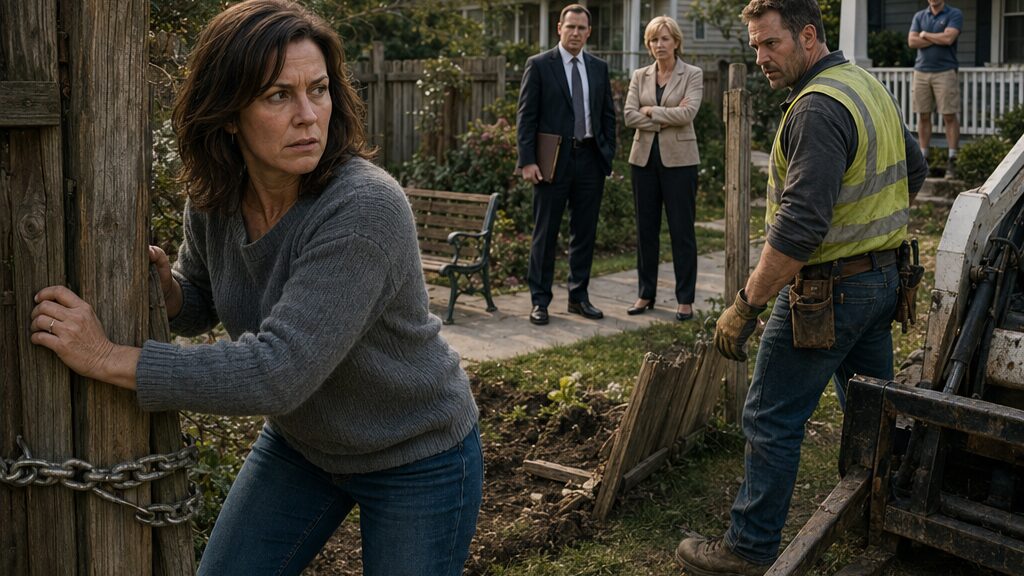
A truck sat beside the curb. Two workers stood inside her backyard. One had wrapped a thick chain around a fence post. Another guided the chain while a machine pulled slowly backward.
The privacy fence shuddered.
The gate.
Her gate.
“Stop!”
Kathleen threw open the back door and ran barefoot across the grass.
The chain tightened.
Wood groaned.
A section of fence ripped sideways.
The sound echoed across the neighborhood.
“STOP!”
One of the workers looked up.
The machine halted.
For half a second.
Then a voice came from the sidewalk.
“Continue.”
Kathleen recognized the speaker immediately.
Sandra Miller.
HOA president.
Standing beside her was Robert Carter, the HOA attorney.
A clipboard rested under his arm.
Kathleen reached the damaged fence and grabbed a fallen panel before it hit the ground.
“What are you doing?”
Robert stepped forward.
“Mrs. Williams, the board approved emergency compliance action.”
“You can’t just come onto my property and tear down my fence.”
“The exemption protecting this structure is no longer valid.”
Kathleen stared at him.
“What exemption?”
“The grandfathered exemption.”
“The one approved years ago?”
“Correct.”
“Then it’s still approved.”
Robert’s expression barely changed.
“According to the board’s review, it is not.”
The worker nearest her shifted uncomfortably.
Behind Kathleen, the gate swung open on one remaining hinge.
The sight sent a pulse of panic through her chest.
Not because of the fence itself.
Because of what sat beyond it.
The corner of the yard.
The secluded section hidden by tall panels.
The place nobody outside the family ever entered.
A place Ashley used every day.
A place now exposed.
Kathleen stepped between the workers and the opening.
“You don’t have authority to do this.”
Robert held up a document.
“We do.”
She snatched the pages.
The heading read EMERGENCY COMPLIANCE ACTION.
Emergency.
The word made her laugh.
Not because it was funny.
Because it was absurd.
“A fence is an emergency now?”
Sandra folded her arms.
“We’ve received complaints for months.”
“From who?”
“Residents.”
“Which residents?”
Sandra didn’t answer.
Across the street, a few curtains moved.
Porches filled.
People were watching.
The chain lay coiled in wet grass like a snake.
The worker operating the machine cleared his throat.
“Sir…”
Robert looked at him.
“What?”
The worker pointed toward the open section.
“Maybe we should verify—”
“We have authorization.”
The worker fell silent.
Kathleen turned slowly.
“You never even came to speak to me.”
“We sent notices.”
“You sent form letters.”
“We followed procedure.”
There it was again.
Procedure.
The word felt like a wall.
Not a real wall.
A wall made from people deciding they didn’t need to understand.
Only enforce.
A door opened inside the house.
Kathleen’s stomach tightened.
Ashley appeared in the doorway.
The young woman froze.
Her eyes moved to the missing section of fence.
Then to the neighbors.
Then to the workers.
The color drained from her face.
Kathleen immediately crossed the yard.
“Ashley.”
Ashley didn’t answer.
The open gap held her attention.
A stranger could see directly into the protected corner now.
The small bench.
The raised garden bed.
The privacy screens.
The place where Ashley sat when panic became too much.
The place she trusted.
Or had trusted.
Robert’s voice carried across the yard.
“Mrs. Williams, please step away from the work area.”
Kathleen turned.
“No.”
His expression hardened.
“Do not interfere with the crew.”
“Then get them off my property.”
“We are acting lawfully.”
The machine started again.
The chain jerked.
Wood exploded with a sharp crack.
An entire section collapsed.
Ashley flinched.
Kathleen saw it.
Not the movement.
The look.
Fear.
Not of the workers.
Not of Robert.
Of losing something.
A certainty.
A promise.
The contractor closest to the chain watched Ashley for several seconds.
Then he looked back toward Robert.
“How much of it are we taking down?”
“All noncompliant sections.”
The contractor frowned.
“What exactly is the violation?”
Robert answered immediately.
“Height. Design inconsistency. Expired exemption.”
The contractor glanced at Kathleen.
Then at the gate.
Then back at Robert.
His uncertainty lingered only a moment.
The job resumed.
Because jobs always resumed.
Until someone gave a reason not to.
By noon, nearly a third of the fence was gone.
The open gap felt enormous.
Neighbors drifted past pretending not to stare.
Sandra left after making a few calls.
Robert remained long enough to deliver a final warning.
“If you obstruct further work, legal remedies will be pursued.”
Kathleen looked at him.
“Did anyone actually review the original approval?”
“The board reviewed relevant materials.”
“That’s not what I asked.”
Robert didn’t answer.
He simply walked away.
That bothered her more than anything else.
Not anger.
Avoidance.
As if he knew something she didn’t.
Or didn’t know something he should.
The workers packed equipment and left for the day.
The damaged gate hung crooked and useless.
Silence settled over the yard.
Ashley remained inside.
Kathleen understood why.
The backyard no longer felt private.
It felt exposed.
Vulnerable.
She spent the afternoon digging through old filing cabinets.
Folders.
Property records.
Invoices.
Permit copies.
Letters.
Years of paperwork.
Dust coated her fingertips.
Hours passed.
Then she found it.
An aging folder marked HOA EXEMPTION.
Inside were approval letters.
Meeting minutes.
Signatures.
Supporting documentation.
More than she remembered.
Her pulse quickened.
The exemption wasn’t vague.
It was specific.
Detailed.
Documented.
Official.
She sat down slowly.
If these papers existed…
why had the board acted as if they didn’t?
Kathleen looked again at the signatures.
One belonged to a former board member.
Attached behind it was a correspondence page she had never noticed before.
The date stopped her.
Someone had reviewed this issue years after approval.
And reaffirmed it.
She stared at the page.
Then at the damaged gate visible through the window.
The question growing inside her was no longer whether the HOA had made a mistake.
It was why they were pretending this history didn’t exist.
Chapter 2: The Rule Nobody Explained
The document looked convincing enough to destroy her case.
Kathleen read it three times.
Each reading made her stomach sink a little further.
Across her kitchen table lay a newly downloaded copy of the HOA compliance policy.
One section had been highlighted by Robert Carter.
Grandfathered structures remain protected unless substantial modifications alter original conditions.
At first glance it seemed simple.
Dangerously simple.
Her fence had been repaired over the years.
Panels replaced.
Posts reinforced.
Storm damage fixed.
The HOA now claimed those repairs voided the exemption.
Kathleen rubbed her temples.
For the first time since the fence came down, doubt slipped into the room.
Maybe Robert wasn’t ignoring the rules.
Maybe he genuinely believed he was following them.
That possibility bothered her.
Because fighting dishonesty was easier than fighting certainty.
She gathered her paperwork and drove to the HOA records office.
The receptionist barely looked up.
“Can I help you?”
“I need access to board records related to my property.”
The woman hesitated.
Then nodded.
“Limited review only.”
Kathleen expected resistance.
Instead she got indifference.
Somehow that felt worse.
An hour later she sat surrounded by binders.
Minutes.
Correspondence.
Archived decisions.
Most were boring.
Routine.
Predictable.
Then she found something strange.
A discussion from six years earlier.
Her fence had appeared on an agenda.
The board debated whether maintenance repairs counted as modifications.
The vote wasn’t unanimous.
One member argued that removing the exemption would create unnecessary hardship.
Another argued that exceptions weakened enforcement.
Kathleen copied every page.
Then she found something even stranger.
The final decision referenced a follow-up letter.
The letter wasn’t attached.
She searched the binder again.
Nothing.
The file jumped from discussion to conclusion.
Missing pages.
A shadow crossed the table.
Sandra Miller stood nearby.
“Looking for something?”
Kathleen looked up.
“The follow-up letter.”
Sandra frowned.
“What letter?”
“The one referenced in the meeting notes.”
Sandra glanced at the page.
Her expression shifted slightly.
Only slightly.
But enough.
“I don’t remember.”
“You were on the board then.”
“I wasn’t president.”
“Do you remember the decision?”
Sandra sighed.
“We were trying to be consistent.”
“There it is again.”
“What?”
“Consistent.”
Sandra folded her arms.
“Do you know how many complaints we receive when one homeowner gets special treatment?”
Kathleen stared at her.
“This isn’t special treatment.”
“That’s how people see it.”
The answer sounded honest.
Not kind.
Not helpful.
But honest.
Sandra seemed tired.
Not triumphant.
Not cruel.
Just tired.
Kathleen suddenly understood something.
Sandra wasn’t trying to hurt her.
She was trying to avoid accusations from everyone else.
That didn’t excuse anything.
But it explained something.
Before Kathleen could respond, Sandra’s phone buzzed.
She checked it.
Her face tightened.
“The board scheduled a hearing.”
“When?”
“Next week.”
Kathleen blinked.
“Next week?”
“The matter has become… public.”
Sandra walked away before Kathleen could ask more.
Public.
The word followed her home.
She learned exactly what it meant an hour later.
Kevin Roberts had posted photographs online.
Photos of her fence.
Photos of the damaged sections.
Photos of workers.
Photos of her yard.
The accompanying caption made her jaw tighten.
Finally cleaning up the neighborhood.
Hundreds of comments followed.
Most from people who knew almost nothing.
The fence was ugly.
Rules matter.
Everyone should comply.
Stop making exceptions.
Kathleen scrolled through them.
Then froze.
One comment stood out.
A resident mentioned repeated complaints dating back nearly a year.
Nearly a year.
Not months.
A year.
Someone had been pushing this far longer than she realized.
The hearing wasn’t about a fence anymore.
Someone wanted the fence gone.
The question was why.
Chapter 3: What the Fence Hides
By Saturday morning, people were slowing their cars to look.
The damaged fence had become neighborhood entertainment.
Kathleen hated that more than the comments.
People could say whatever they wanted online.
Seeing them stare in person felt different.
The broken gate leaned against the side of the house.
The opening remained uncovered.
Temporary screening flapped weakly in the breeze.
It wasn’t enough.
Everyone knew it.
Two neighbors stood near the sidewalk pretending to discuss landscaping.
Their eyes never left the yard.
Kathleen was carrying replacement tarps when she heard laughter.
Kevin Roberts.
Of course.
He stood with another resident near the property line.
“Look,” Kevin said loudly enough to be heard. “All this drama over a fence.”
His companion chuckled.
Kevin pointed toward the opening.
“You’d think it was protecting state secrets.”
Kathleen kept walking.
She knew responding would only feed him.
But Ashley heard.
The screen door clicked softly.
Kevin noticed.
His smile faded slightly.
Ashley stepped outside.
Only a few feet.
No further.
Her gaze lingered on the exposed corner.
The bench.
The garden.
The missing panels.
She immediately retreated inside.
Kevin watched her go.
For the first time, uncertainty flickered across his face.
Not understanding.
Just confusion.
As if reality wasn’t matching the story he had created.
Later that afternoon, Kathleen found Ashley sitting in the recovery corner.
The young woman was curled beneath a blanket despite the warmth.
The opening in the fence remained visible from where she sat.
Ashley kept glancing toward it.
Kathleen lowered herself onto the bench.
Neither spoke for a while.
The garden boxes stood between them.
Small herbs.
Flowers.
Plants grown from months of careful routines.
“What are you thinking?” Kathleen finally asked.
Ashley shrugged.
Not convincing.
Kathleen waited.
Eventually Ashley spoke.
“It feels different.”
“The yard?”
Ashley nodded.
“Like people can see everything.”
Kathleen looked toward the opening.
“They can’t.”
“But they can.”
The words came quietly.
And because they were quiet, they landed harder.
Ashley stared at the damaged fence.
“You promised this place was safe.”
Kathleen felt something twist inside her.
“I know.”
“I believed you.”
The statement wasn’t an accusation.
That made it worse.
A promise broken by circumstances still felt broken.
Kathleen reached for an answer and found none.
The sound of a vehicle interrupted them.
A delivery truck.
Nothing important.
Yet Ashley visibly relaxed only after it passed.
Kathleen noticed.
Every unexpected sound now mattered.
Every glimpse through the opening mattered.
Every stranger mattered.
This had never been about privacy.
It was about predictability.
Control.
The ability to look at a space and know it belonged to you.
Her phone vibrated.
An email.
The hearing had been moved forward.
Three days earlier than scheduled.
Kathleen stared at the message.
Another acceleration.
Another push.
Another sign that someone wanted this resolved quickly.
Too quickly.
That evening she reviewed the documents again.
A pattern emerged.
Complaints.
Follow-up complaints.
Requests for action.
References to appearance.
References to precedent.
One name appeared repeatedly.
Kevin Roberts.
Not every complaint.
But enough.
Far more than she expected.
A knock sounded at the door.
When Kathleen opened it, she found Jason Green standing outside.
The contractor looked uncomfortable.
“I thought you should know something.”
Kathleen stepped aside.
Jason remained on the porch.
“I checked the job file.”
“And?”
“There wasn’t much in it.”
“What does that mean?”
“It means most compliance removals come with more documentation.”
Kathleen’s attention sharpened.
“What was missing?”
Jason hesitated.
“Context.”
“What kind of context?”
“The kind that explains why a structure exists.”
He looked toward the damaged fence.
Then toward the exposed yard.
“I’ve done this work for a long time.”
“And?”
“I’ve learned that if somebody builds something that big and keeps maintaining it for years, there’s usually a reason.”
Kathleen said nothing.
Jason nodded once.
Then turned to leave.
Halfway down the path he stopped.
“The hearing’s moving fast because somebody wants an answer before questions start getting asked.”
He left before she could respond.
Night settled over the neighborhood.
The damaged gate cast a crooked shadow across the grass.
Ashley stood beside it.
Looking at it.
Not touching it.
Just looking.
After a long silence she asked the question Kathleen had been dreading.
“If they take the rest of it…”
Her voice faltered.
Then continued.
“Will it ever feel safe here again?”
Chapter 4: The Survey Stakes
The contractor’s truck was already parked beside the damaged fence when Kathleen stepped outside.
Jason Green stood near the property line with his hands on his hips.
No equipment was running.
No chains rattled.
No workers moved.
Robert Carter was arguing with someone Kathleen didn’t recognize.
A surveyor.
Bright orange stakes dotted the grass near the fence.
Kathleen walked quickly toward them.
“What’s happening?”
Jason looked relieved to see her.
“Good timing.”
Robert immediately turned.
“The inspection is routine.”
The surveyor glanced at him but didn’t agree.
Instead he studied a clipboard.
“Actually, the measurements don’t match the removal order.”
Silence followed.
Brief.
Sharp.
Kathleen felt her pulse quicken.
“What doesn’t match?”
The surveyor pointed toward the damaged fence.
“The order identifies the disputed section as extending beyond the approved boundary.”
“And does it?”
The surveyor frowned.
“So far, no.”
Robert stepped forward.
“We’re verifying all measurements.”
Jason folded his arms.
“That’s what I asked for before we tore down half the fence.”
Robert ignored him.
The surveyor continued checking markers.
A tape measure stretched across the yard.
Orange stakes appeared one after another.
Each one landed closer to Kathleen’s side than Robert seemed comfortable with.
Neighbors gathered again.
Watching.
Always watching.
Kevin Roberts stood near the sidewalk.
His confidence from earlier days seemed less obvious now.
The surveyor eventually stopped beside one of the remaining fence posts.
He tapped the stake nearest it.
“This line places the structure inside the approved property area.”
Kathleen looked at Robert.
“So the fence isn’t where you claimed it was.”
Robert adjusted his glasses.
“The compliance issue involves more than location.”
“That wasn’t my question.”
No answer came.
Jason kicked lightly at the dirt.
“You told us the boundary issue justified emergency removal.”
The surveyor looked between them.
“Was that part of the complaint?”
Robert’s silence lasted too long.
The surveyor noticed.
So did everyone else.
A murmur moved through the gathered neighbors.
Not outrage.
Not yet.
Doubt.
The first crack in certainty.
Kathleen felt it.
A small shift.
Nothing solved.
But something had changed.
The narrative no longer belonged entirely to the HOA.
Hours later the inspection continued.
The surveyor reviewed archived maps.
Property filings.
Older records.
Kathleen sat at a folding table near the driveway reviewing copies of her documents.
Jason approached carrying a bottle of water.
“You were right.”
She looked up.
“About what?”
“There being more to this.”
Kathleen accepted the bottle.
Jason glanced toward the damaged gate.
“When I started this job, I thought it was another ugly-neighbor dispute.”
“And now?”
He hesitated.
“Now I think somebody made decisions before asking enough questions.”
That wasn’t the same as taking her side.
But it mattered.
The distinction felt important.
People changing their minds because they learned something.
Not because they were forced.
The afternoon brought another surprise.
The surveyor requested archived correspondence connected to the exemption.
Sandra Miller arrived carrying a storage box from the HOA office.
The sight alone made Kathleen suspicious.
Why hadn’t those records appeared earlier?
Sandra looked exhausted.
As if the entire situation had become heavier than expected.
The surveyor began sorting through the contents.
Letters.
Meeting notes.
Copies of approvals.
Then he paused.
“What is this?”
Everyone looked up.
He held a thin packet.
Several pages stapled together.
The top sheet carried a familiar address.
Kathleen’s.
Her breath caught.
Sandra stepped closer.
“I don’t remember seeing that.”
The surveyor skimmed the pages.
His expression changed.
“These appear to be safety-related submissions.”
Kathleen stood.
“What submissions?”
The surveyor handed them over.
Immediately she recognized them.
Documents she had filed months ago.
Additional explanations.
Supporting statements.
Clarifications.
All stamped received.
None stamped reviewed.
Her stomach dropped.
She flipped through every page.
Not a single response.
Not a single notation.
Nothing.
The silence around her grew uncomfortable.
Sandra took the packet.
Read it.
Then read it again.
“You submitted these?”
“Of course I submitted them.”
“When?”
Kathleen pointed directly at the date.
Sandra’s face lost color.
Robert moved toward them.
Sandra held up a hand.
Not aggressively.
Automatically.
As if she needed a moment.
The gesture surprised everyone.
Including Robert.
The HOA president looked genuinely unsettled.
“This should have been included in the review file.”
Robert’s jaw tightened.
“We don’t know that.”
Sandra looked at him.
“We absolutely know that.”
For the first time, the two appeared divided.
Not publicly united.
Not confident.
Just people staring at paperwork that raised difficult questions.
The surveyor closed his clipboard.
“I can’t certify the basis for further removal today.”
Robert frowned.
“What does that mean?”
“It means I need additional records before I can support the findings.”
Jason exhaled slowly.
The remaining workers exchanged looks.
No one touched the equipment.
No one approached the fence.
For the first time since the conflict began, the destruction stopped.
Not because Kathleen won.
Because uncertainty had entered the process.
And uncertainty frightened institutions.
As the crowd dispersed, Sandra remained near the damaged gate.
She looked at the opening for a long moment.
Then at Kathleen.
“I honestly never saw those documents.”
Kathleen wanted to believe her.
Part of her did.
Part of her didn’t.
The problem wasn’t whether Sandra had seen them.
The problem was that nobody important apparently had.
Sandra handed the packet back.
“We need to find out what happened.”
It sounded sincere.
Yet the damage already existed.
The broken panels.
The exposed yard.
Ashley’s fear.
Those things didn’t disappear because someone suddenly wanted answers.
That evening Kathleen spread the recovered documents across her dining table.
One page caught her attention.
A routing sheet.
Simple.
Ordinary.
Easy to miss.
She nearly set it aside.
Then she noticed a notation.
Forwarded for review.
No reviewer listed.
No action recorded.
The file hadn’t been rejected.
It hadn’t been evaluated.
It had vanished inside the system.
Kathleen stared at the page.
Somebody had received the warning.
Somebody had chosen not to act.
Chapter 5: The File Nobody Read
Kathleen placed the packet in front of the board before anyone else could speak.
The room fell quiet.
The broken gate leaned against the meeting hall wall outside the glass doors, visible through the windows.
She had arranged that intentionally.
A reminder.
A consequence.
Not an abstract discussion.
A real one.
The special HOA meeting had drawn more residents than usual.
People who never attended board sessions filled the seats.
Some came because of curiosity.
Others because of the growing controversy.
Sandra Miller sat at the center of the board table.
Robert Carter occupied a chair beside her.
Neither looked comfortable.
Kathleen remained standing.
“This file was submitted months ago.”
She tapped the stack.
“It was received.”
Another tap.
“It was logged.”
Another.
“It was never reviewed.”
Robert immediately leaned forward.
“We don’t know that.”
Kathleen slid the routing sheet across the table.
“Then explain this.”
The document reached Sandra first.
She read it.
Then passed it silently to Robert.
The attorney’s expression tightened.
Not panic.
Calculation.
He read every page carefully.
Too carefully.
The audience noticed.
So did Kathleen.
If the documents meant nothing, he would have dismissed them instantly.
Instead he examined them line by line.
A board member spoke.
“Was this part of the original file?”
Sandra answered before Robert could.
“It should have been.”
Murmurs spread across the room.
Kevin Roberts sat near the back.
Arms crossed.
Watching.
Not smirking anymore.
The mood had shifted.
No one seemed entirely sure who was right.
Only that something wasn’t adding up.
Robert finally placed the papers down.
“The board relied on the records available at the time.”
Kathleen stared at him.
“That’s your defense?”
“It is a factual statement.”
“No.”
Her voice remained calm.
“Your defense is that nobody checked.”
The room grew quieter.
Sandra looked away.
The criticism landed harder than anger would have.
Because it sounded true.
The board began reviewing records one by one.
Minutes passed.
Then more.
An uncomfortable process.
Slow.
Detailed.
Necessary.
A board member discovered references to supporting material that never appeared in the final review package.
Another found a notation indicating follow-up was recommended.
No evidence of follow-up existed.
Questions multiplied.
Answers didn’t.
Midway through the meeting, Sandra requested a short recess.
The board gathered in a corner of the room.
Whispered discussions followed.
Residents exchanged theories.
Kathleen remained seated.
Exhaustion pressed against her.
For days she had fought.
Argued.
Explained.
Defended.
The temptation to stop was growing.
Not because she doubted herself.
Because she was tired of exposing pieces of her life to strangers.
A chair scraped nearby.
Kevin Roberts approached.
Kathleen looked up.
Neither spoke immediately.
Finally Kevin cleared his throat.
“I didn’t know.”
The statement hung awkwardly between them.
Kathleen waited.
“I thought the board had already checked everything.”
She almost laughed.
Not because it was funny.
Because that assumption had fueled the entire mess.
“What exactly did you think was happening?” she asked.
Kevin looked toward the damaged fence visible through the window.
“I thought somebody got special treatment.”
“And that bothered you.”
“Yes.”
At least he was honest.
Kevin rubbed the back of his neck.
“My complaints weren’t about hurting anybody.”
“I know.”
The words surprised both of them.
She did know.
Kevin wasn’t cruel.
He was careless.
There was a difference.
A meaningful one.
The board returned.
The meeting resumed.
Sandra spoke first.
“We have identified several missing review documents.”
The room reacted immediately.
Some residents looked angry.
Others confused.
Robert remained expressionless.
Sandra continued.
“The board cannot determine whether the original review process was completed correctly.”
A resident raised a hand.
“Then why was demolition approved?”
Nobody answered right away.
That silence said more than any explanation.
Kathleen watched Sandra closely.
The HOA president looked genuinely shaken.
Not because of public criticism.
Because she was beginning to understand the consequences.
The fence wasn’t theoretical.
People were.
Eventually Sandra spoke.
“The board made decisions using incomplete information.”
The admission landed heavily.
Not a full apology.
Not accountability.
But closer than before.
Robert shifted in his chair.
“Procedurally, the decision was still authorized.”
Several heads turned toward him.
Including Sandra’s.
“Authorized isn’t the same as justified,” she said quietly.
The attorney looked surprised.
Perhaps because she said it publicly.
Perhaps because she said it at all.
The meeting stretched into evening.
Records continued surfacing.
Questions continued multiplying.
Then another discovery emerged.
A board member located archived correspondence tied to Kathleen’s property.
Inside was a recommendation.
Review hardship considerations before enforcement action.
The recommendation had never been discussed.
Never voted on.
Never addressed.
Sandra closed her eyes briefly.
Just once.
The gesture lasted a second.
Yet it revealed more than any statement.
Kathleen saw a woman confronting the possibility that her board had failed.
Not maliciously.
Not intentionally.
But failed all the same.
When the meeting finally ended, little had been resolved.
Except one thing.
The board could no longer claim complete ignorance.
People knew there were missing pieces.
People knew warnings existed.
People knew questions had been ignored.
Outside, residents slowly dispersed.
The broken gate still rested against the wall.
A reminder waiting in the dark.
Sandra approached Kathleen before leaving.
For several seconds neither woman spoke.
Then Sandra said, “Someone should have looked harder.”
Kathleen nodded.
“Yes.”
Sandra glanced toward the parking lot.
Toward Robert.
Then back.
“If the hearing moves forward, you’ll need someone willing to explain the human side of this.”
Kathleen already knew who she meant.
The thought made her stomach tighten.
Because explaining the human side meant exposing truths she had spent years protecting.
As if summoned by the thought itself, her phone vibrated.
A message appeared.
Debra Smith.
I’m ready to speak publicly if Ashley agrees.
Kathleen stared at the screen.
The next step had arrived.
And there would be no hiding behind paperwork anymore.
Chapter 6: The Cost of Feeling Safe
The hearing room buzzed with nervous conversation until the door opened.
Debra Smith stepped inside carrying a thick folder.
The noise faded almost immediately.
Kathleen saw several residents recognize her.
Not personally.
Professionally.
Debra had spent years working with survivors and families throughout the area.
She wasn’t dramatic.
She wasn’t political.
She wasn’t known for exaggeration.
Which made her presence matter.
Ashley sat beside Kathleen.
Rigid.
Silent.
Hands clasped tightly together.
Kathleen leaned closer.
“You don’t have to do this.”
Ashley kept her eyes forward.
“Maybe I do.”
The answer carried no confidence.
Only determination.
Sometimes determination mattered more.
Across the room, Sandra reviewed documents.
Robert organized notes beside her.
The attorney looked prepared.
The way people look when they believe facts will protect them.
Kathleen wasn’t so sure anymore.
The hearing began.
Formal introductions.
Procedural statements.
Review of events.
The same facts everyone had already heard.
Fence.
Exemption.
Complaints.
Removal.
Missing documents.
Then Debra was called forward.
She sat calmly.
Opened her folder.
Waited.
The room settled.
Robert spoke first.
“Ms. Smith, can you explain your involvement with the Williams household?”
“I provide support services.”
“For whom?”
Debra glanced briefly toward Ashley.
Then answered carefully.
“A domestic-violence survivor rebuilding stability after prolonged trauma.”
The room became very still.
No dramatic reaction.
Just silence.
The kind that follows information people weren’t expecting.
Robert nodded.
“And how is that relevant to a fence dispute?”
Debra’s gaze didn’t waver.
“Because it isn’t a fence dispute.”
The statement lingered.
Debra continued.
“The enclosed area behind the property was intentionally structured as a recovery space.”
She described routines.
Predictability.
Controlled visibility.
Safe boundaries.
Simple things.
A bench.
A garden.
A gate that could be closed.
A place where nobody watched.
Nobody evaluated.
Nobody unexpectedly appeared.
Kathleen watched faces throughout the room.
The change happened gradually.
Not sympathy.
Understanding.
A different thing.
Several residents lowered their eyes.
Others glanced toward the photographs displayed earlier.
The fence no longer looked decorative.
It looked purposeful.
Debra never exaggerated.
Never appealed for pity.
She simply explained consequences.
“What happens when that space is removed?” Sandra asked quietly.
Debra paused.
Then answered.
“People lose trust.”
No one interrupted.
“Not trust in a structure.”
She looked toward Ashley.
“Trust in safety itself.”
The words settled heavily across the room.
For Kathleen, they landed hardest because they echoed her own fear.
The fear she had never spoken aloud.
The fear behind every argument.
Every document.
Every sleepless night.
Ashley shifted beside her.
Kathleen turned.
The young woman looked pale.
Her breathing quickened.
The crowd.
The attention.
The discussion.
Too much.
Ashley stood suddenly.
Several heads turned.
Kathleen rose with her.
“We can leave.”
Ashley shook her head.
For a moment Kathleen thought she might walk out anyway.
Instead Ashley remained standing.
Trembling slightly.
Looking directly at the board.
At Sandra.
At Robert.
At everyone.
The silence stretched.
Then Ashley spoke.
“I wasn’t afraid of the fence coming down.”
Her voice barely carried.
People leaned forward to hear.
“I was afraid it meant nobody cared why it was there.”
No speech followed.
No dramatic explanation.
Just that.
The room understood.
More than they would have from ten additional minutes of testimony.
Ashley sat back down.
Kathleen took her hand.
For the first time since this began, she didn’t pull away.
Across the room, Sandra looked visibly affected.
Even Robert seemed unsettled.
Not defeated.
Not converted.
Just confronted with something his paperwork had never measured.
The hearing continued.
But the atmosphere had changed.
Discussion shifted from compliance standards to responsibility.
From rules to consequences.
From property to people.
One board member raised concerns about liability.
Another questioned review procedures.
A resident asked how many other hardship cases might have been overlooked.
Questions came faster now.
Questions nobody had wanted before.
Robert attempted to redirect the conversation toward process.
Yet process suddenly felt insufficient.
Not wrong.
Incomplete.
By the time final statements concluded, everyone understood the issue differently than they had that morning.
Sandra requested a board recess.
The members rose and exited into a private room.
The door closed behind them.
No decision.
Not yet.
Kathleen sat quietly.
Ashley remained beside her.
Debra organized her papers.
Outside the hearing room, conversations erupted.
Inside, uncertainty remained.
The board was finally asking the right questions.
Whether they would have the courage to answer them was something else entirely.
Chapter 7: The Gate Closes Again
The sound of hammers echoed through the backyard.
Kathleen stepped onto the porch and stopped.
Fresh fence boards rested in neat stacks beside the lawn.
For a moment she simply stared.
The damaged opening that had dominated her view for weeks was finally changing.
Not through arguments.
Not through paperwork.
Through repair.
Jason Green was already at work.
He lifted a board into place and checked its alignment before fastening it.
A second worker helped steady the post.
Neither spoke much.
The work itself seemed important enough.
Kathleen walked toward the gate.
The old broken section had been removed.
A new frame leaned nearby, waiting to be installed.
She touched the unfinished wood.
Smooth.
Solid.
Temporary no longer.
Behind her, footsteps approached.
Ashley.
She stopped beside Kathleen and watched silently.
The reconstruction had taken several weeks to approve.
The board had recessed after the hearing.
Then reviewed records.
Then commissioned an independent examination of the exemption process.
Then reviewed the missing documents.
One conclusion kept appearing.
The enforcement action should never have moved forward without additional review.
The final vote had not been unanimous.
But it had been decisive.
The exemption would be restored.
The fence would remain.
The HOA would fund repairs for the damaged sections.
And a hardship-review policy would be added for future cases.
Not because of public embarrassment.
Because too many facts had been ignored.
Kathleen still remembered the moment the decision arrived.
A certified envelope.
A formal letter.
Simple language.
No dramatic apology.
No sweeping admission.
Just acknowledgment.
The board had acted on incomplete information.
The damage would be corrected.
The words had not erased what happened.
But they mattered.
Ashley looked toward the rebuilt section.
“Do you think it’ll feel normal again?”
Kathleen considered the question.
“Not immediately.”
Ashley nodded.
As if she expected that answer.
Trust repaired more slowly than fences.
Jason approached carrying tools.
He wiped sweat from his forehead.
“We’ll have the gate up today.”
The statement sounded oddly ceremonial.
Like announcing the return of something bigger than lumber.
Kathleen smiled.
“Thank you.”
Jason shrugged.
“I should’ve asked more questions at the beginning.”
“You stopped when it mattered.”
He looked toward the fence.
“Maybe.”
His expression suggested he wasn’t entirely convinced.
The experience had changed him too.
People rarely enjoyed discovering they had participated in something harmful.
Even indirectly.
The morning passed.
Posts were secured.
Panels installed.
Hardware mounted.
Neighbors occasionally slowed to watch.
The atmosphere felt different now.
Not curious.
Reflective.
As if the community had become aware that it had witnessed something uncomfortable about itself.
Around noon, another visitor arrived.
Sandra Miller.
She stood near the sidewalk for several seconds before approaching.
Kathleen saw the hesitation immediately.
The HOA president who once stood confidently beside the removal crew looked very different now.
Not weaker.
Just less certain.
Sandra stopped beside the new gate frame.
“It looks good.”
Jason returned to work a few feet away.
Giving them privacy without leaving.
Kathleen nodded.
“It does.”
Sandra folded her hands.
For several moments she said nothing.
Then finally spoke.
“I owe you something.”
Kathleen remained silent.
Sandra looked directly at the restored fence.
“I kept telling myself I was being fair.”
The words came carefully.
“As long as every homeowner followed the same standards, I thought fairness would take care of itself.”
Kathleen listened.
“I stopped asking whether the standards fit the situation.”
Sandra exhaled.
“When the complaints kept coming, I became more concerned about consistency than understanding.”
There was no script in her voice.
No prepared statement.
Just someone confronting a mistake.
Kathleen appreciated that more than an apology designed to end discomfort.
“You weren’t the only one.”
Sandra nodded.
“I know.”
The admission surprised her.
Kathleen could have blamed a single person.
Sometimes she wanted to.
It would have been easier.
But too many people had contributed.
The board.
The attorney.
The neighbors.
Even herself.
She had hidden so much that nobody outside the house understood what was at stake.
Protection had become isolation.
Isolation had become misunderstanding.
Sandra glanced toward Ashley.
“She’s brave.”
Ashley looked uncomfortable hearing it.
Sandra smiled gently.
“I mean that.”
After a moment she continued.
“The policy changes passed.”
Kathleen had already received the notice, but hearing it aloud felt different.
“We created a formal hardship review process.”
“Good.”
“It won’t undo what happened.”
“No.”
Sandra nodded.
“But maybe it keeps it from happening again.”
For the first time, Kathleen believed that might be true.
Sandra eventually left.
No dramatic reconciliation.
No perfect resolution.
Just two women who understood more than they had before.
The afternoon brought another small surprise.
Kevin Roberts walked across the street carrying a flat of flowers.
Kathleen nearly laughed from disbelief.
Kevin looked uncomfortable enough for three people.
“I wasn’t sure if I should come over.”
“You came anyway.”
“Yeah.”
He held up the flowers.
“They’re for the garden.”
Ashley glanced toward him.
Kevin shifted awkwardly.
“I know that doesn’t fix anything.”
“No,” Kathleen said.
“It doesn’t.”
He nodded.
“I figured.”
The silence stretched.
Then Ashley surprised everyone.
Including herself.
“Thank you.”
Kevin looked genuinely relieved.
The flowers found a place in one of the garden beds.
A small gesture.
Not redemption.
Not forgiveness.
Just recognition.
Sometimes that was enough.
Late afternoon sunlight stretched across the yard as Jason finished the final installation.
The gate stood upright.
Fresh hinges.
Fresh hardware.
Fresh wood.
Yet somehow it looked familiar.
Like something returning home.
Jason tested the latch.
The metal clicked cleanly into place.
He smiled.
“There you go.”
The workers packed their tools.
One by one they departed.
Eventually only Kathleen and Ashley remained.
The yard felt quiet.
Not empty.
Protected.
Kathleen walked toward the gate.
Her hand rested on the smooth wood.
Weeks earlier she had stood in nearly the same spot watching strangers tear it apart.
The memory remained vivid.
The chain.
The noise.
The panic.
Now another memory would exist beside it.
Repair.
Understanding.
Choice.
Ashley joined her.
Together they looked across the enclosed space.
The bench.
The garden.
The privacy screens.
Everything seemed unchanged.
Yet everything had changed.
Kathleen realized something then.
The deepest fear had never been losing the fence.
It had been losing Ashley’s belief that safety could be real.
That trust had survived.
Not untouched.
But alive.
A small voice interrupted the moment.
One of the neighborhood children stood nearby holding a bicycle.
The child had often ridden past during the construction.
Watching quietly.
Now the child looked at the new gate.
Then at Kathleen.
“My mom said fences keep people out.”
Kathleen smiled.
“Sometimes.”
The child studied the gate.
“Then why was everyone fighting so hard to keep this one?”
Before Kathleen could answer, Ashley stepped forward.
Her voice was soft.
But steady.
“Because sometimes a boundary is how you protect the people you love.”
The child thought about that.
Then nodded.
As if the answer made perfect sense.
The bicycle rolled away.
Ashley looked at the gate again.
Slowly she reached out.
Pulled it closed.
The latch clicked.
A simple sound.
Wood.
Metal.
Nothing extraordinary.
Yet the sound settled over the yard like a promise.
For the first time in weeks, Ashley smiled without hesitation.
And for the first time in weeks, Kathleen believed that home felt like home again.
The story has ended.