They Pointed Him Away From the Aircraft Until the Commander Recognized Five Lines on His Arm
Chapter 1: The White Glove Pointed Toward the Exit
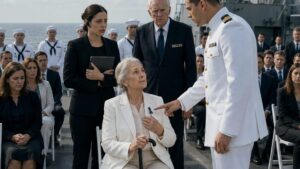
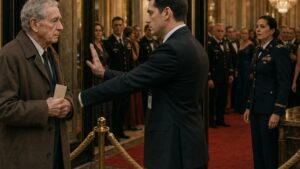
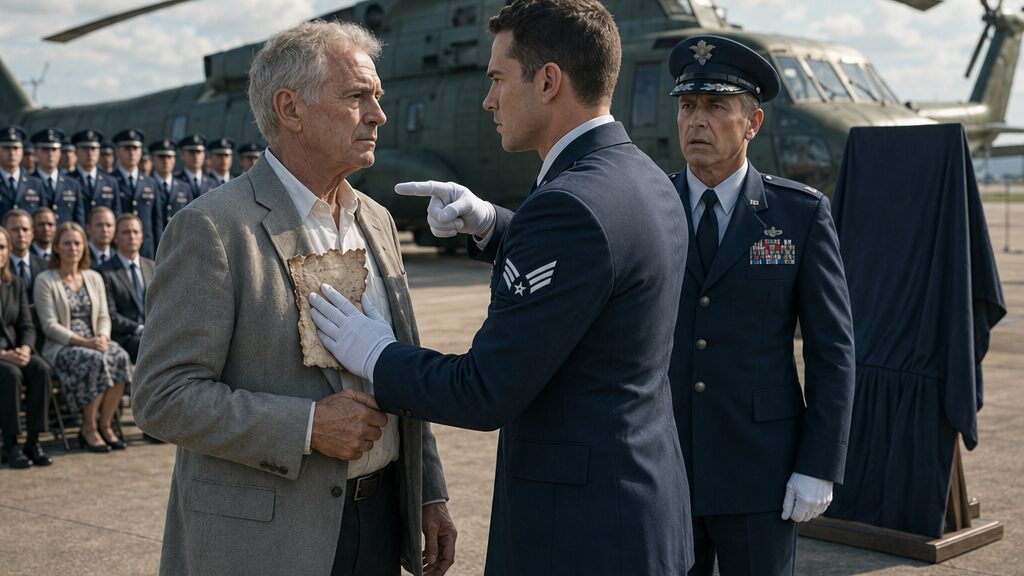
The white-gloved finger stopped less than an inch from Ronald Allen’s chest.
“You need to move now, sir. The formation is waiting on you.”
The young staff sergeant did not shout. He did something worse: he slowed each word, as though Ronald’s gray hair had made ordinary English difficult.
Ronald looked past the finger toward the flight line. Three ranks of airmen stood motionless in the late-morning glare. Beyond them, the restored rescue aircraft rested behind a waist-high barrier, its dark green skin polished too evenly, its windows reflecting the hangar doors. A cloth covered the memorial panel beside its nose.
He had not seen that aircraft in forty-seven years.
Not intact, anyway.
“I’m trying to speak with Sandra Brown,” Ronald said.
The staff sergeant glanced at the water-stained invitation in Ronald’s hand. “And I’ve explained that Ms. Brown is inside the restricted area.”
“My name should be on her list.”
“It isn’t.”
Ronald unfolded the invitation again. The lower corner had fused into a soft gray curl after rain leaked through the kitchen window two nights earlier. The printed date remained visible. His name did not.
The staff sergeant tapped a tablet clipped to his left forearm. “I checked twice.”
“Then check under restoration guests.”
“I checked all categories.”
The finger returned, aimed this time toward a narrow lane marked CIVILIAN EXIT.
People had begun watching. A row of folding chairs filled with family members faced the aircraft. Restoration volunteers in matching blue shirts paused beside a display table. Two local reporters turned their camera operator slightly, not enough to make it obvious.
Ronald felt the old maintenance card against the inside lining of his blazer. Its stiff edge pressed beneath his ribs.
He could have ended the argument in six words.
I served on this aircraft.
Instead, he folded the invitation along its damaged crease.
“Please stop pointing at me,” he said.
The staff sergeant’s jaw tightened. His name strip read CLARK.
“Sir, I am giving you a lawful direction in a controlled area.”
“I heard the direction.”
“Then follow it.”
Ronald looked at the aircraft again. The restoration crew had done careful work. The rescue winch housing appeared original. The landing gear doors carried the right uneven overlap. Even the emergency panel near the aft fuel cell had been matched to the older alloy.
Almost.
A thin seam ran half an inch too high along the lower edge.
“They mounted that panel backward,” Ronald said.
Joshua Clark followed his gaze. “What?”
“The aft fuel access. The hinge line should sit below the drain channel.”
Joshua’s expression changed from impatience to suspicion.
“Sir, don’t pretend you know the aircraft because you read the display brochure.”
“There was no brochure when that panel was cut.”
One of the restoration volunteers, standing several yards away, turned his head.
Ronald regretted the sentence as soon as it left him. It was more than he had intended to say and less than Joshua would need to understand.
Joshua stepped closer. “How did you get this invitation?”
“It was mailed to me.”
“By whom?”
“Sandra Brown.”
“Then why isn’t your name in the system?”
“I don’t know.”
“Do you have military identification?”
“Not current.”
“Veteran identification?”
“In the car.”
That was a lie. The card had expired two years ago and remained in a desk drawer at home beneath a stack of unopened association newsletters. Ronald watched Joshua recognize the hesitation.
“You came onto an active installation without valid identification,” Joshua said.
“I entered through the visitor gate with a driver’s license.”
“And now you’re attempting to pass a ceremonial barrier without authorization.”
“I’m asking for thirty seconds with the archivist.”
Joshua looked over Ronald’s shoulder toward the approaching formation leader, then toward the officer’s box near the covered panel. His face carried the fixed concentration of a man counting errors before someone else could count them for him.
“Last month,” Joshua said, lowering his voice, “an unlisted contractor got through this checkpoint because someone accepted a handwritten note. I was the someone. So no, I’m not making an exception because you know the name of an access panel.”
Ronald understood then. Not the disrespect, but the fear beneath it.
He might have softened if Joshua had left the matter there.
Instead, Joshua lifted his voice.
“Security, I have an unauthorized civilian refusing to clear the formation route.”
Several heads turned fully now. The humiliation spread across the airfield without anyone moving closer.
Ronald’s hand closed around the invitation. His knuckles ached. For one moment he saw another line of men under another hard sky, all of them waiting for one decision while fuel ran black across packed earth.
He pressed the memory down.
“I am not refusing to clear anything,” he said. “I am waiting for you to call Sandra Brown.”
“You don’t dictate procedure here.”
“No. I’m asking you to use it.”
The base security officer started toward them from the far end of the barrier.
Joshua reached for the damaged invitation. “Give me that.”
Ronald held on.
The paper tore at the wet corner.
His right hand jerked upward to catch it before it fell, and the sleeve of his light gray blazer slid past his elbow.
The air touched the faded mark on his forearm.
A broken rotor, blue-black with age. Across it, five short lines.
Joshua saw only an old tattoo. His fingers closed around the torn invitation, and he pushed it back against Ronald’s palm.
“Exit lane,” he said.
A shadow crossed them.
Someone behind Joshua stopped so abruptly that the heel of a polished shoe struck the pavement.
Ronald lowered his arm.
The senior officer approaching from the ceremony platform wore a dark formal uniform crowded with ribbons, though Ronald noticed none of them first. He noticed the man’s left hand. Two fingers were stiff at the middle joint.
That hand had once been slick with hydraulic fluid and blood.
The officer stared at Ronald’s forearm, then at his face.
The years seemed to leave him unevenly.
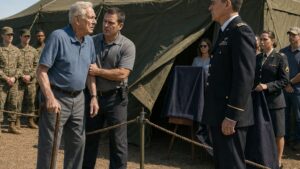
“Allen?” he said.
Chapter 2: Five Faded Lines Changed the Commander’s Voice
Anthony Rivera’s right hand rose before anyone spoke again.
The salute was precise, but not ceremonial. It came too quickly for performance and too slowly for reflex, as if the commander had spent decades preparing for a moment he had never expected to receive.
Behind him, the formation remained still.
Joshua Clark looked from Anthony’s white glove to Ronald’s worn black shoes and seemed unable to reconcile the two.
Ronald did not return the salute.
He stepped forward and placed two fingers around Anthony’s wrist.
The glove felt cool and impossibly clean.
“Not yet,” Ronald said.
Anthony’s eyes shifted. The hand lowered between them.
Up close, Ronald could see the boy beneath the commander’s face. Not in the features. Those had hardened and broadened. It was in the left pupil, which still tightened a fraction slower than the right, and in the way Anthony kept his weight away from the leg that had been pinned beneath the instrument panel.
“I looked for you,” Anthony said.
“No, you looked for a record.”
“I requested every name attached to the recovery.”
“And they gave you the flight crew.”
Anthony glanced toward the restored aircraft.
Joshua cleared his throat. “Colonel Rivera, this individual was not on the access list.”
Anthony turned to him, not angrily. “His name is Ronald Allen.”
“Yes, sir.”
“He was there.”
Joshua’s posture straightened. “At the mission?”
Anthony looked back at Ronald. “At the fire.”
The words traveled farther than Anthony intended. The nearest row of airmen heard them. So did the reporters.
Ronald withdrew his arm and pulled his sleeve down over the five lines.
“Can we go somewhere without an audience?” he asked.
Anthony nodded at once. “Of course.”
That change—the immediate answer, the lowered voice, the absence of instruction—did more than the salute had.
Anthony motioned toward the hangar. Then he stopped and looked at Ronald rather than assuming he would follow.
“May I?”
Ronald gave one short nod.
They crossed through a narrow service door beside the main hangar entrance. Joshua came behind them after a moment, carrying the torn invitation as though it had become evidence against him.
Inside, the noise of the flight line fell to a distant mechanical hum. The corridor smelled of waxed concrete, canvas, and old metal warmed beneath new paint. Photographs from the restoration hung in temporary frames along one wall.
Anthony removed his cap.
“I saw the emblem,” he said. “Five lines across a broken rotor.”
Ronald reached inside his blazer.
Joshua’s body tensed.
Ronald drew out a stained maintenance card no larger than his palm. Its corners had softened, and a brown tide mark crossed the bottom half. He held it toward Anthony.
“Read the back.”
Anthony took it carefully.
On the front, faded pencil marks recorded fuel pressure, hydraulic temperature, and an engine vibration that had required inspection. The reverse carried five surnames written in block letters, one beneath another.
ALLEN.
WILSON.
JACKSON.
ROBINSON.
PEREZ.
Beside the last four were small marks in red grease pencil.
Anthony read them twice.
“These aren’t in the program.”
“No.”
“Who wrote this?”
“I did.”
Joshua remained near the service door. “Sir, is this an official maintenance record?”
“It was,” Ronald said. “Before someone decided it wasn’t useful.”
Anthony held the card under the corridor light. “Why do I remember the lines?”
Ronald looked at the five names.
“Because you saw them before they put you on the medevac.”
Anthony’s mouth opened, then closed.
The corridor seemed to narrow around them.
“I remember men around the litter,” he said. “One of them had ink on his arm.”
“All five of us did.”
“That night?”
“The next morning. A medical technician had a pen that wouldn’t wash off. Christopher drew the rotor. We added the lines.”
Anthony touched one gloved thumb to the card but stopped before rubbing the paper. “I was told the aircraft crew cleared the wreck under its own power.”
“You were told wrong.”
Anthony looked toward the hangar wall as if the photographs might rearrange themselves.
The mission had appeared in his speeches for years. Ronald knew that without asking. The young pilot had become an instructor, then a group commander, then a wing commander. There had been articles, anniversary dinners, restoration fundraising letters. In every version Ronald had seen, the aircraft had crashed under hostile conditions, the surviving crew had evacuated, and a rapid response had prevented further loss.
Rapid response.
A phrase broad enough to contain everyone and name no one.
Anthony said, “Sandra has the recovery file.”
“Sandra has what survived the recovery file.”
“She told me there were gaps.”
“Did she tell you there were men missing from it?”
Anthony’s silence gave the answer.
A voice came through the overhead speaker: “Ceremonial party, ten-minute readiness check.”
Anthony flinched toward the sound.
Ronald saw the movement.
“You’re still watching the clock.”
“I have two hundred people outside.”
“And four names in your hand.”
Joshua shifted near the doorway. “Colonel, security needs to know whether Mr. Allen is cleared.”
Anthony turned sharply. “He is cleared.”
“For the ceremony area or—”
“For anywhere I am.”
Ronald felt no satisfaction. Joshua’s face had gone pale, but the order solved the wrong problem.
Anthony held out the maintenance card. “Come with me to the front row. Sit beside me. When the ceremony ends, we’ll speak with Sandra and open a formal review.”
Ronald did not take the card.
“You think I came for a chair?”
“No.”
“You saluted me in front of those airmen.”
“I should have done it years ago.”
“You should have learned the names.”
Anthony’s expression tightened, not with anger but with injury. Ronald knew the difference and disliked himself for causing it. Still, he did not step back.
“I was twenty-two,” Anthony said. “I woke up in a hospital with half the mission missing from my memory.”
“And I was twenty-nine. I remember all of it.”
The words struck harder than Ronald intended.
Anthony lowered his eyes to the card.
“What do the red marks mean?”
Ronald took it from him and placed his thumb over the markings.
“Not here.”
“Then tell Sandra.”
“That is what I’ve been trying to do.”
The overhead speaker clicked again. Music began faintly outside as the audience was asked to take their seats.
Anthony opened the corridor door. Sunlight cut across the floor, and through the gap Ronald could see the cloth-covered panel positioned beside the aircraft.
A printed program rested on a stand near the entrance.
Ronald took one.
Under the title THE RESCUE THAT BROUGHT THEM HOME, a paragraph praised the flight crew’s discipline and the command team’s rapid coordination. No ground recovery personnel were named.
Ronald looked from the program to the card.
Joshua had come closer now. His pointing hand hung rigidly at his side.
Anthony said, “We can delay the ceremony five minutes.”
“Five minutes won’t fix that.”
“What exactly are you asking me to do?”
Ronald pointed toward the covered memorial panel.
“If you unveil that,” he said, “you erase them again.”
Chapter 3: The Memorial Panel Left Four Men Outside
Sandra Brown pulled the proof sheet from beneath a stack of archival folders and turned it toward Ronald.
The memorial text had already been engraved.
A photograph showed the dark metal panel under its protective cloth, every line of lettering complete.
Ronald read the third paragraph once. Then again.
Following impact, the surviving aircrew evacuated the aircraft before emergency teams secured the site.
“Evacuated,” he said.
Sandra stood across the narrow archive table. She wore no uniform, only a blue restoration badge and reading glasses on a thin cord. “That language came from the final incident summary.”
“It came from someone who wasn’t there.”
“I understand your objection.”
“No. You understand the sentence.”
Anthony closed the office door behind them. Joshua remained outside, visible through the wired-glass window, speaking into his radio.
The archive room occupied one corner of the hangar office. Flat storage drawers lined the walls. Acid-free boxes sat in labeled rows. On the far side of the glass, the restored aircraft’s tail filled half the view.
Sandra placed Ronald’s maintenance card beside the proof sheet.
“This matters,” she said. “But it does not establish the full sequence by itself.”
“The names are there.”
“Yes.”
“The aircraft number is there.”
“Yes.”
“The pressure readings match the damage report.”
“They appear to.”
Ronald looked up. “Appear?”
“I have to use precise language.”
“So did the people who left four men out.”
Sandra removed her glasses. “Mr. Allen, precision is the only way I can help you. If I treat every unverified statement as fact because the person giving it is sincere, then nothing in this room is worth preserving.”
Anthony moved to the table. “Sandra, I remember the emblem.”
“You remember seeing it after trauma and sedation.”
“I remember hands pulling me.”
“That is significant testimony. It is not yet a complete record.”
Ronald almost admired her refusal to bend before rank. Almost.
She opened the official incident summary. The paper had been copied from microfilm, its type uneven along the edges.
“Here,” she said. “Impact at 21:14. Fire suppression initiated at 21:18. First survivor transferred to medical personnel at 21:21. The report attributes extraction to the aircrew and emergency response element.”
Ronald leaned over the page.
His eyes stopped at the final time.
21:21.
“That’s wrong.”
Sandra waited.
“The first litter left the wreck before the suppression truck arrived.”
“The document says otherwise.”
“The document is wrong.”
“How do you know?”
“Because the truck lost pressure at the east ditch. We used hand bottles until they brought the auxiliary line around.”
Anthony said quietly, “I remember white foam.”
“You remember the second discharge,” Ronald said. “Not the first.”
Sandra pulled another folder from the stack. “There is a preliminary communications log.”
She turned several pages. At 21:19, a handwritten entry read: Survivor one clear. Second approach underway.
The entry had been crossed through in dark ink.
Below it, in a different hand: Aircrew evacuation in progress.
Ronald felt the room change around him.
“Who altered that?” Anthony asked.
Sandra examined the page. “No initials.”
“There should be initials,” Ronald said.
“There should.”
His thumb found the five lines beneath his sleeve and rubbed them through the cloth.
Sandra noticed.
“Tell me about the second approach.”
Ronald removed his hand.
“The fire shifted.”
“That isn’t what I asked.”
“The wind turned beneath the fuselage. Fuel was running toward the drainage cut.”
“Who went back?”
Ronald looked at the maintenance card.
Sandra touched the five names one by one, without pressing hard enough to damage the surface.
“Allen. Wilson. Jackson. Robinson. Perez.” Her finger stopped. “I can connect you to the aircraft maintenance section. I can connect Wilson to ground transport and Perez to medical support. Jackson appears in an equipment issue ledger. Robinson does not appear in the recovery packet at all.”
“He was there.”
“I am not saying he wasn’t.”
“That is what absence becomes after enough years.”
Sandra let the sentence stand.
Outside, a percussion roll began as the ceremonial band tested its timing. The sound came through the glass as a low vibration.
Anthony pulled a chair out but did not sit. “I remember being dragged over metal.”
Ronald looked at him.
“The cockpit frame,” Anthony continued. “My harness wouldn’t release. Someone cut it. I remember a voice saying not to pull my left leg.”
“Christopher.”
“Which surname?”
“Robinson.”
Anthony’s gaze dropped to the card. “Then I heard someone shouting for the line.”
Ronald’s throat tightened.
Sandra moved a small recorder to the center of the table.
“We should capture this now.”
“No.”
She stopped with one hand over the switch.
“Mr. Allen—”
“No recorder.”
“Your account is exactly what is missing.”
“You asked for the sequence. I gave you enough to stop the unveiling.”
“You gave me reason to question it, not authority to replace it.”
Anthony said, “Then we delay.”
Sandra’s face hardened. “On what basis? A damaged card, a disputed log entry, and memories none of us has formally documented?”
“On the basis that the current wording may be false.”
“May be. If we stop a public ceremony minutes before it begins, we will need to explain why. That explanation will become part of the record too.”
Ronald stared at the recorder.
Three times over the years, letters had arrived asking him to speak about the mission. He had returned none of them. The first had come from a base historian. The second from a reunion committee. The third had carried handwriting on the envelope that he recognized before he opened it.
He had burned none of them.
That would have required admitting he could not answer.
Sandra pushed the recorder closer. “Who ordered the second approach?”
Ronald’s chair scraped backward.
Anthony watched him with growing recognition of a different kind.
“There was an evacuation order,” Anthony said.
Ronald said nothing.
“Ronald.”
The use of his first name made the old room appear for half a second: red emergency light, smoke pressed flat by rotor wash, a voice breaking over the radio.
Pull back. All ground personnel pull back.
Then his own voice, calling one man’s name.
He stood.
Sandra’s expression shifted from professional resistance to concern. “Did you countermand the order?”
“No.”
“Did someone else?”
“No.”
Anthony went still. “Then why was there a second approach?”
Ronald buttoned his blazer over the pocket where the card had been.
“You wanted names. You have them.”
“That isn’t enough,” Sandra said.
“It should have been.”
He moved toward the door.
Sandra opened a thin folder pulled from the bottom of the incident packet. “Wait.”
Ronald stopped but did not turn.
Paper whispered behind him.
“This was filed separately from the final summary,” she said. “Personnel action, temporary restriction of duties.”
Anthony came around the table.
Sandra read in silence for several seconds. When she spoke again, her voice had lost its edge.
“Ronald Allen. Failure to comply with emergency withdrawal instruction.”
The band outside began the first formal bars of the ceremony music.
Sandra turned the page.
“There’s no disposition attached. Only a notation.”
Anthony leaned closer. “What notation?”
Sandra looked at Ronald.
“Withdrawn after casualty review.”
Chapter 4: The Silence Ronald Called Loyalty Hurt the Living
“Why did that commander know your name?”
Laura’s question followed Ronald out of the archive room and into the empty hangar bay.
He kept walking.
Behind them, the ceremony music swelled through the walls, muffled by steel and distance. A maintenance cart sat beneath the aircraft’s left wing, abandoned in the rush to clear the hangar. Its tray held clean rags, safety wire, and a row of polished tools arranged by size.
Laura caught his elbow before he reached the side door.
“Dad.”
He stopped because she had not called him that in the sharp voice she used when she was angry. This was the voice she used when she found him standing in the kitchen at two in the morning with a glass of water he had forgotten to drink.
Anthony and Sandra remained in the archive room. Through the window, Ronald could see Sandra bent over the personnel-action folder. Anthony stood with both hands braced on the table.
Laura looked toward them, then back at Ronald.
“You told me this was an invitation to see an old aircraft.”
“It is.”
“You didn’t tell me the wing commander was on it with you.”
“I didn’t know he’d be here.”
“He saluted you in front of half the base.”
Ronald adjusted the torn invitation in his pocket. “That was his decision.”
“And lowering his hand was yours.”
He started toward the exterior door again.
Laura moved in front of him.
“Every time this comes close, you leave.”
“This isn’t the place.”
“You brought us here.”
“I came to give Sandra a card.”
“You drove three hours, let a man humiliate you in public, and still wouldn’t say why you belonged here. Now there’s a disciplinary file with your name on it, and you’re acting like the problem is everybody asking questions.”
Ronald’s hand rose to his sleeve.
Laura saw it. Her eyes went to the place where his fingers rubbed the five lines beneath the fabric.
“You do that when you don’t want to answer me.”
He lowered his hand.
She opened the side door. Heat rolled in from the pavement. Ronald followed her across the service lane to the visitor parking area, where her car stood between two vans belonging to the restoration volunteers.
The aircraft’s tail remained visible above the hangar roof.
Laura unlocked the car but did not get in. Instead, she opened the rear door and reached beneath a folded sweater.
She brought out a clear plastic sleeve.
Ronald recognized the handwriting through the plastic.
He looked away.
“I found this after Mom died,” Laura said. “It was in the cedar box with your discharge papers.”
“You had no business going through that.”
“She told me where the key was.”
“That doesn’t make it yours.”
“No. It makes it something she was tired of protecting for you.”
Ronald’s jaw tightened.
Laura slid the letter free. The fold marks had nearly split through.
“She wrote to you three times,” Laura said.
“Once.”
“Three times. One letter. Two follow-up notes.”
“I never saw the notes.”
“You never answered the letter.”
Ronald looked toward the access barrier. The formation had shifted into ceremonial position. The cloth still covered the memorial panel.
Laura read from the page.
“‘Mr. Allen, no one will tell me why the review was closed. I have been told Christopher returned to the aircraft after an evacuation order. I need to know whether he was following your instruction when he died.’”
“Stop.”
“She deserved an answer.”
“I said stop.”
Laura lowered the paper.
A transport aircraft moved somewhere beyond the runway, its engines building to a low vibration. Ronald felt it in the soles of his shoes.
“He was following you,” Laura said.
Ronald stared at the pavement.
“Wasn’t he?”
The hangar wall, the parked cars, the bright strip of runway all seemed too clean.
He saw mud instead. Black fuel spreading in it. Christopher’s face lit orange on one side. The emergency line jumping in their hands when the pressure dropped.
“I called him back,” Ronald said.
Laura’s expression changed.
The anger remained, but something underneath it gave way.
“After the withdrawal order?”
“Yes.”
“Why?”
Ronald took the letter from her. He folded it along its old crease, exactly as it had been folded when it arrived.
“The result is what matters.”
“No. That’s what you say when the reason hurts too much.”
“He died.”
“That isn’t an answer.”
“It is the only part his wife had to live with.”
“And you left her to decide the rest alone.”
Ronald put the letter back into the plastic sleeve. His hands were steady until he reached the final corner. Then the edge caught against his thumb.
Laura took it from him gently.
“I used to think you wouldn’t talk because the military told you not to,” she said. “Then I thought maybe you were protecting us. But you weren’t protecting anybody. You were keeping yourself in the worst second of that night and calling it loyalty.”
“That’s enough.”
“No. You gave the dead every explanation you never gave us.”
The words landed without force. They did not need any.
Ronald opened the passenger door.
Laura did not move.
“If we leave now,” she said, “that panel goes up. Those names stay out. Christopher’s wife stays unanswered. And you go home believing silence is the only honest thing you’ve ever done.”
He gripped the top of the door.
Through the open hangar, the master of ceremonies began testing the microphone. A voice crossed the flight line in broken phrases.
Distinguished guests.
Legacy of courage.
Sacrifice remembered.
Ronald closed the door without getting in.
Laura wiped beneath one eye with the side of her hand. “Tell me why you called him back.”
He looked at her.
For one second, the answer rose to his mouth.
A trapped man. A medic’s voice. Christopher turning before Ronald finished the sentence.
Then the archive-room door opened.
Anthony crossed the service lane without his cap. He had removed his white gloves. In one bare hand, he carried the personnel-action folder.
He stopped several feet away, as though he had learned that approaching Ronald required permission.
“There’s something you need to hear,” Anthony said.
Ronald glanced at the folder.
Anthony’s grip tightened along its edge.
“I knew the recovery account had gaps before I approved the memorial text.”
Chapter 5: A Private Seat Could Not Repair a Public Lie
Anthony offered Ronald the chair directly beside his own.
It stood at the head of a polished table in the command reception room, facing a wall of glass overlooking the flight line. From there, Ronald could see the covered memorial panel, the waiting audience, and the restored aircraft positioned like a promise no one had yet tested.
“I can have your name added to the program announcement,” Anthony said. “You’ll sit with me. After the ceremony, Sandra will record your statement and we’ll open a formal review.”
Ronald remained standing.
Laura took a place near the door. Joshua had been summoned from the access barrier and now stood opposite her, his white-gloved hands clasped behind his back.
Anthony’s own gloves lay on the table between two untouched glasses of water.
“You knew,” Ronald said.
“I knew the file did not establish who conducted the ground extraction.”
“That isn’t the same as knowing four men had been omitted.”
“No.”
“Did you ask?”
Anthony looked through the glass toward the aircraft.
“I asked Sandra whether the panel was supportable.”
“And?”
“She said every sentence could be traced to an existing record.”
Ronald rested his fingertips on the back of the offered chair but did not pull it out.
“You asked whether the words could survive a complaint. You didn’t ask whether they were true.”
Anthony accepted that without protest.
“The restoration has taken seven years,” he said. “Federal preservation funds, private donors, volunteer labor. The next allocation depends on this exhibit opening on schedule. If we cancel now, the review board can freeze the remaining work.”
“Then let them freeze it.”
“There are two other aircraft waiting for structural repair. One may not survive another winter outside.”
“And that panel?”
Anthony’s eyes moved toward the covered shape.
“It was written cautiously.”
“Cautiously for whom?”
A knock sounded. The ceremony master of ceremonies opened the door only far enough to speak.
“Colonel, twelve minutes to unveiling.”
Anthony nodded. “Hold at twelve.”
“We’ve been told the state delegation has to depart early.”
“Hold at twelve.”
The door closed.
Ronald looked at the empty chair again.
“You think placing me there changes what’s engraved out there.”
“No.”
“You think saluting me changes it.”
“No.”
“Then why offer either?”
Anthony placed both palms on the table.
“Because I owe you respect even if I cannot settle the record in ten minutes.”
“Respect is not a substitute for ten minutes of courage.”
Joshua’s eyes lifted.
Anthony’s face tightened. “You believe this is easy because you arrived today with the part of the story no one else had.”
“I arrived today because Sandra invited me.”
“She invited you three times before this.”
Ronald went still.
Laura looked at Anthony. “You knew that too?”
“I saw the unanswered requests in the project correspondence.”
Anthony’s voice remained controlled, but the restraint now belonged to anger.
“We searched for the recovery team. We asked veterans’ groups. We published notices. Ronald’s name surfaced, then disappeared because he would not answer.”
Ronald gripped the chair harder.
Anthony continued. “I am responsible for approving incomplete language. He is responsible for withholding testimony that might have changed it years ago. Both can be true.”
The room went quiet.
Joshua shifted his weight but kept his hands behind his back.
Ronald released the chair.
“Were the families invited?” he asked.
Anthony frowned. “Which families?”
“The four names on the card.”
“I don’t know.”
“Then find out.”
Anthony turned to Joshua. “Staff Sergeant?”
Joshua’s face had lost the certainty it carried at the barrier.
“The guest list came from the official mission roster,” he said.
“That doesn’t answer him.”
Joshua swallowed. “A family was at the visitor gate this morning. Their surname didn’t match anyone on the approved roster.”
“Which surname?”
“Robinson.”
Ronald felt Laura move behind him.
“What happened?” Anthony asked.
“They had a photocopy of a service record and a letter about the restoration. The access office couldn’t connect it to the event authorization.”
“And you turned them away.”
“The gate did. I confirmed the list.”
Anthony stared at him.
Joshua’s voice became quieter. “After last month, I was told not to make discretionary exceptions.”
Ronald looked at the young man’s white gloves. One thumb worried the seam of the other.
“Did they say why they came?” Ronald asked.
Joshua nodded once. “They said Christopher Robinson had served with the aircraft.”
The name filled the room more completely than any rank.
“Where are they now?” Ronald asked.
“I don’t know. They left the gate.”
Anthony reached for the telephone.
Ronald stopped him.
“Don’t find them so you can put them in a front-row chair beside me.”
Anthony’s hand remained over the receiver.
“What do you want?”
“I want you to stop asking what can be done after the ceremony.”
The overhead speaker came alive.
“Attention, ceremonial party. Due to an adjustment in the state delegation schedule, unveiling sequence will begin in two minutes.”
Anthony turned toward the glass.
“That was not authorized.”
The master of ceremonies’ voice continued, inviting guests to take their seats.
On the flight line, two uniformed attendants moved toward the rope attached to the memorial cloth.
Anthony picked up the telephone. “Delay them.”
No one answered.
Joshua reached for his radio. Static crackled, then a voice reported that the platform director had advanced the sequence.
Anthony moved toward the door.
Ronald took the maintenance card from the table before he could pass.
“Ronald,” Anthony said, “wait here.”
“No.”
“I can stop it.”
“You could have stopped it before I arrived.”
Anthony’s expression shifted.
Ronald put the card inside his blazer. His fingers brushed the copied letter Laura had returned to him.
The chair beside Anthony remained empty.
For years Ronald had believed silence kept Christopher from being reduced to one bad decision on one terrible night. Now Christopher’s family had been turned away from a ceremony describing an escape he had helped make possible.
Ronald walked to the door.
Laura stepped aside.
“Dad,” she said.
He looked at her.
She did not ask him to stay. She did not ask whether he was ready.
She only held his gaze.
Joshua opened the door, then hesitated.
“Sir,” he said to Ronald, “the microphone is live.”
Ronald passed him.
Outside, the announcer introduced Anthony Rivera as the surviving pilot whose leadership had carried his crew through the crash.
The first attendant tightened the unveiling rope.
Ronald crossed the hangar threshold and began walking toward the microphone.
Chapter 6: Before the Cloth Fell, Ronald Raised His Hand
The rope drew taut as Ronald stepped into the center aisle.
The audience turned in small waves. First the people nearest him, then the rows ahead as they followed one another’s gaze. Beyond them, the formation held its posture. The restored aircraft stood behind the speaker’s platform, and beside it the memorial cloth lifted slightly at one corner.
Ronald raised his right hand.
The sleeve of his blazer slipped back.
Five faded lines showed against his forearm.
“Please stop.”
His voice did not reach the speakers, but it carried far enough for the attendant holding the rope to hesitate.
The ceremony master of ceremonies moved toward him. “Sir, you need to return to your seat.”
“I don’t have one.”
A few people murmured.
Anthony came from the hangar at a fast walk, Joshua and Laura behind him.
The attendant looked to Anthony for instruction.
Anthony held up one bare hand.
“Hold the unveiling.”
The rope slackened.
A local reporter raised a camera. Anthony saw it and turned toward the platform director.
“Leave it,” Ronald said.
Anthony looked at him.
“If this is corrected only after everyone goes home, then the wrong version is still the one they came to hear.”
The microphone stood at the edge of the platform. Ronald climbed the two shallow steps without assistance.
The master of ceremonies moved aside reluctantly.
Ronald looked at the audience. Families, officials, former crew members, mechanics, young airmen. Some appeared concerned. Others looked irritated at the interruption. Most had no idea who he was.
That was all right.
He set the damaged maintenance card on the lectern.
“My name is Ronald Allen,” he said.
The speakers gave his voice back to him, larger and flatter.
“I worked this aircraft when it was assigned to rescue operations. I did not fly it. I was not its commander. My name does not need to be the first one you remember today.”
He felt Anthony standing behind his left shoulder.
Ronald looked toward the covered panel.
“But the account beneath that cloth says the surviving aircrew evacuated before emergency teams secured the wreck. That did not happen.”
Silence settled unevenly across the chairs.
“The aircraft came down hard. The forward gear folded. The left side dug into the ground, and fuel began running beneath the fuselage. The suppression truck lost pressure before reaching us.”
He paused.
A smell returned—not fuel exactly, but old canvas warmed under lights. His body supplied the rest.
“There were five of us on the first line,” he continued. “Mark Wilson. Joshua Jackson. Anthony Perez. Christopher Robinson. And me.”
The use of names taken by living men nearby made several heads turn, but Ronald did not look away from the audience.
“We had hand bottles and a recovery line. We pulled the first survivor through a cut frame because the cockpit release would not move.”
Anthony stepped toward the microphone.
“I remember that,” he said. “I remember metal beneath my back. Someone told them not to pull my left leg.”
Ronald turned.
Anthony faced the audience rather than Ronald.
“I cannot confirm everything Mr. Allen is saying from my own memory,” he added. “I was injured. My recollection is incomplete. But I remember being pulled. I did not leave that aircraft under my own power.”
The statement changed the air.
Not proof. Not certainty. But enough to break the engraved sentence open.
Sandra reached the foot of the platform carrying the copied communications log.
“The official record contains a crossed-out entry stating that a survivor was clear before the main suppression unit arrived,” she said. “The change is unexplained.”
Ronald saw caution in her face, but not resistance.
He placed both hands on the lectern.
“There was an order to withdraw.”
The audience stilled again.
Anthony’s eyes moved to him.
Ronald’s thumb pressed against the edge of the maintenance card.
“The fire had shifted under the fuselage. Fuel was moving toward the drainage cut. We were told all ground personnel were to pull back.”
He stopped.
The next words had waited forty-seven years and had not grown easier.
“I disobeyed that order.”
A woman in the front row lowered her program.
Ronald heard Laura breathe behind him.
“I heard someone inside the rear section. A medical technician had gone in after the second crewman. The frame moved, and he became trapped.”
Sandra glanced at the communications log.
Ronald continued.
“I had already sent Christopher Robinson back from the line. He was clear. He had burns on one sleeve, and his right hand was cut. He was where he was supposed to be.”
The cloth beside the aircraft shifted in the wind.
“Then I heard the technician call.”
Ronald’s voice thinned. He waited until it returned.
“I called Christopher’s name.”
No one moved.
“I did not order him. I did not have the authority. I called because he was closest and because I knew he would understand what the sound meant.”
The memory arrived without mercy.
Christopher turning.
Not confused. Not pressured.
Looking once toward the burning rear section, then back at Ronald.
You still hear him?
Yes.
Then hold the line.
Ronald gripped the lectern.
“He went back before I finished asking.”
Laura came closer but did not touch him.
“Christopher reached the technician. The rest of us held the recovery line. They got the technician out.”
A question rose from somewhere in the audience, but Anthony silenced it with a look.
“Christopher did not clear the second collapse,” Ronald said. “That is why I refused interviews. That is why I never answered his wife. I believed if I explained the choice, it would sound like I was asking to be forgiven for making it.”
He looked down at the five names on the card.
“But silence did not protect him. It left him outside the story.”
No applause followed. Ronald was grateful.
Only the low wind crossed the microphones.
Sandra climbed onto the platform.
“I need to say something clearly,” she said. “Mr. Allen’s account cannot become verified history simply because it has been spoken publicly. We will need records, testimony, and review.”
Several faces tightened.
Ronald nodded.
“She’s right.”
Sandra looked at him, surprised.
“If you replace one clean story with another because it feels better, you have learned nothing,” Ronald said. “Mark what is confirmed. Mark what is remembered. Mark what remains uncertain. But do not call absence proof that men were never there.”
Sandra held the communications log against her chest.
“That can be done,” she said. “Not today. Not honestly.”
A state official near the front leaned toward an aide. The restoration volunteers exchanged worried looks. The cloth remained over the panel, but the ceremony schedule printed in every program had already failed.
Anthony stepped to the microphone.
“I approved the present wording,” he said. “I knew there were unresolved gaps in the recovery record. I accepted language that could be supported on paper because this project was under deadline and because I believed opening the exhibit mattered more than postponing it.”
His voice remained level.
“That decision was mine.”
The formation did not move, but Ronald saw the effect travel through it.
Anthony turned to the attendants holding the rope.
“Release it.”
One attendant loosened his grip.
The cloth settled fully against the panel.
Anthony faced the audience again.
“This memorial will not be unveiled today.”
The state official stood. “Colonel, we should discuss—”
“No.”
Anthony did not raise his voice.
“The aircraft exhibit may open after safety and access requirements are met. The memorial text will remain covered until the recovery record is reviewed and the families connected to these names are invited to be heard.”
He looked at Joshua.
“Staff Sergeant Clark.”
Joshua stepped forward.
“Sir.”
“Contact the visitor gate. Locate the Robinson family’s entry record. Find a way to reach them that does not begin with asking them to prove why they matter.”
Joshua’s face tightened with shame.
“Yes, sir.”
“And document what happened this morning.”
A pause.
“Yes, sir.”
Ronald took the maintenance card from the lectern.
Anthony looked toward the five faded lines on Ronald’s arm, then at the hand that held the card.
He did not salute.
Instead, he asked, “Will you stay for the review?”
The question carried no command, no assumption, no ceremony.
Ronald looked at Laura.
Her eyes were wet, but she did not rescue him from the choice.
He thought of Christopher’s widow waiting for an answer that had never come. He thought of four names outside a locked gate and five lines fading under his sleeve.
“Yes,” Ronald said. “But I won’t be the only voice.”
Anthony nodded.
Behind them, the memorial cloth remained in place.
For the first time that day, it did not look like concealment.
It looked like a promise not yet earned.
Chapter 7: The Record Changed Only After Everyone Admitted Their Part
“The first draft makes us heroes,” Ronald said. “The second makes us a footnote. Neither one tells the truth.”
Sandra Brown lowered the two sheets she had been reading.
Three weeks after the halted unveiling, the archive conference room still carried the smell of fresh paint from the restoration project. The long table had disappeared beneath copied logs, medical notes, photographs, maintenance ledgers, and translucent overlays marked with times and positions.
On the wall beyond the glass, the aircraft waited inside the hangar. The memorial panel beside it remained covered.
Sandra placed the first draft on Ronald’s left.
On the ground, an improvised recovery team led by Ronald Allen extracted the surviving aircrew under hazardous conditions.
Then she placed the second on his right.
Emergency personnel assisted survivors following impact.
Ronald tapped the first page.
“I did not lead five men into anything.”
“The disciplinary notation identifies you as the senior maintainer present.”
“Senior does not mean leader.”
“It can establish responsibility.”
“It can also make the other four look like they waited for me to become brave.”
Anthony Rivera sat across from him in an undecorated service uniform. He had attended every review session without ribbons, aides, or prepared remarks. Ronald had noticed the choice but had not thanked him for it.
Anthony said, “Someone made the decision not to withdraw.”
“I made my decision. The others made theirs.”
Sandra leaned back. “Then give me language that distinguishes those decisions without claiming knowledge we cannot support.”
Ronald looked down at the transparent overlay spread over the table.
Five lines had been drawn across a diagram of the crash site. One began near the maintenance truck, another at ground transport, another beside the medical station. They converged at the aircraft.
The lines resembled the marks on his arm, though no one had intended that when the map was made.
Sandra pointed to the evidence beneath it.
“The communications log confirms a survivor was clear before the main suppression unit arrived. The equipment ledger confirms four hand bottles were issued and never returned. Medical notes describe fuel exposure on three ground personnel whose names match the card.”
“Four bottles,” Ronald said. “Five men.”
“Which is why the card matters. But the card does not prove who held what position or who went back when.”
Anthony folded his hands. “My medical record states that I was delivered by litter.”
“It does,” Sandra said. “That confirms you did not self-evacuate. It does not identify everyone who carried you.”
Ronald nodded.
Sandra watched him. “You appear relieved.”
“I am.”
“Most people would want the strongest possible wording.”
“Most people weren’t there.”
The conference-room door opened.
Joshua Clark entered in service dress, without gloves. He carried a visitor folder and stopped near the wall rather than approaching the table.
“There’s someone here to speak with Mr. Allen,” he said.
Ronald’s body tightened before he asked who.
Joshua looked toward the corridor. “Christopher Robinson’s family representative.”
A woman stepped through the doorway. She was near Ronald’s daughter’s age, perhaps slightly older. She carried the same plastic sleeve Laura had shown him in the parking lot, but this one held the original letter.
Laura entered behind her and closed the door.
Ronald rose.
The woman did not offer her hand.
“My mother wrote this,” she said.
Ronald looked at the letter.
“I know.”
“She waited eleven years for an answer.”
No one moved around the table. Sandra reached toward the recorder, then stopped and left it untouched.
Ronald said, “I received it.”
“My mother was told there had been a casualty review, but no one would release the full result. She thought that meant Christopher had done something wrong.”
“He didn’t.”
“You could have told her that.”
“Yes.”
The woman’s mouth tightened. “Why didn’t you?”
Ronald had rehearsed explanations during sleepless nights, though he had never admitted they were rehearsals. He could have said the record was restricted. He could have said he feared reopening the investigation. He could have described Christopher’s return to the aircraft and the years Ronald spent believing he had summoned him to his death.
All of it would have been true.
None of it answered the question.
“Because I was ashamed,” Ronald said.
The room seemed to lean toward him.
“I thought if I explained what happened, it would sound like I wanted your mother to excuse me. I told myself silence belonged to Christopher. It did not. It belonged to me.”
The woman looked at him for a long time.
“My mother died believing her husband might have ignored an order for no reason.”
Ronald did not look down.
“I am sorry.”
He did not add that he had suffered too. He did not tell her he had carried Christopher’s voice for forty-seven years. Those things were his and did not reduce what she had lost.
She placed the letter on the table beside the maintenance card.
“I don’t forgive you because you finally answered in front of cameras.”
“I didn’t expect you to.”
“But I want the panel corrected.”
“So do I.”
“And I want it to say that the record is incomplete. Not that you know every thought in my uncle’s head because you were standing beside him.”
Ronald glanced at Sandra.
“That is fair.”
Anthony leaned forward. “The proposed wording could identify Ronald as the recovery leader while naming the others as team members.”
“No,” Ronald said.
Anthony paused.
“The chain had no single hero,” Ronald continued. “Mark held the bottle when the pressure failed. Joshua Jackson cut the harness. Anthony Perez kept the medical technician breathing. Christopher went back. I called his name and held the line. Put that in the testimony file if the evidence supports it. Do not build another clean story around me because I am the one who lived long enough to speak.”
Sandra picked up a pencil.
“What should the panel say?”
Ronald looked at the five lines crossing the site diagram.
“That the official summary did not identify the ground recovery team. That surviving records and later testimony establish five men participated in extraction and fire control. That some details remain disputed.”
“And the names?”
“All five.”
Sandra wrote.
The door opened again. Joshua stood aside to admit three people from the corridor: an older man, a woman with a service photograph held against her chest, and a younger family member carrying a folder.
Joshua looked directly at Ronald.
“This is the family we turned away on ceremony day,” he said. “I asked them to return before the wording was approved.”
He swallowed.
“I also told them exactly why they were turned away. I did not blame the list.”
Ronald looked at the open doorway, then at Christopher’s family gathering on the other side of the table.
The meeting had not ended.
It had finally become large enough to begin.
Chapter 8: Respect Became the Names They Finally Chose to Read
Joshua opened the barrier before Ronald reached for his invitation.
There was no tablet in his hand and no white glove pointing toward the civilian exit. He stepped aside, held the gate fully open, and waited.
“Good morning, Mr. Allen.”
Ronald stopped.
Two months had passed since the halted ceremony. The airfield was quieter now. No formation stood in ranks, no state delegation waited beneath a canopy, and no band played against the wind. The reopening had been limited to the families, restoration workers, the current maintenance crew, and a few reporters.
Ronald touched the folded invitation in his pocket but left it there.
“Morning, Staff Sergeant.”
Joshua looked toward Laura, who stood beside Ronald.
“Ms. Allen.”
Laura nodded.
Near the barrier, a small sign explained the new visitor procedure. Guests connected to historic exhibits could request manual review when digital records were incomplete. No one would be admitted without screening, but no one would be dismissed solely because the computer failed to recognize a name.
Joshua had written the first draft himself.
Ronald walked through the gate.
The restored aircraft waited beside the hangar, unchanged in shape but altered in meaning. The backward fuel-panel hinge had been corrected. Ronald noticed it before anything else.
Sandra stood near the memorial with a thin binder tucked beneath one arm. The cloth was gone.
The new panel did not describe an effortless evacuation.
Its first section listed facts supported by the surviving operational record. The second identified details established through medical notes, equipment ledgers, and multiple accounts. A final section stated plainly that parts of the recovery sequence remained unresolved.
At the center were five names.
Ronald Allen.
Mark Wilson.
Joshua Jackson.
Anthony Perez.
Christopher Robinson.
Their ranks appeared in smaller lettering beneath, equal in size.
Below the names were five plain lines.
No broken rotor. No decorative insignia. Nothing that turned the mark into a logo.
Just five strokes.
Sandra came beside Ronald.
“The families approved the final wording.”
“You approved it too.”
“After they did.”
He looked at the binder. “What’s that?”
“Your recorded testimony, Anthony’s statement, the family letters, and the supporting documents. Each section is labeled by source.”
“Not all one story.”
“No.”
“That’s better.”
Anthony approached from the aircraft’s far side. He wore a simple service uniform and carried no gloves.
For a moment, neither man spoke.
Then Anthony straightened slightly.
“Would it be appropriate?” he asked.
Ronald knew what he meant.
He considered refusing. The first salute had come before listening, offered as a repayment Anthony could complete in one gesture. This one came after the ceremony had been stopped, after the records had been opened, after Anthony had put his own decision into the official review.
Ronald nodded.
Anthony raised his hand.
The salute lasted no more than a breath.
Ronald returned it.
When their hands lowered, Ronald turned toward Laura.
“This is my daughter,” he said.
Anthony’s expression softened. “We met briefly.”
“You met the person trying to get me into a car. You did not meet the woman who kept the letters I would not answer.”
Laura looked at Ronald, surprised.
He continued before the old instinct could close his mouth.
“She should be part of any conversation about what silence cost.”
Anthony held out his hand to her. “Then I would be grateful to listen.”
Laura took it.
A reporter approached with a microphone lowered at his side.
“Mr. Allen, may I ask one question?”
Ronald glanced toward the families gathered near the panel.
“One.”
“How does it feel to finally be recognized as the hero of the mission?”
The word settled badly.
Two months earlier, Ronald might have walked away. He might have decided the question proved nothing had changed and left others to fill his silence with whatever answer pleased them.
He stayed.
“I am not the hero of the mission,” he said.
The reporter lifted the microphone.
Ronald raised one finger, not in accusation but to hold the moment steady.
“Do not turn that into false humility. I made a decision that helped save a man, and another man died after answering my call. Both belong in the account.”
The reporter waited.
“There were five people on that line. There were aircrew in the wreck. There was a medical technician who went back for someone else. There were families who carried questions longer than any of us carried the equipment. If you need one face for your story, you will make the same mistake the old panel made.”
The microphone lowered slightly.
“What should people remember, then?”
Ronald looked at the names.
“That records are made by people. So are omissions.”
The reporter stepped back.
No one applauded. A maintenance crew member quietly removed his cap. Sandra opened the binder for Christopher’s family. Joshua left the barrier to escort an elderly visitor who had arrived at the wrong entrance.
Respect moved through the space as work.
Anthony stood with Laura near the aircraft, listening as she described the letters her mother had saved. He did not interrupt to explain Ronald to her.
Ronald approached the panel alone.
He read each name silently at first.
Mark Wilson.
Joshua Jackson.
Anthony Perez.
His own.
Then Christopher Robinson.
The last name resisted his voice.
A woman from Christopher’s family stood several feet behind him with the old service photograph held against her chest. Others waited with her, uncertain whether to approach.
Ronald placed two fingers against the five plain lines beneath the names.
The metal was cool.
“Christopher Robinson,” he said aloud.
The woman’s breath caught.
Ronald stepped away from the panel.
For years he had imagined standing in front of Christopher’s family and finding the perfect arrangement of words—something accurate enough to remove blame, humble enough not to request forgiveness, complete enough to return what silence had taken.
No such words existed.
He turned toward them and opened the space before the aircraft.
“You should go first,” he said.
The family moved forward.
Ronald joined Laura near the barrier, not hidden and not at the center. Behind them, Joshua held the gate open for the next guest and asked their name without impatience.
The story has ended.