They Rushed the Old Man Through Court Until a Navy Captain Read the Name in His Logbook
Chapter 1: The Evidence Envelope He Would Not Release
“Stop clutching the evidence, sir.”
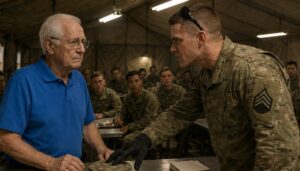
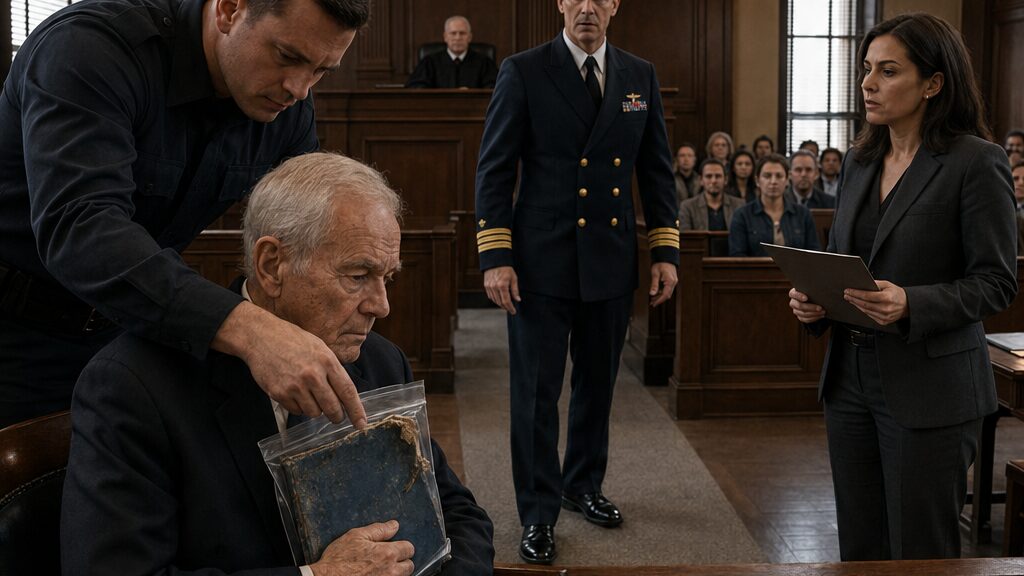
Deputy Eric Smith reached across the wooden rail, and Daniel Moore pulled the clear envelope closer to his chest.
The movement was small, but it stopped the murmuring in the first two rows of the gallery. Through the scratched plastic, the battered blue cover of an old duty log showed beneath a web of water stains. One corner had softened almost to pulp.
Eric leaned farther over Daniel’s shoulder. “It stays with the court.”
“I know where it stays.”
“Then let go.”
Daniel looked at the deputy’s thumb. It rested less than an inch from the damaged corner.
“Move your hand first.”
Eric exhaled through his nose. Behind him, the clerk sorted files into stacks without looking up. The morning docket had already fallen twenty minutes behind. A mother bounced a restless child near the aisle. Two men in work uniforms whispered over parking citations.
Daniel sat alone at the defense table in a dark suit that had grown loose across his shoulders. Beneath his left lapel, barely visible, was a strip of faded blue ribbon. His right hand rested over it whenever he was not holding the envelope.
Eric lowered his voice, but not enough to keep the gallery from hearing.
“Mr. Moore, I’ve explained this twice. The judge will call your case. The evidence goes on the table. You answer the questions. We keep moving.”
“You explained it loudly twice.”
A few faces turned away to hide smiles.
Eric’s jaw tightened. “Are you having trouble understanding me?”
Daniel lifted his eyes. “No.”
The single word landed more sharply than Eric expected. He straightened, then took the envelope by its sealed top edge.
Daniel released it only after Eric moved his thumb.
The public defender hurried in with a yellow pad under one arm. He sat beside Daniel and whispered that the city attorney had offered to resolve the matter that morning. Return of property. No contest. Possibly a small fine.
Daniel watched Eric place the envelope on the prosecution table.
“Did she read it?” he asked.
“The log?”
“Yes.”
“I don’t know.”
“Then she doesn’t know what she’s offering.”
The public defender glanced toward Catherine Ramirez, who stood near the clerk’s station reviewing a thin file. She wore a charcoal suit and the expression of someone who had already solved the practical problem in front of her.
“Mr. Moore,” the defender said, “the city says you entered a condemned municipal property after posted notice and removed an item listed for disposal. They’re not accusing you of selling it or damaging anything.”
“They damaged it.”
“That may be true, but it doesn’t make it yours.”
Daniel said nothing.
When the judge took the bench, the room rose. Daniel used both hands on the table before standing. Eric reached toward his elbow without asking. Daniel shifted just enough to avoid him.
The clerk called the case.
Catherine began with dates. The former Navy reserve center had transferred to municipal control three years earlier. The city had fenced the property after structural inspections found mold, standing water, and unstable flooring. Demolition was scheduled for Friday.
“Mr. Moore entered through a maintenance door on March ninth,” she said. “He removed one bound record from a basement storage area and declined to return it when approached by the property manager.”
The judge looked at Daniel. “Mr. Moore, do you understand the allegation?”
“Yes, Your Honor.”
Catherine glanced down at her notes. “Given his age and the nature of the item, the city is open to the possibility that Mr. Moore was confused about ownership.”
Daniel’s hand moved over the ribbon beneath his lapel.
His public defender whispered, “Let her finish.”
Catherine continued. “He appears to regard the book as a personal military keepsake. We do not seek incarceration. We seek return of the property and assurance that he will not enter the site again.”
The judge asked, “Mr. Moore, did you believe the building was still Navy property?”
“No.”
Catherine looked up.
“Did you see the restricted-entry notices?” the judge asked.
“Yes.”
“How many?”
“Three outside. One on the east maintenance door.”
The courtroom went still.
Daniel continued before his attorney could stop him. “The outer fence notice was dated January twenty-second. The door notice was replaced February fourteenth after rain took the lower half off.”
The judge’s brows drew together. “So you understood the restrictions.”
“Yes, Your Honor.”
“And entered anyway.”
“Yes.”
The public defender set down his pen.
Catherine closed her file, then opened it again. The easy explanation had vanished. Daniel saw irritation replace concern in her face.
“Why?” the judge asked.
Daniel looked at the blue log lying on Catherine’s table.
The damaged corner faced downward now. No one had noticed.
“I went for that.”
“That answers what you took,” Catherine said. “Not why.”
Daniel’s gaze remained on the envelope.
The judge waited. “Mr. Moore?”
He could feel the room leaning toward him, waiting for a sentimental answer they could classify and dismiss. An old man’s memory. A Navy souvenir. A final piece of youth.
“It should not have been there,” he said.
Catherine lifted the inventory sheet. “According to the property record, the item was assessed with other duplicate administrative materials.”
The clerk accepted the page and read from it. “One blue duty ledger, water damaged. Duplicate. No retention value.”
Daniel’s fingers tightened over the ribbon.
“No retention value,” the clerk repeated, marking the item number.
The words carried him for half a second to a steel compartment where smoke had lowered the ceiling and three short blasts had cut through the alarm noise.
He drew one careful breath.
“That isn’t what the notation means,” he said.
Catherine turned toward him. “What notation?”
“The alarm entry.”
She slid the evidence envelope closer and looked through the plastic. “It says three short signals followed by evacuation.”
“No.”
His voice remained quiet, but the public defender stopped writing.
“It wasn’t an evacuation bell,” Daniel said. “Three short meant boundary failure.”
The rear courtroom door opened.
A man in Navy dress uniform entered carrying a facilities file. Gold stripes circled his sleeves. He took two steps down the center aisle, heard Daniel’s words, and stopped.
Chapter 2: The Captain Stopped at Daniel’s Name
“Deputy,” the uniformed man said, “please take your hand off that page.”
Eric looked down.
While turning the evidence envelope toward Catherine, he had pressed two fingers against the softened corner of the log. He removed them immediately.
The Navy officer continued down the aisle. He was broad-shouldered, gray at the temples, and old enough to move without hurry in a room that expected everyone else to rush.
Catherine met him beside the prosecution table. “Captain King?”
“Nicholas King. Regional facilities and historical records review.”
She indicated the blue log. “You were asked to address custody of materials transferred with the reserve center.”
Nicholas did not answer at once. He studied the visible page through the plastic.
A hand-drawn compartment grid occupied the lower half. Water had blurred two columns, but the watch signature remained faintly legible near the binding.
Nicholas bent closer.
Daniel watched recognition begin not in the captain’s face but in his posture. His shoulders settled. His chin lifted slightly.
“May I see the inside cover?” Nicholas asked.
Catherine looked to the judge, who nodded.
Eric broke the evidence seal and started to pull the log free.
“Not by that corner,” Daniel said.
Eric stopped. This time he did not argue.
Nicholas took the book with both hands and opened it flat on the table. The old spine gave a dry crack. He traced no words, touched no ink. His eyes moved from the compartment diagram to the name written beside the watch entry.
“D. Moore,” he read.
Daniel stared at the tabletop.
Nicholas turned another page. There were maintenance initials, drill notes, piping corrections, and a series of compact annotations in the same narrow hand.
The captain looked across the room.
“Daniel Moore?”
“Yes.”
“Chief Daniel Moore?”
The public defender glanced at Daniel, surprised by the title.
Daniel nodded once.
Nicholas closed the book carefully.
Then he came to attention.
The courtroom seemed to lose every small sound at once—the child’s shoe against the bench, the clerk’s paper, the air vent above the flag.
Nicholas raised his right hand in a restrained salute.
Daniel did not move.
His first feeling was not pride. It was the old, familiar pressure beneath his ribs, the one that came whenever someone honored the wrong part of the story.
Nicholas held the salute.
Daniel’s hand remained over the faded ribbon beneath his lapel. Finally, he lifted it. His fingers trembled once before settling near his brow.
The exchange lasted only seconds.
No one applauded. The judge did not speak. Eric stood farther back from Daniel’s chair than before.
When Nicholas lowered his hand, Daniel asked, “Did the demolition crew reach the basement records room?”
The question unsettled the room more than the salute had.
Nicholas looked toward Catherine. “I was told the movable contents had been inventoried.”
“That is the city’s position,” she said.
“That wasn’t my question,” Daniel replied.
Catherine’s expression cooled. “Captain King’s recognition of your service does not establish that the property belongs to you.”
“I didn’t say it did.”
“Nor does it excuse entering a condemned building.”
“I didn’t say that either.”
The judge leaned forward. “Then perhaps someone should tell this court why the basement matters.”
Daniel looked at Nicholas, but the captain’s recognition had not given him an answer. It had only made concealment harder.
Nicholas reopened the log.
“I know Chief Moore’s name from a damage-control case study used in regional training,” he said. “The reference was brief. A shipboard compartment fire, successful containment under severe conditions.”
Daniel’s jaw tightened.
Catherine caught the movement. “Was this log part of that incident?”
Nicholas examined the date on the visible page. “It may include working entries related to it.”
“May?”
“The transferred Navy archive does not list this volume.”
Catherine turned to Daniel. “So there is no record that the Navy retained ownership.”
“Absence from a transfer list doesn’t mean it lacked historical value,” Nicholas said.
“It also doesn’t mean Mr. Moore could remove it.”
Nicholas nodded. “Correct.”
The public defender shifted in his chair. The courtroom’s admiration had already found its boundary.
Catherine approached the witness position with the municipal file.
“Captain, would a retired damage-control chief understand restricted access markings on a former military facility?”
“Yes.”
“Would he understand structural hazard notices?”
“Yes.”
“Would he know that records must be reviewed through authorized channels?”
Nicholas paused before answering.
“Yes.”
Catherine returned to her table. “Then recognition of Mr. Moore’s experience makes confusion less likely, not more.”
Daniel looked at the blue log.
The captain’s arrival had made the deputy step back. It had made the clerk stop calling the book disposable. It had made the judge listen.
It had also closed the only easy route out.
The judge asked Nicholas whether the log could be secured pending review. He agreed, provided no further handling occurred without an archivist.
Catherine objected to delaying the case on the strength of an unidentified historical claim.
Daniel’s public defender asked for forty-eight hours.
Catherine removed a second page from her file.
“There is already an inventory classification,” she said. “Prepared during the joint transfer review.”
She handed copies to the clerk and defense table.
Daniel did not need his reading glasses to find the line. It sat near the bottom beneath broken chairs, obsolete wiring manuals, and mold-damaged binders.
BLUE DUTY LEDGER. DUPLICATE. NO RETENTION VALUE.
Nicholas read it twice.
“Who made that determination?” he asked.
“The municipal contractor, based on the materials left after Navy removal.”
“And the Navy reviewer?”
“No signature appears.”
The judge granted a site inspection for the following afternoon and ordered the log held in controlled custody.
Eric approached to reseal it. He stopped beside Daniel first.
“Is there a safer way to close this?” he asked.
Daniel showed him where to support the spine.
It was a change, but too small to answer what mattered.
As the clerk gathered the files, Catherine placed the inventory copy in front of Daniel.
“If the Navy did not claim it,” she said, “and the city classified it for disposal, what exactly do you believe you saved?”
Daniel looked at the words no retention value.
He could have told her it was a man.
Instead he said, “Something they never read.”
Chapter 3: The Building Was Coming Down Friday
The demolition foreman drew a red X across the records-room wall while Daniel was still standing in the doorway.
The paint hissed from the can and crossed an old rectangular stain where shelving had once stood.
“Don’t mark over that,” Daniel said.
The foreman lowered the can. “Whole wall comes down Friday.”
Daniel looked past him into the room. Damp concrete. Exposed conduit. A floor bowed toward a drain clogged with black leaves. The air smelled of wet paper even though nearly all the paper was gone.
Nicholas stood behind Daniel wearing work clothes instead of his dress uniform. Catherine had arrived in low boots and a city-issued hard hat, carrying the court authorization in a plastic folder.
“You said the log came from this room?” she asked.
Daniel pointed toward the pale outline on the wall. “Third shelf.”
“There are no shelves.”
“They removed them.”
The foreman gave Catherine an impatient look. “We’ve got forty minutes before the engineer closes the basement again.”
Daniel stepped inside.
His cane struck the concrete once, then stopped.
At the far wall, a water stain curved upward like smoke rolling beneath a steel ceiling. For an instant his body refused to move farther. He heard, not the drip from a broken pipe, but three clipped alarm blasts buried inside a roar.
Nicholas noticed.
“You all right, Chief?”
Daniel hated the title in that room.
“I’m standing.”
Catherine watched him, then addressed the property manager. “When were the records cleared?”
“Over several months. Navy took designated material. City contractor sorted the remainder.”
“Who supervised the basement?”
The manager checked a clipboard. “Different crews.”
Daniel moved to the wall where the shelves had been. Dust had preserved four narrow rectangles. The third was the width of the blue log.
“There,” he said.
Catherine photographed it. “An empty outline doesn’t establish what sat there.”
“No.”
She seemed surprised by his agreement.
The foreman pointed toward a stack of collapsed archive boxes near the drain. “Those were judged contaminated. Nobody’s opening them without masks.”
Nicholas crouched beside the stack. Several boxes had been cut along the front panels. Clean rectangles showed where catalog labels had been removed.
“Why cut the numbers off?” he asked.
The property manager frowned. “Could’ve peeled in the damp.”
Nicholas lifted one loose flap. The cut was straight.
“Card stock doesn’t peel with a utility blade.”
Catherine joined him. “Does this prove records were deliberately concealed?”
“No,” Nicholas said. “It proves the sorting process was poor.”
Daniel looked at her. “That enough for you?”
“It is enough to investigate the process,” she said. “It is not enough to transfer ownership of one item to you.”
The distinction irritated him because it was accurate.
They worked through the surviving boxes upstairs, where daylight entered through boarded windows in narrow stripes. Most contents were routine: maintenance schedules, expired safety instructions, duplicate personnel rosters with identifying pages removed.
Nicholas found an old index sheet listing basement ranges by category. The line corresponding to Daniel’s shelf read WATCH RECORDS—TRAINING/OPERATIONS, but the continuation page was missing.
A small vindication. Not enough.
Near noon, Catherine spread three documents across a folding table: the Navy transfer manifest, the municipal acceptance list, and the contractor’s disposal inventory.
“The disputed ledger appears on only one,” she said.
“The disposal list,” Nicholas replied.
“No accession number. No Navy claim. No named custodian.”
Daniel stared through the broken window toward the fenced drill yard. Weeds had split the asphalt where recruits once practiced hose handling.
“I was custodian.”
“When?” Catherine asked.
“Before retirement. Later I volunteered here.”
“For how long?”
“Eleven years.”
The property manager looked up. “Your volunteer access ended six years ago.”
Daniel did not answer.
Catherine caught it. “Why?”
He folded the missing continuation page back beneath the index.
“That isn’t part of the charge.”
“It may be part of your claim that you had some continuing responsibility.”
“I didn’t say I had legal responsibility.”
“Then what kind did you have?”
He walked away from the table.
At the basement door, Nicholas called after him. “Chief, if the log contains an operational record, I can request an emergency historical review. But I need more than your word that it matters.”
Daniel stopped without turning.
“You recognized my name.”
“I recognized a name in a training summary.”
“That should be enough to know the summary wasn’t complete.”
Nicholas’s silence followed him up the stairs.
By Tuesday afternoon, the group had moved to the municipal records office. The archivist there confirmed that the city’s transfer had been rushed because the reserve center’s roof failure made storage unsafe. Nothing suggested a conspiracy. Nothing proved competence either.
Catherine gathered the papers into a single stack.
“Mr. Moore was right that the disposal process was careless,” she said. “But the log still does not appear on the Navy retention schedule.”
Nicholas rubbed a hand across his mouth. “Without provenance, an archive may treat it as an orphaned record.”
“Meaning?”
“Historically interesting. Legally uncertain. Difficult to authenticate.”
Daniel looked toward the evidence case on the far desk. The blue cover was visible beneath a new archival support board.
For years he had believed saving the book would save what was written inside it.
Now the book itself might be dismissed as something detached from any official chain, its truth reduced to an old man’s interpretation.
The office door opened.
Sandra Moore entered holding a white envelope and wearing the same expression she used when school administrators had forced her to defend a decision she had not made.
“Dad.”
Daniel’s hand tightened around his cane.
She crossed the room and placed a letter beside Catherine’s documents.
“I found this in his kitchen drawer.”
Catherine read the first page. Then the second.
“Mr. Moore,” she said, “this is a formal notice from the property manager dated four months ago.”
Daniel looked at Sandra.
Her anger had fear underneath it.
Catherine continued. “It says you were found inside the building twice before the incident charged here. You were warned in writing that any further entry would be referred to law enforcement.”
Nicholas turned slowly toward him.
Sandra’s voice was quiet. “You told me you hadn’t been back there in years.”
Daniel looked at the red city stamp on the letter.
He had hidden the warnings because explaining them would have required explaining the shelf, the log, the alarm, and the name he had not spoken aloud in decades.
Catherine folded the notice closed.
“This was not one desperate visit,” she said. “You kept going back.”
No one in the room looked at him as confused anymore.
That should have felt like dignity.
Instead, Daniel saw that the truth had only made the question harder.
“Why?” Sandra asked.
Chapter 4: His Daughter Offered the Wrong Kind of Rescue
Sandra placed the medical-assessment forms beside Daniel’s unopened citation box.
The papers were already clipped in order. Memory screening. Functional capacity. Physician authorization. A blank line waited for Daniel’s signature beneath the words voluntary evaluation.
He stood at the kitchen counter with one hand braced against the edge.
“No.”
“You haven’t read them.”
“I read the heading.”
“It isn’t a declaration that you’re incompetent.”
“No. It’s the first page of one.”
Sandra pulled out a chair. “Sit down before you fall.”
Daniel remained standing.
The old house was quiet except for the refrigerator motor and the faint tapping of a branch against the window. His suit jacket hung over the back of another chair. On the table, next to the forms, sat a narrow black presentation box he had taken from the bedroom closet after returning from the records office.
Sandra looked at it.
“I’ve never seen that.”
“You weren’t meant to.”
“That’s becoming the answer to everything.”
Daniel opened the citation box instead. Inside were copies of the trespass complaint, the evidence receipt, and the letter he had hidden from her. Sandra had flattened the letter’s folds.
“You went back twice after they warned you,” she said. “Then you went a third time and took something.”
“Yes.”
“And you lied to me.”
“I said I hadn’t been there in years.”
“That is called lying.”
He looked toward the black box. “Yes.”
The admission slowed her but did not soften her.
“The public defender says the city may accept a competency review as part of a dismissal request. It gives them a way to step back.”
“A way to say I didn’t know what I was doing.”
“You walked into a condemned building alone.”
“I knew exactly what I was doing.”
“That doesn’t make it better.”
“No.”
Sandra stared at him. She had expected resistance, then anger, then denial. His agreement gave her nowhere easy to stand.
She touched the edge of the black box. “Is this why you wore the ribbon?”
Daniel moved it out of her reach.
Her hand froze.
He had done the same thing with the log in court. He saw the resemblance and disliked it.
Sandra drew her hand back. “I’m not Deputy Smith.”
“I know.”
“Do you?”
Daniel opened the box.
The ribbon lay against faded velvet, a narrow strip of blue dulled by decades in darkness. The metal clasp had left a rust-colored shadow beneath it.
Sandra leaned closer. “You kept that in the closet all these years?”
“Yes.”
“You never wore it on Veterans Day. Not at Mom’s funeral. Not even when the school invited you to speak.”
“I didn’t want to speak.”
“But you wore it Monday.”
Daniel closed the lid halfway.
Monday’s date had been printed at the top of every courtroom page. He had known what day it was before dawn, before putting on the suit, before taking the box from behind his wife’s winter blankets.
“It was the anniversary,” he said.
“Of what?”
He shut the box.
Sandra pushed the medical forms toward him. “This is what I mean. You expect everyone to trust decisions you won’t explain.”
“My decisions are mine.”
“Not when I get a call saying my seventy-eight-year-old father has been arrested inside a building with a failing roof.”
“I wasn’t under the roof section.”
“That is not reassuring.”
Daniel sat at last, more because his knee had begun to shake than because she had told him to. Sandra noticed. He hated that she noticed.
She lowered her voice. “You don’t have to prove anything to me.”
“I’m not trying to.”
“Then let me help.”
“By telling the court I don’t understand my own actions?”
“By giving them another explanation.”
“A false one.”
Her face tightened. “You think I want them to call you confused?”
“You brought the forms.”
“I brought them because you will not give anyone the truth.”
The words stayed between them.
Daniel’s public defender arrived the next morning with a leather folder and a look of controlled fatigue. They met in a courthouse conference room where the blinds had been pulled against the glare.
He reviewed the assessment forms, then set them aside.
“I won’t file these without your consent,” he said. “But I need you to understand what the city sees. Repeated unauthorized entry. A removed object with uncertain ownership. Refusal to explain motive. Emotional attachment to an old military record.”
“Historical attachment.”
“That distinction requires evidence.”
Sandra sat at the far end of the table with her arms folded.
The defender continued. “Captain King’s recognition helped your credibility. It also established that you knew the rules.”
“I know.”
“And if you refuse every practical resolution, the court may conclude this is fixation rather than preservation.”
Daniel’s fingers moved toward the place beneath his lapel where the ribbon had been. He was not wearing it now.
Sandra watched the gesture.
“Tell him about the station number,” she said.
Daniel turned to her.
“What station number?” the defender asked.
Sandra kept her eyes on her father. “When I was sixteen, I found him asleep at the kitchen table. He woke up shouting a number. He knocked over a chair trying to get to the back door.”
“That was a dream.”
“It happened again after Mom died.”
Daniel looked down at the grain of the conference table.
“What number?” the defender asked.
Sandra answered, “Repair Three.”
The room narrowed.
Not a sailor’s name. Not yet. Just the station.
Sandra’s voice lost its edge. “I thought it was a place he was trying to reach.”
Daniel remembered her at sixteen, barefoot in the kitchen, holding a broom because he had frightened her. He had told her the chair slipped. She had accepted the lie because children often accepted whatever kept the house intact.
The public defender opened his folder. “Is the disputed log connected to Repair Three?”
Daniel did not answer.
“If it is, that matters.”
“It matters to the record.”
“It also matters to your defense.”
“That is not the same thing.”
The defender leaned back. “Mr. Moore, silence is not protecting the record. Right now silence is allowing everyone else to define it.”
Daniel looked at Sandra.
She had spent years arranging appointments he had not requested, replacing loose rugs, labeling medication bottles, calling whenever rain was forecast because the back steps grew slick. He had treated each kindness as evidence that she no longer saw him clearly.
He had never considered what she had been forced to see instead: a man waking to commands from rooms he refused to describe.
At home that evening, Daniel took the blue log’s photocopied evidence pages from his attorney’s folder. One page had been reproduced with the fold still hiding the final lines.
Sandra stood across the kitchen table.
“You asked why I kept going back,” he said.
He unfolded the copy.
Three pencil marks appeared beside the alarm entry. Beneath them ran a cramped line in Daniel’s younger handwriting, faded but legible.
VOICE FROM REPAIR THREE CALLED BOUNDARY FAILURE BEFORE CHIEF ORDER.
Sandra read it twice.
Daniel placed one finger below the sentence.
“That line,” he said, “is why he never came home.”
Chapter 5: The Official Report Left Out Three Seconds
The official report credited “chief-directed containment.”
The working log recorded an unidentified voice acting first.
Nicholas laid the two pages side by side beneath the archive lamp. The official copy was clean, typed, and stamped. The log reproduction was warped by water damage, its pencil marks uneven and interrupted near the fold.
Catherine stood at the other end of the table. “How much weight would an archive give the handwritten version?”
“That depends on provenance, authorship, corroboration, and whether the entry was made contemporaneously,” Nicholas said.
Daniel sat between them, facing both pages.
Sandra had not come. He had told her the review might take hours. She had understood the sentence for what it was: not an instruction to stay away, but a request for one final chance to speak before she heard the truth from strangers.
Nicholas enlarged the scan on a monitor.
“Three timing marks,” he said. “Do they represent seconds?”
Daniel nodded.
Catherine asked, “Three seconds between what and what?”
“The first blast and the boundary call.”
“And the chief’s order?”
“After.”
“After how long?”
Daniel looked at the marks. “Three seconds.”
Nicholas turned toward him. “The final report says you identified the boundary failure and ordered containment immediately.”
“That’s what it says.”
“I’m asking what happened.”
Daniel’s thumbnail pressed against the side of his index finger until the skin whitened.
A Navy archivist entered carrying a second folder. Inside were damage-control diagrams, a casualty list, and a surviving radio summary. The summary referred to Repair Three reporting loss of boundary integrity. It did not name the speaker.
Nicholas aligned the timestamps.
“The radio summary supports a call from Repair Three before the recorded command,” he said. “But these times were rounded to the nearest minute.”
“So it supports sequence, not seconds,” Catherine said.
“Correct.”
A small piece of truth. Not enough to carry the weight Daniel had placed on it.
The archivist found Daniel’s initials at the bottom of the working entry.
D.M.
Catherine pointed to them. “You wrote the correction?”
“I confirmed it.”
“When?”
“The next morning.”
“Then you knew the official report was incomplete.”
“Yes.”
“Did you submit this page?”
Daniel did not answer.
Nicholas looked at him. “Chief?”
“No.”
The word seemed louder in the archive room than it had in court.
Catherine folded her arms. “Why not?”
Daniel studied the official report. Its clean language had survived because it asked nothing difficult from the people who filed it.
The fire had started below a machinery access passage during a training transit. Smoke crossed the deck faster than the first report suggested. Daniel had been senior at the station. The blast knocked one sailor down and turned the compartment lights red through the haze.
Repair Three called the boundary.
Daniel had heard the voice.
He had not given the first order.
“Transfer orders came through,” he said.
Nicholas’s expression hardened. “That doesn’t answer her.”
“No.”
“You initialed a correction and left it in a working log.”
“Yes.”
“Why?”
Daniel looked at the blurred pencil line.
“Because the official report had already gone.”
“Reports can be amended,” Nicholas said.
“They can.”
Catherine pulled out a chair and sat, reducing the distance between them without making her voice gentler.
“Were you protecting the sailor named in this entry?”
“He isn’t named there.”
“Were you trying to get his role recognized?”
“Yes.”
“After waiting more than fifty years.”
Daniel’s gaze lifted.
She continued. “Or are you trying to change what the record says about you before you die?”
Nicholas looked sharply at her, but she did not withdraw the question.
Daniel expected anger to come. It did not. The old defense—that no one had the right to ask—had worn thin.
“Both,” he said.
The archivist stopped turning pages.
Catherine’s face changed, not into sympathy but attention.
Daniel looked back at the timing marks.
“The first blast threw a cabinet across the passage. I could hear the alarm, but I couldn’t place the break. He could.”
“The sailor at Repair Three?” Nicholas asked.
“Yes.”
“What did he do?”
Daniel swallowed. “Called the boundary. Moved to dog the access. Got two men behind the seal.”
“And you?”
The answer sat behind his teeth.
“I took command.”
“That isn’t what I asked,” Catherine said.
Daniel’s chair scraped as he stood.
The archivist reached instinctively toward him, then stopped. No one touched him.
He walked to the end of the room, where shelves held gray document boxes under white labels. Thousands of preserved pages. Names reduced to indexes. Decisions flattened into reports.
“I took command,” he repeated.
Nicholas did not press him again.
Instead, he returned to the log and examined the fold. “There may be another notation under the damaged edge.”
The archivist adjusted the scan. A partial station code emerged, followed by a casualty transfer notation. The sailor had been evacuated alive and died later from injuries.
The log did not prove why he had moved first. It did not prove Daniel had frozen. It did preserve a sequence the final report had smoothed away.
Catherine gathered her copy but left the original scan before Daniel.
“This supports historical review,” she said. “It does not establish ownership. And it does not erase the warnings or the trespass.”
“I know.”
“The city has another concern. You removed the log instead of reporting it through the archive process.”
“I reported boxes six years ago.”
“To whom?”
“The center manager.”
“Do you have a record?”
“No.”
“And after that?”
“I checked the room.”
“You entered repeatedly.”
“Yes.”
“Why didn’t you contact Captain King’s office?”
Daniel looked at Nicholas.
Because official channels had once produced the clean report on the table. Because the log had stayed safe only while no one cared about it. Because distrust, repeated long enough, could begin to resemble duty.
“I didn’t think they’d keep it,” he said.
Nicholas absorbed the answer without defending the Navy.
“That may have been a fair fear,” he said. “It was still your decision to make alone.”
By late afternoon, they returned to a courthouse conference room. Catherine arrived last with a single-page proposal.
“The city will dismiss the trespass charge,” she said.
Daniel’s public defender straightened. “On what terms?”
“Immediate return of the log. A written no-entry agreement. The record sealed after compliance.”
Daniel read the page.
There was no mention of the fire. No historical claim. No review requirement. No obligation to preserve the book beyond ordinary evidence retention.
Catherine tapped the final paragraph.
“The city will not contest transfer to an authorized custodian if one independently accepts it. But Mr. Moore will make no public ownership claim and no assertion that the prosecution validated his account.”
Nicholas frowned. “That leaves the historical question untouched.”
“It keeps a minor case from becoming a trial about an event this court cannot adjudicate.”
The proposal was reasonable in every way that mattered to a docket.
Daniel could go home. The charge would disappear. The sealed record would protect him from the shame Sandra feared. Nicholas could continue his review if the archive accepted the log.
All Daniel had to do was let the official silence remain convenient.
Catherine slid a pen across the table.
“This is the easiest way out,” she said.
Daniel looked at the blank signature line.
For most of his life, he had believed silence was the difficult choice.
Now, for the first time, it looked like the easy one.
Chapter 6: Daniel Refused the Easiest Way Home
The judge held the dismissal agreement above the bench.
“Mr. Moore, do you accept these terms?”
Daniel rose slowly beside his attorney.
“No, Your Honor.”
Catherine’s pen stopped over her notes.
The judge lowered the page. “You understand the city is offering to dismiss the charge?”
“Yes.”
“And seal the record upon compliance?”
“Yes.”
“Then tell me what remains unacceptable.”
Daniel looked at the blue log resting in an archival cradle between the two tables. Nicholas had brought it under controlled custody. The softened corner no longer touched any surface. A narrow support strip held the damaged pages open without pressure.
“Not with the record still wrong,” Daniel said.
The judge studied him. “Which record?”
“All of them.”
His attorney whispered, “We need a moment.”
Daniel shook his head.
He had spent enough moments waiting for courage to arrive as if it were another man’s order.
“I want to testify.”
Catherine stood. “Your Honor, before Mr. Moore waives—”
“I know what I’m waiving,” Daniel said.
The judge warned him that his statements could establish every element of the charged offense. Daniel listened. He answered each question clearly. His public defender objected once for the record, then sat beside him rather than in front of him.
Daniel took the witness chair.
Eric approached with the microphone. He stopped at arm’s length.
“May I move this closer, sir?”
Daniel nodded.
The deputy adjusted it without leaning over him.
Catherine began with the building.
“Did you enter the former reserve center on March ninth?”
“Yes.”
“Did you see the restricted-entry notices?”
“Yes.”
“Did you remove the blue duty log?”
“Yes.”
“Did anyone authorize you?”
“No.”
A murmur moved through the gallery and died under the judge’s glance.
Catherine rested both hands on the table. “Are you asking this court to excuse those acts because you served in the Navy?”
“No.”
“Because Captain King recognized you?”
“No.”
“Because the log may have historical value?”
“No.”
She paused. “Then why reject dismissal?”
Daniel looked toward Sandra in the second row. She held her hands together so tightly the knuckles had paled. He had told her he would testify. He had not told her what he would say.
“Because dismissal would let me leave without telling what I did.”
“You have just admitted the trespass.”
“Not that.”
Catherine’s gaze shifted briefly to the log.
The judge said, “Proceed carefully, Ms. Ramirez.”
She nodded. “Tell the court what happened during the fire.”
Daniel placed his right hand over the ribbon beneath his lapel.
The reflex came before thought. He felt the faded cloth through his shirt and jacket—the small, preserved symbol of an account that had left out the part he remembered most.
He removed his hand.
Then he laid it flat on the closed cover of the log.
“The blast hit before the second alarm,” he said. “It threw equipment into the passage and took out the forward lights. I was senior at the station.”
His voice remained steady until he reached the next sentence.
“I stopped.”
No one moved.
Catherine did not ask what he meant. She let the silence require him to define it.
“I heard the alarm. I knew there was smoke crossing the boundary. But for three seconds, I did not know which order to give.”
Nicholas stood near the witness rail, his expression unreadable.
Daniel continued. “The sailor at Repair Three knew. He called boundary failure before I did. He moved to the access and got two men behind the seal.”
“What was his rank?” Catherine asked.
“Seaman.”
“And you were the chief.”
“Yes.”
“What happened after those three seconds?”
“I gave the containment order. We closed the passage, shifted ventilation, and kept the fire from crossing into the next compartment.”
“The official report credits your direction.”
“Yes.”
“Was that false?”
Daniel looked at the clean report on Catherine’s table.
“Not entirely.”
The answer unsettled the gallery more than a dramatic denial would have.
“I did direct containment,” he said. “After he moved. Both things are true.”
“What happened to him?”
“He was burned before the seal closed. He died after transfer.”
Sandra lowered her head.
Catherine’s voice softened by only a degree. “Why was his action omitted?”
“The working notes identified the station, not the speaker. The final report compressed the sequence. I received commendation as the senior man.”
“Did you object?”
“Not where it counted.”
Nicholas looked down.
Daniel’s thumb touched the edge of the log. “I wrote the correction. Initialed it. Left it in the book.”
“Why didn’t you submit an amendment?”
There it was—the question he had converted into fifty years of guarding paper.
“Because an amendment would have required me to say why he acted before I did.”
“And you were ashamed.”
“Yes.”
“Then your silence protected you.”
“Yes.”
The word hurt less spoken aloud than it had inside him.
Catherine glanced toward the judge, then back to Daniel. “Why preserve the log now?”
“Because the official account made my part simple. It made his part disappear.”
“But you also kept the only correction hidden in a basement.”
Daniel’s fingers curled against the cover.
“Yes.”
The admission broke the last clean version of his motive. He had not merely rescued truth from careless officials. He had controlled it. He had made himself its only custodian because that allowed him to honor the sailor without surrendering the punishment he believed he deserved.
“I told myself the book was safer with me,” he said. “What I meant was I was safer if no one read it while I was alive.”
The judge leaned back, giving him time.
Daniel looked at Sandra.
“I thought silence was loyalty,” he said. “It was fear with better posture.”
Sandra pressed a hand to her mouth but did not look away.
Catherine returned to the table and lifted the dismissal agreement.
“If the city preserved this log and submitted it for historical review, would you accept dismissal?”
Daniel considered it.
“No.”
His attorney closed his eyes briefly.
“Why not?” Catherine asked.
“Because I trespassed.”
“You want a conviction?”
“I want the same record to hold both things. I entered when I had no right. The log was going to be lost. I was wrong. The disposal decision was wrong. One does not erase the other.”
Nicholas stepped forward. “Your Honor, the Navy is prepared to request immediate review of the remaining materials.”
The judge raised a hand. “Captain, this is Mr. Moore’s testimony.”
Nicholas stopped.
The correction mattered. Recognition had filled the courtroom on Monday. Now listening required even the captain to remain silent.
Daniel opened the log to the damaged page. The three pencil marks stood beside the alarm notation.
He could still withdraw into technical language. Boundary. Seal. Ventilation. Sequence.
Instead he said, “He was nineteen.”
The judge asked, “Who?”
Daniel’s throat tightened.
For decades, he had kept the name separate from the report, separate from the commendation, separate even from Sandra. A name spoken aloud could be questioned, misspelled, shortened, or forgotten. A name kept inside could not be taken—but neither could it be honored.
He said the sailor’s name.
The court reporter asked him to repeat it for accuracy.
Daniel did.
Catherine looked at the log, then at the proposal she had written.
“What do you want done with the book?” she asked.
“Preserve it under his name and the unit record. Not mine alone.”
“And if an archive determines the entry cannot support a formal correction?”
“Then preserve the disagreement. Don’t call it worthless because it isn’t convenient.”
He closed the log.
His hand remained on the cover for a moment. Then he pushed it across the witness table toward Catherine.
The book moved only a foot, but Daniel felt the distance in his chest.
“I took it,” he said. “I’m returning it.”
Catherine did not touch it immediately.
When she did, she used both hands.
The city had what it needed for conviction. Daniel’s own testimony had supplied intent, knowledge, entry, and removal. The salute could not undo any of it. Neither could the log.
The judge called a recess.
Catherine gathered the proposed dismissal, tore it once down the middle, and placed the pieces inside her file.
Daniel’s public defender leaned toward him. “That was our best offer.”
“I know.”
Across the aisle, Catherine spoke quietly with Nicholas, the municipal attorney, and the archivist. Her face showed no conversion, no sudden reverence. She pointed to statutes, then to the transfer manifest, then to Daniel’s testimony.
After several minutes, she returned to the center of the courtroom.
“Your Honor,” she said, “the city requests additional time.”
The judge glanced at the torn agreement. “To strengthen the charge?”
“No.”
Catherine looked directly at Daniel.
“To write a resolution that does not confuse respect with exemption—and does not confuse accountability with disposal.”
Chapter 7: Respect Became What They Did Next
Catherine began by correcting the record.
“At the initial hearing,” she said, “the city characterized Mr. Moore as possibly confused about the ownership and significance of the recovered material. The evidence does not support that characterization.”
Daniel sat beside his attorney with both hands visible on the table. The blue ribbon showed beneath his lapel, but he did not touch it.
Friday’s courtroom was quieter than it had been on Monday. There were no reporters crowding the aisle, no row of uniformed visitors, no expectation of spectacle. Nicholas sat behind the city table with the Navy archivist. Sandra occupied the same place in the second row, close enough for Daniel to see that she had brought no forms and no folder.
Catherine continued.
“The evidence does support a knowing civil violation. Mr. Moore entered restricted property after repeated notice and removed material without authorization. His service history explains his connection to that material. It does not excuse his conduct.”
Daniel glanced at her.
She did not soften the charge. She did not decorate it either.
“The city and defense therefore propose an amended resolution,” she said.
The judge reviewed the document. Daniel had already read it twice that morning, once with his attorney and once alone.
The criminal trespass count would be reduced to a civil violation. Daniel would pay for the damaged lock and complete supervised service assisting the joint review of records recovered from the reserve center. The city would suspend demolition of the basement storage section long enough for Navy and municipal archivists to inspect the remaining material.
The blue duty log would not be returned to Daniel.
It would be transferred into archival custody.
The judge looked over the paper. “Mr. Moore, is this resolution acceptable to you?”
Daniel looked at the log.
It rested in a rigid transparent sleeve on the clerk’s table. A new white label had been placed beneath it, blank except for an accession number written in pencil.
Not yet a name.
“Yes, Your Honor.”
“You understand that you are accepting responsibility for entering the property?”
“Yes.”
“And that your military service is not the basis for reducing the violation?”
“Yes.”
The judge turned to Catherine. “What is the basis?”
“The city’s failure to conduct a sufficiently careful review of potentially historical records contributed to the circumstances,” she said. “Mr. Moore’s conduct remains his own. So does ours.”
A clerk in the gallery stopped writing and looked up.
The judge signed the order.
“There will be no erasure of the violation,” she said. “There will also be no repetition in this court’s record of the suggestion that Mr. Moore acted from confusion.”
Daniel expected relief. What came instead was a tired steadiness, like the moment after a compartment had been sealed and everyone still had to account for who remained inside.
Eric approached the defense table carrying the log.
He did not place it down immediately.
“Mr. Moore,” he said, “may I set this in front of you?”
Daniel nodded.
Eric lowered it with both hands, supporting the spine through the sleeve exactly as Daniel had shown him on Monday.
“The archivist needs your signature on the transfer line,” Eric said. “After that, they’ll take custody.”
Daniel read the form.
DONOR OR TRANSFERRING PARTY.
His name had been typed beneath the heading, although legally he was neither the owner nor the donor. Catherine had added a handwritten clarification: recovered and surrendered by.
The distinction mattered.
He signed.
When he pushed the form back, Eric remained beside him.
“Would you like help standing?”
The question was quiet enough that no one else needed to hear it.
Daniel’s first impulse was refusal. His knee ached from the long hearing, and the table edge had already begun to look like something he might need.
He looked at Eric’s open hand.
“Yes,” Daniel said.
Eric waited until Daniel placed his own hand in it. He did not grip his elbow or pull. He gave only enough pressure for Daniel to rise under his own balance.
Sandra watched without moving toward them.
That mattered too.
Several weeks later, the reserve center’s basement no longer carried a red demolition mark across the records-room wall. The rest of the building had come down in sections, but the storage wing remained behind temporary fencing while archivists worked through the surviving boxes.
Daniel reported there three mornings each week.
He wore gloves, recorded water damage, and read old handwriting that younger staff often mistook for meaningless abbreviations. He was not allowed to remove anything. He did not ask.
The review found maintenance cards, drill rosters, photographs without captions, and three additional working logs that had never appeared on the transfer manifest. None contained a revelation large enough to transform history. Together, they corrected small things: a date, a station assignment, the spelling of a sailor’s surname, the order in which a valve had failed.
Daniel had once believed memory survived only through singular acts of rescue.
Now he watched it survive through pencils, labels, sleeves, and people willing to check one more box.
The Navy archivist prepared the blue log for permanent transfer in a climate-controlled room at the regional repository. Daniel and Sandra stood on the other side of the worktable while the archivist slid the book into a fitted preservation sleeve.
The final label read:
UNIT DAMAGE-CONTROL DUTY LOG
SHIPBOARD FIRE WORKING RECORD
INCLUDING REPAIR THREE INITIAL CALL
TRANSFERRED WITH TESTIMONY OF CHIEF DANIEL MOORE
Below it was the young sailor’s name.
Not hidden in an attachment. Not reduced to an unidentified voice.
Daniel read the line without touching the sleeve.
“The historical review cannot promise a formal amendment,” Nicholas said from beside him. “The evidence standard is different after this many years.”
“I know.”
“But the working record, your testimony, and the disputed sequence will remain together.”
“That’s enough.”
Nicholas considered him. “Is it?”
Daniel looked at the name again.
“No,” he said. “But it’s honest.”
The archivist asked Daniel to confirm that the original log could now be moved into permanent storage.
The question should have been routine.
His hand rose halfway toward the book.
For fifty years, the object had existed in a place he could imagine reaching. First on a ship, then in the reserve center, then in the basement room. Even when he did not possess it, he had known its shelf.
Permanent storage meant a sealed room, controlled access, rules, and other hands.
Sandra stood beside him without telling him what to do.
Daniel lowered his hand.
“Yes,” he said. “Take it.”
The archivist lifted the sleeved log and carried it through the secure door. The lock closed with a soft mechanical click.
Daniel remained where he was.
He had expected the sound to resemble loss.
Instead it resembled a boundary being secured.
Outside the repository, Nicholas waited beside the flagpole. He had come in uniform because another duty had brought him to the building, but there was no audience beyond Sandra and a grounds worker loading empty boxes into a cart.
Nicholas faced Daniel.
The first salute in court had recognized a service record. It had changed the room before anyone understood the man.
This one came after the trespass, the testimony, the shame, and the surrender.
Nicholas raised his hand.
Daniel returned the salute.
Neither held it for display.
When they lowered their hands, Nicholas said, “Thank you for correcting us.”
Daniel shook his head. “I waited too long.”
“Yes,” Nicholas said.
The answer contained no rescue.
Then he added, “You still did it.”
Nicholas walked toward the parking lot, leaving Daniel and Sandra beside the repository steps.
Sandra did not ask whether he was all right. She did not take his arm.
They stood together until Daniel spoke.
“He used to whistle at Repair Three,” he said.
Sandra turned toward him.
“The sailor?”
Daniel nodded. “Always the same four notes. Drove everyone crazy.”
“What was he like?”
The question was simple. Not what happened. Not why did you hide it. Not whether Daniel could bear the answer.
Who was he?
Daniel looked back at the secure door through which the log had disappeared.
Then he told his daughter the sailor’s name without lowering his eyes.
The story has ended.