They Mocked the Old Veteran’s Trembling Hands Until the Wind Changed the Entire Firing Line
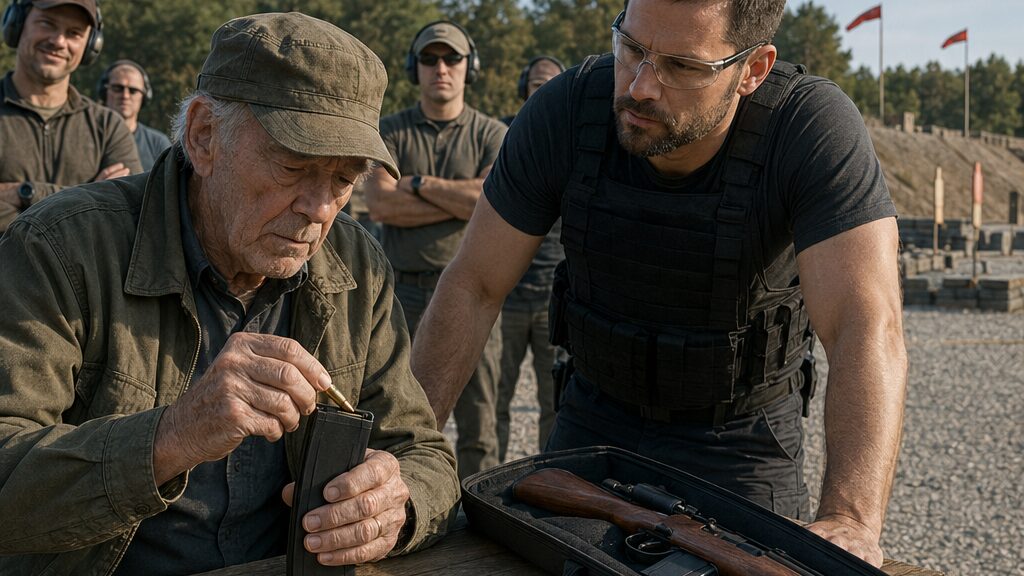
Chapter 1: The Fifth Cartridge Would Not Sit Straight
“Do not force the fifth round.”
Kevin Young’s hand closed over the magazine before Samuel Carter finished speaking.
The movement was quick, practiced, and unnecessary. Kevin lifted the magazine from Samuel’s fingers and held it beneath the white morning light as though the problem could be identified only after passing into younger hands.
Around the rough wooden bench, conversation thinned.
Samuel left his right hand where it rested above the scattered brass cartridges. The tremor continued without the weight of the magazine to conceal it—a small lateral movement through the thumb and first two fingers. He did not make a fist. Hiding it had become more tiring than having it.
Kevin turned the magazine once. His black tactical vest was spotless despite the gravel dust. A radio sat high on one shoulder, and a digital shot timer hung against his chest.
“It’s a standard five-round magazine,” he said. “You press straight down and back.”
“I know how it loads.”
One of the men behind Kevin shifted his hearing protection and looked toward the registration tent. The other smiled without quite committing to it.
Kevin placed the fifth cartridge against the feed lips and pushed. It entered with a hard metallic snap.
“There.”
Samuel looked at the top round. Its nose sat a fraction too high on the left.
Kevin slid the magazine back across the bench. “Grip strength becomes an issue for everybody eventually. That’s why we do equipment checks before anyone goes near the line.”
Samuel’s wooden-stock rifle lay in an open case beside him, bolt open, chamber flag visible, muzzle directed toward the berm. His ammunition remained boxed until the range officer had given permission to load magazines at the preparation tables. Every object was arranged within easy reach of his left hand.
Kevin, meanwhile, had crossed in front of the muzzle twice while speaking.
Samuel touched the magazine with his fingernail. A shallow scrape marked one side near the base plate. He rotated it, pressed his thumb beneath the upper edge, and felt the faint inward roll of metal.
“The left lip is bent.”
Kevin gave a patient smile intended for an audience. “You couldn’t seat the round, Mr. Carter.”
“It caught twice at the same angle.”
“You’re here for the charity match?”
Samuel nodded.
“Then I need to know you can operate the equipment safely and follow modern range commands. We have junior shooters today. Sponsors. Families.”
“I saw them.”
Kevin glanced at the faded olive jacket Samuel had worn for twenty years and the brown cap whose bill had softened from rain, sweat, and handling. “This isn’t a veterans’ reunion demonstration. The stages are timed.”
“That was printed on the application.”
A few feet away, Emma Carter stopped at the registration table with two paper cups. She had been watching long enough for the coffee to tilt toward the rims.
Kevin lowered his voice, though not enough to make the exchange private. “There’s no shame in observing. We have seating behind the line.”
Samuel looked beyond him.
The range had changed since the last time he had stood there. Steel frames had replaced several timber target stands. Cameras watched the firing lanes. Sponsor banners ran along the roof of the briefing shelter. The gravel was fresh, the barriers painted, the electronic scoring system mounted inside a weatherproof cabinet.
But on a support post behind Kevin, beneath sun-faded coats of gray paint, Samuel could still make out the remains of black block lettering.
PRESSURE NEVER—
The rest disappeared behind a red banner advertising precision optics.
He remembered painting those words with a short brush because the range owner at the time had refused to pay for stencils. He remembered a younger hand beside his, spreading too much paint and laughing when it ran.
Samuel looked back at the magazine.
“Tag it,” he said.
Kevin’s expression cooled. “Excuse me?”
“Mark it out of service and inspect the feed lips.”
“I just loaded it.”
“You forced it.”
The small smile vanished from the observer nearest Kevin. The other man looked down at his boots.
Kevin leaned forward, planting both hands on the bench. His shadow fell over Samuel’s cartridges.
“You came here with incomplete medical disclosure, a visible tremor, and equipment older than most of my instructors. I’m trying to keep you from embarrassing yourself.”
Samuel’s right hand moved once against the tabletop. “Then do it quietly.”
The men behind Kevin stopped smiling.
For a moment, Samuel thought Kevin might hear what he had said rather than only how it sounded. Then Kevin straightened and turned toward an assistant range officer.
“Change his badge.”
Emma set the coffee down. “What does that mean?”
“Observation status until I complete an assessment.”
Samuel rose before Emma could object. His left palm pressed against the bench; his right remained near his side. Standing took longer than it once had, but he gave the movement the time it required. He closed the rifle case without touching the firearm and fastened both latches.
Kevin watched him as if the measured movement confirmed everything.
Emma came around the table. “Grandpa—”
“I’m standing.”
“That isn’t what I was going to say.”
“It usually is.”
The words landed harder than Samuel intended. Emma’s face tightened, and he regretted them at once, but apology had never arrived easily when he felt observed.
Kevin held out Samuel’s participant badge. A strip of orange tape now crossed the bottom. In black marker, he had written OBSERVATION ONLY.
“The briefing starts in twenty minutes,” Kevin said. “You’re welcome to attend.”
Samuel took the badge with his left hand.
Emma waited until Kevin had moved toward the next table before speaking. “Was coming here a mistake?”
Kevin slowed several paces away.
Samuel noticed.
Emma lowered her voice. “Your hand was worse this morning. You wouldn’t let me help with the case. Now you’re fighting with the training director before registration is even finished.”
“I reported damaged equipment.”
“You also haven’t shot a match since before the nerve injury.”
Kevin resumed walking, but his shoulders had changed. He had heard enough.
Samuel looked toward the old lettering under the sponsor banner. The uncovered words had outlasted the paint around them.
Pressure never.
He had not come to win a match. He had told Emma that twice during the drive and himself more often than that. He had come because of the scholarship name printed on the flyer folded inside his jacket. He had come to see what remained here.
Walking away would have been simple.
It would also have been familiar.
At the bench, Kevin pressed the cartridges free with a loading tool, dropped them into the ammunition tray, and carried the disputed magazine toward the equipment station.
“Where are you taking that?” Samuel called.
Kevin did not turn. “Back to inventory.”
“I asked you to tag it.”
“And I assessed it.”
Samuel stood with the orange-striped badge hanging against his jacket while the younger man placed the scratched magazine among a dozen identical black boxes in the loaner bin.
Chapter 2: The Rule Painted Beneath Newer Words
The name on the memorial board made Samuel stop so abruptly that Emma walked into his shoulder.
A photograph had been mounted beneath the heading JUNIOR MARKSMANSHIP SCHOLARSHIP. The man pictured was younger than Samuel remembered him at the end and older than he had been at the beginning. He wore no uniform, only a denim shirt and the careful half smile of someone tolerating a camera.
Below the photograph, gold lettering gave the scholarship’s name.
No first name was needed inside Samuel’s head.
He turned before Emma could see his face and nearly walked back toward the parking lot.
“Grandpa?”
The safety briefing shelter stood thirty yards ahead. Junior competitors filed beneath it carrying empty rifle cases while parents followed with folding chairs. Kevin’s assistants checked chamber flags at the entrance. Everything looked orderly.
Samuel reached inside his jacket and touched the folded range card he had carried there for six years.
“Briefing’s starting,” he said.
Emma looked from him to the memorial board. She had learned when not to ask a question, though she disliked the lesson.
They took places at the rear of the shelter. Kevin stood before a digital display showing diagrams of the day’s stages. He was good at this part. His commands were concise. He explained muzzle boundaries, loading procedures, emergency signals, and the requirement that bolts remain open until a shooter received direct authorization.
Samuel listened without moving.
Kevin had modernized the range well. He had separated junior relays from adult competitors, installed marked safe areas, and assigned medical staff to each side of the property. The procedures were not careless.
The emphasis was.
“The timed stages reward commitment,” Kevin told the group. “Once you have your process, trust it. Hesitation causes more errors than speed.”
A banner behind him covered most of the old painted rule on the support beam. Only three words remained visible at the edge:
NEVER CANCELS PROCEDURE.
Samuel watched Kevin advance the slide.
“In practical shooting, you don’t fight resistance. You commit through it.”
A few instructors nodded.
Near the equipment line, a junior shooter repeated the phrase under her breath. She was perhaps fifteen, small beneath an oversized range vest, with both hands wrapped around the charging handle of an unloaded loaner rifle. The bolt had stopped halfway.
“Commit through resistance,” she whispered.
She pulled harder.
Samuel crossed the shelter before deciding to.
“Stop.”
The girl froze.
One assistant range officer turned sharply. “Sir, stay behind the marked line.”
Samuel held up both empty hands. “She has not been cleared to continue.”
The girl looked from him to the assistant. “It’s stuck.”
“Keep it pointed downrange,” Samuel said. “Finger straight along the stock. Don’t move anything else.”
The rifle remained aimed into the designated clearing barrel. The chamber flag hung crookedly from the action.
Samuel did not touch it.
“May I look from here?” he asked the assistant.
The range officer hesitated, then nodded.
Samuel bent enough to see the ejection port. “The flag’s stem is trapped under the bolt. Release pressure slowly. Let the handle move forward half an inch.”
The girl obeyed. The tension eased, and the bright plastic stem slipped free.
“Now lock it open again,” Samuel said.
She did, this time without force.
A few parents had turned to watch. Kevin stepped away from the display.
“What’s happening?”
“Chamber flag caught under the bolt,” the assistant said.
Kevin looked at Samuel. “And you were instructed to remain in the observation area.”
“The rifle was pointed safely. I never touched it.”
“You were still giving commands to a junior participant.”
“I asked your officer’s permission.”
Kevin’s gaze moved to the assistant, who looked uncomfortable but nodded.
The girl held the rifle steady. “He helped.”
Kevin took the firearm from her only after confirming her hands were clear, then inspected the action. His handling was correct, efficient, and controlled.
Samuel almost wished it had been otherwise. A foolish man was easier to dismiss than a capable one who had chosen pride over listening.
Kevin returned the rifle. “The flag was inserted too deep. That is not an equipment failure.”
“No,” Samuel said. “It was resistance giving information.”
The words drew a quiet reaction from several adults.
Kevin heard it. “Mr. Carter, you are a guest today. Not an instructor.”
Samuel looked past him to the old rule beneath the banner.
“Then teach the whole sentence.”
Kevin followed his gaze. “What sentence?”
Samuel pointed.
An edge of the banner lifted in the breeze. For one second the full line appeared beneath it, faded but readable.
PRESSURE NEVER CANCELS PROCEDURE.
Then the fabric dropped.
Kevin’s face revealed nothing. “Old paint doesn’t override the current curriculum.”
“No. But good sense should survive revision.”
Emma stepped closer. “Grandpa.”
Her warning was gentle, which made it harder to ignore.
Kevin addressed the group rather than Samuel. “We will resume. If anyone encounters resistance in a firearm, maintain safe direction and notify a range officer. Do not diagnose equipment unless you are assigned to do so.”
It was a proper instruction. Samuel could not object to it.
Kevin’s eyes remained on him as everyone returned to place.
Samuel walked to the back of the shelter. The junior shooter gave him a small nod. He returned it.
Emma handed him the coffee, now lukewarm. “You could have told the range officer and let him handle it.”
“There wasn’t time before she pulled again.”
“You were right. That doesn’t mean you’re making this easier.”
“Easy wasn’t why I came.”
“Then why did you?”
He looked toward the memorial board.
Emma followed his gaze this time. “You knew him.”
Samuel folded the range card more tightly inside his pocket.
A whistle sounded from the equipment station, calling the first relay. Shooters began moving toward the lanes. Assistants distributed numbered magazines from the loaner bins.
Samuel watched the black boxes pass from hand to hand.
The scratch was small—a pale diagonal near the base plate—but he found it immediately when an assistant placed the disputed magazine beside a young veteran’s ammunition tray.
The veteran counted four cartridges into it.
Then picked up the fifth.
Chapter 3: The Cease-Fire Nobody Wanted Called
Samuel recognized the scratch as the starter raised the timer.
The young veteran at Lane Four stood behind a waist-high barrier, rifle grounded in the rack, magazine on the table beside him. The fifth cartridge sat high beneath the damaged feed lip, its nose lifted slightly left.
Kevin stood two lanes away, checking the line.
Samuel stepped toward the rope.
“Range officer.”
No one heard him over the briefing commands and the clack of bolts being verified open.
“Kevin.”
Kevin glanced back. His expression hardened when he saw Samuel moving.
“Behind the rope, Mr. Carter.”
“The magazine in Lane Four is the one I reported.”
Kevin looked at the shooter’s table from where he stood. “I inspected it.”
“You forced a cartridge into it.”
“Return to the observation area.”
The starter lifted the electronic timer beside his ear. “Shooter ready?”
The young veteran nodded.
Samuel saw him insert the magazine. It resisted before seating. The shooter struck the base with his palm, the way people did when time had already begun inside their heads.
Kevin turned away from Samuel.
The timer had not sounded yet.
Samuel crossed the rope with both hands empty and raised his left arm.
“Cease fire!”
The command came from lower in his chest than ordinary speech. It was not loud in the frantic way of panic. It carried the cut and weight of something designed to travel across gunfire.
Every trained person on the line stopped.
Fingers straightened. Muzzles remained downrange. The starter lowered the timer without activating it. Even spectators behind the second barrier fell silent.
Kevin’s face darkened. “Mr. Carter, step off my line.”
“Lane Four has an unserviceable magazine.”
“You do not call commands on this range.”
“I did when you were about to start with equipment I reported.”
The young veteran stood motionless, right hand off the rifle. “What do you want me to do?”
Kevin answered at once. “Maintain position.”
Samuel did not speak over him.
That mattered. However wrong Kevin had been, two authorities issuing competing instructions around loaded equipment would make the line less safe, not more.
Kevin approached Lane Four. “Remove the magazine and place it on the table.”
The shooter pressed the release.
The magazine did not fall.
He pulled once. It remained caught.
Kevin’s jaw tightened. “Keep the muzzle downrange. Do not force it.”
Samuel heard the change in phrasing.
An assistant range officer moved beside Kevin. Together they stabilized the rifle and cleared the stage according to procedure. The shooter stepped back only after the chamber had been visually and physically confirmed empty.
Spectators began whispering.
Kevin removed the magazine and examined it. The top cartridge sat nose-high.
“Could be ammunition variance,” he said.
Samuel remained outside the active lane now, hands at his sides. “Unload it under inspection.”
Gary Wilson had arrived from the registration tent. He wore a range polo and carried a clipboard beneath one arm. “What happened?”
Kevin answered without looking at him. “A participant interrupted the relay over a suspected magazine issue.”
“The magazine failed to release,” the assistant said.
Gary’s eyes moved to Samuel, then to the orange tape on his badge. “Was it previously reported?”
“Yes,” Samuel said.
Kevin’s shoulders went still.
A woman in a sponsor jacket stood near the results display, listening.
Gary noticed her too.
“Clear the line,” he said. “We inspect before resuming.”
No one argued.
At the equipment table, Kevin used a loading tool to strip the cartridges one at a time while Gary, both assistants, the shooter, and the sponsor representative watched. The first four came free normally.
The fifth caught.
Kevin pressed again. It tilted against the left feed lip.
Samuel said nothing.
Gary leaned closer. “Mark the magazine and bring the gauge.”
The assistant retrieved a small inspection kit. Measurements showed the left lip rolled inward enough to interfere with cartridge presentation. The damage was modest, the kind that might function once and fail the next time.
The range had a procedure for it. A red tag. An inventory log. Immediate removal from service.
The magazine had none of those.
Gary looked at Kevin. “When was this first identified?”
Kevin kept his eyes on the gauge. “During registration.”
“And why was it returned to the bin?”
“I loaded it successfully.”
“That wasn’t the question.”
The sponsor representative wrote something in a notebook.
Kevin’s face flushed, but his voice stayed controlled. “I assessed the issue as user-related.”
“Based on what?” Gary asked.
Kevin glanced toward Samuel’s hand.
Everyone followed his gaze.
The tremor had returned. It moved through Samuel’s fingers in the open space between them.
There it was—the evidence Kevin had trusted more than the evidence Samuel had given him.
The junior students stood behind the rope, watching. The girl with the trapped chamber flag stared at the damaged magazine.
Samuel wished they were somewhere else. He did not enjoy the silence turning in his favor. Public correction could teach, but it could also become appetite.
“The shooter did nothing wrong,” Samuel said. “He was issued defective equipment.”
The young veteran exhaled and lowered his shoulders.
Gary handed the magazine to an assistant. “Tag it. Photograph it. Record the sequence from registration forward.”
The sponsor representative stepped nearer. “Will this be included in the event report?”
Gary hesitated.
Only half a second, but Samuel saw Kevin see it too.
“Yes,” Gary said finally.
The answer cost him something.
Kevin turned to Samuel. “You still had no authority to enter the line.”
“No.”
The admission unsettled him more than an argument would have.
Samuel continued, “I called before the start signal. I kept my hands visible. I stopped when you took control.”
“You disrupted a live event.”
“I prevented a timed stage from beginning with equipment you had been asked to remove.”
Murmurs rose again.
Samuel looked toward the spectators. “That is all that happened. It does not need an audience.”
The words cut off some of the excitement. Not all.
Kevin removed his cap, wiped his forehead, and put it back on. For the first time that morning, he looked less like a man performing authority and more like one carrying it badly.
Gary ordered a ten-minute pause. The junior competitors were moved beneath the shelter. Assistants began checking every loaner magazine.
Emma approached Samuel near the barrier.
“You knew exactly what it would do.”
“I knew what it might do.”
“That isn’t the same.”
“No.”
She looked at his hand. “And if you had been wrong?”
“Then I would have accepted being wrong.”
Kevin heard that as he passed.
He stopped.
The sponsor representative had followed Gary toward the office. Through the open door, Samuel could see her pointing at the event paperwork. Kevin watched them, and for an instant the whole shape of his pressure became visible: the staff in matching shirts, the new cameras, the junior scholarship banners, the polished program he had built and could lose.
Then his eyes returned to Samuel, and the pressure hardened back into pride.
“Walk with me,” Kevin said.
They moved behind the equipment shed, away from the crowd but not beyond Emma’s sight. Wind stirred dust across the gravel and rattled the leaves along the tree line.
Kevin kept his voice low. “You’ve made your point.”
“The magazine made it.”
“You want back into the match.”
“I registered for it.”
“I can put you on the fifty-yard sheltered lane after lunch. Five rounds, seated support, no timer. We call it an exhibition. You demonstrate safe handling, everyone gets their respectful moment, and this ends.”
Samuel studied him.
Kevin was offering a path that protected the event, protected Samuel from a difficult stage, and protected himself from a second public loss. It was not pure mockery. That made it worse.
“An easy lane,” Samuel said.
“A controlled one.”
“With no score.”
“You haven’t competed publicly in years. Your granddaughter confirmed that.”
Samuel’s mouth tightened. Emma had spoken from concern. Kevin had turned concern into evidence.
“I am giving you a dignified option,” Kevin said.
“No. You are arranging the conclusion before the rifle is loaded.”
Kevin’s restraint thinned. “What exactly do you want?”
Samuel looked past him toward the far berm. Wind flags lifted at different angles down the length of the range. The nearest leaned right. Beyond it, dust moved left across the base of the targets.
“Not an exhibition,” Samuel said. “Score me under the same wind.”
Chapter 4: The Easy Lane Was Another Kind of Insult
“Being right about the magazine does not mean your hand is ready for the rifle.”
Emma said it beneath the lunch shelter, where folding tables separated them from the spectators but not from the occasional glance. Samuel sat with an empty magazine in his left hand. His right thumb pressed slowly against its base, then released with his breathing.
In.
Pressure.
Out.
Release.
There were no cartridges in it. Kevin had removed all ammunition from the preparation area while the loaner equipment was inspected.
Samuel repeated the motion.
Emma set his untouched sandwich beside him. “Did you hear me?”
“I heard you.”
“You haven’t answered.”
“Those are different things.”
Her mouth tightened. “That is exactly the problem.”
Across the range, Kevin stood inside the office with Gary and the sponsor representative. Through the open window, Samuel could see paperwork spread across the desk. Kevin pointed at one page, then another. Gary’s arms remained folded.
The range had resumed limited activity, but the timed stages were still suspended. Assistants checked magazines with gauges while junior shooters practiced unloaded positions under the shelter.
Emma sat opposite Samuel. “You said you weren’t here to prove anything.”
“I’m not.”
“You just demanded to be scored in the hardest conditions.”
“I demanded the same conditions.”
“That sounds like proving something with better manners.”
Samuel stopped moving the magazine.
The tremor resumed immediately, stronger after the morning’s strain. Emma saw it. She always did.
Three years earlier, after the nerve injury, she had placed his hand beneath a heat pack and asked him to touch his thumb to each finger. He had failed twice on the smallest one and told her the room was cold. She had not corrected him. The next week, she brought him a different set of exercises and never mentioned the excuse.
“I can withdraw,” Samuel said.
Emma’s shoulders lowered slightly.
“After a proper assessment.”
They rose again. “You make everything sound like procedure.”
“Procedure keeps pride from making decisions.”
“Whose pride?”
He looked toward the office.
Emma followed his gaze. “That doesn’t answer me.”
“No,” Samuel said. “It doesn’t.”
Kevin emerged carrying a folder. He stopped beside the shelter rather than entering it.
“Mr. Carter. Office.”
Samuel put down the empty magazine and stood. Emma came with him.
Inside, the air conditioner rattled above a wall of framed range certifications. Gary leaned against the filing cabinet. The sponsor representative had left.
Kevin closed the door.
“The event remains funded for today,” Gary said. “Future support depends on the incident report and corrective action.”
Samuel nodded.
Kevin opened the folder. “We can still settle your participation without turning this into a spectacle.”
“The sheltered lane.”
“It is a reasonable accommodation.”
“Without a score.”
Kevin’s jaw moved. “You have no recent qualification record.”
“I submitted my records.”
“Your last public match was three years ago.”
Emma shifted beside Samuel.
Kevin noticed. “Is that incorrect?”
Samuel said nothing.
Emma did. “No.”
Kevin looked at her now. “And the hand condition?”
“It affects him at rest and during some fine-motor tasks.”
“Does it affect firing?”
“It can.”
Samuel turned his head.
Emma met his eyes. “You asked for an honest assessment.”
Kevin’s voice softened, not kindly but professionally. “Then we agree one is required.”
“What stage?” Samuel asked.
Gary unfolded a range map. “Neutral qualification. Five rounds at two hundred yards from supported prone. Standard scoring ring. No rapid transition. Same equipment inspection as every competitor.”
“Same time limit?”
Kevin said, “You do not need the same time pressure.”
“Then it is not the same assessment.”
“The point is safety.”
“The point changed when you offered an exhibition.”
Kevin placed both palms on the desk. For an instant he looked as he had at the loading bench, but the posture no longer carried the same confidence.
“You think I am trying to humiliate you.”
“You already tried.”
Gary looked down.
Kevin stepped back from the desk. “I have twelve paid staff here. The junior scholarship covers equipment for families who cannot afford it. The sponsor pays for the medical team, half the insurance increase, and every camera you see on the line. One bad event and all of that becomes a memory.”
“That is pressure,” Samuel said.
“Yes.”
Samuel looked toward the old post visible through the window. The banner hid the painted sentence again.
“It still does not cancel procedure.”
Kevin’s eyes followed his. Something changed in his face, too quick to name.
Gary tapped the map. “Same qualification, same time limit, same scoring. Afternoon relay.”
Kevin stared at him. “Gary—”
“We need a clean answer. Not an arranged one.”
Samuel nodded once. “Agreed.”
Kevin closed the folder harder than necessary. “Fine. Your personal rifle still has to pass inspection.”
At the equipment bench, an assistant checked the wooden-stock rifle from muzzle to butt. Samuel watched each step without interfering. The bore was clear. The action functioned properly. The trigger weight passed.
Then the assistant pulled on the sling.
The front attachment shifted.
He tried again. The worn metal stud moved inside the stock.
“Unserviceable,” he said.
Samuel took the rifle only after the assistant had confirmed it clear. He examined the loose attachment. It had held during dry practice at home. Here, under a firm inspection, the wood compressed around it.
Emma watched his face. “Can it be repaired?”
“Not before the relay,” Kevin said.
Samuel ran his thumb across the worn place. He had carried the rifle through rain, dust, storage moves, and years when he told himself he would begin shooting again next month. Familiarity had hidden the damage from him as surely as Kevin’s certainty had hidden the magazine defect.
“You missed it,” Emma said quietly.
“Yes.”
The admission tasted different when it belonged to him.
Kevin gestured toward the loaner rack. “You can withdraw, or use range equipment.”
Samuel placed the rifle back in its case. The latches closed with two small clicks.
“Loaner.”
Kevin selected a plain bolt-action rifle with a synthetic stock and a modest fixed-power optic. It was maintained, functional, and entirely unfamiliar.
“No special equipment,” he said.
“I did not ask for any.”
Samuel shouldered it only after permission. The stock sat too low against his cheek. The trigger broke heavier than his own. At the sight-in lane, he dry-fired once, then twice, learning where pressure became release.
His right hand trembled when he lowered the rifle.
For the first time that day, uncertainty entered without disguise.
He had relied on more than skill. He had relied on the known curve of old wood, the exact reach to his trigger, the sling tension his body remembered. Now even that was gone.
A truck door slammed outside.
A broad-shouldered man with gray at his temples crossed the gravel carrying hearing protection in one hand. He glanced toward the office window, then stopped so suddenly that the equipment bag swung against his leg.
His eyes fixed on Samuel.
“You brought him here,” the man said to Gary, “without knowing who he is?”
Chapter 5: The Student Who Remembered the Wrong Lesson
“Sergeant Carter.”
David Rivera spoke the title across the equipment shed as if the intervening years had been a hallway rather than half a lifetime.
Samuel rested the unloaded loaner rifle in the rack. “Do not use that here.”
David’s expression changed, but not into embarrassment. “You used to correct me for dropping it.”
“I was responsible for you then.”
“And now?”
“Now you should know better.”
Gary looked between them. Kevin stood near the office door with the qualification folder under one arm.
“You know Mr. Carter?” Gary asked.
David gave a brief laugh without humor. “He trained me.”
Kevin’s gaze sharpened. “Military?”
“Army first. Then service-rifle coaching. Later he helped half the state police instructors learn how to teach instead of just shoot.”
Samuel closed the loaner rifle’s case. “Enough.”
David looked at him. “Still deciding what other people are allowed to know?”
The words landed with more force than the recognition.
Gary glanced toward the shelter, where spectators had begun noticing the gathering. “We should move this conversation.”
They went behind the equipment shed, near the tree line where the wind carried their voices away from the firing lanes. Emma stayed beside Samuel. Kevin followed, though no one invited him.
David stood with his hands on his hips. He was fifty-eight now, heavier through the middle, but Samuel could still see the recruit who had once tried to conceal a split thumbnail because he feared losing range time.
“You came for the scholarship,” David said.
Samuel did not answer.
“That is his card in your pocket, isn’t it?”
Emma looked at Samuel’s jacket.
He felt the folded paper there as if it had gained weight.
Kevin said, “Whose card?”
David turned toward the memorial board. “The man this event is named for. He trained under Samuel too.”
“Not today,” Samuel said.
David faced him again. “That is what you always said when the subject wasn’t clean enough for a firing line.”
“This is not the place.”
“It is exactly the place. They have his picture on a board and your sentence painted under a banner.”
Gary looked toward the shelter post.
Kevin’s eyes narrowed. “Your sentence?”
Samuel drew the range card from his pocket. The paper had softened at the folds. One side held an old score grid. On the back, in cramped handwriting, were words only Samuel and the dead man had ever needed to understand.
He did not unfold it.
“We wrote the early safety program together,” Samuel said. “Several instructors contributed.”
David shook his head. “You wrote the rule everybody remembered.”
“Rules do not belong to the person who writes them.”
“No. But failures do?”
Emma turned toward David. “What is that supposed to mean?”
David’s anger faltered. He looked at her and seemed to recognize that she had inherited a history without its explanations.
Samuel spared him the choice. “It means I taught men to endure pressure.”
“You taught us to make it invisible,” David said.
Kevin shifted the folder under his arm. His attention was no longer on Samuel’s age. It had moved to concealment.
David stepped closer, voice lower. “You remember the blackout drills?”
Samuel did.
They had loaded magazines in a dark room under red emergency lamps, identifying bent lips and damaged springs by touch. Young soldiers had complained that the exercise was slow and old-fashioned. Samuel had made them repeat it until resistance became language beneath their fingers.
“You made us load one round at a time,” David said. “No light. No gloves. You said a man who could feel a fault before it became a failure might save the whole line.”
Kevin looked toward the tagged magazine on the inspection table.
“That is how you knew,” he said.
Samuel met his eyes. “That is how I suspected.”
David continued. “He never guessed. He verified.”
“Stop helping me,” Samuel said.
“I am not helping you.”
Silence settled between them.
David’s face had hardened in a way Samuel had not expected. Recognition should have been easier. Gratitude, perhaps. A story polished by time.
Instead, David had arrived carrying an old debt of his own.
“You taught us how to control our breathing,” David said. “How to slow our pulse. How to hold steady when everything around us wanted speed.”
Samuel folded the range card once more.
“But when a man could not carry something alone,” David said, “you gave him another procedure.”
Emma’s hand moved toward Samuel’s sleeve, then stopped.
The memory came without permission: a phone call after midnight, a voice saying he was not doing well, Samuel answering with sleep, routine, exercise, the next appointment, practical steps. Useful things. Insufficient things.
He had believed calm could be transferred through instruction.
Sometimes it only sounded like distance.
“He asked me for help,” Samuel said.
David’s anger thinned. “Yes.”
“I thought he was asking for a plan.”
“He was asking you not to leave him alone with it.”
Kevin looked away first.
Samuel stared at the range card. The handwritten note on the back pressed against his thumb through the fold.
Emma spoke carefully. “Is that why you came?”
“To see what they were teaching in his name.”
“And to shoot?”
Samuel did not answer quickly enough.
David saw it. “Part of you wanted the old record board too.”
“There is no old record board.”
“There was when you drove in.”
Samuel looked at him.
David gave a weary nod toward the office. “I saw the frame in storage. They took the old results down when they remodeled.”
The accusation was not entirely fair.
That made it no less accurate.
Samuel had told himself the match did not matter. Yet he had brought his own rifle, inspected his ammunition twice, and felt something tighten when Kevin suggested he sit behind the line. His promise and his pride had traveled in the same case.
Kevin stepped closer. “So you concealed that you wrote part of the curriculum, trained the memorial recipient, and held a record here.”
“I did not come for recognition.”
“You let me challenge you in front of a crowd.”
“You did that without assistance.”
Gary exhaled sharply.
Kevin’s face reddened. “You could have corrected the record at registration.”
“I corrected the equipment.”
“That is not the same thing.”
“No.”
Again, the admission denied Kevin the argument he expected.
A range bell sounded twice, announcing that the afternoon schedule had been revised. Assistants began moving target frames toward the long precision lane.
Kevin opened the folder and wrote on the qualification sheet.
Gary watched him. “Which relay?”
“The three-thirty wind stage.”
David looked toward the flags. “That is the hardest lane after the ground heats.”
“It is also the next neutral qualification opening,” Kevin said.
“Neutral?” Emma asked.
Kevin capped his pen. “Same rifle category. Same scoring. Same time. Same spectators as every other competitor.”
Samuel studied him. There was retaliation in the choice. There was also consistency.
“Put it on the public board,” Samuel said.
Emma turned. “You do not have to agree to every challenge someone sets.”
“No,” he said. “Only the fair ones.”
Kevin walked to the results board and wrote beneath the afternoon schedule:
3:30—SAMUEL CARTER—LANE 7—STANDARD WIND QUALIFICATION.
The sponsor representative stood nearby. Junior shooters gathered to read it. Word moved through the crowd faster than any official announcement.
At the far berm, the flags snapped right while the treetops beyond them leaned left.
Chapter 6: Expensive Glass Could Not Read the Trees
The nearest wind flag dropped against its pole while the distant treetops continued bending in the opposite direction.
Samuel saw it before he touched the rifle.
Lane Seven stretched across two hundred yards of sun-heated ground. Pale dust moved in brief sheets above the gravel, then vanished over patches of grass. The first flag hung limp. The second angled right. Beyond the target line, the highest branches rolled left in slow waves.
Three layers.
Kevin stood behind the firing point with a handheld weather meter and a tablet connected to the range sensors.
“Reading is four miles per hour from three o’clock,” he said.
Samuel looked at the dust crossing left beneath the target frame.
“Here,” Samuel said.
Kevin glanced at him. “What?”
“Four miles per hour here.”
The starter checked the timer. Junior students watched from behind the rope. The sponsor representative stood beside Gary. David remained near the results board, arms folded. Emma had moved where Samuel could see her without turning his head.
The loaner rifle rested on the mat, bolt open, chamber flag inserted. Five cartridges waited in a tray. The magazine had been inspected and tagged with a green service mark.
Samuel knelt carefully. His right hand shook as he removed the chamber flag and presented the open action for verification. The assistant range officer confirmed clear, then stepped back.
“Load on command only,” Kevin said.
Samuel settled prone behind the rifle. The synthetic stock felt hollow against his cheek. The optic offered less magnification than he preferred, but the glass was clean. He adjusted the rear support, tested his shoulder pressure, and lifted his head.
The first flag stirred.
The treetops had not changed.
“Shooter ready?” the starter asked.
Samuel looked through the optic. The paper target wavered in heat distortion.
“Not ready.”
A murmur passed behind the rope.
Kevin checked the tablet. “Conditions are stable.”
Samuel watched a strand of dry grass halfway downrange lean left while dust near the target moved right.
“No.”
Kevin’s mouth tightened. “You have a fixed preparation window.”
“I know.”
Samuel closed his eyes for one breath.
At rest, the tremor lived in his fingers. Under strain, it climbed toward his wrist. He did not command it to stop. Commands were useless against facts. He built support around it: left hand under the stock, shoulder firm, trigger finger placed only when the sights settled.
The starter raised the timer again.
“Ready?”
The nearest flag lifted toward the right. Farther downrange, the second flag began to fall. The treetops paused.
“Ready.”
The signal sounded.
Samuel inserted the magazine, closed the bolt, and settled behind the optic. His first sight picture drifted low. He breathed out, paused at the natural bottom, and began pressure on the trigger.
A flicker of dust crossed the target base.
He lifted his finger and lowered the rifle.
The crowd whispered.
Kevin said, “Wind reading unchanged.”
Samuel waited.
The timer continued.
The gust passed. The grass halfway downrange stood upright for less than a second.
Samuel fired.
The rifle recoiled into his shoulder. He worked the bolt without lifting his cheek, then rebuilt the position rather than chasing the first shot.
Through the limited optic, he could not see the hole.
The nearest flag snapped right.
He lowered the rifle again.
Someone behind the rope muttered, “He’s freezing.”
Samuel heard it. Years earlier, he might have fired simply to deny the word. Age had not removed pride; it had only made its cost more visible.
The timer sounded a warning.
Kevin stepped close enough that Samuel could hear him without raising his voice. “The device says the wind has stabilized.”
Samuel kept his eyes downrange. “The trees disagree.”
“You are running out of time.”
“So is the gust.”
At the far edge, the treetops slowed. The second flag turned. Dust near the target stopped sliding sideways.
Samuel lifted the rifle.
Breath.
Pressure.
Release.
The second shot broke.
The spotter looked through a high-powered scope and then looked again. He said nothing, but his posture changed.
Samuel cycled the bolt.
“Two shots, forty seconds,” the starter called.
The third condition never became perfect. There was no such thing. The near flag leaned right while heat shimmer pushed the target’s edge into a false bend. Samuel corrected less than Kevin’s tablet indicated and fired.
The fourth shot came after a shorter pause.
By then, the spectators had stopped whispering.
The fifth cartridge rose from the magazine and entered the chamber without resistance. Samuel felt the clean movement through the bolt handle. No force. No argument. Information received and answered.
“Ten seconds,” the starter called.
Kevin’s tablet showed a new reading. “Wind is down. Hold center.”
Samuel saw the grass flatten left.
The sensor had updated to the near lane. The target was receiving something else.
He shifted his hold a fraction.
Five seconds.
Samuel breathed out.
The tremor reached his trigger finger, a tiny pulse against the metal. He did not fight it. He waited through one beat, then increased pressure between movements.
The shot broke with one second remaining.
“Time.”
Samuel opened the bolt, removed the magazine, and presented the action. The assistant confirmed clear and inserted the chamber flag.
Only then did Samuel push himself upright.
His right hand shook hard enough that he had to rest it against his thigh.
Emma saw. So did Kevin.
No one spoke until the target carrier began moving.
The paper came toward them along the cable, turning slightly in the wind. From a distance, the holes looked ordinary. As it drew closer, the group tightened into shape: five impacts clustered inside the center scoring area, not one ragged impossible hole, but a compact group with a slight horizontal spread.
The statistician measured it twice.
“Best qualifying group today,” he said.
The silence that followed was different from cheering. It did not rise. It settled.
Kevin took the target and examined the shot pattern. The expensive weather meter still glowed in his other hand.
Samuel looked past him to the flags.
“The device was not wrong,” he said.
Kevin’s eyes lifted.
“It told you what the air was doing where you stood.”
David gave the smallest nod.
The junior shooter Samuel had helped earlier stared at the paper as though it contained a hidden sentence.
Gary brought forward a winner’s card and held it toward Samuel. “That qualifies you for the final award.”
Samuel did not take it.
The sponsor representative stepped closer. Cameras had begun recording from beyond the rope.
Samuel pointed toward the inspection table, where the damaged magazine lay beneath its red tag.
“Record the morning incident first.”
Gary’s hand lowered.
“We can complete the report after the ceremony,” Kevin said.
“No.”
Kevin looked at the crowd, then at the target in his hand. He understood what Samuel was refusing: the neat ending, the photograph, the old man’s victory separated from the institution’s failure.
Samuel’s hand trembled openly at his side.
“The target proves I can still shoot,” he said. “It proves nothing about whether this range will tell the truth.”
Gary looked toward the sponsor representative.
She closed her notebook and waited.
Kevin held the best target of the day in one hand and the glowing wind meter in the other. Then he turned toward the office where the unfiled incident report remained on the desk.
Chapter 7: The Target Proved Less Than They Thought
Gary offered Samuel the microphone.
Samuel pushed it gently back across the folding table.
The public results board stood outside the range office, his name written at the top of the afternoon qualification list. Beside it, Kevin had pinned the target with four brass tacks. The five-shot group drew people closer, but Samuel had placed something else beneath it before anyone could begin the ceremony.
The damaged magazine lay under its red tag.
Accuracy above. Failure below.
The sponsor representative looked from one to the other. “People are waiting for the award presentation.”
“They can wait for the report,” Samuel said.
Gary lowered the microphone. Behind him, the junior competitors gathered beneath the shelter with their families. Some watched Samuel. Others stared at the target as if skill might be absorbed by looking hard enough.
Kevin stood at the office desk filling out the incident form. He had removed his tactical vest and hung it over the chair. Without it, he looked younger and more tired.
The sponsor representative entered the office and placed one hand beside the paperwork.
“The equipment issue was identified before the relay began,” she said. “The firearm never discharged during the incident. We can describe it as a precautionary stop.”
Kevin kept writing.
“That is accurate,” she continued. “It also avoids suggesting that defective equipment was knowingly returned to service.”
His pen stopped.
Gary glanced through the doorway. “Kevin.”
The sponsor representative lowered her voice. “Future funding depends on confidence. You do not rebuild confidence by creating a headline.”
Samuel watched Kevin’s shoulders.
All day, the younger man had treated pressure like something to overcome through speed. Now there was no timer, no firing command, no device to consult. Only a blank line marked PRIOR WARNING RECEIVED.
Kevin checked the box beside yes.
Then he wrote Samuel’s name and the time of the original report.
The sponsor representative straightened. “You understand what that may do.”
“Yes.”
“You could note that the warning came from an unqualified participant.”
Kevin looked toward Samuel’s target.
“He was not unqualified to identify the defect.”
The woman closed her notebook. “Send me the completed report.”
When she left, no one spoke for several seconds.
Samuel had expected Kevin to defend himself. Part of him had prepared for it. That readiness now had nowhere to go.
Kevin carried the form outside and handed it to Gary. “The magazine was returned to inventory after a verbal warning. I made that decision.”
Gary read the first page. “We will suspend timed loaner stages until every magazine is inspected and the check-in process is revised.”
Kevin nodded.
“And the report goes to the sponsor unchanged.”
“Yes.”
Samuel looked at the target again. The group had become less important since it arrived.
Gary raised the microphone. “We need to explain the delay.”
“No speech,” Samuel said.
“You earned the award.”
“I earned a score.”
“They ought to know who you are,” David said from the edge of the crowd.
Samuel turned toward him. “They know enough.”
David crossed his arms. “That has always been your answer.”
Emma stood beside the table, studying Samuel rather than the target. “Maybe this time they need something different.”
The junior shooter with the oversized vest waited near the front. She held her hearing protection against her chest. Earlier, she had watched Samuel stop her from forcing the trapped chamber flag. Now she watched the adults decide which truth could be spoken cleanly.
Samuel unfolded the old range card.
The score grid on the front had faded almost white. On the back, the handwriting remained dark where the pen had pressed hard.
This place makes sense because the rules do not change when I am having a bad day.
Below it was a second line, written months later.
I wish people worked that way.
Samuel had answered that second message with a list. Sleep schedule. Exercise. Appointment times. Things to measure. Things to complete.
He had not gone to the man’s house.
He had not asked whether he should stay on the phone.
Samuel laid the card beside the magazine.
“The scholarship is named for one of my students,” he said.
The nearest conversations stopped.
“He was a good shooter. Better than he believed and not as steady as he looked.”
David lowered his eyes.
Samuel kept his voice level. “I taught him that pressure never cancels procedure. I taught him to inspect equipment, control his breathing, and finish what he began.”
The wind lifted a corner of the target.
“When he asked for help outside the range, I gave him procedures. I thought usefulness was the same as presence.”
Emma’s hand closed around the edge of the table.
“It was not.”
No one moved toward Samuel. He was grateful for that.
Kevin looked at the handwritten card but did not reach for it.
Samuel touched the red tag on the magazine. “A person tells you something is wrong, you do not force the next step because the schedule says move. You stop. You listen. You verify.”
The words were for Kevin, but not only Kevin.
They were also for the man whose photograph stood beneath the shelter, and for Samuel himself, who had spent years treating his own weakening hand as an equipment problem to be hidden or solved alone.
Gary placed the winner’s card on the table. “The prize belongs to you.”
Samuel looked toward the junior students.
“Put it into the scholarship.”
A few people began to clap. Samuel raised one hand, and the sound died before it could grow.
“The target does not make me right about everything.”
David’s expression softened, though sadness remained in it.
Kevin stepped forward. “No. But the report makes me wrong about something that mattered.”
He turned so the assistants and families could hear him.
“I assessed Mr. Carter before I completed the equipment check. I treated his tremor as proof and his warning as an excuse. Then I returned the magazine to service.”
His voice caught slightly on the last sentence.
“I am responsible for that.”
There was no applause this time.
Gary pinned the incident notice beside the results sheet. The damaged magazine remained beneath Samuel’s target, and the two objects changed one another. The target proved discipline. The magazine proved why discipline had to begin before the shooting.
Emma waited until the crowd moved toward the scholarship table.
“If Gary asks you to teach here,” she said, “you cannot pretend your hand does not have limits.”
“I know.”
“You will need shorter sessions. Breaks. Someone else carrying cases on bad days.”
Samuel folded the range card along its softened crease. “You have prepared a list.”
“I learned from you.”
He almost smiled.
Her face remained serious. “And you will have to tell people when you need help before they guess.”
That requirement felt more difficult than the wind stage.
Across the shelter, Gary and Kevin spoke beside the old painted rule. Kevin reached up and removed the lower corner of the sponsor banner from the support post. The full sentence appeared for the first time that day.
PRESSURE NEVER CANCELS PROCEDURE.
A junior shooter approached Samuel. It was the same girl whose chamber flag had caught that morning.
She pointed to the red-tagged magazine. “Will you show us how you knew before the rifle ever fired?”
Samuel looked at Emma, then at Kevin, who had gone still beside the uncovered words.
For years, Samuel had believed that leaving quietly was the purest form of humility. Now the girl waited for an answer that silence could not give.
He placed his weathered hand over the magazine.
“Yes,” he said. “But not today.”
“When?”
Samuel looked toward the wooden loading bench.
“When we can begin at the beginning.”
Chapter 8: What Steady Hands Were Meant to Teach
Samuel’s hand trembled visibly as he placed the training magazine on the wooden bench.
Twelve junior students watched from the other side. No live ammunition had been issued. Their rifles remained cased in the secure rack, actions open and chamber flags visible under the supervision of two range officers.
On the bench lay five inert brass-colored training cartridges.
One month had passed, but the scratch on the magazine still caught the morning light.
“This one is permanently out of service,” Samuel said. “It is here because damaged things can still teach, provided nobody pretends they are safe to use.”
The junior shooter from the charity match stood nearest him. Her range vest fit better now. She looked at his right hand, then deliberately returned her attention to the magazine.
Samuel appreciated the choice.
Behind the students, the sponsor banner had been relocated. The old sentence remained exposed on the support post. Beneath it, a new board listed the revised training sequence:
INSPECT.
COMMUNICATE.
VERIFY.
PROCEED.
No step carried a time limit.
Kevin stood near the equipment rack wearing a plain range shirt instead of his tactical vest. He held a clipboard but had not spoken since the class began.
Samuel set the first inert cartridge into the magazine.
“Pressure downward, then back. Do not race the spring.”
The cartridge seated.
He loaded the second and third. His thumb shook between movements, but each time he rested the magazine against the bench and waited until he could apply pressure in a controlled line.
“The goal is not to make your hands look steady,” he said. “The goal is to notice what they are telling you.”
He inserted the fourth.
Then he handed the magazine to the junior shooter.
She picked up the fifth cartridge.
“Same pressure?” she asked.
“Until the information changes.”
She pressed.
The cartridge caught against the damaged lip.
Her forehead tightened. She pushed harder for half a second, then stopped.
Samuel said nothing.
The class leaned closer.
She removed pressure and looked into the top of the magazine. “It tilted left.”
“What do you do?”
“Stop. Keep it out of service. Tell the instructor.”
“Why?”
“Because resistance might be information.”
Samuel nodded. “Might be. We still verify.”
The girl passed the magazine to the student beside her rather than trying again.
That small act pleased Samuel more than the target had.
Emma watched from the end of the bench with his old wooden-stock rifle case at her feet. The sling attachment had been repaired, but she had carried the case from the truck without asking permission. Samuel had let her.
During the break, he opened it for a demonstration of inspection points. When he tried to fasten the sling, his fingers failed to align the clasp.
He tried once more.
Emma waited.
A month earlier, he would have turned his body to hide the effort.
“Can you hold the buckle?” he asked.
She did, without smiling or making the moment larger. Together they secured it.
Across the bench, Kevin saw.
After the break, Samuel expected him to resume his position behind the class. Instead, Kevin placed his clipboard on the table and sat on the bench among the students.
Gary, observing from the shelter, raised an eyebrow.
Kevin ignored him.
“I have not completed the revised fundamentals assessment,” he said.
Samuel studied him. “You helped write it.”
“That is not the same as passing it.”
Several students glanced between them.
Samuel placed an undamaged training magazine in front of Kevin. “Begin.”
Kevin picked it up. His movements were smooth and fast. The first three cartridges seated almost as one continuous action.
“Again,” Samuel said.
Kevin looked up. “I did not make an error.”
“You did not inspect the magazine.”
“It was issued from the verified tray.”
“Who verified it?”
Kevin glanced toward the range officer.
Samuel waited.
Kevin removed the cartridges and began again. This time he checked the body, base plate, spring pressure, and feed lips before loading.
His pace slowed.
The class watched the man who had once taught commitment through resistance learn to pause before it.
On the fifth cartridge, Samuel tapped the bench.
Kevin stopped.
“What changed?” he asked.
“Nothing.”
“Then why did you stop?”
“You signaled.”
“That is not information from the equipment.”
Kevin looked at the magazine. A hint of frustration entered his face, followed by recognition.
“I surrendered my process to authority.”
Samuel nodded. “That can be as dangerous as ignoring it.”
The junior shooter raised her hand. “But we have to follow range officers.”
“Yes,” Samuel said. “Commands keep the line safe. Thinking keeps you useful inside those commands. Respect both.”
Kevin unloaded the training magazine and began once more.
By the third attempt, his handling was slower than before and more complete.
At the far berm, the wind flag lifted, turned, and fell. Several students glanced toward it. Samuel had included a wind-reading block later in the course, but the first lesson remained at the bench. Accuracy began long before a sight picture.
Gary approached during the final exercise and handed Samuel a revised instructor schedule. Two mornings each month, ninety minutes each, with breaks marked in ink. Kevin’s name appeared beside his on every session.
Samuel read it.
“Too much?” Emma asked.
He nearly said no.
Instead, he considered the stiffness in his wrist, the fatigue already settling into his shoulder, and the way his hand had worsened after the previous hour.
“Not if the break stays where it is.”
Gary nodded. “It stays.”
“And someone else moves the equipment.”
Kevin said, “I will.”
Samuel looked at him.
“That was not an apology,” Kevin added. “It was an assignment.”
“Good.”
The last student at the bench was younger than the others and eager enough to make every movement twice. She inspected the damaged magazine, then picked up the fifth inert cartridge.
Samuel saw the familiar mistake forming before it happened: the tightening jaw, the thumb bearing down, the desire to complete the task while everyone watched.
The cartridge caught.
Her thumb pressed harder.
Samuel did not reach across the bench.
Kevin did not speak.
The girl’s face flushed. Then she eased the pressure.
She removed the cartridge, rotated the magazine beneath the light, and traced the bent lip with one fingernail.
“It changed,” she said.
Samuel’s right hand trembled against his knee.
“Yes.”
She set the cartridge down instead of forcing it. Then she attached the red out-of-service tag exactly as she had been taught.
No one applauded. No one needed to.
Samuel looked along the bench at Kevin seated among the students, Emma holding the repaired rifle case, and the old rule uncovered behind them.
Steady hands, he understood now, had never meant hands that did not shake.
They were hands that listened before applying force, stopped when something changed, and reached for another person when the weight should not be carried alone.
The girl moved to give the magazine back to him.
Samuel shook his head.
“You found the fault,” he said. “You finish the lesson.”
She placed it in the inspection tray and recorded the defect.
Samuel let the quiet result belong to her.
The story has ended.