They Ordered the Old Pilot Off the Flight Line Until His Faded Tattoo Stopped Them
Chapter 1: The Old Man Beneath the Flight-Line Overhang
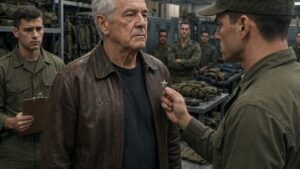
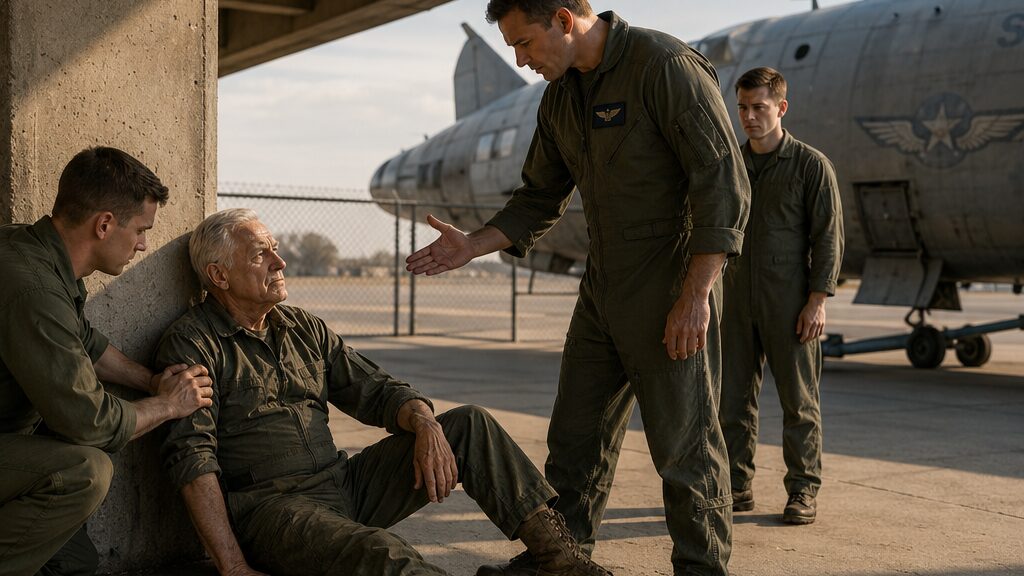
The junior airman’s hand closed around Samuel Carter’s upper arm just as the tow tractor coughed to life across the flight line.
“Move him before the tow crew gets here,” the young officer said.
Samuel looked at the fingers pressing into the faded olive cloth of his flight suit. The grip was careful, almost apologetic, but it was still a grip. He had crossed half the world under worse hands than these. Age had not made the indignity gentler.
“I can stand,” he said.
His right leg disagreed.
The strength left it halfway through the motion, and Samuel settled back against the concrete support column before his knee could fold beneath him. The heel of his worn boot scraped the pavement. He placed two fingers against the leather above his ankle and waited for the cramp to pass.
The second junior airman stepped closer.
The officer held up a hand. “Sir, you’re inside a restricted staging area. We need your identification and your authorization to be here.”
The word sir carried no respect. It was the smooth, distant word used for lost civilians, angry passengers, and old men who might not understand where they had wandered.
Samuel raised his eyes.
The officer was perhaps thirty, broad-shouldered in a clean flight suit, with a new squadron patch sewn over his chest. Behind him stood the two airmen and a security sergeant near the chain-link gate. None of them looked cruel. That made the scene worse. Cruelty could be answered. Procedure merely rolled over whatever lay in front of it.
Beyond them, aircraft 62–17 rested beneath the morning glare.
Its paint had been dulled by decades of weather and maintenance compounds. A tow bar was already attached to the nose gear. Orange safety streamers hung beneath the fuselage, shifting in the hot air. Under the rescue insignia on the port side sat a shallow access panel no wider than a man’s forearm.
Samuel had come for that panel.
The officer followed his gaze. “Are you with the museum transfer team?”
“No.”
“Former contractor?”
“No.”
“Then how did you get through the gate?”
“The contractor gate was open.”
The officer’s jaw tightened. “That doesn’t make this area public.”
“I know what it is.”
“Then you know why you can’t sit here.”
Samuel almost smiled. He had sat beneath this same overhang when the concrete had been fresh enough to smell of lime. Men had smoked beside that column, though regulations had forbidden it even then. David Ramirez had once balanced a wrench on his upper lip there while pretending to give a maintenance briefing.
The memory arrived whole and useless.
Samuel looked back at the aircraft. “You’re moving it at noon.”
“That’s correct.”
“It can’t cross the transfer gate.”
The junior airman’s hand tightened again.
Samuel turned his head. “Take your hand off me.”
The airman glanced at the officer.
“Sir,” the officer said, “we have tried to be patient.”
“No. You’ve tried to be quick.”
The second airman looked down.
A radio crackled at the security sergeant’s shoulder. Somewhere behind the hangars, a turbine climbed into a high metallic whine. The sound entered Samuel through the ribs, familiar enough to make his hands remember controls that no longer existed.
The officer stepped between Samuel and the aircraft.
“My name is Captain Ryan Wright. I’m responsible for this flight-line section until the transfer is complete. You are delaying personnel and equipment. If you cannot stand, we’ll bring a chair and escort you to the visitor office.”
“I didn’t come to visit.”
“What did you come to do?”
“Open the lower rescue panel.”
Ryan stared at him for a moment, then looked toward the aircraft as though checking whether Samuel meant another panel.
“That panel is sealed.”
“It shouldn’t be.”
“It was inspected yesterday.”
“By someone using the current manual.”
“That is generally how inspections work.”
One of the airmen hid a flicker of amusement. Ryan did not.
Samuel shifted his boot, willing blood back into his leg. “The rescue-panel safety pin has been painted over.”
Ryan glanced toward the aircraft again.
“You can’t see the pin from here,” he said.
“I don’t need to see the pin. I can see the paint line.”
The airmen turned toward 62–17.
From beneath the overhang, the aircraft’s side looked like a broad field of worn gray. The small panel was mostly hidden by shadow. Only the corner of the rescue insignia and the dark seam of the access latch were visible.
Ryan crouched slightly, narrowing his eyes.
Samuel pointed with two fingers rather than his whole hand. “Lower edge. Three inches aft of the latch. The paint should break around bare metal. It doesn’t.”
Ryan’s expression changed, though only by a fraction.
“The pin was redesigned,” he said.
“Not on that airframe.”
“How would you know?”
“Because the old pin swells if the compartment takes moisture. Paint traps it. Then someone forces the latch, shears the head, and leaves half the pin inside the channel.”
Ryan looked at the nearest airman. “Were you on the inspection team?”
“No, sir.”
“Get the closeout photographs.”
The airman pulled a tablet from his belt and moved aside.
Samuel allowed himself one breath. It was not a victory. Ryan had not ordered the tow stopped. The tractor engine still idled beyond the painted line, sending a faint vibration through the pavement.
The junior airman released Samuel’s arm, but only to reposition his grip.
Samuel’s temper rose.
He could have said who he was. He could have named the aircraft commander who had signed the original acceptance forms, the maintenance superintendent who had cursed every warped panel on the fleet, the rescue squadron whose emblem had later been cleaned up and redrawn for men like Ryan.
Instead, he watched the young officer study him.
Ryan’s gaze moved over the old flight suit, the missing name tape, the frayed cuff, the worn boots. Then it settled on Samuel’s exposed forearm.
The tattoo had faded from black to blue-gray. A broken wing curved above the numbers 62–17. Time had softened the edges, but not the shape.
Ryan went still.
The patch on his own chest bore a cleaner version of the same broken wing.
The airman returned with the tablet. “Captain, the closeout photo shows the lower edge painted solid.”
Ryan did not take the device.
His attention remained on Samuel’s arm.
“Where did you get that emblem?” he asked.
Samuel looked down at the tattoo as if seeing it from a distance.
“Four of us got it in a place where the needles were boiled in a coffee tin.”
“That design belonged to the Sixty-Second Rescue Detachment.”
“It belonged to the people in it.”
Ryan’s voice lost its official flatness. “That unit was redesignated before I was born.”
Samuel’s leg had begun to throb. He pressed two fingers against the side of his boot again, the old habit automatic: circulation, movement, pain, decide.
Ryan noticed the gesture.
It had once been part of the preflight routine on aircraft with unreliable pedal tension. Two fingers to the boot, flex the ankle, confirm motion before climbing in. No handbook had required it. Men had simply learned from the man before them.
Ryan looked from Samuel’s hand to the aircraft and back.
“Tell me your name,” he said.
Samuel hesitated.
Names had consequences. A name could reopen records, bring strangers, demand explanations. He had spent thirty-six years believing silence kept certain burdens contained.
Across the concrete, the tow tractor gave a warning beep.
“Samuel Carter,” he said.
Ryan’s face sharpened.
Then, quietly, without looking away from Samuel, he said, “Airmen, release his arm.”
Chapter 2: The Salute That Did Not Stop the Tow
Ryan found the name in a photograph before he found it in any official record.
The squadron heritage page took too long to load on his tablet, each second filled by the steady diesel rumble of the tow tractor. When the image finally appeared, it showed nine men standing beneath the wing of an aircraft whose tail number ended in 17.
The photograph was grainy and sun-bleached. The men were young enough to seem almost careless. One had his arms folded. Another leaned against the landing gear. Near the center stood Samuel Carter, thirty-six years younger, his face narrow and unsmiling.
Below the image, the caption read:
PERSONNEL OF THE 62ND RESCUE DETACHMENT, UNDATED.
No ranks. No mission summary. No service dates.
Ryan enlarged the photograph.
Samuel’s left sleeve was rolled above the elbow. The tattoo was already there.
Ryan lowered the tablet.
The old man remained seated beneath the overhang, one knee raised, his breathing controlled. The two airmen had stepped back, but the space they left around him did not erase what had happened. Ryan could still hear his own order: Move him.
He had issued it because three people had been watching and he wanted the problem handled quickly. The realization sat badly in his stomach.
“You served with the Sixty-Second,” he said.
Samuel’s eyes moved toward the aircraft. “I did.”
“You flew 62–17?”
“I signed for it.”
That was not quite an answer, but it was enough.
Ryan straightened.
The salute came without planning. His right hand rose to the edge of his brow, precise and restrained. The junior airmen came to attention behind him, surprised into silence.
Samuel looked up.
For one uncomfortable second, Ryan wondered if he had made the scene worse—turned the man into an exhibit, offered ceremony where an apology was required.
Samuel did not return the salute from the ground.
He gave one small nod.
Ryan lowered his hand.
“I’m Captain Ryan Wright,” he said, though he had already introduced himself once. This time, he meant it as an introduction rather than a warning. “May I help you stand?”
Samuel studied the offered hand.
“No.”
Ryan let it fall without offense.
“I’ll stand when my leg settles.”
“Understood.”
The changed word seemed to reach the airmen. One of them moved a folding chair from beside the security post and placed it nearby without forcing it upon Samuel. The other handed Ryan the inspection tablet.
Ryan looked at the closeout image.
The lower edge of the panel had indeed been painted over. A small thing. Possibly harmless. But Samuel had seen it from nearly forty yards away.
“What is inside that compartment?” Ryan asked.
Samuel’s thumb moved across the tattoo. “Something that should not leave this base.”
“That isn’t enough to stop a transfer.”
“It ought to be enough to inspect the panel.”
Ryan looked toward 62–17. “The aircraft was cleared yesterday.”
“Then clear it correctly today.”
Before Ryan could answer, a white maintenance truck entered the staging lane and braked near the overhang. Nicholas Green stepped out before the engine stopped.
He wore hearing protection around his neck and carried a clipboard thick with tagged forms. He moved like a man who had spent the morning finding mistakes left by other people.
“What’s the delay?” he called.
Ryan met him halfway.
“We have a discrepancy in the port rescue panel.”
Nicholas looked at the aircraft. “What discrepancy?”
“The safety pin may have been painted over.”
“May have been?”
Ryan held out the tablet.
Nicholas glanced at the image. “That panel was signed off.”
“By the current technical order. Mr. Carter says this airframe uses the earlier pin design.”
Nicholas looked past Ryan toward Samuel.
Recognition did not cross his face. Only calculation.
“Who is Mr. Carter?”
“He flew with the unit that operated this aircraft.”
“Fine. Then he can speak to the museum liaison after transfer.”
Samuel heard him. “The museum won’t receive it intact.”
Nicholas approached the overhang. “Sir, this aircraft is being moved to a civilian restoration contractor. Nothing is being dismantled here.”
“It will be dismantled there.”
“That is not under my control.”
“It is under your control until it crosses the gate.”
Nicholas’s jaw worked once. “And the gate window closes at noon. If we miss it, the contractor charges the base for another escort, another transport crew, and another day of equipment staging.”
Ryan said, “We need ten minutes to inspect the panel.”
“No. We need documentation showing a hazard.”
“The paint line is documentation.”
“The paint line shows paint.”
Samuel pushed his palm against the pavement and tried to rise. His leg trembled. The nearby airman stepped forward, then stopped, remembering the order to release him.
Ryan waited.
Samuel reached the chair on his own and used its back to pull himself upright. Once standing, he was taller than Ryan had expected, though age had drawn his shoulders inward.
“Your closeout team used a six-point socket on that latch,” Samuel said to Nicholas.
Nicholas glanced at the photograph. “The latch head is hexagonal.”
“Now it is.”
“What does that mean?”
“It means someone rounded the original corners years ago and filed them back. Force it from the outside, and the pressure tongue can jump the track.”
Nicholas studied him more carefully.
Samuel did not enjoy the new attention. He had come to open a panel, not to prove that his memory still functioned. Every correct answer made the men more interested in him and less interested in why he was there.
Nicholas turned to Ryan. “Does he have authorization?”
“No.”
“Identification?”
Ryan looked at Samuel.
Samuel reached into the flight suit’s chest pocket and produced a worn wallet. His retired military identification card was current, though the photograph made him look more tired than he felt.
Nicholas examined it and handed it back.
“Mr. Carter, your service is not in question.”
Samuel slid the card away. “You didn’t know I served five minutes ago.”
Nicholas accepted the rebuke without flinching. “Now I do. It does not change the transfer order.”
Ryan felt the distinction like a line drawn across the concrete. Respect on one side. Action on the other.
“What would change it?” he asked.
“A verified safety concern, command authorization, or evidence of protected material inside the aircraft.”
Samuel said nothing.
Nicholas faced him. “You said something cannot leave the base. Is it hazardous?”
“Possibly.”
“Classified?”
“No.”
“Government property?”
“Part of it.”
“Part of what?”
Samuel looked beyond them to the access latch beneath the broken-wing insignia.
A maintenance crew had begun removing wheel chocks.
Ryan followed his gaze. “Mr. Carter, help us understand.”
Samuel’s face tightened at the word help. He had spent most of his life answering questions only after deciding what the questioner needed to know. That discipline had once kept crews calm and missions contained. Now it had become a wall no one else could climb.
“There is an old locator battery in the compartment,” he said.
Nicholas frowned. “Those were removed during retrofit.”
“Most were.”
“And the rest?”
Samuel did not answer.
Nicholas checked his watch. “We have fifty-eight minutes. I’ll allow an archive search and a review of the retrofit record. The aircraft does not move until eleven forty-five.”
Ryan released a breath.
Nicholas pointed toward Samuel. “But he does not approach the aircraft. He does not touch a panel. And if there is no written discrepancy by eleven forty-five, the transfer proceeds.”
Samuel’s mouth flattened.
Ryan said, “We can work with that.”
“You can,” Nicholas replied. “I have a contract team charging by the hour.”
He turned to leave, then stopped.
“One more question, Mr. Carter. If you knew a battery might still be inside, why did you wait until the morning of transfer?”
The aircraft’s metal skin flashed in the sunlight. Samuel could almost see David’s hand disappearing through the open panel, fingers blackened with hydraulic fluid, a small object wrapped in maintenance cloth.
Thirty-six years narrowed into the space behind Samuel’s ribs.
Nicholas waited.
“What is inside that panel?” he asked.
Samuel kept his eyes on 62–17.
“A promise I should have delivered thirty-six years ago.”
Chapter 3: The Record That Said Samuel Was Never There
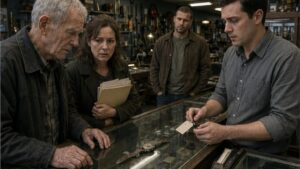
“According to this,” Catherine Hall said, turning the monitor toward Samuel, “you never flew that aircraft after 1989.”
The archive room was cold enough to make his injured leg stiffen.
Samuel leaned toward the screen. A digitized sortie table filled one side, with scanned maintenance cards arranged beside it. Aircraft 62–17 appeared on eleven entries during its final operational month. Samuel’s name appeared on none.
Ryan stood behind his chair. Nicholas remained near the door, checking his watch often enough to make every movement feel counted.
Catherine folded her hands.
She had silver hair cut close around her ears and the steady gaze of someone who had spent decades separating memory from evidence.
“Your service record places you with the detachment,” she said. “The squadron photograph confirms that. But the aircraft history shows another crew on its final mission.”
“I didn’t say I flew the final mission.”
“You said you knew what was secured in the panel.”
“I do.”
“And that knowledge came from a different flight?”
Samuel looked at the sortie list.
The flight was not there.
Its absence should not have surprised him. The rescue had begun as a weather diversion, become an unauthorized extraction, and ended with three separate commands trying to decide which part of it they could afford to acknowledge. Paperwork had been rewritten before the mud dried on the landing gear.
He had helped them do it.
Ryan moved closer to the screen. “What date are we looking for?”
Samuel’s eyes went to the faded numbers on his forearm.
“June second.”
Catherine typed the date.
“No sortie listed.”
“The year was ’89.”
“I know.”
“Check fuel reconciliation.”
She glanced at him. “This archive is indexed by mission records.”
“Fuel had to go somewhere.”
Catherine entered another search.
A scanned ledger appeared, handwritten totals reduced to gray smudges. She enlarged the page. The official entries balanced. Aircraft 62–17 had received fuel in the morning and returned below reserve after an engine test.
Samuel almost laughed.
“Engine test,” he said.
“That is what the ledger says.”
“It was airborne three hours and forty-two minutes.”
Nicholas looked up from his watch. “Can you prove that?”
Samuel pointed at the lower margin. “Enlarge the handwritten correction.”
Catherine zoomed in.
Beside the typed fuel total, someone had written a smaller figure and crossed it out. The mark was faint, nearly lost beneath a later stamp.
“That says seven-four-zero,” Ryan said.
“No,” Samuel replied. “Seven-four-six.”
“The last digit could be either.”
“It’s a six. David wrote sixes open at the top.”
Catherine studied him. “David Ramirez?”
Samuel nodded.
She enlarged the image until the ink separated into pixels.
The corrected quantity exceeded what an engine test would have consumed.
Ryan leaned one hand on the desk. “That fuel load supports a full sortie.”
“It supports a long one,” Catherine said. “It does not prove who flew it.”
Samuel sat back.
There it was again: the clean resistance of evidence. He could not resent Catherine for requiring it. Too many stories hardened into fact because someone in a flight suit remembered them loudly enough.
Still, every minute spent proving the aircraft had flown was a minute closer to the tow.
Catherine opened the maintenance scans from the following day. “What happened after the flight?”
“The hoist was damaged. Port stabilizer took debris. The locator compartment flooded.”
Nicholas stepped forward. “There is no structural repair listed.”
“It wasn’t structural.”
“Then what debris?”
Samuel’s answer caught behind his teeth.
Roofing sheet. Tree limbs. Part of a flooded church sign. A man’s boot without the man inside it.
He chose the smallest truth.
“Storm debris.”
Catherine’s eyes remained on him. She heard the omission even if she could not name it.
Ryan said, “Was this a rescue mission?”
Samuel looked at the old fuel ledger. “It became one.”
“Who authorized it?”
“No one who wanted their name attached afterward.”
Nicholas exhaled through his nose. “That is not useful.”
“It’s accurate.”
“My team cannot stop a legal aircraft transfer because an undocumented sortie may have occurred thirty-six years ago.”
Ryan turned. “The painted pin and possible battery are present concerns.”
“And I authorized a records review.” Nicholas checked the time. “Which has produced no proof of a battery and no proof Mr. Carter flew this airframe.”
Samuel’s hand tightened on the edge of the desk.
Ryan noticed. “Give us more time.”
“I already did.”
Nicholas’s radio sounded.
He answered, listened, and stepped into the hallway. His voice dropped, but the door remained open.
“Yes, proceed with sealing preparations… No tow until eleven forty-five… Correct.”
Samuel looked at the clock mounted above the archive shelves.
Forty-five minutes.
When Nicholas returned, Ryan said, “You’re sealing the panel before we inspect it?”
“I’m preserving transfer condition. If your review finds a legitimate discrepancy, we reopen it under maintenance control.”
“And if the seal damages the old latch?”
Nicholas’s expression hardened. “Then Mr. Carter should provide something more than recollection.”
Samuel heard the fairness inside the cruelty. That was what made it difficult. Nicholas was not wrong to demand evidence. He was wrong only in believing a deadline made incomplete evidence disposable.
Catherine returned to the scans.
“Who else was on the flight?” she asked.
Samuel watched the cursor blink in the search field.
“Four crew.”
“Names?”
He gave two, then stopped before David’s.
Catherine waited.
Ryan said softly, “Mr. Carter.”
Samuel turned toward him.
The salute from the overhang had not vanished from Ryan’s manner, but it had changed. The young officer was no longer looking for a legend. He was asking for help.
Samuel found that harder to resist.
“David Ramirez,” he said.
Catherine searched the name.
Maintenance rosters appeared first. Then commendation references. Then a personnel casualty entry with most of the attached mission report unavailable.
Ryan read the date.
“June second, 1989.”
The room became very still.
Catherine opened the casualty index. “His recorded duty location was not aircraft 62–17.”
“It was.”
“The report assigns him to ground recovery support.”
“He was aboard.”
Nicholas looked from the screen to Samuel. “Then either the report is wrong or you are.”
Samuel met his eyes. “The report is incomplete.”
“Convenient.”
Ryan turned sharply. “Chief.”
Nicholas’s face changed, not with regret, but restraint. “I’m stating the problem.”
“You’re stating it like an accusation.”
“It becomes one if we stop a transfer based on testimony contradicted by official records.”
Samuel rose too quickly.
Pain cut through his leg, but he remained standing.
“I signed those records,” he said.
No one spoke.
Samuel looked at the casualty entry. David’s life had been reduced to a wrong duty location and a closed attachment.
“I signed the version they gave the family,” he continued. “I signed the fuel explanation. I signed the maintenance delay. If you want to know why the truth is missing, start with me.”
Ryan’s expression shifted.
Nicholas stopped watching the clock.
Catherine did not offer comfort. She turned back to the archive and opened a set of unindexed maintenance images.
“That means you helped create the contradiction now working against you,” she said.
“Yes.”
“Why?”
Samuel’s gaze dropped to the faded tattoo on his forearm.
“Because we brought people home,” he said. “And because we didn’t bring everyone home.”
Catherine searched David’s personnel number rather than his name.
A folder appeared with no descriptive title. Inside were three scanned maintenance slips, one equipment receipt, and a blurred photograph of 62–17’s port side.
The access panel stood open.
Catherine enlarged the image. David Ramirez crouched beneath the broken-wing insignia, one arm inside the compartment. Beside him, younger Samuel stood with his face turned away from the camera.
Ryan bent toward the screen.
At the bottom of the folder lay a handwritten notation.
Catherine opened it.
The paper had been folded before scanning. Half the sentence vanished into a crease, but the signature remained clear.
D. RAMIREZ.
Above it, in cramped block letters, were five readable words:
PERSONAL ITEM SECURED—CAPTAIN KNOWS.
Nicholas’s radio crackled again.
The tow crew was requesting permission to apply the transfer seal.
Catherine looked at Samuel.
“What did David secure
Chapter 4: The Daughter Who Refused His Apology
Amy Ramirez entered the visitor room carrying a photograph and thirty-six years of questions.
She did not greet Samuel.
She placed the photograph face down on the table between them and remained standing.
“You had thirty-six years to tell me why my father never came home.”
The room overlooked the flight line through a wide pane of reinforced glass. Beyond it, aircraft 62–17 sat attached to the tow tractor, its worn fuselage washed pale by the late-morning sun. A maintenance crew worked around it in clipped movements. No one outside looked toward the room.
Samuel had imagined this meeting many times. In none of those versions had Amy looked so much like David.
Not in the face. Her features were sharper, her hair dark with silver near the temples. It was the stillness. David had gone quiet when he was angry, as if every word had to pass inspection before he released it.
Samuel rose from his chair.
His leg protested, but he stayed upright.
“Amy.”
“Don’t say my name like you’ve been using it all these years.”
Ryan stood near the door. Catherine remained by the window with a folder against her chest. Nicholas had not come inside. He had given them fifteen minutes and made it clear that the aircraft schedule continued whether the conversation succeeded or failed.
Samuel looked at the overturned photograph.
“I asked them to contact you because there may be something of your father’s inside that aircraft.”
“There may be?”
“There is.”
“Then why didn’t you bring it to me?”
“I couldn’t open the compartment after the aircraft was placed in storage.”
Amy’s expression did not change.
“You knew where it was.”
“Yes.”
“You knew it belonged to him.”
“Yes.”
“And you waited until somebody was about to cut the airplane apart.”
Samuel felt Ryan watching him. The younger pilot had treated the old maintenance notation as a breakthrough. Amy treated it as an indictment.
She pulled out the chair but did not sit.
“My mother waited for someone to explain what happened,” she said. “Every man who came to the house used the same words. Weather. Duty. Loss. Service. Nobody said what my father was doing when he died.”
Samuel kept his hands at his sides.
“The report was incomplete.”
“You signed it.”
“Yes.”
“That is a very clean answer.”
“It is the true one.”
“It is the smallest true one.”
The accuracy of it left him with nothing to say.
Amy turned the photograph over.
David crouched beside the open access panel of 62–17, his sleeves rolled up and grease dark along one forearm. He was looking toward the camera with a crooked half smile. Behind him, a younger Samuel stood near the landing gear, turned partly away.
The worn latch beneath the rescue insignia was visible above David’s shoulder.
Amy tapped the photograph.
“This was in my mother’s things. No date. No note. She thought it was taken before his last deployment.”
“It was taken the morning after the rescue.”
“So you admit there was a rescue.”
“Yes.”
“Who were you rescuing?”
Samuel glanced toward Catherine.
Amy caught the movement.
“Don’t look at her. She didn’t sign the letter that came to our house.”
Catherine’s face remained composed, but she took one step farther back.
Samuel sat carefully. The stiffness in his leg had become a hard knot beneath the knee.
“There were civilians trapped by flooding,” he said. “And one injured service member at a landing zone that was no longer usable.”
“How many civilians?”
“Seven.”
“And you got them out?”
“Six.”
Amy’s eyes narrowed. “Who was the seventh?”
“A child who had already been moved before we arrived. We didn’t know that until later.”
She absorbed the answer without softening.
“And my father?”
Samuel’s gaze dropped to the photograph.
“He kept the hoist running.”
“That is not how he died.”
“No.”
“Then say the part you keep stepping around.”
A radio transmission crackled faintly through the hallway. Someone outside requested a seal kit for the port rescue panel.
Ryan checked his watch.
Amy heard it too.
“They’re moving the aircraft?”
“At eleven forty-five unless we give them a reason not to,” Ryan said.
Amy looked at him for the first time. “And you believe him?”
Ryan did not rush the answer.
“I believe he knows the aircraft. I believe the records were changed. I don’t yet know why.”
“Neither do I.”
Samuel reached for the photograph, then stopped before touching it.
“There is a manual release key,” he said. “Flat steel. Two inches long. Notched at one end.”
Amy’s face changed.
The shift was slight, but Samuel saw it.
“What about it?”
“David carried one on his key ring.”
Amy opened her handbag.
From a small inner pocket, she removed a narrow brass-colored key worn nearly smooth. It had no label, only a shallow notch near the tip.
Samuel forgot the room.
David had tied the key to a red cord because he lost everything that fit in a pocket. After the funeral, Samuel had removed the cord and mailed the key without explanation. He had told himself Amy would understand someday. He had known even then that she could not.
Amy laid it on the table.
“You sent this to me three weeks after the funeral. No note. No return address. It opened nothing in our house.”
Samuel reached toward it.
Amy covered the key with her palm.
“Is this what opens the panel?”
“Yes.”
The answer changed the air in the room.
Ryan moved closer to the table. Catherine opened the folder and placed the maintenance photograph beside Amy’s. The shape of the latch matched the key’s notched end.
For the first time that morning, the hidden compartment was not merely a claim. It could be reached.
Amy kept her hand over the key.
“What is inside?”
“A crew nameplate.”
“And?”
Samuel did not answer.
Her fingers tightened.
“And?”
“A recording.”
“For whom?”
“For you.”
Amy sat down at last, though not from relief.
“My father recorded something for me, and you left it inside an airplane for thirty-six years?”
“I did not know whether it survived.”
“That isn’t what I asked.”
Samuel felt the old defense rise inside him: the aircraft was locked in storage, ownership changed, access vanished, records disappeared. Each fact was true. Together they formed a shelter he had occupied too long.
“I was afraid to bring it to you,” he said.
Amy laughed once, without humor.
“Afraid of what? That I would ask questions?”
“Yes.”
“And now you want me to let you open the panel so you can feel better before they haul the plane away.”
“No.”
“That is what this is.”
“It belongs to you.”
“It belonged to me thirty-six years ago.”
Ryan turned slightly toward the window as the tow tractor’s warning light began flashing.
Catherine said, “Amy, without your consent, the recording can be secured as potential personal property, but—”
“No.” Amy did not look away from Samuel. “Nobody opens anything until he tells me why my father was left aboard.”
Samuel’s mouth went dry.
“He wasn’t left.”
“Then what happened?”
The old mission returned in fragments: rain hammering the windshield, the hoist cable shivering under load, David on the intercom saying the gearbox would hold if somebody stayed with it, the warning light turning amber.
Samuel had spent decades arranging those fragments so they never formed a complete sentence.
Amy slid the key toward the center of the table but did not release it.
“What order did you give?”
Outside, a maintenance worker approached the aircraft with a red transfer seal.
Samuel looked at David’s photograph.
“I ordered your father to stay aboard,” he said, “when I should have turned us home.”
Chapter 5: The Rescue Mission Missing From the Log
“The tow tractor is connected and standing by,” the flight-line dispatcher announced over the maintenance radio. “Transfer crew requests final release.”
Catherine Hall checked the wall clock.
Thirty-two minutes remained.
She had spent forty years watching urgent people damage records by deciding too quickly what those records meant. Now urgency sat in every chair of the archive room.
Ryan stood at one terminal, comparing retrofit orders against aircraft serial numbers. Nicholas occupied the end of the table with a blank safety declaration in front of him. Samuel and Amy sat opposite each other, separated by the manual-release key.
No one had touched it since the visitor room.
Catherine opened the scanned equipment ledger again.
“Start with the flight,” she said. “Not the guilt. Route, load, weather, damage.”
Samuel’s face tightened at her tone.
She did not apologize. Feelings mattered, but the tow crew would not stop for feelings.
“We launched for a medical transfer,” he said. “Storm front moved faster than forecast. While returning, we received a broken call from a flooded civil defense site.”
“Official tasking?”
“No.”
“Coordinates?”
Samuel gave them.
Ryan entered the numbers into an old mapping archive. A river valley appeared, then a historical weather layer. Most of the landing zone lay beneath a blue flood overlay.
“There was no room to set down,” Samuel continued. “We used the hoist from a hover. First lift brought up two civilians. Second brought three. On the third, debris struck the stabilizer and damaged the hoist fairing.”
“David was operating the hoist?” Amy asked.
“He was keeping it operating.”
Catherine glanced at her, then back to Samuel. “What failed?”
“Cable guide bent. Gearbox started walking in the mount.”
Ryan looked up. “That should have triggered an immediate abort.”
“It did.”
The room went quiet.
Nicholas tapped the blank declaration with one finger. “Who called it?”
“I did,” Samuel said.
“And you left?”
“No.”
Amy’s eyes remained on him.
Catherine wrote the sequence by hand. “Why not?”
Samuel watched the pen move.
“There was one injured service member still below. Broken pelvis. Water rising around the platform.”
“That was the person named in the casualty report?” Catherine asked.
“No. The report placed him on a ground convoy.”
“Another false location.”
“Yes.”
Nicholas leaned back. “So command concealed an unauthorized flight, changed the location of an injured service member, and reassigned Ramirez to ground duty?”
Samuel’s gaze hardened. “No one sat in a room and designed a grand lie. Each office corrected the piece that threatened its own people. By the time the file closed, none of the pieces touched.”
Catherine looked at him more carefully.
That was how institutional memory usually failed—not through conspiracy, but through many frightened hands smoothing different corners.
Ryan turned his monitor.
“I found the rescue-panel diagram.”
The drawing showed an obsolete locator compartment behind the access latch. A cylindrical emergency beacon battery occupied the rear bracket.
Ryan enlarged the removal-history table.
“Retrofit directive says all nickel-cadmium units were to be removed by 1993.”
Nicholas pointed at the status column. “62–17 is marked complete.”
“By fleet batch,” Ryan said. “There’s no airframe-specific removal entry.”
“Because the batch certification covered it.”
“Unless the panel was inaccessible.”
Samuel looked at the diagram. “It was.”
Nicholas’s eyes narrowed. “Why?”
“The latch tongue jumped the track after the storm. We closed it from inside using the pressure arm.”
“That would make external removal difficult,” Catherine said.
“Not difficult,” Samuel replied. “Impossible unless you release the pressure first.”
Ryan scrolled through the maintenance notes. “No later entry shows the compartment opened.”
Nicholas stared at the screen.
The old battery was no longer only Samuel’s memory. It had become an undocumented possibility inside an aircraft about to enter civilian transport.
“Corrosion risk?” Nicholas asked.
“High if moisture reached it,” Ryan said. “Potential leakage. Maybe thermal damage if disturbed.”
Samuel added, “The locator casing cracked during the impact.”
Nicholas turned on him. “You knew that and waited until today?”
“I knew it was cracked in 1989. I did not know the battery was never removed.”
“You suspected it.”
“Yes.”
“And you entered a restricted area instead of calling maintenance control.”
“I called three times last month.”
Nicholas stopped.
Catherine looked up. “What happened?”
“Visitor office transferred me to the museum liaison. The liaison said the aircraft was already cleared. Maintenance control would not discuss an airframe with someone outside the transfer team.”
Nicholas’s expression shifted, but not enough to become an apology.
“What name did you give?”
“My own.”
“That may have been the problem. There is no current association between you and the aircraft.”
Samuel’s mouth flattened. “That is why I came.”
Nicholas lifted the safety declaration.
“This gives us a basis to delay, but only if Mr. Carter signs that he has direct knowledge of a potentially hazardous battery remaining aboard.”
Ryan said, “He does.”
“I need his signature, not yours.”
Nicholas placed the form in front of Samuel.
The document was plain: identity, basis of knowledge, estimated hazard, date last observed, and certification that the information was complete to the signer’s knowledge.
Samuel read it twice.
At the bottom, beneath the signature line, another sentence required disclosure of circumstances surrounding the unrecorded equipment condition.
His hand remained beside the paper.
Amy watched him.
“What are you leaving out?” Nicholas asked.
Samuel looked toward the key.
“The battery is not the only reason the panel stayed closed.”
“We know about the personal item.”
“No,” Amy said. “We know what he says is there.”
Catherine heard the distinction.
Ryan leaned on the table. “Mr. Carter, sign the safety section. We can document the personal property separately.”
Samuel shook his head.
Nicholas’s patience frayed. “You came here to stop the aircraft. This stops it.”
“Temporarily.”
“That is what you asked for.”
“It also makes the battery sound like the reason I came.”
“Isn’t it?”
Samuel looked at Amy.
The answer was no, and everyone knew it.
Nicholas pulled the form back an inch. “If this is a device to gain access to a personal object, say so now.”
“The battery may still be dangerous.”
“Then sign.”
Samuel’s fingers closed over the pen.
A younger version of himself would have signed without hesitation. Hazard identified. Action required. Personal matters later.
But later had become thirty-six years.
Amy’s father had been converted into a maintenance notation, a wrong duty location, and a voice trapped behind a corroded latch. Samuel had helped make that possible by choosing the operational truth over the whole one each time someone gave him a form.
He set the pen down.
Ryan stared at him. “What are you doing?”
“I will sign after Amy hears the mission.”
Nicholas stood.
“The tow window closes in twenty-four minutes.”
“Then she will hear it in less than twenty-four.”
“You are tying a safety declaration to a private confession.”
“No. I am refusing to use the battery as another excuse to avoid the rest.”
Amy’s expression changed, though anger remained in it.
Nicholas gathered the form.
“I cannot hold the aircraft because you have chosen this morning to repair your conscience.”
Ryan stepped between him and the door. “You have evidence of a possible battery.”
“I have an unsigned allegation from a man whose records contradict him.”
“You have a diagram, a missing removal entry, and a sealed panel.”
“And a contract, a release order, and a prior fleet certification.”
Catherine closed the archive folder.
“Both of you are right enough to cause damage.”
Nicholas looked at her.
She continued, “The hazard is credible but unconfirmed. The history is incomplete but not invented. Give him ten minutes.”
Nicholas’s radio crackled.
“Chief, transfer supervisor requests movement authorization. Escort team is in position.”
His eyes closed for half a second.
When he opened them, he looked less like an obstacle and more like a man standing beneath weight no one else could see.
“I had a documentation failure six months ago,” he said. “One missing inspection signature. No injury, no damaged aircraft. Still under review. If I delay this transfer without a signed basis, I own the cost and the compliance failure.”
Samuel said, “And if the battery is there?”
“Then I own that too.”
The admission settled between them.
Nicholas keyed his radio. “Hold release for ten minutes. At the end of ten, begin movement unless I transmit a maintenance stop.”
He placed the declaration back before Samuel.
“After that, I cannot protect the option.”
Samuel looked at Amy.
She picked up the manual-release key and closed her fist around it.
“Tell me,” she said.
Samuel did not reach for the pen.
“Not here.”
The flight-line radio announced that the tow crew had begun its final brake check.
Samuel rose.
“I will sign after she hears everything directly from me.”
Chapter 6: What David Chose Inside the Storm
“Your father disobeyed my first order,” Samuel said, “and I disobeyed my own second one.”
The briefing room had no windows except a narrow pane facing the runway. Through it, the tail of 62–17 stood above the maintenance trucks.
Amy sat across from Samuel with the manual-release key on the table between them. Ryan remained near the radio. Catherine stood beside the door with the unsigned declaration. Nicholas had returned to the flight line, leaving them exactly ten minutes.
Samuel did not know how to fit thirty-six years into that space.
He began with the sound.
“The hoist gearbox was striking the mount. Once every rotation. A hard knock through the cabin floor.”
Amy said nothing.
“We had six people aboard who had not been there when we launched. Two were children. One man had swallowed enough floodwater that he could barely breathe. The injured service member was still below.”
“You called an abort.”
“Yes.”
“What did my father do?”
“He told me the gearbox would hold for one more lift if he stayed beside it and kept pressure on the housing.”
“By hand?”
“With a pry bar.”
Ryan shifted against the wall.
Samuel could see the question on his face: why had anyone allowed it?
“We were in a hover,” Samuel continued. “Wind from the left. No stable reference except a church steeple and the rescue light below us. I ordered David away from the hoist and told the crew we were leaving.”
“Did he obey?”
“No.”
“What did he say?”
Samuel looked at the key.
“He said, ‘You can court-martial me after we get him out.’”
For the first time, Amy’s expression almost moved toward recognition rather than anger. The line sounded like David because it was David: humor used not to lighten danger but to deny it authority.
Samuel continued.
“I repeated the order. David unplugged his intercom lead.”
Amy looked down.
“He made it impossible for you to command him?”
“He made it impossible for me to hear him argue.”
“What was your second order?”
Samuel’s throat tightened.
“I ordered an abort again. I turned the aircraft away from the platform.”
“Then how did he die aboard?”
“Because I turned back.”
The radio on Ryan’s belt crackled.
“Five minutes to scheduled movement.”
Ryan lowered the volume but did not silence it.
Samuel placed both hands on the table. His right hand trembled now, not from age alone.
“The injured man slipped from the platform when the water struck it. His safety line caught on the rail. He was hanging half in the current. David reconnected his intercom and said the cable was still good.”
“You believed him?”
“I wanted to.”
“That is not the same thing.”
“No.”
Amy’s gaze held him.
“I reversed the abort,” Samuel said. “I brought us back over the platform. I gave the order to lower the hook.”
“And my father stayed with the gearbox.”
“Yes.”
“Did you order him to?”
The answer had lived inside Samuel as a single hard fact.
“Yes.”
Amy inhaled slowly.
Samuel forced himself not to look away.
“I told him to hold the mount until the injured man cleared the platform. The gearbox tore free during the lift. The housing struck him.”
No one moved.
The runway beyond the narrow window shimmered under heat.
“Was he alive when you landed?” Amy asked.
“Yes.”
“For how long?”
“Eleven minutes.”
“What did he say?”
Samuel’s control broke at the edge, not into tears, but into a voice suddenly roughened.
“He asked whether we got the man.”
Amy closed her eyes.
“I told him yes.”
“And then?”
“He told me there was something in the locator compartment. He said it was for you. He made me promise I would bring it.”
“But you didn’t.”
“No.”
The answer landed harder now because Samuel had stripped away every excuse before it.
Amy opened her handbag and removed a folded sheet of paper. Its creases had softened with years of handling.
“My father wrote this six months before he died.”
She unfolded it.
“He was deployed when I turned thirteen. He missed my birthday and sent a letter instead.”
Samuel knew of the letter. He had never seen it.
Amy read from the middle.
“‘Carter thinks responsibility means he owns every bad thing that happens near him. One day somebody ought to tell him the rest of us make choices too.’”
Samuel stared at her.
David’s voice came through the sentence without sound.
Amy folded the letter once.
“You have spent thirty-six years telling yourself you killed a man who argued with you, unplugged his headset, refused an abort, and stayed beside a broken machine.”
“I gave the order that kept us there.”
“Yes.”
“I was aircraft commander.”
“Yes.”
“I could have left.”
“And my father could have stepped away from the hoist.”
Samuel’s jaw tightened. “He was under my command.”
“He was also a grown man.”
“That does not remove my responsibility.”
“I am not trying to remove it.”
Her voice sharpened.
“I am trying to stop you from taking his.”
The words struck deeper than accusation.
Amy leaned forward.
“You made a decision. He made one. Then you survived, and you decided survival made every choice yours.”
Samuel looked at the tattoo on his forearm.
The broken wing and the numbers had once marked four men. Over the years, he had allowed the ink to become a private sentence against himself.
Catherine placed the safety declaration beside his hand.
Outside, the tow tractor sounded its warning alarm.
Ryan touched his radio.
“Chief Green, status?”
Nicholas answered through static. “No signed declaration received. Transfer supervisor is initiating movement in two minutes.”
Ryan looked at Samuel. “We need the form.”
Samuel picked up the pen.
Amy placed the manual-release key beside his tattooed forearm.
The small metal object caught the fluorescent light.
“I am still angry,” she said. “I do not forgive thirty-six years because you finally ran out of time.”
“I know.”
“No, you don’t. But you can learn.”
Samuel looked at the key.
“What do you want me to do?”
“Finish what both of you left unfinished.”
He signed his name.
Catherine took the form, checked the statement, and handed it to Ryan.
Ryan read the hazard declaration aloud enough for the radio microphone to capture it: direct observation of a damaged locator casing, no verified removal entry, possible sealed nickel-cadmium battery, moisture exposure, pressure-loaded latch.
He transmitted the details.
Static answered.
Then Nicholas’s voice came through.
“Declaration received. Stand by.”
Everyone turned toward the narrow window.
For a moment, nothing happened.
Then the tow tractor began to move.
The tow bar tightened. Aircraft 62–17 rolled forward, slow and heavy, its tires crossing the first painted line.
Ryan seized the radio.
“Chief, the aircraft is moving.”
“I see it.”
“Order the stop.”
A pause followed.
The old rescue insignia slid past the edge of the window. Beneath it, the worn access latch moved toward the transfer gate with David’s voice still sealed behind it.
Samuel pushed away from the table.
His leg nearly failed, but Amy caught his forearm.
This time he did not tell her to let go.
Chapter 7: The Panel Beneath the Broken Wing
Ryan stepped into the transfer lane and raised both arms.
“Emergency maintenance stop!”
The tow tractor driver braked hard enough to make the tow bar shudder. Aircraft 62–17 rolled another three feet before its tires settled against the painted line.
A horn sounded from the escort vehicle behind it.
The civilian transfer supervisor climbed down from the passenger side, already shouting about authorization, but Ryan kept his eyes on the aircraft. The lower rescue panel had stopped less than twenty yards from the gate.
Nicholas came around the nose gear with his radio in one hand and Samuel’s signed declaration in the other.
“Set the brakes,” he ordered. “Chock all wheels. Establish a maintenance boundary.”
The words changed the scene.
The same airmen who had tried to move Samuel beneath the overhang now moved around the aircraft with deliberate care. Chocks struck concrete. Red cones appeared along the transfer lane. The tow tractor shut down, leaving a sudden hollow quiet beneath the distant turbine noise.
The transfer supervisor approached Nicholas.
“You had clearance.”
“I have a documented battery discrepancy.”
“Your inspection was closed yesterday.”
“It is open now.”
“This delay goes on your unit.”
Nicholas looked at the aircraft, then at the signed declaration.
“Yes,” he said. “It does.”
Ryan heard no heroism in the answer. Only acceptance.
Amy and Catherine came through the maintenance gate with Samuel between them. Amy still held his forearm, though she released it once they reached level pavement. Samuel did not object or thank her. He looked only at the panel beneath the broken-wing insignia.
The old latch seemed smaller from this distance.
A maintenance worker knelt beside it with insulated gloves and a tool tray.
Nicholas stopped Samuel several feet away.
“You may advise,” he said. “My crew performs the work.”
“That is how it should be.”
Nicholas handed the declaration to a clerk and crouched beside the worker.
“The manual release key?”
Amy opened her hand.
The narrow metal key lay across her palm, worn bright along one edge. She hesitated before giving it to Ryan.
“My father carried this?”
Samuel nodded. “On a red cord.”
She placed the key in Ryan’s hand.
He carried it to the worker and watched him insert the notched end into the release slot. The key seated with a soft metallic click.
The worker turned it.
Nothing happened.
He applied more pressure.
“Stop,” Samuel said.
Every head turned.
“The latch is loaded.”
The worker looked at Nicholas. “Technical order says rotate counterclockwise until release.”
“The current order assumes the pressure arm was reset from outside,” Samuel said. “This one was closed from inside.”
Nicholas rose. “What is the sequence?”
Samuel stepped closer to the maintenance boundary but did not cross it.
“Push the panel inward at the lower aft corner. Not the center. Hold pressure, turn the key halfway, then pull the emergency vent ring under the insignia.”
The worker ran a gloved hand beneath the painted broken wing.
“There’s no ring.”
“It’s recessed. Two finger widths behind the lower feather.”
Ryan crouched beside him and found a shallow indentation under layers of paint.
Samuel pointed. “Scrape only the edge. If the battery leaked, you do not want metal dust inside.”
Nicholas repeated the instruction to the worker.
The paint came away in thin flakes. Beneath it appeared a small corroded ring.
Samuel’s breathing changed.
Ryan could not tell whether the old man was seeing the panel before him or another version beneath storm-dark skies.
The worker pressed the lower corner. Another maintainer inserted the key and turned it halfway. Nicholas hooked an insulated tool through the ring.
“On three,” Samuel said. “One. Two. Three.”
Nicholas pulled.
Air escaped from the panel with a dry hiss.
The latch shifted.
The maintenance worker turned the key the rest of the way, and the panel opened less than an inch before stopping against corrosion.
A sharp chemical odor reached them.
Nicholas’s face hardened. “Back everyone up.”
The crew withdrew. A hazardous-material kit was brought forward. The transfer supervisor stopped arguing.
Inside the compartment, the old cylindrical battery had split along one seam. White-green residue covered the mounting bracket. Moisture had darkened the insulation around it.
Nicholas stared at the damage.
“If that had shifted during transport—”
“It might have done nothing,” Samuel said. “Or it might have heated against the frame.”
Nicholas looked at him. “You prevented a hazardous transfer.”
Samuel’s eyes remained on the open panel.
“I delayed reporting one for thirty-six years.”
The battery was photographed, isolated, and lifted into a containment vessel. Behind it lay a maintenance cloth hardened by age.
Ryan saw Samuel’s hand close at his side.
The worker reached toward the cloth.
“Wait,” Nicholas said.
He turned to Amy. “The declaration identifies possible personal property. You should witness removal.”
Amy stepped to the boundary.
The worker lifted the bundle and placed it on a clean tray. The cloth separated at one corner, revealing a bent metal plate with four engraved names. The surface was blackened, one edge curled inward from impact.
Samuel recognized it before the dirt was brushed away.
The crew nameplate from the hoist station.
David had pried it loose after the rescue, while the aircraft still smelled of floodwater and burned wiring. Four names had been stamped into it.
Samuel Carter.
David Ramirez.
Two others who had survived long enough to carry the memory in different directions.
Nicholas put on clean gloves. He lifted the plate from the tray and approached Samuel.
For a second, Ryan remembered the junior airman’s hand gripping the old man’s arm that morning. The contrast seemed to exist in Nicholas’s movements too. He held the damaged plate with both hands.
“Mr. Carter.”
Samuel looked down at it.
His fingers rose but stopped before contact.
Nicholas waited.
Samuel finally accepted the plate. The metal trembled between his hands.
No one saluted. No one spoke.
Samuel traced David’s name once with his thumb, then turned toward Amy.
“This was never mine alone.”
He placed the nameplate in her hands.
Amy’s face tightened as its weight settled into her palms. She held it against her body, not like a relic, but like something breakable that had already survived too much.
The worker returned to the compartment.
“There’s another item.”
Behind the battery bracket, sealed inside two brittle plastic sleeves, lay a microcassette. A strip of yellowed tape crossed its casing.
One word had been written on it.
AMY.
Catherine took the cassette carefully. A crack ran from one corner through the clear plastic.
“Can it be played?” Amy asked.
“Possibly,” Catherine said. “The archive has equipment, but the casing may need stabilization.”
“How long?”
“I don’t know.”
The uncertainty struck harder than the discovery. They had opened the panel, stopped the aircraft, found the object—and still David’s voice remained beyond reach.
Nicholas ordered the panel and compartment photographed before any further handling. The crew completed the hazard log. He signed the maintenance stop and then the amended transfer record, each stroke slow and exact.
The transfer supervisor asked whether the aircraft would still leave.
“Yes,” Nicholas said. “After the compartment is cleared and documented.”
Samuel looked at 62–17.
He had imagined that opening the panel might compel the world to preserve the aircraft. Instead, the tow bar remained attached. The contractor waited. The gate still stood open.
The machine would go.
He found that he could bear it.
Catherine carried the cassette toward the archive. Amy walked beside her with the nameplate. Ryan remained with Samuel near the open panel.
“You were right,” Ryan said.
“Not about everything.”
“No.”
Ryan did not try to soften it.
Nicholas approached, removed his gloves, and faced Samuel.
“I moved too quickly.”
Samuel studied him.
“You had reasons.”
“I also had a choice.”
The admission was enough. More than an apology would have been, perhaps, because Nicholas did not ask to be released from it.
From the archive building, Catherine appeared in the doorway and raised one hand.
They crossed the lane as a group.
Inside, an old cassette deck had been brought from climate storage. The cracked shell had been secured with archival tape, and the reels turned unevenly beneath the clear cover.
Catherine lowered the cassette into the machine.
Amy stood close enough to touch the stop button.
Samuel remained behind her.
Catherine pressed play.
Static filled the room.
The tape dragged, clicked, and nearly stopped.
Then a man laughed.
Amy covered her mouth.
David’s voice emerged through thirty-six years of distortion.
“Amy, if Carter ever brings you this, he waited too long.”
Chapter 8: Respect Became the Way They Listened
David’s recorded laughter broke the solemn room before his final message had properly begun.
It was not the dignified sound Samuel had preserved in memory. It was rough, breathless, and interrupted by a cough.
“Probably told himself he was waiting for the right time,” David’s voice continued through the damaged speaker. “Carter likes the right time. Trouble is, it rarely reports for duty.”
Amy gave a small sound that might have been a laugh or a sob.
Samuel closed his eyes.
He had remembered David’s last minutes for so long that he had nearly erased the man who existed before them—the mechanic who balanced tools on his face, who cheated at cards badly, who called every malfunction a personality dispute.
The tape wavered.
“If you’re hearing this, kiddo, something went wrong enough that I couldn’t hand it to you myself. I’m sorry for that.”
Amy reached toward the machine, then pulled her hand back.
David spoke about ordinary things first. A missed birthday. A bicycle chain he had promised to fix. The way Amy’s mother pretended not to like country music while knowing every word. Each detail widened the room around his death.
Then his voice grew quieter.
“We went back for somebody today. That was my choice. Carter called us out. I argued. He came back because I said the gear would hold.”
Samuel opened his eyes.
Amy was staring at the spinning reels.
“It didn’t hold,” David said. “That part is on the machine, on the storm, on me, and on a lot of decisions made by people trying to do one decent thing in a bad place.”
The recording clicked.
For two seconds, there was only hiss.
Then David said, “Do not let Carter turn one shared decision into a lifelong sentence. He will try.”
Amy reached forward and pressed pause.
The sudden silence struck the room.
Catherine stepped away from the equipment. Ryan and Nicholas waited near the archive door. Neither looked impatient. Outside, the transfer crew had resumed its preparations, but no one inside moved to hurry the recording.
Amy turned toward Samuel.
“You heard him say it.”
Samuel’s hands rested on the back of a chair.
“Yes.”
“And you are still going to tell yourself the order was yours.”
“It was.”
She shook her head.
“You keep answering a different question.”
He looked at her.
“The order was yours,” she said. “The choice to stay was his. The choice to go back was yours. The choice to help was both of yours. You want one sentence that assigns everything cleanly, and there isn’t one.”
Samuel’s gaze moved to the damaged nameplate on the table.
“I should have come to you.”
“Yes.”
“I should have told your mother.”
“Yes.”
“I thought the truth would make his death harder to carry.”
Amy’s expression tightened. “You did not carry it for us. You left us without it.”
He accepted the words without defense.
“I know that now.”
“No. You know part of it now.”
She rested one hand on the cassette deck.
“Forgiveness is not in that compartment. Neither is thirty-six years. I am not walking out of here pretending one recording fixed what you chose.”
Samuel nodded.
“What happens next?” he asked.
“You answer when I call.”
“I will.”
“You tell me the whole mission again when there is no tractor waiting outside.”
“I will.”
“And you stop disappearing because the conversation becomes uncomfortable.”
He almost said that discomfort had nothing to do with it. The denial formed automatically, then died before reaching his mouth.
“I will try.”
Amy studied him.
“That is the first honest answer you’ve given me about the future.”
She pressed play.
David’s voice returned, softer now.
He told Amy that courage was usually less impressive than people made it sound. Sometimes it meant staying. Sometimes leaving. Sometimes admitting fear before fear made the decision alone.
His final words were not about the mission.
They were instructions to live well, take care of her mother, and never trust Samuel to remember a birthday without writing it on his hand.
The tape ended with another brief laugh and the mechanical snap of the recorder stopping.
No one spoke for several seconds.
Catherine removed the cassette.
“Amy, this belongs to you,” she said. “We can preserve it and make a digital copy. Nothing enters the archive without your permission.”
Amy looked at Samuel.
He had once imagined the recording becoming proof—proof of what happened, proof of David’s intent, perhaps proof that Samuel deserved less blame than he carried. Now it seemed indecent to claim any part of it.
“It is hers,” he said.
Catherine nodded.
Amy touched the cracked casing.
“You can archive a copy,” she said. “With the full mission record. Not the cleaned version.”
Samuel felt the old instinct to limit, revise, protect.
He let it pass.
“The full record,” he agreed.
Nicholas stepped forward with a new maintenance form. “I have added the undocumented battery condition, the panel history, and the recovered materials. The earlier closeout is being withdrawn.”
Catherine took the form.
“And the sortie?”
“That requires command review.”
“I’ll submit the archive evidence,” she said.
Samuel looked at Nicholas. “Do not write it as if the aircraft saved those people.”
Nicholas waited.
“The crew did,” Samuel said. “And the people below helped one another survive long enough for us to reach them.”
Nicholas made a note.
Not because Samuel had been recognized, Ryan thought, but because they were listening now.
A radio call announced that 62–17 had been cleared for transfer after the hazardous materials team completed its work.
Amy looked through the archive window.
“They’re still taking it.”
“Yes,” Samuel said.
“Does that bother you?”
He watched the aircraft beyond the glass. The panel had been closed again, its latch resting properly in the track. Amy herself had turned the manual key after the final inspection, sealing an empty compartment where secrecy had lived.
“It did,” he said. “This morning.”
“And now?”
“The aircraft carried the truth. It doesn’t have to keep carrying it.”
The answer surprised him with its simplicity.
Catherine placed an oral-history consent form beside the archive log.
“We will need your account,” she said. “Not today. When you are ready.”
Samuel looked at Amy.
“Next week,” he said.
Amy raised an eyebrow. “That sounds like the right time.”
He heard David’s joke inside the words.
“Tuesday,” Samuel amended. “Ten in the morning.”
Catherine wrote it down before he could retreat.
Outside, the tractor began pulling 62–17 toward the gate again.
The group returned to the overhang to watch it pass.
Samuel lowered himself into the same place against the concrete column where Ryan had found him that morning. His leg had stiffened completely. Across the pavement, the aircraft moved slowly between escort vehicles, the broken-wing insignia passing through bands of shadow and sunlight.
Ryan stood several feet away.
He did not offer a chair. He did not tell Samuel to move. He waited until the aircraft had crossed the gate and the noise of the tractor had diminished.
Then he approached.
“Mr. Carter.”
Samuel looked up.
Ryan did not extend his hand immediately.
“May I help you up?”
The question settled into the space where an order had been that morning.
Samuel looked toward Amy. She held David’s nameplate against her side and waited without urging him.
“Yes,” he said.
Ryan offered his arm.
Samuel took it.
His leg trembled as he rose, but the tremor no longer felt like evidence against him. Age had taken strength from certain muscles and none from the decision to stand.
Once Samuel was steady, Ryan released him.
The two junior airmen remained near the security post. One lowered his eyes, perhaps remembering his hand on Samuel’s sleeve. Samuel gave him a small nod. The young man straightened.
Ryan stepped back.
He raised his right hand in a salute.
This time Samuel was standing.
He returned it.
There was no audience beyond the few people who had spent the day learning how incomplete a gesture could be. No applause followed. No announcement crossed the radio.
Ryan lowered his hand first.
Amy moved beside Samuel and offered him the nameplate.
He shook his head.
“You keep it.”
“For now,” she said. “You can tell me about the other two names Tuesday.”
Samuel looked at the bent metal, then at the faded numbers on his forearm.
“For now,” he agreed.
They walked toward the archive building together.
Behind them, the concrete overhang stood empty. Ahead, Catherine had left the door open.
The story has ended.