They Laughed At The Old Man Behind The Yellow Line Until The Target Came Back Silent
Chapter 1: The Old Man Behind The Yellow Line
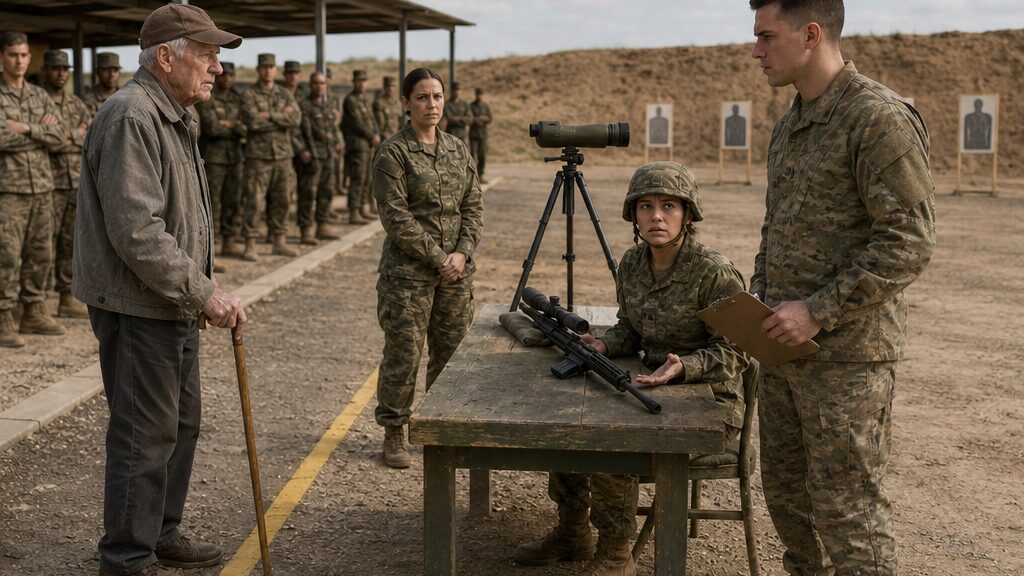
Edward Miller stopped walking before anyone told him to stop.
The cane in his right hand had touched gravel, then packed dust, then the clean painted edge of the yellow safety line stretched across the observation area. Beyond it, a young soldier sat stiff at the firing bench with her helmet low over her brow and her hands open beside a cleared rifle. A young instructor stood over her, one hand on his hip, the other already reaching for the clipboard before the target had been checked a second time.
“You pulled it,” Ryan Moore said.
The words carried down the line with more force than the shot had.
The young soldier did not move. Her name tape read Green. Her cheek was still pale from the pressure of the stock, and her mouth opened once before she shut it again. Around her, the other soldiers stood in that uncomfortable silence soldiers used when they had been ordered to witness someone else’s failure.
Edward kept his cane behind the yellow paint.
No one had noticed him yet. That was how he preferred it.
He wore a gray canvas jacket that had faded at the elbows, a brown cap with no patch, and shoes polished by habit rather than pride. He had come for the small dedication ceremony near the old range office, nothing more. A memorial plaque, a few folded chairs, some official remarks. He had planned to stand in the back, nod when expected, and leave before anyone decided to ask what years he had served or whether he remembered the names on the wall.
The rifle range had changed. The berms looked higher. The target carriers had been replaced. There were newer benches, newer optics, newer clipboards. But the wind still crossed left to right after it struck the low scrub past the third lane. The sound still came back a half-beat late from the dirt bank. And the yellow line still meant what it had always meant.
You did not cross it until the range allowed you.
Ryan bent into the spotting scope, looked for less than two seconds, and straightened. “Missed the scoring zone.”
Ashley Green swallowed. “Instructor, I held the sight picture. I called it slightly—”
“You called it wrong,” Ryan said. “That is the issue.”
Edward’s left hand tightened around the cane’s worn handle. Not enough for anyone to notice. Enough for the old groove under his thumb to find him.
At the next lane, a soldier shifted his boots. Somewhere behind Edward, a memorial volunteer whispered, then stopped. The range smelled of dust, hot metal, old oil, and paper warmed by the sun.
Ryan picked up the clipboard. “This is the third correction this week. Qualification is not a debate.”
Ashley’s eyes flicked toward the target downrange. “May I see the paper?”
“When it’s pulled.”
“You already marked it.”
Ryan looked down at her, and Edward saw the mistake before the young man made it worse. It was not the clipboard. It was not the impatience. It was the need to be seen being certain.
“Because I saw enough,” Ryan said.
That was when Edward looked past them, toward the target frame, and saw the corner of the paper flutter in a rhythm that did not match the open wind. A loose lower clip. Not fully free, not enough to tear away, just enough to give the paper a slight forward belly whenever the breeze hit the berm and curled back.
A small thing. A thing a scope could miss if the man behind it was already looking for failure.
Edward said nothing.
He had promised himself he would not be that old man. The one who came back to a place and believed every changed rule was wrong, every younger voice disrespectful, every new tool an insult to memory. He had seen old instructors do that when he was young. Men who confused experience with ownership. Men who stood too close to the line and talked too long.
So he stayed behind the paint.
A senior safety officer, Margaret Baker, moved along the range with a careful eye. She paused near Ryan but did not interrupt. Her gaze swept the benches, muzzles, open bolts, flags, hands. Good. At least someone was watching the things that mattered before pride entered them.
Ryan turned toward the observing soldiers. “This is why we do not rely on feelings. We rely on results. You can think you did everything correctly and still fail the standard.”
Ashley’s face hardened, but her eyes had gone wet. Not crying. Holding. There was a difference.
Edward had seen that face before. Young shooters wore it when they were trying to keep shame from reaching their hands.
A range assistant down near the berm waited for the all-clear to pull the paper. Ryan gestured impatiently.
“Bring it in.”
The assistant began moving toward the target frame.
Edward’s cane tapped once against the dust, a sound too small for the line but loud enough for him. He almost stepped back. He had no business here, he told himself. The Army belonged to the people wearing the uniform now. His time had ended with a cardboard box of old manuals and a handshake in a hallway.
Then Ashley spoke, quieter than before. “I followed the pause.”
Ryan turned sharply. “What pause?”
“The safety pause before reset. Breath, sight, confirm, then touch. Like the manual says.”
A few of the younger soldiers glanced at one another.
Ryan gave a short laugh without humor. “Old manual stuff does not save a bad shot.”
Edward looked at Margaret Baker. Her eyes had moved from Ashley to him.
For one second, neither of them spoke.
Ryan finally noticed the old man standing behind the yellow line. His expression tightened, the way a man’s face tightens when he sees an interruption he cannot yet classify.
“Sir,” Ryan said, with a hard politeness that made the word smaller than it should have been, “the ceremony area is behind the chairs.”
Edward lifted his cap brim a fraction. “I’m clear of your line.”
“I can see that. Please stay clear of the instruction too.”
The soldiers went still in a different way now. Not because a trainee had failed. Because someone old had been corrected in public, and no one knew whether to look away.
Edward nodded once.
Ryan seemed encouraged by the lack of resistance. “We have live-fire procedures running. Visitors sometimes think because they watched a few ranges thirty years ago, they can comment. That is how confusion starts.”
Margaret’s jaw shifted. She did not step in.
Edward let his eyes rest on the spotting scope, then the target, then the loose flutter of paper. He did not look at Ryan long enough to make it a contest.
“I won’t cross your line,” he said.
Ryan smiled faintly. “Good.”
The target paper came back on its carrier, still far enough away that only the dark marks showed. Ryan took it before Ashley could stand.
He looked once, then folded the bottom edge inward.
Edward noticed that too.
Ashley rose halfway from the bench. “Instructor?”
Ryan clipped the folded paper under the board. “You will sit for review. Depending on what this shows, this may end today’s qualification attempt.”
The line stayed silent.
Ashley’s shoulders dropped one inch.
Edward’s cane remained behind the yellow paint, exactly where it belonged. But the silence in him had changed shape.
Chapter 2: The Scope Shows Less Than The Wind
Ryan Moore ordered the target pulled into full view, then held it high enough for everyone to know he controlled it and low enough that no one could read it.
Ashley Green saw the fold first.
It cut across the lower corner of the paper, hiding the part that had fluttered when the wind came back from the berm. She could not have explained why that mattered. She only knew that when the target moved before her shot, she had waited. She had done what she had been taught in the old laminated card still taped inside the range shelter.
Pause. Breathe. Confirm. Continue only when safe and stable.
Ryan called it hesitation.
He stood in front of the firing bench with the target under his clipboard and looked at her as if the answer had already been written. “Private Green, explain your process.”
The soldiers behind her did not speak, but their attention pressed on the back of her neck. She could feel the grit in her collar. She could feel the slight tremor in her right hand and hated it.
“I took the command,” Ashley said. “Settled. Checked the lane. The paper moved.”
“The paper moved,” Ryan repeated.
“Yes, Instructor.”
“Targets move in wind.”
“I know that.”
“Do you?”
Her face warmed.
From behind the yellow line, the old man in the gray jacket shifted his cane from his right hand to his left. It was a small movement, almost nothing, but Ashley noticed the way he did it without looking down. Like his body remembered where everything was.
Ryan turned to the observing soldiers. “This is what happens when a shooter starts negotiating with the environment instead of applying fundamentals.”
Ashley stared ahead. The rifle on the bench was cleared, bolt open, muzzle downrange, chamber flag visible. Every rule in place. Every safety step followed. Still, she felt as if she had done something dangerous merely by speaking.
Margaret Baker walked closer. “Let her finish.”
Ryan’s eyes flicked toward her. “She is finishing.”
“No,” Margaret said. “She is being corrected before she finishes.”
That brought a thin line of silence across the range.
Ryan inhaled through his nose. “Fine. Finish.”
Ashley looked at the target paper under his board. “The lower edge lifted. I paused because it didn’t look seated.”
Ryan stared at her for a beat, then tapped the clipboard. “And after that?”
“I reset my breath.”
“You broke rhythm.”
“I followed the pause.”
“You mean the old range pause.”
Ashley said nothing.
Ryan shook his head as if the answer disappointed him more than angered him. “That phrase keeps coming up. It is not a magic spell. It is not a substitute for confidence.”
Behind the line, the old man said softly, “It was never meant to be.”
The words were quiet enough that Ashley almost thought she had imagined them.
Margaret turned.
The old man did not step forward. His cane tip stayed behind the yellow paint, and he kept both hands visible. He was looking not at Ryan, but at the target paper.
Ryan’s mouth tightened. “Sir, I thought we were clear.”
Edward Miller looked at him then. Calmly. Without apology. “A pause is not fear. It is the last place pride has to ask permission.”
Ashley felt the words strike the range in a way Ryan’s sharper ones had not. Not loud. Not dramatic. But older than the benches, somehow.
Margaret’s expression changed.
It was not recognition exactly. It was the look of a person hearing a tune from another room and realizing she knew the next note.
“Where did you hear that?” she asked.
Edward glanced at her and looked away. “Long time ago.”
Ryan gave a short, clipped breath. “This is exactly the confusion I am talking about. Visitors repeating sayings, trainees turning them into excuses, and everyone forgetting we have a standard.”
Ashley’s hands curled at her sides.
A standard. She wanted the standard. She had trained for it. She had stayed late to dry-fire on cleared equipment under supervision until the range lights shut off. She had taken correction. She had swallowed embarrassment. She had done everything except argue her way into being believed.
Ryan pulled a pen from his sleeve pocket and wrote on the evaluation form.
Ashley watched the dark line form beside her name.
“Failure to maintain confidence during live-fire sequence,” he said aloud as he wrote. “Questionable target call. Recommend review before continued qualification.”
The words seemed heavier because he spoke them for witnesses.
Margaret stepped closer. “Ryan, that is a hard note before the target is fully inspected.”
“The target has been inspected.”
“Not by safety.”
“It is a scoring issue.”
“It became a safety issue when she said the paper was unstable.”
Ryan looked toward the berm and back. “The paper was stable enough for everyone else.”
Edward’s cane tapped once.
Ryan turned on him. “Do you need something, sir?”
“No.”
“Then let us work.”
Edward lowered his eyes, and for a moment Ashley thought he would retreat. Something in her chest sank. She had not expected him to save her. She did not even know him. But the way he had spoken made the air feel less rigged.
Then he said, still quietly, “You checked the hole. Not the paper.”
Ryan stared at him.
A murmur passed through the soldiers before discipline smothered it.
Margaret took two steps toward the target board. “Let me see it.”
Ryan did not hand it over immediately. That delay hurt him more than refusal would have. Everyone saw it. Ashley saw it. Edward saw it. Margaret saw it.
Finally, Ryan passed the board to her.
Margaret unfolded the bottom edge. Dust fell from the crease. She studied the target, the lower clip marks, and the stretched tear near the frame notch. Her eyes moved once toward Edward.
Ryan said, “A loose clip does not explain her grouping.”
“No,” Margaret said. “But it explains why she paused.”
Ashley breathed for the first time in what felt like minutes.
It was not vindication. Not yet. The score was still bad. The note was still written. The soldiers had still seen her questioned like a child making excuses. But one piece of what she said had become real outside her own mouth.
Ryan took the board back too quickly. “A pause is still a break in sequence.”
Edward looked toward Ashley. Not kindly in the soft way civilians did when they pitied soldiers. More directly than that. He looked as if he expected her to remain standing.
She straightened.
Ryan saw it and seemed to dislike it. He clipped the target to his board and turned to the line.
“We are going to remove all variables,” he said. “Private Green will re-test publicly on lane three. Different rifle. Fresh paper. New clips. Same distance. No old sayings. No excuses.”
Margaret’s eyes narrowed. “Ryan.”
He did not look at her. “If she can shoot, she can shoot.”
Ashley felt the watching soldiers shift again, and the fear that had been in her stomach sharpened into something colder.
Ryan pointed to the rifle rack. “Set up the spare training rifle. The heavy one.”
At the edge of the observation area, the old man’s hand closed over the cane handle.
Ashley looked at him, and he looked back only long enough for her to understand that he had noticed the same thing she had.
This was no longer a re-test.
It was a stage.
Chapter 3: The Target Will Tell You
Edward stepped forward before Ryan could turn Ashley’s second chance into a lesson about obedience.
The cane moved first. Its rubber tip pressed into the dust beside the yellow safety line, not over it, never over it. Edward stopped with the paint almost touching the toe of his shoe. On the other side, the firing lane waited under bright noon light: bench, rifle, scope, paper, berm. All of it familiar enough to hurt.
Ryan Moore looked at the cane, then at Edward’s face. “Sir, do not step onto my range.”
“I haven’t.”
“You are interfering with a qualification.”
“I’m asking you not to turn one into a performance.”
The words were soft. That made the silence after them worse.
Ashley stood beside lane three with her helmet under one arm. The spare training rifle rested on the bench, cleared and flagged. It was heavier than the one she had used before. Edward could see from where he stood that its sling had been adjusted for someone with longer arms, and that the rear rest had been shifted half an inch off the bench notch. Small things. Not sabotage. Not even necessarily conscious. But enough to make a nervous shooter feel as if her own body had betrayed her.
Ryan folded his arms. “You have a name, sir?”
Edward paused. “Edward Miller.”
The name did not travel through the soldiers the way some names did. No sudden whispers. No recognition. Good. He had not come here to be recognized.
Ryan nodded as if the ordinary name confirmed his suspicion. “Mr. Miller, you are welcome to observe from the visitor area. You are not welcome to coach my trainee.”
“She told the truth about the paper.”
“She failed to maintain sequence.”
“She maintained safety.”
Ryan stepped closer to the line. “You keep saying safety like it changes the target.”
“It changes everything before the target.”
A few soldiers looked down.
Ryan smiled without warmth. “That sounds nice. It also sounds like something from a manual nobody uses anymore.”
Margaret Baker moved to the side of the lane, watching both men. Her hands stayed relaxed, but Edward could see the calculation in her eyes. She would not let the range become unsafe. Neither would he.
“Private Green,” Ryan said, still looking at Edward, “take position.”
Ashley hesitated.
There it was. The damage that public certainty did. A shooter could recover from a bad shot. Recovering from being made into an example was harder.
Edward did not look at Ashley. He kept his eyes on Ryan because the young man needed all the attention he seemed to crave.
“Check the bench fit first,” Edward said.
Ryan laughed once. “Now the bench is wrong?”
“I said check it.”
“Mr. Miller, your hands are shaking too much to hold a coffee cup, and you want to diagnose a rifle lane from behind a painted line?”
The sentence hit the range cleanly.
No one moved.
Edward felt the old tremor in his fingers answer Ryan before he did. It was there, visible when he rested, worse when the morning was long, worse when he had been standing too much. His body had become honest in ways his pride did not enjoy.
Ryan saw it. So did the soldiers. So did Ashley.
Edward looked down at his hand on the cane. The knuckles were raised, the skin thin, the veins dark. Old hands. Hands that had signed discharge papers. Hands that had packed away range cards. Hands that had once corrected a thousand young grips with a touch light enough not to shame anyone.
He could have walked away.
That was the cleanest thing. The humble thing, he had told himself for years.
But Ashley stood with the heavy rifle in front of her and an official note already forming around her name.
Edward raised his eyes. “You’re right.”
Ryan blinked.
“My hands shake,” Edward said. “That is why I don’t touch anything I’m not cleared to touch. That is why I stopped at your line. That is why I asked for the target to be checked instead of making myself important.”
The range stayed still.
Ryan’s smile thinned.
Edward pointed with two fingers, low and precise, not toward any person, not toward the rifle, but toward the target frame downrange. “The lower edge lifted before her shot. The clip left a crescent in the paper. Her pause was correct. Her next shot should not be judged on equipment you adjusted after deciding she was wrong.”
“You cannot see a clip mark from here.”
“No,” Edward said. “But I saw the paper move wrong before the shot. I saw you fold the proof after. And I saw the bench set for someone else.”
Ryan’s face reddened. “This is absurd.”
“Then prove it.”
The words came out before Edward could soften them.
Margaret’s head turned slightly.
Edward regretted the edge in his voice, not because Ryan did not deserve correction, but because the line deserved better than pride from either side. He took one breath and lowered his hand.
“I’m not asking you to believe me,” he said. “I’m asking you to check.”
Ryan glanced toward the soldiers. Too many eyes. Too much public ground lost if he conceded. Edward knew that look too. Men did foolish things when backing down felt like falling.
Ryan lifted the spotting scope and angled it toward the target frame. “We already checked.”
“Check the lower right edge.”
“The scoring zone is what matters.”
“The target will tell you.”
The sentence did not sound loud when Edward said it. It simply landed and stayed.
Margaret stepped between Ryan and the bench, not blocking him, only entering the space with the authority of safety. “We can verify the target frame before the re-test. That is within procedure.”
Ryan stared at her. “You are entertaining this?”
“I am maintaining the range.”
“The range is maintained.”
“Then verification will be quick.”
Ashley looked at Margaret as if someone had opened a door but not yet invited her through.
Ryan’s jaw worked. “Fine.”
He bent into the spotting scope.
Edward watched the young man’s shoulders. A person’s face could lie. Shoulders often did not. At first Ryan held them high, squared for an audience. Then the left one dipped. Slightly. His hand adjusted the focus. He looked longer.
Dust moved along the yellow line in thin threads.
Edward heard the range as he had heard it years ago: the small metal click of a sling swivel, the paper snap downrange, the breath someone held too long, the silence of people waiting for a verdict they pretended was only technical.
Ryan reached for the adjustment knob again.
Margaret watched him now instead of the target.
Ashley stood perfectly still.
Ryan’s mouth opened, then closed.
He shifted his eye away from the scope, looked at the target board in his hand, then bent to the scope again as if a second look might give him back the first answer.
No one spoke.
The yellow line lay between Edward and the firing lane, bright and narrow and absolute.
Ryan slowly straightened from the spotting scope.
The color had left his face.
Chapter 4: A Miss That Was Never Hers
Ryan folded the target before the watching soldiers could see the lower corner.
His thumb pressed the paper flat against the clipboard, pinning the crease where the clip mark had torn a pale crescent through the edge. It was not much. A scuff, a stretched notch, a dust line where the paper had lifted and slapped back against the frame. Not enough, he told himself, to overturn an evaluation. Not enough to let a trainee rewrite the standard because an old man with a cane had made everyone stare.
But he had seen it through the spotting scope.
That was the problem.
He had seen the lower edge of the paper lift when the wind curled back from the berm. He had seen the mark that matched what Ashley Green had described. He had seen, worse than that, that the shot he had called a clean failure was not where he had first thought it was. The pattern was ugly, yes, but not careless. It showed a shooter who had paused, fought the rifle, and tried to recover under pressure.
A miss, maybe.
Not the kind of miss he had announced.
Ryan felt the weight of every face behind him. Soldiers. Margaret Baker. The old man. Ashley. The memorial volunteers setting chairs near the range office. All of them waiting for him to decide what the truth would cost.
He straightened from the spotting scope and kept his face hard.
“Target frame needs maintenance,” he said.
Margaret’s eyes narrowed. “That is not what you said before.”
“It does not change the qualification result.”
Ashley’s breath caught, small but audible.
Ryan hated that he heard it. He hated that part of him wanted to lower his voice. He hated more that Edward Miller stood behind the yellow line with no victory in his posture at all. If the old man had smirked, Ryan could have dismissed him. If he had bragged, Ryan could have made this about discipline. But Edward only watched the target as if he felt sorry for the paper.
Margaret held out her hand. “Let me inspect it.”
Ryan looked toward the observation line. “We can do that in the office.”
“We can do it here.”
“This is not a courtroom.”
“No,” Margaret said. “It is a range. That makes the paper part of the record.”
A few soldiers shifted their stance. The words did not accuse him, but the effect was the same.
Ryan handed her the target.
Margaret unfolded the bottom edge slowly, careful not to tear it more. The lower right clip mark opened like a small white mouth. Dust clung along the crease. She angled the paper toward the sun and then toward the target frame still downrange.
Ashley stepped forward half a pace before stopping herself. “May I—”
“Stay where you are,” Ryan said.
Margaret gave him a sharp look. “She can see her own target.”
Ryan felt heat climb into his neck. “Not until review is complete.”
Edward’s cane tip moved once in the dust. He did not cross the line.
Margaret studied the shot pattern. “Her point of impact shifted after the paper moved.”
“Or she anticipated recoil.”
“Maybe.”
That single word irritated him more than open disagreement. Maybe allowed doubt to breathe.
Ryan reached for the target again. “A loose paper edge does not explain everything.”
“No,” Edward said from behind the line. “But it explains enough that you should not have written her off.”
Ryan turned. “I did not ask you.”
“No.”
“You made your point.”
Edward looked at Ashley, then back at Ryan. “Not yet.”
The restraint in the old man’s voice made it worse. Ryan heard no challenge for status there. No demand to be obeyed. Only a refusal to let the matter be buried. It left Ryan with no clean enemy.
A vehicle rolled up near the range office, tires grinding over gravel. James Wright stepped out before the engine had fully settled, his uniform pressed, his face already set into the expression of a man who had been interrupted during something important. Behind him, a base public affairs clerk hovered with a folder, then wisely stayed near the chairs.
James looked first at the stopped lane, then at the cluster of soldiers, then at Ryan.
“Why is lane three cold during a memorial demonstration?”
Ryan snapped the clipboard against his leg. “Minor equipment issue, sir.”
James’s gaze moved to Margaret. “Safety issue?”
“Potential target-frame stability issue,” Margaret said.
“Resolved?”
“Not yet.”
Ryan felt the ground slipping. “Sir, Private Green failed to maintain firing sequence. A visitor interfered before the re-test.”
James followed the direction of Ryan’s eyes and saw Edward behind the yellow line.
For one small second, James’s official expression changed. Not recognition exactly. More like the irritation of finding an old file in a drawer he thought had been emptied.
“Mr. Miller,” James said.
Edward lifted his cap brim. “Commander.”
Ryan looked between them.
So the old man was not just a random visitor. Of course he wasn’t. Ryan felt the first real edge of embarrassment and did what he always did with embarrassment: turned it into procedure.
“Sir,” he said, “if Mr. Miller is here for the dedication, he needs to remain in the ceremony area. He has repeatedly interrupted instruction and influenced a trainee under evaluation.”
Ashley’s chin dipped. The word influenced landed on her like another mark.
Edward said, “Private Green told the truth before I spoke.”
Ryan faced him. “You do not know that.”
“I know what the paper did.”
“You guessed.”
“I observed.”
Ryan gave a humorless laugh. “From behind the yellow line.”
Edward’s eyes lowered briefly to the painted strip. “That is where I was supposed to be.”
James stepped closer to the target Margaret held. “Let me see.”
Margaret passed it over. James unfolded the bottom edge, his jaw tightening at the clip mark. He was not a range fool; Ryan knew that. James had enough experience to see the problem, and enough command sense to fear what admitting it would do in front of everyone.
The memorial ceremony was supposed to begin in under an hour. Families were arriving. A plaque stood under a canvas cover beside the old office. The last thing command wanted was a public disagreement over a trainee’s failed evaluation and an elderly visitor correcting an instructor.
James looked at Ryan. “Was the frame checked before the lane went hot?”
Ryan answered too fast. “Standard visual check was completed.”
“By whom?”
Ryan hesitated. “Range assistant.”
Margaret said, “I did not personally verify the lower clips on lane three.”
That was Margaret’s way: she gave away her own exposure before anyone could use it against her. Ryan both respected and resented it.
James looked at Ashley. “Did you report target movement before firing?”
Ashley swallowed. “I paused when I saw it, sir. I reported after Instructor Moore asked.”
Ryan cut in. “After the shot failed.”
Edward’s voice came quietly. “After you called it before inspection.”
Ryan turned on him. “You are not part of this review.”
The old man nodded once. “That’s what I was trying to be.”
For a moment, Ryan saw something in Edward’s face that was not superiority. It looked almost like regret. That irritated Ryan too. Regret belonged to people who had made decisions. Edward had only appeared at the worst possible second and made him look careless in front of trainees.
James folded the target again, but not to hide it. To control the conversation. “We will move this to the range office.”
Ryan seized the opening. “Sir, I recommend Private Green’s qualification remain suspended pending review. I also recommend Mr. Miller be removed from the active range area.”
Ashley stared at the ground.
Margaret’s expression hardened. “Removed?”
“Escorted back to the ceremony area,” Ryan said. “For safety and continuity.”
Edward did not react. That bothered Ryan most of all.
James rubbed one thumb along the edge of the target paper. “No one is being escorted anywhere yet.”
Ryan’s stomach tightened.
“However,” James continued, “we are not conducting a debate in front of the line. Lane three remains cold. Private Green, stand by. Instructor Moore, bring the evaluation note. Safety Officer Baker, bring the target. Mr. Miller—”
Edward looked up.
James paused as if choosing a word that would not admit too much. “You may come to the office if you have relevant information.”
Ryan almost objected. He stopped because objecting would reveal need.
The group moved away from the firing line toward the low range office. Soldiers watched them go. Some tried not to look at Ashley. Others looked at Edward’s cane as if it had become more important than the rifle on the bench.
Inside the office, the air was warmer and smelled of old paper, cleaning solvent, and coffee left too long on a burner. A rack of retired range signs leaned against one wall. Above them hung faded photographs of classes from years past, faces sunburned and young under helmet straps.
Ryan placed his evaluation note on the desk. The handwriting looked harsher indoors.
James read it, then looked at the target again. “This note is premature.”
Ryan’s mouth dried. “Sir, with respect, if we let every trainee challenge a bad shot, the standard loses meaning.”
Edward stood near the door. He had not taken the chair offered by the clerk. His cane was planted between his shoes, both hands resting on top.
“The standard loses meaning,” Edward said, “when the instructor protects the note more than the truth.”
Ryan’s eyes snapped to him.
James said, “Mr. Miller.”
Edward lowered his head. “Understood.”
But the damage was done. Ryan felt it reach the room.
He looked at James, then Margaret. “You do not understand the pressure on this program. We have command watching results. We have new trainees coming through faster every cycle. If I let hesitation become acceptable—”
“Hesitation did not cause the clip mark,” Margaret said.
Ryan pointed at the paper. “And the clip mark did not make her miss the center.”
“No,” Edward said. “Fear did the rest.”
Ashley flinched.
Ryan saw it and knew, suddenly and unwillingly, that Edward had not meant Ashley’s fear alone.
The room fell quiet.
James closed the folder. “We are not finalizing the evaluation yet.”
Ryan’s face went still. “Sir.”
“Not yet.”
It was not defeat. Not officially. But Ryan felt the eyes on him and heard the sentence beneath the sentence: you moved too fast.
Margaret lifted the target and studied Edward over its torn corner. “Mr. Miller,” she said, quieter now, “were you stationed here when the old range rule was written?”
Edward’s hands tightened over the cane.
For the first time all morning, he looked as if he wanted to leave.
Chapter 5: The Rule Written After Silence
Edward saw his younger face before he answered Margaret.
It was half-hidden in a faded photograph above the old sign rack, third row from the bottom, left side, the color washed thin by years of sun through the office window. He stood behind a line of kneeling trainees, younger than Ryan was now, his sleeves rolled, his jaw still sharp, one hand lifted in the middle of a correction. At the bottom of the photo, a strip of yellow paint cut across the dirt.
The same line.
Not the same paint, of course. Paint got scraped, repainted, widened, ignored, argued about. But the idea of it had remained. Do not cross until the range allows you. Do not rush because pride is watching. Do not mistake speed for discipline.
Edward looked away from the photograph too late.
Margaret followed his eyes.
Ryan noticed. So did James.
The office seemed smaller than it had a moment before.
“Mr. Miller?” Margaret asked again.
Edward could have said no. Not exactly a lie, if he shaped it right. He had not been stationed here in the way the question meant. He had been assigned, borrowed, attached, sent wherever young soldiers needed to learn that a rifle was not a place to put anger. There were always ways to hide inside language.
Instead, he took one breath and said, “I spent time here.”
James glanced at the photograph. “How much time?”
“Enough to know where the wind lies.”
Ryan’s mouth tightened. “That is not an answer.”
Edward looked at him. “No.”
The old habit rose in him: keep the past folded. Do not unfold it in front of people who only wanted proof. Proof became performance too quickly. Names became currency. Old pain became a tool other people used to win arguments.
Ashley stood near the door, hands clasped behind her back, trying to look as if the room did not decide something about her future. Edward saw that and felt the old silence betray him again.
Margaret moved to a metal cabinet beside the desk. “There should be archived range manuals in here.”
James said, “Margaret.”
“I’m checking procedure.”
“You’re checking history.”
“Sometimes history is procedure that survived.”
Ryan exhaled sharply. “This is becoming ridiculous. We have a present-day qualification issue, and now we are digging through old manuals because Mr. Miller has a photograph on a wall?”
Edward looked at the photo again. He had forgotten it existed. Or told himself he had.
In the picture, the trainee kneeling nearest the yellow line had a grin he should not have had on a range. Young men smiled at the wrong times when they wanted fear to look like confidence. Edward remembered tapping the toe of his boot against the paint and saying, not unkindly, The line is not there to slow you down. It is there to keep your pride from arriving first.
The memory did not stay in the photograph. It moved, as memories did when he was tired, to another day. Another paper. Another young soldier who had been too eager to prove he did not need correction. A rushed command. A skipped pause. No malice. No villain. Just noise, pressure, and one moment no one could take back. The official report had used clean words. Preventable. Procedural. Training failure.
Edward had written none of the final report, but his phrase had gone into the rule that followed.
Pause. Breathe. Confirm. Continue only when safe and stable.
He had left instruction the next year.
Margaret pulled a binder from the cabinet. Dust marked her fingers. She set it on the desk and opened it carefully. The pages were yellowed at the edges, laminated sheets tucked between revised sections and newer printed inserts.
Ryan looked as if he wanted to close it with both hands.
James stood behind Margaret. “This will not become a ceremony speech.”
Edward said, “It shouldn’t.”
Margaret turned a few pages, stopped, then looked at him.
She read aloud, not loudly. “Range Stability Pause. Instructor note: A shooter who halts due to target instability, uncertain command, visible lane interference, or unsafe condition shall not be penalized for hesitation unless the pause itself creates a safety hazard.”
Ryan’s face changed.
Margaret continued, slower now. “The pause is not fear. It is the last place pride has to ask permission.”
Ashley looked at Edward.
The words sat in the office like something returned to its owner.
Ryan’s eyes flicked to Edward, then away. “Old language.”
“Still in the archived standard,” Margaret said.
“Archived.”
James leaned closer. “Is it superseded?”
Margaret checked the page marker, then the update sheet behind it. “Modified. Not removed.”
Ryan’s voice lowered. “The current guide emphasizes continuous sequence.”
“It does not erase safety pause,” Margaret said.
Edward felt the pressure of the room turning toward him. He disliked it. A target could be read without making the shooter into a monument. A rule could be honored without dragging every old wound into daylight.
James looked at him. “You wrote this?”
Edward shook his head. “Committees write things.”
“Did you give them that line?”
Edward did not answer.
Ashley spoke before anyone else could press him. “Sir, I used that pause because it was on the card in the shelter. I didn’t know who wrote it.”
Ryan turned to her. “Private Green—”
“No disrespect, Instructor,” she said, and the steadiness in her voice surprised even her. “But I did not invent it after I missed.”
The small payoff of the truth was not enough to free her yet. Edward could see that. Ryan could still argue score. James could still bury the morning under “pending review.” Margaret could recommend, but command would decide.
Edward had seen institutions accept partial truth as a way to avoid full responsibility.
James closed the binder halfway. “We have a memorial event beginning in thirty minutes. Families are already outside. I will not have this turn into a dispute in front of them.”
Ryan’s posture eased by a fraction. “Agreed, sir.”
Edward watched that ease and felt anger rise, not hot, but clean.
James continued, “Private Green’s evaluation will be held for later review. Instructor Moore, you will restart the demonstration with another trainee.”
Ashley’s face went blank.
Ryan nodded quickly. “Yes, sir.”
There it was. A neat solution. No one wrong in public. No immediate correction. No official embarrassment. Ashley not failed, but not cleared. Ryan not vindicated, but not challenged. Edward not exposed, but not useful.
A quiet burial.
Edward looked at the old photograph. His younger self had one hand lifted, stopping a line before it rushed. Back then he had believed silence was discipline if it prevented ego from speaking. Later he had turned silence into a hiding place and called it humility.
He heard the old report again. Preventable.
“No,” Edward said.
The room stilled.
James looked at him. “Excuse me?”
Edward’s hand trembled on the cane. He let it. “Do not move the problem to another lane and call that order.”
Ryan’s eyes flashed. “Mr. Miller—”
Edward looked at him. “You made your correction public. Her chance should be public too.”
Ashley stared at him, startled.
James’s voice hardened. “You are not in command here.”
“No.”
“Then be careful.”
Edward nodded. “That is what I am trying to be.”
The answer struck James differently than defiance would have. He looked at the binder, then the target, then Ashley.
Margaret closed the manual and kept one finger inside the page. “There is a way to do it safely. Re-check lane three. Correct the bench. Replace the target. Let Private Green re-test under observation.”
Ryan said, “That rewards hesitation.”
Edward said, “No. It rewards telling the truth before someone powerful decides truth is inconvenient.”
Ryan’s face tightened, and for a moment Edward saw the younger man not as an antagonist, but as a soldier afraid of being measured by a room that had already begun to doubt him. Ryan had built himself out of certainty. Pull one piece loose and he did not know what would remain.
That made him human.
It did not make him right.
James rubbed his forehead once. Outside, a volunteer tested the microphone near the memorial chairs. A soft squeal of feedback slipped through the office wall and vanished.
“We do this by procedure,” James said at last. “No speeches. No spectacle. Private Green may re-test after lane inspection.”
Ryan looked stunned. “Sir—”
James cut him off. “You wanted standards. We will use them.”
Ashley’s lips parted. “Yes, sir.”
Edward stepped back toward the door. He had said enough. Too much, maybe. His heart beat harder than he liked.
Then Ashley turned to him.
“Mr. Miller?”
He stopped.
She did not look like the frightened soldier from the bench now. Not fearless. Something better: afraid and standing anyway.
“Will you watch?” she asked. “Not shoot for me. Just watch.”
Edward’s grip shifted on the cane.
The old photograph watched him from the wall. The yellow line in it seemed brighter than the one outside.
Chapter 6: One Breath Before The Whole Range
James Wright asked Edward Miller if he was willing to step onto the active line, and the question made the whole range go quiet before Edward could answer.
It was not an invitation to show off. James made that clear with his posture, his voice, and the two safety officers already resetting lane three. The rifle was cleared. The bench was checked. The old target had been bagged with the evaluation sheet. The new paper hung flat under fresh clips. The yellow line had been swept clean where boots and cane marks had scuffed the dust.
Still, the question carried.
Edward stood behind the paint with his cap low and his cane in front of him. A few yards away, Ashley Green waited with her helmet on and her jaw set tight. Ryan Moore stood beside the bench with a face composed enough for command and pale enough for anyone watching closely.
James repeated himself. “Mr. Miller, under official supervision, are you willing to observe from the active line?”
Edward looked at Ashley first.
She gave one small shake of her head. Not refusal. Reminder.
Not shoot for me.
He understood.
“I’ll observe,” Edward said. “She fires.”
Ryan’s expression sharpened. “Convenient.”
Margaret Baker turned. “Instructor Moore.”
“No,” Ryan said, keeping his voice controlled now because James was listening. “If we are going to let Mr. Miller correct instruction in front of a formation, then let the correction be complete. He has implied the lane, the equipment, and the evaluation were mishandled. We should know whether he can actually support that beyond sayings from an old binder.”
Edward’s fingers tightened, then loosened on the cane.
There it was. Ryan needed the moment to become a contest because contests had winners and losers. Procedure had responsibility. Responsibility was heavier.
James looked at Edward. “You are not required to demonstrate anything.”
“I know.”
Ashley turned toward Edward. For the first time, he saw worry for him instead of herself.
Ryan walked to the rifle rack and selected an unfamiliar training rifle, heavier than the one Ashley had first used, newer than anything Edward would have chosen for his own hands. He kept it pointed downrange, action open, chamber flag visible, and placed it on the bench under Margaret’s watch.
“I am not handing anyone a disadvantage,” Ryan said, though no one had accused him aloud. “This is standard equipment.”
Edward studied the rifle from behind the line. He did not touch it. He did not need to. Ryan wanted him to refuse. Refusal could be shaped into proof that the old man only knew how to criticize.
Edward had done that to himself in another form for years.
Hide, and call it humility.
He looked at Ashley. “You first.”
Ryan frowned. “That is not what I proposed.”
“It is what matters.”
James nodded once. “Private Green will re-test first.”
Ashley stepped to the bench.
The range settled around her. Not silent in the empty way. Silent in the full way, when everyone knew the next minute could change the meaning of the last hour. Edward stayed behind the line until Margaret cleared him forward to the marked observer position. Even then, he moved slowly, cane in his right hand, left hand open, every step visible.
When he reached the permitted spot, he laid his cane on the ground parallel to the yellow line.
Some of the soldiers noticed.
Edward did not explain. The cane had carried him to the boundary. It would not carry him past discipline.
Ashley took position after the command. Her breath came too high at first. Edward heard it in the set of her shoulders. Ryan heard it too and looked ready to speak.
Edward did not coach her. He had promised.
Instead, he looked at the target. Flat paper. Correct clips. Bench aligned. Rifle supported. No excuses left, and no hidden traps either. A fair chance could be frightening in its own way.
Ashley placed her cheek, paused, lifted her finger clear, and scanned the lane. The old rhythm moved through her, not perfect, but present.
Pause. Breathe. Confirm.
Ryan’s jaw worked as if he were biting back a correction.
Edward kept his eyes on the target.
Ashley fired.
The shot cracked downrange and came back from the berm. She did not rush the next. She reset. The second shot came cleaner. The third carried less fear. By the final shot, her shoulders had stopped fighting the rifle.
Margaret called the line safe through the proper sequence. The target was retrieved.
Ashley stood away from the bench, hands visible, eyes fixed ahead.
Ryan took the paper from the assistant. He looked once.
For a moment, no one knew how to read his face.
Then James held out his hand. “Target.”
Ryan passed it over.
James studied it, then gave it to Margaret. Margaret’s mouth softened in the smallest way.
“Within standard,” she said.
Ashley closed her eyes, but only for a second.
The soldiers did not cheer. The range was not that kind of place. But something moved through them—an adjustment, a quiet reordering. Ashley Green had not been rescued by an old man’s legend. She had been given a fair lane and had done the work herself.
Edward picked up his cane and stepped back toward the yellow line.
Ryan’s voice stopped him. “That proves she can shoot under corrected conditions. It does not prove you saw all that from back there.”
Ashley turned sharply. “Instructor—”
Ryan held up a hand, not looking at her. “No. If the implication is that my instruction failed because I dismissed expertise, then let expertise stand where everyone can see it.”
James said, “Careful, Ryan.”
Ryan’s eyes stayed on Edward. “I am being careful, sir. The range deserves clarity. So do the trainees.”
There was enough truth in that to keep the challenge from sounding completely hollow. Edward saw the fear under it now, the young man’s need not to disappear in front of his own formation. Ryan had been wrong. He had also been cornered in public, and cornered pride could still do harm.
Edward could refuse.
He should refuse, perhaps. Demonstrations fed the wrong hunger. Crowds loved proof more than lessons. Old men became stories before they became people.
But if he refused now, Ryan would keep a piece of the morning. Not all of it. Enough to say the old man had guessed. Enough to keep contempt alive under cleaner language.
Edward looked at Margaret. “Range condition?”
“Cold,” she said. “Can be made hot under supervision.”
“Equipment?”
“Cleared and verified.”
“Purpose?”
James answered before Ryan could. “Demonstration of fundamentals under corrected lane conditions. No competition. No wager. No spectacle.”
Edward looked at Ryan. “You hear that?”
Ryan’s face tightened. “Yes.”
“No competition,” Edward said.
“I heard him.”
“No humiliation.”
Ryan blinked.
Edward stepped closer, still outside the active position. “If I do this, the target does not belong to your pride or mine. It belongs to the lesson.”
Ryan looked away first.
James studied Edward for a long moment. “Are you certain?”
Edward was not. His knees hurt. His hand trembled. The newer rifle was unfamiliar. His eyes were not what they had been. His body had become a series of negotiations he did not enjoy conducting in public.
But certainty had never been the point.
“No,” Edward said. “But I’m willing.”
Margaret ran the safety sequence again. The range answered. The soldiers shifted behind the observation line. Ashley stood with her cleared rifle and watched Edward as if she were memorizing not his skill, but the way he approached the bench.
Edward laid his cane down again, parallel to the yellow line, then stepped into position only when cleared.
The rifle felt different than old memory wanted it to feel. He did not fight that. Fighting equipment was how young pride wasted breath. He adjusted himself to the safe position, slow enough that a few soldiers might have mistaken it for uncertainty. Let them. He checked what needed checking, obeyed every command, and kept his finger away until the moment belonged to the shot and nothing else.
At rest, his hands trembled.
Ryan saw it. Edward let him.
Then Edward settled his breath.
The tremor did not vanish like magic. It narrowed. It found a rhythm smaller than the rifle, smaller than the watching line, smaller than the years he had spent telling himself he was finished. His world reduced to safe command, sight, breath, target, and the old mercy of not hurrying.
He fired once.
Reset.
Again.
Reset.
A third time.
No flourish. No speed. No expression on his face that the crowd could use for a legend. Only the discipline of a man who knew that every shot began long before the trigger and ended only after the rifle was safe again.
When the string was complete, Edward cleared the rifle under supervision and stepped back.
His hand shook when he reached for the cane.
Ashley saw. So did Ryan.
The target carrier began its slow return from downrange, the fresh paper facing away from them as it traveled.
No one spoke while it came.
Chapter 7: When The Range Finally Went Quiet
The target returned with its face turned away, and nobody reached for it too quickly.
The paper swayed once on the carrier as it came to a stop beside the firing point. Fresh clips held the corners flat. Three clean holes sat somewhere on the unseen side, carrying more weight than any sentence Edward Miller could have spoken. Ryan Moore stood closest to it, but for the first time all day he did not move like the range belonged to his voice.
Margaret Baker looked to James Wright.
James gave a single nod. “Retrieve and verify.”
Ryan stepped forward.
Edward watched his hand. It did not shake, but it hesitated before touching the edge of the paper. That hesitation told Edward more than the target would. Ryan understood now that proof was not always a weapon you could aim away from yourself.
The young instructor unclipped the paper and turned it.
No one made a sound.
The grouping was small, plain, and undeniable. Not theatrical. Not impossible. Not something that belonged in a tall tale told over coffee. Just three disciplined shots seated close enough that even the newest trainee on the line understood what they were seeing. A clean cluster under controlled conditions, fired by an old man whose hand had trembled before the command and trembled again now around the head of his cane.
Ryan stared at the paper.
Then he looked through the spotting scope anyway.
Edward almost felt sorry for him.
Ryan adjusted the focus. Looked. Stopped. Adjusted again, though there was nothing left to adjust. The target did not change for him. The paper did not offer a kinder version. The scope showed exactly what the naked eye had already admitted.
Behind the observation line, Ashley Green stood still with her own corrected target held at her side. She did not smile. Her shoulders had lowered, but her face remained careful, as if she did not yet trust relief to be safe.
James stepped beside Ryan. “Read both results.”
Ryan’s jaw tightened.
The order was quiet. That made it impossible to mistake.
Ryan lowered the scope and turned toward the line. In his hand, Edward’s target looked smaller than the morning had made it feel. He held up Ashley’s paper first.
“Private Green’s corrected qualification target is within standard,” he said.
Ashley blinked once.
The soldiers behind her did not cheer. A few straightened. One lowered his eyes as if ashamed of how easily he had believed the first verdict.
Ryan swallowed. “Her prior evaluation note will be withdrawn pending corrected review.”
James said, “Not pending. Withdrawn.”
Ryan’s face colored, but he nodded. “Withdrawn.”
Ashley’s fingers tightened on the edge of her target. The paper bent slightly under her grip, and she released it at once, careful not to damage the proof that had come back to her.
Ryan lifted Edward’s target next.
He looked at the three holes for a long moment before speaking. “Mr. Miller’s demonstration confirms control, consistency, and safe fundamentals under supervised conditions.”
The sentence sounded official because Ryan had nowhere else to hide.
Edward did not look at the soldiers. He looked at Ryan.
The young man had lost the room, but not everything. That mattered. A man stripped completely of dignity learned only bitterness. Edward had seen it happen. Humiliation could correct a moment and ruin a person if everyone enjoyed it too much.
James took the target from Ryan and laid it on the bench beside Edward’s cane.
There it was: paper and wood, proof and age, both resting near the yellow line.
“Mr. Miller,” James said, “your instruction was relevant.”
Edward’s mouth tightened at the word instruction. He had not worn it in years.
“I observed,” he said.
Margaret looked at him. “You did more than observe.”
Edward glanced toward Ashley. She was watching him with the same look she had given him in the office, as if she wanted him to understand that she had not needed a hero. She had needed the truth held steady long enough for her own work to count.
He nodded to her once.
Then he turned back to Ryan. “Instructor Moore.”
Ryan’s eyes lifted.
“The first rule is respect.”
The range held its breath around the sentence.
Ryan’s face hardened by instinct, then slowly changed when Edward did not continue like a man preparing to shame him. Edward reached for his cane but did not pick it up yet.
“Not because people deserve softness,” Edward said. “Because safety depends on seeing what is actually there. If you decide a shooter is weak before you watch them, you stop watching the lane. If you decide an old man is useless before he speaks, you stop hearing the warning. If you decide your authority is the same as truth, the range gets smaller than your pride.”
Ryan looked down.
Edward stopped himself there. He had already said more than he meant to. The old habit pulled at him: retreat now, before anyone turned the moment into a performance. But silence had done enough harm for one day.
He touched the edge of Ashley’s target. “She told you what she saw.”
Ryan’s voice was low. “I know.”
“Say that to her.”
Ryan looked at Ashley.
The pause was long enough to become a choice.
“Private Green,” he said, “you reported a valid lane concern. I dismissed it too early. Your corrected target stands.”
Ashley’s throat moved. “Yes, Instructor.”
Ryan glanced at Edward’s target on the bench. “And I apologize for the comment about your hands.”
Edward picked up his cane at last. His fingers shook around it. He let the tremor remain visible.
“They do shake,” he said. “You were not wrong about that.”
Ryan looked confused.
“You were wrong about what it meant.”
The words landed without cruelty.
James stepped forward, official again, but softened by the day’s weight. “The memorial ceremony will begin in ten minutes. Lane three is closed until the target frame is inspected and signed off. Safety Officer Baker, make sure the correction is entered.”
“Yes, sir,” Margaret said.
Ryan folded neither target.
That, more than the apology, told Edward something had shifted.
The soldiers began to move, but slowly, as if the range itself had changed shape around them. Some returned equipment. Some helped reset chairs near the memorial wall. Ashley walked to the evaluation table and watched Margaret mark the correction in ink.
Edward turned toward the visitor area.
He had taken three steps when a young soldier’s voice stopped him.
“Mr. Miller?”
Edward looked back.
The soldier stood just behind the yellow line, helmet tucked under one arm, nervous in the way people were when asking for something that mattered. Two others lingered behind him. Ashley stood a few feet away, not pushing, not speaking for them.
The young soldier nodded toward the target, then toward the line. “When the ceremony’s over, would you show us the pause?”
Edward felt the old refusal rise. He was tired. His knees ached. The day had already taken more from him than he had planned to give. He had come to stand in the back and leave with his memories folded.
Near the memorial wall, the covered plaque waited. The old office window reflected a thin strip of yellow paint. In that reflection, Edward could almost see his younger self lifting a hand before a line rushed forward.
He looked at Ashley.
She gave him no plea. Only room to choose.
Edward set the cane tip carefully in the dust behind the yellow line.
“One lesson,” he said.
The young soldiers gathered quietly.
No one clapped. No one called him a legend. No one asked for old stories or decorations or proof beyond what the target had already said. They simply stood on the proper side of the paint and waited.
Edward faced them with his shaking hands resting on the cane.
“The line is not there to keep you from the range,” he said. “It is there to remind you what must be respected before you enter it.”
Ryan stood at the edge of the group, not in front now. Listening.
Edward looked down the lane, where the paper targets hung still against the berm, and for the first time that day, the silence did not feel like hiding.
The story has ended.