The Quiet Gardener Who Let His Neighbor Cross One Line Too Many
Chapter 1: The Vans Arrived Before Sunrise Again
The first tire track cut through Patrick Miller’s bean bed before the sun had even reached the tomatoes.
He stood at the edge of the garden with the hose loose in one hand, watching water darken the crushed soil around the tread mark. The imprint was wide, fresh, and deep enough to hold a little brown shine at the bottom. It had flattened three bean sprouts and pressed the corner stake sideways until the string line sagged.
Patrick did not move for a long moment.
On the other side of the low wire fence, two white commercial vans sat crooked in the narrow strip between his vegetable garden and Jeffrey Garcia’s driveway. One rear tire rested over the property line, its rubber sunk into the same soil Patrick had turned by hand in March. The vans wore no bright lettering, only magnetic panels Jeffrey removed whenever he wanted the vehicles to look less like a fleet and more like a temporary mistake.
Temporary mistakes did not leave repeated tracks.
Patrick shut off the hose and set it carefully beside the tomato cages. His hands were damp and gritty. He wiped them on his work pants, took his phone from his shirt pocket, and photographed the tire mark from three angles. Then he stepped back, lined up the shot with the row stakes, and photographed the van tire pressing over the boundary string.
He had a folder full of these pictures.
Dawn damage. Afternoon damage. Mud damage after rain. A crushed pepper plant two weeks ago. Broken marigolds along the edge. A van mirror hanging over his cucumber trellis like a threat.
Each time, he had taken photographs. Each time, he had told himself that patience made better neighbors than anger.
A screen door creaked across the street.
Linda Hill came out in a faded blue robe, carrying a small bag of trash. She stopped when she saw Patrick crouched beside the garden bed with his phone.
“Again?” she asked.
Patrick straightened. “Again.”
Linda looked toward Jeffrey’s house. The blinds were closed, but the driveway was crowded: vans, stacked bins, a trailer hitched too close to the sidewalk. Jeffrey had added a broad house extension the previous year, all dark siding and oversized windows, angled toward the street as if it expected to be admired.
Linda lowered her voice though no one was outside. “He was saying at the mailboxes yesterday that the strip’s basically his anyway.”
Patrick looked down at the tire track. “It isn’t.”
“I know.” Linda twisted the top of the trash bag. “I just mean, he’s saying it like everyone already agreed.”
That was Jeffrey’s way. He did not ask permission. He created weather and expected everyone else to dress for it.
Patrick stepped over the garden string and walked to the narrow place where the dirt rose slightly near the back corner of the tomato row. Kneeling, he brushed mulch aside with two fingers. Beneath the damp soil, barely visible, was the round metal cap of the surveyor’s pin.
He cleaned it gently.
Linda came closer but stayed on the sidewalk. “Is that the marker?”
Patrick nodded.
“Maybe you should put a little flag on it.”
“If I make it easy to see,” Patrick said, “I make it easy to hit.”
She looked uncomfortable. “Patrick…”
He pressed soil around the pin, not covering it fully. “It’s been here longer than either of us.”
A van door slammed.
Joshua Garcia appeared beside the nearer vehicle, hair flattened on one side, work shirt half tucked, keys in his hand. He froze when he saw Patrick kneeling at the boundary.
“Morning,” Joshua said.
Patrick rose slowly. “Your rear tire is in my garden.”
Joshua looked at the tire as if hoping it might have moved by itself. “Yeah. I’m sorry. I got in late. There wasn’t room by the curb.”
“There was room on your side.”
Joshua’s jaw tightened. He was younger than Jeffrey by three decades but carried the same heavy shoulders without the same confidence. He worked for his father’s business, drove the vans, loaded equipment, apologized quietly, and then did the same thing again the next morning.
“I’ll move it,” Joshua said.
Patrick stepped aside.
Joshua opened the van door, then paused with one hand on the frame. “He told me not to worry about parking there.”
Patrick said nothing.
Joshua glanced toward his father’s house. “He said to keep using the strip until the line gets corrected.”
Linda’s eyes moved quickly to Patrick.
The morning seemed to lose a degree of warmth.
Patrick looked at the hidden pin, then at the van tire sunk into his soil. “Corrected?”
Joshua swallowed. “That’s what he said.”
“The line doesn’t need correcting.”
“I’m just telling you what he said.”
“And what do you think?”
Joshua’s face changed. Not much. Just enough for Patrick to see the answer pass through and get locked behind loyalty. He got into the van, started it, and backed out carefully. The tire came free with a wet pull, leaving a deeper rut behind. A bean sprout, dragged by the tread, lay pale-rooted on top of the soil.
Joshua stopped beside the curb and leaned out. “I really am sorry.”
Patrick nodded once, because the apology seemed to belong to Joshua alone.
The van rolled away. Linda stayed where she was, watching the empty rut.
“You should call somebody,” she said.
“I have.”
“Someone official, I mean.”
Patrick looked toward the house extension across the line. The dark siding caught the first hard edge of sunlight. Its shadow reached over the disputed strip and touched the corner of his tomato bed.
“I know what you mean,” he said.
Linda hugged the trash bag closer. “Jeffrey doesn’t like being embarrassed.”
“No one does.”
“He’s not like you.” She said it softly, almost kindly. “He doesn’t let things go.”
Patrick bent and lifted the uprooted bean sprout. Its stem had split. He placed it on the edge of the bed, not because he could save it, but because leaving it in the tire mark felt wrong.
Linda went back across the street. Joshua’s van disappeared around the corner. For a few minutes, Patrick heard only water ticking from the hose nozzle and the faint metallic tap of a loose gate latch.
He walked to the shed and took out four short wooden stakes, a roll of twine, and a small orange cloth he had avoided using for months. He tied the cloth low, not on the pin itself, but on a stake set just inside his garden. Then he tightened the boundary string until it ran straight again from post to post.
His hands worked with care. Too much care, maybe. He knew that about himself. He could spend twenty minutes repairing a line in the soil and none telling the man who crossed it what it meant.
A sound came from Jeffrey’s driveway.
Not an engine. Not a door.
A scrape.
Patrick looked up.
Jeffrey Garcia stood beside the open garage, wearing polished brown shoes and a white shirt too crisp for yard work. In one hand he held a rusted iron crowbar, thick and long, its hooked end dark with old use. He did not wave. He did not pretend surprise.
He only watched Patrick’s newly tightened string line, then looked at Patrick and smiled as if the morning had finally begun.
Chapter 2: The Man Who Called Dirt Wasted Space
“Your garden ends where my business needs space,” Jeffrey Garcia said, loud enough for Linda to hear from her porch and Joshua to hear from the van.
Patrick stood behind the low wire fence with a tomato stake in his hand. The words settled between them like dust kicked from a tire. Jeffrey had crossed halfway down his driveway, the rusted crowbar resting against one shoulder, his polished shoes stopping just short of the softened garden soil.
Joshua was loading folded ladders into the van. He slowed but did not stop.
Linda had come out again, now dressed, her arms folded tight. She stayed near her mailbox, a woman pretending to collect envelopes that had not yet been delivered.
Patrick pushed the tomato stake into the dirt. “My garden ends at the surveyed line.”
Jeffrey laughed through his nose. “You hear that? Surveyed line. Like we’re arguing over a border crossing.” He pointed the crowbar toward the vegetables. “It’s dirt, Patrick. You’re growing tomatoes and beans. I’m running payroll.”
“You’re parking vans on my property.”
“I’m keeping people employed.”
“You’re crushing my soil.”
Jeffrey stepped closer. The tip of the crowbar lowered until it hovered over the string. “Soil. You hear yourself?”
Patrick did not look at Linda, though he could feel her wanting him to lower his voice even though he had not raised it. That was another thing Jeffrey did well. He made quiet people look difficult for refusing to move.
Joshua shut the van’s rear door harder than necessary. “Dad, we should get the riverfront delivery out.”
“In a minute.”
“It’s already late.”
Jeffrey’s face tightened, and for the first time that morning, Patrick saw the strain under the performance. A quick flicker at the corner of Jeffrey’s mouth. A man counting hours, fees, complaints.
Then Jeffrey smoothed it away.
“You know why we’re late?” he said, turning so everyone could be included. “Because the street’s jammed. Because every time one of my vans stops where it can actually load, somebody calls the city. And now I’ve got a neighbor sitting on a strip of dead space acting like he’s guarding a national monument.”
Patrick looked at the tomato rows. They were straight, green, and staked by hand. Not dead space. Not wasted.
“The strip is mine,” he said.
Jeffrey smiled. “For now.”
Linda’s head lifted.
Patrick set the stake aside. “What does that mean?”
“It means old records get corrected. Lines get adjusted. People find out what’s reasonable.”
“Lines don’t move because you need parking.”
“They move when they were wrong to begin with.”
The crowbar’s hooked end dipped and tapped the ground once. Metal touched packed dirt with a small, ugly sound.
Patrick stepped toward the fence.
Joshua came around the van. “Dad.”
Jeffrey ignored him. “I’ve got customers asking why my crews can’t get in and out. I’ve got delivery windows. I’ve got insurance. I’ve got people depending on me. What do you have? A hobby that takes up useful access.”
A flush rose in Patrick’s neck. He hated that. Anger, when it reached the skin, felt like losing control in public.
He kept his voice even. “The garden is on my deed.”
Jeffrey leaned over the fence just enough to make Linda inhale. “Then show everybody the deed.”
Patrick’s gaze moved to the house extension behind Jeffrey. Dark siding. New gutters. The wall that came too far, though no one on the street knew by how much. He could show more than the deed. He could show the records he had rolled and tied in his kitchen drawer.
Instead, he said, “Move the vans and stay off my soil.”
Jeffrey chuckled, but his eyes had sharpened. “That’s the problem with men like you. You think being quiet makes you right.”
“No,” Patrick said. “The line makes me right.”
For a second, no one spoke.
Then Jeffrey turned toward Linda. “You tell him. You’ve lived here long enough. That side strip’s always been access.”
Linda shifted. “It was never for parking, Jeffrey.”
“But people used it.”
“People walked through it sometimes.”
“Exactly.”
Patrick saw the trap. Jeffrey was not trying to prove ownership. He was trying to build the sound of ownership. Enough casual words, enough “always,” enough neighbors tired of tension, and truth could start to feel rude.
Linda looked at Patrick, apologetic already. “Maybe there’s some way to work it out,” she said. “Just until his busy season passes.”
Jeffrey spread his hands as if generosity had arrived. “There. A reasonable person.”
Patrick walked to the shed door, reached inside, and brought out a plastic sleeve. The paper inside had yellowed slightly at the folds. He handed it over the fence to Linda, not Jeffrey.
She hesitated, then took it.
“It’s the survey notice from when I bought the house,” Patrick said. “The markers were verified. The garden beds are inside the line.”
Linda studied the page. Her mouth pinched. “This does show the corner.”
Jeffrey did not look at it. “Old notice.”
“It has dates,” Linda said.
“Old dates.”
“It has the municipality stamp.”
Jeffrey’s jaw worked once. “And where does it show my driveway access? Where does it show commercial loading? Where does it show the way this street actually functions now?” He snapped his fingers toward Joshua. “We’re done wasting time.”
Joshua climbed into the van without looking at Patrick.
Jeffrey stepped backward, crowbar still in hand. “You think a piece of paper settles everything.”
Patrick took the survey notice from Linda when she offered it back. “It settles enough.”
“No,” Jeffrey said. “It settles what somebody thought before the neighborhood changed.”
The van engine started. A second van, still in Jeffrey’s driveway, blocked part of the sidewalk. A delivery driver on the street slowed, looked irritated, and drove on.
Jeffrey watched him go. The strain flashed again.
Linda came closer to Patrick after Jeffrey turned away. Her voice dropped. “He’s under pressure. I’m not saying he’s right. I’m saying he’s looking for somebody to blame.”
“He picked my garden.”
“I know. But he sends work to half the block. Repairs, hauling, small contracts. People listen when he says someone’s making trouble.”
Patrick slid the survey notice back into the plastic sleeve. “Being useful doesn’t make him honest.”
“No,” Linda said. “But it makes people afraid to say so.”
Across the strip, Jeffrey looked over his shoulder. “Municipal inspection’s next week,” he called. “By then, that old pin better not be confusing anyone.”
Patrick’s fingers tightened around the sleeve.
Linda whispered, “What inspection?”
Jeffrey smiled again, but now it was thin, a blade with polish on it. “Enjoy the tomatoes, Patrick. Markers disappear. Records get updated. Life goes on.”
He carried the crowbar into the open garage, where a heavy wheelbarrow leaned beside stacked bags of gravel.
Patrick looked at the garden string, at the orange cloth, at the small rise of dirt hiding the pin.
For the first time all morning, his patience did not feel like peace.
It felt like leaving a door unlocked.
Chapter 3: The Blueprint Patrick Refused To Use
The municipal blueprint would not lie flat.
Patrick unrolled it across the kitchen table and weighted one corner with a packet of bean seeds, another with a jar of twine, another with his coffee mug, and the last with the photograph he had taken that morning of the muddy surveyor’s pin. Still, the paper curled inward, trying to hide its lines.
He touched the printed boundary with one finger.
The line ran straight behind his garden, past the tomato rows, through the narrow strip Jeffrey called access, and under the outer wall of Jeffrey’s house extension.
Patrick had seen it dozens of times. It still made his stomach tighten.
Outside the kitchen window, the garden sat in hard afternoon light. The orange cloth on the stake fluttered once, then went still. Beyond it, Jeffrey’s extension wall threw a clean rectangular shadow across the disputed strip. It was a handsome addition if a person did not know where the line was. Dark siding, broad window, new gutter flashing.
Built partly on land Jeffrey did not own.
Patrick had requested the municipal records four months earlier, after the second time a van crushed the lettuce bed. He had expected a simple confirmation of the boundary. He had not expected the extension. He had not expected the woman at the records desk to frown, check the parcel overlay twice, and say, “You may want to speak with code enforcement.”
He had taken the copy home and placed it in the drawer beside his seed catalogues.
Then he had done nothing.
Not nothing, exactly. He had photographed. He had repaired. He had moved soil back into place with a hand trowel. He had told himself that if Jeffrey stopped, the extension could remain someone else’s mistake. He had told himself that a man could defend a garden without destroying a household.
His phone buzzed on the table, rattling against the paper.
The name on the screen was Maria Thompson.
Patrick answered. “This is Patrick.”
“Mr. Miller, it’s Maria Thompson with municipal code. I’m returning your message about the boundary marker.”
Patrick looked at the photograph under the coffee mug. Mud. Metal. Proof so small it could disappear under one boot heel.
“Thank you for calling,” he said.
“I reviewed the parcel record you referenced,” Maria said. Paper shifted on her end. “Before we go further, I want to be clear. If you file a formal complaint involving a structure over a property line, code enforcement may be required to act. That can include fines, orders to remove, revised permits, legal notices. Once it’s opened, it may not be something you can simply withdraw because the neighbors talk it out.”
Patrick closed his eyes.
There it was. The reason he had let the drawer stay shut.
“I understand,” he said.
“Do you?” Maria’s tone was not unkind, but it was tired. “Boundary disputes often come in hot. People want us to scare someone. Then when they realize enforcement has consequences, they want us to make it gentle.”
“I’m not trying to scare him.”
“What are you trying to do?”
Patrick looked out at the tomato stakes. “Keep him off my garden.”
“Then begin with the trespass and parking complaints. Photographs. Dates. Any correspondence. Don’t start with demolition unless the structure is truly part of the issue.”
“It may be.”
A pause.
“How may be?” Maria asked.
Patrick moved his finger along the blueprint line until it passed beneath the extension wall. “The plans show his addition crossing onto my parcel.”
“Do you have the official stamped copy?”
“Yes.”
“And the original survey marker is still in place?”
“Yes.”
“Visible?”
“Not unless you know where to look.”
“Keep it that way unless an inspector asks to see it.”
“He mentioned moving it.”
Maria’s voice changed. Not louder. Sharper. “Your neighbor mentioned moving an official survey marker?”
“He said old pins confuse people. He had a crowbar this morning.”
The silence on the line lasted long enough for Patrick to hear a truck backing somewhere beyond Maria’s office.
“Mr. Miller,” she said, “do not argue with him over that marker.”
“I haven’t.”
“If he tampers with it, digs it up, damages it, removes it, or buries it to misrepresent the boundary, the situation becomes much more serious. Take photographs from your property. Do not put yourself in danger. Call the police if he trespasses with tools.”
Patrick almost laughed. Danger seemed too large a word for a garden, and yet the crowbar had looked wrong in Jeffrey’s hand. Not ridiculous. Not theatrical. Useful.
“I don’t want this to become bigger than it has to be,” he said.
“Then don’t let the physical evidence disappear.”
After the call ended, Patrick remained seated, one hand resting on the blueprint. He could hear his refrigerator hum, the faint ticking of the wall clock, and outside, the scratch of a bird in the dry leaves near the shed.
Mercy, he thought, had been easier when it looked like patience.
The phone buzzed again. Not a call this time. A text from Linda.
He’s telling people you’re trying to block his inspection out of spite. I’m sorry.
Patrick read it twice.
Then another message came.
He says the strip has always been his access path. Says he has witnesses.
Patrick set the phone down gently.
On the table, the blueprint curled against the seed packet. Legal lines, garden lines, the line between patience and permission. He took fresh photographs of the blueprint, then opened his folder and added them to the months of tire tracks, damaged plants, and van shadows stretching across the beds.
At the bottom of the folder was a picture from spring: the day he had planted the first tomato row. Fresh soil. Straight string. No tire marks. No orange cloth. No vans. The garden looked almost naive.
He remembered standing there that day with dirt on his hands, promising himself the yard would be quiet. After years of work, noise, obligations, other people’s emergencies, this small rectangle of earth would ask only honest labor from him. Water. Stake. Weed. Wait.
He had mistaken quiet for something the world would respect.
A hollow thump came from outside.
Patrick rose from the table.
Through the kitchen window, he saw Jeffrey at the edge of the driveway, dragging the heavy wheelbarrow from his garage. It bounced once over the concrete lip, metal tray clanging, its front wheel wobbling. The wheelbarrow was loaded with broken chunks of gravel and old pavers. Joshua stood behind him, saying something Patrick could not hear.
Jeffrey did not answer his son. He looked toward Patrick’s garden and kept pulling.
The rusted crowbar lay across the top of the load like a tool waiting for a hand.
Patrick rolled the blueprint slowly, tied it with twine, and took it with him toward the back door.
Chapter 4: The Crowbar Bit Into The Line
“That pin moves today,” Jeffrey Garcia said, and drove the hooked end of the crowbar into the dirt beside Patrick’s tomato row.
The sound was small and final. Metal bit earth. Soil split. One of Patrick’s boundary strings trembled where the crowbar shaft brushed it, and the orange cloth tied to the low stake fluttered though there was no breeze.
Patrick stood three steps inside his back door with the rolled blueprint in his left hand.
Jeffrey saw it and smiled. “Bringing paperwork to a dirt fight?”
Joshua stood behind the wheelbarrow, both hands on the metal handles, his face pale beneath the late-afternoon heat. The wheelbarrow tray was loaded with gravel, broken pavers, and chunks of old concrete, enough weight to make the front wheel sink into Patrick’s softened garden edge. Jeffrey had parked one van halfway across the strip, blocking the view from the street except for anyone already watching.
Linda Hill was watching.
She stood near her porch steps with one hand pressed to her throat.
Patrick stepped off the back threshold and crossed the small stretch of lawn. He did not hurry. The blueprint knocked lightly against his thigh with each step.
“Take the crowbar out of the ground,” he said.
Jeffrey leaned on it harder. The metal groaned against buried stone. “This ground?”
“My ground.”
Jeffrey looked toward Joshua. “You hear how he talks? Like I’m invading a country.”
Joshua said nothing.
“Take it out,” Patrick repeated.
Jeffrey’s smirk thinned. “You’ve had months to be reasonable. Months. I asked for space. I asked for access. I asked you to stop acting like a few feet of dirt matters more than a working business.”
“You didn’t ask. You parked.”
“Because I had to.”
“You had a driveway.”
“I had deliveries backing up into the street. I had customers calling because crews were late. I had neighbors complaining when vans stopped at the curb.” Jeffrey jabbed a finger toward the garden. “And through all of that, you stood out here watering vegetables like this strip was sacred.”
Patrick looked at the crowbar, then at the half-exposed survey pin. The hooked metal had dug less than six inches away. Fresh dirt covered part of the cap.
“It is marked,” Patrick said.
“It was marked wrong.”
“You know it wasn’t.”
Something changed in Jeffrey’s eyes. A flash, quick and ugly, not anger exactly. Fear caught wearing anger’s clothes.
Then it was gone.
Jeffrey twisted the crowbar. Dirt cracked. “Old pins confuse people.”
“Leave it.”
“Not before inspection.”
Joshua’s head snapped toward his father.
Patrick heard it. So did Linda. The word landed on all of them.
Inspection.
Jeffrey noticed too late. He pulled the crowbar free and aimed its hooked end toward the orange cloth. “You think you’re clever, don’t you? Little flags. Little photos. Little messages to the city.”
Patrick set the rolled blueprint on the top rail of the low fence where he could reach it but not yet open it. He stepped closer to the disturbed soil.
Joshua tightened his grip on the wheelbarrow handles. “Dad, let’s not do this.”
“We’re already doing it.”
“Then do it yourself.”
Jeffrey turned. “What did you say?”
Joshua swallowed but did not move forward. “I said I don’t want to dump that on his garden.”
“It’s not his garden where I told you to dump it.”
“The rows are right there.”
“The rows are wherever he wants them to be because everyone lets him act fragile.” Jeffrey pointed at the wheelbarrow. “Push.”
Joshua’s fingers loosened from the handles.
For one quiet second, Patrick thought the whole thing might stop there. Not because Jeffrey had found decency, but because his son’s refusal had put a human body between the order and the act.
Then Jeffrey stepped around Joshua and seized the handles himself.
The wheelbarrow lurched forward.
Its front wheel climbed the edge of the garden bed, crushed the string, and rolled over the first row of young bean plants. Gravel shifted in the tray with a dry, heavy scrape. One broken paver slid, struck the side, and knocked loose a clump of dirt that spilled onto Patrick’s seedlings.
Patrick moved.
“Wrong side of the line,” he said.
Jeffrey shoved again.
The wheelbarrow wheel sank deeper. The tray tipped toward the survey pin. If Jeffrey dumped it there, gravel would bury the marker, the orange cloth, the broken string, the whole visible truth beneath a mess that could be called fill, repair, access, anything but trespass.
Patrick reached the wheelbarrow before Jeffrey could lift the handles.
“Let go,” Jeffrey snapped.
Patrick took the handles.
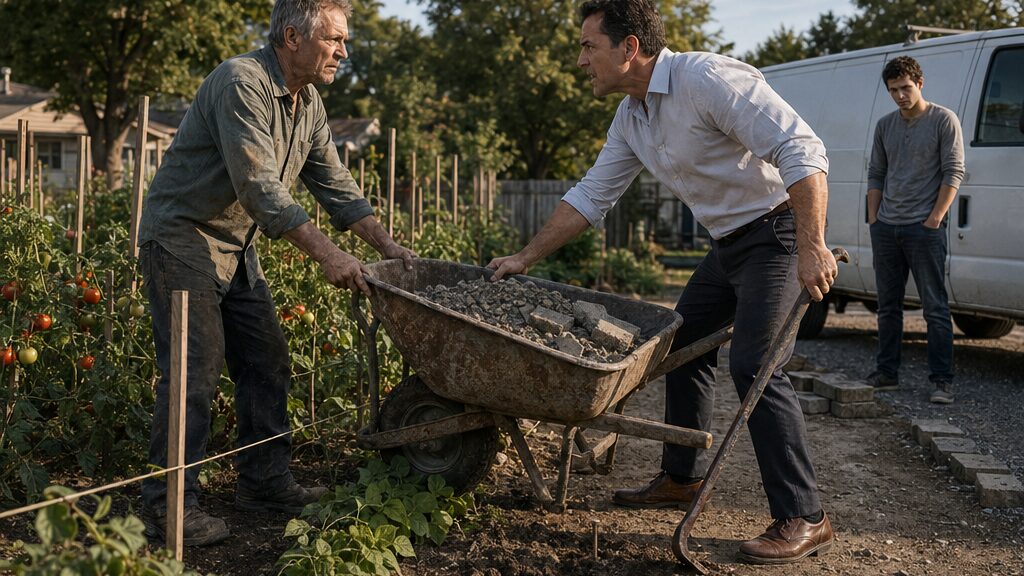
For a moment, both men held the same piece of metal.
Jeffrey’s polished shoes were planted in Patrick’s soil now, the toes flecked brown. Sweat stood along his upper lip. “You touch my equipment, and I swear—”
Patrick pulled.
Not backward. Up.
The wheelbarrow came with a shriek from the overloaded axle. Gravel and pavers shifted toward Jeffrey. His face opened in surprise. Patrick stepped into the weight, used both hands, and flipped the handles hard to the side.
The tray rolled over with a thunderous crash.
Gravel, concrete chunks, and packed dirt spilled across Jeffrey’s shoes and ankles. He stumbled back against the fence, shouting. The crowbar fell from his hand and struck the ground inches from the exposed pin.
Linda cried out.
Joshua swore under his breath and rushed forward, then stopped when he saw Patrick’s face.
Patrick was breathing hard now. Not wild. Not lost. But fully awake in his own body in a way he had not been for months.
The wheelbarrow lay upside down, its single metal wheel still spinning, wobbling in the air with a warped squeal.
Jeffrey looked down at his dirt-covered shoes, then up at Patrick. “Are you insane?”
Patrick did not answer.
The wheel slowed.
Patrick stepped over the spilled gravel, lifted his boot, and brought it down on the wheel.
The first stomp bent the rim.
The second collapsed the metal inward with a sharp crunch that silenced everything else.
No one moved.
The wheelbarrow lay upside down over the broken boundary string, its crushed wheel folded like a closed mouth. The surveyor’s pin remained beside it, exposed, dirty, and still in place.
Patrick picked up the rusted crowbar and threw it onto Jeffrey’s driveway.
It landed on concrete with a ringing scrape.
Jeffrey stared at the ruined wheel. His face had gone red, but his eyes were bright with something more useful than rage.
He reached into his pocket and pulled out his phone.
Chapter 5: The Victim Story Started With A Phone Call
“He went insane over a few feet of dirt,” Jeffrey shouted into his phone, loud enough for the whole street to hear. “He attacked me. He destroyed my property. I need police here now.”
Patrick stood beside the overturned wheelbarrow with dirt on his boots and the rolled blueprint in his hand.
The air smelled of cut tomato stems, rust, and spilled gravel. The crushed wheel leaned at a crooked angle beneath the tray. The surveyor’s pin, half uncovered by the struggle, glinted through loose soil near Patrick’s left boot.
Jeffrey paced at the edge of the driveway, one shoe scuffed, the other caked in wet dirt. He kept glancing down at them as if the insult to his polish mattered more than the crowbar marks beside the pin.
“No, I’m not exaggerating,” Jeffrey said into the phone. “He flipped a wheelbarrow at me. My son saw it. A neighbor saw it. He’s been unstable for months.”
Linda took one step back.
Patrick saw it.
The small retreat did more damage than Jeffrey’s shouting. Linda had seen the crowbar. She had seen the wheelbarrow cross the line. But the word lawsuit, the word police, the word unstable—those had weight. They made witnesses shrink into themselves.
Joshua stood near the van, arms hanging at his sides. His gaze kept moving between his father and the exposed pin.
Jeffrey ended the call and pointed at Patrick. “You’re finished.”
Patrick said, “You brought a crowbar into my garden.”
“You flipped my equipment.”
“You tried to bury the marker.”
“What marker?” Jeffrey barked. “That old scrap in the dirt? You planted that there to start trouble.”
Joshua looked sharply at him.
Patrick bent, took a photograph of the pin, the crowbar marks, the spilled gravel, and the overturned wheelbarrow. Jeffrey lunged toward him.
“Stop taking pictures of me.”
Patrick straightened but did not step back. “I’m taking pictures of my property.”
“Your property?” Jeffrey laughed, but his voice cracked. “You sound like a man trying to convince himself.”
Linda came down from her porch, slow and unwilling. “Jeffrey, maybe wait until they get here.”
He turned on her. “No, Linda. You saw what he did.”
“I saw—”
“You saw him flip the wheelbarrow.”
She stopped.
Patrick watched her face. Fear, apology, calculation. She did small repair jobs through Jeffrey’s referrals. Everyone knew it. He had sent her gutter work, fence work, two roof patch jobs after spring storms. On a street where people counted every bill, influence did not need a badge.
“You saw him destroy my property,” Jeffrey said.
Linda’s mouth tightened. “I saw the wheelbarrow flip.”
“That’s what I said.”
“No,” Joshua said.
The word came quietly, but it cut through the street.
Jeffrey turned. “What?”
Joshua’s face had gone pale again, but this time he held his father’s stare. “That’s not all that happened.”
Jeffrey walked toward him. “Be careful.”
Joshua swallowed. “You pushed it into the garden first.”
“I moved equipment on an access strip.”
“You told me to dump gravel over the pin.”
Jeffrey’s hand tightened around his phone. “You don’t know what you heard.”
“I heard you.”
For a moment, Patrick thought Joshua might say everything. Whatever he knew. Whatever had been sitting behind his eyes since morning.
Then Jeffrey lowered his voice. “You want to lose your job today?”
Joshua looked away.
The police cruiser arrived before the silence could settle.
It rolled to the curb behind the vans, lights off, official enough without sound. An officer stepped out and took in the scene in pieces: overturned wheelbarrow, crushed wheel, spilled concrete, disturbed garden bed, Jeffrey pointing, Patrick silent, Linda stiff near the sidewalk, Joshua staring at the ground.
Jeffrey reached him first.
“Officer, thank God. This man attacked me on my own access path. Destroyed my wheelbarrow. Threatened me with my own tool.”
Patrick’s fingers closed around the blueprint.
The officer looked at Patrick. “Sir?”
Patrick said, “He entered my garden with a crowbar and tried to pry up a survey marker.”
Jeffrey threw his hands out. “There it is. Survey marker. That’s his excuse. He’s been harassing my business for months. Taking photos of my vans, calling the city, blocking access, making up boundary issues.”
The officer looked at the wheelbarrow again. “Who flipped this?”
“I did,” Patrick said.
Jeffrey smiled.
Patrick felt the shift immediately. Visible damage had a language. Crushed metal spoke faster than buried lines. A destroyed wheelbarrow needed no explanation. A surveyor’s pin hidden in dirt did.
“Why?” the officer asked.
“Because he was pushing it over the marker and into my garden.”
“It’s my equipment,” Jeffrey said. “On my access path.”
“Is this your property?” the officer asked Patrick.
“Yes.”
Jeffrey laughed. “No, it’s disputed.”
“Disputed doesn’t mean yours,” Patrick said.
The officer raised a hand. “One at a time.”
Linda shifted again. Patrick looked at her, not pleading, just seeing whether she would stand where truth required.
Jeffrey saw the look. “Linda, you tell him. You’ve heard this man. He’s obsessed with this dirt.”
Linda’s face flushed. “I don’t want to be dragged into a lawsuit.”
“There won’t be a lawsuit if people tell the truth,” Patrick said.
Jeffrey snapped, “There’ll be a lawsuit if people lie.”
Linda’s mouth closed.
The officer’s attention moved back to Patrick’s boots, the crushed wheel, the spilled gravel. “Sir, do you have proof of the boundary?”
Patrick could have opened the small old survey notice. He could have shown the photos on his phone. He could have offered a partial defense and kept the larger truth folded a little longer.
That was the habit. Give enough to survive the moment. Not enough to cause the next one.
Then he looked down at the crowbar cuts in the dirt around the pin.
Mercy without boundaries becomes permission.
Joshua spoke without lifting his head. “He didn’t cross first.”
Jeffrey’s face hardened. “Joshua.”
“He warned you,” Joshua said, quieter now. “You pushed it anyway.”
The officer looked between them.
Patrick felt the last door inside him close—not in anger, but in decision. He had waited for Jeffrey to stop. He had waited for neighbors to speak. He had waited for the situation to remain small enough that no one had to lose more than pride.
Jeffrey had called the police and brought the lie to the garden himself.
Patrick set the rolled blueprint on the fence rail and untied the twine.
“Good,” he said. “They’ll need this.”
He unfolded the municipal blueprint across the top of the garden fence, smoothing the curl with both hands until the printed boundary line lay open in the afternoon light.
Chapter 6: The House Extension Was Over The Line
Maria Thompson arrived before Jeffrey stopped talking.
She came in a municipal vehicle with a clipboard under one arm and a measuring wheel folded in her other hand. She did not rush, but her eyes moved quickly: the disturbed soil, the official pin, the gouge marks from the crowbar, the overturned wheelbarrow, the gravel spilled exactly where a boundary might be buried.
Then she looked at Jeffrey.
“Why is an official survey marker exposed, disturbed, and surrounded by fresh pry marks?” she asked.
Jeffrey’s mouth stayed open around the sentence he had been giving the officer. For once, no sound came out.
Patrick stood beside the fence with the blueprint held flat beneath both hands. Wind lifted one edge. He pressed it down.
The officer turned to Maria. “You’re code enforcement?”
“Maria Thompson. Municipal code and property compliance.” She showed identification, then nodded toward the blueprint. “Mr. Miller contacted our office earlier today regarding possible tampering.”
Jeffrey found his voice. “Possible tampering? He staged this whole thing. That pin wasn’t even visible until he started digging around for it.”
Maria crouched at the marker. She did not touch it at first. She photographed it from above, then from the side. Her expression remained neutral, which somehow made Jeffrey angrier.
“That marker corresponds to the corner notation in the older parcel survey,” she said.
“You can tell that by looking?” Jeffrey demanded.
“I can tell enough not to ignore it.” She looked up. “And I can tell these marks are recent.”
Patrick watched the officer’s posture change. Not dramatic. Just a slight turn away from the crushed wheelbarrow and toward the earth.
Jeffrey noticed too. “The wheelbarrow,” he said. “Look at the wheelbarrow. He destroyed it right in front of me.”
“I see the wheelbarrow,” Maria said.
“He flipped it onto my feet.”
“Were you pushing it toward the marker?”
Jeffrey laughed. “I was moving gravel on an access path.”
Maria stood. “With a crowbar?”
“It was in the wheelbarrow.”
“It was found on the driveway,” Patrick said.
Jeffrey pointed at him. “Because he threw it there.”
Maria looked at Joshua. “Did your father use the crowbar near this marker?”
Joshua’s eyes flicked to Jeffrey.
“Careful,” Jeffrey said.
The officer turned. “Let him answer.”
Joshua’s mouth worked once before any words came. “He put it in the dirt.”
Jeffrey stared at his son as if a stranger had spoken through him.
Maria wrote something on her clipboard.
“It was already loose,” Jeffrey snapped. “Anybody could see it was old. For all I know, Patrick put that thing there to make my extension look wrong.”
The word extension changed the air.
Patrick felt it move through the small group. Linda, standing near the sidewalk, looked from Jeffrey’s house to the blueprint. The officer did the same. Joshua closed his eyes for one second.
Maria turned toward the dark-sided structure attached to Jeffrey’s house. “Your extension is the subject of next week’s inspection?”
“It passed permit review,” Jeffrey said too quickly.
“Partial permit review,” Maria corrected. “The file shows final exterior compliance was delayed pending boundary confirmation.”
Jeffrey’s face tightened. “That delay is paperwork.”
“It is now more than paperwork.”
Patrick looked down at the blueprint. The printed line was clean. Too clean for the mess around it. It cut past the garden beds, across the strip, through the place where Jeffrey’s extension wall stood in the real world.
Maria stepped to the fence. “May I see the stamped copy?”
Patrick handed it to her.
The moment it left his hands, he felt lighter and worse.
Maria studied the stamp, the parcel numbers, the extension outline. Then she walked to the survey pin, set her measuring wheel down, and began checking distances. The officer followed. Linda came closer despite herself. Joshua stayed by the van with his fists clenched.
Jeffrey kept talking.
“This is absurd. Everyone knows that strip has been access for years. Ask Linda. Ask anyone. Old owners used it. Delivery trucks used it. You can’t let one man with a vegetable patch shut down a business because of lines on a page.”
Maria stopped at the extension wall. The wheel clicked once more and fell silent.
The wall’s shadow lay across Patrick’s garden edge.
She looked at the blueprint again.
“Mr. Garcia,” she said, “did your contractor discuss a setback issue with you before construction?”
Jeffrey’s anger faltered. “I hired professionals.”
“That isn’t what I asked.”
“I hired people to handle it.”
“Did anyone tell you the extension footprint might cross or crowd the property boundary?”
Joshua looked at his father.
Jeffrey wiped his mouth with the back of his hand. “They said the old records were unclear.”
Patrick heard the admission before Jeffrey seemed to understand he had made it.
Maria wrote again. “So you were aware of a boundary concern.”
“I was aware of bureaucratic nonsense holding up a project I paid for.”
“And today you attempted to disturb a marker tied to that boundary.”
“No.”
Joshua whispered, “Dad.”
Jeffrey swung toward him. “Enough.”
Patrick saw the son flinch, and for the first time that day, the victory he had imagined did not feel clean. Joshua’s paycheck, Jeffrey’s debt, the vans, the pressure, the foolish pride dressed as necessity—it was all there in the young man’s face. Not innocence. Not guilt. Something trapped between them.
Maria unfolded a second document from her clipboard. “Based on the visible marker, the stamped municipal blueprint, and the apparent location of this wall, I have grounds to issue an immediate enforcement notice pending formal survey verification.”
Jeffrey stepped toward her. The officer moved one foot, enough.
“What does that mean?” Jeffrey asked.
“It means no further work, no use of the disputed strip for business access, and no alteration of the marker or surrounding area. It also means the extension cannot remain as built if the formal verification confirms what these records show.”
Linda made a small sound. “Cannot remain?”
Maria looked at her, then back at Jeffrey. “Removal or modification may be required.”
“Modification,” Jeffrey said. He clung to that word. “Fine. A permit correction.”
Maria did not soften. “If the structure is over the line, correction may mean demolition of the encroaching portion. Fines may apply. Additional penalties may apply if marker tampering is confirmed.”
Jeffrey’s face drained slowly, color leaving from the cheeks first.
Patrick looked down at his hands. Dirt under the nails. A crease of blueprint dust on his thumb. Months of restraint had brought them here anyway.
Jeffrey turned on him. “You knew.”
Patrick said nothing.
“You knew and you sat on it.”
Patrick met his eyes. “I waited for you to stop.”
“For me to stop parking vans?”
“For you to stop crossing the line.”
Jeffrey gave a short, broken laugh. “You think this makes you noble?”
“No.”
The answer seemed to unsettle Jeffrey more than any accusation could have.
Maria tore the top sheet from her notice pad and clipped it to her board. “Mr. Garcia, this is your immediate enforcement notice. You will receive formal documents after verification, but as of now you are ordered not to disturb the marker, the soil around it, the boundary string, or any evidence of today’s incident.”
Jeffrey did not take the paper.
It remained in Maria’s outstretched hand until the officer said, “Mr. Garcia.”
Joshua stepped forward as if he might take it for him, then stopped.
Jeffrey finally grabbed the notice. His hand shook once, hard enough to bend the page.
Maria looked toward the dark wall of the extension, its shadow lying over the disturbed garden, the spilled gravel, the crushed wheel, and the small metal pin that had not moved.
“The extension cannot remain as built,” she said.
Chapter 7: The Garden Stayed Where The Line Stayed
The commercial vans were gone, but the “FOR SALE” sign stood where their tires used to block the morning light.
Patrick saw it before he saw the tomatoes.
The sign had been hammered into the narrow strip beside Jeffrey’s driveway, its white face tilted slightly toward Patrick’s garden as if it too had crossed the line by habit. Behind it, yellow caution tape hung along the dark-sided extension wall. Red spray paint marked the siding in blunt symbols Patrick did not understand but could read well enough: cut here, remove this, stop pretending.
For one week, the street had been quieter than it had been in months.
No van engines before sunrise. No backup alarms. No tires grinding soil. No Jeffrey calling to drivers from the driveway as if the whole block were his loading dock.
Quiet should have felt like victory.
Patrick stood at the garden edge with the hose in his hand and did not turn it on.
The tomatoes had begun to recover. Their leaves still curled where the wheelbarrow had bruised the row, but the main stems had held. The bean bed was uglier. Three plants were gone entirely, and one corner of soil remained compacted where the van tire had sunk deep. Patrick had loosened it twice with a hand fork. It would take more work. Some damage did not reverse just because the thing causing it disappeared.
Across the boundary, Jeffrey’s driveway looked stripped. Empty rectangles of cleaner concrete marked where vans had parked every day. A trailer was gone. The garage door was closed. On the porch, a stack of official envelopes had been wedged under a brick.
The front door opened.
Joshua Garcia came out carrying a cardboard box. He saw Patrick and stopped.
For a moment neither of them spoke. Joshua looked older than he had a week ago. Not by years, but by sleep lost in pieces. He crossed the driveway and stopped on his own side of the boundary.
“My father says you got what you wanted,” Joshua said.
Patrick lowered the hose nozzle. “Did he send you to say that?”
“No.”
The answer came too fast to be false.
Joshua looked at the “FOR SALE” sign, then at the marked extension wall. “The fines came in yesterday. Preliminary ones. Then there’s the contractor, the lawyer, the permits, whatever it costs to cut that part down without wrecking the rest.” He gave a small, humorless laugh. “Bank doesn’t care whose fault it is. They just care that payments are late.”
Patrick did not say he was sorry. The words formed, but they would have been for Patrick, not Joshua.
“Your father knew there was a boundary issue,” he said.
Joshua’s jaw tightened. “He knew there was a question.”
“He tried to remove the answer.”
Joshua looked down. “Yeah.”
A demolition crew’s small machine sat idle near the curb, its metal bucket resting on the pavement. Even still, it changed the feel of the street. Metal waiting to touch earth. Metal waiting to touch wall.
“The business might not survive,” Joshua said.
Patrick looked toward the empty driveway.
“That isn’t what I wanted,” he said.
“But it’s what happened.”
“Yes.”
Joshua’s eyes came up then, angry and wet but not childish. “I told him not to push the wheelbarrow.”
“I heard you.”
“I should’ve said more before that.”
Patrick could have taken the kindness of that admission and used it to lighten himself. He did not.
“So should I,” he said.
Joshua blinked.
Patrick turned the hose nozzle in his palm. “I had the blueprint for months.”
“I figured.”
“I thought if I kept the proof private, he might stop before it became official.”
Joshua looked at the extension wall. “He took that as weakness.”
“Yes.”
They stood with the boundary between them, not high, not visible except for the string Patrick had reset, but real enough now that neither man stepped over it.
Joshua shifted the cardboard box against his hip. “He won’t apologize.”
“I know.”
“He’s telling people you planned it. That you waited until he was trapped.”
Patrick almost looked away, but did not. “Did I?”
The question surprised Joshua. It seemed to surprise Patrick too.
Joshua stared at him. “You didn’t make him build over the line.”
“No.”
“You didn’t make him bring the crowbar.”
“No.”
“You didn’t make him call the police.”
“No.”
Joshua swallowed. “But you did wait.”
Patrick looked at the garden, at the rows he had kept straight while the problem grew crooked beside them.
“Yes,” he said.
Joshua nodded once, as if that was the only honest answer available. He turned to go, then paused. “My mother used to say he could turn one bad choice into ten just by refusing to admit the first one.”
It was the first time Patrick had heard Joshua speak of his family without sounding like an employee.
“Maybe that’s what happened here,” Joshua said.
He carried the box to a car parked at the curb. Patrick watched him place it in the back seat, carefully, as if it held breakable things.
A porch step creaked behind him.
Linda Hill came through Patrick’s side gate with two wooden stakes and a roll of garden twine in her hands. She did not ask permission. She stopped when she reached the bean bed and looked at the damaged corner.
“I found these in my garage,” she said. “They’re not fancy.”
Patrick took one stake from her. “They’ll work.”
They reset the boundary together.
Linda held the twine while Patrick drove the first stake into the soil. Her hands were steady until Jeffrey’s front door opened again. Then the twine trembled.
Jeffrey stepped onto his porch, looked at them, and went still.
He had not shaved. His shirt hung loose at the collar. The bright, polished certainty was gone from him, but what remained was not humility. It was injury hardened into blame.
Linda’s chin lifted, just a little.
“I should have spoken sooner,” she said, not loudly, but loud enough.
Jeffrey looked at her as if she had stolen something.
Patrick tied the twine to the second stake. The line pulled straight.
Linda held it taut. “I knew where the garden was,” she said. “We all did.”
Jeffrey said nothing. After a moment, he went back inside and shut the door.
Linda exhaled. “That was easier in my head.”
“It usually is.”
She gave him a quick, tired smile. “You keeping the garden?”
Patrick looked at the tomatoes, the beans, the narrow strip, the sign, the red marks on the extension. “Yes.”
“Good.”
After she left, Patrick walked along the boundary, checking each stake. Near the fence, half hidden under weeds and dust, he found the crushed wheelbarrow wheel.
No one had taken it.
The rim was folded inward where his boot had come down. A week of sun had dried mud in the crease. He lifted it and felt the weight of it pull at his shoulder. It looked uglier in daylight than it had in the moment. Less like triumph. More like evidence of what it had taken to make everyone stop.
For a second, he saw himself from outside: a quiet man with dirt under his nails, keeping a broken wheel as if it proved something.
He carried it to the shed.
Inside, the air smelled of potting soil, twine, old wood, and metal tools. The municipal blueprint lay rolled on the shelf beside the seed packets, no longer hidden in a kitchen drawer. Patrick placed the crushed wheel beneath it, leaning it against the wall near the stakes.
Not a trophy.
A reminder.
Outside, the demolition machine started with a low mechanical cough. Patrick stepped back into the garden as the first section of Jeffrey’s marked extension wall gave a dull crack under pressure. The sound passed through the street and faded into the leaves.
Patrick turned on the hose.
Water spread over the bean bed, darkening the loosened soil. It ran up to the boundary string and stopped where the earth dipped, shining in a thin, honest line. Across from him, the “FOR SALE” sign rocked once in the vibration from the machine, then settled.
Patrick watered the tomatoes next. Their leaves shook under the spray and lifted again. Birds moved in the fence shrubs, returning to the quiet as if they had been waiting for permission.
He stood there until the soil took what it needed.
The story has ended.