They Tried To Remove The Old Man With The Camera Until A Marine Saw The Photograph
Chapter 1: The Man With The Camera Was Blocking The Front Row
“You can’t stand there, sir.”
James Walker kept his hand over the cracked leather case against his ribs as if the security guard had reached for his heart instead of the strap.
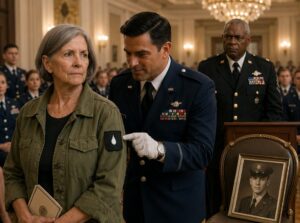
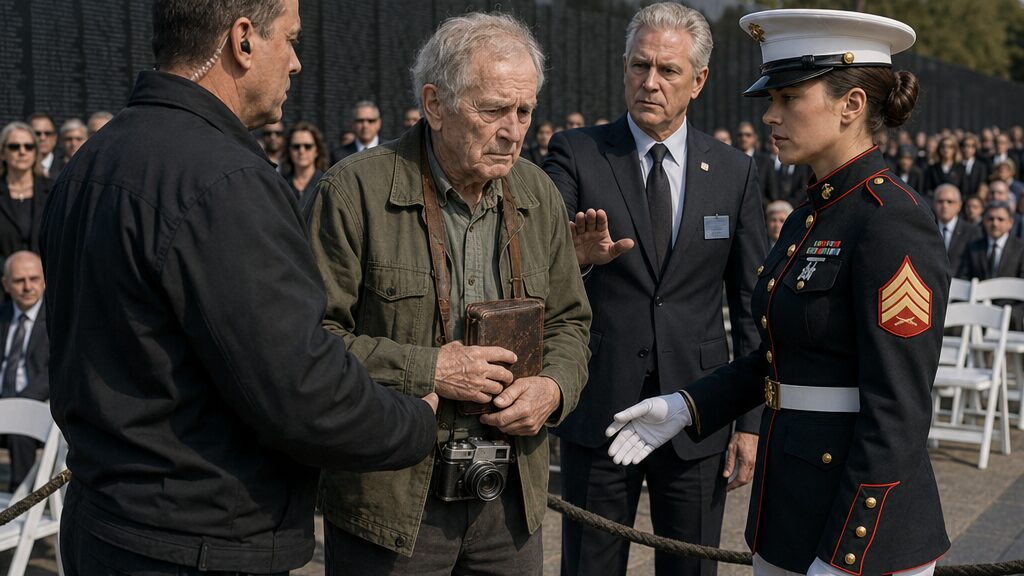
The guard was young enough to call him sir without meaning it. His black jacket still held its pressed shape, his earpiece wire tucked neatly behind one ear. Beyond him, white folding chairs faced the memorial wall in careful rows. A podium stood near the front, draped with a dark cloth. Small flags waited in a bundle beside the base. Families had begun to gather behind the rope line, their voices low, their programs folded in half.
James had not come for the podium.
He had come for the third panel from the left, six rows down, where the morning light touched only part of a name.
The camera hung from his neck on a worn brown strap. It was an old film camera, heavy and black, with silver edges rubbed dull by years of hands. The leather case attached to it had a cracked corner and a brass snap that no longer closed unless James pressed it twice. He pressed it now.
“Sir,” the guard repeated, firmer this time. “This area is restricted until after the ceremony.”
James looked past him.
There were too many chairs. Too many polished shoes. Too many clean uniforms moving in straight lines. The wall itself stood quiet behind all of it, dark and reflective, making every living person look like a ghost that had arrived late.
“I know,” James said.
The guard blinked. “Then I need you to step back behind the rope.”
James’s right hand moved slightly, not toward the guard, not away from him, but toward the wall. He had measured the distance in his mind before stepping across the line. He had done it every year without crossing. This year, he had crossed before his courage could fail him.
“I know where I need to stand.”
A few heads turned.
James felt them more than saw them: the quick glance at his jacket with its frayed cuffs, at the scuffed shoes, at the gray stubble he had missed near his jaw, at the camera that looked too old to belong to anyone official. He had worn his cleanest shirt. It had still yellowed at the collar. The green jacket had hung on the back of his kitchen chair since before dawn, and when he put it on, he had thought of taking it off again.
The guard lowered his voice. “You’re blocking the front row.”
James looked at the chairs. Each one held a printed card with a reserved name. He had not touched them. He was standing three feet to the side, where the wall curved into shadow.
“I won’t sit.”
“That’s not the point.”
No. It never was.
A man in a dark suit crossed from the podium area, his pace clipped and irritated before he had even heard the explanation. His hair was silver, combed back with precision. A small event badge hung at his chest. The letters were large enough for James to read: STEPHEN HALL.
Stephen looked first at the guard, then at James, then at the camera.
“What’s going on?”
The guard straightened. “He stepped into the restricted area. Says he knows where he needs to stand.”
Stephen’s eyes moved over James in a clean, practiced sweep, the kind James remembered from inspections, hospitals, records desks, funeral offices. Assess, categorize, remove.
“Sir, the memorial opens to the public after the formal program,” Stephen said. “We have families seated here in less than twenty minutes.”
James nodded once.
Stephen waited, and when no more words came, his mouth tightened.
“Are you with one of the media teams?”
James touched the camera again. “No.”
“Then you can’t photograph the ceremony from inside the rope. We have approved photographers.”
The word photograph landed with the faint click of an old shutter in James’s head.
A young man laughing with dust on his cheek. A hand lifted to block the sun. “Make me look taller, Walker.” The smell of hot metal. Someone calling for water. Someone else saying, “One good one for home.”
James closed his eyes for half a second.
“I’m not here to take pictures,” he said.
Stephen glanced at the camera as if it had contradicted him. “You’re carrying a camera.”
“Yes.”
“Is there film in it?”
James did not answer quickly enough.
The guard shifted his weight. Behind Stephen, two uniformed Marines near the chairs had stopped arranging programs. One of them, a woman in dress blues, watched without moving. Her posture was straight, her white gloves held at her side. James saw her eyes go to the case under his palm.
Stephen’s voice became smoother, which made it worse. “Sir, I need you to understand. This is a remembrance ceremony for families of the fallen. We cannot allow personal displays or unauthorized materials near the wall before the program.”
James looked at the engraved name again, half hidden behind Stephen’s shoulder.
“I brought it for one family.”
Stephen exhaled through his nose. “You’ll need to go through the submission table. The volunteers are outside the entrance.”
“It doesn’t belong on a table.”
A woman in the second row of chairs turned fully around. Someone behind the rope whispered something James could not hear, but he knew the shape of it. Confused. Homeless. Protester. Maybe drunk. Maybe harmless. Maybe not.
He pulled his shoulders inward. The camera bumped softly against his chest.
Stephen noticed the motion. “What’s in the case?”
James’s hand tightened.
“Sir.”
James felt the old snap under his thumb. He had opened it in his apartment before sunrise and stared at the photograph until the kitchen window brightened. He had told himself he would not leave with it again. He had told himself that the wall was not enough, that a name cut into stone was not the same as a face in someone’s hand.
But now there were too many eyes.
“It’s mine,” James said.
Stephen’s expression cooled. “That’s not an answer.”
The guard took half a step closer. Not aggressive. Not yet. But close enough for James to smell the starch in his jacket.
“Sir,” the guard said, “I’m going to ask you to move now.”
James did not move.
He had moved when the buses came. Moved when the photographer’s tent burned. Moved when the hospital clerk said next. Moved when people told him ceremonies were for healing. Moved every year to the back, where he could see the wall without being seen by it.
This time his shoes stayed on the stone path.
“I know where I need to stand,” he said again, but the words came out thinner.
Stephen’s face changed, not with understanding, but decision.
“Escort him behind the public rope. Carefully. Do not make a scene.”
The guard reached toward James’s elbow.
James flinched before he could stop himself.
The motion was small. Shame followed it instantly, hot and humiliating. He was seventy-eight years old, and his body still answered to hands before his mind did. The camera swung. The leather case slipped from under his palm, and he grabbed it too hard, his knuckles whitening.
The female Marine stepped forward.
“Hold on,” she said.
The guard paused, fingers inches from James’s sleeve.
Stephen turned. “Staff Sergeant Hill, we have it handled.”
The Marine did not look at him first. She looked at James’s hand.
Then she looked at the case.
James saw the moment her eyes narrowed—not in suspicion, but recognition of something out of place. Not the camera itself. Not the cracked leather. The way he held it. The way his thumb protected the broken snap as though someone else might open history with dirty hands.
She stepped between the guard and James without touching either of them.
“Sir,” she said, and this time the word had weight. “May I ask what you’re carrying?”
James tried to answer.
His throat closed around the name on the wall.
Chapter 2: The Photograph Made The Marine Stand Still
Rachel Hill saw the old man’s hand trembling over the leather case and knew, with a sudden unease, that everyone had been asking the wrong question.
Stephen wanted to know why he had crossed the rope.
The guard wanted to know how to move him without attracting attention.
The families behind them wanted the ceremony to begin on time.
But Rachel had spent enough years around Marines, old and young, proud and broken, loud and nearly silent, to recognize the way some men held certain objects. Not like property. Like a living thing entrusted to them by someone who could no longer ask for it back.
“Sir,” she said again, softer, “may I see it?”
The old man looked at Stephen.
Not for permission. For threat.
Stephen folded his arms. “Staff Sergeant, we don’t have time to inspect every personal item someone brings inside the rope.”
Rachel did not move her eyes from the old man. “I’m not inspecting it.”
The guard glanced between them. A few ceremony guests had stopped pretending not to watch. The nearest row of white chairs remained empty, but their printed reservation cards fluttered in the light breeze, each one waiting for a body, a family, a grief made official.
The old man’s thumb pressed the brass snap twice. It resisted the first time. Opened on the second.
Rachel saw the inside of the case before she understood it.
Black-and-white photographs. Not glossy reproductions. Not display prints from a museum table. Real photographs, small and curled at the edges, separated by thin paper gone almost translucent. They were worn the way letters became worn, not by neglect but by too much careful touching.
The old man did not hand her the case.
He opened it just wide enough.
Rachel bent slightly. “May I?”
His mouth tightened. He nodded once.
She slipped off one white glove before she touched anything. Stephen made a small impatient sound, but Rachel ignored it. Bare fingertips could feel fragility better than cotton. Her hand hovered over the stack until the old man shifted one photograph forward with his thumb.
The image showed two young Marines standing beside a sandbag wall. One held a camera low against his hip. The other had one hand lifted as if caught mid-joke, his grin too alive for the old paper to contain. Dust blurred the background. On the back, in faded ink, someone had written two names.
Rachel read the second name first.
Timothy Allen.
The air changed.
Not outside, where the microphone was being tested and a volunteer was asking families to take their seats. Not around Stephen, who was still watching the delay like a problem multiplying. The change happened inside Rachel’s chest, sharp and quiet.
She looked up at the wall.
The third panel from the left. Six rows down. She had walked past it earlier while checking the front row. A card had been placed on the chair nearest that section.
ALLEN FAMILY.
Rachel turned back to the photograph. The young Marine beside Timothy had James Walker’s eyes. Younger, clearer, looking at the camera as if he trusted whoever stood behind it. No—Rachel looked again. The young man with the camera low against his hip was James. Someone else must have taken the shot.
She looked at the old man.
He stared at the photograph, not at her.
“Were you a Marine?” she asked.
Stephen’s shoulders stiffened.
The old man’s jaw worked once before the answer came. “A long time ago.”
Rachel stood straighter without deciding to. Her hand came away from the photo. She did not salute. Not here, not like a performance for the people already watching. But her body corrected itself. Her voice did too.
“Mr. Walker,” she said, reading the name from the back of the photograph, “I apologize for the way this started.”
At that, the old man’s eyes lifted.
There was no pride in them. No satisfaction. Only a tired caution, as if apology could be another way of taking something from him.
Stephen stepped closer. “He should have said that when asked.”
Rachel turned to him. “He was asked what was in the case, not who he was.”
Stephen’s face reddened faintly. “This is exactly why we have procedures. If he has historical material, he can submit it properly after the ceremony.”
The old man began closing the case.
Rachel placed her hand near it, not touching. “Please don’t.”
His fingers stopped.
She looked back at the photograph, then at the wall again. The engraved names held the morning light in thin silver lines. Timothy Allen was there. She could see it now from where she stood.
“Is this why you came?” she asked.
James did not answer.
Behind them, the microphone gave a brief squeal. Guests shifted. A volunteer waved toward Stephen, urgent and confused.
Stephen lowered his voice. “Staff Sergeant Hill, I respect what you’re trying to do, but we cannot allow an unidentified photo to be placed at the memorial during the formal program. Families bring things all the time. Letters, flowers, flags, dog tags. If we make one exception before the ceremony, we create a situation.”
Rachel heard the logic. She had followed similar rules herself. Rules prevented chaos. Rules protected ceremonies from becoming arguments over who deserved space closest to grief.
But the old man was still standing with the open case in his hands, and everyone had nearly moved him like furniture.
She looked at James. “Do you want to place the photograph?”
His fingers tightened around the case.
“No,” he said.
Stephen seized on it. “Then there’s no issue. Sir, you can view the wall after—”
“I need to stand there,” James said.
Rachel waited.
James swallowed. His eyes went to the chair with the Allen family card, then away so quickly she almost missed it.
“Not for long.”
The photograph remained exposed. Timothy Allen’s grin seemed impossible beside his engraved name. Rachel felt the cruel distance between those two versions of a person—the living face and the official line.
She reached toward the photograph again, then stopped herself.
“May I touch it?”
James looked at her hand. At the missing glove. At the way she waited.
Another small nod.
Rachel lifted the photograph by its edges. It weighed almost nothing. It changed everything.
“Stephen,” she said, “this isn’t a display item. It may be connected to one of today’s families.”
“We don’t know that.”
Rachel turned the photograph slightly, enough for him to see the back without taking it from her. “Timothy Allen.”
Stephen’s eyes flicked toward the wall, then toward the front-row card. For the first time, uncertainty crossed his face.
The security guard lowered his hand from his belt.
Rachel looked at James again. “Did you serve with him?”
James’s gaze fixed on the image.
“Yes.”
The word was so quiet the wind nearly carried it away.
A murmur moved through the nearest guests. Someone behind the rope whispered, “He served with him.” Rachel wished they would stop watching, then knew the watching mattered. The room—or what passed for a room beneath open sky and stone—had seen him nearly removed. It needed to see the correction, too.
But correction was not enough.
Stephen cleared his throat. “Mr. Walker, if you’ll come with us to the side tent, we can document the item and decide the appropriate—”
James reached for the photograph.
Rachel gave it back at once.
He slid it into the case, but not before his thumb brushed Timothy’s face. The motion was quick. Almost hidden. Rachel saw it anyway.
She understood then that the photograph was not simply proof that James had served. It was not a badge, not evidence, not leverage. It was something he had survived with and maybe because of.
The old man turned toward the wall.
Rachel followed his gaze and read the name aloud before she realized she had done it.
“Timothy Allen.”
James flinched.
Not like he had when the guard reached for him. This was deeper, older.
He looked at Rachel, and for the first time his voice came with force.
“Don’t say it like he’s only stone.”
Chapter 3: Stephen Hall Had A Ceremony To Protect
“Respect requires rules,” Stephen Hall said, and hated how defensive it sounded the moment it left his mouth.
Rachel Hill stood across from him in the side tent, the old man beside her with the camera still hanging from his neck. The leather case now rested on a folding table between them, closed but not abandoned. James Walker had placed one hand on it and kept it there, as if the table were a border and his palm the only guard posted to defend it.
Outside, the ceremony kept assembling itself without Stephen’s full attention. A volunteer adjusted the flags. Families moved toward the reserved chairs. The sound technician tapped the microphone again, sending two dull thumps through the speaker. Every sound reminded Stephen that the schedule was not waiting for him to untangle one old man’s silence.
Rachel’s voice stayed low. “Rules can be respectful. They can also be used to avoid seeing what’s in front of you.”
Stephen glanced toward the tent opening. “What’s in front of me is a ceremony with Gold Star families arriving, a national veterans’ group watching the timing, and strict instructions from the memorial board. We do not allow personal items into the program unless they’ve been cleared.”
James said nothing.
That silence irritated Stephen more than argument would have. Argument gave him something to answer. Silence made him feel like the villain in a story no one had explained to him.
The archivist clerk, a thin woman with a tablet under one arm and cotton gloves already on, stood at the end of the table. She had been pulled from the records booth when Rachel insisted someone needed to see the photograph properly.
“May I examine the photo?” the clerk asked.
James’s hand did not move.
Rachel turned to him. “Mr. Walker?”
James looked at the clerk’s gloves, then at Rachel’s bare hand, then at the closed case.
“No.”
Stephen spread one hand. “This is the problem.”
Rachel’s eyes sharpened. “The problem started when you tried to remove him.”
“The problem started when he crossed a restricted rope carrying an undisclosed item and refused to answer basic questions.”
James’s hand pressed flatter over the case.
Stephen noticed the movement and, despite himself, softened his tone. “Mr. Walker, I am not trying to take it from you. But if you want anything placed near the wall or connected to today’s program, we need provenance. We need a release. We need to know whether this is original material, whether it belongs to you, whether another family has a claim.”
The archivist clerk nodded carefully. “If the photograph is what Staff Sergeant Hill says it is, it could be historically significant. But I can’t accept or display it without documentation.”
James looked down at the case. “I didn’t bring it for history.”
Stephen almost said that history was exactly where old war photographs belonged, but stopped. He had been a public affairs officer long enough to know when a sentence would sound worse spoken aloud.
Outside, a volunteer leaned into the tent opening. “Mr. Hall? Five minutes until seating closes.”
Stephen held up one finger. The volunteer vanished.
Five minutes.
Five minutes before the front row needed to look composed. Five minutes before the Allen family would be guided to their seats. Five minutes before the ceremony moved from preparation into public memory, and any mistake became part of what the families remembered.
Stephen had seen mistakes happen. A name skipped once on a printed program. A wreath placed at the wrong panel. A microphone left open while a donor complained about parking. Small failures became large wounds when people arrived already carrying grief.
That was what Rachel did not understand yet. She saw an old man being mishandled. Stephen saw fifty families who had been promised that, for one morning, nothing would be mishandled.
He looked at James. “Were you invited by the Allen family?”
James’s mouth tightened.
“No.”
“Have you contacted them before today?”
A pause.
“No.”
Rachel turned slightly toward James at that.
Stephen felt the ground shift. Not triumph. Not exactly. But the facts had begun leaning his way.
“So you came to approach a family who does not know you, during a formal ceremony, with an original photograph of their fallen loved one, without prior notice.”
James’s eyes lifted. They were pale and steady and exhausted.
“I came to stand where I should have stood a long time ago.”
“That may be true,” Stephen said. “But my responsibility is to the families here today, including the Allen family. I cannot allow a stranger to surprise them at the wall because he has an emotional attachment to an item.”
Rachel stepped closer to the table. “He served with Timothy Allen.”
“We have his word and a photo none of us have authenticated.”
James reached for the case snap.
Rachel saw it too. “Mr. Walker, wait.”
But James opened the case, removed a folded paper from beneath the photographs, and placed it on the table without unfolding it. His hand trembled once, then stilled.
Stephen looked at it.
Old paper. Soft at the creases. Not official at a glance. No embossed seal. No convenient answer.
“What is that?” Stephen asked.
James stared at the paper as if it might accuse him.
“Nothing that helps you.”
The archivist clerk leaned in, not touching. “May I?”
“No.”
Stephen rubbed his forehead. “Mr. Walker, you can’t keep producing materials and refusing review.”
James picked up the folded paper and put it back into the case.
Rachel watched him with new concern. She was beginning to see it too, Stephen thought. Service did not make this simple. If anything, it made the situation more delicate. A veteran could still be wrong. A grieving man could still harm a grieving family by arriving unannounced with old pain in his hands.
Stephen drew a form from the clipboard near the tent pole and slid it across the table. “Sign a temporary custody release. We’ll secure the photograph, document it, and contact the family after the ceremony. You can remain nearby as a guest.”
James stared at the form.
The camera hung motionless against his chest.
“No.”
“Then you’ll need to leave the restricted area until after the program.”
Rachel’s head turned sharply. “Stephen.”
“I’m not removing him from the memorial. I’m moving him out of a controlled ceremony space until we have authorization.”
James closed the case. The snap failed. He pressed it again. It closed.
The tiny click sounded final.
Stephen felt a brief, unwelcome flicker of pity. The man looked smaller now, not because he had lost authority, but because everyone had found a way to talk around the thing he could not say.
The volunteer returned to the tent opening, face tight with urgency.
“Mr. Hall,” the volunteer said, “the Allen family card is confirmed. Timothy Allen’s sister is here. Anna Lee just checked in.”
James’s hand slipped off the leather case.
For the first time since Stephen had met him, the old man looked ready to run.
Chapter 4: The Name On The Wall Was Not The Whole Story
James saw Anna Lee before anyone said which woman she was.
She stood just beyond the tent opening, speaking with a volunteer who held a clipboard against her chest. Anna was not crying. That made it worse. She wore a dark coat and held the ceremony program folded lengthwise, the way people held things when they needed both hands busy. Her eyes moved once toward the wall, found the Allen family card, and stopped there.
James turned away so fast the camera struck his sternum.
Rachel noticed.
“Mr. Walker,” she said.
He closed his fingers over the camera as if he could quiet it. “I need air.”
Stephen looked toward the tent opening. “We’re already outside.”
James stepped around him anyway.
The guard moved as if to block him, but Rachel lifted one hand. “Let him walk.”
“Not into the front row,” Stephen said.
“Then with me.”
James did not wait to see whether Stephen approved. He moved along the side path where the memorial wall bent away from the chairs and the voices thinned. Rachel followed at his left, close enough to help if his footing failed, far enough not to make him feel handled.
At the quieter section of the wall, James stopped. The names there were not Timothy’s, but they were still names. He kept his eyes on them because they asked less of him than Anna’s face.
Rachel waited longer than most people would have.
Finally she said, “You came for her.”
James shook his head.
“You came for Timothy Allen,” she corrected.
His thumb found the edge of the camera case. “Same thing, after this long.”
Rachel stood beside him. Her dress blues caught faint reflections from the dark stone. She was young enough to still believe there was a right way to stand when memory entered the room. James envied that, then hated himself for envying anything about the young.
“Did she know you?” Rachel asked.
“No.”
“Did Timothy talk about her?”
James shut his eyes.
A hot road. A strip of shade behind a wall. Timothy Allen trying to wipe grit from his teeth with the back of his hand. “My sister says I smile like I’m lying. Take one where I look honest.” James lowering the camera, saying the light was bad. Timothy laughing anyway.
“Yes,” James said.
Rachel’s voice changed. “Then why hasn’t she seen the photo?”
There it was. Not accusation. Worse. A question clean enough to require an answer.
James opened the leather case, not fully, just enough to slip the top photograph out and hold it between his fingers. The edges had softened from years of being removed and returned. Timothy’s face looked younger every time James saw it. That was the cruelty of photographs. They did not age with the person who carried them.
“He wanted one good one sent home,” James said.
“To Anna?”
James nodded.
Rachel looked at the photo but did not reach for it. She had learned quickly. That mattered more than her apology.
“What happened?” she asked.
James’s jaw tightened.
Outside, a volunteer tested a bell. One clear note moved through the morning and broke apart against the wall.
James heard another sound under it: the camera shutter snapping once, twice, then the crack of incoming fire so sudden the world became elbows and dirt and shouted names. He felt Timothy’s hand hit his chest hard enough to throw him backward. He remembered being angry for half a second because the push ruined the frame.
Then the place where he had stood became dust.
Rachel did not press him, but the question stayed.
“He pushed me down,” James said.
Rachel’s eyes lifted from the photograph.
James kept his gaze on Timothy’s smile. “I had the camera up. He saw what I didn’t.”
The words came out flat, stripped of the noise that belonged to them. He had spent decades making them smaller. Small enough to fit behind his teeth. Small enough not to wake anyone.
“He saved your life,” Rachel said.
James slid the photograph halfway back into the case, then stopped.
“He gave me a job before he did it.”
Rachel waited.
James’s thumb moved over the back of the photo. “He said, ‘Home gets the good one.’ That was all. He said it like he was asking me to pass the salt.”
The Marine’s throat worked once. She looked away toward the ceremony chairs, where people were taking their seats in neat rows that grief had never respected.
“You came every year?” she asked.
James looked at her sharply.
Rachel’s face showed no triumph at guessing right. Only sadness.
“Mr. Walker,” she said, “the way you knew exactly where to stand. The way you looked at the Allen card. This wasn’t your first time here.”
James put the photograph back into the case.
“First time crossing the rope.”
“How many years?”
He gave a sound that might have been a laugh if there had been anything left in it. “Enough to know which guards are kind and which ones look at shoes first.”
Rachel’s face tightened.
“I’m not saying that for pity,” James said.
“No,” she said. “You’re saying it so I don’t make it prettier than it is.”
That surprised him enough to make him look at her.
For a moment she reminded him of no one, which was a mercy. Not Timothy. Not the corpsmen. Not the young people who thanked him too loudly in grocery stores when they saw an old service cap he no longer wore. She was simply Rachel Hill, standing beside him and trying to understand without taking command of the understanding.
“Why today?” she asked.
James looked toward the tent.
Anna had moved closer to the front rows. The volunteer was pointing toward her seat. Anna nodded politely, but her eyes kept drifting toward the wall, searching for the name before she sat under it.
James felt the old failure rise again, familiar as breath.
“I almost mailed it once,” he said. “Had the envelope. Had the address. Sat at my kitchen table until the sun came up.”
“What stopped you?”
He looked at the camera hanging from his neck. “I wrote a letter. Every version started with I. I saw him. I was there. I survived. Couldn’t send a letter about Timothy that kept beginning with me.”
Rachel said nothing.
James’s hand slid under the strap where it had rubbed his neck raw. “So I told myself silence was cleaner.”
“And now?”
The ceremony bell rang again. Two notes this time.
James looked at Anna.
“She’s getting older,” he said. “So am I.”
Rachel’s gaze moved from James to Anna and back. “Then let me help you speak to her.”
“No.”
The answer came too quickly.
Rachel took it in, and he saw her understand the shape of his flaw before he could hide it. He did not want help. He wanted absolution without witness. He wanted to place the photograph near stone because stone could not ask why he had waited.
“Mr. Walker,” Rachel said, “if you leave again, she still won’t know.”
James gripped the case until the cracked corner pressed into his palm.
A movement near the tent caught Rachel’s attention. She had left the photograph partly visible when James opened the case; in the brief exchange, she had lifted it once more to keep it from bending as he struggled with the strap. Now she still held it by the edges, Timothy’s face turned outward.
Anna Lee stood ten feet away, no volunteer beside her anymore.
Her eyes were fixed on the photograph.
The folded program slipped from her hand and struck the stone path with a soft slap.
She did not look at James. Not yet. Her stare stayed on Rachel’s hand, on the young face in black and white, on the smile that had belonged to her brother before the wall learned his name.
Anna’s voice came low and dangerous.
“Why do you have my brother’s face in your hand?”
Chapter 5: Anna Lee Did Not Want Another Official Story
Anna did not reach for the photograph at first because she was afraid it would disappear if she moved too quickly.
The Marine held it by the edges, careful and pale-faced, as if the paper had become too heavy for one hand. Beside her stood an old man Anna had never seen before, though something about him struck her as familiar in the wrong way. Not his face. His stillness. The way he looked prepared to be blamed and almost relieved that blame had finally arrived.
“Who are you?” Anna asked him.
The old man’s mouth opened.
No answer came.
The silence hit her harder than a denial would have.
Rachel turned slightly. “Ma’am, my name is Staff Sergeant Hill. This is James Walker. He served with your brother.”
Anna’s eyes stayed on James. “Then he can tell me himself.”
James looked down.
The memorial ceremony continued gathering force behind them. Programs rustled. The microphone clicked. Families were being guided into seats. Someone called for the front row to settle. Anna heard all of it as if from the far end of a hallway.
For years, people had spoken to her in finished sentences. We honor his sacrifice. We remember his courage. He served with distinction. Every phrase polished smooth enough that no fingerprints remained on it. She had kept every letter, every program, every folded flag ritual, and still there were days when she could not remember whether Timothy had laughed through his nose or through his teeth.
Now a stranger stood three steps away with Timothy’s face in a photograph she had never seen.
“Why do you have that?” Anna asked.
Rachel looked to James.
James took a breath that seemed to hurt. “It was his.”
“No.” Anna shook her head once. “It’s his face. That is not the same thing.”
The old man flinched, and Anna almost regretted it. Almost.
Stephen Hall arrived from the tent with the guard behind him. He stopped when he saw Anna, then arranged his expression into concern.
“Ms. Lee,” he said, “I’m sorry for the confusion. We’re handling this matter privately so it doesn’t interfere with the ceremony.”
Anna turned on him. “You knew about this?”
“We only became aware of the photograph moments ago.”
“And you were going to what? File it? Approve it? Put it behind a table after the ceremony?”
Stephen’s jaw tightened. “There are procedures for personal materials connected to the fallen.”
Anna laughed once, without humor. “Of course there are.”
Rachel held the photograph closer to her own chest, protective but not possessive. “Ms. Lee, it may be best if we step into the tent. The photo is fragile.”
That word cut through Anna’s anger. Fragile.
She looked at Timothy’s face again. He was standing in sun, one hand lifted, smiling like he had just said something he expected no one else to find funny. Younger than she remembered him now. Younger than her children had been when they first asked why their uncle’s name was on a wall.
“Give it to me,” Anna said.
Rachel did not move immediately. “May I show you how to hold it?”
Anna stared at her, ready to resent that too.
But Rachel’s voice was not managerial. It was careful.
Anna nodded.
Rachel stepped closer, placed the photograph in Anna’s hands, and guided her fingers to the white border. “Only the edges if you can.”
The paper was lighter than Anna expected. She had held certificates heavier than this, plaques heavier than this, the folded flag heavier than this. The only thing that had ever felt as light and impossible had been the last birthday card Timothy sent home, the one with three lines of jokes and no mention of danger.
Anna looked at the photo until the world narrowed to her brother’s grin.
Then she turned it over.
The handwriting on the back was faded, cramped, familiar enough to make her knees weaken.
Timothy had always crowded his letters against the margins, as if paper cost more in a war zone than courage. Most of the writing had blurred with age, but one word remained clear.
Anna.
Her breath caught.
James made a small movement toward her, then stopped himself.
Anna looked up. “You had his handwriting?”
James’s face had gone gray beneath its weathered lines.
“Yes.”
“For how long?”
Rachel lowered her eyes.
Stephen glanced toward the chairs. “Ms. Lee, the ceremony is about to begin. I don’t want you to feel rushed, but—”
“Then don’t rush me.”
The words were quiet. Stephen closed his mouth.
Anna turned back to James. “How long?”
His hand moved to the camera strap. “Since he died.”
The ceremony bell rang outside.
Anna’s fingers tightened on the edges of the photo. Rachel noticed and gently placed her hand beneath it, not taking it, only supporting the paper before it bent.
“Since he died,” Anna repeated.
James nodded once.
Anna felt the anger reorganize inside her. It had rushed first toward him, because he was there and Timothy was not. But Stephen’s interruption, the tent, the forms she had glimpsed on the folding table, the phrase procedures for personal materials—all of it pressed against old bruises. For years, institutions had protected Timothy’s memory by smoothing it flat. Now this old man had protected it by hiding it.
Both felt like theft.
“Why didn’t you send it?” she asked.
James’s eyes lifted, and for one second she saw that he had asked himself the same question so many times it had worn a path through him.
He almost answered.
His lips shaped the beginning of something.
Then Stephen stepped between them with the gentleness of a man trying not to look forceful.
“Ms. Lee, your reserved seat is waiting. I can assign someone to secure the photograph until after the program. We can set up a private review with documentation, perhaps even scan it for preservation.”
Anna looked at him. “You want to secure my brother?”
“No,” Stephen said, and this time she heard strain under his control. “I want to prevent a painful moment from becoming a public incident.”
“It is already painful.”
“Yes,” Stephen said. “And I am trying to keep it from becoming worse.”
For the first time, Anna saw his fear. Not compassion exactly. Fear of a mistake happening under his watch. Fear that grief, if not directed properly, would spill across the ceremony he had promised to hold steady.
It did not make him right.
But it made him human, which was more inconvenient.
Rachel turned to Stephen. “Could the ceremony begin with the family seated a minute late?”
Stephen looked toward the podium. “The name reading is timed with the honor detail. The front row has to be settled.”
Anna looked down at Timothy’s handwriting. The faded word seemed to pulse under her thumb.
James spoke before she did.
“I took it after he told me who to send it to.”
The whole group stilled.
Anna’s eyes returned to him.
His voice was nearly gone, but the words were clear enough.
“He said your name before the last picture. He told me home gets the good one.”
Anna could not make herself ask the next question. It rose anyway, filling the space between them.
Why did you keep it from me?
James looked at the photograph in her hands, then at the name waiting on the wall.
“I brought it today,” he said, “because I was afraid if I waited one more year, I’d die with it still in my case.”
Chapter 6: The Promise Was Older Than The Ceremony
The announcer began reading names outside, and James heard Timothy’s before it came.
Not through the speaker. Not from the printed program. He heard it in the old place where memory waited without aging. Timothy Allen, twenty-three, laughing in bad light, asking for one good picture because his sister said he always looked guilty in photographs.
James stood in the side tent with the camera strap cutting into the back of his neck and Anna Lee holding the photograph he should have mailed before her hair carried a single thread of gray.
A name came through the microphone.
Not Timothy’s.
Anna turned toward the sound anyway, instinct pulling her to the ceremony even while her hands refused to release the photo.
Stephen looked relieved by the movement. “Ms. Lee, we can continue this afterward. I’ll personally make sure—”
“No,” Rachel said.
Stephen turned.
Rachel’s face was controlled, but James saw the tension in her jaw. “Not afterward if afterward means everyone else decides what happens to the photograph before she does.”
“I am trying to protect her.”
“Then ask her what protection looks like.”
Stephen’s eyes moved to Anna.
Anna did not answer him. She looked at James.
“Tell me now,” she said.
James felt the tent shrink around him.
Rachel stepped closer, her voice low enough for only him. “Mr. Walker, I can explain what you told me. I can tell her you served with him.”
He looked at her.
It would be easier. Rachel had a clear voice. Rachel could stand straight and make the story sound honorable. She could say Timothy saved his life without saying James had spent decades making that sacrifice heavier by hiding from the person who deserved its last small remnant.
James reached for the camera strap.
“No,” he said.
Rachel’s eyes softened.
James lifted the strap over his head. His hands shook halfway through, and the camera bumped against his shoulder before he caught it. For a moment he nearly clutched it back to his chest. Instead, he set it on the folding table between himself and Anna.
The table changed. Before, it had been a place where Stephen wanted forms signed and items managed. Now it held the thing James had used to stand between himself and the world.
Anna watched him place it down.
James kept one hand on the camera body. The metal felt cool, familiar, unforgiving.
“He was beside me when the shelling started,” James said. “We had been out since morning. I was supposed to be taking pictures for the unit record. Bridges. Roads. Men pretending they weren’t scared.”
Anna looked at Timothy’s face.
“He hated having his picture taken,” James said.
A faint sound escaped Anna, not quite a laugh, not quite a sob. “No, he didn’t.”
James blinked.
Anna’s mouth trembled. “He used to pose in every family photo like he was running for mayor.”
The correction struck James gently and cruelly. Timothy had not hated pictures. He had only complained because complaining made everyone else laugh.
James nodded. “Then he lied to me.”
Anna’s grip on the photo loosened by a fraction.
Outside, another name passed through the speaker.
James looked at the camera. “I had just taken that one. Not with this camera. Another. This is the only one I kept after. The rest went where they were supposed to go.”
“Except his,” Anna said.
“Except his.”
Stephen shifted near the tent entrance. James sensed him preparing to interrupt, to return the world to time and order.
James spoke before he could.
“Timothy saw movement over my shoulder. I didn’t. I was looking through the lens.” James touched the viewfinder. “That’s the thing about a camera. It makes the world smaller. You think you’re seeing clearly because the frame is sharp. But everything outside the frame can still kill you.”
Rachel looked down.
Anna did not.
“He hit me here.” James touched his chest, just below the collarbone. “Hard. Knocked me behind the wall. I was angry at him. That’s what I remember first. Not fear. Anger. Because the picture blurred.”
His voice roughened.
“Then the place where I had been standing was gone.”
Anna closed her eyes.
James forced himself to continue before the old silence took back the room.
“I tried to get to him. They pulled me back. He was still talking for a little while. Not much. Enough.”
“What did he say?” Anna whispered.
James looked at her, and the truth that had seemed impossible for decades became suddenly small. Not easy. Small. Human-sized.
“He said, ‘Tell Anna home gets the good one.’ Then he said—” James stopped.
The missing line lodged behind his ribs.
Anna stepped closer. “Then he said what?”
James shook his head.
“Not yet,” he said, ashamed of the weakness in it.
Stephen glanced toward the front rows. “Timothy Allen’s name is coming up within minutes. Ms. Lee should be seated.”
Anna did not turn. “I am Timothy Allen’s family. I know where I should be.”
James felt that sentence pass through him. I know where I should be. The same thing he had tried to say at the rope, only she said it without apology.
Rachel looked at Stephen. “Can we give them the space?”
Stephen’s face tightened. “If she misses the reading of her brother’s name because we mishandled—”
“You already did,” Anna said.
Stephen went still.
Anna’s eyes remained on James, but the words were for all of them. “Not just today. Every year, someone tells us where to stand, when to sit, when to rise, when to receive, when to be grateful. I came because my brother’s name is here. But if this man has carried something Timothy meant for me, then I am not leaving it to a schedule.”
Stephen’s mouth opened. Closed.
Outside, the announcer read another name.
James heard the sequence nearing the place where Allen would come. He had memorized the order years ago, though he had never admitted that to himself.
Rachel moved beside him. “Mr. Walker,” she said, “you don’t have to make it public.”
He knew she meant it kindly.
That was the danger. Kindness could become another hiding place.
James looked at Anna. “I didn’t send it because I thought I had no right to comfort you.”
Anna’s face changed.
He made himself keep going.
“He died pushing me out of the way. I lived. I came home with his picture and his words and all I could think was that any letter from me would be asking you to forgive the wrong man for breathing.”
The tent was silent except for the speaker outside.
Rachel’s eyes shone, but she did not interrupt.
James looked at the camera on the table. “I told myself keeping it safe was honoring him. It wasn’t. It was fear. I was afraid you would thank me. I was afraid you would hate me. I was afraid you would ask me why him and not me, and I would have no answer that didn’t insult us both.”
Anna held the photograph against her coat.
For a moment, James thought she would step back. She had every right.
Instead she said, “I might still be angry.”
“You should be.”
“I might not know what to do with you.”
“I don’t either,” James said.
That brought the smallest break in her expression. Pain, but also something living under it.
Stephen moved again. “The name is close.”
Anna turned toward the tent opening. The front row waited. Timothy’s card waited. The engraved wall waited.
Then she looked at James.
“Stand with me when they read it.”
James’s first instinct was to refuse. Not because he did not want to, but because wanting it felt like theft. Timothy’s name belonged to Anna. To the family. To the stone. James had no claim except the worst one: he remembered what the last moments sounded like.
Anna seemed to see the refusal forming.
“Not in front of me,” she said. “Beside me.”
James looked down at the camera he had removed from his neck.
Without it, his chest felt exposed.
Rachel picked up the camera carefully, both hands beneath it, and held it out to him as if returning something alive.
James did not put it back on.
He took it by the body and carried it at his side.
Outside, the announcer read the name just before Timothy’s.
Anna stepped toward the light and waited for James to follow.
Chapter 7: Respect Meant Making Room, Not Making Noise
Stephen reached toward James as he stepped from the tent, then stopped with his hand hanging uselessly in the air.
Rachel saw it happen.
The gesture was not rough. It was not even completed. But it carried the old meaning of the morning: wait, move back, not there, not yet, not you. James saw it too. His shoulders drew in before Stephen’s fingers came anywhere near him.
Rachel stepped beside James.
Not in front of him this time.
Beside him.
Stephen looked at her, then at Anna Lee, then toward the rows of seated families. The announcer’s voice moved steadily through the names, each one followed by a measured pause. The honor detail stood ready near the flag bundle. The front row had turned to look at the interruption gathering at its edge.
“Staff Sergeant,” Stephen said under his breath, “we cannot create confusion during the reading.”
Rachel kept her voice lower than his. “Then don’t.”
The security guard approached from the rope line, uncertain now, his earlier confidence worn thin. “Sir, do you need me to move him to—”
“Ask him,” Rachel said.
The guard stopped.
Rachel did not look away from Stephen. “Don’t move him. Ask him.”
The guard’s face changed first with embarrassment, then with understanding. He turned to James, visibly choosing his words.
“Mr. Walker,” he said, “where do you need to stand?”
The question passed through the small group like a different kind of command.
James looked at the wall.
Anna stood close enough that the sleeve of her dark coat brushed his jacket. She held Timothy’s photograph in both hands, still by the edges, the way Rachel had shown her. The old camera rested at James’s side, not around his neck. Without the strap, he seemed less hidden and more fragile.
“There,” James said.
He pointed not to the center, not to the podium, not to any place a camera would want. He pointed to the side of the front row where the Allen family card marked the chair nearest Timothy’s engraved name.
Stephen stared at the place, then at the families watching. Rachel saw the calculation in his eyes. If he refused, everyone would see refusal. If he agreed, the ceremony would bend around one unscheduled truth.
Outside the circle of them, the announcer read another name.
Stephen looked at Anna. “Ms. Lee?”
Anna did not ask his permission. “He stands with me.”
Stephen’s mouth compressed, but the answer he gave was not the one from the tent.
“All right.”
It was not an apology. It was smaller than that. Maybe harder.
He turned to the guard. “Clear the side of the row. No one touches the photograph. No one handles the camera.”
The guard nodded quickly.
Rachel watched James hear those instructions. He did not smile. He did not straighten with pride. But some defensive set in his jaw loosened, as if the room had stopped requiring him to brace for the next hand.
They moved together.
The front row shifted to make space. A woman holding a folded program drew her knees back. A man in a dark suit rose from the aisle seat and stepped aside without being asked twice. No one applauded. No one saluted. The absence of spectacle felt like a mercy.
Rachel walked behind James and Anna, close enough to stop anyone from pressing too near. Stephen followed on the other side, his badge catching the light. He looked older than he had that morning. Not kinder, exactly. But less certain that control and care were the same thing.
The announcer’s voice continued.
James stood beside Anna at the edge of the row. His eyes fixed on the wall. Anna lifted the photograph, not high, just enough that Timothy’s face faced the engraved name. Rachel saw James glance at it once and look away.
The name before Timothy’s was read.
The pause after it widened.
Rachel felt the line of Marines behind the podium adjust in unison, almost imperceptibly. She stood straighter, not for show but because the moment deserved the discipline of her body.
Then the announcer read, “Timothy Allen.”
Anna’s fingers tightened. James did not move at all.
For two seconds, nothing happened except the name settling into the air.
Then James lowered his head.
Not a bow for the crowd. Not a pose. Just the movement of a man who had run out of ways to stand against the weight of one syllable after another.
Anna reached for him with her elbow, not her hand, because both hands held the photograph. The touch was brief. An invitation, not support.
James accepted it by not moving away.
Stephen stood at the aisle, watching. The volunteer with the clipboard tried to whisper something to him, but he raised one hand without looking. For once, the schedule waited.
Rachel heard a soft click near James’s side.
Her eyes dropped.
James had not lifted the camera. His hand had simply closed around the body, and one old finger had brushed the shutter out of memory. There was no film advance, no flash, no attempt to capture the ceremony. Only the sound of a habit older than the wall.
Anna heard it too.
She looked down at the camera, then at James. “Did you take it right after?”
James shook his head. “Before.”
“Before what happened?”
His eyes stayed on Timothy’s name. “Before he knew.”
Anna looked again at the photograph in her hands, and Rachel saw understanding move through her in a painful line. The picture was not a final image in the way she had feared. It was the last ordinary one. The one before anyone knew the day would split into before and after.
Stephen stepped closer, but this time he did not interrupt. “Mr. Walker,” he said quietly.
James turned his head.
Stephen’s voice had lost its public shape. “Would you like a chair?”
James looked at him for a long moment. “No.”
Stephen nodded. “Then we’ll keep the space clear.”
It was such a small correction that no one in the back rows would know it mattered. Rachel knew. Anna knew. James seemed almost afraid to know.
The announcer continued down the list.
Anna leaned toward James without taking her eyes off the wall. “Will you place it?”
James looked at the photograph.
Rachel expected him to say yes. The whole morning seemed to have moved toward that: the old man reaching the wall, the photo returning to the name, the public correction complete. Stephen must have expected it too; he glanced toward the base of the panel where flowers and flags already lay in careful clusters.
James did not reach for the photograph.
“It belongs to you,” he said.
Anna turned to him.
“I thought it belonged here,” he continued. “Because I was too afraid to bring it to your door. But stone can’t remember him for you.”
Anna’s face changed, the anger and grief shifting again into something less guarded.
Rachel felt the meaning of the morning deepen and move out of her control. Recognition had brought James to the front row, but it could not decide what he owed or what Anna needed. Respect now meant protecting the choice, not shaping it into a clean ceremonial image.
Anna looked at the back of the photograph. “There’s writing.”
James looked away.
“I saw my name,” she said. “But the rest is faded.”
His hand tightened around the camera.
Anna turned the photograph over carefully.
Rachel saw the back for only a second: pale ink, crowded letters, lines broken by years of touch. At the top, the word Anna remained clearer than the rest. Under it, a few scattered fragments. Home. Good one. Tell her.
James made a sound like someone taking a step on broken ground.
Anna held the photograph between them.
“What did he write, James?”
James stared at the faded note. His face had gone still in a way Rachel now knew meant he was fighting the urge to disappear.
The announcer moved on to the next name, but in the small space beside Timothy Allen’s chair, no one followed.
James touched the lower corner of the photograph and turned it a little toward the light.
The faded note addressed to Anna waited in his own dead friend’s hand.
Chapter 8: The Photograph Finally Went Home
“Read it to me,” Anna said.
James looked at the faded words and knew at once which parts the years had taken.
Ink had thinned into brown shadows. The fold had cut through the second line. His thumb had worn one corner soft from the nights he had held the photograph under a kitchen lamp and told himself he was preserving it. But Timothy’s handwriting still leaned forward, impatient and crowded, as if even on the back of a photograph he had been trying to get home faster than the mail could carry him.
Anna held the photograph between them. “You’re the only one who remembers what’s missing.”
The ceremony had moved on. Families remained seated, but the tight public attention had loosened. A few people still glanced over, curious, then turned back toward the podium as the next names were read. Rachel stood nearby, quietly making sure no one stepped into the fragile space. Stephen waited at the aisle with the guard, both of them still now.
James tried to read the words as they were.
“Anna,” he said.
Her eyes closed briefly at the sound of her name in his mouth.
James continued, following the broken ink. “‘Home gets the good one.’”
Anna looked down. “That part I can see.”
His throat tightened.
She waited.
He had carried the rest as punishment for so long that saying it aloud felt like giving away the last thing Timothy had left him. Then he understood the shame inside that thought. Timothy had not left it for him.
James looked at the photograph’s front. Timothy Allen stood in sunlight, one hand lifted, his grin too quick for any war to own.
“He said it after I complained about wasting film,” James said. “I told him I wasn’t taking portraits for sweethearts and sisters. He said, ‘You take roads like they’ll miss their mothers, Walker. Take one picture of somebody who will.’”
Anna pressed the photo to her coat, careful not to bend it.
James breathed once, shallowly.
“The part that faded,” he said, “wasn’t grand. He didn’t write anything about duty. Nothing that would fit on a program.”
Anna’s eyes opened.
James touched the back of the photograph, not covering the words. “He wrote, ‘Tell her I ate the peaches.’”
Anna stared at him.
For a moment James thought he had wounded her with something too small.
Then she made a sound that broke and warmed at the same time.
“The peaches,” she whispered.
James nodded, though he did not know the story.
Anna did. That was enough.
She laughed once through tears that had finally come, but even the tears seemed startled, as if grief had opened a side door and found a kitchen there. “I sent him canned peaches in every box. He used to write back that he was saving them for a special occasion.”
James looked at Timothy’s grin again. “He ate them that morning. Shared them with three men and pretended he hadn’t.”
Anna covered her mouth with one hand. The photograph trembled in the other, and Rachel stepped forward just enough to support the bottom edge without taking it.
Anna did not pull away.
That small acceptance nearly undid James.
For years, he had imagined this moment as accusation or forgiveness. He had not imagined peaches. He had not imagined that the line he feared speaking would give Timothy back to Anna not as a name, not as a sacrifice, but as a younger brother lying about canned fruit.
“He said one more thing,” James said.
Anna looked at him.
“He said, ‘Tell her I looked honest.’”
Anna laughed again, softer, and cried into it. “He never did.”
“No,” James said. “But he tried.”
He reached into the leather case and removed the thin paper that had stayed hidden beneath the photographs. This time he unfolded it. Not for Stephen. Not for the archivist clerk. For Anna.
“It’s the letter I never sent,” he said. “I don’t know if it helps. Most of it is wrong. Too much of me in it. But the address is there. I carried it with the picture.”
Anna looked at the paper without taking it.
“Did you write it after he died?”
James nodded.
“Then it is part of what happened.”
He held it out.
She accepted it with the same edge-care she had learned for the photograph.
Stephen approached slowly. “Ms. Lee,” he said, “Mr. Walker. If you want, we can have the photograph preserved properly. Scanned. Added to the memorial archive with Timothy Allen’s record.”
Rachel glanced at him, wary.
Stephen saw it and stopped two steps away. “Only with your permission,” he added. “And not today if today is not the day.”
The correction was not dramatic. It did not erase the morning. But James heard the difference. Stephen had not said secure. He had not said submit. He had not said item.
Anna looked at James. “What do you want?”
The question frightened him more than Stephen’s orders had.
He looked at the wall, at Timothy’s name, at the photograph that had lived too long in darkness. For decades he had believed the answer was to keep it safe until he became brave enough to give it away. Now he saw that safekeeping had become another form of keeping.
“It should go home first,” he said.
Anna’s hand tightened around the photo. “With me?”
“With you.” James swallowed. “If you want a copy here later, that’s yours to choose.”
Stephen nodded once. “I can arrange a private appointment. No forms today.”
Anna looked at him for a long moment. “No one takes it out of my hands today.”
“No,” Stephen said. “No one does.”
The honor detail finished its section of the ceremony. The seated families began to rise. Some moved toward the wall with flowers. Others stayed seated as if standing required a strength they had not brought with them. The world around James resumed, but it no longer seemed to be pushing him backward.
Anna turned the photograph one last time toward Timothy’s name.
“Do you want to place it there?” she asked James.
He shook his head.
“I wanted to,” he said. “All these years I thought if I could leave it here, I could leave too.”
Anna understood. He saw that she did, and wished she did not have to.
Instead of placing the photograph at the wall, she held it against her chest.
“Then it comes with me,” she said. “And you can tell me the rest somewhere quieter.”
James almost refused.
The old silence rose, loyal and poisonous. He had told the truth. Was that not enough? Could he not step away now, lighter, forgiven or unforgiven, but finished?
Anna looked at him, waiting.
Not demanding.
Waiting.
James felt the camera case under his arm. For the first time in years, it held less than it had that morning. The missing weight made him unsteady.
“I don’t remember everything right,” he said.
“Neither do I,” Anna answered.
Rachel bent to pick up an empty chair that had been moved aside for James. She carried it herself toward the row, not because no one else could, but because she had learned that care was sometimes a thing done quietly with both hands.
Stephen walked beside James as they left the front row. He did not guide him by the elbow. He did not hurry him. When the path narrowed near the rope, Stephen slowed to James’s pace and waited for him to pass first.
At the edge of the memorial, Anna held Timothy’s photograph in one hand and James’s old letter in the other.
James looked once back at the wall.
For the first time, Timothy’s name did not seem trapped there.
It seemed to have somewhere else to go.
The story has ended.