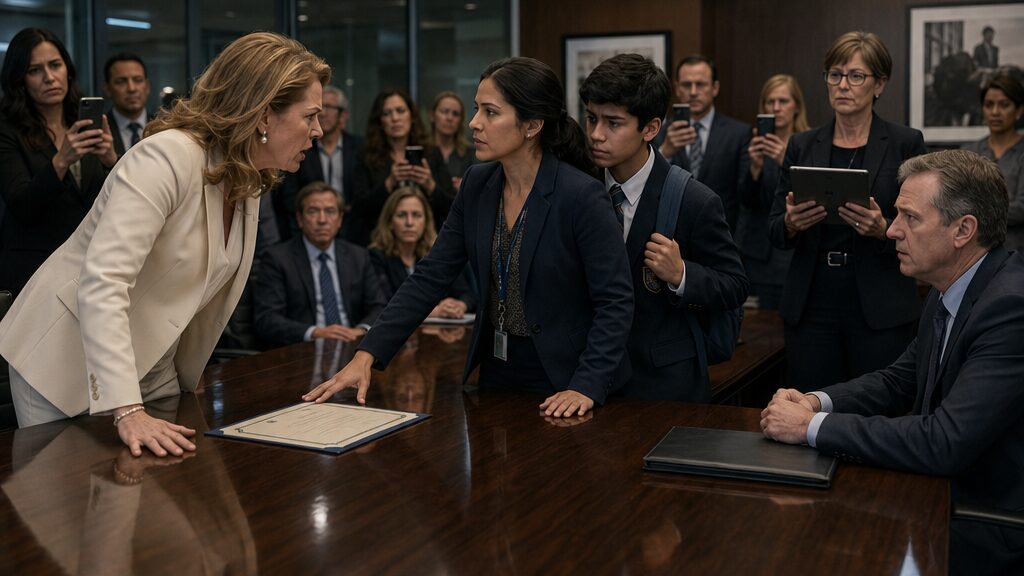
The Scholarship Student They Tried To Erase Before One Teacher Made The Room Read The Truth
Chapter 1: The Certificate On The Boardroom Table
Sharon Davis slammed her palm beside Benjamin Gonzalez’s award certificate so hard the silver nameplate on the boardroom table jumped.
“Scholarship kids don’t belong at this school.”
The room went silent in a way Samantha Ramirez had heard only twice before in her teaching career: once after a student fainted during a lab demonstration, and once when a parent called a child a charity case during open house and everyone pretended not to hear.
Benjamin stood behind Samantha’s chair with his hands folded around the strap of his backpack. He had not sat down since they entered. His science fair ribbon, still pinned to the edge of his blazer, looked too bright against his pale face.
The certificate lay flat in the center of the long table. Heavy cream paper. Blue embossed seal. Benjamin Gonzalez, First Place, Applied Environmental Science. Samantha had watched him hold it with both hands less than an hour earlier in the gymnasium, staring at his own name as if the letters might vanish if he breathed too sharply.
Now Sharon’s manicured fingers hovered near the corner of it.
Mary King, one of the board members, adjusted her glasses. “Mrs. Davis, please lower your voice.”
“My voice is not the problem,” Sharon said. She looked polished enough to belong on one of the school’s donation brochures: ivory jacket, pearl earrings, perfect hair, face tight with fury that had been dressed as concern. “The problem is that a student with no access to advanced materials somehow produces a better project than students whose families have invested in this institution for years.”
Samantha felt Benjamin shift behind her. Not step back. Not exactly. Just a small withdrawal inside his own body.
Charles Miller, the principal, sat at the head of the table with both hands clasped over a leather folder. He had not corrected Sharon. That was the first answer Samantha received.
The boardroom was packed beyond what a student disciplinary review should allow. Donor parents lined the wall beneath framed photographs of graduating classes and capital campaign plaques. A few faculty members stood near the door, silent and stiff. Phones had already appeared in hands, low at first, angled as if the room itself had become evidence.
Samantha placed her palm gently on the back of the empty chair beside her. “Benjamin should sit.”
Sharon laughed once, dry and sharp. “He can stand for the five minutes it takes to correct this.”
Benjamin did not move.
Samantha turned enough for him to see her face. “Sit down, Benjamin.”
His eyes flicked toward Sharon, then Charles, then the certificate. He sat slowly, as if a wrong movement could be used against him.
Charles cleared his throat. “Let’s maintain order. This is a review meeting, not a trial.”
“It felt like a ceremony when you announced his name,” Sharon said. “Funny how procedure only matters after the wrong child wins.”
Samantha looked at Charles. “Then let’s begin with the actual concern. What evidence has been presented?”
Charles’s smile was thin and practiced. “Mrs. Ramirez, as faculty adviser, you’ll have a chance to respond.”
“I’m responding now.”
A faint murmur moved through the room. A parent near the back lifted her phone higher. Samantha recognized her from the middle school hallway: Janet Mitchell, always asking questions at meetings, always sounding as if she might be gathering proof for two different sides at once.
Sharon pointed at the project board propped against the wall. Benjamin’s display showed a low-cost water filtration model built from layered sand, charcoal, mesh, and a printed housing he had redesigned again and again during lunch periods. His handwritten notes were pinned in a neat grid. Samantha could still remember the day he had come in holding a cracked prototype and said quietly, I think the failure is useful if I document it.
“That design mirrors concepts Ryan was developing,” Sharon said.
“Concepts are not theft,” Samantha replied.
“Don’t lecture me.”
“I’m not lecturing. I’m asking for evidence.”
Charles opened the leather folder. “There have been concerns about originality, access to school resources, and improper assistance.”
“From whom?” Samantha asked.
Charles’s gaze moved briefly to Sharon, then away. “From multiple members of the community.”
Benjamin’s hands tightened under the table.
Samantha kept her voice even. “Name one specific claim.”
Sharon leaned forward. “He doesn’t deny it.”
Benjamin’s head lifted a fraction, but no sound came.
Samantha’s heart tightened. She knew that silence. She had seen students use it like a shield, believing that if they made themselves smaller, adults would run out of reasons to strike. She had once let a meeting continue too long because she trusted the adults in the room to hear a quiet student eventually. That student had transferred before winter break.
She had promised herself never to confuse a child’s silence with consent again.
“Benjamin is not required to defend himself against accusations no one has stated clearly,” Samantha said.
Charles’s expression cooled. “Mrs. Ramirez, careful.”
The warning was soft enough that half the room might miss it. Samantha did not.
Sharon turned toward the parents behind her. “This is exactly the problem. Standards vanish the second someone says scholarship. Then families like ours are expected to smile and fund the performance.”
Several phones rose higher. The tiny red recording light on one screen reflected in the polished table.
Charles slid the leather folder toward Samantha. It stopped inches from her hand.
“What is this?” she asked.
“A proposed resolution,” Charles said.
Samantha did not open it yet. “Proposed by whom?”
“By administration.”
Sharon folded her arms, satisfied.
The certificate remained between them, flat and vulnerable. Benjamin’s name caught the overhead light.
Mary King glanced from Charles to Samantha. “Principal Miller, has the student’s project history been reviewed?”
“We are in the process of reviewing all relevant materials.”
Samantha heard the careful wording. Not yes. Not no.
“I sent the project logs to your office this morning,” she said.
Charles’s jaw shifted. “And I appreciate your thoroughness. But tonight we must consider the broader health of the school community.”
Sharon’s lips pressed into something almost like approval.
Samantha leaned back slightly. The broader health of the school community. It was the kind of phrase that could hide anything: fear, money, cowardice, prejudice. She looked down the table at the certificate. It had stopped being paper. It had become a test the adults had written for themselves.
Charles rose and gestured toward the side door. “Mrs. Ramirez, may I speak with you privately for a moment?”
Benjamin’s eyes followed her.
Samantha did not want to leave him in that room, but refusing would give Charles exactly what he needed: evidence that she was emotional, obstructive, unprofessional. She bent toward Benjamin. “I’ll be right outside the glass. Do not answer anything unless I’m beside you.”
He nodded once.
The side office was small, used mostly for storing extra binders and donor event supplies. Charles closed the door but left the blinds open. Through the glass, Samantha could see Sharon speaking with two parents near the certificate.
Charles lowered his voice. “You need to help me contain this.”
“Contain what? The accusation or Sharon?”
His eyes hardened. “Donors are watching.”
“So is Benjamin.”
“This school runs on relationships.”
“It should run on rules.”
He exhaled, impatient now. “You know what happens if the Davis family walks? They are tied to three pledged gifts this year. Lab renovation. Scholarship fund. Faculty stipends. This is not just about one project board.”
Samantha looked through the glass at Benjamin sitting alone at the table while adults stood around him.
“It is to him,” she said.
Charles softened his tone, which made it worse. “You’re a good teacher. Everyone knows that. Sign the resolution. Acknowledge that boundaries around assistance may have been unclear. We suspend the award pending review. Benjamin apologizes for confusion, no permanent mark if everyone cooperates. We survive the week.”
“You already wrote the ending.”
“I wrote an exit.”
“For whom?”
Charles did not answer.
Back in the boardroom, Sharon reached toward the certificate as if testing whether anyone would stop her. Samantha turned from the glass.
Charles opened the leather folder in his hands and angled the top page toward her. “It only needs your signature.”
Chapter 2: The Report Written Before The Truth
The first sentence of the report had already convicted him.
Samantha read it twice because the wording was so clean, so careful, so finished that for one foolish second she thought she must have misunderstood.
Student Benjamin Gonzalez knowingly submitted derivative work in violation of academic integrity expectations.
Knowingly.
Not allegedly. Not under review. Not pending verification.
Knowingly.
Samantha felt heat rise behind her eyes and forced it back down before it could become useful to Charles. He was watching for anger. Sharon was watching for weakness. Benjamin was watching for permission to disappear.
The page rested on the boardroom table between the award certificate and Samantha’s hand. It was printed on school letterhead. Charles had paper-clipped a signature tab near the bottom, a little blue arrow pointing to the place where her name was supposed to make the lie respectable.
Samantha looked at him. “When was this drafted?”
Charles’s mouth tightened. “That’s not relevant.”
“It states intent. It states guilt. It states a violation. When was it drafted?”
Sharon leaned back in her chair. “Does it matter? We all know what happened.”
“No,” Samantha said. “We do not.”
A few people shifted along the wall. Someone whispered, then stopped when Mary King raised a hand.
Charles tapped the page with two fingers. “This is a preliminary administrative document.”
“It says Benjamin knowingly submitted derivative work.”
“It summarizes the concern.”
“It fabricates a conclusion.”
A low sound moved through the parents. Not quite support. Not quite outrage. Interest. Samantha hated that the room had become entertainment to some of them before it had become justice to any of them.
Sharon pointed at Benjamin’s project board again. “His design appeared out of nowhere.”
Samantha turned to her. “It appeared over six weeks in my classroom.”
“Convenient.”
“Documented.”
Benjamin’s eyes flicked up.
For a moment Samantha was back in the lab after school, the room smelling faintly of heated plastic and wet charcoal. Benjamin had hunched over the scratched workbench, rewriting measurements in a notebook with the focus of someone who did not own extra materials and could not afford careless mistakes. When his first housing cracked, he had not cursed. He had labeled the fracture point, photographed it, and whispered, Failure three is better than failure two.
The files existed. Drafts, photos, notes, submission logs. She had them all. She had sent the timeline to Charles that morning, trusting the official channel because that was what teachers were told to do when a parent’s anger became institutional.
Now the official channel had delivered a lie with a signature tab.
Benjamin shifted in his chair. “Mrs. Ramirez—”
Sharon’s gaze snapped to him.
He stopped.
The room noticed. Samantha noticed more: the way Benjamin swallowed whatever he had been about to say, the way his shoulders settled into that practiced stillness. He was not calm. He was obeying an old survival rule.
Samantha kept her eyes on him. “You can speak.”
Benjamin looked at the phones, then at the certificate, then down at his hands. “It’s okay.”
“No,” Samantha said gently. “It isn’t.”
Charles’s face flushed. “Mrs. Ramirez, this is precisely why we need structure. We are not going to emotionally pressure a student into making statements in a room full of adults.”
Samantha almost laughed at the shape of his hypocrisy, but Benjamin was too close for bitterness. She turned the report so Mary could see it.
“Has the board reviewed this language?”
Mary reached for the page. Charles’s hand came down on the top edge before she could lift it.
“It is an administrative draft,” he said. “Not yet submitted.”
“Then why does it need my signature tonight?” Samantha asked.
Sharon leaned forward. “Because delay makes this worse. My son had to stand in that gymnasium and watch a questionable project celebrated over his. Do you know what that does to a child?”
Benjamin flinched at the word questionable.
Samantha’s voice lowered. “I know what this is doing to one.”
Sharon’s face hardened. “Don’t twist motherhood into your defense.”
“I’m defending work.”
“You’re defending your favorite.”
There it was. The accusation behind the accusation. Samantha had expected it, but it still struck where Charles needed it to. A teacher could be painted as biased more easily than a parent could be painted as cruel, especially in a school where donations wore blazers and scholarship students learned to say thank you for being tolerated.
Charles seized the opening. “No one is questioning your dedication, Samantha. But your closeness to the project is exactly why we need a clean resolution.”
Clean. She looked at the report again. Clean enough to stain only Benjamin.
“What happens if I sign?” she asked.
Charles relaxed a fraction, mistaking the question for movement. “The award is suspended pending final review. Benjamin submits a written apology acknowledging confusion around project development. No expulsion. No permanent notation if the family cooperates.”
“If the family cooperates,” Samantha repeated.
Benjamin’s mother was not in the room. She worked nights, and when Samantha had called, Benjamin had said too quickly, Please don’t make her leave work. I can explain later. Another quiet bargain. Another cost paid by the person with the least room to pay it.
“And if I don’t sign?” Samantha asked.
Charles’s practiced warmth vanished. “Then your conduct tonight becomes part of the review.”
Mary’s eyes sharpened. “Principal Miller.”
Charles did not look at her. “A faculty member obstructing an integrity investigation is a serious matter.”
Sharon smiled without softness. “Finally.”
Samantha sat still long enough to feel the whole room lean toward her decision. The certificate was close enough that she could read Benjamin’s name upside down. The ink did not tremble. Paper had that advantage over children.
She picked up the report.
Benjamin inhaled.
Charles’s hand moved subtly toward a pen.
Samantha read the first sentence one more time. Years ago, she had watched another student sign an apology for an incident everyone called complicated because no adult wanted to say rich boys had lied. The apology had followed the student into every recommendation letter request until she stopped asking. Samantha had told herself she had done what she could. That lie had tasted professional for almost a year.
She placed the report back on the table, turned it toward Charles, and slid it across until it touched his folder.
“I won’t sign this.”
Charles’s lips parted.
Sharon’s eyes narrowed.
Samantha rested both hands on the table so no one could mistake her stillness for uncertainty. “I won’t lie about a child to protect a check.”
The room’s silence changed. It became less comfortable for the people who had expected obedience.
Charles leaned forward. “You need to be very careful.”
“I am being careful.”
“No,” he said softly. “You’re being reckless.”
Sharon pushed her chair back. “This is absurd. The board does not need permission from a science teacher to maintain standards.”
Mary straightened. “Mrs. Davis, sit down.”
But Sharon was already standing.
The phones lifted again, more openly now. Janet Mitchell’s screen was held at chest height, steady.
Sharon reached across the table. Her fingers landed on the corner of Benjamin’s certificate.
“If the school won’t protect its standards,” she said, “then this award has no value.”
Benjamin’s chair scraped back an inch.
Samantha moved before Sharon could lift the paper.
Chapter 3: The First Timestamp Opens A Larger Door
Samantha caught the edge of the certificate before Sharon could pull it from the table.
For one second they both held it—Sharon by the corner, Samantha with two fingers pressed flat over Benjamin’s name. The paper bent slightly between them. The room seemed to draw a single breath and keep it.
“Let go,” Sharon said.
Samantha did not raise her voice. “You first.”
“This is not yours.”
“It isn’t yours either.”
Benjamin stood so quickly his chair bumped the wall behind him. “Please don’t—”
Samantha turned her head just enough to see him. “It won’t tear.”
She said it as a promise, though she could feel how easily the certificate might crease if Sharon pulled harder. Heavy paper, official seal, blue ribbon printed at the top. Such a small thing to carry so much adult cowardice.
Mary King rose. “Mrs. Davis, remove your hand from the student’s award.”
Sharon looked around as if expecting the room to rescue her from embarrassment. No one moved. Even Charles remained seated, face pale with calculation.
Slowly, Sharon released the corner.
Samantha kept the certificate pinned until it lay flat again. Then she slid it closer to Benjamin, not enough to remove it from the table, only enough to make clear whose name mattered.
“We are going to look at the project files now,” she said.
Charles stood. “That is not your decision.”
“It became my decision when you asked me to sign a false report.”
His voice dropped. “Samantha.”
She heard the warning. She also heard something beneath it: fear. Not of her. Of the room seeing too much too quickly.
Samantha opened her work bag and removed the school laptop. The casing was scratched near the hinge from years of classroom carts and hurried grading. It looked almost embarrassingly ordinary beside the polished table and donors’ watches.
Sharon crossed her arms. “How do we know whatever she shows us hasn’t been arranged?”
Samantha plugged the laptop into the boardroom display cable. “You’ll see the school account logs.”
Charles stepped toward her. “Student records require administrative handling.”
“You had them this morning.”
Mary turned. “You had these records?”
Charles’s mouth closed.
Samantha clicked into the science department portal. Her fingers felt steady, but only because she focused on small tasks: password, folder, student project archive, Benjamin Gonzalez. Each step was a rung on a ladder she had almost failed to climb earlier.
The boardroom screen flickered blue, then filled with folders.
Benjamin’s name appeared at the top.
A murmur ran through the room.
Samantha opened the first folder: Water Filtration Housing Drafts. Inside were files with dates running back more than a month. She selected the earliest design document and opened the version history.
The timestamp appeared in a narrow gray panel on the right side of the screen.
Original file created: 37 days ago.
The room went silent again, but this time it was not because Sharon had struck the table. It was because Benjamin’s work had started speaking in a language the adults could not interrupt.
Samantha clicked through the drafts. Each version showed changes: intake angle adjusted, mesh layer reduced, charcoal chamber widened, output valve repositioned. She opened photographs uploaded from the lab bench, then a spreadsheet of test results. Dates. Times. Failed trials. Notes in Benjamin’s careful wording.
Failure three drains too slowly but removes more visible sediment.
Try wider lower chamber.
Ask Mrs. Ramirez if recycled casing counts as outside material.
A sound came from Benjamin, small and quickly swallowed.
Samantha did not look at him yet. If she did, she might lose the cool line of her voice.
“This is the school account,” she said. “These are the revision logs. This is not a final board appearing out of nowhere. This is thirty-seven days of recorded work.”
Janet Mitchell lowered her phone slightly, then raised it again, closer to the screen.
Mary stepped nearer to the display. “Can the system show submission history?”
“Yes.”
Samantha opened the competition portal. Benjamin’s submission had been uploaded eight days before the fair deadline. She opened the attachment history. Draft project summary. Revised bibliography. Design photos. Teacher confirmation form.
Charles’s face tightened with each click.
Sharon said, “Files can be misleading.”
“Failure notes are rarely forged for fun,” Samantha replied.
A few parents turned toward Sharon. Not against her yet. Just no longer entirely with her. Samantha could feel the balance shifting, but not settling. That was dangerous. A partial truth could make powerful people more desperate.
Charles found his voice. “No one is saying Benjamin did no work.”
Samantha looked at him. “The report says he knowingly submitted derivative work.”
“The concern is whether the work was independently conceived.”
“This shows development.”
“It shows activity.” Charles moved toward the screen, reclaiming the room inch by inch. “It does not authenticate originality. It does not address outside influence. It does not resolve the complaint.”
Benjamin’s hands curled at his sides.
Sharon seized the opening. “Exactly. A timeline is not innocence.”
Samantha looked from Sharon to Charles. There it was: the moved line. First Benjamin’s silence was proof. Then the lack of visible process was proof. Now the visible process was insufficient because it had arrived from the wrong side.
Mary’s tone sharpened. “Principal Miller, why were these materials not presented at the beginning of the meeting?”
Charles adjusted his tie. “Because tonight’s purpose was preliminary review.”
“You prepared a disciplinary report.”
“As a possible resolution.”
“With a conclusion.”
“With language subject to revision.”
Samantha opened another file, this one a scanned planning sheet with Benjamin’s initials in the corner. “You received this archive at 9:12 this morning.”
Charles looked at her then. A fast, flat look. The kind adults gave when a private arrangement had been mentioned in public.
Sharon noticed it too. “Why is she being allowed to run this meeting?”
Mary did not answer Sharon. She kept her eyes on Charles. “Did you receive the project archive from Mrs. Ramirez this morning?”
Charles spread his hands. “My office receives many documents.”
“Did you receive this one?”
“I would need to check.”
Samantha clicked into her sent folder before she could talk herself into restraint. She opened the email to Charles with the subject line: Benjamin Gonzalez Project Timeline and Logs. The timestamp sat cleanly above the message.
Sent: 9:12 AM.
Attached: project_archive_BG.zip.
Charles’s name was in the recipient field.
A low ripple crossed the boardroom.
Charles’s face hardened. “Email receipt does not mean full review.”
“No,” Samantha said. “But it means you knew proof existed before you handed me that report.”
He stepped closer, voice now controlled for the phones. “This is becoming inappropriate. I recommend the award be suspended pending formal authentication of these files.”
Benjamin closed his eyes.
Samantha felt the blow land in him. Not because the evidence had failed, but because it had worked and still not been enough.
Mary picked up the printed board packet in front of her. She flipped past the agenda, the complaint summary, the proposed resolution. Her fingers stopped on a page where a section header read Project Development Timeline.
Below it, there was nothing but white space.
She lifted the packet so the room could see the blank.
“Principal Miller,” Mary said, “why is the timestamped file log missing from this packet?”
Chapter 4: The Packet With The Missing Page
Mary King held the board packet up under the ceiling lights, and the blank space on the page seemed louder than anything Sharon had said.
The heading was there. Project Development Timeline. Beneath it, there should have been dates, file names, submission logs, the same trail Samantha had just projected on the screen. Instead there was only white paper, wide and clean, as if Benjamin’s weeks of work had been erased before the meeting ever began.
Charles reached for the packet. “Mary, that is an internal draft.”
Mary did not hand it over. “An internal draft distributed to voting board members.”
“It was incomplete.”
“Then why did we receive it as part of tonight’s review?”
The boardroom door clicked open behind them. A staff member leaned in, startled by the silence, then quickly withdrew. No one laughed. No one shifted comfortably. Even the phones seemed steadier now, lifted not for gossip but because everyone understood something had changed.
Samantha stood beside the laptop with one hand still near the trackpad. On the screen behind her, Benjamin’s earliest file remained open. Original file created: 37 days ago. It glowed above the board table like a date carved into stone.
Charles looked at the screen, then at the packet, then at the parents. “The file log had not been authenticated.”
“That is not what the blank page says,” Samantha said.
Sharon snapped, “Are we really going to let a formatting issue derail the fact that this project is under legitimate concern?”
Benjamin sat with both hands folded around the edge of his chair. His certificate was still on the table, closer to him now, but not in his hands. Samantha noticed he had not touched it since Sharon had tried to take it. As if the paper had become dangerous.
Mary lowered the packet. “We’re taking a ten-minute recess.”
Charles objected immediately. “That’s unnecessary.”
“It is necessary,” Mary said. “No one leaves the building. Principal Miller, I want the complete administrative file available when we reconvene.”
Charles’s face tightened. “That will require time.”
“You have ten minutes.”
The room loosened in fragments. Chairs scraped. Parents moved toward the walls, murmuring into phones. Sharon stepped away from the table and began typing furiously, her thumbs striking her screen with controlled violence.
Samantha closed the laptop halfway, not enough to disconnect it. Benjamin remained seated.
“Come with me,” she said softly.
He looked at the certificate.
“I’ll ask Mary to keep it on the table.”
Mary heard. She placed her packet over the certificate, not hiding it, only weighting it. “It doesn’t move.”
Benjamin stood.
In the hallway, the school felt wrong. The trophy cases outside the boardroom still shone under soft lights. Photographs from the science fair lined the cork display near the entrance: smiling finalists, ribboned boards, donors shaking hands with students. Benjamin appeared in one photo at the far end, standing a little apart with his project, smiling as if he had been surprised into it.
Samantha walked with him toward the drinking fountain, giving him distance from the glass wall. “You did well in there.”
“I didn’t do anything.”
“You stayed.”
He looked at her then, and the exhaustion in his face was older than he was. “That’s not the same.”
Before Samantha could answer, Charles came through the boardroom door.
“Benjamin,” he said, with sudden gentleness that made Samantha’s stomach turn, “why don’t you wait inside with the faculty observer?”
Samantha stepped into his path. “He can stay with me.”
Charles kept his eyes on Benjamin. “This isn’t your responsibility. Adults are working through a difficult issue.”
Benjamin’s gaze dropped.
Samantha said, “The difficult issue is about him.”
Charles finally looked at her. “A word.”
“No.”
His nostrils flared. “A word, Mrs. Ramirez.”
Benjamin stiffened at the formality. Samantha hated that Charles knew how to make a hallway feel like a disciplinary office.
She turned to Benjamin. “Stand by the display case. I can see you.”
He moved only a few steps away, close enough that she could still hear his breathing.
Charles lowered his voice. “You are crossing lines you do not understand.”
“I understand exactly where the line is. You put Benjamin on one side and donor comfort on the other.”
“That is an easy sentence to say when you are not responsible for keeping this school open.”
Samantha stared at him.
He leaned closer. “Do you know what happens when families like Sharon’s leave? Aid programs shrink. Staff get cut. Students like Benjamin lose more than a certificate. You think you are protecting him, but you are gambling with the very system that let him through the door.”
For a second, the argument found the place in Samantha where fear lived. It was not because she trusted Charles. It was because she knew private schools did run on money, and scholarships did depend on donors who liked their generosity praised but not challenged.
Then she looked through the glass wall.
The certificate sat under Mary’s packet. Benjamin’s name half visible. Half covered.
“What system?” Samantha asked. “The one that invites him in and then asks him to apologize when he wins?”
Charles’s voice hardened. “I should have put you on leave the moment you opened student files on that screen.”
“You had those files.”
“I had an email. You had no authorization to turn this meeting into theater.”
Behind him, Janet Mitchell stood near a framed portrait of the school founder, her phone held low but angled toward them. Samantha noticed the red recording dot a half-second before Charles did.
He turned sharply. “Mrs. Mitchell, this is a private personnel conversation.”
Janet’s face colored, but she did not lower the phone. “It’s a hallway.”
Charles stepped back, smoothing his expression too late.
From the boardroom, Sharon’s voice cut through the glass. “Charles.”
He looked at Samantha once more. “If you continue accessing records during this meeting, I will recommend immediate administrative leave pending review.”
Samantha felt the threat land, not as pain but as clarity. Until that moment, some part of her had still been waiting for Charles to remember he was principal. To protect the student. To correct himself quietly before the damage became permanent.
That hope had helped him.
She had sent the logs privately. She had waited. She had trusted the packet would include them. She had believed procedure would carry truth into the room because that was how honest adults were supposed to behave.
Instead, procedure had arrived with a blank page.
Charles returned to the boardroom. Janet lowered her phone, unsettled by what she had caught.
Samantha looked at Benjamin. He was staring at the science fair photographs. Not at his own, but at another one near the center: Ryan Davis beside a sleek project board with bright printed diagrams and expensive acrylic casing.
Benjamin’s hand hovered near the glass but did not touch it.
“What is it?” Samantha asked.
He hesitated.
Inside the boardroom, Sharon was speaking quickly to Charles, one hand pressed over her phone. Mary was sorting through papers at the table. The recess was slipping away.
Benjamin said, “Ryan knew.”
Samantha went still. “Knew what?”
“My project. Before the fair.” Benjamin swallowed. “He saw it weeks ago.”
“Did he say something to you?”
“No. Not bad.” Benjamin looked toward the boardroom doors as if expecting Sharon to appear. “He came into the lab when his sensor wasn’t working. I helped him test it with my setup. He saw my filter housing then.”
Samantha kept her voice careful. “Why didn’t you tell me earlier?”
His eyes flicked to the phones visible through the glass. “Because then it sounds like I’m blaming him.”
“You wouldn’t be.”
“They’ll say I am.” He looked at the floor. “They always make it sound like I’m asking for more.”
The words struck harder than any accusation in the boardroom.
Samantha turned toward the display case. In the photo, Ryan Davis stood smiling beside a project that had won second place. His mother’s hand rested proudly on his shoulder at the edge of the frame.
Behind them, barely visible on a lab table in the background, was Benjamin’s unfinished prototype.
The boardroom door opened.
Mary’s voice carried into the hall. “We are reconvening.”
Benjamin stepped closer to Samantha and spoke so quietly she almost missed it.
“Ryan Davis knew about the project weeks ago.”
Chapter 5: The Rival Who Did Not Want The Lie
Ryan Davis was waiting by the science wing display case with his tie loosened and his phone shaking in his hand.
He looked nothing like the confident boy from the photograph. His hair was still neatly combed, his blazer still sharp, but his face had gone pale under the bright hallway lights. On his phone screen, Samantha saw a paused recording of the boardroom: Sharon’s hand beside the certificate, Benjamin sitting rigidly behind her, the caption someone had already added in bold white letters.
Scholarship kid accused after beating donor’s son.
Ryan locked the screen when he saw her looking.
“I didn’t post it,” he said.
Samantha stopped several feet away, close enough to speak but not close enough to corner him. Benjamin stood beside her, silent.
Ryan’s eyes moved to Benjamin, then away. “People are sending it around.”
“Who?” Samantha asked.
“Parents. Students. I don’t know. Everyone.”
The hallway outside the science wing had emptied except for the three of them and the muffled hum of the boardroom down the corridor. The display case behind Ryan held ribbons from past competitions, photographs of smiling teams, and a printed program from that afternoon’s fair. Benjamin’s name was at the top of the winner list. Ryan’s was directly below it.
Ryan folded his phone into his palm as if trying to crush it.
“My mother said there were questions,” he said.
“Were there?” Samantha asked.
He did not answer.
Benjamin’s face remained carefully blank, but Samantha knew the effort it took him to stand there. It would have been easier for him to let Ryan stay a symbol: donor child, second place, reason for humiliation. But Ryan was not a symbol in the hallway. He was a frightened student with an expensive blazer and a mother making damage in his name.
Samantha said, “Ryan, did you ever tell your mother Benjamin stole your project?”
“No.” The answer came too fast. Then softer: “No.”
“Did you think he did?”
Ryan’s throat moved. “His was better.”
Benjamin looked down.
“That isn’t what I asked,” Samantha said.
Ryan stared at the display case. “No. I didn’t think he stole it.”
A door opened somewhere down the hall, then closed. The building felt as if it were listening through vents and glass.
“Benjamin said you saw his prototype weeks ago,” Samantha said.
Ryan nodded once.
“Tell me what happened.”
Ryan’s shoulders rose and fell. “My sensor kept giving bad readings. I thought it was the code, but he said the water flow was too uneven. He let me test it with his chamber because his flow was steadier. He didn’t have to. I was being—” He stopped.
“Being what?” Samantha asked.
Ryan pressed his thumb into the edge of his phone. “Annoying.”
Benjamin’s mouth moved, almost a smile, almost nothing. “You were frustrated.”
Ryan looked at him then, startled by the generosity.
Samantha felt the small truth land between them. Benjamin had helped him. Not to gain favor. Not to steal. Simply because a problem was there and he knew how to solve part of it.
“Did your mother know Benjamin helped you?” Samantha asked.
Ryan’s face tightened. “I told her his model was good.”
“That’s not the same.”
“I know.”
“Did you tell her he saw your project first, or that you saw his?”
Ryan looked toward the boardroom. “She didn’t want details.”
There was the shape of it. Not evidence misunderstood, but evidence refused before it could inconvenience pride.
Ryan spoke quickly now, as if the words had been waiting and had become painful to hold. “After the awards, she kept saying judges were trying to make a point. That the school wanted a scholarship success story for the newsletter. That I had more original materials. I told her Benjamin’s testing was stronger. She said I was being naïve.”
Benjamin whispered, “I’m sorry.”
Ryan flinched. “Why are you sorry?”
Benjamin did not seem to know what to do with the question.
Samantha felt something in her chest twist. This was one of the quiet injuries no report would capture: a boy apologizing for winning fairly because another family had made his success feel like bad manners.
Ryan looked at Samantha. “Please don’t make me say this in there.”
Samantha held his gaze. “Ryan.”
“My mother will—” He stopped again, shame crossing his face before fear covered it. “She’ll make it worse. For everyone.”
Benjamin’s hand tightened around his backpack strap.
Samantha could use Ryan. The thought came cold and immediate. Bring him into the boardroom. Ask him one question in front of Mary, phones, Charles, Sharon. Did Benjamin steal your work? No. Did he help you? Yes. The accusation would crack in a way even Sharon could not smooth over.
It would also put one student under the same adult machinery already grinding another.
Charles would call it relevant testimony. Sharon would call it betrayal. Parents would record Ryan’s face. By morning, two boys would be content for families who liked justice most when it cost someone else.
Samantha hated that she had to decide so fast.
“Do you have anything from that day?” she asked. “A photo, message, file, anything that shows Benjamin’s prototype existed?”
Ryan blinked. “Maybe.”
He opened his phone with fumbling fingers and scrolled through photos. Samantha watched the thumbnails flick past: homework screenshots, sports field, cafeteria table, science fair setup. Then Ryan stopped.
“There.”
The photo showed Ryan’s sensor assembly on a lab bench. Behind it, partly out of focus, sat Benjamin’s unfinished filter housing. Not polished, not final, but unmistakable: same chamber shape, same angled intake, same blue tape labeling the cracked edge. On the corner of the bench, Benjamin’s notebook lay open.
The date stamp sat three weeks before the competition.
Ryan held the phone toward Samantha. “I took it to show my tutor the sensor setup. I wasn’t trying to—”
“I know,” Samantha said.
Benjamin stared at the photo. His face changed not with relief, but with the shock of seeing his own early work exist somewhere outside his memory, outside his defense, outside the reach of someone’s insult.
“May I send this to Mary?” Samantha asked.
Ryan pulled the phone back slightly.
Samantha did not reach for it. “Not as a statement against you. As proof of when Benjamin’s prototype existed. I don’t have to say you did anything wrong.”
Ryan looked at Benjamin.
Benjamin said, “You don’t have to.”
The kindness made Ryan look more miserable.
Before he could answer, Sharon’s voice rang down the corridor.
“Ryan.”
She was walking toward them with Charles a few steps behind her. Her phone was in her hand, her expression sharpened by whatever call she had just finished.
Ryan stiffened.
Sharon looked from her son to Benjamin to Samantha. “What is this?”
“A hallway,” Samantha said.
“Don’t be clever with me.” Sharon turned to Ryan. “Go back to the car.”
Ryan did not move.
Charles approached with a controlled smile that did not reach his eyes. “The board is reconvening. Samantha, you should return before your absence is interpreted as refusal to participate.”
Sharon ignored him. Her gaze fixed on Samantha. “Several families are prepared to withdraw their support if the board fails to act tonight. I hope you understand what that means for the school you claim to care about.”
Samantha thought of Charles’s words. Truth does not keep the lights on. She thought of Benjamin apologizing. She thought of Ryan’s photo, proof held in a shaking hand.
Mary appeared at the far end of the hall. “Everyone back in the boardroom, please.”
Then Mary looked down at her tablet. Something in her posture changed.
She stopped walking.
Her eyes moved once to Sharon, then to Charles.
“What is it?” Samantha asked.
Mary’s voice was calm, but the air around it was not.
“I’ve just been forwarded an email from Sharon Davis.” She looked at the subject line again. “It’s titled Before Tonight’s Vote.”
Chapter 6: Before Tonight’s Vote
Mary read the subject line aloud, and Sharon’s face changed before a single word of the email did.
Not much. A tightening at the mouth. A blink held half a second too long. A small turn of the shoulder as if she could angle her body between the room and the message on Mary’s tablet.
Charles saw it too. Samantha knew he did because his hand moved toward his tie and stopped before touching it.
The boardroom had reconvened around the certificate, the unsigned report, and the laptop still connected to the screen. Benjamin sat beside Samantha now, not behind her. Ryan had followed them in but remained near the wall, half-hidden by a row of adults who pretended not to notice him. Janet Mitchell stood near the back, phone lowered but ready.
Mary placed her tablet on the table. “This email was forwarded to me by a board member who could not attend tonight but was included on the original thread.”
Sharon laughed once. “This is ridiculous. Private correspondence among board families has no place in a student review.”
“Then perhaps student reviews should not be discussed in private correspondence among board families,” Mary said.
Charles cut in. “Mary, before this goes further, I strongly recommend we pause for counsel.”
Samantha looked at him. “You were comfortable proceeding without counsel when the report accused Benjamin.”
“This is now a governance issue.”
“It was always a governance issue,” Mary said.
The room settled around that sentence.
Sharon placed both palms on the table. Her board badge, clipped earlier to the folder in front of her, caught the light. “I have supported this school for eleven years. I have chaired events, raised money, opened my home to donor meetings, and protected the school from exactly this kind of public embarrassment.”
Benjamin’s eyes dropped to the certificate.
Samantha heard the familiar bargain inside Sharon’s words: gratitude as leash, generosity as ownership.
Mary looked down at the email. “The message was sent yesterday at 8:43 p.m. Subject: Before Tonight’s Vote.”
Charles said sharply, “Mary.”
She continued.
“If the board allows the Gonzalez award to stand, families who maintain this institution will understand that standards have become negotiable. I will not recommend further giving to a school that chooses optics over merit, and I will make sure other parents know where their contributions are going.”
No one moved.
Mary scrolled.
“There is more.” Her voice remained even. “It says, The cleanest path is for administration to secure a faculty acknowledgment that project guidance exceeded appropriate boundaries. If the adviser signs, the child can be handled quietly.”
Samantha felt Benjamin go still beside her.
Handled.
Not taught. Not heard. Not protected.
Handled.
Sharon’s face flushed. “That was taken completely out of context.”
Mary turned the tablet slightly. “It is in context.”
Charles reached for his water glass and did not drink.
Samantha looked at him. “Did you receive this email?”
Charles’s mouth opened, then closed.
Mary scrolled again. “There is a reply from Principal Miller.”
A parent near the back whispered, “Oh.”
Charles stood. “I am formally requesting that this meeting adjourn.”
Mary looked up. “Sit down.”
The command was quiet, but it carried more authority than Charles had managed all night.
He did not sit.
Janet Mitchell lifted her phone. “For what it’s worth, my recording has him threatening Mrs. Ramirez in the hallway.”
Charles turned on her. “You recorded a private conversation?”
“You said truth doesn’t keep the lights on,” Janet said. Her voice shook, but she did not lower the phone. “That didn’t sound private. It sounded like policy.”
The room shifted again. Janet was not noble in that moment; Samantha could see the fear in her eyes, the awareness that she had stepped out of observer safety. But she had stepped.
Charles’s face drained.
Mary returned to the email. “Principal Miller replied: I understand the urgency. I will handle the faculty side and present a resolution that avoids escalation.”
Sharon looked at Charles with open fury, not because he had done wrong, but because he had failed to keep wrong hidden.
Samantha heard Benjamin’s breathing beside her. Shallow. Controlled.
She wanted to put a hand on his shoulder, but she did not. Not in front of phones. Not in a way that made him look smaller. Instead she moved the certificate an inch closer to him, close enough that his name was fully visible.
Charles found his voice. “The phrase ‘handle the faculty side’ referred to facilitating communication with Mrs. Ramirez.”
Samantha picked up the unsigned report and held it where Mary could see the signature tab. “This is how you facilitated it?”
“That document was never finalized.”
“Because I refused.”
Sharon pushed back from the table. “This teacher has turned a student concern into an attack on every family that gives this school opportunity.”
Samantha turned to her. “Opportunity for whom?”
“For students like Benjamin,” Sharon snapped. “Do you think scholarships appear out of thin air? Do you think families like his benefit when donors are insulted?”
Benjamin’s face tightened, but he remained silent.
Samantha had heard versions of that argument all her career. The money that opened the door also expected the child to stand gratefully in the doorway and never take up too much space inside.
Mary said, “Mrs. Davis, this email appears to connect financial pressure to a student disciplinary outcome.”
“It connects standards to support.”
“It connects support to reversal of an award.”
“My son lost to a project under review.”
Ryan moved near the wall. “Mom.”
Sharon turned so fast several parents looked at him for the first time.
Ryan’s face went red, but he did not retreat.
“Not now,” Sharon said.
He looked at Benjamin, then at the table. “I didn’t ask you to do this.”
The words were not loud. They did not solve anything. But they cut through the room with a different kind of force because they did not come from a document.
Sharon stared at him. “Go outside.”
Ryan swallowed. “Benjamin didn’t steal from me.”
Charles closed his eyes briefly.
Sharon’s voice lowered. “Ryan.”
“He helped me,” Ryan said, barely above a whisper. “With my sensor. Before the fair.”
The room held still.
Benjamin looked at Ryan, stunned and stricken at once.
Samantha felt the temptation to press harder. Ask him for the photo. Put it on screen. Finish it. But Ryan’s hand was shaking, and Benjamin had already been made into a spectacle. Samantha would not trade one child’s public fear to repair another’s public wound unless there was no other way.
She said, “Ryan has a dated photo confirming Benjamin’s prototype existed weeks before the competition. Mary can receive it privately for the record.”
Ryan looked at her with something like gratitude and shame mixed together.
Sharon’s chair scraped. “This is outrageous. He’s a child. You people are manipulating my son.”
“You brought a child’s award into a donor threat,” Mary said.
Charles suddenly pointed at the laptop. “And Mrs. Ramirez displayed student records on a public screen without proper authorization. If we are discussing procedure, we need to discuss all of it.”
There it was: the last available door. If Charles could not disprove the files, he would punish the showing of them. If he could not defend the report, he would attack the hand that refused to sign.
Several board members exchanged glances. The word authorization had weight in schools. Samantha knew it. Charles knew she knew it.
Her job stood in that word.
She looked at the screen, the timestamps still visible. She looked at the certificate, the false report, Mary’s tablet with Sharon’s email, Janet’s phone, Ryan’s lowered head, Benjamin’s hands folded so tightly his knuckles had paled.
For most of the night, Samantha had tried to keep one foot inside the institution’s good opinion. Careful language. Proper channels. Respect for process, even after process had been used to corner a student.
That door was gone now.
She closed the laptop halfway, leaving the screen frozen.
Then she picked up the false report and placed it directly beside Benjamin’s award certificate.
The contrast was brutal: one document earned over thirty-seven days, the other written before the truth was allowed to enter the room.
Samantha stepped back so the board could see both.
“If I violated procedure by showing the work that proves he was telling the truth,” she said, “then put that in my file. But before you do, decide what you want in his.”
Charles stared at her.
Samantha looked from Mary to the other board members, then finally to Benjamin.
“Which document do you want Benjamin Gonzalez to remember this school by?”
Chapter 7: The Room That Finally Had To Listen
Mary King stood with Sharon’s email still open on her tablet and said, “This meeting is now evidence.”
The sentence landed with no drama, no raised voice, no ceremony. That made it worse for Charles. His face had the flattened look of a man who had expected anger and instead received a record.
Sharon’s chair scraped backward. “You are making a mistake.”
Mary did not look at her. “The board will enter the project logs, the original packet, the missing timeline page, the email thread, and the hallway recording into review.”
Charles reached for the folder in front of him. “Mary, you cannot unilaterally—”
“I am not acting unilaterally.” She looked down the table at the other board members. “We are going to decide, on the record, whether Benjamin Gonzalez’s award stands tonight.”
The room tightened around Benjamin’s name.
Samantha stood beside him with the false report and the certificate still lying side by side on the table. She had imagined, in the hidden part of her mind that she did not like to admit existed, that the truth would feel clean once spoken aloud. It did not. It felt exposed and unfinished. The timestamps had not erased Benjamin’s humiliation. Sharon’s email had not unmade the words scholarship kids don’t belong at this school. Charles’s panic did not restore what his silence had taken.
Benjamin stared at the certificate as if he had to be careful about wanting it back.
Mary turned to him. “Benjamin, you do not have to speak. But if there is anything you would like the board to hear before we vote, you may say it now.”
Samantha almost objected. The instinct rose fast. Protect him. Keep him from the room. Let the documents carry it.
Then Benjamin lifted his head.
His hands were trembling under the table, but his voice, when it came, did not.
“I didn’t want to win twice.”
No one spoke.
Benjamin looked at the certificate, not at Sharon. “I just wanted my work to count once.”
The words were small enough to fit in the room and heavy enough to change it.
Samantha felt them like a hand against her ribs. Not because they were polished. Because they were not. Benjamin had not asked for punishment. He had not asked for applause. He had not even asked anyone to admit how cruel they had been. He had named the simplest thing the adults had nearly taken from him: the right for completed work to mean what it meant.
Ryan moved away from the wall. Sharon turned toward him with a warning in her eyes, but he kept walking until he stood several feet from the table.
“He helped me,” Ryan said.
His voice cracked on the second word, but he did not stop.
Benjamin looked at him.
Ryan swallowed. “My sensor wasn’t working. He let me test it with his chamber. His prototype already existed. I saw it. I took a photo because my tutor needed to see my setup, and his model is in the background. I sent it to Mrs. King.”
Mary checked her tablet, then nodded once. “Received.”
Sharon’s face had gone rigid. “Ryan, enough.”
He looked at her, miserable but steady. “Mom, I lost. That’s all that happened.”
The sentence stripped the accusation of all its decoration. No standards. No donor concern. No school integrity. A child had lost a competition, and adults had built a machine around the wound.
Sharon sat down as if the chair had moved beneath her.
Charles tried one last time. “This does not address the procedural breach committed tonight.”
Samantha turned to him.
For all her anger, she could see him now not as a monster but as something smaller and more familiar: a man who had told himself every compromise was temporary, every silence strategic, every protected donor necessary for some future good. The harm was not smaller because he had reasons. It was sharper because he had learned to call those reasons responsibility.
“You’re right,” Samantha said.
He blinked, thrown off.
“I displayed Benjamin’s records before the board without waiting for your authorization.” She kept her hands still at her sides. “I did it because you had the records and withheld them. I did it because you handed me a report that stated guilt before evidence. If that becomes a review of my conduct, I’ll answer it.”
Charles’s mouth tightened.
“But it does not become a replacement for his truth,” she said.
Mary nodded. “The board will separate those matters.”
A board member near the far end spoke quietly. “Motion to restore the award immediately and remove the disciplinary report from consideration.”
“Second,” another said.
Sharon stood again. “If you do this, you will answer to families who keep this school alive.”
Mary finally looked at her. “We are answering to one student first.”
The vote was not unanimous, but it was clear. Hands rose, some firmly, some with the reluctance of people discovering that doing the obvious thing could still cost them dinner invitations, donations, comfort. Each hand changed the air a little.
Charles remained standing after the final count, one hand on the back of his chair.
Mary closed the packet with the missing page. “Benjamin Gonzalez’s first-place award stands. The disciplinary report will not be entered into his record. Principal Miller will be placed on administrative leave pending investigation into suppression of materials and improper handling of the complaint. Mrs. Davis’s board access and committee privileges are suspended pending governance review.”
Sharon’s hand went to the badge clipped to her folder.
For the first time that night, no one moved to help her.
Mary extended her hand. “The badge, please.”
Sharon stared as if the request were vulgar.
Then, with a motion so sharp it almost tore the clip, she removed the badge and placed it face down on the table. The plastic made a small sound against the wood.
Samantha looked at it only once. She did not want Benjamin’s memory of this moment to belong to Sharon.
Mary picked up the certificate. The corner was slightly bent from where Sharon had tried to take it. Mary smoothed it with her palm, but the crease remained faintly visible. Maybe that was right. Not everything restored became untouched.
She held it out.
Benjamin did not take it immediately.
Samantha leaned close, not touching him. “It’s yours.”
His fingers closed around the certificate with careful pressure, as if accepting it too quickly might make someone change their mind. He looked at his name. This time he did not stare as if the letters might vanish. He stared as if learning how to let them stay.
A few parents began to clap, uncertain and scattered.
Mary raised a hand, stopping it before it became performance. “This is not a ceremony.”
The quiet that followed was better.
Charles sank into his chair. The phone screens behind him glowed like small windows. Janet Mitchell lowered hers, her face no longer eager, only troubled. Ryan stood near the wall with his shoulders lowered, looking younger now that he had stopped carrying his mother’s version of him.
Sharon gathered her bag with shaking hands. At the door, she turned back once.
“This school will regret humiliating my family,” she said.
Benjamin flinched, but only a little.
Samantha answered before Mary could. “No one needed to humiliate your family. You asked the room to humiliate him.”
Sharon left without another word.
The door closed softly, which somehow made the end feel more final than a slam.
Mary approached Samantha while the board members began speaking in low, urgent tones about counsel, minutes, statements, procedure. “Mrs. Ramirez,” she said, “the board owes you an apology as well. We can arrange a private meeting tomorrow to address the position you were put in.”
Samantha looked at Benjamin, still holding the certificate. His ribbon had gone crooked on his blazer. His face was tired, but his shoulders were not folded inward anymore.
“No,” Samantha said.
Mary paused.
Samantha chose the next words carefully. Not hot. Not polished. True.
“The apology to me can wait. Benjamin’s record needs written correction tonight. Not a verbal assurance. Not a private note. A formal statement that the accusation was unsupported, that his award stands, and that the disciplinary report was withdrawn before entry.”
Charles looked up sharply. “That language exposes the school.”
Samantha turned to him. “Then write down what happened carefully.”
Mary held Samantha’s gaze, then nodded. “We’ll draft it before anyone leaves.”
For the first time all night, Samantha felt the ground under her feet. Not victory. Not safety. Something firmer than both: consequence moving in the right direction because she had stopped waiting for permission.
Benjamin stepped closer to her. “Mrs. Ramirez?”
“Yes?”
He looked at the certificate, then at the table where the false report still lay unsigned. “Can I keep the bent one?”
Samantha followed his gaze to the crease near the corner.
Mary seemed about to offer a clean reprint.
Samantha spoke first. “You can.”
Benjamin nodded. “Then I’ll remember it was still mine.”
The false report remained on the table, signature line empty. Beside it, Sharon’s badge lay face down, stripped of its shine. Charles sat alone beneath the fading glow of phone screens, no longer at the head of anything that mattered.
Benjamin held the certificate with both hands, not high, not for applause, simply close enough that his name faced outward.
Samantha stood beside him while the room finally learned how to be quiet for the right reason.
The story has ended.