The Woman He Called Dead Turned His Own Range Into A Monument Of Silence
Chapter 1: The Balcony Watched Before The Range Went Silent
“You’re dead!”
Kevin Scott’s voice cracked across the firing line before the first drill had officially started. He leaned so close to Robert Miller’s ear that Robert’s shoulder jerked against the stock of his rifle.
“Dead in a doorway,” Kevin shouted. “Dead in the street. Dead because you were thinking instead of moving.”
The mechanized target in front of Robert glided sideways between two plywood storefronts painted to look like an alley. Its black silhouette disappeared behind a false wall, then reappeared in a window cutout with a clean mechanical whir. Robert kept his cheek welded to the stock, but the shot he took was late. Dust jumped from the berm three inches from the target’s edge.
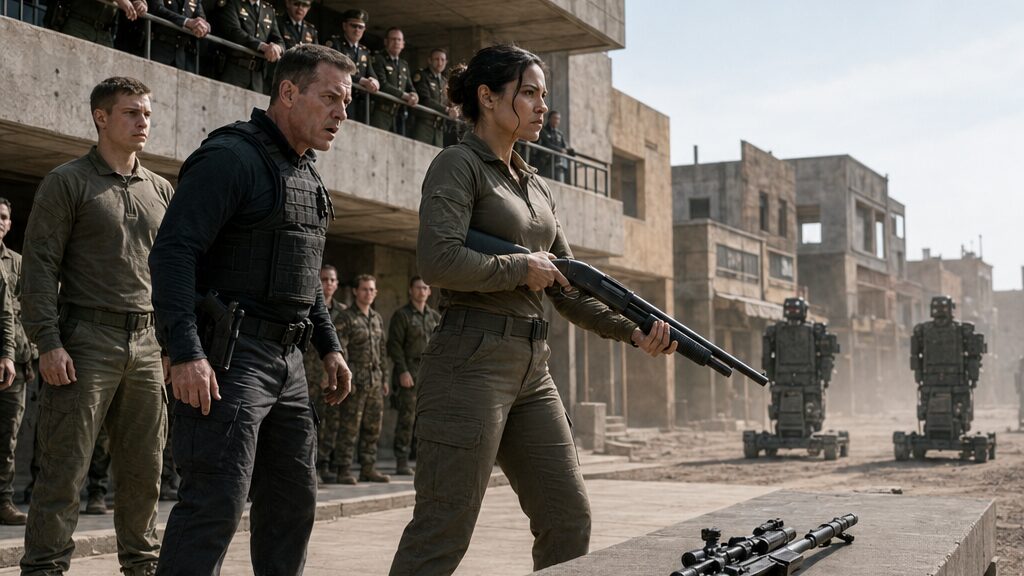
Above them, on the VIP balcony, high-ranking officers watched from behind dark glass and railings. Their uniforms were pressed, their faces unreadable. A demonstration packet sat in each officer’s hand, clipped and printed with names, lane numbers, drill times, and safety notes. Down below, every soldier knew the balcony mattered even when no one looked up.
Kevin wanted them looking up.
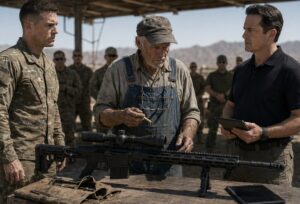
He paced the line like he owned the concrete, wearing his range safety vest over clean tactical gear and the combat knife he always carried at his belt. The knife did not look used for work. It looked displayed. Black handle, polished edge, placed where every eye would catch it when he turned.
“Again,” Kevin said.
The target system reset with a dull clank. Somewhere inside the village, gears engaged behind the fake storefronts. A painted door swung open. Another threat silhouette rolled into view.
Catherine Ramirez lay two lanes down from Robert, low behind her SR-25, eyes steady through the optic. She had arrived with no announcement and almost no gear beyond what was required. No loud patches. No story-swapping near the benches. No grin for the officers overhead. Her dark hair was tied back loosely enough that a strand had escaped along her cheek, but nothing else about her seemed out of place.
She breathed once.
The target appeared.
Her rifle cracked.
The silhouette took the round in the center mass box before the mechanism had finished its lateral slide.
No one cheered. On Kevin’s range, cheering without permission was another way to get noticed. Catherine did not check who had seen. She just reset her breathing and waited for the next command.
Robert had seen.
He was trying not to show it.
He had been on enough ranges to know the difference between a good shot and a shot that seemed inevitable. Most people chased the target. Catherine let it arrive where she had already decided it would be. Her hands did not tighten. Her shoulders did not rise. After firing, she settled so still that the dust around her elbows seemed louder than she was.
Kevin passed behind her without speaking. For a moment Robert thought maybe he had missed it, maybe Kevin’s hunger for a public mistake had kept him focused on the weaker lanes.
Then one of the mechanized targets jammed.
It stopped halfway out of a fake apartment window, angled wrong, its metal track grinding behind the plywood. A safety light blinked amber at the side of the lane. Several soldiers lifted their heads. Robert did too, grateful for any interruption that was not aimed at him.
Catherine did not lift hers. She eased her finger straight, settled the rifle safe, and waited. Her breathing changed by almost nothing, but Robert caught it because he had started watching her instead of the target. She took the delay into herself and made it part of the drill.
Kevin caught Robert watching.
His eyes moved from Robert’s face to Catherine’s lane, then up toward the balcony. A small shift went through him, almost too fast to read. Irritation first. Then opportunity.
“Range hold,” Kevin called.
The line froze.
The amber light stopped blinking when a technician inside the control shack killed the track. The jammed target hung in the window like a half-finished accusation.
Kevin walked to the center of the concrete pad and turned so his voice would carry both to the line and to the balcony.
“This is exactly what gets people killed,” he said. “Machines hesitate. Doors stick. Targets don’t respect your little plan. Pressure does not care about your comfort.”
No one answered.
Catherine remained behind her rifle.
Kevin’s gaze found her again.
“You,” he said.
She lifted her eyes from the optic, not her whole head.
Kevin smiled as if she had already failed.
“Name.”
“Ramirez.”
“Full voice.”
“Catherine Ramirez.”
On the balcony, one of the officers shifted through the demonstration packet. Patricia Hill, standing near the center rail, paused at the page in front of her. She had the stillness of someone who had recognized a word but not yet decided what to do with it.
Kevin did not notice. He was watching the line watch him.
“Temporary attachment,” he said. “That right?”
“Yes.”
“Quiet type.”
Catherine said nothing.
Kevin stepped closer to her lane. “Quiet gets sold as discipline by people who haven’t been scared hard enough.”
Robert felt his stomach tighten. He wanted to look away, but something in Catherine’s stillness made that feel worse than watching. The whole line had gone alert in the way soldiers did when the danger was not downrange anymore.
Kevin crouched beside Catherine’s rifle without touching it. “You think because you can print a cute little group on paper, you understand this place?”
Catherine’s cheek rested near the stock, her posture unchanged. “I understand the lane.”
“The lane,” Kevin repeated, louder, making it a joke for the balcony. “Hear that? She understands the lane.”
A few soldiers gave cautious laughs. Robert did not. Neither did Shirley Lee, the range medic standing near the aid table with her bag half-zipped and her hands folded too tightly.
The jammed target creaked in the plywood window as wind pushed through the simulation village.
Kevin straightened. “Reset the target,” he called.
The technician’s voice crackled over the speaker. “Track is fouled, thirty seconds.”
Kevin kept his eyes on Catherine. “No problem. We can use thirty seconds.”
Catherine finally lifted her head fully. Her expression did not change, but Robert saw something narrow in her eyes. Not fear. Calculation.
Kevin leaned into her lane until his shadow fell across her rifle.
“Let’s see,” he said, “if the quiet one can pull a trigger under pressure.”
Chapter 2: The Bipod Hit Concrete In Front Of Everyone
Kevin’s boot struck the bipod before Catherine could move the rifle.
The metal legs snapped backward, collapsed, and slapped the concrete with a clatter sharp enough to make three soldiers turn their muzzles down by instinct. Catherine’s SR-25 dipped hard at the front, the barrel dropping toward the lane mat before her support hand caught the handguard and held it clear.
For one second, the range forgot how to breathe.
Then Kevin’s voice filled the gap.
“You’re dead,” he screamed, bending over her shoulder. “Dead before you even knew the ground changed.”
Catherine’s palm stayed under the rifle. Her finger was straight. The safety was engaged. Her cheek had lifted from the stock, but nothing else about her moved quickly. Not even after he had put his boot into her equipment in front of the entire firing line.
On the balcony, Patricia Hill’s hand stopped moving over her packet.
Robert stared at the folded bipod legs. He had watched instructors kick dirt near boots, slap helmets, throw empty magazines to make a point. He had never seen one kick the support out from under a weapon on a live-fire line and call it instruction.
Shirley Lee stepped forward from the medic table. “RSO—”
Kevin spun on her. “Range is cold under my command.”
“The weapon was mounted and controlled,” Shirley said, careful but firm.
“And now it is safer because I am controlling the lesson.” Kevin pointed toward the red flag at the side of the lane. “You want to talk procedure in front of the VIP deck, Lee, or do you want to let me run my range?”
Shirley stopped, but her jaw held tension. She looked at Catherine, not Kevin. Catherine gave the smallest shake of her head.
Do not.
It irritated Robert that he understood it. It irritated him more that he obeyed the same thing without being told. Everyone stayed where Kevin wanted them: quiet, visible, available.
Kevin turned back to Catherine. “You didn’t even flinch.”
Catherine lowered the SR-25 carefully onto its side, muzzle downrange, action visible.
“That was safe,” she said.
It was the wrong answer for Kevin because it was not afraid of him.
His neck flushed under the collar. “Safe?” He laughed once toward the balcony. “You hear that? She thinks this is about safe.”
No one above laughed. The officers watched. That only made Kevin louder.
“This is about whether you have the instinct to act when the world takes your perfect little platform away.” He kicked the collapsed bipod again, not hard this time, but enough to make the metal scrape. “This is about whether you freeze.”
Catherine rose to one knee. Dust clung to the sleeve of her uniform. Her hair had loosened further, a dark strand cutting across one cheek. She tucked it back with two fingers, not hurried, not dramatic.
Robert realized he had been waiting for anger. He wanted it, maybe. A raised voice. A refusal. Something that would give everyone permission to name what had just happened.
But Catherine only said, “The line should be reset before the next drill.”
Kevin’s smile changed. It thinned.
“You don’t give range commands here.”
“No,” Catherine said. “You do.”
The answer should have satisfied him. It did not. It held up a mirror he did not want.
He walked around her lane, placing himself where every soldier could see his profile and every officer above could see Catherine below him.
“You know what I see?” he said. “I see a shooter who can hold still when things are tidy. I see paper discipline. I see someone who likes distance because distance lies.”
The target system behind him came alive again with a low electric groan. The jam had cleared. A silhouette rolled from behind a plywood sedan, black against sun-bleached paint. Nobody fired. The range remained cold.
Kevin jabbed a finger toward the moving target. “That thing does not care about your quiet. A hallway does not care. A corner does not care. The person coming at you does not care that you qualified clean in whatever soft lane sent you here.”
Catherine’s eyes flicked once toward the balcony.
Patricia Hill was watching her now, not Kevin.
That was the first time Kevin seemed to understand he did not fully own the room. He followed Catherine’s glance upward, saw the officers’ attention, and turned it into fuel.
He stepped closer until his boots nearly touched the edge of her mat.
“You know what you don’t have?” he said.
Catherine did not answer.
Kevin leaned down and shouted so hard the cords stood in his neck. “Killer instinct.”
The words struck the line differently than the boot had. The boot had been unsafe. The words were personal.
Robert saw Catherine’s hand close once against her thigh, then open. It was almost nothing. If he had not been watching her like a lifeline, he would have missed it.
Kevin did not miss it.
“There it is,” he said softly, pleased. “There’s the crack.”
Catherine looked up at him. “No.”
“No?”
“No crack.”
A few soldiers shifted.
Kevin’s face hardened. “You think this is calm? This is hesitation dressed up pretty.”
Shirley moved again, this time only half a step. “Kevin.”
He sliced one hand through the air without looking at her. “Not now.”
“You created a safety issue.”
“I created pressure.”
“You kicked equipment under a weapon.”
“It was cold.”
“It became cold because she made it cold.”
That landed.
Kevin went still for half a breath. Robert saw it: the brief, dangerous moment when Kevin knew someone had said the truth too cleanly. He could either step back and accept the correction, or he could make retreat impossible.
His hand moved to the shotgun on the equipment table.
It was not standard for the drill. Everyone knew that. The 12-gauge pump-action had been sitting there all morning like a prop in a speech Kevin had been waiting to give. Heavy slug rounds sat in a neat line beside it. The weapon was polished and staged, his favorite showpiece for demonstrations about close-range violence and authority.
Kevin picked it up.
The line tightened.
He held it across his chest and turned toward Catherine.
“You want safe?” he said. “Fine. Let’s make it simple. No bipod. No fancy glass. No soft little precision cradle. Just recoil, pressure, and a trigger.”
Catherine looked at the shotgun, then at him.
Kevin pumped it once, empty, just for the sound. The action snapped through the range like a metal door slamming shut.
“This,” he said, “is what pressure sounds like.”
Chapter 3: The Showpiece Weapon Became His First Mistake
Kevin lifted the shotgun toward the far end of the simulation village and pointed with the barrel at a paper target clipped near the 200-yard berm.
“See that?” he called. “Two hundred yards. Paper on staples. You miss, it stays. You hit sloppy, it tears. You hesitate, everyone sees.”
The target looked small from the firing line, a pale rectangle beyond the plywood streets, beyond the rolling silhouettes, beyond the dust shimmering over the concrete. Someone had taped a coin to the center, probably for one of Kevin’s demonstrations, a little bright circle catching sun when the wind pressed the paper flat.
A shotgun with slugs could hit at distance in trained hands, but Kevin was not offering a fair drill. He was offering a public trap dressed as instruction.
Catherine stood beside her collapsed bipod and watched him build it.
“Pressure,” Kevin said, rolling the word around for the balcony, “does not care what weapon you prefer. Pressure hands you what is available.”
He turned and thrust the shotgun toward her.
Catherine did not take it.
The refusal was so small it barely looked like one. Her hands remained at her sides. Her shoulders stayed level. She looked at the weapon, then at the line, then at Shirley.
“Is the line safe?” Catherine asked.
Her voice carried because everyone else had stopped making sound.
Kevin blinked. “What?”
“Is the line safe?”
A murmur moved through the soldiers and died immediately.
Kevin gave a short laugh. “That’s your question?”
“It’s the first one.”
Up on the balcony, Patricia Hill lowered her demonstration packet. Beside her, an aide leaned close and whispered something. Patricia did not look away from Catherine.
Kevin heard whispers above him and mistook them for impatience. “The line is safe because I say it is safe.”
Catherine’s gaze stayed on him. “Range status.”
His jaw tightened. “Cold.”
“Medical ready?”
Shirley answered before Kevin could stop her. “Ready.”
“Target lane clear?”
The technician’s voice crackled over the speaker after a beat. “Lane clear.”
Catherine finally held out her hand.
Kevin smiled as if he had won. He placed the shotgun into her grip with theatrical care, then leaned in close enough that only the first two lanes and the balcony microphones might catch him.
“Don’t hide behind procedure now.”
Catherine’s fingers wrapped around the stock and fore-end. She checked the chamber, checked the safety, checked the muzzle line. No hurry. No tremor. Her movements did not flatter the weapon or the man who had handed it to her.
On the balcony, Patricia turned a page back in the packet.
“Where is her marksmanship record?” she asked quietly.
The aide at her side scanned the page. “Temporary attachment list only.”
“That is not what I asked.”
“It is not included, ma’am.”
Patricia’s eyes narrowed. “Why?”
The aide had no answer ready. He looked down toward the range as if the missing line might be visible somewhere near Catherine’s boots.
Below, Kevin clapped once. “All eyes here.”
Robert felt the order crawl over his skin. He turned because disobeying Kevin on a live range carried consequences even when Kevin was the danger.
“Every soldier on this line,” Kevin said, “is going to watch what happens when someone confuses quiet with readiness.”
Catherine looked at the target again. The coin flashed once.
Something changed in her face, not enough for Kevin, but enough for Robert. Until then she had seemed to be enduring him. Now she seemed to be measuring something that had nothing to do with his voice.
Kevin loaded the first slug into the tube, then another, working loudly, letting each round become part of the performance. “Heavy recoil,” he said. “No bench. No optic worth bragging about. No bipod. No excuses.”
Catherine said nothing.
The shotgun came back to her hands. It weighed differently from the SR-25. It wanted a different stance, a different conversation with bone and breath. She settled it low for a moment, feeling the balance. Kevin watched, hungry for the slightest awkwardness.
He found none.
That irritated him more than fear would have.
“You know,” he said, turning halfway to the balcony, “some people think credentials make fighters. They don’t. Paper does not pull the trigger. Trophies do not clear rooms. Pretty groups do not save lives.”
Catherine’s eyes flicked to him at the word trophies.
It was gone quickly, but something in it made Shirley straighten.
Kevin stepped closer. “What, that one touched something?”
“Stand clear of the firing side,” Catherine said.
A few soldiers looked down.
Kevin’s mouth opened, then closed. A safety instruction from him would have sounded like command. From her, it sounded like fact.
He moved back half a step, forced to obey the rule he used on everyone else.
Catherine placed one foot forward, one back. Not wide. Not dramatic. Her body aligned to receive the recoil without fighting it. She angled her head once, clearing the loose strand of hair from her cheek. Her breathing slowed until even Robert, who had been listening for it, could not catch it anymore.
Kevin tried to recover the room.
“Take your time,” he said loudly. “Maybe by sunset you’ll find that killer instinct.”
Catherine did not shoulder the weapon yet.
She looked toward the balcony. Not for permission. Not for rescue. Patricia Hill met her gaze from above, and in that brief connection Robert sensed a conversation no one else had been invited into.
Patricia knew something.
Catherine knew Patricia knew.
Kevin knew only that attention had drifted away from him again.
His voice sharpened. “Ramirez.”
Catherine turned back.
“If you’re going to embarrass yourself,” he said, “do it where the whole unit can learn from it.”
She looked at the paper target at the far end of the village. She looked at the moving silhouettes resting behind plywood corners. She looked at the fallen bipod legs beside her SR-25.
Then she took one slow step to the firing mark.
“Catherine,” Shirley said, low enough that it could have been concern or warning.
Catherine did not look away from the lane. “I know.”
Kevin smirked. “You know what?”
She brought the shotgun up.
For the first time all morning, Kevin stopped talking before he meant to.
Catherine worked the pump with a hard, clean motion. The round chambered with a metallic crack that snapped against the fake storefronts and came back from the berm.
Every officer on the balcony leaned forward.
Every soldier on the line held still.
Catherine’s voice was calm, cold, and just loud enough to carry.
“Then watch pressure behave.”
Chapter 4: The Coin At Two Hundred Yards Had No Center Left
The chambering sound cut Kevin’s next insult in half.
It struck the plywood storefronts, ran down the empty lanes, and came back thinner from the berm. Catherine held the shotgun like it had finally stopped being Kevin’s prop and become only a tool. Her cheek settled against the stock. Her left hand locked forward on the pump. Her stance did not widen for show.
Kevin’s mouth remained open.
No words came out.
The target at 200 yards fluttered at its staples, a pale square pinned against the backer. The coin taped to its center winked once in the sun, too small to matter to anyone who thought loudness was a measurement.
Catherine did not aim at the coin first.
Robert realized that only after the first shot.
The shotgun fired with a brutal, flat thunder that pushed through every chest on the line. Dust lifted from the concrete. The paper target snapped at its upper left corner.
The staple vanished.
No one understood it yet.
Kevin flinched backward, then hid the movement by turning his shoulder. “Low left,” he barked, too fast, too eager. “She pulled—”
Catherine pumped the action.
The empty hull spun out and bounced on the concrete.
The second shot cracked before Kevin finished the lie.
The upper right corner of the paper jumped free.
This time the balcony reacted. Not with applause. Not with speech. With leaning bodies and stopped hands and officers lowering their packets because the paper had begun to tell a story their forms had missed.
Robert’s throat tightened.
She was not trying to hit the target.
She was removing what held it.
Kevin saw it then too. His hand moved once, as if he could stop her with a gesture, but range authority had no place between a shooter and a live trigger once he had ordered the whole unit to watch.
Catherine fired again.
The lower left staple disappeared.
The target twisted, hanging by one corner now, rocking in the backstop wind. Behind it, briefly visible through the tilt, was a second darker backer with the coin’s shadow marked at center.
Shirley had her hand near her radio. She did not lift it. Her eyes had moved from Kevin’s face to Catherine’s hands, and whatever concern she carried had changed shape. It was no longer fear of an accident. It was recognition of control so complete it made the earlier abuse look smaller and uglier by comparison.
Kevin forced out a laugh. “Cute trick.”
Catherine cycled the pump.
The fourth shot tore the last staple clean from the lower right corner.
The paper target fell.
It did not rip. It did not tumble violently. It slid loose and fluttered downward in a slow pale sheet, freed from all four corners as if someone had unpinned it by hand. The range watched it drop. Even the mechanized village seemed to hold still, its targets parked behind windows and fake doors like witnesses that had forgotten their cue.
Then the paper hit the dirt.
Behind it, the second backer stood exposed.
At its center, the coin had a hole through it.
Not chipped. Not bent loose. Punched clean through the middle.
Robert heard someone behind him inhale hard. He did not know who. He only knew his own fingers had gone numb around his rifle sling.
Catherine lowered the shotgun slightly, muzzle still safe, eyes still downrange. She had not smiled. She had not looked at Kevin. She had not looked at the balcony. The whole act had taken less time than one of Kevin’s speeches.
The silence afterward lasted longer.
It was not empty. It was full of everything Kevin had said and could not take back. Dead. No killer instinct. Pressure breaks people like you.
Above the line, Patricia Hill stood motionless at the balcony rail. Her aide leaned toward her, but she lifted one hand without looking at him. Wait.
Kevin stared downrange at the backer. His face had lost color unevenly, around the mouth first.
“That’s not—” he started.
Catherine opened the action, checked the chamber, and held the weapon where Shirley could see it clear.
Shirley’s voice came clean across the line. “Weapon clear.”
The words did something Kevin’s shouting had not done all morning. They restored order.
Catherine stepped back from the firing mark. A strand of hair had fallen across her cheek again. She flipped it back with the back of her wrist, not for style, not for the watching officers, but because it was in her eye.
Kevin looked at the fallen paper, then the coin, then the shotgun.
His hand reached for the weapon as if ownership of it might restore the world. Catherine did not resist. She handed it back butt-first and safe. The care of the handoff made the humiliation worse.
“You planned that,” Kevin said.
Catherine said nothing.
“You saw the target before,” he pressed. “You knew the staples. You knew the distance.”
“Yes,” she said.
The admission gave him a little air. “So it was rehearsed.”
“No.”
“No?” He gave a sharp laugh. “You expect me to believe you just decided to do that?”
“I decided not to miss.”
The line stayed silent.
Kevin’s eyes flicked up to the balcony. He needed someone there to frown. Someone to treat the shot as unsafe, arrogant, improper. But the officers looked down with the hard attention of people who had just watched a question answer itself.
Patricia finally spoke to her aide, too quietly for the firing line to hear, but Robert saw the aide stiffen and write something on the packet margin.
Kevin noticed that too.
His anger returned with fear inside it.
“Range theatrics don’t impress me,” he said, but his voice no longer filled the concrete. It scraped against it. “A target doesn’t shoot back.”
Catherine’s eyes moved to him then.
For the first time, Robert saw something behind the calm that was not calm at all. Not anger. Not pride. Something older and colder. Something that had heard similar words in a place with no balcony and no demonstration schedule.
Kevin must have seen a piece of it because he took a half step back before catching himself.
The shotgun hung low in his hand.
“Where,” he said, quieter now, “the hell did you learn to shoot like that?”
Catherine’s gaze stayed on him, but for a breath she was not on the range.
The fake storefronts seemed to flatten. The mechanical tracks, the bleached target paper, the officers above, the soldiers beside her—all of it thinned behind the memory of a different silence. One that came after real thunder. One that did not end when a drill ended. One where no instructor yelled because no one was left to hear him.
Her fingers closed once, then opened.
She had won the range.
That was the problem.
Winning made the old door open.
Kevin swallowed. The question hung between them, smaller than he intended and larger than he understood.
“Where the hell,” he repeated, almost whispering, “did you learn that?”
Chapter 5: The Only One Who Walked Out Did Not Celebrate
Catherine ejected the last shell and let the casing hit the concrete before she answered him.
It bounced once beside her boot, rolled in a half circle, and came to rest in the dust shaken loose by her shots. No one bent to pick it up. Not Kevin. Not Robert. Not the officers above, who had begun moving down from the balcony with the slow inevitability of a storm arriving after the damage.
Catherine looked at Kevin Scott until his eyes stopped searching for somewhere else to land.
“Olympic gold,” she said. “Precision shooting.”
The line changed around her. Not loudly. The reaction passed through the soldiers in restrained pieces: a lifted chin, a tightened jaw, a glance toward the backer where the coin had no center left. Robert felt heat crawl up his neck. It was not embarrassment for himself, exactly. It was embarrassment at how quickly all of them had allowed Kevin to define what they were seeing.
Kevin blinked. “That’s cute.”
The word came out thin.
Catherine’s expression did not move.
“Then,” she said, “a classified operation.”
Shirley’s eyes dropped to the casing by Catherine’s boot.
Kevin tried to laugh. “Sure.”
Catherine stepped close enough that he had to choose whether to back up in front of everyone. He did not move, but his grip tightened around the shotgun.
Her voice lowered.
“I was the only one who walked out.”
The range did not become silent then. It had already been silent. It became something else. Something heavier. The kind of quiet that did not belong to humiliation anymore, but to the dead space around a truth no one had permission to ask about.
Kevin’s face changed slowly. He wanted to reject it. Robert could see that. He wanted to call it a story, a trick, another kind of credential. But Catherine had not said it like a person using pain as rank. She had said it like a person naming the edge of a hole and refusing to invite anyone closer.
Patricia Hill reached the bottom of the balcony stairs with two officers and her aide behind her. She did not hurry across the concrete. Her eyes moved first to Catherine, then to the fallen bipod, then to Shirley.
“Range status,” Patricia said.
Shirley answered before Kevin could. “Cold. Weapons clear. No injuries.”
Patricia nodded once. “Safety concern?”
Kevin snapped back into himself. “No safety concern, ma’am. Demonstration stress drill. I was evaluating response under disrupted position.”
Shirley’s mouth tightened.
Patricia looked at her. “Medic Lee?”
Shirley hesitated.
Kevin turned his head slightly. It was not a threat anyone could quote later. Just his stare, sharpened by habit.
Catherine saw Shirley’s hesitation and hated that she understood it. Silence was a skill. Kevin had turned it into a cage for everyone else.
Shirley lifted her chin. “The bipod was kicked out from under a mounted weapon during a posture check. The shooter controlled it and made the line safe. The disruption was unnecessary.”
Kevin’s face flushed again. “With respect, range instruction is not a medical assessment.”
“No,” Patricia said. “But safety is.”
That single sentence moved the room. Kevin heard it. So did every soldier who had ever watched him wrap ego in procedure and dare someone lower-ranked to challenge the knot.
He tried another angle. “Ma’am, what happened afterward was reckless showboating. Taking a slug gun to a two-hundred-yard paper target for a stunt—”
“You ordered the unit to watch,” Patricia said.
Kevin stopped.
“You provided the weapon,” Patricia continued. “You set the target. You declared the line cold, then safe. You framed the drill as pressure response.”
His jaw worked, but no useful sound came.
Patricia finally looked at Catherine. There was recognition in her face now, and something like regret kept behind discipline.
“Ramirez,” she said.
“Ma’am.”
“You are finished on the line for now.”
Kevin’s shoulders lifted slightly, almost relief.
Patricia saw that too. “The demonstration is paused pending review of range conduct.”
The relief died.
A low movement passed through the line—not sound, exactly, but the collective adjustment of people realizing an authority had cracked in public. Kevin’s fingers hovered near the knife at his belt before he remembered the shotgun in his hands and set it on the equipment table harder than necessary.
“This is a mistake,” he said. “You let one visiting shooter embarrass range command in front of VIPs, you undermine the whole training culture.”
Patricia’s eyes cooled. “Training culture is exactly what is under review.”
Kevin looked at Catherine then with open resentment. Not because she had beaten him. Because she had revealed him without raising her voice.
Catherine felt no satisfaction.
That irritated her more than his anger.
She had imagined, in the old days before she stopped imagining endings, that a perfect shot should bring the clean click of completion. Target down. Threat ended. Breath released. But the operation had taught her otherwise. There were shots that saved your life and still left you carrying what the bullet could not repair.
The coin at 200 yards had been easy compared with staying present after.
Robert moved only when Shirley gestured him toward the far end to help retrieve the fallen target. The paper lay in the dust like something that had surrendered without being struck. Its four corners were clean where the staples had been. No ragged tears. No wild holes. He carried it back carefully, two fingers pinching the edge, afraid even his touch might ruin what everyone had seen.
At the equipment table, Kevin had stripped off his vest and thrown it over a chair. His combat knife lay beside the cleared shotgun, its black handle angled toward the target sheet as if it had been placed there for a photograph.
Robert set the paper down.
The coin backer arrived a moment later in another soldier’s hands. Someone had removed the coin from the tape and placed it on the table. The hole through its center caught the light.
No one joked now.
Kevin reached for his knife, then stopped when Patricia’s aide called his name from near the control shack.
“Scott. Statement.”
It was not a request.
Kevin’s eyes flashed toward Catherine once more before he turned away. He left the knife on the table.
Catherine saw it.
So did Robert.
He looked from the knife to the target sheet, then to Catherine. For the first time all morning, he spoke to her without being ordered.
“What do we do with it?”
Catherine looked at the flawless paper lying beside the blade Kevin had worn like proof of himself.
She should have said, Evidence.
She should have said, Leave it.
She should have said nothing.
Instead she felt the silence around the younger soldiers, the way it still held Kevin’s voice even after he had walked away.
She did not answer Robert.
Not yet.
Chapter 6: The Knife On The Wall Was Not Revenge
Robert carried the target sheet into the barracks like evidence he was afraid might accuse him too.
He held it flat against a piece of cardboard scavenged from the supply room, both palms spread wide so the corners would not bend. The paper was almost ordinary under the fluorescent lights. That made it worse. Four clean freed corners. A center mark aligned with the hole in the coin backer. No dramatic tear. No wild proof of struggle. Just precision so complete it looked quiet.
Soldiers followed him into the common room in ones and twos, pretending they had reasons to be there. A canteen refill. A misplaced glove. A phone charger. No one said they had come to look.
Catherine stopped in the doorway.
She had meant to go past. Shower. Clean the dust from her sleeves. Put the range in a sealed compartment with all the other things that waited behind her eyes and made no noise unless touched.
Then someone near the back of the room imitated Kevin’s voice.
“You’re dead.”
It was meant as a joke. The soldier even smiled after saying it.
But Robert flinched.
So did another young soldier near the vending machine, a quick shoulder jerk he tried to hide by reaching for a drink he did not buy.
Catherine saw both movements.
Her hand remained on the doorframe.
The room noticed her noticing, and the weak laugh died.
Robert lowered the cardboard onto the center table. “Sorry,” he said, though he had not been the one who spoke.
Catherine stepped inside.
“No,” she said.
The word was not loud, but everyone made space for it.
The barracks common room smelled of old coffee, boot polish, and overheated wiring. A bulletin board hung on one wall beneath notices about inspection schedules, equipment turn-in, and weekend restrictions. Beside it were old unit photos and laminated safety reminders no one read unless something had already gone wrong.
Robert looked at the target sheet. “They’ll take it for the review.”
“Maybe,” Catherine said.
“Then we shouldn’t have brought it here.”
“Maybe not.”
That answer confused him. He had expected certainty from her after the range. Everyone had. It was part of the mistake they were already making—turning her into something easy because Kevin had failed to break her.
She moved closer to the table and looked down at the paper.
It would be simple to let it become gossip. By night, the story would grow teeth. Kevin’s face. Kevin’s stammer. Catherine’s shots getting farther and faster with every retelling. By morning, it would belong to everyone except the people who needed to understand it.
Robert touched one clean corner. “I kept thinking he’d do it to me next.”
Catherine looked at him.
He swallowed, embarrassed now that he had said it. “Not today. I mean before. Every time we’re on his line. I keep my head down. I thought that was the smart way.”
“It can be,” Catherine said.
“Was it for you?”
She did not answer quickly enough.
Robert looked away first.
That was the problem with silence. Sometimes people filled it with the truth before you were ready to give it.
Shirley entered carrying a sealed plastic bag with the casing inside. She paused when she saw the target on the table. “Patricia Hill is still taking statements.”
“Kevin?” Robert asked.
“In the admin room.” Shirley’s mouth flattened. “Explaining doctrine.”
A few soldiers exchanged glances. Someone muttered, “Of course.”
Shirley set the casing bag on the table beside the target sheet. “She’ll need this.”
Catherine looked at the plastic bag, then at the wall.
The bulletin board was crowded with paper no one respected. Rules printed in block letters. Range reminders curling at the edges. A faded sign said DISCIPLINE IS EVERYONE’S RESPONSIBILITY.
Kevin’s voice lived comfortably under signs like that.
“Do you want it gone?” Shirley asked quietly.
Catherine knew what she meant. Not the target. The attention. The story beginning to gather around her name. The pressure of being looked at with gratitude, curiosity, hunger. The temptation to disappear again behind clean professionalism.
“Yes,” Catherine said.
Robert’s face fell.
Then Catherine added, “But that doesn’t mean it should go.”
The door opened hard enough to strike the wall.
Kevin Scott walked in without his safety vest. Without the shotgun. Without the balcony watching. He looked smaller in the barracks and angrier for it. His belt was empty where the knife should have been, though he did not seem to realize it until his eyes found the table.
“What is this?” he said.
No one answered.
His gaze fixed on the target sheet. “You brought range materials into barracks?”
Robert stepped back.
Kevin saw the movement and regained a piece of himself. “Miller. Pick it up.”
Robert’s hand twitched.
Catherine spoke before he could obey. “No.”
Kevin turned to her. “You don’t command here.”
“Neither do you right now.”
His face hardened. “Careful.”
Shirley moved closer to the table. “Kevin, you’re supposed to be in admin.”
“I’m supposed to be making sure a training artifact doesn’t become barracks theater.” He pointed at the target. “Take it down. Pack it up. Whatever story you people think you saw today, it ends now.”
Catherine looked at the knife on the table.
Kevin followed her gaze. His hand went automatically to his empty belt.
The room saw it happen.
A flush crept up his neck. “That’s mine.”
“Yes,” Catherine said.
“Hand it over.”
She picked it up.
The weight was balanced, expensive, unnecessary for what came next. Kevin had worn it all morning as if courage could be displayed at the hip.
Catherine carried the target sheet to the bulletin board.
Kevin stepped forward. “Ramirez.”
She placed the paper over the faded safety sign.
“This is not revenge,” she said.
No one moved.
“If it were revenge, it would be about you.”
Kevin’s jaw tightened.
Catherine raised his knife.
“This is about every person you taught to confuse fear with discipline.”
She drove the blade through the clean top margin of the target sheet and into the corkboard behind it.
The thunk filled the common room.
The paper held.
Kevin stared at his own knife pinning his humiliation to the wall, and for once, no one needed him to shout to understand what had happened.
Chapter 7: After The Thunder, Nobody Needed Him To Shout
Morning formation began without Kevin Scott’s voice.
That was the first thing everyone noticed and the last thing anyone named. Soldiers stood in ranks outside the barracks, boots aligned on painted lines, rifles secured, eyes forward. The air carried the usual sounds of a range day waking up—the distant clank of target tracks, a vehicle reversing near the control shed, someone closing an ammo can too hard—but none of it had to compete with Kevin screaming a lesson before sunrise.
Catherine stood near the end of the formation, hands still, face unreadable.
Inside the barracks common room behind her, Kevin’s knife still pinned the target sheet to the wall.
Nobody had taken it down.
A few soldiers had passed it before formation and slowed without meaning to. Robert Miller had stopped outright. He had looked at the four clean corners, the hole in the coin backer taped beside it, and the black handle of the knife driven through the paper’s top margin. Then he had squared his shoulders and walked outside without saying anything.
That silence was different from the old one.
Patricia Hill arrived with her aide while the formation waited. She carried no packet this time. Only a thin folder tucked under one arm. Shirley Lee stood near the medic table by the range entrance, watching both Patricia and Catherine with the wary calm of someone who knew official words could either clean a wound or cover it.
Patricia faced the line.
“Range operations will continue today,” she said. “With modifications.”
No one moved.
“Kevin Scott has been removed from live-fire authority pending review.”
A ripple passed through the formation, controlled but unmistakable. Robert’s fingers tightened once against his trouser seam. Catherine kept her eyes forward.
Patricia let the information settle without feeding it. “This is not a celebration. This is not a story for entertainment. A safety role is not a stage. A correction is not a humiliation ritual. Pressure training is not permission to create avoidable danger.”
The words landed harder because she did not raise her voice.
Catherine felt them pass through the line, touching places Kevin had left bruised without ever striking anyone. She should have felt relief. Part of her did. Another part wanted to step backward into anonymity before gratitude could find her.
Patricia turned slightly. “Ramirez.”
Catherine stepped out.
The formation watched her with a new attention she did not like. Yesterday they had watched to see whether Kevin would break her. Today they watched as if she might explain how not to break.
Patricia opened the folder and removed a single page. “There will be a formal note added to the training review regarding your weapon control, safety awareness, and performance under disruption.”
Catherine looked at the page but did not take it.
Patricia’s brow shifted almost imperceptibly.
“Ma’am,” Catherine said, “the note should include the sequence before the shot.”
“It does.”
“And the first error.”
Patricia held her gaze. “It does.”
Catherine glanced toward the range village, where the false storefronts waited in the distance, bright in the morning glare. “Then add that nobody corrected it when it was still small.”
The formation stayed still, but the sentence moved through them.
Patricia did not answer immediately.
Catherine knew she had stepped near the line officers hated—the place where responsibility stopped being one man’s misconduct and became a room full of people watching. She had lived too long in silence to pretend she did not recognize its usefulness. Silence kept order. Silence preserved careers. Silence let a person survive a minute they did not know how to challenge.
It also let Kevin kick the bipod.
Patricia lowered the page slightly. “Including me?”
Catherine turned back to her. “Yes, ma’am.”
The aide looked down. Shirley’s eyes sharpened. Robert stopped breathing for half a second.
Patricia folded the paper once, cleanly. “Noted.”
It was not an apology. It was better than one. It was a door left open where a wall had been.
The morning drill resumed with a different instructor calling range commands from the control line. His voice was firm, not theatrical. The first soldiers moved to their lanes with the awkwardness of people waiting for a blow that did not come.
Robert took position behind his rifle. His target glided from behind a plywood doorway, paused in a window, then moved laterally across a fake alley. His first shot was late, but not wild. He exhaled, reset, and did not look over his shoulder for Kevin.
Catherine watched from behind the line.
“Again,” the instructor called.
Robert adjusted his grip. The target reappeared. He fired. The hit landed inside the marked box.
No one shouted in his ear.
Robert looked almost startled by the absence.
Catherine felt something in her chest loosen, then resist loosening. Her body did not trust peace just because the range had gone quieter. Peace had to prove itself too.
Patricia came to stand beside her while the next sequence loaded.
“The target in the barracks,” Patricia said. “Some consider it unprofessional.”
“I know.”
“They want it removed before the review team arrives.”
Catherine watched the moving silhouette slip behind a false wall. “Who is they?”
Patricia almost smiled. Almost. “People who prefer clean walls.”
“That wall was clean yesterday.”
“And today?”
“Today it tells the truth.”
Patricia looked toward the barracks. “Truth can become theater.”
“Yes.”
“Is that what you want?”
“No.”
The answer came too quickly. Catherine heard that herself and looked down at her hands. They were steady, as always. Steadiness had fooled people for years. Sometimes it fooled her.
She had told herself the knife on the wall was for them. For Robert. For the soldiers who flinched at a phrase. For the next person Kevin might have taught to obey fear and call it discipline.
But part of it had been for her too.
A mark left where silence had failed.
Catherine looked back at Patricia. “Leave it until the review is finished. Then replace it with the safety standard Kevin broke.”
Patricia studied her. “And the target?”
“Frame it without the knife. Put it in the range classroom if you want. Not as a trophy.”
“As what?”
Catherine watched Robert take another shot. This one landed cleaner.
“As a reminder that control is visible.”
Patricia nodded once. “And the knife?”
“Return it after the review.”
“To Kevin?”
“It’s his.”
Patricia’s eyes narrowed slightly. “You do not want to keep it?”
“No.”
“After what he did?”
Catherine looked toward the barracks wall she could not see from where she stood. “If I keep it, it stays about him.”
The next line of soldiers stepped forward. A young soldier near Robert hesitated when the target track jerked louder than expected. Robert leaned slightly toward him, not enough to break formation, and said something Catherine could not hear. The young soldier reset his shoulders and stayed on the rifle.
That was the small thing Catherine had wanted without knowing how to want it.
Not applause.
Transfer.
A lesson passing from one person to another without fear carrying it.
Shirley approached with the sealed casing bag in one hand. “Review team wants this logged.”
Catherine took it and looked at the dull brass inside the plastic. One shell casing. One hard sound. One moment the range could not unhear.
“You all right?” Shirley asked quietly.
Catherine almost gave the old answer.
Yes.
Fine.
Clear.
Instead she let the silence sit long enough to become honest.
“Not all the way.”
Shirley nodded. “Good enough for today?”
Catherine looked at Robert on the line, at Patricia writing a note by hand instead of letting her aide do it, at the instructor calling commands without needing to own the air.
“For today,” Catherine said.
The mechanized targets reset across the urban village. Doors opened. Silhouettes shifted behind false windows. The range waited, no longer dead, no longer loud for the sake of loudness.
Catherine stepped back from the firing line.
Behind her, in the barracks, Kevin’s knife still held the paper to the wall, but only for now. It had done what it needed to do. It had stopped a room. It had named a wrong thing. It had turned a bully’s symbol into a temporary pin for a permanent lesson.
Robert fired again.
The shot cracked clean across the range.
No one shouted after it.
No one needed to.
Catherine walked toward the edge of the concrete as the targets began moving again, and the first true silence after the thunder finally belonged to the living.
The story has ended.