They Sent A Forklift For His Late Wife’s Greenhouse, But The Cameras Were Already Live
Chapter 1: The Blue Hydrangeas Behind The Glass
The red tag was zip-tied to the greenhouse door handle, not the mailbox, not the front gate, not even the little cedar post where the HOA liked to tape its warnings like public shame.
Raymond Hill stopped with the hose in his hand and stared at it.
The tag swung slightly against the glass, bright as a warning flare in the morning sun. Behind it, blue hydrangeas crowded the greenhouse in soft, impossible clusters, their petals damp from the timed misting line he had repaired two nights earlier. Water ticked through the thin irrigation tubes with the steady patience of a heartbeat.
He did not move for several seconds.
Then he set the hose down in the gravel, wiped both hands on his work pants, and walked to the greenhouse door.
The tag had been pulled tight, the plastic tie biting into the brass handle Virginia had picked out fifteen years ago from a salvage shop three towns over. She had called it “unnecessarily pretty,” which meant she wanted it. Raymond had installed it that same afternoon while she stood inside the unfinished greenhouse holding a tray of baby hydrangeas like they were sleeping children.
He slipped a folding knife from his pocket and cut the tie carefully so the blade would not nick the brass.
The red tag dropped into his palm.
VIOLATION NOTICE — UTILITY MODIFICATION WITHOUT AUTHORIZED HOA INSPECTION.
Below that, in bold:
$500 INSPECTION FEE DUE BY 12:00 P.M. TODAY.
Raymond exhaled through his nose. He had known the fee was coming. He had expected some thin envelope, some printed threat, maybe an email with too many capital letters. The HOA never missed a chance to charge money for permission after the work had already been done.
But they had put this one on Virginia’s greenhouse.
He turned the notice over. A second sheet had been stapled to the back and sealed in a plastic sleeve against the dew. It was a diagram of his front yard. The greenhouse was a rectangle near the porch. The path was marked. The valve box near the east bed had a red circle around it.
Then he saw the solar panels.
They were drawn at the edge of the property line, shaded in gray, labeled: OBSTRUCTION-ADJACENT EQUIPMENT — SUBJECT TO CORRECTIVE ACCESS.
Raymond read the phrase twice.
A house finch landed on the gutter above the greenhouse and flicked its head at him, annoyed by his stillness.
“Corrective access,” he said aloud.
The words sounded like something people invented when they did not want to say breaking.
The water line had burst on Sunday, just before dusk. Raymond had found it because the hydrangeas nearest the west wall had begun to sag, their heads dipping as if ashamed. He had called the HOA office because the pipe ran under the front easement and the rules said repairs near visible landscaping required approval.
No one answered.
He filled out the online form. He attached photos. He checked the emergency box. A confirmation number appeared and promised review within five to seven business days.
The hydrangeas would not have lasted two.
So Raymond did what he had done all his life. He dug, cut out the cracked pipe, fitted a new section, checked the pressure, insulated the joint, and restored water before midnight. His knees hurt for hours afterward. Mud dried on his elbows. He had stood in the greenhouse with a flashlight, watching the leaves lift again, and for the first time that week he had slept without seeing Virginia’s hospital bed in his dreams.
Now a red tag hung where her hand used to rest.
The greenhouse was not large. Twelve feet by eighteen. Glass walls on a dark metal frame. A narrow brick path down the middle. Hydrangeas along both sides, blues deep enough to look almost painted, some purple at the edges where the soil had changed. At the far end sat Virginia’s stool, still tucked beneath the shelf where she used to keep pruning shears, twist ties, plant food, and an old radio that only picked up one station clearly.
Raymond stepped inside and closed the door behind him.
Warm, damp air touched his face. The smell of soil and leaves wrapped around him so quickly that his grip loosened on the notice. He could almost hear Virginia humming, not a tune exactly, just the little sound she made when she was content and thinking.
He checked the misting line by habit. The nozzles were working. No leaks near the repair. The pressure gauge held steady.
“You’re fine,” he murmured to the plants.
He did not know whether he was talking to the hydrangeas, the pipe, or himself.
A white envelope lay on the potting bench.
Raymond’s shoulders tightened.
He had not put it there.
The envelope bore the HOA stamp in the corner, and someone had written his name in block letters across the front. No postage. Hand-delivered. He glanced through the glass toward the street. The neighborhood was waking up in its usual careful way: garage doors lifting, sprinklers ticking, a jogger passing without looking left or right. Across the street, Linda Thomas stood on her porch with a mug in both hands. When Raymond looked up, she looked down into the mug as if it needed study.
He opened the envelope.
Inside was the same notice printed on heavier paper, plus a formal order headed by the board president, Karen Brown.
Failure to remit inspection fee by deadline may result in immediate corrective access to affected utility and obstruction-adjacent exterior equipment.
Raymond’s jaw worked once.
The phrase appeared again.
The paper continued:
Security personnel and contracted service providers are authorized to enter the visible frontage zone for remediation of hazards created by unapproved resident work.
He looked toward the solar panels outside, four clean black rectangles mounted low beside the greenhouse, angled toward the morning sun. He had installed them after Virginia died, partly because she had always wanted the greenhouse to run on its own power, partly because he needed a project that did not ask him how he felt.
They powered the small fans, the light strips, and the winter heating pads under the seed trays. In the first year after the funeral, he had checked them three times a day just to have a reason to go outside.
Now they were “obstruction-adjacent.”
Raymond folded the order carefully, too carefully. The old habit rose in him: keep your voice low, keep your papers straight, do not give them a reason. It had served him at factories, city counters, insurance offices, anywhere someone behind a desk had decided his rough hands meant he would not understand the rules.
He took his phone from his pocket and photographed the tag, the envelope, the diagram, the brass handle, the zip tie on the ground. Then he photographed the pipe repair, the valve box, the solar panels, the distance between the panels and the property line.
The camera on the phone clicked softly.
He almost opened his contacts.
The mayor’s office number was still saved from last winter, when he had started to draft an email about HOA enforcement trucks parking on sidewalks and blocking emergency access. He had never sent it. He had written three paragraphs, deleted two, then closed the message when Virginia’s old radio crackled to life by itself during a power flicker.
Don’t make war out of everything, he had told himself.
But Virginia had never said that.
Virginia, who once marched into a hardware store because a clerk kept calling Raymond “buddy” in that clipped way men used when they wanted him smaller. Virginia, who could be gentle with a plant and merciless with a liar.
He placed the papers on the potting bench and turned the little brass faucet near the sink. Water ran clear into the basin.
For a moment, the sound steadied him.
He checked his watch.
8:43 a.m.
More than three hours until noon.
He could pay the $500 and fight later. He could drive to the HOA office with the receipts and the emergency repair confirmation. He could call Karen Brown and leave another message that would sit unheard beneath her polite recorded voice.
He looked at the greenhouse door handle again, at the tiny scratch beside the brass plate where the zip tie had bitten.
His stomach tightened in a slow, cold knot.
Not because of the fee.
Because whoever put that tag there had wanted him to see it on Virginia’s door.
Raymond went back outside and coiled the hose. He forced himself to do it neatly. Around the first loop, his hands shook. By the fourth, they were steady.
A dark private-security SUV rolled around the corner and slowed in front of his house.
Raymond stood with the hose in his hands.
The SUV stopped at the curb. Its glossy side reflected the greenhouse, the solar panels, and Raymond’s small gray house all bent out of shape in the paint. The driver door opened.
George Walker stepped out in a black uniform shirt with a clipped badge, hard boots, dark sunglasses, and a clipboard held like a weapon.
Raymond looked down at his watch again.
8:51 a.m.
George shut the door, smiled without warmth, and walked toward the greenhouse before the deadline had even come close.
Chapter 2: George Walker Brings A War Voice
“Noncompliant resident on site,” George Walker called over his shoulder, loudly enough for three houses and one passing dog walker to hear.
Raymond had not said a word yet.
A second security guard got out of the SUV and stood near the curb with his arms folded. George kept walking until his boots hit the edge of Raymond’s driveway. He moved with the stiff, rehearsed purpose of a man entering a building he had already decided was hostile.
Raymond set the coiled hose beside the spigot.
“You’re early,” he said.
George glanced at his clipboard. “Emergency enforcement schedule.”
“There’s no emergency.”
“Unapproved plumbing modification affecting visible frontage utilities.” George’s voice carried. He turned slightly toward the street, letting the words travel. “That makes it an HOA safety concern.”
Across the street, Linda Thomas had not gone inside. She stood halfway behind one of her porch posts now, mug still in hand. Raymond saw her eyes flick toward the red tag lying on his potting bench through the glass.
George followed Raymond’s glance and smiled a little.
“Neighbors worry when residents decide rules are optional.”
Raymond felt the first sting of heat under his collar. He picked up the plastic sleeve with the notice and held it flat. “The line burst Sunday. I filed the emergency form. No one answered.”
“Approval was not granted.”
“The hydrangeas would’ve died.”
George looked through the glass as if the flowers were furniture he found in poor taste. “Landscaping preference doesn’t override policy.”
Raymond’s hand tightened on the sleeve, wrinkling the edge.
“Those were my wife’s,” he said.
For half a second, something changed in George’s face—not softness, exactly, but the quick calculation of a man deciding whether grief was useful. Then it passed.
“Then you should’ve cared enough to follow procedure.”
The words landed harder than Raymond expected. His mouth opened. Nothing came out.
George stepped closer and tapped the clipboard with two fingers. “Five hundred dollars. Inspection fee. Due immediately.”
“The notice says noon.”
“Corrective access begins at noon. Payment is due now if you want to prevent escalation.”
“That’s not what it says.”
“It says what the board authorizes me to enforce.”
Raymond looked at the badge clipped to George’s chest. PRIVATE COMMUNITY SECURITY. The letters were shiny and official-looking until you read them slowly.
“You’re not the board,” Raymond said.
George’s smile disappeared.
“No,” he said. “I’m the person the board sends when people stop listening.”
A garage door opened two houses down. Someone stepped out, saw George, and went back in before the door had finished rising. Raymond saw that too. George did as well. His posture sharpened, fed by it.
Raymond pulled his phone from his pocket, opened his photos, and held the screen toward George.
“Here’s the confirmation number. Here’s the broken pipe. Here’s the repair before it was covered. I used the same gauge, same depth, same material. I’ve worked on water lines longer than your office has had that form.”
George looked at the phone without taking it.
“That’s a confession.”
“That’s proof I stopped a leak.”
“It’s proof you performed work without the paid inspection.”
“Because nobody answered.”
George’s eyes stayed flat behind the sunglasses. “The HOA is not responsible for your impatience.”
Raymond almost laughed, but it came out as a breath. He looked toward the greenhouse. Condensation had gathered on the lower panes. The hydrangeas nearest the door pressed blue against the glass, full and alive because he had not waited.
“You ever keep anything alive?” Raymond asked.
George’s jaw shifted. “Excuse me?”
Raymond slipped the phone back into his pocket. “Never mind.”
“No, say it.” George stepped into the driveway now. “Say whatever disrespectful thing you think puts you above the rules.”
The second guard shifted at the curb. Linda’s porch door opened a little wider, then stopped.
Raymond knew the trap. George wanted volume. He wanted anger. He wanted a waving finger, a shove, one ugly word that could be written down as resident aggression.
Raymond picked up the envelope and removed the formal order. “This says visible frontage zone. That doesn’t include my greenhouse door. Whoever put the tag there trespassed beyond the path.”
“The entire visible frontage is subject to inspection.”
“That’s not in the covenants.”
George leaned in, lowering his voice for Raymond alone. “Most people don’t know what’s in the covenants. They know what happens when they test us.”
For the first time that morning, Raymond saw it clearly: not just George’s arrogance, but the hunger under it. He wanted Raymond to bend in public. The money mattered, but not as much as the example.
A faint memory surfaced: last month, a widow on the corner had paid an “exterior color variance review fee” after repainting her mailbox post the same white it had always been. Before that, an older man had removed a wheelchair ramp after three notices called it an “unapproved temporary structure.” Raymond had heard these things, collected them in silence, filed photos and dates on his computer, told himself someone else would speak when the time was right.
George had learned from that silence.
“You’ve been doing this to people,” Raymond said.
George’s expression tightened just enough to confirm it.
“We enforce community standards.”
“You collect fear and call it standards.”
The second guard looked away.
George lifted the clipboard and opened it to a page with a large signature at the bottom. Karen Brown. HOA Board President. Raymond recognized the neat, slanted handwriting from holiday notices and fine letters.
“Board policy grants my team authority over utility-related compliance hazards,” George said. “Including resident-created hazards.”
“My pipe isn’t a hazard.”
“It is until inspected.”
“Then inspect it.”
“After payment.”
Raymond gave a short, humorless nod. “There it is.”
George’s face hardened. “No, Mr. Hill. Here it is. You are a delinquent owner with an unapproved utility modification and obstruction-adjacent equipment inside an enforcement zone. You can pay the fee, sign acknowledgment, and cooperate, or you can force corrective action.”
Raymond’s eyes moved past him to Linda’s porch.
Linda was watching openly now. For one brief second, their eyes met. She looked frightened, apologetic, and then she lowered her gaze to her mug again.
That small retreat hurt more than Raymond wanted to admit.
George noticed. He turned just enough to make sure the rest of the street noticed too.
“Nobody wants trouble,” George announced. “But trouble is what happens when one resident thinks his personal feelings outrank the community.”
Raymond folded the emergency repair photos back into the envelope with hands that wanted to do something much less careful.
“My wife built that greenhouse with me,” he said. “The pipe feeds it. The panels power it. You’re not touching any of it.”
George studied him for a long second, then raised one hand to the radio clipped at his shoulder.
“Walker to service unit,” he said. “Resident refusing compliance.”
Static cracked.
Raymond took one step forward. “George.”
George held up a finger, enjoying the interruption he refused to give.
A voice answered through the radio. “Standing by.”
George looked straight at Raymond, and there was no longer even a pretend smile on his face.
“Bring the machine around,” he said. “He wants the hard version.”
Chapter 3: The Forklift At The Property Line
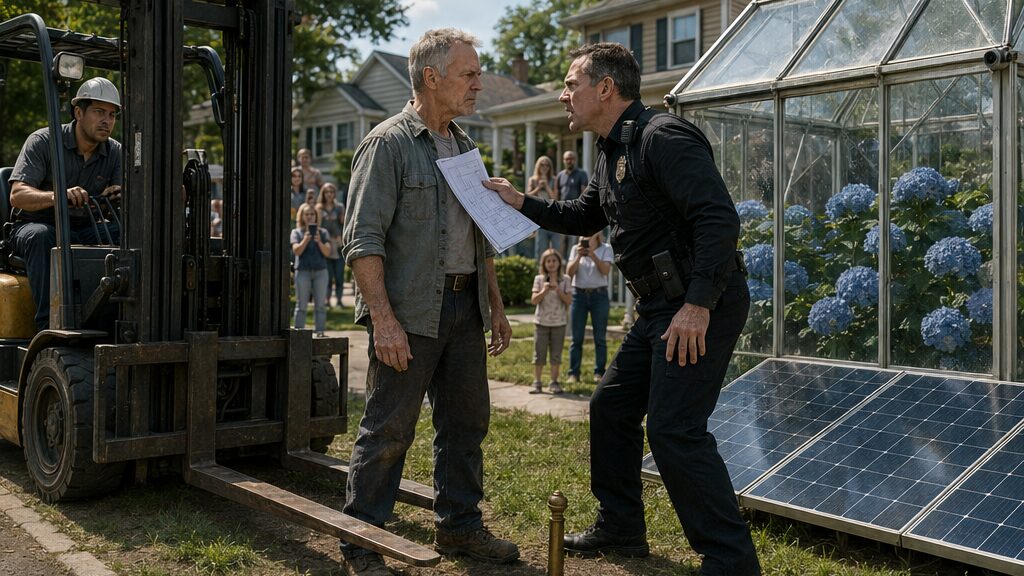
The forklift came around the corner with its forks already lowered.
Raymond heard it before he fully saw it: the diesel rattle, the hydraulic whine, the heavy clack of metal joints over the uneven street. It turned in behind a white service truck, orange body flashing between the parked cars like something from a construction site that had taken a wrong turn into a quiet neighborhood.
George stepped back as if making room for a ceremony.
Raymond moved to the edge of the driveway.
“No,” he said.
The forklift stopped halfway between the curb and the apron. The man in the driver’s seat had one hand on the wheel and the other hovering near the controls. He was younger than Raymond expected, maybe mid-thirties, with tired eyes under a hard hat and the uneasy look of someone who had been told not to ask too many questions.
George walked toward him. “Kevin, position at the east frontage line.”
Kevin Rodriguez looked past George at the greenhouse. Then at the solar panels. Then at Raymond.
“We’re removing the pipe cover, right?” Kevin asked. “That’s what the work order said.”
“Corrective access includes obstruction removal.”
Kevin’s hand settled on the control lever but did not move it. “Those panels are bolted down.”
“Then you have a machine.”
Raymond stepped off the driveway and onto the strip of grass between the panels and the valve box. “Those panels are mine. They’re inside the property line.”
George opened his clipboard again and pulled out a folded sheet larger than the rest. He snapped it open with theatrical precision. Blue lines, property markings, utility notations, arrows.
“According to the enforcement diagram,” George said, “this area has been designated HOA-accessible frontage.”
Raymond recognized his own yard in the drawing, and then did not. The greenhouse was shifted a few feet west. The boundary line near the solar panels angled in a way no real survey had ever shown. The valve box had a thick red circle around it, and an arrow pointing toward the solar panels: REMOVE OBSTRUCTION IF NEEDED FOR ACCESS.
He reached for the paper.
George pulled it back. “Don’t touch official documents.”
“That line is wrong.”
“That line is board-approved.”
“That line is wrong,” Raymond repeated.
George turned to Kevin. “Advance to mark.”
Kevin eased the forklift forward a few feet. The forks dipped, not touching the ground but low enough to make the message clear. The vibration traveled through the soil. Behind Raymond, inside the greenhouse, hydrangea heads trembled on their stems.
Raymond looked back.
A cluster near the door shook as if a hand had brushed through it.
His chest tightened so sharply he had to breathe through his teeth.
Sunday night came back in pieces: mud under his nails, flashlight between his teeth, the cracked pipe spraying water into the trench, the panic when he realized the greenhouse line had lost pressure. He had carried buckets from the kitchen until his arms shook. He had apologized to the plants, absurdly, because there had been no one else awake to hear him.
Virginia would have laughed gently at that, then taken one bucket from him and told him to stop acting like he was alone.
He was alone now, except for the man with the clipboard and the machine.
George’s second guard moved toward the valve box with a long-handled tool.
Raymond turned. “Stay out of there.”
The guard paused.
George said, “Proceed.”
The guard bent toward the valve cover.
Raymond took three fast steps, grabbed the edge of the tool before it touched the cover, and held it there. Not yanking. Not swinging. Just stopping it.
The guard looked to George.
George’s lips thinned. “Interfering with authorized remediation.”
“Protecting my water.”
“Your unapproved water modification.”
“My legal repair.”
“Your opinion has been noted.”
Raymond let go of the tool slowly, aware of every phone that might be pointed from every window. He lifted both hands, palms open, and looked at Kevin.
“Don’t drive that machine any farther.”
Kevin’s mouth opened, then closed. “Sir, I’m just here on contract.”
“Then read what you’re being asked to hit.”
George snapped the blueprint once in the air. “He is not to engage with you.”
“I’m talking to the man driving toward my property.”
George stepped between them. “You are talking to my operator during an enforcement action.”
Raymond stared at him. “You hear yourself?”
For the first time, a flicker of embarrassment crossed Kevin’s face.
George saw it and stiffened. “Kevin. Forward.”
The forklift lurched another foot.
The fork tips crossed over the driveway seam and pointed toward the solar panel frame. They were still several feet away, but the angle was unmistakable. Raymond imagined one metal tine catching the lower edge, lifting, twisting, glass popping under force. He imagined the power cutting to the greenhouse fans. The misting cycle failing. Heat building under glass. Blue petals collapsing by evening.
His hands closed.
“You touch those panels,” he said, “you kill the greenhouse.”
George gave a dry laugh. “Dramatic.”
Raymond looked at him. “You wouldn’t know.”
The words were quiet, but George flinched as if they had been louder.
Then George lifted his chin and raised his voice again, dragging the street back into the scene. “For the record, resident has refused payment, refused inspection, physically interfered with service personnel, and is making irrational claims regarding decorative landscaping.”
Raymond glanced across the street. Linda stood frozen on her porch. Beside her railing, a delivery driver had stopped with a package in his hand. Two curtains shifted in the house next door.
Public. That was George’s favorite tool. Not the fine. Not the badge. The stage.
Raymond forced his voice steady. “For the record, your diagram misplaces the property line by almost four feet.”
George’s nostrils flared.
Raymond pointed to the edge of the driveway where a narrow brass survey marker sat half-hidden in the grass. “That marker was placed by the county. The solar panels are inside it. Your drawing moves the line to give yourself access you don’t have.”
George looked down at the marker.
His hand tightened on the blueprint.
Raymond saw it then: not fear, not yet, but the quick pulse of a man whose paper had been challenged by something fixed in the ground.
Kevin leaned out slightly from the forklift seat. “Captain Walker, maybe we should pause and verify—”
“We verified,” George snapped.
“With who?”
George turned on him. “With the board.”
“That’s not a survey,” Raymond said.
George faced him again, and this time his voice dropped into something colder. “The board can make your house unlivable by dinner if you keep pushing.”
Raymond felt the sentence settle over the yard.
Unlivable.
Not fined. Not inspected. Not reviewed.
Unlivable.
The greenhouse seemed very loud behind him, though it made almost no sound: the tiny hiss of mist, the faint tick of expanding glass in the sun, the soft drip of water into soil.
George raised his radio. “Shut off the water.”
The guard at the valve box bent again.
Raymond moved, but George stepped into his path and shoved the blueprint and enforcement order against his chest.
“Read it while you still have utilities,” George said.
The paper crumpled against Raymond’s shirt. George’s hand stayed there a second too long, pressing.
Raymond looked down at the documents. The false line. The red circles. The official seal printed beside Karen Brown’s signature. The words that tried to turn his wife’s greenhouse into an obstacle and his water into a privilege.
He did not grab the paper.
Not yet.
He looked past George to Kevin.
Kevin’s right boot shifted toward the pedal.
The forklift engine revved, deep and hungry, and George pointed straight at the solar panels.
Chapter 4: The Cameras Virginia Never Saw
Raymond glanced at the tiny black dot above the greenhouse door just as George shouted, “Closer.”
The dot was no bigger than the head of a screw. It sat tucked into the dark metal trim where the morning glare made it almost invisible. Raymond had installed it with trembling hands six months earlier, after he found boot prints in the flower bed and a warning sticker slapped across the greenhouse glass at eye level.
Virginia had never seen the cameras.
That was the part that still made him feel ashamed.
Kevin eased the forklift forward another few inches, then braked hard enough to make the forks dip. The machine shuddered. A low vibration moved through the ground and into Raymond’s shoes. Behind him, the hydrangeas trembled in their rows, blue heads bobbing in the warm glass light.
“Mr. Hill,” Kevin called, his voice tight, “you need to move.”
Raymond did not answer him. His eyes stayed on the camera lens.
The livestream was already running.
Not public. Not really. It fed to a private page Raymond had created under a plain name, with a link stored in drafts, emails, and one scheduled alert he had set up after the last time George’s team walked past his porch without knocking. Raymond had told himself it was for documentation. For court, maybe. For insurance. For the day he finally had enough proof and enough courage to hand it to someone who could not pretend not to see.
But he had never sent it to the neighbors.
Not even Linda.
Not even after the mailbox fines. Not after the widow on the corner cried at the community drop box because she had paid three fees in one month and still had two violations pending. Not after George’s men parked a security SUV outside Raymond’s house for forty minutes because he had questioned a lawn-edge notice.
Raymond had watched. Recorded. Filed.
Endured.
George stepped in front of him, blocking the view of the camera. “What are you looking at?”
“Nothing.”
George turned sharply toward the greenhouse trim.
Raymond saw the thought form in him. Not recognition, but suspicion. George’s eyes scanned the door, the brass handle, the side shelf visible through the glass, the old radio beside Virginia’s stool.
“You have something in there?” George asked.
“My wife’s flowers.”
“Don’t get poetic with me.”
George snapped his fingers at the second guard. “Check the greenhouse door. He may be hiding tools or a bypass valve.”
Raymond moved before the guard did. He stepped back, placing himself between the man and the greenhouse entrance.
“No one goes in there.”
George’s smile returned, thin and triumphant. “Obstruction. Interference. Possible concealment.”
“It’s a greenhouse.”
“It is part of the enforcement zone.”
“It is not.”
“Everything you keep saying doesn’t change the order.”
Raymond’s throat felt dry despite the damp air leaking from the greenhouse vents. He could hear the misting line click off inside. Silence fell for a breath, broken only by the forklift idle and the faint drip of water into soil.
The old memory came without warning.
Virginia standing barefoot on the brick path inside the greenhouse, one hand on the brass handle, her scarf tied badly because she hated asking for help with knots. She had been thinner then, but her eyes had still been bright with argument.
“You don’t become decent by becoming quiet,” she had told him.
He had been angry that day, though not at her. The HOA had sent its first letter about the greenhouse trim color. George had not been captain then, only a security man with new sunglasses and a habit of standing too close. Raymond had wanted to tear the letter in half, march into the board meeting, and make them say Virginia’s name while they complained about the shade of dark metal around her glass walls.
Instead he had paid the repainting review fee.
Virginia had watched him seal the envelope.
“They count on you swallowing things,” she said.
“I’m keeping peace.”
“No,” she said softly. “You’re keeping score in a room nobody else can enter.”
He had hated that she was right.
The guard took one step toward the greenhouse.
Raymond lifted his hand. “Stop.”
George spoke over him. “Open it.”
The guard reached for the brass handle.
Something in Raymond’s chest pulled tight enough to hurt.
He could have shouted then. He could have shoved the man back. He could have done exactly what George wanted and become the angry resident in the report. Instead, he stepped sideways, not touching the guard, and placed his body directly in front of the door.
“Touch the handle,” Raymond said, “and you’ll be on camera doing it.”
The words came out before he meant to say them.
George went still.
Kevin looked up from the forklift seat.
Linda, across the street, leaned forward from her porch.
George removed his sunglasses slowly. Without them, his eyes looked smaller and more tired, but also meaner. “What camera?”
Raymond said nothing.
George looked at the greenhouse trim again. This time he saw it. The little dark dot above the door. Then another beneath the eave. Then the faint red blink near the side vent, reflected once in the glass and gone.
His face changed.
Not fear. Not yet. Calculation.
“You are recording HOA personnel without consent?”
“Outside. On my property.”
“This is a private enforcement action.”
“This is my front yard.”
George pointed at the camera. “Shut it off.”
“No.”
“I said shut it off.”
“And I said no.”
The word surprised Raymond. Not because it was loud. Because it was simple. It did not ask permission, explain, apologize, or soften itself for the person hearing it.
George stepped close enough that Raymond could smell coffee on his breath. “You think a camera makes you safe?”
Raymond’s hand drifted toward his pocket, where his phone pressed against his thigh. The livestream link sat unsent except for one scheduled message he had forgotten to cancel. The one set to go to Linda if he ever failed to stop a recording manually during an HOA visit. He had made the rule too complicated on purpose, maybe so it would never happen.
George’s eyes followed the movement.
“Hands where I can see them,” he barked.
Raymond froze.
The command cracked across the yard like something official, and for an instant everyone obeyed it. Even the guard stopped. Even Kevin sat rigid. Even Linda seemed to shrink behind her porch post again.
Raymond slowly lifted both hands.
George smiled again, because he had regained the shape of the scene.
“Good,” George said. “Now we’re going to proceed safely.”
Safely.
The word almost broke something in Raymond.
Behind him, through glass, the hydrangeas were alive because he had refused to wait for approval. The cameras were live because he had refused to trust memory alone. But the link was still nearly private, the proof still trapped inside the room Virginia had warned him about.
He turned his head just enough to look across the street.
Linda had her phone in her hand now.
She stared down at it.
A faint vibration buzzed against Raymond’s own thigh. Not a call. Not a message he could check. But he knew. The scheduled alert. The private livestream link. It had gone to Linda because he had not stopped it.
George misread the glance.
“Don’t look for help,” he said. “No one on this street wants your trouble.”
Linda’s thumb hovered above her screen.
Raymond could not tell whether she would press anything. He could not blame her if she did not. He had spent months teaching everyone that silence was the safest thing.
George turned back to Kevin. “Advance to the panels.”
Kevin swallowed. “Captain—”
“Now.”
The forklift growled as Kevin’s boot shifted.
Raymond looked once more at the camera Virginia had never seen, then at the greenhouse she had loved, then at the woman across the street who was still deciding whether fear was heavier than truth.
Linda stared at the live feed on her phone, her face pale in the porch shade, and her finger trembled over the share button.
Chapter 5: Not One Inch Past That Line
Raymond stepped in front of the forklift, close enough that Kevin shouted and slammed both hands against the controls.
The machine lurched and rocked. The forks dipped with a metallic groan, stopping a few feet from Raymond’s knees. Hot diesel breath rolled over him. The engine noise filled his ribs, heavy and stupid and alive only because frightened men had been told to obey it.
“Move!” Kevin yelled.
Raymond did not.
George spun toward him, phone already rising in one hand. “There it is. There’s the threat. Stay right there, Mr. Hill. Let everyone see how unstable you are.”
Raymond looked at the phone lens, then past it to the solar panels. The fork tips were aimed at the lower frame of the nearest panel. One push and the mount would buckle. One shove and the glass would spiderweb. One careless motion and the greenhouse would lose the power that kept Virginia’s hydrangeas breathing through the worst summer afternoons.
He planted his boots on the grass beside the brass survey marker.
“Not one inch past that line.”
George laughed too loudly. “You don’t give commands here.”
Raymond pointed down. “County marker. My property begins here. Your drawing is wrong.”
George thrust the blueprint and enforcement order toward him. “This is the active document.”
“That paper moved the line.”
“The board approved it.”
“The board doesn’t move land by drawing on it.”
George’s phone stayed up, but his hand had begun to tremble. Barely. Just enough for the lens to quiver. Raymond saw it, and George saw Raymond seeing it.
“Careful,” George said.
“No,” Raymond said. “That’s what you should’ve been.”
George stepped close and slapped the papers against Raymond’s chest.
The sound cracked sharp enough that Linda flinched across the street.
“The board can make your house unlivable by dinner,” George said, low and hard. “Water shutoff. Safety lien. Daily penalties. Emergency access. You want to play boundary games? I’ll have every permit on this glass box pulled apart by sunset.”
Raymond looked down at the paper crushed against his shirt.
For a moment, his old fear did what it always did. It searched for the smallest door. Pay the fee. Let the inspection happen. Save the greenhouse today and fight later. Keep proof. Keep quiet. Keep breathing.
Then he saw the words on the top page.
COMPLIANCE ACCESS EVENT.
Not repair. Not inspection. Event.
Under it, in a neat printed line: Exterior Utility Obstruction Removal Authorized As Needed.
The solar panels had been renamed into permission.
Raymond’s eyes tracked the diagram. The greenhouse was still shifted wrong. The boundary wrong. The valve box circled like a target. The panel array shaded gray, neither private nor common, turned into something vague enough to damage.
He looked at George’s thumb pressing the page to his chest. The nail was clean, buffed, absurdly careful. A man’s hand trying to make paper heavier than ground.
Kevin leaned out of the forklift. “Captain Walker, if the marker’s there, we should stop.”
George did not look away from Raymond. “You have one job.”
“I’m not sure the forks clear the panels without damage.”
“They aren’t supposed to clear the panels,” George snapped.
The yard went still.
The sentence hung there, naked and stupid, too honest to be recalled.
George’s jaw tightened. His phone was still pointed at Raymond, but his eyes cut toward Kevin with warning.
Raymond saw Linda across the street jerk her head down toward her own screen. She had heard it. Maybe her phone had heard it too.
The second guard shifted away from the valve box.
Raymond breathed in. Diesel. wet soil. hot grass. the faint mineral smell of water from the repaired pipe.
Virginia’s voice, not as memory now but as pressure in the bones: You’re keeping score in a room nobody else can enter.
He lifted his right hand and closed it over the top edge of the papers.
George’s eyes narrowed. “Do not touch official—”
Raymond yanked.
For all George’s performance, his grip broke easily.
The papers came free with a tearing sound at one corner. George stumbled half a step forward, shocked less by the force than by the fact that Raymond had used any.
“Hey!” George barked.
Raymond backed toward the forklift fan housing, the blueprint and order in both hands.
George reached for him. “Give those back.”
Raymond looked once at the greenhouse.
Blue hydrangeas filled the glass behind him, trembling under the engine’s idle. One bloom near the door had a broken petal stuck to the inside of the pane, flattened by condensation. For some reason, that small torn thing steadied him more than anger did.
He folded the papers once.
George lunged.
Raymond tore them down the middle.
The sound was clean and final.
“Stop him!” George shouted.
Raymond tore again. The blueprint split through the false property line. The red circle around the valve box ripped into two useless curves. Karen Brown’s printed authorization separated from the words “obstruction removal” and fluttered against Raymond’s wrist.
George grabbed his sleeve.
Raymond twisted free, not striking him, not shoving him, just pulling away with the stubborn strength of a man who had spent forty years lifting things heavier than threats.
“You’re destroying evidence!” George shouted.
Raymond looked at the scraps in his hands.
“No,” he said. “I’m making sure it can’t destroy mine.”
He stepped to the side of the forklift.
Kevin shouted, “Sir, don’t get near the intake!”
Raymond knew machinery. He saw the cooling fan guard, the open side vent, the pull of air tugging at dust and dry grass. He did not reach into it. He did not need to.
He flung the shredded papers straight at the vent.
The fan caught them.
White sheets slapped against the guard, then ripped smaller, then vanished inward in a violent flutter. The machine coughed. The idle hitched. Scraps spat out, sucked back, plastered across the intake. The fan whined once, high and ugly.
Kevin killed the throttle too late.
The forklift shook as if it had swallowed a handful of bones. A belt squealed. The engine stuttered, roared, and choked. More paper fragments whipped through the air, some blackened at the edges from heat, some bright white and spinning.
George stood frozen, one hand still raised.
Raymond stepped back to the brass marker.
The forklift lurched forward six inches, then died.
Its forks stopped just short of the nearest solar panel.
The sudden silence rang.
For one breath, nobody moved.
Then George’s face flooded red.
“You attacked HOA equipment,” he said, too loud, too fast. “Everyone saw that. You attacked authorized equipment during a lawful enforcement action.”
Raymond’s pulse hammered, but his voice came out low. “Your machine stopped before it crossed the line.”
“You vandalized it.”
“You ordered it into my property.”
George whipped his phone toward the dead forklift, then toward Raymond. “You are done. Do you hear me? Done.”
Behind him, Kevin climbed down from the forklift, pale and breathing hard. He looked at the intake, at the panel, at the brass marker in the grass.
“That could’ve gone bad,” Kevin muttered.
George rounded on him. “Get back in and restart it.”
Kevin looked at him. “Paper’s jammed in the fan.”
“Clear it.”
“I’m not touching that while it’s hot.”
“Then wait two minutes and clear it.”
Raymond could feel the entire street leaning in. Porch doors. Windows. Phones.
George lifted his radio, then lowered it and grabbed his cell phone instead. His thumb moved hard across the screen.
“Police,” he said. “Now.”
He put the phone to his ear, staring at Raymond like a man already writing the story he wanted heard first.
Raymond glanced across the street.
Linda was no longer hiding behind the porch post. She stood at the top of her steps with her phone raised, not filming him from a distance, but staring at the screen as if something on it had made her forget to be afraid.
Then her thumb came down.
Chapter 6: Thousands Watching The Paper Burn
The forklift coughed once after it was dead, a last ugly rattle that sent a torn scrap of George’s order spinning into the grass at Raymond’s feet.
George pointed at it as if it were a weapon. “That is sabotage.”
Raymond did not bend to pick it up.
The nearest solar panel reflected the sky, unbroken. The fork tips hung inches away, low and dull and useless. Behind the glass, the hydrangeas were still trembling, but they were standing.
George paced with the phone at his ear. “Yes, I need officers dispatched for resident aggression during an HOA enforcement action. Equipment damaged. Personnel endangered. Yes, he physically interfered.”
Raymond looked at Kevin.
Kevin looked away first.
“Tell them the part where you told him to hit the panels,” Raymond said.
George covered the phone. “Do not speak.”
Raymond’s fear returned then, but in a different shape. Not the fear of losing the greenhouse. That had passed into something harder. This was the old institutional fear: the report written first, the clean uniform believed first, the rough hands explained last. George knew how to sound official. Raymond knew how men like him became footnotes in paperwork.
Across the street, Linda made a small sound.
Raymond turned.
Her phone was in both hands now. Her eyes were wide, moving quickly as if reading lines that appeared faster than she could follow. The delivery driver beside her steps had his own phone out. A teenager at the corner pointed toward Raymond’s house and said something Raymond could not hear.
George heard the shift too. He lowered his phone slightly.
“What?” he demanded.
Linda looked up, pale but no longer hidden. “George.”
“Stay out of this, Mrs. Thomas.”
“It’s live.”
The words changed the air.
George’s mouth tightened. “What is live?”
Linda swallowed. “All of it.”
Raymond felt his own phone buzz once, twice, then again in rapid bursts. He did not take it out. He could not look away from George’s face.
George’s eyes went to the greenhouse cameras, then Linda’s phone, then the houses around them. “Turn that off.”
Linda gave a short, frightened laugh that was not amusement. “I didn’t start it.”
“You shared private enforcement footage.”
“You said he attacked you,” she said. “But the video has you saying the panels weren’t supposed to be cleared.”
George’s face went blank.
Raymond’s phone buzzed again and again. A storm trapped in his pocket.
The police dispatcher’s voice crackled faintly from George’s cell. He turned away and spoke fast. “We have unauthorized surveillance and edited footage circulating. Resident is escalating.”
“Edited?” Kevin said.
George cut him a look.
Kevin was standing beside the forklift intake, one hand on his hard hat, the other hanging uselessly by his side. He looked younger now, not because his face had changed, but because the fear in it had lost its professional mask.
George lowered the phone. “Clear the fan.”
Kevin did not move.
“Kevin.”
“No.”
The single word was small, but it traveled.
George stared at him. “You work under my site direction.”
“I work for the service company.”
“Contracted by us.”
“To perform access work,” Kevin said. “Not ram private panels.”
George stepped toward him. “You want to lose this contract?”
Kevin’s face tightened. He looked at Raymond, then at the greenhouse, then at Linda’s raised phone. For a second Raymond saw the calculation in him: rent, bills, a supervisor, a bad report, the cost of saying the true thing when the lie had a uniform.
Kevin’s voice shook when he spoke, but he spoke clearly.
“You told me to hit the panels.”
The delivery driver’s mouth fell open. Linda’s phone tilted slightly but stayed up. Somewhere, from one of the houses, someone said, “I got that.”
George’s expression twisted. “I told you to advance for corrective access.”
“You said they weren’t supposed to clear the panels.”
“That is not what I meant.”
“That’s what you said.”
Raymond should have felt relief. Instead, the ground seemed to tilt under him. The scene was no longer contained in the yard, no longer tucked safely inside his private archive. It was spilling outward, messy and alive, carried by people who had looked away ten minutes ago and were now watching too closely.
His phone kept buzzing.
He finally pulled it out.
The livestream page had opened under a flood of comments. Numbers climbed in the corner so fast he thought the screen had glitched. Hundreds, then thousands. The private link had been reposted into neighborhood groups, city complaint pages, a local news thread, and places Raymond had never heard of.
George’s voice came from the video preview, delayed by a few seconds: The board can make your house unlivable by dinner.
Raymond locked the screen as if burned.
George had returned to the dispatcher. “I want officers here now. The resident is creating a public disturbance and has damaged machinery.”
Raymond said, “Tell them the machine was on my property.”
“It was not.”
“You saw the marker.”
“I saw you jump in front of equipment.”
“I stood on my land.”
George pointed at Raymond’s phone. “And you staged this.”
That accusation struck harder than Raymond expected. He looked around at the neighbors, the phones, the street suddenly crowded with attention. He could see how George would shape it: lonely widower with cameras, planned confrontation, damaged equipment, viral sympathy, manipulated grief.
Raymond’s hand tightened around the phone.
Maybe he had staged some of it. Not the forklift. Not George’s words. Not the threat. But the cameras were there because Raymond had expected something. The link existed because a part of him had known silence would fail. He had wanted proof, but he had also wanted not to be alone when the proof finally mattered.
George saw the doubt flicker.
“You wanted this,” George said quietly, stepping closer. “All of this. You waited for a scene.”
Raymond looked at the dead forklift.
“No,” he said. “I waited too long.”
George blinked.
Before he could answer, his phone rang against his cheek.
He looked down. The dispatcher call had ended. A new call filled the screen. The name displayed across it made his posture change before he spoke.
MAYOR CHARLES WRIGHT.
George stared at the phone as if refusing it might erase it.
The ringtone continued.
Linda lowered her phone a fraction. Kevin took one step away from the forklift. The second guard stopped pretending to inspect the valve box and looked at George.
“Answer it,” Raymond said.
George’s eyes flashed. Perhaps out of habit, perhaps because he needed everyone to hear that he still spoke with authority, he tapped the screen and answered on speaker.
“Captain Walker,” Mayor Charles Wright said, his voice sharp with controlled anger, “do not move that machine another inch.”
Chapter 7: The Board Behind The Uniforms
Karen Brown arrived before the forklift was towed, wearing white pants, a pale blazer, and the expression of someone stepping over a spill she intended someone else to clean.
She did not look at the greenhouse first. She looked at the phones.
Neighbors had gathered in loose clusters along the sidewalks now, not close enough to be involved, not far enough to pretend they were not watching. The dead forklift sat at the edge of Raymond’s yard with paper scraps crusted around its cooling vent. A city vehicle had parked behind George’s SUV. The investigator who stepped out of it had not said much yet. He had photographed the brass survey marker, the solar panels, the valve box, the forklift, then the camera above the greenhouse door.
George stood near the curb with his arms folded, stripped of his radio by silence rather than force. Mayor Charles Wright was no longer on speaker, but the damage his call had done remained in the air.
Karen walked directly to Raymond.
“Mr. Hill,” she said, too softly for the crowd, “this has gotten out of hand.”
Raymond looked down at the folder she carried.
It was navy blue, clean, and expensive-looking. Not a clipboard. Not a violation sleeve. A settlement folder. He recognized the type from insurance offices and hospital billing desks: paper meant to make pressure look orderly.
“The forklift is still in my yard,” Raymond said.
“It will be removed.”
“The valve cover is damaged.”
“We’ll replace it.”
“The pipe was almost smashed.”
“But it wasn’t.” Karen opened the folder. “That matters.”
Raymond stared at her.
Behind Karen, George turned his head sharply, as if the word almost had insulted him. Kevin Rodriguez stood beside the service truck, face gray with exhaustion. Linda Thomas was near her porch steps, arms wrapped around herself, her phone no longer raised but still in her hand.
Karen slid a document from the folder.
“We can end this tonight,” she said. “Full replacement of the valve cover. Payment for any verified equipment servicing connected to the forklift incident. Written confirmation that no further action will be taken regarding your emergency plumbing repair. And a one-year waiver of routine exterior review fees.”
Raymond took the paper but did not read it yet.
“What do you want?”
Karen’s mouth tightened, barely. “A mutual non-disparagement and confidentiality agreement.”
George looked over.
Raymond turned the page. Near the bottom was a signature line with his name typed beneath it. A deadline had been handwritten in blue ink.
11:59 P.M.
“You printed this fast,” he said.
Karen did not blink. “Responsible boards prepare for contingencies.”
“Is that what you call this?”
“I call it preventing a neighborhood dispute from becoming a destructive legal mess.”
The investigator glanced up from photographing the forklift’s tire position, but he did not interrupt.
Karen lowered her voice. “Mr. Hill, people online are not your friends. They will watch this today and forget you tomorrow. Meanwhile, you still live here. Your greenhouse still needs approvals. Your solar panels still have permit history. Your plumbing repair still occurred before inspection. You may feel powerful right now, but legal processes are slow and expensive.”
Raymond looked at the greenhouse.
The interior lights had come on automatically as the afternoon dimmed toward evening. Through the glass, the hydrangeas glowed blue under the soft white strips powered by the panels George had tried to destroy. The glass reflected Karen’s pale blazer back at him, ghostlike and cold.
“You threatening me with Virginia’s greenhouse permits?” he asked.
Karen’s face shifted. There it was—the calculation. Not cruelty like George’s. Something smoother. Something that had learned to bruise without raising its voice.
“I’m telling you everything becomes relevant once lawyers get involved.”
George stepped closer. “Karen, don’t negotiate with him like he’s—”
“George,” she said without turning, “stop helping.”
The silence after that was sharp enough to cut through his uniform.
For the first time all day, Raymond saw the line between them. George had worn the authority. Karen had supplied it. George had wanted the street to see him command. Karen wanted the paperwork to survive whatever he did.
Linda crossed the street slowly, as if each step required permission from a part of herself she had ignored for too long.
“Raymond,” she said.
Karen’s eyes flicked toward her. “Mrs. Thomas, this is not the time.”
Linda stopped beside the driveway. “It’s exactly the time.”
Her voice shook, but she kept going.
“They did it to Betty from the corner lot. Told her the irrigation heads were noncompliant and she owed two inspection fees. She paid because George said they could cap her outdoor water. And Brian White paid last month after they said his ramp blocked emergency access.”
Karen’s expression cooled. “Those matters are unrelated.”
“No,” Linda said. “They’re not.”
George took a step. “Linda, you need to be careful.”
She flinched, but she did not back away. That small refusal changed her face. Not brave exactly. Ashamed and brave at once.
“I was careful,” she said. “That was the problem.”
Raymond looked at her then, really looked. He had blamed her porch silence because it was easier than admitting he had built the same kind of silence into cameras and folders and unsent emails.
Linda held out her phone. On the screen was a paused clip from the livestream. George’s mouth was open mid-command. The caption someone had added below it read: They aren’t supposed to clear the panels.
“People are sending me messages,” she said. “Not strangers. Neighbors. They’re saying this happened to them too.”
Karen closed the folder halfway. “Social media outrage is not evidence.”
The investigator stepped closer. “Written complaints are.”
Karen turned to him. “And you are?”
“City compliance investigator.”
“I was under the impression Mayor Wright was requesting a pause, not launching an inspection.”
“He requested both.”
Karen’s smile held for one second too long. “Then I assume you’ll contact our counsel.”
“I will. I’m also going to need a copy of the board policy authorizing security-led compliance access events.”
Something passed through Karen’s eyes.
Raymond noticed because she looked at George before she answered.
George did not meet her gaze.
“There are internal guidelines,” Karen said.
“Signed?” the investigator asked.
Karen’s fingers tightened around the folder.
Raymond saw it then: the board had not merely allowed George to improvise. They had named what he did. They had created a phrase broad enough to open gates, shut valves, threaten panels, and frighten people into paying before a court could examine anything.
Compliance access event.
The machine had been paperwork before it was steel.
Karen turned back to Raymond. “This is exactly why I’m offering a practical solution.”
“A quiet one,” Raymond said.
“A fair one.”
“A cheap one.”
Her face flushed. “Be careful.”
He almost smiled, not because anything was funny, but because everyone had said that to him today. George. Kevin. Karen. Even the fearful part of himself.
Be careful.
Virginia had never asked him to be careless. But she had known the difference between peace and surrender.
Karen opened the folder again and pushed the agreement toward him. “Sign tonight, and your greenhouse stays out of it.”
Raymond heard the threat in the space between the words.
He looked at the brass handle on the greenhouse door, scratched where the red tag had been tied. He thought of Virginia’s hand there. Her scarf. Her voice. You’re keeping score in a room nobody else can enter.
Then he thought of Betty paying. Brian removing a ramp. Linda looking into her mug while George performed for the street. Kevin nearly driving because he needed work more than he trusted his own doubt.
Raymond folded the agreement once and handed it back.
“No.”
Karen did not take it. “You should speak with an attorney before making that decision.”
“I will.”
“Then don’t make it emotionally.”
Raymond stepped past her.
For a second she seemed to think he was walking away from the fight. George did too. His shoulders loosened, just slightly.
Raymond went to the greenhouse door.
The investigator followed. Linda stayed near the driveway. Kevin watched from beside the service truck, his hard hat hanging at his side like something he no longer wanted to wear.
Raymond placed his hand on the brass handle. The scratch under his thumb was small, but he felt it as if it were fresh.
He opened the door.
Warm, damp air rolled out, carrying soil, water, and the green breath of living things. The hydrangeas glowed under the lights, blue and violet and full, not witnesses exactly, not proof, but the reason proof had mattered.
Raymond stepped aside and looked at the investigator.
“Start recording inside,” he said.
Chapter 8: The Mortgage Cleared Beneath The Hydrangeas
The settlement letter arrived while Raymond was kneeling beside the same valve George had ordered smashed.
The new cover sat clean and square in its frame, darker than the old one, the bolts still bright. Raymond had been checking the repaired line because he still did that now—checked what had already held, tightened what was already tight, listened for leaks that were not there. Some habits came from care. Some from fear wearing care’s clothes.
The mail carrier stood at the edge of the driveway with a certified envelope in one hand.
“Need a signature,” she said.
Raymond rose slowly. His knees complained. Soil clung to one palm. He wiped it on his pants before taking the pen.
The envelope was from the attorney.
He knew before he opened it. Not every number, not every clause, but the shape of it. The board had fought for three weeks, then folded in pieces. First the emergency suspension. Then the city’s notice of unlawful enforcement practices. Then Kevin’s written statement. Then Linda’s collection of complaints from neighbors who had paid fees under threat of utility disruption. Then the policy with Karen Brown’s signature, copied from board files and uglier in daylight than Raymond had imagined.
Compliance access event.
The phrase had died badly in front of lawyers.
Raymond carried the envelope into the greenhouse before opening it.
He did not know why. Or maybe he did.
The hydrangeas were in full color. Some blooms had shifted toward purple at their edges, and one near the back had gone pale where the soil mix needed adjusting. Virginia would have noticed that before breakfast. Raymond noticed it now with a small ache that no settlement could touch.
He sat on her old stool and tore the envelope carefully.
The letter used words like resolution, dissolution, liability exposure, settlement distribution, mortgage satisfaction. Raymond read it once, then again.
The amount was larger than he had let himself imagine.
Enough to clear the mortgage.
Enough to repair the panels, though they had survived.
Enough to pay attorney fees, establish the fund his lawyer had suggested, and still leave money sitting in an account with Raymond’s name on it like a thing that did not know what grief cost.
He lowered the letter to his lap.
The greenhouse fans hummed above him, powered by the same panels that had reflected the forklift forks inches from ruin. Water moved through the repaired pipe with a faint murmur below the brick path. The sound filled the quiet, modest and stubborn.
Raymond laughed once.
It startled him.
It was not joy exactly. It was disbelief leaving the body.
A knock sounded on the greenhouse frame.
He looked up.
Kevin Rodriguez stood outside the door, cap in hand instead of hard hat. He had not come onto the path. His truck was parked at the curb, engine off. He looked thinner than he had that day, or maybe simply less protected by noise.
Raymond folded the letter and set it on the potting bench.
He opened the door.
Kevin held out an envelope. “I won’t stay.”
Raymond took it but did not step aside. “You all right?”
Kevin looked down the street toward the faint marks still visible where the forklift tires had pressed the grass near the property line. “Lost the contract. Kept my license. Could’ve gone worse.”
Raymond nodded.
Kevin swallowed. “I wrote it down. What I did. What he told me. What I should’ve done before you had to stand there.”
“You already gave a statement.”
“This one’s not for the city.”
Raymond looked at the envelope.
Kevin’s fingers flexed around the cap. “I almost drove forward because I needed the work. That’s the truth. I heard you say the panels powered the greenhouse, and I still had my foot on the pedal.” He looked at Raymond then, and there was no performance in him. Only shame that had run out of hiding places. “I’m sorry.”
For a moment, Raymond wanted to hold on to anger. It would have been clean. Easier than seeing Kevin as a man with bills and fear and a moment he would carry.
“You stopped,” Raymond said.
“Late.”
“But you stopped.”
Kevin nodded once, not accepting forgiveness exactly, but receiving the fact because it was the only one Raymond had offered.
After he left, Raymond opened the envelope. The note was short, handwritten, no excuses. At the bottom Kevin had added one line that made Raymond sit down again.
I hope someday I trust my conscience before someone else has to risk their body to wake it up.
Raymond placed the note beside the settlement letter.
For several minutes, he listened to the water.
By evening, the neighborhood common room was fuller than he had ever seen it without a holiday raffle or a fight over dues.
The HOA board no longer sat at the front table because there was no board now, not legally. The city had appointed a temporary administrator until residents could vote under new rules. Karen Brown was not there. George Walker was gone from the neighborhood entirely; his SUV no longer idled at curbs, and the private security contract had been terminated. Rumor filled in what official letters did not, but Raymond had stopped feeding himself on rumors. The facts were enough.
Linda stood near the coffee urn with a stack of printed forms.
She looked nervous when Raymond approached. “Repair fund sign-up,” she said. “Transparent approvals. Volunteer review. No surprise fees.”
Raymond looked at the forms. His name was printed at the bottom as the initial donor.
“You made it sound too official,” he said.
She winced. “Sorry.”
“I didn’t say bad.”
Her shoulders loosened.
The settlement could have stayed private after the legal announcements. Raymond had almost chosen that. Pay the mortgage. Lock the greenhouse. Let the neighborhood fix itself without asking anything else from him.
But two days after the agreement was finalized, he had found three envelopes on his porch. One from Betty, who wrote that she had paid $1,200 she could not afford because she thought being alone meant being wrong. One from Brian White, who said his ramp was back up. One from a child in a house Raymond barely knew, a crayon drawing of the greenhouse with blue circles for flowers and a black rectangle for the stopped forklift.
He had stood with those papers in his hand and understood that keeping score privately was still keeping score in a locked room.
So he gave some of the money structure. Not charity. Not victory. A repair fund with open books, resident votes, emergency exceptions, and no one allowed to charge a person for keeping water running.
Later, when the meeting thinned and the folding chairs scraped back into stacks, Linda walked with him toward the greenhouse.
“I should’ve helped sooner,” she said.
Raymond did not answer right away.
The sunset had turned the glass walls gold. Inside, the hydrangeas held the last light in their petals. The new valve cover was barely visible beyond the path. Near the grass, the tire marks had begun to fade.
“I should’ve spoken sooner,” Raymond said.
Linda looked at him.
He kept walking. “We can both be right.”
She nodded, eyes wet, and stopped at the driveway instead of following him all the way in.
Raymond entered the greenhouse alone.
For a moment he stood just inside the door with his hand on the brass handle. The scratch from the red tag was still there. He had decided not to polish it out.
He took the old radio from the shelf and turned the dial. Static. A burst of music. Then the one station that still came through clearly.
Virginia’s stool sat at the end of the brick path.
Raymond did not sit on it this time.
He picked it up, carried it to the center of the greenhouse, and set it beside a second stool he had brought in from the garage. The space looked strange with room for someone else. Less preserved. More alive.
Then he turned the brass faucet.
Water moved through the pipe George had wanted smashed, under the path, into the thin black irrigation lines. The first mist drifted over the hydrangeas. Droplets caught the light, bright and brief against the glass.
Raymond stood beneath the soft hiss and let some of it touch his face.
“Still here,” he said.
The flowers gave no answer. They did not need to. They lifted under the water, blue and stubborn, while outside the dead machine marks faded at the property line and the house behind him, finally, belonged fully to him.
The story has ended.