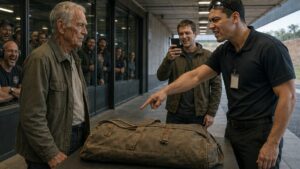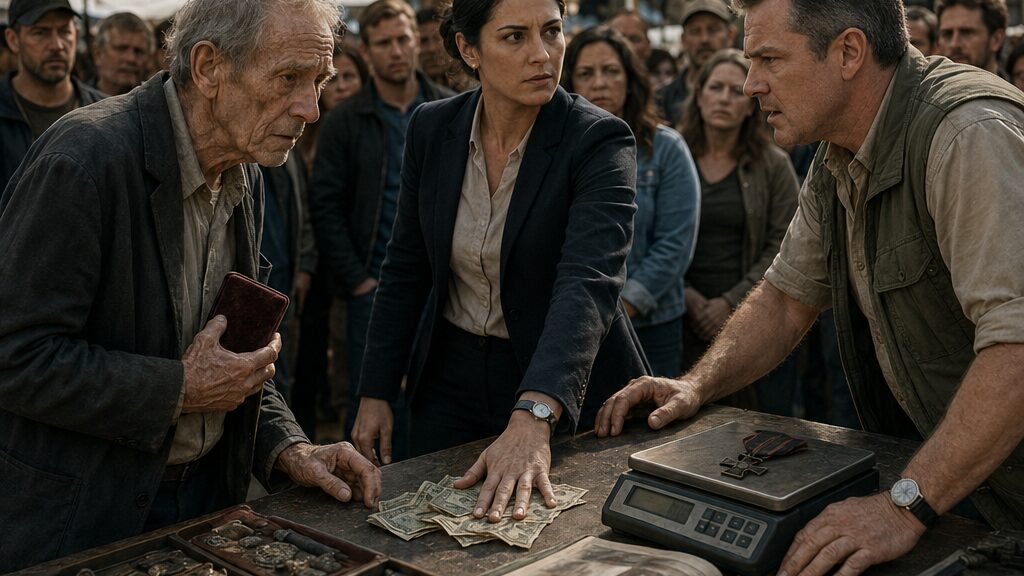
The Hungry Veteran Put His Medal on the Scale, but Its True Weight Could Not Be Priced
Chapter 1: The Medal Beneath the Counter Glass
Robert Davis caught himself against the hood of his car before his knees reached the pavement.
The metal was already hot beneath his palm. For several seconds he stood bent over it, breathing through his nose while the crowded flea market shifted beyond the chain-link fence: folding tables opening, canvas awnings snapping, vendors shouting about tools and watches and records nobody had played in thirty years.
His vision narrowed to the cracked paint beneath his fingers.
When it cleared, he opened the passenger door.
A five-dollar bill waited in the glove compartment beside a packet of crackers. Robert stared at both. The crackers had been there since Thursday. The bill would buy coffee, perhaps something with eggs, and leave almost nothing.
His hand moved past them.
From beneath a folded road map, he lifted a faded velvet box.
It was no larger than his palm, yet the weight of it traveled through his wrist and settled behind his ribs.
His phone showed 8:17.
The lender’s message remained across the screen.
PAYMENT DEADLINE: 2:30 P.M. REPOSSESSION PROCESS BEGINS TODAY.
Robert shut the glove compartment without taking the food.
He crossed the parking lot slowly, keeping his right hand inside his coat pocket around the box. The market entrance smelled of hot dust, frying onions, machine oil, and old fabric. A child ran past wearing a plastic helmet with a chipped star painted on the front. At the first military-surplus table, rows of imitation medals hung from hooks and turned in the morning breeze.
They clicked lightly against one another.
Robert stopped despite himself.
Bright ribbon. Cheap stamped metal. Artificial age rubbed into the edges.
Three for twenty dollars, a cardboard sign promised.
He continued down the aisle.
Eric Baker’s stall occupied a corner beneath a faded green awning. Glass cases displayed field watches, bayonets with blunted tips, unit patches, brass buckles, old compasses, and framed discharge papers belonging to men whose families had apparently stopped wanting them. Behind the counter, Eric was taping a handwritten sign to a locked cabinet.
MILITARY ITEMS BOUGHT—CASH PAID.
Eric looked up. His eyes moved first to Robert’s worn coat, then to his boots, then to the hand buried in his pocket.
“Selling?”
“Maybe.”
“Maybe doesn’t open the register.”
Robert almost turned away.
His fingers closed around the velvet box. The corners were soft from years of handling. He remembered the first time it had been placed in his hand, though not the ceremony itself. What he remembered was the empty chair behind the last row.
He set the box on the glass.
Eric peeled away the old brass clasp and lifted the lid.
The change in his face lasted less than a second.
His mouth stopped moving. His thumb hovered above the ribbon without touching it. Then his eyelids lowered, and the bored dealer returned.
“Well,” he said. “That’s unusual.”
Robert watched him carefully. “You know what it is?”
“I know what it’s trying to be.”
Eric lifted the medal by its ribbon. The narrow bands of color had faded unevenly. The metal itself had darkened around the raised emblem, but the edges still held a dull gleam.
“It isn’t trying to be anything,” Robert said.
Eric gave him a thin smile. “People bring me reproductions every weekend. Sometimes they know. Sometimes Grandpa told them a story and they believed it.”
“This one was issued after the unit citation review.”
“That so?”
“Second board. Not the first. The first recommendation was rejected because the action report was incomplete.”
Eric glanced at him.
Robert continued. “The suspension ring was reinforced on the second issue. The reproductions get that wrong. So do most catalog photographs.”
Eric turned the medal slightly. His thumbnail found the reinforced ring.
For a moment, the noise of the market seemed to move farther away.
“You’ve done your homework,” Eric said.
“I was there.”
Eric placed the medal on a square of black cloth, but not on Robert’s side of the counter. He put it behind the glass display lip, close to his register.
Robert’s hand remained open where the box had been.
“How much do you need?” Eric asked.
Robert disliked the question. A buyer should ask what an object was worth, not what the seller could survive without.
“What will you offer?”
“That depends. No certificate?”
“No.”
“Orders?”
“No.”
“Photograph of presentation?”
Robert shook his head.
Eric sighed as though Robert had disappointed him personally. “Then all I have is a piece of metal and a story.”
“The name is engraved.”
“Names can be engraved.”
Robert felt the weakness returning, a faint coldness beneath the heat. He steadied himself against the counter without making it obvious.
From the aisle came the clatter of a rack being unfolded. Someone laughed. A vendor called out a price for fishing reels.
Eric picked up the velvet box and checked beneath the lining. Robert’s grease-stained business card was still tucked there, forgotten. Eric read it before sliding it back.
Davis Repair Cooperative.
The word cooperative had seemed important once.
Eric closed the box. “Business still open?”
Robert’s gaze sharpened. “That isn’t part of the sale.”
“Everything’s part of the sale.”
Robert reached toward the medal. “Then there isn’t one.”
Eric placed two fingers over it.
Not forcefully. Not enough to make a scene. Just enough to remind Robert that the medal was now on Eric’s side of the glass.
“You came all the way through that gate,” Eric said. “Might as well hear a number.”
Robert looked at the clock mounted beside the awning support. It had stopped at 11:42, perhaps months ago, but the sight of it made him take out his phone.
8:31.
Less than six hours.
He saw the red notice folded behind his driver’s license. He saw the workshop door with its new padlock. He saw the lender’s inventory sheet listing his lathe, compressor, welding unit, tool chests, car, and household furniture as recoverable assets.
“Hear a number,” Eric repeated.
Robert lowered his hand.
Eric crouched as though searching beneath the counter for a calculator. Instead, he pulled out a thick collector’s guide with a cracked blue spine. He kept it below the glass, mostly hidden by his body.
Pages whispered beneath his fingers.
He stopped at a full-color photograph.
Even upside down, Robert recognized the narrow ribbon, the reinforced ring, and the raised emblem only ten men had ever worn.
Eric looked at the listed valuation. His jaw tightened.
Then he closed the guide halfway, leaving one finger inside to mark the page, and rose with an expression of weary regret.
“Without paperwork,” he said, “this may not be worth much at all.”
Chapter 2: Whatever the Hungry Man Will Take
“Forty dollars,” Eric announced, loudly enough for the woman arranging canteens at the next stall to turn her head.
Robert did not answer.
Eric switched on a cheap digital scale. Its green numbers flashed, reset, and settled at zero. He placed the medal on the metal platform as though weighing a broken necklace.
“Silver content isn’t what people think,” he said. “Most of the value is sentimental, and sentiment doesn’t resell.”
The scale gave a small electronic chirp.
Robert watched the numbers stabilize.
Twenty-eight grams.
A machine had reduced it to that.
Not the smoke that had hidden the landing zone. Not the three trips across open ground. Not the men whose blood had dried across Robert’s sleeves before anyone placed a medal in his hand.
Twenty-eight grams.
Eric tapped the display. “You see?”
“I can see.”
“You don’t have supporting documents. Condition is poor. Ribbon’s faded. Engraving hurts it unless the name can be verified.”
“You already verified it.”
Eric’s gaze hardened slightly. “I verified that somebody engraved a name.”
Two men browsing a tray of pocketknives had begun listening. Eric noticed them and leaned more comfortably against the counter, turning the exchange into a performance.
“This is a rich man’s hobby,” he said. “Collectors want provenance. Cases. Signed orders. Clean history.”
Robert’s stomach tightened painfully.
Eric looked at his face, then at his hands.
“You clearly haven’t eaten today,” he added. “So you’ll take whatever I throw at you.”
One of the men by the knives looked away. The other studied Robert with quiet discomfort but said nothing.
Robert felt heat climb the back of his neck. He had endured men shouting into his face when he was nineteen. He had taken orders from officers too frightened to speak without anger. He had spent hours under fire listening to wounded men beg for mothers, wives, water, or death.
None of it felt like standing before a flea-market counter while strangers measured his hunger.
“Give it back,” he said.
Eric did not move. “I’m making an offer.”
“Then I’m declining.”
“You haven’t heard the final amount.”
“You said forty.”
“For the metal. I might stretch to sixty-five because the box is original.”
Robert almost laughed. The sound that came out was dry and small.
His phone vibrated.
He took it from his pocket. Another lender message filled the screen.
FINAL COURTESY NOTICE. MINIMUM PAYMENT REQUIRED BEFORE 2:30 P.M.: $1,840.
Eric’s eyes moved quickly over the numbers.
Robert locked the screen.
“Sixty-five won’t help you much,” Eric said.
“No.”
“But it helps more than walking out with nothing.”
Robert opened his wallet to check the lender’s office address, though he knew it by memory. His fingers slipped on the worn leather. The wallet struck the glass, opened, and spilled its contents onto the counter.
Driver’s license. Five expired discount cards. A folded photograph facedown.
And the red repossession notice.
It unfolded as it fell.
Across the top, beneath the lender’s name, stood the secured property list and the words DAVIS REPAIR COOPERATIVE—DEFAULT STATUS.
Eric read it before Robert snatched it up.
“Repair shop,” he said. “That why your hands look like that?”
Robert tucked the papers away.
“You guarantee the loan personally?”
Silence answered for him.
Eric’s expression changed, not into sympathy but calculation.
“Seventy-five,” he said.
A broad-shouldered shopper in a faded service cap stepped closer. He had been sorting through canvas belts at the far end of the stall.
“That ribbon isn’t common,” he said.
Eric’s mouth flattened. “You a dealer?”
“No.”
“Then don’t confuse uncommon with valuable.”
The shopper pointed toward the medal. “I’ve seen unit awards. Never that pattern.”
“Because it’s a reproduction of a proposed issue that barely existed.” Eric picked up the medal and flipped it between his fingers. “They circulate online. Small batches. Made to fool people who want to believe.”
Robert’s hand curled against the counter.
The shopper looked at him. “Is that true?”
Robert could have answered.
He could have named the operation, the review board, the ten recipients, the date the citations were finally approved. He could have described the difference between this medal and every imitation hanging three stalls away.
Instead he saw the empty chair at the ceremony again.
He said nothing.
Eric gave a dismissive shrug. “There you go.”
The shopper hesitated, then stepped back into the aisle.
Robert hated him for leaving. He hated Eric for lying. Most of all, he hated himself for making the lie useful.
“Eighty,” Eric said quietly. “Final.”
Robert checked the time.
10:46.
The market had grown dense around them. Bargain hunters squeezed through the aisle carrying lamps, crates, folded chairs, and rusted tools. Each passing body brought another wave of heat beneath the awning.
Robert’s vision fluttered at the edges.
Eighty dollars would not stop the seizure. But perhaps it could buy enough fuel to reach the lender’s office. Perhaps standing in front of someone might produce a delay that messages had not. Perhaps he could put food in his stomach before trying.
He calculated the possibilities because calculating was easier than looking at the medal.
Eric counted four twenty-dollar bills from the register. He made each one snap against the glass.
“Once you take the cash,” he said, “we’re done.”
Robert stared at the crumpled money.
There were names he had not spoken in years because speaking them summoned too much.
There were men who had lived long enough to have children because Robert had dragged them through mud while something burned behind him.
There was one man who had not come out.
The medal had never felt like an honor. It had felt like a question left in his care.
But the lender did not accept questions.
Robert extended his hand.
The movement exposed the tremor he had been hiding.
Eric’s eyes dropped to it. Satisfaction flickered across his face. He pushed the bills closer.
“Smart choice.”
Robert’s fingertips touched the top note.
A woman’s hand came down over the money.
Her nails were short and unpainted. A slim watch circled her wrist. The hand did not tremble.
“No,” she said.
Eric looked up sharply.
The woman stood at Robert’s left shoulder, dressed in a pale blouse beneath a dark jacket too well cut for the market. She carried no shopping bags. Her dark hair was pulled back, and her expression held the controlled stillness of someone who had already seen enough.
“This is a private transaction,” Eric said.
“Then perhaps you should have lied more quietly.”
She leaned across the counter and pulled the collector’s guide from where Eric had left its corner exposed beneath the glass.
He reached for it, but she opened it first.
The marked page fell flat.
There was the medal, photographed against black velvet. Beneath it ran a valuation range with five figures, followed by a note describing the award’s extraordinary rarity.
The woman placed one finger beside the number.
Then she looked directly at Eric.
“Why,” Lisa Martinez asked, “does your own guide value that medal at thousands of times what you just offered him?”
Chapter 3: The Name Engraved on the Back
“Robert Davis,” Lisa said before he had given her his name.
His hand withdrew from the money.
Eric snatched the collector’s guide off the counter and shut it. “You don’t know what you’re looking at.”
“I know exactly what I’m looking at.”
Lisa turned toward Robert, but he was watching the medal on the scale.
“How do you know my name?” he asked.
She pointed to the edge of the medal. “The engraving.”
“It’s faceup.”
“I’ve seen photographs of the back.”
Eric lifted the medal before either of them could touch it. “That’s enough. He agreed to sell.”
“I touched the money,” Robert said. “I didn’t take it.”
“A verbal agreement counts.”
“Not here, it doesn’t.”
The new voice came from behind the stall.
Rebecca Hill wore a market identification badge clipped to a linen shirt and carried a radio against one hip. She had the hurried, irritated look of someone summoned away from three other problems.
“What’s happening?” she asked.
“Buyer’s remorse,” Eric said immediately. “And interference.”
Lisa opened the guide again. “He recognized a rare medal, hid the valuation, and offered scrap price.”
Rebecca’s eyes moved toward the growing semicircle of shoppers. “Everyone needs to lower their voices.”
“My voice is low,” Lisa said.
“Then keep it that way. Eric?”
Eric reached beneath the counter and produced a narrow paper slip. “Purchase agreement. Military collectible, eighty dollars. Seller accepted.”
The ink looked fresh enough to shine.
Rebecca held out her hand. Eric gave her the paper reluctantly.
She read it. “No seller signature.”
“He agreed verbally.”
“Our vendor rules require a signature for collectible purchases above twenty-five dollars.”
“It isn’t above twenty-five until I pay him.”
Rebecca looked at him. “You wrote eighty.”
Eric’s jaw worked.
Robert held out his hand. “Give me the medal.”
Eric placed it on the black cloth but kept the cloth on his side. “We’re still resolving the transaction.”
“There is no transaction,” Rebecca said.
“I spent time authenticating it.”
“You called it worthless.”
“I called it unverified.”
Lisa moved closer to the counter. “Turn it over.”
Eric ignored her.
“Turn it over,” she repeated.
Robert looked at her profile. The confidence in her voice had the hard, quick edge of habit. She was used to rooms changing when she spoke. Used to obstacles becoming assignments for someone else.
He had known officers like that. Good ones and dangerous ones.
“I said give it back,” Robert told Eric.
Eric looked past him at the crowd. “Perhaps we should all step aside and discuss this without an audience.”
“You created the audience,” Robert said.
That silenced him.
Rebecca reached across the counter, took the medal from the cloth, and placed it in Robert’s palm.
The metal was warm from the scale.
Robert’s fingers closed around it instinctively.
Lisa watched his hand. “May I see the reverse?”
“No.”
Her composure shifted, only slightly. “Mr. Davis—”
“I didn’t ask you to stop anything.”
“He was stealing from you.”
“He offered. I was deciding.”
“You were being cornered.”
Robert picked up the velvet box. “That doesn’t make it your corner.”
A few shoppers drifted away, disappointed that the confrontation had softened. Eric began rearranging objects behind the glass with needless force.
Lisa held her ground.
“I’ll pay the amount on that notice,” she said.
Robert went still.
“You read it.”
“So did half this aisle.”
“That wasn’t permission.”
“No. It wasn’t.” She took a breath. “But I can transfer it today. Whatever the lender requires.”
Eric gave a short, humorless laugh. “Of course you can.”
Lisa did not look at him.
Robert placed the medal inside the velvet box but did not close the lid. “Why?”
“Because you should not lose your home or your tools over this.”
“You don’t know what I should lose.”
“I know you shouldn’t have to sell that.”
“You know a photograph.”
“I know the award.”
“Then you know it belongs to a unit, not one man.”
“I know only ten were issued.”
Robert’s thumb rested against the worn ribbon.
Lisa continued more carefully. “My father kept records. Clippings. Copies of citations. There was a photograph of this medal, and your name was written beneath it.”
The market noise pressed back into the silence between them: coins striking a tabletop, a baby crying, someone testing the horn on an old bicycle.
Robert looked up.
“What was your father’s name?”
Lisa’s lips parted.
For the first time since she had stepped to the counter, certainty left her face.
“Why?”
“What was his name?”
She glanced at the medal as though it might answer in her place.
“Martinez,” Robert said. “There were two in the unit.”
Lisa swallowed. “My father was the communications sergeant.”
Robert’s hand tightened around the box.
That still left two possibilities for one terrible second.
Then she said, “He recorded messages for me when I was young. He died before I was old enough to remember his voice without them.”
Robert looked beyond her, past the awnings and the moving crowd, but the flea market was gone.
There was only a broken slope under smoke. A radio screaming with overlapping calls. A man with blood across one sleeve shoving two wounded soldiers toward Robert and pointing downhill.
Take them out.
Robert heard the order as clearly as if no years had passed.
Lisa studied him. “You knew him.”
He closed the velvet lid.
“Yes.”
Her voice dropped. “The record said you led the extraction.”
Robert felt the old resistance rise. It had protected him through ceremonies, reunions, condolence letters, and nights when the dark became crowded with voices. Silence was easier. Silence did not ask to be forgiven.
But Eric was listening.
Rebecca was listening.
Lisa’s father had already waited inside him for decades.
“I can clear the debt,” Lisa said. “You can keep the medal. We can finish this in five minutes.”
There it was again—the clean solution, offered with good intentions and no understanding of the price.
Robert pushed the box into his coat pocket.
“No.”
Lisa stared at him. “No?”
“I won’t sell it to him. I won’t sell it to you either.”
“I’m not asking you to sell it.”
“Money still changes hands.”
“You need help.”
Robert’s expression hardened. “You don’t know what I need.”
“I know my father wrote your name down.”
“He shouldn’t have.”
The words struck her more sharply than he intended.
She took a step back. “Why not?”
Eric slid the unsigned purchase slip beneath his register, but Rebecca caught the motion.
“Leave that where it is,” she said.
He stopped.
Robert barely noticed. He was watching Lisa now, seeing in the shape of her eyes the man who had stood in smoke and made a decision for all of them.
Lisa’s voice was quieter when she spoke again.
“What happened to him?”
Robert reached toward the counter as though the medal were still there. His hand found only glass.
He let it fall.
“Your father died,” he said, “because I obeyed him.”
Chapter 4: The Business Built for Broken Returns
The velvet box struck the concrete before Robert realized his hand had opened.
It landed on one corner in the service passage behind the market stalls, bounced once, and slid beneath a folding chair. The sound was small, but Lisa flinched as if something precious had shattered.
Robert bent for it.
The passage tilted.
He caught the edge of a utility table and stayed there, one hand locked around the metal frame, while sweat ran cold beneath his collar.
“Sit down,” Lisa said.
“I’m fine.”
“You dropped an empty box and nearly followed it.”
“I said I’m fine.”
Rebecca, who had led them away from Eric’s stall while she reviewed the disputed sale, returned carrying a paper cup. “Drink this before I have to call someone.”
Robert looked at the water but did not take it.
Lisa did.
She pressed the cup into his hand. “You can be angry while drinking.”
His fingers trembled against the paper. The movement irritated him more than her command. He drank because refusing now would only make the weakness more visible.
The service passage smelled of cardboard, hot wiring, and cooking oil from a food stall on the opposite side of the canvas wall. Beyond it, the market continued at full volume. Prices were shouted. Children complained. Somewhere, a drill whined against metal.
Rebecca crouched and retrieved the velvet box.
When she handed it back, the lining had shifted. A stained business card protruded from beneath the cream fabric.
Lisa saw it.
DAVIS REPAIR COOPERATIVE.
She read the address. “This is your business?”
“It was.”
Rebecca’s radio crackled. She stepped away to answer it, leaving them beside stacked crates marked for the market office.
Lisa glanced toward the end of the passage, where Eric remained visible between moving shoppers. Rebecca had instructed him not to remove the medal from the stall until the dispute was settled. He stood behind his counter now, speaking urgently into his phone.
Lisa looked back at Robert. “How much do you owe?”
“That isn’t your concern.”
“It became my concern when you said my father died because of you.”
“I said because I obeyed him.”
“That isn’t an explanation.”
“No.”
“Then give me one.”
Robert tucked the business card back under the lining and pressed it flat with his thumb. A dark crescent of grease marked the edge. He remembered printing the first batch himself because the shop could not afford professional cards. Samuel had complained that the lettering sat crooked. Robert had told him crooked letters still carried the right address.
For eighteen months, that address had meant something.
Men arrived late without being fired. One worked with the loading door open because enclosed rooms tightened around him. Another could not tolerate sudden sounds, so they replaced pneumatic tools with quieter equipment whenever possible. Samuel kept his radio low and announced himself before approaching anyone from behind.
They repaired lawn equipment, wheelchairs, lamps, small engines, kitchen appliances—anything people brought through the door.
They also undercharged almost everyone.
“The business failed,” Robert said.
Lisa waited.
“That happens.”
“You took a loan.”
“Yes.”
“The notice listed your tools, car, and household property.”
“I read my own mail.”
“How bad are the terms?”
He drank the rest of the water. “Bad enough.”
Lisa extended her hand. “Let me see them.”
“No.”
“I run a company. I’ve reviewed lending agreements.”
“That doesn’t make mine yours.”
Her jaw tightened. For a moment, the softness left her voice. “You are hours from losing the equipment you could sell to pay this debt, and you would rather let a dishonest man take your medal than let someone read six pages.”
Robert looked at her.
There it was—the authority beneath the concern. She expected resistance to yield when she identified the efficient solution.
“My father gave you an order,” she said. “You obeyed him. You do not get to use that sentence like a wall and then tell me nothing else.”
The words struck cleanly.
Robert took the folded agreement from his inner pocket.
He did not hand it over immediately. He held it between them, feeling its thinness. The medal weighed twenty-eight grams. These pages weighed almost nothing, yet they had emptied a workshop.
Lisa accepted them carefully.
She read standing beneath a hanging extension cord, turning each page with increasing slowness. Her expression changed first at the interest schedule, then at the default penalties.
“This minimum payment doesn’t cure the default,” she said.
“No.”
“It buys ten business days.”
“I know.”
“Then the balance increases again.”
“I know.”
“They can still accelerate the full amount.”
“I know what the words mean.”
Lisa lowered the papers. “Why did you sign this?”
Robert looked through a gap in the canvas wall. A vendor was selling polished tools from a blue tarp. Wrenches arranged by size. Socket sets with missing pieces. The kind of things his workers used to restore for people who could not replace them.
“The bank said our revenue was unstable,” he said.
“It was.”
“Yes.”
“And this lender approved you anyway because you pledged everything.”
“Yes.”
“What were you trying to save?”
He almost said the shop.
Instead he saw Samuel standing at the workbench on his first morning, unable to turn on the grinder because the sound had frozen his hand above the switch. Robert had stood beside him without speaking until Samuel lowered his arm. The next day they used hand files.
“Men who had trouble returning,” Robert said.
Lisa’s gaze lifted.
“Returning from where?”
“Anywhere. Service. Hospitals. Their own houses. Regular jobs expected them to be regular men by eight every morning.” He nodded toward the business card. “We fixed things. Some days that was all.”
“You employed veterans.”
“They worked. I didn’t employ a cause.”
“How many?”
“Six, at different times.”
“And they know the business is gone?”
“They know the doors are locked.”
“That wasn’t my question.”
Robert said nothing.
Lisa folded the loan agreement along its existing creases. “You hid the missed payments from them.”
“They had enough to carry.”
“So you carried it for them.”
“I signed the loan.”
“You also decided they were too fragile to know the truth.”
His eyes hardened. “You didn’t meet them.”
“No. But I know what it is to have someone decide what grief I can survive.”
The market noise seemed to recede.
Robert looked away first.
A man emerged from the far end of the passage moving fast enough to knock a cardboard box from a stack. He was in his forties, broad through the shoulders, with an uneven gait and a faded work shirt bearing the stitched outline where a company patch had been removed.
“Robert.”
Robert’s hand tightened around the box.
Samuel Young stopped several feet away. His breathing was heavy, whether from the walk or anger Robert could not tell.
“You turned your phone off,” Samuel said.
“It died.”
“It rang yesterday.”
Robert had no answer.
Samuel noticed Lisa, then the loan papers in her hand. His eyes moved to the empty velvet box.
“What did you bring here?”
“Nothing that concerns you.”
Samuel gave a sharp laugh. “Still doing that.”
“Doing what?”
“Deciding what concerns everybody.”
Rebecca returned from the office, but one look at Samuel made her stop at the edge of the passage.
Samuel stepped closer. “The shop was locked on Monday. By Tuesday, the lender had taped an inventory sheet to the door. You told us there was a permit problem.”
“There was no reason to drag you into it.”
“We worked there.”
“You were paid.”
“Until the last two checks.”
Robert’s face changed.
Samuel saw it. “You thought we wouldn’t notice you never deposited your own pay?”
“I handled it.”
“No. You hid it.”
“I kept the doors open.”
“You kept us showing up to a place that was dying while you signed away your house.”
“My house isn’t pledged.”
“Your furniture is.”
Lisa looked down at the agreement. Robert could feel the heat rise in his face again.
Samuel’s anger cracked at the edges. “Did you think we’d blame ourselves?”
Robert remained silent.
“That’s exactly what you thought.” Samuel rubbed one hand over his mouth. “You thought if you told us the truth, we’d decide we broke the business.”
“You didn’t.”
“Then why weren’t we allowed to help?”
“Because there wasn’t anything you could do.”
Samuel stared at him. “You don’t know that. You never asked.”
The words landed harder than Eric’s insult.
Robert had believed silence protected them. He had believed he could absorb the losses the way he had once absorbed orders, fear, and the weight of injured men. He had mistaken carrying alone for carrying well.
Samuel glanced toward the market stall. “Is the medal over there?”
Robert did not answer quickly enough.
Samuel closed his eyes.
“You brought it to a surplus dealer.”
“I needed the payment.”
“For ten days,” Lisa said.
Samuel looked at the papers in her hand, then back at Robert. “You were going to sell that for ten days?”
Robert’s voice came low. “It was mine to sell.”
“No,” Samuel said. “It was yours to decide about. That isn’t the same thing as pretending none of us exist.”
He reached into the canvas bag hanging from his shoulder and pulled out a yellowed envelope sealed with brittle tape.
“We went through the donated records yesterday,” he said. “Looking for anything the lender couldn’t claim.”
Robert recognized the handwriting before Samuel turned the envelope fully toward him.
The letters leaned forward, pressed deep into the paper.
ROBERT DAVIS.
Below the name, in smaller writing:
PERSONAL.
Lisa made a quiet sound.
Samuel looked between them. “It was inside a box of old communication equipment donated years ago. There’s a storage card in it.”
Robert did not take the envelope.
Lisa stepped closer, her face emptied of color.
“That’s my father’s handwriting,” she said.
Chapter 5: The Order Robert Never Forgave
The label on the storage card read: FOR DAVIS—WHEN HE STARTS BLAMING HIMSELF.
Robert held the card by its edges in the market office while the clock above Rebecca’s desk advanced to 1:17.
No one spoke.
The office was a narrow converted trailer behind the vendor rows. A window air conditioner rattled without cooling much. Through the blinds, Eric’s stall could be seen at an angle, its green awning lowered halfway while Rebecca reviewed the incident. The medal remained there in a locked display drawer.
The velvet box sat empty on the desk.
Robert kept looking at it.
Samuel had opened the envelope only after Robert nodded. Inside had been the storage card, a folded technical note, and no letter. The card belonged to an outdated field recorder. The market office computer could not read it, but Samuel had carried an adapter from the repair shop’s electronics cabinet.
“You knew this was there?” Lisa asked him.
“Found it yesterday.”
“Why didn’t you call?”
“I did.” Samuel looked at Robert. “About eleven times.”
Robert turned the card between his fingers.
The handwriting had not changed in his memory. Martinez labeled everything—frequencies, batteries, recorded messages, spare cables. He pressed hard with a pen, as though every word needed to survive impact.
Lisa sat across from Robert. She had removed her jacket and folded it over the back of the chair. Without it, she looked younger and less certain.
“You don’t have to play it here,” she said.
Robert glanced at the clock.
The lender’s deadline did not care where old voices were heard.
“Put it in.”
Samuel connected the adapter.
The computer recognized the card after two attempts. A single audio file appeared, unnamed except for a string of numbers. Its date was corrupted.
Samuel looked at Robert before clicking.
Static filled the office.
Then a man coughed.
Lisa gripped the edge of the desk.
The voice came through thin and broken, interrupted by digital tearing.
“Davis…”
Robert’s shoulders locked.
He had forgotten the exact depth of that voice. Memory had flattened it over the years into an order shouted through smoke. The recording restored something warmer beneath it.
“…if this reaches you…”
A burst of static swallowed several seconds.
“…know what you’ll do…”
The audio cracked again.
Robert stared at the empty box.
Then the voice returned, suddenly clear.
“Take them out.”
The file skipped.
“…do not…”
Static rose until the words vanished.
Samuel stopped the playback.
No one moved.
Lisa’s eyes remained fixed on the screen. “Is there more?”
“The file continues, but the data’s damaged.”
“Can you repair it?”
“Maybe. Not here quickly.”
“Try.”
Samuel opened a recovery program from the adapter drive and began copying the file.
Robert stood.
Lisa looked up. “Where are you going?”
“Away from that voice.”
“You heard three words.”
“I heard enough.”
“No, you heard what you expected.”
Robert pushed the chair back. Its metal legs scraped the floor.
She rose too. “What happened?”
He looked at the blinds. Beyond them, sunlight struck the edge of Eric’s awning. The market moved around the stall as though nothing had changed.
“There were seven wounded at the lower position,” Robert said.
His voice sounded detached to him, almost conversational.
“Your father had communications on the ridge. Two others were still mobile. We had one vehicle that could reach the lower track.”
Lisa did not interrupt.
“The first trip took three. We came back for two more. The ridge was taking fire, and the road was closing.” Robert’s hand tightened against the desk. “I told him we could carry the last two and return for him.”
“What did he say?”
“Take them out.”
The recorded words seemed to remain in the room.
“He ordered you?”
“Yes.”
“And you obeyed.”
“After I argued.”
Robert saw Martinez gripping the side of the vehicle, blood on his sleeve that was not his own. He saw the man point toward the two wounded soldiers lying in the mud. One had stopped calling for help. The other was barely conscious.
“I told him I had room.”
“For him?”
“For one more.”
Lisa’s face changed.
“He put the wounded man in that space,” Robert said. “Then he struck the side of the vehicle and ordered us downhill.”
“You went back.”
“We tried.”
The road disappeared in the memory beneath dirt and smoke. The driver had reversed until the rear wheel dropped into a crater. They abandoned the vehicle and moved the wounded by hand. By the time Robert reached another radio, the ridge position had gone silent.
“There wasn’t another extraction,” he said.
Lisa lowered her gaze.
“The citation said you saved six men.”
“Seven survived the movement.”
“And my father?”
Robert looked at her. “Did not.”
The air conditioner rattled.
For years Lisa had imagined her father’s death as an isolated tragedy, sealed before her own memory formed. Now there were hands around it. Orders. Seats in a vehicle. A choice.
“I used to hate the survivors,” she said.
Samuel stopped working.
Lisa folded her arms across herself. “Not specific people. I didn’t know their names. But when I was young, everyone said he died saving his unit, and all I heard was that the unit came home.”
Robert said nothing.
“I thought someone must have chosen to leave him,” she continued. “Someone got the seat he didn’t.”
Robert’s eyes went to the storage card.
“Someone did,” he said.
Lisa’s face tightened. “That isn’t what I said.”
“It is what happened.”
“He made the choice.”
“I drove away.”
“You carried wounded men out.”
“I drove away.”
The repetition ended the argument because it was not an argument. It was a sentence Robert had already imposed.
A knock sounded at the office door.
Rebecca opened it halfway. Eric stood behind her, holding a folded sheet of paper.
“I need two minutes,” he said.
“No,” Rebecca replied.
“It concerns the disputed property.”
“The property stays secured.”
Eric looked past her to Robert. “I have a revised offer.”
Lisa turned toward him with open disbelief.
Eric held up the paper. “A serious one.”
Rebecca blocked the doorway. “You are under review for deceptive practices.”
“Which is why I’m trying to resolve the misunderstanding.”
Robert looked at the offer sheet.
“Let him in.”
Lisa said, “Robert.”
“I said let him in.”
Rebecca hesitated, then stepped aside.
Eric entered without meeting anyone’s eyes. Sweat darkened the collar of his shirt. His earlier confidence had thinned, leaving something more anxious beneath it.
“I contacted a collector,” he said. “He’s willing to pay substantially above guide estimate if authenticity checks out.”
“You contacted him before making the eighty-dollar offer,” Rebecca said.
Eric ignored her. He placed the paper beside the velvet box.
The number was large enough to stop the immediate seizure and reduce most of the remaining debt.
Robert read the condition beneath it.
Seller acknowledges prior valuation dispute resulted from incomplete information and confirms vendor acted in good faith.
“You want me to clear you,” Robert said.
“I want a clean transaction.”
“You knew what it was.”
“I suspected. Suspicion isn’t authentication.”
“You opened the guide to the exact page.”
“I’m a dealer. I check references.”
“And then offered scrap.”
Eric’s mouth tightened. “I have three months of stall fees due. I bought two false items this spring and refunded both customers. One more mistake and people stop trusting me. You came in without documentation, needing money. I made an aggressive offer. That is not illegal.”
“No,” Robert said. “Just deliberate.”
Eric pushed the paper closer. “This helps both of us.”
Robert studied him.
For the first time, he could see the fear beneath Eric’s practiced contempt. The stall was not merely a counter. It was rent, reputation, perhaps the last business that would have him. But fear had not forced Eric’s hand onto the scale. Fear had only provided the excuse.
Lisa stepped toward the desk. “I can pay the full balance now. No conditions.”
Robert looked at her.
She stopped.
The same impatience that had entered her voice in the passage appeared again, but now she recognized it. Her hand lowered before she reached for her phone.
“You’re doing it again,” Robert said.
Lisa nodded once. “Yes.”
“I’m not a problem you can close.”
“I know.”
“Do you?”
She looked at the empty velvet box, then at the storage card.
“I know money is the only tool I reached for,” she said. “That doesn’t mean the need isn’t real. But the choice has to be yours.”
Robert turned back to Eric.
He tore the offer sheet in half.
Eric’s face went still.
“You’ll lose the car,” he said.
“Maybe.”
“The tools too.”
“Maybe.”
“And for what? Principle?”
Robert pushed the torn halves across the desk. “No. For the right to make one decision you don’t own.”
He took the empty velvet box and placed it inside his coat.
Samuel looked up from the computer. “The recovery isn’t finished.”
“Keep working.”
Robert went to the door.
Lisa followed him into the heat behind the market stalls. “Where are you going?”
“To decide what the medal is worth.”
“The lender’s deadline is in just over an hour.”
Robert looked toward Eric’s green awning.
“Then I have thirty minutes before their agent gets here,” he said. “After that, the decision belongs to someone else.”
Chapter 6: The Hand That Lifted It Back
Robert’s phone began ringing as Eric pushed the crumpled bills and unsigned transaction slip toward him.
The medal rested again on the digital scale.
Twenty-eight grams.
The market had thickened around the stall. Rebecca stood behind the counter entrance with her radio in one hand and Eric’s sales ledger in the other. Samuel and Lisa remained beside Robert. Several shoppers who had witnessed the morning exchange had returned, though no one spoke.
Robert answered the call.
“Mr. Davis?” a clipped voice said. “Our field representative is approaching the address on file. This is your final opportunity to make the minimum payment.”
“I’m not at the property.”
“That does not alter the deadline.”
“How long?”
“Payment must clear while we are on this call.”
Eric tapped the transaction slip. “Take the collector offer. We can wire it.”
Robert looked at the paper. Eric had replaced the eighty-dollar figure with the higher amount, but the statement of good faith remained.
“No.”
“You heard them,” Eric said. “You’re out of time.”
The lender’s voice sharpened through the phone. “Mr. Davis, are you prepared to submit payment?”
Robert did not answer.
Eric reached for the medal.
Robert’s hand moved first.
He lifted it from the scale and closed his fingers around it. Then he pressed the power button.
The green numbers vanished.
A faint electronic click marked the end of the weighing.
“This is not for sale,” Robert said.
Eric’s face reddened. “You brought it here to sell.”
“I changed my mind.”
“You accepted my offer.”
Rebecca raised the unsigned slip. “He did not.”
“I spent hours on this.”
“You spent hours trying to cheat him,” Samuel said.
Eric pointed toward the crowd. “All of you think this is simple because she can write a check.” He nodded at Lisa. “Some of us don’t have that luxury. I have buyers waiting. Commitments.”
Rebecca opened the ledger.
“You had a buyer waiting at nine twelve,” she said. “Your time-stamped message entry lists the medal category before you gave him a price.”
Eric looked at her sharply.
“You weren’t supposed to take that.”
“It belongs to the stall record.”
She turned the page toward him. Beside the morning’s date, Eric had written a collector’s initials and a projected resale number.
The amount was more than Robert had expected.
No one in the crowd reacted loudly. That made Eric’s exposure worse. A man who had been browsing his stall for years removed a watch from the counter and set it down.
Another shopper followed.
Eric watched them leave.
“I made an offer,” he said. “He was free to refuse.”
“Yes,” Robert said. “I was.”
The lender remained on the line. “Mr. Davis, the minimum payment is one thousand eight hundred forty dollars. If it is not received now, recovery action proceeds.”
Lisa took out her phone. “I can send it.”
Robert turned to her. “No.”
Her hand froze.
“I can clear the entire debt,” she said. “Not only the minimum.”
“No.”
“This is not charity.”
“What is it?”
She opened her mouth.
Robert waited.
The crowd, Eric, the market—all of it seemed to narrow around that unanswered question.
“For my father,” Lisa said at last.
“That is exactly why.”
Her brow furrowed.
“If you pay everything because he died,” Robert said, “then I owe you for his death. You owe me for the men who lived. We turn all of it into numbers and call the account settled.”
“I’m trying to keep them from taking your property.”
“I know.”
“Then let me.”
“No undefined gifts.”
The lender said, “Thirty seconds, Mr. Davis.”
Samuel stepped closer. “The shop has assets.”
Robert looked at him.
“The welding unit. The small lathe. Two compressors. Parts stock. The lift if it still passes inspection.”
“All pledged.”
“Pledged doesn’t mean worthless. We inventory it, sell what makes sense, and apply it properly instead of letting the lender seize it at whatever recovery value they choose.”
“They’ve locked the building.”
“We can request supervised access.”
“You think they’ll agree?”
“I think we haven’t asked.”
The words carried the accusation from the service passage, but less anger now.
Samuel continued. “The others will help.”
“They don’t owe the business anything.”
“No. But you don’t get to decide they can’t.”
The lender began, “Recovery action is now—”
“Wait,” Robert said.
He looked at Lisa.
“Would you lend the minimum payment?”
She stared at him.
“Interest-free,” he said. “Written agreement. Repayment from the equipment sale. If the sale falls short, a monthly amount I can meet.”
“Yes.”
“Not because of your father.”
Her eyes shifted to the medal in his hand.
“Because you asked,” she said.
Robert felt something inside him resist even then. A final hard piece of pride insisted that asking had already cost too much.
He ignored it.
“Do it.”
Lisa moved quickly but not carelessly. She asked the lender for payment instructions, repeated the amount, and verified the account number against Robert’s notice. Robert made her slow down when she attempted to transfer more than the minimum.
“Exactly eighteen forty,” he said.
“The penalties keep growing.”
“Exactly.”
She changed the amount.
While the transfer processed, Rebecca brought paper from the office. Samuel found a pen. Robert dictated simple terms: principal only, no interest, repayment after supervised inventory and sale, minimum monthly payments if liquidation proceeds were insufficient.
Lisa read every line.
“You don’t need to put the monthly amount this low,” Robert said.
“Yes, I do. Otherwise I’m writing terms you may not be able to keep.”
He studied her, then nodded.
They signed.
Lisa’s phone chimed.
The lender confirmed receipt a moment later. The field representative would suspend recovery for ten business days.
Relief did not arrive like light. It came as an absence—the pressure against Robert’s chest easing just enough for him to notice how tired he was.
Eric looked at the signed paper. “So she bought it after all.”
Robert turned toward him.
“No.”
“Money changed hands.”
Robert opened his palm. The medal lay there, warm and darkened by age.
“This stayed with me.”
Rebecca lowered Eric’s green awning completely. “Your selling privileges are suspended pending review.”
“You can’t do that over one complaint.”
“I can do it over records showing deliberate misrepresentation.”
Eric stared at her, then at the empty aisle in front of his stall. His anger collapsed into something smaller.
“You’ll ruin me,” he said.
Rebecca folded the ledger under her arm. “You made the entry.”
Robert understood the sentence better than he wanted to.
Eric had made his choice. Robert had made his own entries too—loan signatures, ignored calls, false assurances to workers. Harm did not stop being harm because fear had held the pen.
He placed the medal inside the velvet box.
For a moment, he thought of closing it and returning it to his coat.
Instead he turned to Lisa.
She watched him cautiously.
“Your father’s name was on the ridge report,” Robert said. “Mine was on the citation.”
Lisa’s face tightened.
“That never felt right.”
He held out the open box.
She looked down at it but did not reach.
“This isn’t payment,” Robert said.
“Then what is it?”
“A correction.”
“For what?”
“For coming home when he didn’t.”
Samuel shifted behind them, but Lisa did not look away from Robert.
“You carried out the men he ordered you to carry,” she said.
“And left him.”
“He chose.”
“I lived with the result.”
“So did I.”
Robert’s arm began to tremble beneath the weight of the small box. Lisa saw it and raised both hands.
For one second, he thought she would take the medal.
Instead she placed her fingers beneath his wrist, supporting the hand that held it without closing her own around the box.
Robert looked at her.
She shook her head.
“No,” she said. “You do not get to hand me his death and call that a correction.”
Chapter 7: Heavy With the Lives Carried Home
Lisa refused to close her hand around the box.
Her fingers remained beneath Robert’s wrist, steadying him without accepting what he offered. The medal lay between them, dark against the pale lining.
“You do not get to hand me his death and call that a correction,” she repeated.
Robert’s arm lowered slowly.
Around them, the flea market had begun to move again. The witnesses dispersed without applause or comment. Rebecca finished lowering Eric’s awning and secured the fastener while he stood behind the darkened counter, surrounded by objects he could no longer sell.
Samuel stepped closer. “The recovery program finished.”
Lisa turned.
Samuel held the adapter in one hand. “It found another section. Not much. Twenty seconds, maybe.”
Robert closed the velvet box.
“No,” he said.
Lisa’s face tightened, but she did not argue immediately.
Samuel looked at the box in Robert’s hand. “You carried that message around for years without knowing it existed.”
“I carried enough.”
“That’s the problem,” Samuel said.
Robert looked at him sharply.
Samuel did not retreat. “You keep deciding when everyone else is finished speaking.”
The words might once have sent Robert walking. Instead he felt the signed agreement folded in his pocket, the debt still waiting beyond ten borrowed days, and the medal resting in his hand because two people had refused to let him disappear behind a decision made alone.
He nodded toward the market office.
“Play it.”
They returned to the narrow trailer. Rebecca remained outside to complete the suspension record, giving them privacy without calling it that.
The velvet box sat in front of Robert on the desk. Lisa took the chair across from him. Samuel connected the adapter and opened the recovered fragment.
The first sound was static.
Then Lisa’s father breathed close to the recorder.
“Davis, you stubborn man…”
The voice broke apart. Robert’s hand closed over the edge of the desk.
“…you’ll count the one you couldn’t carry instead of the seven you did.”
Lisa lowered her head.
The recording clicked, lost several words, then returned.
“I gave the order. They needed you moving, not dying beside me.”
Robert shut his eyes.
The voice continued, faint but unmistakable.
“If you blame yourself, you make my choice worthless. Take them home. That’s the job.”
The file ended with a dry burst of static.
Samuel did not touch the computer.
Robert opened his eyes. The room looked unchanged: cheap desk, humming air conditioner, dust along the blinds. Nothing had lifted from him. The ridge remained where it had always been. So did the vehicle descending without Martinez.
Lisa wiped one cheek with the heel of her hand.
“He knew you,” she said.
“Yes.”
“He knew exactly what you would do.”
Robert looked at the black screen. “Knowing doesn’t undo it.”
“No.”
“I still left.”
“You obeyed the choice he made.”
“I heard that.”
“But you don’t believe it.”
Robert considered lying. The old answer rose easily: I’m fine. It was almost weightless from use.
“No,” he said. “Not yet.”
Lisa nodded. “Then don’t pretend one recording fixes forty years.”
The mercy of that surprised him more than forgiveness would have.
She reached for the loan agreement. Robert had signed in the lower corner; her own name stood beneath his. She folded it once and placed it inside her bag.
“I’ll keep this,” she said.
“You’ll receive the first payment after the inventory.”
“I expect to.”
“No extensions because you feel sorry for me.”
“I don’t feel sorry for you.”
Robert raised an eyebrow.
Lisa looked at the velvet box. “I’m angry with you. That seems different.”
A faint breath of laughter escaped Samuel before he caught it.
Robert turned toward him.
Samuel’s expression sobered. “Tomorrow morning. Eight?”
“The lender controls access.”
“We call them at seven-thirty. Request supervised inventory.”
“The compressor needs a new regulator before it can be valued properly.”
“I know.”
“The small lathe has runout.”
“I know that too.”
Robert studied him. “The others don’t have to come.”
Samuel’s jaw tightened.
Robert stopped himself.
It was so natural, the old habit. Protect them. Decide for them. Carry the answer before anyone could object.
He tried again.
“Ask them,” he said. “Tell them everything. The loan. The missed payments. What can be sold and what cannot.”
“And if they’re angry?”
“They should be.”
Samuel waited.
Robert looked down at his hands. “I told myself I was keeping the failure off them. I was keeping them out. That nearly cost us the chance to save anything.”
Samuel’s anger did not vanish. It settled into something usable.
“You should have trusted us.”
“Yes.”
The word required no defense.
Samuel nodded once. “Eight o’clock.”
Outside, the market aisles had thinned. Vendors packed unsold goods into crates. Rebecca met them near the office door and told Robert the transaction slip had been voided. Eric’s review would proceed through the market’s regular process.
Robert glanced toward the closed green awning.
He felt no victory. Only distance.
Lisa walked beside him toward the exit. Samuel carried nothing for Robert, though he stayed close enough to catch him if necessary.
At the food stall, Lisa stopped and bought a sandwich and a bottle of water. She handed both to Robert without ceremony.
He nearly refused.
Then he took them.
The battered car waited at the far edge of the lot, its hood dulled by years of sun. Robert unlocked the driver’s door, but before getting in, he opened the velvet box one last time.
Lisa stood beside him.
He lifted the medal by its ribbon.
For years he had kept it hidden in drawers, boxes, and coat pockets. Wearing it had felt like claiming all the men when one had remained behind.
Lisa touched the edge of the box, not the medal.
“This is heavy with the lives of the men you saved,” she whispered. “It belongs on your chest, nowhere else.”
Robert looked at her.
Then he pinned the commendation inside his jacket, beneath the worn lapel and directly over his heart.
The metal settled against him.
It was still twenty-eight grams.
It was still too heavy.
But it was no longer his to carry alone.
Lisa steadied the car door while he lowered himself into the seat. Samuel placed the water in the cup holder and stepped back.
Robert set the signed copy of the repayment agreement on the passenger seat. Beside it, he placed the sandwich and the old velvet box, now empty.
Tomorrow there would be locked doors, inventories, difficult calls, and men he had to face without deciding their answers in advance.
Today, he started the engine.
The medal pressed quietly against his chest as he drove home.
The story has ended.