She Signed the Police Chief’s Classic Car Delivery on the HOA Vice President’s Crushed Golf Cart
Chapter 1: The Double Gates Were Built for This Morning
María Cruz opened the side-yard double gates before sunrise and found the HOA notice folded into the latch like a warning left by someone who wanted her to touch it.
The paper was bright white, clean, and clipped beneath the black iron handle she had polished the night before. It had not been there when she checked the hinges at midnight. It had not been there when she measured the clearance for the trailer one last time, standing barefoot in the cool concrete drive with a flashlight in her teeth and a tape measure stretched across the opening.
Now it sat there under the paling sky, stamped with the red seal of the neighborhood association.
NOTICE OF POSSIBLE UNAUTHORIZED COMMERCIAL ACCESS.
María did not unfold it right away.
She looked past the gate instead.
The side yard was ready. The wide concrete pad had been swept clean. The double gates opened inward without a squeak. The low shrubs along the fence had been trimmed back exactly eighteen inches from the approved cargo path. The old wooden storage bench had been dragged out of the way two days ago. Nothing touched the route from the street to the rear pad where the trailer could unload.
She had planned this morning with the kind of care that came from being doubted by people who loved rules more than facts.
Only then did she open the notice.
The signature at the bottom made her mouth tighten.
Rodrigo Salazar.
Vice President, HOA Compliance Committee.
There was no date from the city. No reference number. No attached rule page. Just a paragraph warning that the use of side-yard gates for “oversized commercial delivery activity” might constitute a violation of neighborhood aesthetic standards and access covenants pending review.
Pending review.
The phrase always came wrapped in delay.
María folded the paper along its original crease and slid it into the back pocket of her jeans. Her fingers did not shake, but she felt the old familiar heat at the base of her throat, the one she had learned to swallow before it reached her voice.
Across the street, a porch light clicked on.
A curtain moved.
The neighborhood was waking up to watch.
María stepped back and checked the gates again, more out of discipline than need. The hinges were clean. The rubber stoppers were secure. The side latch was pinned open with a wedge. She had installed the gates after getting city approval, after paying for the survey, after three separate calls about the public access easement, after a contractor told her twice that the width would hold a large vehicle if the driver knew what he was doing.
The HOA had disliked them before they were even painted.
Too wide, Rodrigo had said at the first walkthrough.
Too industrial, he said at the second.
Not consistent with community softness, he said at the last meeting, as if the word softness belonged anywhere near asphalt, drainage, and vehicle clearance.
María had sat in the folding chair under the clubhouse lights and let him talk. She had let him hold up a grainy photo of her unfinished gate frame. She had let him imply that people who needed large access usually intended to run businesses out of their homes. She had not told him what the gates were for.
She had promised Gabriel Morales discretion.
That promise sat heavier than the notice in her pocket.
Her phone buzzed on the low wall beside the gate.
SAMUEL — DELIVERY DRIVER.
She answered before the second vibration.
“Good morning,” she said.
A male voice came through with engine noise under it. “Ms. Cruz? Samuel. I’m about ten minutes out, but I wanted to check something before I turn in.”
María glanced toward the corner where the main road bent behind a line of trimmed hedges. “Is there a problem?”
“There’s a golf cart by the neighborhood entrance.”
Her hand closed around the phone. “A golf cart?”
“Dark green. HOA placard on the front. A man in a blazer waved like he wanted me to stop, but I’m still outside the entry. This is a public street, right?”
“Yes,” María said. Too fast. She slowed herself. “Yes. The road is public access up to my side gate. I have the documents printed.”
Samuel was quiet for one second, and in that second María heard the rumble of the truck, the faint rattle of the trailer, the expensive weight of the covered classic car she had arranged to have brought here before the memorial committee knew it was ready.
“I don’t want trouble,” Samuel said. “Company policy says we avoid confrontations in private communities.”
“It isn’t private,” María said.
She heard how sharp it sounded and closed her eyes.
“I’m sorry,” she added. “Keep coming. Do not leave the access road. I’ll meet you outside.”
“Copy that. Just so you know, he’s following.”
The call ended.
María stood in the open gate, staring down the street.
Her neighbor Clara Ruiz’s driveway sat two houses away, washed in the pale reflection of a shiny silver luxury vehicle. The car was usually tucked deep inside the garage, never left near the curb where sprinklers could spot the paint. This morning, the garage door was up and the vehicle was already nosing outward, angled as if someone had moved it in a hurry and then stopped.
María noticed it. Then she noticed the orange chalk marks near the curb in front of her own property.
Three short lines.
Fresh.
She crouched and touched one with her finger. The chalk came away powdery and damp.
Someone had marked the turning radius overnight.
A screen door opened nearby. A man stepped onto his porch with a coffee mug and pretended not to look. Behind him, another neighbor’s blinds separated by an inch.
María walked back to the small table inside the gate and opened the folder she had prepared. City approval. Easement reference. Contractor’s invoice. Delivery confirmation. Insurance certificate. Photographs of the finished gates, printed in color. She had made two copies, one clipped, one loose. Perfect compliance, stacked and tabbed.
That was what had protected her before. Or what she had told herself was protection.
When Rodrigo had sent the first warning about the gate height, she had sent measurements. When he complained about the hinge color, she had sent the approved paint code. When he suggested she had widened the access illegally, she had sent the survey.
Each time he came back with another concern.
Each time she answered politely.
Each time his smile got thinner.
The truck appeared at the far end of the street like a low, moving shadow, amber lights blinking above the cab. The covered trailer followed behind it, long and careful, its canvas tied down over a shape María knew by memory: rounded fenders, restored chrome, a hood line Gabriel had once described without realizing she was listening so closely.
Her chest tightened.
Not with fear this time.
With the ache of almost.
The delivery truck slowed before the bend.
Then a dark green golf cart rolled out from the curb and stopped broadside in the street.
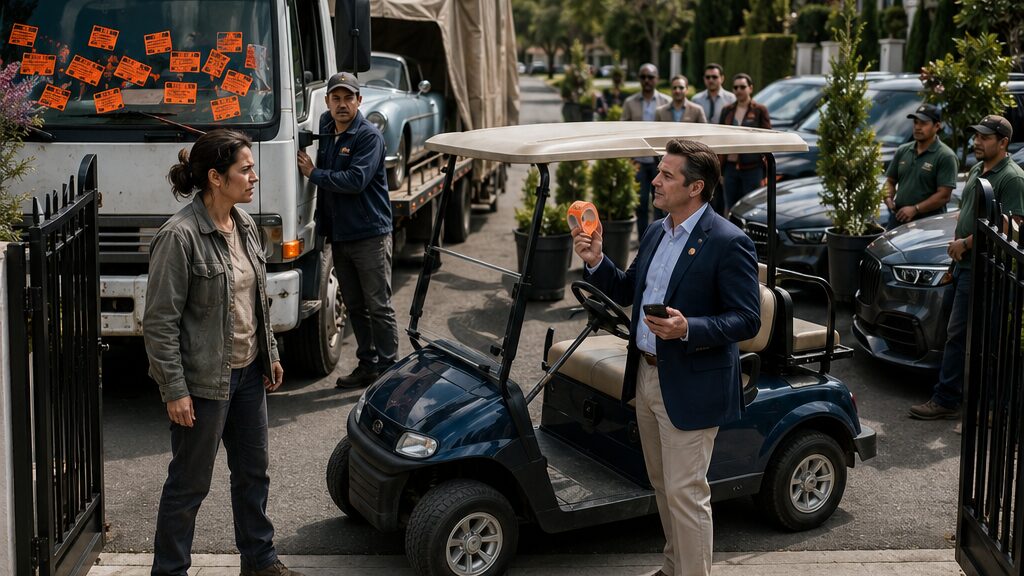
Rodrigo Salazar stepped down from it wearing pressed slacks, a navy blazer, and the expression of a man arriving exactly where he intended to be seen. He lifted one hand toward Samuel’s windshield like a traffic officer, though no badge hung from his chest and no law stood behind him.
The truck’s brakes sighed.
María picked up her folder and walked out through the open double gates.
Rodrigo did not look at her first.
He looked at the truck, then at the trailer, then at the open mouth of her side yard.
Only after that did he turn, smiling just enough for the watching porches.
“María,” he called, raising his hand higher. “We need to discuss your access.”
Behind him, the delivery truck stopped in the middle of the street.
And from somewhere around the corner came the scrape of something heavy being dragged across asphalt.
Chapter 2: Rodrigo Turns Landscaping Into a Barricade
The first potted tree hit the street with a ceramic grind that made Samuel’s truck lurch to a full stop.
María turned toward the sound.
Two workers in gray shirts were dragging a waist-high planter across the asphalt from the direction of the clubhouse path. The tree inside it was not tall enough to shade anything, but the pot was enormous, thick, and heavy, the kind used at entrances to tell people where they were allowed to walk. Another worker followed with a second planter on a dolly. Behind them, Martha Sánchez held a clipboard under one arm and looked less like someone supervising landscaping than someone trying to finish a job before she understood it.
“Martha,” María called. “What are you doing?”
Martha’s eyes flicked to Rodrigo before she answered. “Temporary placement. HOA beautification request.”
“In the street?”
Rodrigo stepped between them smoothly, as if the question had been asked of him. “Traffic calming.”
Samuel leaned from the truck window. “Sir, you can’t put that there. I need that swing to make the turn.”
Rodrigo gave the cab a pleasant look. “You won’t be making any turn until this access issue is resolved.”
The truck idled, diesel vibration pressing through the morning quiet. The trailer sat behind it, long and covered, the canvas rippling faintly. The whole thing was angled just before María’s gate, not blocking the entire street yet, but close enough that any wrong move would become expensive.
Neighbors gathered in doorways now. No one came close.
María opened her folder. “Rodrigo, I have city approval for cargo access. You were sent the documents.”
“I received several documents,” he said. “None of them override community standards.”
“The road is public access.”
“The road runs through an HOA-managed visual corridor.”
“That is not a legal category.”
Rodrigo’s smile thinned. “It is a community category.”
The second planter scraped into place, narrowing the truck’s path. Samuel swore softly inside the cab and checked his mirrors.
Martha raised a hand to her crew. “Hold there.”
Rodrigo snapped his fingers once, not loud, but sharp enough that everyone saw it. “No, continue. I need them staggered.”
Martha hesitated.
He lowered his voice, but María was close enough to hear. “This is under the board’s curb presentation contract. Do you want me to tell the committee you refused placement?”
Martha’s jaw tightened. She signaled the worker forward.
There it was, María thought. Not rage. Not even courage. Just pressure, passed from one person to another until the wrong thing began to look like work.
“Samuel,” María said, walking toward the truck, “keep your wheels straight.”
“I’m trying,” he said. He was younger than she expected, maybe in his thirties, with a delivery cap pulled low and both hands tight on the wheel. “But if they put another pot there, I can’t get the trailer in without jumping the curb.”
“You won’t jump anything,” Rodrigo said. “You’ll reverse out.”
Samuel looked at the long trailer behind him, then at the narrow bend he had just taken. “Not safely.”
“That sounds like a training issue.”
María looked at Rodrigo then, really looked at him: the clean blazer, the polished shoes, the HOA pin on his lapel, the little laminated badge clipped to the golf cart even though it meant nothing. He had come dressed for an audience.
“You planned this,” she said.
He lifted his eyebrows. “I planned to protect the neighborhood from unauthorized industrial use.”
“It’s one delivery.”
“That is how it starts.” Rodrigo turned slightly, projecting now toward the porches. “A resident modifies a side yard. A truck arrives. Then another. Then suddenly we have loading activity, noise, diesel fumes, lowered values. People buy here because we maintain standards.”
A few neighbors shifted. One woman folded her arms. Someone murmured, “He has a point,” too quietly to own it.
María felt the old instinct to answer every accusation with proof. She held out the permit packet.
“Here is the easement language,” she said. “Here is the delivery appointment. Here is the insurance. This is not industrial traffic.”
Rodrigo did not take the papers. “The HOA has not approved a commercial vehicle entry.”
“You don’t approve public access.”
“We approve neighborhood impact.”
From behind the truck came the smooth electric hum of another vehicle.
Clara Ruiz’s silver luxury car rolled out from her driveway and glided toward the curb two houses down. María watched it turn, slow, then stop at a strange angle with its nose too far into the street and its rear end hugging the curb. It was not parked. It was placed.
Samuel saw it too.
“Ma’am,” he called to María, “that car is in my trailer path.”
Clara remained behind the wheel, her sunglasses on though the sun had barely risen. Her knuckles rested high on the steering wheel. She did not look toward María.
Rodrigo glanced at the car and nodded once, almost imperceptibly.
María’s stomach dropped.
The plan was not to question her delivery.
The plan was to trap it.
She walked toward Clara’s car. “Clara, I need you to move.”
Clara lowered her window three inches. “Rodrigo said it’s just for a few minutes.”
“You’re blocking the turn.”
“I’m not in your driveway.”
“You’re in the street.”
Clara’s mouth tightened. “I don’t want my car involved in this.”
“It already is.”
Rodrigo’s voice cut in behind María. “Clara is assisting with temporary traffic control at the request of the association.”
Clara looked relieved to have him speak for her.
María turned back. “She is illegally angled into an active delivery route.”
“Your unauthorized route.”
“My approved route.”
Rodrigo looked at Samuel. “Driver, shut off the engine.”
Samuel did not move.
Rodrigo took one step closer to the cab. “I said shut it off.”
Samuel looked at María, then at the potted trees, then at Clara’s car. The truck kept idling.
“I can’t sit here long,” he said. “My dispatcher will start calling. And if this gets logged as a refused delivery—”
“It isn’t refused,” María said.
Rodrigo’s smile returned. “It will be if the gate fee is not paid and access approval is not granted.”
María stared at him. “Gate fee?”
“For oversized commercial impact. Emergency assessment. Five hundred dollars.”
“That rule does not exist.”
“It will be documented.”
“That is not the same thing.”
Rodrigo’s face changed for the first time. The smile did not vanish; it hardened. “You keep acting as if paperwork makes you exempt from living with other people.”
María felt the sentence land where he meant it to land. Not at the gates. Not at the truck. At her.
For a moment, she saw all the meetings behind this one. His voice asking whether she understood neighborhood character. His email about tone. His note about “cooperative residents.” His talent for making defiance sound like selfishness.
Martha’s crew dragged the third potted tree forward.
“Martha,” María said, sharper now, “do not put that in front of the truck.”
Martha’s eyes pleaded more than they argued. “I was told the placement was cleared.”
“By whom?”
Rodrigo lifted his clipboard. “By the Vice President of the board.”
“That is not clearance,” María said.
Rodrigo turned away from her as if finished and reached into the basket of his golf cart.
When his hand came out, he was holding a roll of neon orange violation stickers, the kind the HOA used on trash bins left out past collection day and cars parked overnight without permits. They were bright enough to be seen from every porch.
“No,” María said.
Rodrigo peeled one back slowly. “If the driver refuses to leave, we document the violation.”
Samuel opened his door halfway. “Do not put anything on my truck.”
Rodrigo kept walking toward the cab.
María stepped after him, folder still in her hand, papers bending under her grip.
The sticker stretched between Rodrigo’s fingers, glossy and loud in the morning light.
He looked once toward the watching neighbors, then lifted it toward Samuel’s windshield.
Chapter 3: The Stickers Turn the Rule Into a Threat
The neon sticker landed across Samuel’s windshield with a slap so sharp that everyone on the street heard it.
For one second, no one moved.
The sticker sat directly in Samuel’s line of sight, a wide orange slash across the glass, blocking the place where his eyes needed to find the edge of the trailer, the potted trees, Clara’s silver bumper, María’s open gate.
Then Samuel pushed the truck door wider. “Are you out of your mind?”
Rodrigo stepped back with both palms raised, as if he had been the one threatened. “Notice has been served.”
“You stuck that on my windshield.”
“Because you are operating an unauthorized commercial vehicle in a restricted residential corridor.”
Samuel looked at María. His face had gone pale beneath the brim of his cap. “I can’t move like this.”
“You won’t have to,” María said.
She walked to the windshield and reached for the sticker’s edge.
Rodrigo caught her wrist.
Not hard enough to bruise. Hard enough for everyone to see.
“Tampering with an official violation notice is another violation,” he said.
María looked down at his hand until he released her.
There was heat in her face now, and she hated that he could see it. She hated even more that he knew she hated it.
“This is not official,” she said.
Rodrigo peeled another sticker from the roll. “It carries the authority of the association.”
“You are blinding a driver.”
“I am marking a vehicle that refuses compliance.”
“He has a trailer attached.”
“Then he should have thought about that before entering.”
Samuel climbed down from the cab, leaving the door open behind him. He did not step far. The truck was still angled. The trailer stretched behind it like a held breath.
“I came in on the route I was given,” he said. “I have a scheduled delivery for this address. You people need to clear the road or give me a safe exit.”
Rodrigo pointed toward the bend. “Reverse.”
Samuel laughed once, without humor. “With planters, a car, and your cart in my blind spots?”
Clara’s driver-side window slid down another inch. “Rodrigo, maybe I should move.”
“No,” Rodrigo said quickly.
Clara froze.
María caught that too.
Samuel lifted his phone. “I’m calling dispatch.”
Rodrigo’s voice sharpened. “Good. Tell them their company will be named in a formal complaint.”
Samuel hesitated, because liability had a language of its own. María could almost see it moving through him: truck, trailer, client, property damage, rich neighborhood, angry official-looking man. He was not neutral anymore. He was trapped.
Martha Sánchez approached María from beside the planters, her clipboard held against her chest.
“Ms. Cruz,” she said quietly.
María did not take her eyes off Rodrigo. “Yes?”
Martha lowered her voice. “We were told to be here at six-thirty. Before the truck.”
María turned.
Martha swallowed. “The instruction was to place the pots once the delivery entered the street. Make it look permanent. That was the phrase.”
María felt something inside her settle—not calm, not relief, but a cruel kind of clarity.
“You knew?” she asked.
“I knew we were placing planters. I didn’t know he was going to put stickers on the windshield.” Martha glanced back at her crew. “These men are hourly. I need this contract.”
“I understand needing work,” María said. “I don’t understand blocking a live vehicle.”
Martha’s eyes flicked toward the truck. “Neither do I.”
Rodrigo saw them speaking and strode closer. “There should be no side agreements happening here.”
Martha straightened. “I’m confirming safety.”
“You’re here to perform contracted placement.”
“I’m not here to cause an accident.”
Rodrigo’s expression darkened, but only for a blink. Then he turned his attention back to María, as if Martha were a tool that had slipped and could be picked up later.
“This is simple,” he said. “Pay the impact fee, submit a retroactive access request, and instruct your driver to leave until the board reviews the matter.”
“My driver,” María said, “is not leaving blind.”
Rodrigo lifted the second sticker.
María stepped between him and the truck.
The street seemed to narrow around them. The potted trees boxed one side. Clara’s vehicle boxed the other. The delivery truck idled behind María, its engine vibrating through the soles of her shoes. On the porch across the street, the man with the coffee mug had stopped pretending not to watch.
Rodrigo held the sticker inches from María’s shoulder. “Move.”
“No.”
“You are interfering with enforcement.”
“You are creating a hazard.”
“You like that word,” he said. “Hazard. As if the hazard isn’t a resident redesigning her property into a loading bay.”
“It is a gate.”
“It is an invitation.”
“To what?”
“To every contractor, transporter, hauler, and business operator who sees this neighborhood as an address instead of a community.”
There it was again. Community, used like a locked door.
María heard her mother’s voice from years ago, not in memory exactly, but in the rhythm of her own restraint: keep your papers, keep your voice even, make them say no in writing. Good advice for counters, clerks, inspectors. Bad advice, maybe, for a man with a sticker in his hand and an audience behind him.
Samuel’s phone rang.
He answered with one hand over his ear. “Yes, I’m on-site. No, I can’t complete access. No, the customer is here.” He listened, jaw tight. “Because they blocked the street.” Another pause. “I understand policy, but reversing out is not safe.”
María turned. “What are they saying?”
Samuel covered the phone. “If I can’t unload or safely hold position, they’ll recall the delivery. They don’t want a claim.”
Rodrigo smiled as if the dispatcher had joined his committee.
“See?” he said. “Professional judgment.”
Samuel’s eyes flashed. “Don’t use me for this.”
Rodrigo ignored him and pressed the second sticker against the windshield, lower this time, catching the driver’s side corner where Samuel would need to see Clara’s bumper.
Samuel cursed and took a step forward.
María put out a hand, stopping him without looking away from Rodrigo.
“Don’t,” she said softly. “That’s what he wants.”
Rodrigo’s phone was already in his other hand.
“Excellent advice,” he said. “Everyone should stay calm while the board documents a resident-created disturbance.”
The word disturbance seemed to please him.
María looked at the truck. The covered trailer. The open double gates. The folder of permits lying now on the hood of her own parked car inside the yard because she had set it down when Rodrigo touched her wrist. Every legal page was still there. Every approval. Every proof.
And none of it could peel neon plastic off Samuel’s windshield fast enough.
Martha walked back to her crew and said something under her breath. The workers stopped moving the third planter. One of them lowered the dolly handles gently, as if noise itself might make him guilty.
Clara opened her door a crack. “Rodrigo, my car is really close to the trailer.”
Rodrigo snapped, “Stay where you are.”
Clara shut the door again, but her face had changed. Not brave yet. Just frightened in a new direction.
María saw the entire arrangement now. The trees were not decoration. Clara’s car was not incidental. The golf cart was not transportation. The stickers were not notices. They were all pieces of one message: you do not pass unless I allow it.
Samuel’s dispatcher’s voice rose faintly from the phone.
Samuel lowered it. “Ms. Cruz, I’ve got minutes. They’re telling me to disengage if this isn’t resolved.”
“Can you move forward if the trees and car are cleared?”
“If they’re cleared, yes. But not with him in front of me. Not with that cart. Not with the windshield like this.”
María nodded once.
Rodrigo must have seen something in her face, because he stepped back toward the golf cart. Not away. Into position.
He climbed in, started it, and rolled forward with a soft electric whine until the cart sat squarely between María and the open gates, its front end angled like a little green barricade wearing an HOA placard.
Then he stepped out and planted himself beside it.
“Well?” he said, loud enough for the porches. “You’ve made accusations. You’ve waved papers. You’ve disrupted a neighborhood street.” He spread his arms. “What exactly are you going to do?”
María looked at Samuel, trapped beside the blinded windshield.
She looked at Martha, rigid beside the potted trees.
She looked at Clara, half-hidden behind tinted glass.
Then she looked at Rodrigo’s golf cart blocking the route her gates had been built to open.
Rodrigo tapped the cart’s roof with the roll of neon stickers.
“Or what?” he asked.
Chapter 4: The Covered Car Carries More Than Metal
A gust of wind caught the trailer cover and lifted one corner just enough for sunlight to strike polished chrome.
The flash was brief, but every watching face seemed to turn toward it.
María moved first. She stepped to the side of the trailer and pressed the canvas back down with both hands, her folder tucked under one arm, her body placed between the neighborhood and the glimpse of the car. The chrome had shone like a secret trying to escape. For one sharp second she saw Gabriel’s hand inside, still on the passenger-side armrest.
Rodrigo saw the movement in her.
His eyes narrowed. “Interesting.”
“It’s a vehicle,” María said.
“Clearly.”
Samuel stood by the open truck door, one hand still gripping his phone. The dispatcher’s voice had gone silent, placed on hold or muted. He looked from the covered trailer to the stickered windshield to the potted trees crowding the road, as if calculating how much longer a job could remain a job before becoming a claim.
Rodrigo took two steps toward the trailer. “If there’s nothing improper about the delivery, there should be no issue with inspection.”
María’s palm flattened harder against the canvas. “You are not inspecting anything.”
“Then you admit there is concealed cargo.”
“It is covered because that is how vehicles are transported.”
“Vehicles,” Rodrigo repeated, turning the word toward the neighbors. “Plural category. Commercial category.”
A faint murmur moved through the porches and sidewalks.
María hated how easily he could make ordinary words sound like evidence.
Clara’s luxury vehicle gave a soft electronic chime from the curb. She had opened her door again, one careful inch, and was leaning out just enough to see the trailer angle.
“Rodrigo,” Clara said, voice tight, “my front bumper is really close to his rear swing. If he moves at all—”
“He won’t move,” Rodrigo said.
“But if someone tells him to reverse?”
“No one is telling him anything except me.”
Clara’s sunglasses hid her eyes, but her fingers were white on the door frame. The car was new enough that María could still see the temporary dealer film in one corner of the rear window. Clara had shown it off at the mailbox three days earlier, laughing too loudly about how she had waited six months for the color.
Now she had parked it like a wall and discovered walls could be hit.
“Move it, Clara,” María said.
Clara’s mouth opened, then closed.
Rodrigo turned on her. “Clara, stay exactly where you are. Your cooperation is noted.”
That phrase made Clara shrink back a fraction.
María heard it for what it was: not praise, but a receipt.
Martha Sánchez had moved her crew away from the third planter. The first two still sat in the road like oversized punctuation marks, announcing that Rodrigo had altered the street faster than María could cite it. One worker leaned on the dolly and kept glancing at Samuel’s windshield.
“This is getting unsafe,” Martha said.
Rodrigo did not even look at her. “The unsafe condition began when an oversized delivery entered without board approval.”
María pulled the folded HOA notice from her pocket and held it up. “This was tucked into my gate before sunrise. You wrote ‘possible unauthorized access.’ Possible. You knew it wasn’t decided.”
Rodrigo smiled. “And yet here we are, with a commercial transporter blocking the street.”
“You blocked the street.”
“I responded to the hazard you created.”
The trailer cover shifted again, not from wind this time.
A soft movement, barely visible, behind the passenger-side glass.
María’s breath caught.
Rodrigo’s gaze snapped toward the car.
Samuel saw María’s face and looked too. “Is someone in there?”
“No,” María said too quickly.
The lie came out before she could shape it into something less brittle.
Rodrigo heard the break in it. “No?”
María stepped closer to the trailer. “This delivery is private.”
“It’s in the street.”
“Because you stopped it there.”
“It is in a community space.”
“It is on a public access route.”
Rodrigo lifted his phone, thumb moving over the screen. “Then you won’t mind explaining to the residents why a concealed vehicle is being delivered through unauthorized cargo gates at sunrise.”
“It isn’t sunrise anymore,” Samuel muttered.
No one laughed.
María turned her head slightly toward the passenger side, just enough to speak without making it obvious. “Stay inside.”
Gabriel did not answer, but she saw the faint movement stop.
Her heart beat hard against her ribs.
She had asked him to stay hidden when he arrived at the restoration shop before dawn, gray jacket buttoned, cap low, looking less like a police chief than a man trying not to make a memory public before it had to be. He had wanted to ride in the passenger seat for the final approach.
“Just through the gate,” he had said. “I want to hear it roll in.”
His father had owned the same model once. Not the same car—María had been careful never to pretend that—but the same year, the same body line, the same curved hood Gabriel had described at a charity repair day after he found her arguing with a city clerk over a tow notice that should never have been issued. He had not fixed her problem with a favor. He had stood beside her and made the clerk read the ordinance out loud.
That had been enough.
She had remembered what enough felt like.
Years later, when the memorial committee planned a small event for families of retired first responders, María had learned the old car model mattered to him. She had found a restorable one through a friend of a friend. She had worked quietly, paid in installments, called in favors, and insisted the delivery remain private until the presentation.
No police escort. No spectacle. No whisper that Gabriel Morales had used his title to receive a gift.
Dignified, she had promised.
And now Rodrigo was turning dignity into suspicion.
“What are you hiding?” he asked.
María’s hand tightened on the canvas tie. “A restored classic car.”
“For whom?”
“A private recipient.”
“A client?”
“No.”
“A buyer?”
“No.”
“A business partner?”
“No.”
“Then why the secrecy?”
Because not every good thing has to pass through your hands to be clean, she thought.
But aloud she said, “Because it is none of your business.”
Rodrigo’s face lit with triumph, as though privacy itself had confessed.
“You hear that?” he called, turning to the neighbors. “None of our business. A resident modifies her property, schedules an oversized vehicle delivery, conceals cargo, refuses inspection, and then tells the community it has no right to ask questions.”
María felt the trap close. Her promise to protect Gabriel from spectacle had become the exact thing Rodrigo could wave in front of an audience. She could reveal the recipient and win the moment too early, perhaps. She could say Gabriel’s name and watch Rodrigo step back. Maybe that would end it.
But then every whisper Rodrigo had planted would shift shape: María used the Police Chief. María arranged special treatment. María brought power into a neighborhood dispute.
She had spent years trying to prove she did not need special permission to be treated fairly.
She would not borrow Gabriel’s authority just because Rodrigo had borrowed the HOA’s.
Samuel’s phone crackled. He listened, then looked at María. “They’re asking again. They need a decision.”
“How long?” María asked.
“Minutes.”
Rodrigo slid his phone higher, camera now pointed toward María, trailer, and the open gates. “Let the record show the resident refuses to identify the concealed delivery recipient.”
“Let the record show,” María said, voice low, “that you put stickers on a windshield and ordered planters into a public route.”
His smile faltered at the steadiness of it.
Then he recovered. “If there’s no commercial interest here, sign a statement. Right now. You accept full liability for any damage, any curb impact, any vehicle contact, any reduction in neighborhood value, and any violation found after inspection.”
“No.”
“Because you know you’re wrong.”
“Because you don’t get to invent papers in the street.”
Clara’s voice came again, smaller. “Rodrigo, I really think I should move.”
This time, Rodrigo’s head whipped toward her. “If you move that car, you are interfering with an active compliance action.”
Clara sat frozen, trapped by the favor she had agreed to before the danger had a shape.
Martha stepped forward. “Mr. Salazar, I’m pulling my crew back from the truck.”
“You’ll do no such thing.”
“I am not putting men between a trailer and a blocked road.”
Rodrigo’s jaw tightened. “Your invoice will reflect incomplete work.”
Martha’s face closed. The threat landed. But she still lifted one hand to her workers, and they stepped away from the planters.
For the first time that morning, Rodrigo looked outnumbered.
Then the covered car shifted again.
This time the movement behind the passenger-side glass was clearer: the shape of a shoulder, the slight turn of a head.
María saw it.
Rodrigo did not.
But one of the neighbors on the sidewalk did, and leaned forward.
María moved quickly, pretending to adjust the canvas, her back blocking the view. Through the small gap near the side window, she caught Gabriel’s eyes.
He was calm, but not passive. One hand rested near the door handle.
No, María mouthed.
His gaze moved past her, toward the stickered windshield, toward Samuel standing in the road, toward Rodrigo holding his phone like a weapon. The question in his face was not whether he could end it. It was whether he should.
María shook her head once.
Not yet.
Rodrigo’s voice rose behind her. “Step away from the trailer.”
María turned, still holding the cover in place. “Move the cart.”
“Identify the recipient.”
“Move the cart.”
“Pay the gate fee.”
“Move the cart.”
“Submit the vehicle for inspection.”
“Move the cart.”
For a second, they stared at each other over the blocked road, the same two words striking every demand he stacked in front of her.
Then Rodrigo laughed once, sharp and humorless.
“You’re making this very easy,” he said.
He walked back to the golf cart, climbed in, and drove it forward until it sat even more squarely before the open gates. The little vehicle’s bumper pointed directly at María’s knees when he stepped down.
He lifted his phone again.
“Let everyone see,” he said, camera aimed at her face. “Let everyone see what kind of resident you are.”
Behind María, through the passenger-side glass, someone moved again in the covered car.
This time only she noticed the hand settling firmly on the inside door handle.
Chapter 5: The Golf Cart Becomes a Badge of False Authority
Rodrigo rolled the golf cart forward until its front bumper nearly touched María’s knees.
The movement was small, almost gentle, which made it worse. He did not hit her. He did not need to. The cart’s nose entered the space where her body stood, and every watching neighbor understood the message without a word: move because I can make you.
María did not step back.
The engine hummed softly beneath the cart’s plastic shell. The HOA placard on the front trembled from the vibration. Behind her, Samuel’s truck idled with an uneven strain, the covered trailer angled across the street, the stickers still burning orange across the windshield.
Rodrigo held up his phone.
“Resident is obstructing compliance personnel,” he narrated.
María looked at the phone lens. “The compliance personnel is blocking a public access route.”
“The resident has become confrontational.”
“The Vice President has placed objects in front of an active delivery truck.”
“The resident refuses to follow lawful instructions.”
“You are not law enforcement.”
Something flickered in Rodrigo’s eyes at that.
Not anger first. Fear.
It passed quickly, but María saw it because she had spent years watching his face for the moment when politeness turned into punishment.
“You always do this,” he said, lowering the phone only slightly. “You turn community concerns into personal attacks.”
“You put stickers on a windshield.”
“I marked a violation.”
“You endangered Samuel.”
“I protected the neighborhood from an unapproved commercial operation.”
“It is not commercial.”
“Then why the oversized transporter? Why the secrecy? Why gates wide enough for equipment?”
María almost answered with Gabriel’s name. It pressed against her tongue like relief.
Instead she looked at the open gates. She had built them wide because access, once denied, had a way of shrinking a person’s life. First one rule, then one delay, then one person at a desk telling her to come back with a paper she had already brought. Gabriel had once stood beside her while she learned that the rule was not always the obstacle. Sometimes it was the person pretending to interpret it.
She had promised herself she would never again confuse a raised voice with authority.
Yet she had been doing exactly that with Rodrigo for months.
Samuel climbed back into the cab and pressed the brake. The truck shuddered.
“Ms. Cruz,” he called through the open door, “I need everyone clear. Brakes are heating. I’ve been holding this angle too long.”
María turned. “Can you shut it down?”
“If I shut down here, dispatch may classify it as failed access. If I move blind, I risk contact. If I sit, I’m cooking the system.”
Rodrigo pointed at him. “Then reverse.”
Samuel looked at the orange sticker blocking the glass, then at Clara’s car. “I cannot reverse safely with your obstruction.”
Rodrigo’s phone swung toward him. “Driver refuses safe exit.”
Samuel’s mouth opened, then closed. He looked younger in that moment, not because he lacked courage, but because he understood how fast a working person’s caution could be edited into guilt by someone recording from the curb.
María stepped between the phone and Samuel.
“Stop filming him.”
Rodrigo smiled. “Why? Does the truth bother you?”
“The truth is behind your camera.”
“The truth is a resident losing control because the rules finally applied to her.”
A porch neighbor murmured something. Another phone lifted.
María felt the scene tilting. Rodrigo knew performance. He knew how to bait the kind of reaction that could be replayed without context. Her voice, if it rose, would be the clip. Her hand, if it touched him, would be the evidence. His plan did not require him to be right. It required her to look wrong in the right three seconds.
The golf cart hummed at her knees.
Martha came up beside the first planter. “Mr. Salazar, the truck needs a clear path or a safe shutdown. My crew is not moving another pot.”
Rodrigo did not look away from María. “Your crew will remain available until the compliance action is completed.”
“No,” Martha said.
That single word made several neighbors turn.
Rodrigo’s face tightened. “Excuse me?”
“No,” Martha repeated, not louder, but steadier. “We were told to place landscape materials. We weren’t told to trap a transport trailer or block a driver’s view.”
Rodrigo’s phone shifted toward her. “Are you refusing contracted work?”
“I’m refusing unsafe work.”
The word unsafe hung there.
Samuel nodded once, grateful and grim.
Clara opened her door fully now, then stopped halfway out, afraid to commit to either side. “Rodrigo, I’m moving my car.”
“You will not,” he snapped.
“My insurance won’t cover this if I knowingly sit here.”
“That’s absurd.”
“You told me it was a temporary curb hold before the truck came in.”
Every head turned toward Clara.
Rodrigo’s expression went flat. “Clara.”
She flinched at her own name.
María felt the first crack widen. Not enough to clear the road. Enough to show that Rodrigo’s authority was built from borrowed obedience, one frightened person at a time.
But the delivery still sat trapped.
Rodrigo recovered fast. “The vehicle was positioned for safety.”
Samuel gave a short laugh. “It’s blocking my swing.”
“You have said plenty,” Rodrigo told him.
Samuel’s dispatcher called again. The ringtone cut through the street with humiliating cheer. Samuel looked at the screen and did not answer.
“How much longer?” María asked.
He shook his head. “I’m already past the decision point.”
Rodrigo heard it and seized on it. “Then leave.”
Samuel looked at the windshield. “I need those stickers removed.”
“They stay until the report is filed.”
María walked to the truck again and reached for the edge of the first sticker.
Rodrigo moved after her. “Touch that notice and I will include tampering.”
She stopped with her fingers an inch from the glass.
There it was: the legal route blocked faster than any legal process could respond. A complaint later would not clear the glass now. A city citation later would not move Clara’s car now. A police report later would not cool Samuel’s brakes now.
The promise of future justice had become another delay.
From inside the covered car came a muffled sound, barely audible under the truck’s idle: the soft click of a door latch testing but not opening.
María turned her head.
Rodrigo heard something this time. “What was that?”
“Move your cart,” María said.
He stepped back to it, touched the plastic roof, and smiled into his phone again. “The resident appears fixated on my personal mobility vehicle.”
“That cart is blocking the route.”
“This cart is HOA property being used for compliance.”
“Is it?”
A flicker crossed his face.
María had not meant the question as a trap, but his reaction told her it had found something. The cart’s glossy green body, the HOA placard, the little compliance flag fixed to the rear—everything about it was meant to look official. But she remembered seeing a leasing decal on its side at a neighborhood picnic. Not HOA-owned. Personally leased, maybe. Borrowed into authority.
Rodrigo raised his voice before she could follow the thought. “I am calling police.”
“Do it,” María said.
He blinked.
“Call them,” she said. “Tell them you blocked a public access route after being warned. Tell them you obstructed a delivery truck. Tell them you placed stickers across a driver’s windshield. Tell them you used a neighbor’s car and hired workers to make it look permanent.”
The neighbors had gone very quiet.
Rodrigo held the phone at chest height. His thumb hovered.
Then his expression shifted again, calculation replacing outrage.
“You’re trying to provoke me because you know you’re losing,” he said. “You want a scene. You want to claim victimhood. But I know exactly what this is.”
He turned his phone toward the open gates, the truck, the trailer, the covered car.
“This is unauthorized commercial access by a resident who thinks rules are harassment.”
María looked past him to the canvas-covered shape.
The passenger-side glass was dark, but she knew Gabriel was watching. She knew he had heard enough to step out. One opened door, one calm sentence, one badge in plain sight, and Rodrigo’s performance would collapse.
But then the story would become Gabriel’s.
Not Samuel’s blinded windshield. Not Martha’s threatened crew. Not Clara’s borrowed compliance. Not María’s gates, María’s paperwork, María’s right to open a route that was already hers.
She had wanted to keep the gift private because dignity mattered.
Now she understood dignity required something harder than privacy.
Rodrigo rolled the cart half an inch closer.
“Last chance,” he said. “Tell your driver to reverse.”
Samuel shouted from the cab, “I can’t hold much longer.”
The truck gave a small, ugly jerk. Not forward exactly—a mechanical settle, a strain releasing through metal and brake heat—but enough for Clara to gasp and Martha’s crew to step back.
María’s body moved before the fear finished.
She turned to Samuel. “Set the brake. Step away from the door.”
“I—”
“Now.”
Something in her voice made him obey. He pulled the brake, killed the engine, and climbed down carefully, keeping one hand on the cab rail. The sudden absence of the truck’s idle left the street exposed and breathless.
María faced Rodrigo.
“Move the cart,” she said.
He lifted his phone higher. “Or what?”
She did not answer.
She set her folder on the curb, beside one of the orange chalk marks. She removed her phone from her back pocket and placed it on top of the folder. She slid the folded HOA notice beneath the phone so it would not blow away.
Then she stepped back.
Rodrigo smiled because he thought she was retreating.
María lowered her shoulders once, testing the distance. The cart was light enough. Plastic body, narrow frame, small windshield, decorative roof. Its authority came from placement, not weight.
“María,” Martha said softly, warning and plea together.
Rodrigo’s smile faltered.
María took one more step back.
The street seemed to draw a line from her open gates to the golf cart’s glossy side. For years, she had stopped at lines other people drew: review pending, tone inappropriate, not consistent, possible violation. She had answered each one with paper.
This one needed force.
Rodrigo’s phone dipped.
María lowered her shoulder and started running.
Chapter 6: The Crash That Made the Street Go Silent
María’s shoulder hit the golf cart with a crack loud enough to stop every voice on the street.
For one suspended instant, the cart rocked but did not fall. Its plastic side buckled under her weight. The little windshield flexed. Rodrigo’s phone hand jerked downward as his mouth opened in an unfinished shout.
Then the cart tipped.
It went over slowly at first, almost politely, as if refusing to believe something so small could bring it down. The left wheels lifted. The HOA placard snapped loose and spun into the gutter. The roof struck the edge of a planter, cracked, and folded sideways. Then the whole cart crashed onto its side with a burst of plastic, glass, and metal that echoed between the manicured houses.
Silence followed so completely that María could hear her own breath.
She stumbled one step, caught herself, and stood with her hands open at her sides. Pain burned across her shoulder, deep and immediate. She did not touch it. She did not look away from Rodrigo.
The overturned golf cart lay between them like a lie finally given a shape.
Rodrigo stared at it.
Then he found his voice.
“You saw that,” he shouted, turning wildly toward the neighbors. “Everyone saw that. Destruction of community property. Assault. Violent conduct. I have it recorded.”
His phone was no longer recording. It had flown from his hand and landed face down near the curb.
No one pointed that out.
Samuel moved first, not toward María, but toward the truck. He climbed onto the step and reached through the open door, peeling at the edge of the lower sticker from inside the cab. The first piece came away with a squeal of adhesive.
Rodrigo saw him. “Do not tamper with those notices.”
Samuel stopped, looked at the cart on its side, then peeled harder. The sticker tore in half.
Martha exhaled. “Crew, move the planters back.”
Rodrigo spun toward her. “Nobody moves anything.”
Martha did not raise her voice. “Move them back.”
Her workers obeyed. The first planter scraped away from the truck path, ceramic grinding over asphalt like the sound that had begun it all, only now the direction had changed.
Clara stepped fully out of her luxury vehicle, keys in hand. “I’m moving my car.”
Rodrigo pointed at her. “Stay where you are.”
“No.” Her voice shook, but it carried. “No, I’m not leaving it there.”
Samuel tore off the second sticker, leaving orange scraps clinging to the glass. “If you move it three feet back and straighten out, I can swing through.”
Clara looked at the trailer, terrified. “You won’t hit me?”
“Not if you move now.”
She hurried into the car.
Rodrigo lunged toward the driver’s side. “Clara, if you move that vehicle, you are admitting participation in—”
“In what?” she snapped, startling herself. “Because you told me it was a curb hold. You said the board needed a visual record before the truck arrived.”
A murmur went through the neighbors.
Rodrigo’s face flushed. “That is not what I said.”
“It is,” Clara said, and her voice nearly broke. “You told me to park there before he came around the corner.”
The sentence landed harder than the crash for some people. María saw it in the way heads turned from the cart to Rodrigo. The accident was loud; the planning was worse.
Rodrigo’s eyes sharpened with panic. “You’re confused.”
Martha said, “No, she isn’t.”
He turned on her. “You’re a contractor.”
“I’m the one you told to make the planters look permanent.”
The crowd changed again. Not cheering, not brave, but rearranging its fear.
María bent slowly and picked up Rodrigo’s phone from the curb. The screen was cracked across one corner but lit when she touched it. The recording had stopped at impact. She held it out to him.
He snatched it from her hand. “You just handed me the evidence.”
“You already had witnesses.”
“I have enough to press charges.”
“You should call.”
“I will.”
“Good.”
The word seemed to unsettle him more than apology would have.
Rodrigo jabbed at his phone. “You think this is funny? You think because you had a tantrum in the street, the rules disappear?”
María’s shoulder throbbed. Her pulse pounded in the soft hollow of her throat. For the first time all morning, she let herself look at the path.
The first planter was dragged aside. The second was moving. Clara’s luxury vehicle backed up with a trembling little chirp and straightened against the curb. Samuel wiped adhesive from the windshield with a cloth from his cab, enough of the orange gone now that the glass showed road again.
A narrow route opened in front of the double gates.
Not wide. Not graceful.
Open.
Samuel looked at María. “I can reposition if everyone stays clear.”
Rodrigo raised his phone to his ear. “Yes, I need police response to an HOA property destruction incident.” He paused, listening. “Residential compliance matter. A resident attacked association equipment.”
Association equipment.
María looked at the cart again.
Its side panel, now facing upward, showed a white leasing sticker half-hidden beneath the fake HOA placard bracket. Personally leased through a recreation vendor. No association asset number. No municipal marking. Just Rodrigo’s vehicle wearing a costume.
Martha saw it too.
“Is that cart even HOA property?” she asked.
Rodrigo’s eyes flashed toward the sticker.
“That is irrelevant.”
“Is it?” Clara said from beside her now-straightened car.
Rodrigo spoke into the phone, louder. “The resident is hostile. Multiple people are interfering. I need officers dispatched.”
Samuel climbed into the cab again. “Ms. Cruz, I can make the gate if the cart stays where it is.”
The overturned cart sat partly out of the route now, no longer blocking the center line. María’s impact had tipped it away from the truck’s path, its crumpled hood facing upward like a dented green table.
“Go slowly,” María said.
Samuel nodded and started the engine.
The truck rumbled back to life. It sounded different now—not trapped, but careful. The windshield still carried torn sticker edges, neon scraps clinging like accusations that had lost their sentence.
Rodrigo held up one hand. “That truck does not move.”
No one obeyed.
Samuel eased the vehicle forward an inch.
The trailer responded, its covered load shifting with the smallest metallic creak. María watched the wheels, then Clara’s bumper, then the nearest planter. Martha guided her crew backward. Clara stood pressed against her car door, both hands over her mouth.
The trailer cleared the first planter by inches.
Rodrigo stepped toward the cab, then stopped when María moved with him.
“Do not get near Samuel,” she said.
His eyes locked onto hers. “You’re finished here.”
“No.”
“I will make sure every resident knows what kind of person you are.”
“They watched.”
“They watched you attack my cart.”
“They watched you block a truck.”
“They watched you lose control.”
María’s shoulder pulsed. She could feel the bruise forming. She could also feel something else, something steadier than anger.
“They watched me give you a choice,” she said.
The truck rolled another foot.
Then, from inside the covered classic car, a door latch clicked.
This time the sound was unmistakable.
Samuel braked instinctively.
Everyone turned toward the trailer.
The canvas along the passenger side shifted. A hand appeared at the edge, pushing it back just enough to reveal the side window. Behind the glass sat a man in a gray jacket, calm-faced, composed, watching Rodrigo with the stillness of someone who had heard every word and stored each one where it belonged.
Rodrigo stared.
Recognition did not arrive all at once. It moved through his face in pieces: irritation, confusion, calculation, then the sudden draining of color.
María closed her eyes for one heartbeat.
Gabriel Morales opened the passenger door from inside the restored classic car.
He stepped carefully down onto the trailer rail, then onto the asphalt, one hand resting on the car as if the vehicle deserved gentleness even in the middle of wreckage. He was not in uniform. He did not need to be. The neighbors knew him. Rodrigo knew him. Even Samuel, who had never met him, seemed to understand from the way the street changed around his presence.
Gabriel looked first at Samuel’s windshield, at the torn neon pieces still stuck to the glass. Then at the displaced planters. Then at Clara’s vehicle. Then at the overturned cart.
Only after that did he look at María.
Her shoulder hurt. Her breath was uneven. She did not ask him to speak.
Gabriel turned to Rodrigo.
Rodrigo’s phone was still pressed to his ear.
From it, faintly, a dispatcher’s voice said, “Sir? Sir, are you still there?”
Gabriel’s gaze did not move.
“Rodrigo,” he said, quiet enough that everyone leaned toward the words, “you just blocked my delivery.”
Chapter 7: The Signature on the Crumpled Hood
Samuel held out the delivery tablet while Rodrigo was still shouting.
The tablet looked absurdly clean in the middle of the street. Its black screen caught the reflection of the overturned golf cart, the torn orange stickers, the potted trees dragged crookedly toward the curb. Samuel’s hand shook only slightly, but María saw the strain in his wrist, the way he kept his body angled between the truck and Rodrigo, ready to protect the delivery paperwork from becoming another object someone tried to weaponize.
“Ms. Cruz,” Samuel said, quiet but firm, “I need your signature to complete handoff before I move through the gate.”
Rodrigo spun toward him. “There is no handoff. This scene is under review.”
Gabriel Morales stood beside the exposed passenger door of the classic car, one hand resting on the roofline. He had not raised his voice. He had not shown a badge. He had not needed to. The street had changed shape around him, as if every person watching had suddenly remembered where performance ended.
Rodrigo seemed to be the only one trying not to remember.
“This is a private HOA matter,” he said, though the words came out thinner than before. “Chief Morales, with respect, you stepped into an active compliance dispute after a resident damaged property.”
Gabriel looked at the damaged golf cart. “That cart is yours?”
Rodrigo’s jaw worked once.
“It is used for HOA duties.”
“That isn’t what I asked.”
The question hung there, clean and heavy.
Rodrigo glanced at the white leasing sticker now plainly visible on the upturned side panel. “The association recognizes my use of it.”
“Does the association own it?”
Rodrigo did not answer.
María watched the silence do what her papers had not been able to do. It made the costume visible.
Samuel held the tablet closer to her. “I’m sorry, but dispatch will close this if we delay any longer.”
María reached for it.
Rodrigo stepped forward. “Do not sign anything connected to this delivery until damages are assessed.”
Gabriel shifted one foot, just enough that Rodrigo stopped advancing.
“Rodrigo,” Gabriel said, “step back from the driver.”
“I am addressing the resident.”
“You are interfering with completion of a lawful delivery.”
Rodrigo’s face flushed. “This delivery entered under disputed conditions.”
María took the tablet from Samuel. Its edge was warm from his hand.
For a second, she saw the whole morning compressed into that small screen: the notice in the latch, the chalk on the curb, the planters grinding across asphalt, Clara’s silver car angled like a polished refusal, Rodrigo’s hand on her wrist, the orange sticker sealing itself across Samuel’s view.
Samuel’s safety had become leverage. Her silence had become evidence. Gabriel’s privacy had become a trap.
She looked down at the tablet. It required a signature box, a time stamp, and a confirmation that the delivery had arrived in acceptable condition.
The car had arrived.
The condition of the street was another matter.
“Where do you want to sign?” Samuel asked.
There was no table. No clipboard. María’s folder lay on the curb near the chalk marks, papers scattered but intact. The hood of her own parked car was inside the gates, too far away. Samuel’s cab was still high and sticker-smeared. The trailer rail was narrow.
Then her eyes fell on the overturned golf cart.
The cart’s crumpled hood faced upward, dented but broad enough, its plastic surface cracked into shallow ridges. The HOA placard lay in the gutter nearby, no longer attached to anything.
María walked to the cart.
Rodrigo saw where she was going and stiffened. “Absolutely not.”
She stopped beside the ruined hood and placed the tablet on it.
The cracked plastic dipped slightly beneath the pressure.
A sound moved through the watching neighbors—not laughter, not applause, but recognition.
Rodrigo’s voice rose. “That is my property.”
María looked at him. “It was blocking mine.”
Gabriel’s mouth did not smile, but his eyes changed.
Before María could sign, Clara Ruiz stepped away from her silver vehicle. She had moved it straight against the curb now, but she remained beside it as though proximity might keep the guilt contained.
“I need to say something,” Clara said.
Rodrigo turned on her. “No, you do not.”
“Yes,” she said, and the second word came steadier. “You told me to park there before the delivery came. You said if my car was already along the curb, it would make it look like the truck couldn’t safely enter without violating neighborhood traffic flow.”
Rodrigo’s face hardened. “You misunderstood a traffic safety request.”
“No.” Clara swallowed. “I understood it exactly. I just didn’t think it would go this far.”
María did not look away from the tablet. Clara’s admission mattered, but it did not make the signature for her.
Martha Sánchez spoke next, from beside the planters. “My crew was told to arrive early and place the trees after the truck entered the street. We were told to make the route look closed.”
Rodrigo stared at her as if betrayal were something only other people committed. “You are risking your contract.”
Martha’s mouth tightened. “You already did that when you made us part of this.”
She turned to her crew. “Move the last planter to the curb. Clear the path completely.”
The workers obeyed without waiting for Rodrigo.
The final planter scraped backward, and the sound felt different now. Not barricade. Removal.
Rodrigo looked from Martha to Clara to Gabriel, then finally to María. His face changed again, searching for the version of the scene where he still stood above it.
“Chief Morales,” he said, softening his voice, “I think we can agree this got out of hand. I had no idea the delivery was connected to you. Had Ms. Cruz disclosed that information, obviously—”
“No,” María said.
Everyone turned toward her.
Rodrigo blinked. “Excuse me?”
“No,” she repeated. “You don’t get to apologize to him because you found out who was watching.”
A flush climbed Rodrigo’s neck.
María held the stylus in her hand but did not sign yet. Her shoulder throbbed beneath her shirt, and the pain helped her stay present. “Samuel was here before you knew Gabriel was. Martha’s crew was here before you knew Gabriel was. Clara’s car was in the road before you knew Gabriel was. I was standing in front of you with the same paperwork before you knew Gabriel was.”
Rodrigo’s lips parted.
She did not let him fill the space.
“You didn’t need to know the recipient to stop blinding a driver.”
The street went still again, but this silence was not shock. It was attention.
Gabriel looked at María, and for the first time since stepping out, he seemed almost relieved. Not because she had defended him. Because she had not.
Rodrigo recovered enough to sneer. “So now you’re giving speeches.”
“No,” María said. “I’m completing my delivery.”
She bent over the tablet.
The crumpled golf cart hood flexed under her left hand. She signed with her right, one clean line across the glowing box. Her name appeared in black against the screen: María Cruz. Not hurried. Not shaking. Not asking permission.
Samuel exhaled like a man who had been holding his breath for twenty minutes.
“Delivered,” he said.
The word passed over the street with quiet finality.
María lifted the tablet and handed it back to him. “Thank you for holding position.”
Samuel looked at the torn stickers on his windshield, then at the cleared route. “Thank you for not letting him use me as a roadblock.”
Rodrigo made a sharp sound. “This is not over.”
Gabriel finally stepped closer to him. “You’re right.”
Rodrigo’s expression flickered.
Gabriel looked toward the planters, the luxury vehicle, the torn stickers, the cart, then at the neighbors still holding phones. “The obstruction will need to be documented. So will the interference with the driver’s visibility.”
Rodrigo’s phone hand tightened. “I was enforcing community standards.”
Gabriel’s voice remained even. “You can explain that in the report.”
María looked toward the open double gates. The truck waited, engine steady now, trailer aligned, path clear.
The visible battle was over.
And still she felt the old pull: retreat inside, close the gates, let Gabriel handle the aftermath, let someone with a title write the final version so she would not have to stand there being looked at.
Samuel climbed into the cab and eased the truck forward. The trailer moved, slow and controlled, carrying the classic car toward the opening she had built for this morning.
María stood beside the crushed golf cart hood, her signature still cooling in the delivery system, and realized winning the visible battle had only brought her to the next choice.
Chapter 8: The Gates Close Behind the Car, Not Behind Her
The classic car rolled through the double gates while the broken golf cart remained in the street behind it.
Samuel guided the truck with both hands high on the wheel, his windshield still streaked with torn orange adhesive. The trailer cleared the first gatepost by inches. María stood just inside the opening, one hand raised to guide him, the other pressed lightly against her sore shoulder. The covered car moved into her side yard with the slow dignity of something that had nearly been turned back but refused to disappear.
The rear trailer wheels crossed the threshold.
For the first time all morning, nothing blocked them.
María should have felt relief as the truck settled onto the concrete pad. Instead, she felt the dangerous temptation of the open gate behind her. She could close it now. She could let the street argue without her. Gabriel was outside. Martha had spoken. Clara had admitted enough. Samuel had the completed signature.
The old habit whispered: you have done enough; go quiet before they punish the sound of your voice.
From the street, Rodrigo’s voice rose again, strained and urgent. “This was a misunderstanding. A regrettable escalation caused by unclear communication.”
María turned.
Two HOA board allies had arrived too late in a second golf cart, slowing beside the overturned one with faces arranged into concern. One of them looked at the cracked plastic, then at Rodrigo, then at Gabriel, and seemed to understand that concern would not be enough.
Gabriel stood with his phone out now, photographing the planters, the curb angle, the sticker scraps on Samuel’s windshield, the leasing decal on Rodrigo’s cart. He did not rush. Each photo was quiet, methodical, impossible to argue with in the moment and difficult to distort later.
Rodrigo pointed toward María. “She used force before allowing proper mediation.”
Martha answered before María could. “She warned you.”
Clara, pale beside her silver vehicle, added, “More than once.”
Rodrigo glared at them both. “You’re both trying to distance yourselves.”
“Yes,” Clara said, surprising everyone. “I am.”
The simple honesty landed with a small force. Not heroic. Just true.
Samuel climbed down from the cab inside the gate and walked to the back of the trailer. “Ms. Cruz, I’ll need to unload once the area is fully clear.”
“It is clear,” María said.
He glanced toward the street. “I meant legally clear.”
The phrase struck her differently now. Legally clear had never been only paperwork. It was who got to say what happened and have it believed.
Gabriel walked to the open gates but did not enter without looking at her first.
“May I?” he asked.
María nodded.
He stepped inside and lowered his voice. “The delivery is complete?”
“Signed.”
“Good.” He looked at the covered car, and for a moment the official stillness left his face. Something older crossed it—grief, gratitude, restraint. He reached toward the canvas but stopped before touching it. “You kept your promise.”
“Not very quietly.”
“No,” he said. “But with more dignity than the morning deserved.”
She almost smiled. The movement pulled at the pain in her shoulder, and the smile faded.
Gabriel noticed. “You should have that looked at.”
“Later.”
“María.”
“Later,” she repeated, gentler. “Samuel needs to unload.”
Gabriel looked back toward the street. Rodrigo was speaking to the newly arrived board allies now, hands moving quickly, building a version of events out of fragments he could still hold. María saw the familiar process begin: soften the obstruction, elevate the damage, frame the victim as unstable, call the harm a misunderstanding.
Gabriel saw her watching.
“The cleanest report,” he said, “starts with your statement.”
She looked at him.
“Not mine,” he added. “Yours.”
For a second, she was back at a city counter years earlier, holding a tow notice she did not deserve while a clerk told her the appeal window had closed. Gabriel had stood beside her then, not pushing, not performing, simply asking the clerk to read the ordinance aloud. He had given her no shortcut. He had given her room to be heard.
She had mistaken that room for rescue for a long time.
Now he was offering it again, and this time she understood the difference.
“If I make the statement,” she said, “Rodrigo will say I’m angry.”
“He is already saying that.”
“He’ll say I’m violent.”
“He is already saying that too.”
“He’ll say I planned it.”
Gabriel looked at the open gates, the cleared path, the planters dragged aside. “Then tell the truth in order.”
The truth in order.
The notice in the latch.
The chalk on the curb.
Samuel’s call about the golf cart.
The potted trees.
Clara’s car.
The stickers.
The gate fee.
Martha’s warning.
Samuel’s brakes.
The cart at her knees.
Her warning.
Her choice.
María looked down at her hands. There was adhesive residue on one finger from where she had almost peeled the sticker away. A faint orange smear marked the pad of her thumb.
Rodrigo’s stickers had been meant to label other people’s violations. One had ended up marking her anyway.
Samuel came over with the delivery tablet tucked under his arm. “I called dispatch. They logged the delivery as completed.” He hesitated. “And I told them I’ll be filing a safety incident report.”
“Good,” María said.
He shifted his cap in his hands. “For what it’s worth, thank you.”
“For the cart?” she asked dryly.
“No.” His eyes went toward the street, where Rodrigo was still talking. “For acting when my safety was being used as leverage.”
The words entered her quietly and stayed.
Behind them, the covered classic car waited on the trailer. The gift had survived. The promise had survived. But the morning had changed what the promise meant. Dignity was not silence. Privacy was not surrender. Restraint did not require disappearing when someone louder arrived with a rule he had bent into a weapon.
María walked back through the double gates to the street.
Rodrigo saw her and straightened. “María, I strongly advise you not to say anything further without board representation.”
She stopped beside Gabriel, but not behind him.
“I’m not speaking to the board first,” she said.
One of the board allies frowned. “This is an internal community issue.”
“No,” María said. “It became a public access obstruction when the street was blocked.”
Rodrigo laughed once, brittle. “You’re suddenly an expert?”
“No.” She looked at the torn orange scraps on Samuel’s windshield, then at Martha, then at Clara. “I’m the person whose gate you tried to close.”
Gabriel opened a notes app on his phone and held it ready, not as a badge, not as a rescue, but as a record.
“Start wherever you want,” he said.
María looked toward the curb. The potted trees sat in a crooked line now, removed from the road but still heavy with what they had been used for. The orange chalk marks were fading under tire dust. The HOA notice lay on her folder where she had left it before she ran, its warning folded beneath the phone she had chosen not to use as a shield.
She picked up the notice and smoothed it once against her thigh.
Then she faced the street.
“At 5:52 this morning,” she said, “I opened my side-yard double gates and found this notice tucked into the latch.”
Rodrigo started to interrupt.
Gabriel did not look at him. “Let her finish.”
María continued.
She told the truth in order.
Not perfectly. Her voice caught once when she described Samuel trying to hold the truck at an angle. Her shoulder ached when she lifted her hand to point at the windshield. She did not make herself sound calmer than she had been. She did not make Rodrigo sound more monstrous than he had chosen to be. She said what he had done. She said what she had warned. She said what she had feared would happen if the truck moved blind.
When she reached the golf cart, she paused.
Rodrigo leaned forward, ready.
María looked at the cart on its side, its crumpled hood still holding the faint rectangular dust mark from the delivery tablet.
“I hit it,” she said. “After the driver was blinded, after the road was blocked, after the cart was placed in front of me, and after I told him to move it.”
No one spoke.
That was the part Rodrigo had waited for. But said in order, it did not sound like the beginning of the story. It sounded like the point where all his choices finally met hers.
Gabriel saved the statement. Samuel took photos of his windshield. Martha gave her crew’s arrival time. Clara confirmed the instruction to park before the truck arrived, her voice small but steady.
The HOA allies stopped using the word misunderstanding.
Inside the side yard, Samuel lowered the trailer ramp. The covered classic car rolled down slowly under his guidance, its tires touching María’s concrete pad with a soft, final sound. Gabriel stood very still when the canvas came off. Chrome caught the sun again, no longer a secret flash but a full bright line along the hood.
María watched his hand hover above the car before resting gently near the passenger door.
He did not thank her loudly.
He did not need to.
The street behind them began to clear in pieces. Martha’s crew loaded the last planter onto the dolly. Clara moved her luxury vehicle into her driveway and stayed there with the door open, as if hiding would make the admission smaller and staying visible would make it worse. Rodrigo stood beside his overturned golf cart, a torn neon sticker stuck to his blazer sleeve near the cuff.
He noticed it only when one of the board allies glanced down.
He peeled at it, but the adhesive stretched and clung.
María saw it and felt no triumph sharp enough to enjoy. Only the clean, steady knowledge that the mark had returned to the hand that used it.
Samuel brought her the final receipt. “For your records.”
She took it. Her signature sat at the bottom, time-stamped, plain and undeniable.
The double gates remained open behind her.
Gabriel looked at them, then at her. “You can close up if you want.”
María glanced at the street, at the official photos still being taken, at the cart, at the cleared road.
“Not yet,” she said.
She walked to the gate and rested one hand on the iron latch, feeling the weight of it, the smoothness of the metal she had checked before sunrise. Then she left it open until the last photo was taken, until Samuel’s report was filed, until her own statement sat saved on Gabriel’s phone and copied to hers.
Only then did she swing the gates inward.
They closed behind the classic car.
Not behind her.
The story has ended.