The Day Dolores Tore the Trash Bag and Made the Bank’s Lie Bleed on Live Television
Chapter 1: The Watch Started Tapping Before the Door Opened
Dolores Navarro heard the watch before she heard the knock.
Three sharp taps came through the narrow gap of the front door, metal against metal, impatient and small, like someone timing how long dignity was allowed to last. She was standing in her reading nook with a cup of tea cooling beside Ramón’s photograph, one finger resting on the spine of a book she had meant to reshelve after breakfast.
Tap. Tap. Tap.
The sound did not belong in the house.
Her house had its own sounds: the warm click of the lamp beside Ramón’s chair, the soft complaint of old floorboards, the faint breath of paper when a page turned. In the mornings, sunlight pressed through the lace curtains and laid itself gently over the antique shelves Ramón had built one wall at a time. Even the dust here seemed to settle respectfully.
The tapping came again.
Dolores picked up the worn file folder from the side table. She had tied it with a faded blue ribbon because the cardboard had split along one crease. Inside were copies of tax receipts, mortgage releases, letters, title pages, complaint forms, and one yellowed envelope Ramón had once labeled in his careful square handwriting: House, final documents. She tucked the folder against her chest before she crossed the hallway.
The knock came this time. Not hard. Certain.
When she opened the door, Mario Bravo looked past her before he looked at her.
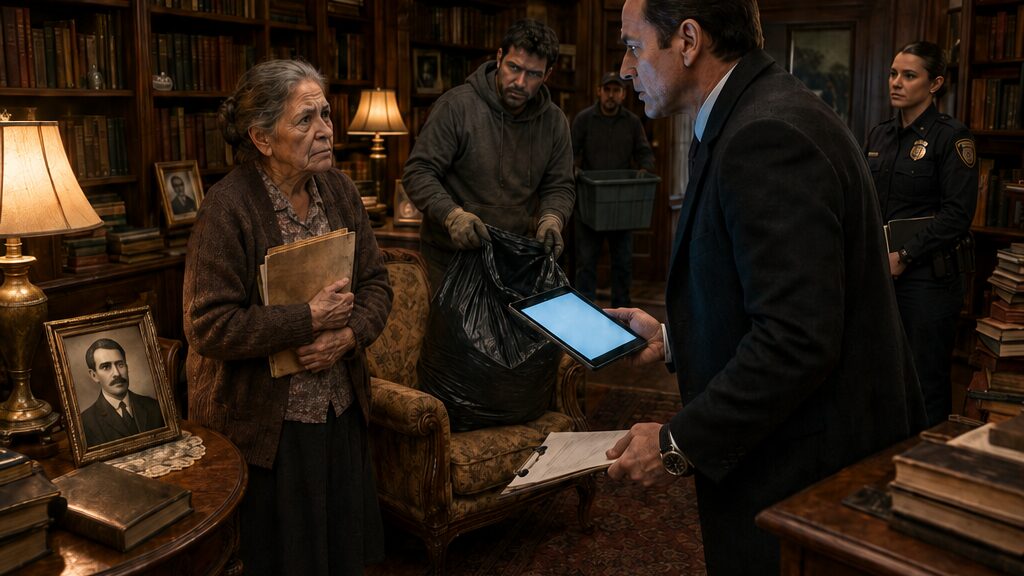
He stood on her porch in a dark fitted coat, polished shoes, and a watch that flashed when he lifted his wrist. Behind him waited two contractors in work clothes, one carrying a stack of flattened black trash bags, the other with empty plastic bins. A uniformed police officer stood at the edge of the porch, face composed, eyes already scanning the frame of the door as if measuring how much trouble the morning might become.
“Dolores Navarro?” Mario asked, though he did not say it like a question.
“Yes.”
“I’m Mario Bravo. Foreclosure operations.” He raised a tablet, its screen glowing pale blue in the morning light. “We’re here to execute the court-approved possession order on behalf of the bank.”
Dolores did not move from the doorway.
“No,” she said. “There is an error.”
The man’s mouth tightened, not with surprise but with the irritation of a person hearing a song he disliked for the hundredth time.
“That’s been reviewed.”
“No,” Dolores repeated. She lifted the folder slightly. “It has not.”
The officer stepped closer. “Ma’am, I’m Officer Andrea Ortiz. We’re here to keep the peace while the order is carried out.”
Dolores looked from Andrea to the contractors. One of them, the taller one with tired eyes and a gray hooded sweatshirt, shifted his weight and glanced away. The plastic bags under his arm made a soft, obscene rustling.
“This is my home,” Dolores said. “I have owned it for forty-three years.”
Mario tapped his watch once, as though her sentence had exceeded its allowed length.
“Lucas,” he said over his shoulder. “Start in the main room. Books, loose items, framed materials. Bag what’s not furniture.”
The tall contractor, Lucas, hesitated. “Inside?”
Mario finally looked directly at Dolores. “She’s been notified.”
Dolores stepped into the doorway with more speed than any of them seemed to expect. Her shoulder brushed the old brass latch Ramón had polished every Sunday for years.
“You will not enter until you read this.”
She untied the ribbon with fingers that did not shake. The first sheet was already on top because she had practiced this. Paid in Full. Mortgage Release. Recorded. Stamped. She had arranged the documents by date, oldest to newest, because that was how truth should be shown: patiently, in order, without drama.
Mario did not take the paper.
Instead, he held up the tablet in front of Andrea. “The court saw the certified ledger. Loan balance, penalties, collection status. The address is confirmed.”
Dolores leaned forward despite herself.
The screen glowed like cold water. Her name sat there in black type. Her address too. But beside it was a number so enormous, so absurd, that for one moment her mind would not accept it as attached to her life.
$487,260.18.
She almost laughed. The sound lodged in her throat.
“That is not mine.”
Mario gave a small shrug. “That is what everyone says.”
“I have never borrowed that amount.”
“Records disagree.”
“Records can be wrong.”
“Court orders are not suggestions.” His watch hand lifted again. “And we are already six minutes behind.”
Andrea’s eyes flicked to the document in Dolores’s hand. “Mr. Bravo, has there been a final review of her packet?”
Mario smiled without warmth. “Officer, with respect, if we paused every time a homeowner produced a folder, we would never complete a legal possession.”
Dolores heard the phrase homeowner produced a folder and felt something in her chest go hard and flat. It was not anger yet. It was the old tired knowledge that people could make you sound foolish simply by describing you from a high enough place.
“This is the release recorded with the county,” Dolores said. “Here is the date. Here is the clerk’s seal. My husband and I paid the last installment in 1998.”
Mario glanced at the paper now, but only with his eyes, not his hands.
“Ma’am, the balance here includes a later secured loan.”
“There was no later loan.”
“The database says there was.”
“Then the database is lying.”
The younger contractor near the steps looked down quickly, as if that sentence embarrassed him. Lucas kept staring at the reading nook visible behind Dolores: the tall shelves, the amber lamp, Ramón’s green armchair, the framed photograph on the table. In the photograph, Ramón was still fifty-nine, still broad-shouldered, still caught laughing at something just outside the frame. Dolores had never been able to remember what made him laugh that day. That bothered her more than she admitted.
Mario raised two fingers and snapped them.
The sound cracked across the porch.
“Proceed.”
Lucas did not move at first. Then the other contractor squeezed past the doorframe. Dolores turned, startled by how quickly the boundary had failed. Andrea stepped in after him, not touching Dolores, but close enough that the message was clear: do not block them.
The first contractor entered the reading nook and unfolded a black trash bag with a practiced shake.
The bag opened beside Ramón’s chair.
“No,” Dolores said.
Her voice came out softer than she intended, which angered her more than shouting would have.
Mario crossed the threshold, carrying the tablet like a lantern from a colder world. The blue glow touched the spines of Ramón’s books, the old brass reading lamp, the wool blanket still folded over the arm of the chair. It turned the room unfamiliar.
“Document refusal to vacate,” Mario said to Andrea.
Andrea did not write immediately. Her gaze was on Dolores’s folder.
Dolores held the mortgage release out again. “Please. Look at the date.”
Mario walked around her as though she were furniture placed inconveniently in a hallway.
“Lucas,” he said, sharper now. “Bag everything loose.”
Lucas pulled one of the black bags free. The plastic sighed open in his hands beside the chair Ramón had built when his knees were still strong enough to kneel on hardwood.
Dolores looked at the glowing tablet, then at the paper in her own hand.
For the first time that morning, she understood the paper was not enough.
Chapter 2: The Database Said She Owed a Stranger’s Life
“This is what the court saw,” Mario said, angling the tablet toward Andrea as if presenting scripture.
The screen lit Andrea’s face from below. Dolores could see the officer trying not to frown. There were columns, dates, codes, a red status line, and Dolores’s name pinned at the top like a specimen. The number remained there too, obscene in its precision, as though the extra eighteen cents made the lie more respectable.
Dolores stepped close enough to read, but Mario shifted the tablet away.
“I have a right to see what you are using against me.”
“You received notices.”
“I received threats.”
Mario’s eyes sharpened. “Careful.”
Andrea looked between them. “What kind of threats?”
Dolores opened her mouth, then closed it.
There had been calls. Three of them. A man’s voice smooth enough to pass as professional unless you knew how fear sounded when dressed politely. He had said things like avoid embarrassment and easier if you cooperate and temporary relocation. Dolores had written the dates on the back of an old grocery receipt, then tucked it into the file. She had not called anyone. She had not wanted to hear another clerk pause after asking her age.
She turned back to the tablet instead.
“The employment line,” she said. “Show that again.”
Mario did not move.
Andrea’s voice cooled. “Mr. Bravo.”
With visible annoyance, Mario tilted the tablet.
Dolores read the entry upside down at first, then from the side as he adjusted it. Employer: Navarro Custom Freight. Commercial equipment lien. Branch origin: East Mercer Lending Office.
She felt her face change before she could stop it.
“East Mercer,” she said.
Mario caught the reaction. His thumb moved on the tablet, too quick. “Administrative branch codes aren’t relevant to today’s order.”
“I have never used that branch.”
“The loan was acquired through a consolidation file.”
“My husband repaired radios,” Dolores said. “Not freight trucks. We never owned commercial equipment. We never had a business called Navarro Custom Freight.”
Mario looked at Andrea. “This is common. Borrowers often don’t understand how collateral transfers work.”
Dolores turned so sharply that the folder edge struck her wrist. “Do not translate my life to me.”
The contractor with the bins stopped near the lower shelf. Lucas, half bent with a bag in hand, looked up.
Andrea took one step into the room. “Mrs. Navarro, do you have identification records, original mortgage papers, anything with signatures?”
Dolores almost said yes with relief. Then she saw Mario’s expression: not worried, not surprised, merely impatient. He had expected this too.
She opened the folder on the reading table, careful not to knock Ramón’s photograph. The frame was heavy walnut, its glass polished every Saturday. The tablet’s blue glow reflected faintly over Ramón’s smiling face, making him look submerged.
Dolores removed a plastic sleeve and slid out three papers.
“This is the original mortgage. This is the final payment receipt. This is the county release. My signature is here. Ramón’s is here. We signed everything in person at North Halden Bank, before it became whatever it is now.” She placed one finger beneath the date. “June 12, 1998. The clerk had red glasses. The air conditioning was broken.”
Andrea’s pen paused over her small notebook.
Mario gave a short laugh. “The color of a clerk’s glasses does not invalidate a court order.”
“No,” Dolores said. “But remembering it proves I was there.”
The room went still enough for the old lamp to hum.
Andrea leaned closer to the documents without taking them. “You remember the exact payoff date?”
“I remember because Ramón insisted we walk home afterward. He said if we owned every board under our feet, we should arrive slowly.”
Lucas lowered the black bag.
For a moment, Dolores thought she had found a crack in the morning. Not victory. Just a small human pause.
Mario sealed it.
“Officer, memory is not evidence. The certified ledger is current. Her documents are historical. A later secured loan supersedes them.”
“I did not sign a later loan.”
“That’s a separate dispute.”
“It is the dispute.”
Mario turned the tablet back toward himself. “Today is possession.”
The younger contractor lifted a row of books from the shelf nearest the window. Dolores saw the titles tilt in his arms: Ramón’s repair manuals, her old library cataloging guides, a cracked Spanish dictionary with pressed flowers between the pages. He dropped them into a bin with a sound that seemed too loud for paper.
“Careful,” she said.
The contractor looked at Mario before answering her.
Mario snapped his fingers again. “Continue.”
Andrea’s jaw tightened. “Let’s keep property damage to a minimum.”
“Of course,” Mario said, as if he had wanted that all along.
Dolores searched the tablet from where she stood, scanning for anything else. East Mercer. Commercial equipment. A loan number beginning with EM. Her eyes caught a signature thumbnail before Mario scrolled past.
“Wait.”
He did not.
“Go back.”
“No.”
“The signature,” Dolores said. “That is not mine.”
Mario’s smile vanished. “You saw it for half a second.”
“I have written my name the same way since I was sixteen. My D turns inward. That one loops backward.”
Andrea turned to Mario. “Can you enlarge the signature?”
“The signature was certified in the file review.”
“Can you enlarge it?”
Mario tapped the screen with two hard motions. “Officer Ortiz, I’m not here to relitigate the case in a living room.”
“It is not a living room,” Dolores said.
They both looked at her.
“It is a reading nook.”
The words sounded small after all the large ones: foreclosure, certified, secured, possession. But she needed the room named correctly. If they were going to take it, they should at least know what they were taking.
Mario’s watch flashed again as he checked the time.
“Mrs. Navarro, the court has already determined occupancy. Your personal attachment to the space is understandable, but irrelevant.”
Dolores looked down at the file, suddenly aware of how messy it seemed spread across the table. Too many papers. Too many notes in the margins. Too many years fighting one cold screen. She had thought the thickness would prove seriousness. Now she saw how it could be made to look like confusion.
Andrea noticed the tremor in her hand before Dolores could still it.
Mario noticed Andrea noticing.
“This is exactly the problem,” he said, voice softening into something worse than cruelty. “These situations are hard for elderly occupants. They collect old paperwork and convince themselves it cancels current law.”
Dolores felt the heat rise under her collar.
“I was the head catalog clerk at the county library for twenty-six years. I know how records work.”
“Then you understand current records supersede outdated ones.”
“That is not what I said.”
Mario turned to Andrea. “Officer, for safety, I recommend she remain clear of the contractors. We don’t want her hurt.”
Hurt. As though concern had walked in with him instead of men carrying trash bags.
Andrea hesitated. “Mrs. Navarro, please stand with me near the hallway while they work.”
“No.”
“Please.”
Dolores saw Andrea was not mocking her. That made it worse. The officer was trying to be kind while helping remove her from her own room.
Lucas lifted another armful of books, slower this time. One slipped and fell open at his feet. Dolores recognized Ramón’s pencil marks in the margin, his blocky arrows pointing to a paragraph about old radio coils. She took one step toward it.
Andrea’s hand moved, not touching, but ready.
Mario leaned close enough that only Dolores could hear him.
“You should have taken the settlement call when you had the chance.”
Dolores froze.
The tablet glowed against his coat. The watch ticked once near her ear.
Andrea’s eyes narrowed. “What settlement call?”
Mario straightened smoothly. “Standard loss mitigation contact.”
Dolores kept her mouth closed, and in that silence the room shifted against her.
Chapter 3: The File Proved Less Than Dolores Needed
“Why didn’t you mention the settlement call in your complaint letters?” Andrea asked.
The question was not cruel. That was why it landed so deeply.
Dolores stood beside the hallway table with her file open under both hands, papers exposed like ribs. In the reading nook behind her, Lucas moved more slowly than before, but he still moved. The younger contractor had begun stacking plastic bins near the door. Mario watched them all while pretending to review something on his tablet, his thumb still, his attention sharp.
Dolores touched the corner of a receipt tucked into the file.
“I wrote the dates down.”
“That isn’t what I asked.”
“I know what you asked.”
Andrea waited.
Dolores hated the waiting most. All her life, she had appreciated patient people. Librarians, teachers, nurses, Ramón when he taught children on the block how to tune a radio dial. But official patience was different. It made a small room inside her open up, the room where she kept every moment someone had spoken slowly to her after learning her age.
She pulled out the grocery receipt. The dates were written on the back in blue ink. Three calls. Two times. One note that said processing fee? relocation?
Mario’s expression did not change when Andrea took the receipt. That made Dolores uneasy.
“He called,” Dolores said. “Or someone from his office did. The voice sounded like his. I cannot swear to that in court, so I did not write his name.”
Mario looked up. “Because it wasn’t me.”
Dolores met his eyes. “You said my hallway was narrow.”
Andrea looked at him.
Mario sighed. “Property photos are part of the file.”
“You said it would be embarrassing if neighbors watched me carried out.”
“That is a serious accusation.”
“You said if I signed a temporary relocation agreement and paid a processing fee, the debt could be reviewed after I left.”
Mario’s face hardened. “Loss mitigation programs have fees.”
Andrea’s voice stayed even. “You asked her for money to delay the eviction?”
“I explained options made available by the bank.”
“The branch listed on your tablet is East Mercer,” Dolores said. “I told you on the phone I had never been there. You told me old women forget where they sign things.”
The younger contractor stopped moving.
Mario’s eyes flicked toward him. “Back to work.”
Lucas had crossed to a low shelf near Ramón’s chair. He drew out a cardboard box, its top folded but not taped. On the side, in Ramón’s handwriting, was written manuals and notes, keep dry.
Dolores took two steps before Andrea’s glance stopped her.
“Please,” Dolores said to Lucas. “Those are not ordinary books.”
Lucas looked into the box. “They’re repair manuals?”
“Some are. Some have his notes. He wrote in the margins when his hands were still steady. After that I wrote for him when he told me what to put.”
Lucas’s fingers loosened on the cardboard.
The box was old enough to sag at the bottom. Dolores remembered Ramón sitting in the chair with a blanket over his knees, a manual open across a wooden board because his lap had become too narrow for the weight of hardbound books. He would tap the paragraph with one finger, and Dolores would write the note where he asked. Not because the information mattered anymore. Because he still did.
Lucas set the box down carefully on the chair instead of in the bin.
Mario saw.
“Mr. Pérez,” he said.
Lucas did not answer immediately.
Mario’s voice sharpened. “You are being paid for removal, not appraisal.”
Lucas picked the box up again, but now he held it like it contained glass.
Dolores felt a small, dangerous gratitude. It almost weakened her.
Andrea was still studying the receipt. “Mrs. Navarro, why didn’t you report the call?”
Dolores looked at the floorboards Ramón had sanded himself. Near the hallway, one board had a darker knot shaped like a comma. She had stood there when the second call came. She remembered because she had stared at that knot while the voice explained that court officers were less patient than bank officers.
“I thought if I reported it, they would ask why I waited,” she said.
Andrea’s face softened by the smallest degree.
“And because I was ashamed,” Dolores added, before she could stop herself.
“Ashamed of what?”
“That I was frightened by a man on a telephone.”
Mario gave a quiet breath through his nose. It might have been amusement. It might have been relief.
Dolores regretted the admission at once. Shame, once spoken, did not always become lighter. Sometimes it simply became available to the wrong people.
Mario lifted his tablet and began taking photographs of the room.
“What are you doing?” Andrea asked.
“Documenting noncompliance and property condition,” he said. “Given the allegations now being made, I want a complete record.”
He photographed the spread of papers on the hallway table. The half-open file. The receipt. The books out of place. Dolores herself, before she could turn away.
“Stop that,” she said.
“You’re obstructing a lawful process. Documentation protects everyone.”
“No,” Dolores said. “It protects you.”
He moved past her toward the reading nook, camera clicking softly. The glow of the tablet swept over the shelves and landed on Ramón’s photograph. Dolores stepped after him.
Andrea shifted too. “Mr. Bravo, keep the camera off personal family items unless necessary.”
“Everything here is inventory now.”
The sentence passed through Dolores like cold wire.
Inventory.
Not shelves Ramón had measured twice and cut once because he distrusted shortcuts. Not the chair with one arm slightly smoother where his hand had rested. Not the framed photograph from the day their mortgage was paid. Not the books she had arranged by subject because alphabetizing a home library felt too impersonal.
Inventory.
The file slipped under her hand as she reached to gather the scattered pages. A cream envelope slid loose from the lower pocket and dropped near the hallway table leg.
Dolores bent, slower than she wanted.
Mario was faster.
He stepped near it, blocking Andrea’s view with his coat, and his hand moved down as if adjusting the tablet case. When he straightened, the envelope was gone.
Dolores saw the motion. Not clearly enough to prove. Clearly enough to know.
Her heart struck once, hard.
“What did you pick up?” she asked.
Mario did not turn. “Excuse me?”
“There was an envelope.”
“There are papers everywhere because you keep waving them around.”
Andrea looked down. “What envelope?”
Dolores searched the folder with both hands. Title records. Complaint copies. The mortgage release. The grocery receipt. The county tax statements.
The back pocket was empty.
She tried to remember which envelope had been there. Her file had too many envelopes, too many copies, too many proofs layered like desperate wallpaper against the same wall. Then she saw, in memory, the seal on the missing one. The one she had not placed on top because it was new. Because she had wanted to read it one more time before showing anyone. Because it had arrived only yesterday, and she had not understood all of it yet.
Mario walked toward Ramón’s chair with the tablet in one hand and his clipboard in the other, his coat hanging smooth over the pocket where the envelope had disappeared.
Dolores looked at Andrea.
“He took something,” she said.
Mario smiled without looking back.
Lucas stood near the chair, holding Ramón’s box of annotated books, and for the first time since entering the house, he did not move when Mario told him to.
Chapter 4: Ramón’s Photograph Was Not Just a Photograph
“Trash or donation?” Mario asked.
He had lifted Ramón’s photograph from the reading table with two fingers at the corner of the frame, as if the walnut were dusty, as if the glass held something contagious. The empty space it left behind on the table was lighter than the rest of the wood, a clean rectangle where the lamp had protected it from years of sun.
Dolores felt the room tilt toward that empty mark.
Lucas still held the box of annotated books. He had not obeyed Mario, but he had not put the box down either. Andrea stood near the hallway table, the grocery receipt in one hand, Dolores’s scattered documents in the other, looking between the missing envelope and Mario’s pocket with the expression of someone who had not yet found the right doorway into doubt.
“Put it back,” Dolores said.
Mario turned the frame slightly, glancing at the photograph. “Personal items are inventoried after removal.”
“That is not inventory.”
“It’s a framed photo.”
“It is Ramón.”
The younger contractor looked away quickly. Lucas lowered the box until it rested against his thigh.
Mario gave a tight smile. “Mrs. Navarro, I understand grief makes objects feel—”
“No,” Dolores said.
Her voice did not rise. It cut.
Mario stopped.
“No,” she repeated. “You do not understand anything in this room.”
The reading nook seemed to listen. The tall shelves rose on three sides, crowded with books arranged the way Dolores had always arranged them: reference on the bottom, fiction near the lamp, Ramón’s manuals on the shelf he could reach from his chair. The warm bulb under the green glass shade made a circle on the table where the photograph had stood each day since the funeral. Dolores had never moved it farther than the width of her hand.
Mario looked around as though granting the room one final inspection. “Then explain it quickly.”
Andrea’s eyes moved to Dolores, and for a dangerous second Dolores wanted to explain everything. She wanted to tell them how Ramón had spent the first week of retirement measuring the wall with a pencil behind his ear, saying books deserved better than leaning. How he had cut each board in the driveway, stopping to cough into an old towel he thought she did not notice. How, when his fingers began to stiffen, he let Dolores hold the nail while he guided the hammer over her hand. How the first night the shelves were finished, he had sat in the green chair and said, If the world ever gets too loud, come here first.
But Mario’s watch ticked.
The room did not need a speech. It needed protection.
“He built that shelf when his hands were already failing,” Dolores said.
Lucas looked at the shelf beside him. One edge of it bore a slight curve where the wood had been sanded too long. Ramón used to rub that place with his thumb after guests left, annoyed by the imperfection. Dolores had always loved it more because of the flaw.
Mario’s expression shifted. Not softened. Calculated.
“That’s very touching,” he said. “And none of it changes today.”
He held the photograph toward Lucas.
“Take it.”
Lucas did not reach for it.
Mario’s jaw tightened. “Mr. Pérez.”
Lucas looked at Dolores before he looked at Mario. “I can wrap it separate.”
“You can do what I hired you to do.”
“It’s glass. It could break in the bag.”
“Then don’t break it.”
The younger contractor had gone still near the bins. Andrea’s hand lowered slightly with the receipt. Dolores saw it then: the smallest fracture in the morning. Not rescue. Not proof. But reluctance. Reluctance could be worked with. Reluctance meant someone still knew the difference between clearing a room and desecrating it.
Mario saw it too.
His face flushed at the cheekbones. He was a man accustomed to rooms following the direction of his impatience. Dolores could see the effort it took him not to look at his watch again.
“You’re all allowing sentiment to interfere with a lawful order,” he said.
Andrea’s voice was measured. “No one is interfering with the order by handling personal property carefully.”
Mario turned on her. “Officer, your role here is to prevent obstruction.”
“My role is also to prevent unnecessary escalation.”
That irritated him more than open defiance would have. He looked back at Dolores, and the smile that returned was smaller, meaner, designed only for her.
“This is what happens when people confuse possession with ownership.”
Dolores’s fingers tightened on the edge of the file.
“I own this house.”
“You occupy it.”
The word struck harder than inventory.
For forty-three years she had woken under this roof. She had cooked soup here when Ramón’s appetite failed. She had polished the hallway rail after his handprints no longer appeared on it. She had shelved and reshelved books because keeping order in a room was easier than keeping order in a life after death. And now a man with a glowing tablet had reduced all of that to occupy.
Mario turned toward the black trash bag beside the chair.
Lucas shifted. “Mr. Bravo—”
“Move.”
Lucas did not.
For one moment, the contractor’s tired face showed everything he had been hiding: the need for the day’s pay, the discomfort of refusing a man who could withhold it, the shame of being in a widow’s reading nook with a trash bag in his hand. Then he stepped half a pace back instead of forward.
It was not much.
It was enough to embarrass Mario in front of everyone.
Mario snatched one of the black bags from the stack himself. The plastic crackled open with a violent shake. He still held Ramón’s photograph in his other hand. The tablet was tucked under his arm now, its glow leaking against his coat. The clipboard hung from his wrist by a strap.
“Fine,” he said. “I’ll show you how simple this is.”
Dolores moved before she decided to.
Andrea said, “Mr. Bravo, wait.”
Mario ignored her. He lowered the bag toward the frame, the mouth of it widening like a dark throat.
The photograph caught the lamplight as it tilted. Ramón’s smile flashed under the glass. For half a breath, Dolores was back on the afternoon it was taken: the two of them outside the bank after the final payment, Ramón laughing because the wind had lifted the corner of the receipt from her hand and sent her chasing it down the sidewalk while he leaned against a parking meter, delighted as a boy.
That was what she had not been able to remember earlier.
The wind. The receipt. His laugh.
Her own laugh following his.
The memory arrived so clearly it hurt.
Dolores stepped between Mario and the bag.
“Enough,” Andrea said, but the word was too late and not pointed in the right direction.
Mario’s eyes flicked down to Dolores as if surprised she still had a body. “Do not touch me.”
Dolores did not touch him. She reached for the bag.
Mario lifted the frame higher, taunting now, his smile returning because he believed he had found the object that made her unreasonable. “You want to be charged over a picture?”
Dolores’s chest rose once.
“Do not touch him,” she said.
Mario’s smile widened by a fraction.
Then he swung the frame toward the open black bag.
Chapter 5: The Trash Bag Tore Like a Verdict
Dolores caught the trash bag with both hands before Ramón’s photograph disappeared inside.
The plastic stretched between her fingers and Mario’s fist, glossy and black and cheap, smelling faintly of chemicals. Mario jerked back in surprise. The photograph knocked against the bag’s rim but did not fall. Glass struck plastic with a dull sound that made Dolores’s whole body answer.
“Let go,” Mario snapped.
Dolores did not.
The room compressed around the bag: Lucas holding his breath near the chair, Andrea stepping forward, the younger contractor frozen with one hand on a bin, the tablet glowing under Mario’s arm like a trapped piece of blue ice. Dolores felt the thin material tremble. She thought absurdly of all the library dust jackets she had repaired with tape, all the torn pages she had flattened gently under wax paper.
This was not for mending.
Mario yanked harder. “You are obstructing a lawful removal.”
“You took my envelope.”
His eyes flashed.
There. It was there and gone, but Dolores saw it.
“I don’t know what you’re talking about.”
“Yes, you do.”
Andrea’s voice came sharply. “Both of you, release the bag.”
Mario obeyed by pulling back with more force, trying to tear it from Dolores’s grip and turn her resistance into a stumble. Dolores’s shoulder burned. Her fingers, knotted with age, tightened around the plastic handles.
For one humiliating second she thought she would fail.
Then she heard Ramón’s voice, not as memory exactly, but as a habit inside her bones: Pull along the weakness, not against the strength.
The seam.
Dolores shifted her grip to the side seam and pulled downward with everything she had saved by being quiet for too many years.
The bag ripped.
It did not tear politely. It split from mouth to bottom in one long, explosive shriek that cracked through the room like a verdict. The sound startled Mario backward. The photograph slid from his hand and dropped onto the cushion of Ramón’s green chair instead of the floor.
The torn plastic streamed between Dolores’s hands.
Mario shouted something, but Dolores was already moving. The clipboard swung from his wrist as he tried to catch the tablet under his arm. Dolores whipped the torn sheet of plastic around the clipboard, around the strap, around his hand. The slick black material slapped over the papers clipped there, covering the top page, twisting as he struggled.
“Stop!” he barked.
The tablet slipped from under his arm and struck the rug with a muted thud. The clipboard bucked against his wrist. Papers fanned out across the floor. One page slid beneath the chair. Another skated toward Andrea’s boot.
Dolores stood with the torn handles still clenched in both hands, breathing hard.
No one moved.
The bookshelves seemed to ring with the echo of the tear. Dust trembled in the lamplight. The green shade buzzed faintly. Ramón’s photograph lay face-up on the chair cushion, safe, his smile turned toward the ceiling.
For the first time since Mario had entered her house, he looked ridiculous.
The clipboard was half wrapped in black plastic, its metal clip trapped. One corner of the torn bag had snagged on his watch. His polished certainty had come undone in strips.
Then his face changed.
“Arrest her,” he said.
Andrea did not move.
Mario turned toward her, louder. “Officer Ortiz, arrest her now. Assault, obstruction, interference with a court-approved possession.”
Dolores’s hands began to tremble only after he said arrest.
She let the torn plastic fall. It landed at her feet like a shed skin.
“I did not touch him,” she said.
Mario lifted his tangled wrist. “She attacked me.”
“She stopped you from throwing away my husband.”
“That is exactly what I mean. Irrational, unstable—”
“Enough,” Andrea said.
The word finally struck the right person.
Mario stared at her. “Excuse me?”
Andrea crouched and picked up the page near her boot. Her eyes scanned it, then flicked to the scattered papers beneath Mario. “No one touches anything.”
Mario tried to step toward the tablet.
Andrea’s hand moved to the side, palm out. “Do not.”
“That device contains bank property.”
“And these papers are now part of what happened here.”
His watch was still caught in the plastic. He tore it loose with an angry jerk, scraping the edge of the clipboard across his sleeve.
Dolores looked toward the hallway table. Her file had fallen open during the struggle, pages spread across the floor. She saw the mortgage release. The grocery receipt. A complaint copy. Then, near Mario’s right shoe, a cream envelope half under the torn plastic.
The seal showed.
Andrea saw Dolores see it.
Mario did too.
He bent.
“So did she,” Mario said, grabbing for it. “She scattered everything. I need to—”
Andrea’s boot came down on one corner of the envelope.
Mario stopped with his hand in midair.
The room held its breath again, but this time the silence belonged to Andrea.
She bent slowly and picked up the envelope. Cream paper. Folded hard at one edge, as though it had been forced quickly into a pocket. Across the front was Dolores’s name and address. In the upper corner, a printed seal.
Andrea’s expression changed before she opened it.
“Where did this come from?” she asked.
Dolores swallowed. “It was in my file.”
Mario laughed once. “Everything is in her file. Old coupons are probably in her file.”
Andrea did not look at him.
The envelope had been opened before. Dolores had slit it neatly with Ramón’s old letter knife the previous afternoon, then read it three times at the table. The words had frightened her because they sounded important in a way she did not fully understand. She had meant to call the number printed at the bottom after breakfast. Before the watch. Before the knock.
Andrea drew out the letter.
Mario’s voice flattened. “Officer, that correspondence is unrelated to the possession order.”
“You know what it is?” Andrea asked.
“No. I said it’s unrelated.”
“You said that quickly.”
His jaw worked once.
Andrea unfolded the letter. Her eyes moved over the first lines. Then again, slower.
Dolores could hear her own breathing. She wanted to speak, to explain that the letter had come yesterday, that she had not hidden it, that she had simply been tired and unsure whom to trust. But she had explained enough this morning. Too much, maybe. Every explanation had given Mario another handle to grab.
Andrea read silently.
Lucas set Ramón’s box of annotated books down on the chair’s ottoman with careful hands. The younger contractor stepped away from the bins as if distance could undo participation.
Mario reached for his tablet again.
“Leave it,” Andrea said without looking up.
“I need to contact legal.”
“Leave it.”
“You are exceeding your role.”
Andrea lifted her eyes from the letter. “Mr. Bravo, did you know the East Mercer Lending Office had been ordered to cease collection activity?”
Dolores did not understand every word, but she understood cease.
Mario’s face emptied.
Only for a second. Then he became smooth again.
“That’s not applicable to this file.”
Andrea held up the letter. “This is addressed to Mrs. Navarro. It references the same branch code on your tablet.”
Mario’s watch began tapping again, but now it was not deliberate. His thumb was striking the side of it as his fingers flexed.
Dolores looked at the tablet on the rug. Its screen had not gone dark. Her name still glowed there. Her address. The impossible debt.
For the first time, the glow looked weak.
Andrea stepped closer to Mario. “Did you remove this envelope from her file?”
He scoffed. “Absolutely not.”
Lucas’s voice came from beside the chair, low but clear.
“I saw him bend near the table.”
Mario swung toward him. “You saw nothing.”
Lucas’s face flushed. He looked frightened, but he did not take the words back.
Andrea folded the letter once, carefully, and kept it in her hand.
“Mrs. Navarro,” she said, “please sit down.”
Dolores almost refused. Sitting felt like surrender. Then she saw Ramón’s photograph on the chair cushion, unharmed but displaced, and she lowered herself onto the edge of the ottoman instead. Her knees had begun to shake.
Mario lifted his chin. “Officer, this has become unsafe. She needs to be removed from the premises.”
Andrea turned toward him fully.
“No,” she said. “Now I need to verify why you were so determined that no one read this.”
Chapter 6: The Closed Branch Still Wanted Her House
Andrea read the phrase aloud before she called it in.
“Cease all collection and foreclosure activity.”
The words landed in the reading nook with a force quieter than the ripping trash bag but heavier. Dolores sat on the ottoman beside Ramón’s chair, one hand resting near the photograph, the other pressed flat against the file folder as if it might scatter again. Mario stood near the rug with the tablet at his feet and the torn black plastic still hanging from his clipboard.
For once, no one reached for Dolores’s belongings.
Andrea read the next line under her breath, then looked toward the tablet. “East Mercer Lending Office.”
Mario’s face had settled into professional offense. “A branch action does not automatically invalidate every assigned asset.”
“You said you didn’t know what the letter was.”
“I didn’t know the exact contents.”
“But you knew enough to call it unrelated.”
His watch tapped faster now. Not against metal. Against his own thumbnail. A faint, dry click-click-click.
Dolores heard it and felt the morning turn. Earlier, the sound had pushed her toward the edge of her own home. Now it seemed to be measuring the distance Mario had left.
Andrea unclipped the radio from her shoulder. “Dispatch, this is Ortiz. I need verification on an FDIC cease activity notice connected to East Mercer Lending Office, foreclosure enforcement in progress, residential address…”
Mario took one step toward the tablet.
Andrea’s hand dropped to hover near it. “Don’t.”
“I’m not interfering.”
“You’re moving toward the device I told you not to touch.”
“It contains privileged bank information.”
“It also contains the record you used to enter this home.”
Mario stared at her. “Do you understand what you’re doing?”
“Yes.”
“I don’t think you do. If you obstruct enforcement of a valid court order, this becomes your problem.”
Andrea did not answer him. She read Dolores’s address into the radio, then the branch code from the letter. A voice crackled back, thin and official, asking her to repeat the code.
Dolores watched Andrea’s face while she waited. The officer had looked steady since entering the house, but now Dolores saw what steadiness cost. Andrea’s jaw was tight. One hand still held the letter, careful not to crease it further. She was not certain yet. She was choosing where to place her uncertainty.
Mario saw that too.
“Officer,” he said, lowering his voice, “I appreciate caution. I do. But there are families who play these games for months. Elderly occupants, adult children hiding behind them, files full of irrelevant papers. Meanwhile losses pile up, properties deteriorate, neighborhoods suffer.”
Dolores turned toward him slowly. “My shelves are dusted every Thursday.”
He ignored her.
“I’ve been doing this thirteen years,” he continued. “The longer we indulge every objection, the harder it becomes for everyone. Even for her. You think you’re helping, but you’re prolonging the inevitable.”
There it was, Dolores thought. The place where he kept his conscience. Not missing. Stored away behind words like losses and properties and inevitable.
Andrea’s radio crackled.
“Ortiz, stand by for supervisor confirmation. Preliminary shows East Mercer Lending Office under federal restriction as of three days ago. Repeat, preliminary shows restriction. Do not release documents or electronic devices connected to active enforcement until advised.”
Mario moved before the final word finished.
He bent and snatched the tablet from the rug.
Lucas stepped back. The younger contractor muttered something under his breath. Dolores rose too quickly, her hand catching the chair arm.
Andrea was faster than all of them.
“Put it down.”
Mario held the tablet tight against his chest. “I’m calling counsel.”
“You can call from your phone after you put down the tablet.”
“This device is encrypted bank property.”
“This device is evidence in a disputed enforcement action.”
“Alleged disputed.”
“Put it down.”
Mario’s composure cracked at the edges. “Do you know what happens if confidential borrower data is compromised because a local officer decided to improvise?”
Andrea stepped toward him. “Do you know what happens if you remove a device after federal restriction has been confirmed over the radio?”
He did not answer.
Dolores had never thought of silence as something that could expose a person. Mario’s silence did. It showed calculation where outrage should have been. He was not confused. He was choosing.
The radio crackled again. Andrea listened, eyes still on Mario.
“Copy,” she said. “Yes. Same name. Same address. Same branch code.” A pause. “Understood.”
Mario’s thumb edged along the tablet case.
“Mr. Bravo,” Andrea said, “place the tablet on the table.”
“I need to step outside.”
“No.”
“I have a right to contact counsel.”
“You are not being denied that. You are being denied removal of potential evidence.”
The word evidence changed the temperature of the room.
Dolores looked at Ramón’s photograph. His face was still turned upward on the cushion. She could see a fine line in the glass where it must have struck the chair frame. Not broken. Marked.
Andrea stepped between Dolores and Mario.
It was a small movement. No apology. No announcement. Just her body placed in the path Mario would have to cross to reach the old woman or the file. Dolores felt the meaning of it before she let herself trust it.
Mario noticed the movement and laughed once, sharply. “This is absurd.”
Andrea held out her hand. “Tablet.”
“No.”
“Now.”
For several seconds, nothing moved but Mario’s watch hand.
Then he set the tablet on the reading table so hard the lamp trembled.
Dolores flinched. Andrea saw it.
“Careful,” Andrea said.
Mario’s eyes darted toward the front windows. The street outside was visible through the lace curtains, distorted by old glass. A neighbor stood on the sidewalk with a phone in hand. Another figure had appeared near the curb.
Mario looked back at the contractors. “Pack your equipment. We’re done here until this officer gets clarification from someone competent.”
“No one leaves yet,” Andrea said.
“You can’t detain my crew.”
“I can ask them to remain as witnesses.”
Lucas set both hands flat at his sides. “I’ll stay.”
Mario’s head snapped toward him.
Lucas swallowed, but his voice held. “I’ll stay.”
Dolores looked at him, and he looked away. Shame again. But this time shame had made him still instead of obedient.
Andrea’s radio sounded once more, and the voice on the other end was clearer, firmer. Dolores caught fragments: federal restriction, predatory lending investigation, unauthorized contact, preserve scene.
Mario closed his eyes for half a second.
When he opened them, he had found one last shape for himself.
“This is a misunderstanding,” he said. “The bank will correct it.”
Andrea took the tablet from the table and placed it beyond his reach.
“No,” she said. “For now, it’s an active investigation.”
A low engine rumbled outside, then stopped in front of the house.
Everyone turned.
Through the window, beyond the lace curtain and the warped old glass, Dolores saw a white news van pull against the curb. A woman stepped out with a microphone in one hand, followed by a camera operator already lifting the camera to his shoulder.
Mario stared as if the van had driven up from a nightmare he had not admitted having.
Andrea looked toward the door.
Dolores kept one hand on Ramón’s chair and one on the file.
The newswoman crossed the sidewalk toward the porch.
Chapter 7: The Camera Found Him Beside the Bookshelves
Gabriela Martínez reached the porch just as Andrea said, “Mr. Bravo, put your hands where I can see them.”
Mario turned toward the doorway with the expression of a man who had expected paperwork and found a stage. Behind Gabriela, the camera operator lifted the lens high enough to see past her shoulder. The red recording light blinked once, small and merciless.
“No filming inside,” Andrea said.
Gabriela stopped with one foot on the threshold. “We received reports of an active foreclosure tied to East Mercer Lending Office.”
Mario’s face changed at the branch name. Not much. Enough.
Dolores saw it from beside Ramón’s chair.
The reading nook looked wounded now. Books leaned out from half-emptied shelves. A bin sat open near the doorway. The torn black trash bag lay across the rug like a shadow someone had tried to peel from the floor. Her file was spread over the hallway table and down onto the boards. The tablet rested beyond Mario’s reach, its glow dimmer than before but still there, still displaying her name as though it had any right to remain in the room.
Gabriela looked past Andrea, past Mario, and found Dolores.
Recognition moved across her face.
“Mrs. Navarro?”
Dolores knew her then, though the woman’s hair was shorter and her jacket sharper than it had been years ago. Gabriela had once come to the library with a stack of community college forms and a child asleep in a stroller. Dolores had helped her find scholarship guides, then stayed after closing while Gabriela filled out the first application with a pencil borrowed from the reference desk.
“Gabriela,” Dolores said.
Mario seized on the familiarity. “Excellent. So we have a personal relationship with the media. That explains the ambush.”
Gabriela’s eyes shifted to him. “You’re Mario Bravo?”
“You need to leave this property.”
Andrea stepped between them. “No one is entering further. Ms. Martínez, stay on the porch.”
“Are you confirming an arrest?”
“No statement yet.”
Mario laughed sharply. “There is no arrest.”
The camera light caught the side of his face. His skin looked pale under it, less polished. He angled his body away and lifted one hand toward his coat pocket.
Andrea’s voice hardened. “Hands visible.”
“I’m getting my phone.”
“Slowly.”
He obeyed with exaggerated care, as though performing reasonableness for the camera. “This is a civil matter being distorted by a confused elderly occupant, an overcautious officer, and now a reporter chasing a headline.”
Dolores’s hand tightened on the arm of Ramón’s chair. The word confused had become a tool in his mouth, worn smooth from use.
Gabriela looked at her, not the way officials had looked at her that morning, not measuring danger or delay, but asking permission without saying it.
The camera operator adjusted his stance.
Dolores shook her head once.
Not in here.
Gabriela understood. She turned slightly, keeping the camera at the threshold, aimed at Mario and Andrea but not at the room’s interior.
Mario noticed that too and tried to step into the reading nook, deeper into the private space, away from the lens. Andrea blocked him.
“Stay where you are.”
“This is ridiculous,” he said. “You’re letting a news crew interfere with an enforcement action.”
Andrea held the FDIC letter in one hand and her radio in the other. “The enforcement action is suspended pending verification.”
“It is not suspended by you.”
“It is suspended by the federal restriction tied to the branch code on your own device.”
Gabriela’s microphone lifted slightly. “Did you say federal restriction?”
Andrea looked at her. “I said no statement yet.”
But the words had already entered the air.
Mario turned to the camera. His voice softened into something he must have used often across conference tables. “This is exactly why these matters should not be tried in public. A homeowner produces a paper, people misunderstand regulatory language, and suddenly a routine legal process becomes a spectacle.”
“A routine legal process?” Gabriela asked.
“For lawful possession of secured property.”
Dolores rose.
The movement was small, but every eye in the doorway returned to her. Her knees hurt. Her shoulder burned from the pull of the trash bag. She knew how she must look: small, old, surrounded by mess. She knew Mario wanted the camera to see that and understand disorder.
So she bent and picked up Ramón’s photograph.
The glass had a thin pale line at one corner, but the image beneath was intact. She held it with both hands, not toward the camera, not toward Mario, but against herself.
“This is not secured property,” she said.
Mario opened his mouth.
Lucas spoke first.
“He told us not to look at the file.”
The words came from beside the ottoman, low and rough. Everyone turned.
Mario’s face went still. “Lucas.”
Lucas swallowed. He looked at Dolores and then at the floor. “In the truck. Before we came in. He said the lady would have a file. Said not to get drawn into it. Said if she put papers in our hands, set them aside and keep moving.”
Mario’s eyes burned. “You misunderstood a standard instruction.”
Lucas shook his head once. “No.”
The younger contractor looked at him in alarm, as if silence had been the only safe place and Lucas had just stepped out of it.
Gabriela moved the microphone toward Lucas but did not cross the threshold. “Did he say why?”
Lucas’s face reddened. “He said old files make old people feel powerful.”
The sentence seemed to strike the shelves.
Dolores looked down at the photograph in her hands. Ramón’s smile had not changed, but for the first time that morning she felt something other than fear move through her grief. Not comfort. Not victory. A witness. One human being had chosen to tell a truth that cost him something.
Mario stepped toward Lucas. “You are done. You will not be paid for today.”
Andrea moved instantly. “Back up.”
Mario stopped, breathing through his nose.
Gabriela looked at Dolores again. “Mrs. Navarro, may we film the room?”
The question entered Dolores more sharply than she expected.
The room had already been violated. Strangers had crossed the rug. A tablet had glowed over Ramón’s face. A trash bag had opened beside his chair. Papers had spread across the floor. Now another light waited at the doorway, and this one might help, but help did not make it gentle.
Dolores looked at the bookshelves. One shelf was partly empty. The gap showed a lighter rectangle where books had stood for decades. She thought of the library after closing, how public a place could become tender once the last visitor left. She had spent her life helping people find information without making them feel exposed by needing it.
“No,” she said.
Gabriela lowered the microphone slightly.
Mario seized on it. “There. You have no consent to film.”
Dolores turned toward Gabriela. “You may film him outside. Not this room.”
A faint surprise crossed Gabriela’s face. Then respect.
“Understood.”
Mario laughed under his breath. “You think you control the terms now?”
Dolores met his eyes. “No. I am learning.”
Andrea’s radio crackled again. She listened, then clipped it back to her shoulder. The sound of the latch was final.
“Mario Bravo,” she said, “turn around.”
The camera’s red light blinked steadily.
Mario stared at her. “On what basis?”
“Attempted removal of evidence, suspected unauthorized foreclosure activity under federal restriction, and obstruction of an active investigation pending formal charges.”
“You are making a career-ending mistake.”
“No,” Andrea said. “You made yours before I arrived.”
His gaze darted once toward the tablet, once toward the porch, once toward Dolores. For a moment the polished man vanished and something frightened showed through: a man who had bet everything on speed, on shame, on people too tired or too old or too poor to force him into daylight.
Andrea took his wrist.
The expensive watch flashed as she turned his arm behind his back.
Click.
The sound of the cuff closing was smaller than the tearing trash bag, but it ended more.
Gabriela stepped back onto the porch so the camera could see the threshold. Andrea guided Mario forward, out of the reading nook, past the hallway table with Dolores’s file, past the door he had entered as if the house were already his to empty.
As he crossed the threshold, Mario turned his face away from the camera.
Gabriela’s voice remained steady. “We are outside the home of Dolores Navarro, where a foreclosure action connected to the now-restricted East Mercer Lending Office has just taken a dramatic turn. Authorities have detained foreclosure manager Mario Bravo after questions arose over the legitimacy of the enforcement effort.”
Mario stumbled slightly on the porch step. Not enough to fall. Enough for the camera to catch him losing rhythm.
Dolores stood inside, holding Ramón’s photograph against her chest, and watched through the doorway as the man who had called her an occupant was led into the open.
Chapter 8: This House Remembers Who Belongs Here
Dolores found Ramón’s photograph face-down beneath the chair after everyone had gone.
For one terrible second, she thought the glass had shattered. She lowered herself carefully, one hand braced on the ottoman, and lifted the frame from the floor. The corner was scraped. The glass held only the same thin line she had seen earlier, pale as a thread. Ramón’s face looked back at her through it, still smiling, though now the smile seemed farther away.
The reading nook was quiet again, but not as it had been that morning.
Quiet before had been shelter. This quiet had debris in it.
A black strip from the torn trash bag lay near the rug’s edge. One of Mario’s forms remained under the table, stamped with boxes and codes that no longer frightened her in the same way. The books Lucas had removed were stacked in careful, guilty piles by the wall. The tablet was gone with Andrea as evidence. So was the FDIC letter, sealed in a clear police sleeve. Dolores’s file had been returned to her, but not yet closed.
She set Ramón’s photograph on her lap and touched the back of the frame.
Something shifted behind the cardboard backing.
Dolores froze.
With one fingernail, she turned the small metal tabs Ramón had always complained were poorly made. The backing loosened. Behind the photograph, folded once, was a narrow slip of paper browned slightly at the crease.
She knew his handwriting before she read the words.
When the room feels too quiet, read aloud anyway.
Dolores sat very still.
The house made its ordinary sounds around her: a pipe settling, a car passing outside, the faint tick of the lamp cooling and warming by degrees. For years she had believed she had kept Ramón’s memory alive by preserving the room exactly. The chair in place. The books in order. The photograph beneath the lamp. Quiet, always quiet, because grief had made noise feel like disrespect.
But Ramón had left her an instruction, not a shrine.
Read aloud anyway.
A knock sounded softly at the open front door.
Dolores folded the note once along its old crease and slipped it back behind the photograph, then called, “Come in.”
Andrea entered without stepping beyond the hallway until Dolores nodded. She no longer wore the look of an officer managing a difficult call. She carried the file folder in both hands.
“I wanted to return this personally,” Andrea said.
Dolores accepted it.
The folder looked different in Andrea’s hands. Earlier it had seemed to make Dolores smaller, a frantic old woman with too much paper. Now Andrea held it as if it had weight.
“The FDIC letter and the tablet will stay with investigators,” Andrea said. “I made copies of the mortgage release and your complaint letters before sealing the folder back up.”
“My grocery receipt?”
A small, tired smile touched Andrea’s face. “That too.”
Dolores nodded.
There were things Andrea could have said then. Apologies that would have sounded correct and insufficient. Explanations about procedure. Promises about follow-up. Instead, she looked at the half-emptied shelf, the torn bag, the chair, the photograph in Dolores’s lap.
“I should have looked sooner,” she said.
Dolores held the folder against her knee.
“Yes,” she said.
Andrea accepted it without flinching. That mattered.
“The house is safe tonight,” Andrea said. “Longer, I believe, but there will be legal cleanup. Statements. Calls. Other names may come up. This branch was already under investigation, and what happened here may help people who didn’t have your paperwork.”
Dolores thought of the voice on the phone telling her not to make things embarrassing. She thought of other kitchens, other porches, other people holding folders that officials did not want to touch.
“I will speak to them,” she said. “But not today.”
“Of course.”
Another figure appeared in the doorway behind Andrea. Gabriela held no microphone now. The camera operator was gone.
“I can come back,” Gabriela said.
Dolores shook her head. “Come in as far as the rug. No filming.”
Gabriela stepped inside carefully, as if the room were a chapel or a library after closing. Her eyes moved over the shelves, then to the chair, then to Dolores. There was hunger in her; not cruel hunger, but reporter hunger, the need to hold a story before it cooled. Dolores recognized it and did not resent it. Need had many respectable disguises.
“I won’t air anything from inside,” Gabriela said. “Only the arrest outside and what officials confirm.”
“Good.”
“I wanted to ask if you’d give a statement. One sentence is enough. People are already calling about East Mercer. Some say they got the same settlement calls.”
Dolores looked at the photograph in her lap. The new crack across the glass crossed Ramón’s shoulder, not his face. She could replace the glass. She would not replace the frame.
“What did you say on television?” Dolores asked.
“That a foreclosure action connected to a restricted branch led to questions about unauthorized enforcement. I did not say you were confused. I did not show the room.”
Dolores glanced at Andrea.
Andrea nodded once.
Gabriela took a small recorder from her pocket and held it low, not yet switched on. “Only if you want.”
Dolores almost refused. The old instinct rose in her: keep it private, keep it orderly, do not give strangers more than they need. Then she saw the torn trash bag on the floor. Silence had not protected the room. Politeness had not made Mario careful. Documents alone had not stopped his hand from reaching for Ramón’s photograph.
She held the frame tighter.
“One sentence,” Dolores said.
Gabriela turned on the recorder.
Dolores looked not at Gabriela, not at Andrea, but at the shelves Ramón had built when his hands were failing.
“A house is not empty just because a database cannot see what lives there.”
Gabriela’s eyes softened. She turned the recorder off immediately.
“Thank you.”
Dolores nodded, and that was all she could give.
Andrea left first, promising a call from investigators. Gabriela lingered only long enough to set the moved books back onto the nearest table instead of the floor. Lucas had already carried the bins back to the truck before leaving his card with Andrea, though Dolores did not know whether he would be paid. The younger contractor had not met her eyes.
When the front door finally closed, the house did not become whole all at once.
Dolores stood in the reading nook and looked at what had to be done. The shelves needed reordering. The table needed clearing. The file needed a new folder, stronger than the old one. The torn trash bag would have to stay, at least a piece of it, because Andrea had said investigators might need everything left behind. The room was safe for now, but safe did not mean untouched.
She picked up the strip of black plastic and folded it once, then again. Not neatly. It resisted neatness. She placed it inside an empty stationery box on the lower shelf.
Evidence, she thought.
Then she carried Ramón’s photograph to the table beneath the lamp.
The clean rectangle in the wood waited there. She set the frame exactly where it had always stood, then changed her mind and turned it slightly toward the chair instead of outward. Ramón did not need to face visitors. He had never liked being stared at.
Dolores went to the stack of books Lucas had set aside and lifted the top one. It was one of Ramón’s manuals, heavy and worn, with his pencil marks dark along the margins. A slip of paper marked a page near the middle.
She opened it.
The room felt too quiet.
For once, she did not treat that quiet as proof of loss. She treated it as a place waiting to be filled.
Dolores sat in Ramón’s green chair, beneath the warm circle of the lamp, with the file folder closed on the table and the photograph watching from its rightful place. Her voice was rough at first. It had been a long time since she had read aloud to anyone.
Then the words steadied.
Outside, somewhere down the block, a news van started and drove away. Inside, the shelves held. The lamp hummed. The house listened.
The story has ended.