The HOA Parked Two Trucks in His Garage, But the Old Man Knew Why They Chose His Door
Chapter 1: The Trucks Were Already Inside the Garage
Justin Davis saw the two white trucks before he saw his grandfather.
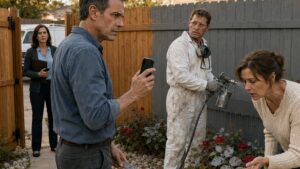
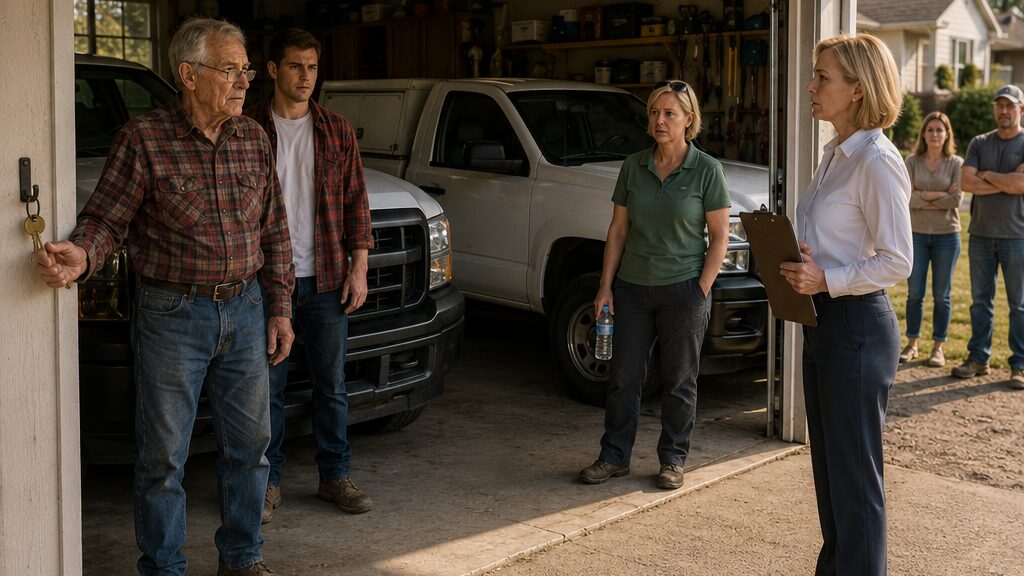
They were parked deep inside the open garage, nose to tail, where George Davis’s old blue pickup usually sat with its hood half-raised and a coffee can full of bolts balanced on the bumper. The trucks were too clean for ranch work. Too square. Too official-looking. Each had a magnetic sign on the door with the neighborhood association’s green crest, the kind Justin had seen on mailers about fence height, lawn edges, and holiday decorations left up too long.
For a second, he stayed seated in his own car with the engine ticking down, one hand still on the wheel.
His grandfather’s ranch house sat at the far edge of the subdivision, where the smooth HOA streets gave up and turned into cracked county pavement. George had lived there before the gates, before the decorative stone entrance, before the association decided the past could be managed with bylaws and monthly dues. The garage was not some community shed. It was where Justin had learned to change brake pads, where George sharpened mower blades, where his grandmother’s handwriting still labeled coffee cans: deck screws, spare hinges, don’t throw away.
A woman in a green polo stepped out from behind the first truck carrying a clipboard and a half-empty bottle of water. She looked at Justin like he had walked into her office.
“Can I help you?” she asked.
Justin got out slowly. “I was about to ask you that.”
The woman blinked. She had short blond hair tucked behind one ear and sunglasses pushed up on her head. Her polo had the HOA crest stitched over the left side, but the name tag clipped beneath it was turned slightly sideways.
Justin looked past her, searching the dim garage. “Grandpa?”
George appeared from behind the workbench with a rag in one hand. He wore his usual plaid shirt, sleeves rolled to the forearms, glasses low on his nose. He looked older in the shadow of the trucks. Not weak, exactly. Just misplaced, like something in his own garage had shifted around him without asking.
“Justin,” he said. “You’re early.”
“Traffic was light.” Justin stepped around a set of orange cones that had no business being there. “Whose trucks are these?”
George wiped his hands on the rag, though there was no grease on them. “That’s what I’m learning.”
The woman in the green polo gave a small laugh meant to smooth things over. “We’re just borrowing the space for the weekend. Maintenance overflow. Nothing dramatic.”
Justin turned to her. “Borrowing?”
“For association equipment.” She gestured toward the trucks as if two full-sized vehicles could be explained with one flick of the wrist. “I’m Nancy Wilson, maintenance coordinator. Laura approved it.”
“Laura who?”
“Laura King. Board president.”
Justin looked back at his grandfather. George had not moved. His eyes were on the trucks, then on the far wall where his own tools had been pushed tighter together to make room. A stack of folded tarps rested against the cabinet that held his grandmother’s gardening things.
“Did you approve it?” Justin asked.
Nancy answered before George could. “Mr. Davis has always been very cooperative with neighborhood needs.”
Justin felt his jaw tighten. “That’s not what I asked.”
Nancy’s smile lost an inch. “The association has a temporary logistics issue. The maintenance lot is unavailable until Monday morning, and the garage is covered by the old access arrangement.”
“Old access arrangement,” Justin repeated.
George’s gaze moved to a hook by the workbench. His garage key hung there on a brass ring, untouched. Justin remembered that key from childhood. George never carried it when he was home. He used to say a man should not have to unlock his own place in the middle of the day.
Now the key seemed to hang in the room like a question.
One of the maintenance drivers appeared near the second truck, holding a phone, then thought better of whatever he had planned to say and stepped back out of sight. Justin smelled cut grass, motor oil, and the cold rubber scent of tires that had been driven recently. Someone had backed these trucks in with care. Someone had known they would fit.
“Grandpa,” Justin said, quieter now, “where’s your pickup?”
“Behind the barn.”
“You moved it?”
George folded the rag once, then twice. “They were already in here when I came out after lunch.”
Justin stared at Nancy. “You parked in his garage while he was inside the house?”
Nancy shifted her weight. “The side door was open.”
“The garage door was open,” Justin said. “That doesn’t mean you can take it.”
“It wasn’t taken.” Nancy’s voice sharpened, then softened as she glanced toward the driveway. “It’s temporary. Laura said this had been discussed.”
“With who?”
Nancy looked at George.
George only said, “Interesting.”
The word landed lightly, but Justin felt the room change. His grandfather did not raise his voice. He did not step forward or reach for the trucks or tell anyone to get off his property. He just stood between the workbench and the first truck, with that folded rag in his hand, and said the one word as if he had set a level on a crooked shelf and found exactly what he expected.
Nancy’s face tightened again. “Mr. Davis, we’re not trying to make this difficult.”
“No,” George said. “I imagine you’re not.”
Justin knew that tone. He had heard it once when a parts dealer tried to charge him twice for a rebuilt alternator. George had not accused the man. He had asked him to read the invoice out loud. By the end, the man had apologized without being told to.
But this was different. Two HOA trucks sat inside his grandfather’s garage, blocking the cabinets, the lift jack, the pegboard, and the old blue vise that had belonged to George’s father. The trucks filled the air with the dull arrogance of things already decided.
Justin stepped closer to the nearest truck and saw a folded paper tucked beneath the windshield wiper. Temporary relocation schedule. No signature. No property address listed, only “north service structure.”
“North service structure?” he read aloud. “Is that what you’re calling his garage?”
Nancy reached for the paper. Justin pulled it away before she could touch it.
“Please don’t interfere with association documents,” she said.
“This was on private property.”
George’s eyes flicked to Justin. Not warning. Not approval. Something in between.
A car door shut outside.
Nancy turned toward the sound with visible relief. “That’ll be Laura.”
Justin looked through the open garage door.
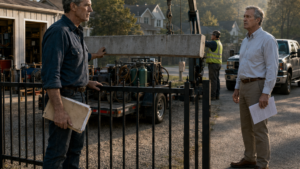
A woman in a white blouse and dark slacks was walking up the driveway with a clipboard held against her chest. She moved briskly, chin lifted, as if the driveway were a hallway and everyone in it had an appointment with her. Her hair was neat, her expression composed, and the thin black binder clipped under her arm looked thicker than it needed to be.
Behind her, two neighbors had slowed near the property line. One pretended to check a mailbox. The other stood openly with both hands on a rake, watching.
“Mr. Davis,” the woman called before she reached the garage. “I understand there’s some confusion.”
George put the folded rag on the workbench. He looked at the trucks once more, then at the key on the hook.
“No confusion yet,” he said.
Laura King stopped just outside the garage threshold, her gaze moving over Justin first and dismissing him, then landing on George. “The HOA needs this garage through Monday.”
Chapter 2: The Clipboard Met the Wrong Kind of Silence
“Are you really refusing community maintenance?” Laura King asked.
She said it loudly enough for the two neighbors at the property line to hear, and softly enough to pretend she had not meant them to. George noticed the skill in it. He had heard voices like that in council chambers and church basements and roadside arguments after fender benders—voices that wrapped accusation in public concern.
He stepped just inside the line of shade cast by the garage door. The afternoon light stopped at his boots. Laura stood in it, bright and official, the clipboard angled against her blouse like a shield.
“I’m refusing nothing yet,” George said. “I’m asking who authorized parking two association trucks in my garage.”
Laura’s eyes moved once toward Nancy, who looked suddenly interested in the driveway gravel.
“The association has standing access for maintenance support along the north service boundary,” Laura said.
“This is not a service boundary.”
“It’s listed that way in the records.”
“Then the records are confused.”
Justin made a sharp sound behind him. George did not turn. He could feel his grandson’s anger like heat from a stove. Justin wanted a raised voice, a finger pointed at the trucks, something fast enough to match the insult. George knew that feeling. He had been young once, too, and had mistaken speed for strength more often than he liked to remember.
Laura flipped a page on her clipboard. The paper made a clean snapping sound. “Mr. Davis, I’m trying to be respectful. The community has landscaping and drainage work scheduled this weekend. The maintenance lot is blocked because of repair staging. Your garage is the logical temporary location.”
“My garage,” George said.
“Adjacent to association-managed access.”
“Private property.”
Laura’s polite expression held, but her jaw tightened. “Private property within an association footprint.”
George let that sit.
One of the maintenance drivers shifted inside the garage. The rubber sole of his boot squeaked against the concrete. Beyond him, George could see the second truck’s rear bumper pressed too close to the storage cabinet where his wife had kept garden twine, gloves, and three packets of seeds she had never planted. He had not opened that cabinet in months.
The key still hung by the workbench.
He looked at it longer than he meant to.
“Grandpa,” Justin said, “they can’t just—”
George lifted one hand without looking back. Justin stopped, but barely.
Laura noticed the gesture. Something like satisfaction passed over her face. She thought she had found the shape of the family: the hotheaded grandson, the quiet old man, the woman with the papers between them. She lowered her voice by half.
“I understand this feels inconvenient,” she said. “But sometimes community living requires cooperation.”
George reached toward the key hook. He did not take the key at first. He simply closed his fingers around the brass ring and felt the familiar worn edge press into his palm.
“My wife used to say cooperation starts with asking.”
Laura’s expression changed, not with sympathy but impatience. “And I’m sure your wife understood community standards.”
George turned the key once in his hand.
Nancy looked down.
Justin took a step forward. “Don’t talk about my grandmother.”
Laura’s eyes flicked to him. “Young man, this is an association matter.”
“Then keep it about the association.”
“Justin,” George said.
His grandson’s mouth closed, but his face stayed red. George wished, for one brief second, that the boy was not there. Not because Justin had done wrong. Because witnesses made old wounds perform. Because the garage was easier to defend when nobody knew why it mattered.
George took two slow steps toward the opening. Laura did not move back. She adjusted her clipboard instead, lifting it a fraction.
“You said there’s standing access,” George said. “Show me.”
Laura blinked. “I don’t carry the complete property file with me.”
“But you carry enough to put trucks in my garage.”
Her fingers tightened around the metal clip at the top of the board.
“I carry the operational schedule.”
“I’m not asking for the schedule. I’m asking for the authority.”
One of the neighbors near the mailbox stopped pretending to sort envelopes. The other leaned slightly on the rake.
Laura’s cheeks colored. “Mr. Davis, nobody is trying to steal your garage.”
“That’s good.”
“It is a temporary need.”
“Then a temporary written agreement would have been easy.”
Nancy cleared her throat. “Laura, maybe we should move them until—”
Laura turned her head just enough to cut Nancy off without a word.
George saw that, too. The whole arrangement was less solid than Laura wanted it to look. Nancy had expected a favor to stay a favor. Laura had expected the favor to become policy once the trucks were inside. That was how lines moved. Not with fences dragged at midnight, but with small acts people were too tired to challenge.
Laura flipped another page. “The original development documents describe this structure as part of the north utility approach.”
“No,” George said.
“You haven’t seen what I’ve seen.”
“I was here when they drew it.”
For the first time, Laura hesitated.
Justin looked at him. “You were?”
George kept his eyes on Laura. “I was police chief when the first drainage dispute came through. The developer wanted a service lane. The county wanted emergency access. The homeowners wanted a gate. Nobody wanted to pay for any of it.”
Laura recovered quickly. “Then you know these agreements are complicated.”
“I know people like to call them complicated when plain words don’t help them.”
A small silence followed. Not long. Long enough.
Laura took a breath through her nose. “I don’t appreciate being accused of misrepresenting documents.”
“I haven’t accused you.”
“You implied it.”
“I asked you to show me.”
Justin’s phone was in his hand now. George saw the black screen tilted low, thumb hovering. Recording, maybe. Or ready to. George almost told him to put it away, then did not. The world had changed. Young people kept proof because older people had taught them paper could disappear.
Laura saw the phone, too. Her eyes cooled.
“Mr. Davis,” she said, “if your concern is liability, the association can note temporary use.”
“After the fact?”
“Today.”
“After the trucks are already here.”
She looked toward the neighbors, then back at him. “You mind that much?”
George felt the key bite into his palm. He thought of his wife’s hand closing over his on the same key ring years ago, both of them laughing because he had misplaced it in a coffee can and blamed the universe. He thought of her sitting at the little garage desk with reading glasses on, underlining a property amendment because she trusted written words more than friendly promises.
He smiled before he meant to.
Not wide. Not warm. Just enough.
Laura misread it. “Good. So we can be reasonable.”
“Actually,” George said, “I mind.”
Justin went still.
Laura’s smile disappeared. “Excuse me?”
“It’s a private garage.”
“As I’ve explained—”
“No,” George said. “You’ve described a need. You have not shown a right.”
Laura stepped closer, lowering her voice. “Mr. Davis, I have six crews waiting on a Monday inspection, a blocked maintenance lot, and residents who will not appreciate delays because one homeowner decided to make a point.”
“Then you should have asked the homeowner before the crews were waiting.”
“You’re putting the whole neighborhood in a difficult position.”
“No, ma’am.” George opened his left hand. The key lay against his palm. “You did that when you parked trucks inside a building you don’t own.”
The “ma’am” struck harder than anger would have. Laura’s nostrils flared.
“You may want to consider,” she said, “how far you want this to go.”
George reached slowly into his back pocket.
Justin shifted. Nancy froze. One of the drivers stared at the concrete.
George pulled out his wallet. The leather was old, soft at the fold. He had not opened that particular flap in years except to renew the card behind it, and even that had felt unnecessary after retirement. He slid the identification free and held it low, not thrust forward, not waved. Just visible.
The badge seal caught the light. Retired Police Chief. George Davis.
Laura’s eyes dropped to it. The clipboard lowered a few inches.
“I’m not showing you this because I want to use it,” George said. “I’m showing you because I spent thirty-eight years learning the difference between access and entry. You don’t have permission. You don’t have written authority. And if you have a document saying otherwise, I’ll be glad to read it.”
Nancy whispered, “Laura.”
The neighbors were no longer pretending at anything. The driver near the truck pocketed his phone as if embarrassed to have one.
Laura’s face had not collapsed; George gave her credit for that. She was too disciplined to panic in public. But something hardened behind her eyes. The embarrassment had found a place to go.
“Move the trucks,” she said to Nancy.
Nancy nodded too quickly. “Yes. Of course.”
The first driver hurried toward the cab. The engine coughed, then started with a diesel rattle that filled the garage and made the pegboard tremble. George stepped back, wallet still in one hand, key still in the other. Justin moved beside him, close enough that their shoulders nearly touched.
The first truck rolled out slowly. Its side mirror passed within inches of the workbench. George watched it clear the doorway, then watched the second driver climb in.
Laura did not leave. She stood with the clipboard against her hip, expression carefully blank.
“You could have called me,” George said.
“I did what the records allowed.”
“Then bring the records next time.”
“Oh, I will.” She looked at Justin’s phone, then at George’s ID before he slid it back into his wallet. “And for clarity, Mr. Davis, this is not finished.”
“No,” George said. “I expect not.”
The second truck reversed out into the driveway. Nancy followed it, avoiding everyone’s eyes. The neighbors began moving again, suddenly busy with mailboxes and rakes, though not fast enough to hide the pleasure on their faces.
Justin let out a breath. “Grandpa, that was—”
George put the key back on the hook.
His grandson stopped smiling. “You’re not filing anything?”
“They moved the trucks.”
“That’s not the point.”
“It’s enough for today.”
Laura turned at the end of the driveway. Her car door was open, but she paused beside it, clipboard tucked under her arm.
“Then we’ll handle this officially,” she called back.
George watched her drive away without answering. Only when the car disappeared past the bend did he look at the key hanging by the workbench and realize his hand still felt its shape.
Chapter 3: The Violation Notice Arrived Before Breakfast
The violation notice was taped to the garage door before Justin finished his first cup of coffee.
He found it because he had gone outside to check whether the driveway still held tire marks from the HOA trucks. It did. Two faint tracks curved toward the garage, pressed into the dust like proof that might blow away by noon. But the paper on the door was fresh, sealed in a clear plastic sleeve, with blue painter’s tape squared neatly at all four corners.
Justin pulled it down and read the first line.
Notice of Obstruction of Association Maintenance Access.
His stomach tightened.
Behind him, the kitchen screen door creaked. George stepped onto the porch in slippers and yesterday’s plaid shirt, his gray hair flattened on one side from sleep. He held a mug of black coffee. He looked at Justin’s face, then at the paper.
“They didn’t waste time,” Justin said.
George came down the steps without hurry, but his mouth had gone thin.
Justin held out the notice. “They’re accusing you.”
George took it. His eyes moved down the page. He read slowly, lips still. The morning around them felt too ordinary for the words on the paper: birds along the fence line, a sprinkler ticking somewhere across the road, a delivery van whining through the subdivision gate.
“They say you obstructed maintenance crews,” Justin said. “They say access was granted under some map number. They say if you don’t comply by Monday, daily fines start.”
George’s eyes stopped near the middle of the page.
Justin saw it. “What?”
“Map 14-C.”
“You know it?”
George folded the notice once, then stopped himself and flattened it again. “I know the argument.”
“That’s not an answer.”
“It’s the answer I’ve got before breakfast.”
Justin stared at him. “Grandpa.”
George turned toward the garage door. Without the trucks inside, the building seemed almost normal again, except for the tape marks on the painted wood and the pale squares of dust where the tires had been. The key still hung inside by the workbench. Justin could see it through the side window, a little brass flash in the dim.
“They lied,” Justin said. “Yesterday she backed down because she knew she was wrong. Now she’s making it official.”
George kept looking at the door.
“We need to call somebody,” Justin said. “County code, sheriff’s office, whoever handles HOA stuff. You were police chief. You know everyone.”
“I was police chief,” George said. “I’m not now.”
“That doesn’t mean you let them do this.”
“I didn’t say that.”
“You’re acting like it.”
George turned then, and Justin regretted the words as soon as they came out. Not because they were false, but because they landed somewhere old.
His grandfather handed the notice back. “Make a copy before you spill coffee on it.”
“I’m serious.”
“So am I.”
They went inside. The kitchen smelled of toast George had forgotten to butter. On the table lay yesterday’s mail, a seed catalog, and the small ceramic dish where George kept loose change and keys he actually used. The garage key was not there. It was still on the hook, visible through the window over the sink.
Justin set the notice on the table and smoothed it flat with both hands.
“This says your garage is a ‘north service structure.’”
“It isn’t.”
“But if they have an old map saying it is—”
“Maps can be wrong.”
“Then prove it.”
George took off his glasses and rubbed the bridge of his nose. “There was a drainage fight years back. Before half those houses were built. The developer wanted to run equipment along the north edge of my property whenever they pleased. Your grandmother didn’t like the wording.”
Justin looked up. “Grandma?”
“She read better than the lawyers thought she did.”
That was the first thing George had said all morning that felt like a door opening. Justin waited.
George put his glasses back on. “The county allowed emergency access across the lane, not storage, not staging, not parking. There was an amendment.”
“Where is it?”
“In the files.”
“Then get it.”
George’s eyes moved toward the hallway that led to the little office, then away again. “Later.”
Justin almost laughed. “Later? The fine starts Monday.”
“It’s Saturday.”
“And Laura is already ahead of us.”
George picked up his mug, found it empty, and set it down without drinking. That small wasted motion bothered Justin more than silence would have.
“She’s using paperwork,” Justin said. “You used to tell me paperwork matters because it remembers what people try to forget.”
“I said that?”
“You said it when I lost the title to that old motorcycle.”
George looked faintly amused despite himself. “That motorcycle never deserved a title.”
“It still needed one.”
For a moment, the edge between them softened. Then Justin tapped the notice.
“So does the garage.”
George did not answer.
Justin pushed back from the table and walked to the window. Through it, he could see the garage interior, the workbench, the vise, the hanging key. His grandmother had labeled half that place in blue marker. Even after she died, George had kept her order. Not museum-neat, but respected. If a box said pruning twine, it held pruning twine. If a drawer said fuses, there were fuses wrapped in their packages. Justin had once teased him about it. George had said, “Your grandmother knew where things belonged. A man ought to honor that when he can.”
Now strangers had parked trucks in front of all of it.
“What happened to the maintenance lot?” Justin asked.
George looked at him. “What?”
“Nancy said it was unavailable. Laura said repair staging. That sound true?”
“No.”
“How do you know?”
“Because I drove past it Thursday. It was empty.”
Justin’s pulse jumped. “Then why use your garage?”
George picked up the notice again. His thumb covered the map number, then slid away. “That’s the question.”
The landline rang.
Neither of them moved on the first ring. Or the second. On the third, George reached for the receiver mounted on the kitchen wall.
“Davis.”
Justin could hear a woman’s voice, thin through the handset. Not Laura. Older. Familiar maybe.
George listened without speaking.
“When?” he asked.
Another pause.
“No, Elizabeth. I haven’t gone looking yet.”
Justin straightened.
George’s face changed, but only slightly. His eyes narrowed the way they did when he recognized a sound under an engine knock.
“I remember,” he said. “Yes. She did.”
Justin mouthed, Who?
George turned his back a little, not enough to hide, enough to ask for privacy without saying it.
“I’ll come by this evening,” George said. “No, don’t bring it here. Not yet.”
He hung up.
“Elizabeth Allen?” Justin asked. He remembered her from holiday potlucks years ago, a former dispatcher with sharp eyes who lived two lots down and always knew which neighbor’s dog had gotten loose before the owner did.
George nodded.
“What did she say?”
“She saw the notice.”
“Everybody saw the notice. It was taped to the door like a wanted poster.”
“She said the map number is missing something.”
Justin waited.
George picked up the paper and folded it carefully, once across, once down. “She said your grandmother signed a different version.”
“Then we go get it.”
“This evening.”
“Why not now?”
George looked toward the garage again. “Because some things you don’t drag out in anger.”
Justin’s patience broke. “Grandpa, they dragged it out for you. They put it on your door.”
George’s shoulders lowered. He looked tired in a way Justin had not seen yesterday. The old police chief had stood in the garage with an ID in one hand and made Laura King step back. This morning, with a sheet of paper on the table, he looked less certain.
That scared Justin.
George walked to the back door, opened it, and crossed the yard to the garage. Justin followed, saying nothing.
Inside, the air was cooler. George stood before the key hook. For years the brass key had stayed there unless a storm was coming or George planned to be away overnight. He lifted it off the hook now and held it in his palm.
Justin watched him lock the side door, then the big rolling door, then tug each handle twice.
“You never lock it during the day,” Justin said.
George slipped the key into his shirt pocket.
“No,” he said. “I don’t.”
Chapter 4: The Old Map Left Out One Promise
“That map is not the version your wife signed,” Elizabeth Allen said before George had both feet on her porch.
She stood behind the screen door with one hand on the latch, silver hair pinned at the back of her head, house shoes planted wide as if she were bracing against a wind only she could feel. Justin waited a step behind George, but Elizabeth’s eyes went to him at once.
“You brought the boy.”
“He’s twenty-two,” George said.
“That doesn’t mean he’s not the boy.”
Justin opened his mouth, then closed it. There was something about Elizabeth that made argument feel like poor manners and wasted time.
She unlatched the screen. “Come in before someone decides my porch is a meeting.”
The front room smelled faintly of lemon cleaner and old paper. A small lamp glowed beside a recliner, though the sun had not fully gone down. On the coffee table lay a cardboard file box with a dispatcher’s headset coiled on top of it like a relic from another life.
George looked at the headset.
“Still keep it?” he asked.
“Still works better than half the people I used to hear through it.” Elizabeth lowered herself into the recliner and pointed at the couch. “Sit.”
George did. Justin stayed standing near the mantel, where a framed photograph showed a younger Elizabeth at a radio console, one hand pressed to an earpiece.
She opened the file box and removed a folder with a rubber band around it.
“I wasn’t going to get involved,” she said.
George’s mouth twitched. “That was never one of your talents.”
“It became one after retirement.” She slipped off the rubber band. “People ask for one memory, then blame you for having the rest.”
Justin leaned forward. “What do you remember?”
Elizabeth looked at him for a moment, measuring how much young anger could hold. “I remember your grandmother sitting in a folding chair at the county office with a pen in her hand and refusing to sign until they changed one sentence.”
George’s fingers tightened on his knee.
“What sentence?” Justin asked.
Elizabeth glanced at George.
He did not answer.
She opened the folder. Inside were photocopies of maps, minutes from meetings, and handwritten notes in tight blue ink. She pulled out one map and laid it on the table. It looked like the version attached to the violation notice, only older, the lines fuzzier from copying. The north edge of George’s property was marked with a dotted access lane.
“This is what Laura is waving around,” Elizabeth said. “Map 14-C. The developer loved this one because it made everything look shared.”
She pulled out another page.
“This is what came after.”
Justin bent over it. The second map had the same dotted lane, but the garage was shaded differently. Beside it, someone had written: Private structure excluded from association storage or staging. Emergency access by written consent only except imminent hazard.
“That’s clear,” Justin said. “That’s completely clear.”
“It was supposed to be.” Elizabeth looked at George. “Your wife made sure.”
George reached toward the paper but did not touch it. “This isn’t the signed final.”
“No. It’s my copy from the meeting packet. I don’t have the signature page.”
“But you had it once?”
“I saw it once.” Elizabeth’s voice softened, though not enough to become gentle. “Your wife put her finger on the line and said, ‘I don’t mind neighbors passing through in a flood. I mind becoming their closet.’”
Justin looked at his grandfather.
George’s gaze had dropped to the carpet. His face was still, but the stillness had gone from controlled to fragile.
“She said that?” Justin asked.
“She said plenty.” Elizabeth stacked the pages with care. “Most of it smarter than what the men in pressed shirts were saying.”
George stood abruptly. “Thank you.”
Elizabeth did not move. “Don’t run off with half a file and call that courage.”
Justin stared at her.
George turned back. “I didn’t come to be lectured.”
“No, you came because Laura King put a notice on your garage and you finally remembered other people can see it.” Elizabeth tapped the folder. “You want the rest? Go find the signed page.”
“In the HOA office?”
“Or county records, if the clerk filed it right. But the association kept the originals after the turnover. You know that.”
George’s face tightened. He did know. Justin could see it.
Elizabeth leaned back. “Laura’s not using that map by accident.”
“You don’t know that,” George said.
“I know she’s too careful to quote a map number she hasn’t looked at.”
Justin said, “Then she saw the exclusion and ignored it.”
“Maybe.” Elizabeth’s eyes shifted toward him. “Or maybe the file she has is missing what mine is missing. That’s the trouble with old paper. It gives everyone room to be righteous.”
That stopped him.
Until that moment, Justin had wanted Laura to be exactly what she looked like in the driveway: a woman with a clipboard who had gotten caught and decided to punish the man who embarrassed her. Elizabeth’s version was worse because it was less clean. It meant there might be enough confusion for Laura to hide inside.
George gathered the copies Elizabeth allowed him to take. He held them by the edges, as if they might bruise.
At the door, Elizabeth touched his sleeve. “George.”
He paused.
“She fought hard for that garage. Not because of the building.”
“I know.”
“No,” Elizabeth said. “You remember. That isn’t the same thing as knowing.”
George stepped onto the porch without answering.
The drive back was quiet. Justin kept the copies on his lap and watched the neighborhood lights come on one by one. Sprinklers ticked. Dogs barked behind vinyl fences. At the edge of the subdivision, George turned into his gravel drive and stopped near the garage rather than the house.
“You okay?” Justin asked.
George switched off the engine. “No.”
The honesty was so plain that Justin did not know what to do with it.
They went into the garage through the side door. George unlocked it with the key he had pocketed that morning. The sound seemed louder than usual. Inside, he switched on the overhead light, and the room returned all at once: tools, cabinets, oil stains, the old desk in the corner beneath a metal shelf.
George walked to that desk.
Justin had not paid much attention to it in years. It was narrow, painted gray, with three drawers and a chair his grandmother had cushioned with faded fabric. On the wall above it hung a calendar from the year she died, never replaced, still turned to April.
George opened the top drawer. Pens. Tape. A ruler. Old registration stickers. He opened the second. Insurance papers, manuals, a folder marked tractor receipts. His hands moved carefully, but his breathing changed.
In the bottom drawer he found a brown envelope labeled in his grandmother’s handwriting: North boundary / do not discard.
Justin stepped closer. “That’s it?”
George opened it.
Inside was a duplicate amendment, cleaner than Elizabeth’s copy, the paragraph about the garage underlined twice. There were meeting notes, an unsigned map, and a carbon copy of a letter addressed to the association board. But no final signed page.
George looked through the envelope again, slower. Then again.
“It’s not here,” Justin said.
“No.”
“But this proves enough, doesn’t it?”
“It proves there was an amendment. It doesn’t prove they accepted it.”
“You know they did.”
George placed both hands flat on the desk. His wedding ring caught the overhead light.
“Knowing isn’t the same as showing,” he said.
Justin heard Elizabeth’s words echo in the room.
A small white tag hung from the lamp switch on the desk. Justin had seen it before but never read it closely. In blue marker, his grandmother had written: garage key — George always loses it.
He reached toward it, then stopped before touching.
George saw him looking. For a second his face opened with such quiet pain that Justin wished he had looked away.
“She made a joke out of everything I was bad at,” George said.
“She was good at that.”
“She was good at keeping me honest.”
The garage settled around them. Outside, a car passed slowly on the road, then continued.
George gathered the papers and slid them back into the envelope. He did not cry. He did not sit down. He only pressed his thumb against the handwriting on the front as if checking whether ink could still be felt after all these years.
“The signed page might be in the HOA records,” Justin said.
George nodded.
“Then we go tomorrow.”
“No,” George said. “You go nowhere near their office without me.”
“Then come with me.”
George looked toward the cabinets the trucks had blocked the day before. “I don’t know if I can walk into that room and make her name into evidence.”
Justin did not answer. He had wanted action, but this was not delay. Not exactly. It was grief standing in the way wearing his grandfather’s shirt.
He stepped back toward the side door to give George a moment and heard his grandfather speak, not to him, not fully.
“I promised her I wouldn’t let them take it.”
Justin stopped in the doorway.
George was still facing the desk, one hand on the envelope, the garage key heavy in his shirt pocket.
“I promised,” he said again, quieter.
Chapter 5: Laura King Needed the Garage More Than She Admitted
Justin saw Nancy Wilson carrying file boxes out of the HOA office at 3:17 on Sunday afternoon.
The office was supposed to be closed. The sign on the glass door said weekend appointments only, and the parking lot beside the low brick clubhouse sat empty except for Nancy’s hatchback and one white maintenance truck backed near the curb. But Nancy was there in the heat, wrestling a cardboard banker’s box through the side door with her hip, her green polo darkened at the collar.
Justin cut his engine before she saw him.
For one minute, he stayed inside the car and watched.
Nancy set the box on the pavement, looked toward the main road, then went back inside. Another box already sat behind the hatchback. Both had black marker on the sides. One read irrigation invoices. The other read board storage—temporary.
Justin got out.
The maintenance lot sat beyond the clubhouse, behind a chain-link fence screened with half-dead shrubs. On Thursday, George had said it was empty. On Sunday, it still looked empty. No construction staging. No blocked entrance. No equipment stacked in the way. Only a faded orange cone leaned against the fence, as if somebody had meant to create a problem and gotten tired halfway through.
Nancy came out with a third box and nearly dropped it when she saw him.
“You shouldn’t be here,” she said.
“I could say the same.”
“This is association property.”
“And my grandfather’s garage isn’t.”
She looked past him toward the road, then toward the office door. “I’m not discussing this with you.”
Justin walked closer, but stopped well short of the boxes. He had learned enough from George not to touch what wasn’t his, especially when touching it would give somebody else a clean accusation.
“What happened to the maintenance lot?” he asked.
Nancy swallowed. “It’s not that simple.”
“It looks simple. It looks empty.”
“The lot wasn’t the issue.”
“Then why did you tell my grandfather it was unavailable?”
She pressed her lips together.
Justin pointed toward the box marked temporary. “What are those?”
“Records.”
“HOA records?”
“Old records.”
“From George’s file?”
“No.”
She said it too quickly.
The side door opened behind her. Laura King stepped out with a ring binder tucked under one arm and a phone pressed to her ear. She stopped when she saw Justin. Her expression did not change much, but her voice sharpened.
“I’ll call you back,” she said into the phone, then ended the call. “Mr. Davis.”
“Justin.”
“I know your name.”
“Then use it.”
Nancy shut her eyes for half a second.
Laura slipped the phone into her pocket. She was dressed more casually than on Friday—pressed jeans, pale blouse, flats—but still carried herself like a meeting had followed her outside. “There is no reason for you to be at the association office on a Sunday.”
“There was no reason for your trucks to be in my grandfather’s garage on Friday.”
“Your grandfather’s matter is being handled through proper channels.”
“You mean the notice you taped to his door?”
Laura looked at Nancy. “You can take those to the storage unit.”
Nancy did not move.
Justin noticed. “Storage unit?”
Laura’s eyes returned to him. “Association materials have to be relocated while we resolve access.”
“The maintenance lot isn’t blocked.”
“I didn’t say it was blocked.”
“Nancy did.”
Nancy’s face flushed. “I said unavailable.”
“You said it because Laura told you to.”
The sentence landed harder than Justin expected. Not because it was loud, but because Nancy’s shoulders dropped as if she had been waiting for someone to finally say it.
Laura stepped between them. “Careful.”
“Why? Is that official too?”
“Your grandfather is already facing a compliance matter. You would be wise not to make it worse.”
Justin almost reached for his phone. He wanted to record her. He wanted her tone preserved, her neat threat saved in a little black rectangle he could shove across a table later. But George’s voice came back to him: paper remembers what people try to forget.
He looked at the boxes instead.
“What are you hiding?”
Laura’s nostrils flared. “That is an inappropriate accusation.”
“Then answer it.”
“The association lost access to off-site storage earlier than planned. The board is handling it.”
Nancy made a small sound.
Laura turned. “Nancy.”
But the sound had already told Justin enough. “Lost access?”
Nancy looked from Laura to Justin, then toward the empty maintenance lot. “The storage contract expired.”
Laura’s face tightened. “It was not renewed under acceptable terms.”
“It doubled,” Nancy said.
Laura stared at her.
Nancy’s voice shook, but she kept going. “The owner raised the rate. Laura didn’t want to take an emergency increase to the board before inspection because people are already mad about dues.”
Justin stood still.
It was not the answer he had expected. He had imagined pure entitlement, maybe a grudge against George, maybe a lazy convenience that turned cruel after embarrassment. But this was messier: a storage contract, a budget, a Monday inspection, and Laura King trying to keep the neighborhood looking competent while quietly borrowing a widower’s garage without permission.
Laura turned slowly back to Justin. “You don’t understand how associations function.”
“I understand you used his garage because it was cheaper than admitting a mistake.”
“The entire neighborhood pays when operations fail.”
“The neighborhood didn’t park those trucks.”
Laura’s eyes flashed. “You think your grandfather’s the only person with history here? You think every retired man at the edge of the subdivision gets to decide whether drainage crews work, whether landscaping happens, whether residents get notices from the county because a ditch wasn’t cleared?”
“He gets to decide who enters his garage.”
“Not when prior access exists.”
“You still haven’t shown it.”
Laura held up the binder. “The board will review it tomorrow evening.”
Justin looked at Nancy. “Emergency meeting?”
Nancy’s silence answered.
Laura said, “The board will determine whether Mr. Davis’s obstruction requires enforcement beyond the initial notice.”
“You mean you’re going to vote against him.”
“I mean the board will consider the facts.”
“Your facts.”
“The recorded facts.”
She said recorded with intention.
Justin glanced toward the office window. He saw stacks of folders on a conference table, a copier lid raised, loose papers sliding slightly in the air-conditioning draft. On the corner of the table lay a small manila envelope. Written across it in block letters was Davis access key—temporary.
His body went cold.
He stepped toward the window before Laura could block his view. The envelope was partly open. Inside, something brass glinted.
“Nancy,” he said, “what is that?”
Nancy looked through the window. Her face changed.
Laura’s voice went flat. “It’s association material.”
“That’s a key.”
“It is not your concern.”
Justin turned on her. “Is that my grandfather’s garage key?”
Laura’s expression became careful in a way that scared him more than anger. “The association maintains duplicate access for service structures covered by easement.”
“That is his garage.”
“Not according to the records currently in effect.”
Nancy whispered, “Laura, stop.”
Justin looked at her. “How did you get it?”
Nancy’s eyes filled with a panic she could not quite hide. “I didn’t copy it.”
“I asked how she got it.”
Laura stepped closer. “This conversation is over.”
“No, it isn’t.”
“It is. Leave before I call security.”
“There’s no security here.”
“There are cameras.”
Justin looked up at the small black dome under the eave. For the first time, he smiled a little, though he did not feel amused.
“Good,” he said. “Then they saw the boxes too.”
Laura’s confidence faltered for one beat.
Nancy picked up the box marked temporary and shoved it into her hatchback. Her hands shook. “Justin,” she said quietly, not looking at Laura, “go home.”
“Not until—”
“Go home,” Nancy repeated, and now her voice had something urgent in it. “Tell your grandfather to check the lock. Today.”
Laura snapped, “Nancy.”
Nancy closed the hatchback hard enough that the sound cracked across the empty lot.
Justin backed away, his eyes still on the office window, on the manila envelope, on the brass flash inside it. The old anger came back, but it had changed. It was no longer just about trucks. Someone had found a way to copy a key to the room George had not locked in years.
He got into his car with his hands tight around the wheel.
As he pulled out, Nancy stood by her hatchback, pale and rigid. Laura remained near the office door with the binder under her arm, watching him leave.
Justin turned onto the road and called George before he reached the gate.
His grandfather answered on the second ring.
“Grandpa,” Justin said, “Laura already has a key.”
Chapter 6: The Copied Key Opened the Wrong Memory
Fresh scratches circled the garage lock like silver hairline cracks.
George saw them before he put the key in. The brass plate had been clean that morning when he turned the bolt. Now three new marks cut across the edge, bright against the worn metal, as if somebody had missed the slot in a hurry or used a key that did not quite belong.
He stood in the cooling Sunday light with Justin behind him and did not open the door.
“Grandpa,” Justin said, breathless from the drive, “that wasn’t there yesterday.”
“No.”
“You believe me now?”
George looked at the scratches until they stopped being scratches and became a door he should have closed years earlier.
Justin shifted behind him. “We need to call somebody.”
George put his hand in his shirt pocket and felt the original key. It was warm from his body. He thought of the one Justin had seen in the manila envelope at the HOA office—brass, copied, labeled, turned into procedure. Temporary access.
How many quiet mistakes could a man make before someone else used them as permission?
George unlocked the door and stepped inside.
The garage smelled of wood dust, oil, and the faint dry sweetness of old cardboard. Everything looked still. Nothing obviously stolen. Nothing overturned. But the stillness had changed. He could feel it before he saw it.
The chair at the gray desk was angled wrong.
His wife had always pushed it under.
George crossed the room. Justin followed, quieter now. The overhead light hummed when George switched it on. The workbench brightened. The vise cast its familiar shadow. The brown envelope from the bottom drawer lay on the desk where George had left it, but the flap was no longer tucked in.
Justin saw it too. “Someone opened it.”
George touched the envelope with two fingers. He could still remember his wife labeling it. She had written slowly because her hands had already begun to ache by then, though she denied it when he noticed. North boundary / do not discard.
He drew out the papers.
The duplicate amendment was there. Elizabeth’s copies were there. The unsigned map was there.
A folded note fell onto the desk.
George stopped breathing for a moment.
It was not new. The paper had yellowed at the edges, and the crease had softened from years of pressure inside the envelope. But he had not seen it Saturday night. It must have been tucked behind the map, caught in the fold, hidden until careless fingers disturbed what careful hands had packed away.
Justin picked it up, then froze. “Is this Grandma’s handwriting?”
George held out his hand.
Justin gave it to him.
The note was short.
George—
If they ever call this garage shared, make them read the last page. Not the map. The page. People point at drawings when words would stop them.
And don’t be kind just because you’re tired.
—M.
George sat down before his knees could choose for him.
Justin did not speak.
The garage hummed around them. Outside, a car rolled past slowly, then moved on. George read the note again, and the words rearranged something inside him that he had kept locked harder than the door.
Don’t be kind just because you’re tired.
He had told himself for years that he was keeping peace. After his wife died, neighbors came by with casseroles and awkward voices. Board members asked small favors, then bigger ones. Could a contractor turn around in his lane? Could crews use the north edge after heavy rain? Could George leave the side gate unlatched during drainage work? He had said yes because no felt like another chore. He had said yes because people praised him for being reasonable. He had said yes because fighting over land without her beside him felt like reading half a sentence.
Then Laura King had found the shape of his yes and built a policy around it.
Justin knelt by the desk and began sorting the envelope contents with more care than George expected from his impatient hands.
“You said there was an emergency access after a storm,” Justin said.
George nodded. “Three years ago. Culvert washed out behind the east row. County truck needed to get around the flooded section. I let them cut through the lane and stage near the garage for one night.”
“You signed something?”
“A temporary consent form.”
“For one night?”
“One night.”
“Where is it?”
George opened the side drawer of the desk. He already knew which folder before his hand found it. Storm repairs / county. Inside was a carbon copy of a single-page access permission. He laid it on the desk.
Justin read it. “This says emergency equipment access and temporary staging near north lane, by owner permission, expiring 8 a.m. the next morning.”
“Yes.”
“This isn’t HOA storage.”
“No.”
“But Laura could point to this and say you allowed staging.”
“If nobody asks what kind.”
Justin looked at him. “Why didn’t you shut it down then? When they started acting like it was normal?”
George folded the note along its old crease. “Because the first few times didn’t feel worth the argument.”
“They copied your key.”
“I know.”
“They came in here.”
“I know.”
Justin stood, frustrated. “Do you? Because every time they push, you wait. They parked trucks in here, you waited. They taped a notice, you waited. They copied a key, and you’re still sitting at the desk.”
George looked up sharply. Justin stopped.
For a moment, neither of them moved.
Then George took off his glasses and placed them on the desk beside the note. “You think I’m not angry because I’m old.”
Justin’s mouth tightened. “I didn’t say that.”
“You think anger has to look like yours to be real.”
That landed. Justin looked away.
George picked up the old storm form. “I spent most of my life walking into rooms after people had already done the loud part. You learn that loud feels good until someone writes down only the worst sentence you said.”
“This isn’t about being loud.”
“No,” George said. “It’s about being willing. And I haven’t been.”
Justin’s face changed.
George slid the storm form, the amendment copy, and his wife’s note into separate piles. Then he went through the envelope again, slower this time, feeling each fold. At the bottom, stuck inside the crease of the old map, was a second sheet.
He drew it out carefully.
It was thinner than the rest, nearly transparent in the light. A signature page. County acknowledgment stamp. Association turnover initials. His wife’s signature near the bottom, firm and unmistakable. George Davis beside it. The developer’s representative. A board witness no longer living in the neighborhood.
Justin leaned over his shoulder. “Is that it?”
George read the final paragraph.
Private garage structure excluded from association storage, staging, or routine maintenance use. Emergency passage or staging requires express written consent of property owner, renewed per incident.
“Yes,” George said.
The word sounded strange. Too small for what it unlocked.
Justin laughed once under his breath, pure relief. “She kept it here.”
George looked at the note again.
Make them read the last page.
His wife had known him. Known he might remember the map, the argument, the principle, the insult. Known he might forget that the last page mattered because grief made everything practical feel like betrayal.
He stood.
Justin picked up the paper. “We need copies. Photos. Everything.”
“We will.”
“And the copied key?”
George walked to the lockbox under the workbench, opened it, and removed a small clear evidence sleeve left over from a life he had tried not to carry into retirement. He placed his original key inside one sleeve, then stopped.
Justin watched him. “We don’t have their copied key.”
“Not yet.”
“But Nancy saw it.”
“Yes.”
“Will she say so?”
George looked toward the darkening window. “Depends which fear is bigger by tomorrow.”
He took the original key back out of the sleeve and held it in his bare palm. Then he opened a small tin on the shelf where spare machine screws were kept. Inside lay old key tags, the paper kind with metal rims. One was labeled in his wife’s handwriting: garage key — George always loses it.
George touched it, then attached it to the original key.
Justin’s voice softened. “Grandpa.”
George folded the signed page and note into a clean folder. “I let them turn my quiet into agreement.”
Justin did not argue.
“I let them use the fact that I didn’t want to say her name in a room full of people.” George put the folder under his arm. “That ends tomorrow.”
“What are you going to do?”
George locked the desk. Then he walked to the side door and looked down at the scratched plate.
“I’m going to let Laura King read what your grandmother wrote into the record.”
Justin swallowed. “As police chief?”
George shook his head. “No.”
He locked the garage from the inside, then opened it again, testing the bolt, listening to the clean click.
“As the man whose name is on the door.”
Justin stood beside him as the last light thinned along the driveway.
George held out the truck keys.
“Tomorrow evening,” he said, “you drive me to the board meeting.”
Chapter 7: The Board Heard the Part the Notice Erased
Laura King read George’s violation aloud before he had taken off his coat.
The HOA clubhouse was too bright, all overhead lights and polished folding tables, with a coffee urn steaming near the back and a row of residents pretending they had come only because Monday meetings were routine. George knew better. People attended when a fine touched a neighbor. They attended when somebody else’s trouble might explain their own dues increase. They attended when Laura King’s voice promised order and her agenda promised conflict.
“Obstruction of association maintenance access,” Laura said from the front table, each word clipped. “Failure to permit temporary staging for approved community operations. Refusal witnessed by maintenance personnel and residents.”
Justin stiffened beside George.
George put one hand lightly on his grandson’s forearm. Not to silence him this time. To steady both of them.
Laura glanced up from the paper. “Mr. Davis, you may sit.”
“I’ll stand for now.”
A board member shifted in a chair. Nancy sat near the end of the table, face pale, hands folded so tightly her knuckles had gone white. Elizabeth Allen sat in the second row with her purse on her lap, eyes fixed on Laura as if listening to a dispatch call nobody else could hear clearly.
Laura set the notice down. “This meeting has been called to determine whether enforcement should continue and whether temporary access to the north service structure should be affirmed until maintenance storage is resolved.”
“Garage,” Justin muttered.
George heard him, but kept his eyes on Laura. “Call it what it is.”
Laura’s smile was thin. “The terminology is part of the matter under review.”
“No,” George said. “The terminology is how you made the matter.”
A few people in the room murmured. Laura tapped her pen once on the clipboard. The sound cut through them.
“Mr. Davis, you had an opportunity to cooperate informally. You chose not to.”
“I had an opportunity to surrender quietly. I chose not to.”
Laura’s expression held, but barely.
A board member cleared his throat. “Maybe we should look at the documents.”
“Yes,” Laura said. “Let’s.”
She opened her binder and pulled out a blown-up copy of Map 14-C. It had been marked with yellow highlights along the north edge of George’s property. The garage was circled in red.
George looked at the red circle and felt nothing at first. Then he felt his wife’s note in the folder under his arm, and the feeling returned—not rage, not grief alone, but a clean hard line between what was true and what had been made convenient.
Laura turned the map toward the residents. “As you can see, the north boundary has long been designated for maintenance access.”
George walked to the front table. He did not hurry.
Laura’s eyes dropped to his jacket pocket. “If you intend to present your former law enforcement credentials again, I need to clarify that this is a civil association matter.”
George stopped.
Justin’s face flushed. Elizabeth’s eyebrows lifted. Nancy looked down at her hands.
George slowly took his wallet from his pocket and placed it on the table unopened.
“I didn’t bring that out for you tonight,” he said.
Laura’s pen stilled.
George opened the folder instead.
“This is the map you showed,” he said, placing Elizabeth’s copy beside Laura’s. “This is also Map 14-C. It shows the access lane. It does not grant storage. It does not rename my garage.”
Laura leaned back. “That copy is incomplete.”
“It is.”
A flicker of satisfaction crossed her face too early.
George placed the second page down. “This is the amendment that followed.”
A board member leaned in. Another reached for reading glasses. Laura did not touch the paper.
George read the paragraph aloud, not loudly, not dramatically. The words carried because the room had gone quiet.
“Private garage structure excluded from association storage, staging, or routine maintenance use. Emergency passage or staging requires express written consent of property owner, renewed per incident.”
He set the page down.
Laura said, “We would need to verify—”
George placed the signed page beside it.
“County stamp,” he said. “Association turnover initials. Developer representative. My signature. My wife’s signature.”
Nancy closed her eyes.
Laura’s face changed by a degree. “I was not provided that page in the current file.”
“Then the current file is incomplete.”
“That is possible.”
“But you acted like it wasn’t.”
Her eyes sharpened. “The association acted based on available records and operational necessity.”
George reached into his pocket and took out his garage key. The paper tag in his wife’s handwriting dangled from the brass ring. He laid it on the table beside the amendment.
Then he took from Justin a printed photo of the manila envelope visible through the HOA office window. Davis access key—temporary. The brass glint inside it. Justin had printed it that afternoon at the county copy shop.
Laura sat very still.
“This was in your office yesterday,” George said.
A board member picked up the photo. “Laura?”
Laura’s lips parted, then closed.
George said, “My garage lock has fresh scratches. Someone used or tried to use a copied key.”
“We maintain access for covered structures,” Laura said.
“My garage is not covered.”
“At the time, based on our file—”
“Laura,” Nancy said.
Every head turned.
Nancy looked as if the word had escaped before she could cage it. Her hands separated, then folded again. Laura stared at her with a warning so clear the room seemed to feel it.
Nancy swallowed. “The key shouldn’t have been copied.”
Laura said, “Nancy, this is not—”
“No.” Nancy looked at George, then at the board. “It shouldn’t have. I told Laura we needed written consent after Mr. Davis objected Friday. She said the old access file was enough until inspection.”
The room stirred.
Laura’s voice went cold. “You are mischaracterizing a logistical decision.”
Nancy’s eyes filled, but she did not stop. “The trucks were moved there because the storage contract expired and we didn’t have money approved for the new rate. The maintenance lot wasn’t blocked. It was empty.”
A resident in the back said, “Are you kidding?”
Laura rose halfway from her chair. “The association had a Monday inspection. If maintenance failed, every resident could have faced increased costs. I was trying to prevent a larger problem.”
“By making my garage the solution,” George said.
“By using existing access.”
“By pretending the last page didn’t exist.”
Laura looked at him then, and for the first time all weekend, George saw the fear beneath her control. Not fear of him. Fear of the room. Fear of the residents doing math in their heads. Fear of dues, votes, blame, the slow collapse of an image she had polished until it shone.
“I inherited a mess,” she said, quieter. “The prior board left unpaid invoices, a storage contract nobody budgeted for, drainage work already scheduled. Residents scream when dues go up and scream when work isn’t done. You know what this place is like. Everyone wants standards until standards cost money.”
No one spoke.
George believed her.
That was the surprise of it. He believed she had been handed a mess. He believed residents complained. He believed the Monday inspection mattered. He even believed she had felt cornered.
But belief did not move the boundary.
“My wife understood costs,” George said. “She also understood that need is not consent.”
Laura’s face tightened at the mention of his wife, but she did not interrupt.
George touched the paper tag on the key. “She signed that amendment because she knew someday a person in a hurry would point to the map and skip the words. She was not against the neighborhood. She was against neighbors becoming careless with what wasn’t theirs.”
Elizabeth lowered her gaze.
Justin stood very still at George’s side.
A board member turned to Laura. “Did you review the complete file before issuing the violation?”
Laura’s silence answered before she did. “I reviewed the file available.”
“Did you know there might be an amendment?”
Nancy spoke again, barely above a whisper. “I mentioned Elizabeth’s old meeting notes after the trucks were moved.”
Laura looked at her, stunned.
Nancy’s mouth trembled. “You said old notes wouldn’t matter before Monday.”
The board member took off his glasses.
George felt tired then, suddenly and deeply. Not victorious. Not satisfied. Just tired of watching people use pressure to excuse the shape of harm.
He picked up his wallet and put it back in his pocket. The badge stayed hidden.
“I am asking for three things,” he said. “Retract the violation. Reimburse the lock repair and any damage from the trucks. Change your access procedure so no board president, now or later, can copy a private key without written consent.”
Laura’s chair scraped. “You’re asking the board to compromise maintenance operations.”
“I’m asking the board to read its own documents.”
The room held its breath around that.
The board conferred in low voices. Laura remained standing, one hand on her clipboard, the other pressed flat to the table. Nancy stared at the floor. Justin looked at George as if seeing both less and more of him than before.
When the board member finally lifted his head, he did not look at Laura first.
“The violation is suspended pending formal retraction,” he said. “Effective immediately, no access to Mr. Davis’s garage is authorized. The copied key, if it exists, is to be surrendered tonight. The board will review reimbursement and amend access procedures at the next regular meeting.”
Laura said, “And my authority to manage maintenance emergencies?”
Another board member answered this time. “Suspended until review.”
A sharp quiet followed.
Not applause. Not triumph. Just the sound of something official losing its disguise.
Nancy reached into her bag with shaking fingers and removed a small manila envelope. She placed it on the table without looking at Laura.
George recognized the block letters from Justin’s photo.
Davis access key—temporary.
He did not touch it.
Justin did. He lifted the envelope, opened it, and looked inside. Then he looked at George and nodded.
Laura gathered her papers slowly. Her face had gone pale, but her posture stayed upright. At the door, she stopped near George.
“You made this look simple,” she said.
“No,” George replied. “You did.”
She flinched as if he had raised his voice.
He placed the original key back in his pocket, beside his wife’s note, while the copied one lay sealed on the table for the board to record. Then he turned toward Justin, the room still murmuring behind them, and realized that public justice had answered only the easiest part.
The garage would be empty when they got home.
That did not mean he knew how to open it.
Chapter 8: The Key He Finally Chose to Give Away
The empty garage felt louder than it had when the trucks were inside.
Justin noticed it the moment he rolled up the repaired door a week later. Nothing blocked the workbench now. No white trucks, no cones, no strangers with schedules. The concrete floor had been swept clean, but two faint tire shadows remained where the rubber had sat too long in the heat. Near the side door, the old lock plate had been replaced with a new one, brighter than the surrounding paint.
George stood beside him with a paper envelope from the HOA tucked under one arm.
“They sent the check?” Justin asked.
George nodded. “Lock repair. Workbench scrape. Door adjustment.”
“And the violation?”
“Retracted.”
Justin waited for the satisfaction to come.
It didn’t, not the way he expected. He had thought the moment would feel like winning. Instead, the garage seemed to be holding its breath, waiting to see whether George would step inside as if it still belonged to him.
A week had passed since the board meeting. The copied key had been surrendered and destroyed in front of two board members and the county code clerk. The HOA had sent a written policy change requiring signed owner consent for any private-property access beyond emergency passage. Laura King’s authority over maintenance emergencies had been suspended pending review. Nancy Wilson had kept her job, though Justin had heard from Elizabeth that she now sent every instruction by email and saved copies.
Laura had not come by.
She had sent a letter.
George had opened it at the kitchen table that morning, read it once, and slid it back into the envelope without comment. Justin had seen only the first line: Mr. Davis, I regret that association operations created distress regarding your garage.
Not I’m sorry I crossed the line.
Not I was wrong.
But maybe that was all some people could manage when pride had to travel through paper.
George stepped into the garage and looked around. His movements were deliberate. He touched the new lock plate, then the edge of the workbench where the scrape had been sanded and oiled. The old blue vise still sat bolted to the corner. The gray desk waited under the calendar that had never been changed from April.
Justin followed, carrying a small toolbox.
“You want me to tighten the latch?” he asked.
“Already done.”
“Then what am I here for?”
George looked at him over the top of his glasses. “You need a reason now?”
“No.” Justin set the toolbox on the bench. “But when you call at eight in the morning and say bring tools, I assume something’s broken.”
“Something was.”
Justin glanced at the lock. “Looks fixed.”
George did not answer.
They worked anyway. That was easier than talking, and both of them knew it. Justin adjusted the hinge on the old storage cabinet the trucks had crowded. George sorted screws from a coffee can into the right drawers, not because the screws needed sorting, but because his hands wanted familiar work. The garage settled around the sounds: metal on metal, wood creaking, the soft clink of a wrench set down.
After a while, Justin opened the cabinet his grandmother had used for gardening supplies. The packets of seeds still sat in a shallow tray on the second shelf. He picked one up.
“These are old.”
“Most things in here are.”
“You keeping them?”
George glanced over. “Your grandmother kept them.”
“That’s not what I asked.”
George gave him a look, but it had no bite in it. He took the packet and turned it over in his fingers. The paper had faded, the printed flowers gone pale.
“I don’t know,” he said.
Justin leaned against the cabinet. “That might be the first time I’ve heard you say that all week.”
George put the packet back. “I say it plenty.”
“You say ‘we’ll see.’ That’s different.”
The corner of George’s mouth moved.
For a few minutes, they worked in silence again. Justin replaced a cracked plastic bin under the desk. George opened the top drawer, saw the brown envelope, and paused. The north boundary papers had been copied and filed, but the originals were back where his wife had kept them, now inside a new acid-free sleeve Elizabeth had insisted on bringing over without being asked.
Beside the envelope lay Laura’s letter.
Justin noticed it. “You keeping that too?”
“For now.”
“Did she apologize?”
George removed the letter and unfolded it. His eyes moved over the page without much expression.
“She regretted the distress,” he said.
Justin snorted. “That’s not an apology.”
“No.”
“You mad?”
George thought about it. “Not the way I was.”
“How were you?”
George folded the letter carefully. “Tired. Mostly. Then ashamed.”
Justin straightened. “Ashamed? You didn’t do anything.”
“That was the problem.”
The words made the garage feel smaller.
George set the letter on the desk. “I let too many little things pass because I didn’t want to be the old man fighting every change. I told myself silence was peace. Sometimes it was. Sometimes it was just easier for everyone but me.”
Justin looked down at his hands. There was grease under one thumbnail from the cabinet hinge.
“I thought you were just letting them walk over you,” he said.
“I know.”
“I hated it.”
“I know that too.”
Justin’s throat tightened unexpectedly. “I didn’t hate you. I just—”
George lifted one hand. “I know.”
This time, Justin believed him.
George reached into the desk drawer and took out the garage key. Not the old one with his wife’s paper tag. That one still hung near the lamp switch, where she had labeled it years ago. This was a new key, brighter brass, cut clean, attached to a plain ring with no label yet.
Justin stared at it.
“What’s that?”
“Looks like a key.”
“Grandpa.”
George held it between two fingers. “I had the locksmith cut it when he replaced the lock.”
“For backup?”
“For you.”
Justin did not take it right away.
George’s hand stayed extended, steady but not casual. “Your grandmother always said I treated this place like a second rib cage. Kept everything protected, including things that didn’t need protecting from family.”
Justin tried to smile, but it came out crooked. “She said that?”
“More than once. Less politely.”
A laugh slipped out of Justin, then faded.
George turned the key so it caught the overhead light. “This doesn’t mean you come in here and reorganize my sockets.”
“I wouldn’t dare.”
“You absolutely would.”
“Only the messy ones.”
“They’re not messy.”
“They’re sorted by a system nobody alive understands.”
George’s eyes softened. “One person understood it.”
Justin looked toward the gray desk, the calendar, the tag on the lamp. “Yeah.”
George placed the key in Justin’s palm and closed his grandson’s fingers around it.
“It means,” George said, “if something happens, you don’t have to wait outside my door wondering whether you’re allowed in. And it means I don’t get to call it peace when I’m just keeping everybody at the edge of the driveway.”
Justin held the key tightly. It felt too small for what it was.
“Thank you,” he said.
George nodded once, looking away as if the shelves required inspection.
A truck slowed outside, and both of them turned. For one sharp second, Justin felt the old anger rise again. But it was only a delivery driver leaving a padded envelope at the porch. No HOA crest. No clipboard. No white maintenance truck nosing into the driveway.
George saw Justin’s reaction.
“Still waiting for another fight?” he asked.
“Maybe.”
“Don’t waste your whole life braced.”
“That your advice?”
“That’s my warning.”
Justin slipped the new key onto his own key ring. It settled among his car key, apartment key, and a bottle opener he never used. The brass looked too bright there, but he liked the weight of it.
They finished the cabinet after lunch. George let Justin adjust the drawers on the gray desk, though he watched every screw. The old packet of seeds stayed on the shelf. Laura’s letter stayed folded in the drawer, not forgiven, not thrown away. The copied key was gone. The original hung under the handwritten tag: garage key — George always loses it.
Near sunset, George took a small hook from a drawer and mounted it beside the old tag. He did not explain what he was doing. Justin stood back and let him work.
When the hook was set, George reached for a second tag, blank and paper-rimmed in metal. He wrote carefully, slower than usual.
Justin’s key.
He hung the empty tag on the new hook, waiting for the day Justin might leave his copy there while they worked.
Justin looked at the two tags side by side: one in his grandmother’s blue handwriting, one in George’s darker, heavier print. For the first time since Friday, the garage did not feel invaded or sealed. It felt used. Claimed. Shared on purpose.
George stepped back, screwdriver still in hand.
“That crooked?” he asked.
Justin studied the hook. It was perfectly level.
“A little,” he said.
George gave him a sideways look. “Liar.”
“Runs in the family.”
Outside, the driveway lay empty in the evening light. Inside, George hung the new tag beside his wife’s old one, and this time, when he left the garage door open, it did not feel like forgetting to protect something.
It felt like choosing who was welcome.
The story has ended.