The Necklace She Couldn’t Afford to Lose
The Necklace She Couldn’t Afford to Lose
Part I — The Counter
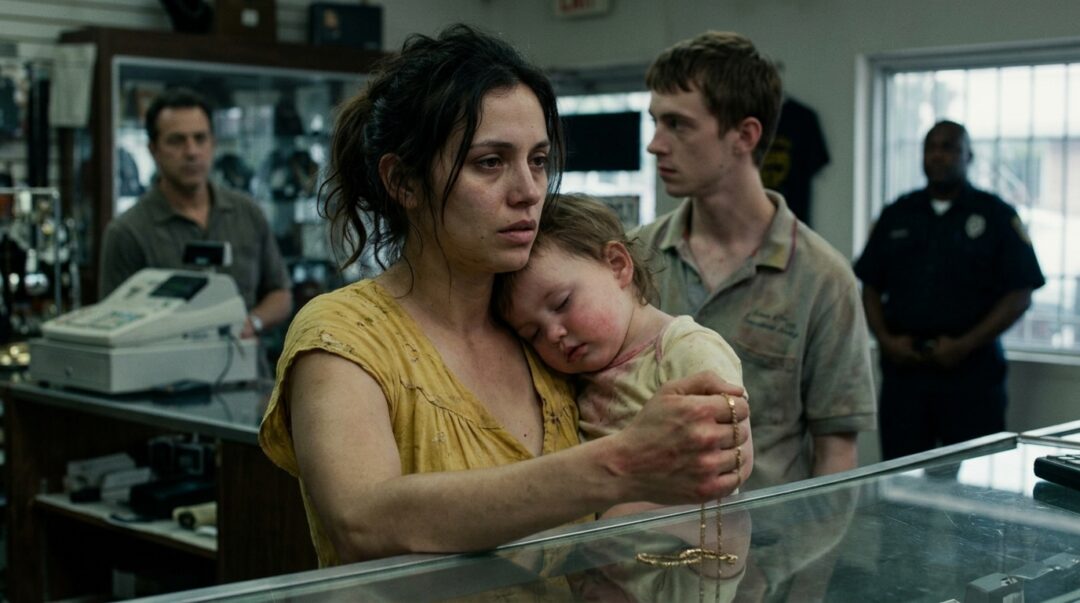
By the time Marisol stepped into the pawn shop, the necklace had already cut a red line into her palm.
She had wrapped it around her fingers so tightly that the thin chain bit into her skin every time her daughter shifted against her hip. It was the only way to keep from putting it back around her own neck. The only way to keep from changing her mind.
The bell above the door gave a cheap metallic jingle that made three people look up at once.
A man waiting near the register glanced at Marisol’s stained yellow dress, then at the little girl resting drowsily against her shoulder. A security guard near the front window straightened slightly, not aggressive, just watchful in the way people became when poverty walked in holding a child.
Marisol nearly turned around.
She had been fighting that impulse all morning. At the bus stop. On the sidewalk outside the pharmacy. Even standing in front of the pawn shop window, staring at a row of secondhand watches and old wedding bands under fluorescent light. Shame had followed her from one block to the next, staying close as heat.
Her daughter, Leni, rubbed her face into Marisol’s shoulder and let out a soft, tired whine.
“It’s okay,” Marisol whispered, though she had no real reason to say it.
The words came out automatically now. She had been saying them for months.
She crossed the room toward the glass counter. Behind it stood a young clerk in a faded store polo, all sharp elbows and impatience. His name tag said Troy, though he didn’t look up long enough to act like he had one.
He was finishing with another customer, his voice dry and practiced, as if every object in the world had already disappointed him.
When it was Marisol’s turn, she placed the necklace on the glass.
Not dropped. Not offered with confidence. Just set down carefully, like something alive that might still change its mind and crawl back to her.
Troy looked at the chain for less than a second.
“That it?” he asked.
Marisol adjusted Leni higher on her hip. “I need cash today.”
Troy leaned closer, then leaned back again as though the necklace had failed some private test. “You waited in line for this?”
The words were not loud. They didn’t need to be. In a room like that, contempt traveled farther than sound.
Marisol felt the stare of the man behind her. She felt the security guard still watching from the window. Leni, half asleep, lifted one small hand and touched the hollow of Marisol’s throat, the place where the necklace had rested all morning.
Marisol swallowed. “I just need enough.”
“For what?” Troy asked.
She hated the question immediately.
It wasn’t his business. It wasn’t anyone’s. But this was how these moments worked. Need always demanded performance. You had to explain yourself to people who had never skipped dinner so a child wouldn’t.
“For groceries,” she said. “And medicine.”
Troy picked up the necklace between two fingers. “This chain means nothing.”
Marisol stared at him.
Not because she wanted to argue. Because for one foolish second, the sentence knocked the air out of her.
Nothing.
The necklace had been cheap even when it was new. She knew that. Silver-colored, not true silver. The clasp had been repaired twice. One side of the chain was slightly darker than the other. But it had rested against her skin on the day she married Emilio under a white rental tent behind his aunt’s apartment building. He had fastened it with shaking hands because he couldn’t afford the ring he thought she deserved, and she had laughed and told him she would rather wear that necklace forever than anything bought on credit.
She had worn it at Leni’s baptism.
She had worn it to Emilio’s funeral.
Nothing.
“It means everything to me,” she said quietly.
Troy snorted under his breath. “Then why sell it?”
Marisol’s fingers tightened around Leni’s little sneaker.
Because the landlord had taped another warning to the door.
Because the bottle of fever medicine on the pharmacy shelf cost less than dinner and still more than she had.
Because she had stopped calling her sister three months ago when she realized every conversation ended with a favor.
Because survival didn’t care what a thing meant.
“Because I have to,” she said.
For the first time, the room went fully still.
Not silent. The old wall fan still clicked. A television bolted in one corner still muttered a talk show no one was watching. But the human stillness changed. The kind that happens when strangers realize they have accidentally become witnesses.
Leni stirred, then began to fuss in soft, exhausted sounds. Marisol bounced her gently, eyes fixed on the glass counter.
She wanted the clerk to say a number. Any number. Low enough to insult her, high enough to buy a few hours. She could survive either. What she couldn’t survive was standing there much longer under everybody’s pity.
Then another voice came from farther down the counter.
“Let me see it.”
Marisol looked up.
The older man had been there the entire time, partly obscured by a rack of boxed electronics and a stack of paperwork. He stepped into the light with no hurry. His shirt was dark, sleeves rolled neatly to the forearms. Graying hair touched his temples. He carried himself with the unforced stillness of someone accustomed to being obeyed without asking twice.
Troy straightened. “Vic, it’s not worth—”
“Let me see it,” the man repeated.
His name, apparently, was Victor.
Marisol slid the necklace across the glass with fingers that had begun to tremble.
Victor did not inspect it the way Troy had. He looked at the clasp. The worn links. The discoloration. Then, inexplicably, he looked at Marisol’s face. At Leni’s flushed cheeks. At the tired yellow fabric gathered where her daughter’s hand gripped her shoulder.
Something in his expression shifted, though only slightly.
The problem with hope, Marisol had learned, was that it arrived even when you didn’t invite it.
She hated it almost as much as shame.
Victor set the necklace down gently.
Marisol braced herself.
Part II — What Desperation Costs
The day had begun before sunrise with Leni burning against her chest.
At first Marisol told herself the girl was only warm from sleep. Then Leni woke crying, her skin hot and dry, her little body fighting her even in half-dream. Marisol found the thermometer in the bathroom cabinet behind cotton balls and a cracked bottle of aspirin. The numbers that blinked up at her were enough to send a cold numbness through her arms.
She had shaken the last of the children’s medicine from the bottle the night before. It hadn’t even been a full dose.
By six in the morning she had checked her bank account twice, as if numbers might rearrange themselves out of kindness. They hadn’t. Her balance sat there in brutal little digits, too low to help and too honest to lie.
She thought about calling her sister, then didn’t.
Rosa had helped with diapers, then rent, then the electric bill. Every favor came wrapped in concern, and concern came wrapped in questions Marisol could not bear to answer anymore.
How are you still behind?
Didn’t Emilio’s cousin promise work?
Why don’t you move in with somebody for a while?
Because pride was useless but still stubborn. Because grief had made her slow in ways she couldn’t explain. Because every month felt like climbing a staircase that grew another step while she was still lifting her foot.
She dressed Leni. She dressed herself. She searched the apartment for coins, old bills, anything. At the bottom of a kitchen drawer she found two bus passes, one expired, and a church flyer folded around nothing.
The necklace was in the small ceramic dish by the bed.
She had looked at it then looked away. Then looked back.
It had not seemed like a real option at first. Not because it was too valuable to sell. Because it wasn’t valuable enough. But sometimes desperation lowered the bar from “enough” to “something.” Something to stand in front of a pharmacist with. Something to turn into juice, bread, medicine, maybe eggs.
By noon she was on the bus, Leni limp against her, the city sliding past in strips of concrete and payday-loan signs and laundromats with broken letters in the windows.
She chose the pawn shop because it was not the nearest one. The nearest one knew her mother. The nearest one increased the odds of recognition, and recognition was a luxury she could not afford.
Now, under the fluorescent lights, all of that exhaustion stood with her at the counter like an invisible crowd.
Victor did not speak immediately. He held the necklace for another second, then placed it in Marisol’s open palm as though returning it after inspection.
Troy gave a short laugh of disbelief. “I told you. It’s not worth much.”
Victor turned his head.
“Be quiet,” he said.
He did not raise his voice. That somehow made it worse for Troy. Or better, depending on where you stood.
The younger man’s mouth snapped shut.
Marisol felt something shift again in the room. The waiting customer by the register pretended suddenly to be very interested in a shelf of old game consoles. The security guard looked away toward the street. Everybody understood that the line between transaction and humiliation had just been redrawn.
Victor looked back at Marisol. “How old is she?”
Marisol glanced down at Leni, who had pressed her damp face into her neck. “Two.”
“She sick?”
Marisol nodded once. She did not trust herself with more than that.
Victor’s gaze moved briefly to the child, then to the necklace in Marisol’s hand.
“This from somebody important?”
The question was simple. It hit harder than the mockery had.
“My husband,” Marisol said.
She did not add late husband at first. She wanted, for one ridiculous heartbeat, to let the sentence stand in the present.
Victor waited.
Marisol swallowed. “He gave it to me when we got married.”
Troy shifted somewhere behind the counter, perhaps embarrassed now, perhaps merely bored. Marisol didn’t look at him.
Victor nodded slowly, not in sympathy exactly, but in understanding.
“Don’t sell that,” he said.
The words passed through her before they landed.
Marisol let out a breath that sounded almost like a laugh. “I don’t have a better idea.”
That, more than anything else, seemed to affect him. Not tears. Not pleading. Just the flat truth of someone who had run out of options dignified enough to say aloud.
Victor opened the register.
The click of the drawer made Marisol look up sharply.
He took out a stack of bills, counted them once, then came around from behind the counter.
That was when her heartbeat changed.
People in places like that stayed behind barriers. Glass counters, registers, rules, suspicion. They did not step into your side of the moment unless something had gone wrong.
Marisol instinctively moved Leni closer.
Victor stopped a respectful distance away and held out the money.
She stared at it. “No. If I take that, you need the necklace.”
Victor gave the faintest shake of his head.
“I don’t.”
“That’s not how this works.”
“No,” he said. “It isn’t.”
For the first time all day, Marisol felt tears rise so fast they frightened her.
She tried to blink them back. The last thing she wanted was to cry in front of strangers. She had spent too many months holding herself together with routines and lists and bus schedules and canned soup and promises to a child too young to understand promises.
But there it was—that sudden, dangerous breaking point when someone offered kindness and the body no longer knew how to remain composed.
Victor did not push the money closer. He simply waited.
Leni gave a weak little cough and tightened her arm around Marisol’s neck.
That decided it.
Marisol took the bills with her free hand, but then immediately held out the necklace again, desperate to keep the world logical.
Victor looked at it, then at her.
“Keep it,” he said.
“I can’t.”
“You can.”
He reached for the chain, not taking it away, only lifting it lightly from her fingers. For one startled second Marisol thought he had changed his mind, that the universe had corrected itself and kindness had remembered its price.
Then he stepped closer and fastened the necklace around her neck.
The motion was slow, careful, almost ceremonial. The cold metal brushed her skin.
Marisol closed her eyes.
Somewhere behind them, she heard Troy inhale. Heard the old fan clicking in the corner. Heard the bell above the door jingle as someone new came in and paused, sensing at once that they had stepped into the middle of something.
When Marisol opened her eyes again, Victor had already moved back half a step, restoring space, restoring choice.
“Take care of your little girl,” he said.
Her mouth trembled before the words came. “Thank you.”
It wasn’t enough. It never could be. But it was all language could manage with a heart splitting open under relief.
Part III — The Walk Home
Outside, the afternoon sun looked almost rude in its brightness.
Marisol stood on the sidewalk for a moment as if the ground had changed under her feet. The city moved around her in ordinary noise—cars passing, a dog barking from a fenced yard, somebody dragging a trash bin to the curb. None of it matched the violence of what had just happened inside her.
Leni touched the necklace as though recognizing its return.
Marisol laughed then, a wet, shaky sound that turned into tears for real. She pressed her lips to her daughter’s hair and let herself cry three silent breaths before forcing her legs to move.
At the pharmacy, she bought the medicine first.
Then juice boxes, crackers, bananas, a loaf of bread, rice, and eggs. She stood at the register expecting, absurdly, for some hidden fee to rise from the conveyor belt and swallow the miracle whole. But the total stayed within reach. She paid. The cashier handed her the receipt without suspicion, without pity, without knowing she had just participated in the kind of victory no one else would name.
Back at the apartment, she managed to get the medicine into Leni with only a little struggle. Then she sat beside the child on the bed in the single room they both slept in and watched the fever slowly soften the girl’s face into sleep.
Only after that did Marisol finally allow herself to sit still.
The necklace rested at her throat, familiar as a pulse.
She touched it and thought of Emilio—not in the polished, saintly way grief sometimes tried to remake the dead, but as he had actually been: laughing too loud, always sure he could fix broken things with his hands, terrible at folding laundry, gentle with stray animals, proud in impractical ways. He would have hated seeing her in that pawn shop. Not because she had failed, but because he would have known what it cost her to walk in.
For a long time she stared at the wall and listened to Leni breathe.
Then she did something she had not done in months.
She took out a notebook from the kitchen drawer and started writing numbers.
Rent overdue.
Bus fare.
The clinic.
Groceries.
Hours available if Rosa could watch Leni on Saturdays.
The diner two blocks over had a sign in the window: Weekend Help Needed. Marisol had passed it three times that week and never gone inside because she didn’t know what she would do with Leni. But problems looked different now—not solved, not even close, just changed enough to be faced in sequence instead of all at once.
Kindness had not rescued her life.
It had interrupted its collapse.
That mattered.
Two days later, when Leni’s fever had broken and color had come back into her cheeks, Marisol took the bus past the pawn shop again.
She had told herself she was only going to the laundromat. She even carried a bag of clothes to make the lie feel less transparent. But when the bus slowed at the corner, she got off.
The pawn shop window looked exactly the same as before. Watches. Rings. Electronics. Cold fluorescent light. Nothing on the glass announced that anything remarkable had ever happened inside.
Marisol stood outside for nearly a minute before going in.
The bell jingled.
This time Victor looked up immediately.
Recognition flickered across his face, followed by something like caution, as if he worried she had returned because the help had not been enough.
Marisol walked to the counter.
Troy was there too, and if he remembered her, he gave no sign beyond a sudden interest in organizing receipt paper.
Marisol set a small paper bag on the glass.
Victor frowned slightly. “What’s this?”
“I brought empanadas,” she said.
The sentence felt foolish the moment it left her mouth. Too small. Too domestic. Too inadequate for what she owed.
But Victor only looked at the bag, then back at her.
“You didn’t have to do that.”
“I know.” Marisol touched the necklace at her throat. “I still wanted to.”
For a second he said nothing. Then he nodded, once, accepting the gift with the same quiet respect he had shown her need. No performance. No insistence that it had been nothing. No false modesty that would cheapen the memory of it.
“How’s your daughter?” he asked.
“Better.”
“That’s good.”
Marisol hesitated, then smiled faintly. “I applied for a job.”
Victor’s face changed in a way so subtle another person might have missed it. Not pride exactly. Relief, perhaps. Or the simple satisfaction of seeing a small mercy continue moving after you release it.
“Good,” he said again. “Keep going.”
She laughed softly. “That’s the plan.”
When she left the shop the second time, the city looked the same as it always had—uneven sidewalks, faded brick, traffic, heat shimmering over parked cars. But she moved through it differently. Not because her burdens were gone. They weren’t. The rent was still late. The work was still uncertain. Grief had not loosened its oldest knots.
What changed was harder to explain.
In the months after Emilio died, Marisol had begun to feel that the world noticed weakness only to press on it. Every office. Every bill. Every conversation that started with concern and ended with arithmetic. Need had made her smaller in other people’s eyes and, worse, in her own.
Then one man in a pawn shop had refused the transaction she thought the world required.
He had not saved her by seeing her as tragic.
He had helped her by seeing her as whole.
That difference stayed.
Weeks later, when she finally did get weekend shifts at the diner, she wore the necklace to her first day. She wore it while balancing plates and smiling at customers whose problems ended at lukewarm coffee. She wore it when Rosa watched Leni and complained lovingly about cartoons played too loud. She wore it when the landlord, denied one more excuse to threaten, became suddenly polite.
And on the hardest nights, when exhaustion made everything feel one missed payment away from disaster again, Marisol would touch the chain at her throat and remember the exact weight of Victor’s words.
Don’t sell that.
Not because the necklace itself could save her.
But because once, at the precise moment she believed desperation had stripped her down to an object and a price, someone had looked at her and decided she was worth more than the bargain.
In the end, that was what remained.
Not the fluorescent shop lights.
Not Troy’s contempt.
Not even the folded bills that had disappeared within hours into medicine and food and bus fare.
What remained was the refusal.
The refusal to let need take the last tender thing she had left.
And when Marisol tucked Leni into bed at night, when the apartment was quiet and the city’s distant sirens softened into background noise, she would sometimes catch her daughter’s sleepy hand reaching for the necklace, the same way she had done on the day of the pawn shop.
Each time, Marisol would let her hold it for a moment before easing those tiny fingers away.
Then she would kiss her forehead, switch off the light, and lie in the dark with one hand resting over the chain at her throat.
A cheap necklace.
A priceless mercy.
And a life, not fixed, but still moving forward.