The Flowers Looked Beautiful Until the Whole Neighborhood Forgot Whose Yard It Was
Chapter 1: The Flowers Were Already There Before Breakfast
Emily Taylor stopped with one hand on the coffee pot because the dirt outside her kitchen window had turned red, yellow, and violet overnight.
For a second, her mind refused to understand what she was seeing. The strip along the left side of her front yard, the narrow bed she had spent six weekends clearing by hand, was no longer bare. It had been filled edge to edge with flowers. Marigolds, petunias, something purple and low to the ground she didn’t know the name of. Fresh mulch lay between them in a dark, perfect blanket.
Her coffee dripped onto the counter.
Emily set the pot down without finishing the pour and moved closer to the window. The sun had barely cleared the roofs across the street. Sprinklers clicked somewhere two houses down. The neighborhood still had that early Saturday quiet, the kind that usually let her stand barefoot in the kitchen and pretend the day belonged to her before the leaf blowers started.
But someone had been in her yard.
Not near it. Not looking at it. In it.
The bed ran beside the short white fence that separated her property from the sidewalk curve. Yesterday it had looked unfinished, she knew that. A plain strip of loosened soil, a few uneven stones, and three small wooden markers poking up at careful intervals. She had meant to go out before breakfast to check whether the last rain had shifted the soil.
Now the markers were gone.
Emily leaned closer until her forehead nearly touched the glass.
“No,” she said, though no one was there to hear it.
She crossed the kitchen fast, catching her hip on the corner of the island. Her phone buzzed on the counter, but she ignored it. At the front door she shoved her feet into garden clogs, the wrong ones, the cracked pair she only used for taking out trash. Her hands shook once on the deadbolt before she made them still.
The morning air smelled like wet mulch.
That was the first thing that hit her when she stepped outside: not the flowers, not the color, but the smell of fresh landscaping. Sweet, damp, clean. The smell of a job finished by someone else.
Emily walked down the front path and stopped at the edge of the bed. The flowers were planted in tidy diagonal sweeps, too tidy to be an accident or a prank by bored teenagers. Someone had thought about color. Someone had spaced them with a gardener’s confidence. Someone had pressed them firmly into soil Emily had been trying not to compact.
She crouched without touching anything.
Where the first wooden marker should have stood, there was a petunia.
Where the second marker should have been, a mound of mulch.
The third—she could not see the third at all.
A door opened across the street.
Emily looked up.
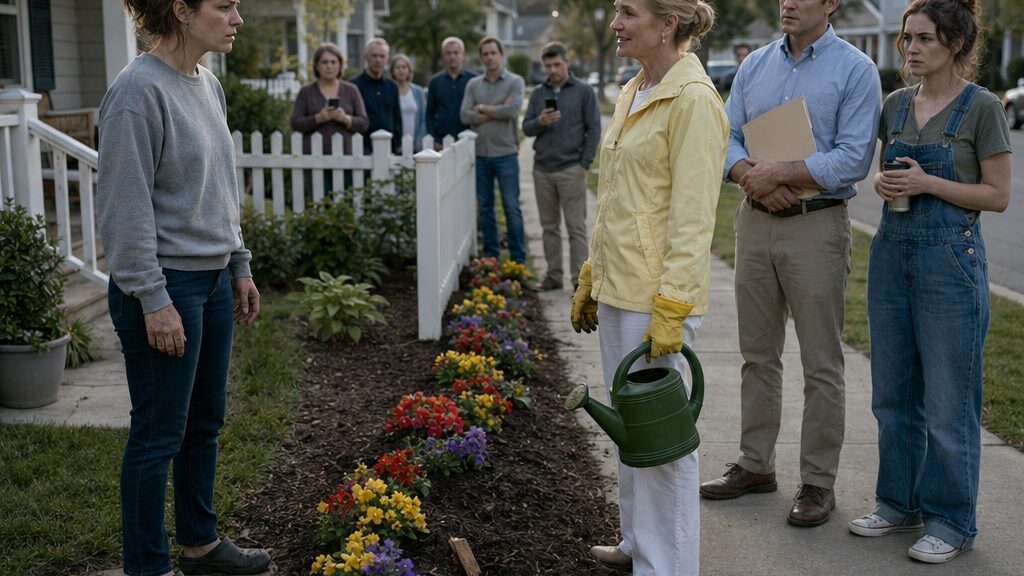
Barbara Johnson came through the gap between the hedges at the side of the neighboring house wearing yellow gardening gloves and a light rain jacket even though the sky was clear. She held a green watering can in one hand and a pair of clippers in the other. Her blonde hair was pulled back tight, and her expression carried the bright, practiced satisfaction of someone arriving for praise.
“Oh,” Barbara said, as if she had just happened upon Emily admiring the work. “You’re up.”
Emily stood slowly.
Barbara smiled wider and lifted the watering can. “I was going to give them one more drink before the sun got too high.”
Emily looked from Barbara’s gloves to the flowers.
“You planted these?”
Barbara’s smile did not fade. It changed shape, becoming patient. “The volunteers helped with the heavier flats. But yes, I coordinated it.”
“In my yard.”
“Well.” Barbara glanced down the street, then back at Emily with a small laugh. “Along the edge. That strip has been sitting like that for weeks, and the garden walk is next Saturday. I thought, why not make it cheerful?”
Emily waited for the apology that did not come.
Barbara stepped closer to the bed and tipped the watering can over a cluster of yellow marigolds. Water pattered on leaves and darkened the mulch. “You’re welcome, by the way. I know you’ve had a lot on your plate, and curb appeal can be overwhelming when you’re new.”
“I’m not new,” Emily said.
Barbara blinked. “You know what I mean.”
Emily did know. She had owned the house for eleven months, long enough to pay dues, receive notices about trash bins, and learn that no one on the landscaping committee liked a yard they could not quickly understand. Not long enough, apparently, to be treated as someone whose soil was hers.
“You came onto my property last night,” Emily said.
Barbara’s watering can paused. “Early this morning. And only because the delivery came sooner than expected. We were very careful.”
“We?”
A woman in a floral shirt turned from the sidewalk, where Emily had not noticed her standing beside two empty plastic trays. “It really does look better,” the woman said, cheerful but cautious, like she was trying to smooth a wrinkle before it became visible. “I told Barbara it brightened up the whole curve.”
Emily stared at her.
The woman with the floral shirt gave a small shrug. “I mean, you have to admit, the color is lovely.”
More movement came from the driveway across the way. One of the landscaping volunteers carried a stack of black nursery pots toward Barbara’s garage. Another neighbor slowed during his morning walk, phone in hand, dog tugging toward the new flowers.
Barbara straightened. “See? Everyone noticed immediately.”
“That’s not the point,” Emily said.
The dog walker stopped. “What happened?”
Barbara answered before Emily could. “Just a little surprise beautification. The Taylor place is finally ready for the garden walk.”
The Taylor place.
Emily felt the words settle on her shoulders like a borrowed coat. This house had been her grandmother’s before it had been hers. Before that, it had been the small ranch with the crooked mailbox and the pink azaleas everyone complained dropped petals on the sidewalk. But to Barbara, it was a place in need of fixing. A slot on a neighborhood map.
Emily opened her mouth and shut it again.
She could say: There were markers here.
She could say: I was restoring this bed.
She could say: My grandmother planted things under this soil before any of you cared whether my mulch matched.
But the three neighbors were looking at her, and Barbara was still holding the watering can like evidence of kindness.
“You should have asked,” Emily said.
Barbara’s eyebrows lifted. Not much. Just enough.
“I would have,” she said, “but I was afraid you’d say no before seeing how nice it could be.”
The woman in the floral shirt gave a tiny laugh, the kind meant to include everyone. “Well, it is nice.”
Emily looked down at the flowers. A red bloom trembled under the last drops from Barbara’s watering can. A smear of mud marked the edge of the stone border Emily had placed herself, one stone at a time, after work, kneeling until her back burned.
“You were afraid I’d say no,” Emily repeated.
Barbara’s face tightened, but her voice stayed smooth. “I was trying to help.”
“You were trying to get your way.”
The dog walker shifted his leash to the other hand. The volunteer with the pots stopped moving. The morning quiet thinned.
Barbara set the watering can down with deliberate care. “Emily, I understand property lines. I chair the landscaping committee.”
“That’s why you should understand permission.”
“No one damaged anything.”
Emily looked at the missing marker space and pressed her thumb against the side of her index finger so hard the nail hurt. If she crouched and started digging now, she would look frantic. If she said nothing, Barbara would keep smiling beside the flowers as though the yard had been rescued.
A car rolled slowly past. Then another. Saturday mornings did that in Meadowbrook Ridge; people drove to tennis lessons, hardware stores, breakfast, and somehow still found time to notice whose lawn had changed.
Barbara noticed too. She raised her chin slightly.
“I know it may feel sudden,” she said, loud enough for the others to hear, “but this neighborhood works best when we all contribute to how it looks. Your front border was unfinished. I made it beautiful.”
Emily felt heat rise in her face.
“It was not unfinished.”
Barbara glanced down at the mulch. “Emily.”
One word. Soft, almost sympathetic. It landed worse than an accusation.
The woman in the floral shirt bent and touched one of the purple flowers. “These will fill in by next weekend.”
Next weekend. The garden walk. The event Barbara had mentioned in three newsletters, two reminder emails, and one laminated notice by the mailboxes. Visitors from neighboring subdivisions would stroll through selected streets, admiring front beds and porch planters. The HOA would put up white signs. Barbara would wear her committee badge.
Emily had ignored the event because her yard was not a display.
Barbara seemed to read her silence as surrender. She picked up the watering can again and turned toward the bed.
Emily stepped forward.
“Don’t water them.”
The can stopped midair.
The dog walker’s dog whined.
Barbara lowered the can slowly. “They need water.”
“I didn’t ask for them.”
“No,” Barbara said, and now the pleasantness thinned. “But the rest of us have to look at the result when people drive by.”
There it was. Not help. Not generosity. The rest of us.
Emily’s phone buzzed again in the pocket of her sweatshirt. She pulled it out without taking her eyes off Barbara. A notification from the neighborhood group sat on the screen.
Thank you Barbara and the landscaping team for the beautiful surprise at the Taylor corner! Meadowbrook looks garden-walk ready!
There was already one heart reaction.
Then another.
Emily’s fingers closed around the phone.
Barbara’s own phone chimed from her jacket pocket. She glanced at it and let herself smile.
“Well,” Barbara said, turning so her voice carried to the sidewalk, “I’m sure the HOA will be thrilled you finally have some curb appeal.”
Chapter 2: Everyone Thanked Barbara Except the Woman Who Lived There
“That border makes the whole corner pop,” the neighbor with the floral shirt said before she asked Emily if she was all right.
Emily stood on the grass with her phone still in her hand, watching the heart reactions multiply under the neighborhood post. The photo attached to it had been taken from the sidewalk, angled so the flower bed looked like a magazine strip of color. You could not see the trampled soil near the fence. You could not see where the wooden markers had been.
You could see Barbara.
She was in the corner of the photo, half turned away as if she had been caught mid-service, watering can in hand.
Emily wanted to ask who had taken it. Instead she locked the screen.
“I didn’t give permission for any of this,” she said.
The dog walker cleared his throat. “Maybe it was just a miscommunication.”
“No communication happened,” Emily said.
Barbara removed one glove finger by finger. “Let’s not turn a nice morning into a legal seminar.”
“It became legal when you entered my yard.”
The volunteer carrying nursery pots looked down as though the pots had suddenly become very interesting. The woman in the floral shirt pressed her lips together, not quite disapproving, not quite sympathetic.
From the sidewalk, Rebecca Harris approached in faded overalls with a travel mug in one hand. She lived three houses down and had once helped Emily lift a fallen branch after a storm. Emily liked her, or had liked her, in the distant way she liked anyone who waved without asking questions.
Rebecca slowed when she saw the group. “Wow,” she said, looking at the flowers. “That’s… a lot brighter.”
Barbara seized the tone. “Isn’t it? We were just saying Emily hasn’t had a chance to finish the bed, and with the garden walk coming, it seemed neighborly to step in.”
Rebecca’s eyes flicked to Emily. “Did you know they were doing it?”
“No.”
The word came out flat enough to stop Rebecca’s smile.
“Oh,” Rebecca said.
Barbara tucked her gloves under one arm. “She saw it before she knew the plan.”
“There was a plan?” Emily asked.
Barbara ignored that and addressed Rebecca. “The garden walk route was adjusted last month. The Taylor corner is visible from the entrance, so if it looks abandoned, it affects everyone.”
“Abandoned,” Emily repeated.
Barbara sighed. “Unfinished, then.”
“It was soil.”
“It was bare soil.”
“It was my bare soil.”
A window opened somewhere across the street. Emily heard the faint metallic clink of blinds. The audience was growing without anyone having to step outside.
The dog walker shifted backward. “I should keep moving.”
But he didn’t. Not really. He moved three feet and stopped when a dark SUV pulled up along the curb.
Stephen King got out wearing weekend khakis and a pale blue button-down that looked too crisp for eight in the morning. He was the HOA board president, though he carried himself like a man who wished the title came with fewer Saturday phone calls. He looked first at the flowers, then at Barbara, then at Emily.
“Morning,” he said carefully.
Barbara smiled as if he had arrived exactly on cue. “Stephen, good. You can help clear this up.”
Emily hated how official his presence made everything feel.
Stephen came up the walk but stopped before stepping onto Emily’s lawn. At least he had that much sense.
“I saw the post,” he said.
“Then you saw the improvement,” Barbara said. “The landscaping committee had extra annuals from the entrance beds, and the Taylor strip needed attention.”
Stephen looked at Emily. “I’m guessing you weren’t aware?”
“I woke up to it,” Emily said.
His mouth tightened. “That’s not ideal.”
“Not ideal?” Emily asked.
Barbara gave a small laugh. “Stephen means the timing.”
“I mean the lack of clarity,” Stephen said, then seemed to regret choosing words that satisfied no one. “Barbara, was there prior written approval for work on a homeowner’s lot?”
Barbara’s smile held, but the muscles around it sharpened. “The border touches the common-view corridor.”
“That isn’t the same as common property.”
“No, but the rules allow the committee to address visible maintenance issues before public events.”
Emily turned to Stephen. “Is that true?”
Stephen rubbed the bridge of his nose. “There are provisions for emergency maintenance in visible areas.”
“This was not an emergency.”
“No,” Stephen said. “I understand.”
Barbara cut in. “The garden walk is in seven days. We have visitors, sponsors, printed maps—”
“Sponsors?” Emily asked.
Rebecca looked surprised too.
Barbara waved that away. “Local businesses place small ads in the program. It helps fund the seasonal planting. This is not some personal hobby, Emily. A lot of people have worked on it.”
The sentence did its job. The circle shifted. Not visibly, not dramatically, but Emily felt it. Suddenly she was not just objecting to flowers. She was standing in the way of volunteers, visitors, funding, the good of Meadowbrook Ridge.
Stephen took a slow breath. “Maybe the practical solution is to leave them through next weekend and revisit after the garden walk.”
Emily stared at him.
“No.”
“It would avoid disruption,” he said.
“Disruption already happened.”
“I understand that.”
“No,” Emily said, sharper now. “You understand that it looks better in a photo, and you’d like me to be quiet until your event is over.”
Rebecca lowered her travel mug.
Barbara’s face flushed. “That is unfair.”
“Is it?”
“I did not sneak into your yard to upset you. I saw a problem, I had materials, and I solved it.”
“You solved your problem,” Emily said.
Stephen lifted both hands slightly. “Let’s keep this respectful.”
Emily nearly laughed. Respectful. The word everyone reached for after the damage had already been done.
Barbara bent and picked a stray leaf from the mulch. “There are people here who would be grateful for help. I suppose I assumed you’d see the spirit of it.”
“The spirit of it entered my yard without asking.”
The woman in the floral shirt murmured, “I don’t think anyone meant harm.”
Emily turned to her. “Would you be fine if I came over tonight and repainted your porch because I thought the color needed help?”
The woman blinked. “That’s different.”
“Why?”
“Because paint is permanent.”
Emily looked down at the flowers. “You don’t know what was here.”
The words slipped out before she could stop them.
For the first time, Barbara’s expression changed completely. It was quick, a flicker of uncertainty or irritation, then gone. “There was dirt.”
Emily felt the trap close around her own silence. If she explained now, in front of the dog walker and the floral shirt and Stephen with his careful face, her grandmother would become a defense. A story to justify why she deserved control of her own yard. The thought made her throat tighten.
“There were markers,” Emily said.
Barbara frowned. “I didn’t see any markers.”
“You didn’t look.”
“We cleaned the bed before planting. If there were old sticks or debris—”
“They weren’t debris.”
The word came out too loud.
Rebecca stepped closer. “What kind of markers?”
Emily turned away from the group and crouched at the edge of the bed. She did not want their eyes on her back, but she needed to see. The mulch looked smooth where it should not have been. She moved a leaf aside with two fingers.
No marker.
She shifted to the left, trying not to disturb the petunia roots. Nothing.
Her pulse began to thud.
Stephen’s shadow fell across the grass. “Emily?”
She moved faster now, pushing mulch back in small, careful strokes. Her fingers hit damp soil, then a thin white feeder root from one of the new flowers. She stopped before she tore it.
Barbara said, “Please don’t uproot them.”
Emily looked up at her.
The watering can sat between them, green and ordinary and unbearable.
“I’m looking for what you buried.”
Barbara folded her arms. “I buried nothing.”
Emily stood. Her knee was wet from the grass. Fine mulch clung to her fingertips.
Stephen said, “Maybe everyone should take a breath. Emily, I can review the guidelines and circle back.”
“No,” Emily said. “You can tell me whether she had permission.”
Stephen hesitated.
That hesitation did more than an answer would have.
Barbara saw it too. She turned toward the neighbors with a strained smile. “The committee has always handled route-facing improvements. Stephen knows that.”
Stephen’s voice lowered. “Barbara, we still need homeowner consent for lot work unless there’s a safety issue.”
“Then call it beautification support.”
“That’s not a category.”
Silence snapped into place.
For one brief second, Emily felt the ground shift under Barbara instead of under her.
Then Stephen looked at the flowers again and said, “But removing them immediately could create additional damage, so leaving them temporarily may still be the least harmful option.”
There it was again: the compromise that cost him nothing.
Emily’s anger cooled into something steadier.
“You want them to stay because moving them is inconvenient.”
“I want to prevent the situation from getting worse.”
“It got worse when you asked me to host evidence until after your event.”
Rebecca drew in a small breath.
Barbara’s phone chimed again. Then Emily’s. Then the floral-shirt neighbor’s.
The neighborhood thread had updated.
Beautiful work by Barbara and team! So glad the Taylor corner is finally getting some love before the walk.
Emily looked at the message, then at the flower bed.
Finally getting some love.
She walked past Stephen, past Barbara, and knelt at the far end of the border where the third marker had been, the one closest to the fence. It had marked the smallest cluster. The weakest.
This time, when she moved the mulch, her finger struck something hard.
For a heartbeat she felt relief.
Then she pulled it loose and saw it was only the broken top of a wooden stake, snapped clean across, the label end missing.
Chapter 3: The Missing Marker Changed What the Flowers Meant
Emily found the first crushed shoot under the marigolds at 1:17 that afternoon, after everyone had gone home and the neighborhood had finished congratulating itself.
She had waited until the street emptied. She told herself it was because she did not want more people stepping on the lawn, but that was only half true. The other half was uglier: she did not want anyone watching her care too much.
The sun had moved high enough to flatten the colors of Barbara’s flowers into something bright and merciless. Emily knelt beside the bed with a hand trowel, a bowl, and the broken marker top resting on the grass beside her. She had changed into jeans and an old gray T-shirt, but she still felt like the woman from the morning, standing in front of everyone with mulch on her fingers while they waited for her to become reasonable.
She slid the trowel into the soil at a shallow angle and lifted.
The marigold held firm, its nursery root ball packed tight. Around it, the soil Emily had loosened over weeks was pressed into clumps. She set the trowel down and used her fingers instead.
“Easy,” she whispered, though she did not know whether she was speaking to the new flower or what might be under it.
The first shoot was pale green and bent sideways, no longer than her thumb. Its tip had been bruised dark where mulch and a root ball had pinned it.
Emily sat back on her heels.
For a few seconds she did nothing.
Then she reached for the bowl and placed the clump of mulch beside it, as if ordering the damage could make it smaller. She uncovered two more shoots near the fence line. One had snapped. One was still curved underground, searching for light that had been replaced by petunias.
Her phone buzzed on the porch step.
She ignored it.
It buzzed again.
The third time, she wiped her hand on her jeans and picked it up.
The Meadowbrook Ridge Residents thread had become a parade of gratitude.
Gorgeous colors!
Thank you, Barbara, for always seeing what needs doing.
The Taylor corner looks amazing now.
Can’t wait for the garden walk!
Someone had posted three more photos. In one, Barbara stood with the volunteers in front of Emily’s yard. In another, the flowers filled the frame so completely the house behind them looked incidental. In the third, Emily appeared in the background, arms crossed, face turned partly away.
The caption read: Some people show love through action.
Emily’s thumb hovered over the screen.
She typed: Action without permission is not love.
Then she deleted it.
She typed: Please remove photos of my house.
Then she deleted that too.
Finally she locked the phone and set it face down in the grass.
This was the thing about being watched in a neighborhood: even silence became material other people could use.
Emily returned to the bed. She moved along the border inch by inch, parting mulch, checking for remnants of the markers. The labels had been written in pencil and sealed with clear tape because she had not wanted black plastic tags sticking up like a nursery aisle. Her grandmother had used wood markers. Plain ones. “Plants should look like they came from the ground,” she had said once, “not from a filing cabinet.”
Emily found the second broken stake near the base of a purple flower, driven sideways into the soil.
She pressed it into her palm until the edge left a line.
By late afternoon, she had uncovered five damaged shoots and one intact cluster buried beneath a heap of mulch. She had not removed Barbara’s flowers. Not yet. She had lifted only enough to see, then pressed them back with reluctant care. Some small stubborn part of her refused to kill one living thing to prove someone else had harmed another.
That made her feel foolish.
In the garage, she searched the shelves above the potting bench. Her grandmother’s old things still occupied the left side because Emily had not known what to do with them. A rusted hand rake. A coffee can filled with plant ties. Paper seed packets so old the pictures had faded. A pair of gloves with a tear near the thumb.
She pulled down the plastic storage bin marked House Papers and Garden in her own handwriting.
Inside were warranty folders, appliance manuals, closing documents, and a stack of notebooks tied with garden twine. The twine stopped her before the notebooks did.
Emily took them to the kitchen table.
The same kitchen window looked out over the new flowers. From inside, they almost looked harmless. That was the worst part. If she did not know what had been underneath, if she had not spent evenings loosening compacted clay and mixing in compost by hand, she might have thought Barbara had done something generous.
Her phone buzzed again.
This time it was a direct message from Rebecca.
Hey. I’m sorry this got weird. I think Barbara meant well, but I also get why you’re upset. Let me know if you need help with anything.
Emily read it twice.
I also get why you’re upset.
Not: you’re right.
Not: what happened was wrong.
A careful message. A neighborhood message.
Emily set the phone aside and untied the twine.
Her grandmother’s notebooks smelled faintly like dust and basement cardboard. The first one was full of grocery lists mixed with planting dates. Tomatoes beside dentist appointments. Fertilizer beside church potluck reminders. The second had sketches of the backyard. The third had the front beds.
Emily turned pages until she found the line drawing of the left fence strip.
There it was.
A rough rectangle marked in her grandmother’s slanted handwriting: old daffodil line, leave space, don’t let them cover it.
Emily’s throat tightened.
Beneath that was another note, written smaller.
For Emily if she ever wants the spring back.
She touched the words with the cleanest finger she had.
The memory came without asking: her grandmother at the kitchen table, thinner than she wanted anyone to notice, pushing a folder toward Emily and saying the house would be easier to sell to someone else but harder to forgive that way. Emily had laughed because she did not know what to do with tenderness when it came wrapped in legal paperwork and a failing roof.
“You don’t have to keep it perfect,” her grandmother had said. “Just don’t let them make it theirs.”
At the time, Emily had thought she meant the house.
Now she looked through the window at the flowers.
Her phone lit up again.
This time the notification was from Barbara in the residents thread.
I’m sorry Emily misunderstood a kindness. The committee only wanted to help bring a neglected corner back into bloom for everyone to enjoy.
Emily stared at the words until they blurred.
Then she looked back down at the notebook page, where her grandmother had circled the same strip of yard Barbara had covered overnight.
Chapter 4: Dennis Remembered the Yard Before It Was Perfect
Dennis Walker returned the missing marker at 8:03 on Sunday morning, holding it between two fingers like something that had washed up after a storm.
Emily had opened the front door because she saw him through the kitchen window. He was standing at the edge of her walkway in a faded baseball cap and a gray sweatshirt, looking down at the new flower bed with the expression of a man trying to decide whether a wound was old or fresh.
“I found this in the gutter,” he said.
Emily stepped onto the porch.
The marker was split down the middle. The pencil writing had blurred from water and mud, but one word remained visible under the torn strip of tape.
Daff.
Emily took it carefully. Her thumb covered the broken edge.
“Thank you,” she said.
Dennis nodded once. “Figured it wasn’t trash.”
Behind him, the flowers looked brighter than they should have after what she had found beneath them. Barbara’s mulch was still damp. The marigolds stood with neat, cheerful faces turned toward the street, as if nothing had happened.
Dennis looked at the bed again. “Your grandmother used to mark things that way.”
Emily’s fingers tightened around the little stake.
“You knew her?”
“Most of us did, once.” His mouth moved in a small, rueful line. “Some of us better than we acted.”
Emily did not know what to say to that. She had seen Dennis before, usually on his porch with a newspaper or trimming the hedge beside his driveway. He waved, but he rarely crossed the street. He had been one of the neighbors she filed under harmless, which maybe only meant she had not needed anything from him yet.
“She drew a map,” Emily said before she could stop herself.
“I’d be surprised if she hadn’t. She knew every bulb in that yard.”
The words were so plain they struck harder than sympathy would have.
Emily looked back at the house. Through the window she could see the notebook on the kitchen table, still open to the circled strip. She had left it there overnight because she couldn’t bring herself to close it.
“I didn’t know anyone remembered,” she said.
Dennis shifted his weight, uncomfortable now. “People remember more than they say.”
“That doesn’t help much.”
“No,” he said. “It doesn’t.”
A car slowed near the curve, then continued. Emily stepped down from the porch, suddenly aware of how visible they were from the sidewalk. Dennis seemed to notice too, because he moved closer to the flower bed and lowered his voice.
“Barbara knew there was something different about this strip.”
Emily looked up sharply.
Dennis held up one hand. “I don’t mean she knew about your markers yesterday. I don’t know that. But she knew your grandmother fought them on this yard years ago.”
“The HOA?”
“It wasn’t as formal then. More like pressure dressed up as advice.” His eyes stayed on the flowers. “There was a garden contest, not a walk. Barbara wasn’t chair yet, but she was already on the committee. They wanted matching borders along this side of the street. Your grandmother said no.”
Emily heard her grandmother’s voice in the kitchen: Just don’t let them make it theirs.
“What happened?”
Dennis looked across the street, toward the houses with their trimmed shrubs and glossy porch planters. “They talked about her like she was stubborn. Said the place looked old-fashioned. Said she was dragging down the street. I heard it. I didn’t say much.”
The admission settled between them.
Emily wanted to ask why. She wanted to make him explain what kind of person heard that and stayed quiet. But the answer was probably the same answer she had lived with yesterday. It was easier not to become the difficult one.
Dennis crouched slowly beside the bed, one hand braced on his knee. “Your grandmother didn’t care about perfect. She cared about what came back.”
Emily swallowed.
“She told you that?”
“She told anyone who’d listen. That was the trick. Not many did.”
A notification sounded from Emily’s phone inside the house. She had turned the volume up in case the county extension clerk returned her message, but now every sound from that device made her stomach tighten. She did not go get it.
Dennis looked toward the porch. “They’re still talking?”
“Barbara posted that I misunderstood a kindness.”
He winced. “That sounds like her.”
Emily knelt at the edge of the bed, leaving a careful distance between her knees and the new flowers. “I found crushed shoots.”
Dennis’s face changed.
She pointed without touching. “Here. And there. Some are still alive. I don’t know how many.”
“Daffodils?”
“Some. Maybe iris. I’m not sure.” She gave a short laugh with no humor in it. “I thought if I waited one more season, I could see what came up before deciding what to do. That was apparently offensive to the street.”
Dennis reached out, then stopped before his fingers touched the mulch. “She should have asked.”
The sentence was so simple that Emily almost looked away.
Yesterday, she had said the same thing and been made to feel childish. From Dennis, it sounded like a complete moral position.
“She said the HOA would be thrilled,” Emily said.
Dennis stood with effort. “The HOA likes being thrilled after the work is already done. Saves them having to be brave before it starts.”
“Stephen said they still need consent.”
“Stephen says the right thing when nobody is asking him to pay for it.”
Emily almost smiled. Almost.
Dennis glanced toward Barbara’s house. The driveway was empty, but the front porch was dressed for the garden walk already, two tall planters flanking the door like sentries.
“She’ll bring this to the board,” he said.
Emily looked at him. “Because I objected?”
“Because you embarrassed her.”
“I didn’t plant flowers in someone else’s yard.”
“No. But you made her look like someone who did.”
The unfairness of it made Emily press the broken marker against her palm again.
Dennis watched her do it. “You don’t have to tell everybody everything. But you may have to tell them enough.”
“I shouldn’t have to explain my grandmother to keep people out of my yard.”
“No,” he said. “You shouldn’t.”
For a few seconds, neither of them moved. A sprinkler began ticking somewhere behind Dennis’s house. The sound counted off the silence.
Emily looked at the flower bed. “I hate that they’re pretty.”
Dennis’s mouth softened. “That’s how they get away with some things.”
The phone inside buzzed again. Then again.
Emily shut her eyes briefly.
Dennis turned toward the porch. “You might want to check that.”
She did not want to. She wanted to stand outside with the broken marker and the one person who had said the obvious thing without making her earn it. But the buzzing continued, a small mechanical insistence from the kitchen table.
Emily went inside with Dennis waiting on the porch step.
Her phone showed three missed messages from Rebecca and one email notification from the Meadowbrook Ridge HOA community account.
The subject line was crisp, official, and worse than any group thread.
Emergency Landscaping Review Notice — Taylor Property.
Emily opened it while standing at the kitchen table, her grandmother’s notebook still spread beneath her hand.
Pursuant to visible-lot maintenance concerns and community event preparation, the Meadowbrook Ridge HOA Board will conduct an emergency landscaping review Monday at 6:30 p.m. regarding recent alterations and homeowner objections at the Taylor property.
Her eyes moved to the final line.
Homeowner attendance is strongly encouraged.
Outside, Dennis was still waiting, the bright flowers between him and the street like a cheerful warning.
Chapter 5: The Board Wanted Pretty Pictures, Not Permission
Emily saw her yard on the clubhouse projector before anyone said hello.
The photo filled the pull-down screen at the front of the room: Barbara’s flower border glowing in late-morning light, Emily’s house behind it cropped neatly enough to remove the porch step with the cracked paint and the patch of lawn she had not reseeded. Across the top, in cheerful green font, were the words Meadowbrook Ridge Garden Walk Preview.
Emily stopped just inside the doorway.
There were twelve folding chairs set in two rows, a coffee urn on a side table, and a stack of printed programs beside a vase of cut hydrangeas. Stephen King stood near a laptop, talking softly with the community manager. Barbara sat in the front row with a folder in her lap, dressed in a cream cardigan and pearl earrings, as if unauthorized planting required business casual.
Rebecca sat in the back row. When she saw Emily, she lifted one hand, then seemed unsure whether waving was too much.
Dennis stood against the side wall instead of taking a chair.
Emily had not expected him. The sight of him steadied her and annoyed her at the same time. She did not want to need witnesses.
Stephen noticed her and straightened. “Emily. Thank you for coming.”
The slide behind him changed automatically to another image of her yard, this one closer. The flowers filled the screen.
Emily looked from the photo to Stephen. “Why is my house in your slideshow?”
Stephen glanced back, then reached for the laptop. “That’s part of the draft garden walk presentation. It was prepared before—”
“Before I objected?”
Barbara turned in her chair. “Before anyone realized there would be an objection to flowers.”
Emily took the empty chair closest to the aisle, leaving one seat between herself and Rebecca. “There was an objection to trespassing.”
A murmur moved through the room. Not loud. Meadowbrook Ridge did not do loud at meetings. It did throat clearing, chair shifting, and meaningful looks toward the person making things uncomfortable.
Stephen clicked the projector off. The screen went blank, but the afterimage of flowers seemed to stay in Emily’s eyes.
“We’re here to determine the best path forward,” he said.
“The best path is removing what was planted without my permission.”
Barbara opened her folder. “The committee acted in good faith.”
Emily looked at the folder. “Is that written somewhere as an exception?”
Stephen raised a hand. “Let’s establish the timeline first.”
That was new. Emily leaned back slightly.
Barbara’s posture tightened.
Stephen looked at his notes. “Barbara, you received the extra annuals Friday evening?”
“Yes. From the entrance-bed order.”
“And the planting occurred early Saturday morning?”
“With volunteers, yes.”
“Did you receive written consent from Emily prior to planting?”
Barbara’s lips pressed together. “No.”
A small shift went through the room.
Stephen continued, “Did you contact me before planting?”
Barbara’s eyes flicked toward Emily, then back to Stephen. “I sent you a message after the delivery arrived.”
“After the delivery, but before planting?”
Barbara turned a page in her folder. “Stephen, we had a practical issue. The Taylor strip is directly visible from the entrance route, and the garden walk materials had already gone to print. I made a judgment call.”
“That wasn’t the question,” Dennis said from the wall.
Everyone turned.
Dennis looked uncomfortable with the attention but did not take it back.
Stephen checked his phone. “For clarity, the message I received from Barbara came at 7:42 Saturday morning. The planting was already complete by then.”
Emily looked at Barbara.
Barbara’s face held, but the pink at her throat deepened.
Stephen said, “The message said, ‘Used remaining flats to dress Taylor corner. Looks much better. Hope that avoids complaints next weekend.’”
Rebecca looked down at her hands.
Emily felt the room tilt, not enough to free her, but enough to expose a seam.
“So no one approved it,” she said.
Stephen paused. “Not in advance.”
Barbara closed her folder. “I never claimed there was a formal approval. I said the committee has historically handled visible issues before events.”
“Visible issues,” Emily repeated.
Barbara turned fully now, no longer performing for the board alone. “Yes. Your front strip has been bare for weeks. We sent reminders about the garden walk. We encouraged everyone on the route to freshen visible beds. You did not respond.”
“I’m not on the route.”
“You are on the entrance curve.”
“That’s not the same thing.”
“It is when every visitor passes your house.” Barbara’s voice stayed level, but something harder had entered it. “This subdivision maintains standards. That is why people buy here. That is why property values hold. One neglected strip may feel personal to you, but it reflects on all of us.”
Neglected. Again.
Emily heard her grandmother’s pencil moving across notebook paper. Old daffodil line, leave space.
“My yard was not neglected,” Emily said.
Barbara’s eyebrows lifted. “Then what was it?”
Emily felt the answer rise and stick.
Dennis shifted against the wall. Rebecca looked at her, waiting. Stephen’s pen hovered over his notes.
Tell them enough, Dennis had said.
But enough was a door. Once opened, people walked through with their muddy shoes and good intentions.
“It was being restored,” Emily said.
Barbara gave a faint sigh. “Restored to what?”
Emily did not answer.
Barbara turned to Stephen with the weary patience of someone forced into reason. “This is exactly the issue. No plan was submitted. No visible progress was made. The committee stepped in with seasonal color. Now we’re being accused of wrongdoing for improving a route-facing area.”
Stephen looked tired. “Barbara, the consent problem is real.”
“And the event problem is real too,” Barbara said. “The programs are printed. The map includes that corner. Sponsors have paid to be associated with a polished community event. Are we going to tear out healthy flowers six days before the walk because Emily dislikes how help was offered?”
“I dislike that it was not offered,” Emily said. “It was done.”
The community manager finally spoke. “There may be a temporary compromise. The flowers could remain through the garden walk, and after that the committee could assist with relocating them at no charge.”
Emily looked at her. “At no charge?”
The woman blinked.
“You mean I don’t have to pay people to undo what I never asked them to do?”
Stephen said, “Emily, I know that phrasing sounds—”
“It sounds accurate.”
Barbara leaned forward. “You would rather have a bare strip for visitors?”
“I would rather have my yard.”
“It is still your yard.”
“No. Right now it is your advertisement.”
The room went still.
Emily felt the cost of the sentence the second it landed. Barbara’s face did not collapse or flare; it froze. Stephen looked at the blank projector screen as if he wished the flowers were still there to look at instead.
Rebecca shifted in her chair. “Couldn’t they be moved before Saturday? If the issue is where they are?”
Barbara turned on her. “Moved where? Into whose labor? Whose budget? These are living plants, not furniture.”
Emily almost laughed at that, but the sound would have come out wrong.
“They were living plants when you put them on top of mine,” she said.
Barbara’s eyes narrowed. “What plants?”
The opening was there. Emily could have taken it. She could have pulled out copies of the notebook page from the folder in her bag. She had made them that afternoon at the office supply store, standing under fluorescent lights while strangers printed birthday invitations and shipping labels. She could show the sketch. She could say her grandmother’s name. She could make the room understand.
Instead, she felt herself closing.
“Plants that were marked,” she said.
Barbara gave a small shake of her head. “Old sticks and dormant weeds are not a landscape plan.”
Dennis pushed away from the wall. “Careful.”
Barbara looked at him. “Excuse me?”
He did not answer, but Emily saw his jaw tighten.
Stephen tapped his pen once. “Let’s stay focused. We have two issues. First, the planting should not have happened without homeowner consent. Second, removing it immediately may create appearance and logistics problems for the event.”
Emily looked at him. “That is not two equal issues.”
“No,” he admitted. “But they both exist now.”
“Because Barbara created one.”
Barbara stood. “I will not sit here and be treated like I vandalized your property. I used leftover flowers and volunteer time to improve a neglected area. That is the truth, whether you appreciate it or not.”
Emily stood too, slowly. “Then here is my truth. I want them moved before the garden walk.”
Stephen’s shoulders sank.
Barbara’s laugh was short and disbelieving. “And if that damages whatever invisible garden you claim was there?”
Emily felt the room sharpen around that word.
Invisible.
Barbara picked up her folder. “Or is that the point? Are we supposed to guess what you’re hiding under the dirt?”
Emily’s hand went to the folder in her own bag, to the copied sketch she still had not shown anyone.
For one long second, she held it.
Then she let go.
Chapter 6: What Looked Like Weeds Had Been Waiting All Spring
Emily began lifting Barbara’s flowers before sunrise because she no longer trusted daylight to belong to her.
She worked by the porch light and the weak blue edge of morning, kneeling on an old foam pad with a garden fork, two cardboard boxes, and her grandmother’s notebook sealed in a plastic sleeve beside her. The street was quiet enough that every sound seemed too loud: the fork entering soil, the soft tear of feeder roots, her own breath when a clump resisted.
She had decided at 3:12 a.m. after lying awake with Barbara’s question turning in her head.
What are you hiding under the dirt?
Nothing, Emily had thought.
Then: Not nothing.
She was hiding grief because grief made people soften their voices and take liberties. She was hiding the promise because a promise sounded sentimental in a meeting room. She was hiding the fact that she had not known how badly she needed those ugly little shoots to come back until someone covered them with flowers.
So she went outside before anyone could ask permission to watch.
The first petunia came up cleanly. Emily set it in a box with soil around its roots. The next one caught against something underneath. She stopped, fingers already cold despite the mild morning, and loosened the mulch by hand.
A thin green shoot curved beneath it, pale from being buried. Bruised but alive.
Emily held the petunia aside and stared.
The shoot had been waiting all spring in the dark, pushing up slowly through clay and compost and old weather, only to meet Barbara’s root ball pressing down from above.
“I’m sorry,” Emily whispered.
She did not know which plant she meant.
By the time the eastern roofs turned gold, she had lifted eight flowers and uncovered a broken line of old bulbs beneath them. Some shoots had yellowed at the tips. Some lay flattened. A few still pointed upward with stubborn, almost embarrassing hope.
Behind her, a mug clicked against something.
Emily turned so fast the garden fork fell sideways.
Rebecca Harris stood at the edge of the walkway in a sweatshirt and overalls, holding two coffees in a cardboard carrier. Her hair was pulled into a messy knot, and her face had none of the careful brightness from Saturday.
“I didn’t mean to scare you,” Rebecca said.
Emily wiped her wrist across her forehead. “You’re early.”
“I saw your porch light.” Rebecca looked at the boxes, then at the exposed shoots. “And I couldn’t sleep much.”
Emily returned to the bed. “That makes two of us.”
Rebecca came closer but stopped before stepping onto the soil. “Are those what the markers were for?”
Emily nodded.
“What are they?”
“Daffodils, I think. Maybe some iris farther down. My grandmother’s notes aren’t always clear.” She lifted another flower, careful not to shake loose too much dirt. “She believed plants were allowed to surprise you.”
Rebecca set the coffee carrier on the walkway. “Why didn’t you just tell everyone?”
The question was not sharp. That made it harder.
Emily sat back on her heels. Her gloves were streaked black with mulch and clay. “Because I shouldn’t have to trade a family story for basic permission.”
Rebecca looked down.
“And because,” Emily added, quieter, “once people know something hurts, they think they’re entitled to handle it gently. But they’re still handling it.”
Rebecca absorbed that without answering. Across the street, a garage door rumbled open, then stopped halfway before closing again. Someone was watching.
Emily turned back to the soil.
“My grandmother sold me this house for less than she could have gotten,” she said. The words felt rough from disuse. “She said she didn’t need the highest offer. She needed someone who wouldn’t let the house become a staged version of itself.”
Rebecca crouched beside the walkway. “She lived here a long time?”
“Thirty-eight years.”
“That’s why Dennis knew the yard.”
Emily looked toward his house. His porch light was on, though he was not outside.
“She drew this bed before she died,” Emily said, touching the plastic-covered notebook with the back of her glove. “She marked where things might come up. I spent months thinking most of it was gone.”
“And it wasn’t.”
“No.” Emily looked at the flattened shoots. “Not all of it.”
Rebecca’s face changed as she looked at the flower boxes. “Barbara didn’t know?”
Emily slid the fork under another root ball. “Dennis thinks she knew the yard had history.”
“But not this?”
“I don’t know.”
A car door shut down the street.
Emily did not look up immediately. She lifted the flower, placed it in the box, and used two fingers to clear mulch from another shoot. Only when footsteps struck the sidewalk did she turn.
Barbara Johnson stood at the edge of the yard wearing white capris, a navy pullover, and the expression of someone who had expected to find damage and was offended to be proven right.
“What are you doing?” Barbara asked.
Emily rose slowly with soil on both knees.
“Moving the flowers.”
“You are destroying community property.”
Rebecca stood. “Barbara—”
“No.” Barbara pointed at the boxes. “Those plants were purchased with committee funds.”
“Leftover funds,” Emily said.
“That doesn’t make them yours to rip out.”
Emily looked at her. “They are in my yard.”
Barbara’s gaze flicked to the exposed strip, to the pale shoots uncovered between holes. For a brief second, her face did something unguarded. Emily saw recognition, or fear of recognition. Then Barbara’s mouth tightened.
“If you had a plan, you should have submitted it.”
Emily laughed once under her breath. “There it is.”
“A visible lot requires standards.”
“A visible lot also has an owner.”
Barbara stepped closer, stopping just short of the soil. “You are making this personal.”
“It is personal.”
Rebecca glanced between them.
Emily bent and picked up the notebook. Her hand trembled, so she held it with both hands and opened it to the plastic-covered sketch. She did not thrust it at Barbara. She did not explain everything. She turned it so the circled strip faced outward.
“My grandmother planted this line years ago,” Emily said. “I was trying to see what survived.”
Barbara stared at the page.
“She wrote that before she died,” Emily said. “I marked the bed. You covered it.”
For once, Barbara did not answer immediately.
The pause drew attention. A neighbor had reached the sidewalk with a dog. The floral-shirt woman stood near her mailbox. Another curtain moved across the street.
Barbara seemed to feel the eyes gathering. Her shoulders squared.
“I am sorry for your loss,” she said, careful and formal. “But grief does not exempt a property from community standards.”
Rebecca made a small sound. “Barbara.”
Emily felt something in her settle into place.
Not calm. Not forgiveness. Something more useful.
“No,” Emily said. “And community standards do not exempt you from asking.”
Barbara’s face hardened. “You cannot expect everyone to know the private meaning of every patch of dirt.”
“I expected you to know it wasn’t yours.”
The street had gone quiet enough for the words to carry.
Barbara looked toward the watching neighbors and then back at Emily. “I won’t be blamed for not reading your mind.”
“No one asked you to read my mind. I asked you not to enter my yard.”
From behind Barbara, Dennis Walker’s voice cut in, rougher than Emily had ever heard it.
“That yard had history, Barbara. And you knew enough to ask before touching it.”
Barbara turned.
Dennis stood on the sidewalk in yesterday’s cap, his hands at his sides, looking not at the flowers but at her.
Emily held the notebook against her chest.
Barbara’s face changed again, and this time she could not hide it before the neighbors saw.
Chapter 7: Barbara’s Gift Was Never Only About Flowers
Stephen King showed Emily the email at 2:16 Tuesday afternoon, and the first thing she noticed was not Barbara’s words but the time stamp.
Saturday, 7:42 a.m.
The planting had been finished by then. Emily had already seen the flowers from her kitchen window. Barbara had already stood in her yard with the watering can and told her she was welcome.
Stephen held his phone out in the HOA office, angled so Emily could read without taking it from him. The blinds were half closed against the afternoon glare, striping the carpet and the side of Barbara’s cream cardigan. Barbara sat in the chair by the filing cabinet with her purse on her lap, her hands folded over it so tightly the skin across her knuckles shone.
Used remaining flats to dress Taylor corner. Looks much better. Hope that avoids complaints next weekend.
Emily read the sentence twice.
Not: Emily approved.
Not: The committee discussed.
Not even: I asked.
Looks much better.
She looked at Barbara.
Barbara did not look back.
Stephen lowered the phone. “I should have responded immediately. I didn’t see it until after the post had already gone up.”
“You didn’t correct it after you saw it either,” Emily said.
His face tightened. “No. I didn’t.”
The admission was quiet, but it changed the room. Stephen had spent days moving around the edges of blame, straightening language, turning trespass into lack of clarity and violation into timing. Now he stood behind his desk with one hand on his phone and the other in his pocket, looking like a man who had finally run out of softer words.
Barbara shifted. “This is becoming disproportionate.”
Emily turned toward her. “To the damage?”
“To the intent.” Barbara’s voice was controlled, but the polish had thinned. “I did not wake up Saturday morning planning to hurt anyone’s grandmother’s flowers.”
“No,” Emily said. “You woke up planning to make sure my yard looked the way you wanted before anyone could object.”
Barbara’s eyes lifted then. There was anger there, but fatigue too. Emily saw it before Barbara looked away again.
Stephen sat behind the desk. “Barbara, Dennis says you knew the Taylor yard had history with prior committee disputes.”
Barbara exhaled through her nose. “Dennis remembers everything in the most dramatic possible way.”
“That wasn’t an answer.”
“No, I did not know Emily was conducting some private restoration of dormant bulbs.”
Emily waited.
Barbara’s mouth pressed into a line. “I knew her grandmother had opinions about the yard.”
“Opinions,” Emily repeated.
“She resisted updates,” Barbara said. “That’s all I knew.”
Stephen glanced down at the printed pages on his desk. “There were complaints last year about committee overreach.”
Barbara’s head turned sharply. “That has nothing to do with this.”
Emily looked from one to the other.
Stephen hesitated, then pushed one sheet forward. “Two homeowners objected to pruning done near mailboxes without clear permission. Another asked that committee members stop leaving plant suggestions taped to doors.”
Barbara’s face flushed. “Those were not formal complaints.”
“They were enough that the board discussed rotating committee leadership after the garden walk,” Stephen said.
For the first time since Saturday, Barbara looked genuinely frightened.
It was small. A quick widening of the eyes, a tiny movement of her hands over the purse. But it was there, and Emily understood with a sudden, unwelcome clarity that the flowers in her yard had not only been about the flowers. They had been Barbara’s proof. Proof that she could still fix what others left undone. Proof that the neighborhood still needed her eye, her standards, her early-morning certainty.
Barbara saw Emily understand and seemed to hate her for it.
“So that’s what this is,” Emily said. “You needed a win.”
Barbara stood. “Do not reduce my work to some personal insecurity.”
“You reduced my yard to a bad first impression.”
Barbara’s voice sharpened. “Because first impressions matter here. You may not like that, but they do. People volunteer their time to maintain this community. They show up. They plant. They trim. They organize. And then someone who has lived here barely a year decides all of that is oppression because a flower touched the wrong dirt.”
Emily felt the old pull toward anger. It rose quickly, hot and familiar, ready to make her sound exactly as unreasonable as Barbara needed her to sound.
She took one breath.
Then another.
“My grandmother lived here thirty-eight years,” she said. “I have been here longer than a year in every way that matters to me. You didn’t ask because asking would have given me a choice.”
Barbara’s lips parted, but no answer came.
Stephen leaned back. “We need a correction in the residents thread.”
Barbara turned to him. “Absolutely not.”
“Barbara.”
“I will not publicly humiliate myself because Emily decided after the fact that bare dirt was sacred.”
Emily flinched despite herself.
Stephen’s voice cooled. “That is not what happened.”
Barbara looked between them, and for a moment the office felt too small for all the things nobody had said sooner. The filing cabinet hummed faintly. Outside, a lawn crew worked somewhere beyond the parking lot, the distant buzz rising and falling.
Emily picked up the broken marker from the edge of Stephen’s desk. She had brought it in a plastic bag because she had wanted the board to see something physical. Now it seemed smaller than the damage it represented.
“I’m not asking you to call it sacred,” she said. “I’m asking you to call it mine.”
Barbara’s face changed again. The anger remained, but something in it loosened.
“I thought,” she said, then stopped.
Stephen waited.
Emily waited too, though every part of her wanted to be finished.
Barbara looked down at her purse. “I thought once people saw it, you would be relieved.” Her voice was lower now. Not soft. Just less armed. “I thought you would thank me after everyone else did. That it would be easier for you than figuring it out yourself.”
Emily stared at her.
“You thought public pressure would make gratitude easier.”
Barbara’s jaw tightened. “I thought beauty would make the argument unnecessary.”
“That’s worse.”
Barbara looked up, hurt flashing before pride covered it. “You think I don’t know how this neighborhood talks? If something looks off, they complain. If the entrance looks tired, they complain. If flowers die, they complain. If nobody fixes it, they complain. I fix things before complaints become meetings.”
“And when people complain about you?”
Barbara went still.
Stephen looked down.
There it was. The piece no document could have given Emily. Barbara was not only protecting the garden walk. She was protecting the version of herself that the neighborhood had rewarded for years, until the same control that once looked helpful began to feel invasive.
Emily could feel sympathy nearby, like a tool on a table she had not decided to pick up.
Barbara sat again, slowly. “I am sorry about the bulbs.”
The words were private. Small. A little stiff. But they existed.
Emily looked at her. “Are you sorry about entering my yard?”
Barbara’s eyes dropped.
“That is different.”
“No,” Emily said. “It’s the part that caused everything else.”
Stephen rubbed his forehead. “Barbara, the board can require a public correction.”
“You can require it,” Barbara said, “but you cannot make people forget the spectacle this has become.”
Emily almost smiled at the bitter accuracy of that. Meadowbrook Ridge would not forget. It would fold this into its quiet archive of social debts: who overstepped, who objected, who apologized too late, who stood in whose yard before breakfast.
“I don’t need people to forget,” Emily said.
Barbara looked at her.
“I need them to stop repeating the wrong story.”
The room was silent.
Stephen nodded once. “The garden walk is Saturday. We can issue the consent clarification before then.”
“No,” Emily said.
Stephen paused. “No?”
Emily looked at Barbara, not Stephen. “The clarification can come from the board. But the story came from Barbara.”
Barbara’s mouth tightened. “You want me to post in the thread.”
“I want you to say it where you made me look ungrateful.”
“I did not name you.”
“You photographed my house.”
Barbara looked away.
Emily stood, the broken marker in her hand. She had expected this moment to feel like victory, but it felt more like standing at the edge of a bed she had not finished digging. There was satisfaction in being right, yes. But there was also the tired knowledge that being right did not replant anything.
“The flowers can stay until Saturday morning,” she said.
Barbara’s eyes came back to her quickly.
Stephen said, “Emily—”
“Not where they are,” Emily said. “In boxes. Watered. Alive. On my driveway. If Barbara tells the truth at the garden walk, they can be replanted along the curb where I choose. Away from the heirloom shoots.”
Barbara stood again, slower this time. “You’re making conditions.”
“Yes.”
“You want me to confess in front of visitors.”
“I want you to correct in public what you broke in public.”
Barbara’s hand moved to the strap of her purse. Her face had gone pale except for two spots high on her cheeks.
“And if I don’t?”
Emily opened the office door. Sunlight flashed off the sidewalk outside, bright and ordinary.
“Then the flowers leave my yard the same way they came in,” she said. “Without your permission.”
Chapter 8: The Yard Became Hers When They Moved the Flowers
The garden walk visitors arrived before the flowers had been moved, stepping off the sidewalk in canvas shoes and sun hats while Emily still had dirt under her fingernails.
She heard them before she saw them: polite voices at the corner, the rustle of printed programs, someone saying, “Oh, this must be the Taylor border.” The words came through the open kitchen window where Emily stood with both hands braced on the sink.
The flowers were not in the ground anymore. They sat in shallow cardboard boxes along the driveway, roots wrapped in damp soil, blooms leaning toward morning light. The strip beside the fence looked raw without them. Uneven holes marked where Barbara’s annuals had been. Between those holes, the older shoots showed in a broken green line, fragile and exposed.
Emily had meant to finish before the first visitors reached the street.
Meadowbrook Ridge had other plans.
By 9:05, a small cluster had formed near her walkway. Two women studied the boxes. A man in a visor looked from the program to the yard, confused. The floral-shirt neighbor hovered by the mailbox as though she was not watching while absolutely watching.
Rebecca stood on Emily’s driveway with a hand shovel, waiting for direction. Dennis was by the fence, guarding the exposed strip with a seriousness that would have been funny in another life. Stephen stood near the curb in a navy blazer, holding a folder and wearing the expression of a board president who had finally learned that neutrality did not make him invisible.
Barbara had not arrived.
Emily checked the street again.
Nothing.
Rebecca came to the porch. “We can start moving them to the curb strip without her.”
Emily looked at the boxes. The flowers had survived two days of being lifted, watered, and shifted out of harm’s way. They looked less perfect now. Some leaves drooped. Mulch clung to the roots in awkward clumps. They no longer looked like a finished gift. They looked like work waiting for a decision.
“She said she’d be here at nine,” Emily said.
Rebecca glanced at the visitors. “Maybe she changed her mind.”
Emily had considered that. Barbara might stay home, let the board issue its careful statement, and trust the neighborhood to soften the rest over time. People were good at softening what made them uncomfortable. By next month, someone would say both women had overreacted. By fall, the story would become “the flower misunderstanding.” By next spring, nobody would remember who had stood in whose yard without asking.
Emily dried her hands on a towel, though they were already dry.
“No,” she said. “We wait five more minutes.”
The man in the visor stepped closer to Dennis. “Are these part of the garden walk?”
Dennis looked at Emily.
Emily walked down the path before anyone could answer for her.
“They are now,” she said.
The man blinked.
“This bed is being restored,” Emily continued, her voice steady enough to surprise her. “The annuals were planted in the wrong place. We’re moving them.”
One of the women looked at the exposed shoots. “Oh. Are those coming up?”
“Yes.”
“What are they?”
Emily looked down. “Old daffodils. Maybe iris. We’ll know more if they get the chance.”
The woman nodded, as if that answer made perfect sense. Maybe it did. Maybe outside the tight rules of Meadowbrook Ridge, plants were allowed to be uncertain.
A car door shut.
Barbara Johnson crossed from her driveway wearing dark slacks, a white blouse, and gardening gloves folded in one hand. No watering can. No committee badge. Her hair was neat, but her face looked as if she had slept badly.
The sidewalk quieted in the way groups quieted when they sensed a scene forming.
Barbara stopped at the edge of Emily’s walkway.
For a moment, neither of them spoke.
Stephen moved a half step forward. Barbara glanced at him once, then looked at Emily.
“I’m here,” she said.
Emily nodded.
The words they had agreed on were simple. Not dramatic. Not an apology performance. Barbara had rejected three versions by email, and Emily had rejected two that sounded like weather reports. The final version had been typed by Stephen and edited by Emily to remove phrases like regrettable confusion and unintended misunderstanding.
Barbara turned toward the visitors and neighbors.
Her hands tightened around the gloves.
“Before anyone asks about this bed,” she said, voice carrying but not loud, “I need to correct something. I planted these flowers along Emily Taylor’s yard without her permission.”
The floral-shirt neighbor looked down.
A visitor lowered her program.
Barbara swallowed. “I thought I was improving a visible area before the garden walk. I should have asked. I didn’t. The choice about this yard belonged to Emily.”
No one clapped. No one gasped. No one rescued Barbara from the silence.
That was good.
That was hard.
Emily felt the sentence move through the group, not as spectacle but as a real correction. Barbara had said the thing plainly. She had not mentioned grief. She had not made herself the victim. She had not called it a misunderstanding.
Stephen opened his folder. “The board will also be updating committee procedures. No volunteer work on individual lots without written homeowner consent except documented safety issues.”
A few people nodded with the mild seriousness of people who liked rules better after someone else needed them.
Barbara turned to Emily. “Where do you want them?”
The question was quiet. It was also the first one that mattered.
Emily looked at the yard.
For days, she had imagined the flowers gone completely. She had pictured bare soil restored, Barbara’s colors removed, every sign of the violation erased. But the boxes on the driveway were full of living plants, and the curb strip between the sidewalk and street was empty except for grass that never grew well.
Her grandmother would have hated waste.
Emily picked up the hand shovel Rebecca had brought and walked to the curb strip. “Here,” she said. “Not along the fence. Not over the old line. Here, where they can be seen without covering what was already there.”
Rebecca smiled slightly and came to help.
For a few seconds, Barbara did not move. Then she stepped off the walkway, knelt at the driveway, and lifted a marigold from the first box. Her gloves were still folded in one hand. She seemed to realize it, set the plant down, and pulled them on.
Dennis took a trowel from his back pocket. “About time I made myself useful.”
Emily glanced at him. “You were useful already.”
He shook his head. “Not early enough.”
She did not argue. There were some apologies that needed time to become full-sized.
They worked in a loose line. Emily chose the spacing. Rebecca loosened the soil. Dennis passed plants. Barbara set them where Emily pointed and pressed dirt around the roots with careful, almost excessive gentleness. Stephen carried water from the side spigot without being asked. The floral-shirt neighbor eventually stepped forward with a pair of kneeling pads and offered them silently.
Emily accepted one.
The work changed the crowd. Visitors who had come expecting a polished route stayed to watch something less polished and more interesting. A child asked why the flowers were moving. The woman with the program said, “Because they’re making room for what was there first,” and Emily had to look away for a second.
At the fence line, the heirloom shoots remained visible. Thin. Bruised. Unimpressive. The opposite of a showpiece.
Emily placed small new markers beside them, this time taller and clearer, each one labeled in dark pencil and covered with tape. Daffodil line. Possible iris. Wait and see.
Barbara saw the last one.
“Wait and see,” she read.
“My grandmother wrote that in one of her notebooks,” Emily said.
Barbara nodded. Her face shifted as if she wanted to say something more, then did not trust herself to do it well.
Good, Emily thought. Not every silence was avoidance. Some silences were people choosing not to take more space than they deserved.
By late morning, the curb strip held Barbara’s annuals in a bright, imperfect band. They looked different there. Less like proof. More like color. A few blooms tilted crookedly, and the mulch did not cover every gap, but the border belonged to the place Emily had chosen for it.
Stephen came to her with a printed sheet. “Draft of the consent rule. I’ll circulate it after the walk.”
Emily scanned it. Written permission. Clearly defined emergency exception. Homeowner opt-out. Committee accountability.
“It needs a complaint process,” she said.
Stephen blinked, then nodded. “Right. Yes. I’ll add that.”
The old Emily might have softened the request. Sorry, maybe, if it’s not too much. This Emily handed the paper back and said nothing else.
Barbara approached while Rebecca watered the newly planted curb strip.
“I posted in the residents thread,” Barbara said.
Emily looked at her.
Barbara held out her phone.
The message was short.
I need to correct my earlier post. I planted flowers at the Taylor property without Emily’s permission. My intention was to improve the garden walk route, but the choice was not mine to make. The flowers are being moved today under Emily’s direction.
Emily read it once. Then again.
“Thank you,” she said.
Barbara’s eyes flicked toward the exposed shoots by the fence. “Will they come back?”
“I don’t know.”
“I’m sorry I covered them.”
Emily nodded. “I know.”
It was not forgiveness. Not exactly. It was an acknowledgment placed carefully in the open air, like a plant that might or might not take.
Barbara looked toward the curb strip. “The marigolds will need water twice a day for a few days.”
“I can handle it.”
A small wince crossed Barbara’s face. “I know.”
For the first time, Emily believed she did.
The garden walk continued down the street. Visitors moved on to porches with hanging baskets and beds that had been ready for weeks. Meadowbrook Ridge resumed its polished rhythm, but not quite as smoothly as before. People stepped more carefully around Emily’s fence line. They asked before crossing the grass. They looked at the little shoots as if small, unfinished things had earned the right to be noticed.
Near noon, Rebecca gathered the empty boxes. “For what it’s worth,” she said, “this is more interesting than the official walk.”
Emily smiled tiredly. “Don’t tell Barbara.”
Rebecca laughed, then caught herself when Barbara looked over. Barbara, unexpectedly, pretended not to hear.
Dennis stayed after the others drifted away. He stood beside the old line, hands in his pockets.
“Your grandmother would’ve liked that marker,” he said.
Emily looked at the one that said Wait and see.
“She would’ve said my handwriting was too neat.”
“She did have opinions.”
“So I’ve heard.”
Dennis nodded toward the curb. “You made it yours without tearing it all out.”
Emily watched Barbara stack the last empty tray by the driveway. “I wanted to.”
“I know.”
“I still might regret not doing it.”
“Maybe,” Dennis said. “But you’ll regret it in your own yard.”
That stayed with her after he left.
When the street finally quieted, Emily carried the tools back to the porch and washed her hands at the outdoor spigot. Mud ran across the walkway in thin brown lines. Her knees ached. Her shoulders burned. She had not eaten since dawn.
Before going inside, she stepped to the edge of the fence bed.
The old shoots were still there, fragile and uneven, their tips catching light between the markers. Beyond them, along the curb, the moved flowers made a bright border that no longer hid anything.
From the kitchen window, later, Emily looked out with a glass of water in her hand.
The yard did not look perfect. The soil was patchy. The curb strip was too new. The fence line looked like a question only spring could answer.
But the flowers were where she had put them.
The old shoots were visible.
And for the first time since Saturday morning, Emily could see the whole yard without feeling like someone else had reached through the glass and claimed it.
The story has ended.