The Giant Clock Everyone Wanted Removed Became the Place Their Neighborhood Finally Met
Chapter 1: The Clock That Stopped Traffic on Briarwood Lane
The first car slowed before Jason Carter had even tightened the last bolt.
It was a silver SUV with a school sticker on the back window, rolling past his front yard at the same cautious speed people used when they saw a loose dog or a police cruiser. The driver’s face turned toward the lawn, then toward Jason, then back toward the thing standing twelve feet from his porch.
The clock looked even larger in daylight.
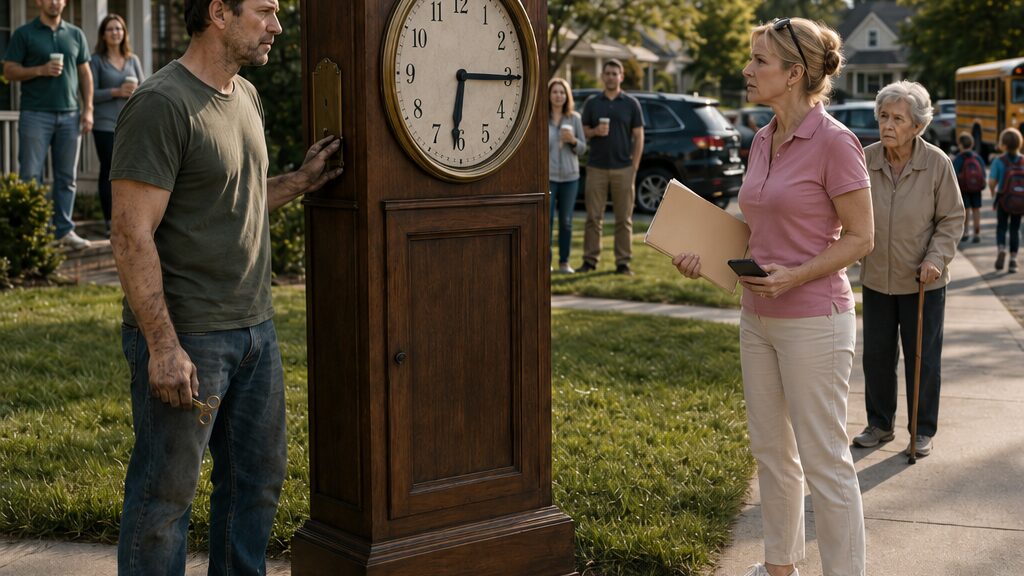
It had arrived before sunrise on a flatbed truck, wrapped in canvas and strapped down like a museum piece. Now it stood on a square stone base near the sidewalk, dark wood polished to a soft brown, brass rim catching the morning sun. It was shaped like an old street clock and a grandfather clock had made an argument and refused to compromise. Its white face was nearly as wide as Jason’s kitchen table. The black hands pointed to 6:15.
Jason heard another car slow.
Then another.
By 7:10, Briarwood Lane had become a line of quiet rolling witnesses.
He kept his socket wrench in his right hand and did not look directly at anyone. That was the trick he had learned in the months after Anna died: if you did not meet people’s eyes, they had less room to offer pity.
A child at the bus stop pointed. One of the parents lowered a coffee mug from his mouth and stared openly. Across the street, a neighbor in a bathrobe stepped onto the porch with a phone in her hand, not raised, but ready.
Jason leaned down and checked the base again.
“Please tell me,” a voice said from the sidewalk, sharp enough to cut through the idling engines, “that this is temporary.”
Jason knew Heather Clark’s voice before he turned around.
She stood at the edge of his driveway in a pink polo, pale pants, and spotless white sneakers that had never met a damp lawn. Her blonde hair was clipped back with a kind of discipline that made the rest of the morning look unprepared. In one hand she held her phone. In the other, she held a thin folder against her ribs like she had been born with board documents under her arm.
“Morning, Heather,” Jason said.
Her eyes moved up the clock, down to the stone base, and back to him. “Jason. What is that?”
He looked over his shoulder, as if there might be more than one answer. “A clock.”
A porch door opened somewhere behind him. Someone coughed to cover a laugh.
Heather’s lips pressed into a line. “I can see it’s a clock.”
“That puts us ahead of schedule.”
Her gaze snapped to him. “This isn’t funny.”
Jason wiped his thumb across a smear of grease on the wrench. “No. It’s not.”
For half a second, something in his voice thinned the air between them. Heather noticed it, but she chose not to follow it. She looked again at the clock, at the base, at the distance between the object and the sidewalk, already measuring it as a violation.
“You cannot keep a giant clock in your front yard,” she said. “It’s completely out of scale with the neighborhood. It’s distracting. It’s not in harmony with the approved exterior standards.”
Jason glanced at the row of nearly identical mailboxes, the trimmed hedges, the beige and gray houses set back from the street like they had all agreed not to raise their voices.
“Briarwood Lane has standards,” Heather continued. “We all agreed to them when we bought here.”
“I remember the packet.”
“Then you remember exterior structures require approval.”
“This isn’t attached to the house.”
“It’s in your front yard.”
“So are the maple tree and the mailbox.”
“The maple tree is not twelve feet tall with a clock face on it.”
“It’s getting there.”
The neighbor with the coffee mug did laugh this time. Heather turned her head just enough for the laugh to die.
Jason should have stopped. He knew that. Anna would have touched the inside of his wrist under the table, the tiny warning that meant, Don’t make it worse just because you can. But Anna was not there, and the clock was, and Heather had chosen an audience before asking one real question.
A yellow school bus groaned to a stop at the corner. The children climbed on slowly, each one stealing another look at the clock. Its hands still held at 6:15, the minute Anna had written down in blue ink three months before the hospital room, before the folded discharge papers, before the casserole dishes and condolence cards lined his counter like proof of a life reduced to logistics.
Heather stepped onto the lawn without asking. “Has this been permitted?”
“It’s on private property.”
“That wasn’t my question.”
“No,” Jason said. “It wasn’t.”
She inhaled through her nose. “I’m asking as the compliance chair.”
“And I’m answering as the person holding the wrench.”
Her face colored. Not much. Just enough. Jason regretted it almost immediately, but regret was useless once it left the mouth dressed as humor.
A pickup slowed beside the curb. The driver leaned across the passenger seat, took in the clock, then Heather, then Jason, and drove on.
Heather saw that too. Her voice lowered. “This kind of thing affects everyone. People work hard to keep this subdivision looking respectable.”
Jason turned back to the base and tightened the final bolt. “Respectable.”
“You know what I mean.”
“I’m never sure people do when they use that word.”
“Jason.” She said his name like a warning. “You may think grief gives you a pass to do whatever you want, but the rest of us still have to live here.”
The wrench slipped in his hand.
For the first time, he looked directly at her.
The street noise seemed to pull away. The bus folded its door shut. A dog barked two houses down. Heather’s eyes flicked toward the neighbors watching from porches and car windows, and Jason understood she knew she had said too much. He also understood she would not take it back in public.
He could have told her then.
He could have said Anna ordered it. He could have said the box arrived after the funeral because shipping had been delayed. He could have said his wife had sat at their kitchen table with catalog pages and sticky notes, planning something that he had once called sweet but impractical. He could have said the clock was not for decoration, not exactly, and not for him alone.
Instead, he set the wrench down on the grass and reached into his pocket for the small brass key.
Heather watched him cross to the clock’s side panel.
“What are you doing?” she asked.
“Winding it.”
“This is not the time.”
He opened the panel. The inside smelled faintly of oil and cedar. Anna would have liked that. She used to say old things should smell like they had survived being useful.
Jason fitted the key and turned.
The mechanism answered with a low, careful click. Then another. Then a thread of ticking moved through the morning, small but stubborn, like a heartbeat heard through a wall.
Heather’s face changed. Not softened. Changed. She had expected anger, maybe embarrassment, maybe surrender. She had not expected him to treat the clock as if it mattered more than being watched.
“You have forty-eight hours,” she said.
Jason closed the panel. “For what?”
“To remove it. Or submit proof of prior written approval, which I’m assuming you don’t have.”
He slid the key back into his pocket. “That sounds official.”
“It is official.”
“Then you’ll want to put it in writing.”
“I intend to.”
He turned toward her, and because he did not trust himself to say anything that would not break open in the wrong place, he smiled.
It was small. Tired. Not kind. Not cruel. Just the smile of a man who had learned that some explanations cost more than people deserved at seven in the morning.
Heather mistook it for mockery. Her shoulders went rigid.
“It keeps better time than most of us,” Jason said.
She stared at him.
Across the street, someone’s phone finally lifted.
Heather opened her folder, pulled out a blank form, then seemed to realize she did not need it yet. Instead, she raised her phone, took two pictures of the clock, and one picture of Jason standing beside it.
“Fine,” she said. “We’ll do it the proper way.”
Jason looked past her, toward the school bus turning out of the neighborhood. For a second, the clock’s face held the reflection of the bus windows, each square of glass catching light and moving on.
Heather began typing with both thumbs.
Jason stayed where he was and listened to the ticking settle into the street.
By the time she walked away, the first complaint had already been filed, and Jason was still winding the clock as if the deadline had not started.
Chapter 2: The Rulebook Had No Page for Grief
The violation notice arrived before Jason finished his coffee.
It came with a soft chime from his laptop, polite and obscene. He was standing at the kitchen counter in yesterday’s jeans, watching the coffeemaker drip too slowly into the pot. The clock outside ticked beyond the front window, steady enough to be heard whenever the refrigerator motor stopped.
Subject: Immediate Compliance Review — Unapproved Exterior Structure.
Jason did not open it right away.
He stared at the sender line instead: Briarwood Lane Homeowners Association. Beneath that, copied in smaller gray letters, were Heather Clark, Robert Hill, and a general board address that made the matter feel larger than the person who had stood on his lawn.
The coffeemaker sputtered.
Jason poured too early. A dark splash hit the counter.
“Nice,” he muttered.
Anna would have handed him a dish towel without looking up from whatever she was reading. She had been patient about messes in a way that made him reckless with them. Now there were no extra hands. Just the towel folded exactly where she had always left it, because he kept washing it and returning it there like routine could impersonate presence.
He clicked the email.
Heather had written it in the tone of someone trying very hard to sound neutral.
Dear Mr. Carter,
It has come to the Board’s attention that a large freestanding clock structure has been installed in the front yard of your property without prior written approval. Per Briarwood Lane HOA exterior standards, all non-landscaping structures visible from the street require review before installation.
The structure must be removed within forty-eight hours unless documentation of approval is provided.
Attached: Photo evidence, exterior standards section, violation response form.
Jason scrolled past the photo.
There he was beside the clock, one hand still near the brass panel, his mouth caught in that small, stupid smile. In the picture, he looked exactly like Heather thought he was: a man pleased with himself for causing trouble.
He opened the attached standards.
The document was twenty-six pages long. Anna had once called it “the neighborhood’s nervous system.” Jason had called it “a ransom note with landscaping preferences.” She had laughed and told him he was impossible before highlighting a paragraph about mailbox paint.
He searched the PDF for “clock.”
Nothing.
“Freestanding structure.”
Three results.
“Decorative feature.”
Seven results.
“Grief.”
Nothing.
He closed the standards and sat down at the kitchen table.
The table still had the faint pale circle where Anna’s plant pot had sat for years. After she died, the plant had gone brown from the edges inward. Jason had thrown it away after a week of pretending it could recover. The circle remained, a soft accusation in the wood.
Near the far end of the table sat the cardboard envelope he had avoided since the delivery driver brought it with the clock’s paperwork. He had opened it only enough to find the invoice. Now he pulled it toward him.
Inside were folded installation instructions, a warranty card, and a receipt with Anna Carter’s name printed above their address.
Order date: February 18.
Delivery window: April 22–May 5.
Anna had died on April 3.
Jason pressed his thumb over the date until the paper bent.
He remembered the night she placed the order. Not clearly at first. Memory had become unreliable since the funeral, either too sharp or uselessly blurred. But then the kitchen returned around him: Anna in a sweatshirt, laptop open, hair pinned badly because she never had patience for doing it properly. The glow of the screen had lit her face from below.
“It’s not for us,” she had said.
“It’s in our yard.”
“Near the sidewalk.”
“That’s a distinction only you would consider meaningful.”
She had turned the laptop toward him. “Look at it. It has character.”
“It has a mortgage.”
“It’s a clock, Jason.”
“It’s a public declaration that we’ve become people who own a giant clock.”
She had laughed then, but not for long.
“You know how many people walk alone in the morning?” she asked.
“Probably because they want to.”
“Some do. Some don’t.”
He had been tired. Tax season was chewing through his evenings, and the sink was full, and he had mistaken her seriousness for one more idea that would pass if he did not feed it too much attention.
“So the clock fixes loneliness?” he had asked.
“No,” she said. “It gives people a place to show up without having to ask for help.”
He had made a face. Not cruel. He had told himself that often. Not cruel. Just dismissive in the ordinary way people are when they assume there will be time later to be better.
Now the clock stood outside, and later had run out.
Jason found the handwritten note tucked behind the warranty card.
Anna’s handwriting slanted upward when she was excited. The note was on a torn piece of yellow legal paper.
6:15, before everyone disappears.
Below that, in smaller writing:
Ask Ruth if Tuesday still feels hard.
Ask the new mother at #18 if she wants company, not advice.
Ask the man with the red leash his dog’s name again.
No clipboard. No sign-up sheet. Just be there.
Jason read it twice before the words stopped behaving like information and became her voice.
He folded the paper carefully and set it beside the invoice. Then he opened a reply to the HOA.
Dear Board,
The clock was ordered by my late wife, Anna Carter, before her passing. It was intended as—
He stopped.
Intended as what?
A memorial? It was not that, not to Anna. She would have hated the word if it made the thing sit still. A community marker? That sounded like something from a grant proposal. A meeting point? For whom? Ruth, apparently. A new mother he had never spoken to. A man with a dog.
He deleted “late wife.”
Then typed it again.
Then deleted the whole sentence.
He could already hear Heather reading it. Not unkindly, maybe. Maybe with embarrassment. Maybe with suspicion. People were strange around grief. They either softened too much or looked for ways to prove you were using it. Jason did not know which would be worse.
His phone buzzed.
A text from an unknown number:
This is Robert Hill with the HOA Board. I’m sorry this has escalated quickly. We’ll need to do a compliance walk-through tomorrow morning. 7:00 a.m. Please confirm you’ll be home.
Jason read it while the laptop cursor blinked in the empty reply box.
Outside, the clock ticked.
He stood, took his coffee, and walked to the front hall.
Anna’s walking shoes were still by the door.
He had moved most of her things into boxes with labels that made him feel like a stranger hired to clean up after a life. Sweaters. Books. Bathroom. Desk. But the shoes had stayed. Gray with pale blue laces, worn at the heels, one lace always coming undone no matter how tightly she tied it.
Beside them sat his own sneakers, newer, hardly used.
He crouched and touched one of Anna’s laces.
“Before everyone disappears,” he said, but quietly, as if she might correct him from the kitchen.
His phone buzzed again.
Mr. Carter? Please confirm.
Jason returned to the table. The HOA email waited, blank and accusing. He typed one sentence.
I will be home.
He sent it to Robert, not the board.
Then he closed the laptop on the unfinished reply to Heather, leaving Anna’s name trapped inside the draft until the screen went dark.
Chapter 3: When the First Walker Came Back Alone
Ruth Baker was standing under the clock at 6:15 as if someone had invited her and forgotten to unlock the door.
Jason saw her through the narrow window beside the front door. At first, she was only a shape in the blue-gray morning, small and upright in a beige windbreaker, one hand resting on the handle of a cane she did not seem to need so much as trust. The streetlights were still on. The houses along Briarwood Lane looked sealed and sleeping.
He had come downstairs early because he did not want Robert Hill to find him unprepared for the walk-through. He had not expected anyone else. Certainly not Ruth, who lived two streets over and had waved to him maybe four times in six years.
She looked up at the clock face.
Its hands pointed to 6:15.
Jason’s first instinct was to step away from the window. That shamed him enough that he opened the door instead.
The cold reached him first. Then the ticking.
“Mrs. Baker?”
Ruth turned. Her face changed when she saw him, but not with surprise. More like disappointment carefully rearranged into manners.
“Jason,” she said. “I’m sorry. I didn’t mean to bother you.”
“You’re not.”
She glanced at the clock. “I thought maybe…” She let the sentence trail off.
He stepped onto the porch. “Maybe what?”
“That she’d told you.”
Anna’s name did not need to be said. It moved between them anyway.
Jason came down the steps slowly. The lawn was damp enough to darken the edges of his sneakers. He had set the brass panel closed the night before, but now the clock seemed more awake than any of the houses around it.
“Told me what?” he asked.
Ruth’s fingers tightened on the cane handle. “About Tuesdays.”
He looked at her, waiting.
She gave a small laugh that did not reach her eyes. “Well, listen to me. It’s Tuesday and I’ve already made it strange.”
“No,” Jason said. “You haven’t.”
She looked past him toward the house. “Anna used to come by at six-fifteen on Tuesdays. Not every day. She had different people on different days, I think. She said if I walked before breakfast, I was less likely to sit down and start remembering things.”
Jason swallowed. “Remembering?”
“My son calls on Sundays,” Ruth said. “He means well. Then Monday I tell myself I’m fine. Tuesday is usually when I stop believing it.”
The clock ticked between them.
Jason did not know where to put his hands. He folded them, unfolded them, then stuck them in his sweatshirt pocket.
“I didn’t know,” he said.
“I know.” Ruth said it gently, which somehow made it worse.
A garage door opened down the street. Light spilled across a driveway. A car started, then idled.
Ruth glanced toward the sound and lowered her voice. “She said there would be a clock eventually. Something people could meet under without making a fuss. I thought she was joking at first.”
“She wasn’t.”
“No.” Ruth looked up at the face again. “She rarely was when people thought she was.”
Jason almost smiled, but it stopped in his throat.
The clock gave a soft internal shift. Not a full chime. Just a preparation of metal, a gathering in the mechanism. He had set it not to ring loudly before eight because he did not want to give Heather another line item. But at 6:15 it released a muted bell, barely more than a note held inside a wooden chest.
Ruth closed her eyes.
Jason looked away.
For a minute, neither of them spoke. The morning had that private quality it held before lawn crews and school buses and garage doors turned the neighborhood back into a schedule. Jason understood, suddenly and with a force that made him feel slow, why Anna had chosen this hour. Before everyone disappeared into cars. Before each house became an island with curtains.
Ruth opened her eyes. “Did she leave you the list?”
Jason turned back. “What list?”
“Oh.” Ruth’s expression shifted. “Maybe I shouldn’t have—”
“What list, Ruth?”
She studied him then, not as the neighbor who had lost his wife, but as a man who might be trusted with something late. “She had names. Not many. People she thought might come if they didn’t have to sign up for anything.”
Jason remembered the note: No clipboard. No sign-up sheet. Just be there.
“I found a note,” he said. “Not a list.”
Ruth nodded slowly. “Then maybe she kept it herself.”
A car rolled past, slower than necessary. Heather Clark sat behind the wheel.
Jason felt Ruth stiffen before he fully registered the car. Heather’s window was half down. Her hair was clipped back, her face bare of the polished board-meeting readiness she wore later in the day. For one fragile second, she looked like someone who had not slept well.
Then she saw Ruth beneath the clock.
Her hand moved.
The phone came up.
Jason stepped forward without thinking. “Heather.”
She lowered the phone only an inch. “Morning, Jason.”
“It’s early.”
“That’s usually when unauthorized structures are easiest to inspect without blocking traffic.”
Ruth’s chin lifted. “I’m not traffic.”
Heather’s eyes moved to her. “Good morning, Mrs. Baker.”
“Good morning.”
Heather looked from Ruth to the clock, then back to Jason. “I hope you understand this doesn’t help your case.”
“What case?”
“Creating a gathering point around a non-approved installation.”
Jason let out one short breath. “She’s standing on a sidewalk.”
“She’s standing under a structure that was placed without approval.”
Ruth’s voice was quiet. “I stood here because Anna said I could.”
Heather’s face changed, but only slightly. Anna’s name had landed somewhere she had not prepared to defend against. Still, her phone stayed in her hand.
“I’m sorry for your loss,” Heather said, to Jason, in the formal tone people used when sympathy had to share space with procedure. “But grief doesn’t exempt property owners from the standards everyone else follows.”
Jason should have answered. He should have said Ruth had come on her own. He should have said Anna had wanted this before sickness took the choice from her. Instead he saw Heather’s phone tilted toward the clock and imagined the photo in another email, Ruth reduced to evidence.
His voice came out too cold. “Do whatever you came to do.”
Ruth looked at him.
Heather did, too.
The words had protected nothing. They had only made him seem harder.
Heather took the photo.
A front door opened nearby. Someone collected a newspaper from the driveway and paused too long. The morning was waking around them, and the private hour Anna had tried to make safe was already becoming public.
Heather drove on after a moment, her car disappearing around the curve toward the clubhouse.
Ruth remained under the clock, but something had gone out of her posture.
“I’m sorry,” Jason said.
“For what?”
“For making that worse.”
She gave him a look so direct he felt twelve years old. “You didn’t make her take the picture.”
“No. I made it easy.”
Ruth considered that. Then she reached into the pocket of her windbreaker and pulled out a folded square of paper, softened along the creases. “Anna gave this to me when she started getting tired. She said if she forgot to call, I should keep walking anyway.”
Jason did not move.
Ruth held the paper out.
“I thought it was only mine,” she said. “But after seeing the clock, I think maybe she wanted you to find the rest.”
He took it carefully.
The paper was lined, torn from a small notebook. Anna’s handwriting filled both sides. At the top was Ruth — Tuesday, 6:15. Beside it, in parentheses, Anna had written, don’t let her walk alone.
Below that were other notes. House numbers. Descriptions instead of names. New mom, #18. Red leash. Retired teacher with blue mailbox. Man who sits in garage before sunrise. A few lines were crossed out. A few had question marks.
Jason’s throat tightened until he could barely breathe.
Ruth tapped one of the crossed-out lines. “I don’t know what all of those mean.”
Jason stared at the list.
For the first time since the clock arrived, it felt heavier than wood, brass, and stone. It felt like Anna had left him a map of the neighborhood he had been living in without seeing.
At the far end of the street, another garage door opened.
Ruth looked toward it, then back at him. “Who else was she expecting, Jason?”
Chapter 4: The Board Meeting Became a Public Test
Jason walked into the HOA clubhouse Wednesday evening and found the clock already there before him.
Not the clock itself. A photo of it filled the far wall, blown up by a projector until the brass rim looked garish and the wooden body seemed taller than his house. In the picture, the morning light made every surface shine. Ruth stood beneath it, small in her beige windbreaker, one hand on her cane. Jason was half visible at the edge of the frame, turned toward Heather’s car with his jaw set.
Someone had enlarged the image enough that Ruth looked like evidence.
Jason stopped just inside the door.
A few heads turned. Folding chairs had been arranged in rows facing a long table where the board members sat with paper cups, laptops, and expressions of tired importance. The room smelled of carpet cleaner and burnt coffee. A laminated sign near the door reminded residents to sign in before speaking.
Heather Clark stood beside the projector screen in a white blazer over a dark top, her hair clipped back, a pen in one hand. She looked more formal than she had on his lawn, more careful. That made her harder to dismiss.
Robert Hill sat at the table with a binder open in front of him. When he saw Jason, he gave a small nod that was not quite greeting and not quite apology.
Jason signed his name on the clipboard near the door.
Under “Reason for attendance,” someone had already written: exterior structure violation.
He took a chair in the second row. Ruth sat at the aisle end in the first row, her cane tucked beside her knee. She did not turn around, but when Jason sat, one of her hands moved to the empty chair beside her as if she had been saving him a place and had decided not to make a scene of it.
Heather tapped the pen against her folder. “All right. We’ll move to item four. Unapproved exterior installation at 214 Briarwood Lane.”
Jason looked at the projected photo again. On a screen, the clock seemed less like a thing Anna had chosen and more like something accused.
Heather cleared her throat. “As you can see, the structure is highly visible from the street. It was installed without prior architectural review, without written approval, and without confirmation from the county regarding setbacks or safety.”
A board member murmured, “Has the county said anything?”
“Not yet,” Heather said. “But that is part of the concern. The HOA standards exist so residents don’t put the board in a position of reacting after the fact.”
Jason waited for the anger to come. It did not. What came instead was a flat heaviness, the kind he felt when he opened a box and found something of Anna’s he had forgotten keeping.
Heather clicked to the next slide.
Another photo appeared. This one had been taken from down the street. The clock stood near the sidewalk with houses behind it, every roofline and garage door making its height more obvious. A neighbor in the back row whispered, “See? That’s what I mean.”
Heather glanced toward the sound. “Would you like to speak?”
The neighbor shifted but stood. He was a man Jason recognized only by his lawn equipment and the flag bracket by his garage. “I’m not trying to be insensitive,” he began, which was how people in Briarwood often prepared to be exactly that. “But it makes the street look like a theme park. Or like one of those roadside attractions. We all paid a lot to live somewhere that doesn’t look random.”
A few people nodded.
Jason felt Ruth’s shoulders tighten.
Heather did not smile, but Jason saw relief in the way she wrote something down. She had wanted someone else to say it first.
Another resident raised a hand. “What happens when other people want big things in their yards? A statue? A fountain? A sign? Then we’re stuck.”
“That is precisely the issue,” Heather said. “Precedent.”
The word landed cleanly. Jason had always hated words people used to make fear sound intelligent.
Robert adjusted his glasses. “Mr. Carter, you’ll have a chance to respond.”
Jason stood before he had decided what to say.
The room shifted. Chairs creaked. Heather looked at him with professional patience.
He could feel the folded list in his jacket pocket. Ruth. Tuesday. Don’t let her walk alone. New mother. Red leash. Blue mailbox. He had carried it all day like a living thing.
“My wife ordered the clock,” he said.
A few faces changed.
Heather looked down at her folder. Robert’s pen stopped moving.
Jason heard the next sentence waiting behind that one. She ordered it before she died. She wanted people to meet there. It wasn’t a stunt. It wasn’t mine first. It was hers, and I was too proud to understand it while she was alive.
He could not push the words out in that room, not with the projector light washing Anna’s absence into a violation case.
So he said, “Delivery was delayed.”
Heather’s voice softened by one measured degree. “Jason, I am sorry. Truly. But the question tonight is not who ordered it. The question is whether it complies.”
Ruth turned her head then. “Sometimes who ordered a thing matters.”
Heather’s jaw tightened. “Mrs. Baker, you’re not on the agenda.”
“She’s in your photo,” Jason said.
Heather looked at him.
The room became still.
Robert leaned forward. “Let’s keep this orderly.”
Heather clicked off the projected image of Ruth. The screen went blue.
Jason regretted the line as soon as the screen changed. He had not defended Ruth; he had exposed Heather in a way that made the room choose sides. The old habit again. Dryness as a weapon. Silence until it sharpened into something worse.
Heather placed the remote on the table. “I understand this is emotional. But the board cannot make decisions based on individual grief, personal taste, or informal use. The standards are what keep neighbor disputes from becoming personal.”
There was strain in her voice now. Not theatrical. Real.
Robert turned a page in his binder. “For context, last year we had the shed dispute on Marigold Court. The board delayed enforcement, and it became an issue between three households. Two legal letters. One resident moved. That’s part of why the current process is stricter.”
Heather’s eyes stayed on the table.
Jason remembered that dispute vaguely. A shed too close to a fence. Anonymous letters. Someone’s security camera pointed over someone else’s gate. Anna had called it “a failure of people to knock on doors.”
Robert continued. “The structure at 214 is not specifically named in the rules. That doesn’t mean it is allowed. It means the board has to determine category and impact.”
Jason sat down slowly.
For the first time that evening, Heather did not look like a woman enjoying authority. She looked like someone bracing against a mistake she could already hear being blamed on her.
A board member asked, “Can it be moved to the rear yard?”
Heather said, “That would resolve the visibility issue.”
Robert looked at Jason. “Would you consider placing it behind a fence? You could keep the clock. It just wouldn’t affect the streetscape.”
The offer moved through the room with surprising ease. Heads nodded. The neighbor who had mentioned the theme park looked satisfied. Even Heather’s shoulders lowered slightly, as if a solution had appeared that let everyone leave with their faces intact.
Jason looked at Ruth.
She was staring at the blank blue screen.
Behind a fence, the clock would be safe. No one would photograph it. No one would file notices. No one would accuse him of turning grief into a loophole. He could keep Anna’s clock and lose the argument quietly.
It almost sounded like mercy.
“I’ll think about it,” Jason said.
Heather exhaled. Robert wrote something down.
The board voted to issue conditional removal: forty-eight hours to move the clock out of front-yard visibility, or it would proceed to enforcement review. The wording was clean. The decision was practical. People began gathering bags before the final sentence had finished.
Jason stepped into the aisle. Ruth stood slowly beside him.
“I’m sorry,” he said, unsure whether he meant for the meeting, the photo, the compromise, or all the years he had not known where Anna went at 6:15.
Ruth adjusted her grip on the cane. “You have nothing to apologize to me for.”
“That’s generous.”
“It isn’t.” She looked toward Heather, who was collecting folders at the front table while a board member spoke too close to her ear. “It’s accurate.”
Jason folded the meeting packet in half.
Behind a fence.
It would have been so easy to call the delivery company. So easy to make the clock private. So easy to tell himself Anna would understand.
Ruth touched his sleeve.
“Jason,” she said quietly.
He turned.
Her face was tired, but her voice was steady. “Anna didn’t put it behind a fence.”
Then she walked toward the exit, leaving him in the aisle with the folded packet in his hand and the first clear choice he had not wanted to make.
Chapter 5: The Names on Anna’s Morning List
Jason opened Anna’s list at 4:52 Thursday morning and saw that beside Ruth’s name she had written, don’t let her walk alone.
He had read the line before. He had carried it through the board meeting and felt it burn in his pocket when the word “streetscape” made people nod. But before dawn, with the house dark and the clock outside ticking faintly through the front window, the words no longer looked like a note.
They looked like an instruction he had already failed.
He spread the paper on the kitchen table beneath the overhead light. Anna’s handwriting crowded the page in a way that made him ache. She had never respected margins when she cared about something.
Ruth — Tuesday, 6:15. Don’t let her walk alone.
18 — baby up all night? Ask if she wants quiet company. Do not give advice.
Red leash man — dog’s name? Ask again. He smiled when you asked.
Blue mailbox — retired teacher, maybe. Keeps curtains closed until trash day.
Garage man — sunrise coffee, never waves first. Try three times, not two.
At the bottom, written darker, as if Anna had pressed harder:
No pity. No fixing. Just show up.
Jason sat back.
The clock ticked in the yard, each second nudging the house toward morning.
He had almost accepted the fence. Last night, standing in the clubhouse parking lot, he had taken out his phone and searched for moving crews. He had found the same delivery company that installed the clock and stared at their contact form until his thumb hovered over the screen.
Then he imagined Anna’s face if he said, Good news, I saved your clock by hiding it where no one can meet under it.
He had put the phone away.
Now, in the front hall, Anna’s walking shoes sat by the door with their pale blue laces untied. Jason crouched and touched the nearest one.
“I don’t know how you did this,” he said.
The house gave no answer.
He put on his own sneakers.
At 5:18, he left the house with Anna’s folded list in one pocket and three blank envelopes in the other. He did not know what he intended to do, which was dangerous. Most of his worst decisions began with silence and a vague sense of righteousness.
The neighborhood was dark except for porch lights and the weak glow of kitchen windows. Without cars moving, Briarwood Lane seemed less like a subdivision and more like a stage set waiting for people to remember their lines.
He started with #18.
A plastic tricycle lay tipped on its side near the garage. A delivery box sat by the door, damp at the corners. Jason stood on the walkway longer than he should have, feeling absurd. He had never spoken to the woman who lived there beyond a nod at the mailbox.
He almost turned back.
Then a light came on behind the front window.
A baby cried.
The sound broke something in him, not dramatically, just enough to move his feet. He stepped back from the door and took one of the blank envelopes from his pocket. On a small card, he wrote:
6:15 at the clock if you want a walk. No talking required.
He did not sign it.
Then he stopped, crossed out the last line, and wrote:
Jason Carter, #214.
He slid the card under the edge of the doormat.
When he turned, someone was standing at the curb.
A man in a baseball cap held a red leash. At the end of it, an old brown dog sniffed a mailbox post with great seriousness.
Jason froze.
The man looked at him. Not alarmed. Not friendly. Just present.
“Morning,” Jason said.
The man nodded.
The dog looked up and thumped its tail once.
Jason’s fingers brushed the list in his pocket. Dog’s name? Ask again.
He cleared his throat. “What’s his name?”
The man glanced down at the dog as if confirming the animal had authorized disclosure. “Buddy.”
Jason nodded. “Anna asked me once and I forgot.”
At Anna’s name, the man’s expression shifted. He looked toward Jason’s house, though from there the clock was hidden by the curve.
“She remembered,” the man said.
Jason waited.
The man rubbed the leash between both hands. “My wife died two years ago. Everybody brought food the first week. Anna was the only person who asked if I still knew how to walk without somewhere to go.”
Jason looked at the dog, because looking at the man felt like trespassing.
“She walked with you?”
“Twice a week for a while. Then less, when she got tired.” He swallowed. “She said there’d be a clock. Said then nobody would need to knock.”
Jason felt the list fold against his leg in the pocket.
“I didn’t know,” he said.
The man gave a small, humorless smile. “Most of us didn’t know about each other either. That was kind of the point.”
A porch light snapped on across the street. Both men looked toward it, trained by suburban instinct to notice observation.
Jason reached into his pocket and pulled out another card. “I’m putting these out. For tomorrow. Six-fifteen.”
The man took it, read it, and turned it over though there was nothing on the back.
“Is this about the HOA?” he asked.
“No.” Jason hesitated. “Maybe. I don’t want it to be.”
The man slipped the card into his jacket pocket. “Things become about them when they decide they are.”
He walked on with Buddy, leaving Jason with that sentence in the middle of the street.
The retired teacher with the blue mailbox lived on a quiet bend where the houses were larger and the lawns wider. Jason had never noticed the mailbox was blue. Not truly. It was a soft, weathered blue, not the approved black most of the neighborhood had. A small rebellion so modest no one had bothered to crush it.
The curtains were closed.
Jason stood there with the third card and thought of all the times Anna had returned from walks flushed with cold, saying things like, People will tell you the truth if your shoes are moving.
He had answered emails while she talked. He had nodded at the wrong places. He had thought her morning routes were exercise.
He placed the card beneath the mailbox flag.
As he stepped back, the front door opened a hand’s width.
An older woman’s voice said, “She told you?”
Jason turned.
The woman remained partly hidden behind the door, robe pulled tight at her throat.
“Not enough,” Jason said.
The door opened another inch.
“She never made me feel watched,” the woman said. “That’s harder than it sounds in a place like this.”
Jason looked down at the driveway. “I’m sorry.”
“For what?”
He almost gave the ordinary answer. Your loss. The trouble. The clock. Everything.
Instead he said, “For thinking she was just taking walks.”
The woman studied him through the crack. “Maybe that’s all she wanted you to think until you were ready to know different.”
It was the kind of kindness that did not absolve him. He appreciated that more than absolution.
By the time Jason returned home, the sky was beginning to pale behind the roofs. The clock stood in his yard with its hands moving toward 6:15, no longer strange to him and somehow stranger because of that.
A white pickup truck was parked near the clubhouse when he passed the corner. Two men stood beside it, one holding a measuring tape, the other looking down at a clipboard. Heather’s car was next to them.
Jason stopped on the sidewalk.
Heather stood near the clubhouse entrance in a gray sweater and dark pants, arms folded against the cold. She was speaking to Robert Hill, who had one hand pressed to his forehead as if the morning had started with a headache. Heather saw Jason before Robert did.
Her mouth tightened.
Jason knew then that the forty-eight hours had become less flexible than the word “conditional” had suggested.
He walked the rest of the way home without approaching them.
Inside, he found the last three blank cards in the drawer where Anna had kept stamps, rubber bands, and half-used birthday candles. His hand shook when he wrote the next invitation, so he slowed down until each letter looked deliberate.
6:15 at the clock if you want a walk.
No talking required.
Jason Carter, #214.
He wrote two more.
Then he crossed out no talking required on all three and replaced it with:
No sign-up sheet.
That felt closer to Anna.
He waited until the street was empty again, then slipped the invitations under three doors.
At his own front porch, he turned back toward the clock. The hands were nearly at 6:15. In another twenty-four hours, Heather might arrive with the board’s authority and a contractor’s measuring tape, and Jason would have either neighbors beside him or an oversized object everyone could still call ridiculous.
He placed his palm against the clock’s wooden side.
“Tomorrow,” he said.
The clock ticked beneath his hand, and for once it did not sound like time running out. It sounded like someone approaching.
Chapter 6: At 6:15, the Sidewalk Filled Anyway
Jason opened the front door Friday morning expecting silence and found six neighbors standing beneath the clock.
For a moment, he stayed in the doorway with one hand on the knob, unable to step forward. The porch light behind him threw his shadow across the steps. Beyond it, the lawn was dim and blue, the clock face pale above the small group gathered near the sidewalk.
Ruth was there in her beige windbreaker, cane hooked over one arm. The man with the red leash stood beside Buddy, who had settled at the clock’s base like he had appointed himself keeper of the hour. The older woman from the blue mailbox wore walking shoes and a coat too light for the cold. A young woman Jason recognized from #18 held a baby monitor in one hand and a travel mug in the other, her hair tucked hastily under a knit cap. Two other neighbors lingered near the curb, not quite joining, not quite leaving.
No one spoke when Jason came down the porch steps.
The clock’s hands pointed to 6:13.
Jason felt the folded list in his pocket, but he did not take it out. Something about the group made paper feel inadequate.
Ruth looked at him. “We weren’t sure if we should knock.”
“Anna would’ve said no,” Jason said.
The young woman from #18 gave a tired smile. “She did. Once. She said if people knock too early, everybody feels like they have to clean the kitchen first.”
A small laugh moved through the group, quiet but real.
Jason looked at her more closely. “You knew Anna?”
“She walked past when I was sitting on the porch at five in the morning with the baby. I thought she was going to give advice.” The woman lifted her mug. “She gave me coffee instead.”
Jason turned toward the clock before his face could betray him.
The hands moved.
6:14.
The red-leash man nodded toward Jason’s porch. “She said there’d be a clock so nobody had to be brave first.”
Ruth took a breath that trembled but did not break. “Looks like it worked.”
Jason almost said, It’s not approved. He almost said, They may still make me move it. He almost said all the practical things that had kept him useful and useless in equal measure.
Instead, he said, “It’s a minute fast.”
Ruth looked up. “No, it isn’t.”
The group went quiet.
At 6:15, the clock gave its soft muted chime.
The note was not loud enough to wake the houses. It was not grand. It did not announce anything to the world. It simply entered the morning and held there, warm metal inside cold air.
The older woman from the blue mailbox lowered her eyes.
The young woman wiped at her cheek with the heel of her hand and pretended to adjust her hat.
Jason looked down at the grass.
For the first time since Anna died, the silence around her name did not feel empty. It felt occupied.
They had taken only three steps toward the sidewalk when headlights turned into the lane.
Heather’s car came first. Behind it, Robert Hill’s sedan. Then the white pickup Jason had seen near the clubhouse, with two workers inside and a contractor’s logo printed on the door. The truck stopped across from Jason’s house. One worker got out with a measuring tape clipped to his belt.
The walking group stopped too.
Jason heard Ruth’s cane touch the pavement.
Heather stepped from her car wearing a navy jacket and holding her phone, a folder, and the controlled expression of someone who had rehearsed the morning in a version where there were fewer witnesses. Robert got out more slowly, carrying his binder.
Heather took in the group.
Her gaze moved from Ruth to the young woman, to the man with the red leash, to Buddy at the base of the clock, then to Jason. Her confusion lasted less than a second before she turned it into suspicion.
“Jason,” she said. “What is this?”
“Six-fifteen,” he said.
Robert looked at the clock, then at his watch.
Heather’s eyes narrowed. “You invited people here.”
“Yes.”
The word surprised him. Not because it was untrue, but because he did not soften it.
Ruth stepped forward. “Some of us were invited before.”
Heather’s hand tightened around the folder. “Mrs. Baker, I understand you were fond of Anna. That doesn’t change the compliance issue.”
“No,” Ruth said. “But it may change whether you understand what you’re looking at.”
One of the workers shifted beside the truck. The measuring tape knocked against his belt with a small metallic click. The sound made Jason’s whole body tense.
Heather heard it too and seemed to remember why she had come. She opened the folder. “The board issued conditional removal or relocation. The structure remains visible. We’re here to document dimensions and determine next enforcement steps.”
The young woman from #18 hugged her travel mug against her chest. “You’re removing it now?”
“No,” Robert said quickly. “Not removing. Measuring. Reviewing.”
Heather shot him a look.
Robert adjusted his glasses. “That’s accurate.”
Jason looked at the contractor, then at the clock. He imagined straps around its body, men calling out angles, the base loosened, the clock lifted away from the one place Anna had imagined people might stand without having to ask.
“Can we not do this in front of them?” Heather said to Jason, lowering her voice but not enough.
He stared at her. “You came in front of them.”
A faint flush touched her neck.
“That was before you staged a gathering,” she said.
The words landed badly. Jason saw it in every face around the clock. The young woman looked down. The red-leash man stepped back as if he had been caught somewhere he did not belong. Ruth’s mouth tightened.
Jason had an old reflex: keep the wound private, keep the room orderly, say less so no one could use more against you. He felt it rise like a hand over his throat.
Then he looked at Anna’s clock and understood that his silence had already been used against everyone standing there.
“This wasn’t staged,” he said.
Heather gave a short breath. “Jason.”
“No. You don’t get to make them props because that’s easier to argue with.”
Robert looked at him more closely.
Jason reached into his pocket and pulled out Anna’s list. He did not unfold it.
“My wife’s name was Anna,” he said.
The group went still. Even Heather’s folder lowered an inch.
“She ordered this clock before she died. Not as a memorial. Not because she wanted a decoration. She wanted a place people could meet in the morning without having to call it a group, or a program, or charity, or whatever word makes people stay home.”
His voice held. Barely.
Jason looked at Ruth, then at the others. “She knew things I didn’t. She knew who walked alone. She knew who needed quiet company. She knew who wouldn’t ask.”
The young woman from #18 looked away, jaw tight.
Jason forced himself to face Heather again. “I didn’t invite them to dodge the rules. I invited them because I finally read what she left.”
Heather’s expression had changed. Not surrendered. Not soft. But the certainty had cracked enough for something else to show through.
Robert stepped toward the clock and looked at its base, then at the sidewalk, then at the gathered neighbors. “Heather,” he said quietly, “we may have classified this too narrowly.”
She turned on him. “Robert, it is a freestanding structure.”
“It may also function as a community meeting marker.”
“That category doesn’t exist in the standards.”
“No,” he said. “But common-use features do exist in the bylaws. Benches, entry signage, approved shared landscaping.”
“This is in his yard.”
“Near the sidewalk,” Jason said.
Heather looked at him, and for once he heard Anna’s old distinction return through his own mouth.
The worker by the truck cleared his throat. “Do you still want measurements?”
Nobody answered.
Buddy sat down heavily at the base of the clock and leaned against the wood.
Ruth looked at the dog, then at Jason, and a small laugh escaped her before she pressed her fingers to her mouth.
The sound eased the group by a fraction.
Heather closed her folder. “This is not something I can approve on the sidewalk.”
“I’m not asking you to,” Jason said.
“You’re asking the board to ignore its own process.”
“No,” he said. “I’m asking you to see who the process is about.”
That struck harder than he intended. Heather looked toward the houses, where curtains had shifted and porch lights glowed. For a second, she seemed less like the compliance chair and more like a woman suddenly aware that everyone would have an opinion no matter what she did next.
Robert placed his binder under one arm. “We pause enforcement,” he said.
Heather looked at him sharply.
“We pause,” he repeated, voice still cautious but firmer. “We document the use, review the bylaws, and bring it back to the board Monday. If we remove first and discover a community-use argument later, we create a bigger problem.”
Heather’s mouth opened, then closed.
Jason knew enough about her to understand that Robert had given her a path that was not defeat, but it still required stepping back in public. That was not easy for anyone in Briarwood Lane. Maybe it was especially hard for her.
The contractor stood waiting.
Heather turned to him. “No removal activity today.”
“Just measurements?”
She hesitated.
Robert said, “From the sidewalk only.”
Heather nodded once. “From the sidewalk.”
The group around the clock did not cheer. No one clapped. The older woman from the blue mailbox simply exhaled. The young woman took a sip from her mug with both hands. The man with the red leash looked at Buddy and whispered, “Come on,” though the dog did not move.
Ruth stepped beside Jason. “We should walk before everyone loses their nerve.”
Jason almost laughed.
The clock ticked above them, indifferent to procedure.
Heather watched as Ruth took the first step down the sidewalk. The others followed slowly, awkwardly, like people remembering how to join a line. Jason stayed back for half a breath, because part of him still believed the clock needed guarding.
Then Ruth looked over her shoulder.
He stepped off the grass and joined them.
Behind him, Robert stood with Heather near the curb, both of them looking at the clock as if it had changed categories while they were watching.
Jason heard Robert say, “We’ll need to put this on Monday’s agenda.”
Heather did not answer immediately.
When she did, her voice was low, but Jason heard it.
“Then we’d better get the category right.”
Chapter 7: The Vote Was Not the Apology
The Monday agenda did not say violation anymore.
Jason stood in the back of the HOA clubhouse with the folded paper in his hand and read the fourth item twice, because the change was so small it almost looked accidental.
214 Briarwood Lane — unauthorized structure / possible community marker.
Possible.
That single word had done something to the room before the meeting even started. People who had come expecting enforcement now whispered like they had walked into a hearing where the verdict had gone missing. The photo of the clock was still projected on the wall, but this time it was not the close-up of Ruth beneath it. It was a wider shot from Friday morning: the clock, the sidewalk, six neighbors gathered at 6:15, Buddy planted at the base with his nose down as if he had found the most important smell in the subdivision.
Jason had not known Robert had taken that picture.
He looked toward the board table. Robert Hill was arranging papers into three piles, his movements careful and tight. Heather Clark sat two chairs away from him in a gray blazer, not white this time, with no folder pressed dramatically to her side. She had a stack of documents in front of her and a pen aligned beside them. Her hair was clipped back, but not as sharply as usual.
Ruth sat in the first row. The red-leash man stood near the side wall because Buddy was not allowed in the clubhouse. The young woman from #18 had not come; Jason had seen her porch light on when he passed and imagined her choosing sleep over subdivision procedure. He was glad for her.
The board chair called the meeting to order with the weary voice of someone who had learned that residents could turn mailbox colors into moral crises.
When item four came up, Jason’s throat tightened.
Robert spoke first. “Since our last meeting, we reviewed the exterior standards and the common-use provisions in the bylaws. The issue is not as straightforward as the initial violation notice suggested.”
Heather’s face stayed still.
A board member leaned toward his microphone. “Because it’s on private property?”
“Because it is on private property but being used as a neighborhood meeting point,” Robert said. “The bylaws do allow board-approved common-use features if maintenance, access, liability, and aesthetic impact are addressed.”
“The bylaws mean benches and entry signs,” another board member said.
“They don’t say only benches and entry signs.”
Heather picked up her pen. “They also don’t say twelve-foot clocks.”
A few people laughed softly, not unkindly.
Jason watched Heather. Her line could have been mocking, but it was not delivered that way. It was tired. Almost practical. A person pointing at the obvious problem because someone had to.
Robert nodded. “Correct. Which is why we drafted a conditional classification rather than pretending it already fits.”
The board chair looked over his glasses. “Heather, you asked for time before this meeting. Do you want to summarize your concerns?”
Heather’s fingers tightened on the pen. For a second, Jason thought she might refuse, but she straightened one page in front of her.
“My concerns are the same as before,” she said. “Visibility, precedent, maintenance, and enforcement consistency. If the board approves this, we need to be clear that it does not open the door for every resident to place large personal items in front yards and call them community features.”
She looked up then, not at Jason but at the room.
“Last year, we mishandled the Marigold Court shed issue,” she continued. “The board waited too long, avoided hard conversations, and let neighbors turn on each other. I was asked afterward why compliance didn’t intervene sooner. I’ve been trying not to repeat that.”
The room went quiet in a different way.
Jason had thought of Heather as someone who liked rules because rules gave her height. Now he saw something else, not better exactly, but more human: a woman standing inside the memory of being blamed for a mess she had not created alone, determined never to look weak in a folding-chair room again.
Heather turned a page. “That said, the situation at 214 has facts that were not clear at the time of the initial complaint.”
Not clear, Jason thought. Not missed. Not ignored. But it was the closest thing to an opening she could give without stepping out of herself entirely.
The board chair nodded toward Jason. “Mr. Carter, you may speak.”
Jason stood.
The paper in his hand was not Anna’s list. He had left that at home. He had brought the original delivery receipt instead, the one with Anna’s name printed at the top. He had folded and unfolded it so many times the crease had softened.
He walked to the small podium. The microphone made a low thump when he touched it.
“I’m not asking you to approve a memorial,” he said.
Heather’s pen stopped.
Jason looked at the photo on the wall. In it, he stood at the edge of the group, not quite part of it yet.
“My wife ordered the clock. Most of you know that now. Some of you knew her. Some of you didn’t.” He took a breath. “She didn’t order it so people would feel sorry for me. She ordered it because she thought this neighborhood had people who needed a way to show up without having to explain why.”
Ruth looked down at her hands.
Jason kept going before his nerve could close. “I was late understanding that. I thought it was too big. Too strange. I thought people would stare. I was right about that part.”
A few small smiles appeared. Even Robert’s mouth moved.
“But on Friday, people came,” Jason said. “Not because I wanted to make a point at the board. They came because Anna had already made the point before any of us were arguing about categories.”
He placed the delivery receipt on the podium.
“I will maintain the clock. I’ll pay for repairs. I’ll add whatever safety inspection you require. If the board wants a written access agreement for the walking group, I’ll sign it.” He looked toward Heather then, because this part mattered. “But I don’t want to own what happens under it. If it stays, it should be open to anyone in Briarwood who wants to stand there at six-fifteen and walk.”
The board chair leaned back.
Heather looked down at her papers.
One board member asked, “Who manages the group?”
Jason shook his head. “No one.”
“That creates problems.”
“It creates fewer than you’d think,” Ruth said from the front row.
The board chair looked at her. “Mrs. Baker, if you’d like to speak—”
“I don’t want to manage anything either,” Ruth said. “That was the beauty of it.”
A murmur passed through the room.
Heather lifted her head. “Someone has to be responsible if the clock stays.”
“I’ll be responsible for the clock,” Jason said. “Not for people deciding to walk.”
Heather studied him. “Maintenance?”
“Yes.”
“Insurance?”
“If needed.”
“Lighting?”
“No extra lighting.”
“Sound?”
“The chime is muted before eight. I can put that in writing.”
“And if residents complain about noise, crowding, or parking?”
Jason almost answered too fast. He stopped himself.
This was not an attack. Not only that. It was Heather building a bridge out of requirements, because requirements were the only material she trusted.
“Then the board reviews it,” he said. “Publicly. Not by sidewalk photo.”
That landed.
Heather looked at him for a long moment. Then she gave one small nod, not apology, not agreement, but acknowledgment of a boundary she had crossed.
Robert distributed a single-page proposal. The clock would be conditionally approved as a neighborhood common-use marker for a ninety-day trial. Jason would maintain it. No signage. No amplified sound. No events. The walking group would remain informal and open to all residents. The board would review complaints only if submitted with specific dates and impacts, not general dislike.
“Not general dislike,” Ruth whispered, and Jason heard the smile in it.
The vote was not unanimous.
One board member voted no because “a clock today could be a lighthouse tomorrow.” Another abstained with the solemnity of a judge. Robert voted yes. The board chair voted yes.
Heather was last.
She stared at the proposal for so long Jason felt the room lean toward her.
Then she said, “Yes, with the maintenance condition clearly recorded.”
No one clapped. It was better that way.
After the meeting, people gathered in small groups, already turning the decision into versions they could carry home. Jason stayed near the wall, waiting for the room to thin.
Heather approached him with the final form.
“Sign here,” she said.
Her tone was businesslike, but quieter.
Jason took the pen. The page listed the clock as a conditional common-use marker. Beneath the signature line, Robert had attached a copy of Anna’s original delivery receipt to support the timeline.
Anna Carter.
Jason paused with the pen above the paper.
Heather noticed. “Robert thought it belonged in the record.”
“It does.”
He signed his name below the maintenance agreement.
For a moment, neither of them moved.
Heather tucked the form into her folder. “I still think it’s too large.”
Jason looked at her.
She met his eyes. “I also think I handled the first morning badly.”
It was not an apology in the way people liked them online. There was no performance, no dramatic surrender, no warm confession. But it cost her something. Jason could see that.
“So did I,” he said.
Heather looked surprised.
“I could’ve explained sooner,” he said.
“You shouldn’t have had to explain your wife on the lawn.”
“No,” Jason said. “But I also shouldn’t have used silence like a locked door.”
Heather closed the folder against her chest. Behind her, Robert turned off the projector, and the photo of the clock vanished from the wall.
When Jason stepped outside, the evening air was cool and smelled faintly of cut grass from the clubhouse lawn. Ruth was waiting near the sidewalk.
“Well?” she asked.
“It stays,” Jason said.
Ruth nodded once, as if she had expected nothing less, but her hand trembled on the cane.
Jason looked down at the signed copy in his hand. Anna’s delivery receipt sat beneath it, visible through the thin paper, her name aligned under his like two times printed on the same face.
The clock could stay now. That was the victory.
But as he walked home with Ruth beside him, Jason understood the condition he had not said aloud in the meeting: if the clock belonged to everyone at 6:15, then it could no longer belong only to Anna and him.
At his kitchen table, under the soft yellow light, he placed the signed maintenance form directly beneath Anna’s original receipt and left both there, touching.
Chapter 8: The Morning Bell No Longer Belonged to One House
At 6:14, Jason reached for Anna’s shoes.
His hand was halfway to the pale blue laces before he realized what he was doing. The shoes sat by the front door exactly where they had sat for months, gray fabric softened at the toes, one lace twisted under the tongue. They looked ready in the cruel way empty shoes could look ready.
Outside, the clock waited in the dark.
Jason stood still, fingers curled in the air, and listened to the faint ticking through the front wall.
Two weeks had passed since the vote. The clock had survived its first complaint, its first inspection, its first neighborhood email thread with too many exclamation points. Robert had dropped off a laminated maintenance schedule Jason had not asked for but appreciated more than he admitted. Ruth had corrected the walking route twice. Buddy had decided the clock base was the official place to sit, whether or not anyone agreed.
Jason had watched from the porch most mornings.
He told himself that was enough. He wound the clock. He kept the chime muted. He checked the base after rain. He smiled when people gathered, nodded when they passed, and went back inside before the group returned.
That was stewardship, he told himself.
That was not hiding, he told himself.
At 6:15, the clock gave its soft bell.
Jason’s hand dropped from Anna’s shoes.
“No,” he said quietly.
He took his own sneakers from the mat.
The laces resisted him because he pulled too tightly. He loosened them, tied them again, and opened the door before he could change his mind.
The morning was cold enough to make him inhale sharply. Under the clock, the group had already gathered: Ruth with her cane, the red-leash man with Buddy, the older woman from the blue mailbox, the young woman from #18 without the baby monitor this time, two neighbors Jason still knew mostly by house number, and a man in a work jacket who stood slightly apart pretending to check his phone.
The clock’s face glowed softly from the streetlight. Its hands had moved past 6:15.
Ruth saw Jason on the porch and did not wave. She simply shifted half a step, making room beside her as if the place had always been there.
Jason came down the steps.
No one made a big thing of it. That helped. The red-leash man said, “Morning.” The young woman lifted her coffee in greeting. Buddy sniffed Jason’s shoe and apparently found him acceptable.
Jason took his place near Ruth.
“Your first official walk?” she asked.
“I maintain the equipment,” he said. “I don’t know about official.”
“Anna would’ve rolled her eyes at that.”
“She rolled her eyes at most of my best material.”
Ruth smiled but did not press.
They were about to start when a car slowed near the curb.
Every head turned with the practiced caution of people still learning whether a quiet thing would be allowed to stay quiet.
Heather Clark parked in front of Jason’s house and turned off the engine.
She sat there for a moment with both hands on the steering wheel. No clipboard. No folder. No phone raised toward the clock. She wore a dark sweatshirt and walking shoes so new they reflected the porch light. Her hair was pulled back, but not clipped into its usual board-meeting shape.
Jason felt the group’s attention shift around him.
Heather opened the car door and stepped out.
She came to the edge of the sidewalk and stopped, not under the clock but near enough to be seen by everyone standing there. She looked at the clock, then at the group, then at Jason.
“I’m not here officially,” she said.
Nobody answered right away.
Buddy chose that moment to bark once.
The young woman from #18 coughed into her coffee.
Heather’s mouth twitched, but she held herself steady. “I thought I should see how it works.”
Ruth tapped her cane lightly against the sidewalk. “Mostly we walk.”
“I assumed.”
“Assumptions have had a busy month.”
Jason looked at Ruth.
Heather did too. For a second, old defensiveness flashed across her face. Then it faded into something tired enough to be honest.
“That’s fair,” Heather said.
No one moved.
Jason knew this was the place where a different kind of story would make Heather confess everything, where she would explain her loneliness, cry in the half-light, and be welcomed with easy forgiveness while the clock chimed like approval. Briarwood Lane did not work that way. People here edged toward one another in inches, then pretended not to notice.
Ruth looked at Heather’s shoes. “Those will give you blisters if we go the long way.”
Heather glanced down. “They’re fine.”
“They’re new.”
“Yes.”
“You’ll learn.”
The red-leash man turned his face away, but Jason saw his shoulders move.
Ruth stepped onto the sidewalk. “Come on, then. Before everyone disappears.”
Heather looked at Jason, maybe expecting permission, maybe bracing for refusal.
Jason wanted, for one small and ugly second, to keep the clock from her. He wanted it for Ruth, for the young mother, for the man with the red leash, for Anna, for everyone Heather had made feel like evidence. He wanted Heather to stand outside the circle and understand the shape of what she had nearly taken.
The thought arrived cleanly enough that he could not pretend it was justice.
It was only ownership wearing better clothes.
Jason looked up at the clock. The brass rim held a pale line of sunrise.
“She would’ve invited you,” he said.
Heather’s face changed, but she did not thank him. He was grateful for that.
The group began walking.
At first, Jason’s body felt awkward, too aware of itself. He had walked these sidewalks for years without seeing them as anything but distance between driveways. Now every house seemed to hold a story Anna had noticed before he did. The blue mailbox. The porch at #18. The garage where the man with sunrise coffee had once sat without waving. Curtains. Empty chairs. A child’s forgotten scooter. A dog bowl near a side gate.
The neighborhood had not transformed. It had only become legible.
Ruth walked beside him at a pace that looked slow until he realized she could maintain it forever. Heather stayed near the back at first, arms folded against the cold. After the first turn, the young woman from #18 fell into step beside her and asked something too quiet for Jason to hear. Heather answered with a short nod, then a sentence. Not warm. Not polished. But present.
At the cul-de-sac, Buddy tangled his leash around a mailbox post, and three people stopped to help while the red-leash man insisted he had it under control. He did not. The older woman from the blue mailbox solved it by stepping over the leash with surprising grace, and everybody laughed quietly enough not to wake anyone.
Jason laughed too.
The sound startled him.
Ruth glanced sideways but did not comment.
When they looped back toward Briarwood Lane, the sun had begun to show itself between the rooflines. The clock appeared ahead of them, standing where the street curved, its face turned toward the morning. For months, Jason had seen it as something he had to defend. Then as something he had to explain. Now, from a distance, with people walking toward it from both sides of the sidewalk, it looked less like an object in his yard than a promise the street had agreed to keep for one more day.
As the group approached, Jason slowed.
Ruth slowed with him. “You all right?”
He nodded.
That was not quite true, but it was true enough to keep walking.
At the clock, the others did not stop in a neat circle. They drifted. The young woman headed home first, walking faster when her phone buzzed. The red-leash man waited for Buddy to finish sniffing the base. Heather stood a few feet from the clock, looking at the small brass maintenance plate Robert had required Jason to add near the side panel.
It read:
Briarwood Lane Community Timepiece
Maintained by Jason Carter
Open walking meet-up, 6:15 a.m.
Jason had argued against “timepiece” and lost.
Heather touched the edge of the plate. “Robert picked that word, didn’t he?”
“Immediately,” Jason said.
“I thought so.”
They stood there without the old sharpness filling the space.
Heather stepped back. “For what it’s worth, I’m glad it’s maintained by you.”
Jason looked at the clock. “For now.”
Ruth, already halfway up the sidewalk toward her street, called back, “Not forever, if we can help it.”
Jason watched her go.
There it was, the part he had known was coming and had still hoped to avoid. The clock would outgrow him if he let it. Someone else would wind it one day. Someone else would notice if the chime slipped late. Someone else would say, See you at the clock, as if it had always been there.
Anna would become less the explanation and more the beginning.
Jason opened the side panel and took out the brass key. The morning light touched it in his palm.
For a moment, he imagined putting it back in his pocket and keeping that much for himself. A harmless thing. A private right. The last proof that he was still the one closest to what she had meant.
Then Ruth’s words returned: Anna didn’t put it behind a fence.
Jason turned to the red-leash man, who was still waiting for Buddy to decide whether the clock base had changed overnight.
“Can you hold this tomorrow?” Jason asked.
The man looked at the key as if Jason had offered him something fragile. “Me?”
“Just tomorrow. I have an early appointment.”
It was a lie. Not a cruel one. A bridge.
The man took the key carefully. “I can do that.”
Heather watched but said nothing.
Jason closed the panel and stepped back from the clock.
The group had begun to scatter now, each person returning to a house, a dog bowl, a baby waking, a kettle, a day that would ask ordinary things of them. No one looked like they had been saved. That was not what the clock did. It gave them a place to begin before disappearing into their separate lives.
Jason remained on the sidewalk until the last walker turned the corner.
The clock ticked behind him, steady and unhurried.
For the first time, he did not stand guard.
He walked with the others until the curve of Briarwood Lane carried them out of sight, and the morning bell kept time for the street without asking who it belonged to.
The story has ended.