The Farmer Who Blocked the Only Road and Made Their Forged Authority Speak Live
Chapter 1: The Survey Flags Beyond the Wetland Line
The orange flag had not been there when Dennis Walker checked the eastern ditch at dusk.
Now it stood six paces beyond the federal wetland marker, its wire stem driven through moss into black soil. A strip of fluorescent tape snapped above it like a small, bright insult.
Dennis stopped at the edge of the reeds.
The ground around the flag held boot prints and the narrow punctures of a survey tripod. Whoever had planted it had crossed the painted boundary post, stepped over the low timber rail, and measured a line toward the drainage channel that divided his farm from the Harris property.
He did not pull the flag out.
Instead, he crouched and followed the alignment with his eyes. Another orange mark showed beneath a willow farther south. Beyond it, a third stood near the culvert under the only road into the farm.
Not a property survey.
An equipment route.
The line avoided the soft center of the marsh and aimed directly for the raised strip beside the irrigation ditch, the one place where a tracked excavator might pass without sinking immediately. It would still crush the protected buffer. It would still cut through the shallow flow where frogs spawned in spring and where runoff samples had turned faintly cloudy twice that month.
Dennis took a folded map from his jacket. Years of handling had softened the creases. He placed one blunt finger on the survey line, then on the neighboring drainage outlet marked in red pencil.
The same direction.
A truck door closed behind the barn.
Dennis straightened.
Carol Martinez came around the corner carrying a compact camera case. Two members of her crew followed without speaking, one holding a tripod, the other a hard-sided transmission unit. Their station van remained hidden behind the barn, out of sight from the entrance road.
“You said no lights,” Dennis told her.
“There aren’t any.”
He pointed to the silver latch on the case catching the dawn.
Carol turned it inward. “Better?”
“No.”
“You called me at four-thirty.”
“I called because the flags moved inside the line.”
She looked toward the wetland. “Did you touch them?”
“No.”
“Good.”
Carol walked as far as the marker but did not cross the timber rail. Her gaze followed the sequence toward the culvert. The practical set of her mouth changed.
“That route goes to the ditch.”
“It goes to whatever they don’t want inspected this afternoon.”
“You still don’t know that.”
Dennis folded the map.
“I know a surveyor doesn’t mark a machinery lane at two in the morning unless somebody wants the ground ready before daylight.”
Carol’s crew began moving equipment through the barn’s side door. They had already blacked out the narrow windows. Inside, behind stacked hay bales and an old grain separator, they would have a clear view through gaps in the boards toward the farmhouse yard and entrance road.
Carol caught Dennis watching them.
“The uplink stays off until there’s something verifiable,” she said.
“You saw the flags.”
“I saw trespass. I didn’t see who planted them.”
“You saw the transfer records.”
“I saw three purchases routed through holding companies and one proposed easement that disappeared from the county index. Suspicious isn’t the same as broadcastable.”
Dennis pressed his thumb against the tractor key in his pocket. The old brass teeth had worn smooth at the edges.
“They’ll give you more.”
“That sounds like you want them to.”
“I want them to say what they came here to do.”
Carol studied him. “And if all they do is hand you a court order?”
“Then you film the order.”
“If it’s genuine, I film you obeying it.”
He looked at her then.
She did not lower her eyes. That was one reason he had called her instead of the local paper, whose editor played cards with Kevin Harris’s farm manager every Thursday.
Carol stepped closer. “You told me the claim was false. You did not tell me why you were certain.”
“I have my records.”
“That isn’t an answer.”
“It’s the one I’ve got.”
A phone vibrated in his shirt pocket.
Linda’s name filled the screen.
Dennis let it ring twice before answering.
“Where are you?” she asked.
“At home.”
“That isn’t what I meant. Are you outside?”
He looked toward the pale road beyond the gate. “Yes.”
“I heard Kevin’s taking possession this morning.”
“From who?”
“Someone who works at the county office heard there was an order. She called me because she thought I knew.”
Dennis said nothing.
Linda’s breathing sharpened in the silence. “You knew they were coming.”
“I knew they might.”
“And you didn’t call me.”
“There was no reason.”
“No reason? You think men showing up to remove you from the farm isn’t a reason?”
“They’re not removing me.”
Carol turned away, giving him a privacy neither of them believed existed.
Linda said, “Leave before they arrive. Go to town. Call a judge. Call whoever handles the wetland contract.”
“They’re not open yet.”
“Then do not stand there waiting for a fight.”
“I’m not waiting for one.”
“What’s behind the barn?”
Dennis glanced at the dark opening where the last equipment case vanished.
“Nothing you need to worry about.”
“That sentence is why I stopped believing you.”
The words landed without volume. Linda had learned long ago that shouting at him only gave him something to resist.
Dennis looked past the survey flags to the farmhouse. One lower hinge on the porch door still sagged from the winter his wife had wanted it repaired and he had kept saying after planting, after harvest, after the loan meeting, after they knew whether the bank would extend them another month.
His wife had died knowing the farm remained theirs.
She had not died knowing how narrowly.
“Stay away this morning,” he said.
Linda gave a bitter laugh. “You don’t get to protect me with silence anymore.”
The call ended.
Dennis put the phone away.
Carol stood beside the marker. “What order was she talking about?”
“A rumor.”
“She said possession.”
“People use words they don’t understand.”
“Do you understand this one?”
He walked to the orange flag and crouched again, not to avoid her question but because the line across the ground was easier to face.
Years earlier, in a county office that smelled of wet coats and copier heat, a lender had placed a stack of papers in front of him. His wife had been home with fever. The grain payment was late. The tractor transmission sat dismantled. He had signed where the man tapped.
He had told himself he would explain that evening.
Then the next.
By the time he did, the debt had become not a decision but a weather system over the house.
He had saved every page since.
Every renewal, release, inspection, map, stamp, and receipt rested in a steel document box beneath the farmhouse stairs. Preparation had kept the land. Silence had cost almost everything else.
An engine sounded far down the county road.
Not one engine.
Several.
Carol heard it too. She touched the earpiece hanging at her collar. “Inside,” she told her crew.
Dennis walked toward the barn, slid one door nearly shut, and left a hand-width gap between the boards.
“No broadcast until they cross the line,” Carol said.
“You decide what you can prove.”
“And you?”
“I decide what crosses my ground.”
He went to the machine shed and pulled the tarp from the antique tractor. Rust stippled the red hood. The steering wheel had been wrapped twice with black tape. It was older than Linda and louder than good sense, but the engine turned over when Dennis checked the starter.
He shut it down.
The convoy appeared beyond the cottonwoods.
First came a black truck polished enough to reflect the fence posts. Behind it rolled two contractor pickups, an equipment trailer carrying a compact excavator, and a county vehicle with roof lights dark. Mud lifted from the tires in thin fans.
The vehicles slowed where the single-lane road narrowed between the irrigation ditch and the timber boundary.
Dennis stood in the farmhouse yard with the brass key resting against his palm.
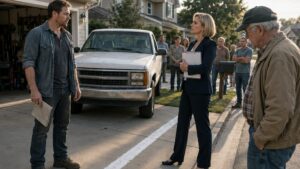
Kevin Harris stepped from the black truck before it had fully settled. His coat was clean, his boots were new, and he looked at the farm as though he had already purchased the view.
Robert Baker emerged from the passenger side carrying a leather folder. A heavy paper protruded from it, folded around a raised seal.
Two deputies left the county vehicle. The older one was Matthew Jackson.
Kevin pointed toward the farmhouse.
A contractor reached into a truck bed and lifted out a steel crowbar.
Chapter 2: The Crowbar Against the Farmhouse Door
Kevin drove the crowbar beneath the farmhouse latch while Robert Baker was still opening the leather folder.
The steel struck old wood with a flat crack that carried across the yard.
“Take that out,” Dennis said.
Kevin leaned his weight against the bar. The porch door flexed inward. “This stopped being your door at six this morning.”
Matthew Jackson came up the porch steps fast enough to catch Kevin’s wrist before he pried again.
“Hold on,” Matthew said. “Nobody forces entry while I’m standing here.”
Robert removed a document from the folder and unfolded it with care. His gray suit looked untouched by the damp road. “Deputy, the writ grants immediate possession, including structures and secured contents.”
“It grants you a conversation until I read it.”
“It grants my client relief from unlawful occupancy.”
Dennis remained below the porch. Behind him, the barn stood quiet, its doors nearly closed.
Kevin pulled the crowbar free but did not put it down.
Robert held the paper where Dennis could see the top half. A county heading. A stamped seal. A case number. Below that, his own name appeared in heavy type beside language about default, secured acreage, and failure to surrender possession.
The sight did not frighten Dennis as much as one line halfway down the page.
Original agricultural security agreement.
Robert watched him find it.
“You recognize the obligation,” he said.
“I recognize words copied from one.”
Kevin gave Matthew a short smile. “There. He admits it.”
Dennis climbed one porch step. “Let me see the judge’s signature.”
Robert shifted the page back. “You are not entitled to seize or alter an enforcement document.”
“I asked to read it.”
“You had notice.”
“Where?”
“Three certified demands, followed by service at the address of record.”
Dennis looked at Matthew. “A writ of possession on a discharged farm loan doesn’t come through the eviction docket.”
Robert’s polished expression tightened by a degree. “It is a consolidated enforcement action.”
“No county judge here calls farmland a residential premises under secured contents.”
One of the younger contractors glanced at Robert.
Matthew extended his hand. “Give me the document.”
Robert hesitated, then passed it over.
Matthew read the first page, lips barely moving. He turned it sideways to inspect the seal, then looked at the case number printed beneath the county heading.
“This prefix is old,” he said.
“It is assigned by division,” Robert replied.
“What division?”
“Civil enforcement.”
Matthew traced the number with his thumb. “Our current civil filings don’t start with E.”
Robert’s voice cooled. “Are you a clerk now, Deputy?”
“No. That’s why I’m going to call one.”
“We do not have time for courthouse staff to wander in after breakfast. The order is effective. Delay exposes the county to liability and permits Mr. Walker to remove secured property.”
Dennis looked toward the open machine shed. The tractor sat inside, its hood visible in shadow.
Kevin followed his gaze.
“You’ve had years to remove what you care about,” Kevin said. “You chose not to.”
“This wetland agreement is still active.”
“That subsidy contract doesn’t erase debt.”
“It prevents your equipment from crossing that buffer.”
Robert lifted another page. “The conservation agreement attaches to the owner in possession. Once possession transfers, my client may seek modification.”
“After review,” Dennis said. “Not before.”
Kevin tapped the crowbar against the porch post. “You think those reeds are sacred because the government pays you not to plant corn there.”
“They keep your runoff out of the river.”
Kevin’s jaw set.
There it was—small, quick, and gone. Not proof, but recognition.
Matthew stepped off the porch with the order in hand and spoke quietly into his radio. The other deputy remained between Kevin and the door.
Robert checked his watch. “Deputy Jackson, you are allowing an occupant to obstruct a valid judicial directive.”
“I’m verifying it.”
“You were brought here to maintain peace.”
“I was told this was a civil standby.”
“It is.”
“Then stop directing people to break doors.”
Kevin tossed the crowbar onto the porch. It landed beside the threshold with a hard metallic ring.
“Fine,” he said. “We’ll secure the exterior and remove the equipment first.”
A contractor unhooked a chain from his belt.
Dennis’s gaze moved to the steel document box visible through the narrow porch window beneath the stairs. He had set it there before dawn, ready to carry if fire or force reached the house. Its dull green lid bore scratches from three moves and one basement flood.
Robert saw it too.
“You may take personal clothing and medication,” he said. “Business records stay.”
“Those records concern the wetland contract.”
“They concern the secured property.”
“They concern you.”
For the first time, Robert’s composure slipped plainly. “Be careful what you imply.”
A car horn sounded at the gate.
Linda’s small sedan stopped behind the county vehicle, blocked by the convoy. She left it in the road and came toward the yard wearing work clothes beneath an unbuttoned coat. Her eyes moved from the crowbar to the order in Matthew’s hands, then to Dennis.
“You said they weren’t removing you.”
“They aren’t.”
“Stop saying things as if saying them makes them true.”
Kevin stepped down from the porch. “Linda, your father is turning a lawful transfer into a spectacle.”
She looked at him. “Why is there a crowbar against our door?”
“A misunderstanding.”
“The wood is split.”
Robert inserted himself between them. “Ms. Walker, this arises from an unresolved security agreement executed by your parents. We would prefer cooperation.”
Linda went still.
Dennis knew the exact instant she understood which agreement Robert meant.
Her gaze returned to him, but now the anger in it had an older shape.
“The refinancing?” she asked.
Dennis did not answer quickly enough.
Robert said, “So the family acknowledges the obligation.”
“It existed,” Linda said. “Years ago.”
Kevin spread his hands toward Matthew. “And now we’re done pretending this came from nowhere.”
Dennis felt Carol behind the barn wall without seeing her. He imagined the lens trained through the boards, recording not a clean theft but his daughter confirming the foundation beneath it.
Linda came closer. “You told me the loan had been handled.”
“It was.”
“You told me there was nothing attached to the land.”
“There isn’t now.”
“Now?”
Robert’s tone softened into false sympathy. “These arrangements are complicated. People under financial strain often misunderstand what was released and what survived.”
Dennis looked directly at him. “You know what was released.”
“I know what the court recognized.”
“Then give Matthew the docket contact.”
“The order is the court’s voice.”
“No,” Dennis said. “Paper is paper until somebody answers for it.”
Matthew lowered his radio. “Dispatch can’t raise the civil clerk yet. They’re trying the on-call judge.”
Robert exhaled sharply. “My client’s contractors are billing by the hour. Crop planning has deadlines. Lending conditions have deadlines. Mr. Walker cannot manufacture delay simply by refusing reality.”
Kevin looked toward the equipment trailer.
“We have possession,” he said. “Unload.”
Matthew stepped into his path. “Nothing moves until I verify the order.”
Kevin’s face hardened. “Your sheriff knows my family employs half the south end of this county.”
“My badge doesn’t.”
“No, but your budget does.”
The yard became very quiet.
Matthew folded the document once and held it against his chest. “That machine stays on the trailer.”
Kevin stared at him, breathing through his nose. Then he turned to the contractor nearest the excavator.
“Start it.”
The contractor looked between Kevin and Matthew.
Robert said, “Proceed only to the property boundary.”
“The boundary is the county road,” Kevin replied. “We’re already past it.”
Dennis glanced at the survey flags, then at the lane. Once the excavator came off the trailer, its tracks would fill the entire narrow approach. Even if Matthew stopped it at the gate, Kevin would have placed several tons of machinery where delay favored him.
Dennis walked toward the machine shed.
Linda caught his sleeve. “What are you doing?”
“What I should have done before they reached the porch.”
“Dad, don’t.”
He removed her hand gently.
Inside the shed, he climbed onto the antique tractor. The seat springs complained beneath his weight. He pushed the brass key into the ignition.
Across the yard, the excavator coughed alive on its trailer.
Dennis pulled the choke, set the throttle, and turned the key.
The old engine fired with a violent red shudder.
Chapter 3: The Only Road Closed by Iron
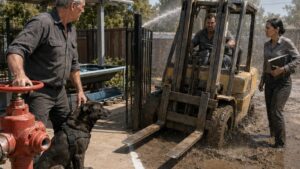
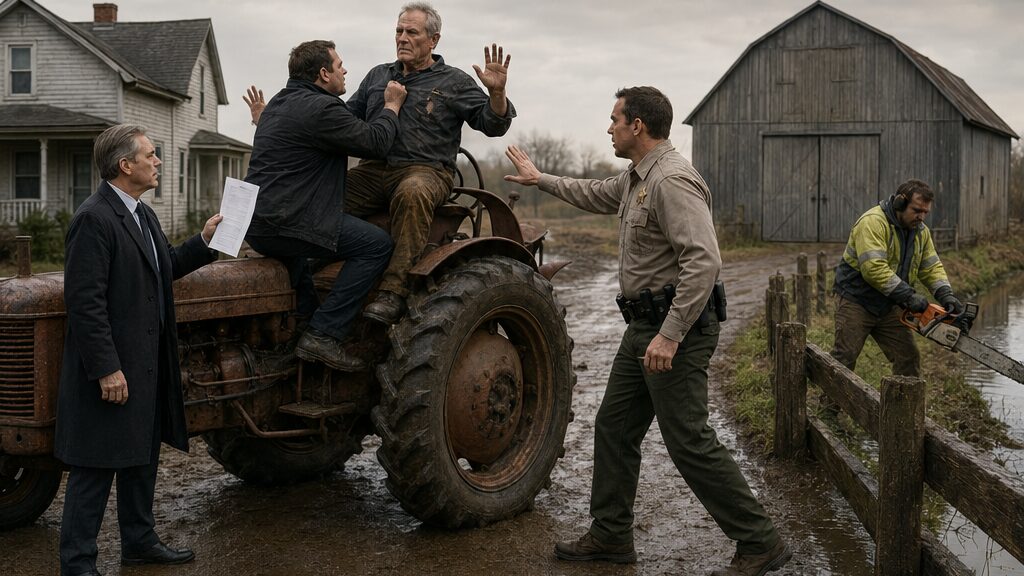
The tractor’s rear wheel dropped off the roadbed and sank six inches into the ditch shoulder.
Dennis felt the machine lean beneath him.
He turned harder.
The front axle swung across the lane until the rusted hood pointed toward the wetland rail and the broad rear tires blocked the road from ditch to fence. One wheel sat against the soft bank. The other nearly touched the timber posts. No truck could pass. No excavator could come forward without pushing the tractor into protected ground.
Dennis killed the engine.
Silence struck the lane harder than the motor noise had.
He pulled out the key and put it in his shirt pocket.
Kevin came down the road with the speed of a man who had expected every obstacle except one that refused to move.
“Start it,” he said.
Dennis stayed in the seat.
Matthew followed several paces behind. “Kevin, stop.”
“You heard him admit the debt. You have the order. Move this piece of junk or let us do it.”
Robert approached more slowly, carrying a set of photocopies separate from the writ. “Mr. Walker is now actively obstructing enforcement.”
Dennis rested both hands on the steering wheel.
“The roadbed ends at my gate,” he said. “Your equipment crosses the buffer if it goes around.”
Kevin pointed toward the low timber barrier. “Then we remove the barrier.”
“That rail marks the protected line.”
“It’s rotten lumber.”
“It’s part of the approved management plan.”
Robert lifted the copies. “The possession order transfers authority over improvements.”
“Not federal compliance.”
“The agreement follows lawful possession.”
“After agency review.”
Robert looked toward Matthew. “Arrest him before he turns this into something worse.”
Matthew did not move. “For sitting on his tractor?”
“For using machinery to obstruct a court order.”
“You told me this was a civil standby.”
“The conduct is no longer civil.”
Dennis watched Matthew’s jaw tighten. The deputy had known him for years, though not well. He had once brought his children to see the nesting platforms during a school field trip. That familiarity now worked against both of them. Matthew was determined not to appear as though memory could outweigh stamped paper.
The excavator idled behind the trailer ramps. Diesel fumes drifted down the lane.
A contractor attached a towing strap to the front of Kevin’s pickup.
Matthew pointed at him. “Put that down.”
“We can pull the tractor straight,” Kevin said.
“The rear wheel is in the shoulder. You pull it wrong, it rolls.”
“Then Dennis should climb off.”
Dennis looked down at the black water in the irrigation ditch. A roll could pin him or break the bank. Kevin knew enough about machinery to understand that. Perhaps he believed Dennis would surrender before the strap tightened.
Kevin came beside the tractor and looked up.
“This doesn’t save the farm,” he said quietly. “It only makes people watch you lose it.”
Dennis glanced at the barn. From this angle, he could see the narrow black gap between the doors.
“People should watch closely.”
Kevin’s eyes followed his, but the barn showed nothing.
Robert stepped onto the road’s raised edge and spread the certified notices across the tractor hood. Plastic sleeves protected them from the damp.
“Service attempt one,” he said. “Service attempt two. Final demand. Every opportunity was provided.”
Dennis looked at the first address.
The number belonged to the old north storage building.
Its roof had collapsed eleven years earlier. The county had removed the address from the emergency map after Dennis dismantled what remained.
He pointed to it. “Nobody lives there.”
“It is listed in the original security agreement.”
“It was a grain shed.”
“Then you failed to update your service address.”
“My mailing address is on every wetland inspection, every tax notice, and every annual filing.”
Robert tapped the certificate. “Legal service follows the contract.”
Dennis studied the signature line. A postal notation claimed refusal by occupant.
“There was no occupant to refuse it.”
Linda had moved close enough to read over Robert’s arm. “He’s right. That building hasn’t existed since I was in college.”
Robert gathered the pages. “Its condition is irrelevant.”
Matthew held out his hand. “Let me see those.”
Robert did not give them over.
“You have the writ.”
“I want the notices.”
“They are attorney work product supporting enforcement.”
“You just showed them to everybody on the road.”
Robert’s fingers tightened around the sleeves.
Matthew stepped closer. “Hand them to me.”
For several seconds, neither man moved. Then Robert passed them over.
Matthew examined the addresses, checked something on the small terminal clipped inside the county vehicle, and looked toward the wetland.
“That parcel number was retired,” he said.
“Addresses change,” Robert replied.
“The notice says personal refusal.”
“A process server certified it.”
“At a structure that doesn’t exist.”
Robert’s face had begun to shine at the temples despite the cool morning. “These are collateral issues. The writ controls.”
Matthew looked toward the excavator operator. “Shut that machine down.”
Kevin turned. “Don’t.”
The operator kept both hands on the controls.
Matthew raised his voice. “Shut it down until verification.”
The diesel engine dropped to a lower idle, then ceased. Its cooling metal ticked in the sudden quiet.
For the first time since the convoy arrived, Kevin looked less angry than frightened.
It lasted only a moment.
Then he walked to his truck, pulled out the towing strap himself, and threw it onto the road.
“You think because a notice went to an old building, the debt vanished?” he said. “My family has carried this county through bad seasons. We kept the elevator open. We kept people working. He locks away eighty acres of usable ground and collects checks for growing mud.”
Dennis said, “It isn’t your ground.”
“It drains through mine. It blocks mine. Every acre you refuse to use raises costs for everyone around you.”
“You mean it costs you.”
“Yes,” Kevin snapped. “It costs me. It costs my workers. It costs the lenders financing the expansion. Land has to produce.”
“The wetland produces clean water.”
Kevin laughed once without humor. “Tell that to a bank.”
There was truth inside the bitterness, but not the kind Kevin meant. Dennis heard the pressure behind his words: lenders, expansion, deadlines. A farm empire could look solid from the road while hollowing beneath its machinery.
Linda climbed onto the tractor step but remained below the seat.
“You knew this was coming,” she said to Dennis.
“I suspected.”
“You called a reporter.”
His eyes shifted to her.
“That’s what’s in the barn, isn’t it?”
Kevin turned toward the building.
Dennis said, “Linda.”
“No. You told me to stay away because you wanted to control every part of this.”
“I wanted you clear of it.”
“You wanted me uninformed.”
Robert looked from father to daughter. “Ms. Walker, if your father has arranged undisclosed recording of a protected enforcement action—”
“Don’t use me,” Linda said.
“I am trying to prevent him from worsening his position.”
She faced Dennis again. “Are you?”
He could have told her then about the suspicious transfers Carol had traced, the runoff samples, the survey flags, the false filing patterns. He could have told her about the steel box and the discharge release within it.
Instead he said, “Get off the road.”
Her face closed.
“That,” she said, “is exactly what you said when Mom asked about the loan.”
The words reached farther than a shout.
Dennis’s fingers tightened on the steering wheel.
Kevin saw it.
He stepped onto the tractor’s rear axle, caught the fender, and hauled himself upward.
Matthew moved. “Kevin, get down.”
Kevin planted one boot on the wheel hub and reached for Dennis.
“You want everyone watching?” he said. “Then let them watch us remove you.”
His hand closed around the front of Dennis’s shirt.
The fabric pulled tight against Dennis’s throat. The brass key pressed through the pocket into his chest.
Dennis could have broken Kevin’s grip in one motion. He knew where to turn the wrist, where to drive an elbow, how little force the unstable wheel would tolerate.
Instead, he lifted both hands from the steering wheel and held them open where Matthew—and the hidden camera inside the barn—could see them.
Kevin pulled harder.
The pocket seam began to tear.
Chapter 4: The Debt Dennis Never Explained
The pocket seam gave way with a dry rip.
The brass key dropped inside Dennis’s shirt and lodged against his ribs. Kevin’s fist remained twisted in the torn fabric, pulling Dennis halfway from the tractor seat.
Dennis kept both hands raised.
“Let go of him,” Matthew said.
Kevin looked over his shoulder. “He’s resisting removal.”
“You’re the only one touching him.”
Matthew climbed onto the lower step and caught Kevin by the forearm. Kevin released Dennis, but his boot slipped on the wheel hub. For one dangerous second, his weight shifted toward the ditch. Dennis caught the back of his coat and steadied him.
Kevin jerked away as soon as his feet reached the road.
The act lasted less than a second. No gratitude passed between them.
Matthew placed himself beside the tractor. “Nobody climbs up again.”
Robert moved forward with the writ held against his chest. “Deputy, Mr. Harris was attempting to protect secured property from concealment.”
“He was dragging a man off a machine.”
“A machine being used unlawfully.”
Dennis reached through the torn pocket and closed his fingers around the key. Its teeth dug into his palm.
From inside the barn, Carol watched Kevin regain his balance on a small monitor. The camera operator had captured Dennis’s open hands, Matthew’s warning, and Kevin’s grip. The image was clean.
The story was not.
Carol touched her headset. “Keep recording. No broadcast.”
One crew member glanced at her. “He put hands on him.”
“That proves an assault. It doesn’t prove the order is false.”
“What more do you need?”
“The truth.”
Outside, Linda stood at the foot of the tractor, staring at the torn shirt.
“You could have fallen,” she said.
Dennis climbed down slowly, keeping the tractor between Kevin and the wetland road. “I didn’t.”
“That is not an answer.”
“It’s what happened.”
“No. What happened is you arranged all of this and told me nothing.”
Robert heard the opening and used it.
“Ms. Walker, there may still be a way to avoid criminal charges and unnecessary public embarrassment. If your father surrenders the key and permits an inventory—”
“Stop talking to her,” Dennis said.
Robert’s mouth thinned. “You do not get to control every conversation.”
Linda looked at Dennis. “He’s right about that much.”
The sentence struck more deeply than Kevin’s hand had.
Dennis stepped toward the farmhouse.
Matthew blocked him gently. “Where are you going?”
“For the records.”
Robert raised the writ. “Documents attached to the secured operation cannot be removed.”
“They’re mine.”
“Then bring the box to the porch and open it where we can see.”
Dennis almost refused. The steel box held the worst year of his life reduced to paper: overdue notices, restructuring terms, letters he had hidden beneath feed invoices, and the final discharge release he had checked so many times that its fold had begun to split.
He had prepared to expose Robert.
He had not prepared to expose himself.
Linda moved past him toward the house.
“I know where the box is,” she said.
Dennis caught her arm. “Leave it.”
She pulled free. “You told me the debt was handled. Let me see what that meant.”
The split door stuck against its damaged latch. Linda shoved it open and disappeared inside.
Robert remained near the porch while Matthew examined the writ again. Kevin paced beside the stopped excavator, speaking quietly to the contractors. One of them looked toward the timber rail, then toward the chains and tools in the pickup.
Dennis saw the calculation.
So did Matthew.
“Tell your people to stay off that barrier,” the deputy said.
Kevin did not turn. “They’re standing beside a road.”
“They were brought to move equipment. They’re not moving anything.”
“You’re taking his side.”
“I’m preventing injury while I verify your paper.”
Robert checked his watch. “We have already lost forty minutes.”
“To what?” Dennis asked.
Robert looked at him too quickly.
Before he could answer, Linda emerged carrying the green steel box. Dust marked the front of her coat. She set it on the porch boards and looked at Dennis.
“It was locked.”
He held up the tractor key.
“The small key is on the same ring,” she said.
He climbed the steps. The brass key had left four red impressions in his palm. He opened the box.
The smell of paper and old metal rose from it.
Linda knelt beside him. At the top lay current wetland agreements, inspection reports, boundary maps, and tax receipts arranged by year. Beneath those were the older files, tied with faded cotton cord.
Robert leaned closer.
Dennis saw recognition in his eyes before Robert hid it.
“You’ve seen these,” Dennis said.
“I have seen documents filed in public proceedings.”
“Not this box.”
Robert gave a small, contemptuous shrug. “Your financial distress was hardly private.”
Linda untied the cord. The first page bore both her parents’ signatures.
Her finger stopped at her mother’s name.
“She signed this?”
Dennis’s throat tightened. “The original operating loan, yes.”
“And the refinancing?”
He did not answer.
Linda searched the pages. She found the later agreement, then looked from her mother’s missing signature to Dennis.
“You signed alone.”
“The grain payment failed. We had four days before foreclosure proceedings.”
“Did Mom know?”
“She knew we needed time.”
“That is not what I asked.”
Behind the barn boards, Carol heard every word through the directional microphone. She lowered her eyes from the monitor.
Dennis had told her the order was forged. He had not told her it had been built from a real agreement bearing the same parcel numbers, collateral descriptions, and lender language now printed inside Robert’s writ.
Linda turned another page. “You put the acreage back under security.”
“For ninety days.”
“You put the house under it.”
“For ninety days.”
“And you never told her?”
Dennis looked toward the wetland rather than at his daughter. “I told her after the extension came through.”
“How long after?”
“Long enough.”
Linda sat back on her heels.
The anger went out of her face, but nothing gentler replaced it.
Matthew stepped onto the porch. “Is there a release?”
“Yes,” Dennis said.
He reached beneath the oldest file and removed a clear sleeve. Inside was a single-page discharge recorded after the loan was paid through a conservation settlement and crop-insurance adjustment.
Linda took it first.
The county stamp in the lower corner was pale, its ink weakened by age and moisture. The recording number remained legible, but only under the porch light.
Matthew held it toward the morning.
Robert laughed softly. “That is your proof?”
“It discharged the lien,” Dennis said.
“It appears to be an unverified copy with an incomplete recording mark.”
“It came from the clerk’s office.”
“Then where is the certified original?”
“In their archive.”
“Convenient.”
Matthew pointed to the number. “This can be checked.”
“When?” Robert asked. “Next week? After Mr. Walker removes equipment, alters records, or contaminates the claimed property?”
Dennis’s gaze sharpened. “Contaminates?”
Robert paused.
Kevin stopped pacing.
Robert corrected himself. “Compromises. The property.”
Linda looked at Dennis. “Why didn’t you show me this years ago?”
“I didn’t want you carrying it.”
“You made me carry the part I couldn’t see.”
Dennis lowered his head.
He had expected accusation. He had expected her to say he loved the farm more than his family, as she had once said while loading boxes into her car.
Instead, she touched her mother’s signature through the plastic sleeve.
“You were ashamed,” she said.
Dennis could not deny it.
Robert took advantage of the silence.
“The validity of this supposed release is now disputed,” he announced. “The possession order remains controlling until a court determines otherwise. My client will secure the property and preserve all records pending review.”
Matthew turned on him. “You don’t get to invent temporary authority because your evidence is challenged.”
“The court already granted it.”
“The court still isn’t answering.”
“And every minute of delay creates harm.”
Kevin came to the porch. “Enough. We have the order, the old agreement, and his own admission. Move the tractor.”
Matthew stepped down to meet him. “No.”
Kevin pointed toward the timber rail running beside the blocked lane. “Then we go around it.”
“That crosses the protected buffer.”
“We’ll remove one section and replace it.”
Dennis closed the steel box.
“You cut that rail,” he said, “you enter the wetland.”
Kevin’s expression settled into something colder than anger.
“It’s wood, Dennis.”
“No. It’s the line.”
Kevin turned toward the contractors.
One of them reached into the pickup bed and lifted out a chainsaw.
He carried it toward the first timber post beside the tractor, set it on the ground, and pulled the starter cord.
The engine coughed once.
On the second pull, it roared alive.
Chapter 5: The Chainsaw at the Protected Water
The spinning chain touched the timber post less than a yard from the federal boundary sign.
Pale wood sprayed across the wet grass.
Dennis was off the porch before Matthew could call his name.
The contractor leaned into the cut, shoulders braced against the saw’s vibration. He wore hearing protection and kept his eyes on the blade. Either he had not heard Matthew’s order to stop, or he had decided Kevin’s money mattered more.
“Shut it down!” Matthew shouted.
Kevin stepped between him and the barrier.
“This is private property under court possession.”
“You cross that marker, I will detain you.”
“For obeying a writ?”
“For ignoring a direct safety order.”
Robert moved beside them, pages flapping in his hand. “Deputy, do not threaten my client for exercising rights granted by the court.”
The chainsaw sank deeper.
The post was not merely a fence support. A metal plate bolted to its far side carried the wetland agreement number and the measured distance to the protected water. If the post fell, the machinery lane marked by the orange flags would open directly along the ditch.
Dennis crossed the last few yards.
The contractor saw him and lifted the saw from the cut. The chain screamed in open air.
“Back up,” the man warned.
Dennis did not.
“Shut it off.”
“I’ve got a job.”
“You’ve got one chance to put it down.”
Kevin called from behind him, “Finish the cut.”
The contractor’s grip tightened.
Dennis saw everything at once: the spinning chain, the wet grass beneath the man’s boots, the top handle vibrating above the engine housing, and the spark-plug lead running beneath a flexible rubber cap.
He had repaired saws older than the contractor.
The man lowered the blade toward the post again.
Dennis stepped inside the arc before the chain could bite. His left hand locked over the top handle. With his right, he tore the rubber cap and wire free from the plug.
The engine died mid-roar.
The sudden silence made the irrigation water audible.
The contractor pulled backward, still holding the rear grip. Dennis twisted the dead machine away from both of them, released the handle, and dropped it into the deep puddle beside the ditch.
It struck with a heavy splash.
Brown water closed over the bar and half the engine housing.
Nobody moved.
Then Kevin shouted, “He attacked him!”
“I didn’t touch him,” Dennis said.
The contractor looked at his own hands as though checking.
Matthew reached them and placed one palm against Dennis’s chest, guiding him back from the puddle. With the other, he pointed toward the pickups.
“All contractors behind the vehicles. Now.”
Robert said, “That was destruction of property.”
Matthew ignored him. “Move.”
The contractor removed his hearing protection. His face had gone pale. “He grabbed the saw.”
“He disabled it,” Matthew said. “You were operating it after a lawful order to stop.”
“Mr. Harris told me—”
“I don’t care who signs your check. Back up.”
The other workers retreated first. The man beside the puddle followed, looking relieved to be ordered away.
Matthew faced Dennis.
“You do that again, I put you in the county vehicle whether you touch someone or not.”
Dennis nodded.
“You understand me?”
“Yes.”
Matthew looked at the dead chainsaw, then at the clean space between Dennis and the contractor. His voice lowered.
“You knew where that wire was.”
“Yes.”
“You could have lost a hand.”
“So could he.”
That answer seemed to anger Matthew more than defiance would have.
“You don’t get to calculate everybody’s risk alone.”
Dennis looked toward Linda.
She stood beside the steel box, one hand pressed to its lid.
Matthew followed his gaze, then stepped away. “Nobody crosses that barrier.”
Kevin’s face had reddened above the collar. “You are allowing him to destroy my equipment and obstruct access because you grew up admiring his little nature project.”
“I’m stopping this because your contractor brought a running saw inside an active dispute.”
“My equipment is scheduled to be on the eastern drainage tract before noon.”
The words came out too fast.
Carol, listening from the barn, raised one finger to the camera operator.
Dennis said, “Eastern drainage tract?”
Kevin realized his mistake. “The acreage covered by the possession order.”
“The order describes the house parcel and secured equipment.”
Robert stepped in. “It incorporates all attached agricultural tracts.”
“Then show the attachment.”
Robert began turning pages.
Dennis watched his hands. The attachment did not exist. Robert knew it. Kevin knew it. Matthew was beginning to know it.
Kevin looked past the tractor toward the line of orange flags.
“We need a clear path,” he said. “That is all.”
“Before what?” Dennis asked.
“Before planting delays cost another season.”
“You don’t plant wetlands.”
“We can improve drainage.”
“On your side?”
“Wherever water is being held unnaturally.”
Linda came down from the porch. “The state inspection is today, isn’t it?”
Kevin’s eyes shifted to her.
Dennis had never told her the exact time, but she had seen the notice in the box.
Matthew said, “What inspection?”
Dennis answered without taking his eyes from Kevin. “The environmental office is coming at two. They’re tracing cloudy discharge found in the south channel.”
Robert snapped his folder shut. “That has no bearing on possession.”
“It has bearing on why your client needs this road before noon.”
Kevin laughed, but it sounded thin. “You think inspectors care about a little fertilizer after a rain?”
Carol leaned toward the monitor.
Dennis said, “They care when it enters protected water.”
“My farm feeds twelve thousand acres.”
“And that excuses what?”
“It means I don’t have the luxury of treating every drainage ditch like a museum exhibit.”
The bitterness in Kevin’s voice was no longer performed. He pointed toward the wetland with a shaking hand.
“That ground could carry a service route, a tile line, and enough controlled drainage to save the southern fields. Instead, you let it flood because a federal contract pays you to call failure conservation.”
Dennis glanced at the black water moving beneath the reeds.
“This wetland was here before either farm.”
“And the bank doesn’t lend against history.”
There it was again.
Not just entitlement. Fear.
Dennis said, “How much did you borrow against the expansion?”
Robert moved sharply. “Do not answer that.”
Kevin rounded on him. “I know.”
“No, you don’t,” Robert said. “And you are not required to discuss private financing.”
Dennis watched them.
“The lenders sent somebody,” he said. “They know the drainage work is stalled.”
Kevin’s silence confirmed enough.
Robert lowered his voice. “We are not discussing collateral arrangements in front of law enforcement.”
“Why not?” Linda asked. “You brought my father’s here.”
Robert turned toward her. “Your father’s debt is the basis of a lawful order.”
“Then why do you need the wetland road before an inspection?”
“We do not.”
Kevin pointed at the orange flags. “Because if inspectors trace anything through that ditch, they freeze the drainage permit. If they freeze the permit, the lenders suspend the next release. If that happens, three hundred people spend harvest wondering whether their checks clear.”
Robert went white.
Matthew said, “Kevin, stop talking.”
But Kevin had moved beyond caution.
“He gets to sit on a tractor and call it principle. I have payroll. Contracts. Families depending on decisions he doesn’t have to make.”
“You planted those flags,” Dennis said.
“I authorized a survey.”
“Inside the federal line.”
“A line can be corrected.”
“The water sample can’t.”
Kevin took one step toward him. “You think you’ve won because a deputy told a saw operator to back up? I will bury this farm in motions. I will challenge every map, every subsidy, every inspection. I will drain that swamp through legal channels if it takes ten years, and you’ll sell the house to pay for the privilege of watching.”
Robert seized Kevin’s arm.
“That is enough.”
Kevin shook him off. “You said the order would give us access before the inspectors arrived.”
The lane went silent again.
Robert stared at him.
Matthew’s hand moved toward the writ.
Dennis said, “He said that?”
Kevin’s anger faltered.
Robert spoke carefully. “My client is distressed and misstating privileged strategy.”
“You said the filing would hold for one day,” Kevin replied. “You said by the time anyone checked the division number, the equipment would already be through.”
Robert’s face lost what remained of its polish.
“You knew the debt was discharged,” Linda said.
“No,” Robert answered. “I knew the recording was defective.”
“You built the order from the old papers,” Dennis said.
“I relied on documents provided by my client.”
Kevin stepped back as if struck. “You drafted everything.”
“And you insisted on immediate action despite my advice.”
“You told me the seal would pass.”
Matthew moved between them and took the writ from Robert’s hand.
Robert resisted for half a second, then released it.
“Deputy, those statements are being taken out of context.”
“By who?” Matthew asked.
Robert looked around the farm.
The closed barn. The silent road. The contractors behind their trucks.
No visible witness beyond those he believed he could pressure later.
Dennis reached into his torn shirt and pulled out the brass tractor key.
He held it above his shoulder.
Carol saw the signal on the monitor.
The barn doors began to slide apart.
Daylight opened across the hidden cameras, cables, transmission cases, and the red glow of a live broadcast indicator.
Carol walked out first with a microphone in her hand.
Behind her, the camera operator kept the lens fixed on Robert.
“We recorded the context,” she said. “All of it.”
Chapter 6: The Forged Seal Under Live Light
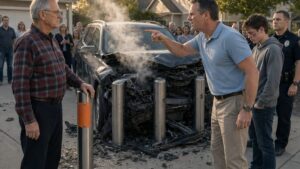
Robert walked straight toward the camera.
“You will terminate this transmission immediately,” he said. “You are broadcasting privileged legal communications and interfering with an active court enforcement.”
Carol did not step back.
The camera’s red light remained on.
“You made those statements on a farm road in front of deputies, contractors, and the property owner,” she said. “Nothing about that was privileged.”
“I do not consent to the use of my image.”
“You entered private property carrying what you represented as a public court order.”
Kevin stared at the camera as if it were a weapon Dennis had concealed rather than a witness Robert had supplied.
“How long has this been live?” he asked.
Carol looked at him. “Long enough.”
Robert turned to Matthew. “Seize their equipment. This is unlawful surveillance designed to provoke admissions.”
Matthew held the writ by its edges.
“I’m not seizing a news camera because you dislike what you said.”
“This was staged.”
Dennis stood beside the tractor, shirt torn, mud drying on his boots. “The crowbar was yours. The saw was yours. The words were yours.”
Robert pointed at the barn. “You concealed a broadcast crew while pretending to engage in good faith.”
“I asked you to verify the order.”
“You withheld the history of the debt.”
Carol’s earpiece crackled. She listened, then lifted a hand toward her camera operator.
“Our newsroom has reached the county clerk,” she said. “The case number printed on that order belongs to a closed estate proceeding from eight years ago.”
Matthew looked down at the number.
Robert’s expression did not change, but his voice rose. “Case identifiers may be reassigned after administrative consolidation.”
Carol listened again.
“The clerk says they are not.”
The younger deputy moved closer to Matthew. Together they examined the seal.
Carol continued. “The court division named in the stamp was dissolved three years ago. No writ of possession was issued against Dennis Walker this week, this month, or this year.”
Kevin looked at Robert.
“You said it was expedited.”
Robert spoke without turning. “Do not say another word.”
“You said the clerk had cleared it.”
“I said the recording issue could support emergency relief.”
“You handed me an order.”
Carol’s producer spoke in her ear again. This time her eyes narrowed.
“The signature,” she said, “matches a judge’s signature from an unrelated filing. The judge retired before the division named on your document was dissolved.”
Robert faced the camera once more. “A newsroom employee is not qualified to authenticate judicial records. What you are airing is allegation, not adjudication.”
“That part is true,” Carol said. “We’re reporting what the clerk confirmed and what viewers can see. We are not declaring a conviction.”
Her restraint made Robert’s panic more visible.
He pointed at Dennis. “Then report the entire truth. Report that he owed the debt. Report that he concealed the agreement from his own daughter. Report that he planned this ambush because he knew a legitimate claim existed.”
The camera shifted toward Dennis.
Carol did not stop it.
That was the moment Dennis had feared more than arrest.
He had imagined the broadcast as a clean opening of Robert’s false paper under public light. He had not imagined the light turning toward the green steel box, his wife’s signature, or Linda standing beside the porch with years of unanswered questions in her face.
Carol said, “Did the debt exist?”
Dennis could have answered narrowly.
He could have said it had been discharged and nothing more. He could have let Robert remain the only man whose shame mattered on camera.
Instead, he went to the porch and lifted the steel box.
He carried it into the road and set it on the tractor hood.
“Yes,” he said. “The debt existed.”
Robert seized the answer. “There.”
Dennis opened the box.
“I signed an extension when the farm was close to foreclosure. I signed it without explaining the full terms to my wife. I hid notices because I thought I could fix the problem before my family had to be afraid.”
Linda watched him from a few feet away.
Dennis removed the refinancing agreement and held it where the camera could see the first page.
“This is the real agreement.”
Then he removed the payment record, conservation settlement, and discharge release.
“These show how it was paid. This is the release filed with the county. The stamp is faint. The number is not.”
Carol’s camera moved closer.
Robert said, “Copies can be altered.”
Dennis handed every document to Matthew.
“Check all of them.”
Matthew accepted the file.
Dennis looked into the camera only once.
“I should have told my family the truth when I signed it. I should have shown my daughter these papers years ago. That doesn’t make his order real.”
Linda lowered her eyes to the documents in Matthew’s hands.
Robert’s strongest defense had been that Dennis’s secrecy proved deceit. Dennis had removed it himself, not by appearing blameless, but by refusing to hide any longer.
Kevin seemed to understand the shift before Robert did.
“He gave you everything,” Kevin said. “You told me the old debt was enough.”
Robert turned on him. “You provided the archived agreement and demanded a mechanism for immediate entry.”
“You said you could get one.”
“I advised you that emergency relief required a factual basis.”
“And then you made the seal.”
Robert’s face tightened. “Careful.”
Kevin glanced at the live camera, then at the contractors who had heard him threaten the wetland.
His fear sharpened into self-preservation.
“I believed the order was genuine,” he said. “Robert handled the court side. I relied on counsel.”
Robert gave a short, disbelieving laugh. “You selected the date because of the environmental inspection.”
“I selected the date you told me was available.”
“You sent the survey crew in last night.”
“At your direction.”
“I told you to document access.”
“You told me no one would check until afternoon.”
Each sentence stripped another layer from the arrangement.
Matthew handed the documents to the younger deputy and stepped toward Kevin.
“Both of you stop.”
Robert spoke over him. “My client is making statements under distress without advice.”
“Your client just accused you of forging a court order,” Matthew said.
“And I deny it.”
“You also presented it to me as valid.”
“Because I believed it was.”
Carol touched her earpiece.
“The county clerk has emailed a certified docket response,” she said. “No action exists under Dennis Walker’s name. The station is putting the confirmation on screen now.”
Robert looked at the monitor inside the barn. The broadcast displayed the false order beside the clerk’s written denial. The seal appeared enlarged beneath it, every uneven edge visible.
The forged paper had not solved everything. It did not prove who designed it or who knew which details. But it could no longer command the road.
Matthew removed his hand from Dennis’s arm where it had rested during the confusion.
Then he took Robert’s leather folder.
“You are temporarily detained while we determine what these documents are and how they were created.”
Robert stepped back. “You have no basis.”
“I have a false case number, a nonexistent order, recorded statements about delaying verification, and a document you attempted to use to direct officers.”
Kevin moved toward his truck.
The younger deputy blocked him.
“I’m leaving,” Kevin said.
“No.”
“This is my lawyer’s misconduct.”
Matthew looked at the cut timber post, the crowbar on the porch, and the chainsaw half submerged in brown water.
“This stopped being only paperwork when you ordered forced entry.”
A phone rang inside Matthew’s vest.
He answered, listened, and looked toward the wetland.
“Yes,” he said. “The access road is secure now.”
He ended the call.
“State environmental investigators are eight minutes out,” he announced. “They’ve seen the broadcast. Nobody leaves, nobody moves equipment, and nobody goes near that drainage ditch.”
Kevin’s shoulders sank by a fraction.
Robert said nothing.
Dennis stood beside the open document box. The tractor still blocked the road. The key remained in his hand, but for the first time that morning it no longer felt like the only thing holding the boundary.
Linda came beside him.
She did not forgive him. She did not touch his arm.
But when Matthew asked who could explain the wetland records to the investigators, Linda placed her hand on the steel box.
“We both can,” she said.
Chapter 7: What Remains When the Boundary Holds
Dennis placed the tractor key on top of the conservation agreement.
The brass looked too small to have carried so much weight.
Across the table, Linda stopped reading.
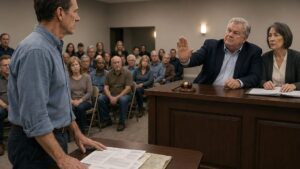
They sat inside the barn where Carol’s cameras had once been hidden. The transmission cases were gone, the hay bales had been returned to their rows, and the wide doors stood open to the repaired entrance road. Morning light reached the scarred tabletop but stopped just short of the key.
The agreement beneath it would place the wetland and its protected buffer into a permanent conservation trust. Dennis would remain the working owner of the farm, but any sale, new loan, drainage change, or alteration to the access road would require outside review.
His signature alone would no longer be enough.
Linda touched the corner of the document.
“You’re certain?”
“No.”
She looked at him.
Dennis leaned back in the folding chair. “That isn’t the same as saying no.”
The trust representative remained at the far end of the table, quietly arranging duplicate pages. A county recorder waited beside him. Neither interrupted.
Several months earlier, Dennis would have resented their presence. He would have seen extra signatures as weakness, oversight as intrusion, and shared authority as another word for losing control.
Now the steel document box sat open between him and Linda.
Every record had been copied. Every debt page had been disclosed. The discharge release had been certified again, this time with a dark new stamp that no one could pretend not to see.
The old papers remained part of the file.
Dennis had not removed the pages that embarrassed him.
Linda turned to the section governing future borrowing. “No agricultural lien without approval from both co-stewards and the trust.”
“That’s what it says.”
“And if one of us refuses?”
“Then there’s no loan.”
“That could cost us a season.”
“It could.”
“You would have hated this ten years ago.”
“I hate parts of it now.”
The trust representative glanced up, uncertain whether Dennis was joking.
Linda was not uncertain. A faint line appeared at the corner of her mouth, then disappeared.
She tapped the page. “Annual financial disclosure.”
“Yes.”
“Independent wetland testing.”
“Yes.”
“Copies of every inspection sent to both of us.”
Dennis looked toward the open doors.
The federal boundary marker had been reset in fresh concrete. The timber rail beside it had been replaced, though one cut post remained in the barn as evidence in the pending case. Beyond the marker, reeds moved over water that had tested cleaner each month since investigators shut down the unauthorized drainage outlet on the Harris property.
“Yes,” he said again.
Linda folded her arms. “I’m not agreeing to be a name on paper while you make every decision and explain them afterward.”
“I know.”
“If equipment fails, I see the estimate before you borrow.”
“Yes.”
“If a crop contract changes, I see it.”
“Yes.”
“If you think you can fix something before anyone needs to worry—”
“I tell you while there’s still time to worry properly.”
She held his gaze.
The recorder lowered his pen to hide a smile.
Linda did not smile.
“I mean it.”
“So do I.”
She looked down at the tractor key.
“Why is that there?”
Dennis picked it up, turned it once between finger and thumb, then set it nearer to her side of the table.
“Because I’ve kept it in my pocket long enough.”
The trust representative slid the signature pages forward.
Dennis signed first.
His name came out uneven where the pen crossed a knot beneath the paper. Linda signed below him. The trust representative and recorder added theirs, each mark limiting the next, each limit strengthening the whole.
When it was done, the recorder gathered the original for filing.
Dennis looked at the empty place where the agreement had been.
He felt no triumph.
Only the strange unease of a man who had finally opened a gate he had spent years guarding.
Outside, a utility truck passed slowly along the county road.
Linda noticed him watching it. “You still think every vehicle is coming here.”
“Most of them aren’t.”
“That wasn’t my point.”
“I know.”
The consequences of the broadcast had arrived without ceremony. Kevin’s expansion loans had been frozen within two days. State investigators found altered drainage channels, unreported chemical storage, and runoff records that did not match field conditions. The mega-farm continued operating, but under restrictions tight enough to expose how much of its growth had depended on the next loan arriving before the last obligation came due.
Robert’s law license had been suspended pending formal discipline. His firm dissolved when clients left and insurers refused to cover the claims that followed. The false order had become one part of a larger case involving fraud, attempted illegal seizure, and misuse of archived documents.
Carol had asked Dennis for three follow-up interviews.
He agreed to one.
When the station tried to title the segment The Farmer Who Stood Alone, he made them change it.
He had not stood alone. That had been the point he almost missed.
Matthew submitted a report admitting that he had deferred too long to the appearance of legal authority. He did not excuse himself. Dennis respected that more than an apology delivered for comfort.
The investigators never asked Dennis to become a symbol. They asked for maps, samples, dates, and access.
He gave them all four.
Linda closed the steel box. “I’ll take the duplicate file home.”
Dennis almost said it belonged beneath the stairs.
Instead, he slid it toward her.
“There’s a spare key in the side compartment.”
“To the box?”
“To everything.”
She looked at him for a long moment, then nodded.
They carried the documents into the farmhouse together. The damaged porch threshold had been replaced, but Dennis had left one shallow crowbar mark in the frame. The carpenter had offered to plane it away.
Dennis declined.
Not every scar needed to be hidden to prove the door still held.
Later that afternoon, he started the antique tractor and drove toward the southern ditch. The brass key turned smoothly in the ignition. A second key, newly cut, rested in Linda’s coat pocket as she followed in the utility truck.
Near the boundary marker, Dennis slowed.
A work crew had opened a narrow drainage trench along the county shoulder. One man stood waist-deep in it, shoveling mud away from a culvert pipe. His reflective vest was too large. His boots were coated to the knees.
Robert Baker looked up at the tractor.
For a moment, neither man spoke.
The former lawyer climbed out of the trench and leaned on the shovel. He appeared older without the suit, though not humbled in the way strangers might have wanted. Resentment still held his shoulders stiff.
“This is temporary,” Robert said.
Dennis left the engine running.
Robert wiped mud from one glove onto the other. “The contractor needed labor. My brother knew someone.”
Dennis said nothing.
“I didn’t design the expansion,” Robert continued. “Kevin came to me with lenders already threatening him. He said hundreds of jobs depended on that road.”
“You made the paper.”
“I made an argument.”
“You made a court order.”
Robert looked toward Linda’s truck behind the tractor, then toward the wetland marker.
“Kevin knew what he was asking for.”
“So did you.”
“He would have found someone else.”
Dennis rested one hand on the steering wheel. “Maybe.”
“That matters.”
“It matters to you.”
Robert’s face tightened. “You think this happened because I didn’t respect a fence?”
“No.”
“Then what?”
Dennis looked at the restored marker. Its black lettering faced the road, plain and legible.
“You knew where the line was.”
Robert glanced at it too.
“And you crossed it anyway,” Dennis said.
There was no satisfaction in the words. No audience waited for them. The passing traffic did not slow.
Robert lowered his eyes to the trench.
Dennis eased the tractor forward, then stopped beside the fresh excavation.
“Mind the boundary,” he said.
Robert gripped the shovel but did not answer.
Dennis drove on.
At the entrance, the repaired gate stood open. The tractor crossed the place where it had once blocked the only road, its rear wheels rolling over packed gravel instead of the ditch shoulder.
Linda waited until he passed.
Then she stepped down from the truck and closed the gate behind him.
She tested the latch once, slipped the spare key into her pocket, and followed the tractor toward the wetland.
The story has ended.