The Blue Mailbox Everyone Wanted Gone Until the Whole Town Remembered Why It Stayed
Chapter 1: The Violation Tag on the Blue Mailbox
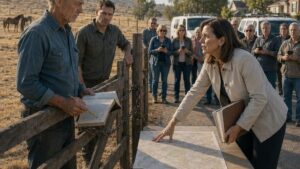
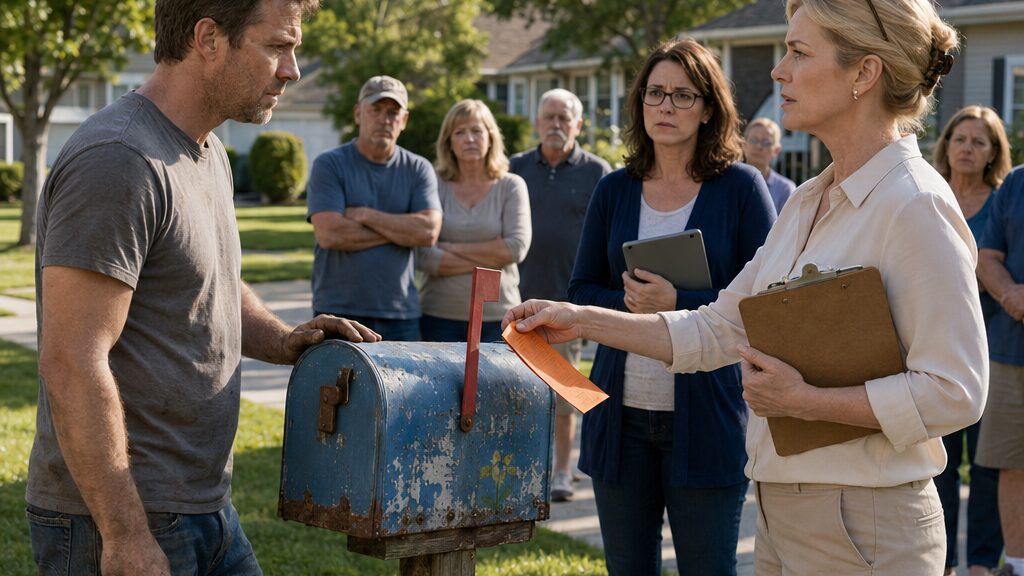
Barbara Mitchell pressed the orange violation tag onto Matthew Adams’s mailbox as if she were sealing evidence at a crime scene.
The tag stuck crookedly across the chipped blue door, half-covering the raised red flag. A corner of it lifted in the breeze, snapped once, and settled against the rusted metal with a thin paper slap.
Matthew stood three steps back on his own lawn with a screwdriver in one hand and a pair of work gloves in the other. He had been tightening the loose hinge when the curb-appeal committee came down the sidewalk in a loose formation: Barbara at the front with her clipboard, Samantha Moore behind her with a tablet, two board members pretending not to look too directly at anything, and three neighbors following at the safe distance people used when they wanted to witness trouble without joining it.
Barbara smoothed the tag with two fingers.
“There,” she said. “Now it’s documented.”
Matthew looked at the orange paper before he looked at her. “You put that on while I was standing here.”
“It’s a notice,” Barbara said. “Not a debate.”
The mailbox leaned slightly toward the street, its wooden post darkened near the soil line. The blue paint had faded toward gray on top, where years of sun had thinned it, and flaked in small curls along the side. Beneath one peeled patch near the door was a sliver of yellow. Near the bottom, if someone bent close enough, there was the curve of something that might have once been a green leaf or a child’s attempt at one.
Barbara did not bend close. She pointed from a distance.
“This is exactly the kind of thing we talked about at the spring meeting,” she said loudly enough for the neighbors to hear. “First impressions. Consistency. Pride of ownership.”
Matthew put the screwdriver into the back pocket of his jeans. “It holds mail.”
“That isn’t the standard.”
“It’s a mailbox.”
“It’s the first thing people see when they turn onto the street.”
Behind her, Samantha glanced up from her tablet. She gave Matthew a small, apologetic look, the kind that did not cost anything. One of the board members checked the gutter line on Matthew’s house as if suddenly fascinated by aluminum seams.
Matthew took one step toward the mailbox.
Barbara’s hand lifted slightly. “Please don’t remove the notice.”
He stopped.
The air between them tightened. A lawn mower droned two houses away and shut off. Somewhere across the street, a child’s bike wheel clicked over the sidewalk seams, then slowed.
Matthew could feel everyone waiting for him to raise his voice. That was the shape of the morning now: Barbara with the clipboard, him with dirty hands, the old mailbox between them like proof that he was the unreasonable one.
He wiped his thumb against his palm, leaving a streak of gray dust.
“My family likes it,” he said.
Barbara’s mouth tightened, not enough to be called a smile. “Your family isn’t the only family that lives in Oak Hollow.”
The name of the neighborhood sat on a stone sign at the entrance, carved in neat serif letters above a bed of white begonias. Oak Hollow had identical mailboxes on most streets now: black metal, brass numbers, approved posts. Barbara had led that project after the last board election. She called it the Uniform Streetscape Initiative. Matthew had voted against it by not voting at all.
Barbara tapped the orange tag. “The approved replacement models were emailed twice. I also left paper copies at the clubhouse.”
“I saw them.”
“Then you understand the requirement.”
“I understand you made a list.”
Samantha’s eyes flicked toward him.
Barbara drew in a slow breath. “The architectural committee adopted the list.”
“The board adopted it?”
“It was reviewed.”
“That’s not the same thing.”
The words came out before Matthew could stop them. He heard the edge in his own voice and hated how quickly it gave Barbara what she needed.
Her eyebrows lifted. “Matthew, this is not personal.”
He almost laughed, but it would have come out wrong.
Instead he looked at the mailbox. The red flag was still upright, though no letter waited inside. He had raised it out of habit that morning while he worked on the hinge, the way he used to do when there was something outgoing for the mail carrier. The little flag had a chip along the edge where bare metal showed. His wife had once said it looked like it had been through a weather report and survived.
Barbara followed his gaze and mistook it for surrender.
“I’m not asking you to do anything unreasonable,” she said. “It’s old. It’s rusted. It doesn’t match the neighborhood.”
One of the neighbors murmured, “It really doesn’t.”
Matthew turned just enough to see who had said it, but the group had already rearranged its faces into neutrality.
He reached for the tag.
“Matthew,” Barbara warned.
He peeled it off carefully, starting at the lifted corner so it would not tear. The adhesive pulled a tiny scale of blue paint from the mailbox door. It stuck to the back of the orange paper.
His chest tightened at the sight of that small blue fleck.
Barbara stepped forward. “That notice is HOA property.”
Matthew folded the tag once, cleanly. Then again. He held it out to her between two fingers.
“You don’t get to paste things on it,” he said.
Barbara did not take the folded paper right away. “On it?”
“The mailbox.”
“It’s an exterior structure subject to community standards.”
“It’s not abandoned.”
“No one said it was abandoned.”
“And it’s not yours to judge like that.”
The sentence landed harder than he intended. Not because it was loud, but because it had come from somewhere he usually kept shut. For a second, Barbara looked less offended than surprised.
Then she took the folded tag.
Samantha cleared her throat. “Maybe we should note homeowner objection and move on.”
Barbara did not look at her. “No, we should complete the notice properly.”
She unclipped a pen from her clipboard and wrote something on the violation form. Matthew watched the pen move: controlled, practiced, final. The neighbors remained where they were. Nobody wanted the next sentence, but everyone wanted to hear it.
“Seven days,” Barbara said. “Replace it with an approved model or submit an appeal in writing.”
Matthew’s jaw worked once. “And if I don’t?”
Barbara flipped to another sheet. “Noncompliant exterior fixtures may be subject to removal after notice, especially if deemed hazardous or materially inconsistent with community standards.”
“It’s not hazardous.”
“The post is leaning.”
“I was fixing the hinge.”
“The post is leaning,” she repeated, and now her voice had softened into the tone people used when they wanted an audience to hear how reasonable they were being. “I’m trying to keep this from becoming more unpleasant than it needs to be.”
Matthew looked past her to the mailbox again. Under the peeled place where the orange tag had taken a chip, more of the old hidden color showed through. Not just yellow. A point. A star, maybe. The kind a child drew with uneven arms.
For a moment the lawn, the committee, the clipboard, and the murmuring neighbors seemed to slide away.
He saw small hands covered in paint. Paper plates used as palettes. His wife kneeling in the grass with a brush tucked behind one ear, laughing because one of the children had painted a cloud upside down. The mailbox had been too bright then, almost ridiculous, and she had loved it for that reason.
Barbara’s voice pulled him back.
“Matthew, I need you to acknowledge receipt.”
He looked at the form.
Samantha held out the tablet this time. There was a signature box open on the screen.
He did not sign.
Barbara’s patience thinned. “Refusal to acknowledge doesn’t stop the timeline.”
“I know.”
“Then you understand what happens next.”
He picked up his gloves from the grass and turned toward the house.
Behind him, Barbara said, “I’d hate for the association to have to remove it for you.”
Matthew stopped at the walkway. He did not turn around right away. His hand closed around the gloves until the leather creaked.
When he finally looked back, the mailbox stood between them with a fresh pale scar in the blue paint and the red flag still raised, as if it had been trying all morning to send a warning nobody wanted to read.
Chapter 2: The Neighbors Who Remembered Only Half
By Monday afternoon, the mailbox had become a joke that people delivered from the sidewalk as if Matthew had ordered it.
“Guess you’re famous now,” one neighbor called while walking a small white dog past his lawn. “Or infamous.”
Matthew was kneeling beside the post with a sanding block, smoothing the places where rust had lifted paint from metal. He did not look up right away. The dog sniffed at the base of the mailbox, then jerked away when Matthew shifted.
“Morning to you, too,” Matthew said, though it was almost evening.
The neighbor laughed because that was easier than deciding whether he had been rude. “Barbara’s serious this time. Whole street’s getting cleaned up.”
Matthew brushed blue dust from his fingers into an old glass jar. Several flakes had gathered at the bottom already, thin as fish scales. He did not know why he was saving them except that throwing them into the grass felt wrong.
The neighbor tugged the dog onward. “You could just get one of those black ones. They look nice.”
Matthew heard that sentence three more times before Thursday.
A black one would look nice. A black one would make the street quiet again. A black one would stop Barbara from slowing her car whenever she passed his house, stop the little looks from neighbors collecting mail, stop Samantha from sending polite reminder emails with phrases like “before this escalates.”
A black one would also leave a blank spot where something had once meant more than matching.
On Tuesday, the mail carrier paused with letters in hand and looked at the hinge Matthew had tightened.
“Still opens,” Matthew said.
The mail carrier gave the mailbox a careful pull. It creaked but opened.
“I’m not the one complaining,” the mail carrier said, sliding envelopes inside. “Just don’t let them move it too far from the curb. That’s when my supervisor cares.”
After the mail truck rolled away, Matthew lifted the red flag and lowered it again. The hinge worked better now. A small victory nobody would count.
He spent the rest of the week doing repairs that could not be accused of defiance. He replaced two screws. He tightened the post brace. He sanded the rough rust near the door but avoided the patches where old shapes had begun to show beneath the blue. By Thursday, three uneven marks had emerged: the yellow star on the door, a green curve near the bottom, and a thumb-sized streak of purple on the side.
He was touching that purple streak with the pad of his finger when Anthony Rivera crossed the street carrying a coffee mug.
Anthony moved slowly but not weakly, with the careful balance of a man who had spent a career outdoors and respected uneven ground. He had lived on the corner longer than Matthew had been married, longer than half the trees on the street had been tall enough for shade.
“You sanding it down or bringing it back?” Anthony asked.
Matthew sat back on his heels. “Trying to make it less offensive.”
Anthony snorted. “That’ll disappoint some people. They enjoy being offended.”
Matthew almost smiled.
Anthony leaned closer to the mailbox, squinting. “Well, I’ll be.”
“What?”
“That star.”
Matthew’s hand went still.
Anthony pointed with one bent finger but did not touch the paint. “I remember that. Kid who painted it had more confidence than skill. Made five points and then gave it six.”
Matthew looked at the yellow shape. He had remembered the day, but not the child. There had been so many of them in the yard that afternoon. Children from the neighborhood, a few from the elementary art club, two from the summer program his wife volunteered with. Paper cups of water. Drop cloths. A card table with cookies someone had brought. Laughter and arguing over colors.
“You were there?” Matthew asked.
“For a while. Your wife made me hold the ladder even though nobody needed a ladder.” Anthony’s mouth softened at the corner. “She said official community art required official supervision.”
Matthew looked down at the jar of paint chips.
Anthony noticed it. “Saving evidence?”
“Saving something.”
They stood in silence for a moment, the kind of silence older neighbors usually filled with weather, property taxes, or squirrels.
Anthony lifted his mug toward the mailbox. “She got the town to pay for the paint, didn’t she?”
Matthew looked up. “Do you remember that?”
“Not the details. Parks department helped set up the event. I was still working then. There was a little grant. Maybe from the arts council, maybe the town beautification fund. One of those names people put on forms so they can buy brushes.”
Matthew wiped his hands on his jeans. “There was a letter.”
“From the town?”
“From the HOA. Or the builder’s association before it became the HOA. I don’t know. It said the mailbox could stay because it was part of the project.”
Anthony’s expression changed. “You have it?”
“I had it.”
He had kept it in a folder in the garage with the contest photo and the flyer his wife had designed on the old home printer. Blue mailbox. Big block letters. COMMUNITY ART DAY. The flyer had been crooked because she refused to let Matthew fix it. “It should look like people made it,” she had said.
After she died, the folder had moved from the garage shelf to a box, from the box to a cabinet, from the cabinet to somewhere he could not remember because for months after the funeral every object in the house had felt either too loud or too useless.
Anthony looked toward Barbara’s house at the end of the block. Her shutters had been repainted the exact approved shade of slate the month after she took over the committee.
“You should find that letter,” Anthony said.
“I know.”
“I mean soon.”
Matthew capped the jar of paint chips with more force than necessary. “You think I don’t know that?”
Anthony did not answer quickly. He looked at Matthew the way people did when they had earned the right to notice grief but not the right to name it.
“I think you’ve been trying to win an argument without telling anyone what the argument is,” he said.
The words stung because they were not unfair.
Matthew stood, joints stiff from kneeling. “Barbara doesn’t need my life story.”
“No. But she’s using the blank space.”
That evening, Matthew opened every cabinet in the garage. He found old tax returns, two broken extension cords, a box of Christmas lights, lesson plans from the year he had stopped teaching full-time, and three picture frames wrapped in newspaper because he had not been able to decide where to hang them. He found the flyer, bent at one corner. He found a photo of his wife with paint on her cheek, standing beside the mailbox when it was too bright and new. He sat on the concrete floor for several minutes with the photo in his hands.
But he did not find the letter.
At nine-fifteen, an email from Samantha arrived with the subject line: Architectural Hearing Notice.
At nine-thirty, someone slid a paper copy through the slot beside his front door.
Matthew picked it up from the floor. The hearing was scheduled for Friday evening at the clubhouse. The violation description was brief.
Nonconforming mailbox. Deteriorated condition. Failure to replace after notice.
Below that, in smaller print, a sentence had been highlighted.
Continued noncompliance may result in association remedy at homeowner expense.
Matthew folded the notice once, then opened it again. Outside, through the front window, the blue mailbox stood at the curb under the porch light, its old paint dull and uneven.
For the first time all week, the red flag was down.
Chapter 3: The Night the Post Was Left Broken
At first Matthew thought the mailbox had vanished because he was not fully awake.
He stood at the end of his driveway before sunrise with a mug cooling in his hand and stared at the curb where the blue shape should have been. The air was gray. The streetlights had not clicked off yet. For a few seconds, his mind kept trying to place the mailbox back where it belonged, as if memory could correct the lawn.
Then he saw the post.
It jutted from the grass at an angle, splintered halfway up, fresh wood pale against the older weather-darkened surface. A strip of blue paint clung to one broken edge. The red flag lay in the gutter six feet away.
Matthew set the mug down on the driveway.
He walked to the curb slowly, then faster, then stopped because there was nowhere to go. The mailbox was not tipped over. It was not damaged in place. It was gone.
Only the post remained.
He crouched and touched the splintered wood. It was rough and newly torn. The bolts that had held the box were missing. Not ripped out. Removed.
His first thought was Barbara.
His second thought was that thinking her name so quickly made him no better than the people who had looked at his mailbox and seen neglect.
He picked up the red flag. Its hinge screw was bent. A smear of blue paint marked the inside of his thumb.
Across the street, a porch light came on.
Anthony opened his front door in a robe and slippers, coffee already in hand. He stepped onto the porch, saw Matthew at the curb, and stopped.
“Matthew?”
Matthew held up the flag.
Anthony’s face went flat with recognition before anger reached it. “When?”
“I don’t know.”
“Did you hear anything?”
“No.”
A garage door rumbled open down the street. A car backed out, paused too long, then drove away without the driver looking toward Matthew’s lawn. Curtains shifted in the house next door. The neighborhood was waking up around the absence.
Matthew took photos with his phone: broken post, missing bolts, tire marks faint in the damp grass, red flag in his palm. He photographed the blue scrap still stuck to the wood. Then he called the nonemergency police line and was told an officer would contact him when available. He called the post office and waited through a recorded menu before a supervisor explained that delivery might be suspended until a secure receptacle was restored.
“You can put up a temporary box,” the supervisor said.
“A temporary box where?”
“At your address.”
“The post is broken.”
“You’ll need a compliant installation.”
The word compliant landed like Barbara had spoken it through the phone.
At eight-ten, her white SUV rolled down the street and slowed beside his curb.
Barbara lowered the passenger window. She wore sunglasses though the sun had barely cleared the roofs.
“Oh,” she said. “That’s unfortunate.”
Matthew stood with the bent red flag still in his hand. “Do you know anything about this?”
Her chin pulled back. “Excuse me?”
“My mailbox is gone.”
“I can see that.”
“Did the HOA remove it?”
Barbara looked at the broken post, then at the street, then back at Matthew. Her expression settled into concern arranged for public view.
“The board did not vote to remove anything last night.”
“That wasn’t my question.”
Anthony had crossed halfway into his yard now, still holding his coffee. Two other neighbors had emerged, one pretending to water a planter that did not need water.
Barbara’s fingers tightened on the steering wheel. “Matthew, maybe someone finally upgraded it for you.”
The sentence was light. Too light.
Anthony’s head turned sharply.
Matthew felt heat rise from his chest to his throat, but he kept his voice low. “That’s a strange thing to say about somebody’s property being taken.”
Barbara’s smile disappeared. “Don’t imply things you can’t prove.”
“I asked a question.”
“And I answered it.”
“No, you didn’t.”
For a moment, neither of them moved. The idling SUV hummed between them. Matthew could see Samantha’s tablet on the passenger seat, or one like it, with a stack of folders beside it.
Barbara put the vehicle in drive. “The hearing is still scheduled for Friday. I suggest you use this opportunity to install an approved replacement before then.”
She drove away.
Anthony crossed the street after she was gone. He looked at the broken post and then at Matthew.
“That sounded rehearsed,” Anthony said.
Matthew did not answer. He was watching the place where the mailbox had been, seeing the outline of it in his mind with painful clarity: the dent on top from the year a branch fell, the scratches near the door, the little green curve almost uncovered.
He spent the next two hours calling people who did not know anything. The HOA management office said all exterior remediation required written authorization. The woman on the phone found his violation notice but no completed removal order.
“Was there a maintenance review?” Matthew asked.
Keys clicked. “There was a request entered.”
“By who?”
“I can’t disclose internal notes.”
“Was it Barbara Mitchell?”
“I can’t disclose internal notes.”
“Was a contractor assigned?”
A pause.
“I see a review request marked pending.”
“Pending means not done.”
“It means pending in our system.”
“My mailbox is gone.”
“I understand your frustration.”
Nobody who said that ever did.
By noon, Matthew drove to the clubhouse office because phone calls had become a maze of polite locked doors. Samantha was there behind a folding table, sorting packets for Friday’s meeting. She looked up when he came in and immediately looked tired.
“I heard,” she said.
“Did you know?”
“No.”
The answer came too quickly to be a lie or too quickly to be useful. Matthew placed printed photos of the broken post on the table.
Samantha looked at them but did not touch them.
“There was an emergency review request,” Matthew said.
She closed her eyes briefly. “Barbara asked management to inspect whether the post was hazardous.”
“When?”
“Yesterday afternoon.”
“After the hearing notice?”
“Yes.”
“And before the hearing.”
Samantha’s mouth tightened. “A review request is not approval to remove.”
“But it starts the process.”
“It can.”
“Who gets copied?”
“Architectural chair. Management. Sometimes maintenance.”
“Sometimes?”
She finally touched one photo, sliding it closer. Her eyes paused on the blue paint scraped at the base.
“This shouldn’t have happened before the hearing,” she said quietly.
“But it did.”
Samantha looked toward the closed office door as if Barbara might appear from behind it. “Bring the photos Friday. I’ll ask management for the request log.”
Matthew gathered the pictures. “Ask?”
“I’m the secretary, Matthew. I don’t run the board.”
“No,” he said. “You just write down what it decides.”
She flinched, and he regretted it immediately, but not enough to apologize before he left.
When he got home, a yellow postal slip was tucked into his doorframe. Mail delivery suspended pending secure mailbox installation.
He stood on the porch reading it while the empty curb waited below.
At four-thirty, a small red car stopped in front of his house. A woman stepped out with a canvas bag, a camera strap over one shoulder, and a notebook already in her hand. She looked not at Matthew first, but at the broken post.
Then she approached the porch.
“Matthew Adams?”
“Yes.”
She offered a business card. “Jennifer Lee. I’m with the county paper.”
Matthew looked at the card but did not take it right away. “If Barbara sent you—”
“She didn’t.”
“Then why are you here?”
Jennifer glanced toward the curb again. “Because someone called our newsroom asking why the missing art mailbox on Willow Bend had been torn out before the anniversary piece ran.”
Matthew’s fingers closed around the porch rail.
“The missing what?” he asked.
Jennifer held out the card again, and this time he took it.
“The missing art mailbox,” she said. “I was hoping you could tell me why people around here stopped calling it that.”
Chapter 4: The Photograph in the Town Archive
Jennifer Lee placed a photocopied picture on Matthew’s kitchen table, and for a moment he could not understand why his wife was standing in black-and-white beside a mailbox that no longer existed.
The copy was grainy, pulled from an old newspaper file. The edges of the original photo had gone soft with age. Still, there she was: one hand on the blue mailbox, head tilted toward a cluster of children around her, paint on the cuff of her sleeve. The mailbox in the photo looked almost too bright to be the same object. Blue like a summer pool. Red flag freshly painted. Stars, leaves, handprints, and uneven purple swirls running along the sides.
Matthew stood with both hands flat on the table.
Jennifer did not speak at first. She had learned, or maybe decided, not to fill the room too quickly.
“Where did you get this?” he asked.
“Our archive,” she said. “The paper ran a short piece years ago. Community Art Day on Willow Bend. I was assigned a follow-up feature for the anniversary of the town’s neighborhood arts grants. Then someone called about the mailbox being gone.”
“Who?”
“They didn’t leave a name.”
Matthew looked at the photo again. He knew the day, but the newspaper version made it feel like something that had happened to other people. A public day. A cheerful day. Not the private place it had become after everyone stopped mentioning it.
Jennifer slid another sheet beside it. It was a clipped article, enlarged until the type looked uneven.
“Local families gathered Saturday to complete a resident-led art installation meant to welcome children walking home from the park,” she said, reading only part of it. “Project organizer—”
“Don’t,” Matthew said.
Jennifer stopped.
He pulled out a chair but did not sit. The kitchen felt smaller with those papers on the table. Behind him, on the counter, the postal slip still lay where he had dropped it. Mail delivery suspended. Secure receptacle required. The house was full of paper now: notices, photos, old flyers, things that arrived too late or demanded too much.
Jennifer lowered her voice. “I’m not here to push you into talking about her.”
“Then what are you here for?”
“To find out why a mailbox the town once wrote about as public art got removed like junk.”
Matthew picked up the photocopy. His wife’s face blurred slightly where the copier had darkened her hair. “It was on my property.”
“That may make it your loss,” Jennifer said. “It doesn’t mean it was only yours.”
He looked at her then.
She did not look pleased with herself for saying it. That helped.
Two hours later, Matthew followed Jennifer into the town records office, a low brick building behind the library with tinted windows and a flag that snapped in the wind hard enough to sound impatient. He had almost refused to go. He had told himself the photocopy was enough. Then he had looked out at the broken post and thought of Barbara using the word resolved.
The town clerk listened to Jennifer’s request with the guarded attention of someone who had seen small local issues become large because someone used the wrong email.
“Neighborhood arts grants from that period are in storage,” the clerk said. “Some are digitized. Some aren’t.”
“We’re looking for anything tied to Oak Hollow, Willow Bend, a mailbox project, or a resident-led installation,” Jennifer said.
The clerk glanced at Matthew. “Are you the resident?”
“My wife was.”
The clerk’s expression shifted. Not pity exactly, but care. “I’ll see what I can find.”
She disappeared through a staff door.
Matthew stood beside a rack of brochures about permits, recycling schedules, and summer concerts. Jennifer leaned against the counter, reviewing notes on her phone. He wanted to ask what she intended to print. He wanted to tell her that people would turn his wife into a sweet paragraph if he let them. They would say beloved. They would say community-minded. They would say things that were not wrong and still not enough.
Instead he said, “Barbara will say this is old.”
Jennifer looked up. “It is old.”
“That’s her point.”
“It may also be yours.”
Before he could answer, the clerk returned with a thin folder and a look of mild surprise.
“I found the grant list,” she said. “Oak Hollow Community Art Mailbox. Small materials grant. Approved by town beautification subcommittee.” She opened the folder. “There’s also a note that the project was acknowledged by the developer’s community association.”
Matthew stepped closer. “Acknowledged how?”
The clerk turned a page, frowned, and turned another. “That’s the odd part. The agenda reference is here, but not the attachment.”
Jennifer straightened. “What attachment?”
“Usually these packets include the approval letter or conditions.” The clerk tapped a line on the old agenda sheet. “See? ‘Resident art mailbox installation, Willow Bend, grandfathered exterior feature pending maintenance by homeowner.’ But the packet copy is missing the supporting page.”
Matthew read the sentence twice.
Grandfathered exterior feature.
The phrase was dry, bureaucratic, almost ugly. He wanted to laugh at how much it mattered.
“Can I get a copy?” he asked.
“Of the agenda, yes. The missing attachment, no.”
“Would the HOA have it?”
“If it transferred from the developer association, they should have retained records.”
Jennifer looked at Matthew. “Should have.”
At the newspaper office, Jennifer pulled another box from a shelf in a back room that smelled like dust, printer ink, and old carpet. Matthew waited near the doorway while she searched through folders marked by year. He should have left. He had already gotten more than he expected: proof that the mailbox had not been some private oddity he had imagined into importance. But the old photo had unsettled something in him.
Jennifer found the original print in a sleeve. This version was clearer than the photocopy.
“Here,” she said.
Matthew took it carefully.
The mailbox was there, newly painted, with the red flag up. His wife stood beside it, laughing at something outside the frame. Children crowded close, some looking at the camera, some not. Anthony stood in the background wearing a parks department shirt, holding a paper cup and looking like he had been tricked into enjoying himself.
On the side of the mailbox, just below the door, was the six-pointed yellow star.
Matthew touched the corner of the photo, not the image itself.
Jennifer watched his face. “That star is still on it?”
“Was,” he said. “Under the blue.”
She understood the correction and wrote nothing down.
When they returned to Oak Hollow near dusk, Samantha Moore was waiting on Matthew’s porch.
She had a binder hugged to her chest and a worry line between her eyebrows. She looked at Jennifer, then at Matthew, then at the broken post near the curb as if hoping it might explain what she had come to say.
“I pulled the archived HOA binder,” Samantha said. “Not officially. I mean, I’m allowed access, but I didn’t request a board action.”
Matthew stepped onto the porch. “And?”
Samantha opened the binder to a row of plastic sleeves. “The mailbox file isn’t there.”
“We know the town attachment is missing,” Jennifer said.
Samantha shook her head. “No, I mean there’s a tab for it. ‘Willow Bend Art Feature.’ Empty sleeve.”
Matthew felt the old anger return, colder now because it had a shape.
Samantha lowered her voice. “There’s something else.”
She turned to a recent printout: architectural review notes, dated months before the orange tag. Barbara’s name appeared in the request line.
Review all grandfathered exceptions for visual consistency under Uniform Streetscape Initiative.
Matthew read it once, then again.
Samantha swallowed. “Barbara asked for old exceptions to be reviewed before she ever tagged your mailbox.”
Jennifer’s pen paused over her notebook.
Matthew looked past Samantha, past the porch, toward the broken post at the curb. The blue paint on the splintered wood had darkened as evening settled over the street.
For the first time since the mailbox vanished, the question was no longer whether someone had made a mistake.
It was how long Barbara had known there was something to find.
Chapter 5: The Meeting Where Procedure Became a Shield
The agenda on the clubhouse wall listed Matthew’s missing mailbox as “resolved” before he had even taken a seat.
It was printed in twelve-point font, taped beside the coffee urn and the sign-in sheet, tucked between “Pool Gate Latch Repair” and “Seasonal Planting Review.” Resolved. One word, neat and final, as if the broken post on Willow Bend had agreed to the matter and moved on.
Matthew stood in front of the paper long enough for Samantha to notice from the folding table.
“I didn’t write that heading,” she said quietly.
Barbara Mitchell, standing near the front of the room with a stack of folders against her hip, heard anyway. “Management prepares the agenda based on current status. The nonconforming structure is no longer present.”
A few residents turned their heads. Some had come for the mailbox. Some had come because they had heard there might be a reporter. Jennifer Lee sat in the back row with a notebook closed on her lap, not pretending to be invisible but not performing attention either.
Matthew removed the agenda from the wall.
Barbara’s shoulders stiffened. “Matthew.”
He carried it to his chair and sat down with the page on his knees.
The clubhouse smelled faintly of coffee, cleaning spray, and the rubber mats stacked near the storage closet. The board members sat behind two folding tables pushed together, nameplates set in front of them. Samantha sat at one end with her laptop open, fingers resting above the keys. Barbara sat in the middle though she was not board president, her folders arranged into clean piles.
When the meeting reached “Exterior Compliance Review,” Barbara spoke before anyone asked her to.
“The association regrets the confusion regarding timing,” she said. “However, the mailbox at issue had been cited for deterioration and inconsistency with approved exterior fixtures. Its absence does not prevent the homeowner from installing one of several compliant alternatives.”
Matthew watched the residents absorb the language. Confusion. Timing. Absence. Alternatives. Words that stepped carefully around the plain fact that something had been taken.
He stood. “My mailbox didn’t become absent. It was removed.”
Barbara folded her hands. “We don’t have confirmation of that.”
“The post is broken.”
“That may indicate unsafe installation.”
“It indicates someone took the mailbox off the post before the hearing.”
One board member shifted. Samantha typed one sentence, then stopped.
Barbara opened a folder. “The architectural committee had documented concerns regarding safety and visual deterioration. The homeowner was notified.”
Jennifer’s pen moved for the first time.
Matthew saw it and felt his throat close. He had brought the photocopy, the town agenda, and the old article in a folder under his chair. He had also brought the photo of his wife, but it stayed inside the folder, turned face-down. He did not want the room looking at her because it had run out of arguments about paint.
He said, “There was a grandfathered exception.”
Barbara’s eyes flicked toward Samantha.
Only once. Only quickly.
But Matthew saw it.
Samantha opened the binder in front of her. “There is a historical tab for a Willow Bend art feature.”
Barbara’s voice cooled. “An empty tab.”
“The town has an agenda reference,” Matthew said.
“An agenda reference is not an exemption.”
“No. But it is a reason not to tear something out before checking.”
A murmur moved through the room.
Barbara tapped her folder on the table once. “Let’s be careful. No one here has established that the HOA removed the mailbox.”
“Then who requested the emergency maintenance review?” Matthew asked.
Barbara looked toward the board president, who looked at Samantha.
Samantha’s fingers hovered again. Her face had gone pale in the fluorescent light.
Barbara said, “As architectural chair, I requested a safety assessment. That is within my role.”
“After you gave me seven days.”
“Because the post was leaning.”
“I was repairing the hinge.”
“The post was leaning,” Barbara repeated, and Matthew heard the same public tone from the lawn, the smooth voice designed to make refusal sound unreasonable. “This association cannot wait for every resident to decide which rules feel meaningful to them.”
A few heads nodded. Not many, but enough.
Barbara stood and lifted a laminated sheet from her pile. It showed approved mailbox colors: black, white, bronze, dark green. No blue. Each swatch had a product number beneath it.
“This is the current standard,” she said. “It exists because inconsistent exterior fixtures affect the overall appearance of the community. People invest their savings in these homes. They expect standards to mean something.”
For a moment Matthew understood her more clearly than he wanted to. He saw the fear beneath the polish: the neighborhood aging, paint peeling, homeowners arguing, board meetings thinning until only the loudest remained. Barbara thought control was care. Maybe sometimes it was.
Then he looked at the blue-less color chart and felt the door close again.
Samantha turned a page in the old binder. “There’s a handwritten note.”
Barbara’s head snapped toward her.
Samantha read carefully. “‘Grandfathered art installation to remain if maintained by homeowner. See town grant packet.’ It isn’t signed on this copy.”
“Then it’s not actionable,” Barbara said.
“It is relevant,” Samantha replied.
The room changed at that. Not dramatically. No one gasped. But people looked at Samantha differently because she had not sounded like someone taking notes.
Matthew pulled the photocopied article from his folder and placed it on the table in front of the board. “The town has the grant listing. The newspaper has the photo. The mailbox wasn’t just old.”
Barbara did not look at the photo for long. “Matthew, no one is trying to erase anyone’s memories.”
The word memories made him reach for the folder too quickly. The private photograph inside shifted, and for one dangerous second the corner showed: his wife’s sleeve, her hand on the mailbox.
He closed the folder.
Barbara saw enough.
Her face softened, but not with kindness he trusted. “I understand this may have sentimental value. Truly. And in the interest of resolving this without further distress, I’m willing to recommend that the association cover the cost of a new approved mailbox and installation.”
A resident murmured that it sounded fair.
Matthew looked at the laminated colors again.
“So you take the old one,” he said, “and buy me a regulation replacement.”
“We don’t know who took—”
“You make the problem look solved.”
Barbara’s lips pressed together. “I am offering a reasonable compromise.”
“No,” Matthew said. “You’re offering a way to make the street look like nothing happened.”
Silence spread from the front row backward.
Jennifer’s pen stopped.
Matthew felt every eye on him. The folder under his hand seemed to pulse with the photograph he would not show. He had thought privacy was strength. Now it felt like a locked door he was standing behind while Barbara described the house from the outside.
He opened his mouth.
Nothing came.
He could not make his wife into evidence. Not yet.
Barbara seemed to sense the gap. “The board needs documentation, not emotion.”
From the second row, Anthony Rivera stood slowly.
His chair legs scraped the floor. He held his cap in both hands, twisting it once before he spoke.
“I was there,” he said.
Barbara blinked. “Anthony, public comment will—”
“I was there when the kids painted it. I was with Parks then.” He looked at Matthew, not Barbara. “And your wife signed that grant form.”
Matthew’s hand went still on the folder.
Anthony’s voice roughened. “She made me witness it because she said I had the most official-looking handwriting.”
The room waited.
Matthew looked at the photo hidden in his folder, then at Anthony, and understood that the mailbox had not been his memory alone for a very long time.
Chapter 6: The Promise Under the Peeling Paint
Anthony arrived the next afternoon with a cardboard produce box pressed against his chest and blue paint dust on one sleeve of his jacket.
Matthew opened the garage door before Anthony could knock. The box looked soft at the corners, its printed label faded by years in storage. Tomato vines. Green Valley Farms. Across the top, in black marker, someone had written OAK HOLLOW ART DAY.
Matthew did not touch it.
Anthony stood on the driveway, breathing a little hard from crossing the street. “Found it in the shed.”
“You kept all this?”
“I kept too much of everything.” Anthony looked past him into the garage. “Figured today that might finally be useful.”
Matthew stepped aside.
The garage had become a sorting room for the dispute. On the workbench were the jar of blue paint chips, the folded orange violation tag, printed photographs of the broken post, the town agenda copy, and the old newspaper article. A temporary black mailbox sat unopened in its cardboard packaging near the wall because the post office would not resume delivery until something secure stood at the curb. Matthew had bought it that morning and hated himself a little for bringing it home.
Anthony noticed the box.
“Needed mail,” Matthew said.
“Needing something doesn’t mean liking it.”
They set the produce box on the workbench. Dust rose when Anthony lifted the flaps.
Inside were flyers, paper plates stuck together with old paint, a cracked plastic cup full of hardened brushes, and a stack of forms bound with a brittle rubber band. Matthew reached for the flyers first because they were easier. COMMUNITY ART DAY. BRING YOUR CHILDREN, YOUR IDEAS, AND CLOTHES THAT CAN GET MESSY. At the bottom, his wife’s handwriting had added, No perfect painters allowed.
He sat on the stool.
Anthony pretended to study a rusted wrench.
Matthew turned another flyer over. There was a note on the back, written in blue ink that had faded but not disappeared.
If the mailbox ever looks too worn, remind Matthew not to repaint the children out of it. The point is that hands were here.
His vision narrowed.
The garage went quiet except for the hum of the old refrigerator in the corner.
Anthony saw his face and stopped pretending not to look. “That hers?”
Matthew nodded once.
He held the flyer with both hands. The paper trembled anyway.
He remembered the night she wrote that. She had been at the kitchen table with grant receipts, laughing at how seriously the town wanted proof of paintbrush purchases. The mailbox had already been installed, too bright under the porch light, and Matthew had said he would seal it again in the spring to keep it from fading. She had told him fading was part of the deal. Kids should be able to walk past and say, I did that, even when what they did was half-covered by weather.
Later, when illness made her world smaller, she had asked about the mailbox more than made sense to him. Not every day. Not dramatically. Just small questions. Was the flag still working? Had the purple side faded? Did the little boy with the six-pointed star still live two streets over? He had promised her it would stay as long as children still recognized it.
After the funeral, children stopped knocking on his door. Families moved. The star disappeared under old blue layers. The mailbox became just his, because he let the silence make it so.
Anthony picked up the stack of forms and slid one free. “Here.”
It was not the exemption letter. It was a grant participation sheet with signatures, addresses, and checkboxes. Near the bottom was his wife’s signature. Beneath it, in Anthony’s larger writing, was a note: Installed at homeowner-maintained curbside mailbox with community association acknowledgment.
Matthew exhaled. “That still doesn’t prove the HOA approved it.”
“No,” Anthony said. “But it proves she didn’t just decorate your mailbox on a whim.”
Matthew laughed once, without humor. “That’s what they think?”
“That’s what some people want to think. It makes it easier.”
He set the note beside the jar of paint chips. The blue flakes had collected at the bottom like fragile evidence of weather, touch, and time.
His phone buzzed.
Unknown number.
He almost ignored it. Then he saw the text preview.
This is the maintenance contractor. I was told you were asking about the blue mailbox.
Matthew opened it.
The message was brief and awkwardly written. The contractor said he had been assigned to inspect a hazardous post on Willow Bend. When he arrived, he had found instructions in the work order to “remove loose fixture if unsafe.” He had removed the mailbox and taken it to the storage yard because no disposal authorization was attached. It was damaged during removal, but not discarded. There was an address at the bottom.
Anthony read Matthew’s face. “What?”
Matthew handed him the phone.
Anthony’s mouth tightened. “So it exists.”
“In a yard.”
“Damaged?”
Matthew was already reaching for his keys.
The storage yard sat behind a strip of small contractor offices near the highway, surrounded by chain-link fence and pale gravel. Jennifer met them there with her camera bag because Matthew had called her from the truck before he could talk himself out of it. He had told her only that the mailbox had been found.
The contractor who opened the gate looked uncomfortable before anyone said a word. He wore a reflective vest and held a clipboard like a shield.
“I didn’t know it was some kind of art thing,” he said.
Matthew walked past him.
The mailbox lay on a pallet beside old posts, cracked planters, and a stack of damaged street signs. Its door was bent. One side had a scrape where the blue paint had been torn down to metal. The red flag mount was broken completely off. But the yellow star was visible now, almost whole. So was the green curve near the bottom. A child’s purple swirl ran along the side, dirt-streaked but unmistakable.
Matthew stopped in front of it.
Jennifer raised her camera, then lowered it. “May I?”
He nodded.
The camera clicked once. Then again.
The contractor shifted. “Work order came through management. Said emergency hazard review. I called to ask if removal was really what they wanted, and the note I got back said to proceed if the fixture was unstable.”
“From who?” Matthew asked.
“I don’t know. Management portal doesn’t always show names. But the original request was from the architectural chair.”
Barbara.
Not proof of everything, maybe. But enough to remove the soft edges from her story.
Matthew crouched and touched the side of the mailbox. A flake of blue paint came loose under his finger. He caught it before it fell.
Jennifer said, “This will run if you want it to.”
He looked back at her.
“Not today,” he said.
Anthony glanced at him. “Matthew.”
“Not today,” Matthew repeated. He stood, holding the paint chip in his palm. “If the story runs now, everyone comes to look at a broken thing and decide who to blame. Barbara gets cornered, the board gets defensive, and the mailbox becomes a neighborhood spectacle.”
Jennifer studied him. “Then what do you want?”
Matthew looked at the damaged mailbox on the pallet, then at the photo Jennifer had printed from the archive, tucked inside her notebook. Fresh paint. Children around it. His wife laughing outside the reach of grief.
“I want the next meeting,” he said. “I want the record corrected while the people who let this happen are in the room.”
“And after?”
He closed his fingers around the blue chip.
“After that,” Matthew said, “you can print the truth.”
Chapter 7: The Landmark Barbara Could Not Call Trash
Matthew carried the broken mailbox into the special HOA session with both arms wrapped around it, and every conversation in the clubhouse died before the door swung shut behind him.
The mailbox was heavier than he remembered. Not because of the metal, but because of the bent door, the scraped side, the missing flag mount, the dirt still lodged along the bottom seam from the contractor’s yard. A strip of blue paint hung loose near one corner. The yellow star showed clearly now, uncovered by damage. The purple swirl ran along the side like a bruise someone had tried to turn back into color.
Barbara Mitchell stood at the front table beside a pitcher of water, one hand resting on her folder. Her face did not change much when she saw it. Only her eyes moved, first to the mailbox, then to Matthew, then to Jennifer Lee in the back row.
Matthew crossed the room without speaking and set the mailbox on the table reserved for public materials.
The metal bottom struck the folding table with a dull, final sound.
Someone in the second row whispered, “That’s it?”
Anthony sat near the aisle, cap in his lap. Samantha Moore sat at the board table with her laptop open, but she was not typing. A stack of printed pages lay beside her hand, clipped neatly. Her face had the tired steadiness of someone who had decided before the meeting which side of quiet she could live with.
Barbara recovered first.
“Matthew,” she said, “this is irregular.”
He looked at the mailbox. “So was removing it.”
The board president cleared his throat. “Let’s keep this orderly. We’re here to address the status of the Willow Bend mailbox and related procedural concerns.”
“Related procedural concerns,” Anthony muttered under his breath.
Barbara opened her folder. “The association has already acknowledged that the timing was unfortunate. We are prepared to discuss replacement options and reimbursement.”
Matthew placed the old newspaper photograph beside the mailbox. Then the town agenda copy. Then the grant participation sheet Anthony had found. Last, he took the jar of blue paint chips from his jacket pocket and set it near the bent door.
The room leaned toward the table without meaning to.
Jennifer remained still in the back, pen ready but not moving.
Matthew touched the jar once, steadying it. “I don’t want a replacement option.”
Barbara’s smile tightened into patience. “The original fixture is visibly damaged.”
“It was damaged during removal.”
“That has not been fully established.”
The contractor, seated near the back at the board’s request, shifted in his chair. He had brought his own folder, thin and creased from being opened too many times.
Samantha looked at him. “The work order states removal if unstable.”
Barbara turned. “If unstable.”
Samantha’s voice stayed even. “The original request entered by the architectural chair asked for review of a hazardous post. The follow-up portal note said to proceed if the fixture was unstable. There is no record that the homeowner was notified before removal.”
The board president looked at Barbara. “Barbara?”
Barbara kept her eyes forward. “I requested an assessment because the post was leaning and because we had documented deterioration.”
Matthew picked up the photograph from the newspaper archive and held it beside the mailbox. “This is the same mailbox.”
Barbara exhaled. “No one is disputing that it was painted at some point.”
“No,” Matthew said. “People disputed that it mattered.”
He laid the photo flat again and pointed to the yellow star. In the photo, it was bright and awkward, with six uneven points. On the damaged mailbox, the same star emerged from beneath years of worn blue paint.
Jennifer finally moved. She came forward with another copy of the photo, larger and clearer, and set it where the front row could see. She did not speak.
Matthew opened the jar and tipped one paint chip into his palm. Blue on one side, thin yellow beneath on the other. He placed it near the star.
“This piece came off when Barbara put the violation tag on it,” he said. “That was the first time the star showed through.”
A murmur moved across the room. Not loud. Not dramatic. But different from the murmurs before. Less entertained. More uneasy.
Samantha slid a printed page toward the board president. “The town clerk confirmed the grant listing. The agenda from the old developer association identifies the mailbox as a grandfathered art installation, homeowner-maintained.”
Barbara’s chair scraped slightly as she stood straighter. “The supporting attachment is missing. We cannot base current enforcement on incomplete historical paperwork.”
“And yet you based removal on an incomplete safety review,” Matthew said.
The room went still.
Barbara looked at him then, truly looked at him, and for a second the authority she had arranged around herself seemed to thin. Underneath it was anger, yes, but also fear. He saw it plainly. Not fear of him. Fear of the room deciding that her certainty had carried them all somewhere they did not want to be.
She took a breath. “Do you know what happens if every homeowner decides their exception is special?”
Matthew did not answer.
Barbara turned toward the residents. “We spent two years getting this neighborhood back into shape. Two years. Complaints about peeling fixtures, mismatched repairs, temporary structures becoming permanent, people ignoring notices because they thought no one would enforce them. Property values matter. Standards matter. If one exception becomes untouchable because it has a story, then every exception becomes a precedent.”
There it was.
Not the polished version. Not the procedure. The fear beneath it.
Matthew looked around the room. Some residents avoided his eyes. Some watched Barbara with sympathy. He understood them more than he wanted to. Everyone wanted the neighborhood to be cared for. Everyone feared being the one house other people whispered about. It was easier to choose matching mailboxes than to ask what else had been painted over.
He touched the broken mailbox door. It wobbled on its bent hinge.
“My wife didn’t make it untouchable,” he said. “She made it touchable.”
Barbara’s expression flickered.
Matthew did not look at the folder where her name appeared on the review request. He did not look at Jennifer. He looked at the people who had walked past his house for years and slowly forgotten what they were passing.
“She wanted children to see something they had helped make,” he said. “She didn’t ask the neighborhood to admire it forever. She asked that it stay visible as long as people still recognized their hands in it.”
He took the old flyer from his folder and unfolded it. His wife’s note was on the back. He did not hold it up like proof in court. He simply read the line that had been sitting in his chest since Anthony brought the box.
“The point is that hands were here.”
No one moved.
Matthew folded the flyer again.
“I should have told you that sooner,” he said. “I thought if I explained it, I’d be asking people to feel sorry for me. So I said less than I should have. That made it easier for some people to call it junk.”
Barbara’s jaw tightened. “I never used that word.”
“No,” Matthew said. “You used procedure.”
The contractor stood awkwardly. “I can confirm I removed it under the emergency work order. I wasn’t told there was any historical review pending.”
The board president rubbed a hand over his mouth. “Barbara, did you know this mailbox might be grandfathered before the removal?”
Barbara looked down at the folder in front of her.
Her silence lasted too long.
Samantha answered only what the record could prove. “She requested a review of all old exceptions months ago. The Willow Bend tab was among them.”
Barbara’s voice came out quieter. “I knew there might be an old exception. I did not know it was still valid.”
“But you knew there was something to check,” Matthew said.
She looked at him. “I could not let every exception become a precedent.”
The room heard the sentence for what it was. Not a confession to malice. Something more ordinary and more damaging: a choice made because control felt safer than truth.
The board president called for a recess that lasted seven minutes and felt longer. Residents stood in clusters. Nobody approached Barbara. Anthony came to Matthew’s side and looked at the mailbox without touching it.
“You did all right,” Anthony said.
“I don’t know what I did.”
“You opened the door.”
When the board returned, the decision came in careful pieces. The association would suspend unilateral emergency removals unless there was immediate safety risk documented by management and notice to the homeowner. The Willow Bend mailbox would be restored at association expense. The architectural guidelines would include an exception process for documented community art features predating current standards. Barbara would remain on the committee for the moment, but no longer with authority to initiate emergency action alone.
It was practical. Imperfect. Real.
A few residents clapped once or twice before realizing it was not that kind of moment.
Barbara sat very still.
The board president asked Matthew if he agreed to the restoration.
Matthew looked at the damaged mailbox. He saw the bent door, the missing flag mount, the raw scrape where blue had been torn away. He also saw the star, clearer than it had been in years.
“No,” he said.
The room turned toward him.
Barbara looked almost relieved, as if refusal would make him unreasonable again.
Matthew rested his hand on the mailbox. “Not like that.”
The board president frowned. “I’m sorry?”
“It shouldn’t go back pretending nothing happened,” Matthew said. “If it goes back, one scar stays visible.”
Anthony lowered his head, and Matthew could not tell if he was hiding a smile or grief.
The board president looked unsure. “A scar?”
Matthew picked up the loose blue chip and placed it on the table beside the old photograph.
“The damage is part of the record now,” he said. “If we paint over all of it, we’re doing the same thing twice.”
Chapter 8: When the Red Flag Went Up Again
The restored mailbox returned to Willow Bend with one strip of bare, scraped metal left unpainted along its side.
It caught the morning light differently from the blue around it. Not bright. Not pretty. Just visible. A narrow silver-gray scar beneath the purple swirl, sealed so it would not rust, left uncovered so no one could pretend the mailbox had survived untouched.
Matthew stood at the curb while the contractor tightened the final bolts into the new post. The post was straight now. The hinge worked. The door opened without scraping. The red flag had been repaired and repainted, though a tiny bend remained near the tip if someone knew where to look.
The blue was not fresh the way it had been in the old photograph. Matthew had mixed the saved paint as close as he could, thinning it slightly so the old shapes showed through. The yellow star remained visible. So did the green curve, the purple swirl, and a few faded handprints that looked almost like weather until the eye learned what it was seeing.
Across the street, curtains shifted. Two neighbors paused during their walk. A child on a scooter slowed near the curb and looked at the mailbox long enough that the adult with him had to stop.
“Is that the famous one?” the child asked.
Matthew did not know whether to laugh.
The adult flushed. “Come on.”
“It’s okay,” Matthew said.
The child pointed at the yellow star. “That part looks like my drawings.”
“Then it’s doing its job,” Matthew said.
The child seemed satisfied and pushed off down the sidewalk.
The contractor packed his tools in silence. Before leaving, he handed Matthew the old broken bolts in a small plastic bag.
“Didn’t know if you wanted these.”
Matthew almost said no. Then he took them. “Thanks.”
The contractor nodded toward the mailbox. “Looks better with the marks.”
After he drove away, Anthony crossed the street carrying a plain white envelope.
“First delivery,” he said.
“That isn’t how mail works.”
“It is today.”
Matthew took the envelope. There was no stamp, no address, only his name written in large uneven letters. Inside was a child’s drawing of the mailbox, blue and red and much taller than it was in real life. Around it were stick figures with different colored hands. At the bottom, an adult had written, Thank you for keeping it.
Matthew held the drawing carefully by the edges.
Anthony looked at the mailbox. “You ready?”
Matthew handed him the envelope.
Anthony slid it inside, closed the door, and raised the red flag.
The little metal arm clicked into place.
For years Matthew had raised that flag for bills, birthday cards, tax forms, notes to the mail carrier. Then he had stopped raising it except by habit. Today it looked less like a signal that something needed to leave and more like a sign that something had finally arrived.
A car slowed at the corner.
Barbara Mitchell’s white SUV.
Matthew saw her before she could decide whether to pretend she had not seen him. She stopped across the street near Anthony’s driveway, both hands on the wheel. Her window was up. Her sunglasses hid her eyes, but not the hesitation in her posture.
Anthony noticed and stepped back slightly, giving Matthew room he had not asked for.
Barbara sat there for several seconds. Then she lowered the window halfway.
“It looks stable,” she said.
It was such a Barbara thing to say that Matthew almost smiled.
“Yes,” he said. “It is.”
Her gaze moved to the unpainted scar. “You left that part.”
“Yes.”
A longer silence followed. Somewhere behind Matthew, the mailbox flag gave a faint metallic tick in the breeze.
Barbara looked as if she might say more. Maybe an apology. Maybe a defense. Maybe some sentence that would try to stand between the two and satisfy neither. In the end, she only nodded once.
“The guidelines were updated,” she said. “Documented community art features have a review process now.”
“I heard.”
“Samantha drafted most of it.”
“That sounds right.”
Barbara’s fingers tightened on the window edge. “I should have checked the file before I acted.”
Matthew watched her. The old anger was still there, but it had changed shape. It no longer needed to fill the street.
“Yes,” he said. “You should have.”
She accepted that without arguing. That, more than anything, told him the neighborhood had shifted a little.
Barbara looked once more at the mailbox, then drove on.
Anthony waited until her SUV turned the corner. “That’s probably the closest she gets today.”
“Maybe ever.”
“Maybe.”
Matthew looked down at the child’s drawing in his hand. The mailbox on the page had no scar. Children did that sometimes. They drew what they loved whole.
Jennifer’s article ran that afternoon. It did not make Matthew into a hero or Barbara into a monster. The headline called the mailbox a restored community landmark. The story mentioned the old art day, the missing records, the procedural changes, and the residents who now remembered painting stars and leaves and handprints at the curb. It quoted Matthew only once.
The point is that hands were here.
By evening, three families had stopped by, not all at once, not with speeches. One neighbor brought a photo from the original art day and apologized for not recognizing the mailbox sooner. Samantha came just before sunset with a printed copy of the new guideline language and a quiet apology that did not ask him to make her feel better. Matthew accepted both.
When the street grew calm again, he taped the child’s drawing to the inside wall of the garage, near the jar of remaining blue paint chips.
Then he walked back to the curb.
The mailbox stood straight on its new post, blue but not too blue, repaired but not disguised. The scar caught the last light. The red flag was still raised, bright against the softening street.
Matthew rested one hand on the top of the box. The metal was warm from the day.
For the first time in a long while, he did not feel as if keeping his promise meant standing guard alone.
Across the street, Anthony lifted his coffee mug in a small salute. Down the block, a child called to another child to come look at the star. The neighborhood did not transform all at once. Lawns still needed mowing. People still looked out windows. Rules still sat in binders waiting for someone to use them well or badly.
But at the curb on Willow Bend, one imperfect thing remained visible.
Matthew lowered the red flag, then raised it once more, just to hear the click.
The story has ended.